







Abstract
This article investigates “meta-sexist” talk in U.S. media discussions regarding Hillary Rodham Clinton’s failed bid for the U.S. Democratic nomination in 2007-2008. More specifically, it describes how specific accusations/claims of “sexist” treatment of Clinton were introduced, debated, and ultimately evaluated during significant moments in the course of her campaign. Drawing on a collection of 24 televised interactions in which “sexism” was explicitly topicalized in relation to Clinton’s campaign, the analysis describes how interviewers respond to participants’ claims of “sexist” treatment of Clinton within two periods in the nominating process—when Clinton was reported by mainstream media as the undisputed front-runner, and when she was reported as losing. In illustrating the general features of the interviewers’ responsive behavior characteristic of each period, the analysis reveals some of the ways in which the legitimacy of “sexist” claims may be undermined by mainstream media.
This article examines U.S. televised media discussions that explicitly topicalize sexism directed at Hillary Rodham Clinton in the context of her failed bid for the Democratic nomination for President in 2007-2008. It describes how specific claims of sexism were introduced, debated, and ultimately evaluated at significant moments in the course of her campaign. Drawing on a collection of 24 televised broadcast interviews that “take sexism as their topic” (Attenborough, 2013a, p. 2), the analysis focuses on how interviewers (IRs) respond to a variety of participants’ claims of “sexist” treatment of Clinton at different points in the nominating process. The case will be made that the IRs’ responsive practices work in various ways to undermine the credibility of such claims, revealing some of the discursive means by which contemporary sexism—in its indirect forms—may operate in media coverage of presidential politics.
The article has two main goals. First, in line with other research published in this special issue (Robles, Stokoe, Weatherall, & Whitehead), this article encourages the investigation of -isms—and specifically “sexism”—in naturally occurring interactional exchanges where such issues are observably at stake. Although a significant amount of research on sexism within social psychology exists, much of it focuses on participants’ understandings of “sexism” using quantitative measurements (e.g., Masser & Abrams, 1999; Summers & Miller, 2014), and/or researcher-generated data derived from surveys/questionnaires (e.g., Douglas & Sutton, 2014; Parks & Roberton, 2008), experiments (e.g., Mallett & Wagner, 2011), and focus group interactions or interviews (e.g., Gough, 1998). In such cases, analysts introduce the relevance of exogenous social categories (e.g., gender) into their analyses from the outset. While no doubt contributing significant findings, by contrast, this analysis seeks to contribute to a growing body of research that considers how -isms are constructed in talk-in-interaction (e.g., Speer, 2002; Whitehead, 2009). In these cases, analysts focus on participants’ orientations to what “counts” as an “-ism” and how those orientations are observable in the ways parties define, negotiate, and contest its meaning in the course of naturally unfolding interactions.
Similar to this line of research, this article also focuses on participants’ orientations to -isms, and specifically to how “sexism” is talked about in mass-mediated interactional exchanges. Mass-mediated contexts are a significant site for investigating participant orientations to -isms, given their capacity to reach large audiences. The news media in particular provide insight into what gets treated as worthy of attention, in the first instance, and their coverage of issues not only helps define for the public what they should be thinking about but also establishes the parameters for how those issues are to be thought about and discussed.
Second, by examining how “sexist” claims are responded to in mediated interactions, this article aims to contribute to the larger project of a feminist critique of mass media. Much research exists on how “sexist” meanings are communicated in contemporary media representations, where “sexism” is often defined by the analyst at the outset—as in, for example, “new” or “neosexism” (e.g., Gill, 2007) or “overt” versus “indirect sexism” (e.g., Mills, 2008)—and thus treated mainly as an “etic” phenomenon (on the distinction between “etic” and “emic” approaches to the analysis of sexism, see Attenborough, 2013b). This article seeks to join a growing body of research on sexism as an “emic,” participant-driven phenomenon in the analysis of mediated texts and talk (e.g., Attenborough, 2013a), where what constitutes “sexism” is presented and contested in situ. In this case-specific analysis, the issue of “sexism” is at least initially made relevant by participants themselves.
In thinking about the description and analysis of sexism in talk-in-interaction, there are (at least) three levels of possible relevance available to participants (and thus, also to analysts):
Action (possible sexism)
Accusations/claims that (1) is sexism
Talk about (2)—accusations/claims that (1) is sexism
At the first level, some action is produced that is interpretable as possibly sexist, an action that may be produced in situ or prior to the present interaction. At the second level, an accusation or claim of sexism is made that treats the action as sexist. Finally, at the third level, people may engage in talk about that accusation or claim of sexism. This third level is what is meant by “meta-sexist” talk. Previous research on participants’ negotiations of the potential meanings of sexism typically focuses on the first and second levels (see, e.g., the articles in this special issue). Here, however, the focus is on participants’ treatment of sexism at this third level, where both the possibly sexist action(s) and the specific accusation(s)/claim(s) that those actions are sexist have been produced prior to the interaction in which they are being discussed. Thus, the analysis examines participants’ treatment of such “meta-sexist” talk in mass-mediated interactions drawn from Clinton’s failed bid for the Democratic nomination in 2007-2008.
Data and Method
The data for this study were collected as part of a long-term project conducted during the 2007-2008 nominating process (see Romaniuk, 2013). During that time, I recorded news interviews featuring talk about Clinton’s campaign from the “Big Four” U.S. commercial TV networks (ABC, CBS, FOX, NBC) as well as the national cable and satellite TV channel, CNN. Then, using the electronic research database of news sources, LexisNexis, I searched for additional news interviews, and specifically all examples where sexism was explicitly topicalized with respect to Clinton’s campaign (search terms Clinton and sexis* were used) between January 2007 (when Clinton announced her campaign) and June 2008 (when she resigned). The resulting collection includes 24 interviews in which journalists, media commentators, and pundits discussed accusations of sexism targeted at Clinton in the course of her campaign.
In terms of interview types, the majority of these discussions took place on the U.S. cable news outlets’ prime-time programs, including, for example, CNN’s Anderson Cooper 360 and MSNBC’s Hardball With Chris Matthews. Although each of these programs has its own unique format, they all provide some recap of the day’s main events, generally by means of an IR and a range of participants either in the studio or in remote locations. Other examples in the collection include cable news programs that feature politically identified hosts such as FOX’s The O’Reilly Factor and MSNBC’s Tucker, since replaced by Hannity. According to Ben-Porath (2007, p. 419), these programs represent a dialogical format that occurs between a representative of the news organization (an anchorperson) and participants who fall broadly into three groups: (1) journalists from the sponsoring news organization; (2) experts, including journalists from other news outlets; and (3) newsmakers or advocates on their behalf. Regardless of participants’ identities and affiliations, however, interactions unfold in a similar format to that of broadcast news interviews. While they may deviate from the journalistic norm of objectivity characteristic of traditional network newscasts (see, e.g., Clayman, 2012), they are nevertheless characterized by the same turn-taking preallocation procedure identified for such interviews (Clayman & Heritage, 2002). That is, IRs have the authority to occupy the first and third slots of question–answer sequences—asking the questions, deciding who speaks when, and engaging in forms of supplementary questions that may probe, counter, or pursue particular lines of inquiry (Greatbatch, 1986).
These interviews were analyzed using a socially oriented approach to discourse analysis that defines discourse as “language embedded in social interaction” (Ehrlich & Romaniuk, 2014, p. 466). The interviews were transcribed using conversation analytic conventions, which provide detailed descriptions of the unfolding interaction. Each transcript—and the talk it represents—was initially “read” by relying, in large part, on the tools of conversation analysis (see, e.g., Sidnell, 2010), including, for example, the analysis of sequence organization and of turn taking. Broadly, I focused on how specific accusations/claims of “sexism” were described and debated by participants as the talk unfolded in real time. Adopting this approach enabled the identification and description of the recurrent and systematic practices characteristic of IR responses within the interviews in the collection.
Figure 1 reports when these 24 interviews were broadcast, spanning a 12-month period—beginning in early July 2007 up until Clinton’s resignation in early June 2008. As these interactions were analyzed, specific themes and patterns emerged that generally corresponded to what I have divided into two distinct periods of coverage: “early coverage,” which includes those discussions that took place between July and December 2007, when Clinton was characterized by mainstream media as “winning,” and “later coverage,” which includes those occurring between January and June 2008, when then-Senator Barack Obama took the lead and Clinton was consistently reported as “losing.” In other recent work (Romaniuk, 2014), I outline some of the differences in journalists’ accounts of a sexist re-presentation of Clinton in terms of these two periods of coverage in print news media. Here I highlight key features of the IRs’ treatment of interviewees’ (IEs) claims that are characteristic of each period.
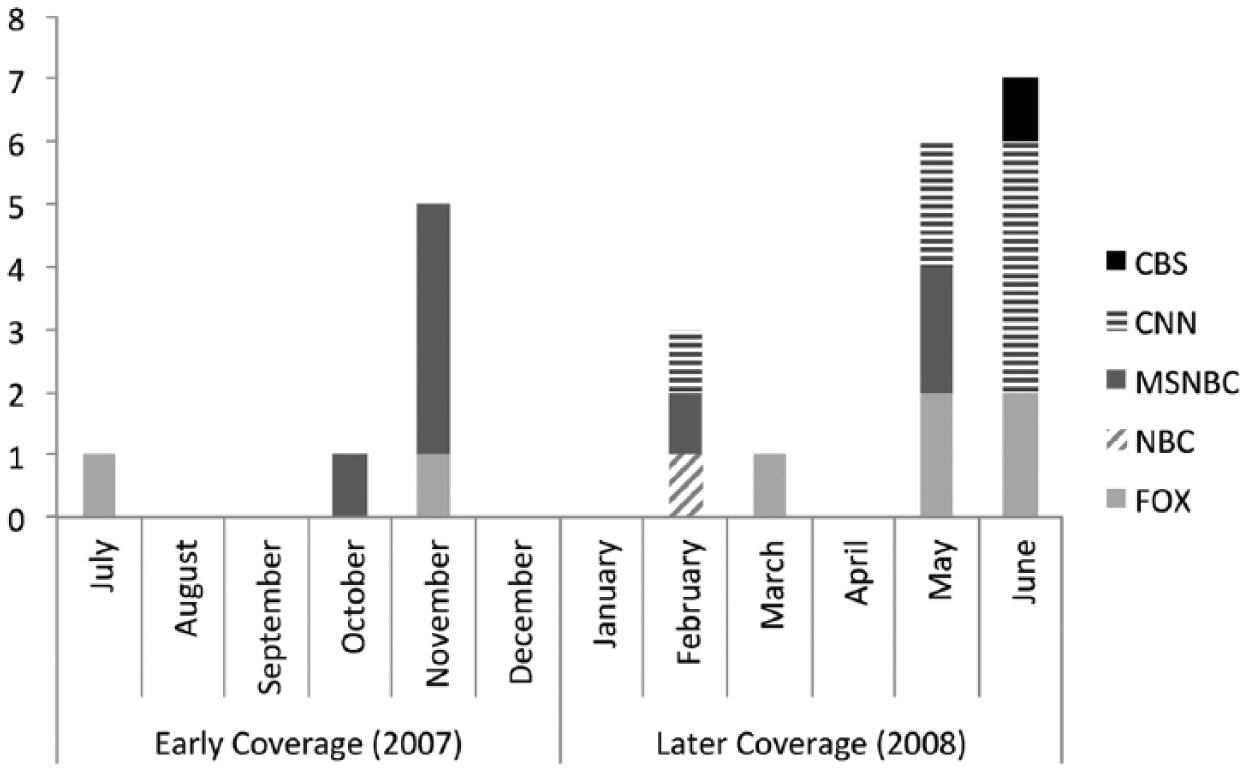
Number of televised discussions of “sexist” treatment of Clinton per month (July 2007-June 2008).
In what follows, I consider how IRs respond to specific claims of “sexism,” starting with those that took place when Clinton was the undisputed front-runner, then moving to those that appeared when she was reported by mainstream media as “losing.” For both periods of coverage, I focus on how individuals’ attempts to articulate and defend such claims are treated by IRs in the course of these mediated interactions. Specifically, I argue that the status of such claims as credible is undermined through the ways the IRs respond to them. The examples presented are representative of the practices identified within the collection.
The Early Period of Coverage: Claims of Sexism and Antagonism
During the early period of coverage, the majority of discussions about “sexism” and Clinton’s campaign occurred in the fall of 2007, around a time when Clinton participated in a Democratic debate on MSNBC with her six, all-male opponents (October 30). Following the debate, various news media organizations began to report that Clinton supporters were “complaining” about possibly unfair treatment of Clinton by the two male moderators of the debate (NBC’s Brian Williams and the late Tim Russert) as well as her six male rivals. After a political advertisement was released by Clinton’s campaign on October 31, 1 several pundits argued that Clinton and her campaign were implying that she was being treated unfairly because she was a woman. Despite Clinton’s claims to the contrary (she was quoted as believing the “pile on” stemmed from the fact that she was ahead, not because of being a woman), some journalists and pundits began to discuss and debate possible “sexist” treatment of Clinton.
The first example of such discussions comes from an interview on MSNBC centered on this very issue. It features the host, Dan Abrams (DA), and two female IEs: Taylor Marsh (TM), a political analyst and known supporter of Hillary Clinton, and Amanda Carpenter (AC), a political advisor and well-known critic of Clinton. Prior to the start of Excerpt 1, Abrams frames the issue as follows:
Hillary Clinton’s camp pointing fingers after her rocky debate performance on Tuesday blaming the media and maybe now even playing the gender card,
2
talking about the all-boys club of presidential politics. Isn’t it a lot simpler that she’s the front-runner by a lot?
Throughout the following excerpt, Marsh attempts to explain how the nature and frequency of the questions Clinton was asked in the debate was unfair, not on the basis of her front-runner status (as Abrams suggests) but on the basis of sex/gender.
There are at least three ways the IR’s responses work to undermine Marsh’s attempt to explain her claim. First, the IR enacts a strong stance of skepticism that does not acknowledge any of Marsh’s points but instead displays disbelief and disagreement with her expressed positions. This first becomes evident after Marsh attempts to explain one dimension of the problematic nature of the debate questions. At Line 50, the IR self-selects to counter Marsh’s position with “but that’s sexist?” Then the IR exhibits further skepticism following some back and forth by claiming Marsh “still [hasn’t] laid out a single example of why their questions were sexist” (Lines 114-116).
Part of the issue here is that the IR’s insistence on Marsh providing a specific example requires her to propose some overtly sexist questions. As pointed out by a number of feminist scholars (e.g., Mills, 2008), a significant component of contemporary forms of sexism is that they work in much more subversive and indirect ways. In the absence of specific examples of overt sexism, Marsh must rely on describing features of the interaction that indirectly communicate sexism (e.g., the nature and frequency of the questions asked, which questions are pursued and how, etc.), features that are far less obviously “sexist” and that require more interactional “work” to unpack in order to be persuasive or convincing (see Romaniuk, 2013). Thus, when Marsh tries to comment on the personal nature and frequency of the questions for a second time (Lines 122-123), the IR demonstrates his unwillingness to accept these as even potentially valid points and instead characterizes her responses as “playing Monday morning quarterback” 3 (Line 138), then reasserts that she has “got no evidence, none zero” (Line 140).
The second way the IE’s attempt to defend her claim is undermined is through the IR’s frequent interruption and intervening talk, as well as his lack of preventing the other IE from interjecting (Lines 50, 56, 59, 62, 69, 80, 83, 126, 129). Marsh herself draws attention to the fact that she is not being provided the interactional space to make her case and makes explicit, multiple bids for the conversational floor (Line 85).
Finally, note the way the IR reformulates her positions. Heritage and Watson (1980) have noted the prevalence of formulations in news programs and described one common use: to present a reading or understanding of prior talk, what they called the “gist” and its “upshot,” which “may or may not be retrievable from the ‘rest’ of the conversation” (p. 249). IRs commonly adopt this practice given that interview talk is produced for the benefit of the viewing audience (Clayman & Heritage, 2002), but they may do so in cooperative or uncooperative ways (Thornborrow, 2002). When claims of “sexism” were being voiced in the early period of coverage, uncooperative formulations are one systematic practice employed by IRs in responding to them. To illustrate an example from Excerpt 1, in response to Marsh noting that Clinton is “the first woman to be a viable presidential nominee” (Lines 52-54), the IR reformulates the upshot of her remarks in an uncooperative way, “So therefore we have to treat her with kid gloves?” (Lines 62-64). By reformulating the observation Marsh has made about Clinton’s status as a woman candidate, the IR brings it to its extreme (suggesting that Clinton should be afforded special treatment rather than equal treatment), and trivializes it by suggesting that she should be treated as a child might be. It is this—inaccurate, from Marsh’s point of view—reading of her talk that is put on display for the audience, which is set up for her confirmation.
The next example is illustrative of these same responsive practices by the IR that work to undermine the IE’s claims. It comes from an interview on MSNBC’s Tucker, a news program featuring then–political news correspondent Tucker Carlson, and Eleanor Smeal, then President of the Feminist Majority Foundation. At the time of the interview, Smeal was quoted in mainstream media as likening the experience of watching Clinton’s performance in the October 30 debate to that of the questioning of Anita Hill during the Clarence Thomas hearings back in October of 1991 (Anita Hill had testified before an all-male Senate Judiciary Committee regarding repeated acts of sexual harassment when working with Supreme Court nominee Clarence Thomas and was subjected to harsh questioning during her testimony.)
At the beginning of Excerpt 2, Carlson’s opening question already exhibits the general stance of skepticism outlined above. That is, he seeks an account for Smeal’s comparison by framing the question as laughable by means of the interpolated particles of aspiration (Potter & Hepburn, 2010), which conveys a nonserious stance, in its delivery (Lines 16, 18).
This stance of skepticism is also accomplished through similar features of responding evident in Excerpt 1, including frequent interruption (e.g., Lines 28, 39) and the use of uncooperative formulations. Carlson twice interjects in the IE’s talk to formulate the upshot of her remarks in ways that transform her position. First, he reformulates a generalization that espouses an extreme position: “So women see themselves as victims?” (Line 23), one that works to undermine the legitimacy of the IE’s comparison. In resisting this (mis)interpretation of her position, Smeal clarifies what she takes to be generalizable about women’s experience, that is, they “just know how hard it is to crash through the glass ceiling” (Lines 24 and 25). Before she completes her turn, however, the IR begins to challenge her claim by seeking an account that again displays disbelief, “Why would it be hard?” (Line 28). Interestingly, his subsequent talk actually transforms the question’s terms such that it becomes a question of “Why would it be hard” for Hillary Clinton given her front-runner status. Notably, as in the other examples characteristic of this period of coverage, there is an implicit assumption that accusations of “sexism” are unfounded or unwarranted when a candidate (i.e., Clinton) is winning, as though being “ahead” somehow shields or protects one from sexist treatment. By shifting focus to Clinton’s status as “over dog,” then, the IR emphasizes her purported advantages over the disadvantages. Finally, yet another reformulation that undercuts the IE’s attempt to defend her claim occurs in the environment of interruption. As Smeal attempts to elaborate on her position (Lines 36-38), the IR reformulates an upshot of her position that is not just entirely inconsistent with her prior talk; it also strategically incorporates a feminist narrative into his critique (Lines 39-44; a strategy that has been described as a form of “new sexism” see, e.g., Benwell, 2007). Employed here, it works to reify stereotypes of women while at the same time discrediting her argument.
These two examples are representative of the general features of IR’s responsive behavior to claims put forth during mediated discussions in the early period of coverage, when Clinton was the undisputed front-runner. Taken together, such displays of disbelief and explicit disagreement, frequent interruption, and the use of uncooperative reformulations reinforce a general stance of skepticism toward the possible validity of “sexist” claims. They also demonstrate an unwillingness to interrogate the politics and values within which contemporary “sexism” operates. Of course, one could argue that such features may just be part of the nature of these types of programs, the individual styles of IRs, or a result of sensational or at least provoking contexts that seek to generate attention and increase ratings. While the entertainment aspect of cable news, in particular, cannot be denied, these same features were not identified in the responsive practices of IRs during discussions from the later period of coverage, when mainstream media consistently characterized Clinton as “losing” or having lost.
The Later Period of Coverage: Claims of Sexism and Acquiescence
In the vast majority of what are best described as “postmortem” discussions, rather than actively contest interactants’ claims of “sexist” treatment of Clinton in the course of her campaign, during this period IRs generally concede that Clinton was subjected to said treatment. In general, instead of frequently interrupting or interjecting as participants attempt to articulate their claims about sexist treatment of Clinton, IRs are observably more collegial.
The third example is representative of the features of IR responses characteristic of this period. It comes from the same network as the first two examples, this time from Hardball With Chris Matthews (CM). As the title of the program suggests, interviews on this program are generally confrontational, especially given Matthews’s interviewing style: He is known for typically subjecting his guests to tough questioning and a high degree of scrutiny. In this interview, Matthews hosts Huffington Post political director, Hilary Rosen (HR), Bloomberg’s Margaret Carlson, and one of MSNBC’s political analysts, Michelle Bernard, though only Rosen is featured in Excerpt 3.
Note how before launching his first question, Matthews begins by acknowledging personal involvement in claims of “sexist” treatment—back in the fall of 2007, he had been criticized for making sexist remarks about Clinton, and he had explicitly resisted and denied such accusations—something that no other IR did in the examples in the collection. There are also no instances of Matthews explicitly (or otherwise) disagreeing with any of the claims put forward by the IE, for example,
Saying sexism occurred does not mean it is the reason she lost (Lines 35-38).
Saying sexism occurred is not the political strategy of a losing campaign (Line 38).
Sexism may have affected the outcome of the early primaries (Lines 70 and 72).
Instead, the IR allows the IE to articulate her perspective and elaborate without frequently being interrupted. Of course, this is not to say that interjections never occur in this or any of the other examples in this period. For example, at Line 52, following a lengthy response by the IE in which she begins citing multiple examples of “sexist” treatment toward Clinton, Matthews does begin to interject. However, his intrusion does not disagree with what she is saying (indeed, she is able to articulate her claims without any explicit displays of disbelief or disagreement) but instead seeks her opinion on a possible causal relationship between gender discrimination and voting behavior. Apart from this, Matthews provides minimal acknowledgment of her talk in progress (e.g., Lines 46, 49) and some minimal agreement (e.g., Line 67); however, he does not actually evaluate her claims either negatively or positively. Instead, the only proposition that is agreed with is the idea that people are more inclined to be supportive of Clinton because of “sexist” treatment.
The final example is taken from a three-person interview between CBS journalist Harry Smith (HS); Pat Schroeder (PS), the first women elected to U.S. Congress from Colorado; and Arianna Huffington (AH), cofounder and editor in chief of The Huffington Post. On reflecting on the role of “sexism” in the course of Clinton’s campaign, at Line 73, the IR asks Schroeder whether Clinton got “a fair shake.” Again observe the markedly different treatment of her talk by the IR, as compared to the examples from the early period.
Notice how there are no instances of explicitly disagreeing with any of the claims put forward, for example:
The sexism that we saw in some of the media really troubled me. And we didn’t have party leaders standing up (Lines 88-90).
It was like they made a witch out of her, some people [. . .] we thought the Salem witch trials were over (Lines 100-102).
Some people no matter what she said it was “I don’t believe it, she’s really evil” [. . .] I’ve never seen anyone do that to a candidate (Lines 104, 106, 108, 110).
The IR is afforded numerous opportunities to respond to these (and other) assertions, following up by probing for more information, countering or in some way evaluating the information being put forward, or formulating the upshot of the contributions (Greatbatch, 1986). And yet the IR instead continuously produces minimal response tokens that provide a kind of verbal “pass” on such opportunities (e.g., Lines 81, 85, 91, 97) or give a minimal endorsement of the positions expressed (e.g., Lines 94, 99), or avoids any follow-up altogether (e.g., lines 111). Thus, while these claims are permitted without any displays of disbelief or explicit disagreement, as was the case in Excerpt 3, the IR also manages not to agree with them either; instead, he acts as a passive recipient. When Smith finally does produce a turn with propositional content, he does not in any way evaluate or ratify what Schroeder has said. Instead, he immediately poses a question to Arianna Huffington that proposes the most idealistic version of reality possible—that the glass ceiling is about to be “ultimately” broken (Lines 111-113).
During these “postmortem” discussions, then, it seems that IRs were generally willing to concede the point that Clinton had been the victim of “sexist” treatment (while in various ways emphasizing that it was not the reason she lost). By providing neither explicit (dis)agreement with specific claims articulated by IEs nor any evaluative uptake of their gist, the IRs’ status as legitimate was nevertheless diminished.
Conclusion
In analyzing specific instances of “meta-sexist” talk, I described how participants’ claims of “sexist” treatment of Clinton were responded to by IRs in post hoc televised mediated interactions. Consistent with the other articles in this special issue, the data for this analysis stemmed from “naturally occurring” interactions within the public domain, wherein what “sexism” is, and how it comes to be treated, was initially collected and considered from an “emic” (i.e., participants’) perspective. Considering IR responses to “sexist” claims within what became identifiable as two periods of coverage (when Clinton was reported as winning vs. when she was reported as losing), I showed two examples representative of the kinds of practices characteristic of each period.
My analysis suggests that within the early period of interviews in my collection, IRs’ responsive behavior was characterized by a high degree of antagonism. That is, IRs displayed a general stance of skepticism toward and marked displays of disagreement with specific claims of “sexist” treatment, frequently interrupting IEs, and reformulating their talk in ways that minimized, trivialized, and ultimately worked to undermine their status as legitimate. By contrast, the IRs’ responsive practices within interviews from the later period of coverage appeared to be characterized by a high degree of acquiescence. In these discussions, IRs engaged in little to no interruptive or explicitly disagreeing talk and little to no overt skeptical stance taking, and yet the legitimacy of “sexist” claims was minimized, for example, by not being negatively or positively evaluated.
What seems to arise from this general pattern concerning IRs’ responsive behavior within these two periods is perhaps the identification of an act of sexism itself. That is, in the examples from the early period of “meta-sexist” talk, IRs appeared to display an apparent unwillingness to let specific claims of “sexist” treatment go unchallenged, whereas in those from the later period, IRs appeared to display an apparent willingness to let them go unchallenged. In describing some of the features of talk-in-interaction that accomplish this, an implicit message seems to be conveyed: that is, that Clinton—or others advocating on her behalf—should not “complain” about sexism when she is winning, and that sexist treatment is not a reasonable explanation for her loss. What this analysis appears to make visible, then, is some of the discursive means by which contemporary sexism—as an “agile, dynamic, changing and diverse set of malleable representations and practices of power” (Gill, 2011,p. 62)—may continue to operate through mainstream media coverage of presidential politics.
Footnotes
Acknowledgements
I would like to thank Kevin Whitehead and Liz Stokoe for inviting me to participate in the panel at the 4th Interactional Conference on Conversation Analysis (ICCA-14) in Los Angeles, California, in June 2014, which provided the inspiration for this article. I am also grateful for helpful comments from Kevin, Federico Rossano, and two anonymous reviewers on earlier versions.
Author’s Note
An earlier version of this article was presented at the annual conference of the National Communication Association in Chicago, Illinois, in November 2014, and at a colloquium in the Department of Communication at Portland State University in December 2015.
Declaration of Conflicting Interests
The author(s) declared no potential conflicts of interests with respect to the authorship and/or publication of this article.
Funding
The author(s) received no financial support for the research, authorship, and/or publication of this article.