







Abstract
We investigated the relationship between the affective component (A: the level of offensiveness/intensity) and the behavioral component (B: the frequency of usage) of taboo words that are part of an individual’s natural language (C: the cognitive component). In Study 1, 900 U.S. residents generated the 10 most common taboo words they use in their daily lives (C). In Study 2, 1,000 U.S. residents were presented with the 30 most common taboo words (C) from Study 1 and asked to rate how offensive they perceived the words (A) and how often they used these words (B). This relationship was controlled for self-reported trait affectivity. We found a slight change in which taboo words people use in everyday life. The results suggest that the level of offensiveness of taboo words (A) predicts the usage of the words (B) that are part of a person’s natural language (C): the ABC-hypothesis of taboo words.
I love French wine, like I love the French language. I have sampled every language, French is my favorite. Fantastic language. Especially to curse with. Nom de dieu de putain de bordel de merde de saloperie de connard d’enculer ta mère. It’s like wiping your arse with silk. I love it.
According to the Oxford Dictionary (2014-02-07), the word taboo is defined as a religious or social phenomenon that forbids or inhibits a discussion about a specific thing (e.g., sex). The word has its origin in the Tongan word tapu which means forbidden (Oxford Dictionaries, 2014-02-07). The everyday expression to swear constitutes different ways to use taboo words, that is, strong, emotional, and offensive words that are perceived as offensive to the receiver (T. Jay, 2000), but obviously to the one doing the swearing as well. Technically, it is defined as a wish to verbally hurt or insult someone (see also Allan & Burridge, 2006). Nonetheless, swearing does not necessarily have to be done to insult another person; one can swear at oneself. The cursing itself can be divided into different categories (e.g., insults, blasphemy, obscenity, slang, racial insults) and the level of offensiveness diverges between mildly offensive to grossly offensive (Janschewitz, 2008; T. Jay, 1992; T. Jay, Caldwell-Harris, & King, 2008; Mabry, 1974).
The study of taboo words in everyday language has in itself been a taboo subject. In recent decades, however, it has been recognized more and more around the world. In the United States, for example, taboo words have been studied through recordings of everyday speech (e.g., T. Jay, 1992, 2000), the context in which people use them (e.g., T. Jay, 1992, Thelwall, 2008), and also in relation to gender differences (e.g., T. Jay, 2009a, 2009b). Additionally, research has also addressed a variety of other words that are not under the narrow verbiage of taboo language, such as, “hurtful words” (Teicher, Samson, Sheu, Polcari, & McGreenery, 2010), swears (Johnson, 2012; Kapoor, 2016), and flaming (Cho & Kwon, 2015; Kwon & Cho, 2015).
This line of research has shown that the frequency of public usage of taboo words is between 0.30% and 0.70% of a speaker’s everyday verbal language (e.g., T. Jay, 1992, 2000, 2009b; McEnery, 2006; Mehl & Pennebaker, 2003). In other words, on average, U.S. residents express between 60 and 90 taboo words per day. Ten words (i.e., fuck, shit, hell, damn, goddamn, Jesus Christ, ass, oh my god, bitch, and sucks) that have an emphasis on sex and religious profanity stand for about 80% of all taboo words that Americans use in everyday life (K. L. Jay & Jay, 2015). Longitudinal studies show that these 10 words have remained the same through the years. Relatively indecent words, such as, cunt, cocksucker, and nigger, are used relatively irregularly in public. In this context, earlier theories on taboo words have actually ignored the emotional aspects of language, but language does not exist separately from people’s emotions, instead, they are highly integrated with each other (T. Jay, 2000).
Indeed, individuals’ affectivity (i.e., a person’s tendency to experience affect, such as, engagement, attentiveness, anger, fear, guilt; Watson, Clark, & Tellegen, 1988) is linked to how frequent taboo words are used (Mehl, Gosling, & Pennebaker, 2006). For example, children at a summer camp used taboo words when in states of anger and frustration in 64% of the cases (T. Jay, 1992). These results have been replicated in nursing homes (T. Jay, 1996a) and mental health facilities (T. Jay, 1996b). The main reason for the usage of taboo words is actually to express emotions (T. Jay & Janschewitz, 2008). The more intensive the experienced emotion is, a stronger taboo word is actually used (T. Jay, 2000). At the same time, the more taboo a word is considered to be or refer to, the more forbidden it is to use it (Andersson, 1985). After all, the usage of taboo words is also a product of one’s cultural values, that is, for a word to be considered as a taboo word, the majority of the people must consider the word offensive and/or forbidden (cf. the Neuro–Psycho–Social Theory of Cursing; T. Jay, 2000).
At a general level, positive or negative reactions and assessment of a stimulus (e.g., a person, an object, an action, a concept, or in this study a taboo word) can be divided into three components: (a) cognitive, which means the knowledge an individual has about a particular topic (e.g., C: knowing taboo words); (b) affective, which involves the emotions associated with a particular topic (e.g., A: the offensiveness/intensity associated with a taboo word); and (c) the behavioral component, which means how individuals actually behave when it comes to a certain topic (e.g., B: how often a taboo word is used; Passer & Smith, 2004). In other words, people possess some knowledge of taboo words (i.e., which words are considered to be taboo), she or he experiences emotions that are linked to these taboo words or has a sense of the intensity of the words, and she or he actually uses these words in public. Emotion and the usage of taboo words has been studied in general, although not based on individuals’ affectivity, that is, as a personality trait (communication via e-mail, T. Jay, April 4, 2014). It is plausible to say that individuals’ affectivity might be related to both the affective (i.e., A: how offensive/intensive the words are perceived by its user) and behavioral (i.e., B: how often a taboo word is used) component of taboo words. In other words, the relationship between the intensity and frequency of taboo words might be influenced by the individual’s propensity to experience positive and negative affect.
The Present Study
In sum, current research suggests that (a) in contrast to the general belief about taboo words being in constant change, there is a relatively stable dictionary of taboo words (i.e., C: the cognitive component); that (b) an individual’s affectivity might be closely tied to how offensive/intense taboo words are perceived (i.e., A: the affective component) and how frequently taboo words are used (i.e., B: the behavioral component); and that (c) the level of offensiveness the user perceives in a taboo word might be related to how often she or he uses the word (i.e., the ABC-hypothesis of taboo words).
In Study 1, we investigated the most common taboo words generated by 900 participants (C: cognitive component). In Study 2, we investigated gender differences in intensity (A: affective component) and frequency/usage (B: behavioral component) of the 30 most frequent taboo words from Study 1 (C: cognitive component). We also investigated, controlling for participant’s self-reported trait affectivity, the relationship between taboo words’ affective (A: the level of offensiveness/intensity associated with the word) and behavioral component (B: the frequency of usage of the word).
Study 1
Method
Ethics Statement
The review board of the Network for Empowerment and Well-Being at the University of Gothenburg, Sweden, approved the research protocol for both Study 1 and Study 2, which was found to comply with the law concerning research involving humans and requiring only informed consent from the participants. Participants, workers from the crowdsourcing platform Amazon’s Mechanical Turk, provided their consent by simply accepting the task (or HIT as it is called in Amazon Mechanical Turk) and then starting to answer the survey. This acceptance was recorded electronically together with the participants’ answers.
Participants and Procedure
The survey was conducted on Amazon’s Mechanical Turk (https://www.mturk.com/mturk/welcome), which is an online system that provides access to a wide range of survey participants. According to Goodman, Cryder, and Cheema (2013), 16 of America’s top 30 universities use Amazon’s Mechanical Turk for data collection. In Study 1, participants were asked to answer the following question: “Write down 10 taboo words you most commonly use, only one word per window please.” All participants were informed that the study was confidential, voluntary, and could be interrupted when they so wished. The participants were 350 women and 550 men (N = 900, Mage = 38.19 ± 9.72) who received $0.50 for taking the survey.
Results and Discussion
The participants generated a total of 8,443 words, 826 of which recurred more than once. We compared the occurrence of the words generated by the participants with words in the English version of Google n-gram database (see the Google n-gram project: http://ngrams.googlelabs.com), which comprises a large amount of Terabytes of text data (for recent description of the Google n-gram database, see Lin et al., 2012). Significant testing was made with chi-square tests, correcting for multiple comparisons using the Bonferroni method. The 10 words that were most frequently used by the participants, compared with the Google n-gram database, were cunt (χ2 = 143511189, p < .001), fuck (χ2 = 131648103, p < .001), motherfucker (χ2 = 45825564, p < .001), asshole (χ2 = 40369213, p < .001), pussy (χ2 = 34211586, p < .001), shit (χ2= 31169197, p < .001), fucker (χ2 = 29977951, p < .001), nigga (χ2 = 13536962, p < .001), faggot (χ2 = 12196410, p < .001), and slut (χ2 = 10846716, p < .001). 1 Importantly, although the Google n-gram database is not a database of spoken corpuses, we found this as a good way of describing the data; not only out of convenience but also because we are comparing a corpus of text that represents taboo words that participants report using in their everyday life. That being said, future studies should compare the occurrences in this study with spoken corpuses.
The 30 most frequent words accounted for 73.40% of the generated words (see Figure 1). In the present study, 5 out the 10 most common words (i.e., fuck, shit, damn, ass, and bitch) and 3 out of the 30 most common words (i.e., hell, goddamn, Jesus) corresponded to the 10 most common words found in earlier studies in the United States (see T.Jay, 2009a). That is, oh my god and sucks, which have earlier been found as part of the 10 most common words, did not appear among the 30 most frequent taboo words that participants in Study 1 generated. One plausible explanation might be the nature of the question presented to the participants (i.e., “Write down 10 taboo words you most commonly use, only one word per window please”), which might have influenced the participants to exclude taboo words composed of more than two words, such as, Oh my God. Moreover, in contrast to earlier research, fuck and shit accounted only for 17% of the generated words (see T. Jay, 2009a, who reported a ratio between 30% and 50% for these words). The results in Study 1 suggest a small shift regarding the 10 most common taboo words used in everyday language, with more taboo words referring to sex and fewer to religion. These two categories of taboo words are, however, the most common in earlier studies.
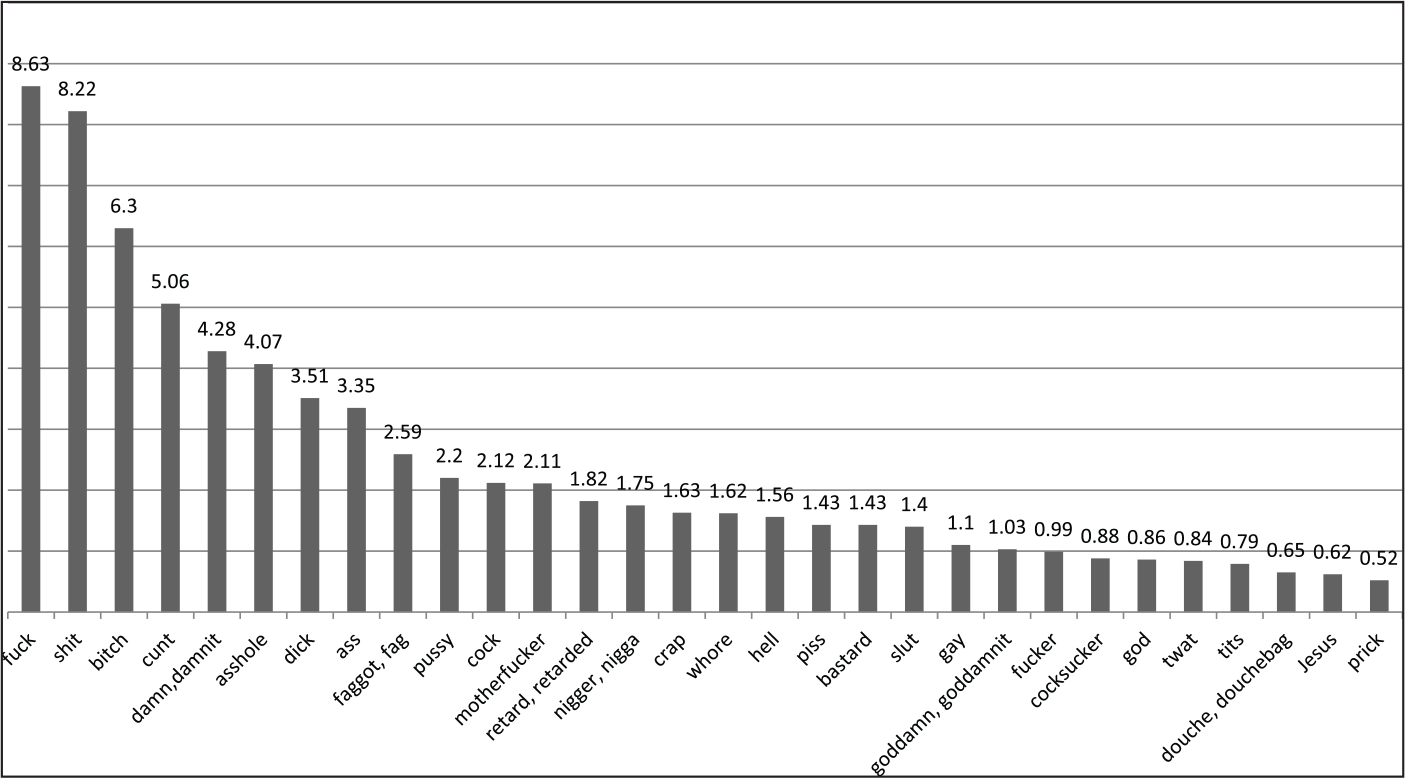
Frequency percentage for each of the 30 most frequent taboo words generated by participants (N = 900) in Study 1.
Study 1 did not provide participants with a definition of taboo words, which has both advantages and disadvantages. The lack of a definition may lead to a greater range of taboo words, however, it might also lead to uncertainty among participants about the words that account as taboo words. Interestingly, the list of the 10 most common taboo words contained the word cunt in fourth place. According to previous studies (T. Jay & Janschewitz, 2008), this word is rarely used in public. Nevertheless, the present study was conducted through an online survey and probably mirrors verbal behavior as it is expressed through the Internet (see, for example, Garcia, Kjell, Sikström, & Archer, 2016; Garcia & Sikström, 2014). For instance, Kwon and Cho (2015) showed that swearing in online political discourses increased positive public perception more than negative perception. The list of the 30 most commonly used taboo words was included in Study 2 as a representation of the cognitive component of our hypothesis (i.e., C).
Study 2
Participants and Procedure
Participants in Study 2 were also recruited from Amazon’s Mechanical Turk, got paid $0.50 for taking the survey, and followed the same protocol used in Study 2. This new sample consisted of 1,000 U.S. residents, 333 women and 667 men (N = 1,000, Mage = 31.50 ± 10.27). In the first part of Study 2, after reporting gender, age, and affectivity, participants were asked to rate how offensive they perceived (A: affective component) each one of the 30 most common taboo words (C: cognitive component) from Study 1. In the second part of Study 2, participants were asked to rate how often they used (B: behavioral component) each one of these 30 taboo words.
Measures
Affect
Trait affectivity was measured using the Positive Affect and Negative Affect Schedule (Watson et al., 1988). Participants are asked to, on a 5-point Likert-type scale (1 = not at all, 5 = very much), estimate the extent to which they experienced over the past few weeks, 10 positive (e.g., strong, proud) and 10 negative (e.g., hostile, scared) emotions. The scores were then summarized to form a positive affect and negative affect scale. In this study, Cronbach’s α was .86 for positive affect and .88 for negative affect.
Offensiveness/Intensity
Participants were asked to rate how offensive they perceived each one of the 30 most frequently used taboo words from Study 1 in a 5-point Likert-type scale (1 = not offensive at all, 5 = very offensive/ugly). An intensity score was computed by simply summarizing the average value of the 30 taboo words. Cronbach’s α was .95.
Frequency
Participants were asked to rate how often they use each one of the 30 most frequently used taboo words from Study 1 in a 5-point Likert-type scale (1 = rarely or never, 5 = very often). A frequency score was computed by simply summarizing the average value of the 30 taboo words. Cronbach’s α was .94.
Results and Discussion
A t test for independent groups showed that there was no significant difference, t = 1.33, df = 998, p = .185; 95% CI [−.03, .16] between men (M = 2.60 ± .72) and women (M = 2.53 ± .73) in how frequent they used the 30 taboo words. There was, however, a significant difference, t = −3.17, df = 998, p = .002; 95% CI [−.25, −.06] between men (M = 1.95 ± .69) and women (M = 2.10 ± .75) in intensity of taboo words. That is, both men and women perceived that they used the taboo words equally often (B: Behavioral Component), but women rated the taboo words as more offensive compared with men (A: the offensiveness/intensity associated with a taboo word). In contrast, previous research (see T. Jay, 1980, 1996a; McEnery, 2006, Mehl & Pennebaker, 2003; Thelwall, 2008) has shown that men use taboo words more frequently than women. This gap between genders, however, was suggested to be gradually decreasing already over 15 years ago (T. Jay, 2000) and more recent studies (K. L. Jay & Jay, 2013) have shown that the gap has actually disappeared. To the best of our knowledge, it has actually been over 8 years between the latest research (e.g., Precht, 2008) showing that males accounted for 55% of the taboo word frequency and the present study, thus, it seems that the gap between genders has indeed evened out. For instance, a pilot study among Swedish adolescents (Rosenberg, 2011) showed similar results to those found in the present study. Nevertheless, despite the fact that women use taboo words at the same extent as men (B: behavioral component), they perceive the taboo words as more offensive/intensive (A: affective component). For instance, women are more aware of social situations and the social consequences of the usage of taboo words (T. Jay & Janschewitz, 2008), which is perhaps mirrored here in their perception of the words’ intensity (A: affective component) but not in how often they actually use them (B: behavioral component). It is beyond the scope of this article to understand if this paradox is due to women wanting to express themselves as men do even though they perceive the words more repulsive than men do. Future studies, however, should investigate this further along gender differences in the cognitive component (C) as well.
Moreover, the level of intensity was negatively correlated to how frequent participants perceived they use the 30 most common taboo words (r = −.42, p < .001). Both positive affect and negative affect were slightly associated to how frequently participants reported using the 30 most common taboo words (r = .15, p < .001 and r = .06, p < .05; see Table 1). A partial correlation, using positive affect and negative affect as control variables showed that intensity was still negatively correlated to how frequent participants perceived they used the 30 most common taboo words (r = −.44, p < .001). To investigate this even further, we conducted a regression analysis, using affectivity and intensity of taboo words as independent variables. This model predicted 21.90% of usage of taboo words, F(3, 996) = 94.61, p < .001: intensity showed a β = −.44, positive affect a β = −.14, and negative affect a β = .18. Nevertheless, the effect of positive and negative affect was under .20, which according to Ferguson (2009) is below the recommended minimum effect size that represents a practically significant effect for data in the social sciences. In contrast, the effect of intensity or level of offensiveness associated with the 30 most common taboo words can be considered to be of medium size (see Ferguson, 2009). However, the debate of what constitutes a meaningful effect size is more complex than relegating it to a .20 level (e.g., McGraw, 1991; Rosenthal, 1991; Rosenthal & Rubin, 1982; Strahan, 1991; Thompson & Schumacker, 1997). Intensity (A: affective component) alone predicted 17.80%, F(1, 998) = 215.93, p < .001 of the usage of taboo words (B: behavioral component), see Figure 2. In sum, the more intense the taboo words were perceived, the less frequently they were used. Suggesting that the intensity of a taboo word or the level of offensiveness perceive by the speaker (A: affective component) leads her or him to avoid using these words (B: behavioral component). Individuals have, after all, a tendency to withdraw from unpleasant situations and approach pleasant ones (see Garcia, Rosenberg, Erlandsson, & Siddiqui, 2010; Higgins, 2001).
Pearson Correlations in Study 2 Between Participants’ (N = 1,000) Trait Affectivity and Taboo Words Frequency and Intensity Score.
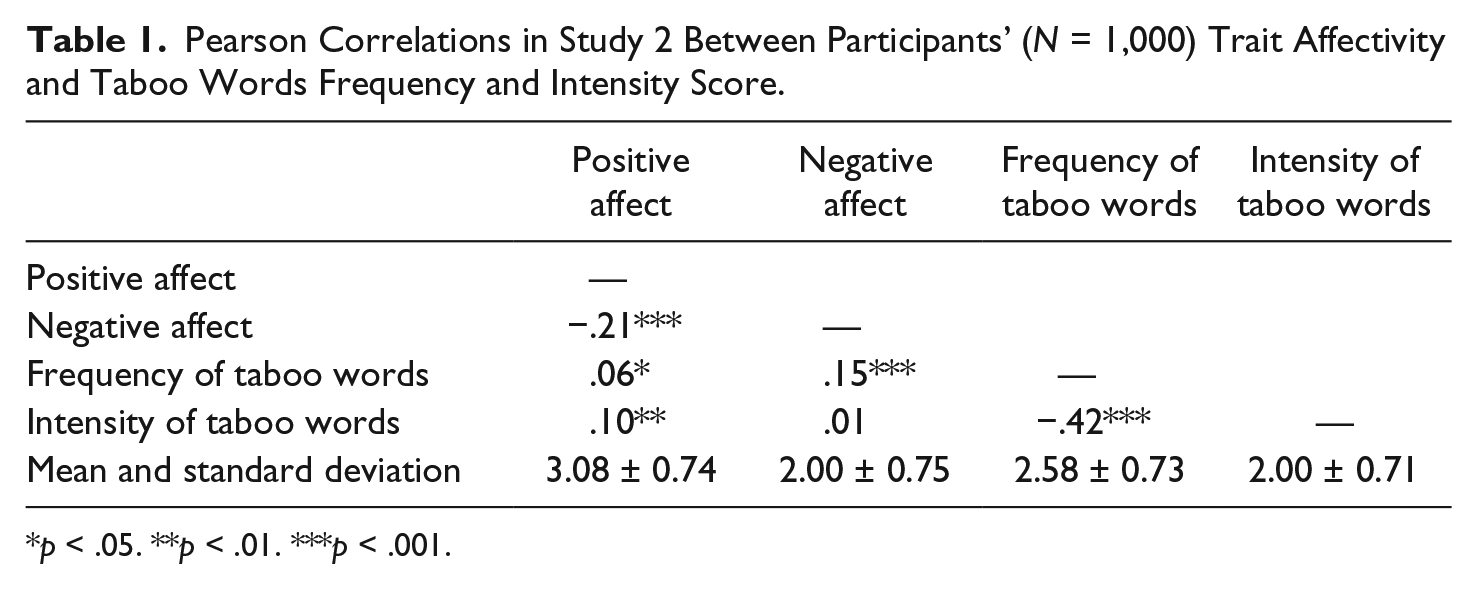
p < .05. **p < .01. ***p < .001.
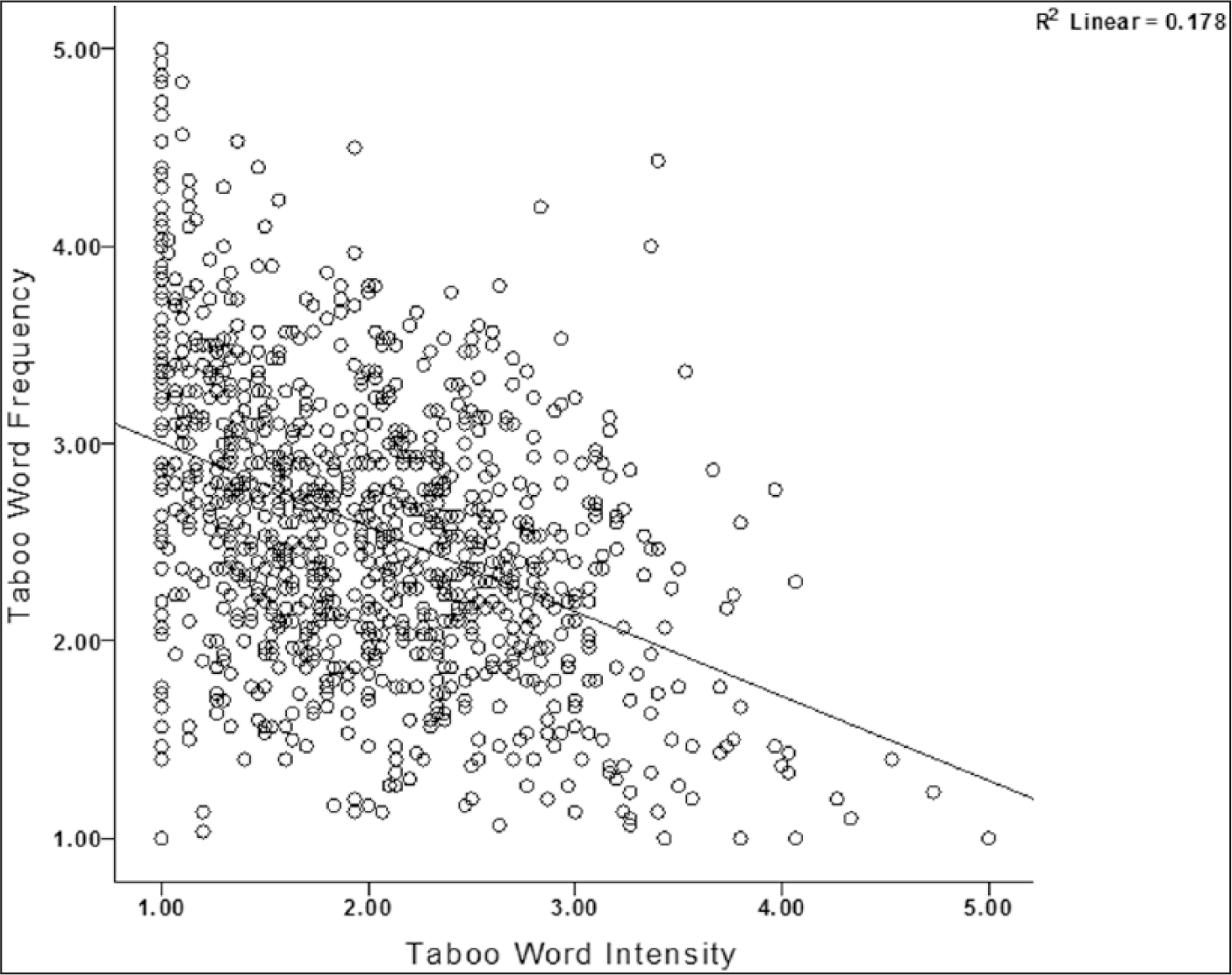
Plot over the relationship in Study 2 between participants’ (N = 1,000) taboo words intensity and frequency score.
The results of these first analyses are according to the expectations stated in the Introduction (i.e., the ABC-hypothesis of taboo words). However, it could be argued that, since both the intensity and frequency measures are an average of ratings of all 30 words, this operationalization of intensity and frequency aggregates measurement errors and systematic variance. Nevertheless, by surveying subjective experiences of the 30 taboo words in a large number of individuals, we argue that we can ensure that the imperfections of one subjective experience measurement cancel out the imperfections of another, that is, the average of the obtained results is closer to the expected value (cf. Gilbert, 2007). That being said, one shortcoming might be that the variance in the level of offensiveness/intensity from one word to another in this 30 most common list has such a big variety that it alone can be distorting the results. For instance, recent research found a correlation between average offensiveness and usage for British participants, but these findings were not replicated among U.S. participants (Dewaele, 2015). On this basis, we conducted two more correlation analyses in which we correlated each word’s frequency rating with that corresponding word’s intensity rating, word-by-word, and then averaged across those correlations. The first correlation was done just between the words’ intensity and frequency ratings, while the second, a partial correlation, was done between the words’ intensity and frequency ratings and using positive affectivity and negative affectivity as the control variables. We corrected for multiple comparisons in both of these two last analyses to a p level <.001 for significant results. The results suggest, again, that the intensity score was, on average, negatively associated to the frequency score even when controlling for affectivity (r = −.31 in both analyses). See Table 2 for details.
Pearson Correlations (Bivariate and Partial) Word-by-Word and Average r in Study 2 Between Participants’ (N = 1,000) Word Frequency and Intensity Score.
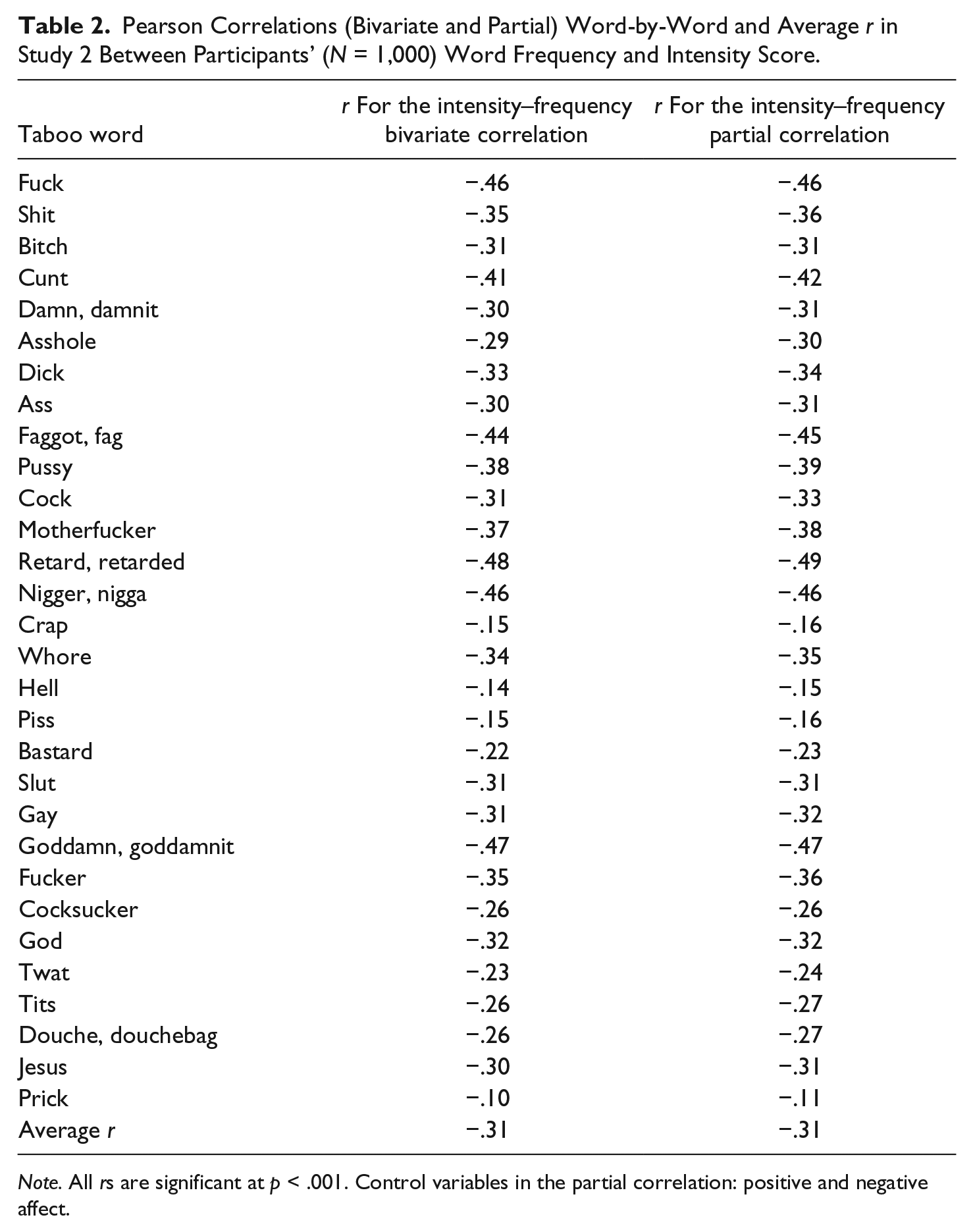
Note. All rs are significant at p < .001. Control variables in the partial correlation: positive and negative affect.
General Discussion
The rationale of the current study was that (a) one of the main reasons for the usage of taboo words is actually to express emotions; (b) the more intensive the experienced emotion is, a stronger taboo word is actually used; and that (c) the more taboo a word is considered to be or refer to, the more forbidden it is to use it. Hence, we proposed that the more offensive a taboo word was perceived to be, the less it would be used; and that this relationship needs to be controlled by the individual’s trait affectivity due to the swearing–emotion link. One caveat here is that despite the fact that extreme emotions are seldom experienced in everyday life, swearing is relatively ubiquitous. For instance, the usage of taboo words “can increase substantially in casual settings, being less offensive in such contexts” (Kapoor, 2016, p. 264). Essentially, although the level of offensiveness/intensity of taboo words is inversely related to usage, offensiveness/intensity itself is highly contextual (Kapoor, 2016). In addition, usage appropriateness (i.e., offensiveness) is dependent on the valence (i.e., credibility, status) of the speaker (Johnson, 2012). In Johnson’s (2012) study, fifth to a half of swear word uses were perceived as appropriate, that is, not taboo. Hence, the perceived valence of the speaker, rather than the trait affectivity of the speaker might present a more holistic picture of the intensity–frequency relationship.
Finally, there are typological and pragmatic differences between swear and curse words: exclamations (Shit! Fuck! Damn! Christ! Jesus!), abuse formulas (Fuck you! Damn you!), interrogative and imperative formulas (e.g., Who the fuck do you think you are?; Get the hell out of here!), and the free use of expressive adjectives, such as fucking and goddamn, in angry swearing, as well as “social/conversational” uses of such words and phrases (Goddard, 2015, p. 189). Goddard (2015) argues that the usage of these forms is embedded in metalexical awareness of a particular speaking community (see also Christie, 2013; Daly, Holmes, Newton, & Stubbe, 2004). Also, in this line, the main factor triggering the words that bilinguals choose to use is not necessarily the different emotional power of the languages they speak, but rather social and cultural norms (Gawinkowska, Paradowski, & Bilewicz, 2013).
All of this research (cf. the Neuro–Psycho–Social Theory of Cursing; T. Jay, 2000) supports the notion that swearing is a product of multiple levels of biosocial and contextual factors (Christie, 2013; Daly et al., 2004; Vingerhoets, Bylsma, & de Vlam, 2013), which will vary somewhat by culture and/or country (Dewaele, 2015; Drange, Hasund, & Stenström, 2014). These concerns about the “pragmatics” of swearing highlight the complexity in understanding swearing and taboo language. Swearing fulfills multiple functions, emotional expression being but one.
Limitations and Strengths
One limitation with the present study is that it was conducted online using Amazon’s Mechanical Turk. Participants may, for example, have diverse backgrounds that could affect the results even if we specifically recruited native English speakers and residents of the United States. Moreover, although the participants got paid for taking the survey, this does not seem to affect data quality (Buhrmester, Kwang, & Gosling, 2011). When it comes to surveys online, there is also the problem of self-selection, which could lead data quality to be affected because participants are not representative for the general population. Aside from a study by Paolacci, Chandler, and Ipeirotis (2010), however, research has not identified any significant differences between data collected through Amazon’s Mechanical Turk and traditionally collected data (Goodman et al., 2013). In addition, this method for data collection gave us the opportunity to have participants who were relatively older than other studies. However, with participants with a mean age of almost 40 years, it is perhaps no wonder why oh my god is not frequently estimated, this phrase has taken off in the past decade and may have escaped that older cohort. Most of the data reported elsewhere (e.g., T. Jay, 2009) are recorded from actual use in public, not estimates of use. Maybe participants underreport how often they use cunt, fuck, and shit, relative to how often they actually use it in real life (see Janschewitz, 2008).
Conclusions
The present study suggests that there seems to be a slight change in which taboo words people use in everyday life. Some of these “new” words can be considered as more offensive than those found in earlier studies. Additionally, there is an “intensity versus frequency paradox” among women that needs to be further studied. Specifically, women seem to swear as frequently as men do (B: behavioral component), but at the same time, women perceive the words they iterate as more offensive (A: affective component). On the basis of the results of Study 2, we propose the ABC-hypothesis of taboo words: the level of offensiveness of taboo words (A) predicts the usage of the words (B) that are part of a person’s natural language (C).
Footnotes
Acknowledgements
We would like to thank Timothy Jay for his prompt and useful answers to our questions regarding research on taboo words. We want to also direct our gratitude toward Rickard Karlsson for important comments on the thesis version of the present study. Last but not the least, we want to thank the reviewers for concrete and constructive suggestions that helped us largely improve the article.
Declaration of Conflicting Interests
The author(s) declared no potential conflicts of interest with respect to the research, authorship, and/or publication of this article.
Funding
The author(s) disclosed receipt of the following financial support for the research, authorship, and/or publication of this article: The development of this article was funded by a grant from the Swedish Research Council (Dnr. 2015-01229). The funders had no role in study design, data collection and analysis, decision to publish, or preparation of the article.