







Abstract
Ideological liberals may focus on mental operations to a greater extent than bodily operations, whereas this pattern may be reversed among conservatives. Although there are suggestive sources of evidence, prior research has not directly examined relations between political ideology and this mind–body distinction. The present investigation did so by content-coding texts using the Linguistic Inquiry and Word Count program and its cognitive and bodily process categories. Three studies involving posts to political news websites (Study 1), presidential State of the Union addresses (Study 2), and writing samples by laypersons (Study 3) converged on the hypothesis that texts produced by those with liberal ideologies would score positively in mind–body terms (reflecting a greater relative mental focus), whereas texts produced by those with conservative ideologies would score negatively in mind–body terms (reflecting a greater bodily focus), a novel linguistic signature of political ideology.
Human existence has been characterized by a fundamental duality contrasting the mind with the body. Minds engage in reasoning, abstract thought, and allow for intellectual insights, whereas bodies eat, digest, ache, and need to be protected as physical entities. Although no human being could function without a mind or a body, the activities and proclivities of each are quite distinct. Indeed, the mind–body distinction is a classic one (Swan, 2009). For example, Descartes (1641/1984) famously contrasted the mind with the body and, in parallel, our souls versus our animal natures. In psychology, James (1890) contrasted the spiritual self, a mental entity, with a material self, a much more embodied entity. Similarly, Maslow (1970) contrasted needs related to the body (such as physical safety) from needs related to intellectual stimulation (such as self-actualization).
Descartes (1641/1984) is a Western philosopher and his dualistic mind–body distinction might possibly be unique to Western cultures (as might the philosophical–psychological ideas of James [1890] and Maslow [1970]). This appears not to be the case. Eastern philosophical texts, too, emphasize the distinct functions of the mind versus the body, including in India (Sharma, 1997), Japan (Peng, Jiang, & Yang, 2011), China (Slingerland & Chudek, 2011), and Korea (Chun, 2004). The fact is that the mind and the body operate quite differently and recognition of such differential functions appears to be somewhat culturally universal (Bloom, 2004; Forstmann, Burgmer, & Mussweiler, 2012; Spiegel, 1994).
In the present investigation, we focus on the mind–body distinction as a potentially important one in understanding variations in political ideology (i.e., liberal vs. conservative). We first make a theoretical case for the idea that the liberal–conservative dimension may be understood, although not exclusively so, in terms of variations in whether the mind or the body is salient to the individual. We then present a method of quantifying this mind–body distinction in an implicit manner on the basis of textual analyses. The relevant dependent measure is termed a mind–body index, with higher scores reflecting greater salience of mental operations than bodily ones. We then conduct three studies—using a variety of sources of data—to support the idea that differences in political ideology vary along this mind–body continuum.
The Mind and the Body in Political Ideology
Mid-century critics suggested that people do not have stable, strong, or consistent political ideologies (e.g., Converse, 1964; Lipset, 1960). It is true that people often differ in their stances on particular political issues. Yet most people have a clear general position along the liberal to conservative continuum (Caprara, Schwartz, Capanna, Vecchione, & Barbaranelli, 2006). The vast majority of people characterize themselves as liberal or conservative even when given the option of not doing so (Jost, 2006). Moreover, those identifying themselves as liberals vote Democratic and those identifying themselves as conservatives vote Republican in U.S. electoral politics, a correlation estimated to be around r = .9 (Jost, 2006). Political ideologies are strongly polarized and strong predictors of relevant outcomes such as voting behavior (Levendusky, 2009). Ideology is therefore a fundamental feature of people’s lives, especially in political realms, and this has led to a resurgence of interest in the underlying factors that differentiate liberals and conservatives. Several of these factors, we suggest, at least implicate our mind–body hypothesis.
First, consider the following predictors of a liberal ideology. Liberal people score higher in openness to experience (Carney, Jost, Gosling, & Potter, 2008), which can be defined in terms of more active mental lives (McCrae & Sutin, 2009). They also score higher in need for cognition (Crowson, 2009a), defined in terms of preferences for thinking deeply and deliberatively (Cacioppo, Petty, Feinstein, & Jarvis, 1996). Liberal participants score higher in integrative complexity (Jost, Glaser, Kruglanski, & Sulloway, 2003), defined in terms of less polarized and more sophisticated psychological thinking (Tetlock, 1983). The moral reasoning of liberals, relative to conservatives, has been characterized as less rule-based and more sophisticated (Nassi, Abramowitz, & Youmans, 1983). Liberals value education more (Rokeach, 1973) and believe in the scientific method to a greater extent (Jost, Nosek, & Gosling, 2008). Additionally, there is neurological evidence for the idea that the brains of liberal individuals attempt to resolve conflicts and discrepancies to a greater extent than the brains of conservative individuals (Amodio, Jost, Master, & Yee, 2007). All of these correlates are consistent with the idea that liberals, in comparison with conservatives, are relatively more mental creatures in their preferences and typical modes of information processing.
Second, consider the following predictors of a relatively more conservative ideology. Conservatives, in comparison with liberals, score higher in dogmatism (Crowson, 2009b), defined in terms of rigid adherence to preexisting beliefs (Altemeyer, 1998). They also score higher in several “epistemic needs”—for order, structure, and closure (Chirumbolo, 2002; Jost et al., 2003; Peterson, Smith, Tannenbaum, & Shaw, 2009)—that are consistent with greater closed-mindedness (Kruglanski & Fishman, 2009). Finally, it has been shown that conservatives, relative to liberals, believe that their knowledge is more certain and less susceptible to doubt or disconfirmation (Crowson, 2009a). All of these correlates are consistent with the idea that conservatives may wish to bypass effortful forms of thinking when they can.
We contrast the mind and the body for theoretical reasons (James, 1890; Lyons, 1999; Swan, 2009). In addition, though, there are sources of evidence for the idea that conservatives, in comparison with liberals, may typically be characterized by a greater bodily focus. In a meta-analysis, Jost et al. (2003) reported that the strongest predictor of political ideology was death anxiety: Conservatives appear to be much more concerned about death to their bodies than liberals (also see Van Leeuwen & Park, 2009). Conservatives also appear to be more embodied in another way. Their moral values emphasize the purity and sanctity of the body more so than liberals (Graham, Haidt, & Nosek, 2009; McAdams et al., 2008). Consistent with this point, they are more concerned with potential contaminations to the body (Haidt & Graham, 2009) and they score higher in disgust sensitivity in relation to a wide variety of bodily disgust elicitors (e.g., ingestion of foul substances, blood and gore, and unusual sexual practices such as bestiality; Inbar, Pizarro, & Bloom, 2009). There is also evidence for the idea that bodily experiences play a more prominent role in their moral judgments (Eskine, Kacinik, & Prinz, 2011). Finally, there is evidence for the idea that conservatives are physiologically more reactive to threats (Jost & Amodio, 2012).
Considered together, the results reviewed are consistent with the idea that political ideology may be aligned with a mind–body continuum, at least in the U.S. two-party system. What sort of continuum, however? We suggest a continuum of consciousness or moment-to-moment awareness. Liberals may spontaneously focus on mental operations to a greater extent than conservatives and conservatives may spontaneously focus on bodily operations to a greater extent than liberals. In making this suggestion, we recognize that the results reported in this section can only indirectly support this hypothesis. What is needed is a tool that tracks the mind–body distinction, implicitly so, in relation to spontaneous variations in awareness of cognitive versus bodily operations. Linguistic content coding is a strong candidate for doing so. 1
Linguistic Content Coding
In appreciating the value of content coding to the psychological literature, McClelland, Koestner, and Weinberger (1989) made the very useful distinction between respondent and operant measures. Respondent measures directly ask people the extent to which they possess the construct in question. Such direct queries activate the construct and responses to such questions are likely to reflect people’s explicit beliefs about themselves, which may not be correct (McClelland, 1951; Nisbett & Wilson, 1977; Robinson & Sedikides, 2009). Operant measures, by contrast, seek to determine the extent to which people spontaneously mention themes (e.g., words or images) consistent with the construct in question. The extent to which they do should not be ascribed to the explicit self-concept, but rather to the sorts of themes that are typically entertained by a person’s consciousness working independently of explicit probing (McClelland, 1987). To assess variations in operant motives, people have been asked to write stories in response to ambiguous pictures and motive-relevant imagery is scored on the basis of these written responses (McClelland, 1987). Operant measures of motivation do not correlate with self-reported assessment of motivation, yet outperform them in predicting motivation-relevant outcomes of a spontaneous nature (McClelland et al., 1989).
Influenced by McClelland’s (1951) ideas, but seeking to create a more objective content coding system for linguistic texts, Stone, Dunphy, Smith, and Ogilvie (1966) developed the General Inquirer software program. This program recognizes the occurrence of words matching a preexisting dictionary. For example, the use of the words “boss,” “dominate,” and “powerful” are scored as power-related words by this software program. The categories coded by the program encompass far more than implicit motives, however. For example, the program scores other content categories such as negative evaluative words, words pertaining to social roles, and even seemingly quite circumscribed categories such as building words or military words. Despite its potential, though, the General Inquirer program uses weighted coding schemes that are not particularly defensible or transparent. In rectifying such problems, Pennebaker, Francis, and Booth (2001) developed the Linguistic Inquiry and Word Count (LIWC) program. LIWC counts the number of words matching a dictionary, with equal weighting given to all words in it. The relevant indices are straightforward, transparent, and objective (Tausczik & Pennebaker, 2010).
Categories scored by LIWC are thought to reflect spontaneous, moment-to-moment variations in consciousness (Pennebaker, Mehl, & Niederhoffer, 2003). Such scores are internally reliable and also reasonably high in test–retest stability (Pennebaker, Chung, Ireland, Gonzales, & Booth, 2007). Pertinent to the present investigation, studies have found the LIWC program useful in understanding group differences. For example, Newman, Groom, Handelman, and Pennebaker (2008) found that females, relative to males, use more words pertaining to social interactions, consistent with their greater social orientation (Diehl, Owen, & Youngblade, 2004). Predictive validity for LIWC has been established in a number of studies, for example, those predicting health-related behaviors (Pennebaker & King, 1999) and suicide (Stirman & Pennebaker, 2001). An initial foray into the political realm has also been made (Pennebaker, Slatcher, & Chung, 2005; Slatcher, Chung, Pennebaker, & Stone, 2007), but the focus has been on particular presidential and vice presidential candidate speeches rather than the more general ideological differences posited in the present investigation.
We contrast mentions of the mind versus the body using the “cognitive process” and “biological process” superordinate categories of the LIWC dictionaries (Pennebaker, Chung, et al., 2007). The cognitive process category encompasses words related to causality and insight, among other relevant subcategories. The greater use of insight and causal words has been shown to mediate the beneficial effects of expressive writing on later health outcomes (Pennebaker, Mayne, & Francis, 1997). The biological process category encompasses words related to the body, health, sexuality, and ingestion. The category is face-valid in tracking spontaneous awareness of the body and its processes, though this category has not been the focus of a great deal of previous research. The two word categories vary in the number of words scored and it would not therefore be surprising if raw frequencies were, overall, higher for the cognitive process than biological process category. We therefore introduce a method for contrasting categories of language when it makes theoretical sense to do so. After z scoring both word categories to correct for expected differences in raw word frequencies and their variances, we subtracted the biological process category from the cognitive process category, creating what we term a mind–body index. Liberals were hypothesized to score higher on this index than conservatives. We conducted three text analysis studies to examine this hypothesis.
Overview of Studies
For the sake of generalizability, the three studies focused on diverse sources of textual data. In Study 1, we analyzed the texts posted to prominent liberal versus conservative news websites. In Study 2, we analyzed State of the Union addresses. In Study 3, we asked undergraduate participants from the United States to write for 10 minutes in relation to two topics and examined word usage as a function of party affiliation (Democratic vs. Republican). In all cases, we hypothesized that liberals (blog posters, presidents, or laypersons) would score higher in the mind–body index than conservatives. Convergence across the studies, and their very different sources of data, would provide general support for the idea that political ideology can be systematically understood in terms of variations along a mind–body consciousness continuum, at least on the basis of the two-party system of the United States.
Study 1
A considerable benefit of the lexical approach to understanding group differences is that it can analyze archival texts and therefore examine sources of data not available when collecting data in the laboratory (Pennebaker et al., 2003). In Study 1, we sought to take advantage of this benefit in understanding the psychological differences between liberal and conservative mind-sets, at least as expressed in language use. The Internet is a prominent source for news information (Thorson & Watson, 2007). Furthermore, many news websites have a political slant, either liberal (e.g., The Huffington Post) or conservative (e.g., Drudge Report), at least with respect to the English-speaking websites that we focused on. We can therefore contrast liberal versus conservative mind-sets, at least initially, by sampling texts from websites known to have a political slant on the news. This was the comparative approach taken in Study 1.
Liberal and Conservative News Websites
Ebizmba.com maintains a list of the 25 most frequented political news websites. We accessed this list on June 9, 2010. For the sake of generalizability, we made an a priori decision to choose the top three liberal and the top three conservative websites. The liberal websites chosen were The Huffington Post (28,000,000 estimated unique monthly visitors), Salon (4,300,000), and Talking Points Memo (1,350,000). The conservative websites chosen were Drudge Report (14,000,000), Politico (5,000,000), and Newsmax (4,200,000).
Text Sampling Strategy
All chosen political news websites maintain an archiving system. However, it was determined that the archiving systems were generally less complete for posts older than 18 months. We therefore sought to sample texts from this 18-month time window. The time frame for sampling was January 1, 2009, to June 30, 2010.
To ensure that sampled texts were representative of the websites’ material, we used the following procedures. First, a website was chosen. Second, a random date within the 18-month time frame was generated. On the vast majority of dates chosen, the archive for that day was intact (72.17% of the time); if it was not, another date was randomly chosen. The date’s entries (articles, editorials, or blurbs, but not videos) were then sequentially numbered, from 1 to the number of such entries present. We used a random number generator (random.org) to select one of the entries at random. We then generated another random date within the time window to select the next text sample, and so on. This process was repeated until we had gathered 100 entries for each website or, in terms of the design, 300 liberal texts and 300 conservative texts.
Computerized Scoring of the Texts
The average entry consisted of 578 words, which is deemed a good number of words for text analysis purposes (Pennebaker et al., 2003). We used the LIWC 2007 program (Pennebaker, Booth, & Francis, 2007; Pennebaker, Chung, et al., 2007) to score the texts. The LIWC system scores about 70 different word categories, depending on software version (Pennebaker et al., 2003). These are separated into linguistic process categories (e.g., words of six letters or more) and psychological process categories (e.g., affect words). Within the latter set of categories, there are a handful of broad categories subsuming narrower ones. These broader categories include the two superordinate categories of interest—cognitive process versus biological process words. It was deemed best to focus our analyses on these broad categories, which are coherent in the domains represented, inclusive of them in theoretical terms, and associated with greater reliability relative to narrower subcategories. 2
Both the cognitive process and biological process categories were extensively developed on the basis of multiple considerations, including face validity, the use of a thesaurus, a theoretical examination of relevant literatures, and input from raters (Pennebaker, Chung, et al., 2007; Pennebaker et al., 2001; Pennebaker et al., 2003; Pennebaker & King, 1999; Tausczik & Pennebaker, 2010). The cognitive process category includes 730 words (e.g., “explain,” “hypothesis,” “theory,” and “understand”) and the biological process category includes 567 words (e.g., “cough,” “digest,” “fatigue,” and “perspire”). Note that the biological process category does not include emotion words, but rather includes words that are more visceral in nature. LIWC does not differentiate between literal and metaphoric uses of words. Doing so would add unwanted subjectivity to the scoring system. In addition, however, it is assumed that the body is a focus of the moment even when body terms are used metaphorically (Gibbs, 1994). 3
Because longer texts will somewhat necessarily result in higher word counts, LIWC 2007 instead quantifies word frequencies—that is, the percentage of words matching a category relative to the total number of words in the text (Pennebaker et al., 2001). Nevertheless, the LIWC 2007 dictionary for cognitive process words is larger than that for biological process words. In addition, the cognitive process words are probably more commonly written that the biological process words. For example, “burp” and “saliva” are two of the biological process words that are rarely encountered in texts such as news entries. There are thus factors not of theoretical interest that will almost necessarily yield higher frequency scores for the cognitive relative to the biological process category. In fact, this was the case when averaging across texts (Ms = 13.59% and 1.15% for the cognitive and biological categories, respectively). For comparative purposes, then, it is simply necessary to standardize both word categories in order to place them on a common metric (Martindale, 1990). We did so by z scoring both word categories. Across texts, then, each word category now had a mean of 0 and a standard deviation of 1. This transformation rendered the word category scores strictly comparable relative to raw word frequency means.
The mind and the body are associated with opposing functions (Bloom, 2004) that we sought to contrast for theoretical reasons and in unidimensional terms. Accordingly, for each text, we subtracted the biological process z score from the cognitive process z score. This weights the two categories equally and can be termed a mind–body index, conceptualized in a bipolar manner. Its expected value is 0. A positive score means that the text, relative to the corpus of texts as a whole, is high in cognitive process words and low in biological process words; a negative score means the opposite. Note that findings involving this mind–body index, reported below, are mathematically equivalent to a contrast of the two z-scored word categories in a repeated-measures analysis of variance (ANOVA), but the mind–body index as computed is superior in its parsimony in linguistic contrasts of the present type (Martindale, 1990).
Results
The mind–body index was hypothesized to systematically vary by political ideology (liberal vs. conservative). We ran a between-text ANOVA contrasting those texts that had been harvested from liberal versus conservative news websites. The main effect for Ideology was significant, F(1, 599) = 5.80, p = .016, partial eta square = .01. As shown in Figure 1, the liberal texts had a positive mind–body score (M = 0.14), whereas the conservative texts had a negative mind–body score (M = −0.14). The findings therefore highlight a distinct linguistic pattern for each ideology. 4
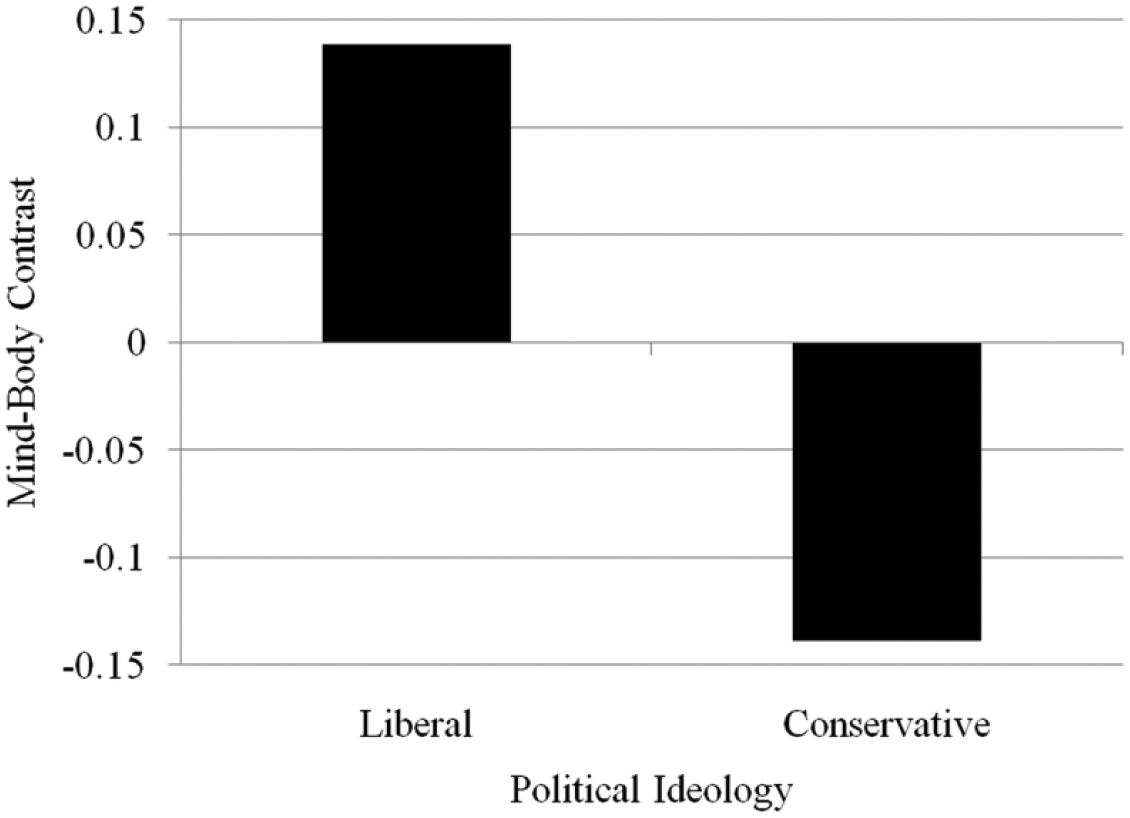
Means for the mind–body index by political ideology, Study 1.
Discussion
The LIWC 2007 dictionary for cognitive process words is larger than that for bodily process words, the cognitive words are typically more commonly written, and it stands to reason that news websites might generally focus on cognitive relative to biological processes. Yet we believe that the cognitive–biological distinction is a fundamental one (Lyons, 1999; Swan, 2009) and further believe that contemporary content analysis methods, using the LIWC categorization system, are particularly suited to contrast these two categories. In doing so, both categories of words have to be z scored, thereby placing them on a common metric. In deriving a mind–body index from this methodology, clear evidence for differences by political ideology was obtained: Liberal posts scored positive in this mind–body index, whereas conservative posts scored negative along the same mind–body dimension. In other words, initial support for the hypothesis was obtained. Of course, the results must be understood in relative terms, but our hypothesis was a relativistic one. Regardless, replication would be desirable.
Study 2
In the United States, political ideology is well captured by a two-party system. That is, Democrats strongly tend to endorse liberal ideologies, while Republicans strongly tend to endorse conservative ideologies (Jost, 2006). Therefore, an excellent way of conceptually replicating the Study 1 findings would involve comparing the speeches of elected Democratic with Republican politicians. Arguably, the most important politician in the United States is the president, who must adhere to his or her party’s ideology to survive the nomination process (Levendusky, 2009). It is also true that presidential State of the Union addresses reflect the history of U.S. politics rather than a particular window of time (e.g., the past 18 months). In Study 2, we hypothesized that the addresses given by Democratic (Republican) presidents would score positively (negatively) along the mind–body dimension introduced in Study 1.
State of the Union Addresses
With some few exceptions, the president of the United States has given State of the Union addresses every year. These addresses are year-specific and encompass accomplishments in the preceding year, barriers to progress, and the administration’s political agenda for the upcoming year. Given the high-profile nature of these speeches, they have been carefully transcribed and archived. We retrieved these State of the Union addresses, in textual form, from an Internet archive termed the presidency project (http://www.presidency.ucsb.edu).
State of the Union addresses prior to the first of Ulysses S. Grant were omitted because, prior to this time in U.S. history, the modern two-party U.S. system did not exist as it does today. For example, George Washington had no political party affiliation and Millard Fillmore belonged to a historical Whig party. Beginning with Grant, all U.S. presidents have belonged to the Democratic or Republican parties.
Following considerable precedent (e.g., Winter, 1993), we consider each speech as a distinct entity. Each speech is written by a different team of writers and is thus reflective of the State of the Union at the time. In addition, the president is the spokesperson for his or her party and party platforms vary from year to year (Bendor, Diermeier, Siegel, & Ting, 2011). Pragmatic issues are also relevant. There have not been enough U.S. presidents in the modern era to justify collapsing speeches by president as doing so would somewhat necessarily be underpowered in the context of hypotheses of the present type. We will revisit such considerations in Study 3.
Each State of the Union address was rendered a text file. There were 59 State of the Union addresses involving a Democratic administration and 86 involving a Republican administration. The average number of words per address was 4,293.
Computerized Scoring of the Texts
The LIWC program (Pennebaker, Booth, et al., 2007; Pennebaker, Chung, et al., 2007) was again used to contrast the percentage of words in each text that matched the cognitive process category of the LIWC dictionary versus its biological process category. The number of words scored for the former category is larger than the number of words scored for the latter category. In addition, State of the Union addresses typically concern issues (e.g., domestic policy) that are necessarily somewhat abstract or cognitive (Thoemmes & Conway, 2007). We therefore expected a higher percentage of cognitive process than biological process words across all State of the Union addresses and this was found to be the case (Ms = 16.29% and 0.75% for the cognitive and biological categories, respectively). Accordingly, we z scored both word categories, and subtracted them as in Study 1, to create a mind–body index. We hypothesized that this index would systematically vary by the political party of the presidential administration (Democratic vs. Republican).
Results
The mind–body index was analyzed as a function of the party of the presidential administration in an ANOVA, which revealed a main effect for political party, F(1, 144) = 4.42, p = .037, partial eta square = .03. As shown in Figure 2, the State of the Union addresses of Democratic administrations had a positive mind–body score (M = 0.25), whereas the State of the Union addresses of Republican administrations had a negative mind–body score (M = −0.17). As a point of interest, the highest mind–body score (4.44) was obtained from the 1914 address of Woodrow Wilson, a Democratic president known for his intellectualism (George & George, 1998). A relevant Wilson sentence, with scored cognitive process words italicized, is as follows: “The causes of this unrest, while various and complicated, are superficial rather than deep-seated.” By contrast, the lowest mind–body score (−3.99) was obtained from the 2003 address of George W. Bush, a Republican president characterized as down-to-earth and even anti-intellectual in his approach to political issues (Strozier & Swiderski, 2005). Here is a relevant Bush sentence, with scored biological process words highlighted: “Religious charities of every creed are doing some of the most vital work in our country—mentoring children, feeding the hungry, taking the hand of the lonely.” 5
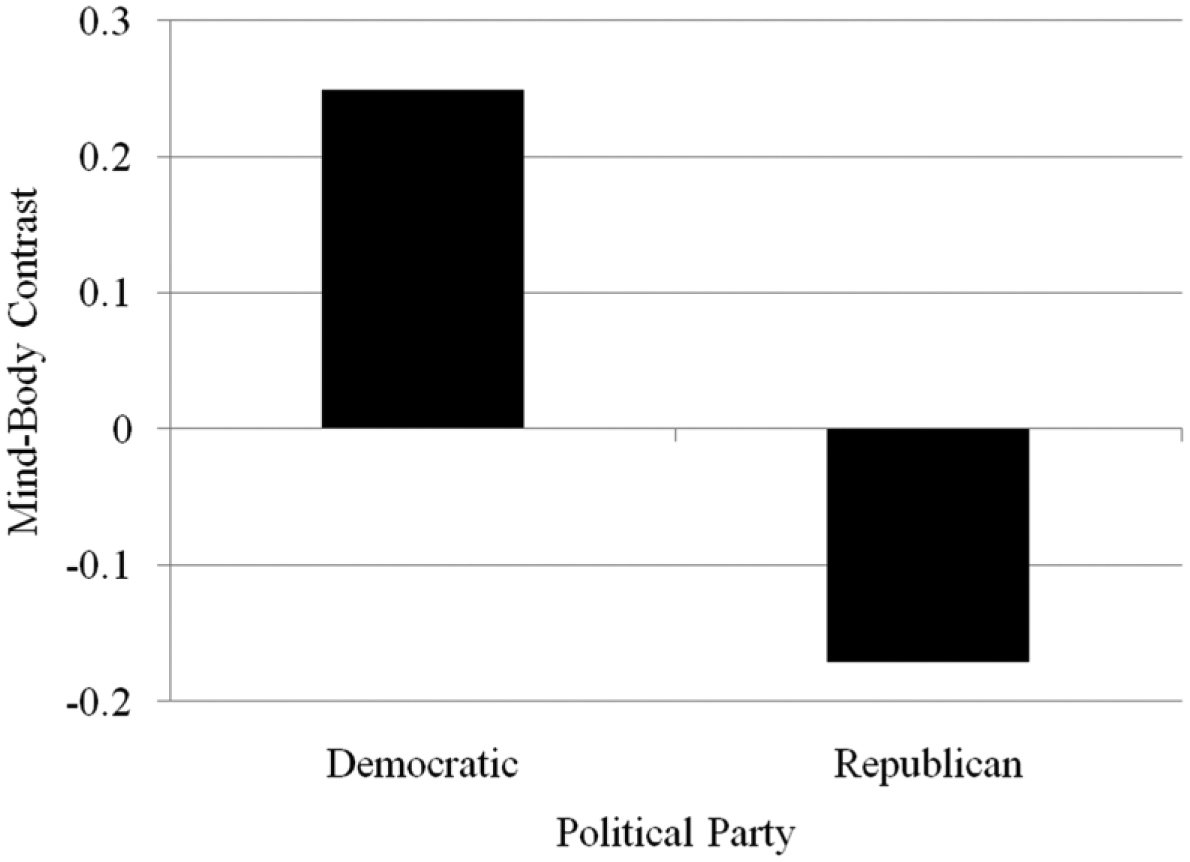
Means for the mind–body index by political party, Study 2.
Discussion
Study 1 analyzed posts to prominent political news websites. We could not be sure that the authors of the posts were liberal or conservative, but we could be sure that the speeches text analyzed in Study 2 were made by Democratic or Republican politicians. In addition, a benefit of the Study 2 texts was that they encompassed over 100 years of U.S. politics. What we emphasize, though, is just how well the results of Study 2 conceptually replicated those of Study 1. Cognitive process words were used more frequently, but correcting for this fact resulted in a clear difference by political ideology: Democratic presidents scored positively along the mind–body continuum, whereas Republican presidents scored negatively. A caveat is that we did not possess adequate power to collapse across speeches for a given President and therefore, as in Study 1, the results so far characterize texts rather than individuals. Although this is a common focus of textual analyses (Tausczik & Pennebaker, 2010), it seemed important to conduct a third study in which individuals rather than texts constituted the unit of analysis.
Study 3
With reference to the Study 1 source of data, not many people write pieces for political news websites and it is probably safe to assume that such individuals are politically savvy and motivated in a manner that far outstrips the general population (Jost, 2006). With reference to the Study 2 source of data, too, U.S. presidents are highly political animals (Levendusky, 2009). The results of the first two studies therefore render it uncertain as to whether laypersons, who might not be especially politically motivated (Converse, 1964), can be differentiated along the mind–body continuum according to political ideology. To examine this question, the Study 3 sample consisted of U.S. undergraduate participants not selected on the basis of political ideology.
The U.S. presidents of Study 2 gave addresses that were somewhat necessarily political (Levendusky, 2009; Winter, 1993), but the authors of the posts to political news websites in Study 1 often reported on nonpolitical news (e.g., entertainment news). Accordingly, it is at least plausible that political ideology can be aligned along a mind–body continuum irrespective of whether people are writing about political topics. This possibility was systematically investigated in Study 3. Participants wrote about both nonpolitical and political topics and we could therefore examine whether differences by political ideology were specific to the political topic or were more general in nature. After writing about both topics, U.S. participants were asked whether they considered themselves to be primarily a Democrat or a Republican, which served as the predictor of the mind–body index in this study.
Participants and General Procedures
Ninety-four (34 female; Mage = 19.67; 79% Caucasian) participants from North Dakota State University completed a “writing study,” for which they received course credit. They first wrote about a neutral topic and then wrote about a political topic (see below). This order was deemed desirable so that writing in the neutral condition occurred in the absence of any mention or probing of political opinions. Subsequent to obtaining both written samples, participants were asked: “Generally speaking, would you classify yourself as more a Republican or a Democrat?” There were 55 Republican-leaning participants and 39 Democratic-leaning participants. This variable is a dichotomous one, but reference to the word “leaning” is meant to recognize that some of the students may not have very strong party identifications.
Writing Topics
Neutral Topic
It was important that the writing topic engaged participants so that a sufficient number of words would be obtained. Participants were instructed to “Write about your life—for example, where you came from, what your life is currently like, what your goals for the future are, and so on.” They were told to write continuously for 5 minutes. They made their response via an E-Prime 2.0 script that echoed their keystrokes (i.e., they could see what they were typing). After 5 minutes, the timed writing task self-terminated.
Political Topic
The second topic was broadly political in that it focused on important values that our society should live by (Barnea & Schwartz, 1998), social issues that are important (Kerlinger, 1984), and the role that the government should play in society (Levendusky, 2009). The exact instructions were as follows: “We are interested in your views on a couple of questions. What values should society live by and why? What social issues are most important to you and why? What role should the government play in the United States and why?” In response to this prompt, too, participants wrote for 5 minutes.
Computerized Scoring of the Texts
On average, participants typed 171 words for the neutral topic and 147 words for the political topic, word counts sufficient for the broad categories of interest. Texts for the two topics were saved as two separate files, distinctly so for each participant. Each text file was then run through the LIWC program (Pennebaker, Booth, et al., 2007), which quantified the percentage of words matching the cognitive and biological process categories.
Across participants, and consistent with prior studies, the percentage of cognitive process words was higher (Ms = 14.81% and 21.92% for the neutral and political topics, respectively) than the percentage of biological process words (Ms = 1.73% and 1.08%). Two mind–body index scores—one for each writing topic—were calculated in a manner identical to the prior studies. One interest was whether the potential influences of party affiliation were general in nature or primarily apparent when writing about political topics.
Results
We examined mind–body scores in a mixed-model ANOVA. The between-subjects factor was the political party of the participant (Democratic vs. Republican). The within-subject factor was writing topic (neutral vs. political). We hypothesized that there would be a main effect for Political Party, which was found, F(1, 92) = 4.90, p = .029, partial eta square = .05. On the other hand, there was not a main effect for Writing Topic, F < 1, and there was not a political party by Writing Topic interaction, F < 1. The noninteraction is particularly important, in that it suggests that participants leaning toward the Democratic (Republican) party can be characterized as more cognitive (embodied) even when writing about nonpolitical topics. Because the nature of the topic written about did not matter, we averaged across this within-subject factor. As shown in Figure 3, mind–body scores were positive among participants self-identifying as Democrats (M = 0.24) and negative among participants self-identifying as Republicans (M = −0.17). 6
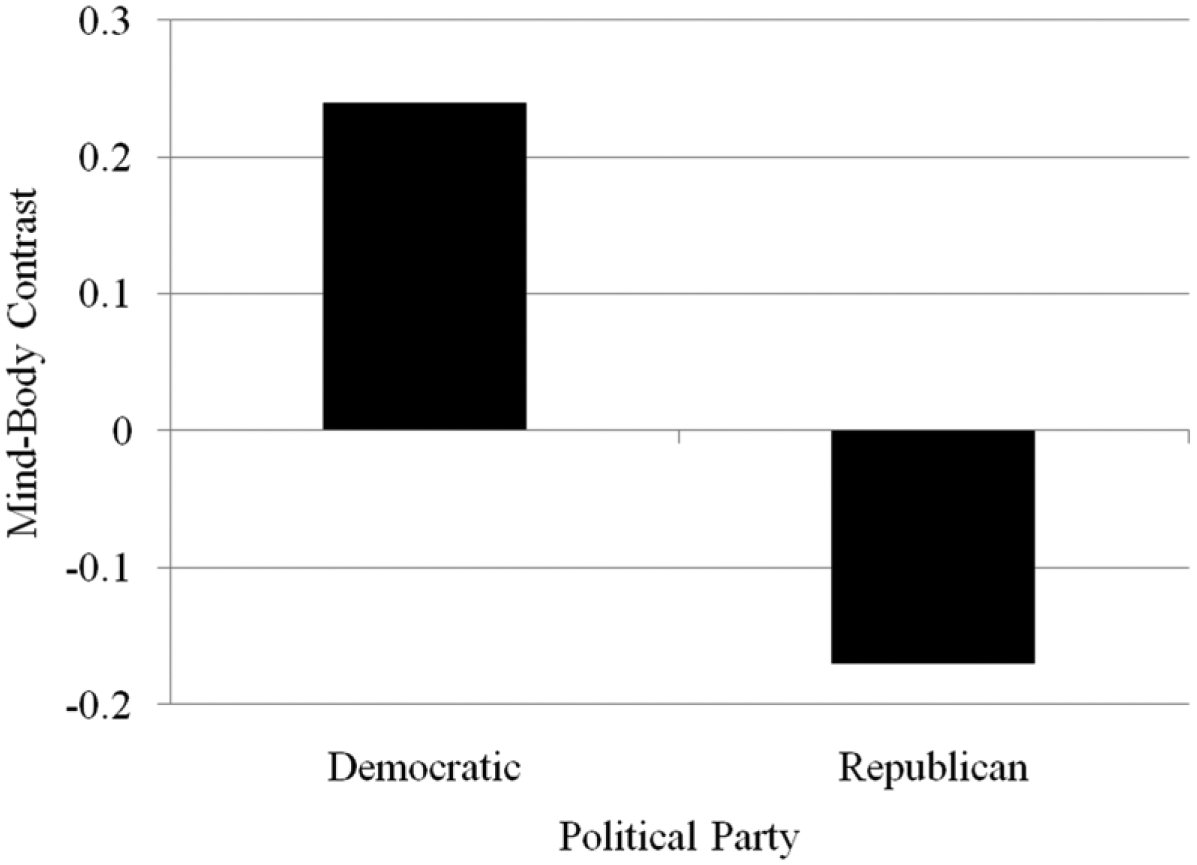
Means for the mind–body index by political party, Study 3.
Discussion
There were three major goals of Study 3 aside from conceptual replication. First, we sought to show that variations along the mind–body index characterize people varying in their political ideology. This point was supported in that participants, rather than texts, were the unit of analysis in Study 3. Second, we sought to show that nonselected participants, who may not be very strongly motivated by politics (Converse, 1964), can be differentiated along the mind–body continuum. This was the case and the results therefore extend previous investigations demonstrating reliable differences by political ideology among laypersons (e.g., Caprara et al., 2006), but here in the context of the implicit sorts of processes that can be assessed by using linguistic coding methods (Pennebaker et al., 2003). Third, we sought to examine whether differences by party affiliation are general in nature or only revealed in the context of writing about political topics. The findings support the former perspective: Even when writing about nonpolitical topics, ideological variations along the mind–body continuum were found. The sample in Study 3 consisted of U.S. undergraduate students and we cannot therefore be sure that similar results would be obtained among older aged individuals. The results of Study 2, however, suggest that this should be the case in that U.S. presidents tend to be at least middle aged. Regardless, what we emphasize is the consistency of the results across three studies.
General Discussion
There are several reliable predictors of political ideology. Some of these predictors—such as values (Barnea & Schwartz, 1998), social dominance orientation (Pratto, Sidanius, Stallworth, & Malle, 1994), or dispositional thinking concerning others (Skitka, Mullen, Griffin, Hutchinson, & Chamberlin, 2002)—implicate factors other than our focus on the mind versus body distinction. Yet many others, we suggest, can be conceptualized in terms of this distinction. For example, liberals score higher in openness to experience (Carney et al., 2008), need for cognition (Crowson, 2009a), and integrative complexity (Jost et al., 2003), outcomes that we suggest converge on the idea that liberals may typically be inclined toward cognitive operations. By contrast, and although there may be lesser evidence, conservatives score higher in death anxiety (Jost et al., 2003), moral foundations related to bodily purity (Graham et al., 2009), and disgust sensitivity (Inbar et al., 2009), outcomes that we suggest converge on the idea that conservatives may typically be more aware of, or at least protective of, their bodies.
On the basis of such ideas, we hypothesized a linguistic signature of political ideology termed the mind–body index, at least with respect to the two-party system of U.S. politics. Study 1 found that posts to liberal news websites scored positively along this index, whereas posts to conservative news websites scored negatively. Study 2 conceptually replicated this difference by political ideology, here in the context of elected Democratic versus Republican presidents giving State of the Union addresses. Study 3 asked student participants to write about nonpolitical and political topics and found that Democratic-leaning (Republican-leaning) participants scored positively (negatively) along the mind–body index, importantly so across both topics. The studies therefore converge on the mind–body distinction as one that maps onto, and potentially underlies, differences between liberal versus conservative ideological mind-sets. We focus on the rationale of the linguistic measure, questions, implications, future directions, and limitations.
The Mind–Body Index
The mind–body distinction is too frequently conceptualized in Freudian terms: An action is seen to reflect the body’s input to the extent that it is problematic, whereas it is seen to reflect the mind’s input to the extent that it is adaptive. This mapping is quite inferential and, in fact, accumulating sources of data suggest that the body contributes to effective decision-making (Adolphs, 2004; Tranel, 2002). If so, one cannot simply equate cognitive operations with adaptive behaviors and bodily operations with impulsive ones. Rather, what is needed is an objective way of quantifying variations along the mind–body continuum irrespective of potential outcomes. We developed our mind–body index in the context of such considerations. In more specific terms, we built on the suggestions of McClelland et al. (1989) and Pennebaker et al. (2003) that when people write or speak, whether imaginatively, their output follows from their stream of consciousness (Klinger, 1995).
From this perspective, mind–oriented texts or individuals should use more words reflecting cognitive processes and body-oriented texts or individuals should use more words reflecting biological processes. Fortunately, LIWC 2007 scores both such categories on the basis of textual input (Pennebaker, Booth, et al., 2007; Pennebaker, Chung, et al., 2007). Although these categories had not been previously contrasted, it makes sense to do so in relation to assessing variations along the classic mind–body continuum (James, 1890; Swan, 2009) in implicit and objective terms (Pennebaker et al., 2003). It is in fact difficult to think of another method that may be as sensitive in doing so. We standardized raw cognitive and biological category frequencies to render these categories comparable (Martindale, 1990). This procedure should encourage a relativistic interpretation of the findings and we are comfortable with a relativistic interpretation. That is, we do not wish to suggest, for example, that conservatives are more aware of their bodies than they are of their minds. Nonetheless, their position along a mind–body continuum is more body-oriented than is true of liberals.
The cognitive process words seem to reflect intellectual achievements and, in fact, cognitive ability undoubtedly contributes some variance to the use of cognitive process words (Pennebaker & Francis, 1996). However, there are likely other influences and we suggest that political ideology is one of them. The biological process category appears much more concrete than the cognitive process category. This is not a problem, however, as the body is in fact a very concrete entity relative to the mind (Swan, 2009), prototypically so (Lakoff & Johnson, 1999). It is our assumption that the use of biological process words is reflective of an embodied perception of the self, but we cannot be entirely sure of this. Arms, burps, and coughs, for example, can be observed while perceiving others in addition to the self. Nonetheless, there are other sources of data to suggest that conservatives may possess more embodied selves (e.g., Eskine et al., 2011; Inbar et al., 2009) and our findings should be interpreted in this light.
An Ideological Signature
As Pennebaker et al. (2003) did, we think that linguistic content coding has great potential utility in understanding group differences in terms of spontaneous variations in moment-to-moment consciousness. Thus far, such methods have primarily been used to examine differences between the speeches of particular candidates. Pennebaker et al. (2005) found (among other findings) that John Kerry used three times the number of negative emotion words than John Edwards did in his media interviews. Slatcher et al. (2007) found (among other findings) that the speeches or interviews of George W. Bush best matched an older aged linguistic prototype and that the speeches or interviews of Dick Cheney best matched a presidential linguistic prototype. Our findings encourage a wider use of linguistic analyses in understanding variations in political ideology. That is, although particular people are quite likely to vary in their word usage, our findings demonstrate a broader linguistic signature of political ideology that may reliably differentiate liberal versus conservative individuals.
Our studies make several contributions along these lines. We were able to conceptually replicate the main effect for political ideology across three distinct data sets. The strengths of the first include the importance of political news websites to public opinion making (Jost, 2006), the fact that many texts were sampled, and the fact that the posts covered diverse topics. The strengths of the second include the importance of State of the Union addresses in charting the course of an administration (Winter, 1993), the long historical scope of such speeches, and the fact that political affiliations were known. The strengths of the third include demonstrating the same conceptual pattern among laypersons, who are not especially politically motivated (Converse, 1964). In addition, Study 3’s replication across both nonpolitical and political topics suggests that ideological differences in mind–body consciousness are stable features of people rather than differences only apparent in the political realm, thus joining a number of other known correlates of political ideology that display this generality (Jost et al., 2003).
Of course, future research directions can be advocated. It would seem useful to show that variations along the mind–body continuum prospectively predict subsequent voting behavior. Replication with other sorts of written texts—such as those posted to liberal versus conservative chat rooms—would be welcome. The Study 3 sample consisted of undergraduate students and, for this reason, replication among older, nonstudent samples may be desirable. Finally, it may be useful to perform experimental work to examine directions of causality. Would identifying with liberal versus conservative policies shift the mind–body index in a manner that parallels the present findings? Alternatively, would manipulations targeting mental operations versus bodily processes shift subsequently reported political ideology? We suggest that the latter direction of influence is more likely. For example, the mind is more appreciative of alternative viewpoints and seeks integrative complexity, factors shown to predict liberal ideologies (Jost et al., 2003). By contrast, the body seeks to protect itself (Rozin & Royzman, 2001) and it has also been shown that concerns about the body’s integrity predict conservative ideologies (Inbar et al., 2009). Empirically, too, there are sources of evidence to suggest that events that make people fearful about their physical safety render people more conservative (Bonanno & Jost, 2006) and that an early childhood temperament that is more open-minded predicts more liberal ideologies later in development (Block & Block, 2006). Thus, we suspect that consciousness concerning the mind would shift ideology in a liberal direction and consciousness concerning the body would shift ideology in a conservative direction. Even so, we must note that we sought to understand variations in political ideology rather than directions of causality and, in this respect, the studies converged on a theory-motivated, yet novel, empirical correlate of political ideology.
In addition to interesting research directions, we would also like to emphasize the potential applied value of the present work. We think of the mind–body index in personality-related or dispositional terms. Therefore, if a researcher knew whether a particular individual was more mind-oriented or body-oriented, he or she should be able to predict other things about the person such as the person’s values (e.g., support for public education funding) and likely voting patterns (i.e., a low mind–body index score should be linked to conservative voting tendencies). The mind–body index also seems likely to relate to other individual difference variables that have considerable societal and political importance such as need for cognition (Cacioppo et al., 1996) and authoritarianism (Altemeyer, 1998). And the mind–body index, our findings suggest, could be considered an implicit measure of ideology, one that seems likely to have unique predictive value relative to explicit assessments of ideology (Gawronski, Galdi, & Arcuri, 2015). Our results also have implications for understanding political discourse and its effectiveness. Body-based imagery and language is likely to be more persuasive among conservatives and mind-oriented imagery is likely to be more persuasive among liberals. Accordingly, the present results could be used to construct appeals that match the linguistic orientation of the particular audience (e.g., a liberal readership vs. a more conservative one). Finally, political consultants might find value in the present work in coaching their candidates toward more effective campaigning strategies and constituency management.
Final Considerations
We are cognizant that our data sets are based on linguistic texts from the United States. Yet extant sources of data are at least suggestive that the present findings might be replicated in other countries as well. A liberalism–conservatism dimension seems to capture fundamental differences in political ideology in a number of countries, including Canada, Hong Kong, and Ghana (Ashton et al., 2005). As in the United States (Jost, 2006), polarization along this dimension exists in multiple cultures (Brooks, Nieuwbeerta, & Manza, 2006). Greater liberalism is predictive of openness to experience (and thus interest in intellectual activities: McCrae & Sutin, 2009) in multiple countries (Van Hiel, Kossowska, & Mervielde, 2000). Furthermore, the liberalism–conservatism dimension predicts dogmatism, defined in terms of rigid adherence to beliefs despite potentially disconfirming evidence (Altemeyer, 1998), in a number of countries (Kemmelmeier et al., 2003). It has further been suggested that body-based forms of morality are more predictive of political conservatism in a number of countries and cultures (Haidt, Graham, & Joseph, 2009). In sum, although our data sets may be limited to a consideration of U.S. politics, there are reasons for thinking that the present findings should potentially be replicable in other countries and cultures as well, though the relevant empirical work has yet to be performed.
Such points aside, there are potential differences by culture as well. The United States is basically a two-party system. In many other countries, there are more than two parties that compete for votes and a broad liberalism–conservatism distinction may encounter some difficulties in such many-party systems (though see Barnea & Schwartz, 1998). The United States is a decidedly individualistic nation, but more collectivist values and concerns appear to pervade political thinking in Eastern cultures such as China, Japan, and Korea (Triandis, 1989). It is not clear to us that greater collectivism would alter the present pattern of results, but it might. Of perhaps more importance, our mind–body index is based on a dualistic distinction between the mind and the body. Certain Eastern schools of thought (e.g., Taoist or Buddhist) have been termed “nondualistic” in that practitioners of such schools strive to eliminate the mind–body distinction (Watson, Batchelor, & Claxton, 2000). In such cultures, it may make less sense to contrast cognitive and biological process categories.
We finally consider relations between our mind–body framework and other frameworks. The classic (Bloom, 2004), but contemporary (Forstmann et al., 2012), mind–body distinction cannot be cleanly mapped onto dual-process theories in social psychology, which emphasize qualities of thinking rather than awareness of mental versus bodily operations (Chaiken & Trope, 1999). The mind–body distinction cannot be understood in terms of affective processes in decision making in that the affective and biological process categories of LIWC are distinct and neither assesses decision making (Pennebaker, Chung, et al., 2007). Lakoff and Johnson (1999) contend that all abstract thoughts are metaphorically embodied in nature. This is a monolithic single-process framework that does not allow for group differences and cannot capture variability along our mind–body index dimension. More or less, then, what we emphasize is the idea that we were able to build on classic ideas concerning the distinct functions of the mind and the body (Descartes, 1641/1984) in a linguistic manner likely sensitive to moment-to-moment variations in the contents of consciousness (Pennebaker et al., 2003). We offer the mind–body index as one that may be useful in further investigations of the present type.
Footnotes
Acknowledgements
We thank Howard Giles and two anonymous reviewers for helpful comments on an earlier version of this article.
Declaration of Conflicting Interests
The author(s) declared no potential conflicts of interest with respect to the research, authorship, and/or publication of this article.
Funding
The author(s) disclosed receipt of the following financial support for the research, authorship, and/or publication of this article: The authors acknowledge support from NSF (BCS 0843982).