







Abstract
Each culture has a distinct set of features that contribute to a unique communication style. For example, bilinguals often balance multiple social contexts and may undergo cognitive changes that consequently support different communication styles. The present work examines how individual differences in bilingual experience affect one form of communication style: sarcastic and indirect language. A diverse sample of largely bilingual adults (first language English) rated their likelihood of using sarcastic and indirect language across different daily settings. They also rated their second language experience. There were two key findings: Bilinguals use sarcasm for similar social functions as do monolinguals (general sarcasm, frustration diffusion, and embarrassment diffusion) and greater global second language proficiency linked to greater usage of general sarcasm in daily life. These results suggest that bilinguals may use sarcasm to achieve various communicative goals and bilingual experience may affect general cognitive capacities that support sarcasm use across real-world contexts.
Keywords
Each culture has a distinct set of nonverbal and verbal features that contribute to a unique communication style. For example, in many cultures, indirectness is considered a form of politeness, whereas other cultures define politeness through direct speech (Holtgraves, 1997). Many individuals descend from multiple cultures, or they migrate and adopt different cultural practices. As a result, biculturalism and bilingualism may affect communication style due to sociocultural differences. Interestingly, bilingualism may also confer changes in cognitive processing that in turn affect communication style. In this article, we investigate the relationship between bilingual experience and one specific communication style: indirect and sarcastic language. Specifically, we investigate how individual differences in bilingual experience (i.e., age of acquisition and proficiency) predict self-perceptions of daily sarcasm use among bilingual adults. Assessing this relationship is of interest to psycholinguists, cognitive scientists, and social psychologists because resolving the demands of bilingualism and sarcasm may depend on similar underlying processes. Moreover, integrating social and intergroup theories with cognition will produce a more holistic and thorough understanding of bilingualism.
Individual Differences in Bilingual Experience
Historically, the rich linguistic, social, and cognitive diversity among bilinguals has not been vigorously studied. Two basic aspects of bilingual variation are second language (L2) proficiency and second language age of acquisition (L2 AoA). Whereas L2 AoA reflects historical and temporally sensitive components of language experience, current proficiency is an ongoing and dynamic marker of use and language diversity (e.g., Gullifer et al., 2018; Gullifer & Titone, 2019). The interplay of these two features may result in dramatically different bilingual experiences. For example, someone may have acquired an L2 as an adult but currently uses it exclusively and has high proficiency. Conversely, someone who acquired two languages from birth may only use one language at home and the other at school. These two experiences may lead to significant differences in social and cognitive development.
Bilingual experience has been argued to strengthen executive functions (Baum & Titone, 2014; Green & Abutalebi, 2013; Gullifer & Titone, 2019; Lehtonen et al., 2018), support mental state inferencing (Schroeder, 2018), and alter sociocultural expectations (Pavlenko, 2006). Executive functions are a set of cognitive processes needed to control thought and behavior, subsuming working memory, monitoring, inhibition, and flexibility (Miyake & Friedman, 2012). Some have proposed that bilinguals profit from enhanced executive functions due to the recruitment of control mechanisms required to manage the coactivation of multiple languages (e.g., Bialystok, 2001). One form of executive functions is working memory. Working memory flexibly retains and manipulates information in memory and, of importance, has been found to support language processing, including sarcasm, where multiple meanings must be coactivated (e.g., Kaakinen, Olkoniemi, Kinnari, & Hyönä, 2014; Miyake & Friedman, 2012).
Whereas executive functions may promote flexible use of multiple languages, the cues that prompt a language decision may be embedded in the social context (Nicoladis & Genesee, 1998). Through daily assessments of these cues, a bilingual may be prompted to use one language over another or code-switch to achieve a pragmatic goal (Genesee, Boivin, & Nicoladis, 1996; Nicoladis, 1998; see also Yim & Clément, 2019). Linguistic decisions are made from inferences from the environment (e.g., French is the official language of Quebec), individual interactions (e.g., My grandfather speaks French), or a combination of these. Thus, bilinguals constantly exercise perspective-taking and compute mental state inferences when navigating and engaging with their world. Importantly, functionally monolingual people who live in strongly bilingual contexts (such as Montreal) may also undergo these experiences.
These social inferences likely rely on executive functions (Brown-Schmidt, 2009; Lin, Keysar, & Epley, 2010; Rubio-Fernández & Glucksberg, 2012) and intergroup perceptions to varying degrees. For example, in novel contexts, bilinguals may rely on visible cues such as perceived race and class to make assumptions about what language a stranger speaks (Norton, 1997). Such stereotypic behavior may alter the quality of the intergroup communication and have significant real-world consequences. Moreover, bilinguals may find themselves in novel intergroup situations more often, as a function of knowing multiple languages, which over time may change their reliance on these cues. Dynamically using multiple languages likely requires cognitive flexibility and openness that may contribute to decreased out-group prejudice (Kozulin, 1999; Mepham & Martinovic, 2018). Thus, individual differences among bilinguals may manifest as changes to cognitive processing or social expectations of the world as well as the experiences that give rise to them.
Importantly, the core processes that are shaped by individual differences in bilingual experience covary with the underlying processes that support indirect and sarcastic language (Deliens, Antoniou, Clin, & Kissine, 2017; Pexman, 2008). Understanding sarcasm in a bilingual context would advance our understanding of intergroup communication styles. Thus, an open question is whether individual differences in bilingual experience predict sarcasm use in daily life.
Sarcasm and Potential Underlying Processes
Sarcasm is a characteristically sharp juxtaposition between the content and intent of one’s words. Sarcasm directs a critical or humorous attitude at a specific target, sometimes resulting in ridicule or mockery (Glenwright & Pexman, 2010; Lee & Katz, 1998). As a communicative style, it serves various social purposes, such as softening a critical attitude (Dews & Winner, 1995), peppering humor into a conversation and maintaining a relationship (Dews, Kaplan, & Winner, 1995; Pexman & Olineck, 2002), or expressing power (Drucker, Fein, Bergerbest, & Giora, 2014). Sarcasm may also be used to reinforce one’s social identity, aggrandize out-group hostility, and foster intergroup competition (Burgers, Beukeboom, Kelder, & Peeters, 2015). Indeed, one’s preferred communication style regarding indirect and sarcastic language is partially a matter of individual differences (Kaakinen et al., 2014; Olkoniemi, Ranta, & Kaakinen, 2016). These individual differences in executive control (Olkoniemi et al., 2016; Pexman & Glenwright, 2007), mental state inferencing (Martin & McDonald, 2005), and cultural norms, social expectations, and group membership (Caucci & Kreuz, 2012; Katz & Pexman, 1997; Pexman & Zvaigzne, 2004; Rockwell & Theriot, 2001) likely constrain the use of sarcasm.
Executive functions likely aid in managing the multiple potential meanings of indirect or sarcastic language. For example, to convey discontent at a political leader, one may sarcastically state, “What a great president.” Here, the assumption is that the listener has activated the speaker’s true political affiliation (working memory) and can inhibit the literal meaning of the statement (inhibitory control; Carlson & Moses, 2001; Miyake & Friedman, 2012; Rothbart & Posner, 1985; Zelazo, Carter, Reznick, & Frye, 1997). Thus, if using sarcasm purely drew on cognitive processes, we would expect that individual differences in executive functions would predict sarcasm use.
At its core, sarcasm is an exercise in discerning the true intention behind a statement and draws from the ability to make mental state inferences (Fan, Liberman, Keysar, & Kinzler, 2015). This is clear from the developmental literature: Children who reliably struggle with mental inferencing cannot fully comprehend irony (Filippova & Astington, 2008; Happé, 1993; Pexman, 2008). In our example, the listener must integrate what they know about the speaker’s political views when determining if the statement was intended literally or sarcastically. Furthermore, the speaker must step into the shoes of the listener to determine if the sarcastic remark is appropriate given the listener’s political views. Indeed, the role of mental state inferencing and executive functions in sarcasm use may be yoked, given that sarcasm necessitates inhibiting aspects of one’s own mental processing and diverting attention to meanings and cues from the perspective of the interlocutor (see Perner & Lang, 2000).
Additional motivation to use sarcasm during communication may stem from desirable in-group behavior and politeness. In some cultures, bluntly stating the intended meaning could be considered rude or threaten the social distance between interlocutors. Therefore, sarcasm and other indirect language thaw an otherwise critical sentiment through humor (Dews & Winner, 1995). As demonstrated earlier, directly displaying discontent for a political leader may be inappropriate in certain settings. By stating the intended sentiment indirectly, the speaker distances themselves from their true feelings. Conversely, the speaker’s goal may be to reinforce their position against the politician by using sarcasm (Burgers et al., 2015). Thus, appropriate usage of sarcasm requires insight into the sociopragmatic context, the cultural norms that govern interactions, and the linguistic context.
The Present Study
Sarcasm is a meaningful communication style that many people adopt for the reasons discussed. Whereas most of the research on sarcasm has either used or assumed a monolingual speaker as the norm, the present study extends this work on sarcasm to the bilingual context. Specifically, we investigate the role of individual differences in bilingual experience (L2 proficiency and L2 AoA) and executive functions in predicting self-perceptions of sarcastic and indirect communication styles. Two fundamental questions guided our inquiry.
First, to what extent do usage patterns for sarcastic and indirect utterances found previously for presumed monolinguals extend to a largely bilingual sample, immersed in a strongly bilingual context? To address this question, we replicate Ivanko, Pexman, and Olineck (2004) who evaluated sarcastic tendencies in a sample of 155 presumed monolinguals (no language background specified). This scale has been reliably used in other studies (Dress, Kreuz, Link, & Caucci, 2008), but here for the first time we extend this evaluation to a linguistically diverse sample of bilinguals, including bilinguals (defined as using two or more languages) and some functionally English monolinguals who live in the strongly Francophone context of Quebec and conduct their daily activities with constant semiotic exposure to French. Given past work, we predict that evaluating the Sarcasm Self-Report Scale (Ivanko et al., 2004) in a bilingual sample will render similar components underlying sarcasm usage patterns (general sarcasm, embarrassment diffusion, frustration diffusion, and face-saving) as found in Ivanko et al. We also replicate the Conversational Indirectness Scale (Holtgraves, 1997) in the same diverse sample.
Second, do individual differences in bilingual experience predict sarcasm usage patterns? We hypothesize that if bilingualism promotes similar core capacities that are necessary for the usage of sarcasm, increased bilingual experience (i.e., earlier L2 AoA, greater L2 proficiency) will pattern with greater use of sarcasm in daily life.
Method
Participants
The study took place at McGill University, which is an Anglophone university in the legally French monolingual city of Montreal, Canada. Most inhabitants are bilingual due to immigration from other countries or from Anglophone parts of Canada. Thus, our sample is linguistically diverse. The sample included 116 adults (89 female, 25 male, 2 unspecified), aged 18 to 35 years, who acquired English as their first language (L1). Of these, 11 spoke only English, 63 spoke two languages, 17 spoke three languages, and 25 spoke more than three languages. The majority of participants spoke French as their second or third language, and others reported knowledge of a variety of languages: American Sign Language, Arabic, Cantonese, Chinese, German, Greek, Gujarati, Hebrew, Hindi, Italian, Japanese, Latin, Malay Russian, Spanish, Swahili, Ukrainian, Urdu, Vietnamese, and Yiddish. Forty-two participants (36%) had at least one parent who had an L1 other than English (or learned English and another language simultaneously). All participants were recruited using the McGill psychology participant pool and public advertising and were granted course credit or monetary compensation ($10/hour) for participating.
Procedures
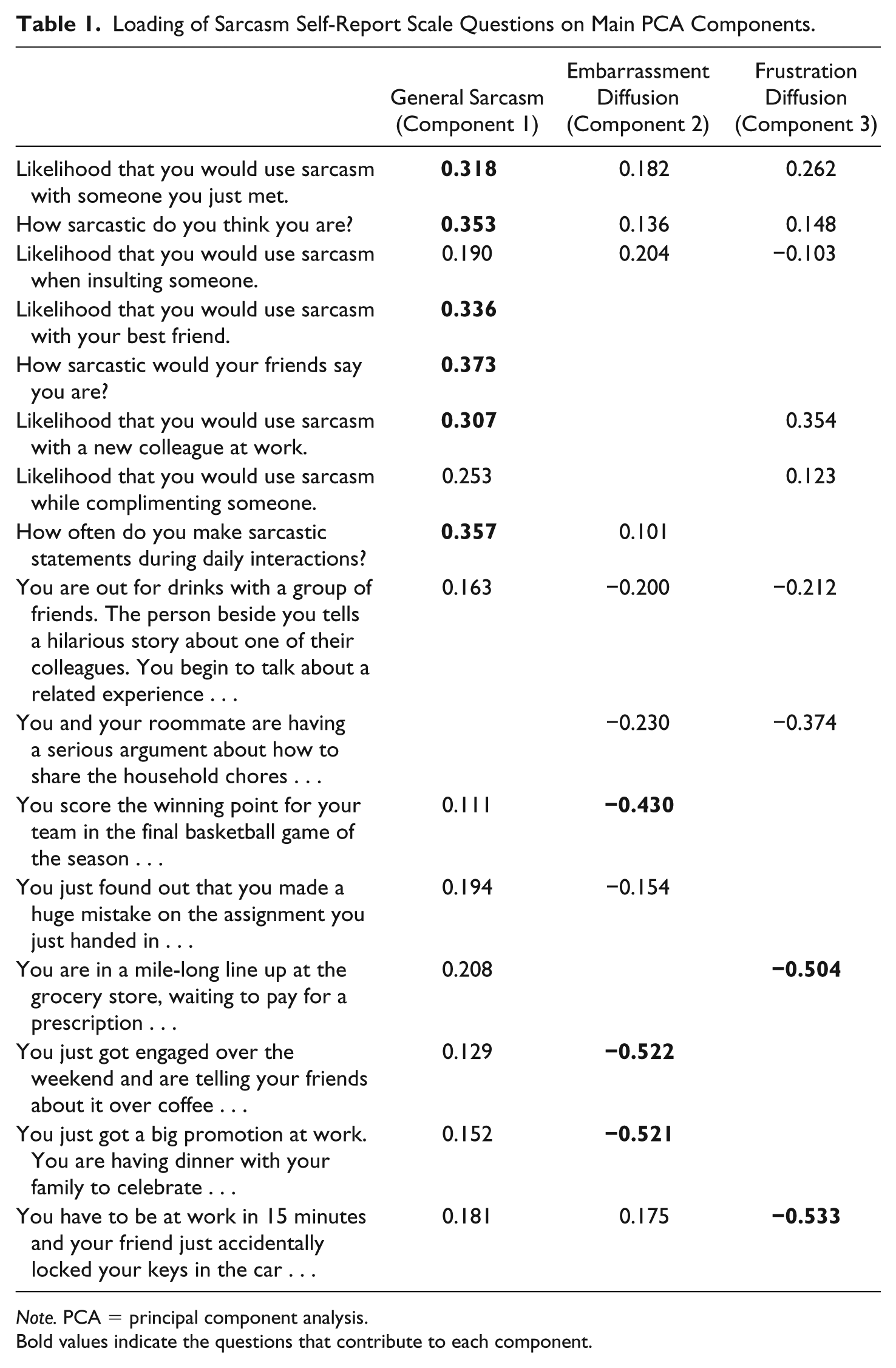
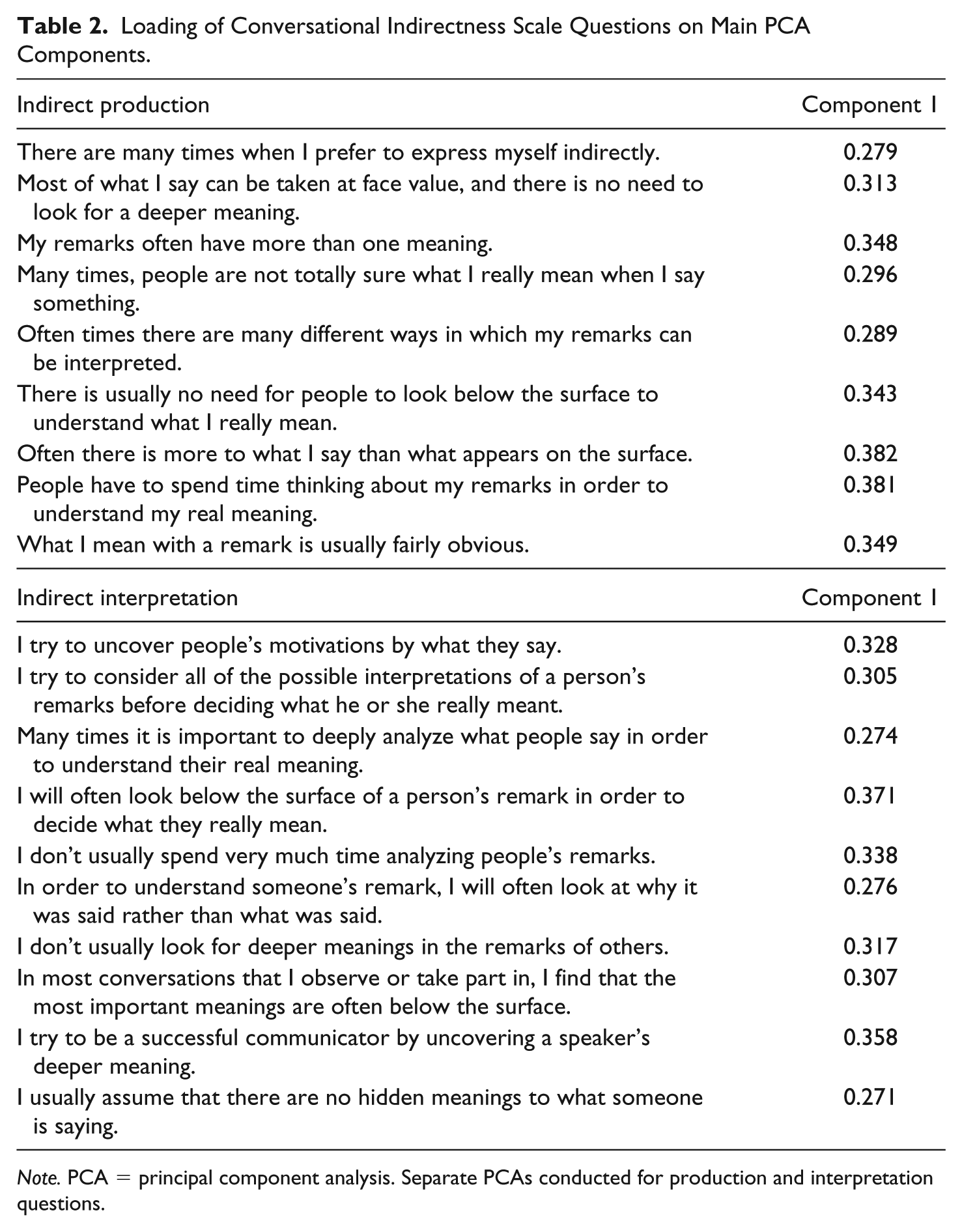
First, we evaluated self-perceptions of daily communication style with two online questionnaires. The first questionnaire, the Sarcasm Self-Report Scale (Ivanko et al., 2004), measures perceived sarcasm use in various contexts (for a full list of questions see Table 1). For each item, participants selected a Likert-type scale rating from 1 (not at all likely) to 7 (extremely likely). The second questionnaire, the Communicative Indirectness Scale (Holtgraves, 1997), measures perceived use of indirect language more generally with a similar 1 to 7 Likert-type rating scheme. Some of these items probe production of indirect language and others probe comprehension of indirect language (Table 2). Half of the items were reverse scored so as to not bias participant responses. Importantly, all participants completed the questionnaire in English (their L1) and were instructed to respond about their general communication styles, without specification of language.
Loading of Sarcasm Self-Report Scale Questions on Main PCA Components.
Note. PCA = principal component analysis.
Bold values indicate the questions that contribute to each component.
Loading of Conversational Indirectness Scale Questions on Main PCA Components.
Note. PCA = principal component analysis. Separate PCAs conducted for production and interpretation questions.
Participants also completed a language background questionnaire, which comprised questions regarding the number of known languages, parents’ languages, and if applicable, L2 background questions (age of L2 acquisition, L2 listening comprehension, L2 pronunciation, L2 fluency, L2 vocabulary, and L2 grammatical ability).
Last, participants completed a computerized verbal working memory test. We used an adapted version of Daneman and Carpenter’s (1980, 1983) reading span working memory test (Unsworth, Heitz, Schrock, & Engle, 2005). Participants were instructed to read complex sentences for comprehension and remember the letter that appeared after presentation of the sentence. The test began with a practice session in which sentence–letter pairs of set size 2 were presented, so as to ensure an understanding of the task rules. After the practice session, sentence–letter pairs ranging in set size from 2 to 7 pseudo-randomly appeared, with set size 2 appearing three times and all other set sizes appearing twice, for a total of 13 trials. All sentences were followed by the presentation of a letter in the center of the screen for 2500 ms. At the end of each set, participants had to type in the correct order of the letters and respond to a yes or no content question from one of the sentences in the set. This test provided a working memory score that served as a proxy for overall executive function abilities.
Results 1
Analysis 1: Evaluating Self-Report Surveys of Communication Style
Rationale
The purpose of Analysis 1 was to evaluate the responses to two self-report surveys on communication style: The Sarcasm Self-Report Scale and the Conversational Indirectness Scale. We were specifically interested in whether the same four subscales of sarcasm use found in Ivanko et al. (2004) would be replicated in a largely bilingual sample.
Data Reduction for the Sarcasm Self-Report Scale
Similar to Ivanko et al. (2004), we first conducted a principal component analysis (PCA) on the 16 questions of the Sarcasm Self-Report Scale. PCA is statistical data reduction tool that recognizes patterns and orthogonally transforms a set of values into uncorrelated components or factors. We report the main loadings of each question in Table 1.
We found evidence for three of the four main components identified in Ivanko et al. (2004): general sarcasm, embarrassment diffusion, and frustration diffusion. Thus, we confirm that a linguistically diverse sample of bilinguals and functional monolinguals living in a bilingual context use sarcasm for similar functions as monolinguals in an English context. There was not substantial evidence for a component related to face-saving in this sample. Collectively, the three components accounted for 58.7% of the variance in the data.
The first component (general sarcasm) comprised six questions related to everyday usage of sarcasm, regardless of specific context or emotional state, such as, “How sarcastic do you think you are?” The second component (embarrassment diffusion) related to three questions probing usage of sarcasm in positive situations, when one wants to deflect attention or politely accept praise. For example, one would have to judge the likelihood of using sarcasm when “you score the winning point for your team in the final basketball game of the season.” The third component (frustration diffusion) was captured in two questions describing a scenario in which one may use sarcasm to mute a negative attitude (e.g., “You are in a mile-long line up at the grocery store, waiting to pay for a prescription”).
Data Reduction for the Conversational Indirectness Scale
We also conducted a PCA on the Conversational Indirectness Scale responses by first dividing the questions into the production (9 questions) versus interpretation (10 questions) of indirect language. Next, we conducted independent PCAs on each subset of questions, extracting the first component from each analysis. The component for indirect production accounted for 52.4% of the variance and the component for indirect interpretation accounted for 48% of the variance. The loadings for each question are shown in Table 2. Next, we assess to what extent these composite scores as well as the Sarcasm Self-Report Scale composite scores, can be predicted by individual differences in bilingual experience.
Analysis 2: Relating Bilingual Experience to Communication Style
Rationale
In Analysis 2, we evaluated individual differences in bilingual language experience. First, we conducted a set of PCAs to statistically isolate the typically highly correlated language background questions. Next, these components were entered in a multiple linear regression model to predict each aspect of sarcastic and indirect communication style elicited from Analysis 1.
Data Reduction for Language Background Measures
To optimally distinguish between different kinds of bilingual experience given our array of measures, we first computed a PCA on self-reported language ratings for participants who fully completed the questionnaire (N = 91). From these questions we found two components that cumulatively accounted for 83.8% of the variance (descriptive statistics in Table 3). The five L2 proficiency variables mapped onto Component 1 (global L2 Proficiency) and the sixth mapped onto Component 2 (L2 AoA). With PCA, we statistically isolate individual differences due to L2 proficiency and AoA.
Descriptive Statistics for Language Background Questionnaire Responses and Working Memory Task (Mean and Standard Deviation).

Note. L2 AoA in years. L2 proficiency ratings from 1 (“no proficiency at all”) to 7 (“like a native speaker”). Working memory score ranged 0-56.
Working Memory
In order to assess the role of executive functions in predicting sarcasm use, we also computed a working memory score for each individual. This involved an all-or-nothing scheme so that both the correct letter and the correct position must have been recalled. For example, if the letter string “JFN” was presented, the participant would only receive the full score if all three letters were entered in the precise order. Any other order (e.g., “JNF”) would result in a score of 0 for that trial.
Modeling Bilingual Communication Styles
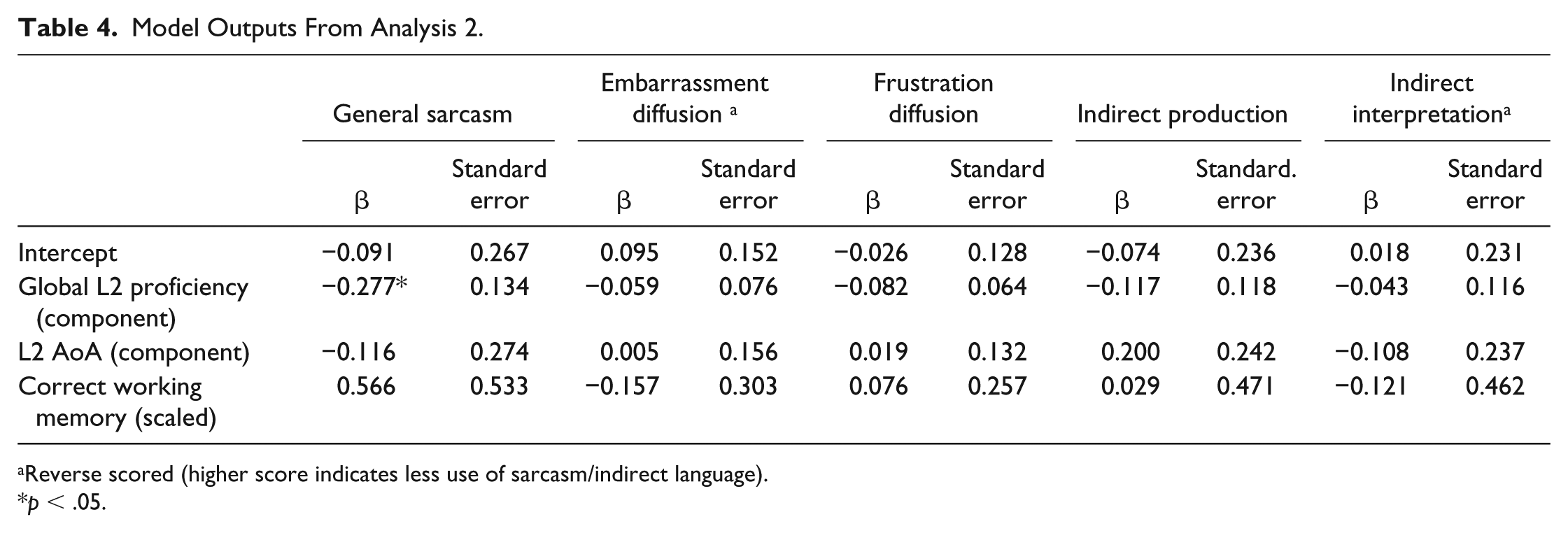
We computed a multiple linear regression model in R for each communication style. The independent variables within these models were the two bilingual PCA components (global L2 proficiency and L2 AoA) and working memory score (scaled). In each model, the dependent variable was each of the five communication styles (general sarcasm, embarrassment diffusion, frustration diffusion, indirect production, indirect interpretation). Thus, the same three independent variables were used to predict each of the five dependent variables. An analysis of model residuals suggested the presence of several outliers. Thus, we calculated a Cook’s distance, which highlights the data points with high leverage on the regression. Cook’s distance indicated that the responses of two individuals were disproportionately influencing the regression, thus they were discarded as outliers. This left a total of 89 participants in the final five models.
Of these five models, reported in Table 4, only the PCA component reflecting general sarcasm was significantly predicted by the global L2 proficiency component (β = −0.28, t = −2.05, p = .04). As can be seen in Figure 1, as global L2 proficiency increased, the component related to general sarcasm use also increased, suggesting that increased global bilingual experience patterns with a greater use of sarcasm in daily life. Of note, this only occurred for the subscale of general sarcasm but not embarrassment diffusion, frustration diffusion, nor for the production or interpretation of indirect language.
Model Outputs From Analysis 2.
Reverse scored (higher score indicates less use of sarcasm/indirect language).
p < .05.
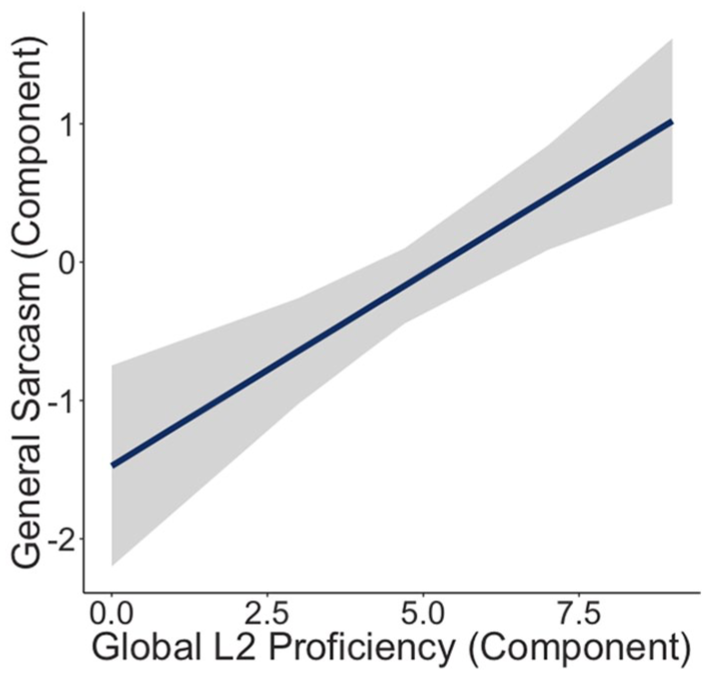
Global L2 proficiency predicts self-rated general sarcasm use
From these same models, we assessed whether there was a significant relationship between the L2 AoA component and correct working memory on communication style. Importantly, neither the L2 AoA PCA component nor correct working memory significantly predicted communication style. In other words, we found no relationship between historical markers of language experience (L2 AoA) or working memory and self-perceptions of sarcastic or indirect language use. These results confirm the impact of ongoing, dynamic markers of language experience, and not static differences or pure executive functions, on daily usage of sarcasm.
Discussion
People build their preferred communication styles from their lived experiences. Bilinguals and people living in a bilingual context particularly must negotiate the multiple communication styles of each of their languages and cultures when communicating in daily life. Thus, the goal of the present work was to investigate how individual differences shape preferred communication styles among bilingual adults. There were two key findings. First, using PCA on the Sarcasm Self-Report Scale and the Conversational Indirectness Scale, we found components relating to general sarcasm, embarrassment diffusion, frustration diffusion, indirect language production, and indirect language interpretation, thus partially replicating Ivanko et al. (2004) work on sarcasm within a predominantly monolingual context. Second, greater global L2 proficiency, and not L2 AoA or working memory, predicted a greater likelihood of general sarcasm use in any language throughout daily life.
Self-Perceptions of Communication Style
In replicating Ivanko et al. (2004), we expected to find similar components relating to the Sarcasm Self-Report Scale in a largely bilingual sample and among people living in a bilingual context. We replicated three of the four subscales of sarcasm use (general sarcasm, embarrassment diffusion, and frustration diffusion) but not face-saving. Face-saving refers to the actions taken by interlocuters during an interaction to promote autonomy and cooperation, and can be understood as forms of politeness (Brown & Levinson, 1987). Ivanko et al. (2004) classify sarcasm for face-saving as the riskiest form of sarcasm because it carries a strong possibility of being misunderstood. In its initial conception, face-saving actions were assumed to be “universal” aspects of language (Brown & Levinson, 1987); however, this theory may not extend to cultures that value group identity over individuality (e.g., Ide, 1989; Izadi, 2015; Mao, 1994; see also Spencer-Oatey & Wang, 2019). Given the diversity of other language and cultural experiences that are present in our bilingual sample, it is plausible that their cultures do not afford sarcasm as a face work strategy.
We did, however, replicate the other three subscales of sarcasm use within the bilingual context. This finding is valuable because it indicates that despite cultural and linguistic influences from a L2, bilinguals are largely using sarcasm for the same communicative purposes as monolinguals. Furthermore, bilinguals use sarcasm in situations with a broad range of emotional valences, from positive (embarrassment diffusion) to negative (frustration diffusion). Future work should ask these same questions specifically in participants’ L2 to ascertain whether the preferred communication style is consistent across their languages.
Relating Bilingual Experience to Communication Style
In this article, we statistically isolated the historically entangled effects of past and current language experience with PCA. In using these component scores to predict communication style, we found that the PCA component related to greater global L2 proficiency, and not L2 AoA, predicts greater likelihoods of using sarcasm in daily conversation in any language. This means that individuals who currently use a L2 tend toward a more sarcastic communication style in general situations, suggesting that perhaps one communicative purpose of sarcasm is to aid in interlingual contexts.
Why does global L2 proficiency, and not AoA, predict sarcasm use? Though there is no conclusive answer, it is important to note that the bilinguals in our sample indicated somewhat high proficiency across many linguistic domains (Table 3) and were all living and tested in Montreal, which is a vibrantly bilingual city with a legally French linguistic landscape (e.g., Landry & Bourhis, 1997; Vingron, Gullifer, Hamill, Leimgruber, & Titone, 2017). The pairing of highly proficient bilinguals with constant semiotic exposure to their L2 may result in minimal effects of AoA on pragmatic language ability. Research on bilingual development suggests that from the age of 2 years, children can modify their speech to match the language of the listener according to the pragmatic context (Genesee et al., 1996; Nicoladis, 1998; Nicoladis & Genesee, 1998; Tare & Gelman, 2011). This adaptive behavior, which likely draws on mental state inferencing and inhibitory control, is critical for deciding which situations are suitable for using sarcasm and which are not. Similarly, it may influence with whom one uses sarcasm. For example, one study found that in intergroup settings, presumed monolinguals use sarcasm more with out-group than in-group members (Burgers et al., 2015). It is possible that individuals infer out-group contexts more appropriate than in-group contexts to use sarcasm because of its mocking and aggressive nature.
To closely replicate Ivanko et al. (2004), we did not adapt the questionnaires to specify which language the participant should reference in making judgments. In addition to providing scale validation, this means that greater proficiency in a L2 globally facilitates broad sociopragmatic and cognitive processes that underlie sarcasm use, irrespective of the language at hand. These broad insights into language may give rise to creative or playful use of language through sarcasm, as has been found with bilingual appreciation of humor (Chen & Dewaele, 2018; Vaid, López, & Martinez, 2015), or aid in managing awkward or tense intergroup communication. In fact, one of the survey questions that assess general sarcasm use asks about sarcasm with new colleagues at work. It is perhaps in these situations where bilinguals utilize sarcasm as a tool to break the ice and insert humor. Highly proficient bilinguals may find themselves in these novel situations more often, as a result of speaking two languages comfortably. Taken together, more proficient bilinguals who report using more sarcasm may display this pattern for a variety of reasons. Ongoing work aims to disentangle the potential mechanisms involved.
Working Memory
Bilingualism exercises the language system, thus strengthening overall control mechanisms and facilitating pragmatic language processing (Channon & Watts, 2003). Given past findings that working memory affects sarcasm processing, we expected to find this effect in our study; however, there was no significant relationship. We predict that compared with this self-rating survey, working memory may play a bigger role in sarcasm production or comprehension, where it may aid in the online retrieval of referent information that is critical to discourse processing. Conversely, other aspects of executive control (e.g., inhibition, flexibility, or nonverbal aspects of working memory) may be more relevant in the use of sarcastic language.
The present study relied on evaluative, self-report indices of language ability and sarcasm use. This may be more reflective of bilinguals’ self-perceptions of overall sociolinguistic abilities, rather than precise knowledge of a L2. Thus, it is possible that the same mechanisms driving sarcasm self-perception coincide with those behind self-perceptions of bilingual ability (e.g., self-esteem, language anxiety). Indeed, past work has revealed an important relationship between language anxiety, perceived L2 ability, and objective L2 ability (MacIntyre, Noels, & Clément, 1997). This finding has important implications for the way language researchers evaluate participants. Future work will utilize less evaluative measures (such as exposure or usage) to gauge bilingual language experience.
Moreover, communication style with respect to sarcasm and indirect language may emerge from converging social, cultural, and cognitive differences. Thus, future work should investigate the extent to which bilinguals use sarcasm in a first versus L2 context. Given that a common purpose of sarcasm is to deliver an emotional punch or to soften criticism, its use likely activates emotional processing networks. Prior research indicates that processing emotional content in L1 is different from L2 (e.g., Pavlenko, 2006; Sheikh & Titone, 2013), which may explain why we did not find a relationship between bilingualism and emotionally motivated subscales of sarcasm (embarrassment and frustration diffusion). This, coupled with varying pragmatic demands and group membership in the L1 compared with the L2, would likely alter how bilinguals use sarcasm in each language.
In sum, the present work suggests an important relationship between bilingual language experience and the capacities that support the use of general sarcasm in daily life. Whether this link is the product of differences in cognitive or social processes (or both) is a question to fuel future research endeavors within the language and social psychology context.
Footnotes
Acknowledgements
Thank you to Enriqueta Lucar who helped with data collection, and Ross Otto and Lauren Human who helped with manuscript reading.
Authors’ Note
A portion of this article was originally presented at ICLASP16 in Edmonton, Alberta.
Declaration of Conflicting Interests
The authors declared no potential conflicts of interest with respect to the research, authorship, and/or publication of this article.
Funding
The authors disclosed receipt of the following financial support for the research, authorship, and/or publication of this article: NSERC Discovery Grant (PI: Titone) and SSHRC Standard Research Grant (PI: Titone).
