







Abstract
The Narrative Categorical Content Analysis toolkit (abbreviated as NarrCat) decomposes narratives into distinct, quantifiable psychological processes. In this study, NarrCat was applied to analyze New Zealand’s historical “Speeches from the Throne” from 1854 to 1913 (68 speeches). Specifically, NarrCat’s cognition, emotion, and intention modules were applied to analyze patterns of psychological perspective, or psychological states, attributed to various groups in the speeches (Māori, British settlers, and British governing elites). This allowed us to examine infrahumanization bias, as denoted by patterns of language, in New Zealand’s governing discourses during colonization. Results showed that Māori were infrahumanized compared with the British settlers overall. However, only British Governing elites were attributed significantly greater agency (i.e., cognition and intention) in inferences of their psychological perspective compared with other groups. Theoretical implications of these findings are discussed through the lens of infrahumanization theory, as well as colonizing discourses like the British Enlightenment and Good Māori–Bad Māori discourse.
The current article aims to contribute to the social science literature in two ways. First, we seek to make a methodological contribution by demonstrating the utility of the Narrative Categorical Content Analysis (NarrCat) program as an effective textual analysis tool, specifically in analyzing intergroup phenomena. Second, we seek to make a theoretical contribution by refining intergroup theory (infrahumanization centered on elitism) in application to a specific historical context that nevertheless has significant implications for the present. In the following sections, we first outline the central assumptions of our methodological orientation before reviewing the theoretical framework we seek to advance, alongside the historical context relevant to our analysis.
Narrative Categorical Content Analysis
Recent decades have witnessed an explosive advance in both theories and technology for the quantitative analysis of texts (for reviews, see Popping, 1997; Smith, Atkinson, McClelland, & Veroff, 1992; West, 2001). Relatively new among these, the NarrCat program is a computerized methodology that enables researchers to quantitatively analyze narrative composition, in relation to psychological processes within texts (László et al., 2013). In the present study, NarrCat was employed to analyze patterns of psychological perspective attributed to various groups in speeches delivered by New Zealand Governors during the height of colonization (1854-1913). In the context of NarrCat, psychological perspective refers to a range of psychological states, including cognitions, emotions, and intentions, which are attributed to actors and groups throughout the texts. Through this, the study seeks to demonstrate how a tool like NarrCat can extend our ability to make psychological inferences from naturally occurring language patterns in text and apply this to the field of intergroup relations.
Scientific Narrative Psychology is an empirical approach, proposing that narrative composition is a rich source of information on identity-related psychological processes (László, 2008; László & Ehmann, 2014). This approach integrates quantitative analytical methods into the study of identity within text (László, Ehmann, Pólya, & Péley, 2007). NarrCat provides the methodological toolkit for this approach.
NarrCat is composed of psychothematic modules that search texts for specific words and expressions (i.e., sequences of words) that match those listed in their built-in dictionaries. A unique feature of NarrCat is that it also performs an automated analysis of the grammatical context of these words and expressions, to distinguish between true and false matches (this feature is discussed in detail in the Method section).
Each psychothematic module of NarrCat identifies linguistic markers of a specific narrative category, which each relate to distinct psychological processes involved in identity–construction (László & Ehmann, 2014). These categories include cognition, emotion, and intention, among others (for a comprehensive review, see László et al., 2013). Output data of the narrative categories (obtained through NarrCat’s modules) enable researchers to assess which individual or group actors are presented as more or less agentic than other actors, more positively or more negatively evaluated than other actors and whose psychological perspective is presented more in a text (among other features).
Comparison With LIWC
Of the various other automated language devices used in psychological research, the Linguistic Inquiry and Word Count (LIWC) software has received the most attention (Pennebaker, Francis, & Booth, 2001). LIWC measures various word categories in texts that are relevant to psychological phenomena and has been able to show how language use conveys information about individuals’ personalities, coping styles and social behavior (Chung & Pennebaker, 2012; Tausczik & Pennebaker, 2010).
Similar to LIWC, NarrCat is an automatized content analytical device, but there is a key point of difference. While research using LIWC typically focuses on correlations between word choices in a text and the psychological states of the writer (or reader) measured outside the text (Pennebaker & King, 1999; Pennebaker, Mehl, & Niederhoffer, 2003; Tausczik & Pennebaker, 2010), NarrCat focuses on how narrative composition constructs psychological meaning by assessing theory-driven psychological processes within the text. 1 Therefore, NarrCat would particularly be valuable in research that examines phenomena unfolding over time (Archer, 1996; Liu, Fisher-Onar, & Woodward, 2014), as it can open a window to psychological phenomena taking place in the past through historical records that serve as a corpus for analysis.
Nonetheless, the output data yielded by NarrCat and LIWC are similar. Both tools count the number of hits in their respective categories. That is, NarrCat provides frequency data reflecting how many times a text describes the emotions, cognitions, and intentions of an actor/group or narrator (among other categories relevant to identity–construction).
Past Applications
Past applications of NarrCat have explored various social psychological processes underlying the construction and transmission of Hungary’s national identity. Specifically, a narrative of Hungarian national identity that is organized around collective victimhood (see Vollhardt, 2012, for a theoretical overview) was identified. In one study, the agency module of NarrCat was applied to history textbooks to measure frequencies of agentic words and phrases attributed to the Hungarian in-group and relevant out-group countries. The study found that Hungary was attributed relatively less agency than other countries in these texts (László, Ferenczhalmy, & Szalai, 2010). Another study applied the emotion module to similar texts, and a collective emotional pattern emerged where depressive feelings characterized historical self-representations, while hostile emotions characterized the depiction of out-group countries (Fülöp et al., 2013).
To date, NarrCat has only been used to explore the group identity structure of Hungarians, using Hungarian dictionaries for the analysis (László & Ehmann, 2014; László et al., 2010; Vincze, Ilg, & Pólya, 2014; Vincze & László, 2004). Therefore, the current study marks the first application of the English language version of NarrCat.
The Present Research
The present study seeks to demonstrate the utility of the NarrCat program by applying it to a systematic set of historical texts from New Zealand. These texts consist of “Speeches from the Throne” that were delivered in New Zealand during the peak of the colonial period (1854-1913). Since the establishment of Parliament in 1854, the “Speeches from the Throne,” delivered by the Governor have regularly communicated the Government’s legislative agenda on behalf of the ruling party or government. 2 These speeches also formally signal the opening of each session of parliament after a change of government. As such, these speeches give insight to elite discourses that were communicated to a primarily British public and official audience, which included a Māori minority. Analyzing this corpus using NarrCat provides intergroup researchers with a valuable window into psychological processes during an era when the British Empire and colonization of the world by Western powers were at their peak. This brings us to the theoretical aim of the current study, which is to understand the language used to communicate a subtle and pervasive intergroup bias within the specific historical context of Aotearoa/New Zealand, during the height of colonization.
For our analysis, the emotion, cognition, and intention modules of NarrCat were applied to compare patterns of psychological perspective attributed with two distinct groups of Europeans (i.e., the British governing elites and British settlers) and to indigenous Māori (for a review of New Zealand race relations, see Ward & Liu, 2012). The emotion, cognition, and intention modules together inform us about the psychological states of the actors, as communicated by the narrators of these texts. Therefore, the hits coming from these modules, allow us to compare patterns of psychological perspective inferred by the narrator, for various actors/groups within the texts (including the narrators themselves).
Past studies on intergroup mentalization have demonstrated how presenting more of the in-group’s psychological states strengthens in-group identification, whereas presenting inner psychological states of the out-group enables readers to empathize with the out-group as well (Bruner, 1990; Keen, 2006; Liu & László, 2007). Attributing psychological states to out-group’s triggers situational empathy for them, as it facilitates the ability to imagine events from their psychological perspective (Batson, Early, & Salvarani, 1997; Hogan, 2003), and allows the perceiver to not rely on preexisting (often negative) stereotypes to interpret their behavior (Galinsky & Moskowitz, 2000; Idson & Mischel, 2001). Shifting the focus to an out-group’s psychological perspective in narratives has therefore been suggested as a promising way of decreasing prejudice (Galinsky & Ku, 2004; Pettigrew, 1997; Stephan & Finlay, 1999; Vescio, Sechrist, & Paolucci, 2003). Drawing from these past insights, the current study interprets patterns of psychological perspective inferred for various groups, as being indicative of the extent of intergroup bias. The following sections review the theoretical frameworks that are used for guiding our examination of this bias.
Infrahumanization
In contrast to the studies aforementioned, excluding the out-group’s psychological perspective from a narrative provides a means for in-group members to construct a self-serving narrative. The theoretical framework of infrahumanization can provide further insights into such phenomena. Infrahumanization is an intergroup bias that is broadly conceptualized as the relative denial of human essence to an out-group (Leyens et al., 2001) asserting that “we” are more human than “them.”
Infrahumanization constitutes a more modern take on dehumanization (Haslam & Loughnan, 2014). At the most extreme end, dehumanization refers to an expression of blatant racism that occurs under conditions of intergroup conflict, aggression, and violence (Kelman, 1973; Staub, 1989). While dehumanization focuses on absolute denials of humanness, infrahumanization involves a subtle denial of an out-group’s humanity by attributing relatively more human essence to the in-group, and in turn relatively less human essence to the out-group (Leyens et al., 2001). Infrahumanization is a much more pervasive tendency that can occur nonconsciously, even in the absence of conflict and intergroup antagonism (although it presents more explicitly under conditions of intergroup conflict; Demoulin et al., 2009).
Attributing significantly less psychological perspective to an out-group compared with the in-group constitutes a form of infrahumanization. This is because everything that defines humanness seems to be tied to the ability to experience psychological states in some form (Leyens et al., 2000). Most commonly, humanness has been associated with capacities for intelligence, language, and refined emotions (Demoulin et al., 2004; Leyens et al., 2000; Leyens et al., 2003). As such, infrahumanization has been defined as a “failure to spontaneously consider another individual’s mind” (Harris & Fiske, 2006). That is, without perceiving the psychological perspective of others, people may not be perceiving others as fully human.
Haslam, Bain, Douge, Lee, and Bastian (2005) introduced the dual model of infrahumanization, which distinguishes between two dimensions of humanness: human uniqueness and human nature. Human uniqueness encompasses attributes that capture human complexity like cognitive capacity, intelligence, self-control, sophistication, and moral sensibility. Human nature consists of attributes that are more fundamental and normative to living entities like emotions, warmth, and vitality.
These two dimensions of humanness have also been labeled as agency and experience by other related theoretical approaches (Epley & Waytz, 2010; Gray, Gray, & Wegner, 2007; Haslam & Loughnan, 2014). The former involves capacities for reasoned thought and planning, while the latter involves the capacity to experience emotions and basic psychological states. Agency can be considered a uniquely human capacity, while experience can be considered as being a part of human nature (Gray et al., 2007; Vaes & Paladino, 2010). Although these terms may be used interchangeably, for ease of interpretation in the current study, agency is used as the standard term for describing higher level human capacities.
Agency is typically denied to those out-group’s perceived as having less competence or status than the in-group (Gray et al., 2007; Haslam & Bain, 2007; Vaes & Paladino, 2010). On the other hand, elements of human nature, like emotion, are considered to be more universal and are rarely denied (Haslam & Loughnan, 2014; Vaes & Paladino, 2010). Thus, the uneven distribution of agency seems to be what drives infrahumanization biases.
Bringing this research into the domain at hand, NarrCat’s modules are able to identify patterns of language, expressing specific psychological states that map on to these distinct dimensions of perceived humanness. The psychological states that are recognized by the cognition and intention modules signal agency, because they are associated with complex abilities for reasoned thought and planning. On the other hand, psychological states recognized by the emotion module are associated with basic experience, and this is considered to be a more fundamental part of human nature (Epley & Waytz, 2010; Gray et al., 2007). Indeed, a study found that perceptions of a subject’s cognition and intention were influenced by how positively the perceiver felt toward the subject, but perceptions of emotion were not (Kozak, Marsh, & Wegner, 2006). This suggests that perceptions of agency tend to be more readily attributed to in-group members than socially distant out-group members, while perceptions of emotional experience are more universal (Hackel, Looser & Van Bavel, 2014). As such, greater cognition and intention should be inferred for the in-group, especially if they are the dominant group (Vaes & Paladino, 2010), while inferences of emotion should be more evenly spread across groups.
Importantly, mind and therefore humanness determines an entity’s moral worth and value (Gray et al., 2007; Haslam et al., 2005). Inferences of psychological perspective have implications for an entity’s moral status in this way. Perceiving an entity’s agency affords them moral responsibility. This is because their capacity to engage in reasoned thought and planning qualifies them to make moral decisions. On the other hand, perceiving the emotional experiences of an entity engenders empathy for them and makes them worthy of moral consideration. This is because their capacity to feel suffering and pain is acknowledged (Waytz, Gray, Epley, & Wegner, 2010).
The New Zealand Context
It is important to consider how these theories of infrahumanization might apply to specific historical places and periods, so as to generalize these phenomena beyond evidence from contemporary times. The indigenous (Polynesian) Māori population of New Zealand was colonized by the British in the 19th century through a mixture of negotiation/persuasion and violence (Belgrave, 2017; Belich, 1986). The first is famously represented by the signing of the Treaty of Waitangi in 1840 between Māori chieftains and the British Crown (Orange, 2004), and the second by the New Zealand Wars, which spanned from mid to late 19th century (Belich, 1986). The British Queen is still the Head of State for New Zealand, and the Governor-General is now delegated authority as her representative, even though a democratically elected Parliament now wields sovereign power in this British Commonwealth.
Liu and Robinson’s (2016) thematic analysis of New Zealand’s “Speeches from the Throne” unpacked British enlightenment discourses, which encompassed themes of rationality, morality, progress, and benevolence as evidence of one’s level of civilizational superiority. By claiming that British laws and customs were more rational and moral than those of others, these discourses positioned the British as “enlightened” colonizers. Interestingly, their study, among others, noted a significant lack of explicit and overt forms of racism in New Zealand’s public discourses. Instead, racism seems to have been complex, contradictory, and relatively less outwardly egregious in nature since historical times (Liu & Robinson, 2016; McCreanor, 1997; Nairn & McCreanor, 1991; Wetherell & Potter, 1993). Indeed, a key element of enlightenment discourses is rationality, which involves positioning oneself as fair, reasonable, and egalitarian (Billig et al., 1988). This allows one to plausibly deny racism, and express subtle forms of “modern” racism. Therefore, it is well worth examining whether Māori have historically been infrahumanized in New Zealand’s elite discourses through systematic patterns of language. This would allow us to quantify specific intergroup processes at work during the peak of colonization, a time period when different social norms would have been prevalent in British (and New Zealand) society.
McCreanor (1997) conducted a discourse analysis on an 1839 text from a book published by the New Zealand Company, finding that historical perceptions of Māori people seemed to consist of both positive and negative judgments. These findings coincide with the historian Belich’s (1986) observation that racist statements about Māori were often accompanied by acknowledgments of their positive qualities. Māori were ascribed to a savage state that also acknowledged their potential to evolve to higher civilization assisted by the “benevolence and moral guidance” of the British.
This interpretive device, formulated as the “Good Māori–Bad Māori” discourse, served a dual function, whereby colonists could justify the punishment of Māori who did not conform to their ideals, while benefitting from the support of those who did (McCreanor, 1997; Nairn & McCreanor, 1991). It also worked in favor of enlightenment discourses, by framing colonists as benevolent and morally superior in their efforts to uplift an “imperfectly enlightened people” to greater civilization (Liu & Robinson, 2016).
When theories of infrahumanization are applied to these historical discourses and context, we can see how agency might have been constructed by British colonizers seeking to consolidate their control over Māori. Māori were perceived to lack higher civilization and therefore would have been positioned as lacking higher level psychological capacities like rationality and morality. Quantitatively, this would translate into Māori being attributed significantly less agentic states like cognition and intention. In turn, by benevolently wanting to elevate Māori and guide them toward civilizational progress, the colonizers would have been framed as agentic and morally responsible.
By applying the theoretical framework of infrahumanization to this historical context, we predicted that Māori would be infrahumanized compared with British settlers in historical “Speeches from the Throne.” Infrahumanization has most commonly been demonstrated through national and ethnic group comparisons in studies of the present era (for reviews, see Leyens et al., 2003; Leyens, Demoulin, Vaes, Gaunt, & Paladino, 2007). The appropriate comparison for Māori within this particular context would be British settlers (i.e., ordinary British subjects), given the social hierarchy of this era which enforced a high power distance between governing elites and ordinary subjects of the Empire (Cannadine, 2002).
Based on the dual model of infrahumanization, we also predicted that this infrahumanization effect will be driven by differences in inferences of agency. That is, the psychological perspective attributed to Māori would hold significantly less inferences of agency (in the form of cognition and intention) than the psychological perspective attributed to British settlers. Since the British claimed civilizational superiority (Liu & Robinson, 2016) and in turn, perceived Māori as “unenlightened,” it seems fair to argue that the British saw themselves as possessing more psychological agency than Māori.
It is also important for us to consider the wider function of these discourses. Given that the speeches were communicated on behalf of British governing elites (representatives of the Crown), it is reasonable to predict that these speeches would contain more of their own psychological perspective compared with all other groups. Under the fixed social hierarchy of the British Empire, the governing elites would have been positioned with markedly more status, power and therefore, more agency than ordinary people (Cannadine, 2002). Thus, we also predicted that there would be significantly less inferences of agency in the psychological perspective attributed to ordinary people, which includes both Māori and settler subjects, compared with the British governing elites. NarrCat should be able to pick up on these intergroup distinctions between elites and their subjects, in addition to distinctions between Māori and settlers, given the wider historical context of these texts.
Finally, based on qualitative and historical observations, where descriptions of Māori barbarism were noted to be most prevalent during conflict (Belich, 1986; Liu & Robinson, 2016), we predicted that the infrahumanization of Māori (compared with British settlers) should be stronger during the New Zealand Wars (1854-1883), than in the postwar period (1884-1913). 3 This aligns with the theoretical framework of infrahumanization and dehumanization, which posits that the denial of an out-group’s humanity becomes more explicit and extreme under conditions of intergroup conflict, violence, and antagonism (Haslam & Loughnan, 2014; Staub, 1989).
In sum, the present article seeks to advance evidence of both the methodological utility of the NarrCat program by applying it to a series of historical English language speeches, and its theoretical utility in testing infrahumanization theory during a period and process of human history that can only be examined through texts: peak colonization of Aotearoa/New Zealand.
Method
Our data set included all “Speeches from the Throne” from 1854 to 1913 (68 total; ranging from 382 to 5,329 words, M = 1658.3, SD = 879.4). Copies of the historical speeches were collected from the New Zealand National Library’s Papers Past database (paperspast.natlib.govt.nz) as computer-generated base transcripts of scanned newspaper articles. These transcripts were edited for accuracy on NVivo 10 (see also Liu & Robinson, 2016, for details of this corpus).
Word searches were performed on these speeches, in order to gather only the extracts that were relevant to intergroup relations. Search words included prevalent terms and labels referring to Māori as a group or individuals (Māori, native aborigine, chief, tribe, and iwi), settlers as a group or individuals (colonist, settler, British, Colonial, European, English, our race, founders, and Pākehā), symbols of the colony’s founding treaty between Māori and settlers (Waitangi and Treaty) and general intergroup terminologies (race and ethnicity). The contexts of each returned word and word stem were reviewed to confirm the relevance of the extract. For example, extracts containing the word “chief” were included only when referring to a Māori chief, and extracts containing the word “British” were included only when referring to British settlers in New Zealand. The length of each extract was determined by representation of a single topical discursive unit. This process resulted in a total of 218 extracts, with a range from 0 to 16 extracts identified in any single speech (M = 3.3, SD = 3). The length of individual extracts ranged from a single sentence to several paragraphs (8-551 words, M = 142.5, SD = 102.4).
Analysis by NarrCat
To analyze the extracts, the English versions of the emotion, cognition, and intention modules of NarrCat were used. The analysis of psychological perspective in the texts combined matches from these modules, which were all implemented in the NooJ Linguistic Development Environment (Silberztein, 2004).
The English version of NarrCat’s dictionaries are based on the original Hungarian version. The Hungarian dictionaries of NarrCat were compiled from frequency dictionaries of verbs, nouns, adjectives, and noninflected words, each containing 10,000 of the most frequently used words within their specific word class. Selection of each entry into their respective NarrCat dictionaries was based on at least six independent judges’ consensus. These were subsequently translated into English. Dictionaries of the three English NarrCat modules used in the current analysis contain a total of 1,211 words, out of which 147 are disambiguated, and they contain a total of 461 phrases.
The extracts were first subjected to a linguistic analysis, which determined the lemma (e.g., the lemma of “thinking” is “think”) and part of speech category for each word in the texts (e.g., the word form “thought” may be the past tense form of the verb “think” or the noun “thought” depending on its position in the syntactic structure). The linguistic analysis was performed via the Stanford CoreNLP Natural Language Processing Toolkit (Manning et al., 2014).
Second, each lemmatized word form in the texts were checked against the lemmas listed in the built-in dictionaries of the emotion, cognition, and intention modules. For example, all word forms in the texts sorted under the lemma “think” (i.e., “think,” “thinks,” “thinking,” and certain occurrences of “thought”) were matched with the lemma <think> listed in the Cognition dictionary (where the angle brackets indicate that the bracketed string is a lemma).
Finally, the grammatical contexts of each match were analyzed using local grammars. Local grammars identify sequences of words to determine matches as true or false hits. Figure 1 shows an example of a local grammar that has been designed to exclude false hits. The Emotion dictionary contains the word “respect” and a reliable contextual cue indicating a false hit is the preposition “in” occurring within a sequence of two words preceding the word “respect” (e.g., in respect [to/of], in this respect, in several respects). All occurrences of “respect” meeting this contextual criterion are excluded from the list of true hits by NarrCat. Consequently, the word “respect” was not coded as an emotion hit in the sequence “In
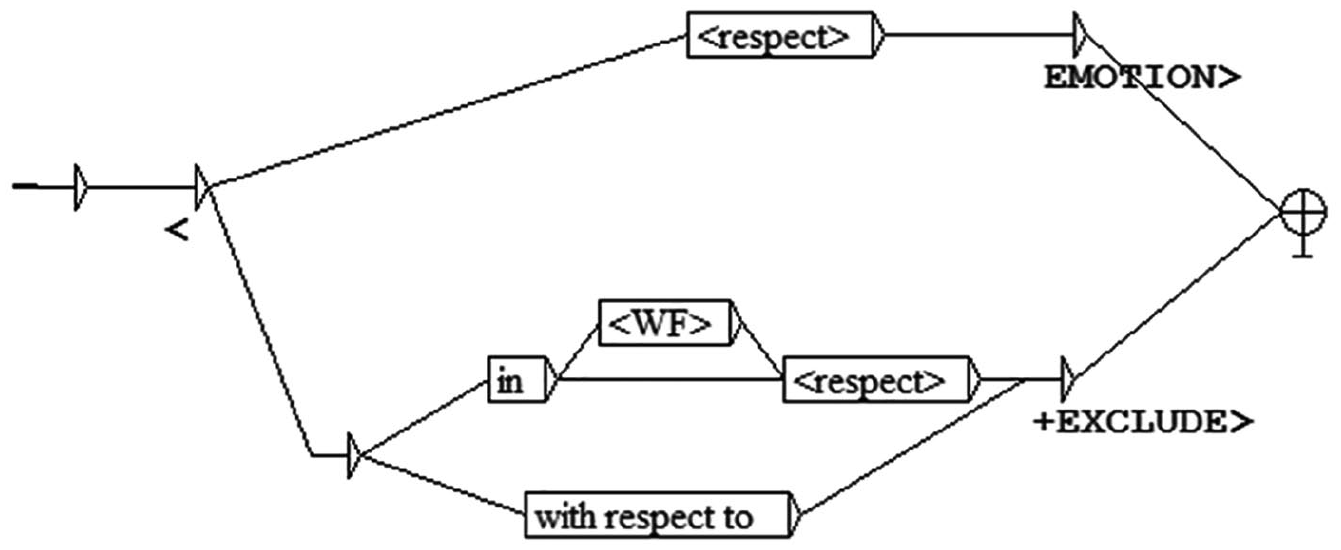
Local grammar for the exclusion of certain word sequences from hits of the emotion module.
The sequence “come-to-the-conclusion” also has a specific context in which the occurrence of the word “come” refers to a cognitive process. There is a local grammar that specifically checks whether the three words following each occurrence of the lemma <come>, matches the predefined context (to-the-<conclusion>).
4
Accordingly, a cognitive hit was identified in the sequence “Advisers have
The part of speech category that is assigned to each word in linguistic analysis can also be incorporated in local grammars. For example, the Intention dictionary contains the lemma “will.” However, only those occurrences of “will” where the assigned part of speech category is either a main verb or a noun, and not a modal auxiliary verb, are recognized as true hits for the intention module. In this way, the local grammar for “will” identified a true intention hit in the sentence “We are deeply sensible of these many expressions of good
The use of linguistic analysis and local grammars minimizes occurrences of false hits in the analysis. The dictionaries of the cognition, emotion, and intention modules without local grammars found 404, 519, and 589 hits, respectively. By adding local grammars, the number of hits decreased to 276, 337, and 56, respectively.
The cognition module identifies words and expressions that infer various cognitive states and processes of actors and the narrator in our texts. These include mental verbs (e.g., think, remember), nouns (e.g., inference, knowledge), idioms (e.g., draw lesson), and more complex linguistic structures describing mental operations. The module also identifies verbs and nouns that describe auditory (e.g., hear, listen) and visual perception (e.g., view, set eyes on) as elements of human cognition. An example of a cognition hit (underlined words are hits identified by the module): “My Ministers
The emotion module identifies words and expressions referring to the emotionality of actors and the narrator in the texts. These include verbs (e.g., hope, hurt), nouns (e.g., fear, fury), adjectives (e.g., grateful, happy), and idioms (e.g., keen on) relating to emotional states. An example of an emotion hit: “It gives me much
The intention module identifies descriptions of behavioral intentions of actors. These include intentional auxiliary verbs (e.g., must, have to), intentional nouns (e.g., intention, want), adverbs (e.g., deliberately, tactically), and expressions (e.g., as a matter of courtesy). An example of an intention hit: “My Ministers have
Reliability
The reliability of NarrCat’s analysis is reflected by the measures of recall and precision. The measure of recall was computed as the ratio of the number of units identified correctly by automated coding and the number of units coded automatically under that code. The measure of precision was computed as the ratio of the number of units identified correctly by automated coding and the number of units coded by the corresponding human coder. 5 The reliability measures produced were 86.4% and 94.6%, respectively, indicating that NarrCat performed a reliable analysis.
Social Reference Coding
Independent human coders removed false hits from NarrCat’s reported tallies before proceeding with the quantitative analysis. Coders then performed social reference coding where the correct hits identified by NarrCat’s modules were mapped to their respective actors. The main actors that emerged were Narrator (Governor), Crown (the British sovereign and his or her government in New Zealand), Parliament (popularly elected national representatives), British settlers, Māori, and Both settler and Māori subjects. 6
The actor for hits referencing Māori, natives, chief, tribe, iwi, and indigenous and aboriginal people were coded as “Māori.” The actor was coded as “Settlers” for hits referencing British and European settlers and colonists, as well as colonial soldiers. Local individual officials like statesmen and military officials were also coded as “Settlers” by default. The actor was coded as “Both settler and Māori subjects” for hits that referenced both racial groups collectively. These included Her Majesty’s subjects, inhabitants, people of the colony, people of New Zealand, or any combination of labels for Māori and European settlers. Hits that were stated in first person were coded for the “Narrator.” Hits that referenced the narrator’s advisers, ministers, home government, the sovereign, or Her Majesty were coded for the “Crown.” Hits that referenced the parliament of New Zealand or were stated by the narrator in second person were coded for “Parliament.”
Results
Patterns of psychological perspective were tested for significance through a multinomial analysis of variance using a maximum likelihood chi-square test statistic (Woodward, Bonett, & Brecht, 1990). To compare patterns of psychological perspective inferred for various actors in the texts, relative hits were used. That is, the percentage of mentions referencing psychological perspective relative to overall mentions of each actor were used for the analysis. This ensured that higher detection of psychological perspective for a given actor was not a by-product of that actor being mentioned more throughout the texts in general.
There was a significant infrahumanization effect of Māori compared with settlers, supporting Hypothesis 1a. As shown in Table 1 (rows 5 and 6), mentions of Māori contained significantly less references to psychological perspective than those of settlers, χ2(1, 351) = 62.811, p < .001.
Overall Mentions of Each Actor Throughout the Extracts and the Percentages of Those That Generated Hits for Psychological Perspective.
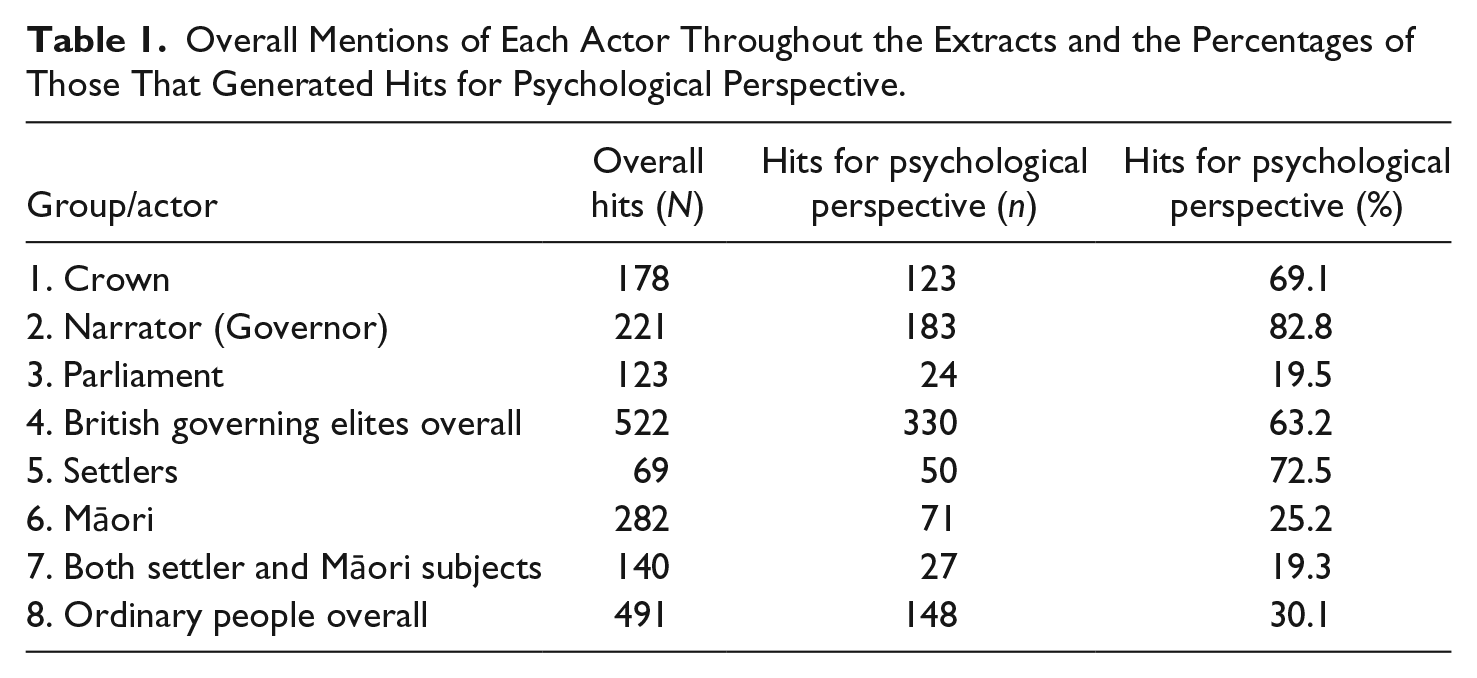
There was also a significant infrahumanization effect of ordinary people (Settlers, Māori, Both Māori and settler subjects) compared with British governing elites (Crown, Narrator, Parliament) supporting Hypothesis 2a. As shown in Table 1 (rows 4 and 8), mentions of ordinary people contained significantly less references to psychological perspective than those involving British governing elites, χ2(1, 1013) = 125.13, p < .001.
There were no significant differences between settlers and Māori in mentions of agency in references to their psychological perspective, χ2(1, 121) = 1.009, p = .315. As shown in Table 2 (rows 1 and 2), settlers did not have significantly greater mentions of cognition and intention in inferences about their psychological perspective than Māori disconfirming Hypothesis 1b. 7
Psychological Perspective Hits for Each Group and the Percentages of Those That are Cognition and Intention Versus Emotion Inferences.
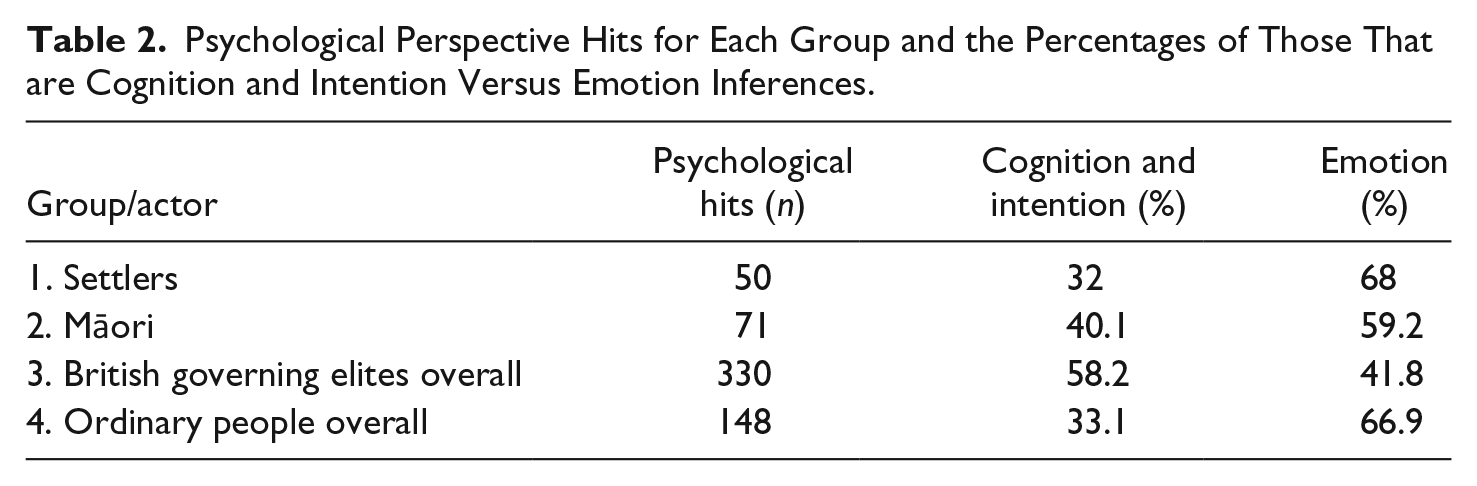
There were indeed significant differences in mentions of both agency and emotion between ordinary people (Settlers, Māori, Both Māori and settler subjects) and British governing elites (Crown, Narrator, Parliament), in references to their psychological perspective χ2(1, 478) = 28.146, p < .001. British governing elites had significantly greater mentions of cognition and intention in inferences about their psychological perspective compared with ordinary people supporting Hypothesis 2b. By contrast, ordinary people had significantly greater mentions of emotion in inferences about their psychological perspective than British governing elites as shown in Table 2 (rows 3 and 4). 8
Of overall mentions of Māori, 23.7% referenced psychological perspective during wartime (compared with 72.1% for settlers), while 25.9% referenced psychological perspective in the post-wartime period (compared with 73.1% for settlers). Based on this, there was no stronger infrahumanization effect of Māori during wartime (1854-1883) compared with the post-wartime period (1884-1913), χ2(1, 351) = 0.034, p = .5. Māori were not significantly more infrahumanized during the New Zealand Wars disconfirming Hypothesis 3.
To provide a further test of racial bias against Māori during wartime, NarrCat’s dispositional evaluation submodule was applied, which identifies words and phrases that evaluate a character or group’s disposition in positive versus negative terms. This found that Māori were attributed a negative evaluational ratio of 0.44 during the wars compared with 0.03 after the wars. 9 Therefore, Māori were significantly more negatively evaluated during the New Zealand Wars, χ2(1, 84) = 14.815, p < .001.
Discussion
The present study examined patterns of psychological perspective inferred for various groups in New Zealand’s elite discourses during the height of colonization (1854-1913). This was done by using NarrCat to map inferences of psychological perspective to actors (and the narrator) in historical “Speeches from the Throne.” Importantly, this research provides the first evidence of NarrCat’s ability to analyze English language patterns. Furthermore, through our application of its modules measuring the narrative categories of cognition, emotion, and intention, we demonstrated the program’s ability to quantify inferences of various psychological states in a large corpus of New Zealand speech extracts.
The current study can broadly be characterized by two steps, with the first involving an automated detection of language patterns by NarrCat, and the second involving human interpretation of these patterns in order to arrive at the theoretical conclusions related to colonization in New Zealand. The most important findings to arise from the first step of our analysis are as follows:
Māori were infrahumanized compared with settlers overall; however, this was not driven by differences in agency and was not more pronounced during a period of heightened intergroup conflict.
Ordinary people were infrahumanized compared with governing elites. British governing elites were consistently attributed greater psychological perspective over their subjects, especially in the form of agency (cognition and intention).
In the following sections, these findings are interpreted and discussed from the viewpoint of infrahumanization theory in combination with a wider literature, to make sense of the patterns identified by NarrCat in a manner that aligns with both theory and context.
Infrahumanization Driven by Racism and Elitism
Based on the theoretical framework of infrahumanization (Leyens et al., 2001), the current study predicted and found that patterns of psychological perspective in New Zealand’s historical “Speeches from the Throne” systematically corresponded to racial biases against Māori. Māori were attributed significantly less psychological perspective than settlers throughout the extracts. Therefore, it appears that the infrahumanization of Māori was part of New Zealand’s official colonizing discourse, but only to a certain extent.
Based on the dual model of infrahumanization (Haslam et al., 2005), we predicted that the infrahumanization of Māori would be driven by lower inferences of their agency. This hypothesis was not confirmed as Māori and settlers were attributed similar levels of cognition and intention in references to their psychological perspective.
Our prediction that more psychological perspective would be inferred for the groups comprising British governing elites than both their Māori and settler subjects was supported. Specifically, the narrator (i.e., the Governor) was attributed more psychological perspective than all other groups, followed by the Crown (i.e., the Queen, Imperial Government). 10 Considering historical factors of the British Empire, including its embedded social hierarchy (Cannadine, 2002) and the influence of British Enlightenment philosophy (Liu & Robinson, 2016), the current study also predicted that patterns of infrahumanization should reflect the real structure of inequality that existed between British governing elites and their subjects. The findings fully supported this prediction. With the assistance of NarrCat, we were able to detect the infrahumanization of ordinary subjects as being driven by relatively less references to their agency. This accurately reflects the greater agency that British elites did indeed hold in society during colonial times (Cannadine, 2002; Liu & Robinson, 2016).
In the extracts, the psychological perspective inferred for British governing elites largely consisted of cognitive and intentional hits involved in legislative decision making (e.g., “The danger and difficulties of the position were
According to the dual model of infrahumanization, this uneven distribution of agency would have contributed to justifying the position of British governing elites as morally responsible figures or the “moral agents of society” (Epley & Waytz, 2010; Haslam et al., 2005). Such a position of moral responsibility indicates a duty or obligation for guiding others who are lacking in their own psychological agency, toward correct moral, social, and intellectual standards. This is also consistent with Liu and Robinson’s (2016) discursive formulation of benevolent tutelage. That is, by being positioned as the link between God and their people, governing elites could legitimize their status as benevolent leaders who were morally bound by duty to “protect and guide” their subordinates for the purpose of greater public good.
In sum, a model of infrahumanization that is shaped mainly by a social hierarchy of inequality and secondarily by racial bias seems to best describe New Zealand’s official discourses during the colonial era. Greater psychological perspective, and therefore humanness, was inferred for the British settlers over the indigenous Māori overall, while greater agency in particular was reserved for those occupying a high position in the hierarchy of the Empire.
The Humanizing of Māori as a “Civilizing” Mission
It has been posited that infrahumanization becomes more explicit and extreme under conditions of intergroup conflict (Haslam & Loughnan, 2014; Staub, 1989) leading us to predict that the infrahumanization of Māori would have been more pronounced during the New Zealand Wars. This prediction was not supported, as the results showed that Māori were attributed similar levels of psychological perspective during and after the New Zealand Wars. Instead of being dehumanized and stripped of agency during conflict (Fussell, 1989), Māori resistance seems to have been framed in ways that actually acknowledged some agency in warfare (see also Belgrave, 2017). A closer reading of the extracts shows that Māori actors were acknowledged to have human qualities in thoughts and intentions, but these were often associated with agency in plotting violent deeds during the wartime period.
Guided by historical observations, we can interpret that the psychologizing of Māori during wartime could be incorporated as a tool for New Zealand’s colonizing discourses. For example, the psychological perspective inferred for Māori during conflict could be framed in ways that emphasized the “Bad Māori” narrative (McCreanor, 1997). Portrayals of Māori as barbarously but intentionally cruel and violent could be achieved by “Bad Māori” psychologizing (e.g., “They have for some time past been
Although less emphasized during wartime, it is also noteworthy that there were some instances of Good Māori psychologizing, involving portrayals of them as having intentions to assimilate to “enlightened” British norms, ideals, and lifestyles (e.g., “My Government has eagerly watched for, and gladly accepted every indication on the part of any of these natives, of a desire to live peaceably with their fellow-subjects . . . ”). Through some consistent acknowledgment of Māori thoughts and intentions, they were depicted as being capable of choosing to live either as Bad (resisting) or Good (assimilable) Māori.
These arguments are not to say that racial prejudice and discrimination were not prevalent during the reign of the British Empire. Rather, it makes sense that a colonizing approach framed as a “civilizing mission” (Liu & Robinson, 2016), would need to consistently incorporate some psychological perspective of Māori, including their thoughts and intentions.
A traditional dehumanization discourse would serve a “destroy and eliminate” approach to colonization well. By contrast, some consistent humanizing of the out-group would be necessary for a “civilizing” approach. In line with the latter, infrahumanization of Māori in these speeches was nuanced with agency never being fully denied even at the height of conflict. In this way, the patterns identified by NarrCat provide quantitative support to the complex story of colonization in New Zealand. That is, while there was some racial bias against Māori overall, this had to be balanced against a civilizing mission that was built on the central premise of Māori possessing some inherent, uniquely human potential (i.e., agency). On the other hand, British governing elites were consistently attributed far greater agency than their subjects, reinforcing their responsibility for setting society’s moral and intellectual standards, and for elevating Māori (and settlers) to reach their “enlightenment potential” (Liu & Robinson, 2016).
It is important to note the limitations of our corpus, given the specific function of the “Speeches from the Throne.” These speeches only highlight discourses communicated on behalf of the elites to ordinary people, rather than capturing patterns of discourse shared among ordinary people across the Empire. Therefore, future research should focus on sources of wider public discourse and investigate whether the same patterns still hold. Future studies that analyze discourses in both elite and nonelite spaces may be able to further test whether a hierarchical distribution of agency was collectively acknowledged in this historical context (or not).
In future studies, infrahumanization theory should also be compared across various (historical) contexts. Australia is known for having a similar history of colonization to New Zealand (Tuffin, 2008), however, their treatment of indigenous people during colonization was markedly different from how the indigenous people of New Zealand were treated and therefore, represented and perceived. The approach taken in Australia was forcible surrender rather than an approach based on a civilizing mission (Ryan, 2012). Throughout its colonization, indigenous groups were dispossessed, marginalized, and even subjected to genocide (Augoustinos, Tuffin, & Rapley, 1999). The distribution of psychological perspective in the historical context of Australia may therefore resemble more traditional dehumanization. Future research should analyze texts across various contexts to identify important similarities and differences.
Conclusion
Through the current study, we demonstrated the strengths of NarrCat to augment the computerized study of psychological meaning in texts in two ways. First, we demonstrated NarrCat’s ability to embed (English) words in complex grammatical structures. Second, we were able to apply intergroup theory to its narrative categories allowing a precise test of psychological theory in an era for which only documentary evidence is available.
In addition, the current study demonstrated an application of infrahumanization theory to the specific historical context of colonization in New Zealand. Infrahumanization is an implicit bias that functions to justify the superiority of an in-group by inferring more psychological perspective of that in-group compared with a relevant out-group, particularly in the form of psychological agency (reasoned thought and planned action). The findings of the present study demonstrated that in New Zealand’s official discourses during colonization, psychological perspective was indeed prioritized for the British in-group over Māori overall. However, agency was prioritized only for a specific subset of this in-group, that is, the governing elites, positioning them as the moral agents of society. Overall, these patterns support the “civilizing” approach as being the dominant colonizing strategy in New Zealand.
Supplemental Material
Supplementary_material_2 – Supplemental material for Automated Analysis of Narrative: NarrCat and the Identification of Infrahumanization Bias Within Text
Supplemental material, Supplementary_material_2 for Automated Analysis of Narrative: NarrCat and the Identification of Infrahumanization Bias Within Text by Sarah Choi, James H. Liu, István Csertő, Orsolya Vincze, Éva Fülöp and Tibor Pólya in Journal of Language and Social Psychology
Footnotes
Acknowledgements
This article is dedicated to the memory of Professor János László. We would also like to thank the anonymous reviewers for their comments, which has greatly helped in improving the article.
Declaration of Conflicting Interests
The author(s) declared no potential conflicts of interest with respect to the research, authorship, and/or publication of this article.
Funding
The author(s) disclosed receipt of the following financial support for the research, authorship, and/or publication of this article: The fourth author has been supported by the European Union, cofinanced by the European Social Fund (Grant number EFOP-3.6.1.-16-2016-00004, grant title: Comprehensive Development for Implementing Smart Specialization Strategies at the University of Pécs. The last author has been supported by the National Research, Development and Innovation Office (NKFIH) Grant number K 109009 and K 124206.
Supplemental Material
Supplemental material for this article is available online.
Notes
Author Biographies
References
Supplementary Material
Please find the following supplemental material available below.
For Open Access articles published under a Creative Commons License, all supplemental material carries the same license as the article it is associated with.
For non-Open Access articles published, all supplemental material carries a non-exclusive license, and permission requests for re-use of supplemental material or any part of supplemental material shall be sent directly to the copyright owner as specified in the copyright notice associated with the article.
