







Abstract
Metaphors are frequently used linguistic devices that have the power to clarify ambiguous topics. In turn, a clear and stable self-concept is important to psychological functioning. The current article examines the potential role of self-concept clarity in understanding metaphor usage. Study 1 found that self-concept clarity negatively predicts metaphor usage. Study 2 found that experimentally lowering self-concept clarity led to more metaphor usage in general, and that self-reported self-concept clarity was implicated as a potential mediating factor. Implications are discussed.
The ancient maxim “know thyself” and the oft repeated “I don’t know who I am anymore” suggest that, at times, people grapple with understanding themselves. How might this pursuit for self-coherence, or self-concept clarity (SCC; Campbell, 1990; Campbell et al., 1996), influence linguistic preference? Far from merely being a medium through which people express themselves, language choice conveys much about how people view and experience the world (e.g., Pennebaker, Mehl, & Niederhoffer, 2003; Tausczik & Pennebaker, 2010). Among many forms of language and communication that provide such insights is the use of metaphor, conceptualized as a potent psychological force in how people interface with their social world (Lakoff & Johnson, 1980).
Although previous theory and research implicate a connection between self-understanding and the epistemic benefits of metaphor (e.g., Keefer, Landau, Sullivan, & Rothschild, 2011), this relationship has yet to be examined directly. The present studies provide such an examination. In so doing, we adopt an integrative methodological orientation that draws from both the traditional language and communication research in documenting relationships between key variables and the social psychological tradition of experimental manipulation to enable causal inference (Patterson, Giles, & Teske, 2011). Specifically, Study 1 seeks to identify the relationship between SCC and metaphor usage, and Study 2 asks whether a lack of SCC would stimulate the linguistic preference for metaphor.
Self-Concept Clarity and Conceptual Metaphor Theory
Given the deleterious consequences that ambiguity about the self can foster, from lower well-being to anxiety and depression (Campbell, 1990; Wu, Watkins, & Hattie, 2010), people are often motivated to seek clarity about the self and the world around them. Although a number of strategies are implicated in such pursuits (e.g., Hogg, 2001), comparatively less research has examined the role of language, and in particular, that of metaphor.
While some view metaphors as simple rhetorical devices, conceptual metaphor theory (CMT; Lakoff & Johnson, 1980) explains their power to shape attitudes, behaviors, and cognitions (e.g., Andrighetto, Riva, Gabbiadini, & Volpato, 2016). CMT articulates how using a metaphor enables the understanding of one concept (the target) in terms of another (the source). Through the process of conceptual mapping, aspects of the source are linked to analogous aspects of the target (Kövecses, 2010; Landau, 2017). In this way, metaphoric framings can have a powerful influence on subsequent attitudes, feelings, and behaviors regarding the target concept. For example, describing crime as a “beast preying on the city” or a “virus infecting the city” led participants to prefer an aggressive or reformist law enforcement strategy, respectively (Thibodeau & Boroditsky, 2011). Presumably this shift in judgment occurred as a result of transferring meanings associated with the metaphor. Beasts are often confronted directly with force, whereas viruses must be diagnosed and treated.
Research integrating CMT and lay epistemic theory (Kruglanski, 1990) reveals metaphors are more readily used when there is uncertainty about the topic (Landau, Keefer, & Rothschild, 2014). The present research reasons that because metaphors help provide epistemic clarity, they might be useful when people are uncertain about who they are. People commonly use metaphors to describe the self, their actions, and their existential situation (Moser, 2007; Schlegel, Vess, & Arndt, 2012). These metaphorical descriptions may, in turn, help people feel they have greater clarity about who they are and their existential world. In one study, participants who organized personal life experiences along a path (vs. organizing chronologically), and thus adopted the metaphor of “life is a journey,” perceived more autobiographical continuity between past events and their current self-concept if they were first primed with uncertainties about the self (Keefer et al., 2011). Furthermore, Fetterman, Bair, Werth, Landkammer, and Robinson (2016) showed that the tendency to use metaphor more generally is associated with the functional impact of emotional understanding.
Present Research
To date, research examining the appeal of metaphors has tended to utilize specific metaphors related to specific domains of interest (e.g., Keefer et al., 2011; cf. Fetterman et al., 2016). Less research has examined the appeal of metaphor usage in general, or the more general role of SCC as a motivator for using metaphors. The present studies examine the hypothesis that if there is a desire for reducing self-ambiguity, and metaphors are an effective linguistic tool that increases the understanding of abstract and ambiguous concepts, then when SCC is low there should be a greater desire for linguistic metaphor usage. By first testing for a relationship between SCC and metaphor usage, and then experimentally manipulating SCC before measuring subsequent metaphor usage, the studies can potentially indicate not only when metaphoric language is preferred but also why; thus, providing a key window into the motivations underlying self-understanding and the associated role of metaphoric language.
Such insights might then position the analysis to offer a more nuanced understanding of the types of metaphors that are preferred. For example, it is unknown whether low SCC would motivate metaphor usage broadly or only for metaphors used to understand the self. Of course, many CMT studies have shown that metaphors are used to understand specific concepts or ideas. Still, given the centrality of the self in people’s understanding of the world, confusion about their self-concept might call into question other understandings, thus motivating broad metaphor usage. We return to this issue in Study 2 and in the General Discussion.
Study 1
The first study informs the extent to which different existential feelings predict preference for metaphors. In addition to SCC, self-esteem, uncertainty, and meaning were also assessed as each has been identified as an existential catalyst of social cognition and behavior (e.g., Ritchie, Sedikides, Wildschut, Arndt, & Gidron, 2011). To this end, participants completed measures of the aforementioned constructs as well as a measure of general metaphor usage (MUM; Fetterman et al., 2016) to elucidate predictors of metaphor preference. Previous research validating the MUM has shown that it predicts, for example, the use of metaphors in written language, susceptibility to the effects of metaphor transfers (e.g., acting pro-socially on days one eats sweeter foods), and moderates the persuasiveness of metaphoric advertising messages (Bok & Yeo, 2019; Fetterman et al., 2016).
Method
Participants and Design
Participants (N = 263) were recruited from Amazon’s Mechanical Turk and compensated with 50 cents. After excluding those who failed to complete the dependent measures or attention-check items within the MUM (i.e., two items asked participants to “please select this option”), and those whose primary language was not English or indicated having trouble understanding language in the study, a final sample of 228 participants was analyzed (70% women, age range = 18 to 80 years, M = 36.60, SD = 12.32 years). 1
Previous research documenting associations with the MUM used student-based sample sizes of about 130 (Fetterman et al., 2016). Because Mturk samples can often have smaller effect sizes (Chandler, Paolacci, Peer, Mueller, & Ratliff, 2015), we aimed to exceed this number as available funds allowed. Entering the final sample size into a sensitivity power analysis revealed a minimum effect size of r = .18, given α = .05 (two-tailed) and power = .80.
Procedure and Materials
Participants completed online materials including a consent form before responding to the measures described below, followed by a debriefing form.
Self-esteem
Self-esteem was measured with four items from the Rosenberg Self-Esteem Scale (Rosenberg, 1965; e.g., “I feel that I am a person of worth, at least on an equal basis with others”; α = .88). Responses were made on a 4-point scale ranging from 1 (strongly disagree) to 4 (strongly agree).
Self-certainty and general certainty
Self-certainty was assessed with two items “I feel confident in my understanding of myself” and “I feel uncertain about myself” (reverse scored; α = .83). Worded similarly, general certainty was assessed with two items about participants’ confidence in their “understanding of the world” and their “uncertainty about the world” (reverse scored; α = .70). Participants responded on a 7-point scale ranging from 1 (strongly disagree) to 7 (strongly agree).
Metaphor usage
To measure preference for metaphoric language, participants completed the 30-item MUM (Fetterman et al., 2016). Each item consisted of two phrases—one metaphoric and one literal—each with equivalent meaning (e.g., “she uses her head” vs. “she makes rational decisions”; “I slept well” vs. “I slept like a rock”; “She is very nice” vs. “She is a saint”). Participants selected the phrases they would be “more inclined to say, think, or write right now at this moment.” A higher proportion of metaphoric phrases indicates more preference for metaphor usage (α = .86).
Self-concept clarity
Participants completed a 12-item measure of SCC (Campbell et al., 1996), using a 7-point scale ranging from 1 (strongly disagree) to 7 (strongly agree; α = .95). Sample items include “In general, I have a clear sense of who I am and what I am” and “My beliefs about myself seem to change very frequently” (reverse scored).
Meaning in life
Participants completed the 10-item Meaning in Life Questionnaire (Steger, Frazier, Oishi, & Kaler, 2006) using a 7-point scale ranging from 1 (absolutely false) to 7 (absolutely true). This includes two subscales: presence of meaning (e.g., “I understand my life’s meaning”; α = .94) and search for meaning (e.g., “I am always looking to find my life’s purpose”; α = .94).
Demographics and Suspicion
Participants reported their age, gender, educational background, ethnicity, political orientation, primary language, and were prompted with three questions gauging general suspicion about the study’s purpose (e.g., “What do you think this study was about?”). None of the participants were excluded based on their responses to these questions.
Results and Discussion
As shown in Table 1, metaphor usage was significantly negatively correlated with SCC, general certainty, the presence of meaning in life subscale, and self-esteem, such that participants with lower levels of these constructs selected metaphoric items more frequently.
Study 1 Bivariate Correlations for Metaphor Usage, Self-Concept Clarity, Meaning in Life, Self-Esteem, and Certainty.
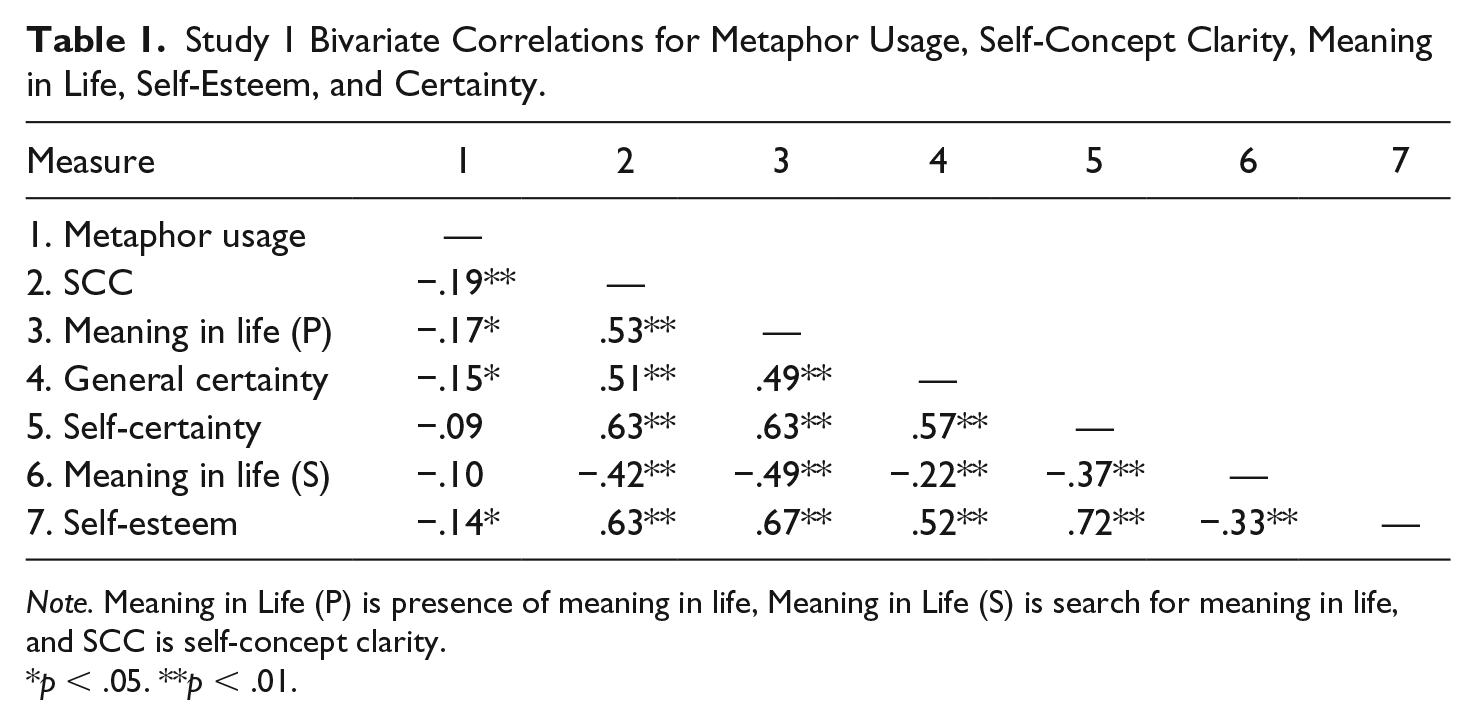
Note. Meaning in Life (P) is presence of meaning in life, Meaning in Life (S) is search for meaning in life, and SCC is self-concept clarity.
p < .05. **p < .01.
To determine if any of these constructs uniquely predicted metaphor usage, a simultaneous regression was conducted. The model including predictors of SCC, general certainty, presence of meaning in life, and self-esteem was significant (R2 = .05, F[4, 223] = 2.60, p = .04). Furthermore, there was a mild tendency for SCC to maintain a stronger unique relationship with metaphor usage (β = −.14, p = .11) than meaning in life (β = −.10, p = .29), general certainty (β = −.05, p = .54), or self-esteem (β = .05, p = .65). Given the relative strength of the relationships for SCC and presence of meaning in life, an additional simultaneous regression was conducted with only these two predictors. Presence of meaning in life predicted MUM scores (β = −.091, p = .239) to a lesser extent than SCC (β = −.143, p = .064).
As evidenced by the pattern of negative correlations, low levels of general certainty, self-esteem, meaning in life, and SCC may contribute to metaphor usage. Of course, these constructs are all intertwined and thus it makes sense they would all converge as predictors. Of present interest is the evidence that SCC may be a potential catalyst. As elucidated above, metaphors are used to clarify ambiguous concepts. When the self is perceived as ambiguous, as when SCC is low, perhaps metaphoric language becomes especially attractive. Of course, the correlational nature of the study design falls short of directly supporting this causal reasoning.
Study 2
Study 2 was designed to determine if there is a causal link between SCC and metaphor usage. By manipulating SCC, Study 2 can reveal whether lower levels of clarity about the self do, indeed, lead to more metaphor usage in general.
Method
Participants and Design
MTurk workers (N = 575) completed a brief online questionnaire. The sample size aimed to exceed that used in previous research with this SCC manipulation (Emery, Walsh, & Slotter, 2015) based on availability of funds. Study 1’s exclusion criteria were applied, with an additional criterion of eliminating those that obviously did not follow instructions for the writing task manipulation (e.g., wrote nonsense). The final sample size was 484 (SCC threat n = 245, SCC confirmation n = 239). 2 Entering the final sample size into a sensitivity power analysis revealed a minimum effect size of d = .26, given α = .05 (two-tailed) and power = .80. The sample was similar to Study 1 with regard to gender (57% women) and age (age range 18-98 years, M = 38.04, SD = 14.07 years).
Procedure and Materials
SCC manipulation
After filler items, participants were randomly assigned to either a SCC threat or SCC confirmation condition previously used to manipulate SCC among MTurk samples (e.g., Emery et al., 2015). In the threat condition participants listed two inconsistent personal attributes (e.g., “ambitious” and “lazy”), and then wrote about “how these two attributes sometimes come into conflict with one another in everyday life” for 5 minutes. Those in the confirmation condition did the same thing for two complementary attributes (e.g., “ambitious” and “successful”). 3 In this way, participants in the threat condition would have ruminated about the self in conflict, while those in the confirmation condition would have ruminated about the self in accord.
Self-concept clarity
Participants then completed the 12-item measure of SCC used in Study 1 (α = .95). For this and the following, participants were asked to answer “based on their feelings in the present moment.”
Metaphor usage measure
Similar to Study 1, participants completed a version of the 30-item MUM scale (α = .82). 4
Self-esteem
Self-esteem was measured with one item “I have high self-esteem” (Robins, Hendin, & Trzesniewski, 2001). Responses were made on a 7-point scale ranging from 1 (absolutely false) to 4 (absolutely true) with instructions specifying current feelings. These instructions and scale also applied to the scale below.
Meaning in life
Participants completed four items from the Meaning in Life Questionnaire (Steger et al., 2006). Two items were from the presence of meaning subscale (α = .86) and the search for meaning subscale (α = .88).
Demographics and Suspicion
These were the same questions as in Study 1.
Results and Discussion
Participants in the SCC threat condition evidenced lower SCC scores (M = 4.65, SD = 1.48) compared with the SCC confirmation condition (M = 5.18, SD = 1.51), t(482) = −3.86, p < .001, d = .35. There was no significant effects of the SCC manipulation on either self-esteem (t[482] = −0.99, p = .32, d = .09), presence of meaning in life (t[482] = −1.83, p = .07, d = .17), or search for meaning in life (t[481] = 0.83, p = .41, d = .08). 5 This indicates the successful manipulation of SCC specifically.
To test the hypothesis that a threat to SCC would lead to greater preference for metaphoric phrases, an independent samples t test was conducted. Participants in the SCC threat condition chose proportionally more metaphoric items on average (M = 0.45, SD = 0.20) than those in the SCC confirmation condition (M = 0.41, SD = 0.19), t(482) = 2.33, p = .02, d = .21. 6
Given the proposed theoretical relevance of SCC on the desire to use metaphors and the aforementioned effect of the manipulation on SCC scores, mediational analyses were conducted (Hayes, 2012; Model 4) using bootstrapping (e.g., Preacher, Rucker, & Hayes, 2007) with 5,000 replications. Results found a significant indirect effect of condition on metaphor usage through SCC (β = −.0078, standard error = .0039; 95% confidence interval [−.0165, −.0014]). This analysis increases confidence that it was, in fact, decreased SCC that lead to increased preference for metaphor.
General Discussion
Do I contradict myself?/Very well then . . . I contradict myself/I am large . . . I contain multitudes. (Whitman, 1855/1973, section 51)
Walt Whitman famously accepted his self-complexity by metaphorically referencing his size. The present research helps inform whether such a reference to size may have been a response to the realization of complexity. More than just decoration, metaphors are linguistic and cognitive tools that can clarify ambiguous concepts and help people make sense of the world. Building from a tradition of conceptualizing language as a window into how people think about and experience the social world (Tausczik & Pennebaker, 2010), we reasoned linguistic metaphors should be particularly appealing when people are faced with a lack of clarity about the self.
Two studies demonstrated correlational and experimental evidence that low SCC contributes to metaphor usage. Study 1 found that epistemic perceptions predict preferences for metaphor use. SCC, meaning in life, self-esteem, and general uncertainty were all negatively correlated with metaphor usage. Although SCC was only marginally correlated with MUM scores when controlling for the other measures, it was the strongest predictor. This does not suggest that SCC is necessarily a more globally privileged catalyst of metaphor usage than meaning, self-esteem, or uncertainty (Baldwin, Landau, & Swanson, 2018); rather, the findings point to the key role that SCC may play. Study 2 confirmed this causal reasoning. When SCC was situationally lowered, preferences for metaphor were higher. In addition, mediational analyses suggested lowering of SCC did in fact contribute to metaphor preference.
The present studies are clearly a preliminary step in exploring the linguistic use of metaphors as it relates to SCC. More research should replicate and explore how metaphor and SCC operate in more “organic” settings and with more nuanced insight into the type of metaphors SCC influences. For instance, Fetterman et al. (2016) found that the MUM predicted metaphor use in written expressions. A reasonable next step would thus be to examine the connection between SCC and written or verbal language use. Given concerns about a decline in varied research methodologies in the social psychology literature (but not communication and language; e.g., Patterson et al., 2011), such inquiry is especially needed in naturalistic settings. In addition, the present research is limited to assessing a more generalized interest in metaphor use. Although Study 2 tried to examine differences in preference for self-relevant versus non–self-relevant metaphors, the MUM is not designed to tap into such differences and the results were inconclusive (see Note 4). As noted in the introduction, there are reasons to suspect both specificity and generality in the present effects.
A further direction could examine whether metaphor usage enhances previously threatened SCC, which would then speak to the potential therapeutic use of metaphoric expression when someone is struggling with forming a stable and clear identity. Indeed, Baldwin et al. (2018) highlight the potential of metaphor to enhance reports of meaning in life (see also Schlegel et al., 2012). Specifically, those who framed life as a metaphorical journey reported more meaning in life, especially when initially having low levels of perceived coherence. This suggests that a readily accessible metaphor such as a journey can provide interrelatedness and coherence to life events, which in turn predicts a perception that life is more meaningful. However, it is important to note that not all metaphors are created equal and thus, such research should proceed cautiously. If specific metaphors do not resonate with the target audience, they can be ineffective or even invite more confusion (Hauser & Schwarz, 2015; Keefer, Landau, Sullivan, & Rothschild, 2014).
In sum, the present findings provide the first demonstration of a connection between a linguistic preference for metaphors with low dispositional levels of SCC, and critically, as a response to situationally lowered SCC. The findings invite further inquiry into the more general epistemic function of language and what this could mean for self-perception.
Footnotes
Acknowledgements
The authors would like to thank the anonymous reviews that contributed with helpful feedback as well as the many research assistants for their hard work and valuable input including: Anna Tamasi, Natalie Edwards, Luke Mouton, Chip Jacobsen, Austin Rogers, Jessica Edgar, Elizabeth Cozzoni, Suryanshi Rawat, Bryn Bandt-Law, Kelsey Walling, and Kevin Strong.
Declaration of Conflicting Interests
The author(s) declared no potential conflicts of interest with respect to the research, authorship, and/or publication of this article.
Funding
The author(s) disclosed receipt of the following financial support for the research, authorship, and/or publication of this article: This research was funded by the primary faculty advisor at the University of Missouri, Jamie Arndt.
