







Abstract
Online excessive gaming has been associated with negative player identity constructions depicting an abnormal life-style. Up-to-date, there is limited insight into player identity management talk about excessive online gaming. To address this gap, drawing from discursive and rhetorical psychology, we investigated naturally occurring talk of 134 players of World of Warcraft (WoW) -a Massively Multiplayer Online Role-Playing Game (MMORPG)- from three publicly available websites and of five players from one focus group. The analysis illuminated participants’ dilemmatic and contradictory ways of constructing the player identity, while displaying immersion in the game. Participants invoke identity constructions like ‘nolifer’, ‘hardcore’ or ‘clean’ player, which they disavow or assign to themselves and to each other depending on the conversational context, while attending to concerns about (ab)normalcy. The study’s findings highlight a dynamic process of player identity construction in talk, occasioned by and exemplifying the contingencies of the discursive context.
In this article, we focus on player identity management talk about excessive, online gaming by presenting a discursive analysis of players’ discourse about the World of Warcraft (WoW), a popular Massively Multiplayer Online Role-Playing Game (MMORPG).
The virtual world of online gaming has been increasingly cultivating online communities world-wide, where millions of people interact individually or within groups, through their avatars, like in MMORPG (Bacchini et al., 2017; Guegan et al., 2015; O' Connor et al., 2015; Yee, 2006). Such environments are reported as fostering immersion and excessive gaming due to such games’ characteristics, like ‘persistence’ and ‘perpetuity’ (Hussain & Griffiths, 2009, p. 564). The game continuously evolves even at players’ absence and never finishes as the game has no definite end (Badrinarayanan et al., 2015; Barnett & Coulson, 2010; Pulos, 2013). Immersion has been associated with problematic gaming, that is, gaming harmful for players’ work or personal relationships (Kuss et al., 2012). Accordingly, a negative players’ image is often invoked involving identity categories, like the nolifer, that is, a player with no life beyond the game (Bergstrom et al., 2016). Such iconography has pathologized excessive gaming (Cole & Griffiths, 2007; Griffiths et al., 2016) with players’ being depicted as leading an abnormal life (Bergstrom et al., 2016). These constructions are widely spread in lay and scientific discourse (e.g., Bergstrom et al., 2016) and there is evidence that players also hold such negative identity stereotypes (Stone, 2019). However, research on player identity with respect to excessive gaming is scarce and mostly includes survey studies approaching identity in ways more compatible with a cognitive stance (e.g., Stone, 2019).
Οnly few studies (Aarsand, 2012) have investigated how players themselves orient to and debate identity constructions with respect to excessive online gaming within naturally occurring talk about gaming. Consequently, little is so far known regarding player identity management talk about excessive online gaming, especially from an endogenous, that is, from participants’ own orientation, perspective. Aiming to contribute such insight, we join proposals for studying identity management as a discursive accomplishment (Antaki et al., 1996; Benwell & Stokoe, 2006; Lamerichs & Te Molder, 2003; Stapleton, 2016; Wilkes & Speer, 2021) by adopting a discursive psychology (DP) approach (Edwards & Potter, 1992). Following a brief overview of research on excessive gaming and player identity, we report discursive analysis illustrating player identity management talk about excessive gaming.
Immersion in Virtual World(s), Player Identity and Abnormalcy
The virtual world of online games, like MMORPG, offers players the chance to engage in various interactive, group gaming activities. For example, in the WoW, one very popular MMORPG recently counting 3.952,021 players (MMO Populations, 2020), players join guilds, that is, structured sub-groups whose members share common goals and characteristics, like costumes (Guegan et al., 2015; O' Connor et al., 2015; Pinto et al., 2015). Guild members follow specific rules and engage in tasks to collaboratively accomplish quests, that is, game-initiated challenges resulting in rewards and raids, meaning group missions against enemies like another group (Badrinarayanan et al., 2015; O' Connor et al., 2015; Pinto et al., 2015). Engagement in such group activities can lead to rewarding social relationships without necessarily endangering players’ ‘real’ lives (Barnett & Coulson, 2010; Cole & Griffiths, 2007). However, gaming presupposes being fully engaged with the game without distractions during a raid (Hellman et al., 2017). Furthermore, progressing in the game necessitates that players devote considerable time online, while being cut off from off-line activities (Barnett & Coulson, 2010). Accordingly, there is a well-entrenched image in lay, media and scientific discourse depicting excessive online gaming players, as disconnected from real, face-to-face communication, a process described as absorption or immersion (Barnett & Coulson, 2010; Bergstrom et al., 2016; Hellman et al., 2017).
Despite reports that excessive gaming and game immersion is a positive and rewarding, enjoyable experience (Barnett & Coulson, 2010; Snodgrass et al., 2019), online games like MMORPG have been sketched as the ideal setting for fostering online gaming addiction or problematic gaming via excessive gaming (Aarsand, 2012; Bacchini et al., 2017; Hellman et al., 2017; Kuss et al., 2012). Overall, engagement with such games has been considered a ‘highly immersive experience’ (Bacchini et al., 2017, p. 1993), with MMORPG being identified as the most ‘addictive internet activity’ (Hellman et al., 2017, p. 1711). Accordingly, the ensuing academic discussion tends to pathologize online gaming, like when examining excessive gaming as a possible mental health disorder (Griffiths et al., 2016). Consequently, such gaming has been associated with abnormal, un-healthy living (Bergstrom et al., 2016).
Players themselves, also associate immersion and excessive gaming with problematic gaming and addiction (Chappell et al., 2006). Identity categories popular in online gaming discourse, like the ‘casual’ and the ‘hardcore’ player, denote a frequently reported distinction (Aarsand, 2012; Shaw, 2011; Stone, 2019) coined by Juul (2010): gamers playing for fun without investing too much time are distinguished from those engaging in excessive gaming, without any involvement in activities beyond gaming, which suggests addiction. Despite the relevance of this topic, research focusing on player identity management in respect of excessive gaming is practically non-existent. Few studies (Guegan et al., 2015; O' Connor et al., 2015), drawing from social identity theory (Tajfel & Turner, 1979) or self-categorization theory (SCT) (Turner et al., 1987), undertake a broader focus on social identity in MMORPG, that is, on one’s sense of identity through identification with a social group. For example, such studies focus on how players’ belonging to a guild fosters a sense of social identity within the game (Guegan et al., 2015) or on the process of identification with the gamer identity (O' Connor et al., 2015).
Some studies (e.g., Stone, 2019), following survey designs, have investigated stereotypical constructions of players’ identity or players’ reactions to stereotypical constructions, evidencing the persistence of negative images and players’ holding negative player identity stereotypes. They have focused on investigating the ‘truth’ of stereotypical identity categories or the extent to which players accept such constructions. Such studies lean on theoretical approaches, treating self-categorizations as individual cognitive functions, contingent on associated social contexts, with context treated as ‘a rather passive phenomenon’ (Lamerichs & Te Molder, 2003, p. 457). Consequently, identity categories are conceptualized as entities to which people individually and mechanically ascribe, via a process of internalizing social norms (Lamerichs & Te Molder, 2003). In that sense, existing research does not attend to calls (e.g., Bergstrom et al., 2016; Stone, 2019) for studies illuminating how players invoke and debate player identity categories in talk about excessive online gaming.
A Discursive Psychology Approach to the Study of Player Identity Management
Approaches like DP or conversation analysis (CA) have promoted the study of identity as a discursive, situated accomplishment within talk (Benwell & Stokoe, 2006). DP (Edwards & Potter, 1992) approaches all psychological phenomena, as ‘social phenomena which are locally produced and managed’ (Lamerichs & Te Molder, 2003, p. 459), within talk-in-interaction, rather than as inner, cognitive phenomena (Edwards & Potter, 1992; Potter, 2012). Accordingly, DP considers identity categories as flexible rhetorical resources which speakers employ while attending to interpersonal aims (Benwell & Stokoe, 2006). Discursive practices are treated as constitutive of identity and not as merely mirroring pre-existing, internalized identities. Thus, DP forwards a naturalistic perspective to the study of identity, contextualized within discursive practices by illuminating the ways in which participants’ endogenous categorization practices attend to accountability issues. Attendance to accountability issues suggests attendance both to the accountability of the identity categories invoked in the participants’ reports, as well as to participants’ own accountability for occasioning and constructing the report produced (Edwards & Potter, 1993). DP is closely affiliated with CA (Sacks et al., 1974) and rhetorical psychology (Billig, 1991, p. 1996) and is increasingly being employed across disciplines (Tseliou et al., 2019). A number of studies have employed CA for the study of interaction during online gaming (e.g., Aarsand & Aronsson, 2009; Piirainen-Marsh & Tainio, 2009). DP is also argued as bearing potential for analyzing online discourse, like forum posts (Goodings et al., 2007; Lamerichs & Te Molder, 2003; Meredith, 2021; Paulus et al., 2016). Nevertheless, its use in such context remains limited.
Few studies (Aarsand, 2012; Bergstrom et al., 2016; Shaw, 2011) have up-to-date undertaken an in-situ study of player identity management talk about excessive gaming. Undertaking an ethnographic perspective, Shaw’s (2011) study attempted to problematize video gamers’ identification as gamers. While referring to video gaming as a highly addictive activity, video gamers exhibited concerns to disavow the stigma of gaming, due to the guilt associated with the pleasure inherent in gaming. Similarly, Bergstrom et al.’s (2016) analysis of Massively Multiplayer Online Game (MMOG) Internet discussion forums highlighted how negative stereotypes about player identity seemed a significant concern for players, who strived coming across as both enjoying gaming and leading normal lives beyond gaming.
Employing a DP framework applied to focus group data, Aarsand (2012) illuminated the dynamic ways of identity construction in MMORPG. He highlighted how teenagers contrasted their construction of the ‘ordinary player’ to their construction of the ‘hardcore player’ and how by doing so, they managed their concerns regarding the implications of excessive gaming for addiction and their struggle to find a balance between ‘playing and playing too much’ (Aarsand, 2012, p. 965).
Overall, with the exception of Aarsand’s study, there is limited insight on naturally occurring player identity management talk about excessive online gaming. Little is so far known on how players orient to and manage identity categories in respect of excessive gaming, while holding themselves and each other accountable for invoking such identity categories in their talk about online gaming. To contribute such insight, we aimed at investigating how WoW players construct the player identity in their discourse about excessive gaming, which identity categories they orient to and how they discursively manage identity construction.
The Present Study
In this study, we employ a DP approach to the study of WoW player identity management talk about excessive online gaming across a variety of contexts of talk. We join proposals (e.g., Benwell & Stokoe, 2006; Lamerichs & Te Molder, 2003) promoting the study of identity categories as flexible rhetorical resources situated within discursive practices.
Method
Data Corpus, Sampling and Participants
Following DP suggestions (Potter, 2012), we sampled data from various discursive contexts. Our data corpus comprised of WoW players’ discourse from publicly available websites and one focus group, counting over 84.000 words (see Table 1).
Details of Online Data.
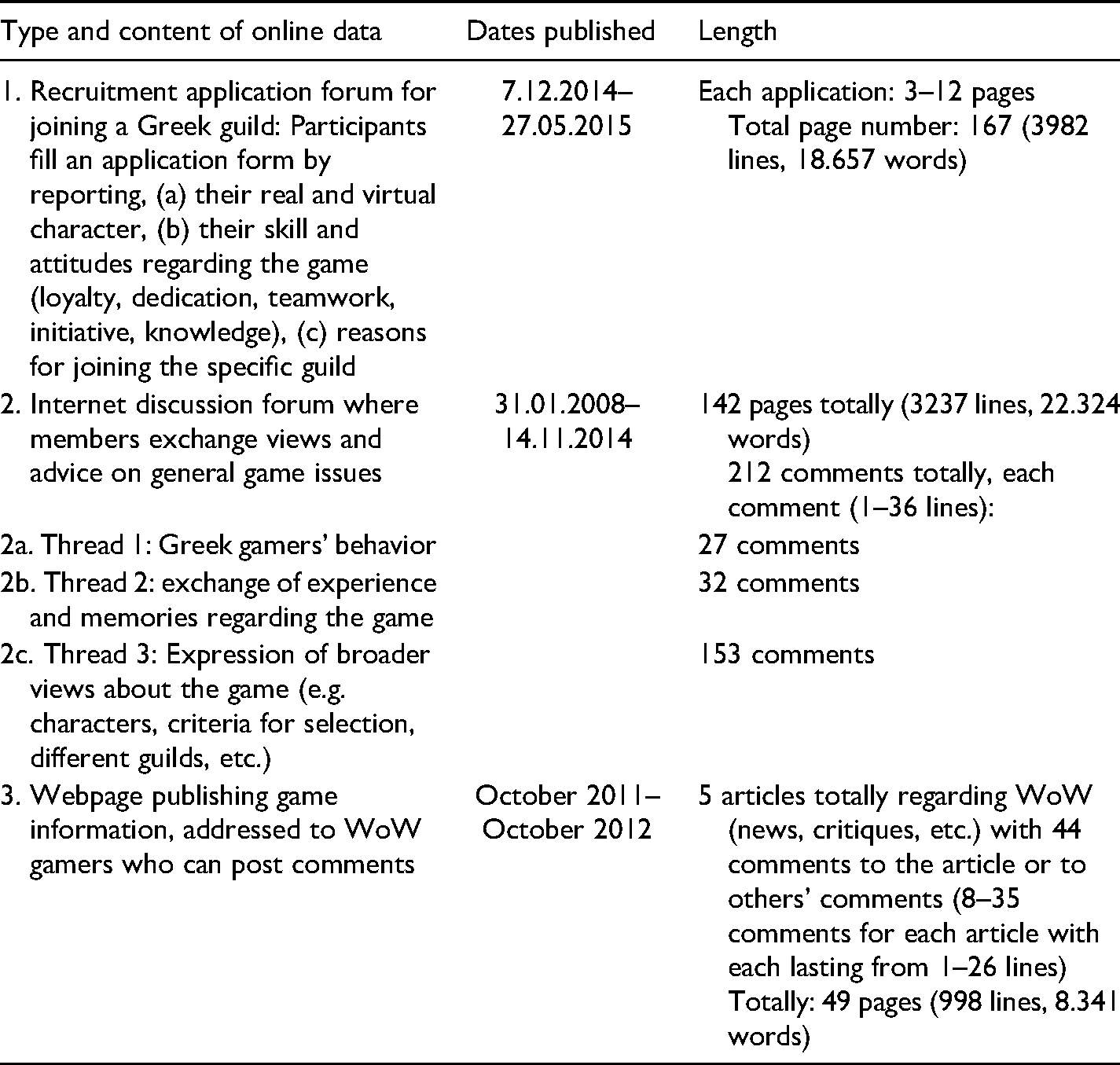
Online data. To identify websites for sampling naturally occurring online data, the first author performed a Google search with keywords in English and in Greek, including ‘WoW’, ‘MMORPGs’ ‘guild’, ‘player’ (in Greek) and days in which raids are usually scheduled. We sampled discourse from all three websites addressed to Greek participants, identified by the search, including: (a) the most recent (see Table 1) 30 applications from an Internet forum where participants fill-in an interview application form to join a specific guild, (b) the most recent (see Table 1) three different discussion threads among 60 MMORPG players, with at least 20 comments per thread, identified in a discussion forum, where participants exchange views, ideas and advice about topics regarding WoW, (c) all five articles referring to WoW and comments to articles posted by 44 participants identified in a website providing information to players about PC games including MMORPG.
Focus group data. We sampled discourse from a focus group with five WoW players (four males, one female, aged from 21 to 33 years) ran by the first author face to face. We used a snowball sampling procedure, starting with one participant who was an acquaintance of the first author and moving on with suggestions made by each recruited participant consecutively. We opted for a small-size, ‘mini-focus’ group (Krueger & Casey, 2015, p. 82) to facilitate the management of group dynamics and a naturally evolving conversation. To that aim, an initial open question invited members to present themselves and share their gaming experiences. The researcher let the conversation evolve and intervened mostly with questions for clarifications or prompts. Furthermore, we secured that each participant was already acquainted with at least another one. Focus group discussion lasted for two and a half hours (35.578 words, 5044 lines).
Procedure
In compliance with British Psychological Society (BPS) guidelines and the code of ethics of the University of Thessaly, Greece, focus group members were initially informed about the study and signed a consent form securing their voluntary participation and granting permission to use anonymized data for research and publication purposes. Online data were sampled from publicly available websites. Given that in such contexts people naturally expect themselves to be observed, consent is not considered necessary (British Psychological Society, 2017). Nevertheless, for this presentation we secured that no participants’ identifying information appears in extracts.
Method of Analysis
Online data were copy-pasted in Word documents and assigned line numbers to facilitate analysis. The focus group discussion was both audio and video recorded and transcribed verbatim following a shortened version of Jefferson’s (2004) notation system.
We performed analysis in three major steps. First, all data were repeatedly read by the first author, as suggested (Potter, 2012), to discern participants’ orientations and the rhetorical features of each discursive context. Second, all data was subjected to line-by-line micro-analysis performed by the first author. This analysis lead to the identification of identity categories invoked by participants and to the variable functions of such invoking across conversational contexts. Third, we grouped data alongside three main axes, including discourse about gender, nationality, and immersion with the game. We analyzed data per axis and per discursive context, considering the specificities of each context and their rhetorical implications for interpretation. We then searched for patterns and/or variations. For example, regarding the third axis, which is the focus of the present analysis, while analyzing focus group data, we considered the rhetorical implications of the researcher’s input (see, e.g. analysis of extract 5). Analysis was performed by authors 1 and 2 and reviewed by all authors.
The analysis was performed following discursive and rhetorical analysis’ premises (Billig, 1991, 1996; Edwards & Potter, 1992; Potter, 2012). As suggested by the Discursive Action Model (DAM) (Edwards & Potter, 1993), we treated participants’ discourse as action-oriented and not as an analytic pathway to mental states beyond it. Specifically, we attended to how participants construct the facticity of their (descriptive) reports. We also attended to the rhetorical design and entanglement of participants’ discourse, especially focusing on their management of accountability in two interlinking levels: the reported identity categories and the act of their reporting, that is, participants’ orientation to such categories.
Following rhetorical psychology emphasis on the dilemmatic aspects of thinking and arguing (Billig, 1996), the analysis addressed how each discursive formulation attends to counter-arguments. We focused on participants’ undertaking ambivalent positions while arguing for one position and trying to eschew the potential consequences of undertaking such position (Billig, 1991). Accordingly, both the content and the structure of participants’ and researcher’s discourse was analyzed regarding the actions performed, its dilemmatic aspects, and the interpersonal aims attended to, depending on the discursive context. Also, where applicable, we attended to ‘next-turn proof’ procedures (Sacks et al., 1974, p. 729), according to which the ways interlocutors interpret each other’s turns is made obvious in the next turn.
To allow for readers’ evaluation of our analytic claims, we follow the standard practice of presenting detailed, micro-analysis of verbatim extracts, selected for being illustrative of analytic claims. All extracts have been translated from Greek to English for the purposes of this presentation with participants being assigned pseudonyms. Authors 1 and 2 were involved in the translation, staying as close as possible to the original text. Acknowledging the tensions and challenges inherent in translation (Nikander, 2008), we include the extracts in the original language in supplemental form.
Analysis
Our analysis highlights how participants flexibly invoke identity categories, while managing certain rhetorical dilemmas, in talk about excessive gaming across discursive contexts. First, we illustrate participants’ orientation to displaying their immersion in the game in contradictory ways. We, then, illustrate participants’ different ways of managing rhetorical dilemmas about normalcy and abnormalcy while invoking identity categories like ‘nolifer’, ‘hardcore player’ or ‘clean’.
Displaying Immersion in the Game
Across discursive contexts, participants oriented to displaying immersion in the game. Such orientation seemed a ‘building block’ for identity constructions made relevant in their discourse (Lamerichs & Te Molder, 2003).
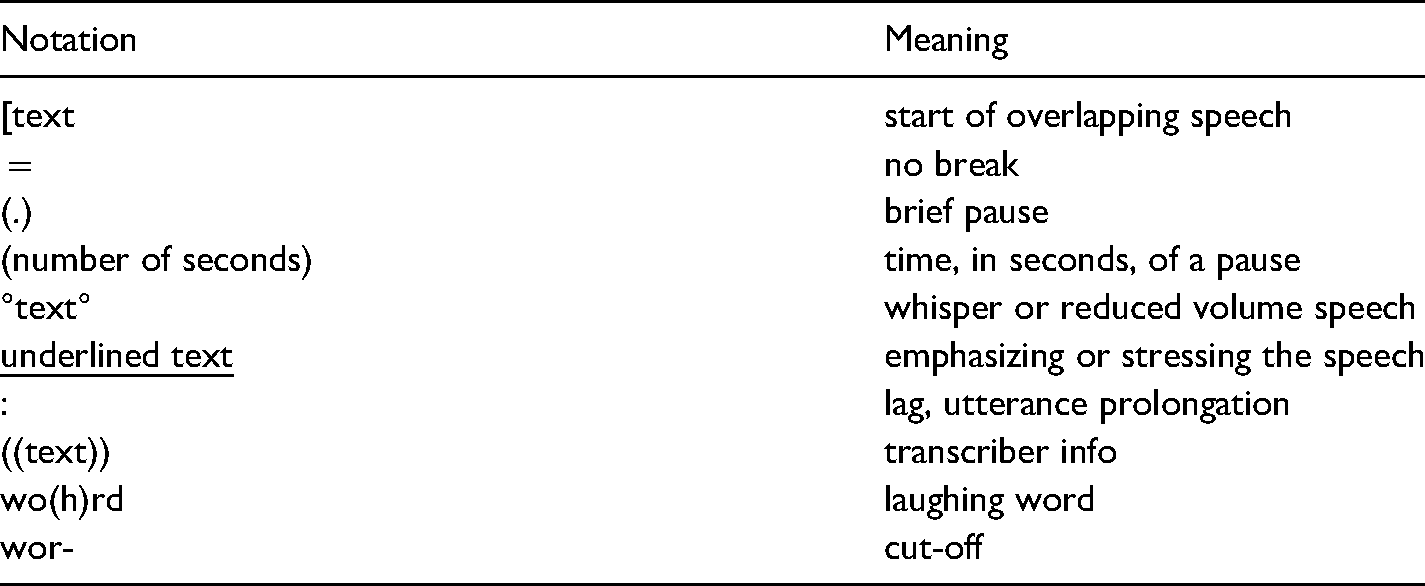
Displaying full immersion. In the recruitment application forum, applicants seemed to construct the identity of a fully dedicated WoW player, immersed in the game’s virtual world, with no social life beyond the game, as illustrated in the following extract (for notation see Table 2) featuring applicant 1 (A1).
Transcription Notation (Adapted from Jefferson, 2004).
Extract 1 (Recruitment application forum, 1 in Table 1)

The opening question by administrator (Adm) invites A1 to report any occupation beyond playing WoW. The A1’s reply seems constructed to refute any potential counter-rhetoric that he is not fully devoted to the game and, thus, not an ideal applicant. The trustworthiness of such claim seems accomplished, first, by the explicit reference to ‘not doing anything’ (878); second, by reference to WoW’s place in his life (879), although he is not asked about it; third, by his reference to the completion of his studies (880–881); and fourth, by his reference to his girl (880). Concerning the latter, note how the occasioned choice (Sacks, 1992), of ‘girl’ instead of ‘girlfriend’, possibly denoting less emotional involvement, pre-empts inferences about A1 being an emotional person, too involved in a personal relationship. Note also, the shift in footing from a first-person formulation (‘I also have a girl’) to a first plural formulation ‘that we have to put in the schedule’ (880) and the choice of ‘have to’, arguably constructing A1’s personal relationship as an obligation and not as a priority (the ‘girl’ is reported fourth, following studies, basketball and WoW). Thus, being a group member is constructed as more significant than being a partner.
Overall, A1’s account seems to eschew possible inferences that he may be unavailable as a player because of leading a social life beyond the game, by downgrading the importance of the latter. Interestingly enough, the temporal marker (‘at this particular period’) (878) alongside the statement that he is not ‘doing anything’, possibly suggests applicant’s effort to eschew the counter-argument that he may have no life at all, due to full commitment with gaming.
Through-out our data, a player’s immersion in the game is further constructed by invoking the identity category of the ‘hardcore’ player. In the following extract, another applicant (A2) is shown to unproblematically present himself as a ‘hardcore player’.
Extract 2 (Recruitment application forum, 1 in Table 1)

A2’s response to the opening question about the time spent in playing (3532–3533) suggests his interpretation that the time devoted in active gaming is the criterion for assessing the applicant’s suitability to become a guild member. Note the lack of any qualifiers before the explicit self-presentation as ‘Hardcore raider’ (3534) denoting an unproblematic undertaking of the hardcore player identity category. Note also the reference to the first, challenging version of WoW (Vanilla) (3534), presenting the applicant as belonging in the special group of the players who first played the game and were ‘hard enough’ to survive the initial WoW versions’ extreme demands. The repetition of the word ‘actively’, the use of the exaggeration ‘at least’ and the reference to ‘hours per day’ (3535–3536) instead of the opening question’s more general reference to ‘hours per week’ (3533), seem to denote the applicant’s irrefutable immersion in the game and excessive gaming. The constructed facticity of such immersion attends to a potential counter-argument that he is not dedicated enough to the game and, thus, not a suitable applicant.
In the recruitment application forum, displaying immersion in the game seems constructed with players invoking identity categories like the ‘hardcore player’. Such categories function as valuable rhetorical resources for players to evidence their dedication to the game, eschewing a potential refusal of admittance on the grounds that they do not deserve the assignment of the player identity. However, when looking at players’ discourse in the Internet discussion forum and the focus group, displaying immersion in the game does not seem equally unproblematic. Furthermore, the invocation of identity categories like the ‘hardcore player’ seems to serve different functions, illustrated subsequently.
Occasioning accountability for immersion. In the following extract, the participants comment on a focus group member leaving briefly the meeting. In their commentary, the category ‘hardcore player’ is invoked to denote the player known for their absolute dedication to the game insofar as they would not leave their seat before fulfilling their aim. Group members are shown as constructing hardcore gaming as an exaggeration, while occasioning accountability in respect of hardcore gaming and refraining from unproblematically ascribing themselves the identity of the hardcore player, like in the previous extracts.
Extract 3 6 (Focus group)
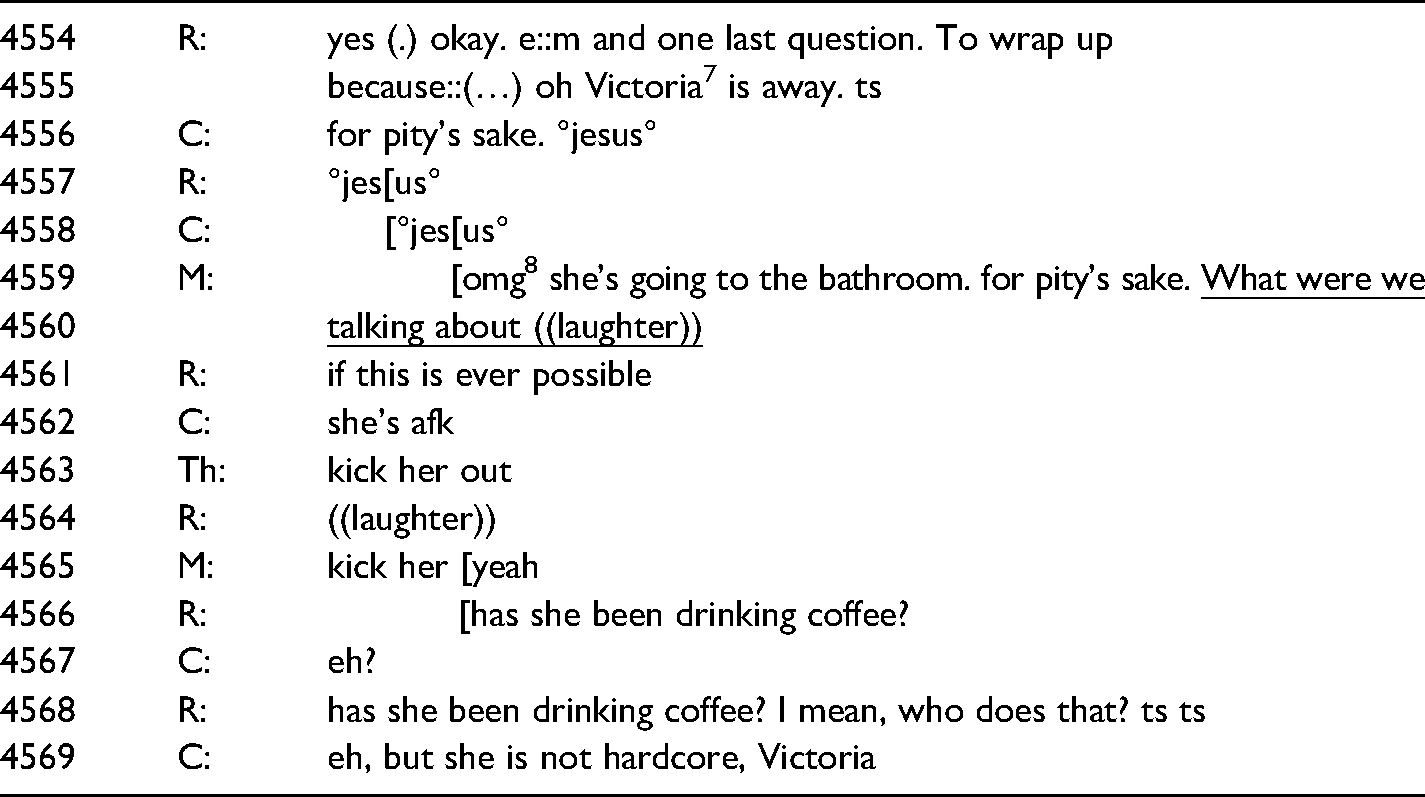
Prior to this extract, the focus group members had referred to players taking precautions like avoiding drinking coffee, to secure not stopping to play for many hours, even for going to the toilet. M occasions the group’s collective memory of such a discussion (‘
Orienting to (Ab)Normalcy
Our analysis of the following extract more clearly illustrates the dilemma at stake: how to speak as a WoW player, immersed and enjoying the game, while, simultaneously, attending to hearable inferences that such immersion may imply an abnormal life.
Extract 4 (Internet discussion forum, 2c, Table 1)
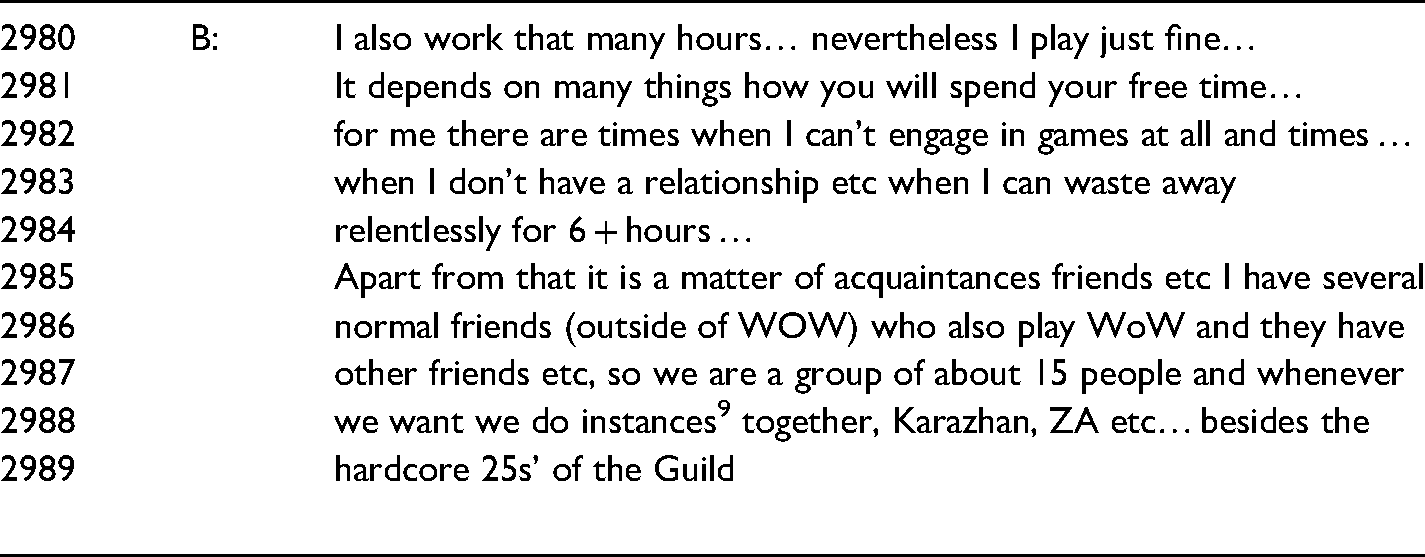
This post follows a previous one where one player, while reporting that he is too busy to commit to the guild for a raid, argued that one should do nothing else except working and playing WoW, due to the game’s nature. Moving beyond the either / or logic of that post, this player (B) argues for a ‘both and’ version of how a busy, work-wise, player can simultaneously enjoy gaming from the position of someone who has mastery over the ‘nature’ of engagement with the WoW, depending ‘on many things’ (2981). Aligning himself partly with being a hardcore player, as at times he ‘can waste away’ (2983), B ostensibly rebuts the hearable inferences of leading an abnormal life: at other times, he is just enjoying himself playing with ‘normal people’ (2986). From such a position of self-mastery, B controls gaming and easily switches from the mode of excessive gaming to the modality of normal play(ing), being both hardcore and ‘normal’.
A number of rhetorical features enhance the credibility of such argumentation. First, by a first-person construction (‘I also work that many hours’) and the use of ‘also’ (2980) the player personalizes his argument (Goffman, 1979) while simultaneously aligns to the previous speaker by also presenting himself as busy. Second, the conditional construction ‘It depends’ coupled with a shift in footing from the previously first-person (‘I also work’) to a second-person construction (‘you will spend’) (2981) and the reporting of extremes (‘I can’t engage in games at all’, ‘I don’t have a relationship’) (2982–2984) facilitate the plausibility of his argument that he is busy work-wise but also participating in raids.
B’s discourse ‘voices’ the dilemma at stake: on the one hand, playing is an enjoyable socializing experience where one can join a group of friends playing together (2987–2988). On the other hand, playing necessitates time and immersion in the game to the point where one can ‘waste away relentlessly’ (2983–2984) and engage in hardcore gaming (2989). Note how friends outside WoW are labeled as ‘normal’ (2986) and how playing for fun (2985–2988) is constructed as taking place ‘besides the hardcore 25’s of the Guild’ (2988–2989), both suggestive of a split between normalcy and abnormalcy or virtual and ‘normal’, non-virtual life.
Managing the Dilemma About (Ab)Normalcy
Disavowing the stigma of nolifer. Displaying immersion in the game and engaging in hardcore gaming seems to risk coming across as a nolifer. In the following extract, focus group participants are shown to disavow the stigma of being a nolifer, when an outgroup member, the researcher, introduces the nolifer identity category.
Extract 5 (Focus group)
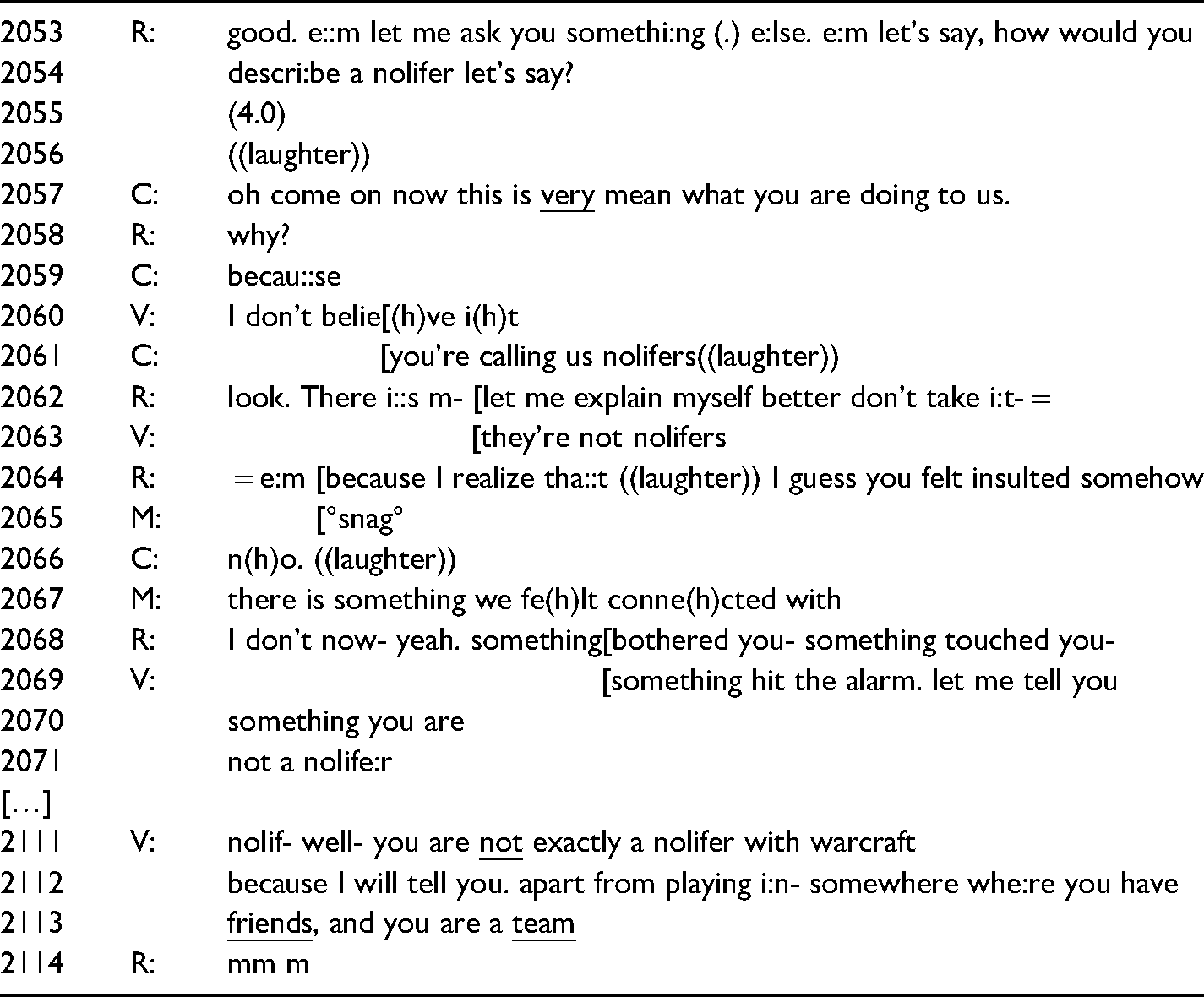
A number of hesitation markers introducing the researcher’s opening question (note the pause, ‘em’ and the tag question ‘let’s say’, 2053–2054) indicate the delicacy of the topic addressed. Such uneasiness with the category of the nolifer is further confirmed by players’ response to the researcher’s question. Following the completion of the researcher’s turn, at the transition relevance place (Sacks et al., 1974), a -conversationally- meaningful and long silence of four seconds occurs in the place of the normatively expected answer (Sacks et al., 1974), thus marking a dispreferred second turn, also prefaced with collective laughter (2055–2056).
When C’s response comes (2057), he publicly displays an understanding of the researcher’s question as a “
A few turns later, M's utterance comes across as a mitigated and partial acceptance of the accusation and therefore of the identification with the nolifer category (‘there is something we fe(h)lt conne(h)cted with’, 2067). Such identification, however, seems treated like a stigma, which focus groups members overtly attempt to disavow. Such disavowal and ostensible rejection of the nolifer category is possibly activated by the mere presence of a non-WoW player, an outsider researching the WoW world, arguably leading a ‘real’ life. The researcher’s presence possibly activates concerns regarding hearable inferences that the ‘virtual’ world implicates an abnormal life for players.
Some turns later, by means of a second person construction generalizing to all WoW players (‘you are
The following extract illustrates some of the ways in which focus group members distance themselves from the category of the nolifer.
Extract 6 (Focus group)
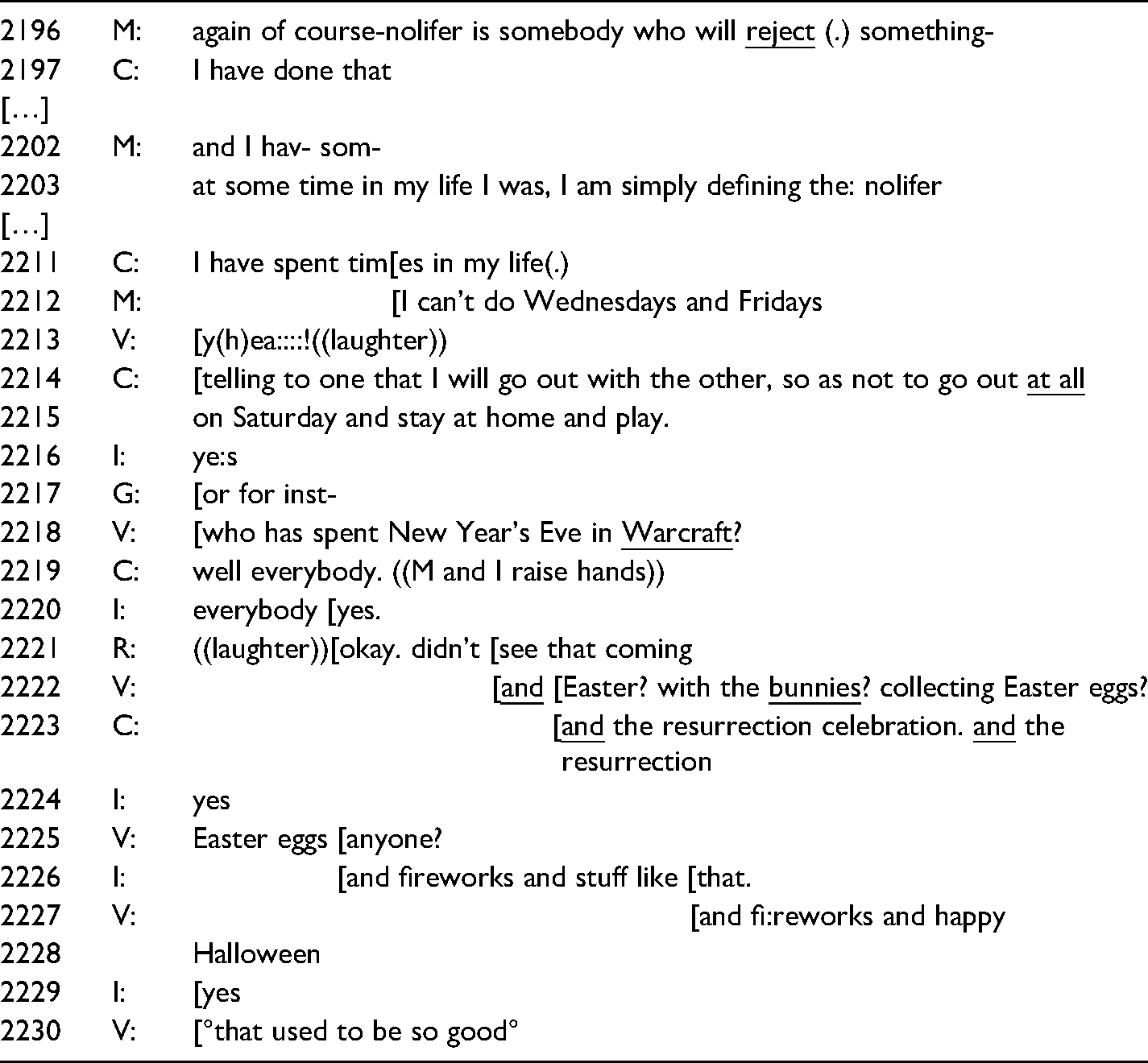
While pursuing a definition of the nolifer category (2196–2197, 2202–2203), a few turns later, focus group members again distance themselves from such category, in this context, by means of time (see also, Aarsand, 2012). Note the past tense constructions (‘I have spent’, 2211, ‘Who has spent’, 2218), facilitating their presentation as ex-nolifers, namely players who should no longer be considered nolifers. C’s vivid description (2214–2215) is coupled with the joint production (note the overlapping turns) of a collective testimony, constructed with consecutive questions jointly answered by further vivid descriptions (e.g., Easter bunnies and Easter eggs, 2218–2228). All serve to enhance the facticity of the claim (Edwards & Potter, 1992): being a WoW player inevitably implies being a nolifer even for a while.
Such inevitable assignment of the nolifer identity category to every WoW player is further justified by V’s concluding, nostalgic turn, uttered as a whisper: ‘°that used to be so good°’ (2230). The reference to gaming’s enjoyable aspect, delivered in a continuous tense enhancing the reality and the normalcy of such claim, seems suggestive of the game’s indulging qualities: WoW is so enjoyable that immersion is hard to resist, to the point of becoming a nolifer. Confining, however, such identification within a limited period of time, normalizes being a nolifer and speaking from the safety of a present which bears no hallmarks of nolifer identity (see also additional extract, supplemental form). mitigates the risk of coming across as leading an abnormal, unhealthy life.
Making addiction relevant. In the following, concluding extracts, we illustrate how the participants, while admitting immersion in the game, topicalize notions of normalcy, health, contamination, addiction and detoxication as descriptive of a players’ lifeworld, invoking identity categories like the ‘clean player’. We illustrate how immersion in WoW gaming is constructed as a seductive, hard to resist one-way process, beyond one’s control and against which one needs to fight to remain healthy. In the following extract, the player, although not explicitly citing the identity category of the “addicted” player, he evidently lists category bound activities normatively associated with such an identity category.
Extract 7 (Internet discussion forum, 2c, Table 1)
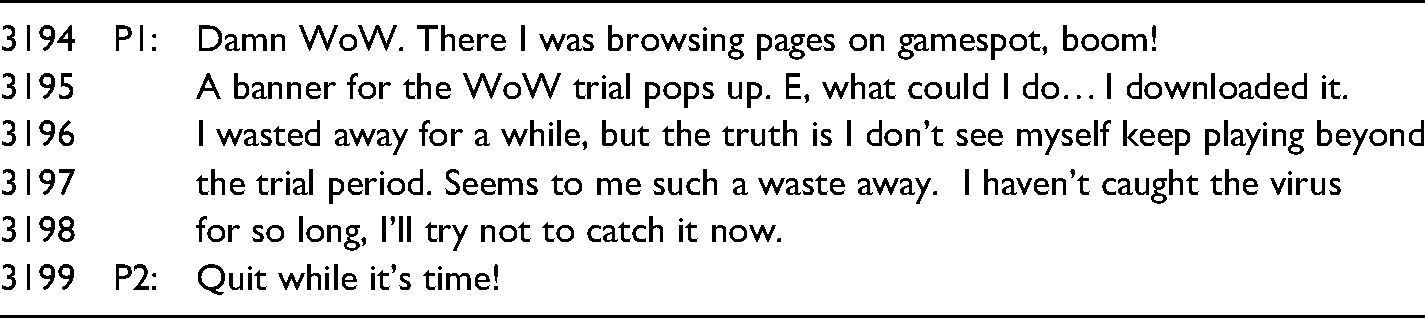
Player’s 1 (P1) first turn (‘damn WoW’, 3194) exemplifies the accountability issues raised by being assigned the WoW player identity category. Players should not be blamed for becoming ‘wasted away’ by excessive gaming because of an irrefutable fact: WoW gaming is like a ‘virus’ (3197) and one needs to ‘try not to catch it’ (3198). The vivid description (‘I was browsing pages on gamespot, boom!’, 3194) and then the unexpected, sudden hit with the banner of the trial (3195) suggest the lack of any alternative and built the irrefutability of such an argument. Like player 1, ‘what could’ one ‘do’, there is no other option but to ‘download’ it (3195). Yet, the pause and the smiley emoticons subtly undermine the seriousness of the narrative while paradoxically enhance the facticity of player’s claim, possibly attending to counter-arguments challenging the veracity of such a claim. Simultaneously they seem to attend to P1’s rhetorical concerns of how to argue against ‘wasting away’ but from the position of an insider who ‘wasted away for a while’ (3196) and not from the position of an outsider who fanatically preaches against ‘wasting away’. Player’s 2 (P2) appeal to undertake action before it is too late (‘Quit while it’s time!’, 3199) confirms player’s 1 claim about WoW gaming’s addictive nature. Remaining uncontaminated from the virus of excessive gaming is thus constructed as a continuous battle, necessitating being alert for relapses (3197–3198), like when being addicted.
In the last extract, explicit self-presentation as ‘clean’ overtly attends to concerns regarding WoW gaming’s addictive nature.
Extract 8 (Internet discussion forum, 2c, Table 1)

Player’s (C) use of ‘clean’ (1362), suggestive of addiction vocabulary, and the mimicking of the structure and the content of a typical ex-addicts’ discourse suggest what seemingly is at stake: being immersed in gaming risks being assigned the identity category of addicted. Such assignment further risks inferences about leading an abnormal, virtual, as opposed to real, life, suggested by the ‘virtual vs. real life’ polarization (1363). Yet, C articulates the occasioning of accountability for immersion from a position of self-mastery over ‘addiction’. On the one hand, the emoticon covertly endorses the immersion in virtual life where there is enjoyment, a claim backed up by reference to ‘the good old days’ (1364) and by using a tense suggesting duration and continuity. On the other hand, there is ‘real’, normal life, constructed as equally ‘appealing’.
Discussion
Our study illustrates how players flexibly employ and debate identity categories in game talk, while displaying immersion in the game and attending to concerns regarding (ab)normalcy.
Our analysis highlights how players occasion accountability concerning identity categories like the nolifer or the hardcore player. It further highlights the dilemmatic aspects of such occasioning across discursive contexts and the different rhetorical strategies employed in identity management talk about excessive gaming. In the context of the focus group discussion and the internet discussion forum, players are shown to occasion accountability for gaming immersion. Specifically, they are shown as warranting such occasioning, by articulating it from a “within”, identity position of self-mastery, presenting themselves as ex-nolifers or ex-hardcore players or by the disavowal of problematic others. Such invoking of self-contained individualism (Sampson, 1988), however, seems paradoxical. The images of self-mastery (self-contained individualism) invoked to legitimate social practices (gaming) arguably subvert self-mastery (addiction).
Previous findings (Aarsand, 2012) also evidence how teenager players position themselves as ‘ordinary players’ to avoid self-presentation as hardcore gamers and take distance from problematic gaming, thus orienting to normalcy. Furthermore, key rhetorical strategies for constructing the ‘ordinary’ player identity, including the use of past tense (i.e., ‘I used to be a nolifer’) or evidencing that the player controls gaming and gaming is fun, are also identified by Aarsand (2012). Previous findings (Bergstrom et al., 2016) further suggest how eschewing negative player identity constructions by ascribing them to other players, goes together with players’ attempts to convince they run entirely ‘normal’, ‘real’, social lives beyond the game.
Our findings, though, make some further contributions, by highlighting the occasioned use of rhetorical strategies and the variable and contradictory functions of the same identity categories. For example, across all our sampled discursive contexts, the category of the ‘hardcore player’ is shown as denoting the player who restlessly keeps on gaming, being fully immersed and devoted in the game. In the recruitment application forum such identity category facilitates constructing the player as the ideal applicant, with participants unproblematically identifying with such self-presentation. However, in the other discursive contexts, such identity category connotes exaggeration and players are shown as distancing themselves from hardcore gaming and as orienting to ‘ordinary’ gaming in Aarsand’s (2012) words. Thus, what seems treated as normative in one context, becomes non-normative in another, raising questions of what is being treated as normalcy/abnormalcy in the gaming world.
Similarly, within the same discursive context, like in the focus group discussion, players are shown as both disavowing the identity category of the nolifer and simultaneously presenting themselves as ex-nolifers. Future research can further disentangle the connotation of ordinary gaming for players and whether such connotation follows mainstream constructions regarding normalcy and / or abnormalcy or introduces a new order of normalcy/abnormalcy in the gaming world.
Like in Bergstrom et al. (2016), the recruitment of our participants did not insinuate any negative implications about their player identity, like in online data. Nevertheless, our participants evidently oriented to such implications, mobilizing (fragments of) addiction narratives suggestive of the extensive, negative portrayal of players by mass media, lay and scientific discourse (e.g., Bergstrom et al., 2016; Hellman et al., 2017). Rather than implying that players have internalized negative stereotypes regarding the player identity (Bergstrom et al., 2016), our analysis highlights how they actively and discursively engage in debating such stereotypes in identity management talk.
Our participants’ discourse about excessive gaming entailed dilemmatic aspects. At times, immersion in the game was formulated by reference to enjoyment narratives and, in other occasions, by reference to addiction narratives. In tune with Chappell et al.’s (2006) suggestion to refrain from approaching such narratives content-wise, pursuing evidence for their truthfulness, we attempted to disentangle their function, considering such dilemmatic aspects as normative (Billig, 1996). We view such an approach as facilitative of adopting suggestions for a de-pathologizing, dual perspective (Snodgrass et al., 2019), which acknowledges both distressful and facilitative of well-being aspects in intensive gaming.
From a DP perspective (Edwards & Potter, 1992) fluidity, flexibility and contradictions within or across discursive contexts regarding identity management talk, constitute a normative phenomenon. Such an approach is consistent with the idea that speakers do not merely internalize norms, but they actively construct and debate what is normative or else what constitutes ‘social order’ (Lamerichs & Te Molder, 2003). Overall, our findings illustrate the variable and contradictory ways in which player identities get upheld and / or downplayed and resisted in the ‘here and now’ of talk about gaming.
We acknowledge that discursive analysis of online discourse, especially building on conversation analytic tenets, is still developing. Methodological advances are needed to address certain peculiarities of online discourse, like the fact that responses to other posts are asynchronous unlike what happens in live conversations or the editing of posts taking place off-line (Giles et al., 2015; Paulus et al., 2016). We also acknowledge the merit of pursuing an ideologically informed discursive lens, which could unpack how participants’ local concerns resonate with wider ideological debates (Bozatzis, 2009; Wetherell, 1998) concerning (ab)normalcy. Future research should undertake such challenges to further illuminate how players’ identity management talk is shaped by and shapes lay and scientific discourse about immersion in excessive online gaming.
Supplemental Material
sj-docx-1-jls-10.1177_0261927X211067820 - Supplemental material for “Immersed in World of Warcraft”: A Discursive Study of Identity Management Talk About Excessive Online Gaming
Supplemental material, sj-docx-1-jls-10.1177_0261927X211067820 for “Immersed in World of Warcraft”: A Discursive Study of Identity Management Talk About Excessive Online Gaming by Vasiliki Kokkini, Eleftheria Tseliou, Georgios Abakoumkin and Nikos Bozatzis in Journal of Language and Social Psychology
Footnotes
Declaration of Conflicting Interests
The author(s) declared no potential conflicts of interest with respect to the research, authorship, and/or publication of this article.
Funding
The author(s) received no financial support for the research, authorship and/or publication of this article.

Supplemental material
Supplemental material for this article is available online.
Notes
Author Biographies
References
Supplementary Material
Please find the following supplemental material available below.
For Open Access articles published under a Creative Commons License, all supplemental material carries the same license as the article it is associated with.
For non-Open Access articles published, all supplemental material carries a non-exclusive license, and permission requests for re-use of supplemental material or any part of supplemental material shall be sent directly to the copyright owner as specified in the copyright notice associated with the article.
