







Abstract
This study examines how both the content (i.e., denial vs. apology) and the verb voice (i.e., active voice vs. passive voice) of a crisis response affect the public's perception of crisis responsibility and, subsequently, the reputation of an organization accused of wrongdoing. The results of two experiments first show that an apology results in higher responsibility attributions than denial, which, in turn, adversely affects an organization's reputation. When we consider the verb voice of the message, a crisis response that is constructed in the passive voice reduces responsibility perceptions more than the active voice, leading to less reputational damage. An interaction effect shows, however, that this result only holds true for a passive denial strategy and not for apologies. As such, when an organization needs to deny an accusation, it seems wise to construct the message in the passive voice in order to strengthen the denial and effectively protect the organizational reputation.
Keywords
Responsibility attributions play a central role in crisis communication literature (Coombs, 2007; Coombs & Holladay, 2002). The degree to which an organization is deemed responsible for a crisis determines both the reputational damage it will suffer and the most appropriate response to repair this harm. Experimental research has repeatedly demonstrated that the more responsible an organization is considered for a crisis, the more its reputation will suffer (e.g., Coombs & Holladay, 2002; Ma & Zhan, 2016; Schoofs et al., 2019). As a response, an organization should accept as much crisis responsibility as is attributed by its stakeholders (Coombs, 2007; Coombs & Holladay, 2002). By selecting the appropriate response strategy in terms of responsibility acceptance, reputational damage can be avoided or repaired.
While we know from prior research that the use of such an appropriate crisis response strategy can indeed repair reputational damage (e.g., Coombs & Holladay, 1996; Sheldon & Sallot, 2008), we know very little about what exactly explains the impact of such strategies (Schoofs et al., 2019). An important question to consider is how crisis response strategies affect public perceptions of responsibility. Especially in the initial stage of a crisis, when an organization's crisis responsibility is often unclear and ambiguous (e.g., in the case of an accusation), the response of an organization could provide stakeholders with important information to infer crisis responsibility from (Coombs, 2007, 2015).
While there is widespread agreement that apologies can be very successful in terms of reputation repair (e.g., Claeys et al., 2010; Schoofs et al., 2019; Sheldon & Sallot, 2008), they can trigger increased attributions of responsibility. Prior research has shown that stakeholders attribute less crisis responsibility to the organization when it denies the crisis as compared to when it apologizes for the crisis (Brown-Devlin et al., 2020; Kim & Sung, 2014). This makes sense because a denial rejects crisis responsibility and an apology accepts it (Coombs, 2007). However, a denial will only result in low levels of responsibility attributions if the public accepts the no responsibility frame (Brühl et al., 2018; Coombs, 2007; Fuoli et al., 2017). Despite the presumptions regarding crisis responses’ impact on responsibility attributions, we know very little about their actual effects in this regard. Nor do we know how this will, in turn, affect the post-crisis reputation. Reputation can be defined as “a collective construct that describes the aggregate perceptions of multiple stakeholders about a company's performance” (Fombrun et al., 2000, p. 242). This study specifically focuses on the perception of the general public, because they are a key stakeholder group in the public relations’ approach to crisis communication (e.g., Fuoli et al., 2017; Kim & Sung, 2014; Schoofs et al., 2019).
In addition, most research on crisis response strategies has only compared its effects to other strategies (e.g., apology vs. denial; Brown-Devlin et al., 2020; Kim & Sung, 2014; Schoofs et al., 2019), without taking into consideration how these strategies are formulated. There are, however, numerous ways to apologize or deny. Psycholinguistic research states that people not only infer responsibility from the explicit content of a message, but from subtle language cues as well (Henley et al., 1995; Knobloch-Westerwick & Taylor, 2008). This implies that it is not only essential to choose the right response strategy, but that it is also important to thoughtfully formulate this crisis response. This is especially relevant in times of crisis when the public is often skeptical about what an organization says and stakeholders also build their perceptions on other message cues besides the explicit content (Borden & Zhang, 2019; Clementson & Page, 2021; De Waele et al., 2019).
One language cue, in particular, that has been identified as having a strong link with responsibility attributions is verb voice (i.e., active and passive voice). Several studies in psychology have shown that a passive voice can act as a device to lower responsibility attributions compared to an active voice. The passive voice creates distance between the sender and the message and de-emphasizes the agent in a sentence (Anspach, 1988; Chan & Maglio, 2020). Research about the legal consequences of crisis communication, therefore, recommends to passively formulate a corporate apology in an attempt to reduce liability (Patel & Reinsch, 2003). Saying “I’m sorry for hurting you” is vastly different than saying “I’m sorry you were hurt”. The former admits one's fault, but the latter does not (Cohen, 1999, p. 1051). That explains why corporate CEOs and legal advisors pay such close attention to how a crisis response strategy is formulated (Claeys & Opgenhaffen, 2021). Causal research is, however, lacking and the question remains what role verb voice truly plays in the context of crisis communication.
Therefore, this study explored the impact of verb voice on responsibility perceptions during an organizational crisis and its subsequent effect on organizational reputation. By means of two experiments, which differed in the type of passive voice, we examined if this language feature influences stakeholders’ responsibility attributions and if its effect is moderated by the content of the crisis response, namely a denial or an apology. As such, this study broadens our theoretical understanding of how the content (i.e., crisis response strategy) and the formulation (i.e., verb voice) of a crisis message interact with regard to responsibility attributions. We know that responsibility attributions play a crucial role in determining the initial reputational damage (cf. Coombs, 2007), and this study allows us to clarify how different aspects of the response play a role in the initial public perception of blame. For practitioners, the findings can help establish how important the formulation of a crisis response strategy is and offer specific guidelines for writing an effective crisis message.
Crisis Communication and Responsibility Attributions
Many key principles in crisis communication are built on attribution theory (Coombs, 2007; Coombs & Holladay, 2002; Ma & Zhan, 2016). This theory states that people search for the causes of events, in particular when those events are negative and unexpected (Weiner 1985, 1986). An organizational crisis is such an event, and stakeholders will judge if the organization is responsible for the crisis or if factors outside the organization can be identified as the cause (Coombs, 2007; Coombs & Holladay, 2002). The level of responsibility stakeholders attribute to the organization will subsequently determine how much reputational damage the crisis inflicts upon the company.
This conceptual process constitutes the fundamental building block of Situational Crisis Communication Theory (SCCT; Coombs, 2007). SCCT argues that the more responsibility the public attributes to an organization in crisis, the more reputational damage will be suffered (Coombs, 2007; Coombs & Holladay, 2002). The theory adds that an organization should subsequently accept as much responsibility as attributed by the stakeholders, in order to effectively protect and repair its reputation (Coombs & Holladay, 1996). When responsibility attributions are very low, the organization can use a deny strategy that rejects all crisis responsibility. When an organization is blamed for the events, however, it can use a rebuild strategy that accepts full responsibility for the crisis through apologies or compensations (Coombs, 2007). This proposition clearly demonstrates the link between responsibility attributions and the content of crisis communication, and many studies have experimentally tested this situational crisis model finding mixed results (e.g., Claeys et al., 2010; Coombs & Holladay, 1996; Kim & Sung, 2014).
However, SCCT indicates that the relationship between responsibility attributions and the content of the crisis response is not unidirectional. The theory suggests that attributions of responsibility not only determine the most optimal crisis response, but that it also works the other way around. In other words, the chosen response affects stakeholders’ responsibility attributions as well and, as such, impacts an organization's post-crisis reputation (Coombs, 2007). This assumption has nevertheless received only scant research attention and requires further attention.
The Content of a Crisis Response
For a long time, an apology was considered the most effective crisis response strategy to protect the organizational reputation (Coombs & Holladay, 2008). However, there has been debate about what constitutes an appropriate apology (Bentley, 2018; Hearit, 2006; Scher & Darley, 1997). Most scholars do agree that the two most fundamental elements of an apology are (1) an acceptance of responsibility and (2) an expression of remorse (Benoit, 1995; Bentley, 2015; Coombs, 2007). Furthermore, the offending party can add optional components to an apology, such as a promise not to repeat the transgression and an offer to repair the damage (Bentley & Ma, 2020; Coombs & Holladay, 2008; Scher & Darley, 1997). Even though apologies are sometimes considered most effective for reputation repair, the outcome is likely to depend on several factors, such as the level of blame (Bentley & Ma, 2020), the type of violation (Kim et al., 2004), an organization's prior reputation (Turk et al., 2012), and the reason to apologize (e.g., guilt or impression management; Weiner, 2006). Recent studies have therefore provided a more nuanced understanding regarding apologies’ effectiveness compared to a denial (Coombs & Holladay, 2008; Fuoli et al., 2017; Schoofs et al., 2019).
An apology undoubtedly remains a highly valuable strategy to restore reputational damage in times of crisis, because it addresses the concerns of victims (Bentley, 2015; Lazare, 2004) increases credibility (van Zoonen & van der Meer, 2015) and induces affective empathy with the organization (McCullough et al., 1997; Schoofs et al., 2019). However, an apology can be regarded as a double-edged sword as it explicitly accepts responsibility, and stakeholders will consequently believe the organization is responsible for the crisis (Brühl et al., 2018). When an organization is indeed to blame, such an impact of apologies on responsibility attributions is not an issue. In such instances, any potential doubt regarding an organization's guilt is already removed, and a genuine apology can communicate to the public that the offense was a one-time mistake. As such, an offense for which an organization has apologized may no longer be connected to the immoral character of the offender (Weiner, 2006). Once guilt has been established, corporate apologies offer a much-needed indication to the public that the organization has learned from its mistakes and the crisis will not be repeated.
Oftentimes, however, the organization bears no guilt, an offense is ambiguous, or the circumstances still need to be investigated. In such instances, apologies may remove any doubt about responsibility (Weiner, 2006). When guilt is ambiguous, a denial can therefore outperform apologies in protecting organizational reputation (Coombs et al., 2016; Fuoli et al., 2017; Schoofs et al., 2019). When stakeholders believe a denial, the crisis may harm the organization's reputation less (Benoit, 1997; Coombs, 2007). An apology, however, leaves no doubt that the organization is to blame, which might be detrimental for the reputation regardless of an apology's positive qualities mentioned earlier (e.g., Schoofs et al., 2019; van Zoonen & van der Meer, 2015).
At the beginning of a crisis, many organizations struggle between issuing an apology or denial. When a crisis hits, the public and the organization oftentimes have little or no information and crisis responsibility is still unclear (e.g., in the case of an accusation). During this stage, a denial still has room to alter responsibility perceptions and the public might give the accused organization the benefit of the doubt (Fuoli et al., 2017). Research among CEOs shows that oftentimes, at the onset of a crisis, they are reluctant to apologize and fully accept responsibility because there is no certainty of guilt yet (Claeys & Opgenhaffen, 2021). Under these conditions, many organizations resort to more defensive strategies like denial (Arendt et al., 2017).
This is illustrated in the response of British Petroleum (BP) to the Deepwater Horizon oil spill in 2010. The organization's CEO, Tony Hayward, denied responsibility in the initial stage of the crisis, but changed his response to an apology after great pressure from the media and the public. This late acceptance of responsibility was not well received and experts believe it would have been a better decision to apologize at the beginning of the incident instead of attempting to deny the crisis (Kanso et al., 2020). When Mercedes released its A-Class and the new car model overturned during a test, which injured the driver, the initial reaction was to deny all responsibility. However, after intense media pressure, Mercedes abandoned the deny strategy and moved towards more accommodating crisis response strategies, such as an apology. Just like BP, Mercedes should have accepted responsibility early on in the crisis, but instead opted to deny the allegations (Ihlen, 2002). These crisis cases indicate that selecting the most appropriate crisis response strategy from the start is crucial in order to effectively protect the corporate reputation, and the choice between a denial and an apology at the onset of the crisis should not be taken lightly. Denial is often preferred at the start of a crisis because it may reduce responsibility perceptions, but is obviously a bad idea when organizations are aware that they are not free of blame (Coombs et al., 2016).
In any case, the fundamental relationship between crisis response strategies and responsibility attributions is not fully understood. The effect of a denial and an apology on stakeholders’ perceptions of responsibility and an organizational reputation is often taken for granted, even though there is little empirical evidence. Therefore, a first aim of our study is to clarify if an apology indeed increases responsibility attributions compared to a denial when there is no clear crisis responsibility and, as such, adversely affects an organization's reputation.
The Verb Voice of a Crisis Response
Psychological research indicates that people construct their responsibility attributions based on both the content and the language of a message (Henley et al., 1995; Knobloch-Westerwick & Taylor, 2008). As such, it is interesting to explore if it matters how the crisis response strategy is formulated in addition to its content. This is especially relevant in the context of an organizational crisis, as this is an event that creates distrust among the public and where the crisis response of the organization is under much scrutiny by the media and the public (Coombs, 2015; Koerber, 2014). Since a crisis situation violates stakeholders’ expectations about how an organization should act, they will pay much attention to every word the organization communicates (Fuoli et al., 2017). Hence, a second aim of the study is to examine if the formulation of a crisis response affects perceptions of responsibility and, as a result, organizational reputation. More specifically, this study will look at verb voice as a language characteristic that is known to be strongly connected to responsibility attributions (Henley et al., 1995; Knobloch-Westerwick & Taylor, 2008).
In English and many other languages, information can be phrased in the active or passive voice (Siewierska, 2013). The distinction between an active and passive construction is a grammatical feature called verb voice and refers to the relationship between the verb and the subject in a sentence (Bussmann, 2006; Fox & Hopper, 1994). In the active voice, the performer of the action (i.e., the agent) is the grammatical subject in the sentence (e.g., “John attacked David”), while in the passive voice, the agent is downgraded to the grammatical object (e.g., “David was attacked by John”) or even removed from the sentence entirely (e.g., “David was attacked”). Although the content of a message remains fundamentally the same when formulated in an active or passive voice, research demonstrates that this small linguistic transformation can seriously affect the interpretation of a message (e.g., Henley et al., 1995; Knobloch-Westerwick & Taylor, 2008).
First, research in the field of language and social psychology shows that the (unconscious) choice in favour of the active or passive voice in people's language use reflects their own attitude and responsibility perceptions (Baratta, 2009; Burgoon et al., 2015; Lamb, 1991; Reilly et al., 2005). For example, Asay et al. (2018, p. 383) observed that managers are inclined to use the passive voice when they present bad firm performances (e.g., “Sales were lost this quarter”), because in this way, they can distance themselves from the negative information being described. In contrast, the active voice is avoided because it turns the spotlight on themselves (e.g., “The company lost sales this quarter”). In another context, Bohner (2001, p. 517) found that individuals who are more accepting of rape myths more frequently use the passive voice to describe sexual violence (e.g., “The woman got raped by the man” vs. the active equivalent: “The man raped the woman”), which puts more blame on the victim and less on the assailant.
Second, research demonstrates that perceptions not only shape language use, but language use also affects perceptions (Chan & Maglio, 2020). Several experiments indicate that an active sentence triggers higher levels of responsibility attributions than a passive sentence (Henley et al., 1995; Knobloch-Westerwick & Taylor, 2008; Platow & Brodie, 1999). A classic example to illustrate this phenomenon is the comparison between the active sentence “I made a mistake” and the passive sentence “A mistake was made by me” (Baxter, 1994, p. 2). In the active voice, the agent “I” is the subject of the sentence, receives much emphasis, and is thus perceived as highly responsible for the mistake. In the passive voice, the agent “I” is downgraded to the object of the sentence, receives less emphasis and, as such, is considered less responsible for the mistake. The contrast is even more pronounced when the passive voice leaves out the by-phrase (i.e., “A mistake was made”) which permits the agent to remain unnamed and, therefore, receives even lower levels of attributed responsibility.
The potential impact of verb voice on responsibility perceptions has also been noted by legal experts in the context of crisis communication (Patel & Reinsch, 2003). Legal counsellors often fear that a straightforward apology can be used against one's client in court as an admission of guilt (Cohen, 1999) and they will pay much attention to the nuances of language in a corporate apology (Claeys & Opgenhaffen, 2021). The passive voice is, in that regard, believed to be a useful tool to reduce legal liability, while at the same time accommodating the psychological and emotional needs of the victims (Cohen, 1999; Patel & Reinsch, 2003).
In summary, we presume that in addition to content, the formulation of a crisis response affects crisis responsibility attributions. An organization will be perceived as less responsible for the crisis when its message is constructed in the passive form than in the active form, which will benefit an organization's reputation.
The Interplay Between the Content and Verb Voice of a Crisis Response
The crisis response strategies denial and apology lie at opposite ends of a continuum, ranging from rejecting to accepting crisis responsibility (Coombs, 2007). As such, they might interfere with the impact of verb voice on responsibility attributions. Prior research has also shown that crisis response strategies can moderate the effectiveness of other dimensions of the organizational crisis response, such as vocal cues (De Waele et al., 2019) and gender similarity between spokesperson and public (Crijns et al., 2017). The question then arises if a crisis message formulated in the passive voice will decrease responsibility attributions, regardless of the content?
In the case of a denial crisis response strategy, the use of a passive voice might further lower responsibility attributions and, as such, better protect the organizational reputation. A denial is a statement in which an accused organization states an allegation to be false and claims to bear no responsibility for the crisis (Benoit, 1995; Coombs, 2007). An organization tries to dissociate itself from a crisis when it adopts the deny strategy and attempts to create distance between the organization and the crisis event (Benoit, 1995; Coombs et al., 2016). A passive construction basically does the same. By de-emphasizing or omitting the agent in a sentence, a passive construction can also reduce responsibility perceptions (Anspach, 1988; Chan & Maglio, 2020). Hence, a passive denial might be more successful in reducing the perceived crisis responsibility than an active denial.
A similar process may occur in the case of an apology. Whereas the active voice might strengthen the level of crisis responsibility attributions, the passive voice could weaken the perception that the organization is to blame. This reasoning is also put forward by legal advisors who believe that a passive apology is a “safe” way to apologize (Cohen, 1999; Patel & Reinsch, 2003). Such an apology can accommodate public expectations and, at the same time, minimize legal repercussions. The perception of the public regarding such strategically crafted apologies might, however, differ from the one a judge will adopt in the courtroom. On the one hand, the public may not notice the subtle linguistic shift from an active to a passive apology because they simply see an organization that apologizes and thus admits to be at fault. On the other hand, they might perceive the passive apology as insincere, which could trigger negative reactions towards the organization in crisis (Wang & McGlone, 2020). Stakeholders could get the impression that a passive apology is just a pseudo-apology, solely designed as a tool for organizations to appear remorseful, but mostly to avoid legal consequences (Bentley, 2015; Cohen, 1999; Kampf, 2009).
Hence, because the interaction between the content and the form of a crisis response is not straightforward, in this study we propose the following research question:
Study 1
Method
Design and stimuli
In order to test the hypotheses and research question, a 2 (crisis response strategy: denial vs. apology) x 2 (verb voice: active voice vs. passive voice) between-subjects experimental design was conducted. Each participant first read an introductory text which described a fictitious crisis scenario before being exposed to one of the four experimental conditions in the format of a newspaper article. A fictitious organization was chosen to avoid confounding effects of an existing organizational reputation (Dean, 2004). The crisis concerned a software company being accused of financial fraud. To allow participants to form their own attributions of responsibility regarding the events, the news article stated that a governmental investigation was being conducted to determine if the accusation was justified or not.
The crisis response strategy was manipulated by changing the CEO's reaction to the fraud accusation. The CEO's response was included as a quotation in the newspaper article. In the deny condition, the CEO rejected responsibility (e.g., “We have been committed to transparency about our annual accounts from the outset”) and condemned the allegations (e.g., “We are disappointed with the false accusation stating we falsified financial records”). In the apology condition, the CEO accepted responsibility (e.g., “We must admit that we have not been committed enough to transparency about our annual accounts from the outset” and expressed remorse (e.g., “We offer our sincere apologies for the financial records we falsified”), which are the two necessary requirements for an apology (Benoit, 1995; Bentley, 2015; Coombs, 2007). The two optional components of an apology (i.e., a promise not to repeat the transgression and an offer to repair the damage) were not included because they were difficult to equally manipulate in the deny condition and we wanted to keep the conditions as similar as possible to secure internal validity. See Appendix A for the full scenarios.
To manipulate verb voice, the response of the CEO was written in an active and passive version. In the active condition, the agent was the grammatical subject in the sentence (e.g., apology: “We accept full responsibility” and denial: “We categorically reject responsibility”), while in the passive condition, the agent was omitted and the object became the subject (e.g., apology: “Full responsibility is accepted” and denial: “Responsibility is categorically rejected”). 1 The original stimuli were created in Dutch, but the grammatical rules of verb voice and its prevalence are similar in the English language (Keenan & Dryer 2007; Siewierska, 2013; van Hell et al., 2005).
Participants and procedure
A convenience sample of 207 Dutch-speaking Belgian men and women participated in the study. Participants were invited through e-mail and social media to fill out an online survey. They first read an introductory text describing the crisis scenario before the respondents were randomly divided across the four experimental conditions. Subsequently, participants completed a questionnaire containing measures of the dependent variables and socio-demographic variables. The average age of the participants was 34 years (SD = 16.89; range = 19 to 85). Approximately 43% were male and 57% were female. The study was approved by the university's ethical review committee and the participants were presented with an informed consent at the start of the survey and a debriefing at the end.
Measures
The manipulation of crisis response strategy was checked through a 7-point semantic differential scale based on the definition of SCCT's crisis response strategies (Coombs, 2007). This is a one-item scale that has been used in previous studies to assess the manipulation of crisis response strategies (e.g., De Waele et al., 2019). The participants rated to what extent they perceived that the organization took responsibility for the crisis ranging from 1 = rejects all responsibility for the crisis to 7 = accepts full responsibility for the crisis.
In line with prior crisis communication research (e.g., Schoofs et al., 2019), perceived crisis responsibility was measured with two items (i.e., “How much do you blame the organization for the crisis?” and “How responsible was the organization for the crisis?”; r = .73, p < .001) on a 7-point Likert scale ranging from 1 = not at all to 7 = very (Griffin et al., 1992).
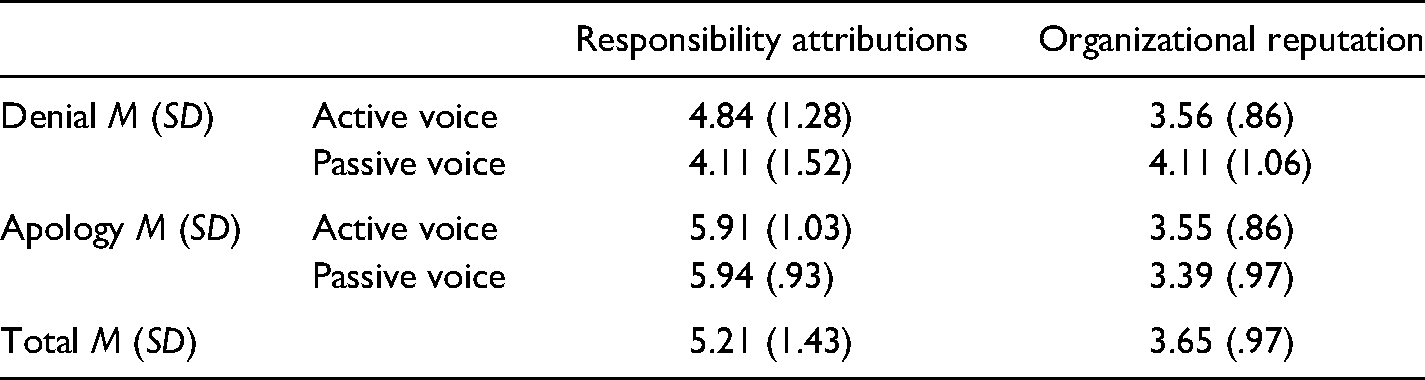
Organizational reputation was measured by means of nine items derived from the Reputation Quotient of Fombrun et al. (2000). The items included statements such as, “I have a good feeling about this company,” and “I admire and respect this company.” The items were rated on a 7-point Likert scale ranging from 1 = completely disagree to 7 = completely agree (α = .90). Table 1 shows the means and standard deviations of the constructs.
Means and Standard Deviations for Responsibility Attributions and Organizational Reputation in Study 1.
Results
Manipulation check
The manipulation of verb voice did not require a manipulation check because it constitutes an objective message variation (O’Keefe, 2003). However, the grammatical correctness and readability of the stimuli were carefully reviewed by two researchers not involved in the study who have a Master's degree in Linguistics.
An independent samples t-test was used to test the manipulation of crisis response strategy. Participants in the apology condition (M = 4.94, SD = 1.62) perceived that the organization took more responsibility for the crisis than participants in the denial condition (M = 2.57, SD = 1.33; t[205] = -11.49, p < .001, d = -1.60). Thus, the manipulation of crisis response strategy was successful.
Test of hypotheses
To address the first hypothesis, a mediation analysis was conducted (PROCESS macro; Hayes 2017). The model included responsibility attributions as mediator in the path from crisis response strategy to organizational reputation (model 4; 5000 bootstrap samples; 95% confidence intervals). The reported regression coefficients (“b”) are unstandardized. The analysis revealed that there was a significant indirect effect of crisis response strategy on organizational reputation through responsibility attributions (b = -.45, SE = .11, 95% CI [-.68, -.25]). The direct effect of crisis response strategy on organizational reputation was not significant (b = .09, SE = .14, 95% CI [-.19, .36]). This result supports the first hypothesis. An apology triggers a higher level of attributed crisis responsibility than a denial, which subsequently results in less reputation repair.
A second mediation analysis was conducted to examine the second hypothesis (PROCESS macro; Hayes 2017). The model included responsibility attributions as mediator in the path from verb voice to organizational reputation (model 4; 5000 bootstrap samples; 95% confidence intervals). The analysis revealed that there was no significant indirect effect of verb voice on organizational reputation through responsibility attributions (b = .10, SE = .06, 95% CI [-.01, .23]). Besides, the direct effect of verb voice on organizational reputation was not significant either (b = .09, SE = .12, 95% CI [-.15, .33]). This result does not confirm the second hypothesis. A crisis response formulated in the passive voice does not result in more reputation repair than a crisis response in the active voice due to lower responsibility perceptions.
Finally, in order to investigate the research question, a moderated mediation analysis was conducted (PROCESS macro; Hayes 2017). The model included responsibility attributions as mediator in the path from verb voice to organizational reputation, with crisis response strategy as moderator (model 7; 5000 bootstrap samples; 95% confidence intervals). The analysis revealed that the moderated mediation index was significant (Index = -.22, SE = .11, 95% CI [-.45, -.03]), which means that crisis response strategy moderates the indirect effect of verb voice on organizational reputation via responsibility attributions. When we look at the conditional indirect effects, it seems that a crisis response formulated in the passive voice does result in more reputation repair than a crisis response in the active voice due to lower responsibility perceptions, but only in the case of a denial (b = .21, SE = .09, 95% CI [.05, .42]) and not in the case of an apology (b = -.01, SE = .06, 95% CI [-.11, .11]). The model indicated by our results is shown in Figure 1.
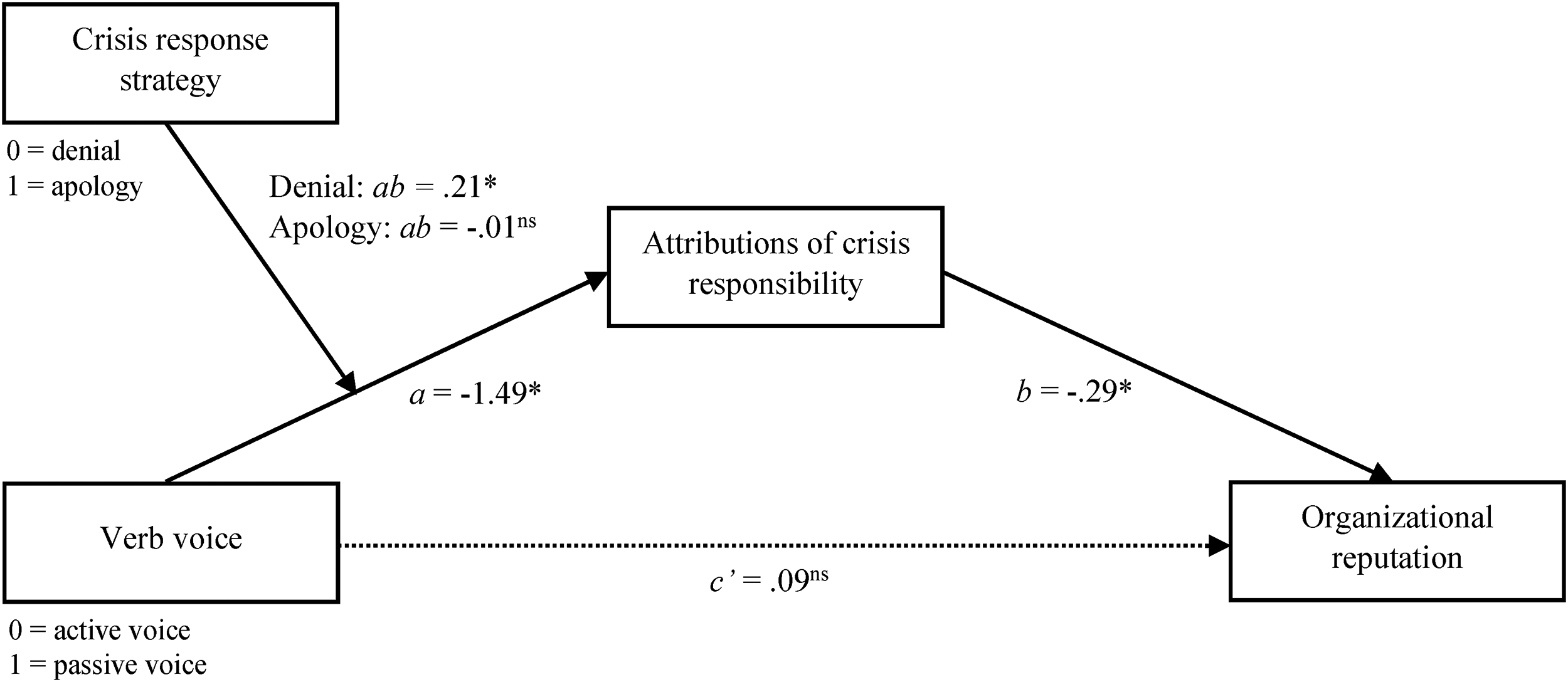
Moderated mediation model in study 1.
Discussion
The findings from study 1 show that crisis responsibility attributions are inferred from both the content and the formulation of a crisis message. First, the results confirm that the content of a crisis message, and more specifically the chosen crisis response strategy, affects the extent to which the public perceives the organization as responsible for the crisis when there is no information yet about the actual level of organizational blame. An organization that offers an apology will be considered as more responsible than an organization that denies the crisis, which results in a less favourable reputation. This result aligns with the limited research that demonstrates that stakeholders are more likely to attribute responsibility to an organization in the case of an apology compared to a denial (Brown-Devlin et al., 2020; Kim & Sung, 2014). The findings also confirm assumptions made by SCCT regarding the benefits of denial (cf. Coombs, 2007). When stakeholders believe this strategy, blame is reduced, as is reputational damage. The findings, therefore, support the assumption that a denial can be as effective as an apology in protecting an organization's reputation when the actual level of responsibility has not been established yet (Coombs et al., 2016; Fuoli et al., 2017; Schoofs et al., 2019).
Second, the manner in which these crisis response strategies are put into words should be taken into account as well. This finding corroborates psycholinguistic research that stresses the importance of verb voice in the attribution process (Henley et al., 1995; Knobloch-Westerwick & Taylor, 2008; Platow & Brodie, 1999). An organization is perceived as less responsible for the crisis when its message is constructed in the passive form as compared to the active form, which reduces reputational damage. However, the effect of verb voice on crisis responsibility depends on the crisis response strategy. The results show that a crisis message in the passive voice will only reduce responsibility attributions when the organization adopts a deny strategy, but not when it apologizes for the crisis. This finding supports the idea that the passive voice strengthens the denial frame. Both the content and the formulation steer the reader's mind to the belief that the organization is not, or at least less, responsible for the crisis (Anspach, 1988; Benoit, 1995; Chan & Maglio, 2020; Coombs, 2007). This results in lower levels of responsibility attributions than an active denial, where there is no match between the content and the form.
In contrast, the results show that the passive voice does not weaken responsibility attributions in the case of an apology. The recommendation to offer a passive apology in court in order to dodge legal liability (Cohen, 1999; Patel, 2003) does not seem to affect the perception of the public. They may not notice any difference in verb voice or be affected by it. The findings, therefore, counter the suggestion from prior research that a passive apology would automatically get punished by the public due to a perception of insincerity (Bentley, 2015; Wang & McGlone, 2020). The public generally seems to simply observe an organization that apologizes and accepts responsibility, upon which they infer that the organization is indeed responsible for the crisis.
Study 2
A follow-up study was conducted for two reasons. In the first place to observe if the results of study 1 could be corroborated in a different crisis scenario and, as such, increase the generalizability and validity of the research findings (Walker et al., 2017). In addition, we wanted to gain a more nuanced understanding of the verb voice effect. In study 1 the stimuli in the passive voice condition took the form of an agentless passive, while the passive voice can occur in an agentive form as well (Ferreira, 2021; Fox & Hopper, 1994). Therefore, study 2 examined if the impact of a passive voice on responsibility attributions differs between the two types of passive construction.
According to linguistic research, an active voice (e.g., “I did not hurt you”) ascribes much responsibility to the agent in the sentence because the agent holds the grammatical function of subject, whereas the agent in the passive voice is obscured and, as such, perceived as less responsible for the described action (Bohner, 2001; Henley et al., 1995; Reilly et al., 2005). However, such studies did not differentiate between an agentless passive in which the agent remains unnamed (e.g., “You were not hurt”) and an agentive passive in which the agent is still present, but only downgraded to the object of the sentence via a by-phrase (e.g., “You were not hurt by me”). The question then arises if a passive voice only reduces responsibility perceptions when the agent is unmentioned in the crisis response (as was the case in study 1) or if it is enough to grammatically downgrade the agent from the subject of the sentence to the object.
Method
Design and stimuli
The second study addressed the hypotheses and research question with a 2 (crisis response strategy: denial vs. apology) x 3 (verb voice: active voice vs. agentive passive voice vs. agentless passive voice) between-subjects experimental design. As in study 1, participants first read a text which described a fictitious crisis scenario and then read a newspaper article about the events including the crisis response of the CEO. To increase the generalizability of our findings, the crisis scenario involved an operational product-harm crisis, instead of a reputational crisis as in the first experiment (Coombs, 2015). A toy manufacturer was being accused of distributing toys that exceeded the permitted level of cadmium, which is a heavy metal that imposes health risks for children. Like in study one, the allegations were still under investigation so the participants could form their own responsibility perceptions.
The CEO response was included as a quotation in a fictitious newspaper article about the events. Similar to the first experiment, response strategy was manipulated by altering the level of responsibility accepted by the organization and the presence or absence of remorse (Benoit, 1995; Bentley, 2015; Coombs, 2007). The CEO rejected crisis responsibility in the deny condition (e.g., “We firmly deny that our organization has ever acted negligently”) and contradicted the allegations concerning the safety of the company's toys (e.g., “Our organization is saddened by the unjust accusation saying we have marketed dangerous toys”). In the apology condition, the CEO admitted negligence in their safety measures (e.g., “We take full responsibility for our negligence“) and apologized for it (e.g., “We offer our sincere apologies for the dangerous toys we have marketed”). See Appendix B for the full scenarios.
Contrary to the first experiment, verb voice had three manipulations instead of two. In the active condition, the agent was the grammatical subject in the sentence (e.g., denial: “We have always monitored the safety procedures very strictly” and apology: “We have not monitored the safety procedures strictly enough”). In the agentive passive condition, the agent was downgraded to the object of the sentence (e.g., denial: “The safety procedures have always been monitored very strictly by us” and apology: “The safety procedures have not been monitored strictly enough by us”). In the agentless passive condition, the agent was removed from the sentence and the object became the subject (e.g., denial: “The safety procedures have always been monitored very strictly” and apology: “The safety procedures have not been monitored strictly enough”).
Participants and procedure
The procedure was the same as in the first study. A convenience sample was invited through e-mail and social media to fill out an online survey. Participants first read an introductory text describing the crisis scenario and were then randomly divided across the six experimental conditions in which they read the news article. Thereafter, the participants completed a questionnaire containing measures of the dependent variables and socio-demographic variables. A sample of 317 Dutch-speaking Belgian men and women participated in the study with an average age of 43 years (SD = 14.90; range = 19 to 77). Approximately 38% were male and 62% were female.
Measures
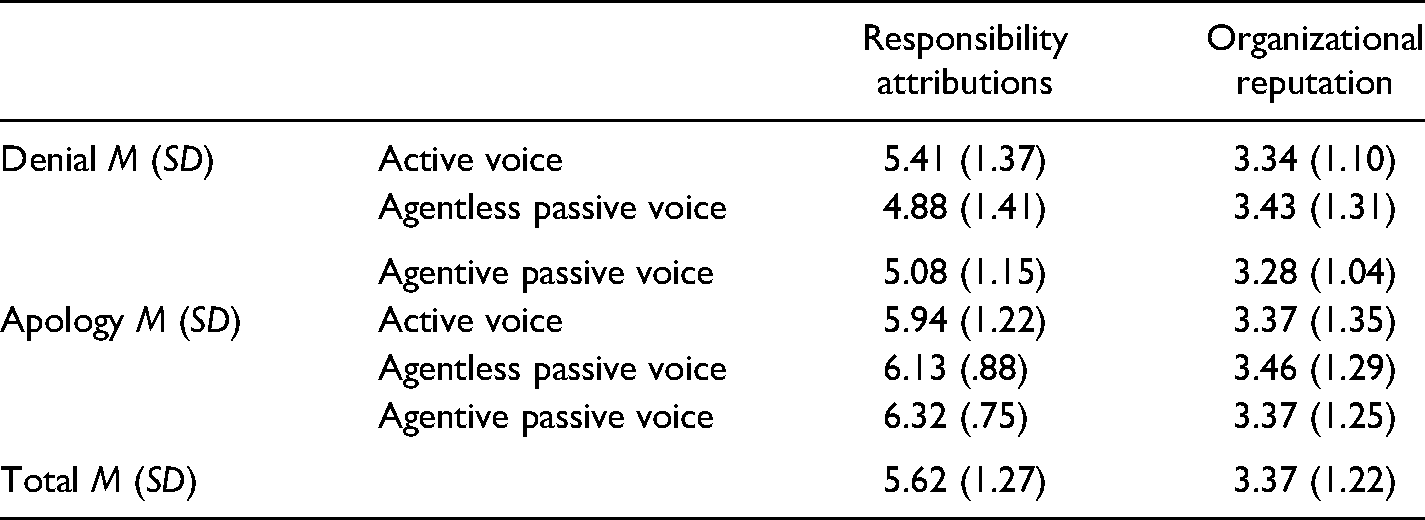
Crisis response strategy, responsibility attributions (r = .63, p < .001), and organizational reputation (α = .92) were measured by the same scales as in the first study (Coombs, 2007; Fombrun et al., 2000; Griffin et al., 1992). Table 2 shows the means and standard deviations of the constructs.
Means and Standard Deviations for Responsibility Attributions and Organizational Reputation in Study 2.
Results
Manipulation check
An independent samples t-test was used to test the manipulation of crisis response strategy. Participants in the apology condition (M = 5.48, SD = 1.69) perceived that the organization took more responsibility for the crisis than participants in the denial condition (M = 2.51, SD = 1.59; t[315] = -16.15, p < .001, d = -1.81). Thus, the manipulation of crisis response strategy was again successful.
Test of hypotheses
To address the first hypothesis, a mediation analysis was conducted (PROCESS macro; Hayes 2017). The model included responsibility attributions as mediator in the path from crisis response strategy to organizational reputation (model 4; 5000 bootstrap samples; 95% confidence intervals). The analysis revealed that there was a significant indirect effect of crisis response strategy on organizational reputation through responsibility attributions (b = -.33, SE = .09, 95% CI [-.51, -.17]). Moreover, the direct effect of crisis response strategy on organizational reputation was significant (b = .38, SE = .14, 95% CI [.10, .66]). This result supports the first hypothesis. An apology triggers a higher level of attributed crisis responsibility than a denial, which subsequently results in less reputation repair.
A second mediation analysis was conducted to examine the second hypothesis (PROCESS macro; Hayes 2017). The model included responsibility attributions as mediator in the path from verb voice to organizational reputation (model 4; 5000 bootstrap samples; 95% confidence intervals). 2 The analysis revealed that there was no significant indirect effect of verb voice on organizational reputation through responsibility attributions when the active voice condition was compared with the agentless passive voice condition (b = .04, SE = .05, 95% CI [-.05, .15]) and when the active voice condition was compared with the agentive passive voice condition (b = -.00, SE = .05, 95% CI [-.09, .09]). Similarly, the direct effect of verb voice on organizational reputation was not significant when the active voice condition was compared with the agentless passive voice condition (b = .05, SE = .16, 95% CI [-.27, .37]) and when the active voice condition was compared with the agentive passive voice condition (b = -.03, SE = .16, 95% CI [-.35, .29]). This result does not confirm the second hypothesis. A crisis response formulated in the passive voice (both agentless and agentive) does not result in more reputation repair than a crisis response in the active voice due to lower responsibility perceptions.
Finally, in order to investigate the research question, a moderated mediation analysis was conducted (PROCESS macro; Hayes 2017). The model included responsibility attributions as mediator in the path from verb voice to organizational reputation, with crisis response strategy as moderator (model 7; 5000 bootstrap samples; 95% confidence intervals). First, the analysis revealed that the moderated mediation index was significant when the active voice condition was compared with the agentless voice condition (Index = -.19, SE = .10, 95% CI [-.40, -.01]. When we look at the conditional indirect effects, it seems that a crisis response formulated in the agentless passive voice does result in more reputation repair than a crisis response in the active voice due to lower responsibility perceptions, but only in the case of a denial (b = .14, SE = .08, 95% CI [.001, .31]) and not in the case of an apology (b = -.05, SE = .06, 95% CI [-.16, .06]). The model indicated by our results is shown in Figure 2. Second, the analysis revealed that the moderated mediation index was also significant when the active voice condition was compared with the agentive voice condition (Index = -.19, SE = .09, 95% CI [-.37, -.03]). However, when we look at the conditional indirect effects, it seems that a crisis response formulated in the agentive passive voice does not result in more reputation repair than a crisis response in the active voice due to lower responsibility perceptions, not in the case of denial (b = .09, SE = .07, 95% CI [-.04, .23]), nor in the case of an apology (b = -.10, SE = .06, 95% CI [-.22, .001]). The model indicated by our results is shown in Figure 3.
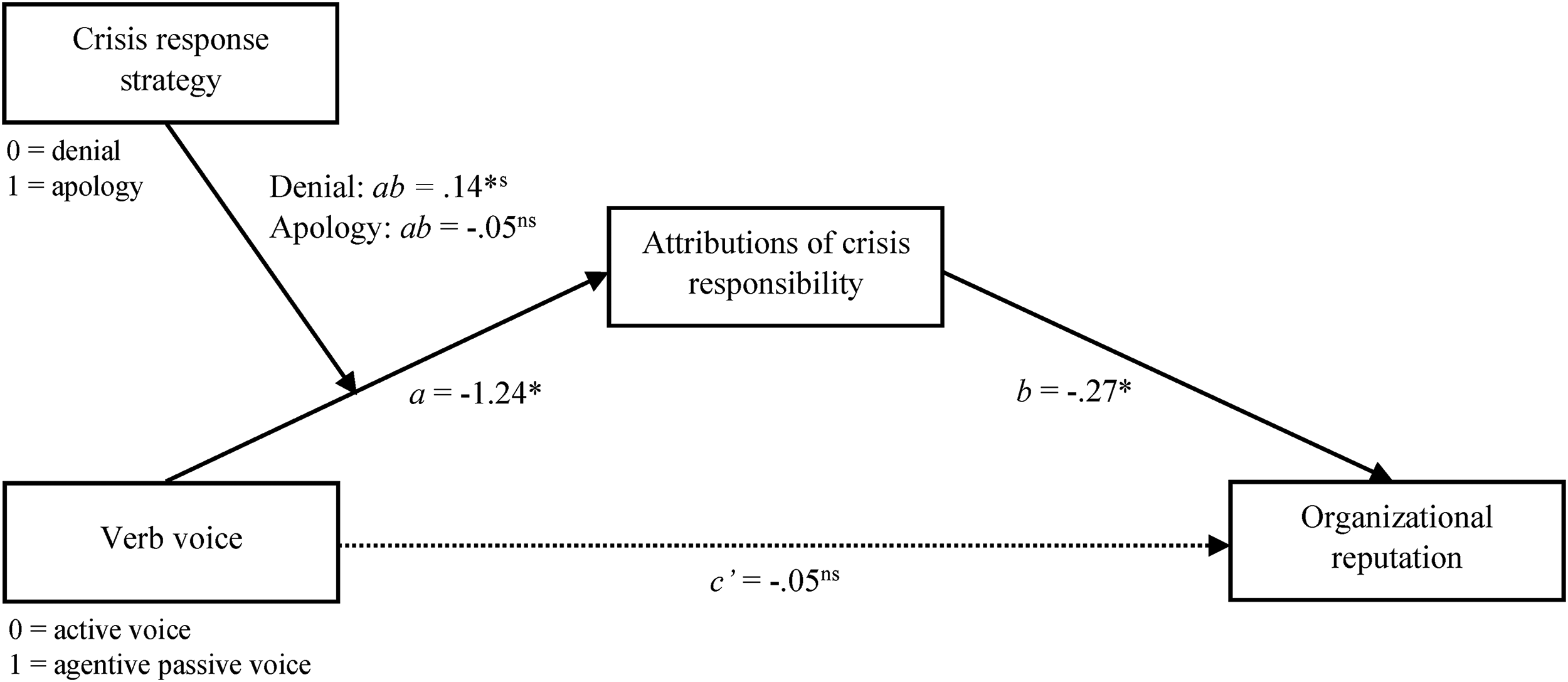
Moderated mediation model in study 2 (active voice and agentless passive voice). Note. Moderated mediation model of the impact of verb voice on organizational reputation through attributions of responsibility in which the a path is moderated by crisis response strategy. Path diagrams are shown with unstandardized regression coefficients. * = 95% CI does not contain zero (significant), ns = CI does contain zero (not significant).
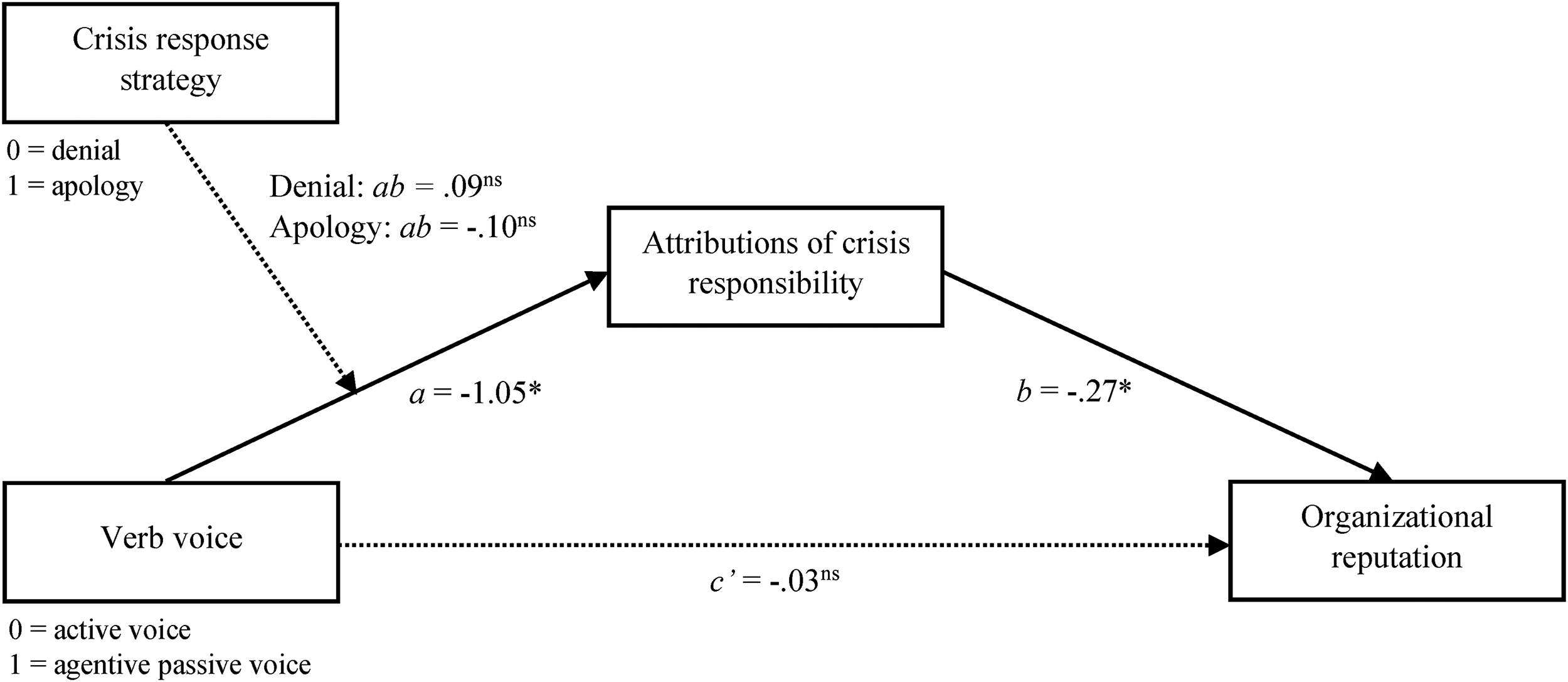
Moderated mediation model in study 2 (active voice and agentive passive voice). Note. Moderated mediation model of the impact of verb voice on organizational reputation through attributions of responsibility in which the a path is moderated by crisis response strategy. Path diagrams are shown with unstandardized regression coefficients. * = 95% CI does not contain zero (significant), ns = CI does contain zero (not significant).
Discussion
The findings from study 2 corroborate the results of study 1 by showing that both the content and the formulation of a crisis message affect crisis responsibility attributions. First, the results again demonstrate that when organizational guilt has not been established yet, the public is more likely to blame an organization when it apologizes for the crisis than when it denies it. Our findings, therefore, consistently confirm the presumption that crisis response strategies are able to affect attributions of responsibility (Brown-Devlin et al., 2020; Coombs, 2007; Kim & Sung, 2014). Even though apologies are often considered the most effective crisis response, especially as compared to denial (Coombs & Holladay, 2008), denying accusations against a company can minimize reputational damage due to a decrease in attributions of responsibility. If stakeholders believe that the organization is indeed not to blame, denial can be effective as well (Coombs et al., 2016; Fuoli et al., 2017; Schoofs et al., 2019).
In addition, the findings from the second experiment confirm that organizations should consider how they formulate their crisis response strategy. The use of a passive voice can reduce attributions of responsibility among the public as compared to an active voice. This effect only holds true, however, in the case of a denial strategy. An apology might take away any potential doubt among the public regarding the organizational crisis responsibility. While a judge in court might differentiate between saying sorry and accepting legal responsibility, in the main, the general public may not distinguish between the two. Contrary to suggestions of previous research, a passive apology does not necessarily reduce responsibility perceptions (Cohen, 1999; Patel, 2003), nor does it provoke a reputational backlash (Bentley, 2015; Wang & McGlone, 2020).
Moreover, study 2 clarifies that the responsibility-reducing impact of the passive voice only appears in an agentless passive construction and not in the form of an agentive passive. This is an important theoretical contribution to the findings of previous studies that did not consider the specific grammatical manifestation of the passive voice in relationship to responsibility attributions (e.g., Henley et al., 1995; Knobloch-Westerwick & Taylor, 2008). It seems that it is not enough to de-emphasize the agent in order to reduce attributions of responsibility. The organization as agent needs to be removed entirely from the sentence to be regarded as less responsible for the crisis.
Limitations and Further Research
This research has some limitations that offer interesting suggestions for further research. First, this study specifically compared the deny and apology strategies because they each lie at one end of the continuum, ranging from rejecting to accepting crisis responsibility (Coombs, 2007). Future research could also investigate how verb voice interacts with diminish crisis response strategies (i.e., excuses and justification). Diminish strategies take a position between a denial and an apology and attempt to minimize crisis responsibility, rather than accept or refute it. It might also be relevant to consider the impact of verb voice on crisis response strategies that do not reveal stance about responsibility at all, such as an expression of empathy or bolstering strategies (e.g., reminding stakeholders about the past good works of the organization; cf. Coombs, 2007).
Second, future research should further explore the boundary conditions of message formulation's impact. The effect of verb voice could differ, for instance, between a written and an oral crisis response, because the passive voice is more common in writing than in speech (Roland et al., 2007). The same applies to language, as the prevalence of the passive voice differs between languages and also holds different cultural meanings (Siewierska, 2013).
Third, in real-life crisis situations, the amount of crisis responsibility attributed by the public will not only be influenced by what the organizations says. Crisis responsibility attributions will also depend on situational and personal factors (Diers-Lawson, 2018), such as an organization's prior reputation (e.g., Claeys & Cauberghe, 2015), an organization's crisis history (e.g., Coombs, 2004), stakeholders’ personal involvement with the crisis (e.g., Nekmat & Kong, 2019), and how severe the public judges the crisis to be (e.g., Laufer et al., 2005). It would, therefore, be interesting to take into account these other antecedents of crisis responsibility and to examine the weight and the interplay of each factor in determining attributions of responsibility.
Finally, this study examined the effect of verb voice in crisis communication on responsibility attributions because there is established literature about the relationship between the passive voice and responsibility perceptions. However, there are other antecedents of organizational reputation that are also influenced by verb voice, besides responsibility, such as sincerity (Wang & McGlone, 2020). This is important to consider, because a lack of sincerity is detrimental to the post-crisis reputation (Claeys et al., 2013) and recent research has established that insincere language cues (e.g., evasion and obfuscation) can heavily impact crisis communication outcomes (Clementson & Page, 2021).
General Discussion
The extent to which an organization is considered responsible for a crisis is one of the most important elements within crisis communication theory (Coombs, 2007; Coombs & Holladay, 2002). Several studies have shown that an organization should adapt its crisis response to the level of attributed responsibility in order to effectively repair reputational damage (Coombs & Holladay, 1996; Coombs & Holladay, 2002; Sheldon & Sallot, 2008). Few studies have, however, empirically studied through which processes crisis response strategies affect the post-crisis reputation (Schoofs et al., 2019). Especially interesting is how these strategies influence the public's attributions of organizational responsibility. In addition to examining the process behind the effectiveness of crisis response strategies, we wanted to go beyond the mere impact of the message content. Two experiments also looked at the role of how these strategies are formulated, because a denial that is actively formulated might come across quite differently from a denial that is written in passive voice.
The findings first confirm that the content of a crisis response indeed strongly determines stakeholders’ responsibility perceptions (Coombs, 2007). More specifically, in situations where an organization's crisis responsibility is ambiguous and there is no actual level of organizational blame established yet (e.g., accusations), a denial will produce lower levels of attributed responsibility than an apology. In both experiments, investigations to determine the cause of the crisis were ongoing and crisis communication efforts, therefore, were able to shape the public's perceptions regarding who was to blame. Research indicates, however, that if an organization denies and is later found guilty, the denial can ultimately backfire (Coombs et al., 2016). We must also note that the mean differences between the denial and the apology in terms of reputation are rather small and that there was a positive direct effect of apologizing on reputation in the second experiment. This means that the positive characteristics of an apology, such as increased empathy with the organization (Schoofs et al., 2019), might counter the negative effect of responsibility attributions. Future research should examine how multiple mediators (e.g., responsibility attributions, credibility perceptions, empathy) come together to shape the final post-crisis reputation.
Second, the results indicate that the linguistic formulation of the crisis response influences the audience's responsibility perceptions as well. Whereas numerous studies have focused on what the most impactful crisis response strategy is and under which circumstances (e.g., Claeys et al., 2010; Coombs et al., 2016; Fuoli et al., 2017), our results show quite clearly that something seemingly insignificant as verb voice can have notable consequences. The public attributes less responsibility to the organization when the crisis response is written in the passive voice compared to the active voice. Crisis communication research has focused abundantly on the impact of overall strategies, and practitioners likewise seem to focus rather on the overall strategy selection than on how these strategies are shaped exactly (Claeys & Opgenhaffen, 2016). Legal counsels in a crisis team, however, might be as much, or even more, concerned with the exact phrasing and formulation of these strategies (Claeys & Opgenhaffen, 2021; Myers, 2016; Patel & Reinsch, 2003). While our findings confirm the importance of the overall response strategy, they also provide a warning for crisis communication professionals to consider the phrasing as well. The results from both studies endorse the psycholinguistic assumption that people process active and passive sentences differently and, as such, develop different social perceptions, such as attributions of responsibility (Henley et al., 1995; Knobloch-Westerwick & Taylor, 2008; Platow & Brodie, 1999). However, this does not mean that organizations in crisis should always communicate in a passive voice when they seek to reduce responsibility attributions, as our findings reveal a more nuanced picture of the verb voice effect. There are boundary conditions that practitioners should keep in mind when they formulate a passively constructed crisis response.
First of all, the strategic advantage of the passive voice concerning crisis responsibility attributions only occurs in the case of a denial and not in the case of an apology. It so happens that the content of the deny strategy and the formulation of the passive voice are well matched, as they both attempt to disconnect the organization from the crisis (Anspach, 1988; Benoit, 1995; Chan & Maglio, 2020; Coombs, 2007). When an organization apologizes, however, there seems to be little room left to minimize responsibility perceptions through verb voice. An apology will result in the perception among the public that an organization bears responsibility, irrespective of whether that apology is formulated in an active or passive manner. So while legal advice proposes to offer a passive apology to reduce responsibility perceptions and, consequently, avoid liability (Cohen, 1999; Patel, 2003), this does not seem to affect public perceptions. Hence, when it comes to public perceptions, organizations are only recommended to use the passive voice when they deny the crisis.
In addition, it may not be enough to merely phrase an organizational denial in the passive voice in order to reduce responsibility perceptions. Our findings indicate that a passive denial only works when the agent in the sentence is removed (i.e., agentless passive), but not when the performer of the action is presented in the by-phrase (i.e., agentive passive). This result suggests that a grammatical downgrade of the agent from the subject to the object is not sufficient to alter responsibility attributions, but that the power of the passive voice lies in the ability to eliminate the agent altogether. In other words, a passive voice by itself does not impact responsibility perceptions, it is the removal of the agent that lowers attributions of responsibility, which can be achieved by using an agentless passive construction.
These findings come with important ethical caveats. First, denying crisis responsibility when the organization is, in fact, guilty is not only bound to be ineffective in the long run (Coombs et al., 2016), it is also simply unethical (Benoit, 1997; Claeys & Opgenhaffen, 2021). The same can be said of adopting the passive voice merely as a linguistic device to mask responsibility (Platow & Brodie, 1999). An organization should, therefore, construct its denial in the passive voice only when it knows it is does not bear responsibility; otherwise it should not deny the crisis in the first place. The use of a passive voice is a means for organizations who are the victim of rumours or false accusations to further strengthen their attempt to avoid reputational damage.
Second, the findings should not be interpreted as support for the recommendation to provide a passive corporate apology in an attempt to reduce legal liability (Kampf, 2009; Patel & Reinsch, 2003). Even though our experiments indicate that a passive apology might go unnoticed by the general public, other research found that there are instances where such apologies could hinder reputation repair. A passive apology is often perceived unfavourably by the public because it can come across as an insincere pseudo-apology (Bentley, 2015; Wang & McGlone, 2020). Further research could examine if, and how, certain contextual factors, like involvement with the crisis (Choi & Lin, 2009), determine the value consumers attach to how apologies are formulated or expressed. More research is needed to gain a better understanding of not only how certain crisis response strategies affect the organizational reputation, but also in what way they should be delivered to stakeholders.
Conclusion
The present study shows that both the content and the formulation of an organizational crisis response impact how much the public thinks an organization is responsible for a crisis and as such influence organizational reputation. When guilt has not been officially established yet, a denial results in a more favourable reputation than an apology due to lower attributed responsibility. In addition, a crisis response phrased in the passive voice reduces responsibility attributions compared to the active voice and consequently results in a better reputation. However, the beneficial effect of the passive voice only occurs in the case of a deny strategy and when the agentless passive voice is adopted. Taken together, the results of this study demonstrate the importance of language in crisis communication and support the notion that it is not only imperative to select the most appropriate crisis response strategy, but to carefully put the chosen strategy into words as well.
Footnotes
Acknowledgements
The authors would like to thank Kaat De Gueldre and Joni Debusschere for their help in collecting the data. We would also like to thank Ellen Soens and Leen Nijssen for their careful review of the stimuli and Kristien Temperville for proof reading the article. Finally, we would like to thank the editor and the reviewers for their valuable and constructive feedback in strengthening the manuscript.
Declaration of Conflicting Interests
The author(s) declared no potential conflicts of interest with respect to the research, authorship, and/or publication of this article.
Funding
The author(s) received no financial support for the research, authorship, and/or publication of this article.

Notes
Author Biographies
Appendices 3
Appendix A. Stimulus Material Study 1
Appendix B. Stimulus Material Study 2