







Abstract
This study examines Flemish teenagers’ perceptions and evaluations of linguistic accommodation in instant messaging: people adapting their language use to (that of) their interlocutor. We conducted a survey among 254 pupils in Belgian secondary education, and compare the results to teenagers’ online writing practices in a reference corpus. Our findings yield insight in the indexicality of accommodation, with (more) mirroring evoking (more) positive evaluations of the relationship between interlocutors. As for self-reported mirroring, the socio-demographic variable of education stands out: while the participants report a frequent online contact with people who differ from them regarding age, gender, or educational track, they only report to accommodate in the first two situations. Furthermore, they perform quite poorly at recognizing accommodative adjustments made by their peers, especially for mixed-education interactions. Finally, while teenagers appear to hold largely the same opinions on accommodation, the analyses reveal some socio-demographic variation.
It has been attested repeatedly that teenagers’ socio-demographic profiles and their online writing style correlate: youths with distinct profiles (in terms of e.g., age or gender) tend to favor certain markers of online writing to different extents (De Decker & Vandekerckhove, 2017; Hilte et al., 2020a; Verheijen, 2018). But the conversation partner’s profile matters too. The phenomenon of accommodation, i.e., people adapting their communicative behavior to (that of) their interlocutor, has been widely investigated in spoken face-to-face interactions, and to a minor extent in online conversations (see below for a literature overview). We previously showed how youths adapt their writing style on chat apps such as WhatsApp, resulting in a style more similar to their interlocutor’s (Hilte et al., 2020b, 2021a, 2021b). But we do not yet know how they perceive their own and their peers’ accommodative behavior. Are teenagers aware of this linguistic phenomenon? And how do they evaluate (non-)mirroring of certain linguistic features? This paper aims to gain insight in their intuitions and opinions on accommodation in instant messaging. It will compare teenagers’ responses to a survey with their peers’ actual accommodative writing practices as attested in a reference corpus and in related work.
The paper is structured as follows: first, we summarize related research. The next section describes the survey design as well as the data collection of the reference corpus. Finally, the results of the survey are reported and discussed.
Related Research
Below, we discuss related work on the perception of accommodation. Next, we summarize previously attested patterns of linguistic mirroring in teenagers’ online interactions.
Accommodation and its Perception
Accommodation (also referred to as e.g., mirroring, matching, or alignment) refers to people adapting their communicative behavior to (that of) their conversation partner. The sociolinguistic framework Communication Accommodation Theory or CAT serves as our main point of reference (see Dragojevic et al., 2016 for an overview of the evolution of and updates on the theory). CAT states that accommodation is driven by a desire to facilitate interaction and regulate social distance, as mirroring others’ language can decrease the linguistic but also the social distance between conversation partners. This common strategy of communicating more similarly to others is called convergence, and the opposite strategy of making one’s language more dissimilar to that of others is known as divergence. While the perceived effect of (non-)accommodation may depend on the linguistic feature (see below), people generally evaluate divergence more negatively and convergence more positively (Dragojevic et al., 2016). Divergence—as well as maintenance/parallelism, i.e., no adaptation—can be perceived as impolite, insulting, or hostile, and can lead to negative interpersonal evaluations (Dragojevic et al., 2016). But convergence generally leads to perceived smoother interactions and positive evaluations in terms of conversation partners’ likeability: mimicry can increase positive perceived speaker characteristics such as attractiveness, intelligibility, and credibility (Chartrand & Bargh, 1999; Dragojevic et al., 2016). On an interpersonal level, mirroring can build rapport between people (Dragojevic et al., 2016) and trust (Scissors et al., 2008). And regarding the relationship between interlocutors, more convergence has been attested among friends than strangers (Riordan et al., 2013) and verbal mimicry has been shown to predict mutual romantic interest and relationship stability (Ireland et al., 2011). Finally, note that convergence does not need to be explicitly noticed to positively impact speaker evaluation and smoothness of the interaction (Chartrand & Bargh, 1999).
But there is an upper limit to the degree of mirroring that is perceived positively. Full convergence is seldom desired: instead, optimal levels of (dis)similarity exist, which are individually and socio-culturally determined (Burgoon et al., 2017; Dragojevic et al., 2016). So-called overaccommodation, which overshoots the adjustment required for smooth interaction, is not always appreciated (Gasiorek & Giles, 2012; Giles & Gasiorek, 2011). It can be perceived as mocking or parody (Jones et al., 2014), or can, when produced by a stranger, come across as overfamiliar (Muir et al., 2016). The opposite phenomenon of underaccommodation exists too: communication that is insufficiently adjusted to a recipient, such as the use of abbreviations or jargon unknown to the receiver (Gasiorek & Giles, 2012). In general, underaccommodation is evaluated less positively than overaccommodation (Gasiorek & Giles, 2012).
Furthermore, the perception of accommodation can be influenced by external factors such as the power relation between interlocutors. The positive interpersonal impressions associated with convergence hold when there is no power difference between interlocutors. But when people differ in social power/status, convergence by the “high” power person tends to be negatively evaluated by the “low” power person as it violates social expectations (Muir et al., 2017). In such contexts, “upward” convergence—one-sided adaptation to the person with greater power—seems to be desired and common (Dragojevic et al., 2016; Kroll et al., 2018; Muir et al., 2016, 2017). Alternatively, divergence occurs in these situations (Muir et al., 2017). This kind of divergence is called speech complementarity (Dragojevic et al., 2016): “communicative behaviors that appear divergent in nature, but have the function of conveying and reinforcing social roles” (Muir et al., 2017, pp. 539–540). This has also been observed in mixed-gender conversations, with men and women mutually diverging to emphasize gender roles (Burgoon et al., 2017; Dragojevic et al., 2016). So divergence can also be an acceptable and even preferred strategy, positively perceived by all parties (Burgoon et al., 2017; Dragojevic et al., 2016; Muir et al., 2017).
What contributes to the perception and evaluation of accommodation too, is the speaker’s inferred motive and deliberateness. For instance, a converging speaker may be evaluated more favorably when the receiver infers the convergence to be deliberate and positively motivated, such as to reduce barriers. Similarly, a diverging speaker may be evaluated less negatively if the receiver thinks of the divergence as unintentional rather than deliberate and negatively motivated (Gasiorek & Giles, 2012). And just like people’s inference on motive is subjective, so is their perception of the linguistic (non-)adaptation itself: individuals’ perceptions of accommodative adjustments may vary, especially since people do not always perceive accommodative adjustments accurately (i.e., aligned with objectively measurable change) (Dragojevic et al., 2016).
Finally, related research has demonstrated that the perceived effect of (non-)accommodation depends on the linguistic feature (e.g., Scissors et al., 2009).
Accommodation in Teenagers’ Online Interactions
While people’s inclination to mirror others is to some extent individually determined (Jones et al., 2014; Xu & Reitter, 2015), certain robust socio-demographic trends have been attested. Below, we summarize patterns relating to the three independent variables that are the focus of this paper: interlocutors’ gender, age, and educational profile. As our analyses will investigate teenagers’ instant messaging, we limit the scope of this section to that genre too.
Teenagers are considered to be driven by a desire for acceptance by their peers and a fear of isolation (Fortman, 2003). They can use language as a tool in this respect: to construct their own social identity, and to signal inclusion to in-group members (i.e., peers) as well as exclusion to out-group members (e.g., adults) (Fortman, 2003). Consequently, youth language has its own characteristics. It is generally viewed as creative, innovative, and non-standard (Androutsopoulos, 2005; De Decker, 2014; Eckert, 1997). In online discourse, teenagers use more prototypical chatspeak markers (e.g., emoji) than older people (Verheijen, 2018). However, adolescent online writing is not homogeneous, as previous work has shown that chatters’ profiles (in terms of e.g., their gender identity or age) evoke significant linguistic variation (De Decker & Vandekerckhove, 2017; Hilte et al., 2020a; Verheijen, 2018). And so do the conversation partners’ profiles.
In our reference corpus of teenagers’ instant messages (see below), we compared boys’ and girls’ writing in same-gender chats (including only boys or only girls; 66% of the conversations) to mixed-gender chats (including boys and girls; 34%) (Hilte et al., 2020b). Significant convergence emerged for expressive chatspeak markers, i.e., mostly typographic features that can encode emotional, social, and pragmatic information in a text utterance, such as emoji or writing in all caps. These features are generally favored by girls (Hilte et al., 2020a), but in (one-on-one) mixed-gender interactions, girls insert significantly fewer of them and boys more, resulting in more similar and less prototypically gendered writing styles. Strikingly, boys converged much more strongly to a more expressive “female” style than vice versa, which contradicts previous work on spoken interactions, in which either a stronger convergence by women is reported (Palomares et al., 2016) or mutual divergence (speech complementarity) by men and women (Dragojevic et al., 2016).
Next, we examined instant messages between teenagers and adults (Hilte et al., 2021a). In the reference corpus, the vast majority of the conversations (93%) involve teenagers only. And the literature confirms that teenagers interact with peers the most (Williams & Garrett, 2012). But when they do interact with adults in the reference corpus (people older than 20; 7% of the conversations), they adapt their writing style by inserting significantly fewer expressive markers (e.g., emoji) and speech-like markers (e.g., regional or colloquial language features). So they adopt a more “adult” style, as especially young teenagers are more ardent users of these chatspeak features than older generations (Hilte et al., 2020a; Verheijen, 2018). The teenagers’ convergence corresponds to commonly observed patterns in spoken interactions between people of different ages or generations: underaccommodation by older interlocutors (not captured in our corpus, which only includes teenage authors) and accommodation or even overaccommodation by younger interlocutors (Giles & Gasiorek, 2011; Williams & Garrett, 2012; Williams & Nussbaum, 2001).
We also examined accommodation with respect to interlocutors’ educational track in secondary school—see below for more information on the Belgian school system. To the best of our knowledge, no other studies inspect this variable 1 . In the reference corpus, youths mostly interact with pupils from their own educational track (76% of the conversations). But when they do chat with pupils from another track (24% of the data), they adapt their writing style: their quantitative use of oral and expressive markers significantly changes depending on their interlocutor’s educational profile. However, they accurately mirror their interlocutor for expressive features only: i.e., they indeed converge towards their peers’ average usage frequency for features like emoji. For instance, when interacting with practice-oriented vocational students, who are the most ardent users of expressive markers, the teenagers tend to increase their own use of these features to match their interlocutor’s style (Hilte et al., 2021b).
Finally, note that accommodation through extra-linguistic (chatspeak) markers such as emoji is not specific or limited to the reference corpus, but has been observed in related work too (Adams et al., 2018; Kroll et al., 2018; Wolf, 2000). Furthermore, other studies have also generalized or translated the phenomenon of accommodation from “classical” genres (e.g., spoken, face-to-face dialogue) to online textual interactions, zooming in on linguistic features that fall outside the scope of the present paper, such as temporal patterns (Doyle et al., 2016; Riordan et al., 2013, 2014; Scissors et al., 2008, 2009).
Experimental Design
This section is devoted to the design of the study. First, we describe the survey and its participants. Next, the corpus is introduced from which the examples in the survey are extracted. Moreover, this corpus will serve as the reference point for comparing the teenagers’ perception of accommodation to their peers’ actual mirroring behavior.
Design of the Survey
We created an online survey 2 to complement our previous research on teenagers’ production of accommodative adjustments in instant messages (Hilte et al., 2020b, 2021a, 2021b) with findings on their attitudes and perceptions concerning the phenomenon. The respondents were secondary school pupils (see below for more information) who filled out the survey on a school computer or their own smartphone. Participation was voluntary and anonymous: participants were not asked to enter their name or class group, but only some general profile information such as their age and gender. Finally, note that we were present in the classroom during data collection to help with any technical issues, or to clarify certain phrasings. But prior to filling out the survey, the pupils did not receive any explicit information, formal instruction, or guidance on the phenomenon of accommodation or what mirroring behavior might look like. We gave a guest lecture on the topic only after the teenagers had submitted their answers.
The survey consisted of multiple question blocks focusing on accommodation in instant messaging on popular platforms such as Facebook Messenger and WhatsApp. The selection of the linguistic and socio-demographic variables that are the focus of the survey was based on our previous work, as we observed significant mirroring in the reference corpus concerning these variables (Hilte et al., 2020b, 2021a, 2021b). And the instant messages in the survey were selected randomly from the reference corpus, with some constraints (described below).
In this section, each question block is described and illustrated with a screenshot from the survey: the screenshot shows the original question in Dutch, and an English translation that was added for the purpose of this paper. Note that the order of the blocks was randomized each time: i.e., all respondents answered the same questions but in different, random, orders.
Blocks 1–3: Who is the receiver? The first question blocks consisted of three distinct prediction tasks concerning the receiver of instant messages. The respondents were shown authentic, anonymized examples from the reference corpus, along with profile information about the sender. They were asked to guess the receiver’s profile in terms of gender, age, or educational track.
In the first task, the participants had to guess the receiver’s gender when shown ten messages and the sender’s gender. An example is shown in Figure 1. The participants could check one of three boxes: “girl,” “boy,” or “I don’t know.” 3 When selecting “girl” or “boy,” they were free but not obliged to write down their argumentation. They were given four gender prediction tasks (each including ten new examples): girls addressing girls, girls addressing boys, boys addressing boys, and boys addressing girls. These forty messages were selected at random (using the “random” library in Python 4 ) from the reference corpus, with some constraints: whenever the content explicitly revealed the receiver’s gender, we picked another message instead. Furthermore, we kept the confounding variables of age and education constant by only selecting utterances from same-age and same-education conversations.
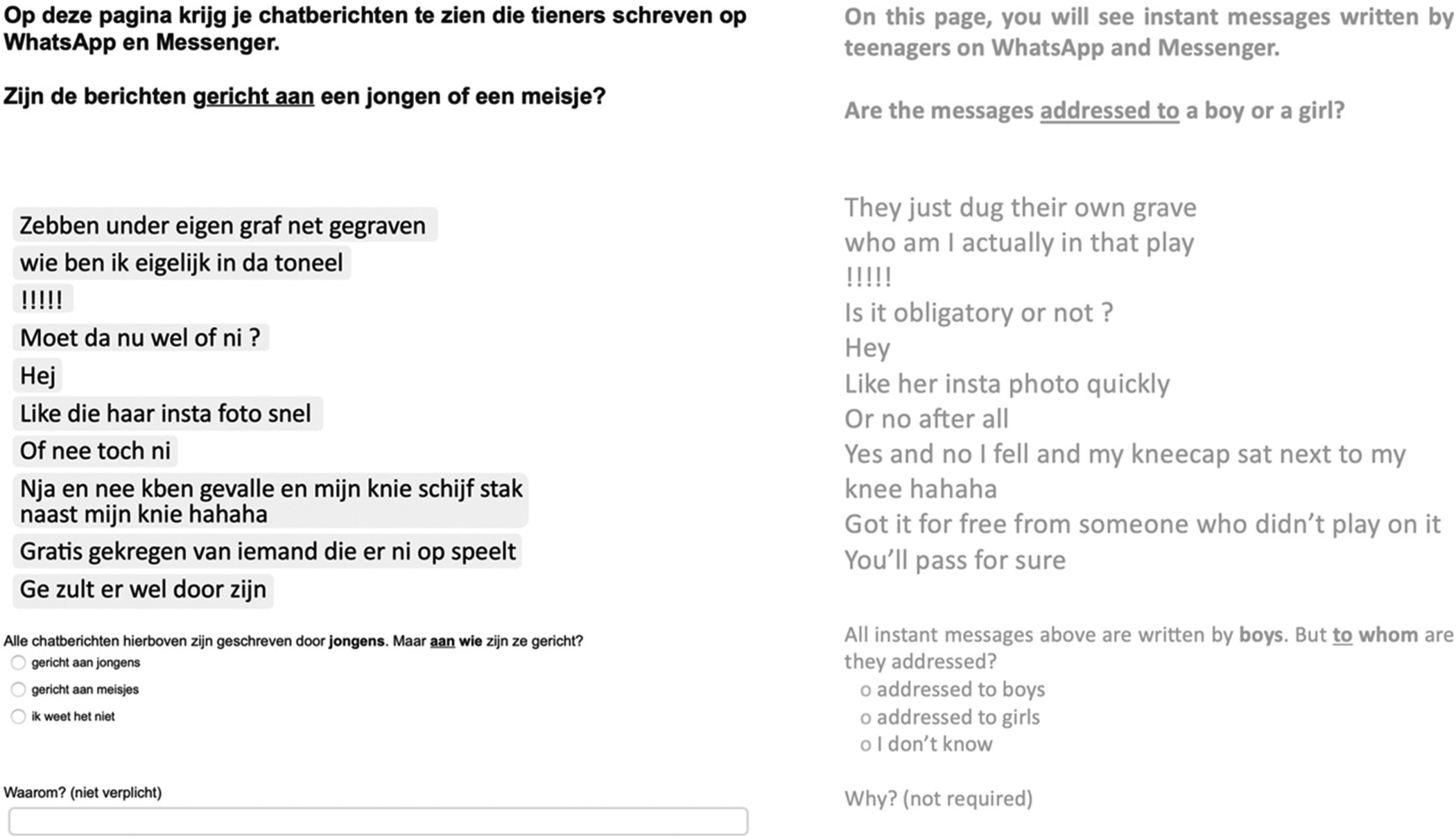
Example from the survey: who is the receiver?.
The second block contained a similar task concerning age: the participants were shown instant messages along with the information that the sender was a teenager. They were then asked whether the receiver was a teenager or an adult. There were two age prediction tasks in total (each including ten new examples): teenagers addressing teenagers, and teenagers addressing adults. Recall that the reference corpus concerns adolescents’ online writing only, and does not include any messages written by adults. These twenty examples were randomly extracted from the corpus, with the same constraints as above, only now we selected utterances from same-gender and same-education interactions.
The third task concerned education. Per 10 instant messages, the participants were given the sender’s educational track: general secondary education (theory-oriented), vocational (practice-oriented), or technical (hybrid) (see below). They were then asked whether the receiver attended the same school track as the sender. The respondents answered six education prediction tasks in total (seeing 10 new example messages each time): pupils from each of the three included school tracks addressing peers from their own versus a different track. All examples were selected randomly from the corpus, with the same constraints as above: no revealing content, and only messages from same-gender, same-age conversations.
These question blocks serve two purposes. First, we want to verify whether the participants can distinguish between the online writing of teenagers who are addressing people with similar versus different socio-demographic profiles than their own. Second, we are interested in the participants’ decision-making. Which properties of the instant messages appear crucial to them? And are they accurate? We will compare the listed cues to actual accommodation patterns attested in the reference corpus and in related work. We argue that when participants make accurate predictions and list accurate cues, this is indicative of correct intuitions on linguistic mirroring. Similarly, inaccurate predictions and cues can be seen as symptomatic of a low awareness of or incorrect intuitions on the same phenomenon. Finally, the potential impact of particular example messages is addressed in the results section.
Block 4: Frequency of contact. The next block concerned the respondents’ frequency of contact with different groups of interlocutors. We asked how often the participants think they interact via instant messaging with people of another gender, adults, or pupils in a different educational track. The answers were multiple choice: “often,” “sometimes,” or “(almost) never.” An example is shown in Figure 2.
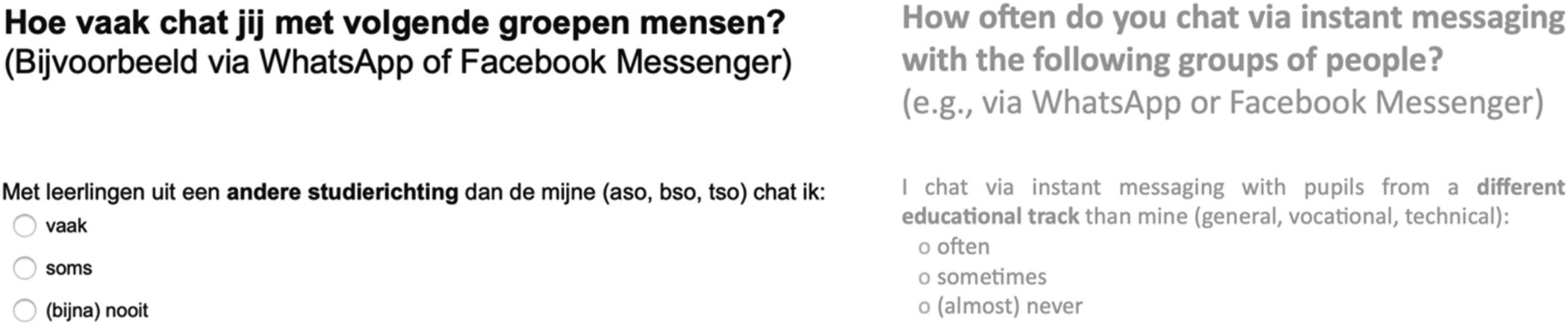
Example from the survey: frequency of contact.
Block 5: Frequency and manner of accommodation. The fifth block contained questions on whether, how, and how often the respondents think that they adjust their online writing style to others in instant messaging. They could indicate how frequently they adapt their language use depending on their interlocutor’s profile in terms of gender, age, and education: “never,” “sometimes,” or “often.” “I don’t know” was added as a fourth option, to capture a potential lack of awareness about accommodation.
Figure 3 shows one of the questions. Note that we did not present the responses on a classical Likert scale with a horizontal layout, since the “I don’t know” option does not fit on such a scale in the same intuitive way as the three other options do.
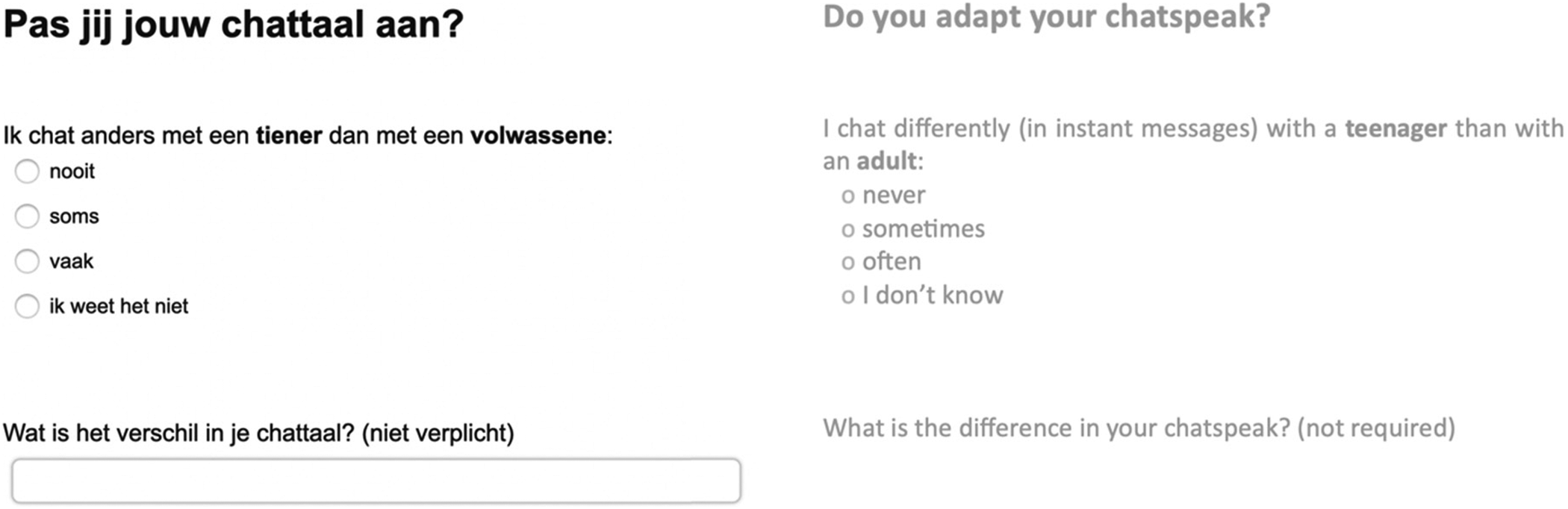
Example from the survey: frequency and manner of accommodation.
This question block was designed to obtain insight in the teenagers’ awareness of accommodation patterns in their own social media writing. The participants’ replies will be compared to their performance in the profiling tasks and to their self-reported frequency of contact with different groups of interlocutors, to reveal potential correlations or discrepancies. In addition, we will compare the respondents’ replies to their peers’ actual accommodative adjustments in the reference corpus.
Blocks 6–9: The indexicality of accommodation. In the final part of the survey, the respondents were shown four fictitious chat conversations and had to indicate whether they thought the interlocutors got along well. The content of all interactions was largely the same: person A asks person B for information, B needs to check something first, and B promises to get back to A. Only A’s specific request and B’s specific replies differ per conversation. In all four interactions, A uses two types of prototypical chatspeak features: oral/speech-like markers (features of regional or colloquial language) and expressive markers (here emoji). In the four examples, person B’s replies either mirror (1) only the use of emoji, (2) only speech-like features, (3) both types of markers, or (4) neither types. Per conversation, the respondents were shown the statement that the interlocutors got along well. They could indicate their (dis)agreement with this statement on a 5-point Likert scale, ranging from complete disagreement to complete agreement. Finally, note that the four conversations were not shown together but scattered throughout the survey, in a randomized order: every respondent saw all four questions, but each in a different, random order.
Figure 4 shows the fictitious conversation in which person B (green text bubbles) only mirrors person A’s emoji use (gray text bubbles), and not A’s use of speech-like markers.
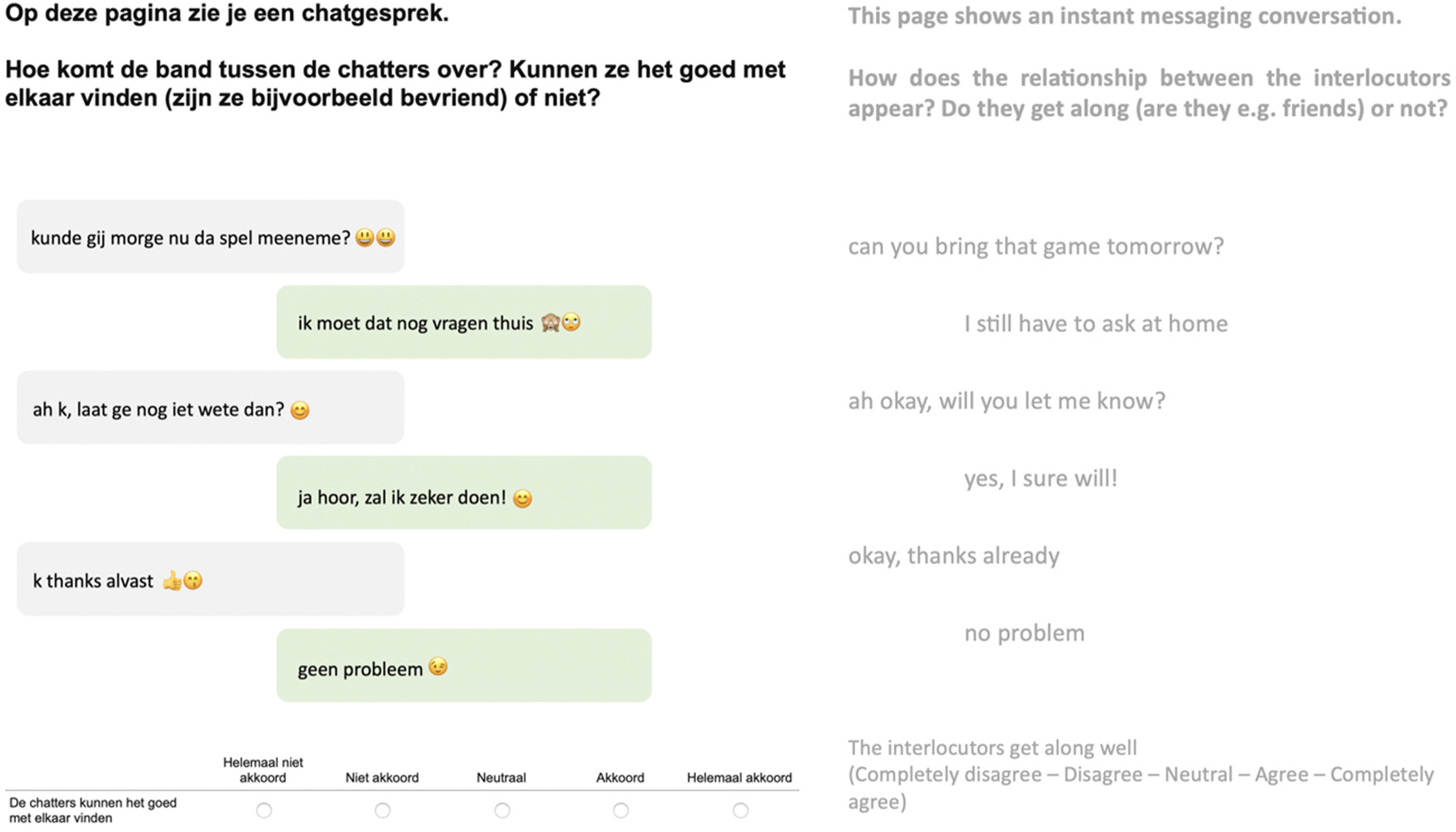
Example from the survey: the indexicality of accommodation.
The replies to these questions may enhance our understanding of the link between interlocutors’ relationship and their degree of mirroring. In this sense, they can yield insight in the indexicality of online accommodation for the adolescent generation: How do adolescents perceive (non-)mirroring pairs of conversation partners? And do different degrees of mirroring evoke different degrees of positive/negative perceptions of the relationship between interlocutors? Finally, potential correlations between the participants’ profiles and their responses can reveal which socio-demographic groups are most sensitive to negative/positive effects of accommodation.
Participants
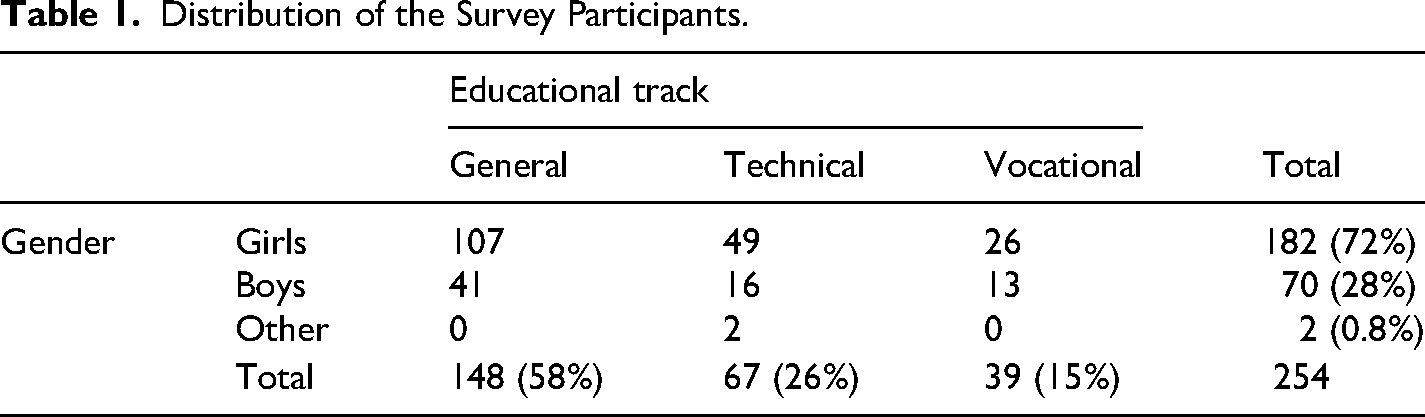
The survey was filled out by 254 Flemish teenagers, i.e., living in Flanders, Dutch-speaking Northern Belgium. They attended five different secondary schools. The participants were between 15 and 20 years old and were all in the three final years of secondary education when the survey was conducted (2021–2022). All of them were pupils in one of the three main types of Belgian secondary education (Flemish Ministry of Education and Training, 2017):
– general secondary education: theory-oriented track that prepares for higher education – technical secondary education: track with a strong theoretical and practical component, and a specific focus on technical courses – vocational secondary education: practice-oriented track that prepares for a specific, often manual, profession.
Table 1 summarizes the respondents’ socio-demographic profiles. Pupils who did not complete the entire survey were deleted from the dataset and do not figure in the table. In order to deal with the educational and gender imbalances, we will examine the impact of these social variables on the teenagers’ replies in additional statistical tests. Finally, Table 1 shows that two participants had a gender identity other than female or male. Because of their low representation in this dataset, we excluded them from the statistical analyses that concerned socio-demographic profile interference, but not from the general analyses, in which their replies are still included and examined.
Distribution of the Survey Participants.
Reference Corpus
The instant messages used as examples in the survey were extracted from a large social media corpus collected by the author of this paper. We visited twelve secondary schools in Flanders, Belgium, and invited pupils to voluntarily donate (parts of) their chat conversations that were produced outside the school context and before our visit. The pupils’ (and for minors, also their parents’) consent was asked to store and linguistically analyze their texts after anonymization. For an extensive description of the corpus and its anonymization, see Chapter 1 in Hilte (2019).
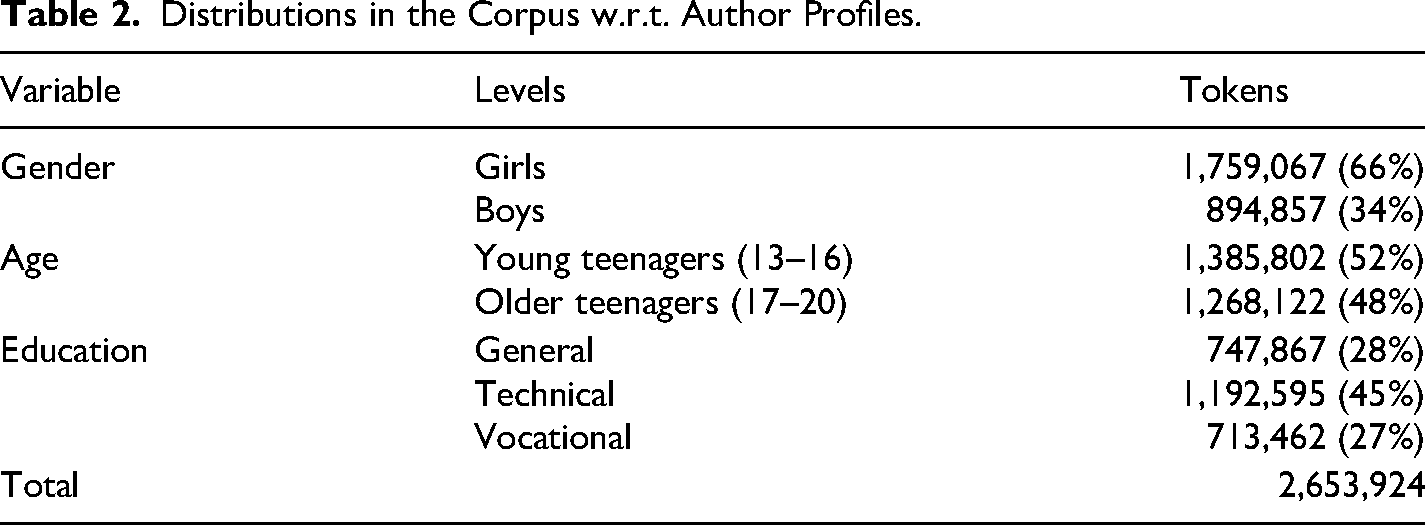
The corpus contains 456,751 instant messages (> 2.6 million tokens) written by 1,398 secondary school pupils who attended one of the three educational tracks described above. At the time of collection, all participants were between 13 and 20 years old. The utterances in the corpus are their private instant messages, produced in Dutch on Facebook Messenger and WhatsApp, mainly between 2015 and 2016. Table 2 summarizes the distributions in the corpus.
Distributions in the Corpus w.r.t. Author Profiles.
Results
Below, the participants’ responses to the survey are discussed and analyzed per set of related question blocks.
Blocks 1–5: Detection and Self-Reporting of Accommodative Behavior
In the first three blocks of the survey, the participants were presented with authentic chat messages and had to guess aspects of the receiver’s profile when given the sender’s profile. In blocks 4 and 5, the respondents were asked how frequently they chat online with people who have a different socio-demographic profile than themselves, and they were asked about their own accommodative behavior in such interactions.
Figure 5 visualizes the results for these tasks: it shows the respondents’ performance in the detection tasks (i.e., the percentage of correct answers), their self-reported frequency of contact (i.e., the sum of their “often”- and “sometimes”-replies, expressed as a percentage), and their self-reported frequency of accommodation (again the sum of “often”- and “sometimes”-replies, as a percentage). In the detection tasks, highest scores were obtained for the questions regarding the receiver’s gender (56% correct answers), followed by age (45% correct), and education (37% correct). Most participants report to sometimes or often interact online with people of a different gender (86% of the participants), of a different age (76%), and of a different educational track (87%). In addition, they report to adapt their own writing style to that of interlocutors of another gender (77% of the respondents) and even more so to adults (96%), but not at all to pupils in a different school track (13%). The distinct tasks are discussed in detail in the sections below.
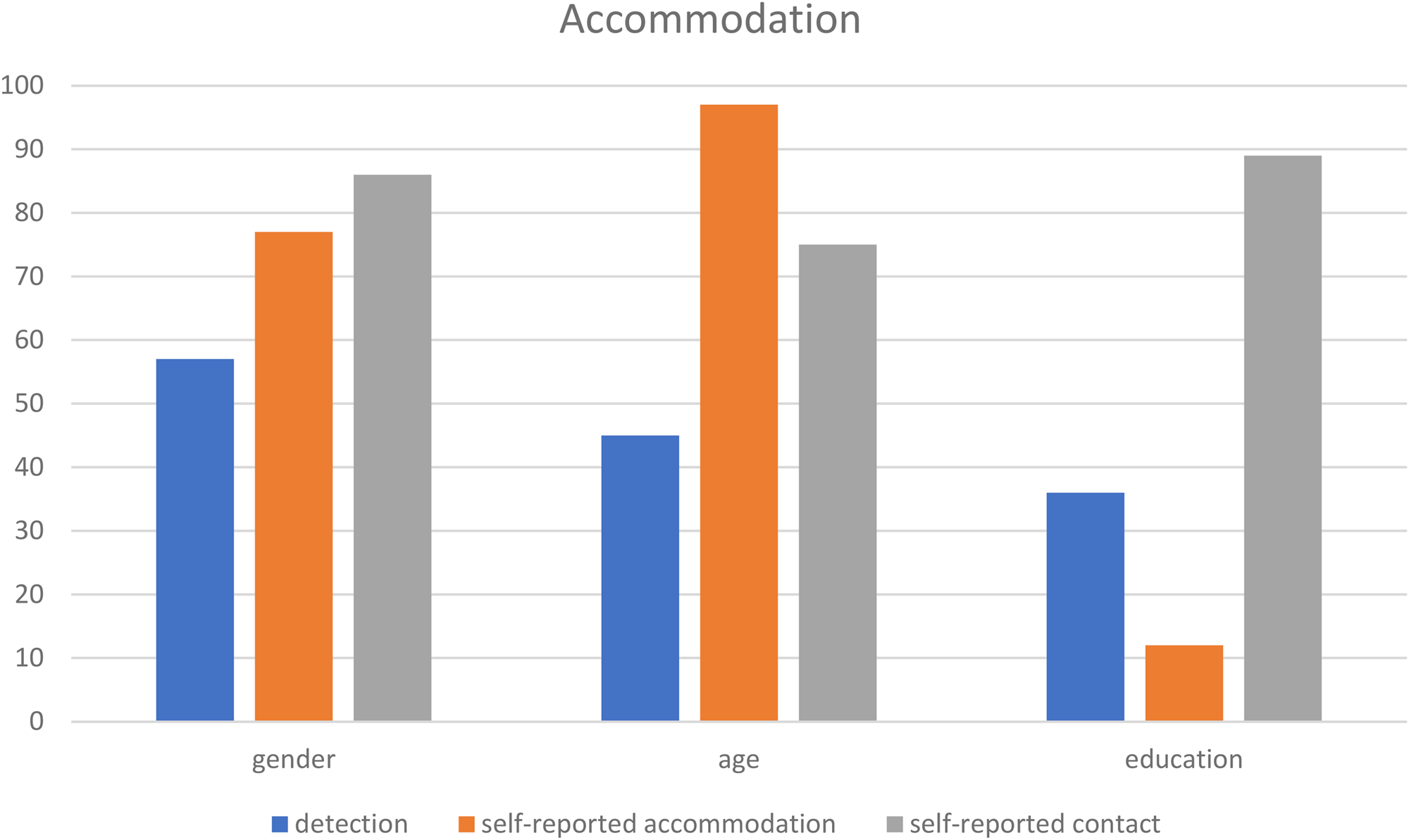
Survey results: detection and self-reporting of accommodative behavior.
We will test for potential effects of the teenagers’ profiles on their replies to the tasks. Per task, we fit a generalized linear model that takes the teenagers’ replies as response. As predictors, we include the teenagers’ gender, age, and educational track. We then verify which predictors significantly contribute to the model with the drop1 function in R (R Core Team, 2022). In the sections below, we report the resulting p-values from these tests. In addition, we will test for potential correlations between the different tasks with pair-wise chi-squared and Fisher’s exact tests. As for individual variation (rather than systematic profile variation): we arranged the data prior to the experiments in such a way that no random effects needed to be added to the statistical models, as the data were independent. For instance, while each participant filled out four gender detection tasks (each time obtaining a score of 0/1 or 1/1), we summed the responses per participant (total score on 4). This way, each line in the dataset represents exactly one pupil, so there are no repeated measurements.
Finally, note that lower (resp. higher) scores in the detection tasks are not likely to be explained by a coincidental lower (resp. higher) degree of convergence in the example messages shown in these tasks: we previously observed strong accommodation patterns in the reference corpus among interlocutors who differ from each other in terms of gender, age, or educational track (Hilte et al., 2020b, 2021a, 2021b). And the detection tasks use random samples from the corpus that should thus reflect this. So, we argue that the impact of individual or coincidental differences is limited. However, systematic differences in degrees of mirroring (e.g., by boys versus girls) do play a role, as these are likely to be reflected in the random samples too. These systematic patterns and their potential influence on the detection tasks are discussed below.
Gender. Most respondents (86%) claim to chat online with people of another gender, often or at least sometimes. Recall that a moderately frequent mixed-gender contact was indeed observed in the reference corpus (Hilte et al., 2020b). In addition, most teenagers (77%) claim to adapt their online writing depending on their interlocutor's gender, sometimes or often. Some (19%) report to never do so. And just a few participants (5%) selected “I don’t know,” which indicates a strong awareness concerning their own (gender-related) mirroring behavior. This is in line with previous findings that showed a strong awareness among teenagers about gendered writing in online discourse (Hilte et al., 2019). But the participants’ frequent (self-reported) mixed-gender contact and accommodation do not result in a good performance in the detection task. Their scores are only slightly above chance level: with 56% correct answers versus 31% incorrect. And the participants’ rare use of the “I don’t know” option (13%) indicates that they feel confident in their judgements, even though these are often not correct.
A correlation emerged between the different tasks: pupils who report frequent mixed-gender contact, more often report to mirror their interlocutor in these settings and vice versa (p = .0081). This suggests a link between accommodative behavior and frequency of interaction with one’s interlocutor. Furthermore, teenagers with different profiles did not perform better or worse in the detection task. But older teenagers do report more frequent mixed-gender contact (p = .0089), which could be explained by mixed-gender friendships/relationships occurring more in later than early adolescence. This group of teenagers, as well as technical education pupils, also report to mirror their interlocutor of another gender more (p = .0209 and p = .0141). While older teenagers’ more frequent mirroring could be linked to their more frequent mixed-gender contact, technical pupils’ more frequent mirroring is harder to explain.
Let us now zoom in on the detection task. The participants were much better at guessing the receiver’s gender when the sender was a boy (77% correct answers vs 35% for female senders). So accommodative adjustments in teenage boys’ writing appear easier to recognize. In the reference corpus, boys indeed converge much more strongly to a female, more “expressive,” writing style than vice versa (Hilte et al., 2020b). This systematic pattern is likely to be reflected in the random sample shown in this task.
Finally, the participants listed the cues used in their decision-making (see Table S1 in the online supplementary material for an exhaustive overview). They relied on both the style and content of the examples. Certain topics were seen as typical of talks among girls (e.g., gossip) versus among boys (e.g., gaming). Concerning the tone of a conversation, the teenagers thought same- and mixed-gender interactions to differ. In same-gender talks, they considered girls to engage in sweet, open conversations and boys to be more tough and short with one another. But they thought that boys and girls converged in this respect in mixed-gender talks, with girls writing in a tougher and boys in a sweeter way. And the participants claimed to recognize stylistic convergence too. They considered girls to use many and boys hardly any expressive chatspeak markers (such as emoji and kisses, e.g., xxx) among each other. But in mixed-gender interactions, they claimed to recognize mirroring, with boys increasing and girls decreasing their use of these markers—a convergence pattern that is attested in the reference corpus (Hilte et al., 2020b). Finally, the participants estimated that girls always write in a correct way, while boys’ writing would only be standard-oriented when addressing a girl. These intuitions correspond to some extent to previous observations. Speech-like markers (including non-standard features of regional and colloquial language) are indeed used more often by boys than girls in the reference corpus (Hilte et al., 2020a). And in mixed-gender interactions, boys indeed decrease their use of these markers, but not significantly (Hilte et al., 2020b).
Many participants also considered the relationship between the interlocutors. Messages that the participants saw as romantic/flirty, were often interpreted as extracted from a boy-girl interaction. But these interpretations were not always accurate.
Finally, the participants could enter additional comments. While almost no respondents expressed disbelief in the idea of gender accommodation, some considered such mirroring to be highly individual, or dependent on other factors such as interlocutors’ personalities or relationship with each other. For instance: one teenager said that boys only mirror others when romantically interested. These intuitions are only partially confirmed in the literature. While related work shows that individual, psychological, and personality-related factors indeed play a role in people’s inclination to mirror others (Jones et al., 2014; Xu & Reitter, 2015), robust gender accommodation patterns have still been attested repeatedly (Dragojevic et al., 2016; Palomares et al., 2016). And while there is a link between romantic interest and linguistic alignment (Ireland et al., 2011), gender accommodation does not coincide with flirting or romance (Hilte et al., 2020b), and mimicry is also observed in “minimal settings” between strangers without any shared goal (Chartrand & Bargh, 1999).
Age. Three quarters of the participants (76%) reports to chat online with adults, sometimes to often. This is a much larger share of intergenerational communication than what is found in the reference corpus (Hilte et al., 2021a), which suggests either an overestimation by the participants, or an evolution in the social media landscape since the corpus was collected (2015–2016), as especially WhatsApp seems to have gained popularity as a platform for intergenerational communication within families. Nearly all respondents (96%) report to sometimes or often adjust their writing in such mixed-age chats. Strikingly, not a single respondent replied “I don’t know,” so they seem very certain about their accommodative behavior. Note that we previously observed a strong awareness among teenagers regarding age-related online writing patterns too (Hilte et al., 2019). Just like for gender, this frequent self-reported intergenerational contact and accommodation did not result in good scores for the detection task. The scores were just below chance level: only 45% of the age assignments were correct, compared to 53% wrong answers and 2% “I don’t know”-replies. So the respondents hardly ever doubt their answers, even though these are more often incorrect than correct.
Furthermore, no correlations were observed between the three age tasks, and the teenagers’ profiles did not have a significant effect on any of the tasks either.
We will now focus on the detection task. While the respondents could easily recognize teenage receivers (84% correct answers), they performed very poorly at detecting adult receivers (6% correct). Recall that this low score for intergenerational messages is not likely to be explained by a coincidental low degree of convergence in the samples: we previously observed strong age-related accommodation in the reference corpus (Hilte et al., 2021a), and the examples in the detection tasks are a random sample that should thus reflect this, as mentioned above.
The participants also listed the cues for their decision-making (Table S2 in the online supplementary material presents an exhaustive overview). Some topics were considered typical of teen-to-teen conversations (e.g., social media, parents) and others of teen-to-adult interactions (e.g., choice for future higher education). Note that topic accommodation is self-reported by teenagers as an important strategy when conversing with (especially much older) adults (Williams & Garrett, 2012). And the respondents also noticed stylistic differences. Chats among teenagers were considered impolite and informal, written in a non-standard register including errors as well as markers of dialect, youth language, and chatspeak. But when addressing adults, teenagers were thought to converge to a more grown-up style by adopting a polite and formal tone, and a more standard-oriented register. The reference corpus confirms that youths’ writing is more standard-oriented when they address adults, with fewer expressive and oral chatspeak markers (Hilte et al., 2021a). So it seems that the participants are quite aware of the fact that and of how they adapt their writing style when addressing adults (the former finding echoing Williams & Garrett, 2012). But their low scores in the detection task suggest that they might overestimate the extent to which this adaptation takes place. The teenagers seem to consider themselves and their peers to write to adults in perfect standard-language prose, whereas in reality, the mirroring may be less outspoken and recognizable.
Finally, the teenagers could comment on the subject. Some noted that the specific age gap and the relationship between interlocutors matter too, hypothesizing that more intimate relationships result in more informal interactions. Recall that relationships were annotated in the reference corpus. Shifts in relationship appear naturally intertwined with interlocutors’ age: most chats among teenagers or between teenagers and young adults involve friends, followed by lovers or relatives. But for intergenerational pairs with a larger age gap (e.g., teenagers and people over thirty), the most common relationship is a family bond. Furthermore, “power” relationships emerge (e.g., sports coach and pupil), while romantic relationships are absent.
Educational track. Most participants (87%) report to chat online with pupils from another educational track, often or at least sometimes. This contradicts the common belief that pupils from distinct tracks interact less, based on them being in different class groups or schools. And only a small share of the reference corpus consists of mixed-education interactions (Hilte et al., 2021b). Do the survey respondents overestimate their mixed-education contact? Possibly, but there could be another explanation: most of them attend schools that offer general, technical, and vocational education, which may increase communication between pupils from these tracks, whereas half of the schools visited for the collection of the reference corpus offered only one education type.
Strikingly, while the participants claim to frequently chat with pupils from other tracks, most of them (76%) report to never adjust their writing style in these contexts. Only 13% claims to do so often or sometimes, and 11% “doesn’t know.” The share of “don’t know” replies, that reflect an unawareness of the phenomenon of intereducational accommodation, is small, especially compared to the vast share of “never” replies. Therefore, we hypothesize that the teenagers are not simply unaware of this type of mirroring, but truly think that they themselves do not accommodate in mixed-education interactions. However, the reference corpus showed that pupils from distinct tracks significantly mirror each other’s usage frequency for expressive markers (Hilte et al., 2021b). Note that youths’ awareness of sociolinguistic variation relating to education has been shown to be low before: in a previous survey, more than half of the teenage participants explicitly denied the existence of (attested) distinct online writing patterns for pupils in different school tracks (Hilte et al., 2019). We come back to this later.
The detection task appeared particularly difficult. Only 37% correct replies were registered, versus 33% incorrect and 31% “I don’t know” responses. This high uncertainty score suggests once more that the link between language and education is unknown terrain for teenagers.
A correlation was observed between two of the education tasks: the few teenagers who claimed to adjust their chatspeak to pupils of other tracks, scored significantly better in the detection task, and vice versa (p = .0381). So, contrary to our findings on gender and age, the teenagers’ self-reported mirroring of pupils in other school tracks might increase their insight in their peers’ accommodative adjustments in such mixed-education settings. And the participants’ profiles seemed to matter too: pupils in the hybrid technical track report more cross-educational online interactions (p = .0091). This makes sense, as these youths attend a school track somewhere between general and vocational education on the continuum from theory to practice. In addition, technical education is often offered in schools that also have a general and/or vocational program, which enables more intereducational contact. However, this might be less of an explanatory factor for this particular group of respondents, since most of them (not just the technical pupils) attend schools with multiple tracks.
Let us now zoom in on the detection task. The participants were slightly better at assigning the receiver’s educational profile when the sender of the messages was a pupil in general education. So, are accommodative adjustments easier to recognize in theoretically educated youths’ online writing? This is not confirmed by the reference corpus, as the adjustive efforts made in mixed-education talks appear symmetrical (Hilte et al., 2021b). But a tentative explorative analysis did reveal that for some features, practice-oriented vocational students stand out with non-accommodative behavior (see below). So this might make these students’ accommodation harder to recognize.
Next, the respondents could list their arguments for the detection task (see Table S3 in the online supplementary material for an exhaustive overview). They considered more (resp. less) theory-oriented pupils to address each other in a more (resp. less) formal and standard-oriented style. But in mixed-education talks, the respondents thought that pupils from more theoretical tracks converged, by adopting a more informal and non-standard style, including errors and chatspeak features. In the reference corpus, however, symmetrical accommodation was observed, and only for expressive markers: all teenagers adequately mirrored the use of these features as associated with their interlocutor’s educational profile (Hilte et al., 2021b).
But the survey participants predominantly based their decisions in this task on content and on the (inferred) relationship between interlocutors. They searched for clues in the messages that the conversation partners had not seen each other in a while (and thus cannot be classmates), or that they have different workloads in school.
Finally, the respondents’ free comments at the end of this question block were quite striking, as they revealed an outspoken resistance against the very idea of intereducational accommodation. And with some participants the question block even struck a sensitive chord. For instance, one pupil stated that people do not and should not adapt their writing in inter-educational settings. And a few participants “rather not answered” or found it “inappropriate to answer,” claiming that the question block was “rooted in stereotyped thoughts.” This echoes our previous survey (Hilte et al., 2019), in which education-related questions also touched upon a sensitive subject. This sensitivity could be partly due to differences in educational profile potentially being perceived as involving hierarchization. While general and technical education grant access to higher (tertiary) education, vocational tracks do not. In vocational tracks, pupils are trained for specific, often manual professions, which tend to be perceived as less prestigious than professions that require a theoretical training.
Blocks 6–9: the Indexicality of (Non-)Accommodation
The final part of the survey investigated how the relationship between (non-)mirroring pairs of interlocutors is perceived. Recall that the respondents were shown four fictitious chat conversations, presented in a random order throughout the survey, and had to indicate whether they thought the interlocutors got along well. The topic of the four interactions was highly similar, but the degree of stylistic mirroring varied: person A always used both emoji and speech-like markers, but person B mirrored either (1) none of these features (i.e., replying in standard Dutch), (2) only the emoji, (3) only the speech-like features, or (4) both feature types.
More accommodation in instant messaging makes more participants perceive the interlocutors as getting along (p < .0001). Half of the respondents (49%) either agree or strongly agree that the interlocutors get along well when no mirroring occurs, so when person B replies in standard Dutch without any emoji or oral markers. But as soon as one of these two feature types is mirrored, the share of participants assuming a good relationship between the interlocutors rises significantly, to 69% (p < .0001) and 70% (p < .0001) for mirroring of oral and expressive markers, respectively. And when both feature types are mirrored, i.e., B uses oral markers as well as emoji, just like person A, even more respondents (78%) think that the interlocutors get along (which is a significant difference from no mirroring at all, p < .0001, but not from mirroring only emoji or only oral markers, p = .2612 and p = .1212). So more outspoken convergence appears to evoke more positive evaluations of the relationship between interlocutors. This is in line with previous work. Communication Accommodation Theory claims that people accommodate to regulate the social distance to their interlocutor (Dragojevic et al., 2016). And indeed: our findings indicate that linguistic mirroring decreases the perceived social distance between conversation partners. Furthermore, our results corroborate the general positive evaluation of convergence as well as the previously attested link between linguistic mimicry and rapport and trust among interlocutors (Dragojevic et al., 2016; Scissors et al., 2008) and the higher degree of convergence attested among friends than among strangers (Riordan et al., 2013). But while previous work demonstrated that the perceived effect of mirroring may differ depending on the linguistic feature (Scissors et al., 2009), no significant difference was observed in the survey between participants’ evaluations of emoji mimicry and orality mimicry (p = .9802). Do note, however, that the mirroring (and thus the insertion) of emoji and oral markers also increases the informality of the interaction. And a higher degree of informality may also cause the participants to interpret the relationship more favorably. We did not verify whether the participants had actually noticed or focused on the stylistic (non-)accommodation at play, since previous work shows that convergence needs not be explicitly noticed to positively impact speaker evaluation (Chartrand & Bargh, 1999).
Next, we examined potential interference from the respondents’ profiles. For the example conversations without any mirroring, or with only emoji mirroring, no profile influence was observed. So these types of (non-)accommodation are perceived in similar ways by teenagers, regardless of their profiles. But when convergence relating to oral markers is concerned, the teenagers’ educational profile significantly impacts their perception. The mimicry of oral markers only is perceived most positively by general education pupils, followed by technical and then vocational ones (p = .0006). And when both emoji and speech-like markers are mirrored, the convergence is also perceived most positively by general students (p = .0010). So compared to their peers, theoretically educated pupils seem to perceive orality matching more favorably in terms of the relationship between interlocutors. That is quite surprising, since oral markers are typical of practice-oriented pupils’ writing (Hilte et al., 2020a). However, previous research on the reference corpus has shown that in intergenerational chats between teenagers and adults, general students decrease their use of speech-like features much more than their peers from other school tracks do (Hilte et al., 2021a). And a tentative exploratory analysis revealed that in intereducational chats, speech-like markers were least mirrored by vocational students, who even diverged (Hilte et al., 2021b). So general pupils’ more positive evaluation of orality mimicry may be linked to their stronger adaptation and potentially stronger awareness of this feature set.
Conclusion
This study examined teenagers’ perception of linguistic accommodation in instant messaging. We reported on a survey conducted among 254 Flemish secondary school pupils, and systematically compared the results to previously attested patterns in a large reference corpus of teenagers’ chat messages.
The findings show that youths evaluate (more) linguistic mirroring (more) favorably, perceiving converging pairs of interlocutors as getting along better. As for their own communicative behavior, the respondents report a frequent online chat contact with people who have a different sociodemographic profile than themselves in terms of gender, age, and education. But when asked about their own and their peers’ linguistic mirroring to such interlocutors, the variable of educational track stands out in a highly consistent way. The teenagers are aware of and have a rather accurate intuition on accommodative adjustments made towards conversation partners with another gender identity and towards adults. And these two types of mirroring do not evoke any strong feelings or reluctance. But this does not hold for the parameter of educational track. Most respondents do not believe that they themselves, or any teenager, would adapt their language to a pupil from another school track. Quite a few respondents are even opposed to the mere idea! This is striking, since significant mirroring has been observed in the reference corpus with respect to interlocutors’ age and gender, but also educational track (Hilte et al., 2020b, 2021a, 2021b). So youths’ perception and production of accommodative changes seem to align for age and gender, but to misalign for education. A less developed insight in the correlation between language and education, which was attested before (Hilte et al., 2019), seems to be at play here. But what can explain the respondents’ outspoken reluctance? The participants’ sensitivity to questions on education-related linguistic patterns (previously observed in Hilte et al., 2019) could be linked to differences in people’s educational track potentially being perceived as involving hierarchization, for instance concerning the prestigiousness commonly associated with the educational tracks themselves, as well as with the educational or professional careers they grant access to. We know that the online writing style of pupils from theoretical tracks tends to be more standard-oriented, whereas the style of practice-oriented pupils contains more non-standard chatspeak features. From a hierarchical point of view, teenagers might find it inappropriate for practice-oriented pupils to have to adopt a more “correct” style in an attempt to mirror their peers in theoretical tracks. And similarly, they could perceive linguistic adaptation of theory-oriented pupils to practice-oriented pupils, by adopting a less standard-oriented writing style, as condescending. Previous research has shown that the perception of accommodation can be influenced by factors such as the power relation between interlocutors. When conversation partners differ in social power, convergence by the “high” power/status person tends to be negatively evaluated by the “low” power/status person, as it violates social expectations (Muir et al., 2017). In such contexts, one-sided adaptation to the person with greater power seems desired and common (Dragojevic et al., 2016; Kroll et al., 2018; Muir et al., 2016, 2017). But the present study shows that that does not hold in the context of educational track. Our findings suggest that pupils from different school tracks do not claim to be or do not want to be perceived as any different (or at least not in a way that touches upon hierarchy or status). In this respect, our study contributes to the vast body of research founded in Communication Accommodation Theory (CAT), and may even further refine the theory’s principles. Our results can contribute to what CAT currently stipulates on the perception and evaluation of accommodation, as they suggest the existence of an additional situation in which convergence is not always evaluated favorably or pursued deliberately: i.e., when potential (perceived) hierarchy is a sensitive topic, and undesired by all parties.
Supplemental Material
sj-docx-1-jls-10.1177_0261927X231167108 - Supplemental material for How is Linguistic Accommodation Perceived in Instant Messaging? A Survey on Teenagers’ Evaluations and Perceptions
Supplemental material, sj-docx-1-jls-10.1177_0261927X231167108 for How is Linguistic Accommodation Perceived in Instant Messaging? A Survey on Teenagers’ Evaluations and Perceptions by Lisa Hilte in Journal of Language and Social Psychology
Footnotes
Acknowledgments
We thank the teachers and pupils for their participation in the survey. We are also grateful to Reinhild Vandekerckhove, as well as to the anonymous reviewer and JLSP editor, for their insightful feedback on previous drafts of this article.
Declaration of Conflicting Interests
The author(s) declared no potential conflicts of interest with respect to the research, authorship, and/or publication of this article.
Funding
The author(s) disclosed receipt of the following financial support for the research, authorship, and/or publication of this article: This research was funded by the FWO (Research Foundation Flanders) under grant 12U2620N

Supplemental Material
Supplemental material for this article is available online.
Notes
Author Biography
References
Supplementary Material
Please find the following supplemental material available below.
For Open Access articles published under a Creative Commons License, all supplemental material carries the same license as the article it is associated with.
For non-Open Access articles published, all supplemental material carries a non-exclusive license, and permission requests for re-use of supplemental material or any part of supplemental material shall be sent directly to the copyright owner as specified in the copyright notice associated with the article.
