







Abstract
The practice of initiating conversations with “guess what” questions is common across various social settings. This study examines whether askers and guessers share similar desires for correct guesses during these interactions, a question previously unexplored in behavioral sciences. Across five studies, our research uncovered a significant discrepancy: Askers generally exhibited a lower desire for correct guesses compared to guessers. This pattern holds true across diverse social contexts. Moreover, the results of guesses impact the outcomes of conversations, with askers experiencing more enjoyment and being more willing to continue the conversation when guesses are incorrect, whereas guessers have the opposite experience. Further, while individuals may recognize this disparity, adopting a perspective-taking approach does not alter the guesser's desire to guess correctly; however, guessers do decrease that desire when reminded to protect the asker's emotions.
At that time, I didn’t understand how contradictory human nature was.
- Maugham, The Moon and Sixpence
“Guess what this research has uncovered?” Chances are that you have come across another “guess what” question. Individuals frequently engage in discussions, sharing personal experiences, gossip, and news during social interactions, often using the “guess what” question as a method to begin conversations or introduce new topics. Do askers and guessers share the same desire for a correct guess? Does the guess result affect the conversation, and if so, how? Answers to these questions bear significant practical implications, as there are certainly times when one does not want to spoil the asker's fun by rushing to guess correctly, if the asker prefers to receive a less accurate guess. Furthermore, answers to these questions can enhance our understanding of human conversational behavior.
In the present study, we refer to “guess what” conversations as conversations that start with the question “guess + specific topic,” for example, “guess what just happened to me?”, “guess who gave me that gift?”, and “guess how much our last travel cost?”. People use such “guess what” questions to lead into a new conversation topic. Our present research compared the desire for the correct guess between askers and guessers across a variety of conversational scenarios, tested two solutions for bridging the asker–guesser discrepancy in their desire for a correct guess, and investigated the consequences of the “guess what” question.
Novelty and Significance
To the best of our knowledge, the “guess what” conversations remain largely unexplored. Nevertheless, several existing studies demonstrate a degree of relevance to this theme, as summarized below.
Individuals engage in various forms of interaction to foster relationships, with conversation being the most prevalent among them (Aron et al., 1997; Dunbar et al., 1997; Goodwin & Heritage, 1990; Mehl et al., 2010; Shearer, 2017). People dedicate substantial time to conversations (Klemmer & Snyder, 1972), which encompass a wide range of topics including self-disclosure, argumentation, gossip, casual chats, and information sharing (Atir et al., 2022; Dunbar, 2004; Lee et al., 2020).
In conversations, two sides often exhibit discrepancies, such as divergent estimates, beliefs, perceptions, and considerations. Before engaging in a conversation, individuals frequently undervalue their potential partner's willingness to engage and the enjoyment that might follow (Epley & Schroeder, 2014; Kumar & Epley, 2021; Schroeder et al., 2022). Additionally, the benefits of engaging in honest conversation are often underestimated (Levine & Cohen, 2018). During conversations, people tend to undervalue the degree to which they are liked by others (Boothby et al., 2018), question their communication skills (Welker et al., 2023), believe that shorter conversations are more appealing to strangers (Hirschi et al., 2022; Kardas, Schroeder et al., 2022), and overestimate the negative consequences of posing sensitive and deep questions (Hart et al., 2021; Kardas, Kumar et al., 2022). Undoubtedly, individuals sometimes overestimate the efficacy of their verbal expression and the level of familiarity with their conversation partner (Keysar & Henly, 2002; Pronin et al., 2001). After conversations, there is often an underestimation of how frequently others may think about the interaction (Cooney et al., 2022). The current research is distinct from the above studies in two aspects. First, it focuses on “guess what” conversations (i.e., conversations that start with the question “guess what/how/who…”) rather than other types of conversations. Second, the current research proposes a new discrepancy: the asker–guesser discrepancy in the desire or pleasure for the correct guess. Given that the discrepancies in the previous conversation research usually involve cognition such as estimation or belief, the current discrepancy, involving desire or emotion, evidently expands the boundary of research on discrepancies related to conversations.
The “guess what” question is a common type of “pre-sequence” known as “pre-announcements,” generally used to signal upcoming information and announcements (Schegloff, 1980, 2007; Sidnell & Stivers, 2013). In linguistics and communication, “pre-sequences” refer to preliminary interactions or speech acts that precede the main message in a conversation (Clayman, 2002; Schegloff, 2007; Sidnell & Stivers, 2013). For example, “Are you busy?” can be used as a pre-request to see if the person has time to help, and “Do you have any plans for tonight?” can be a typical pre-invitation to evaluate whether the person is available. Pre-sequences manage interactions by preparing participants for what is coming next, shaping expectations, and shaping the trajectory of the conversation (Schegloff, 1980, 2007; Sidnell & Stivers, 2013). Although pre-sequences have been discussed for a long time, the discrepancy in “guess what” conversations remains unexplored.
“Guess what” conversations are prevalent in common social interactions, with 97.5% to 99% of participants reporting having experienced such scenarios as askers and 98.8% to 100% as guessers (statistics from the present work). Such prevalence highlights the significance of investigating this type of conversation. Additionally, rather than focusing on the individual desires of the two parties in such conversations, this research explores the discrepancies between them, as divergent desires for correct guesses in “guess what” conversations can obstruct ideal communication.
Hypothesis Development
Pre-sequences involve deeply ingrained social rules that participants typically follow to make interactions predictable, comprehensible, and coherent (Clayman, 2002; Schegloff, 1980, 2007; Sidnell & Stivers, 2013). Additionally, people typically frame their responses to align with social expectations in conversations (Stivers et al., 2024; Stivers & Rossano, 2010). As “guess what” serves as a pre-sequence, the asker intends to lead up to sharing an unexpected experience or discovery. Similar to writers who do not want readers to guess the ending early on (Mandler, 2014), the asker usually wants to share something that is surprising. Consequently, the asker may not want the guesser to guess correctly, as it would diminish the surprise of the forthcoming information. Thus, we propose that there is an asker–guesser discrepancy in the desire or pleasure for the correct guess: Askers have less desire or less pleasure for the correct guess than guessers. We call this discrepancy the guess gap.
What are the consequences of the asker–guesser discrepancy in “guess what” conversations? Conversations are dynamic processes influenced by various factors (Drew & Holt, 1998; Dunbar et al., 1997; Goodwin & Heritage, 1990; Heritage, 1985; Sidnell & Stivers, 2013). As people's desires for the correct guess differ, guess results naturally affect the flow of the conversation and participants’ emotions. Thus, we propose that since askers (vs. guessers) have a lower preference for a correct guess, askers will experience more enjoyment and be more willing to continue the conversation when guesses are incorrect, whereas guessers will experience more pleasure and are more willing to continue when their guesses are correct.
Can the discrepancy be bridged? Askers and guessers both experience “egocentric bias,” a pattern of thinking and behavior in which individuals are overly concerned with their own perspectives, needs, and feelings, often excluding or underestimating the perspectives and needs of others (Epley et al., 2004; Keysar, 2007; Ross et al., 1977). There are two common methods to reduce egocentric bias: perspective-taking and setting an emotion-protection goal (Epley et al., 2004; Legg & Sweeny, 2014). In the present study, we expected that both interventions would reduce guessers’ egocentric bias by encouraging them to consider the asker's feelings and needs, thus reducing guessers’ desire to guess correctly and potentially reducing the guess gap.
The Present Study
Based on the theoretical arguments mentioned above, this study posits that there is an asker–guesser discrepancy in the desire for the correct guess in “guess what” conversations. Moreover, guess results impact the outcomes of conversations, with askers experiencing more enjoyment and being more willing to continue the conversation when guesses are incorrect, whereas guessers experience the opposite. Further, we suggest that perspective-taking and setting an emotion-protection goal would reduce guessers’ egocentric bias, thus reducing guessers’ desire to guess correctly and potentially reducing the guess gap. Formally, we hypothesize the following:
Askers have a lower preference or pleasure for correct guesses compared to guessers.
Perspective-taking and setting an emotional protection-oriented goal would reduce guessers’ desire to guess correctly and thus potentially reduce the guess gap.
The pleasure experienced by askers and guessers, as well as their willingness to continue the conversation, varies depending on the interaction of the role and guess result.
We present five studies that tested our hypotheses. Studies 1 and 2 tested H1 by exploring the existence of a potential mismatch in the desire and enjoyment for a correct guess between askers and guessers, a phenomenon we refer to as the “guess gap.” The objective was to determine whether this discrepancy is indeed present. Study 3 aimed to assess whether participants could identify this gap, as recognizing the discrepancy is a prerequisite for testing potential interventions. Study 4 tested H2 using two interventions. Study 5 tested H3 by investigating the consequences of “guess what” conversations.
All of our studies included an attention check and utilized a pre-determined sample size by referring to previous experimental research on conversation (Cooney et al., 2022; Kardas, Schroeder et al., 2022; Schroeder et al., 2022). We report all measures, manipulations, and exclusions in these studies (Simmons et al., 2011). Our data and material for all studies are available through OSF (https://osf.io/sj3mf/).
Study 1
Study 1 investigated the guess gap through one-on-one conversations between friends, employing scenarios that were inspired by real-life situations.
Participants and Procedure
We utilized a pre-determined sample size by referring to previous experimental research on conversation (Cooney et al., 2022; Kardas, Schroeder et al., 2022; Schroeder et al., 2022). There were about 80 participants in each experimental group (the same in Studies 1–4). We recruited 166 Chinese participants (160 after exclusions: 61.9% female; Mage = 30.69, SDage = 7.73) via the Credamo platform (https://www.credamo.world/#/) with minor remuneration. This sample size provided 80% power to detect an effect size of d = 0.446 or greater in an independent sample t-test with a 5% false-positive rate.
Study 1 utilized a 2 (role: asker vs. guesser) between-subject design. First, we randomly assigned participants to the role of asker vs. guesser and asked them to imagine the scenario we gave them. All conversation scenarios (five in total) are detailed in Appendix A in the Supplemental Material, with one example presented here: (In guesser condition) Friend: “Check out this new hat I got today. What do you think?” You: “It looks great! Did you just buy it?” Friend: “No, it's a gift. Guess who gave it to me?” (In asker condition) You: “Check out this new hat I got today. What do you think?” Friend: “It looks great! Did you just buy it?” You: “No, it's a gift. Guess who gave it to me?”
In each scenario, participants were asked to respond to two questions on 7-point Likert scales. The questions were as follows: (a) “To what extent do you want yourself/the other person to guess correctly in one attempt on this occasion?” and (b) “How happy would you be if you/the other person guessed correctly in one attempt?”.
We set up an attention check scenario in which participants were instructed to select the lowest rating on both questions (the same attention check in Studies 2 and 3). Participants who did not pass the attention check were excluded from the analysis. After answering the above questions, participants were asked a recall question: Have you ever experienced a situation in your life that was similar to the scenarios described above, where you wanted to share something with a friend but asked them to guess first/or a friend wanted to share something with you but asked you to guess first?
Lastly, participants provided demographic information about their age and gender.
Results and Discussion
We obtained the average ratings of five scenarios for the desire and pleasure for a correct guess, respectively, and conducted two independent sample t-tests with participants’ desire for a correct guess and the pleasure of it as the dependent variables and the role manipulation as the independent variable. As shown in Figure 1, guessers and askers differed significantly in their desire for a correct guess, t(158) = 5.42, p < .001, d = 0.86 1 , and their pleasure for it, t(158) = 5.11, p < .001, d = 0.81. Askers prefer not to have the guesser guess correctly (M = 3.96, SD = 1.13) compared to guessers (M = 4.85, SD = 0.94). Accordingly, askers reported lower pleasure when the guesser guessed correctly in one attempt (M = 4.23, SD = 1.14) compared to guessers (M = 5.04, SD = 0.85). This pattern was consistent across all examined scenarios.
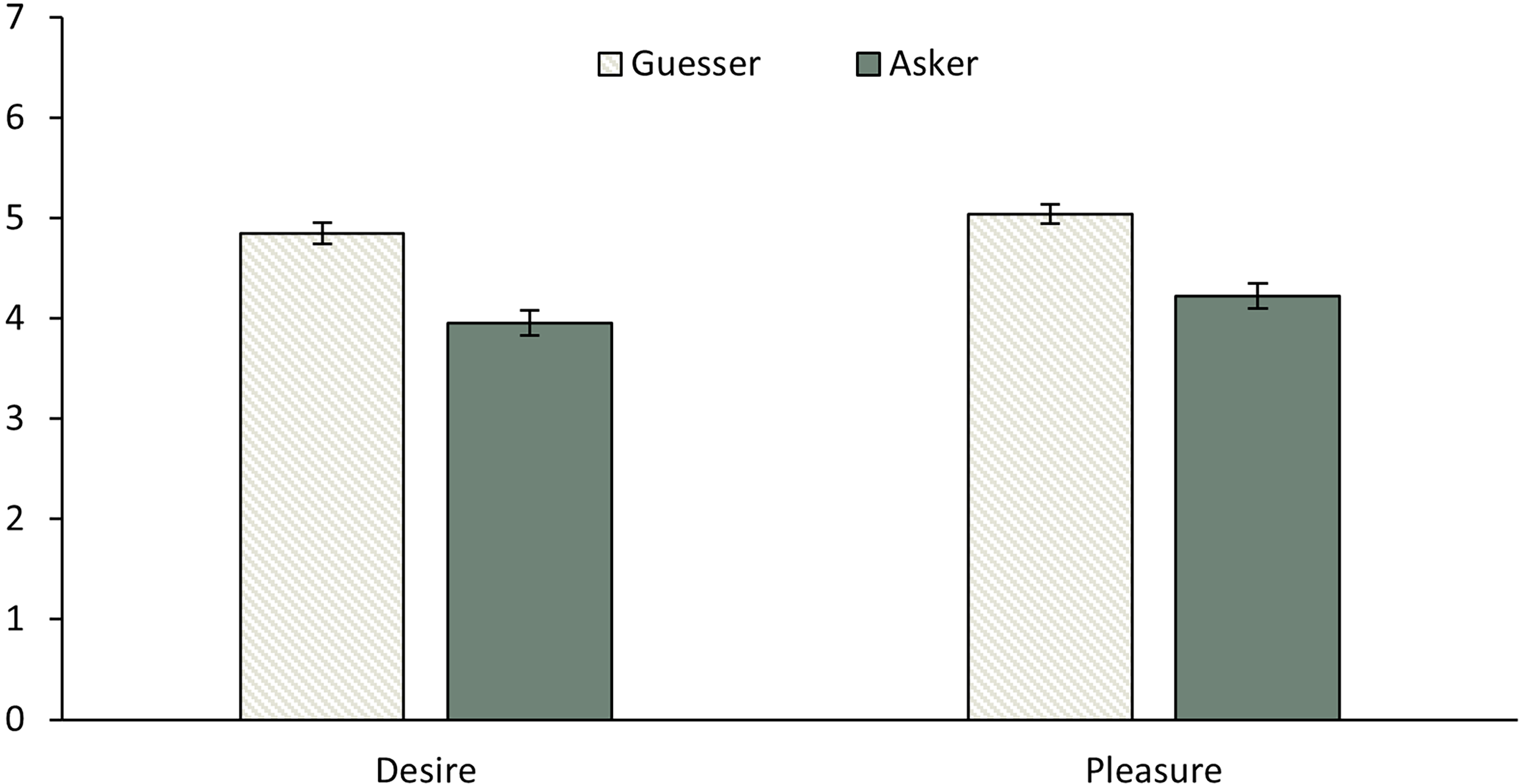
Results of Study 1. Error bars represent standard errors of the mean.
In addition, in the asker condition, 99% of the participants reported having experienced a situation that was similar to the experimental scenario. In the guesser condition, the figure was 100%. This result indicates that “guess what” conversations are quite common and deserves some research like the current one.
Overall, these results provide preliminary evidence of the guess gap. To be specific, askers do not want the guessers to guess correctly as much as they do.
However, the present research had several limitations. Firstly, the scenarios in Study 1 mainly focused on conversations between friends. Although the “guess what” conversations mostly occur among friends, it can take place in other social contexts as well. Secondly, Study 1 was limited to one-on-one conversations, despite the fact that “guess what” prompts can often involve more than one person in real-life scenarios. Lastly, Study 1 assumed a situation where the guesser guesses correctly in one attempt, whereas multiple guesses are often made in life.
Study 2
Study 2 extended the investigation of the guess gap into other social contexts, with a notable change: The potential guessers included multiple people, while the asker remained as one person. Additionally, the questionnaire no longer assumed that guesses are correct on the first attempt.
Participants and Procedure
A total of 170 Chinese participants (160 after exclusions: 68.8% female; Mage = 30.01, SDage = 6.94) completed the study via the Credamo platform with minor remuneration. The study was similar to Study 1, except that the conversational scenarios varied. The conversation scenarios in Study 2 involved a variety of social situations such as social gatherings, networking among company colleagues, family chats, and academic discussions. All detailed scenarios (five in total) are available in Appendix B in the Supplemental Material, with one of the scenarios presented as an example: (In guesser condition) You are an employee in a company, and during work, the manager tells all employees, “The company has finalized the souvenir for this year's annual event. Guess what the company plans to give everyone?” (In asker condition) You are a manager in a company, and during work, you tell all employees, “The company has finalized the souvenir for this year's annual event. Guess what the company plans to give everyone?”
In each scenario of Study 2, participants responded to two questions on 7-point Likert scales, with the endpoints labeled “a little” and “very much.” The questions were as follows: (a) “To what extent do you want yourself/someone to guess correctly on this occasion?” and (b) “How happy would you be if you/someone guessed correctly?”.
Study 2 had the same attention check and recall question as Study 1.
Results and Discussion
We obtained the average ratings of five scenarios for the desire and pleasure for a correct guess, respectively, and conducted two independent sample t-tests with participants’ desire for a correct guess and pleasure of it as the dependent variables and the role manipulation as the independent variable. As shown in Figure 2, guessers and askers differed significantly in their desire for a correct guess, t(158) = 2.50, p = .013, d = 0.40 2 . Consistent with Study 1, askers prefer not to have the guesser guess correctly (M = 4.50, SD = 1.09) compared to guessers (M = 4.89, SD = 0.90). This gap was observed across all scenarios. However, in terms of pleasure in guessing correctly, there is no significant difference between askers and guessers (t (158) = 1.00, p = .318). When assuming the guesser guessed correctly, askers expressed insignificantly less pleasure (M = 4.72, SD = 0.88) than guessers (M = 4.86, SD = 0.92).
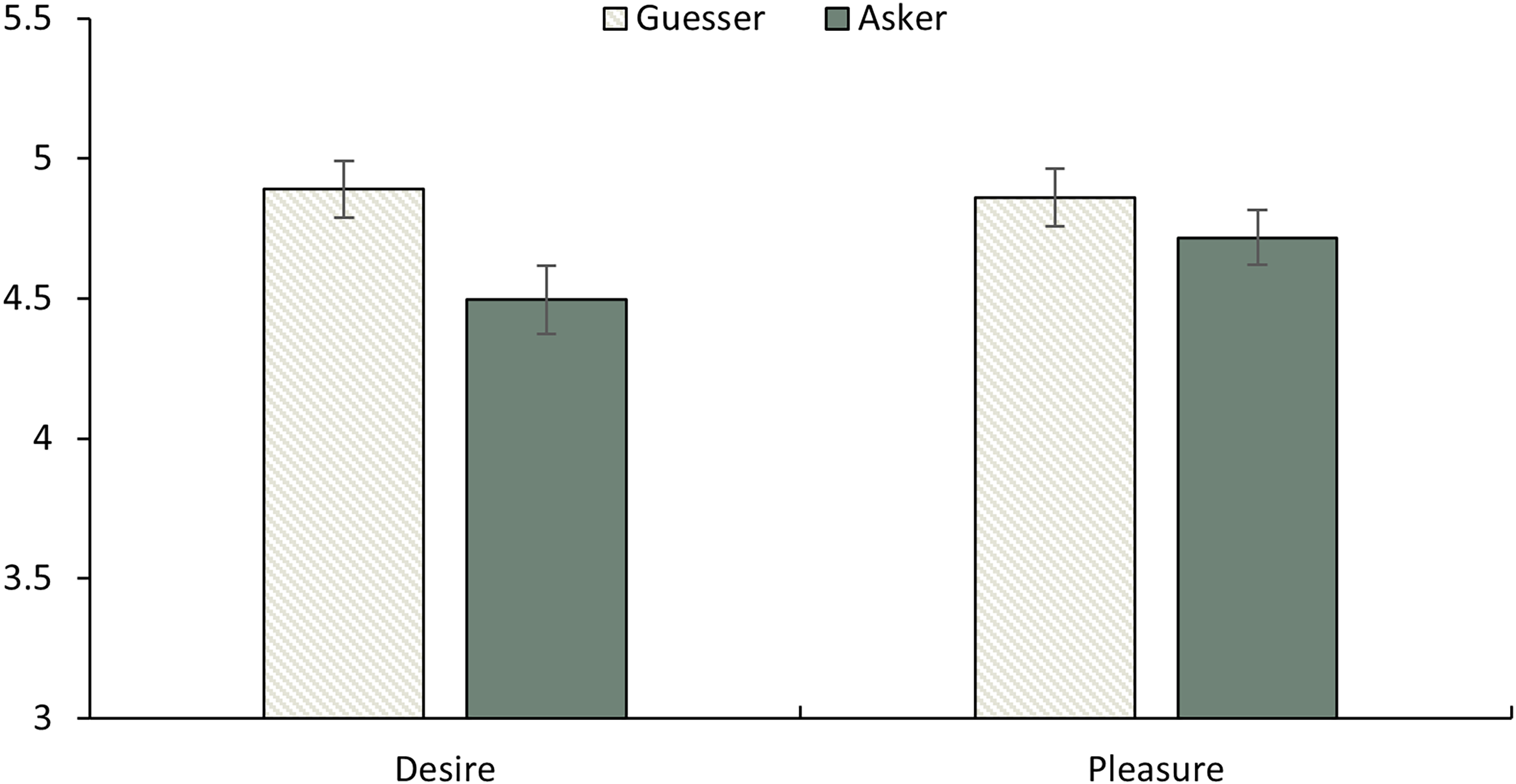
Results of Study 2. Error bars represent standard errors of the mean.
Additionally, in the asker condition, 97.5% of the participants reported having experienced a situation similar to the experimental scenario. In the guesser condition, the figure was 98.8%. This result further reinforced the prevalence of “guess what” conversations and highlights the significance of investigating them, as demonstrated in Study 1.
Overall, Study 2 confirms the presence of a “guess gap” in various social conversation scenarios, including social gatherings, networking events among company colleagues, family chats, and academic discussions. In these contexts, askers and guessers still have divergent preference for the right guess. However, unlike one-on-one conversations between friends, in one-to-many conversation scenarios, both askers and guessers display similar levels of pleasure when guesses are made correctly. We think this is understandable, considering that in one-to-many situations, any correct guess implies engagement with the asker, fulfilling a common desire for interaction within social contexts.
Now that the guess gap has been established across different conversational settings, we wondered whether people would realize this gap.
Study 3
In Study 3, we tested if people can be aware of the guess gap, as recognizing the discrepancy is a prerequisite for testing interventions of Study 4.
Participants and Procedure
A total of 174 Chinese participants (160 after exclusions: 63.7% female; Mage = 29.28, SDage = 7.27) completed the study via Credamo platform with minor remuneration. Study 3 was the same as Study 1, except that we asked participants different questions.
In the asker condition, participants were askers, and we asked them, “To what extent do you think the other person wants to guess correctly in one attempt? (1–7 scale).”
In the guesser condition, participants were guessers, and we asked them, “To what extent do you think the other person wants you to guess correctly in one attempt? (1–7 scale).”
This setup aimed to directly gauge participants’ perceptions of their counterparts’ desires in “guess what” interactions, thereby exploring the awareness of the guess gap.
Results and Discussion
An independent sample t-test was conducted to analyze the average speculation ratings provided by participants, with the role manipulation (asker vs. guesser) serving as the independent variable. As shown in Figure 3, a significant difference was observed in the speculations made by guessers and askers, t(158) = −4.17, p < .001, d = 0.66. Specifically, askers anticipated that guessers would have a strong desire to guess correctly (M = 4.72, SD = 1.28), whereas guessers perceived that askers were less keen on having their guesses be accurate (M = 3.89, SD = 1.22).
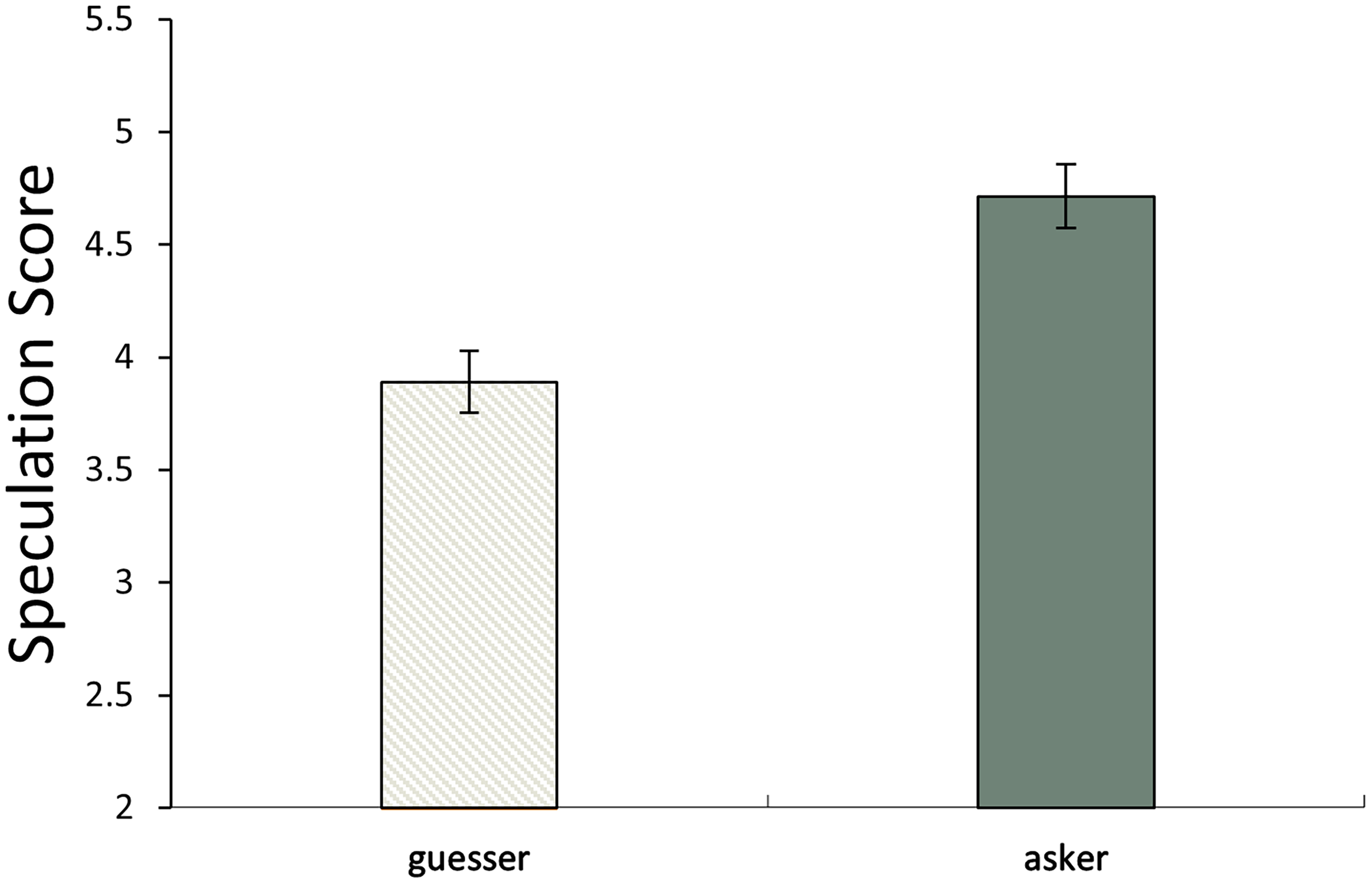
Results of Study 3. Error bars represent standard errors of the mean.
The findings from Study 3 indicate that individuals are capable of recognizing the guess gap. In Study 4, two interventions will be tested to gain more insight of the guess gap.
Study 4
Studies 1 and 2 have identified a significant discrepancy in the desire for a correct guess between askers and guessers, which we termed the “guess gap.” Study 4 tested the reducing effect of two interventions (perspective-taking and emotion-protection) on guessers’ desire and pleasure (scores) for correct answers. Given that the guess gaps equal guessers’ scores minus askers’ scores for correct answers, reduced guessers’ scores imply reduced guess gaps.
In this study, perspective-taking required participants to consider the conversation partner's feelings and needs in “guess what” conversations, while emotion-protection required participants to protect the conversation partner's emotions during interactions. The experimental settings for the two interventions in our study were adapted from prior research (Legg & Sweeny, 2014).
Participants and Procedure
A total of 286 Chinese participants (240 after exclusions: 65.4% female; Mage = 28.52, SDage = 7.44) completed the study via Credamo platform with minor remuneration. This sample size provided 80% power to detect an effect size of η2 = 0.038 or greater in a one-way ANOVA with a 5% false-positive rate. Study 4 used the same conversation scenarios as Study 1.
First, Study 4 utilized a 3 (manipulation: perspective-taking vs. emotion-protection vs. control) between-subject design. All participants were positioned as guessers. After reading each conversation scenario:
In the perspective-taking condition, participants were first asked “How do you think the other person would feel or act if you guess correctly in one go?”.
In the emotion-protection condition, participants read the following: “Note: The other person's emotions may be affected by what you say or do next. Please take care of your friend's emotional feelings in the rest of the conversation!”
In the control condition, participants received no instruction.
Next, participants answered the following two questions using 7-point Likert scales, whose endpoints were labeled not at all and very much: (a) “To what extent do you want yourself to guess correctly in one go?” and (b) “How happy would you be if you guessed correctly in one go?”.
Study 4 included an attention check to ensure that participants understood the perspective-taking or emotion-protection prompt (“What do we need you to do in the above conversation scenarios?”, “to take care of the other person's emotion and feelings.”, or “to think about the other person's feelings from his perspective.”). In the control condition, the attention check was to ask participants about their role in the scenarios.
Results and Discussion
We obtained the average ratings of five scenarios for the desire and pleasure for a correct guess, respectively, and conducted two one-way ANOVAs with participants’ desire to guess correctly and pleasure of guessing correctly as the dependent variables and the manipulation as the independent variable. Results indicated that participants in the control, perspective-taking, and emotion-protection conditions exhibited significant differences in their desire for guessing correctly, F(2, 237) = 6.13, p = .003,
Participants in the emotion-protection condition exhibited a lower desire to guess correctly than those in both the perspective-taking condition, t(158) = 2.62, p = .010, d = 0.42, and the control condition, t(158) = 3.39, p < .001, d = 0.54. Similarly, the pleasure associated with guessing correctly was lower for emotion-protection guessers compared to guessers in the perspective-taking condition, t(158) = 2.53, p = .012, d = 0.40, and the control condition, t(158) = 3.15, p = .002, d = 0.50. No significant differences were found between the perspective-taking and control conditions in terms of either the desire to guess correctly (t (158) = -0.57, p = 0.572) or the pleasure derived from guessing correctly (t (158) = -0.48, p = .632).
The Guess Gap
Since Study 4 and Study 1 share the same conversation scenarios, sample size, and participant recruitment method, we believed the two experiments had a certain degree of comparability. Therefore, we integrated data from Studies 4 and 1 to further examine the potential impact of the two interventions on the guess gap. In Study 1, we have the askers’ desire for a correct guess (Masker = 3.96). In Study 4, we have guessers’ desire to guess correctly in three conditions (Mcontrol = 4.99; Mperspective-taking = 4.89; Memotion-protection = 4.44). Given that the guess gap = guessers’ score–askers’ score, we used the average guessers’ desire and pleasure for each condition in Study 4 to subtract the average askers’ desire and pleasure to get the average guess gaps (see Figure 4). In terms of either desire or pleasure for a correct guess, the control condition had a large guess gap; perspective-taking condition reduced the guess gap slightly; and emotion-protection reduced the guess gap dramatically.
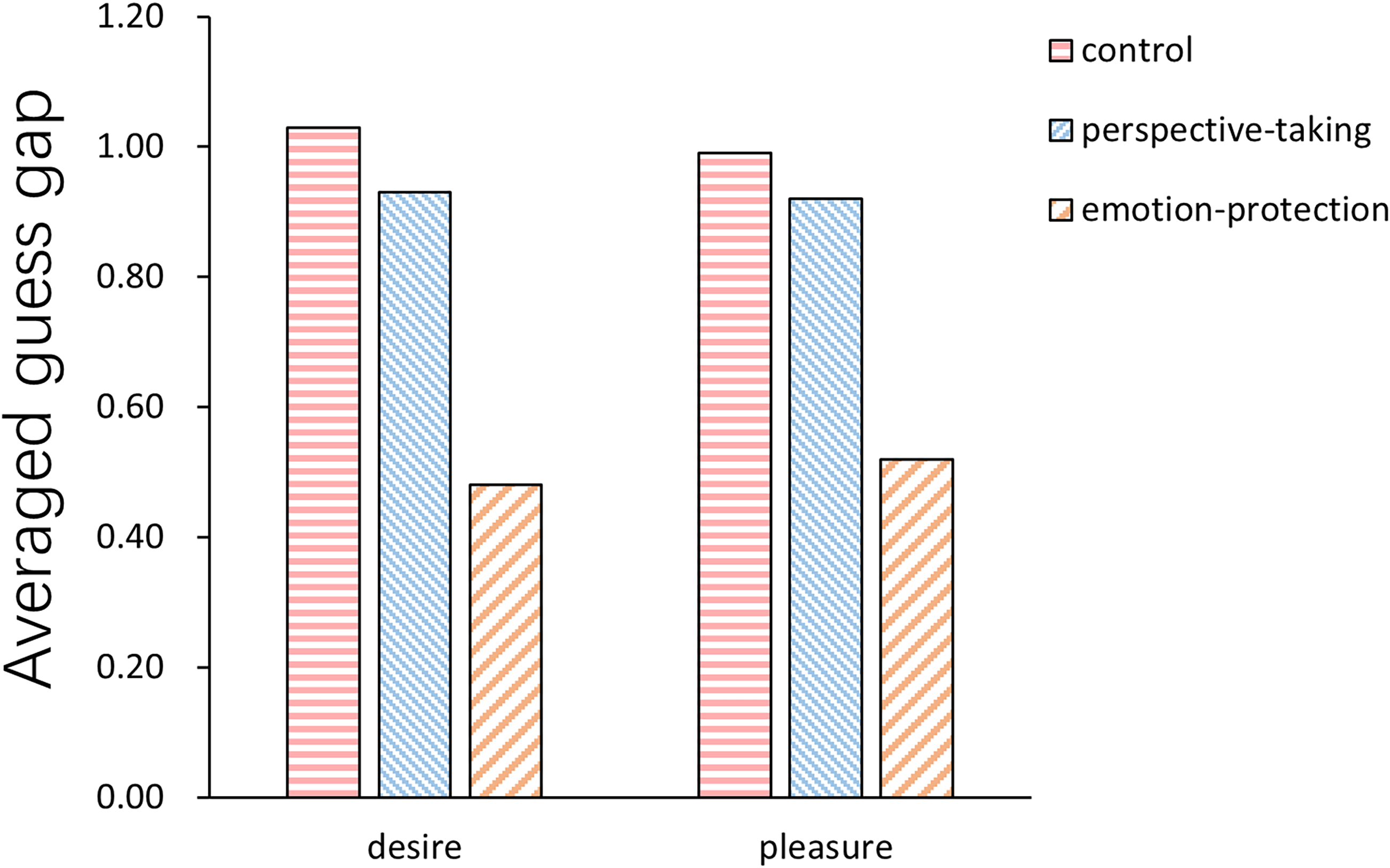
Averaged guess gap of the three conditions in Study 4.
The findings from Study 4 suggest that setting an emotion-protection goal could decrease guessers’ desire and pleasure for a correct guess whereas adopting a perspective-taking stance is insufficient to do so. We speculate that these results may have occurred because an emotion-protection goal is more direct and concrete than perspective-taking, leading to a more effective intervention impact. Specifically, the perspective-taking stance only asked participants to consider how the other person would feel or act, without any additional request. Guessers might realize that askers did not actually want a correct guess, but still maintained their desire to guess correctly. In contrast, the emotion-protection condition explicitly provided a direct instruction that participants must consider the other person's emotions during the conversation. As the guess gap = guessers’ desire for a correct guess minus askers’ desire for a correct guess, the emotion-protection goal therefore has the potential to reduce the guess gap. This is further supported by the combined analysis of the data from Study 4 and Study 1.
It is noteworthy that there are some confounding factors between the two interventions: The emotion-protectioncondition is longer than the perspective-taking condition. In addition, the perspective-taking condition asks a question, whereas the emotion-protection condition offers a declarative sentence. It is unclear at what degree these confounding factors contribute to the different effects of the two interventions.
Study 5
Study 5 served two purposes: (a) to test whether the guess gap is robust after controlling for demographic factors and (b) to investigate the consequences of the guess conversations. Specifically, we studied the effects of the guess result and role on willingness to continue the topic and pleasure gained from the conversation.
Participants and Procedure
A total of 363 Credamo participants (300 after exclusions: 74.0% female; Mage = 28.25, SDage = 7.41) completed the study with minor remuneration. Study 5 employed the same five scenarios of “conversations between friends” used in Study 1.
The study utilized a 2 (role: asker vs. guesser) × 2 (guess result: incorrect vs. correct) between-subject design. Participants were randomly assigned to one of the four conditions.
In the asker condition, participants read the vignette and answered: (1) “To what extent do you want the other person to guess correctly? (1= not at all; 7 = very much)”
In the guesser condition, participants read the vignette and answered: (1)“To what extent do you want yourself to guess correctly? (1 = not at all; 7 = very much)”
Next, participants imagined the guessing outcome as either incorrect or correct and answered: (2) “Please indicate your willingness to continue discussing the topic (1 = not at all; 7 = very much)” and (3) “Please estimate the pleasure you will gain from this conversation (1 = not at all; 7 = very much).”
We set up an attention check question in which participants were instructed to select the scenario not included in the experiment. This was implemented to exclude participants who did not take the experiment seriously. Additionally, we excluded four participants whose response time was less than 1 minute. Finally, participants provided demographic information including age, gender, education level, and average monthly income. Seven people did not report their average monthly income.
Results and Discussion
Desire for Correct Guess
Controlling for demographic variables (age, gender, education level, and average monthly income), a significant main effect of role was found on the desire for a correct guess, F(1, 287) = 31.95, p < .001. Specifically, askers (vs. guessers) demonstrated a lower preference for a correct guess, MAsker = 4.26, SDAsker = 1.16 vs. MGuesser = 4.93, SDGuesser = 0.94; t(298) = −5.51, p < .001, d = 0.64, replicating the finding of previous experiments.
Willingness to Continue the Topic
A 2 (role: asker vs. guesser) × 2 (guess result: correct vs. incorrect) ANOVA was conducted to examine the effects on willingness to continue the topic. The results indicated a significant effect of role on willingness to continue the topic (F (1, 296) = 20.78, p < 0.001), with askers generally more willing to continue the topic compared to guessers, MAsker = 5.64, SDAsker = 0.86 vs. MGuesser = 5.19, SDGuesser = 0.89. The guess result did not significantly influence the willingness to continue the topic, F(1, 296) = 0.33, p = .566. Most importantly, a significant interaction was found between role and guess result, F(1, 296) = 10.55, p = .001. Specifically, askers were more willing to continue the topic when the guess is incorrect (vs. correct), while guessers were more willing when the guess was correct (vs. incorrect) (see Figure 5 for descriptive results).
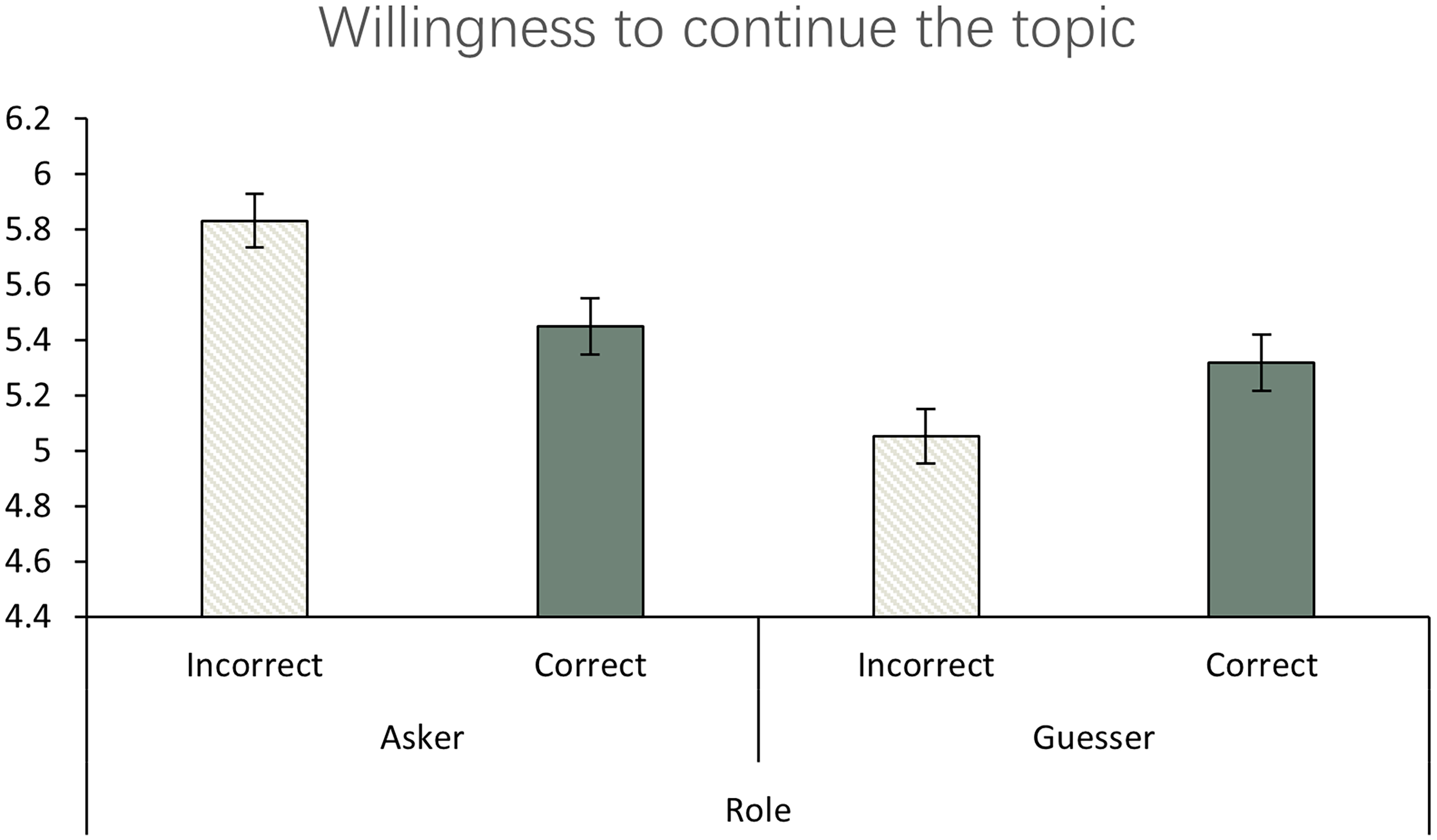
The interaction effect of role and guessing result on willingness to continue the topic.
Pleasure from the Conversation
A 2 (role: asker vs. guesser) × 2 (guess result: correct vs. incorrect) ANOVA was conducted to examine the effects on pleasure derived from the conversation. The results showed a significant influence of role on the pleasure derived from the conversation, F(1, 296) = 11.88, p < .001, with askers generally experiencing more pleasure from the conversation than guessers (MAsker = 5.20, SDAsker = 0.90 vs. MGuesser = 4.83, SDGuesser = 0.99). The guess result did not significantly affect the pleasure from the conversation, F(1, 296) = 0.23, p = .633. Most importantly, there was a significant interaction between role and guess result, F(1, 296) = 10.72, p = .001. Specifically, askers derived more pleasure from the conversation when the guess was incorrect (vs. correct), while guessers experienced more pleasure when their guess was correct (vs. incorrect) (see Figure 6 for descriptive results).
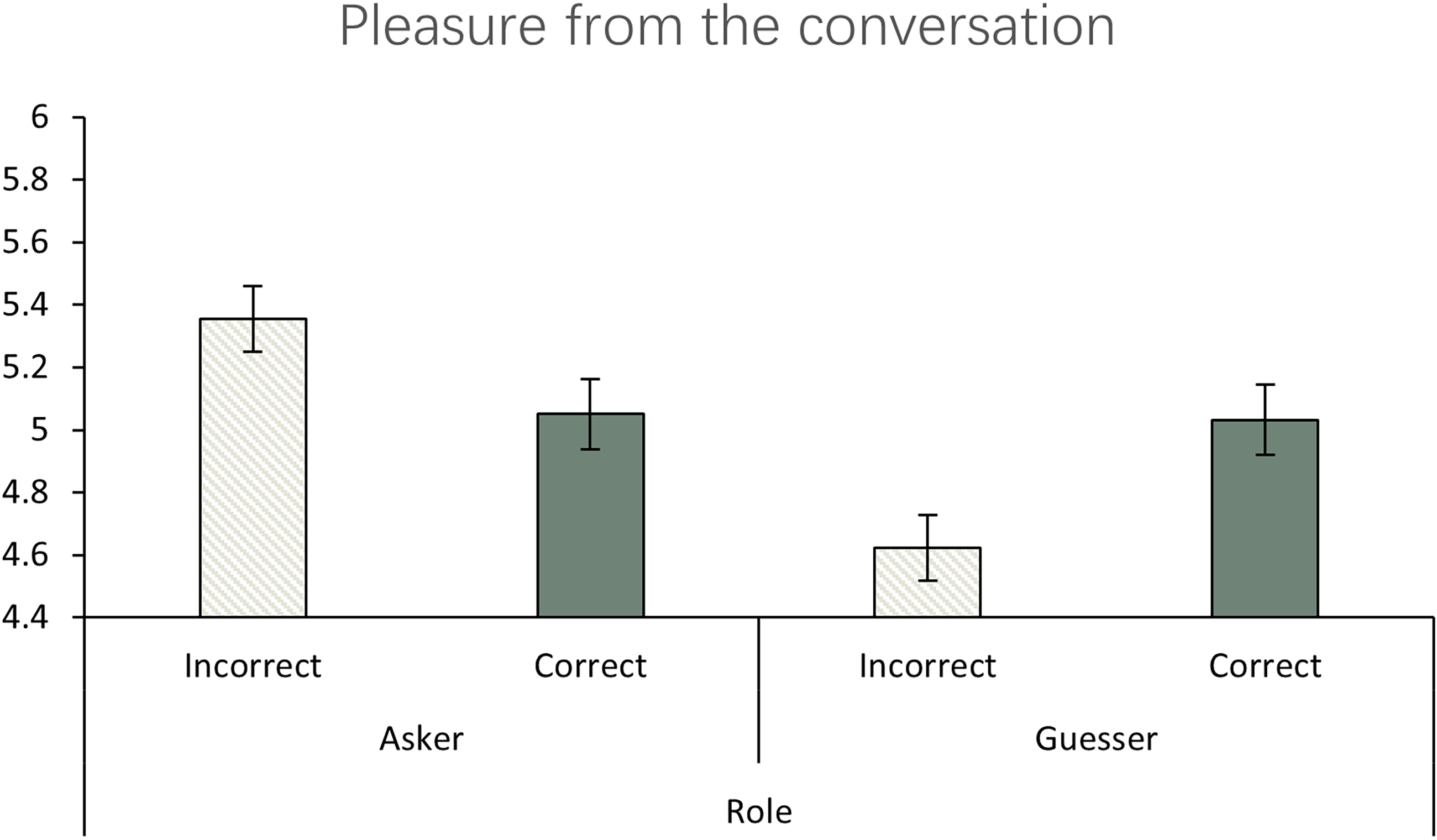
The interaction effect of role and guessing result on the pleasure of the conversation.
To sum up, Study 5 not only confirms that the guess gap is robust after controlling for demographic factors, such as gender, age, education level, and monthly income, but also demonstrates that the guess correctness and conversational role interacted to influence the consequences of a conversation, including the pleasure derived from the conversation and the willingness to continue the topic.
General Discussion
We conducted a comparative analysis across five studies to examine the disparity in the desire for a correct guess between askers and guessers in various conversational scenarios. Study 1 investigated the discrepancy in the desire for a correct guess in one-on-one conversations between friends, revealing that askers have a lesser inclination for the guessers to guess correctly compared to the guessers themselves. Study 2 expanded this investigation to one-to-many conversations in diverse social settings, including social gatherings, networking among colleagues, family chats, and academic discussions. Study 3 revealed that individuals can be aware of this discrepancy. Study 4 demonstrated that perspective-taking does not influence the mindset of the guesser, while indicating that guessers are more prone to decrease their desire for guessing correctly when reminded to protect the asker's emotions. Study 5 provided evidence that guess results affect conversation outcomes. Askers reported greater enjoyment and were more inclined to continue the conversation when guesses were incorrect, whereas guessers reported more pleasure and willingness to continue when their guesses were correct.
One possible explanation for our findings is motivation discrepancy. On the one hand, when askers raise “guess what” questions, they generally have a motivation of showing some surprising information. A correct guess suggests that the information is so unsurprising that guessers can get it right easily. Therefore, askers generally have a low desire for the correct guess. On the other hand, when guessers try to guess the right answer, they generally have a motivation of showing their ability of guessing, which leads them to have a high desire for the correct guess. This framework of motivation discrepancy can also be applied to some previous research results. For example, gift givers and recipients differ in their preferences for gifts due to their divergent motivations (Yang & Urminsky, 2018). Future research could test this motivation discrepancy explanation by directly investigating the motivations of both parties during the “guess what” conversation.
Another possible explanation for our results is role duty. If you play a role, then you are supposed to have corresponding duty. In the “guess what” situation, the guesser's role is supposed to guess it correctly as soon as possible, and thus, the guesser has a strong desire for a correct guess. The asker's role is supposed to not let guesser to get it correct too quickly, and thus, the guesser has a weak desire for a correct guess. This is similar to the game of hide and seek. It is a duty for the hider to hide as secretly as possible; it is also a duty for the seeker to find the hider as quickly as possible. Which of the above two explanations is better? Furthermore, is a hybrid explanation feasible? To our intuition, the motivation explanation is seemingly more suitable for askers and the role explanation seems more suitable for guessers (maybe we can call this hybrid explanation as mindset discrepancy), but is this the case? Our current data cannot answer these questions, and we leave these questions for future research.
Our research offers several academical and practical contributions. First, prior research has demonstrated that individuals can exhibit seemingly self-contradicted behaviors. For instance, individuals enjoy talking about new experiences but prefer listening to stories about past ones (Cooney et al., 2017); people tend to predict that others are attracted to them if they have a relatively large number of friends, while personally preferring to form friendships with individuals who have a relatively small number of friends (Si et al., 2021). We reveal another intriguing self-contradiction in which the asker actively and enthusiastically invites the other person to make a guess, yet does not want the guess to be correct. Second, our findings add a unique perspective to the existing body of literature on discrepancies between both sides in conversations (e.g., Cooney et al., 2022; Kardas et al., 2022; Levine & Cohen, 2018; Mastroianni et al., 2021; Schroeder et al., 2022) by investigating asker–guesser divergent preferences in one of the most common conversation types—“guess what” conversation—and its consequences. Given that the discrepancies in the previous conversation research usually involve cognition such as estimation or belief, the current discrepancy, involving desire or emotion, adds not only a specific phenomenon but also a rarely explored aspect. Third, our findings provide practical tips for people who encounter a “guess what” question: To protect the asker's emotions, they should try to avoid guessing correctly and swiftly. Fourth, our findings offer practical advice for those who pose a “guess what” question. Since guessers are more willing to listen to subsequent information when their guesses are correct, it is wise for askers to share the same desire for correct guess.
Our research has some limitations. Firstly, our experimental conversation scenarios exclusively focused on casual talks and did not involve serious discussions such as sensitive self-disclosure (e.g., “guess what I discovered after months of therapy?” and “I’m transgender.”) or serious announcement (e.g., “guess what your dad told me today?” and “he's divorcing me.”) Therefore, it is difficult to infer whether the asker–guesser discrepancy in the desire for a correct guess remains in these scenarios. In fact, since people generally want to be understood when they reveal themselves (Chaudoir & Fisher, 2010; Laurenceau et al., 1998) and a correct guess may indicate understanding and support, the discrepancy in the desire for a correct guess may not exist in this situation. Additionally, as people prefer interacting with those who have similar attitudes and opinions (Montoya et al., 2008; Selfhout et al., 2009), a correct guess may be desired when people seek coordination in an interaction. Second, our research focuses on one type of pre-sequence_“pre-announcement,” and there may be more interesting aspects to explore within other pre-sequences. For example, prior research has found that people tend to underestimate the likelihood that others will agree to their requests and overestimate the negative ramifications of invitation declines (Flynn & Lake, 2008; Givi & Kirk, 2024). One might want to know the consequences of a pre-invitation like “Do you have any plans for tonight?”—whether it makes rejection more difficult or easier. Third, despite utilizing various conversation scenarios and attempting to encompass diverse social situations and conversational topics, the reliance on participants’ reactions to hypothetical scenarios may affect the ecological validity of our findings. Lastly, given that our study included only Chinese participants, the present findings lack cross-cultural verification.
Given the limitations of the current study, it is recommended that future research focuses on four key aspects. First, it is crucial to investigate the boundary conditions of the “guess gap.” Is this gap also present in “guess what” conversations involving serious event sharing, self-disclosure, and when people seek coordination in an interaction? Additionally, it is meaningful to investigate the consequences of the “guess what” pre-sequence in these scenarios. Second, it would be interesting to conduct a broader exploration of other pre-sequence conversations (e.g., conversations that starts with pre-invitation or pre-request). Third, the ecological validity of the guess gap should be further validated using additional methodologies, such as those commonly used in linguistics. Lastly, we recommend that future studies incorporate diverse nationalities and ethnicities to achieve cross-cultural verification of our results.
Supplemental Material
sj-docx-1-jls-10.1177_0261927X241291259 - Supplemental material for Guess What? The Asker–Guesser Discrepancy in Desire for the Right Guess
Supplemental material, sj-docx-1-jls-10.1177_0261927X241291259 for Guess What? The Asker–Guesser Discrepancy in Desire for the Right Guess by Peiru Peng and Jianmin Zeng in Journal of Language and Social Psychology
Footnotes
Author Notes
We report all measures, manipulations, and exclusions in these studies. All experimental procedures were approved by the Research Ethics Committee at Faculty of Psychology, Southwest University, and conducted in accordance with its guidelines (IRB: H23227).
Data Availability Statement
All data and materials relating to this article are available at https://osf.io/sj3mf/.
Declaration of Conflicting Interests
The authors declared no potential conflicts of interest with respect to the research, authorship, and/or publication of this article.
Funding
This research was supported by Ministry of Education of China - Humanities and Social Sciences Foundation (23YJA190001), and Foundational Research Funds for Central Universities (SWU1609115).

Supplemental Material
Supplemental material for this article is available online.
Notes
Author Biographies
References
Supplementary Material
Please find the following supplemental material available below.
For Open Access articles published under a Creative Commons License, all supplemental material carries the same license as the article it is associated with.
For non-Open Access articles published, all supplemental material carries a non-exclusive license, and permission requests for re-use of supplemental material or any part of supplemental material shall be sent directly to the copyright owner as specified in the copyright notice associated with the article.
