







Abstract
Grammatical gender generally implies disadvantages for women (e.g., the generic masculine leading to real-life invisibility of women). Diverging from this idea, we here postulate that abstract concepts (such as “justice” or “democracy”), arguably reflecting the most sophisticated expression of human thought, are associated with femininity. Two archival studies (Study 1a, b) show the greater frequency of feminine gender among abstract nouns across seven (out of nine) Indo-European languages. Studies 2 and 4 show that feminine abstract nouns are envisaged as female, both explicitly and through a voice-assignment task. Furthermore, through Implicit Association Tests (IATs), we show that abstract concepts are associated with women as a social category (Studies 3a, b). Together, our studies show an association between abstractness and grammatical gender that carries psychological meaning through the gender congruency effect. Arguably, these cognitive processes may contribute to the idealization of women as “super-human,” through the association between abstractness and super-human imagery (Study 4).
It is often argued that grammatical gender creates disadvantages for women. In most grammatical-gendered languages, nouns carry one of two (e.g., Italian, French) or three (e.g., German, Polish) genders and this grammatical gender then affects other constituents of the sentence such as articles, verbs, adjectives and the like, making gender a salient feature of the sentence. Although grammatical gender itself is largely arbitrary (e.g., bridge is feminine in German, but masculine in Spanish), it may affect socio-cognitive processes. This is best illustrated by the “generic masculine” rule, according to which the masculine is employed when the gender of the person is not specified (e.g., “an ideal studentmasc should…”) and, in its plural form, to describe groups of mixed gender (e.g., “The girl and the boy are studentsmasc”). Theoretically, such generic masculine forms are neutral, as they comprise both male and female exemplars; in reality, however, they tend to facilitate the retrieval of gender-congruent (male) exemplars, while making women mentally invisible (see Gygax et al., 2021; Menegatti & Rubini, 2017; Schmitz et al., 2023). Among others, this has been shown to have tangible implications for the outcome of opinion polls (e.g., Braun et al., 2005). Some researchers have taken this argument one step further, hypothesizing that gender disparity and gender prejudice are more pronounced in countries with gendered languages (DeFranza et al. 2020; Prewitt-Freilino et al., 2012; Shoham & Lee, 2018), although the latter argument rests exclusively on correlational evidence.
Diverging from this perspective, we here argue that there is one area in which grammatical gender may “favor” women, namely abstractness. Abstract nouns refer to entities that are not directly perceivable through the senses (Della Rosa et al., 2010): these include concepts such as democracy, justice, or infinity, which are arguably the most sophisticated expression of human thought. Learning of and reasoning about such abstract concepts critically depend on language (Luchkina & Waxman, 2023). Compared to concrete concepts, abstract concepts are acquired at a later age, learned mainly through verbal stimulation rather than direct experience with the object, and are much more difficult to envisage or contextualize (Della Rosa et al., 2010; Mestres-Missé et al., 2014). They generally express complex cultural ideas that transcend perceptual and bodily experiences.
Across six studies, we show that a grammatical and psychological association exists between abstractness and femininity. To address the abstractness–femininity overlap and its psychological impact, the present paper is organized into four sections, each addressing a specific research question. In the first section, we discuss the historical origins of the abstractness–femininity overlap and investigate whether abstract nouns have an above-chance likelihood of carrying feminine grammatical gender in Indo-European languages (Studies 1a and b). In the second section (Study 2), we investigate whether grammatical gender colors the perception of abstract concepts as being feminine (vs. masculine), similar to the gender-congruency effect observed in past research for concrete nouns. In the third section (Studies 3a and b), we argue that if abstract nouns carry predominantly feminine grammatical gender, and if grammatical gender evokes feminine images, then people may implicitly associate abstractness (vs. concreteness) with women (vs. men) as a social group. In the fourth and final section, we explore whether the abstractness–femininity association may also compel people to perceive women as the super-human entities.
We report all data exclusions, manipulations, and measures in the studies. Data, study materials, and supplementary materials are available on the Open Science Repository OSF: https://osf.io/8ysmx/.
Are Abstract Nouns Grammatically Feminine? Origins and Pervasiveness of Grammatical Gender Systems (Study 1)
Why would grammatical gender be associated with abstractness? The history and the development of gender systems cannot be directly observed, so the reconstruction necessarily remains speculative, but going back in time may be useful for understanding today's link between feminine grammatical gender and abstractness. Proto-Indo-European language is considered the common ancestor of Indo-European languages and was spoken as a single language from approximately 4500 BC to 2500 BC, that is, during the Late Neolithic up to the Early Bronze Age. It is believed to have developed from a two-gender system, distinguishing animate vs. inanimate, into a three-gender system (Luraghi, 2011; Matasovic, 2004), divided into animate vs. inanimate/abstract or collective vs. inanimate/concrete. Importantly, the three-gender connotation initially did not have a male/female connotation, as already argued by Brugmann (1891). In references to this author, Luraghi (2011, p. 437) states that “this system was a late development from an earlier two-gender system commonly held to be animacy-based, which morphologically consisted of […] the masculine and the neuter, while the feminine gender was later formed through the addition of a special suffix.” Similarly, Wheeler (1899, p. 529ff) argues that the form-groups of nouns which mark the classification by gender had originally nothing to do with distinctions of sex. Their distinctive endings did not carry with them originally the suggestion of sex; thus, the so-called “feminine” suffixes […] served rather, […] to form collectives and abstracts.
If the feminine suffices initially did not imply any gender meaning at all, but referred to collectives and/or abstractness, this may account for today's co-occurrence of abstractness and feminine grammatical gender. How the extension from abstract to feminine came about, is still debated (for an overview, see Luraghi, 2009) and goes beyond the scope of the present paper.
Regardless of how exactly the switch occurred, linguists seem to agree that the suffices that originally referred to abstractness only subsequently became associated with femininity. If this argument is correct, then it would not be surprising if abstract nouns were predominantly of feminine grammatical gender in those languages that derive from Proto-Indo-European language. In line with this argument, Luraghi (2009) states that feminine nouns tend to be cognitively more complex and that the association between feminine grammatical gender and abstractness is not surprising as it “logically follows from the historical development of the feminine gender out of an (earlier) class of abstract nouns” (p. 8). This reasoning would also allow an additional prediction, namely that the abstractness–femininity association may become weaker over time as a function of subsequent gender change. For instance, it may be stronger in Latin than in Italian, or in Ancient than in Modern Greek. The first aim of the present research program was therefore to investigate, through archival analyses, whether feminine grammatical gender is over-represented among abstract nouns, whether this asymmetry holds across different (current and ancient) Indo-European languages, and whether it tends to become weaker over time.
Study 1a
The primary aim of the first study was to investigate the “feminine abstract” phenomenon in Italian. In line with prior theorizing (Brugmann, 1891; Luraghi, 2011; Matasovic, 2004), we predicted that grammatical gender would be associated with abstractness, so that abstract nouns be predominantly feminine.
Furthermore, we aimed at looking at the implications of the abstractness–femininity association on how feminine (vs. masculine) nouns are imagined and how they are acquired during socialization. If abstract nouns are learned through distinct pathways, as suggested by Della Rosa et al. (2010), and if feminine nouns are associated with abstractness, as tested here, then feminine nouns, compared to masculine ones should also be more difficult to imagine, more detached from context, less familiar, and acquired later in life and mainly through verbal stimulation rather than through direct experience.
Finally, we aimed at exploring the evolution of the abstractness–femininity association over time, specifically by analyzing Latin (i.e., the precursor of Italian and other Romance languages). We expected that in Latin, too, abstract nouns would be predominantly feminine rather than masculine, and that this effect may be even stronger than with Italian, given that Latin is closer to Proto-Indo-European. Results (see supplementary materials, which are available on the OSF: https://osf.io/8ysmx/) confirmed that the abstract–feminine association decreases with increasing temporal distance from Proto-Indoeuropean language, with the abstractness–femininity association being stronger in Latin than in Italian.
Method
To test our hypotheses, we employed the database by Della Rosa et al. (2010), which includes participants’ ratings for concreteness (directly perceivable through the senses), abstractness (not directly perceivable through the senses), imageability (easy to imagine), context availability (easy to think of a context), familiarity (familiar), age of acquisition (age at which participants learnt the word), mode of acquisition (concept entirely acquired through language rather than experience) for 417 Italian nouns, on a scale from 100 to 700. Furthermore, for analysis purposes, we dichotomized the abstractness ratings by splitting the noun list into two groups of approximately equal size (the cut-off being 300); we refer here to the continuous variable as “abstractness ratings,” and the dichotomized variable as “abstractness.”
Since grammatical gender was our main predictor, four nouns were excluded due to gender ambiguity (i.e., they can be both masculine and feminine; nomad, tourist, athlete, teacher) and one due to gender duality (i.e., grammatical gender changes from singular to plural; egg). Our final word list consisted of 412 nouns (205 abstract and 207 concrete). The majority of these nouns had unambiguous gender suffices (-a or -o), whereas a minority (26%) ended in the gender-ambiguous -e, and a negligible number (n = 4) ended in -i or -u.
Results
Independent sample t-tests were also run on the other ratings to check for grammatical gender differences across all nouns. Results showed that, in the overall sample, feminine grammatical gender was linked to lower imaginability, t(399) = 3.81, 95% CI of the difference [33.37, 102.74] p < .001, d = 0.38, lower context availability, t(410) = 2.81, 95% CI of the difference [10.56, 59.88], p = .005, d = 0.28, older age of acquisition, t(403) = −3.07, 95% CI of the difference [−55.63, −12.23], p = .002, d = −0.30, and greater acquisition through a verbal modality rather than experience, t(410) = −2.14, 95% CI of the difference [−62.48, −2.67], p = .033, d = −0.21, but there was no effect of grammatical gender on context familiarity, t(410) = 1.13, 95% CI of the difference [−8.34, 30.89], p = .259, d = 0.11. To test whether these overall gender differences were explained by the fact that grammatically feminine nouns are overrepresented among abstract ones, we ran a mediation model in JASP 0.19.3 (JASP Team, 2025) with grammatical gender as predictor, abstractness ratings as mediator, and imaginability, familiarity, context availability, and age and mode of acquisition as outcomes, using 1,000 bootstrap resamples. Results (see Figure 1) showed that, indeed, abstractness ratings mediated these effects: in other words, grammatically feminine nouns were predominantly abstract, and as such harder to imagine (b = −66.61, SE = 17.02, p < .001, LLCI = −104.49, ULCI = −36.56), less familiar (b = −17.15, SE = 4.70, p < .001, LLCI = −29.31, ULCI = −9.10), acquired later in life (b = 32.83, SE = 8.50, p < .001, LLCI = 17.85, ULCI = 52.21) and through a verbal modality (b = 49.59, SE = 12.75, p < .001, LLCI = 27.04, ULCI = 77.39), and less available in context (b = −43.33, SE = 11.11, p < .001, LLCI = −68.44, ULCI = −23.35).
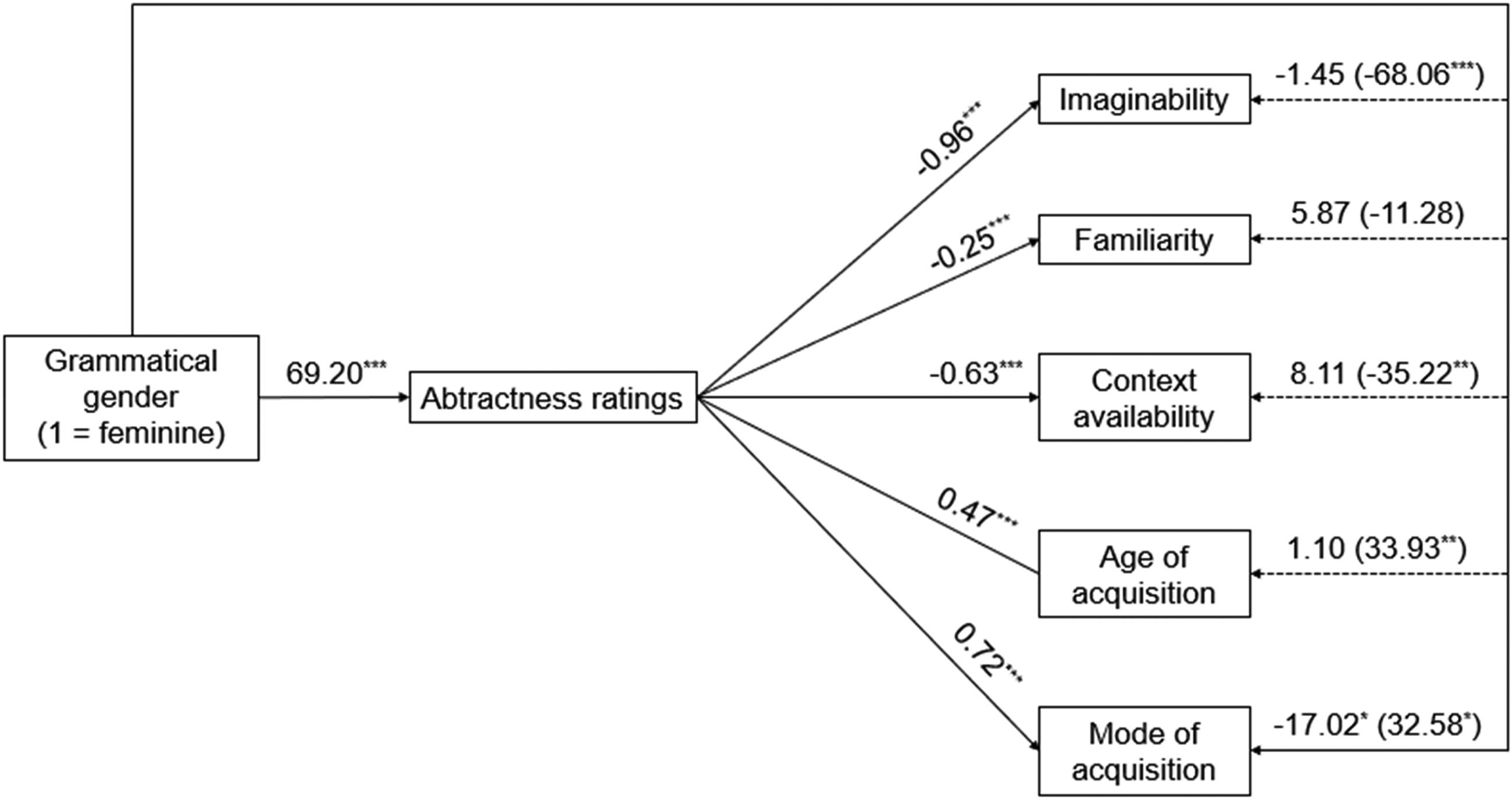
Mediation Model With Imaginability, Familiarity, Context Availability, Age, and Mode of Acquisition as a Function of Grammatical Gender and Abstractness Ratings (Study 1a).
Study 1b
To address the generality of the association between abstractness and femininity in a broader range of Indo-European languages, we extended the prior analysis to other languages derived from Proto-Indo-European. We chose eight currently spoken Indo-European languages representing different branches of the Indo-European language tree (e.g., Kapović et al., 2017), namely Hindi, Modern Greek, Italian, Irish, German, Albanian, Lithuanian, and Polish. We expected to find a similar pattern as that found in Study 1a, with grammatically feminine nouns being over-represented among abstract (but not concrete) nouns.
This additional study also intended to resolve a methodological limit of Study 1a. In Study 1a, abstractness ratings were taken from a prior study in which Italian raters had judged the abstractness of nouns (Della Rosa et al., 2010); given the strong association between gender and abstractness, we cannot exclude with certainty that Della Rosa's Italian raters may have been under the influence of grammatical gender, possibly judging nouns as more or less abstract based on their grammatical gender. To resolve this problem, in Study 1b, we used an English language database for which concreteness ratings (i.e., the degree to which the object is perceivable through the senses and learned through experience) were available (Brysbaert et al., 2014). In this case, ratings had been obtained in a language without grammatical gender, making it unlikely that concreteness ratings had been influenced by grammatical gender.
Method
Nouns in our sample were extracted from a corpus of 40.000 English words (Brysbaert et al., 2014), which includes concreteness ratings: participants were first provided with the definition of concrete (i.e., can be directly experienced through the five senses) and abstract nouns (cannot be directly experienced, but can be defined by other words), and were asked to rate the word on a scale from 1—abstract (language based) to 5—concrete (experience based). We selected the 125 nouns with lowest concreteness ratings and the 125 with the highest concreteness ratings. Here as well, we refer to the dichotomized variable as “abstractness,” and the continuous one as “concreteness ratings.”
The nouns were translated into eight languages, each representing a different branch of Proto-Indo-European: Albanian, German, modern Greek, Hindi, Irish, Italian, Lithuanian, and Polish. The translation procedure consisted in four steps: (1) Translations and grammatical gender were obtained through the online multilanguage dictionary Glosbe (https://it.glosbe.com/); (2) Missing information were obtained through language-specific dictionaries 1 ; (3) Google Translate was employed to fill any remaining gaps in translations; (4) Finally, native-language raters unaware of the hypotheses were asked to check the translations and assess gender where it was still missing. In cases in which native-language raters noted mistakes or inaccuracies in translations, we adopted the translations indicated by the rater.
The selected translation was always the first presented by the dictionary (or indicated as a substitute by the native speaker), so repetitions are present in some cases (e.g., “endlessness” and “limitlessness,” both translated as “Unendlichkeit” in German). Furthermore, two words were excluded from the dataset as they were not nouns (“someway,” “unbefitting”), and eight as the translation was plural in one or more languages (e.g., “tongs”). Finally, in some cases, neither the dictionaries nor the raters were able to provide a translation, which accounts for some missing data; this is not surprising given that some of the abstract terms were indeed unusual and of very low frequency (e.g., “utopianism”).
Results
To test for associations between grammatical gender and abstractness, we ran Chi-square analyses for every language. As shown in Figure 2, grammatical gender and abstractness were associated in German, χ2(1, N = 240) = 55.11, p < .001, d = 1.09, Greek, χ2(1, N = 240) = 68.50, p < .001, d = 1.26, Hindi, χ2(1, N = 236) = 15.33, p < .001, d = 0.53, Irish, χ2(1, N = 238) = 29.67, p < .001, d = 0.76, Italian, χ2(1, N = 238) = 43.12, p < .001, d = 0.94, and Polish, χ2(1, N = 239) = 26.94, p < .001, d = 0.71, but not in Albanian, χ2(1, N = 240) = 1.65, p = .199, d = 0.15, and Lithuanian, χ2(1, N = 240) = 3.11, p = .078, d = 0.23.
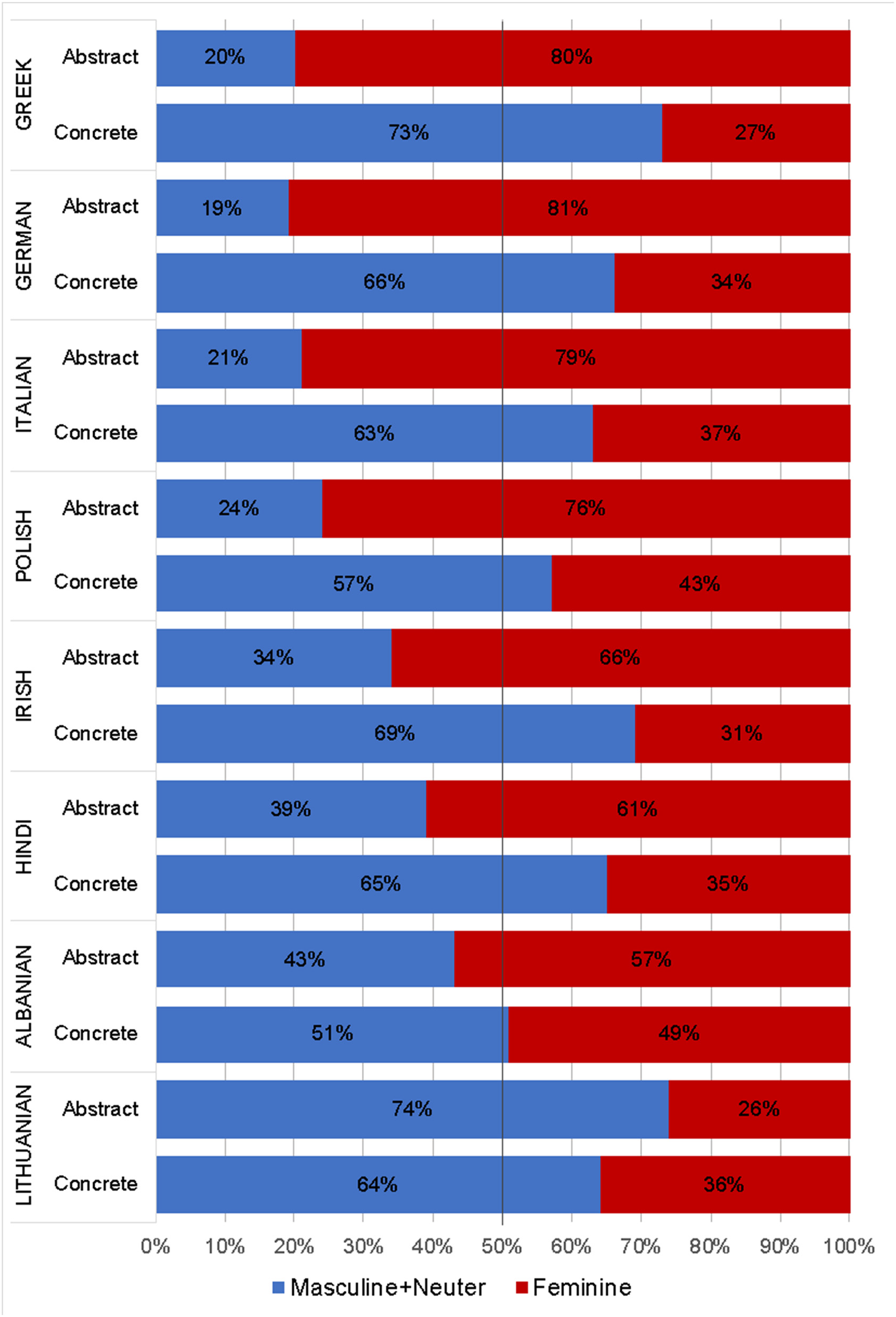
Percentage of Feminine vs. Masculine Nouns as a Function of Abstractness and Language (Study 1b).
Then, we first ran non-parametric binomial tests to check whether the frequency of feminine gender among abstract and concrete nouns was higher or lower than chance. Among concrete nouns, masculine grammatical gender reliably exceeded chance levels for German, p < .001; Greek, p < .001; Hindi, p = .002; Irish, p < .001; Italian, p = .006; and Lithuanian, p = .003. Among abstract nouns, feminine grammatical gender reliably exceeded chance levels for German, p < .001; Greek, p < .001; Hindi, p = .027; Irish, p < .001; Italian, p < .001; and Polish, p < .001.
This pattern was confirmed by independent sample t-tests, using the Bysbaert et al. (2014) concreteness ratings as dependent variable (see supplementary materials, which are available on the OSF: https://osf.io/8ysmx/).
As in Study 1a, feminine gender was numerically over-represented among abstract nouns, but the (relatively few) masculine nouns that were present among the abstract category were no less abstract than the feminine ones (ts ≤ |.90|, ps ≥ .368).
Discussion
Three main conclusions can be drawn from the results of Studies 1a and 1b. First and foremost, the results show that feminine nouns are over-represented among abstract, but not among concrete nouns, in seven (out of nine) Indo-European languages, namely German, modern Greek, Hindi, Irish, Italian, Latin, and Polish. An opposite pattern was observed for concrete nouns in most languages included in Study 1b. Together, our findings suggest a widespread, cross-language association between femininity and abstractness, which, in line with linguistic theory (Luraghi, 2009), presumably derives from the fact that feminine (vs. masculine) gender was historically superimposed on a previously existing classification of abstract (vs. concrete) inanimate concepts. Why this asymmetry was not found in two of the Indo-European languages investigated here, namely Albanian and Lithuanian, remains to be explored in future research; however, evidence suggests that for Lithuanian, the masculine grammatical gender is overrepresented in language and adjective-noun matching follows a very complex pattern, with a dominance of masculine and neutral forms, which may explain the lack of an effect (Adamson & Šereikaitė, 2019; Bruno, 2012).
Second, the Proto-Indo-European derivation of this phenomenon, as detailed above, may also explain why the link between feminine gender and abstractness, although present in both languages, is stronger in Latin than in Italian. Finally, the mediation model suggests that because they are more likely to be abstract, feminine nouns also present those characteristics that are typical of abstract concepts (Della Rosa et al., 2010): in virtue of their overrepresentation among abstract nouns, grammatically feminine nouns are more difficult to envisage and to contextualize, they are learned later in life, and are acquired more through verbal stimulation than through direct experience. This is also in line with the concreteness effect, suggesting that abstract (vs. concrete) words are encoded and memorized less well because they are less likely to activate context information and visual imagery (e.g., Jessen et al., 2000).
To sum up, Studies 1a and 1b provide evidence for the hypothesized abstractness–femininity association, yet, they do not speak to any psychological meaning of this association. In the following studies, we aimed at answering the question: why should the grammatical gender of abstract nouns be psychologically relevant?
Does Grammatical Gender of Abstract Nouns Accord Psychological Meaning? (Study 2)
An extensive line of research suggests that grammatical gender accords psychological meaning to concrete objects (Samuel et al., 2019; Stahlberg et al., 2007). For instance, bridge may elicit masculine qualities such as sturdiness in the minds of Spanish speakers, but feminine qualities such as elegance in the minds of German speakers. This phenomenon, denoted gender-congruency effect, 2 is believed to occur through three distinct routes: (a) the greater accessibility of gender-congruent exemplars during retrieval, (b) the activation of gender-stereotypes that are projected onto objects, and (c) the transmission of gendered images through cultural artifacts.
The first process concerns the fact that grammatical gender determines, to some degree, which examples come to mind. For instance, priming studies suggest that same-gender nouns become more accessible than opposite gender nouns (e.g., Bates et al., 1996). The greater accessibility of gender-congruent exemplars has tangible social consequences for opinion polls, which are often framed in generic masculine forms that favor the retrieval of male exemplars (Stahlberg et al., 2001; Stahlberg & Sczesny, 2001, Study 2). The common process likely to underline these phenomena is selective retrieval, during which grammatical gender channels the search for corresponding gender of the exemplar to be retrieved.
The second process involves the projection of stereotypically masculine or feminine characteristics onto objects, animals, or concepts on the basis of grammatical gender (for an overview, see Bender et al., 2016a). In these cases, the arbitrary grammatical gender of nouns carries over to the object itself. For instance, in Konishi’s (1993) classical study, Spanish and German speakers reacted to words whose grammatical gender differed across the two languages. Participants judged words as higher in potency when they carried masculine grammatical gender. Alternatively, studies may include semantic similarity judgments of word pairs that share or not the same gender. For instance, Vigliocco et al. (2005) found such a carry-over effect in Italian speakers, but not in German speakers. Thus, the overall evidence in this line of research is relatively weak, especially in languages with more than two genders (such as German).
Gender congruency emerges more clearly from studies using the voice-assignment task. Here participants are told that their opinion is needed for the development of a cartoon in which common objects come to life, by indicating whether a male or female voice is better suited to represent that object (e.g., Sera et al., 1994, Exp. 2). In languages with grammatical gender, voice assignment is greatly influenced by the gender of the word (for a review, see Bender et al., 2016a). Although grammatical gender is not the only variable at play (e.g., Mullen, 1990; Sera et al., 1994), it tends to spread to semantically genderless objects (namely nouns, both animate and inanimate, that are not inherently featured by a sex), so that the gender of the selected voice corresponds to the grammatical gender of the word.
One limit of this research is that, to our knowledge, almost all prior studies have investigated gendered images related to concrete nouns such as animals, plants, and artifacts. Among the few exceptions are studies investigating allegorical concepts such as state, innocence, peace, or honor, finding overall relatively small grammatical gender effects in voice assignment (Beller et al., 2015), or only finding an effect when allegories are paired to gender-congruent personified representations (Bender et al., 2016b). On the one hand, one may argue that it is easier to project gender onto concrete objects than onto highly abstract concepts, because abstract nouns are overall much harder to imagine (Della Rosa et al., 2010). On the other hand, the very fact that abstract concepts are not directly accessible to our senses and become comprehensible mainly through linguistic or visual metaphors (Landau et al., 2014) may actually promote personified (and possibly also gendered) mental representations of such concepts. Cultural artifacts such as paintings and sculptures fulfill exactly this function and constitute the third route through which grammatical gender may transmute into gender-congruent mental representations. For instance, Liberty is feminine in numerous gendered languages, including Latin, Italian, French, German, Spanish, ancient and modern Greek, and Polish, and it is usually also represented as a woman in Western cultures. Thus, one way in which grammatical gender can affect our cognition and imagination, are cultural artifacts informed by grammatical gender. However, how strong the direct language vs. the indirect cultural effect is on (social) cognition is still debated (Beller et al., 2015; Bender et al., 2018; Samuel et al., 2019).
Importantly, with the exception of personified allegorical concepts (e.g., Beller et al., 2015; Bender et al., 2016b; Segel & Boroditsky, 2011), relatively little is known about the gender congruency effect for abstract concepts. One study in Polish language (Maciuszek et al., 2019, Study 1) found no evidence for gender-congruency effect for abstract nouns, but, as mentioned by the authors, the experimental task (triadic similarity judgments) may have invited participants to use specific semantic criteria; moreover, the majority of the stimuli employed (e.g., sound, shape, color) were actually rather concrete according to the Brysbaert et al. (2014) database. Hence, the literature still lacks conclusive evidence on the applicability of the gender congruency effect to abstract nouns. A central aim of this research program was therefore to establish whether grammatical gender “rubs off” on abstract nouns as it does on concrete ones, and whether this association between abstractness and femininity spills over to the perception of abstract concepts as having “feminine” properties, much as it does for concrete nouns.
To address the question whether the grammatical gender of abstract nouns carries over to semantics, we investigated whether grammatically feminine abstract nouns are perceived as more feminine than masculine ones, in line with the gender congruency effect. The hypothesis was tested in two ways. First, blind raters indicated whether they pictured the abstract nouns included in Study 1a as feminine or masculine. Second, for a subsample of these abstract nouns, we also generated opposite-gender synonyms, which were then rated through the same procedure. In both cases, we expected grammatically feminine (vs. masculine) nouns to be perceived as representing more feminine (vs. masculine) concepts.
Study 2
Method
Due to technical issues, stimuli consisted of 204 of the 205 abstract nouns included in Study 1, together with 31 3 opposite-gender synonyms, namely synonyms of a given noun that had the alternative grammatical gender (e.g., concept, that in Italian is grammatically masculine, and idea, that is grammatically feminine). Since we selected the first synonym presented by the dictionaries, two repetitions are present (i.e., “guilt,” “passion”). Thus, our final word sample of original nouns + opposite-gender synonyms consisted of 235 nouns.
Results
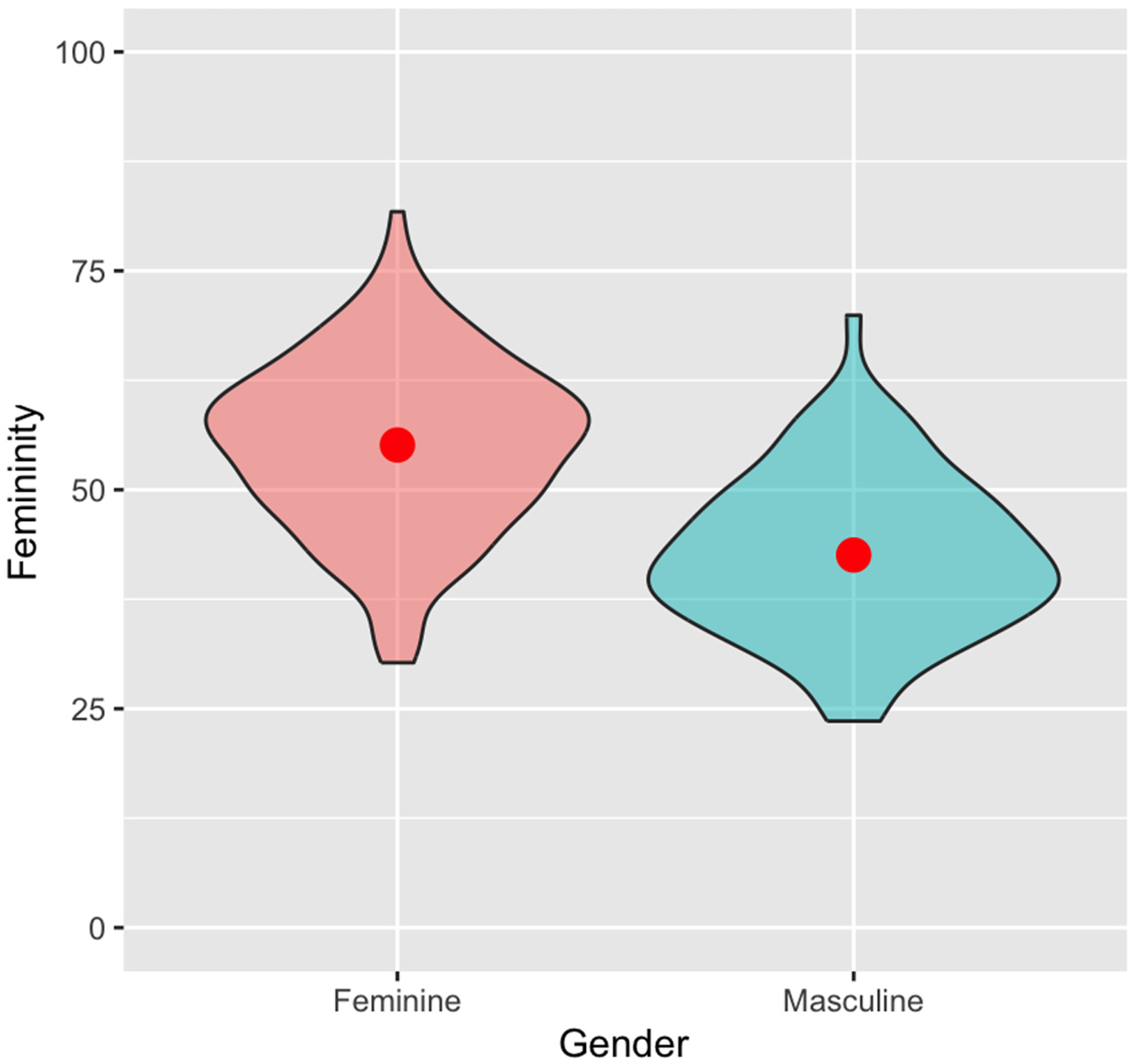
Femininity Ratings for OGS (Study 2).
Discussion
Extending prior research on concrete nouns, the above study confirms the gender congruency effect for abstract nouns. Note that prior research on this issue had been rather inconclusive, in part because of the limited attention to abstract nouns, in part because the few existing studies failed to provide evidence for the gender-congruency effect for abstract nouns (see Maciuszek et al., 2019). In the present research, the effect was rather robust, suggesting that grammatical gender affects the mental representations of nouns, even when they are abstract. Furthermore, 10 out of 12 raters reported having based their ratings of femininity on social or cultural associations and were apparently unaware that grammatical gender may have played a role. However, given the explicit and transparent nature of the task, we cannot exclude that demand characteristics may have been at play. Also, Study 2 only speaks to the association between grammatical and semantic gender, but is silent as to the association between abstractness and semantic gender. To fill this gap, the next studies will therefore address the following question: Given the disproportional presence of grammatically feminine nouns among abstract concepts, are such abstract concepts associated with women above and beyond grammatical gender?
Is Abstractness Associated With Women as a Social Category? (Study 3)
In Studies 3a and 3b, we tested whether abstract (vs. concrete) nouns are more strongly associated with women (vs. men), extending our previous findings in three ways: First, different from Study 2 that assessed the association between grammatical gender and masculinity/femininity, we here investigate the association between abstractness and gender. Given that abstract nouns are overwhelmingly feminine (Study 1) and that grammatical gender of abstract concepts is associated with femininity vs. masculinity (Study 2), one may suspect that people implicitly associate abstractness with women. This prediction rests on the assumption that the repeated co-occurrence of concepts leads to the formation of automatic associations between them. Thus, through repeated pairings, abstractness may come to be associated with women much in the same way in which space becomes associated with gender (Suitner et al., 2017), time (Fuhrman & Boroditsky, 2007), or numbers (Fias & Fischer, 2005), or in which taste becomes associated with colors (Higgins & Hayes, 2019). Second, Study 3 investigates associations of abstract concepts with gender categories (men vs. women) rather than with gendered properties (masculinity vs. femininity). Third, contrary to Study 2 employing a blatant measure, we used an Implicit Association Test (IAT; Greenwald et al., 1998) in Studies 3a and b to assess the implicit (rather than reasoned) association between abstractness and gender categories.
Together, the following two studies (3a and 3b) aimed at testing whether women as a social group are implicitly associated with abstract concepts. Using an IAT, we predicted that women (vs. men) would be associated more strongly with abstract (vs. concrete) concepts (for previous use of the IAT in the context of the gender congruency effect, see Maciuszek et al., 2019).
Study 3a
Method
Second, we split the database into concrete (concreteness ratings ≥ 4) and abstract nouns (concreteness ratings ≤ 3), randomized the words within the two lists, and selected 100 concrete and 101 abstract nouns to evaluate and translate.
Third, we excluded (a) nouns related to people (e.g., “wizard”) or body parts (e.g., “body”); (b) human-related activities (e.g., “bowling”); (c) plural nouns (e.g., “politics”), (d) group nouns (e.g., “team”); (e) profanities, swearwords, and pornography references (e.g., “motherfucker”); (f) culturally bound words (e.g., “penny”); (g) loanwords (e.g., “privacy”); and (h) opaque/ambiguous suffixes (e.g., -e, -a for masculine nouns, -o for feminine nouns).
Fourth, nouns were translated into Italian through the same dictionary employed in Study 2; we selected alternative translations when the primary translation listed in the dictionary: (a) was a compound noun (e.g., “scholarship,” namely “borsa di studio”); (b) had multiple meanings (e.g., the Italian word for “blade” also indicates an animal); (c) was plural; (d) was archaic; (e) was a vezzeggiativo (Italian endearment suffix; e.g., “bunny”) or had a diminutive suffix; (f) was already present among our stimuli (e.g., “heaven” and “paradise,” which have the same translation). If no alternative translation met these criteria, the noun was excluded. The translations were checked by an English–Italian bilingual speaker who was blind to the hypotheses, with the instruction to identify any imprecise translations, which were deleted.
Fifth, we excluded additional nouns that met all criteria to achieve a similar number of stimuli per intersection between grammatical gender and abstract vs. concrete concept. Our final 111 stimuli (28 abstract feminine, 27 abstract masculine, 28 concrete feminine, 28 concrete masculine) are available in the online supplementary materials (https://osf.io/8ysmx/).
Sixth, specifically for the IAT, we included only words that were between 6 and 9 letters long and grouped them randomly into three sets of five words each, evenly split between masculine and feminine, concrete and abstract. Each set (five masculine abstract, five masculine concrete, five feminine abstract, and five feminine concrete) was matched in valence, using ratings by Warriner et al. (2013), so that for the four categories, the averages of valence were within a range of 1.5 points (on a scale going from 1 to 9).
Results
The IATs were processed through iatgen, through which we obtained the D-scores. To test whether participants showed a stronger association for women-abstractness than for women-concreteness, we performed a one-sample t-test on the D-scores. The D-scores (M = 0.14, SD = 0.37) indicated that, overall, participants associated women more with abstract than concrete words, t(158) = 4.85, p < .001, d = 0.39, 95% CI [0.22, 0.55]. This was true for both the balanced, t(80) = 3.37, p = .001, d = 0.38, 95% CI [0.14, 0.60] (M = 0.14, SD = 0.38), and the representative condition, t(77) = 3.48, p < .001, d = 0.39, 95% CI [0.16, 0.62] (M = 0.14, SD = 0.35), with no difference between the two conditions, t(157) = 0.08, p = .933, d = 0.01, 95% CI [-0.30, 0.32]. Unexpectedly but interestingly, analyses run separately by participant gender revealed that the effect was driven primarily by men (M = 0.34, SD = 0.30), t(79) = −10.15, p < .001, d = 1.14, 95% CI [0.85, 1.42], while it was absent for women (M = −0.06, SD = 0.30), t(77) = −1.83, p = .071, d = −0.21, 95% CI [−0.43, 0.02].
Study 3b
Study 3a revealed an implicit association between women and abstract concepts, suggesting that the abstractness–femininity association may generalize to womanhood. However, unexpectedly, this effect was only present in men. Therefore, in Study 3b we tested whether this implicit association was explained by higher levels of benevolent sexism (Glick & Fiske, 1996): perceiving women as associated with abstract (e.g., virtues) and men with concrete concepts is in line with the complementary gender differentiation that is part of benevolent sexism, a stereotypical view that is most commonly held by men (Glick & Fiske, 1996).
Method
Results
The D-scores (M = 0.13, SD = 0.41) indicated that, overall, participants associated women more with abstract than concrete words, t(197) = 4.40, p < .001, d = 0.31, 95% CI [0.17, 0.46], but consistently with Study 3a, the effect was driven primarily by men (M = 0.31, SD = 0.38), t(97) = 8.21, p < .001, d = 0.83, 95% CI [0.60, 1.06], while it was absent for women (M = −0.06, SD = 0.36), t(95) = −1.53, p = .131, d = −0.16, 95% CI [−0.36, 0.05].
Contrary to our hypotheses, however, after accounting for gender, neither benevolent nor hostile sexism predicted the women–abstractness association (ps > .547, see supplementary materials for full model, which are available on the OSF: https://osf.io/8ysmx/). Therefore, even though men (M = 2.89, SD = 1.35) reported greater hostile (but not benevolent) sexism than women (M = 1.88, SD = 1.02), t(183) = 5.94, p < .001, d = .85, 95% CI [0.55, 1.14], this did not explain why men associate abstract concepts more to womanhood, and concrete concepts more to manhood, while women do not (although interestingly, men and women show opposite correlations between sexism and d-scores; see supplementary materials, which are available on the OSF: https://osf.io/8ysmx/).
Discussion
If abstract nouns are predominantly feminine in Indo-European languages (as shown in Studies 1a and 1b), and if grammatical gender affects mental representations through the gender congruency effect (as shown in Study 2), then people should associate women with abstractness. This prediction was supported by Studies 3a and 3b, adding to the literature by showing that women, as a social category, are implicitly associated with abstract concepts, at least by men. Why only men, but not women, associate abstractness with womanhood remains an open question for future research. Our hypothesis that differences in sexism may drive this effect was not supported (Study 3b), in line with an environmentalist model of IATs by which the IAT, and implicit bias more generally, does not reflect individual attitudes, but rather cultural associations that individuals have been exposed to (e.g., Karpinski & Hilton, 2001; Payne & Hannay, 2021). Nevertheless, we can envisage at least two alternative interpretations for the fact that only men associated women with abstractness, based, respectively, on ingroup bias and gender categorization. On the one hand, men may value concreteness more than women and therefore associate men with concreteness and women with abstractness more than women do. On the other hand, the presence of the abstractness–womanhood association in men, but not women, may reflect the fact that, compared to women, men are more likely to construe gender as a dichotomous (Bosson & Michniewicz, 2013) and essentialist, natural category (Morgenroth et al., 2021; Şahin & Soylu Yalcinkaya, 2021),
Another limit of Studies 3a,b lies in the use of the classic IAT that, in the absence of raw data (which is our case), does not allow to distinguish whether the bias was driven by the women–abstract association, or the men–concrete association. Only future studies will be able to disentangle the two, for example, through single-target IATs.
Study 4: Abstract Nouns Are Superhuman
Given that women are associated with abstractness, at least by men (Studies 3a and b), one may wonder whether there are psychological consequences that may derive from this association. In particular, may this association promote the idea of women as super-human beings?
Attitudes toward women tend to be greatly polarized. From a historical and cultural perspective, women in the Western world have been represented as either whores or saints, a traditional divide that can be traced back to Greek and Roman times. Over the centuries, this polarized view of women in Christianity, which is well symbolized by the figure of Mary Magdalena, has remained prevalent in the arts, in fiction (Brown, 2006), theater (Bienias, 2011), music (Richter, 2017), and in cinematography (Sabine, 2013). Psychological research confirms this attitudinal polarization and synthesizes it in the Madonna-whore belief (Bareket et al., 2018): a strict dichotomy, according to which women are classified as either Madonnas (chaste, pure, communal, lacking agency, and worthy of love) or Whores (promiscuous, unfit for motherhood and care, sexually objectified, and recipients of sex). This subtyping of the female universe—into those to be put on a pedestal and those equated to objects or subhuman beings—was shown to be correlated, in both men and women, to system justification, hostile and benevolent sexism, sexist double standard, and sexual objectification (Bareket et al., 2018; Kahalon et al., 2019). Over the past decades, social–psychological research has paid much more attention to the latter than to the former, showing that, when sexualized, women tend to be dehumanized and associated with either animals or objects (e.g., Rudman & Mescher, 2012; Vaes et al., 2011).
By contrast, relatively little is known about the super-humanization of women. Throughout European history, women and girls have often been seen as possessing super-natural powers, and they seem over-proportionally represented among oracles (having prophetic abilities) and in witchcraft (practicing evil spells), including witch trials in Colonial America (see Salem witch trials, Reis, 1997). At times, prominent women (possibly including the mathematician and philosopher Hypatia) were accused of witchcraft (see Janowitz, 2001).
From a psychological perspective, women are often attributed exceptional moral and intellectual skills (for an overview, see Eagly & Mladinic, 1994). This phenomenon, which later became known as “women-are-wonderful effect,” emerges mainly on stereotypically feminine characteristics (Glick et al., 2004; Krys et al., 2018). It can be observed, for example, in the myth of the superwoman who successfully manages multiple roles in society (Nicolson, 2003; Whitty, 2001), in the widely held belief that women are better than men at multi-tasking (Szameitat et al., 2015), and in the belief, within benevolent sexism, that women possess a unique “purity” (Glick & Fiske, 1997). Thus, with the exception of fictional superheroes (which outnumber female superheroines by a ratio of at least 2 to 1; Miller et al., 2016), women are often attributed super-human abilities: even scientists may refer to women in management as potential superheroes (Adams, 2016).
The main aim of Study 4 was to investigate the super-humanization of female nouns. We predicted that abstract and feminine nouns would be perceived as more super-human than concrete and masculine nouns, respectively; thus, abstract feminine nouns would be those with higher super-humanization ratings. Two additional pilots for this study, showing similar patterns, are available in the online supplementary materials (https://osf.io/8ysmx/).
As a secondary aim, we also intended to replicate the results of Study 2 with a subtler task. Even though only one rater reported having based her ratings on grammatical gender, the task employed in Study 2 explicitly prompted a decision related to masculinity vs. femininity, thereby making gender particularly salient (for a methodological critique, see Samuel et al., 2019). Thus, we aimed to solve this issue by investigating the gender congruency effect through a voice-assignment task, that is somewhat more implicit.
Study 4
Method
Word stimuli were selected following the same procedure as Study 3a, but omitting step 6, which was not relevant to the present study.
To assess super-humanization, two measures were used (voice super-humanization and categorization of abstract nouns). In the former, participants were asked whether they imagined the voice to be sub-human (described as “a voice similar to animal sounds, or synthesized and distorted, as if it was less developed than human language”), human (described as “a realistic voice, like that of an ordinary person”), or super-human (described as “a surreal voice, similar to one a super-human entity might have, as if it was superior to human language”). In the categorization task, participants were asked to classify all abstract nouns (randomly ordered) into six categories, based on how they imagined the character: “object” and “mechanical being (e.g., robot, android)” which represented mechanization, “force of nature (e.g., hurricane, plant)” and “animal” which represented animalization, 5 “person” which represented humanization, and “superhuman entity (e.g., spirit, deity)” which represented super-humanization.
Finally, participants reported gender, age, and whether they spoke additional languages fluently.
Results
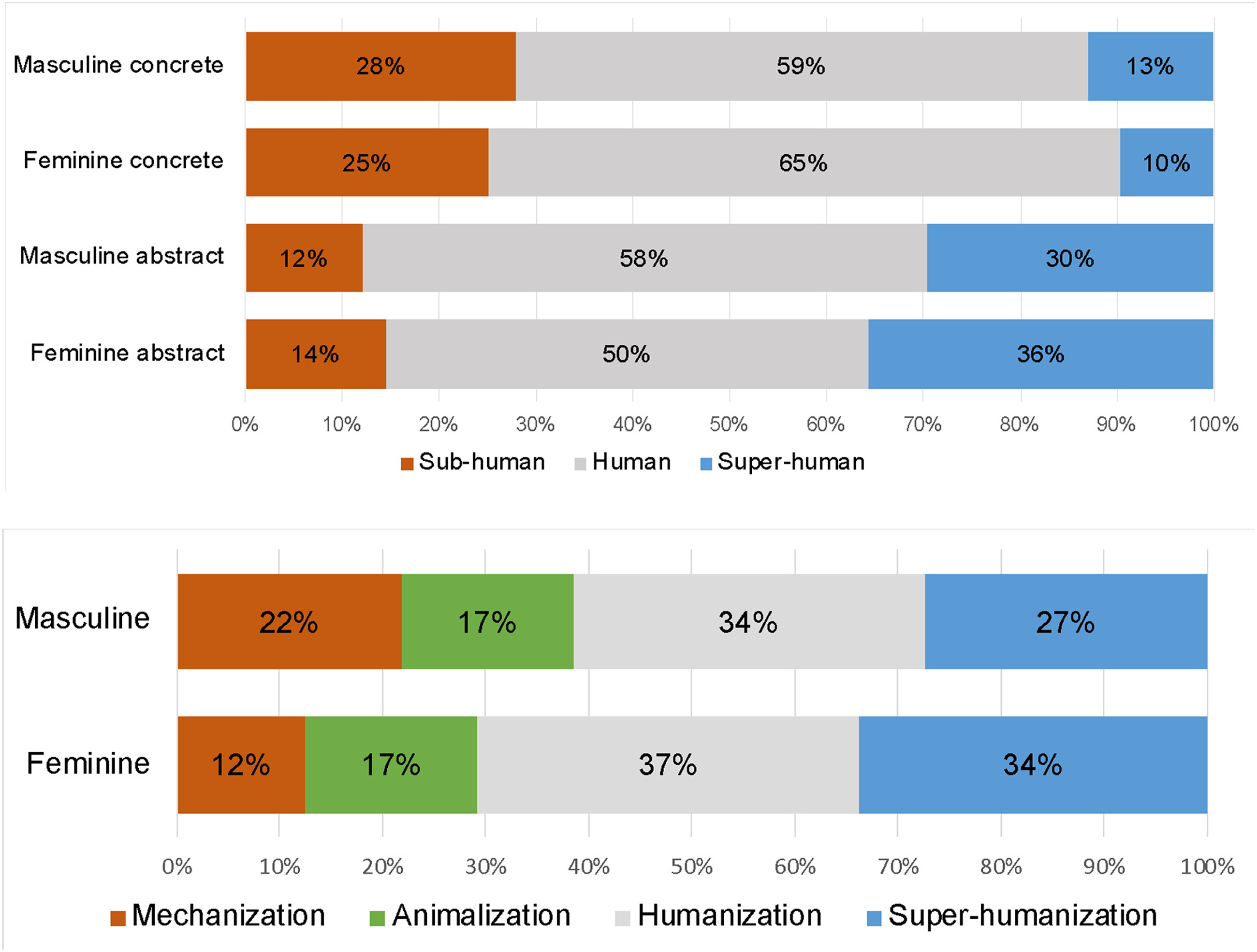
Super-Humanization as a Function of Grammatical Gender and Abstractness (Study 4).
Looking at the third task, namely the categorization of abstract nouns as objects, animals or natural forces, humans, or super-human entities, results showed a similar pattern (Figure 4, lower panel). Again, the association was significant, χ2(3, N = 1306) = 21.81, p < .001, d = .26. In particular, there was no difference in the categorization of masculine and feminine abstract nouns as human, χ2(1, N = 1306) = 1.14, p = .286, d = .06; but, masculine abstract nouns were associated with a dehumanized imagery more frequently than feminine ones, χ2(1, N = 1306) = 12.38, p < .001, d = .20, whereas feminine abstract nouns were associated with a super-human imagery more frequently than masculine ones, χ2(1, N = 1306) = 6.24, p = .013, d = .14.
To explore whether these results may be driven by potential differences in valence, we verified whether there was a difference in valence between masculine and feminine, concrete and abstract nouns: independent-samples t-tests showed this was not the case (ps ≥ .096). In line with this, valence did not correlate with concreteness ratings, r(111) = .04, p = .714. Nevertheless, valence correlated with perceived femininity, r(111) = .30, p = .001.
Discussion
Study 4, once again, confirmed the gender congruency effect for abstract nouns; it also showed that the magnitude of this effect resembles gender-congruency of concrete ones. Additionally, abstract feminine nouns were generally not perceived as more feminine than concrete ones, suggesting again that we are dealing with an epiphenomenon: any difference between abstract and concrete nouns has an effect only in virtue of the grammatical overlap between abstractness and feminine grammatical gender.
Most importantly, however, Study 4 provides first evidence that abstract nouns are super-humanized, and that this is even stronger for grammatically feminine nouns. Therefore, there is preliminary evidence that the association between women and abstractness may play a part in the super-humanization of women, possibly upholding the Madonna–whore dichotomy. Importantly, as in Study 3a and 3b, the results on super-humanization were not confounded by the valence of the stimuli themselves: valence was not predicted by grammatical gender, nor did it correlate with concreteness ratings.
General Discussion
Across six studies, we discuss the prevalence and the psychological implications of the association between abstractness and feminine grammatical gender in Indo-European languages. These questions were addressed in a four-phase research project. In the first phase (Studies 1a and b) we tested the underlying assumption that abstract nouns carry feminine grammatical gender far more frequently than would be expected by chance, an asymmetry that holds for the majority of Indo-European languages investigated here, regardless of whether they have two (masculine, feminine) or three genders (masculine, feminine, neutral). Why two of the nine languages do not show this pattern remains a question for future (linguistic) inquiry.
In the second phase, we explored the psychological consequences of this grammatical regularity, finding a gender-congruency effect for abstract nouns, similar to that found in past research for concrete nouns. Grammatically feminine [vs. masculine] abstract nouns were found to be associated with femininity [vs. masculinity] by raters asked to imagine these concepts (Study 2). This was true even when judging synonyms of opposite grammatical gender (e.g., ideaf - conceptm; fatef − destinym; importancef − valuem; reasonf − intellectm). Similarly, naïve participants in Study 4 over-proportionally selected female voices to represent grammatically feminine abstract concepts and male voices to represent grammatically masculine abstract concepts. In these studies, the gender-congruency effect emerged robustly despite the fact that abstract nouns were presented without articles, which are arguably the strongest marker of grammatical gender. Besides confirming our contention that the majority of abstract nouns will be seen as (conceptually) feminine, these results also extend prior research that had not produced conclusive evidence for the gender–congruency effect for highly abstract concepts. With the exception of personified allegorical concepts (e.g., Beller et al., 2015; Bender et al., 2016b; Segel & Boroditsky, 2011), research on abstract concepts has failed to find evidence for gender congruency (Maciuszek et al., 2019, Study 1). In contrast, our studies 2 and 4 provide coherent evidence that the grammatical gender of abstract nouns carries psychological meaning, such that grammatical gender is projected onto gendered perceptions of the concept itself.
In Studies 3a and b, we took this argument one step further by testing whether the above association would also be reflected in an implicit psychological association between abstractness and woman as a social category. Both studies confirmed the existence of the abstractness–women association, although it was reliable only for male participants, possibly due to additional biases, such as a more binary vision of gender among men.
Finally, Study 4 showed that abstract nouns are associated with super-human imagery, and that this tendency is particularly strong for grammatically feminine abstract nouns. Importantly, these effects were not confounded by valence, in line with the fact that the abstract–feminine association encompasses both positive and negative values. For instance, the four cardinal virtues (prudence, justice, fortitude, and temperance) are grammatically feminine in many Indo-European languages, and they also tend to be depicted as women in the arts. But so are the vices (e.g., pride, greed, wrath, envy), for which, again, female allegorical figures abound in Western arts. Thus, the super-humanization of women seems to encompass the good and the bad, possibly due to the prevalence of feminine gender among abstract concepts, which include virtues and vices.
Together, our studies suggest that abstract concepts, including “super-human” qualities, are associated with femininity both grammatically and psychologically. Although it is premature to speculate about the applied implications of this phenomenon, we can envision two possible cascading effects of this linguistic phenomenon on attitudes toward women. The first possibility is that the association between abstractness and femininity may reinforce sexist attitudes by contributing to a dichotomized view of women as either saints or whores—by perpetuating the notion that womanhood is, in itself, idealized and superhuman. Furthermore, it is conceivable that it hinders women's participation in any activity that requires concreteness and action, such as the workplace. The second possibility is that, to the contrary, this association may actually counter sexist attitudes: particularly in light of the Madonna–whore dichotomy, associating womanhood with super-humanness may inhibit the view of women as sexual objects, possibly limiting societal phenomena such as the sexualization and sexual objectification of women. Future studies should address these, and other, possible consequences of this linguistic phenomenon on attitudes toward women, for example, by testing whether the association between women and abstractness (Studies 3a and 3b) correlates positively with the belief in the Madonna–whore dichotomy or whether the over-representation of feminine nouns among abstract ones in a language correlates with country-level ambivalent sexism or gender inequality.
Limitations and Future Development
Being the first to investigate the abstractness–femininity association, this research necessarily has a number of limitations. First, although suggesting a possible link between abstractness, grammatical gender, and the social construal of gender, our studies did not determine whether the gender congruency effect for abstract nouns is driven primarily by the linguistic path or by the cultural representations path (e.g., through cultural artifacts such as paintings and statues). Future research should disentangle the two, by testing whether the abstractness–femininity association is stronger for abstract concepts (such as virtues and vices) that are widely represented as women in cultural imagery.
Second, although providing first suggestive evidence for the role of language in the super-humanization of women, the present work did not determine any specific forms of super-humanization as they occur in real life. As suggested above, future studies should investigate this issue further, for instance by experimentally testing whether the abstractness–femininity association may trigger or sustain idealizing conceptions of women as Madonna and the like.
Third, when investigating the psychological implications of the abstract = feminine phenomenon, we here focused on super-humanization, but did not explore other consequences. Abstract constructs such as democracy, oppression or injustice are generally learned through linguistic (rather than sensorial or motor) experiences (Barca et al., 2020). The fact that these complex concepts carry feminine gender may well have other, and possibly more positive, implications for the social construal of gender, as well as for the construal of the concepts in question. Future research may explore some of these non-obvious implications of the abstractness–femininity link.
Finally, our research project focused exclusively on Indo-European languages, while ignoring grammatical-gender languages of other language families, such as Arabic. In the absence of empirical evidence, we suspect that the abstract = feminine phenomenon will emerge only in those languages in which grammatical gender became superimposed on a previously existing word classes that distinguished concrete from abstract or collective nouns (as is the case for Indo-European languages).
Conclusions
Although much is known about the effect of grammatical gender on the mental representations of women and men, one regularity of Indo-European languages has largely been overlooked, namely the fact that abstract concepts tend to be grammatically feminine.
We explored some of the potential consequences of this unique association between abstractness and feminine gender by showing that feminine abstract nouns, which greatly outnumber masculine ones, are indeed seen as psychologically feminine, resulting in an implicit association of women with abstractness (at least by male participants). Although the association of women with the most abstract concepts of human thought (such as justice or liberty) may give rise to optimistic interpretations, it may also imply risks, ultimately contributing to the polarized view of women as either sub- or superhuman.
Footnotes
Acknowledgments
We are grateful to Eleni Lipourli, Magdalena Formanowicz, Anisa Shyti, Rachel O’Driscoll, and Namrata Goyal for providing help with the translations of the stimuli in Study 1b, Elizabeth Maria Doerr for providing help with the translation of the stimuli in Study 4, and the raters who collaborated with us in Study 2.

Ethical Approval and Informed Consent
Studies involving human participants were approved by the New York University Abu Dhabi Institutional Review Board [HRPP-2023-214].
Funding
The authors received no financial support for the research, authorship, and/or publication of this article.
Declaration of Conflicting Interests
The authors declared no potential conflicts of interest with respect to the research, authorship, and/or publication of this article.
Notes
Author Biographies
German-born and raised, US-trained, and Italian by choice,