







Abstract
This article discusses two prominent protest movements in India responding to nuclear energy expansion, protests related to the Kudankulam Nuclear Power Project in Tamil Nadu and the Jaitapur Nuclear Power Project in Maharashtra. Partly based on ethnographic fieldwork at both sites, the article argues that these protest movements are substantially different from anti-nuclear mobilisations outside South Asia. Indian nuclear-related protest movements problematise the tensions of development and environment from a grassroots perspective but struggle with opposing claims that more energy is needed. Locally, project-affected people do not trust government agencies to protect them and the local environment against creeping pollutions and potential disasters. Above all, local grievances are directed against high-handed procedures of compensating project-affected persons. Seen from this angle, these protest movements are in effect contributing to the arduous process of democratisation of governance regarding the constantly changing modalities of expanding energy provisions in India.
Introduction
Worldwide, movements against nuclear energy branched out of environmental protection movements in the second half of the 1970s, particularly in Europe following the oil price hike of 1973 (Guha, 2000: 90). Later, prompted by several nuclear accidents, prominently the Three Mile Island nuclear reactor meltdown in March 1979 in the USA and the Chernobyl disaster in Ukraine in 1986, this gave rise to many citizens’ initiatives (Guha, 2000) and anti-nuclear protests (Kitschelt, 1986) particularly in Western Europe. When the Fukushima nuclear reactor in Japan was incapacitated by a tsunami in 2011, this increased global apprehensions about the safety of nuclear power projects (Glaser, 2012) and also impacted on Indian debates (Choudhury, 2012: 39).
Anti-nuclear groups and various green movements (Guha, 2000) opposed the development of nuclear energy in specific country contexts, prominently in Europe in the 1970s (Guha, 2000; Litmanen, 1998) and Russia (Dawson, 1995), and also in Japan (Avenell, 2016) and elsewhere in Asia (Ho, 2018; Lewallen & Holmberg, 2019). Their respective politics and the issues they took up and subsequent interventions were widely influenced by the experience of silent expansion of nuclear and other forms of pollution (Visvanathan, 2007), secretive nuclear energy policies and frightful industrial accidents. Awareness of the slow poisoning of the environment also contributed to rising concerns about the effects of the Anthropocene (Crutzen, 2006), a scenario in which man-made changes to the earth now impact with increasing force on climate change. However, some scholars also registered a decline of protests (Joppke, 1991), as the realisation struck that the global hunger for energy needed to be addressed. For some time, climate change concerns appear to have motivated a renaissance of nuclear energy (Busby, 2013).
In the context of the United Nations Framework Convention on Climate Change, India claimed in 2015 that it was promoting nuclear power as a safe, environmentally benign and economically viable source to meet the country’s increasing electricity needs. Despite the more recent shift towards new technologies to harvest greener, renewable energy sources such as wind and solar power (Bidwai, 2014; Goswami, 2012), the energy projections from nuclear power have also increased over the years (Khan, 2019).
Clearly, thus, the impact of early anti-nuclear movements varied in specific country contexts (Koopmans & Duyvendak, 1995; Wiliarty, 2013). In Germany and France, this led to a gradual phasing out of nuclear energy (Jahn & Korolczuk, 2012), while Britain experienced a renaissance (Johnstone, 2010). Within the wider context of environmental activism in India (Gadgil & Guha, 1994; Ramana, 2012), opposition against nuclear power projects began responding to India’s civil nuclear programme and the subsequent nuclear energy expansion (Bidwai, 2011). While Guha (2000: x) comments on the diversity within the global environmental movement as an environmentalism of the poor, there are many strands of anti-nuclear activism. Early studies on anti-nuclear protest movements mainly argued that this activism demands an alternative model of development (Bhadra, 2013; Khan, 2018; Srikant, 2009) and that it needs to be democratically sound (Vanaik, 2001). As protests against land acquisition processes related to nuclear projects became prominent (S. Sarkar, 2011), they were politicised by local players (Chandra, 2017, 2021). Some studies also examined the nature of state interactions with local people, finding fraught negotiations and repression of the anti-nuclear movement in India (Kaur, 2013, 2020; Ramana, 2012).
This article examines first how India’s expanding civil nuclear energy programme led to specific anti-nuclear protest movements in India that either lasted for decades and/or still continue. It then focuses, in turn, on the Kudankulam and Jaitapur nuclear projects to highlight concerns and conflicts over environmental clearance procedures and land acquisition processes. Discussion of the local evidence leads to the conclusion that ongoing anti-nuclear protests in India need to be understood in the larger public interest context of highly complex ongoing democratisation processes, in which concerns over power abuses and external interventions remain ever-present.
India’s Civil Nuclear Energy Programme
In line with the Nehruvian development model of intensive industrialisation, India established an Atomic Energy Commission already in 1948 and the Department of Atomic Energy was created under the Prime Minister’s office in 1954. The three-stage nuclear development programme also paved the way for the indigenous development of reactors in India (Mirchandani & Namboodiri, 1981). In the meanwhile, with help from the USA and Canada, the first nuclear reactor, CIRUS, and the 1 MW Apsara research reactor with assistance from the UK were materialised, followed by establishing the Bhabha Atomic Research Centre (BARC) in January 1967 in Bombay (Cohen, 2002: 157–9). Then, the Tarapur Atomic Power Station (TAPS) went into operation in 1969 and subsequently, numerous pressurised heavy water reactor installations were constructed in various parts of the country, generating much local opposition (Khan, 2019).
A significant development in the history of India’s nuclear power was the creation of a public sector entity, the Nuclear Power Corporation of India Limited (NPCIL) in 1987, tasked with producing much-needed electricity through nuclear power. Currently, according to the International Atomic Energy Agency (IAEA, 2021), 23 reactors operate in India with a total capacity of 6,885 MWe, providing 3.3% of India’s energy generation, while six reactors are under construction and more plants are proposed at various sites. Kudankulam and Jaitapur are the most important recent projects, planned to contribute significant amounts of nuclear energy in the coming decades.
This article relies on ethnographic fieldwork as a participant observer between May 2017 and May 2018 in villages close to the Kudankulam and Jaitapur site projects, where active protests took place at the time, and opposition still continues. In Kudankulam, fieldwork was conducted at Idindakarai village, Tsunami colony, Kudankulam village, Perumanal and Kutapuli villages. In Jaitapur, fieldwork covered the villages of Madban, Karel, Midgawane, Niveli, Chavanwadi, Sakhri Nate, Jaitapur village and Warilvada. The research focused particularly on the evolution of the projects and protest movements at both sites, with emphasis on how and why opposition emerged at both sites.
The Kudankulam Nuclear Power Project and Related Protests
Kudankulam, one of the biggest nuclear power station projects in India, is located in the Tirunelveli district of southern Tamil Nadu. Planned as a 6,000 MW project with six 1,000MW pressurised Russian water reactors, it has a long history, starting in 1988, when Soviet President Mikhail Gorbachev and Indian Prime Minister Rajiv Gandhi signed the Kudankulam Nuclear Power Project deal. Although the Kudankulam Project foundations were laid during 1989, after years of protests at the site, the project was only commissioned in 2013. After further postponements, the project was re-commissioned on 10 August 2016 with the first two reactors generating power since 2017 (CAG, 2017). Currently, units 3 and 4 are under construction and the planned units 5 and 6 are progressing with preparatory work.
Local discontent against this project arose in 1988, when residents realised that hot water discharge from the plant into the nearby sea would threaten their livelihood. People from Tirunelveli, Kanyakumari and Tuticorin districts organised a massive rally at Tirunelveli in 1988. In May 1989, around 10,000 people assembled to protest. For some time, the power changes in Russia and the political turmoil after Rajiv Gandhi’s assassination on 21 May 1991 in Tamil Nadu slowed the project plans, until a further agreement between India and Russia in 1997. Following this, the NPCIL began to acquire land for the project site and for a nearby township, promising jobs and other opportunities for local people. Another wave of protest, a consolidated struggle against the project, started from 2001 when the local People’s Movement Against Nuclear Energy (PMANE) was established.
To understand the nature of this opposition to the Kudankulam nuclear project, one needs to be aware of various sections of stakeholders, including several people’s movements, groups that oppose nuclear power projects in India and the locals, predominantly fisher folks, farmers and their collective, PMANE. Raising serious concerns against the project, major arguments concern the fact that more than 1 million people live within a 25 km radius of the Kudankulam Nuclear Power Project. This far exceeds the stipulations of India’s Atomic Energy Regulatory Board (AERB) of June 2001 regarding population restrictions for a nuclear power project, suggesting that the total population in the affected ‘sterilised’ area should be small, preferably less than 20,000. It also violated the relevant stipulations of the International Atomic Energy Agency. According to the 2011 Census, the district in which the project is located has a population of 3,077,233 persons. The immediately surrounding villages of the site, such as Idinthakarai/Idindakarai, Kuttapuli, Kuttankuzi, Perumanal and Vairavikinaru, according to local estimates during the fieldwork period, have more than 50,000 inhabitants. In an emergency at the project, such large population makes the task of evacuating people quickly and effectively almost impossible. Moreover, the Tamil Nadu Government Public Works Department established in late April 1991 that an area of 2–5 km radius around the plant site would be designated as ‘sterilisation zone’, meaning that people in this area would be displaced. Yet from the inception of the project, the Kudankulam Nuclear Power Project (KKNPP) authorities had promised the people living in the surrounding region that nobody would be displaced. According to local people, this raised serious suspicions about the credibility of the KKNPP promoters.
Protestors in Kudankulam also claim that the reactors at Kudankulam were set up without sharing the Environment Impact Assessment (EIA) Reports, Site Evaluation Study and Safety Analysis Report with the local people, and that no public hearing was conducted for the first two reactors. They argue that, if this is the manner in which the nuclear establishment wants to construct a nuclear power plant without democratic decision-making and public approval, it is difficult to trust the government when it comes to dealing with the sensitive issue of nuclear energy. The coolant water and low-grade waste from the KKNPP are going to be released into the sea, causing severe adverse impacts on the water in the sea, fish stocks and other non-fish organisms. Tamil Nadu has a coastal length of about 1,076 km and the marine fisheries potential of the state is vast, providing means of livelihood to a large number of locals in this area as Kanyakumari, Tuticorin and Tirunelveli are major fishing districts in the state. Evidently, the project will have far-reaching consequences on fishermen whose sole livelihood option is fishing, and it will have impact on fisher folks elsewhere in Tamil Nadu and Kerala, as implications spread to other nearby coastal regions.
Then, on 26 December 2004, a devastating tsunami hit India’s southern coastal regions, and the Tamil Nadu coastline was among the worst-hit areas. The KKNPP installations were engulfed by flood water, and a tremor was felt in the surrounding villages. After that, on 12 August 2011, there were further tremors in 10 districts of Tamil Nadu, confirming the latent risk of serious natural disasters in this region. The local people feared connections with this nuclear project and the people of Tamil Nadu and the villages around Kudankulam had first-hand experiences of how the state government dealt with the disaster of the 2004 tsunami and its aftermath. Later, the Fukushima disaster in 2011 in Japan made it absolutely clear that nuclear power plants are risk-prone. If even highly developed Japan could not control nuclear hazards, shocked Indians realised that India’s predicaments would be much worse (Bidwai, 2014). Locals also understood that even if the KKNPP functions without any incidents or accidents, it will emit much radioactive material and waste into the atmosphere, affecting air quality, the sea and its water, land, crops, cattle and also human bodies. There was a growing fear that the KKNPP will destroy human and other life in the region. Protestors also identified that the quality of construction, the pipe work and the overall integrity of the KKNPP structures had been called into question by some workers and contractors who delivered this project.
Most worryingly, the issue of liability for the Russian plants is a particularly serious matter, which has not been clearly settled yet. Defying the Indian nuclear liability law, Russia insisted that the Inter-Governmental Agreement (IGA), signed in 2008 by the Indian and Russian governments precedes the 2010 Indian Civil Liability for Nuclear Damage Act (CLNDA), which was a landmark in this respect. Further, Article 13 of the IGA clearly establishes that NPCIL is solely responsible for all claims of damages. This scenario is believed to cause increased vulnerability to local people. Liability related to nuclear power plants remains a very complex issue in India and greater clarity and transparency are required (J. Sarkar, 2011). Since the topic of liability for disasters and accidents remains ambiguous, this means the nuclear companies and foreign countries providing nuclear facilities were not really liable for any mishaps. Earlier, a deadly leak of poisonous gas in early December 1984 in Bhopal, affecting thousands of people, brought to light that there was no clear-cut legal protection regime (Baxi, 1986). The CLNDA of 2010 is now one of the strong safeguards, since the Act places responsibility for any nuclear accident with the operator. However, the operator liability is capped at ₹1,500 crore or any limit that the government decides. And, at Kudankulam, the contracts for the first two reactors still excluded any supplier liability.
Opposition to this project was thus diverse, active for decades and still continues. The state initially tried to negotiate with the locals and sought to gain their trust, but this was lost when the protest movement was brutally suppressed (Bidwai, 2014; Khan, 2019), four protesters were killed, thousands of sedition charges were filed, and many people spent months in jails. Democratic, non-violent protests continue locally and in small forms after united protests in Idindakarai village were systematically curbed. It seems that in a national assertion of what may be called 'higher public interest' in view of the country's energy needs, the local residents are left as hapless victims of 'development', without their voices being heard.
The Jaitapur Nuclear Power Project and Protests
Jaitapur Nuclear Power Park (JNPP) is a proposed nuclear power project in the Raigad region of Maharashtra in Ratnagiri district. Announced by the NPCIL and the Department of Atomic Energy in 2005, this project is one of the biggest nuclear power plants in the world with a capacity of 9,900 MW. Spread over 900 hectares, it will displace five villages in the Western Ghats. The proposal is to install 6 reactors, each providing 1,650 MW, imported from a French nuclear technology company, Électricité de France (EDF). A Memorandum of Understanding (MoU) was signed between the NPCIL and the Government of Maharashtra on 25 September 2006. However, nothing has moved so far at the project site, apart from land acquisition and some basic infrastructure work.
The protest groups and villagers opposing this project have argued that nuclear power is unacceptably costly in Jaitapur, while Raju and Ramana (2013) highlight that it involves serious safety and security concerns. Activists claimed that no rigorous cost-benefit analysis has been conducted and argued that this is not a cost-effective project. A core concern raised in Jaitapur is the region’s fragile environment. The Madban Plateau, where the project will be located, is an ecological hotspot. Its mangroves and rare species of animals, birds, fish, forests and other organisms will all be affected by radiation from the power project. Around 15 Gram Panchayats surrounding the proposed site passed a unanimous resolution against the project, using the powers given to local representatives under the 73rd Amendment of the Indian Constitution in 1992 to make it crystal clear that they do not want this project, which poses a serious threat to their lives and livelihoods in their villages. Two focal points of controversy have arisen in Jaitapur, the modalities of environmental clearance and of land acquisition.
Environmental Clearance
The Ministry of Environment and Forests granted conditional environmental clearance to the Jaitapur project in November 2010, based on a study conducted by the National Environmental Engineering Research Institute (NEERI, 2008). The study itself and the environmental clearance process for the project led to serious criticisms. First of all, it was observed that an institution like NEERI, as an engineering research institute, is not fully equipped to study the ecological impacts of one of the world’s biggest nuclear power projects. Serious flaws in the EIA report were highlighted by the protesters. They claimed that a study by the Bombay Natural History Society (Apte et al., 2012), which mapped 407 hectares of mangrove vegetation around a 10 km radius of the proposed project site, found that at least 11 eco-sensitive sites would be severely damaged by thermal discharge from the project. The same study also identified 134 rare species of plants on the plateau, which had been described as barren land, and also found another 1,000 plant species there. It also observed that four mammals and four birds from Schedule I and five mammals from Schedule II of India’s Wild Life (Protection) Act, 1972, categorised as endangered species, are found at this site. Apart from that, there are rare wild animals, birds, fish, dolphins, porpoises and various other animals in this region that are yet to be comprehensively surveyed by anyone. The two major creeks with huge biodiversity assets alongside the project site, Vijaydurg and Jaitapur creek, had also not been adequately studied by the EIA report. Further, there are sanctuaries and national parks within 80 km of the project such as the Malvan Marine Sanctuary (56 km), Chandoli National Park and the proposed Tiger Project (80 km), Radhanagari National Park (60 km) and the ecologically highly valuable and fragile Western Ghats (80 km). None of these locations were seriously studied by the EIA report.
Economic and livelihood factors also featured prominently in the protest. Ratnagiri has an estimated annual catch of 125,000 tonnes of a variety of fish, including Pomfret, kingfish (Surmai), Indian mackerel (Bangda) and Indian salmon (Rawas), which the nuclear project could reduce significantly. There are two fishing ports less than 5 kms away by road from the project site, Sakhri Nate and Tulsunde. With around 700 fishing boats, they bring in a catch of around 50,000 kg per day, including prawns and squid, which are mostly exported. More than 10,000 local people directly draw their livelihood from fishing, while many more benefit indirectly. The Sakhrinate Fishing Co-operative Society claimed during fieldwork that it alone has an annual turnover of more than ₹1,500 crores. Sakhri Nate may be 5 kms away by road from the project site but is actually less than 2 kms away from the proposed plant across the sea. The villagers worry that when the plant starts working and discharges hot water into the sea, this will destroy the marine life and ruin the local fishing industry. The region is also popular for agriculture and horticulture. Alfonso mangoes, cashew nuts and many other fruits produced here are famous in the world market and are normally directly exported to foreign countries. Once the project becomes a reality, the market for these fruits and vegetables will collapse.
Citing examples from the Tarapur nuclear site and reduced market demand for fish from that region, also in Maharashtra, the locals argued that even if there was no radiation from the project and no impact on agricultural products, negative perceptions of pollution from the vicinity of a nuclear plant would adversely affect the demand for their products. Moreover, according to the Seismic Zone Map of India, Jaitapur and nearby areas fall under Zone IV, a high seismicity zone. Also, the earthquake hazard zoning of India categorised this location as a High Damage Risk Zone.
Land Acquisition
Land acquisition processes in India follow the Right to Fair Compensation and Transparency in Land Acquisition, Rehabilitation and Resettlement Act, 2013, known as the Land Acquisition Act. Until 2013, such processes were governed by the colonial Land Acquisition Act, 1894. For the Jaitapur project, acquisition notices were served on farmers and landowners by the state revenue department and the NPCIL by the project’s designated Special Land Acquisition Officer. According to NPCIL, around 938.026 hectares of land have been acquired for the project from seven villages and the acquired land is predominantly barren. According to the EIA Report, the project site is a coastal location between Rajapur Creek and Jaitapur creek near Jaitapur in Rajapur taluka of Ratnagiri district. The land is described as non-forest land, rocky, barren and privately owned with small patches of agriculture.
The data of the acquired land by the NPCIL (2011) itself, however, shows that around 40% of the total land acquired is agricultural or grazing land, so it is not actually barren. Table 1 gives the data provided by the NPCIL regarding the acquisition of land, showing that out of the total acquired land, 330,754 hectares are agricultural and grazing land.
Land Acquired for the Jaitapur Project (in Hectares)
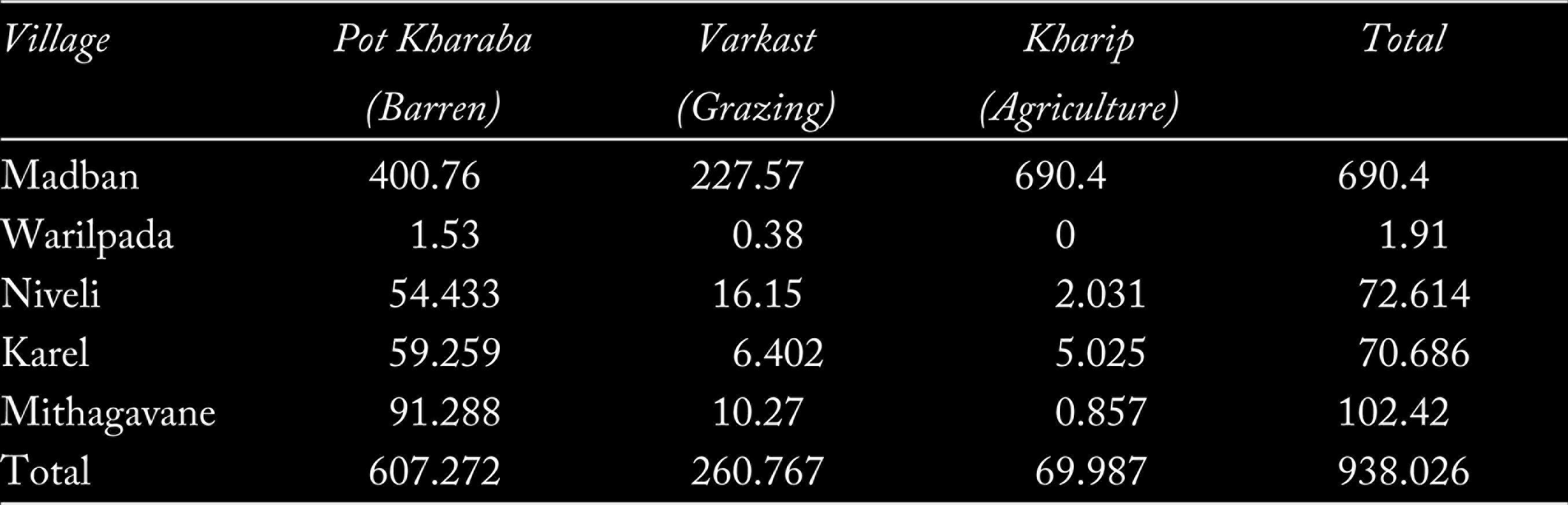
People in these villages conveyed during the fieldwork that there was no barren land in their villages. There was no land that was unproductive. Most of the land acquired for the project was farmland, where rice and vegetables had been cultivated. Even during the summer, when there is no agriculture and allied activity, this land was used for grazing. A farmer from Madban village stated:
First of all, it was said that they do not acquire agricultural land for the project. There is no land in our villages which is of no use. When there is no farming, that land is used for grazing. The land that has been acquired is mostly agricultural land where active farming takes place. They have created different categories of land to complicate the matter, and thereby, to show that the land is barren, so this would also reduce the compensation given to us.
Many local farmers confirmed that NPCIL categorised their land to reduce the compensation amounts payable on the basis of various categories. As soon as the land acquisition notice was served, it was decided by the villagers that they would not allow the land survey to happen, and no one was going to accept the compensation cheques for the land. This united all Madban villagers along with other villages such as Mithagavane and Karel. Following these protests, the NPCIL increased the compensation rates for the land, while compensation was still paid on the basis of the respective category of land.
A rehabilitation package was also announced for project-affected persons. An agreement, signed on 16 October 2010 between the Maharashtra State Government and NPCIL, concerned a Rehabilitation Package of Project-Affected Persons (PAPs) of the Jaitapur project. This package includes, apart from compensation, rehabilitation grants and minimum lifetime pension for vulnerable persons, deserted women and destitute persons. It had provisions for civic amenities, facilities and maintenance, employment for one person from each project-affected family, or a lump sum one-time compensation in lieu of employment. It also included training of locals to make them employable, provision of priority in contracts, scholarships to wards of PAPs and an additional grant to Scheduled Tribe PAPs. The rates of compensation for land ranged from ₹53,000–106,000 per hectare for barren (pot kharaba) land, ₹103,000–423,000 per hectare for grazing land (varkast) and ₹181,000–633,0000 per hectare for agricultural land (kharip). NPCIL deposited ₹14.77 crore with the Special Land Acquisition Officer of Ratnagiri towards land compensation. This was disclosed in the Prime Minister’s answer regarding a question raised in Parliament during 2012, concerning details of rehabilitation and compensation packages worked out and compensation paid to the people affected by the proposed Jaitapur Nuclear Power Plant.
Initially, the state tried to engage the protesters at Jaitapur. However, the opposition was a strong collective of farmers, fisher folks and environmentalists. There were robust police actions against the protestors, four people were killed at Jaitapur, many were injured, and numerous protestors spent time in jail. The opposition is currently inactive, as there is no progress at the project site. Meanwhile, though, different rounds of talks have been going on between EDF and the NPCIL. The most recent project update was that, in April 2021, EDF submitted its binding techno-commercial offer to build six reactors in Jaitapur. Protests are expected to intensify again once project activities at the site are resumed.
Concluding Discussion
Kudankulam and Jaitapur have witnessed two ongoing major people’s opposition movements against nuclear power projects in India. Challenging the powerful Indian nuclear establishment, they raised concerns over the vulnerability and risks of nuclear energy, along the lines of anti-nuclear movements elsewhere in the world (Busby, 2013; Johnstone, 2010; Lewallen & Holmberg, 2019), torn between climate change concerns that portrayed nuclear energy as relatively ‘clean’ and total rejection of such energy. These two movements in India not only highlighted particularly the comparatively higher costs of the nuclear energy of these two projects but also critiqued the negative impacts that these projects would bring to the lives and livelihoods of local people (Gadekar, 1996), particularly as forced land acquisition remains most difficult (S. Sarkar, 2011). While J. Sarkar (2011) suggests that protests are essentially about land acquisition, partly politicised with an eye on local electoral contests; they also raise serious doubts over the ability of the Indian nuclear establishment to deal with any nuclear mishap. Rising public opposition based on safety and environmental grounds has been evident too (Bidwai, 2014). Protests were partly influenced by the international anti-nuclear movements and environmental movements around the world as well as frightful memories of India’s bad record in dealing with mass disasters and industrial accidents (Baxi, 1986).
Yet, quite notably, major concerns of the protesters focused on democratic deficits and local impacts of high-handed governance regarding nuclear energy as well as lack of transparency and accountability of the nuclear establishment. In Kudankulam, significant questions raised by protestors concerned the population restrictions affecting this densely populated region. They also highlighted that EIAs had not been conducted for the initial two reactors and the Site Evaluation Study and Safety Analysis Report were not being shared with the local people. They not only questioned the quality of materials used in reactors but also critiqued the delay in construction. The protesters also highlighted the vulnerability of the region after the experience of the 2004 tsunami and recounted their negative experiences with state authorities in dealing with post-tsunami re-construction.
In Jaitapur, the major concern and grievance remains that environmental clearance was given for a project located in one of the most environmentally vulnerable regions of India, evidently bypassing environmental concerns and regulations. The public hearing conducted for the project was portrayed as a one-sided procedural charade. Protesters questioned how a nuclear power project could get environmental clearance in a region with endangered species of plants and animals, also an agricultural space famous for its fish, vegetables and fruits. The way in which procedures were violated for the land acquisition process has been a major contention. Highlighting this and questioning those violations became the central focus for the movements at both sites. The exceptional powers of the nuclear establishment in India not only facilitate the violations of rules and regulations (Nandy, 1988) but also attract secrecy and forms of official discretion that endanger the public interest. Anything related to nuclear energy could easily be kept away from the public domain, while those who opposed the process were criminalised as enemies of the state (Visvanathan, 1998) and local villagers become victims for engineering of death conditions (Kaur, 2020). The issue of the sheer brutality of external interventions remains of much concern.
While questioning and challenging the nuclear establishment was central to the protests at both places, the Indian protest movements have not been able to alter the energy policy regarding the nuclear power sector. Their contribution was largely confined towards pushing the nuclear energy establishment towards more accountability, transparency and democratic credibility. The cases of Kudankulam and Jaitapur exemplify ground-level Indian anti-nuclear movements led by local collectives of fisher folks, farmers and environmental groups. Although a wider vision for alternative development formed part of the anti-nuclear mobilisations in India, opposition to acquiring agricultural land accelerated the objections from farmers. Fisher folks often stood in the forefront once they realised the immense future challenges to their livelihoods due to these power projects. Collectively, project-affected local people questioned the modalities involved in these projects, particularly concerning land acquisition and demanded transparency, accountability and democracy from the nuclear energy establishment. Hence, this article suggests that the main effects of the anti-nuclear mobilisations in Kudankulam and Jaitapur should and can be seen as a unique contribution in democratising the handling of nuclear energy project planning in India. It is also increasingly obvious now that India needs to rethink the country’s nuclear energy projections and should concentrate on new alternative ‘green’ forms of energy production (Khan, 2019). These will still require land acquisitions and may disrupt local economic arrangements, but at least the negative environmental impacts and dangers of nuclear energy can be avoided in this way.
Footnotes
Acknowledgements
I would like to thank Professor Ashwani Kumar and Professor Mohammed Irshad from Tata Institute of Social Sciences, Mumbai, Professor D. Parthasarathy from IIT Bombay, Professor Aditya Nigam from the Centre for the Study of Developing Societies, Delhi, and Dr Aniket Aga from Ashoka University for their comments, suggestions and encouragements.
Declaration of Conflicting Interests
The author declared no potential conflicts of interest with respect to the research, authorship and/or publication of this article.
Funding
This work was supported by the Centre for Study of Developing Societies, New Delhi and the Indian Council of Social Sciences Research ICSSR PhD Fellowships.