







Abstract
The collapse of British authority following the Japanese invasion of Burma in 1942 triggered a spiral of communal violence: Arakanese Buddhists attacked Muslims in central Arakan, while Muslims attacked Buddhists in the north, forcing both groups into Bengal. This article investigates the refugee crisis of 1942, pivoting the focus from the well-documented Indian exodus to the overlooked displacement of the Arakanese population. Unlike Indian refugees who readily integrated into the labour market, a large proportion of Arakanese refugees were isolated in state-managed camps in northern Bengal, a policy driven by their lack of kinship networks and British fears of Japanese espionage. While this influx of refugees exacerbated food shortages prevailing due to the Bengal famine, it simultaneously alleviated wartime labour shortages. By reconstructing this complex history, the article offers a critical historical perspective on the ongoing cycle of displacement in the region.
Introduction
The escalation of conflict between the Myanmar junta and the Arakan Army from 2024 has shattered regional stability, exacerbating the plight of the Rohingya people (UNICEF, 2024). Currently, more than one million Rohingya people live in refugee camps in Cox’s Bazar, Bangladesh. While these events are often viewed through the lens of contemporary politics, the cycle of communal violence and forced displacement in the Arakan (present-day Rakhine) region has deep historical roots. In 1942, the Japanese invasion of Burma (present-day Myanmar) precipitated a massive Indian exodus to British India. Although the vast majority of the evacuees were Indians, a minority of Arakanese also fled to Bengal. It is noteworthy that Arakan and Bengal at the time were both contiguous territories under British colonial rule. In Arakan, the western frontier of Burma, the withdrawal of British administration triggered a localised power vacuum, leading to a spiral of communal violence between Arakanese Buddhists and Muslims. A crucial distinction separated the two groups: While Indian evacuees were effectively retreating to their ancestral homeland, the Arakanese refugees were entering Bengal—a foreign environment where they possessed no social networks.
Existing scholarship on this period has largely overlooked the specific trajectory of Arakanese refugees, leaving a significant gap in the historiography. Studies on the 1942 exodus, for instance, have been dominated by the Indian experience (Tinker, 1975), effectively rendering invisible the simultaneous displacement of the Arakanese. Meanwhile, research on the 1942 violence in Arakan remains confined to the internal dynamics of communal conflict (Leider, 2017, 2020a, 2020b; Yegar, 1972). Such accounts are often deeply polarised—pitting pro-Buddhist narratives (Chan, 2005; Hla, 2004) against pro-Muslim perspectives (Yunus, 1994)—and rarely extend their analysis beyond the border to the host society in Bengal. Similarly, literature on the Bengal famine of 1943–44 typically treats the refugee influx merely as a demographic pressure on food resources (Greenough, 1982: 88–89; Mukherjee, 2015: 47), paying scant attention to the ethno-political dynamics in Burma that precipitated the crisis.
A notable exception to this historiographical gap is Matsumoto (2025). While the monograph covers the general refugee influx from Burma to Bengal, it remains a wide-ranging survey within a wartime context. This article shifts the focus to the Arakanese, leveraging under-utilised parliamentary records to offer a more granular analysis of their displacement from Burma as well as their reception in Bengal. To this end, the article is organised into four sections. The first section establishes the historical context, outlining the pervasive anti-Indian sentiment in Burma and the mass exodus of Indians that followed the Japanese invasion. The second section examines the outbreak of communal violence in Arakan, detailing the hostilities that drove the displacement of both Muslims and Arakanese Buddhists. The third section investigates the treatment Arakanese refugees received in Bengal, highlighting how their lack of kinship networks led to their placement in state-managed camps in northern Bengal. Finally, the fourth section assesses the socio-economic impact of the refugee influx on Bengal. It highlights two contrasting socio-economic impacts. First, the sudden demographic pressure intensified the strain on already scarce food resources. Second, the influx inadvertently alleviated acute wartime labour shortages, although it remains unclear to what extent the Arakanese were able to participate in the regional labour market. By reconstructing this complex history, the article offers a critical historical perspective on the ongoing cycle of displacement in the region.
Material and Methods
This article examines primary sources from both Burma and Bengal to reconstruct the crisis. To establish the historical context within Burma, specifically pre-war demographics, the article employs the Census of Burma (B-Census, 1933) and Japanese-language sources (Nanpo-nenkan, 1943). For the dynamics of the ethnic conflict in Arakan, it draws on contemporary memoirs (Ba Maw, 1968; Grehan & Mace, 2015; Irwin, 1945). Turning to the reception in Bengal, the analysis relies principally on parliamentary minutes and official correspondence (BLCD; BLAP; ICSD; ILAD; Rahim & Rahim, 1999). These records document the refugee influx, their subsequent life in India, and their impact on the host society, supplemented by data from the Famine Inquiry Commission reports (FIC, 1945), although these official documents were not intended to depict the emotions or activities of the refugees and local communities.
Despite the availability of these official narratives, quantitative data on the evacuees remain significantly limited. Since the authorities did not systematically register those arriving from Burma, no comprehensive investigation reports or reliable statistics exist. Consequently, this article relies on fragmentary accounts. For instance, many cited figures represent visual approximations rather than verified headcounts, often derived merely from scanning the crowds. Such rough estimates make it impossible to accurately classify evacuees by age, sex, religion or occupation. Although it is estimated that the total number of evacuees ranged from 400,000 to 500,000, with a death toll of 10,000 to 50,000, such figures are regarded as largely speculative and unreliable (Tinker, 1975: 2–4).
Finally, several ambiguous terms require definition. First, refugees and evacuees are used interchangeably in this article, referring broadly to all those fleeing Burma. Regarding ethnic classifications, the Burmese refers to Burmese speakers, the majority of whom are Buddhists. Similarly, the Arakanese denotes speakers of the Arakanese dialect of Burmese, who are also predominantly Buddhist. Arakan Muslims refers to Muslims originating from Bengal, mainly from Chittagong—the easternmost district of Bengal bordering Arakan. While this population largely corresponds to present-day Rohingya, the term Rohingya is not used in this article, as it gained political currency only after the 1950s. At the time, they were commonly referred to as Bengalis or Chittagonians. The former refers to speakers of the Bengali language, while the latter denotes speakers of Chittagonian, a dialect of Bengali.
Collapse of British Burma and the Indian Exodus
To understand the specific dynamics of the conflict in Arakan, it is necessary first to outline the relationship between Burmans and Indians throughout Burma. Prior to the Second World War, Burma was home to a substantial Indian diaspora. In the 1930s, the Indian population numbered approximately one million, comprising diverse linguistic groups such as Tamils and Telugus from the Madras presidency and Bengalis from Bengal (B-Census, 1933: 30, 60, 69, 200). These immigrants formed a vital part of the colonial economy, particularly in urban centres like Rangoon (present-day Yangon).
Japanese invasion in early 1942 and subsequent retreat of the British administration shattered this fragile peace, stripping the Indian community of its primary protector. Fearing for their lives in a hostile environment, hundreds of thousands of Indians attempted to flee to India via hazardous sea and land routes. By sea, for instance, the five-day steamer voyage from Rangoon to Calcutta was reportedly arduous and exorbitantly expensive (ILAD, 16 February 1942: 216). However, a significant portion of the Indian community remained in Burma; out of a pre-war population of approximately one million, it is estimated that while some 400,000 civilians managed to flee to India (Grehan & Mace, 2015: 182), roughly 600,000 remained in the country. Table 1 illustrates Rangoon’s population between 1931 and 1943. The data reveal a striking contrast in the fates of different communities: Whereas the Burmese population remained relatively stable, the Indian community, along with the Indo-Burman population, experienced a severe contraction.
Population of Different Ethnic Classes in Rangoon, 1931 and 1943.
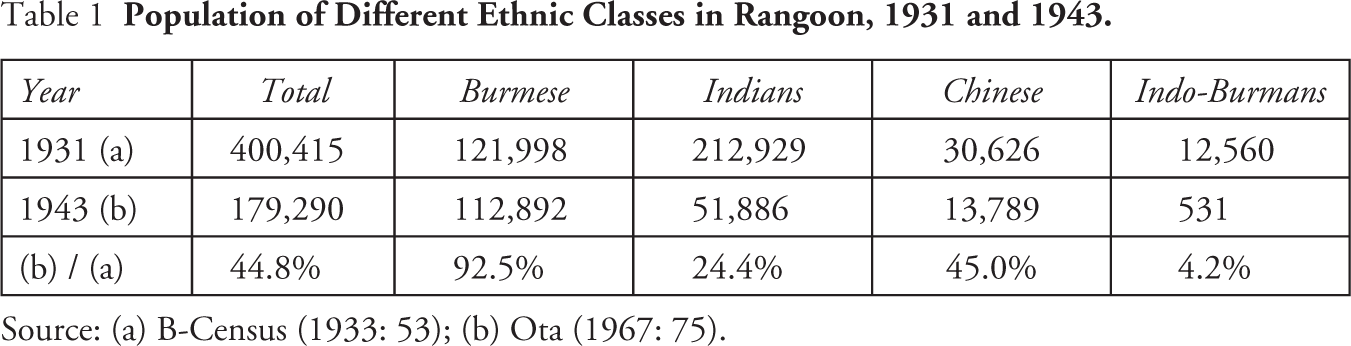
Given the exorbitant costs and physical hardships involved, evacuation was effectively a privilege reserved for the healthy and wealthy. Consequently, those physically or financially unable to endure the journey were compelled to remain. Importantly, the wealthy evacuees left behind substantial assets. Following the occupation of Rangoon in March 1942, the Japanese administration established the Indian Association from among the remaining Indian community and entrusted it with the management of the property left behind by the evacuees. This policy provoked strong resentment among Burmese nationalists, who demanded the confiscation of these assets. The fact that Indians still held title to 23 per cent of Rangoon’s land area in 1943 serves as a testament to the magnitude of the economic power they had previously wielded (Ota, 1967: 82, 263, 283, 292).
This exodus has typically been attributed solely to the fear of Japanese invasion or to mass panic. J.P. Leider suggests that ‘many Indians in Burma tried to flee the Japanese advance’ (Leider, 2017: 207–8), while Ba Maw, the wartime Head of State of Burma, characterised it as a result of Indians ‘losing their heads’ in panic (Ba Maw, 1968: 198). However, if the Japanese military advance or mass panic had been the sole drivers of displacement, one would have expected a comparable exodus of the Burmese population. The fact that the refugees were overwhelmingly Indian points to a more specific cause: the resurgence of anti-Indian hostility.
The violence of 1942 was not unprecedented. Memories of the communal riots of the 1930s instilled a palpable sense of fear among the Indian community in 1942. Notably, the Rangoon riots against Indian dockworkers of May 1930 and the widespread anti-Muslim riots of July 1938 had already resulted in thousands of casualties (Nanpo-nenkan, 1943: 631). Crucially, these conflicts were deeply intertwined with the rise of Burmese nationalism. Founded in the wake of the 1930 riots, the Dobama Asiayone (We Burmans Association) had long promoted a Burma for the Burmans ideology that cast Indians as foreigners. It was this hostility that Indians feared during the chaos of early 1942. This exclusion was explicitly confirmed shortly after the Japanese occupation, when the newly reorganised Dobama-Sinyetha Party stipulated in Article 4 that ‘“We Burmans” refers to the indigenous peoples of Burma such as the Mon, Burman, Arakan, Chin, Karen, and Shan’ (NIDS, Appendix: 85–86). This definition, by explicitly including the Arakanese while omitting the Indian population, serves as a testament to the logic that had rendered Indians vulnerable.
Hence, as long as the colonial administration existed, it acted as a buffer against this hostility. Its collapse removed the only guarantee of safety for Indians. Archibald Wavell, the Commander-in-Chief of India, astutely observed that:
In these circumstances, the Indians were not popular with the Burmese and they realised that they depended for their security on the British ‘Raj’. When this failed they felt they must get out or be murdered. In this they were probably right. (Grehan & Mace, 2015: 164)
Wavell’s observation underscores that the Indian exodus was fundamentally driven by the fear of communal violence in the absence of British protection. This volatility was evident in Rangoon, where Indians constituted a significant portion of the population. One legislator reported that following the first Japanese air raids on 23 December 1941, ‘the Burmese looted the Indians, there was hardly any law and order in the town’ (ICSD, 18 March 1942: 337). Moreover, during the administrative interregnum of late February 1942, the city descended into lawlessness. Rioters rampaged through the commercial districts, burning bazaars and shops—many of which were likely Indian-owned. Describing the resulting devastation, another legislator stated that ‘people there have lost their all. Men who were millionaires are not worth a penny today’ (ICSD, 18 March 1942: 331). However, Indians were not the only group compelled to flee Burma. In the western borderlands of Arakan, the anti-Indian sentiment discussed above materialised into actual violence, triggering a backlash that resulted in a distinct inter-communal conflict.
Demographic Tensions and Communal Violence in Arakan
The 1931 census revealed that the Arakanese constituted slightly over half the population, while Indians and Indo-Burmans—the vast majority of whom were Muslims—collectively comprised more than 40 per cent (B-Census, 1933: 27). The Arakan Mahomedans, classified as Indo-Burman, were a community long rooted in Arakan, whereas the Chittagonians, categorised as Indian, were a seasonal migrant labour force originating from Chittagong (B-Census, 1933: 229–30). The Muslim population was expanding rapidly: During the 1920s alone, it surged by about 17 per cent (B-Census, 1933: 42). This growth was reinforced by intermarriage: Indo-Burmans––children born to Muslim men and Arakanese women––were almost invariably raised as Muslims (B-Census, 1933: 211, 230).
The hostility between Arakanese Buddhists and Muslims mirrored the broader anti-Indian sentiment prevalent throughout Burma, fuelled by a complex interplay of economic and demographic pressures. The continuous influx of immigrants from Chittagong precipitated acute fears among the Arakanese regarding land alienation. Moreover, as Chittagonian labourers were willing to work for lower wages, the Arakanese often found themselves unable to compete economically (Baxter, 1940: 51; Pearn, 1952). This rapid demographic expansion also deepened religious friction between Muslims and Buddhists. Finally, a stark gender imbalance was evident among Chittagonians born outside Burma—a group constituting the seasonal migrant workforce. With only 22 to 23 females per 100 males (Baxter, 1940: 50), this male-dominated influx likely exacerbated local fears that Arakanese women would be absorbed into this growing community.
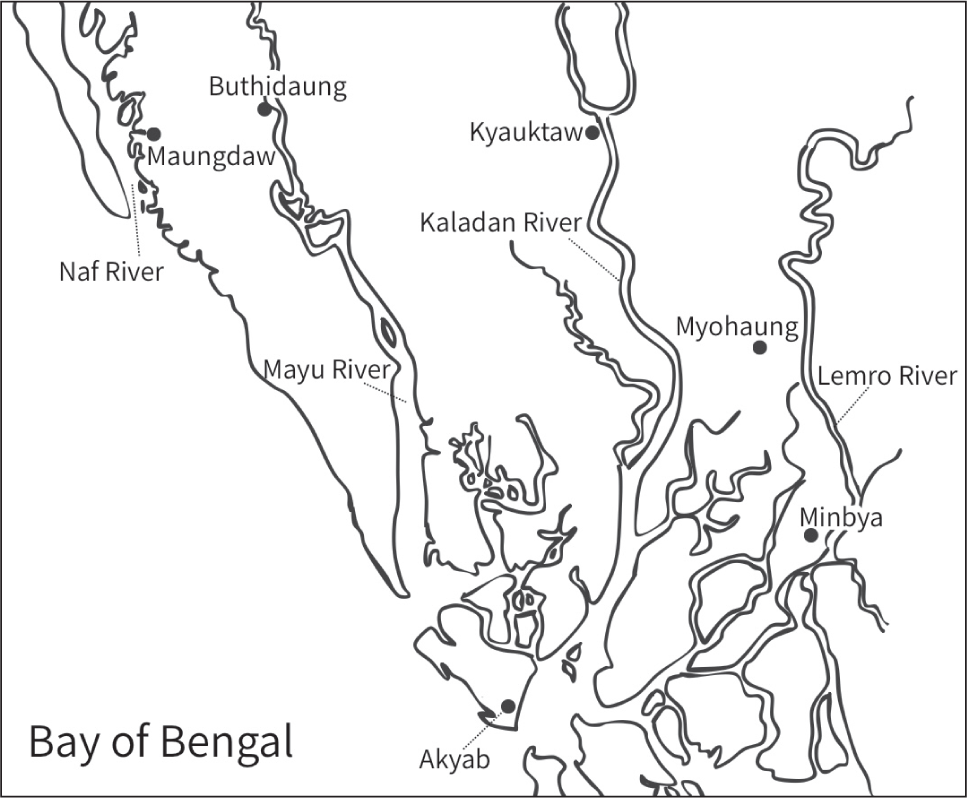
In central Arakan, that is, the plain area surrounding the Kaladan and Lemro Rivers (see Figure 1), the latent hostility discussed above manifested in actual violence. Reports reached Calcutta shortly after the events began. On 21 April 1942, John Herbert, the Governor of Bengal, stated that ‘the homes of Bengalis domiciled in Akyab [District] are being looted and burnt’ (Rahim & Rahim, 1999: 148). Ba Maw provided a more detailed account, recounting that the Arakanese attacked ‘the large Indian concentrations’ in the townships of Myebon, Minbya and Myohaung and that villages like Kyauktaw and Alegyun were set on fire, leaving the Indian community ‘plundered, uprooted, and driven out’ (Ba Maw, 1968: 204; see Figure 1). Finally, based on his post-war inquiries, Peter Murray, an officer in the Burma Civil Service, reported that ‘further south [of northern Arakan], all or nearly all CFs [Chittagonian Muslims] were killed or driven out, mosques destroyed and CF cattle seized’ (Murray, 1980: 3).
Fleeing this violence, waves of Arakan Muslims escaped across the frontier into Bengal. It proved difficult, however, to distinguish these refugees from vast numbers of Indian evacuees retreating from other parts of Burma. Consequently, officials could neither ascertain the precise scale of the influx nor categorise the arrivals by origin or religion. This uncertainty is reflected in the rough estimates provided by officials: A member of the Bengal Legislative Council noted a broad range of ‘40 to 60 thousand evacuees mostly Moslems, from Arakan and other parts of Burma’ (BLCD, 13 November 1942: 543), while Bengal Premier A.K. Fazlul Huq cited a similarly vague figure of ‘about 40,000 evacuees […], mostly Moslems’ (BLCD, 22 March 1943: 359). Unlike short-term migrants who could return to ancestral villages, many long-term residents found themselves stranded in Bengal without kinship support. In Chittagong, for instance, a legislator described how families were ‘wandering […] just like nomad tribes and begging from door to door’ (ILAD, 17 September 1942: 265).
However, the situation in northern Arakan, that is, the region of the Mayu Peninsula lying between the Mayu and Naf rivers and comprising the townships of Maungdaw and Buthidaung (see Figure 1), was the reverse of central Arakan. Here, the demographic balance favoured the Muslims in the townships of Maungdaw and Buthidaung, situated along the frontier with Bengal, formed by the Naf River. Consequently, the dynamics of violence shifted in this area: here, it was the Arakanese who came under attack. By May 1942, Herbert noted that ‘Bengali Muslims have now banded themselves together and have attacked their oppressors, the Mughs [Arakanese]’, forcing them to flee into Bengal (Rahim & Rahim, 1999: 159). In his post-war research, Murray described the dissolution of law and order into ‘bitter and bloody fighting’. He made the sweeping assertion that ‘all Buddhist buildings, pagodas and monasteries, were rased [razed] or burnt, all Magh [Arakanese] villages burnt, and all Magh property (mainly cattle) seized’ (1980: 3).
This violence extended beyond the destruction of religious sites and the seizure of property: It was also characterised by extreme brutality against civilians. The chaotic atmosphere is illustrated by the gruesome, if likely boastful, claim recorded by Anthony Irwin, a member of the British V Force—a British-led irregular force operating against the Japanese during the Burma Campaign—who noted a local Muslim man’s assertion that he had killed ‘two hundred Maughs [Arakanese]’ with a sword (Irwin, 1945: 23). Ba Maw provided a more plausible account from an Arakanese officer who witnessed refugees streaming in day and night; these displaced Arakanese had lost their rice stocks and cattle, and bore harrowing stories of the ‘seizure of five hundred virgins’ (Ba Maw, 1968: 205). This persecution in northern Arakan forced a distinct stream of Arakanese refugees to flee across the border into Cox’s Bazar, located south of Chittagong. Significantly, while the vast majority of Indian evacuees entering Bengal were returning to their ancestral villages, the Arakanese refugees faced a fundamentally different reality. Arriving in a foreign land, they completely lacked the kinship ties necessary for survival.
Arakanese Refugee Experience in Bengal
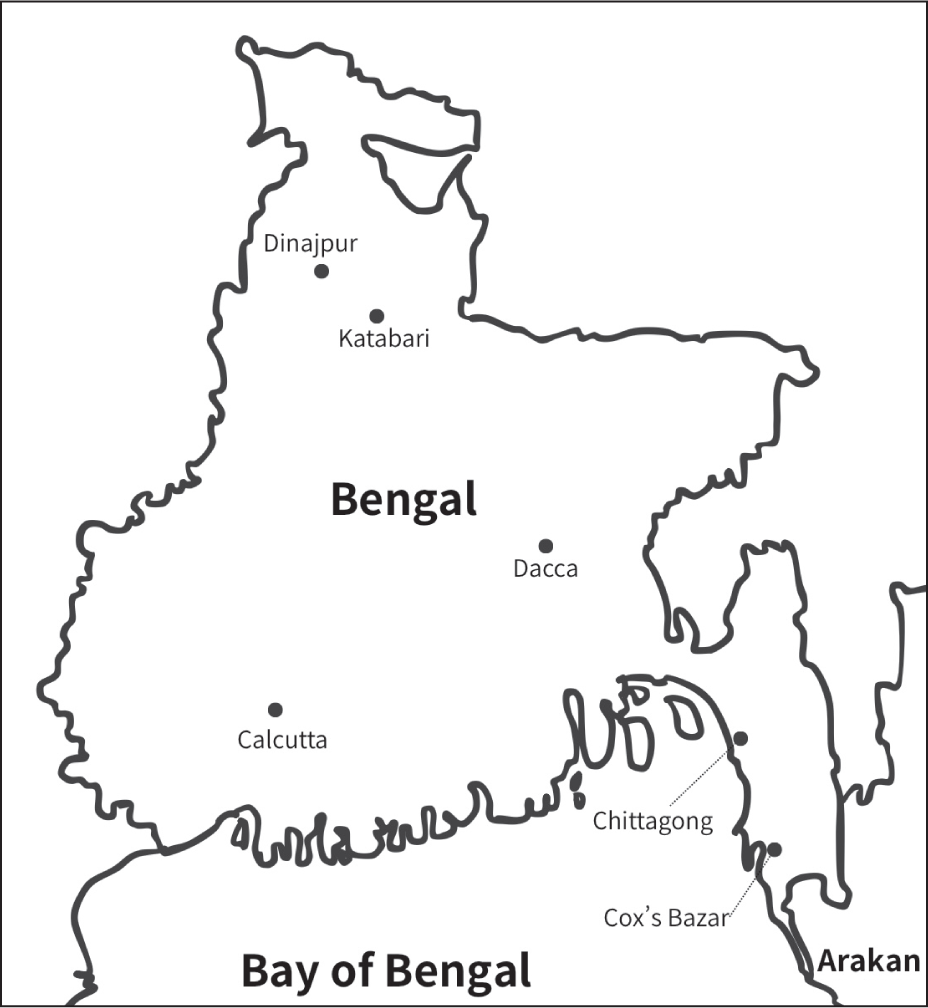
Refugee camps were established for the Arakanese refugees who had fled to Bengal. The existence of these camps is documented primarily through parliamentary records, which offer a glimpse into their scale and location. One significant settlement was located in the Dinajpur District of northern Bengal, approximately 7 miles (11 km) from Dinajpur town (BLCP, 22 March 1943: 406; see Figure 2). As of September 1942, official records indicate that this camp hosted some 8,000 evacuees (BLCP, 15 September 1942: 31). Notably, the maintenance costs for the Arakanese in these camps were borne by the exiled Government of Burma, then based in Simla. The establishment of these special camps was necessitated by the absence of family connections for the Arakanese in Bengal. M.S. Aney, a member for Indians overseas on the Viceroy’s Executive Council, explicitly underscored this distinction when addressing the Legislative Assembly of India regarding the ‘Burman evacuees’ in Dinajpur:
The Honourable Member presumably has in mind the case of some 8,000 Arakanese Mughs who had sought refuge in Chittagong and were moved into the interior of Bengal. These refugees have no relations or homes in India to go to and had to be housed in special camps. (ILAD, 24 September 1942: 512)
This statement highlights why the camps were essential: Unlike Indian evacuees who could often rely on family networks, the Arakanese had no kinship ties in India and were thus entirely dependent on state support.
Beyond Dinajpur, refugee camps were also situated in the neighbouring Rangpur District in northern Bengal. In March 1943, Ahmed Hosain, a member of the Bengal Legislative Assembly, highlighted the presence of a substantial camp at Katabari, within the jurisdiction of the Gobindaganj police station. He sarcastically noted with reference to local food supplies that his constituency had been ‘afforded the unique privilege of entertaining thousands of guests of His Majesty’s Government, namely, the Arakanese refugees’ (BLAP, 24 March 1943: 554). However, the exact scale of this influx remained unclear to both assembly members and government officials. While Hosain claimed that ‘at least 50,000’ refugees had arrived or were arriving, Pramatha Nath Banerjee, a minister for the Government of Bengal, disputed this, vaguely asserting the number was ‘likely to be considerably less’ (BLAP, 25 March 1943: 605).
It remains unclear whether the Government of Bengal withheld exact figures or simply lacked them. When pressed on the number of refugees at the Katabari camp, Banerjee replied: ‘the number actually arrived, […] I am afraid, I cannot disclose’ (BLAP, 25 March 1943: 605). Given his earlier vague assertion that the figure was ‘considerably less’ than 50,000, it is plausible that the government possessed only rough estimates rather than accurate figures. Yet, regardless of such statistical ambiguity, it is evident that multiple Arakanese refugee camps were present in this region. These refugee camps were also not originally established in northern Bengal; instead, they were relocated to the north from the south-eastern border regions adjacent to Arakan. This operational relocation was dictated by two critical imperatives: military security and acute food shortage in the border districts. In the eyes of the British colonial administration, then engaged in war against Japan, the establishment of designated camps was not merely a humanitarian measure but a security necessity. This was because the Arakanese refugees were viewed with deep suspicion due to their general distinctiveness from the Indian population. To the British and Indian authorities, the distinction—whether visual or linguistic—between an Arakanese, a Burmese and a disguised Japanese would have been dangerously blurred.
Such apprehensions were prevalent among high-ranking British officials. As early as January 1942, Herbert warned of the potential infiltration of enemy agents disguising themselves as fleeing civilians, reporting to the Viceroy on ‘the danger of fifth columnists coming in along with refugees, possibly disguised as Burmese’ (Rahim & Rahim, 1999: 129). This specific reference to a fifth column encapsulates the administration’s pervasive fear that Japanese intelligence operatives could easily blend into the chaotic stream of refugees crossing the border. Consequently, the decision to relocate the camps to the north was likely driven by strategic military necessity. Initially, refugees arrived in Chittagong District, immediately adjacent to the Arakan border. However, this region was rapidly transforming into the primary staging ground for the First Arakan Campaign, launched in late 1942 to retake Akyab. In such a sensitive military zone, the presence of thousands of potential enemy agents would have been deemed an unacceptable risk.
Accordingly, the Arakanese were transferred from the vulnerable borderlands of Chittagong to the interior districts of northern Bengal, such as Dinajpur and Rangpur. Situated far from the active war front, these locations served to isolate the refugees, thereby removing the perceived intelligence from the strategic frontier. Crucially, the threat of espionage also extended to Indian refugees. Indeed, the Viceroy’s report on 24 October 1942 recorded that, of the 45 captured agents, ‘some 24 were members of Indian National Army’, while the rest included ‘civilians of various categories’ infiltrating from Burma (Mansergh & Lumby, 1971: 154). Nevertheless, given their physical resemblance to the Japanese, the Arakanese would likely have been subjected to particular scrutiny.
Beyond counter-intelligence concerns, the relocation of the Arakanese to northern Bengal appears to have also been influenced by the logistics of food supply. Historically, south-eastern districts like Chittagong were chronic rice-deficit areas, whereas the north-western districts, including Dinajpur, were rice-surplus regions (FIC, 1945: 114). This structural disparity became critical during the Bengal famine beginning in 1943. While the famine inflicted catastrophic damage on the south-east, its impact in the north remained comparatively mild (Greenough, 1982: 144). Consequently, the transfer of refugees to the interior can be interpreted as a strategic measure to relieve the pressure on the vulnerable south-east.
However, this relocation shifted the burden of supporting the refugees to the host communities in northern Bengal. During a discussion in the Bengal Legislative Assembly regarding food supplies for Arakanese refugees at the Katabari camp, opposition politician Nalinaksha Sanyal asked the government whether it was true that ‘the local price of rice has gone up very high, because of the competition exercised by the refugees’. In response, Banerjee employed provocative rhetoric, remarking: ‘I do not know, sir, whether they are pampered vampires of the empire’ (BLAP, 25 March 1943: 605). Set against a backdrop of skyrocketing rice prices and deepening food insecurity, this exchange—and particularly the use of the word vampire—exposes the intense friction the refugee influx was generating within this community. To a local population already fearing for their own survival, the addition of thousands of extra mouths was perceived as a direct threat to their shrinking resources.
This friction also assumed a distinct religious dimension. In the Assembly, a specific inquiry was raised regarding the allegation that ‘40 to 50 cows are being slaughtered daily by the authorities of the Arakan refugees’ camps at Katabari for feeding the refugees’ (BLAP, 24 April 1944: 283–4). Although the veracity of this claim remains unverified, the question itself reflects the deep-seated grievances of the local population. Given the sacred status of the cow for the Hindu community, such a reference to slaughter implies a distinct element of religious aversion towards the Arakanese Buddhists.
Yet, notwithstanding this local animosity, the Arakanese refugees were by no means shielded from the famine’s devastation; indeed, they often became recipients of inferior supplies. In March 1944, amidst the famine’s lingering aftermath, a disturbing question was raised in the Assembly regarding the diversion of spoiled grain to the Katabari camp. A member asked: ‘Is it a fact that the Government rice which is rotting at Gaibandha has been sent to Katabari refugees’ camp for consumption by the poor refugees?’ (BLAP, 7 March 1944: 376). The government official’s curt reply—‘I have no information’—was notably not a denial, suggesting that the refugees were likely allocated decaying food stocks deemed unfit for the general population.
Socio-economic Impact on the Host Society
The arrival of hundreds of thousands of refugees in 1942, comprising Indians returning from Burma as well as Muslims and Arakanese escaping the violence in Arakan, constituted a demographic shock to Bengal. Regardless of their diverse backgrounds, this influx exacerbated the pressure on an already food-insecure province. This influx has long been cited as an aggravating factor of the Bengal famine of 1943. Contemporary observers recognised the correlation between the sudden demographic surge and food shortages. For instance, Wavell, in his analysis of the famine’s causes in September 1943, explicitly listed ‘the refugee influx’ as one of seven contributing factors, alongside crop failures and the cessation of Burma rice imports (Mansergh & Lumby, 1973: 280). Similarly, the Famine Inquiry Commission identified the arrival of evacuees as one of the five critical events that destabilised Bengal’s economy in 1942 (FIC, 1945: 187).
While the direct strain of the refugee influx on food supplies is well-documented, there is an often-overlooked economic dimension that further exacerbated the crisis. The mass return of refugees signified the effective closure of the Burmese labour market, thereby depriving the Bengali poor of a crucial source of income. Historically, Burma had served as an attractive destination for migrant workers, particularly from Chittagong, who travelled seasonally to work as agricultural labourers or coolies: for example, in the 1920s, such workers could earn wages ‘three to four times’ higher than those prevailing in India (Satyanarayana, 2002: 105). The Japanese occupation and the subsequent cessation of cross-border movement abruptly cut off this lifeline. Herbert reported in June 1942 that ‘some 30 to 50 thousand labourers who normally go into Arakan to cultivate the paddy crop are workless’ (Rahim & Rahim, 1999: 167). This forced immobility resulted in loss of wages and remittances for families in Bengal.
Thus, the refugee crisis impacted the Bengal economy from two simultaneous directions, a dynamic best understood through Amartya Sen’s ‘exchange entitlement’ approach (Sen, 1981). On the demand side, the sudden population influx fuelled inflation, placing upward pressure on the price of rice. On the income side, the closure of the Burmese labour market diminished the purchasing power of the local labouring poor. This widening gap between rising prices and declining incomes undermined the exchange entitlement of vulnerable households, further compounding the conditions leading to famine.
While the influx of refugees inevitably increased the demand for food, its impact on the labour market, conversely, helped to alleviate the acute shortages in the wartime economy. The Indian evacuees, in particular, played a crucial role. Benefiting from linguistic affinity and freedom of movement, they were able to rapidly integrate into the workforce to fill critical vacancies. In contrast, the situation for the Arakanese remained ambiguous. Ostensibly confined to camps in northern Bengal, they were, in principle, cut off from the general labour market. However, given the administrative confusion regarding their exact numbers, it is unclear to what extent this isolation was strictly enforced. Considering their agricultural background as paddy farmers in Arakan, it is reasonable to surmise that they contributed to local farming, likely in an informal capacity. Nevertheless, concrete evidence of such participation remains elusive in the archival record.
The severity of the labour shortage is evident in the sharp rise in wages. This occurred because employers in understaffed sectors were compelled to offer higher pay to attract the necessary workforce. However, this wage growth was uneven. Wage levels showed little change in established and organised industries like cotton and jute mills, whereas they rose appreciably in unorganised and war-related sectors. For instance, the engineering sector recorded an increase of 85 to 100 per cent between 1939 and 1944 (LIC, 1946: 207, 277). Mirroring this, agricultural wages also rose by approximately 100 per cent by 1943 (GOB-RLRC: vol. II: 117; Sen, 1981: 66). This indicates that the labour shortage was particularly acute in these unorganised and war-related sectors as well as in agriculture. Government initiatives were also undertaken to assist refugees in securing new employment, specifically through provincial registration systems. Indeed, reports indicate that those with practical skills, such as doctors, electricians and carpenters, alongside skilled dockworkers, mining experts and unskilled labourers for military construction projects, successfully found re-employment in India (ILAD, 15 September 1942: 92, 119; LIC, 1946: 73).
Regarding the agricultural sector during the Bengal famine, one enduring puzzle remains. The winter rice harvest in January 1943 was a failure, precipitating the famine. In stark contrast, the harvest in January 1944 was one of the most bountiful in Bengal’s history. Yet, throughout 1943—the very period when this crop was sown and tended—the famine claimed at least one million lives, and the largest proportion of the victims were agricultural labourers. Despite this catastrophic loss of the workforce, rice cultivation in 1943 was executed on a massive scale. Sen highlighted this anomaly with evident surprise, noting that ‘it is remarkable that agricultural operations could take place on such a gigantic scale despite deaths […], affecting a large part of the agricultural labour force’ (Sen, 1981: 77–8). While he offers, however, no explanation for this paradox, it can be surmised that the presence of refugees offers a key to resolving this puzzle. It is plausible to hypothesise that the influx of evacuees from Burma helped to fill the labour void created by the mass death of Bengali agricultural labourers. Viewed in this light, the refugee influx played a dual role: While a burden on consumption, they simultaneously replenished the workforce.
As noted earlier, the alleviation of labour shortages has been primarily attributed to Indian evacuees, while the Arakanese were ostensibly confined to camps. However, the actual extent of this isolation remains opaque. Given the administrative chaos and the acute demand for labour, it is quite probable that Arakanese refugees—either by slipping out of camps or because they were never successfully interned— participated in the local workforce to secure their livelihoods. As experienced rice cultivators, adapting to Bengal’s fields would have been seamless. Thus, it is conceivable that the Arakanese, despite their limited numbers, also exerted a positive economic impact on Bengal by contributing to the labour supply. However, in the absence of systematic quantitative data to confirm the exact scale of their workforce participation, this remains a plausible hypothesis rather than a definitive conclusion. Ultimately, the rigidity of ethnic distinctions obscures a simpler reality: the universal human imperative to survive. Both Indians and Arakanese fled the violence in fear for their lives and, in Bengal, both were driven by the same desperate struggle for sustenance and security.
Conclusion
This article has examined the multifaceted refugee crisis of 1942, moving beyond the conventional narrative of the Indian exodus to illuminate the overlooked displacement of the Arakanese population. The collapse of British authority in Burma left the Indian population stripped of their protectors; fearing the resurgence of Burmese anti-Indian sentiment and the Japanese invasion, many Indians fled towards India. In Arakan, a destructive spiral of communal violence occurred: While Muslims in central Arakan fled to Bengal to escape attacks by the Arakanese, the Arakanese in northern Arakan also fled to Bengal in fear of Muslim violence.
Within the host society of Bengal, many Indian evacuees could rely on kinship networks to return to their ancestral homes and integrate into the labour market. In contrast, the Arakanese refugees faced a unique predicament: Lacking social connections and viewed with suspicion as fifth columnists for the Japanese, they were segregated into state-managed camps, although the precise degree of their physical confinement remains ambiguous. These camps were strategically relocated from Chittagong District, near the front line, to the interior of northern Bengal—a decision driven by both military counter-intelligence concerns and the better food situation compared to East Bengal. However, even in these shelters, the Arakanese remained vulnerable and faced local hostility, subsisting on meagre and often inedible rations amidst the deepening Bengal famine.
Economically, the refugee influx presented a paradox. On the one hand, as noted in contemporary studies, the sudden demographic surge—encompassing both Indian and Arakanese refugees—undeniably exerted pressure on Bengal’s food resources, exacerbating the famine. On the other hand, a factor often overlooked in research is that the influx functioned as a crucial supply of labour. Admittedly, this role was primarily fulfilled by Indian returnees. However, the possibility that Arakanese refugees also contributed as agricultural labourers outside the camps should not be entirely dismissed.
It must be acknowledged that this study relies heavily on fragmented legislative and administrative records, and further archival research is needed to fully reconstruct the social history of the refugees from Burma. Furthermore, exploring the longer-term trajectories of these displaced populations and the evolving inter-communal dynamics in the post-war era—ideally through broader theoretical frameworks—remains an important avenue for future research. Nevertheless, the findings of this study offer critical historical nuance to the present-day Rohingya crisis. The events of 1942 demonstrate that the flow of refugees across the Naf River has never been a one-sided phenomenon: rather, both Muslims and Arakanese fell victim to forced displacement, equally driven by the spiral of communal violence.
Recognising that the Arakanese were also refugees in 1942 challenges the rigid binaries of victimhood central to modern nationalist narratives. As the shadows of 1942 continue to loom over ongoing ethnic tensions, recovering this nuanced history remains vital. Moreover, shifting the lens to the host society reveals a complex dual reality: Refugees were not merely a burden on resources, but also integral contributors to the wartime economy. As the world confronts a renewed surge of forced displacement today, the multifaceted crisis of 1942 serves as a poignant reminder of the paradoxical relationship between displaced populations and the societies that shelter them.
Footnotes
Declaration of Conflicting Interests
The author declared no potential conflicts of interest with respect to the research, authorship and/or publication of this article.
Funding
The author received no financial support for the research, authorship and/or publication of this article.