






Abstract
Modern social order is premised on a shared conception of and obedience to a set of defined temporal systems. Time is therefore a powerful tool with which to layer, classify and police the nature of social order. This article explores the relationship between temporality and the social in China’s capital, Beijing. The article draws on observations of Chinese film of the 1990s, the 90th anniversary of the Chinese Communist Party in 2011, and the Chaoyang district beautification campaign, to identify how temporal structures and symbols are traded and manipulated in the pursuit of political rectification and harmony. The article is based on an extended review of Michael Dutton’s recent book, Beijing Time, and refers its new observations to the examples and premises in that book, which are in turn informed by Dutton’s other work on policing and street life in China.
City Character
If Tiananmen Square at dawn now captures the spirit of the nation, Panjiayuan at dawn is host to the spirit of capitalism. (Dutton, 2008: 222)
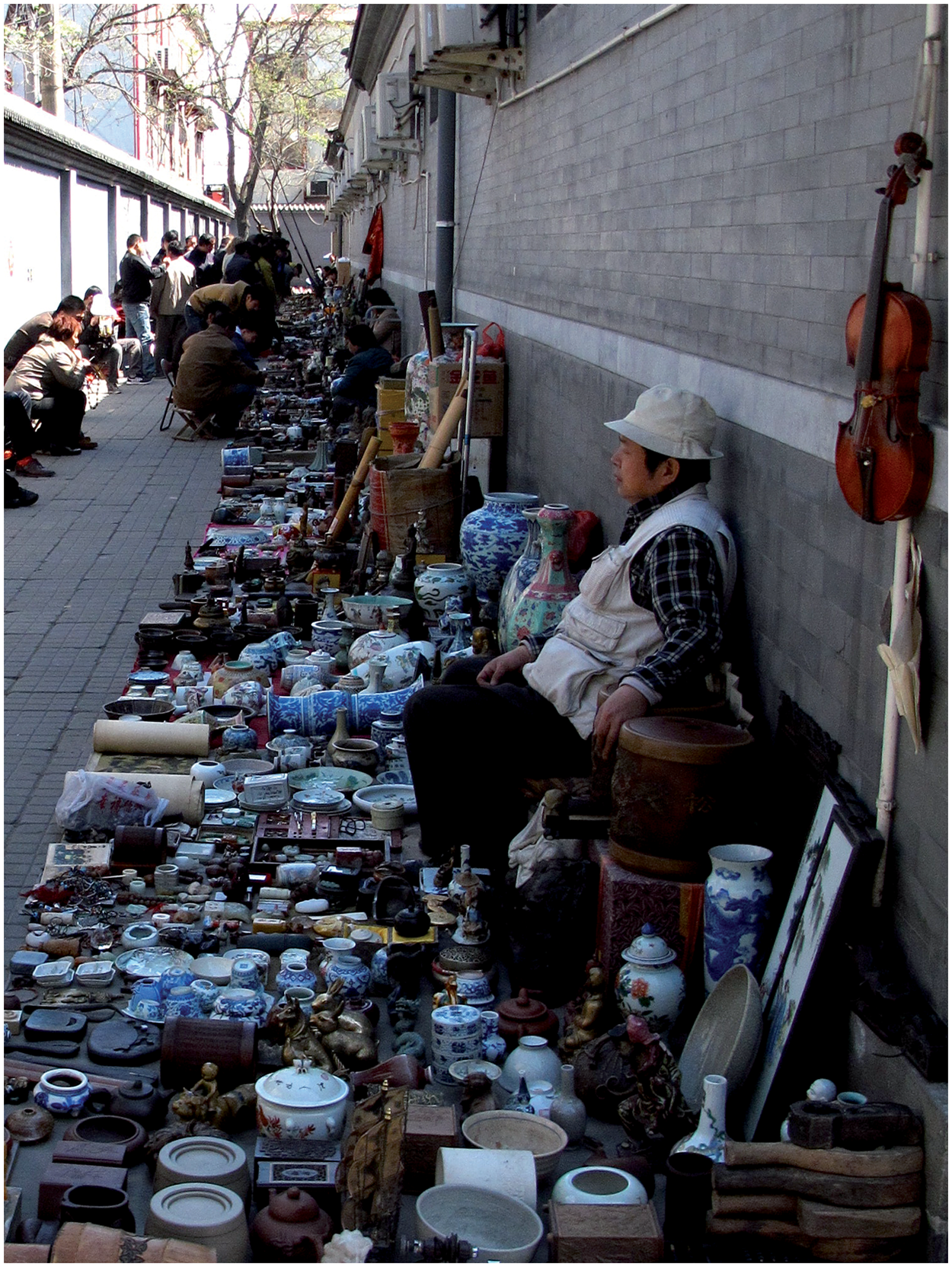
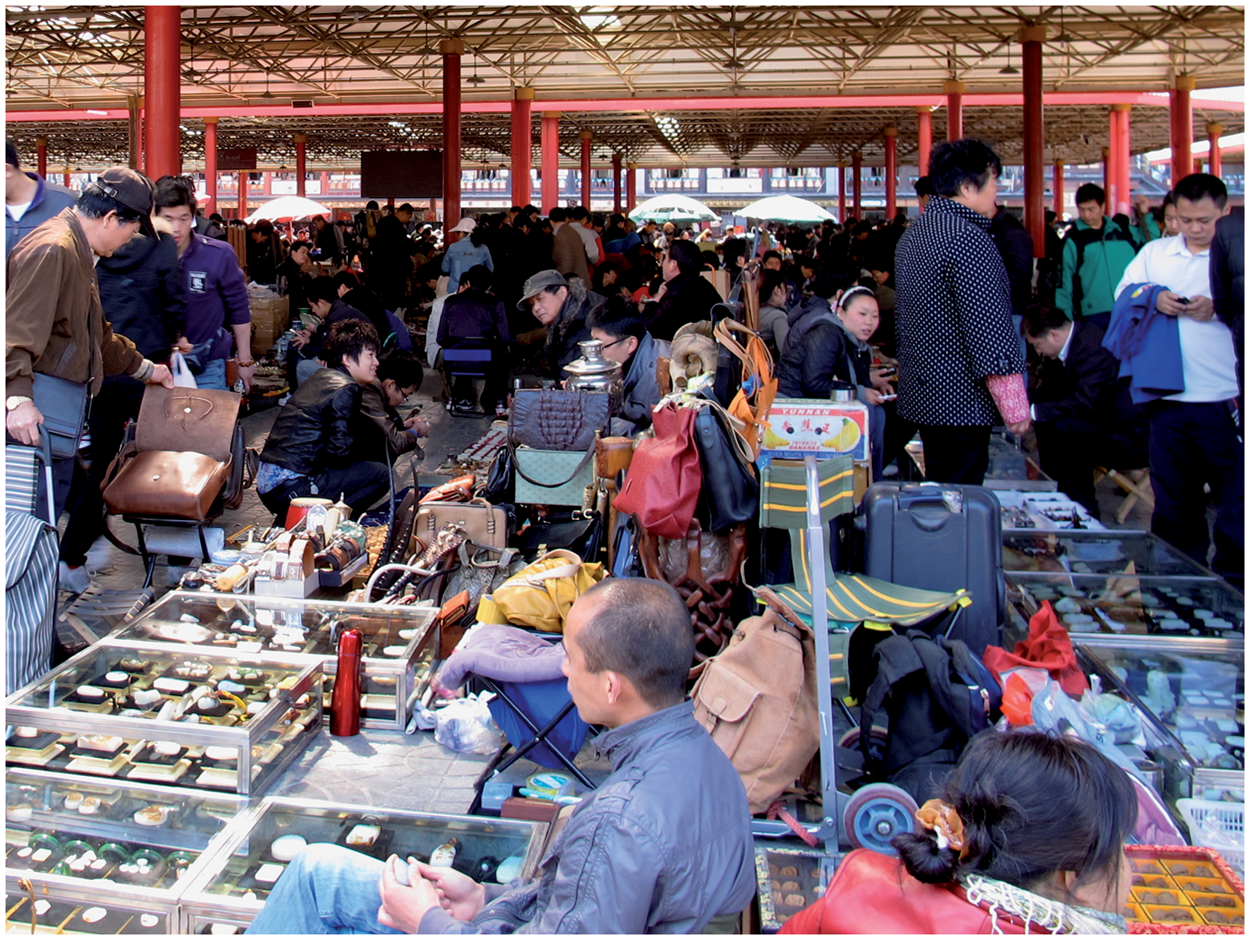
PANJIAYUAN IN Chaoyang district is the site of the ghost market. Named after the hawkers’ ghostly forms travelling through the night to set up their stalls for a 4.30 am start, this fleamarket was originally developed so that impoverished noblemen might shop anonymously for bargains, before daybreak, without losing face. Nowadays it is a mixture of antiques, fakes and Maoist paraphernalia and kitsch (including recently made reproductions) (pp. 216–17). It is an appropriately cynical and nostalgic enterprise, where Beijing’s relationship with its several pasts can be picked over as the day breaks. Its importance to Michael Dutton and his co-researchers, Lo and Wu, is that it exemplifies a city where ghosts are only reincarnations of a market mechanism, and where even the mightiest of political tracts ends up, eventually, on a stall.
Great cities very often possess a character quite discrete from that of the nation in which they are situated but are nonetheless accounted metonymic of the wider geopolitical space, which they self-confidently eclipse, deride, and (mis-)represent. London, New York, Los Angeles, Beijing are all utterly ‘themselves’ and yet are also the touchstones of external and indeed local perceptions of what it is to be in Britain, the USA, China. This anomalous status is at once contradictory and strangely accurate, as such cities do achieve a sense of national centrality whilst retaining and celebrating their specific qualities – whether that be through the pragmatics of brand maintenance, or through a deeply held sense of socio-cultural pride and particularity, or both. These cities are dependent on their people for maintaining and performing their identities, but theirs is a learned performance – the cities’ histories are somehow greater than the sum of their current populations, even though their people (resident, sojourners, and even tourists) contribute to the confirmation and continuation of these narratives in every small reiteration of the city’s life. Thus, the harder it is to grasp the fullness of a city’s ways of being, structures of attention, habits of thought, the more likely it is that this city has that indefinable edge on its more parochial rivals. It has character far beyond its brand. Its attractions include its successes and its disappointments, its sudden enthusiasms and its negligence towards new arrivals. A small town may be bereft at the loss of youth leaving for big cities, and stricken at the passing of old people and old ways, but a city of character hardly notices such mobility – indeed it requires it.
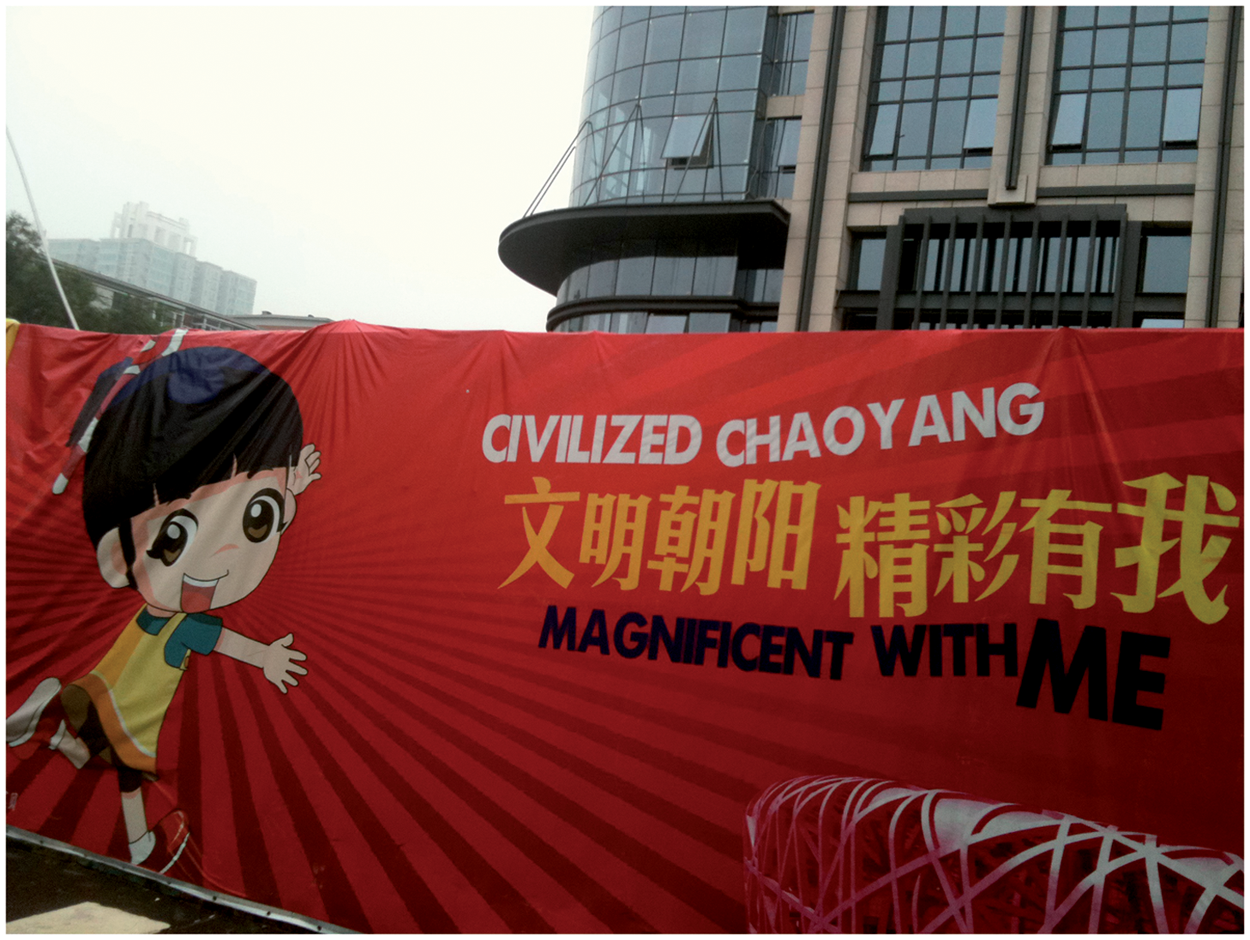
Chaoyang district, the home of the ghost market, is currently (July 2011) the subject of not mighty but certainly very enthusiastic political tracts. The call for ‘magnificent Chaoyang’ on hoardings outside yet another development site on Worker’s Stadium Road is part of a wider campaign for the residential contribution to ‘socialism with Chinese characteristics’:
1
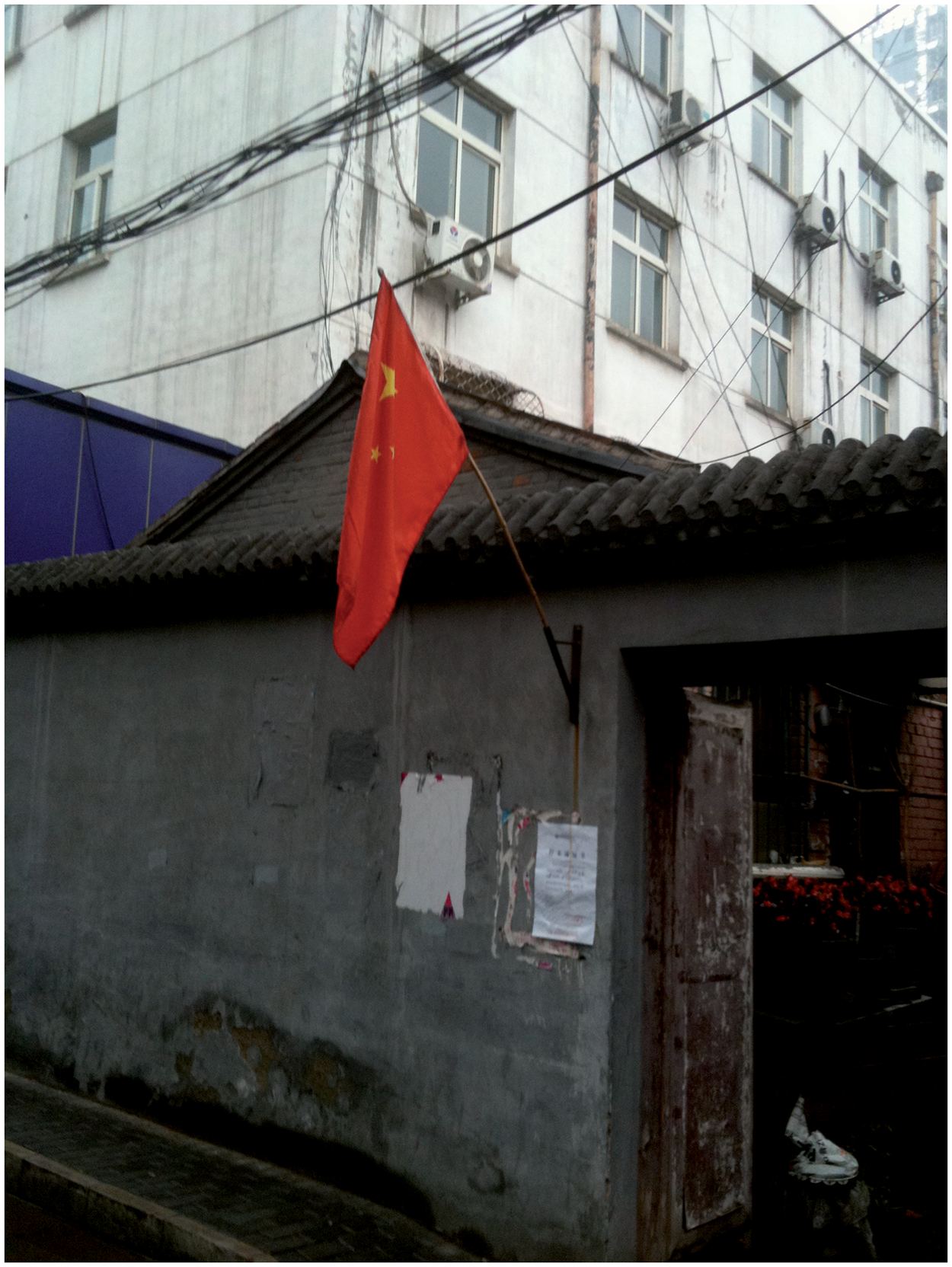
orderly advancement, stability and mutual responsibility amongst the people. Just around the corner from the main road, the notice boards, which used to carry pasted-up newspapers for communal reading, carry detailed advice on managing internet use for better health in children and older people, and on re-designing one’s home layout to collect and use rainwater efficiently. Two doors down from the local Thai restaurant, a small flag hangs outside a minute alley home, celebrating the 90th birthday of the Chinese Communist Party.
Panjiayuan market, April 2011. Photograph courtesy of Kirsten Seale Panjiayuan market, April 2011. Photograph courtesy of Kirsten Seale Panjiayuan market, April 2011. Photograph courtesy of Kirsten Seale Magnificent Chaoyang. Photograph courtesy of Stephi Donald Chaoyang alley on 1 July 2011, the 90th birthday of the Chinese Communist Party. Photograph courtesy of Stephi Donald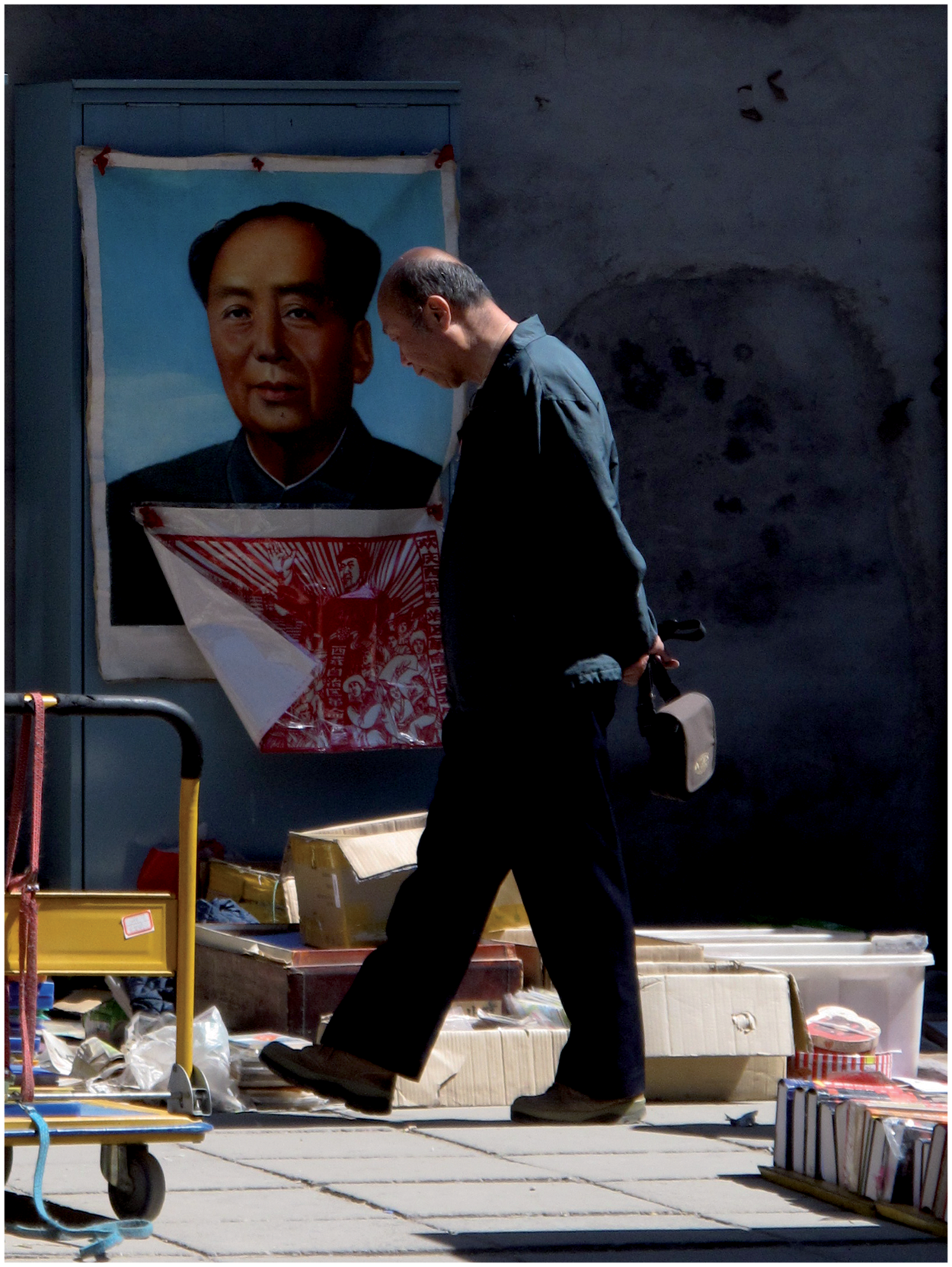
Beijing Time (2008) is a passionate and idiosyncratic attempt to capture the essence of one such great city. The book is therefore energetic, eclectic, and inventive. Those who spend a lot of time in Beijing will recognize the tone of the work as empathetic and sensitive to that of the city itself. The narrative is structured as a journey from the architectural legacy of imperialism to the street-level details of contemporary capitalism with Chinese characteristics, or what we might call statist chaos. The book is organized around three themes: temporality, sociality and aspiration. The title refers to the first of these in an opening discussion of the competing drums and clocks of imperialism, the grand railway buildings and bells of Victorian foreign occupation, and the defiant and equally insistent hourly chimes of revolutionary time. The compulsion to manage time is brilliantly captured, and demonstrates how political powerbrokers are all already modern in this key strategy – for time is space is power. As the hours are marked by the ringing of bells, or the beating of drums, or the playing of recorded music, so the progress of people’s lives is disrupted and ordered in a manner both random (why should a bell signify an hour passing, and why should the drums be obeyed?) and utterly predictable (the power to run time is premised on military might, just as the city squares are reminders of the troops that turn them from public spaces to parade grounds). In 1985, Chen Kaige’s film The Big Parade – a story of young recruits training for National Day celebrations in Tiananmen – showed that, despite the immediate futility of repetition and physical pain, the phenomenon of men and women’s bodies marching in unison, ‘in time’, gives rhythm to power. Stating the obvious perhaps, but that’s why National Day looks the way it does. This attention to synchronicity provides the populace, marchers and onlookers with a performative end in itself. William McNeill argues that military drill is the ultimate musculature of politics; whilst ostensibly about training the body for battle, ‘keeping time’ is also about persuading the body into a passionate embrace of collectivity: ‘Words are inadequate to describe the emotion aroused by the prolonged movement in unison that drilling involved’ (1997: 2).
Acting in unison is likewise a function and pre-requisite of the narrative of revolutionary transition, entrenchment and order. The new times of new China were necessarily premised on the unity of the people under revolution. When that unity was challenged, the membership of the people was re-defined and the ‘people’ re-unified through exclusions and uncertainty. Time was unpicked and re-started. The spatial authority of the Square exacerbates these exercises of political power, but also exceeds the particular movement or powerbroker of the day. The Square provides the temporal beat and the spatial description of change and stability. As such it represents the clock-time of the state whilst also constraining the emotional time of the people in and out of revolution. As Julie Andrews has noted in her retrospective on the images of selective unity from the Cultural Revolution, when those who had built new China ‘happily’ allowed their children to go to Tiananmen Square to see Mao in 1966, they did not realize that many of them would become targets of their children’s movement to change the rhythm of the nation (2010: 26–7; Dutton, 2008: 71). Now, their grandchildren and great grandchildren visit the Square as Reform tourists, to be photographed in front of billboards proclaiming China’s harmonious development. Beijing time and national belonging are announced as synchronous through the rhythm of this Square. The echoes of this rhythm beat across China, although the beat is uneven, but not always fainter, the further one gets from the centre. From the outset of Dutton’s book therefore we are reminded that control over Beijing time is both symptomatic and functional for the state, the empire, and the foreign chancer.
Beijing Time then tells the story of a city that has moved from one era to another, from imperial decline, to occupation, to Mao, to the market. The theme of time is pursued through a day into night exploration of the city’s districts, and here the passing of the hours is conjured in the voices of people that Dutton interviews, who convey a sense of a city that accommodates both the sinews of Party politics and the sturdy texture of the city’s social and economic structure at the level of the street. Beijing people work, play, and fight together; they mark time together in a city that refers only to itself. Belonging is an act of faith in the pre-eminence of the city. Dutton quotes the 1980s/’90s rock singer Cui Jian: ‘The first moment you arrive in Beijing, you’re already a Beijinger. Yes, Beijingers are bastards’ (2008: 198). Yes, too, Beijing coheres as the seat of power and the locus of unquestioned urban pre-eminence in the PRC. Whatever may be happening in Shanghai, 2 Nanjing or Chongqing, it is Beijing that holds time in safe-keeping, or indeed lets the clock overrun. When Beijing workers came onto the streets in June 1989 to defend students running for their lives from the Square, revolutionary time was temporarily appropriated by a physicalization of the social imperative. The Party clock faltered for a few hours, maybe weeks. Twenty years later, the clock has been recalibrated to deal more effectively with multi-temporality. Time in the city is now oriented to asynchronous realities; to at once allow and appropriate the uncertain energy of migration, the busy sociality of the local population, and the increasing acceptance and challenge of world attention. This is happening within an overall acceleration from the machine-time of industrial modernity to the space-defying time of a mobile and aggressively connected global economy.
Nevertheless, underneath this cacophony, the Beijing clock at the rail station still sounds the hour for the Party-state, and the early retirees – under-qualified because of the Cultural Revolution’s impact on education, and unemployed through the economic rationalization under Reform – while away their days in the parks, or on the mahjong boards in 1970s courtyards. Beijing is a city entered and lived through such complicated and vibrant human networks. They are defined and determined by the usual ebb and flow of informal urban connections: the shared interests of market traders and customers, for example, or the old men who fly kites together in the People’s Park, or the couples who meet up to dance ballroom and jazz outside the Worker’s Stadium or to sing old Maoist anthems; such networks are created by long-term proximity – the residents of a district or neighbourhood committee who have known each other for 40 years; the university colleagues who attended No. 1 school or No. 6 school and who still remember what they did together in 1967, and still cannot find the words to put it behind them and move on. Here is a city where one might meet a colleague’s wife for the first time over lunch and who introduces herself as a banner woman (an old Beijinger with Manchu ancestors), and will expect you to know the importance of her forbears.
Can one understand Dutton’s Beijing without being a Beijinger oneself, and how long does one need to live there for that to be the case? What kind of time must one commit to a great city for the city to commit some inside knowledge in return? Is Beijing Time like the extended breath of Brahmanic time – one Brahmanic hour equals 8.76 million years (Adam, 2006: 121)? Does revolutionary time equal whatever is pragmatically possible? And, if so, are everyone’s petty struggles to survive just infinitesimal seconds of the city’s attention, always subject to the clock time of Mao and his successors? On the one hand, this is probably so, on the other, the extent of revolutionary time is also indeterminate, and fragile. Lili, a young migrant from Gansu, takes the plunge into corruption and obtains false qualification certificates so that she can work in this city of bells, songs and clocks (Dutton, 2008: 201–4). She joins up to the ‘public secret’ that Cui Jian screamed out in 1989: if you want to be a Beijinger, you will have to be a hooligan, a criminal element, a Beijing bastard. Lili is forced into the bastardry of false qualifications, she has no rights and yet every right to be in the city. Without the migrant in-flow Beijing’s new economy would falter, and with that stumble would come the chaos of failure. The challenge now is to nurture all this new talent such that the next generation is as successful as it deserves to be.
Lili’s challenge is partly the familiar problem of big city provincialism. In the late 1990s there were, anecdotally at least, signs in small business windows offering work, but ‘only people with Beijing accents need apply’. The employment signs (if they existed) suggested the city’s apprehension of invasion – not by overseas foreigners who can be incorporated and expelled fairly easily – but by the provincial masses who converge on the city in the shape of migrant workers, desperate to make their trek to Beijing worthwhile. For the migrant worker, the trip to the city may allow her/him purchase on the benefits of the new Chinese economy. But for Beijingers in 1998, and even today, the sight of a scruffy migrant worker on a bus, or jostling with thousands of others to get a mainline train home at Spring Festival, is an excresence of the market, a necessary but hardly welcome temporary addition to the urban landscape. S/he speaks with the wrong accent, s/he doesn’t belong in the laneways, or in the new high-rises that have taken the place of many of them in the past ten years, and significantly, s/he reminds the aspirational middle class (zhongchan jieji) that class divisions, until the late 1970s the preserve of Maoist categories and critiques, are now visible as haves and have-nots, as locals and outsiders. In short, the migrant introduces a further spectre of uncertainty into an already accelerated and highly charged marketization of everyday life.
That is the pessimistic view, and is perhaps becoming outdated. More optimistically, the children of migrants are beginning to show up in universities, their capacities fed by their parents’ dedication to their future. Hu Jintao talked in the 90th birthday speech about the need to focus on talent, not background, and the opportunity that resides in China’s entire population. The Federation of Unions recently recommended that model migrants could apply for permanent residency in Beijing – although up to now the maximum number of migrant workers named in the annual model workers list has been a modest 74, and in 2010 the figure was 21 (Wang Wen, 2011). This possible window of opportunity may therefore be much more about defining Beijing’s right to narrowly define the quality of its permanent population than a genuine effort to bring stability to the lives of long-term rural migrants (Chen, 2010). In 2011, a story in The New York Times magazine (Wong, 2011) reported that ‘up to a million’ migrant workers are renting rooms in a warren of underground bunkers – ‘mouseholes’. They are, according to this one report, formally leased, and reasonably well managed by landlords. They may well be centrally regulated in the near future. The dangers of fire and poor ventilation have not apparently missed the attention of authorities, although how they would rehouse a million migrants with low incomes is not discussed.
But this is perhaps an extreme example of how the centre of modernization shifts, and how those laying new claims to Beijing creep closer to the centre of the city’s attention. In 1990, the hutongs could have been seen as communally vibrant laneways of social cohesion, family history, and intra-generational connections. But another opinion was that they were slums, and that the clearances of the past two decades have been about introducing sanitation and the possibility of order into an unhygienic and inward-looking residential environment. Whatever view one takes, and possibly both should be held simultaneously, the ‘mouseholes’ are presumably a symptom of transition which will eventually be cleared out, but the underground social networks, the markets, the stories of hopes and failures that they have surely initiated would be a good place to start for the next iteration of Beijing time. The accompanying photographs to Wong’s report in The New York Times are heartrendingly inventive, and suggest a vibrancy and resilience that Beijing should treasure. One bunker has been turned into a studio to practise martial arts, and in another image someone has stuck New Year paper cut-outs (male and female) under a handwritten direction to the lavatories. This is what people do, what they have always done; this is how they turn the space into place, and become part of the fabric of the city’s social identity.
Movements
Beijinger identity has resonance and instant meaning in the way that being a Londoner, a New Yorker or a Parisian does not require further explanation. The city confers character on the inhabitants and the inhabitants perform that character (or range of characteristics) as if on cue. Their urban status provokes extended narrative and a sense of expectation of oneself and of others. The city’s places and spaces are the sum of the people who use them, and vice versa. The substance of the urban is therefore evoked through personal anecdotes and snapshot profiles with current residents. In Beijing Time, the protagonists present as quintessential types (which testifies to the aptness of Dutton’s choices of subject). Approaching these vignettes through cinematic standards of emotional and intellectual effect-through-affect, the protagonists emerge clearly and recognizably as part of the complex of Beijing-time. Cinema is a cultural form premised on the manipulation of time, movement, image, and character to produce a narrative. Incomplete, partial, and subject to aesthetic and generic forms and paradigms, cinema produces place as a series of stories that allow imagination to trump the limits of experience. Cinema does not deliver unassailable truth but it presents symptoms of the real that become true in a certain field of vision. Cinematic affect is, I would argue, the benchmark of urban authenticity for the contemporary metropolis, the complexity of which otherwise remains unsayable. Beijing’s cinematic character post-Reform includes the pomposity of Party blockbusters, but also the crazy humour of, for instance, the comedies of Feng Xiaogang (and the hapless genius of performances of the comic actor Ge You). Other films, by directors such as Wang Xiaoshuai, have consistently presented a strong sense of the undertow of messy lives, people who do not quite ‘fit’: migrants, youth, creatives, women, the old, the poor. Not always comic in tone, and sometimes criticized for emphasizing a predictable bohemianism, these characterizations nevertheless reiterate the diversity of Chinese urban life.
In the opening sequence of Black Snow, Xie Fei’s desolately elegant 1990 film on the passing of youth and the loss of hope in Beijing a year after the crackdown in Tiananmen, the camera tracks a young man’s back as he walks up the wide steps of the central underground at the Beijing train station. He is underground, and the camera does not seek out the towering station clock face above. Watching this sequence in 2011 we might assume that this man, Liu Huiquan, is an arriving migrant from another province. But the sequence cuts on action, and he turns into the tiny and incomprehensible twists of a residential laneway, or hutong. He must be a local to find his way so easily. He reaches a nondescript dwelling, and breaks in through the new padlock that someone has attached to the battered door. We wonder briefly if this is after all an outsider breaking in to the residential security of the hutong. Almost immediately the neighbour, Auntie Luo, arrives with a plate of food to greet him but also to make sure that he is supposed to be there: ‘I was let out early / … / Ah so the state was gentle on you’. This is the homecoming of a convicted felon, but it is a homecoming of sorts and, the sociality evidenced on his arrival, and which he himself emulates by visiting the family of a fellow inmate, seems at first to be still available to him. His time served, he may be able to re-enter Beijing-time unscathed. But as the film progresses, and Liu falls again into criminality, it is evident that there is no way back to the city’s privileged time, to belonging and a future.
Beijing Time’s snapshots of a city piece together a version of the city that is convincing but appropriately elusive. Their idiosyncracies, hubris and fears fall into a textured pattern that belongs not merely to them but to the urban fabric of Beijing as a powerful, tangible idea. Dutton’s best sources are, predictably, old ladies (and a few old men). Beijing’s residential quarters always seem full of vigorous older women with red armbands, ready to pass an opinion, but Dutton’s anecdote reminds us that, whilst they are garrulous and apparently in control of their local area, they are also vulnerable. Their memories epitomize the frenetic engineering of revolutionary and social discourse in a city where, despite the consistent authority of the Chinese Communist Party, tough politicians have squabbled over power for nearly 70 years and used the populace to fulfil their claims to authority, which confers control of time itself. These older people know that what seems stable can shift. It has done so before and will do so again. I remember meeting an older lady in the Russian quarter of Beijing in 2003. She stopped to talk, but tried Russian before reverting to Chinese. She had really wanted to re-use the Russian she had learned in the 1950s when she had been sent to Moscow, before the Sino-Soviet split in 1960. Of course, had I actually been a Russian speaker in that part of Beijing in 2003, I would almost certainly have been bringing in furs for the rag trade markets, and not particularly interested in the intellectual reminiscences of revolution. The old people in Dutton’s account would have been young children when one could still buy honeyed crab apples on the city streets, and when the sesame sellers from Xinjiang were not there to remind them that the world of China has both shrunk and grown to uncomfortably unexpected proportions. They would have watched the constructions of the ten great projects in the 1950s (2008: 69ff), built by model workers brought in from all over China. They might remember how welcome, or not, this generation of heroic migrant workers was. They would have lived through the great uncertainties of the 1960s and 1970s, and the breathtaking policy changes in the 1980s, as capitalism was given its head. They would probably opt for stability in the last years of their lives.
Dutton has a particularly keen eye for the seeming contradictions of local policing in the world’s largest authoritarian state (1998, 2004). Police officers guide their local constituents through the challenges of modern life, but they also demand acquiescence to the social imperative. Local Public Security Bureau committees and residents’ committees contribute to the skein of information gathering and support to make this enterprise of social management work. The tension between community care and surveillance is more evident for the young and marginal than for older residents who need help. In Black Snow, the local policeman keeps a friendly eye out for the probationary Huiquan, but Huiquan writes to his friend, Chazi (still in prison in the northeast): ‘I now have a job where they don’t look over my shoulder, which is how I like it’. Huiquan has a market trader’s licence and is dealing in the rag trade, and this seems a relatively autonomous way of getting on. The police license the street markets of Beijing, but – short of closing them down – they cannot undermine the semi-criminal logic of over production, the trade in ‘seconds’, and the huge income differentials that make them flourish. ‘Lili’, the young migrant girl from Gansu, unwittingly reiterates the relationship between the market and her small steps to criminal status, nervously obtaining false credentials on borrowed money, at least 20 years after Xie Fei’s fictional Huiquan got into the selling of rip-offs from the factories supplying clothes for export.
Meanwhile, a residential block of septuagenarians in Beijing Time are hard at work with their young female local policewoman to ensure a crime-free zone in their old-fashioned residential quarter. She wants them to replace their old doors with security doors. This is somewhat contentious as it would cut off easy access to the central courtyard which structures the flow of sociability and the possibility of neighbourliness to which they are accustomed. How does one gossip behind a steel door, how does one know what to gossip about? They are spurred on partly by their idolization of the lovely policewoman (Hu) who expends a great deal of effort listening to their problems, and partly by their excited respect for a metropolitan campaign to find the most security conscious residential quarter in the city. No-one articulates what appears to be a central contradiction: that the new doors will undermine their relationships with one another, and thus with the whole network of information, and security, that neighbourhood committees are set up to provide to each other and to the police. The organisation of this campaign as a ‘movement’ (yundong) is familiar, however, both to the concept of community policing in Beijing and to the older folks’ long memories of other movements in every decade since Liberation in 1949.
Through movements, people are mobilized to achieve political, social or moral outcomes for the city, for the Party, and for the state. They require a certain narrowness of focus, a casting off of a different common sense of a different era (albeit one of only a few months or years ago), the thrill of marching in time with the latest craze, and an implicit trust in the authority of the leader. Movements have been deployed since the early 1950s as a form of continuing refinement of the revolutionary body and the desired character of the masses. Movements are essentially contradictory in purpose: they fracture and create unity of word and deed. Each new movement recasts the uncertainty of belonging, but also re-forms the essential need to belong. In the present era of harmonious society, a pervasive concept conceived to counteract the unexpected effects of the disjunct and competing temporalities of capitalism, movements – although aiming still to provide adherence to Beijing-time – are layered according to the temporality and spatiality of the fractured populations of uneven ambition and opportunity. In this case, the emphasis is on managing Beijing streets to avoid crime. The rise of crime, as described in Black Snow but evident too in Lili’s dilemma, is a threat to the everyday lives of the old Beijingers, but the threat of crime demonises migrants and especially incomers from the far West (Xinjiang), and is used as an excuse for ever-increasing public spending on internal security.
Policing and security are also part of a much wider movement to prepare the city for international attention and, at the time of Dutton’s research, for an influx of domestic visitors for the 2008 Olympic Games. Such a movement neatly encapsulates the themes of Beijing that the book has prioritized. First, it creates another temporal envelope: each movement has its own impetus and pace; second, it is intensely social – painfully so when the movement is directed against certain parts of the population as during spiritual pollution campaigns in the 1950s and 1960s (and after 1989), but relatively benign when it is used to create shifts of attitude to (say) security doors (unless you are the domestic visitor/migrant/tourist who is presumed to bring criminality as well as tourist dollars into central Beijing). A movement harnesses the communal energy of those involved – whether for political status, for relative financial and personal security, or simply to attain the relief of being ‘in’ rather than ‘outside’ the ‘people’.
The book’s emphasis on the contemporary yundong reminds us that Beijing is a highly efficient political space which circumscribes, and collaborates with, the sociability and systemic sociality that underpin everyday relationships. Dutton’s colloquial approach investigates the subtle calibrations of humanity and politics, which allow this elaborate layering of time and space to work to the advantage of the state. He nonetheless values the details of relationships, and so makes it impossible to write off the city as anything less than complex, arrogant and tough on the one hand, entertaining and touching on the other:
‘Don’t bother seeing us out’, says Hu as she disentangles herself from [the] tactile old lady and makes her way out the door. ‘Don’t bother following us’, says Hu as the old lady follows us to the end of her street. (2008: 136)
Once aware of the robust sense of communal responsibility and fellow feeling amongst these older people, one can begin to grasp the emotional and civic losses incurred by required relocations to developments outside the city’s ring-roads. Such relocations, particularly of older people, are common to the program of accelerated redevelopment and upgrading of the city’s accommodation. Beijing is changing, and sociality and leisure are threatened by the anomie of urban sprawl, by the existential loneliness of poor migrants, and by the aimlessness of new and unmet aspirations. It seems from Dutton’s examples that the old and the young feel it first.
Precarity
What we want to get rid of, tells us who we are. (Hawkins, 2006: 2)
Beijing Time’s finest section – both for its lyricism and for its understanding of parallel temporalities and uneven aspirations, and indeed in its tacit acknowledgement that migrants cannot always afford any sociality – is the extended description of the rag pickers’ market on the outside of Beijing. The rag pickers operate at a waste disposal site far removed from the developed centre of the city, and the ‘market’ is generally unvisited and unknown except by those who make a living there. The stuff they sort out is the stuff that the city dwellers want to get rid of, at least until these unseen workers have re-categorized it as raw materials by picking out the plastic bags, the bottles, and so on. The rag market is both liminal and central to the logic of an economy based on accelerated growth, high-speed development and relentless urbanization. The rag pickers, mostly rural migrants, are the human face of China’s waste management systems. Their jobs are somewhere between the informal economy of the rag pickers of India’s slums and Brazil’s favelas, and an organized but highly unequal approach to use and re-use of goods made for export. Their labour is part of a global system of waste evaluation and disposal. Human rag pickers may at some point be replaced by machinery, but the work will not disappear. The Chinese rag pickers are a contemporary incarnation of landless peasants, without resources and without status in a society that has reconceptualized class value since the onset of Reform in 1978, but also in the land enclosures of the T’ang and Sung dynasties. There is here another layer of time that brings the past into rhythm with a largely invisible layer of the present.
Their plight (an emotive term that is justified) is a result of Reform economics. In the 1950s, 1960s and 1970s the peasant classes enjoyed a short spell of political legitimacy. They were part of the triumvirate of red class excellence, gongnongbing (workers, peasant-farmers, soldiers). Poster art revered them. City students were sent to ‘help’ them and learn about agricultural labour. Even if their living standards were painfully low, and their actual needs for help woefully misconceptualized, their political status was good. That situation has gone. Farmers are now richer, or poor, depending on their entrepreneurial savvy, their capacity to develop their land for cash crops, and their proximity to cities. If too close, they are liable to find their land eaten up by development, and if too far, the same thing might happen but with less media attention. The rag pickers in Beijing Time are dealing with the garbage. They are sorting through what China (and indeed consumers worldwide who send garbage to China for disposal) wants to get rid of, but they are themselves on the edge of disposability. If we look at their condition through the lens of Hawkins’ comment on waste and society, the rag pickers tell us that Beijing wants to be rid of the sight of poverty, and the tactility of refuse. This city also wants to be rid of the sight of generations who are barely employable and whose presence is decidedly disharmonious.
So Beijing Time moves across the disjunctive spaces of temporal imbalance that the marketization project has brought to new, new China. Many are now richer than before (bi qian fu), and many have removed themselves from the exigencies of rural life. They are free of the drudgery of agricultural labour, but in most cases the conditions of their urban employment are highly uncertain. ‘Precarity’ refers to the condition of uncertainty that prevails at the lowest levels of the global labour market. Surely, national governments struggle to balance the needs of business with the security of the working population, but the competitive flows of labour can be used as an excuse to manage, contain and control the workforce – through actual or threatened precarity. Combined with the state’s capacity to harm comes the state’s incentive to destabilize. Tari and Vanni’s 2005 explanation of San Precario, Italy’s patron saint of those in precarious life and work situations, is relevant to describing Beijing. Migrant labour is self-evidently precarious. The right to the city and its full services is only granted by an urban passport, which migrants do not hold. Human ingenuity and social networks create other mechanisms for survival, but this is an existence where uncertainty is the prevailing condition.
The collective subjectivities and sociality of Beijing are produced by bio-political time management: by keeping in time, by marching in formation towards the goals of modernization, a better life, and a more certain future, but by doing so in a generalized condition of precarity. Time is bifurcated and fractious: both the clock-time of unassailable power (although its very beat betrays the state’s neurotic hankering for control) and the time of the market, which is insistent, multiple, and asymmetric. The city is full of ghosts, whose bodies are out of step: the lost souls in the rag pickers’ markets on the city’s fringe; the tenants of the demolished hutongs relocated to developments outside the fifth ring road; the underground ghosts in the air-raid shelters, before they also get moved on. One subjective formation slips into the place of another as the city changes shape. Thus the human elements are retained, recast and repositioned for its next iteration.
I am writing this review essay in a year, 2011, when Beijing time seems again to be racing backwards. The stories currently coming through about arrests and disappearances of artists, lawyers and activists, and latterly of (‘illegal’) independent candidates for township and county elections, are depressing. The new euphemism on the streets – at least for those intellectuals who are likely to be targeted as general troublemakers – is bei xiuxi (being asked to take a rest), another is being asked to have a cup of tea. It is timely to consider what time really means in an environment that is so strongly over-determined by the whimsical euphemisms of revolutionary time in reverse.
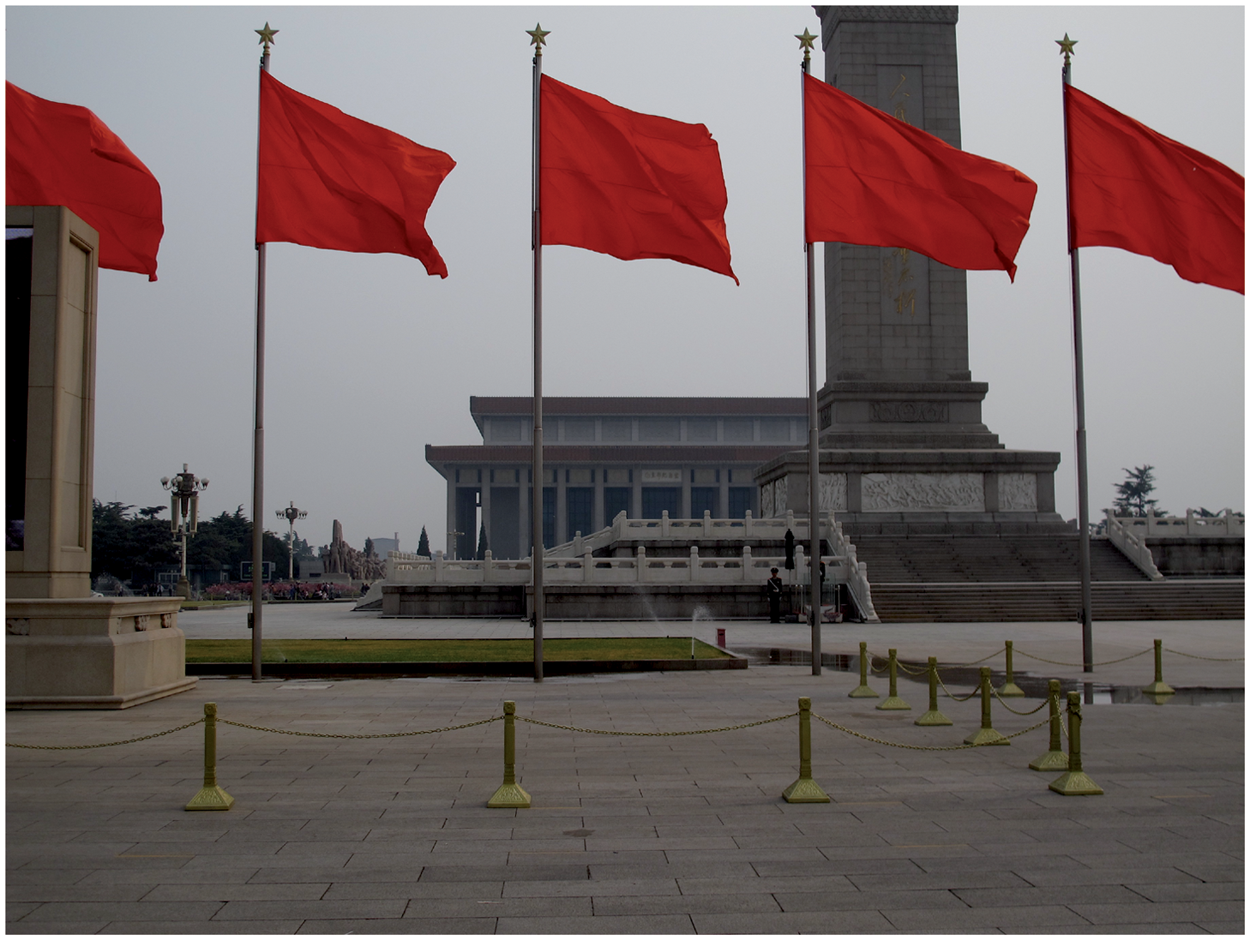
Street cleaner, Beijing, April 2011. Photograph courtesy of Kirsten Seale Flags, Tiananmen, Beijing, April 2011. Photograph courtesy of Kirsten Seale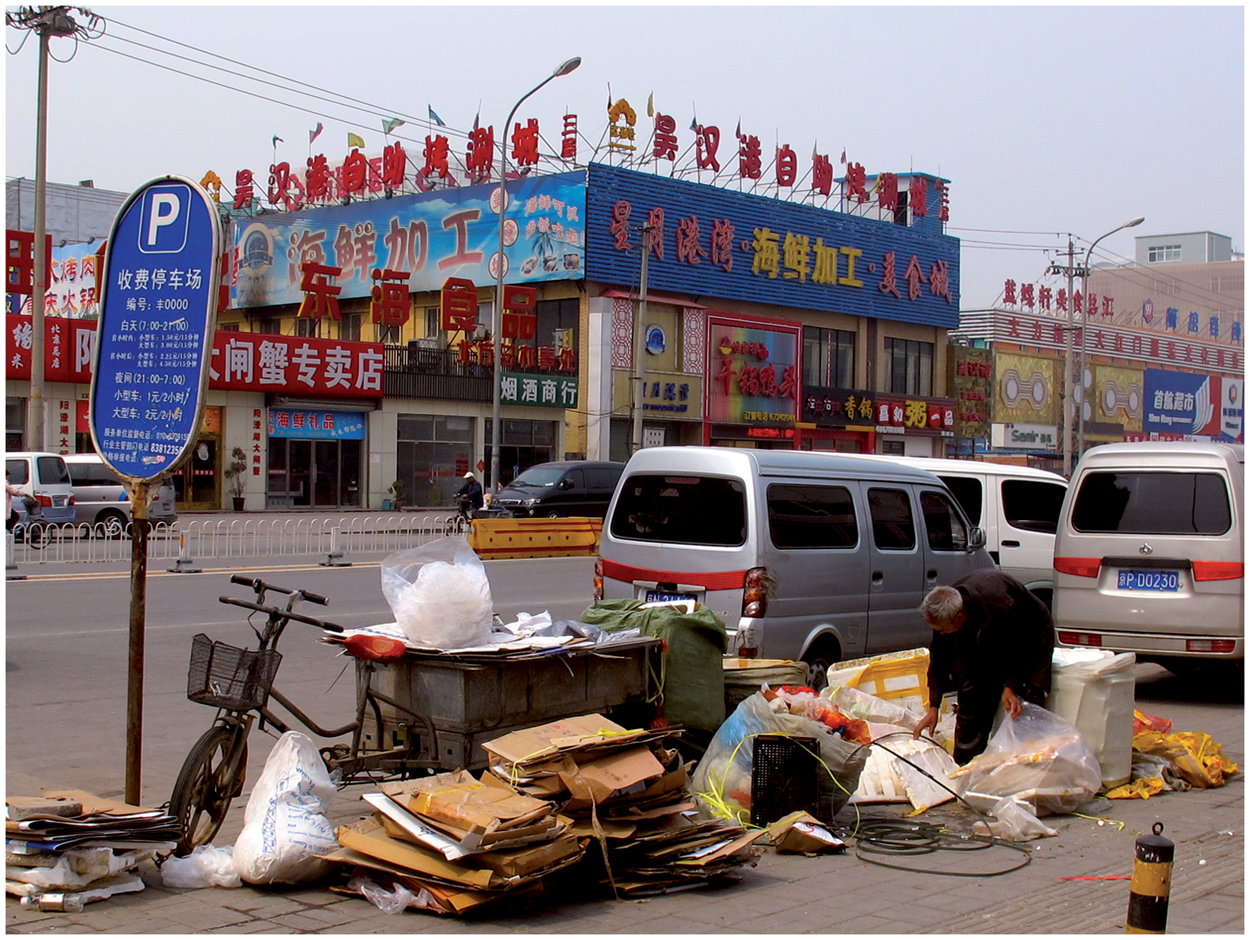
Coda
The discussion above indicates, I hope, that this is an evocative book. I do have some criticisms, but these are small matters of style and address. The vacillation between straight description, interpretive poetics, helpful international comparisons and scholarly quips is in part due to the main author’s easy familiarity with his subject, but it does pose a problem of emphasis and theoretical clarity. Concepts of the authentic, affect, community, public secrets, ‘we-ness’ are introduced with little explanation. Having myself spent time trying to come to grips with ‘public secrets’ in China (for instance), I was hoping for a discussion of how this book re-positioned the term, but found only confident re-statement and thus an ellipsis of the concept being deployed. Whilst the lack of contextual scholarship is very likely an editorial decision, as the book clearly aims for a wide readership, this reduction of theory to a passing phrase can be irksome. Likewise, the writing is sometimes utterly engaged and engaging (as in the passages on policewoman Hu and her flock), but there are also sections where the style becomes flowery, and occasionally the value of invoking other writers and oblique international equivalence is uncertain. ‘Let us take a leaf out of Benjamin’s book and follow the style of the copyist not back into the text, but for a walk down the street … ’ (2008: 85). Benjamin’s defence of the pedestrian-witness is a lovely piece of prose, but whether it is really justified or required to introduce the decision to describe Beijing from the ground up is debatable, or not demonstrated. The strengths of Beijing Time derive from the authors’ historical attention to the persistent relation between time and space in the management of urban populations and in the production of affect, from their lively but serious contemporary conversations with those who submit the narrative of their existence to a specific city fate, and their grounded insights into the contradictions of a city that is both highly managed and always surprising. In these achievements, Beijing Time makes the case for and against Beijing.
Footnotes
Notes
 ). She is currently working on a book on children in world cinema. [email: