







Abstract
One can use mathematics not as an instrument or measure, or a replacement for God, but as a poetic articulation, or perhaps as a stammered experimental approach to cultural dynamics. I choose to start with the simplest symbolic substances that respect the lifeworld’s continuous dynamism, temporality, boundless morphogenesis, superposability, continuity, density and value, and yet are independent of measure, metric, counting, finitude, formal logic, syntax, grammar, digitality and computability – in short, free of the formal structures that would put a cage over all of the lifeworld. I call these substances topological media. This article introduces elementary topological concepts with which we can articulate material and cultural change using notions of proximity, limit, and change, without recourse to number or metric. The motivation is that topology furnishes us with concepts well-adapted for poietically articulating the world as stuff, rather than objects with an a priori schema. With care, it may provide a fruitful approach to morphogenesis and cultural dynamics that is neither reductive nor anthropocentric. I will not pretend any systematic application of the scaffolding concepts introduced in this article. Instead, I would see what fellow students of cultural dynamics and cosmopolitics make of these concepts in their own work.
Mathematics as Poetic Material and Material Mode of Articulation
At a symposium on Deleuze and Whitehead 1 I proposed that one could use mathematics as poetry rather than as instrument or measure, or a replacement for God, or a conceptual battering ram. (I must confess, however, to some pleasure in Alain Badiou’s fearless and fierce polemic maintaining that mathematics = ontology.) Regarding mathematics as substance, and not merely a description of substance, shaping mathematics as poietic material in fact differs in kind from using mathematics to describe the universe as physicists see it. Part of the charm of FoAM’s responsive environment TRG (Kuzmanovic and Boykett, 2006) is its attempt to make palpable a concept of the world (recent quantum field theoretic cosmology) by forcibly identifying it with the perceptual field – a cosmic ambition. The artists could only begin to approximate this by restricting TRG to a very compact physical duration and place in Kibla, and by making allegorical simulations in software. Allegory makes the world of difference between depiction and enaction, perception and phenomenology. Allegory is allied with depiction because it makes a picture and a necessary gap between the picture and what the picture homologously represents; therefore it always implicates questions of knowledge, which devolve to questions of sense data. In that case, however, we are dogged by all the epistemological problems of language as representation raised since Wittgenstein and Debord to the present day.
This article is part of a larger experiment to use mathematics not as representations or models of some aspects or strata of the world, but rather as modes of articulation, especially poetic material modes, that consequently are adequate to life. It could be sharply different sorts of poetic matter: continuous topological dynamics, geometric measure theory, or even fancier stuff like non-commutative algebra and étale cohomology. But I propose to start with the simplest symbolic substances that respect the lifeworld’s continuous dynamism, change, temporality, infinite transformation, morphogenesis, superposability, continuity, density and value, and yet are free of or at least agnostic with respect to measure, metric, counting, finitude, formal logic, linguistics (syntax, grammar), digitality and computability, in short of formal structures that would put a cage over all of the lifeworld. I call these substances topological media. Simplicity is not a requirement of the theory (no Occam’s razor here) but merely an acknowledgement that I do not understand enough about the lifeworld to bring out fancier stuff yet, of which there is so much more up the wizard’s sleeves.
The fundamental difference in this approach is to use mathematics as substance in a workmanlike way, patching here and there to see what values ensue. I regard mathematics as a trellis for play, rather than a carapace, always sensitive to whether the poetic material accommodates transfinite, incommensurable, immanent passion. Totalizing carapaces like Stephen Wolfram’s computational equivalence principle, which at bottom is a transcendental atomic metaphysics founded on making counting sacred, would hammer us into a very sparse ontology. And to a hammer everything is a nail.
This article introduces modes of articulation with which we can articulate substance and infinity using notions of proximity, convergence, limit, change and novelty, without recourse to number or metric. For the moment, I will label these fields of concepts very loosely as: topology, and topological dynamics. 2 These concepts should honour the full density, richness and felt meaning of living experience. Mathematicians will note that for the sake of concision I am using these terms mildly but responsibly loosened from the contexts in which they traditionally have been defined. I will elaborate them more accurately as we proceed.
The motivation for this work is that topology furnishes us with concepts that are well adapted for alternatively articulating the world as plenum and stuff. Continuous topological dynamical systems are useful for articulating morphogenetic process. I should say that I will introduce more and less than what mathematicians call ‘topology’ – as introduced by Henri Poincaré (1892, 1899, 1902a, 1902b, 1904), L.E.J. Brouwer (1910, 1911, 1912, 1976) and Felix Hausdorff (1965) (see also James, 1984). More, because I will refer to fields of articulation and shared experience considerably more extensive than the mathematical purview of point set topology, such as cigarette smoking, songs and social migration. Less, because in this article we will spare the schoolbook approach and take a high road more akin to Gilles Châtelet’s (2000) treatment of mathematics via essential intuitions. Like Châtelet, I will respect the intuitive essences of the concepts and their derivations, which in mathematics take the form of logical (but not formally mechanized) proof. 3 Also, mindful of the problematic misunderstanding of earlier work by, for example, René Thom (1989, 1990), let me dissuade would-be scientists from enlisting topological theorems for mathematical modelling in its instrumental sense. And finally, I wager that the modes of articulation I introduce in this article for their poietic potential have implications for art, philosophy and engineering beyond the scope of the particular motivating applications in this article. However, I will not pretend to make a systematic application of all the scaffolding concepts introduced in this article. In fact, I should like to see what fellow travellers make of these concepts in their own work. (For a more adequate elaboration of some applications of this approach to a particular set of work in the confluence of media and performing arts, computational technologies of performance, and philosophy of process, see Sha, forthcoming.)
A Non-reductive Morphogenesis
I discuss the process of cultural dynamics always accounting for the radical entanglement of observer with the observed. This implies that descriptions of a situation or a process are always situated. (As Maturana and Varela said in Tree of Knowledge [1992]: everything that is said, is said by somebody, somewhere; [see also Maturana, 1987].) So, descriptions are articulations. Therefore, the mode of articulation matters. Topology provides an anexact (in Deleuze’s sense) mode of articulation, that does not need numerical measure, equations, exact data, statistics.
Speaking of human experience, one of the central challenges to anthropology and social sciences has been the contest between ‘quantitative’ and ‘cultural’ methods. Forty years ago, R. Duncan Luce, David Krantz, Amos Tversky and Patrick Suppes published a three-volume Encyclopedia of Measurement (Krantz et al., 1971; Luce et al., 1990; Suppes et al., 1989) for the social sciences that epitomized significant approaches to ‘measuring’ cultural and social dynamics, across a much more ample range of techniques than the statistical or numerically based models that typify quantitative discourse. Despite such an ample and encyclopaedic project, we can still advance the hypothesis that any sufficiently thick account of a human phenomenon, especially as a dynamical process, would be too dense to be adequately modelled by numerical models alone. This seemingly simple hypothesis evokes incompatible and equally certain responses. The incompatibility of those responses marks this as a proposition worth investigation. Against this hypothesis about the inadequacy of quantitative methods, techno-scientifically powered rationality demands rigor, prediction and generalization. Cultural, literary and historical approaches are rigorous in their domains, but compete with difficulty against the rhetorical and political strength of the predictive and general powers afforded by a system of quantitative measurement. Let’s call this debate about the adequacy of quantitive vs. qualitative methods the social scientific measurement problem.
In 2010, a European Union Framework-supported project called ‘A Topological Approach to Cultural Dynamics’ (ATACD) closed its three-year course with a conference in Barcelona with a very large range of responses to the challenge of understanding cultural dynamics, with techniques ranging over quantitative modelling, computational physics and design, and literary and historical methods. The diverse and energetic response demonstrated a wide recognition of the need for fresh approaches to the measurement problem, between absolute mutual rejection, or absorption of one by the other, which in the present age largely means absorption by quantitative and computational models.
This article introduces a handful of the most elementary concepts of topology as a contribution toward more generous articulations of cultural dynamics without number or metric, respecting the material and contingent features of social and cultural phenomena.
What is the methodological significance of such an approach? Rather than begin with a complex schema and observational apparatus, we can try to take a minimally scaffolded approach to the phenomena: minimal in language, and minimal in formal schema. As we dwell in the phenomena, site, event, we can successively identify salient features of the phenomena, and then successively invent articulations that trace the phenomena. We do not pretend at any stage to completely capture what we articulate. Indeed, as I wrote at the beginning of this article, I introduce these topological concepts and theorems not for the purpose of providing a truer model of reality or even of perception, but as a mode of articulation and, on occasion, poetic expression.
The most minimal mode of articulation available to us is the mode of collectives, sets. But bare sets are too bare and in fact offer grip to Russellian paradoxes in their bareness. The next simplest mode of articulation is the notion of proximity, the motivating notion for topology. In fact it is scaffolded by the more primordial notion of ‘open’ set, augmented by the set theoretic notions of intersection and union. Along the way, we avoid metric, numerical measure, for several reasons. A practical one is that, far from Galileo’s claim, most phenomena in the world come to us without numerical measure or metric. In fact, the move toward ‘data-driven’ applications confuses number-measure for the numbered thing, which is a desiccating move. We propose to try the topological as an anexact mode of articulation that retains as much as possible the wet, juicy messiness of the world, without the desiccating moves of metrizing, or premature orthogonalization.
There is a much stronger methodological potential: topological concepts can provide adequate grip so we can apply theorems as an artful propositional procedure, as Isabelle Stengers characterized Whitehead’s speculative philosophy fashioning out of concrete ontology ‘abstractions [that] act as “lures”, luring attention toward “something that matters”’ (2008: 96). 4 The fundamental point is that, typically, a mathematical theorem’s hypotheses do not need to be calibrated by numerical measure, nor in fact any ‘empirical truth’, and therein lies its potential for supple adequacy. In fact, the vast majority of mathematics avoids explicit numerical constants and explicit equations, and this is especially true of topology, as should be clear from the exposition I have given earlier in this essay. What this implies for future work is that we can make arguments that are both qualitative and definitive. For example, under adequate, qualitatively expressed conditions, we may be able to rigorously establish ‘qualitative’ phenomena such as periodicity, convergence and existence of maxima or minima, all significant in articulating cultural, sociological, historical dynamics.
The Case for Continua
Exploring the implications of a topological approach to a plenist, unbifurcated ontology, I am concerned with the question of how things emerge and dissolve with respect to their background. I use ‘thing’ mindful of several notions: (1) Latour’s (and science studies’) things, such as controversies that have left the lab and have entered into public discourse, not unrelated to (2) Heidegger’s ‘thing’, performing, gathering the fourfold: earth and sky, divinities and mortals; and (3) computer science/machine perception’s notion of an object that can be ‘inferred’ from sensor data. A topological dynamic approach offers a processual perspective complementary to these notions. A processual approach to experience calls forth memory and anticipation and, in a technologized world, mechanical analogues known as machine learning and machine perception. The holy grail of machine perception is to recognize a pattern with no a priori distribution, model, taxonomy, or context. This is analogous to upholding Derrida’s (1989) negative answer to the origin of intuition in geometry.
Continuous Topology, Topological Manifolds
Writing of speculative philosophy and art, the challenge is always to describe the notions in just the right degree of detail or concreteness. It’s not only the what but the how and why that we’re concerned with. It takes some judgement to estimate at what level of detail we need to stop, giving enough to offer the reader the conceptual grit and grip needed to make his or her own concepts, but not too much to obscure the essential ideas. Some editors may not recognize that, with technical concepts such as concepts of mathematical objects and related morphisms, one can err on the side of too much explanation. More detailed descriptions aimed at students (of all ages) of mathematics typically would stop the reader at the wall of notation. That said, Klaus Jänich’s (1984) uniquely vivacious book on basic topology could serve as a second reference for some of the articulations I propose. In mathematics, the how and why require us to go through the actual proofs. Understanding a proof may require years of meditation on a paragraph of mathematical writing. That said, I will present a proof only in order to advance and thicken the argument, rather than demonstrate the truth and force of a theorem.
Before we begin, I should emphasize that topology as mathematicians have developed it over the past hundred years comprises an enormous range of spaces, mappings, properties and concepts, immeasurably richer than the discrete, graph topology cited by computer scientists and their clients. (For example, B.C. Smith uses ‘topological’ in a typically loose way: ‘By “topological” I mean that the overall temporal order of events is dictated, but that their absolute or metric time-structure (e.g., exactly how fast the program runs) is not’ [1999: 6].) Graphs are a particular and relatively uninteresting class of topological spaces, but the vast majority of topological spaces are not graphs. For the purposes of this article, when I say ‘topological’ I will mean the general properties of the class of topological manifolds and not the special properties of discrete graphs. In fact, one of my strongest technical reasons for introducing the topological is to provide an alternative to all the figures in discrete sets and graphs. Topology is (much) more than graphs. 5
Examples
It may be helpful to keep in mind some working examples in which you, the reader, can check your developing intuitions about the topological concepts that I am about to describe. For each example, the fundamental question to think about concerns proximity: what do you consider to be a neighbourhood, without necessarily appealing to any numerical quantitative means.
Example: The Earth
One example comes from considering the geophysical boundary of our planet: where does the Earth end and space begin as one ascends into the atmosphere? One could apply all sorts of criteria. The point at which one loses consciousness in a rising high altitude balloon? The barometric pressure? The flux of ultraviolet light or cosmic rays intersecting a meter held in the hand? The visibility of the people waving goodbye? Take the atmospheric resistance, for example. A macroscopic body intersecting the atmosphere at extremely high speed (tens of thousands of miles per hour) and at a shallow enough angle may even glance off the atmosphere the way a rock can skip off the surface of a lake, but the same body brought slowly through the atmosphere will easily penetrate the atmosphere. So the manner in which one approaches the planet certainly affects the boundedness of the planet.
Of course, where the Earth ends and space begins is conventional, but the conventionality underlines the material fact that there is no sharp atmospheric boundary around the planet Earth.
Flows
A flow can be regarded as a set of trajectories, where each particular trajectory of a particle, γ[s], is a mapping from a scalar parameter into a given manifold γ : R → M. A second, less explicit, way is to consider not individual trajectories of flows but a model of how all possible trajectories are generated from a much more concise set of differential equations describing the flow as a whole, whose ‘solutions’ are the trajectories. In other words, the set of differential equations yields not specific numbers but equations as their solutions. So we move from the actual to the potential in a concrete way. In fact this mode of thinking is a germ of the intuition behind the paired concepts: actual/potential. Systems of ordinary differential equations are the heart of the theory of dynamical systems, which in turn provide notions constituting complexity theory, systems theory and cybernetics.
Now, even this description, however flexibly it unchains us from an unwarrantedly explicit description of material dynamical experience, is still too explicit, and subject to reification error, or what A.N. Whitehead called the ‘fallacy of misplaced concreteness’ (Whitehead, 1978: 21). In the absence of any concrete data about the ‘physics of materials’, that is, the constants of the model, analogous to constants of thermal or electrical conductivity, or the gravitational constant G, or the speed of light in electromagnetism, what can we say with rigor and warrant that on the one hand does not make unreasonably ‘concrete’ demands on description, yet on the other hand honours the phenomena in question? If we dispense with explicit equations also at this potential level of ordinary differential equations (ODEs), we can still, nonetheless, make provably certain statements about the behaviour of the possible solutions to a given system. Some qualitative but rigorously treatable features or aspects include periodicity, or the existence and uniqueness or structure of periodic trajectories (also called ‘orbits’). 6
We can articulate rich physical phenomena using notions like the wash of ripples along the banks of a river, the accumulation of leaves in the eddies trapped in the crook of a tree trunk fallen into the water, or more symbolic entities like the destinations of lanterns set out to float on the current, or the origins of a river and all its tributaries. The destination(s) and origins of a trajectory, regarded as limits as trajectory-time goes to infinity or negative infinity, can be regarded as limit events of dynamical processes.
Where’s the Smoke?
Stand a group of people in a room; ask someone to light and smoke a cigarette. Ask each person to raise a hand upon smelling the smoke. This seems like a reasonable way to empirically define where the smoke is. But notice several features about this experiment. The extent of the smoke changes with time. The extent is determined physiologically, situationally, phenomenally: different people have different sensibilities and each person may be more or less sensitive to smoke according to how much s/he thinks about the smoke. In fact, just asking people to smell for smoke primes their sensitivities. Therefore the smoke’s extent is an amalgam of the physical particles in motion, the people’s physiologies, and the phenomenological expectation set by the asking.
Songs
Imagine the set of all songs, alternatively defined as (1) performed live, with contingent warble, glide and rubato; (2) transcribed to a formal system of notes in a normalized and regularized set of pitches and durations; (3) paralleled and labelled by words: titles and lyrics; (4) as variations in air pressure – time series of acoustic amplitudes over time. Each of these characterizations enables quite different ways of considering what songs are similar to what. Consider yet another interpretation: (5) songs as a set of social practices whose cultural and micro-local meaning and value are inherited from local as well as non-local histories. A performance of one song also conditions other performances. In his history of Arab musical performance on the eve of the introduction of European notational, recording and distributional economies, El-Mallah (1997) describes how the recording and transcription of a particular performance freezes-in a canonical representative of a family of related song performances whose boundary is constantly re-negotiated by social practices. A key point here is that those social practices, however categorized, unfold boundlessly and endlessly in ways that I suggest are non-computable in essence. (To argue this fully would take us too far afield, so I refer to Penrose [1991] as one starting point.)
From Demographics to Events
Imagine the set X of all the life courses of people through time. (For this example, think of time conventionally as a unidimensional index of processes.) This is, in principle, a space of boundlessly many dimensions. Each point or element of this set X is itself a whole life course, a trajectory that could be arrayed along a literally boundless number of features: geography, wealth, bio-matter, movement, historical context, class, social fields and so forth. It is difficult to imagine how to compare lives against one another, and in fact one could well argue that any attempt to metrize the set of life courses unavoidably desiccates the experiences they singly and intersubjectively trace. Consider the flow of peoples into the United States over the past century, and consider how the state has attracted, admitted or excluded people along its borders. The life courses of all these immigrants vary infinitely, and we cannot follow these lives in their dizzying contingent crenulation. Indeed, how could we begin to think what lives are proximate, or related to which, and how some lives cluster or intertwine, while others remain forever distinct? In what senses can we understand ‘intertwine’, ‘cluster’ and ‘remain distinct’? How, aside from resorting to literary means of Dantean scale, can we articulate the set of all life courses, the ‘space of lives’? This example and the smoke example suggest a material, morphogenetic approach to socio-cultural dynamics. We will come back to this example, after we have absorbed some topological concepts.
Point-set Topology
The basic axioms of set theory include the notion of inclusion (membership), subset, intersection and union. What is already enormously powerful at this level of description is that there is no comment on the nature of a set, whether it is material or abstract, finite or infinite. There is no restriction at all on how a set may be defined. In a most fundamental difference with computer engineering, a set does not have to be defined by explicit enumeration. Much of the imaginary of the computer scientist is delimited by the notion of a finite, denumerable set {x1, x2, x3, … , xn} where n is some explicit, finite integer. But a set can be defined by a rule, such as ‘set of all real numbers’, or ‘the set of all moments of introspection’, or ‘the set of all pleasures’. It is set theory’s lack of structure (mass, dimension, colour, emotion, race, class, gender, religion, history, etc.) that makes it such an ample notion: anything can be in a set. And it is this very omnivorous nature of the concept of set that gave rise to the most significant crisis in the foundations of logic and mathematics in the early 20th century, instantiated by Russell’s paradox and the paradox of the set of all sets. But here I stop since my concern is not to explicate or repair set theory, but to pass on to fields richer than bare sets. In fact, the very enormity and brilliance of Badiou’s effort to construct a neo-Platonist ontology on set theory testifies to the sparseness of the theory which necessitates the effort. Just one step up from bare set theory takes us to point-set topology, the next sparsest set of concepts in mathematics, built from the raw material of sets, but now admitting more structure.
It may appear marvellous how what seems like the barest whiff of structure yields such a powerful set of concepts and theorems. But this should not appear any more surprising than Galileo’s Renaissance observation that the book of Nature is written in mathematics, if one regards mathematics from a Latourian perspective as a relatively high-level machine for the inscription of material processes (Latour, 1988).
In this article, we can only touch on the most elementary concepts and theorems, but even these seem fertile for our interests in philosophy of media, art and technoscience.
Point-set topology is one of the most primordial modes of articulation available to us, the open set is its most fundamental notion. It is even more primordial than counting. Primordial does not mean foundational, however: it means that no other compactly articulated concepts are ready to hand from which to construct an argument, in the given scope of reasoning.
We begin with point-set topology, not set theory, because, pace Badiou, I believe that set theory is too sparse to accommodate being in the world without severe distortions of our felt experience. Two observations to substantiate this belief: (1) Russell and Whitehead took hundreds of intricate, technical pages to establish from set theory alone the integers: 1, 2, 3,… as sets built out of the empty set: (ø, {ø}, {ø, {ø}}, {ø, {ø, {ø}}}…}. They prove theorem *102, that 1 + 1 = 2, after about 1000 pages of work. (2) In a tour de force effort, for which he received the Fields Medal, Paul Cohen established the independence of the Continuum Hypothesis from the Axiom of Choice. In our context, this demonstrates that the continuum is ontologically distinct from even the transfinitization of ordination, number, count.
The open set captures the notion of a set that welcomes members, and does not have a sharp litmus test for membership. In fact its most fundamental characterization is the following: If x is in the set O, then there is some complete neighbourhood of x entirely contained inside O. What are some examples of an open set? A mundane one would be from demographics. Say that we are restricting access to a movie theatre to people ages 13 to 17. At those boundary ages, disputes inevitably emerge: how close to the ‘edge’ may one be and still be admitted? If we were to say 13 and older, someone who is 12 years, 364 days, 23 hours, and 59 minutes old may argue that they are really already 13 up to the precision of clock technology. Let’s say we restrict to those who are strictly older than 13 and strictly younger than 16. Then one would have a margin, but an undefined sort of margin: any margin will do, so long as that margin is not nil. For example, one test could be for the putative theater-goer to pull someone who is younger, but provably older than 13. That would suffice.
A more nuanced example comes from the political economy of pharmaceuticals in Mexico. Anthropologist Cori Hayden (2007) has studied the complex and ever-shifting taxonomies of pharmaceuticals in Mexico, ranging from brand-name ‘originals’ to ‘generics’, interchangeable generics, and ‘similar’ drugs. She identifies brand-name originals (the ‘originator’ holding the initial patent), generic medicine (same compound, no brand name, not proven bioequivalent), branded generic (same compound, branded by generics manufacturer, not proven to be bioequivalent), interchangeable generic (same compound, bioequivalent), and ‘similar’ (non-bioequivalent copy). The last category is recognized by the World Health Organization, but not by Mexican health regulations. Indeed, a chain of pharmacies has been built along this last category, Dr. Simi’s Similares™. Hayden considers how similarity and equivalency are contested in Mexico among transnational pharmaceutical corporations, other retailers, advertisers and the public (itself a contested set of sets), where the norms of similarity are heterogeneous and politically contested. Numerical measurement is inadequate to the shifting but definite and perhaps overlapping regions of similarity in the world of these pharmaceuticals. 7
The rigorous concept of open set concretizes the notions of similarity and comparison from such examples. The conceptually deepest aspect of the concretization is that it leaves behind the concept of number, or, even more deeply, the very concept of in-principle-numeric measure. In other words, one does not need to measure anything using some metric (a distance, whether physical or ‘abstract’) or number in order to apply this test for openness. This concept of openness underlies the rigorous characterization of open set.
Especially in this article I qualify certain concepts or arguments as ‘rigorous’, meaning that they admit definitions that are sufficiently precise and arguments sufficiently verifiable to be accepted by mathematicians. Such concepts and arguments enjoy a particular mode of portability, shareability and re-usability similar to that shared by the perspectivally approached, aperspectival entities (objects and processes) of mathematics. I use such concepts not to box thought, but to sustain articulation, perhaps poietic articulation.
The open set is the most basic notion in point-set topology, but a set is never definable as open in itself; it is always defined relative to a topology, which is a set X of which U is a subset, together with a family of the subsets of X that are declared to be open. Which sets are declared to be ‘open sets’ is up to you, the designer of the topology, provided only that the subsets in this family satisfy the following.
Axioms of Topology
If A and B are open, then the intersection of A and B (notated A ∩B) is open. The arbitrary union of open sets is open. The total set X, and the empty set, denoted ø, are both open.
I wish to underline the openness of the concept of open set: given a set X – a universe – there is not necessarily a unique topology. More than one topology may be defined on a given set X. Every set X has at least two topologies. The coarsest topology is the one where the only open sets are X and the empty set ø. And the finest topology is the one in which all the subsets are declared to be open.
By definition, a subset C of X is closed if its complement is open in X.
An arbitrary subset U of X may be neither open nor closed. Take, for example, the set of points in the cone of half-open segments based at the origin of xi ≥ 0, but whose distance from the origin is strictly less than 1: (x1)2 + (x2)2 + ··· + (xn)2 < 1.
The main lesson here is that the art of a topologist, even at this elementary level, contains a great deal of creative flexibility, that there is no transcendental principle determining a unique topology for every set X. A topology is always a choice relative to a universe-set, satisfying some light conditions that enable a conversation built upon provable theorems. Note that the full space X and the empty set ø are both open and closed.
Certain kinds of topologies are more amenable than others to most intuitions. For example, you may expect that given any two distinct points a, b in X you ought to be able to find two open sets around each that do not meet, that is, that they can each be contained in their own bubble. But it may be that the elements (points) of a topology are all entangled in some way (e.g. if they are the rays that meet at the origin) and the set of sets declared ‘open’ is too sparse to separate these elements. One example of a very sparse topology would be the one in which the only open sets are the empty set ø, and the entire space X. No two distinct points are separated according to that pathologically sparse topology. (Mathematicians call such unpleasant and complicating situations ‘pathologies’, but have various ways to deal with them by construction and definition.)
Separability and Topological Spaces
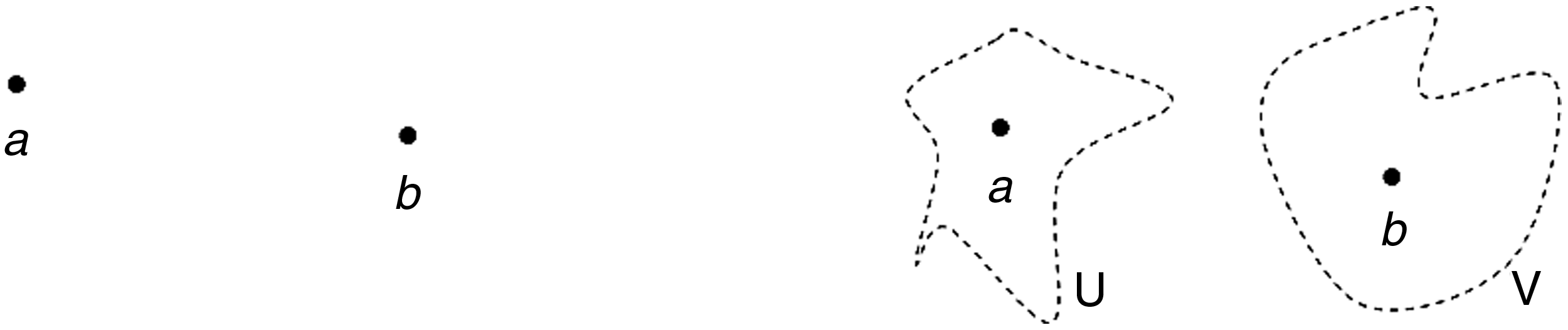
To exclude such pathologies, we use the following Definition: A space X is Hausdorff (separable) if any two points a, b, are contained in disjoint open neighbourhoods U, V; denoted: a ∈ U, and b ∈ V, U ∩ V = Ø. (See Figure 2.) Half-open cone in R2: it includes points on the vertical and horizontal rays. Figure by author. Hausdorff separability: any two points a, b, are contained in disjoint open neighbourhoods U, V, a ∈ U, and b ∈ V. Figure by author.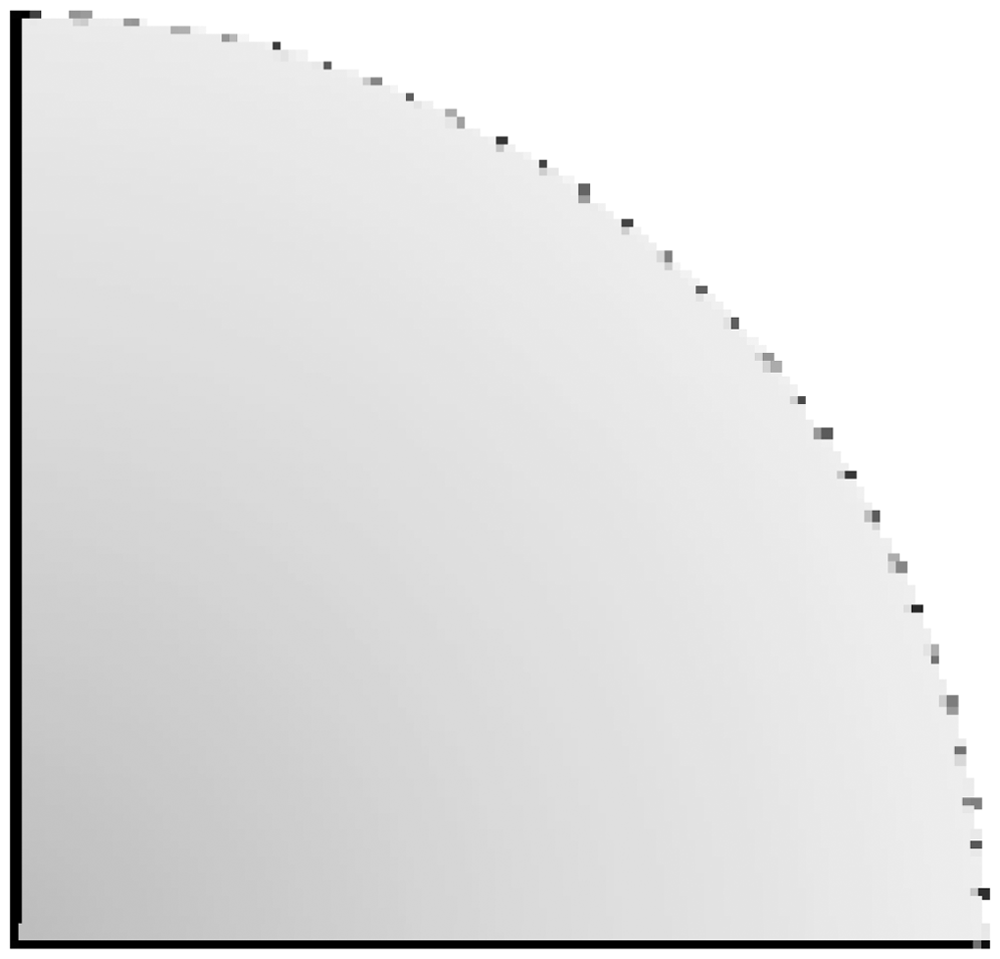
An Example of a Non-separable (non-Hausdorff) Space
Define a topology on subsets of Rn, called the Zariski topology, by looking at the zerosets of polynomials. For a polynomial P(z) there are only finitely many points z in Rn, for which P(z) = 0. Call this set Zeroset[P]. A discrete set of points is closed in Rn, so its complement is an open set. But any two complements of discrete sets of points meet as subsets of Rn, so no pair of points in Rn can be separated by disjoint open sets in the Zariski topology, the family of sets that are defined to be open with respect to the Zariski topology of complements of zerosets of polynomials. (As an exercise, consider the space of all songs that are fixed by a finite set of word-positions, or named-pitches in fixed positions in the melody.)
Inducing a Topology: Revisiting Ellis Island
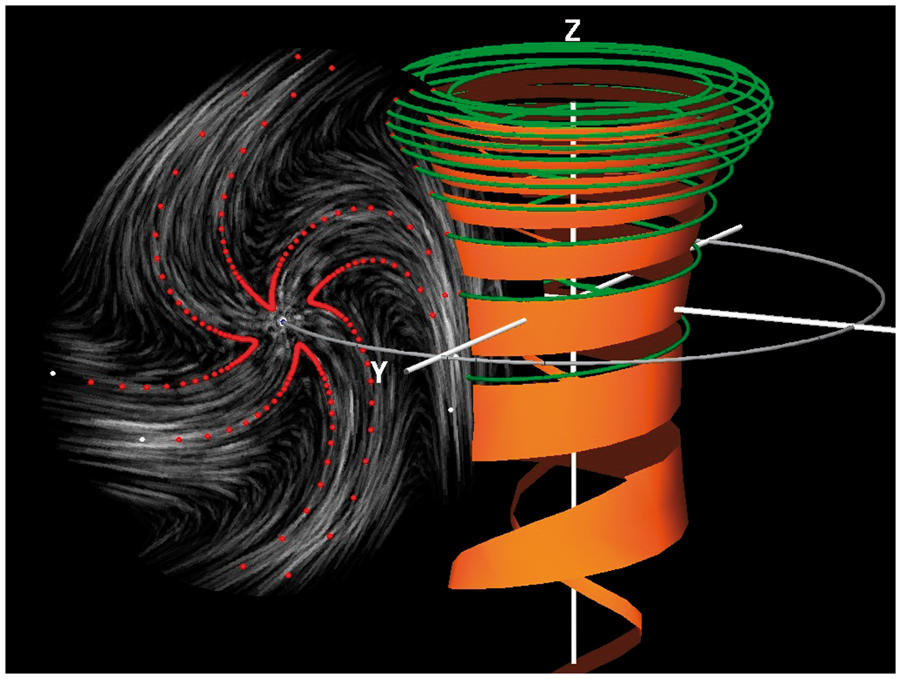
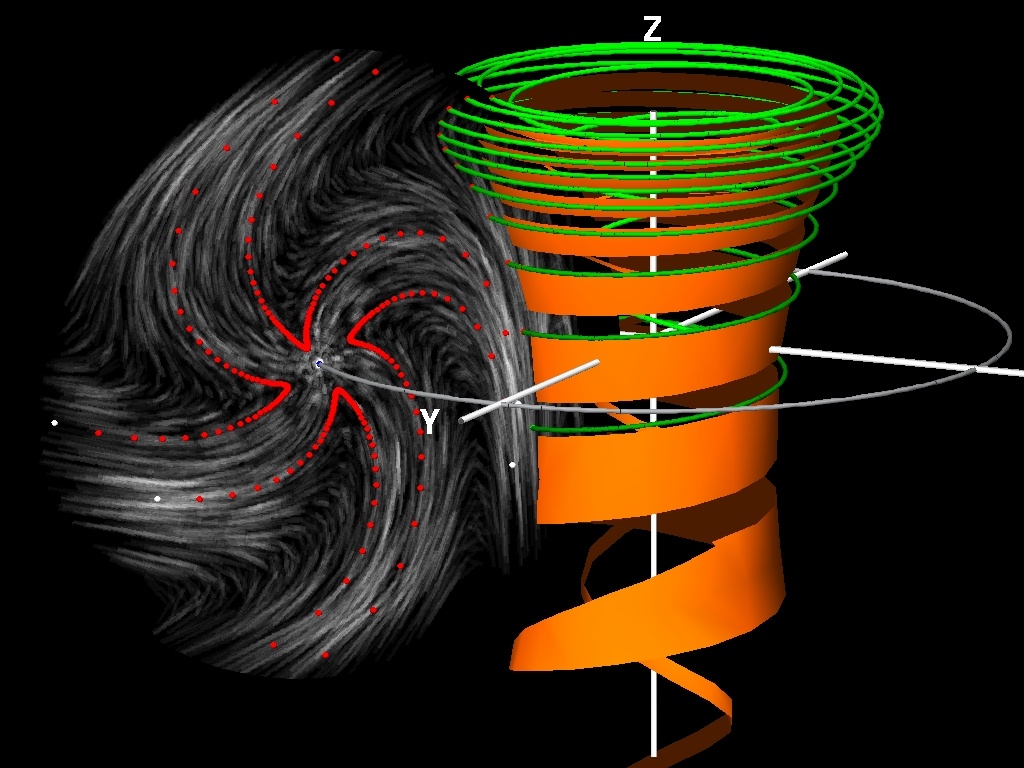
Consider again the flow of peoples into the United States over the past century, but consider an iconic slice through the flow of peoples at the event of their entry through the US Bureau of Immigration center at Ellis Island, New York. Consider the event of being examined by the state and given some status as an immigrant to the nation. In terms of topological dynamical systems this amounts to taking a transversal slice through the flow. This slice is called the Poincaré section (see Figures 3 and 4). (There is a constellation of concepts in differential topology and dynamical systems with which we can make this as fruitfully rigorous as any mathematical theory.)
And imagine some groupings that make sense in such a transversal section to the flow of lives through that place and event. Groupings could arise from one of any number of features: with whom one rubs shoulders in the waiting room, religious practice, exhibiting a medical syndrome, wealth or class, and so forth. Each choice associates the people into different collections of groupings and proximities, by no means spatial or metric. Consider colouring the life courses that run before and extend beyond this event according to some particular grouping. We can in principle colour the life courses by how they grouped on a particular day on Ellis Island. In the words of a student of topology, a topology on people intersecting the Immigration intake facility induces a topology on the set of life courses (see Figure 3). Definition: A point z is a limit of an infinite sequence of points z1, z2, … , if for every neighbourhood U containing z, there is some integer N, for which zi are ∈ U, for all i > N. In other words, no matter how you restrict attention around this point z, after ignoring finitely many points in the sequence, the remaining members of the sequence are all contained in the neighbourhood U. Theorem: Limits in a topological space X are unique if and only if X is Hausdorff.
8
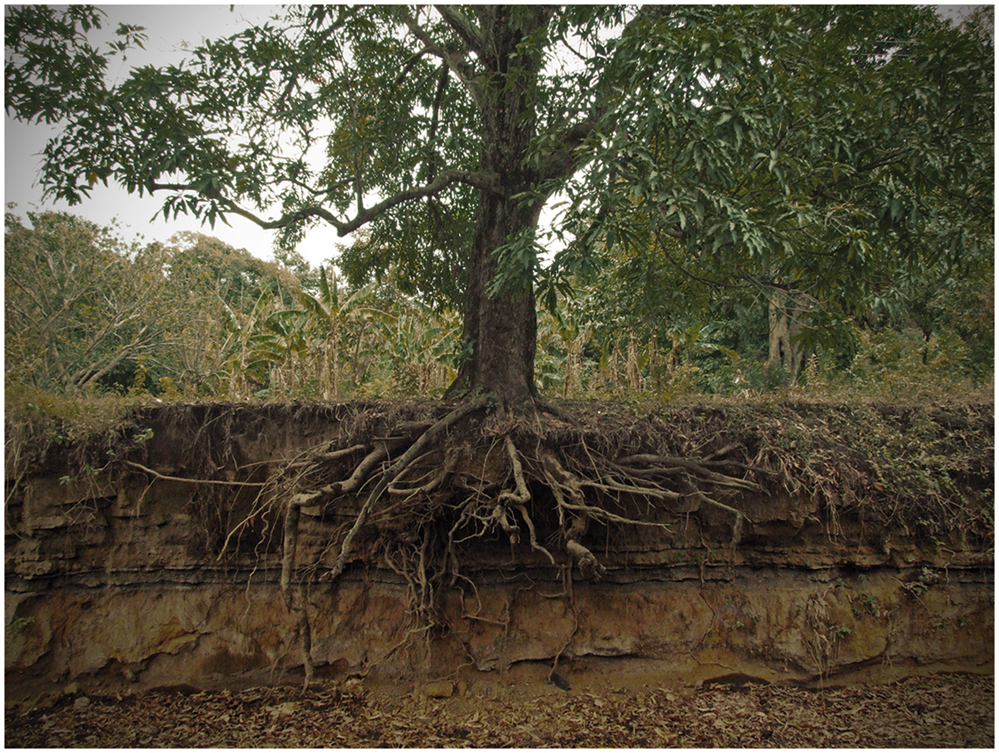
Proof. We prove one direction: X is Hausdorff implies that limits are unique. Suppose x and x’ are each a limit of the sequence z1, z2, …. Let us suppose that x and x’ are distinct. We will show that this yields a contradiction. Since X is Hausdorff, we can find disjoint neighbourhoods U containing x, and U’ containing x. Consider U. By definition, there is a ‘tail’ of the sequence z1, z2, … entirely contained inside U. In other words, there is an integer N such that all zk, for k > N are contained in this neighbourhood U. But the same is true for U’: there is a tail with an associated threshold index N’ of the sequence z1, z2, … that is entirely contained in U’. Looking far enough out along those tails, we arrive at points zk that must lie in both U and U’. (Just choose the index k greater than both N and N’.) But then U and U’ are not disjoint. This contradiction shows that the hypothesis that x and x’ are distinct is untenable. So limits are unique. QED. A Poincaré section through life courses as paths. Figure by author. A Poincaré section through the flow of a dynamical system. Source: H. Löffelmann, T. Kucera and E. Gröller, ‘Visualizing Poincaré Maps together with the Underlying Flow’. Available at: http://www.cg.tuwien.ac.at/research/vis/dynsys/Poincare97/yellow.1024x768.fc.jpg (retrieved 24 May 2012). Tree – arboreal; roots – rhizomatic; dirt – substrate. Source: Available at http://upload.wikimedia.org/wikipedia/commons/6/60/Tree_roots_cross_section.jpg (retrieved 1 June 2012).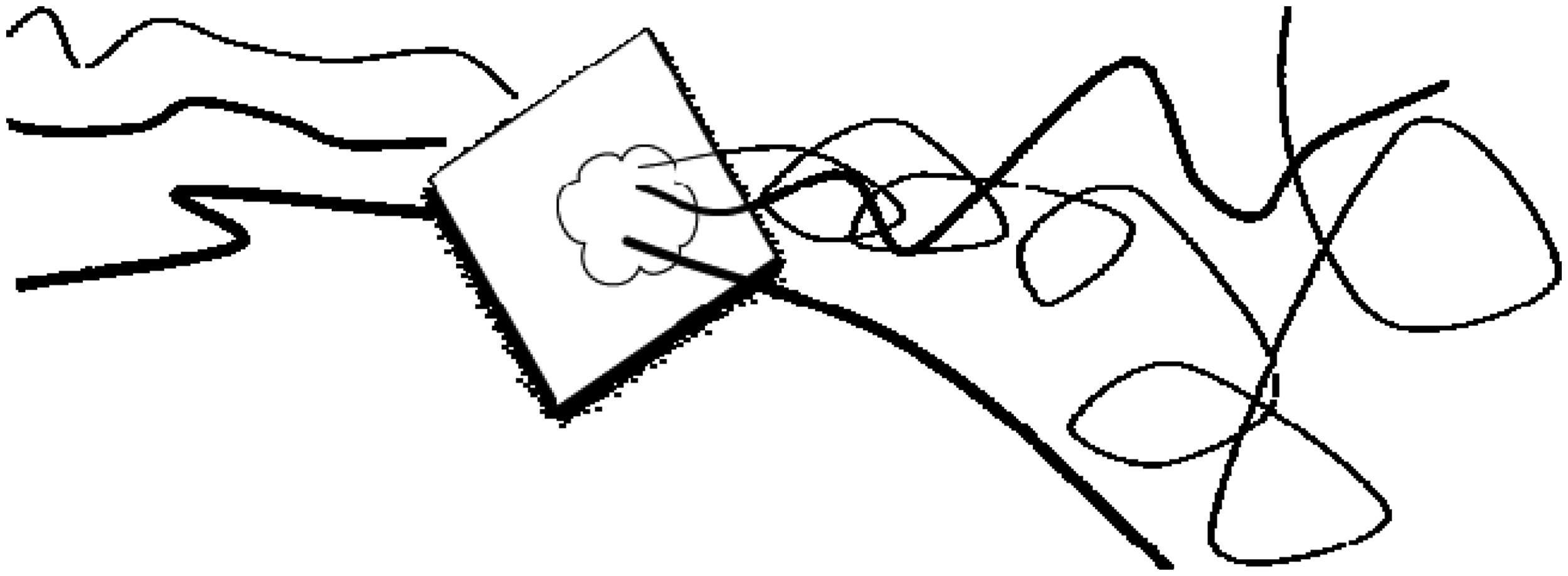

Returning to our demographic example, one could have a topology on the space of life courses that is not Hausdorff. This means that no two distinct life courses are contained in their own, disjoint neighbourhoods. For example, some ethical theories could amount to arguing that each open set of life courses overlaps with every other set of life courses. However, if the topology is Hausdorff, then if an infinite (or practically infinite) sequence of life courses has a limit – if there is some particular life course around which an infinite (boundlessly many) set of life courses cluster – then that limit is unique.
Notice that we can use the proof of the theorem in fact as the sketch of an argument, because the concept and the proof are quite supple and general. They rely on no notion of metric, no numerical measure, no data. Most significantly we have a mode of articulation of changes of state with no requirement that change be arrayed according to a unidimensional index called time, nor any dimensional index at all. Therefore the argument can be used in a great many material dynamic situations.
Covering, Basis
Given a subset Ω of the topological space X, a covering of Ω is a collection of open sets in X such that their union contains Ω. It is key that the sets be open in X. A covering does not have to be finite (or even countably infinite). For example, any subset S of a metric space, no matter how pathological (imagine a monstrously heterogeneous cloud of shards and dust like the set A in Figure 6), has a covering. Just take for the covering a set of epsilon balls centred on the points of S: S ⊂ ∪z∈S Bi (x). There are as many balls as there are points in S, so if S contains an uncountable number of points, then this covering has an uncountable number of balls. It does the job, but extravagantly, transfinitely.
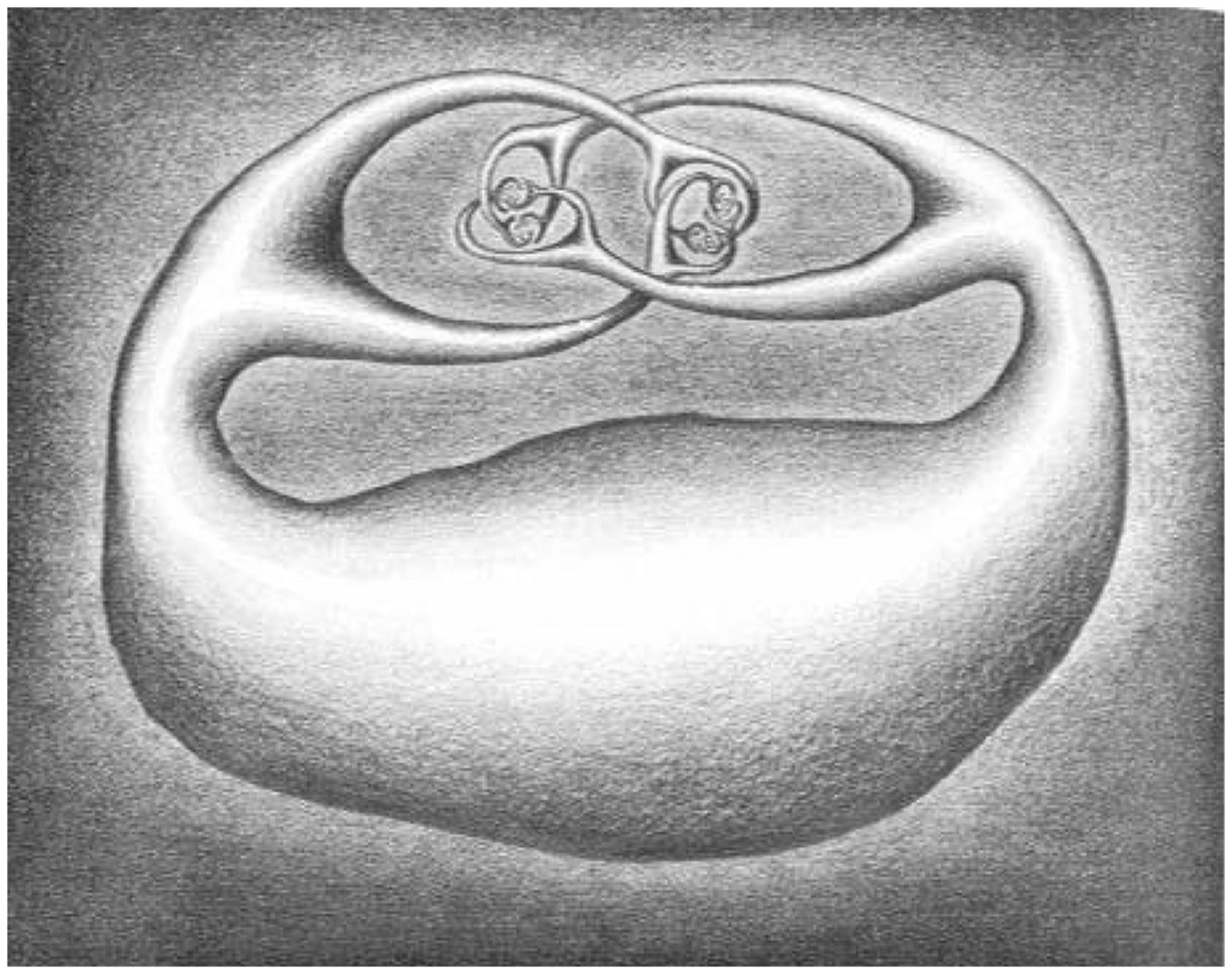
Covering a set A with a family of open sets S1 ∪ S2 ∪ …. Figure by author. Alexander’s Horned Sphere, defined by an infinite nest of ever-finer pincers, cuts R3 into two components, one of which – the exterior – is not simply-connected. Source: Notes on Algebraic Topology, by Andries Brouwer, aeb@cwi.nl,v1.0, 991111, http://www.win.tue.nl/∼aeb/at/algtop-5.html (retrieved 24 May 2012). Lie group action on manifold M, lifting to their respective tangent spaces TM and Lie algebra g. Figure by author.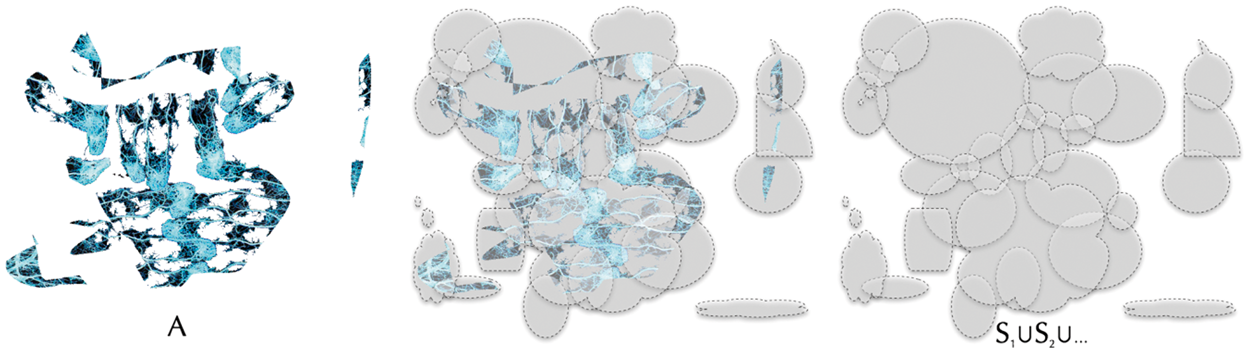
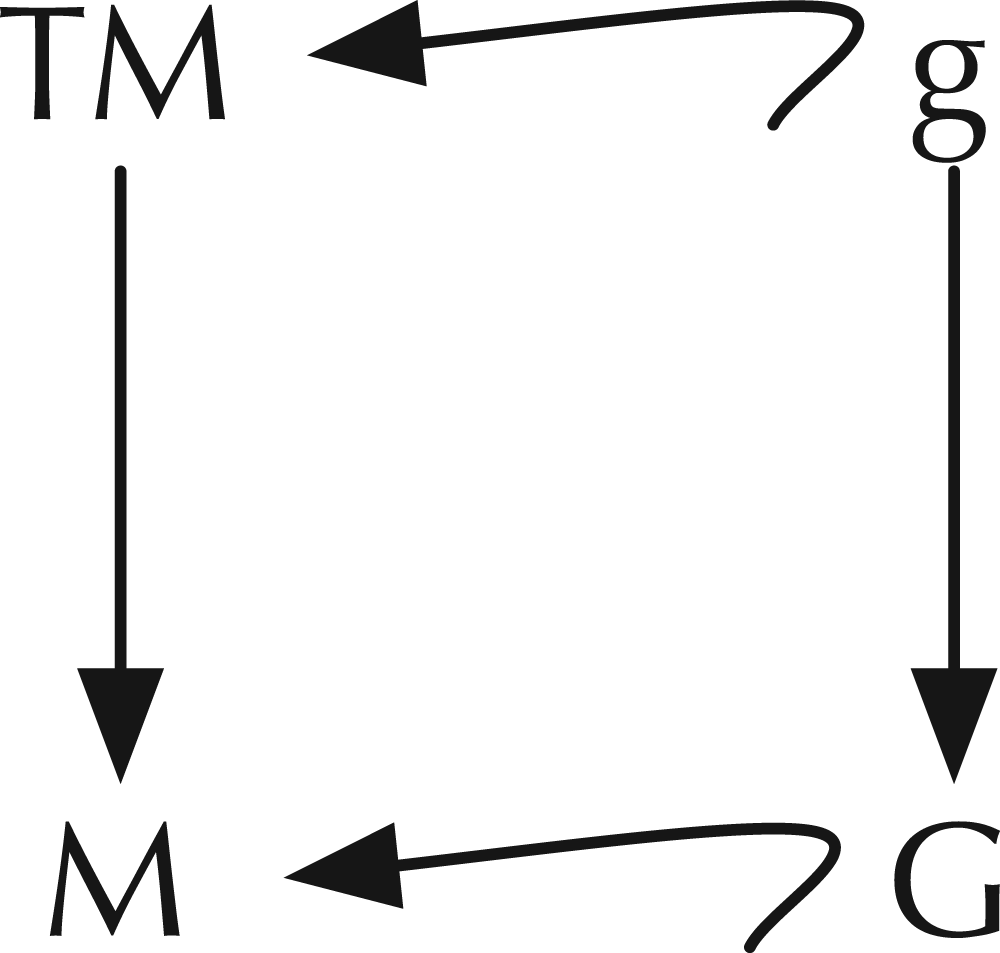
A basis for the topological space X is a family of the open sets in X such that every subset of X has a cover comprising elements from that family. There can be more than one basis – usually an infinite number of bases – for a space X relative to a given topology.
Examples
Exercise: Consider the topology T1 generated by open discs. Compare it with the topology T2 generated by infinite strips. In other words, is every set that can be covered by an open set in T1 also covered by an open set in T2?
Notice that these notions of openness and covering do not require any notion of dimension, so they are more primordial than dimensionality. A topological space does not have to have the property of dimension! But in the case that our topological space is indeed dimensional, in particular if it has the structure of a vector space like R3, then we see that there is some deeper relation between a set’s characteristic of being an open set and its dimensionality. Two-dimensional, in particular planar subsets of R3 cannot be open in any topology on R3.
Topological Vector Spaces
A vector space V is a set that has the structure of Rn, in other words its structure is isomorphic to the product of n copies of the real number line R. Therefore any element of such a space V can be indexed by an n-tuple of real numbers, that is, a vector of dimension n: <x1, x2 … xn>. Although a vector space may seem canonical in man-made parts of our world – witness the prevalence of table-based relational databases in our informatic technology – in fact, the ubiquity is itself an artifact of the convenience of a particular form of linear algebraic thinking.
Not All Topological Spaces Are Vector Spaces
A set (space) may not have any features that resemble a vector space. Christopher Alexander (2002: 143–242) identified 15 fundamental properties that appear over and over again in built spaces that have vitality. The more shape-oriented of these patterns include: interlock, border, good shape and, most importantly, centre. Of course, the space of features that build vitality is infinite and infinitely nuanced, and much more specific in every concrete instance, so how can we interpret Alexander’s 15 patterns? One way is to see them as a basis in a subspace of the topological space of patterns of built structure. Certain patterns are indeed geometrical, or more accurately have to do with spatial relations such as degree or diversity of spatial rhythm, or the propensity to develop centres of tension or attention. Notice that, as is clear with the ‘smoke’ example, these patterns intrinsically intertwine the observer with the observed. Moreover, we do not necessarily have any notion of scaling a pattern, for example, a way to multiply the number of centres by some numerical constant, or otherwise numerically quantify a pattern.
So, while Alexander’s ‘space’ of patterns does not seem to have the structure of a vector space (e.g. a structure of patterns naturally homomorphic with a notion of addition and of scalar multiplication), we can still interpret the foundational character of Alexander’s 15 patterns in the sense of a covering generated by a particular family of patterns (subsets) in the space of all patterns of living in the built environment. But in order to articulate such a topological approach, we would need to articulate the intersection and union of two patterns. One obvious interpretation would be to logically combine them; for example, a design configuration that exemplifies both ‘good interlock’ and ‘no two parts the same’. But another interpretation could be to first apply the operation of making a design have more interlock, and then to further individuate series. Indeed, given that Alexander emphasizes that his patterns are actually transformations rather than particular forms, the second interpretation could be a more plausible approach to topologizing an Alexandrian space of patterns. In that case, an open set of patterns would actually be an open set in the topology of transformations that can be applied to a built structure at a site. Again, recalling that there can be many topologies depending on the situation, we can retain a more supple approach to architectural design.
This emphasis on transformation, rather than ‘things themselves’, plus our previous discussion of dynamical examples, motivates the notion of mappings of topological spaces as a mode of articulation of material dynamical processes.
Mapping
Given topological manifolds X and Y we can define maps (aka functions, mappings) from one to another, f: X → Y, as an association of elements of X and elements of Y: to every element x in X (written x ∈ X), we associate an element labelled f(x) in Y. The only condition is that the result of applying the mapping f is well defined; that is, that the result is determinate and unique for the given x. A rigorous test: if f(x1) ≠ f(x2), then x1 ≠ x2 for any x1, x2 in X.
Given two topological manifolds M and N, consider the set of all mappings that in some sense respect the topological structure of these spaces. Approximately put, such mappings should carry open sets in the domain space M to open sets in the range space N. We call such mappings continuous homomorphisms, and we label the set of such mappings Hom(M,N). One particularly interesting, infinite dimensional subspace of Hom(M,N) is the set of differentiable maps Diff(X,Y) of differentiable maps from X to Y. (To define that requires some calculus, but for now, we will say that in the case X and Y are vector spaces, a differentiable function, at every point x, has some local approximation by a linear mapping.) 9 On top of Diff(X,Y), we can define further a mapping defined not on the base spaces X and Y, but on the function space Diff(X,Y). We’ll call such a mapping an operator to help us remember that it maps a mapping to a mapping. An important example would be a differential operator like ∇ that maps a function f to its differential, a linear mapping ∇f from TM to TN. This provides an enormous expressive range to any analysis of transformation and functional change. You can see that this allows us to lift the discussion of mappings to a tower of structures, or to higher order operators.
Computer engineers, cognitive scientists and their clients in cultural studies or social sciences are typically quite cavalier about the domain or range of a mapping. But in order to make sense of a map f, it is necessary to ask: What is the domain of f? What is its range? For example, following George Lakoff one could define metaphor as a ‘structural homomorphism’ from one cognitive domain to another. But what does that mean? What is the structure? What is a cognitive domain? Is it like an open set in a topological vector space? If this metaphor is supposedly a map called, say, f, is this map non-trivial: Image[f] ≠ ø? Is it even well defined: f(x) ≠ f(y) => x ≠ y? One expects that a metaphor, if indeed it can be regarded as mapping, can certainly associate one entity to two or more entities, therefore such an association is not a well-defined mapping. So it is not clear what space, domain, mapping, or homomorphism mean, but it could be a fertile exercise to pursue this question furnished with topological concepts.
Continuous, Connected, Simply Connected
Gottfried Wilhelm Leibniz, one of the authors of the view of matter to which I am subscribing in this work, introduced a material law of continuity, which he described in a letter to Fontenelle in 1699: the law of continuity that I believe I was the first to introduce, and which is not altogether of geometric necessity, as when it decrees that there is no change by a leap. (Leibniz, 2006: 137)
This prototype criterion of connectedness induces in the imagination a transformation, a mapping, from one set, the interval, into another set, a curve that may be broken or unbroken. It is a subtle and profound shift of conceptual register to turn our attention from sets to the transformations of sets, to what is called a space of mappings. To articulate continuity, we really are asking a question not about a set (an object) U ⊂ X, but a mapping (a transformation on objects) between topological spaces, say φ: X → Y. In this case, we say that a mapping φ from topological space X to topological space Y is continuous if and only if the pre-image of any open set in its range space Y is open in its domain space X; mnemonically, ‘φ−1[open] is open’ – the pre-image of an open set is open. This is a considerably more expansive and supple test than trying to draw a curve in your imagination. This was one of the more subtle conceptual moves in the history of 20th-century mathematics, whose philosophical consequences we are just beginning to consider with this article. Such a concept of continuity offers us a way to begin to articulate continuity in the full extent of felt experience of the world without any recourse to metric or dimension.
Nonetheless, this notion of continuity agrees with the more familiar, restricted, metric concepts of continuity. For example, in the case of the real line R, a classical formal way of describing continuity is to use the ordinary Euclidean distance derived from absolute value on R. Here is a definition of continuity for functions of the real line that uses the notion of a metric: f is continuous at a point x0 if for all ε > 0 there is a δ > 0, such that | x − x0 | < δ => |f[x] − f[x0] | > ε. (Glossing this more fully in English: If a point x is within distance δ of the fixed point x0, then the value of f at x is within distance ε of the value of f at x0.) The function f: R → R is called a continuous mapping if it is continuous at every point x ∈ R.
We can apply what mathematicians colloquially call an ‘epsilon-delta’ characterization of continuity to any function of the real line, but this requires at least some way of measuring the distance between any two elements of the set. You should draw some diagrams and convince yourself that this epsilon-delta definition of continuity agrees with the more purely topological notion of continuity. In other words, if a function mapping R to R is continuous in one sense, then it is continuous in the other sense as well, and conversely.
However natural this has become since Newton, a metric measuring the distance between any two elements of a set is often not evident in social and cultural phenomena. Moreover, demanding or imposing a metric introduces artifacts with political implications. Topology does not require a metric. Theorem. The image under a continuous map f: X → Y, of a connected set K is connected. Proof: Suppose not. Then there are two disjoint open subsets of Y, call them V and W, such that the image under f of K is a subset of the union of V and W. (Written in more contemporary concision: f[K] ⊂ V ∪ W.) Since f is continuous, by definition, the inverse images of V and W with respect to f − f−1[V] and f−1[W] – are both open subsets of X. We’ll prove that these are disjoint, and cover K, which will contradict the hypothesis that K is connected. To show these two pre-images are disjoint, suppose p is a point in their intersection. But then f[p] is in both V and W, which cannot be the case, because V and W are disjoint. Therefore, their pre-images are also disjoint. Next, take any point m in K. By our hypothesis, the image point f[m] must be in either V or W. Therefore m is in the pre-image of V or of W with respect to f − f−1[V] or f−1[W]. In other words m is in the union of f−1[V] and f−1[W]. We’ve shown that K is covered by these two pre-images, which are disjoint, open sets. This contradiction implies that our hypothesis must be false. Therefore f[K] is a connected subset of Y. QED.
Toward Topological Dynamics as an Approach to Social and Cultural Morphogenesis
Let us pause to see where we are and where we are headed. Based on some primordial concepts of open set, topology, basis, mapping, continuity, we have built up a miniature theory that allows us to describe phenomena in qualitative terms and make definite statements about them. These statements, being axioms and theorems, hold in all the situations where we have checked that the three basic conditions for a topology are satisfied. They are propositional in Isabelle Stengers’ sense. Now we head toward building a trellis for describing dynamical systems, which are usually introduced as systems of differential equations, using such qualitative articulations. On one hand, we will be able to give a more delicate and concrete nuance to flow, change and becoming than what Deleuze and Guattari explicitly described, and on the other hand, we do not bind ourselves to numerical empiricism or to reductive forms like graphs. We are not furnished yet with the concepts to articulate these intuitions in detail, so we will defer this for a more complete description of dynamical systems and process another day. At the very least, we should recognize that the classical figures of the line, the circle, and the sinusoidal wave are not adequate to the temporality of human experience and phenomena. To more adequately address this takes us to a forthcoming work. 10
So what, in sum, have we encountered from the beginning of this journey? (It is only a beginning.) We have a non-ego-based, number-free and metric-free account of experience that respects evidence of continuous lived experience but does not reduce to sense perception or ego-centred experience. We have an essential concept of continuity both as a quality of lived experience and as a mode of description of such experience. We have here the seed of an approach to poiesis and expressive experience that is ‘non-classical’ in the senses of quantum theory and measure theory, avoiding recourse to stochastic methods, statistics and informatic sweepings of the lifeworld under the rug. Yet because topological articulations admit metric measures as special cases, we can commensurate dynamical processes with metric, numerical measure when it is warranted, justified and practically feasible. Furnished with a topological alternatives to, or thickenings of, quantitative methods, we can, through particular studies such as the other contributions in this issue, build a new set of methods for cultural analysis that on the one hand mesh analytically with quantitative methods and on the other are more adequate to qualitative change, multiplicity and complex dynamics in culture. Consequently, we have the possibility of a radically de-centred, de-anthropomorphized concept of experience and cultural dynamics. This avoids methodological and critical problems with reductive modelling and the more canonical interpretations of phenomenology. And it provides a conceptual trellis for the condensation of subjectivity in the endless exfoliation of experience in the world.