







Abstract
Bashir Makhoul’s Beijing installation Enter Ghost, Exit Ghost is a maze made out of lenticular images of a Palestinian village that leads to a stack of cardboard boxes that could be a town, a military training camp, or just a heap of damaged packing containers. This article reads the installation through an initial misrecognition, seeing the boxes as a version of ancient Anasazi cliff dwellings. This displacement, where one place recalls somewhere else, is pursued through a discussion of W.J.T. Mitchell’s reflections on comparative ‘promised lands’, Israeli artist Larry Abramson’s notion of abstraction as camouflage, Eyal Weizman’s analysis of simulated battle-spaces, and Mark Twain’s critical reading of desert spaces in the western US and Palestine. The article argues that Makhoul’s work calls up a series of associations between times and places that speaks not only to the specific (Israel/Palestine) but to a broader global hermeneutics of empire based on symbolic overdetermination and strategic concealment and erasure.
Misconstrued
The first time I saw the stack of cardboard boxes heaped up in the corner of the Yang Gallery in Beijing, the ostensible destination at the end of Bashir Makhoul’s lenticular maze, I thought of the Anasazi ruins at Mesa Verde in Colorado. 1 This was an immediate visual response to the sand-coloured boxes, black square-cut holes, and irregularly heaped forms, something to do with the way they fitted the space, pushed up into the corner and crept up the wall until they teetered near the ceiling. The famous Mesa Verde cliff dwellings are tucked into caves under overhanging rock, wedged in and merging with the space. Like Makhoul’s boxes, they are reliant on the surrounding physical environment for support, their arrangement configured by the structuring shape within which they are placed. And, again like Makoul’s boxes, the cliff dwellings are empty. While the Anasazi lived in Mesa Verde for nearly two thousand years, they mysteriously disappeared around the end of the 13th century. For some time the common explanation for the disappearance of the people was simply that severe drought had driven the Anasazi to new lands, though more recently archaeologists have suggested that religious or political strife may have been decisive factors in the migration. In the absence of a written record the abandoned dwellings have long stood as troubling evidence of a lost people and a ruined civilization. Here in Beijing, a city of walls and absences, of invisible strife and hidden power overlaid with the spectacular surfaces of commercial uplift, Makhoul’s Middle Eastern maze recalls and repeats patterns of habitation and evacuation, of power’s dilations and contractions, that are both geographically and historically specific yet disturbingly consonant across continents and centuries.
There is no good reason for comparing an art installation intended to represent a Palestinian village with the ancient dwellings of the southwestern United States. Yet the momentary, unanticipated relation between the look of one place and another is not easily controlled, nor is the memory of this initial reaction readily forgotten. Reading some sort of supporting documentation in advance might have blocked or muffled this kind of semi-automatic associational response. Equally, a geographically specific gesture in the title of the work would have steered reception of the boxes toward a sense that they have something to do with the Middle East. Enter Ghost, Exit Ghost does not provide these clues, instead leaving the door open for an exhibition in China about Israel/Palestine to call up the American West. That there is an autobiographical element to this I am willing to admit, since I have a longstanding research interest in western American landscape photography and am familiar with many of the well-known photographs of Mesa Verde. Understandable, then, that the link I make with Makhoul’s artwork is to familiar images of ancient American ruins. But what interests me about this somewhat lazy leap between continents and contexts on the mere grounds of a confluence of tonal value and form is how easy that move is and how common. One thing looks like another, one place folds into another; time and place are collapsed, contexts are non-existent, the connection between visual stimulus and individual memory has been activated: too late, forget Palestine, here is Colorado. The visual is seemingly beyond legislation and will spark associations that do untold damage to coherent narrative, historical significance, and political analysis. But this is not to argue for an impressionistic, subjectivist, dehistoricized account of the phenomenology of perception. Instead, what unanticipated associational leaps like the cardboard box = Mesa Verde equation can do is hook things together in ways that reveal something powerful about the open provocation of the artwork unprotected by explanatory textual support. Furthermore, the yoking together of new visual information with remembered shapes, scenes, or places draws the unfamiliar into an intimate proximity with the known, not so much to make it safe but to bring it up close and to append it to the vocabulary of forms already in use.
Writing about his early experiences of visiting Israel, W.J.T. Mitchell explains how the desert landscape reminded him of another desert, the space of his boyhood in Nevada. This is ‘a real place in my own memory’, explains Mitchell, but ‘also imaginary’ because it is a Nevada populated with the dinosaurs, cowboys, and communists of youthful narrative and speculation: ‘I still carry this landscape with me as memory, fantasy, and recurrently visited dream place’ (2000: 201). While his first visit to Israel in 1970 reminds Mitchell of this ‘mythical’ Nevada of the Gold Rush, his second visit in 1987 recalls ‘Los Angeles in the sixties, a suburb gone sour, a promised land gone to seed’ (2000: 205). Subsequent visits to the country have overlaid Mitchell’s sense of Israel with ‘other frontier landscapes, from the Australian outback and the solitary Bushranger to the South African veldt and the legend of the Vortrekkers’ (2000: 205). In each case, he identifies ‘the raw avid faces of pioneers, settlers, and colonists turned toward their promised lands, and by the haunting, persistent faces of the dispossessed aborigines – the Paiute and Washoe Indians, the Zulu and the Xhosa, the Bushmen, the Palestinians’ (2000: 205). What begins as an autobiographical ‘flash of déjà vu’ when confronted in 1970 with Israel’s ‘frontier culture’ fizzing with the ‘rough energy and optimism’ Mitchell associates with the Nevada of myth and memory (2000: 205), expands and darkens through time and space to culminate in an inventory of empire’s excluded others. The notion of a ‘promised land’ is not context specific, though the procedures and policies might be modified as required. Instead, the relay from Israel to Nevada to Australia to South Africa produces a network of family resemblances that make the local territorial adventure a metonym for global expansion and exploitation.
At this point, Mitchell stops himself, wondering if it is ‘wrong, somehow, perhaps sentimentalizing or aestheticizing, to merge and juxtapose all these diverse exiles, refugees, colonized, dispossessed peoples into a kind of montage?’ (2000: 205). As a form of ‘landscape tourism’, could Mitchell be guilty of ‘flattening these places into a kind of picturesque victim’s procession, with all historical particularity and specificity erased?’ Perhaps the problem with landscape is that it always reduces ‘a place to an image, a representation’, at worst a ‘potent stereotype for mass consumption and mass hysteria’ (2000: 205). These are serious reservations, but Mitchell had in part already addressed them earlier in the article when he admits that since Dean MacCannell’s influential 1976 book, The Tourist: A New Theory of the Leisure Class, it has been impossible to think of tourism ‘without irony and the double-binds of an impossible quest for authentic experience’ (2000: 197). The authentic is an imported category, as are all the other ideas and theories the tourist touts along with him; for Mitchell, while the migrant or ‘guest-worker’ (as he conceives of himself) has little to offer by way of deep-rooted knowledge of or information about a place, he ‘may have a certain potential for witnessing and testifying to a surface experience of landscape, a comparative experience that has to be understood in autobiographical terms, as inescapably private, personal, and ignorant’ (2000: 197).
Transposed
Mitchell’s consideration of the tourist as an unavoidably but usefully externalized reader of surfaces and well-equipped for comparative analysis gives the visitor a job to do, one that provides the perspective only a stranger (who is, as Zygmunt Bauman has noted, neither friend nor enemy) can bring to a situation, however ‘private, personal, and ignorant’ (2000: 197). What Mitchell is describing here is not only the insightful and curious outsider but also the invading army, which is why he is right to register such strong ambivalence toward the ease with which he can move from colonized Palestine to personal memories of Nevada and on to Los Angeles, Australia and South Africa. The sweep of the tourist’s comparative associations gathers everything up together and does, as Mitchell worries, flatten out the differences. While this signals solidarity between geographically dispersed excluded populations it is also a function of a globalizing tendency that approaches geographically and historically contingent situations all in the same way. If one place is the same as another, what difference does it make where we are?
Enter Ghost, Exit Ghost captures this geopolitical sleight of hand by blurring shots of everyday village streets in East Jerusalem, Hebron, and Palestinian refugee camps with models of the mock-up buildings used in the interchangeable spaces of so-called MOUT (Military Operations on Urban Terrain) training facilities that have proliferated over the last ten years (Davis, 2004; Graham, 2010: 183–225). The best known of these sites is the Tze’elim Military Base in southern Israel’s Negev Desert, commonly known as Chicago, where an entire town was built in the early 1980s by the Israeli Defence Force to simulate on-the-ground conditions for combat rehearsal. Chicago saw the first run of the invasion of Beirut, the first and second Intifada, the Gaza withdrawal, and the Battle of Falluja. Periodically upgraded over the years with assistance from the US Army Corps of Engineers, Chicago has become, as Eyal Weizman observes, ‘the world’s largest mock-up oriental city erected since the filming of “Ben-Hur”’ (Weizman, 2006: n.p.). As a combination of Lebanon, Palestine, and Iraq, Chicago accumulates associations between places and has become the Las Vegas of modern warfare, gathering the attributes of real and anticipated combat zones into a life-size montage of simulated warrior battle-space: It now includes an area called the Kasbah, a section simulating a refugee camp, a downtown neighbourhood with broad streets, a section resembling a rural village, a dense market area with narrow alleys, and urban outskirts. For special training sessions, and to make the site look realistic and alive, the military employs a stage-set designer normally employed in a well known Tel Aviv theatre to provide and organize the relevant props and effects. (Weizman, 2006: n.p.)
As a theatrical space that combines the expertise of entertainment professionals and military strategists, the simulated battle-space has become an integral part of how modern wars are manufactured. Further, as the actual violence of war is increasingly screened out by the exclusion of journalists and other observers, the simulated environments of battle have, along with the ruined spaces left in the aftermath of conflict, become the primary sites through which the terrain of war can be apprehended. Thus a kind of before and after scenario can be found while the event itself is absent. In terms of aftermath, this situation has given rise to what David Campany has called ‘late photography’, which is late in terms not only in relation to being the advanced temporal state of the history of the medium (as in ‘late modernity’ or the ‘late-1970s’) but also in being literally too late to catch the action (Campany, 2007). For Campany, thinking of the kind of post-combat photography produced out of the Gulf War (Sophie Ristelhueber), Iraq (Paul Seawright), and Afghanistan (Simon Norfolk), among others, ‘[o]ne might easily surmise that photography has of late inherited a major role as an undertaker, summariser or accountant’ (2007: 186). Photography ‘turns up late, wanders through the places where things have happened, totting up the effects of the world’s activity’ unable or unwilling to ‘represent events and so cedes them to other media’ (2007: 186). With 24-hour news broadcasts and the internet circulating information apparently as-it-happens, the still photograph has entered a state of permanent belatedness.
Photographs of places like Chicago, like those made by British-based artists Adam Broomberg and Oliver Chanarin (2006) or Israeli photographer Shai Kremer (2008), adopt the same vacant gaze toward depopulated spaces as that associated with the work of Ristelhueber, Seawright, and Norfolk, though how late these images are is open to question. As a rehearsal space, the empty ‘streets’ of Chicago are not haunted by the removed bodies of the dead and injured. Chicago is a space of anticipation rather than belatedness, though as a jerry-built portmanteau of fabricated cities it does house as life-size maquettes the ghost-forms of spaces subsequently destroyed. Chicago is a proleptic rather than a belated space, a what-will-have-been muddle of scenarios that make it simultaneously anterior to and the aftermath of an absent event.
Boxed
Enter Ghost, Exit Ghost eschews the stubborn, if unavoidable, lateness of contemporary conflict photography, though the questions of duration and resistance to a spectacularized mediascape implicit in such work are addressed by Makhoul’s work in different ways. The model town of Chicago is echoed in the cardboard city at the end of Makhoul’s maze, and photographs of the cardboard units are integral to the oscillating surfaces of the large panels of the maze. The photographs of real streets fold into images of the cardboard boxes, the position of the viewer exposing and concealing one and then the other.
Cardboard City Panorama, Enter Ghost, Exit Ghost, Yang Gallery, 798, Beijing, China. Photo: Bashir Makhoul. Street Scene/Boxes Lenticular Surface, Enter Ghost, Exit Ghost, Yang Gallery, 798, Beijing, China. Photo: Bashir Makhoul. Maze, Enter Ghost, Exit Ghost, Yang Gallery, 798, Beijing, China. Photo: Bashir Makhoul].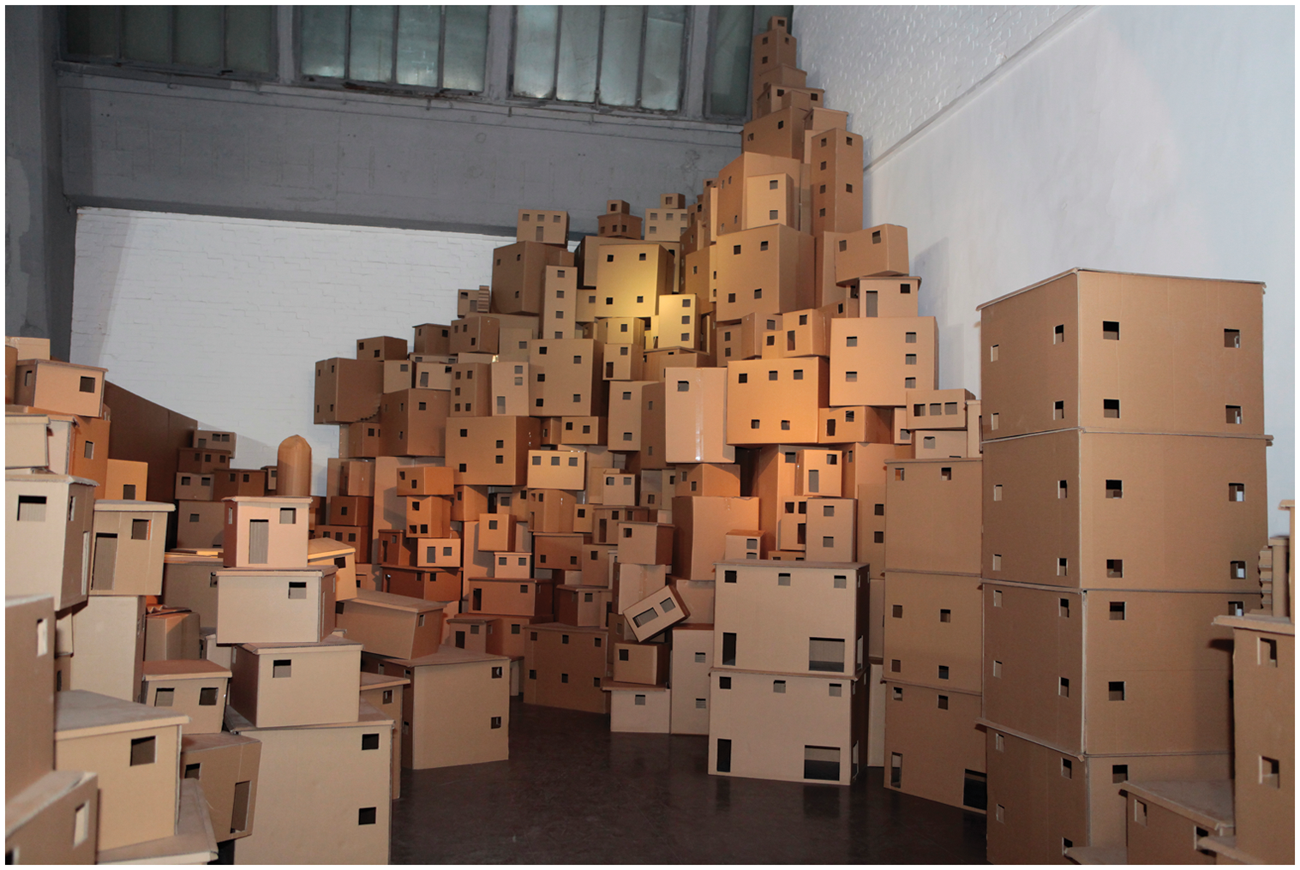
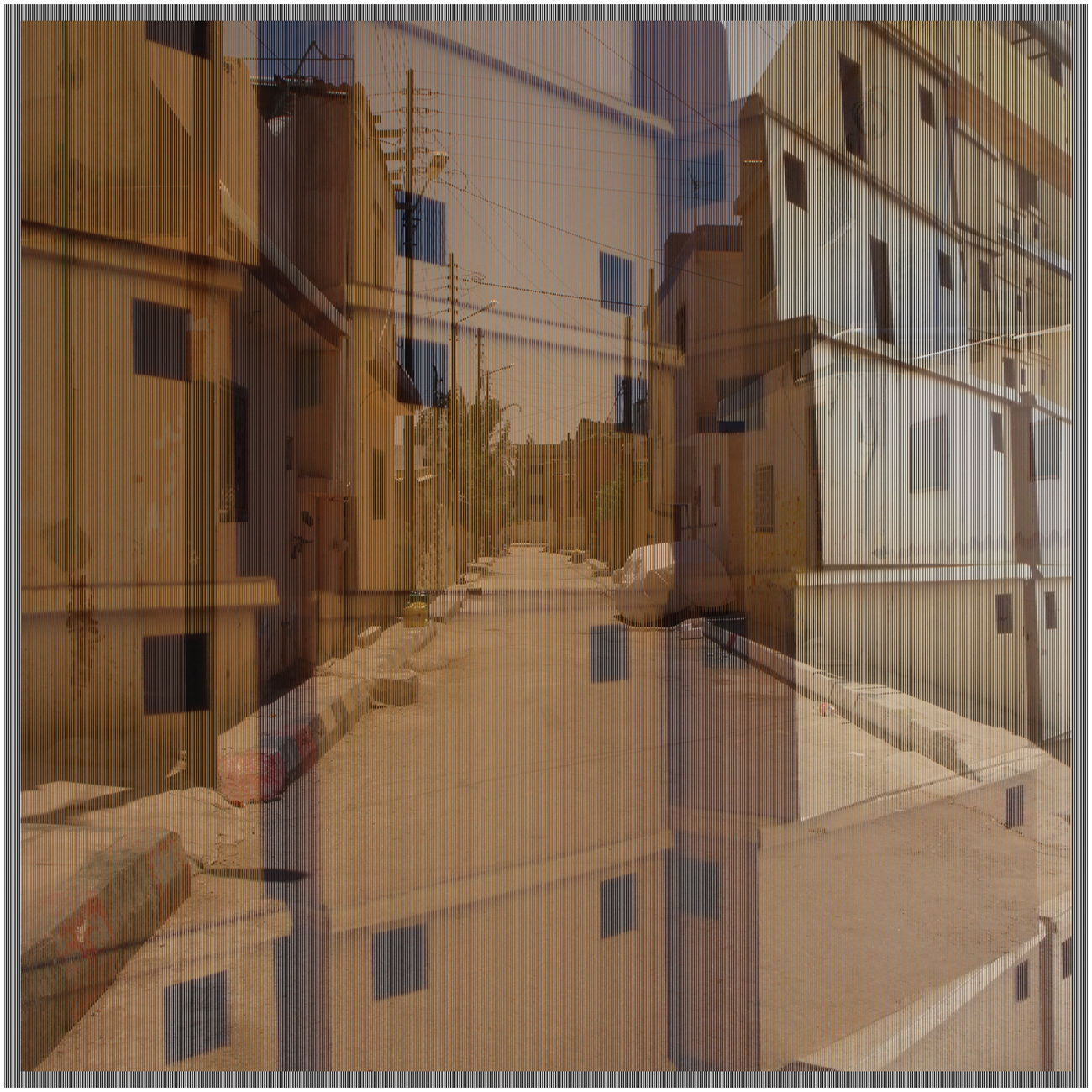
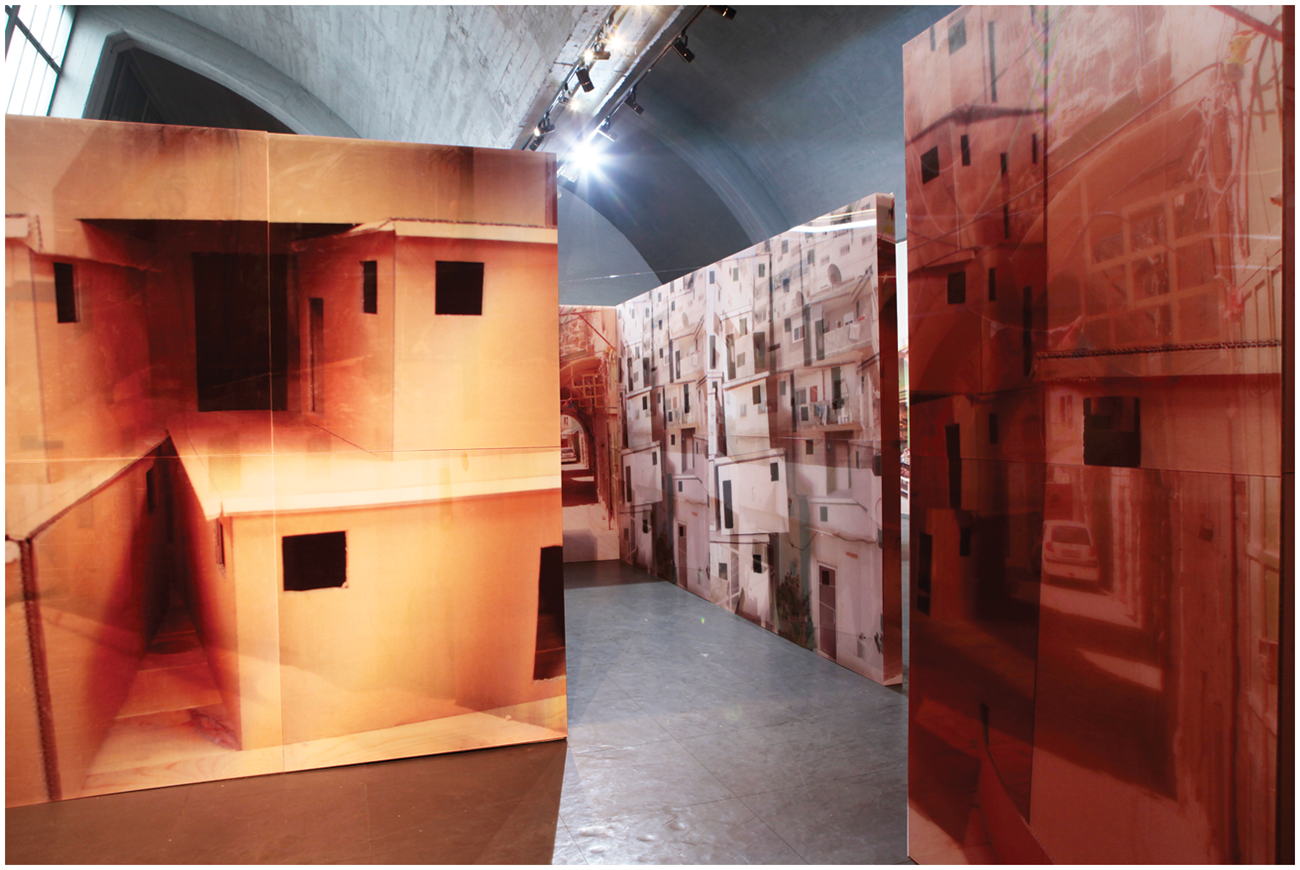
The still image of the street scene is interrupted by the cardboard box even with the slightest shift of the head, the abstraction of the blank brown surfaces and cut-out black window apertures intruding upon and flattening the illusion of depth produced by the street scenes. The aggravating presence of the box in the maze images is not only a premonition of what the maze leads to, it overrides photographic verisimilitude in order to insist upon the abstracting force of the model town as the preeminent structure: as a version of Chicago, the box village turns a real village into an achieved battle-space and mocks the real village as a prophecy of the violence that is immanent within its representation.
The cardboard box is a signifier of transit; it is the container for items stored in a house move, the impoverished shelter for the homeless, and the packaging that protects goods in the mail. When Leman Brothers collapsed in 2008 the iconic image of financial meltdown became that of the trader leaving the building carrying the contents of her desk in a cardboard storage box. The cardboard box can be an improvised playhouse for children or a building block in an architectural model. It is provisional, mobile, light, and vulnerable. The cardboard box has also become in recent years a symbol of protest in Israel/Palestine, used in demonstrations like those in Beit Ommar in 2010 where boxes labeled with the names of Israeli settlements on Beit Ommar land were carried to the perimeter fence around the Karmei Tsur settlement and set alight. When US President Barack Obama and Israeli Prime Minister Benjamin Netanyahu met at the White House in March 2012, ‘Occupy AIPAC’ protesters demonstrated against possible war with Iran and for Palestinian rights, some dressed as cardboard box ‘settlements’. As a stand-in for both a Palestinian village that had been or is about to become a battle-space and an illegal Israeli settlement whereby building is the primary act of aggression, the cardboard box in Enter Ghost, Exit Ghost works simultaneously as a forlornly vulnerable maquette and as an abstracting sign of violence.
According to Israeli artist Larry Abramson, ‘the dominant art movement to emerge together with the state of Israel was “New Horizons” (both established in 1948), a mixed group of artists united in their desire to become part of what they perceived as the most progressive artistic form of the time: abstraction’ (2009: 280–1). Influenced by, among others, Cézanne, this group’s ‘Lyrical Abstraction’ soon established itself as, Abramson explains, ‘the widely accepted canon of Israeli art, the symbol of Israel’s new modernity’ (2009: 281). Exploring the landscape of Tsuba in the Jerusalem hills in 1993 where the leader of the New Horizons group Yosef Zaritsky had painted semi-abstract watercolours two decades before, Abramson notes that while the kibbutz there was built on the site of a Palestinian village evacuated in 1948, the remains of the village ‘prominently commands the view to and from the kibbutz’ (2009: 281). Returning to Zaritsky’s watercolours, Abramson is ‘amazed to discover that for all his plein air pathos, he had “not seen” the deserted Palestinian village; it had disappeared from sight in his delicate harmonies of abstracted form and painterly valeur’ (2009: 281). What Abramson concludes from this act of erasure is that abstraction had come to function as ‘the ultimate Israeli “scopic regime”, an “Art of Camouflage” that permitted Israelis to be at once Zionist and modern’, enabling a blindness toward the ‘morally challenging reality of Palestinian expulsion … while remaining progressive members of the universal community of modernism’ (2009: 281). In response to this understanding of modernist abstraction put into service as a mode of ideological concealment, Abramson undertook to produce a series of ‘sight-specific’ paintings that ‘critically echoed’ Zaritsky’s work. Working from photographs of the Palestinian Tsuba, Abramson produced oil on canvas realistic paintings that were then ‘ruined’ by repeated blotting with newspaper in order, he explains, to ‘place a question mark over the modernist urge to retreat from reality through the aesthetics of abstraction’ (2009: 283).
Given Abramson’s account of Zaritsky’s work and the regard with which his circle’s art was held, it might be fairer to say that the deployment of modernist abstraction by the New Horizons group was less a retreat from reality and more a violent intervention into the nature of that reality. Nevertheless, what Abramson’s assessment makes clear is that the politics of abstraction has a particular and disturbing valence within the Israel/Palestine context and one that provides a helpful purchase on the abstracting function of Makhoul’s boxes.
As the viewer moves through the maze, the boxes interrupt the street scenes depicted on the walls of the enclosure. In doing so they wipe the streets out of the picture and clear out the detail in favour of smooth surface. From the obverse point of view, the photographs of the boxes are interrupted by the realism of the photographs of streets, houses, and interiors. This is less a dialogue and more of an intermittent interference, the movement of the body producing a scramble of visual codes that refuses to stabilize into one or the other. Abstraction and realism are equally present as possibilities but do not come to rest. Inside the maze, visual codes are perpetually revised since the point of a maze is not to stand still but to get in and then get out.
Mazed
For Craig M. Wright, a maze properly defined must have ‘complexity and confusion … inherent in the design’ (2001: 3). Through Egyptian, Hellenic, Etruscan, and Roman civilizations, the maze represented an ingenious work of art but also a ‘gloomy, tortuous prison without means of escape. It was a carefully circumscribed “security zone” into which the uninitiated might penetrate only upon pain of death, yet also a metaphor for the ideal fortified city of the ancient world’ (2001: 73). Christianity gave the maze a new meaning as ‘a spiritual arena full of sin and error within which the human soul must wander’ (2001: 73). As prison, fortification, or spiritual challenge, the maze implies a protagonist, the warrior who must engage in the ‘ancient combat myth’ for which the maze is the arena (2001: 4). A maze, then, presents a challenge that is at once physical, cognitive, and symbolic, posing questions of orientation that resist easy solution. Like Mitchell’s tourist, the maze constructs a space that situates the incarcerated as a combination of ‘nomad, detective, seer and prophet, cultural theorist, and ignoramus’ (2000: 197). Given the maze’s history as ‘security zone’, we might also include among these positions that of prisoner and/or solider.
The panels of Makhoul’s installation suggest but do not exactly constitute a maze. In order to allow visitors the space to view and move through the exhibition the pathways are too wide to create a genuine sense of confusion and the Yang Gallery is not so big that getting lost is an issue.
Size and flimsiness of construction, though, are not guarantors of security, as the family who recently became hopelessly lost in a corn maze in Massachusetts would doubtless agree. Responding to their 911 call, police found the family just 25 feet from the maze entrance, and the subsequent media coverage portrayed them as incapable fools lacking the wherewithal to simply walk through the corn until they were outside. For the family, however, it was a maze that they entered and therefore it was a maze they had to escape from; the environment’s affective power overrode the fact of the cornfield as merely corn and maintained the illusion of being lost. Similarly, Makhoul’s maze never threatens to properly enclose but it does produce a sense of disorientation if attentiveness to the fluid surface of the lenticular panels is extended beyond the few moments it takes to get from one end of the installation to the other. In other words, the maze – of associations, doublings, multiplications, repetitions – extends in proportion to the duration of exposure to it.
A maze maintains its power to puzzle and disorient only in so far as the walls remain firm, either due to their solidity or, like the Massachusetts family, because the maze has a firm grip on the cognitive spatial structure of those inside it. The most obvious way to move through a maze is to simply blast through the walls, a policy the Israeli Defence Force have developed to allow troops to override the built environment and avoid the determining and dangerous constraints of a perceived urban labyrinth (Weizman, 2006). While this puts paid to the notion of the maze as a spiritual challenge, it is consonant with the Israeli approach to urban space that conceives of the bulldozer as ‘a weapon of collective and individual punishment and intimidation, and as a means of shaping the geopolitical configuration of territory’ (Graham, 2004: 197). In the face of this ‘design by destruction’ (Weizman, 2006), Makhoul’s maze stands as an eminently destructible model of an improvised urban collectivity on the verge of being dismantled.
Lenticulated
Lenticular images are most commonly associated with novelty items, postcards, product packaging, and advertising. The interlaced images are capable of producing 3D and animation effects as well as the familiar lenticular flip where there is a fast transition from one element to the next. In Enter Ghost, Exit Ghost the hard industrial finish of the lenticular panels gives the maze walls a plastic sheen that is reminiscent of street advertising, arresting yet transitory. While the images are photographic they have none of the fine art gloss of the exhibition print and instead the image surface is distanced by the plastic casing. A conventional photographic exhibit might demand close attention to the detail of the print but the lenticular panels do not yield to this investigative gaze; careful inspection only reveals the extent to which something is concealed. It is through the movement of the spectator that the double image shows itself, grounding the visual in the somatic trajectory of the body. The fine vertical corrugation of the material produces other effects, foregrounding the screen-like surface of the panels that recall the distracting glare of a monitor or electronic display. Combined with the way the lenticulated box and street photographs flatten depth, the maze starts to work like a video game scenario or simulated environment. Just as the full effect of computer simulations is experienced only through the movement of the avatar, the moving body within the maze activates the surrounding screens to the extent that the individual movements of the spectator to a significant degree shape the experience of the work. Moving in, across, tilting the head, turning around produces a corresponding shift in the visual field.
In recent years the Middle East has become a common battle-space for commercial western video games and military training simulations. Sometimes the setting is specifically Iraq or Afghanistan while in other games a generic Middle Eastern scenario is constructed out of familiar orientalist tropes (Sisler, 2008; Höglund, 2008). The virtual environment of games is often produced through a combination of photography and computer graphics and the urban spaces depicted most commonly draw upon the spatial dynamics of the maze. In this way the conventions of the first-person shooting game, where the maze has been prevalent since the earliest iterations, fold into orientalist assumptions about the labyrinthine and duplicitous Islamic world. Coupled with real-world simulated battle-spaces like Chicago, the video game dimension of Enter Ghost, Exit Ghost insists upon its implicated role in the reproduction of the military-entertainment complex. These associations are hardly buried in the work but written on the surface of the plastic and cardboard.
Unlike the mournful stillness of the ‘late’ photographs of Ristelhueber, Norfolk, and others, there is brash playfulness at work in Makhoul’s installation that the Shakespearean title and serious subject matter are not able to dispel. The fairground element to the work, its recreational dimension and the way it flirts with the flash iconography of gaming and advertising refuses to allow the streets of Palestine to become a grave. The danger is that in refusing high seriousness the installation ends up reinforcing the seamless shift from political violence to entertainment already achieved by the military and its corporate sponsors. If there is a discomfort here it is all to the good, though, since the implication of the spectator in the reproduction of illusion is precisely what the lenticular maze pulls into view. The largely empty streets of the village are offered as a kind of spectacle, the gallery and the art business that supports it positioned as the facilitators of a high end shooter game. While this is not all Enter Ghost, Exist Ghost is about, the question of how close art can get to the optics of domination before it dissolves into affirmation is never far away.
Evacuated
Early photographs made in Palestine by Europeans and Americans during the 19th century often avoided including local people in their images. While this can be accounted for in part by the technical challenges of early photography, it is also the case that often natives were considered unworthy of the ‘Holy Land’. The American photographer and writer Edward L. Wilson, for example, complained during an expedition near the Sea of Galilee that a group of peasants spoiled the prospect before him: ‘They are entirely out of harmony with the character of the land’ (quoted in Davis, 1996: 87). Furthermore, discovering that many of the Christian sites within the cities were already under the control of non-Protestants, Americans preferred to look to the empty landscape as the site of its authentic divinity. The effect of this erasure of Palestinians from representations of their own home presents to Euro-American eyes an apparently unoccupied space eviscerated of its historical specificity and primed for physical and mythic occupation. As Issam Nassar explains, ‘Palestine was reduced to a backdrop upon which the biblical story could be substantiated, rather than recognized as a real place in the real world – attesting to real histories other than the Judeo-Christian narrative’ (2006: 222). Indeed, the production of an empty Palestinian landscape in 19th-century photographs contributes toward the Zionist fabrication of ‘a land without people for a people without land’ and the kind of camouflaging abstraction Abramson charges Zaritsky with perpetrating.
While there are a few bodies in Makhoul’s village, they are rare and seem out of place. The streets are virtually empty and houses look lived in but vacated. In fact, the photographs were taken during the curfew so the depopulated spaces of the village are indeed enforced. The stillness of the scenes then is a troubled stillness, the village wiped of inhabitants just as Chicago houses only imaginary ones. When a human form is spotted in Enter Ghost, Exit Ghost it appears almost as a target, and the video game dimension to the work kicks in as the eye locks on to the familiar form. Desertion calls attention to what life there is that dares show itself and the observer-as-sniper clocks the anomaly in an otherwise evacuated space.
For the American military, the myth of frontier violence as redemptive is an embedded part of how soldiers have articulated the relationship between friend and enemy and can give symbolic authority to otherwise questionable missions. During the Vietnam War, for example, the vocabulary of movie and TV westerns permeated the vernacular of GIs during a period when US hegemony was still grounded in a narrative of expulsion and extermination elevated to the status of national mission (Slotkin, 1998, 2000). That the Bush administration post-9/11 did not shy away from rejuvenating this vocabulary is now a commonplace of recent history, yet the Western mythos also relies upon a deeper sense of biological inevitability that pivots on the widespread belief, taking root in the 18th century and developed and disseminated through the 19th century, that Indian civilization was about to become extinct (Dippie, 1991). Acceptance of the inevitability of disappearance serves to naturalize policies of removal but also allows for the indulgence of a kind of nostalgia for the once great civilization now on the threshold of oblivion.
Part of the fascination among Americans with ancient Indian ruins like that at Mesa Verde is that it confirmed a wider belief in the receding presence of prior inhabitants while at the same time giving the US an ancient history comparable to those of European and Middle Eastern nations. Nineteenth-century photographs of the American West are as bereft of indigenous human life as those made by westerners in Palestine and for similar reasons. The impoverished inhabitants of the western territories and Palestine drew complaints from tourists like Mark Twain that are so similar as to be interchangeable. Indeed, Twain was prone to compare the Middle East to the American West as equally squalid and degraded landscapes within which the presence of lower forms of human life merely confirmed the decrepitude of the entire regions. For Twain, writing in 1869, Palestine is ‘the most hopeless, dreary, heartbroken piece of territory out of Arizona’ (quoted in McKeithan, 1958: 302). He had little positive to say about the ‘squalid humanity’ to be found in the Holy Land (Twain, 1966: 339), describing the inhabitants of Damascus as ‘filthy Arabs’ (1966: 338) and ‘the ugliest, wickedest-looking villains we have seen’ (1966: 329). ‘They reminded me of Indians’ (1966: 340), Twain continues, reiterating the comparison with the American West.
While much has been made of Twain’s hostility toward Palestine, his equally disparaging remarks about Indians and the monotonously inhospitable western American landscape suggest that the target in each case is less the place and people itself, his contempt aimed more squarely at the boosterism and dubious sense of mission that has coming to shape the reception of both the West and the Middle East as ‘promised lands’ by the middle of the 19th century. It is the fabrication of mythic spaces of imperial occupation that Twain is set to dismantle; in reality, these territories are as dull and unprepossessing as anywhere else. ‘Palestine is desolate and unlovely’, he writes, but ‘why should it be otherwise? Can the curse of the Deity beautify a land?’ (1966: 442). Palestine is sacred only to ‘poetry and tradition – it is dream-land’ (1966: 442). In similar fashion, the promise of western adventure is furiously lampooned in Roughing It (1872) as profoundly out of kilter with the more dismal experience on the ground. About to embark on a trek across the desert, Twain writes: ‘This was fine – novel – romantic – dramatically adventurous – this, indeed, was worth living for, worth traveling for!’ (1996: 122). Yet the ‘poetry’, as it is in Palestine, is ‘all in the anticipation – there was none in the reality’ (1996: 123), which is ‘a vast, waveless ocean stricken dead and turned to ashes’ (1996: 123). That neither the western American territories nor the Holy Land prove to be lands of milk and honey for Twain is not, in his case, catastrophic. The satire here is directed toward the fabrication of God’s country as an alibi for material exploitation and nationalist expansion.
Though there are grounds for a thoroughgoing analysis of the folding of American manifest destiny into the Zionist project, my intention here is merely to establish an historical discourse of race and territory that moves across specific geographical locations and that is reliant upon a stable set of assumptions about place and population. A naturalized narrative of exhausted civilizations about to expire works equally well in Colorado and Israel, and the echoes of well-established prejudices continue to animate not only international geopolitics but the scenarios of video games and art exhibitions. Seeing Mesa Verde in a pile of cardboard boxes misconstrues the scene only at the level of local context. The tourist’s eye, like Twain’s, might, as Mitchell suggests, find in the ‘surface experience of landscape’ unanticipated analogies.
Construed
Enter Ghost, Exit Ghost is about one thing looking like, turning into, another. It is both specifically about Israel/Palestine and also anonymous and at times abstract. Buildings are made of cardboard, walls and people appear and disappear, the third dimension flattens into two, scale shifts up and down. The maze is human-scale, the boxes are a model: the eye moves from the restricted view of the maze, where the line of sight is blocked by the angled walls of the panels as well as the slippages of the lenticular surfaces, to the sovereign gaze of the warrior approaching the cardboard city.
Moving through the maze I am a tourist in a world I do not know – a European in a simulated Palestine inside a Chinese gallery – but the scene is reminiscent of something seen elsewhere. ‘Beyond their reality as physical places’, Weizman (2006) explains, ‘the territories and cities of Israel and Palestine constitute a conceptual basis for the understanding of other geo-political problems’. The transfer of the Israeli strategy of occupation ‘to other corners of the globe’ means that the language of ‘objects, spaces and structures it produces’ is one ‘we need to be able to translate in order to critique’. Wars, Weizman continues, ‘are both physical conflicts and conceptual imaginary systems, whose categories are reproducible’. When Mitchell sees Nevada in Palestine or echoes of Mesa Verde are detected in Makhoul’s cardboard model, itself boxed into Beijing’s nest of contained spaces, these associations are rarely outside and beyond the physical spaces and imaginary systems of wars historical and contemporary. Instead, they construe, from the Latin ‘to relate grammatically’, or in classical Latin ‘to build up, pile together’. Seeing one thing in another might begin, as Mitchell admits, in ‘autobiographical terms, as inescapably private, personal, and ignorant’ (2000: 197), but the piling up becomes more than local; there may be no personal attachment to the represented places depicted on the flickering panels but there are connections, memories, and reminders of other places, other pictures, other histories, other ghosts, other struggles, and other losses.