







Abstract
This article is a transcript of a conversation between Michel Foucault and Jonathan Simon in San Francisco in October 1983. It has never previously been published and is transcribed on the basis of a tape recording made at the time. Foucault and Simon begin with a discussion of Foucault’s 1977 lecture ‘About the Concept of the “Dangerous Individual” in 19th-Century Legal Psychiatry’, and move to a discussion of notions of danger, psychiatric expertise in the prosecution cases, crime, responsibility and rights in the US and French legal systems. The transcription is accompanied by a brief contextualizing introduction and a retrospective comment by Simon.
Introduction – Stuart Elden
This English-language conversation took place between Michel Foucault and Jonathan Simon in late October 1983, at Foucault’s apartment in San Francisco1. At the time, Foucault was a Joint Visiting Professor of French and Philosophy at University of California, Berkeley (see Gandal and Kotkin, 1985a; Simon, 1986). He ran a seminar on the topic of parrēsia, which was initially published in an informally circulated transcript, and then as the book Fearless Speech, edited by Joseph Pearson (Foucault, 1985, 2001). A critical edition has recently appeared in French (Foucault, 2016). Alongside this formal seminar, Foucault ran a research group that met weekly at Paul Rabinow’s house. Participants included Arturo Escobar, Keith Gandal, Kent Gerard, David Horn, Stephen Kotkin, Cathy Kudlick and Jonathan Simon. A photo of this group with Foucault, who is wearing the cowboy hat they gave him, appeared in Didier Eribon’s biography of Foucault; a second photo, taken a few moments afterwards, is reproduced above. This seminar was on the early 20th century, tracing governmental mechanisms in the First World War and interwar period, and while future collaborations were planned, these never appeared due to Foucault’s death the next year (see Gandal and Kotkin (1985b; Gandal, n.d.).
While at Berkeley, both on this visit and an earlier one, Foucault also participated in a number of discussions, some of which were recorded and a few of which were published. The publications include the ‘Politics and Ethics’ interview, and the ‘On the Genealogy of Ethics’ conversation which first appeared in the second edition of Hubert Dreyfus and Paul Rabinow’s book on Foucault (Foucault, 1991; Dreyfus and Rabinow, 1983). The original tapes of some of those conversations, along with some transcripts, can be found in the Bancroft Library at Berkeley. The conversation published here dates from the second 1983 visit – a recording of the conversation is archived at the Bancroft Library, University of California, Berkeley, phonotape 2222 C 70 and CD 961. In it, Jonathan Simon, then a doctoral student in jurisprudence and social policy at Berkeley, and now Adrian A. Kragen Professor of Law there, returns to one of Foucault’s interests in the 1970s.
This topic is the question of law, psychiatric expertise in the prosecution of crime and the notion of ‘dangerousness’. The conversation begins with a discussion of Foucault’s essay ‘About the Concept of the “Dangerous Individual” in 19th-Century Legal Psychiatry’. This originally appeared in English (Foucault, 1978a) and then in a slightly revised version in French (1981). (There is no published French version of the first text, nor an English version of the second. Both texts are reprinted in later collections.) The lecture was originally delivered in Toronto, at a conference on law and psychiatry on 24–26 October 1977. (In the interview, Foucault mistakenly suggests it was given in Montreal.) The research in that lecture draws upon the seminar Foucault ran alongside his course ‘Society Must Be Defended’ in 1976, along with some themes explored in the ‘Abnormal’ course of the previous year. The description of the 1976 seminar does not appear in the ‘Course Summary’ in the published lectures, but it can be found in earlier versions: This year’s seminar was devoted to the study of the category of the ‘dangerous individual’ in criminal psychiatry. The notions connected to the theme of ‘social defence’ were compared to notions connected to the new theories of civil responsibility, as they appeared at the end of the nineteenth century. (Foucault, 1989: 94; 1998: 64)
Conversation between Jonathan Simon and Michel Foucault, October 1983
Jonathan Simon: So I had the chance to look over again a paper of yours I had read [‘About the Concept of the “Dangerous” Individual’] – I don’t know if you have seen it in English.
Michel Foucault: Ah yes. That was something which was not supposed to be published.
JS: No?
MF: It was a lecture I gave, I think, in Montreal, or something like that, 2 and, er, once I have been told that it was published. So I do not remember exactly what…
JS: But I read this about a year ago when I started doing my work, and I find it very interesting. The background of the work I’m trying to do is [that] there’s a political battle right now in law in America around dangerousness, not around the question of whether it should be used because everyone knows that it already is, but only the question of whether it should be made explicit and made part of the law formally, instead of hidden as part of the decision of prison wardens and psychiatrists. There’s a number of things that I find mysterious about it [the battle over dangerousness].
MF: Who are the people who are discussing?
JS: Law professors. I don’t know how it works in France, but here, in a sense, law professors at the big schools are sort of the judges of the judges, they publish articles which criticize the judges, and then the judges will cite the article when they give another opinion so they’re [inaudible]. So they got the better grades in law school, and the ones who don’t get so good grades, they become judges. And then the worst grades become lawyers. [Both laugh.]
JS: And they make the most money. But the thing that acted as the impetus to get this going is, and I don’t know if this is happening in France at all – it would be interesting if it did not – but a major struggle against rehabilitation as the main reason for punishment that took place in the late ’70s in America. And it started with the prisoners themselves, revolting against the psychiatrists and the power of the prison officials over them. They would rather have much longer sentences instead of having the sentences that the warden could determine. And it quickly got taken up by a lot of liberal law professors, though, also surprisingly, very right-wing people like public district attorneys, even sheriffs and law enforcement officials, because the left, the liberals, felt that the rehabilitative system and what went with it, which was indeterminate sentencing, you know five years to life for burglary, that it was against justice, against due process, against the Constitution. The right wing thought it was just too light on criminals. For a while there was a consensus that they should move to a system that would have a strict, almost like Beccaria, 3 a strict sentence for each crime that wouldn’t vary, except very, very small amounts that the judge could transform it.
MF: And that was in the early ’70s?
JS: That was by the end of the ’70s. Several states passed, California for instance, changed the Constitution to say punishment is the purpose of prison, they actually wrote it in the Constitution [actually only a statute]. And even though … if you look very carefully at these codes, there is still tremendous room for the judge to make decisions. But it is interesting. There are a number of states who really did come close to realizing this goal. Of course, as I explained in my exposé [presentation to the class], because there are so many jurisdictions in America, it’s difficult to talk about change because now there’s only some states, 10 years ago there were some states that were only just getting indeterminate sentences, even though it started [to spread] in 1920, it took them so long, so change kind of goes back and forth, but what’s sort of arising now is people are saying look, the other function rehabilitation had is not to just let go of the people who are cured, but hold on to the people who are dangerous. I mean, dangerousness was the real usefulness of that sentencing because no one was being cured, but it did allow you to hold on to people, and also to adapt, to let people go when too many people came into prison, which is a problem for wardens all of the time. If you have a system where you have a strict sentence that no-one can change, then what do you do when there are too many people in prison? There’s no way to let them go. Under the parole system, you could say well, these people are now cured and we can let them go. So there’s a debate building up around this, not that I’m going to be a major participant in it, but I’m interested in it, and interested in how to even take a position within it. And there’s a number of questions that I was hoping that you might have some insights on, and it’s possible you don’t. The first is that you ask the question: what is dangerousness?
In your paper, for instance, you speak of [how] in the 19th century the people who first became a target of this sort of concern were people who committed very strange crimes, ‘monstrous’ crimes, especially crimes that involved the family and family relations. But then you mention that by the 20th century it seems to have become a generalized concern and, yet, what I have been trying to do is read the texts of the judicial opinions and the codes very carefully, and tried to spell out what they mean by dangerousness. And I found that it’s almost impossible. They have no definition. Some people make it sound like it’s violence they’re worried about, violent behaviour, which is itself a vague concept. But in other places, even people who have no sign of violence are being held because they’re dangerous, and I’m searching for some footing to begin to understand what, how in our society certain people would show up as dangerous. It’s interesting that in the 19th century we had this notion of dangerous classes of people, but I’m not sure where the people who are dangerous now fit into the system of power, they seem to be not necessarily revolution … they don’t seem to pose a political danger to them.
MF: I think there is in this notion of danger two main features. One, which can be called the old conception of dangerousness, which I think roots in this problem of what they call the monomania, homicidal monomania.
JS: Sort of a monstrous crime.
MF: So those monsters, who killed people, without being able to give the reasons why they killed people. And it’s very interesting to see that in Germany, in England, and in France and maybe also in the States, though I don’t know, I’m not familiar enough with this stuff. In those three countries you see in the 1820s such cases like someone killed a child, or his parents or anyone, in the street, in the house, and is unable to say why, to give reasons. And so… first, it was a puzzle for the judges… and for the doctors and psychiatrists also, since when somebody has a reason to kill – interests, jealousy, a fight about inheritance… things like that, this kind of familial problem, so you can judge the way and appreciate the way, and the reason why. Was it for good or bad reasons, was it because he was interested, or because he was… I’ll take a very, very precise example. It is the case of a woman who has killed her child, and cooked the child.
JS: Oh yes, this is in here. 4
MF: And the debate was this one: if she was starving, so she would have done that in order to eat. And in this case, she is guilty, because she has done that. But if she was rich, or if she had been rich, so she would have no reason to do that, so she could be considered as mad…. a mentally ill patient. And since she was completely poor, there was suspicion that [it] was by ‘interest’ and it was considered as guilty. So a lot of this kind of problem around the question, is there any reason why someone has done [this], and it is only when they have no reason they say that it is an unreasonable act, and then in this type of case you have someone who is dangerous in itself and by himself, not because of the circumstances or context and so on, but he is a potential danger for society without any reason, and by the fact that he has no reason to do what he does.
JS: So even at this early stage, responsibility is not the main problem?
MF: Yes, it was a problem. But since in the French code, in the Napoleonic code, they say that someone is responsible for what he has done when he’s conscious [of] what he is doing and if he is not forced to do it, the problem was when somebody is unable to give the reason why, isn’t it the sign that he was not completely conscious of what he was doing? Or is it the sign that there is some compulsion, [inaudible] pollution which forced him to do what he does? And you have there I think the experience of someone who is dangerous in himself for some mysterious psychological reasons.
And on the other side, I think that behind this notion of dangerousness you have something completely different which is the discovery of the fact that there are statistical irregularities in committing crime in our society. So, exactly as there is a certain rate of accident street [i.e. road traffic] casualties in a city, in the same way you have a constant, permanent rate. So, crime becomes a permanent danger in a society, it can happen exactly as a casualty, as an accident. And I think that the mixture of this notion of psychological danger, which was discovered through those pathological cases, and the discovery of statistic, irregularities, at the crosspoint you have this notion of danger with its ambiguity.
JS: And in the modern period it doesn’t need to be a monstrous crime?
MF: No, not at all. But of course this psychiatric notion of dangerousness became through this problem of the statistical irregularity of crime, this notion of psychological, psychiatric dangerosité [dangerousness], became more and more familiar, more and more, and less and less related to any kind of monstrosity. And this pétit délit, this misdemeanour, small crime, was the illustration, it was at this level that you could find the articulation between psychological dangerosité and the notion of social danger, or statistical dangerosité, because it is quite clear that those great monsters do not happen very often. But for a fact we know very well that through the statistics, because through the statistical study of crime and delinquency [that] started in France in 1826, and I think in other countries at the same moment, they knew very well that the small thieves, or the sexual assaults, and things like that were [inaudible]. And also the fact, for some very obvious reasons, that in those case of small criminality the récidive… [JS: repeat, the recidivism], the recidivism, was very frequent for the first reason that, for those small crimes people had one or two years spent in prison and then went out and began again, and of course there is no recidivism for the great crime because people were killed.
JS: That’s very interesting.
MF: And so those people… the problem of recidivism in Europe at least, in France, began to be a very important issue in the 1850s, 1860s. And, for example, they discovered that for sexual assaults, this kind of crime, it was repetitive. Always the same people do the same thing, in the same circumstances.
JS: But did this also have a political or class base, in the sense that it focused on the illegalities of…?
MF: Well, you see that it is quite clear that this kind… well, I think there is something interesting. Of course it was related to class consciousness, and the idea that there were some classes which were dangerous and so on, yes sure it’s important. But there is something which I think could be studied a bit more. It is the problem of the delinquency in the higher classes. And I told you about the railway problem, 5 there was also the, not the supermarket at this moment, but the problem of the great shops, magazins.
JS: Foodstores, department stores.
MF: You know that in Europe it was in the 1860s or something like that that they started with these huge shops like Macy’s, and what we have in France like La Belle Jardinière, and Le Bon Marché and so on, and Zola has written a book about those… something quite new at this moment. Au Bonheur des Dames is a novel written by Zola about those great stores which are a real social innovation, and in those great shops… what is the name for that? 6
JS: Shoplifting.
MF: Yes, but those shops, how do you call that, those great…
JS: Department stores.
MF: Yes, so in those great shops… those great department stores, the ladies from the bourgeoisie started shoplifting. And there were a lot of those cases, and for the first time they have just discovered that the thief, thieving was the behaviour that could be found in the bourgeoisie exactly as in the lower classes. And also for the problem of sexual delinquency. So this problem of dangerosité is not so clear-cut that you could imagine, it is not the fact that people of lower classes are by themselves dangerous, of course there is this idea but there is also the problem raised by this bourgeois delinquency.
JS: But at least it’s my experience from the way it is dealt with now in America that what we call a white collar criminal, which is a bourgeois, especially business and corporate crime, may even cause a crime that causes violence in the sense of an injury to a worker or a customer who buys a product that has been intentionally allowed to be dangerous, would not be treated by the courts as a dangerous person. As people they are not dangerous. And it’s also the case for instance that the mentally ill in this country, and perhaps in Europe in general, have been treated as dangerous far more than other eventual studies have shown them to be. One area where this comes up in this country is if people are either acquitted by reason of insanity for a crime, or if they are civilly committed, they cannot get out until they show that they are not dangerous, and they have done a number of studies where, for instance, the Supreme Court made a decision which forced them to release several thousand mentally ill people who were kept in criminal hospitals – they said well, you have to civilly commit them or let them go. And they were followed by social scientists, and had very low rates of crime, much lower than what was predicted. So they are not more dangerous… but they are assumed to be dangerous.
MF: Sure. That’s what I think is one of the most interesting things in this story, that in fact mad people are less dangerous than the others, because…
JS: Because they have problems in getting around.
MF: Because their problem is their own psychological problem. The reason why they… they have something else to do than to commit crimes. Anyway, I come back to this problem of this white collar delinquency and criminality. You see, when the judges in the 1860s discovered the frequency of those shoplifting, of course they were very embarrassed, for the reason I told you about the case of the woman who has eaten [her child], the problem was why someone who is rich, who has no need, who can pay, and so on, why does she still steal? So, they were obliged to build up a psychiatric category which had the double advantage of first giving an explanation or categorization of that, exactly as they had the homicidal monomania for the people who killed without any reason, they built up the concept of ‘kleptomania’. And through this category they could keep out of court those women because they had a psychiatric syndrome, which was kleptomania.
JS: But in this time in Europe, if you were found to be not responsible because you were a kleptomaniac, say, did that mean that you were put under state control in a hospital, or were you sent home to be dealt with?
MF: In France, and in the Napoleonic codes, in Europe, we have what we call Article 64, which says that when you are… you don’t understand French at all?
JS: No.
MF: There is no crime, no crime when the act has been committed by someone who was not in control of himself, either because he was not conscious of himself, or because there was something which forced him to do it.
JS: We say the same thing, but then we lock them up.
MF: Yes, but I think that first you establish the reality of the crime, no?
JS: Yes.
MF: Before you… The crime has been committed, but the man is not responsible. In our court, what is very interesting is that the crime does not exist.
JS: Once they determine the madness then they don’t continue?
MF: As soon as, during l’instruction…
JS: The pre-investigation…
MF: During the investigation… if there is psychiatric expertise which demonstrates that the criminal was in an état de démence, a state of madness, during the act, then everything is stopped.
JS: And this is still today?
MF: Sure.
JS: So there are no… here we confine many, many people…
MF: And then, an administrative decision determines, and the patient – because now he is a patient – is locked up in a mental hospital, and the physicians, the doctors, decide how long he has to stay and so on. But justice has nothing to do with that anymore. It’s finished: the crime didn’t exist. Which is very interesting because you see that, from a theoretical point of view, that means that the crime is not an act by itself, crime is a certain relation between an act and an intention.
JS: We changed from that, I think at the end of the 19th century,
MF: You never had that in…
JS: Well, we didn’t have confinement for people…
MF: No, this notion of the inexistence of the crime?
JS: No, not that notion. But we didn’t necessarily… At the turn of the century many codes were written to the effect that as soon as someone is found to be guilty of the crime, or responsible for the crime but not responsible, they did the crime but he’s not responsible, that he would be put under state control as in a criminal setting. It was a subtle distinction between civil hospitals, much the same. It’s more difficult to get out if you are in a criminal hospital – there are more difficult requirements of proof to prove that you are no longer dangerous. One clue that I’ve been trying to make more sense of, and I’m not sure if there is any sense that can be made out of it [short break in the recording] is the root of this word ‘danger’ in the dominium, the Latin term.
MF: I did not know that. It is very interesting.
JS: What fascinates me is the reference, at least in English, would be the subject of danger, in the old sense would be the Lord [i.e. dominus], the powerful person, you would be in danger if you were near him or in his power, whereas today it is being applied to people who are not even working class, but the most marginal people in society, becoming seen this way, and I would like to try to understand how that is worked out. But I guess one must do more study of etymology, the word, but the one thing that I’ve been trying to work out on that is the notion that… and other evidence I’ve got for this is that I began to study some witchcraft prosecutions in England, which was different than in Europe because there was no Inquisition, it was a regular matter of proof. And there have been some good studies on who was accused of being a witch, and who were the accusers and what relationship did they have, and some good historians have claimed that the people who were accused were people who are dependent people in the community, especially in England at a time when private property was becoming more important and customary obligations to support dependent people were falling out of fashion and falling out of use, so there was some sense that there was a combination of guilt and fear of the person that you are going to cut off. And it also seems to me that today the people who are most apt, the shoplifter whose case we looked at in my exposé, are people who are not even working class but are not of any use to the economy, who stand in this relationship.
MF: But don’t you think that we have to make a distinction between the implicit laws or the implicit reasons why judges judge in one way or another, and what is the theoretical problematization of something? For example, I think [of] the problem of the shoplifting in the bourgeoisie. Of course it was not in practice something very important if you compare the number of people who were in those cases and the other crimes, you see that the rate is such it was not numerically or statistically very important. But it has been theoretically important. Also those great monstrous crimes, this problem has occupied huge surface [space] in the juridical, and jurisprudential, and psychiatric literature in the 1830s and in fact it was two or three cases…
JS: So one thing I may do, I should do more, is look past the judges to the discussion about this in psychiatric…
MF: See I am not sure that the problematization, the discussion, I’m not sure that it is a direct reflection, the direct consequence of the practice, between the real practice and the problematization through discussions. I think there is a gap. Of course some of the themes of those theoretical discussions came from the practice, but sometimes from a very small part of the practice which for certain reasons became theoretically a very important issue.
JS: But here it also may feed in the other way, because frequently the judges make no attempt to spell out what would be dangerous but they allow, they ask the psychiatrist ‘is this person dangerous?’, so the psychiatrist must use his own theory.
MF: Yes, they ask this question in the States, the judges?
JS: Yes in this death penalty case we talked about where, in Texas, one of the things that the jury, instead of the judge, but one of the things that the jury has to decide is whether the person is, if he’s already committed murder, is he a danger. Will he be more dangerous? And there the most important testimony comes from psychiatrists. They come in and… there is no requirement that the judge inspect the theory at all, once the psychiatrist, if his credentials are good, his testimony is…
MF: And in France we also have something like that, which is rather interesting; it is the fact that of course the notion of danger does not exist in the law and you cannot find it in the penal system. But there is un arrêté… something like a regulation coming from the Justice Department about the expertise, the psychiatric expertise, and this regulation says that the judges have to ask the psychiatrist if the person is dangerous. If he is – how do you say? – accessible… if he can be improved by the punishment.
JS: Yes, this is also important.
MF: So the questions that the Justice Department says should be asked to the psychiatrist relate to dangerosité, in spite of the fact that the dangerosité does not appear in the legal system.
JS: That’s very similar to how it works here. The court has been asked to make some ruling, not that there be some level of accuracy or reliability of this testimony, but they say no, if he’s a trained psychiatrist, it’s good enough.
MF: And you see, what strikes me, I tried to explain yesterday or last week when we spoke about that but I don’t know if it was clear. What is interesting is that the judges have to ask this question, they are obliged to do it by this regulation, they have to ask the psychiatrist if the accused is or is not dangerous. But the answer left complete freedom to the judge, because what if the answer is ‘yes, he is dangerous’, what does that mean? And what does that imply? From this answer, you can say, if he is dangerous that means he has some psychological tendencies which make him dangerous, but which at the same time lower his responsibility. And then he has to be condemned. Much, with er…
JS: They mitigate the sentence, they make it lower.
MF: The judge can mitigate, mitigate you say? They mitigate the sentence because of his answer, or the judge may respond to this answer and say well, if he is not dangerous he has to be put in jail for a very long time.
JS: He has the freedom to do this?
MF: He has the freedom. You see the juridical translation, or the jurisprudential translation of the expertise in terms of dangerosité, this translation is up to the judge. That’s the first paradox. And the second paradox is that the judge will judge the reason why he will take this, and [the reasons for] this decision are always psychological reasons.
JS: Must they write an opinion?
MF: No. No. In France, the jury has to answer the question, but has no reason to give. And for example, for the famous circonstance atténuante [attenuating circumstances], you know what it is? In 1832 in France… the judge could modify the rate between the crime and the condemnation if there were some reasons why the law in its severity could be mitigated. But those circonstance atténuante, you have a word for that? These reasons why the law, the sentence, could be mitigated, the jury has no reason to give.
JS: Well here we have an illusion that, for instance, the judge will have to state simply ‘he is dangerous’; he may just have to write that down, it’s automatic, no one will ask him what he means, but he does have to say something, or he can say, ‘this person, in order to show that the crime is particularly bad, we must do this’. He must say something, but he can’t be challenged on it unless it’s flagrantly… ‘this person’s a black person therefore we punish’… he can’t say that but if he says anything else he’ll be alright. I’m still troubled by the fact… you see at least in England and America there have always been techniques in the criminal law that cannot be assigned to guilt, they must be seen as relating to a concern, some concern about dangerousness, even if it only means prevention: how do you prevent these things? And yet in the law that we study in law school, or in the law that is celebrated as the great jurisprudence of England and America, there is almost no discussion of it ever, it remains silent in its history, even though it is of almost equal importance for a long, long, time and now today maybe even more important than the problem of guilt, and yet it has just been silent in the law. Certainly at a certain point psychiatry provided a certain discourse that could be used, but even before that they had other… I haven’t studied it thoroughly, but it has always been this way.
One other issue that has always been slightly different, which is… well, [the] problem has always been how do you define dangerousness in the law, but the other problem is how would you prove, what techniques do you use to measure it, and there have been some interesting changes here too, which I discussed a little in my exposé. The logic behind these new plans which are purely statistical, and they fit in perfectly with your description about insurance and accidents, the way they would work, I showed you that list of factors, but, just like an insurance company will go ‘what’s the risk that Jonathan will have an accident so that we know how much to charge him?’ Well, what’s his Grade Point Average, does he live with somebody, is he married, what’s his past driving record – they have all these factors, and then they have a chart that tells them how much money to charge me. This is the exact way that this new system will work, they will have a list of factors, like has this person been arrested for drug use, has he used drugs, has he been employed regularly – these factors. And this is being proposed now and, surprisingly, even people who are liberals, consider themselves liberals, are beginning to come around to saying this is better than letting any psychiatrist come in and give his opinion; now we have objective reasons to treat people. And the logic behind it [is] that, in this country at least, the first time you get arrested for most crimes you will not be put in jail, you’ll get probation, sometimes the second, even third, fourth time, because the jails are so crowded, you will only get what’s called ‘probation’. And people began… criminologists began to point out that by the time someone gets enough crimes that we put them in jail, he’s probably at the end of his career, it’s almost no use to put him in jail, he’s already been arrested four, five times. They’ve done studies that show where the career, the curve of crime…
MF: [laughing] That’s interesting.
JS: By the time we arrest him for good he’s already old, 35, he’s too old now to go out and do much, and now we punish [him] as bad. And so how do we get around this problem? We use legal factors, like how many crimes he’s committed… And the theory now is that well, if we have 10 robbers in front of us, if we had these tables that we could find out what objective factors there were to know about them, not anything, just certain specific factors, we could look at the scale, and then decide some to punish for only one year, or to let go, others to punish 10 years, 15 years… this is not a small change, difference, but a major difference in punishment. And of course it appeals to people because it means we wouldn’t have to build… the people who advertise this, who argue for it, say it won’t be necessary to build any new jails but will still lower crime 30 per cent, they say. And there’s a number of things that I find interesting about it: one is that there’s no need to ask the offender ‘who are you?’, it’s not a problem for this new method – you don’t need to know why people commit crimes. And that seems to be a change from the way we individualize people.
MF: Sure. And I think, though I’m not sure, that is the radicalization of this notion of danger from the point of view of the statistical danger. I think that people eliminate the person and the psychological, psychiatric feature of danger, and they consider danger as a social risk, exactly as the casualties in the street [road traffic casualties], and the problem is to know how it is possible to lower this level of crime, exactly as there are means and ways to lower street casualties.
JS: But there seems to be some sort of switch from the sort of disciplinary approach in which the person must be made an individual. Now we are no longer interested… in the poor people, the lower classes who are criminals, who are likely to be…
MF: I think there is a shift from that type of disciplinary society to a kind of security society, which is rather different.
JS: And it seems to highlight the notion of population because of the fact that these are charts of different populations, and what is the risk that they will be criminals.
MF: That’s it, that’s it.
JS: And it seems that we’re moving from… in the English book on the Introduction to Sexuality, you talk about… and both of those are forms of the exercise of power [Foucault, 1978b]. But it almost seems as if, at least in the penal system, we’re switching more toward a concern for population and not for the….
MF: You see in this perspective you speak about, it’s not the criminal who introduces the risk of crime, but it is a certain type of population which has, represents, the risk of producing criminals. Which is something completely different. In the case of monomania, homicidal monomania, there are this kind of people who were able, as a consequence of some psychological institution, who were able to commit crime, and introduce this risk into society. And now we have types of population because of racist factors and economic [ones], housing and so on and so on… those population, are considered as able to produce criminals. And the risk is related not to the individual but to the population.
JS: But do you think that this change of emphasis from a discipline to more of a concern towards security and populations is only with the lower classes, or in other functions too? I know that like my favourite example of course is… [break in recording] from law school, they still want to interview each student personally, it’s almost like a clinical examination, but with law school they just want a few numbers and they put it on the chart and see if you are good enough to get into the class. But they don’t want to know who you are, they may ask you to write a personal statement but they never read this. So it doesn’t seem it’s only the lower class… Initially the way I tried to approach this was…
MF: So they are interested only in knowing if you belong to a higher risk population, a higher risk of failure…
JS: Of failure.
MF: Or a higher risk of success.
JS: Exactly. But that troubles me because…
MF: Ha! You belong to…?
JS: I belong right now to the risk of doing well. [Both laugh]
MF: I’m glad to hear it!
JS: Having read Discipline and Punish and tried to think about these issues from the point of view of that book, I asked myself if it’s possible we are sort of disinvesting the criminal, in the sense that power is no longer going to target them as a person, as an individual, and will just… almost a return to an exclusion. You point out at one point in the book that in early stages of discipline there were techniques of isolating danger and there became much more intricate ways of targeting the body and the soul. Well now, at least for criminals, it seems to be reversing itself and going backwards.
MF: Yes, you are quite right. Yes, I’m sure there have been, since the Second [World] War, criticism against the disciplinary society, in the factories and the schools, and also in the penal system. And I think that in the penal system it was in the ’70s that the problem became very obvious and became a great issue. And now we are not interested at all in the criminal, there is de-psychologization of criminality to consider, and we consider it, as a phenomenon of global security.
JS: But one of the uses, or the motivations behind the implementation of disciplinary strategies was to, as you said, to maximize the utility of the person and at the same time render them more docile and less dangerous. Is it the case that we no longer want to use these people?
MF: We know very well that this idea, this Benthamian idea, to maximize the utility of behaviour… was a complete failure.
JS: For prisons?
MF: For prisons.
JS: But not for factories?
MF: No, not for factories. From Bentham through to Taylorism. In school also, and so on. But in prison, for the penal system it was a complete failure. The reason why this type of penal system, well not exactly penal system, those penitentiary institutions, the reasons why they were maintained in spite of their complete failure was that there were some side…
JS: … strategic reasons…
MF: profits, and the fact that, for instance, that the police control over the lower classes, over the delinquents, the police control was much easier through inmates or ex-inmates. So to put people in jail and then have control over them, and over the milieu where they come back.
JS: There was this political usefulness of the informers?
MF: Yes.
JS: Although interestingly today, this despite some Marxists who will talk about the need for, say, reserved labour, I don’t see this in this country.
MF: Oh, not at all…
JS: These are people who we would love, if we could just send them somewhere else, we don’t need them at all.
MF: The economical reason for all those disciplinary or security techniques is zero. And I think that it is the reason why the very interesting way… the very well-documented book by Kirchheimer and Rusche [1939] about the prison is not accurate about the modern system. And they say that the economical problem was primary. Of course there was a factory model behind these penal institutions, but this model was purely ideological… Never leads to production in a prison.
JS: You know in this country the only ones were in the South… there were still some prison systems up until the 1960s that made some profit, but that was plantation style work, not factory.
MF: No, it was not the main reason.
JS: The other thing that… The last thing that troubles me is from the political point of view, which is insofar as those of us who are in law want to try and resist this enthroning of dangerousness within law, I mean it’s already here but to now give it total legitimacy, to raise it to a recognized and proper place, sometimes at least to me it seems something worth trying to resist, especially because it will result in great [numbers of] people being punished, very severely, some people, for the reason primarily that they fit into a population, which can be defined as black, male, youth… I mean it is purely racist in its form, so there is some reason for resisting it. But one of the… having read Discipline and Punish and other works, the notion that we can fight this with an appeal to rights, that these people have rights, seems problematic. And yet at times…
MF: Why that?
JS: Excuse me?
MF: Why is it problematic?
JS: Well, I initially long ago thought it was the only way to save everybody. But having read some of your books I changed my mind, in part because of the notion that perhaps this doesn’t work against security. But you had said against disciplinary practices, the appeal to rights is not ultimately a useful strategy because these disciplines can take their place within a system of rights without a great problem.
MF: Yes, sure. But I didn’t, for myself, draw exactly this conclusion after having studied disciplinary society, of course I think that we must be aware that those disciplinary techniques can go through any legal system first, and the second problem is that the legal system is at a certain moment the expression of a force relationship, of a strength relationship, in a society, so it mustn’t have any kind of sacralization of law. But the rights are not exactly the same thing as the law. And anyway, I think that it’s important to fight and struggle against an institution or against a law, or against the legal system in the name of the rights which are at the ground, or which are supposed to be at the ground of those institutions, those laws, the legal system. And that’s the reason why I think we can fight against those disciplinary techniques in the name of rights, even in the name of the rights which have been at the root of those institutions.
JS: But sometimes it is very tricky, and for instance there is this weird practice which we have in this country where before we worry about responsibility and insanity, we ask is the person so insane now that they cannot go to trial. And if they are, if the psychiatrist says yes, then they used to be put away, sometimes forever, it would be a life sentence without any trial. So it was a very good system of control. Many people were dealt with in that way. And since 1972 the Supreme Court says that you can only hold them as long so you think you can still make them well. And after that you must either civilly or administratively commit them, take them out of the criminal system: try them, or let them go. But this used to be a way of confining people forever, indefinitely, and interestingly its basis was not the same as the insanity defence, which was responsibility, its basis was the right to a fair trial. You have a right to a fair trial, but you can’t have a fair trial if you are mentally ill, so that you cannot… so sometimes it seems to me that rights have actually been the cloak under which a disciplinary strategy gets deployed, hidden beneath it.
MF: Yes. I don’t think that the… I think that the relations between the rights and the institutions and the law system, the legal system, I think that those relations are very ambiguous. But that does not mean that you have to get rid of the rights and say, well, nothing to do with that. It’s quite obvious that the fact that someone is put in a mental institution for all his life only because he has done something which, in terms of the legal system, would have cost him one year in prison, I think that you can very well say that it is an insult to human rights, no?
JS: This can be said, but the Supreme Court says no. But this… As somebody in law, it seems like the only weapon which is available, at least in the institution of law, I agree that, I believe that one can’t hope to use rights as a notion to completely liberate, to fight across all society; each institution will have different requirements. But within the penal system there is no other weapon, as these people have no power now, and they only have lawyers out there somewhere who may be able to appeal to the notion of rights.
MF: Yes. And you see, for example, if you want to criticize prisons, there are a lot of ways by which you can criticize prison, its inefficiency and so on, but you can say that also since the prison is supposed to punish people for their crime and correct them in depriving them of their freedom, that must not imply those humiliations, those promiscuité and all those things which are the everyday lives of prisons, which is supplement, addition to what is supposed to be the prison. I think that this in spite, using the rights as a critical tool against the disciplinary system, or the security system, is something really useful.
JS: But it’s difficult for me to quite understand the status of rights – in the field of legal philosophy of course it is a big discussion, what are rights and what not. But that’s of little interest to me from what I’ve read of them. But it’s hard to understand what they would be except, I mean it’s been treated as an ideological idea, but that analysis does not appeal to me totally, because they do seem to have some practical usefulness within society. But… they seem to be a part of the discourse of law, but it’s difficult to see what they are… whether they are strategies or techniques.
MF: [long pause] I think that we could define the right as the limits of the exercise of power: limits which are implied by the definition, the goals, and the rational structure of this power.
JS: But it’s sovereign power, it’s been tied up with sovereign power.
MF: Yeah, sure.
JS: But there are other forms of the exercise of power, that sometimes it may be unclear that rights can limit them.
MF: Well, I think I was wrong when I [just] agreed with what you said about the sovereign power. I think that any kind of institutional power can be tested in this way. This institutional power has some goals, it uses some tools, it has some rational principles, and the problem is to know if it goes beyond those rational goals which have been accepted, at least in principle, by the society.
JS: But in doing so, we always have to come back to measuring it up against sovereignty. That’s to say that this goes past the sovereign power of the institution, or interferes with the sovereignty of the individual, and we have to translate it in law into that terminology. It may not be a major obstacle, but I think you’re right that there’s still something left in this notion of rights that can be useful for resistance.
MF: Yeah, sure, I think that you, we mustn’t make an absolute with those rights, they are related to the conscience of people, they are related to [a] certain strategic configuration in the society. For instance, the right for poor people to live was not the same in the Middle Ages, through some institutions like the charity institutions, and [as it is] now through social security. It is very difficult to say that, for instance, in the Middle Ages the poor people had the right to live, within the same meaning as we give to this word now.
JS: That gives me more optimism at least. [Both laugh… the recording ends at this point]
transcribed by Katie Dingley; edited by Stuart Elden
A Comment on Danger, Crime and Rights – Jonathan Simon
It took me a long time to bring myself to re-read this interview. Stuart Elden had graciously taken the trouble to unearth it as an audio file in the Bancroft Library and have it transcribed and sent to me, but it took me months and lots of prodding to read it. Why? As a discussion it is a lot more interesting than many things I read in between. However, I knew it would stir emotions, and it did.
First there is deep sadness, long buried, of the memory of being with Michel Foucault as a living person; one of the most brilliant, witty, warm, and vivacious persons I have ever known (notwithstanding the fact that he seemed frequently to have a cold or flu, a sign of his dwindling immune system). For a couple of months in the Fall of 1983 I had the great fortune to be in his unforgettable presence for as much as six hours a week between two different classes, along with regular extra lectures that he so frequently bestowed upon the campus during that visit. I was part of a research seminar organized by Hubert Dreyfus and Paul Rabinow consisting of about a dozen Berkeley graduate students, selected to work with Foucault on the question of new technologies of power in the interwar period. This group, selected presumably for our interest in both Foucault and in 20th-century technologies of power, consisted conspicuously of all men (we jokingly called ourselves the ‘Foucettes’) and met in parallel to the weekly lectures he gave before an audience of about 100 graduate students on ‘Fearless Speech’. My focus was on law generally and criminal law in particular. A few weeks before this discussion I had presented my preliminary research consisting of several US judicial decisions on the topic of dangerous individuals, ranging from a 19th-century decision on whether the attempted assassin of President Andrew Jackson was eligible for bail, to a then recent US Supreme Court decision upholding the continued involuntary hospitalization after years of a man acquitted by reason of insanity. 7 This must be the ‘exposé’ that is referenced during the discussion (he must have used the term, since I do not speak French). The late afternoon we spent together came late in the period. We may have had more classes together but I never again visited his home and spoke with him alone. I would have one more chance to look into his eyes and receive his warm personal greetings the night that the curious photos of Foucault with the cowboy hat on were taken, his last before leaving Berkeley. It was to be farewell until next year, as we expected another visit would take place and the research group reconvened.
Foucault was an extraordinarily generous teacher and, needless to say, we all felt that we had been bestowed a remarkable gift with much more to come. Foucault’s death from a brain infection associated with the destruction of his immune system by the HIV virus, the disease we since know as AIDS, was a total shock. The pandemic was just beginning to enter our consciousness in 1983 and 1984, even in the San Francisco Bay Area. Others in our group of a dozen or so, several of whom were openly gay, knew more about the approaching storm, but for me it was first notes of what would be a generation transforming loss of human talent. Foucault was the first for me of many intolerable losses in that era.
There is another emotion that kept me back from the text, embarrassment and deep regret that so much of this transcript is my voice and not his. 8 This is far from a good interview in any sense of the term. My run-on paragraphs and frequent interruptions are even harder to take when you consider that this is our last meeting and what I might have elicited from him and recorded for posterity.
Historical accuracy requires me to confess that part of my loquaciousness may have been drug related. I had come over to San Francisco to meet Foucault at his apartment on a Saturday afternoon. I arranged to earlier meet my close friend and college roommate who, in contrast to my continued life of genteel poverty, had a business, a condo in North Beach, and a wallet full of money. He took me out for lunch and surprised me with some cocaine not long before he dropped me off at Foucault’s apartment. No doubt it added to my run-on sentences. Even worse, when I asked Foucault if he wanted to drink some of the (the no doubt cheap) red wine I had brought with me to our late afternoon meeting, he laughed and said he would be happy to have a glass but he personally preferred ‘LSD and cocaine’. He might have been joking, or perhaps actually probing to see if I could score him something, but in any event I sat in silent embarrassment while taking the cork out, but I instantly regretted not having begged my friend to leave me a bit more of his to share with Foucault. (Can you imagine if I had and it was Foucault’s run-on paragraphs you could read here? But this was before the era of cell phones and there was no hailing my roommate back.)
I suspect that here the drugs and alcohol, as they can often be, were more of a facilitator of what I was already inclined to do anyway. The most obvious reason I talked at, and sometimes rudely interrupted, instead of interviewing Foucault is that I was trying to impress him with how smart and interesting I was, not elicit the most useful responses from him. I was, to put it mildly, showing off and trying to win more of Foucault’s future interest. I don’t know if this is a trait I want to encourage in my graduate students, but in any event it turned out to be a waste of a remarkable interview opportunity that I would never have again.
More valuably, I was also trying to get Foucault’s help on the paper I was writing for the seminar, which amounted to an early review of the phenomenon we would eventually learn to call mass incarceration. The work of Foucault and his associate François Ewald on the role of social insurance in displacing the legal subject of the Napoleonic Code was a major departure point for our discussions of interwar governmental technologies in the research seminar that Fall, and I would draw on those insights for my first two publications (Simon, 1987, 1988). Foucault makes a very clear statement here of his perception that major governmental technologies were now focused at the population level rather than on individuals, the shift from a disciplinary to a security society.
Later, Malcolm Feeley and I described a variety of developments in corrections and criminal justice as forming a ‘new penology’ focused on managing permanent crime risks (Feeley and Simon, 1992). Foucault was naturally reticent to comment on American criminal developments that he was just hearing about, but his endorsement of the view that dangerousness was moving from a psychological focus on the individual deviance to a statistical concern with risks of certain populations was a starting point for that article.
Perhaps the most valuable parts of this discussion to me now are Foucault’s efforts to straighten out my confused reading of his views on legal rights and their role in contesting power. I express toward the end of this discussion what was then at least a common reading of Foucault’s view of rights in the 1980s, based on some passages in Discipline and Punish: The Birth of the Prison. On this reading, rights function as a kind of ideological state apparatus in the Althusserian sense, to demobilize resistance and entrap most people in subordinated positions under the premise of liberal rights protections (some version of this was a big part of the critical legal studies movement at this time). Foucault, who personally had never faltered at calling upon rights, both national legal and human rights on behalf of a wide range of repressed groups, including prisoners, seemed more than slightly exasperated with this tendency to read rights as a support structure for disciplinary power. ‘I think these relations [between rights and power] are very ambiguous. But that does not mean that you have to get rid of the rights and say, well, nothing to do with that.’ More emphatically, he insists: ‘I think that this is in spite [of the penetration of rights by power], using rights as [a] critical tool against the disciplinary system, or the security system, is something really useful.’
I am, lastly, deeply grateful to Stuart Elden and the other members of the Theory, Culture & Society editorial committee for bringing me back to what is perhaps the most enduring and important point to take away from this discussion some 32 years ago, which is Foucault the researcher mentor. We know that Foucault was struggling to complete at least two different books in the History of Sexuality series that Fall as his health steadily worsened. I recall concerns shared among the students that Foucault was getting nothing of his own writing done during the Fall in San Francisco and Berkeley due to the depth of teaching and lecturing he had agreed to do (we worried he would not want to come back in ’84). Yet Foucault took off a couple more such valuable hours on that Saturday afternoon to help a 24-year-old law and graduate student who he had known for only a few weeks stumble through some baby steps in a genealogical analysis of what we now call mass incarceration. Why? I can assure you that despite his sometime infamy as a libertine, he didn’t do it because I was so good looking, indeed he never made a sign at all of any sexual interest in me, or to my knowledge anyone else in the group. Nor had I tried to ply him with drugs (as I admitted, that only occurred to me too late). To me it was a sign of just how much value he placed on transmitting his gifts as a researcher to others by demonstrating before them the work of interrogating raw discursive ‘facts’ of history, politics or law. Foucault’s enduring value as a master teacher of the craft of social research is something that we perhaps did not see as clearly then over the enormous interest generated by his most provocative ideas and phrases. Indeed, this side of Foucault may even now be coming into its own as a new generation that did not read Discipline and Punish, or Volume I of the History of Sexuality is taking up Foucauldian research approaches in sociology and socio-legal studies on topics unknown to Foucault.
Fortunately, more than 30 years after his death, this productive side of Foucault’s work is more available than ever thanks to the now translated and published annual Collège de France lectures in which he publicly displayed his own research process in the middle of the work. That Fall, we students at Berkeley had only just been given our first exposure to Foucault, the work-in-progress lecturer. An even smaller and luckier group of us had the even more intense gift of Foucault as a research mentor, workshopping our preliminary research with us, week after week. For a couple of hours that afternoon I had that brilliant gaze solely focused on my research interests and, in many respects, I’ve been working off of it for more than 30 years. This is in the end what the tape captured here, a small example of Michel Foucault the research facilitator.
Left to right: Mark Maslan; Eric Johnson (hidden); Thomas Zummer (part-hidden); Stephen Kotkin; Kent Gerard (crouching); Michel Foucault; David Levin (at front); David Horn; Jonathan Simon; Arturo Escobar; Paul Rabinow; Jerome (Jerry) Wakefield.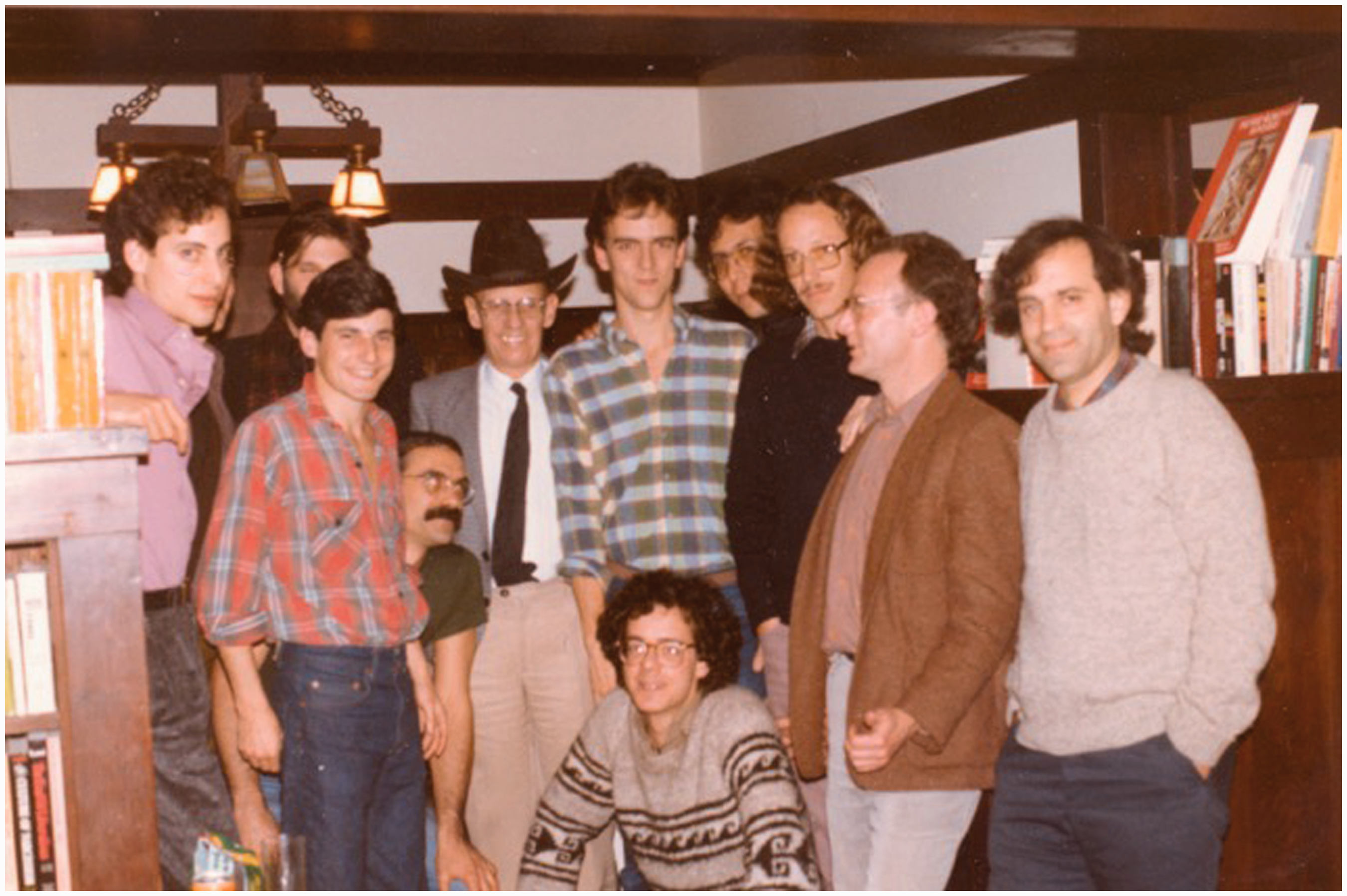
Footnotes
Acknowledgements
We are grateful to Daniel Defert, Henri-Paul Fruchaud and Daniele Lorenzini for helping us to get rights to this conversation, kindly granted by Foucault’s sister and sister-in-law.