







Abstract
Between the affirmative and the negative, the compositional and the oppositional, we need to rethink the difference between difference and contradiction. In this regard, the concept of ‘diplomacy’, as developed by Isabelle Stengers, is of particular significance. Whereas many adherents of an affirmative ontology of difference reduce contradiction to a caveat – ‘of course, antagonism is inevitable, but …’ – diplomacy makes contradiction its fundamental concern. This article explicates the significance of such a conception, via close readings of Stengers’ work in relation to that of Gilles Deleuze, and Gottfried Wilhelm Leibniz. However, it also develops diplomacy in new directions, particularly relating the diplomatic ‘fold’ to the sovereign ‘cut’. The fold of coexistence, then, is achieved through diplomacy as a ‘labour of difference’, against ‘facile pluralism’, which takes worldly cohabitation as given. A diplomatic political ontology is neither bellicose nor pacific; rather, it dramatizes the possibility of peace from within a coercive historical reality.
It is not the elements or the sets which define the multiplicity. What defines it is the
The diplomatic achievement means the event of the production of a new proposition, articulating what was a contradiction leading to war. […] [A] contradiction (either/or) has been turned into a contrast (and, and). (Stengers, 2005a: 193)
The Labour of Difference
I wish to propose that the concept of ‘diplomacy’ – particularly as articulated by Isabelle Stengers, as part of an ‘ecology of practices’ (2011a: Book VII) – enables a way of rethinking political ontology that is crucial to our intellectual and political moment. However, this conceptual prospect remains, at present, a possibility – unactualized, and seemingly unrecognized. With the aid of some contemporary praxographers of diplomacy (e.g. Constantinou, 1996; Opondo, 2010), the following pages explicate and develop this prospect, via Stengers’ interpretations of Gilles Deleuze, and Gottfried Wilhelm Leibniz. However, my reading of this conceptual cascade (Leibniz–Deleuze–Stengers) also seeks to add another branching, another layer, another fold.
It comes down to this: we need to rethink the difference between difference and contradiction. It is now more than half a century since Deleuze declared that ‘difference and repetition have taken the place of the identical and the negative, of identity and contradiction’ (1994 [1968]: xix). The philosophical and political shadows looming over this statement are readily deciphered. For GWF Hegel, ‘[d]ifference as such is already implicitly contradiction’ (2010 [1813]: 374). That is, to differ is to lack; to exist differently is to be at odds with existence. Amidst a milieu of post-Stalinist disaffection and budding student revolt, Deleuze was far from alone in his diagnosis. However, whereas, for example, Theodor Adorno (1973 [1966]) sought to redeem Hegelian dialectics via a more radical, historical negativity, Deleuze sought to give the ‘generalized anti-Hegelianism’ of his epoch a fundamentally affirmative expression (1994 [1968]: xix).
Between affirmation and negation, the compositional and the oppositional: it is this apparently fathomless chasm – this allegedly unavoidable either/or – that, I believe, must be fundamentally rethought. Whither ‘diplomacy’.
The dangers of negativity – ressentiment, despondency, dependency, dread; our entire ‘political economy of negative passions’ (Braidotti, 2011: 279; cf. Lefebvre, 2008 [1961]: 270–1) – are, today, undiminished. Nevertheless, Deleuze was perfectly lucid about the risk that his search for ‘difference without negation’ ran: that is, lapsing into the sheltered platitudes of a ‘beautiful soul’ – one who says ‘we are different, but not opposed …’, who ‘sees differences everywhere […] respectable, reconcilable or federative differences, while history continues to be made through bloody contradictions’ (1994 [1968]: xix, 52; see also pp. 207, 268). However, rather than following Adorno in repudiating the Nietzschean ‘pathos of saying yes to life’ (2008 [1965]: 18), Deleuze found in affirmation a power of autonomous defiance, an ‘aggression’ (1994 [1968]: xix) that sets difference free from ontological bellicosity (Stengers, 2019: 7).
It is here, between oppositional and compositional modes of political praxis – perhaps the principal lines of division within critical theory, as it has emerged and evolved over the past half-century (cf. Braidotti, 2019; Latour, 2010) – that, I believe, Stengers’ diplomacy holds profound (and seemingly unrecognized) significance. While remaining in a compositional mode, it retains contradiction as a problematique that is existentially meaningful. That is, while, for Deleuze (as for so many inspired by his thought), the bellicosity of actually existing worlds cannot be denied, nor is this something to dwell upon. Contradiction is reduced to a caveat; Stengers raises it to a concern.
An ecology of practices, Stengers writes, ‘understands conflicting interests as being a general rule’ (2011b: 62). This attentiveness to conflict, I believe, implies an important divergence from an orthodox Deleuzian ontology of difference. Although not frequently formulated in this way (though see Stengers, 2011a: 392), I wish to understand this divergence in terms of Deleuze’s reading of Leibniz.
In The Fold: Leibniz and the Baroque (1993 [1988]), Deleuze undertook a spectacular reorientation of Leibniz’s labyrinthine monadic orrery around the concept of le pli – the fold or pleat. This lexical-conceptual choice is crucial. Implicate, replicate, duplicate, complicate, explicate, supplicate, simple, duplicitous, complicit, pleat, plait, ply, comply, complete, replete, perplex, complex, pliant, multiply, display, apply, reply, plight, supplement, deploy, and so on: the Proto-Indo-European etymon *plek – whether via the Latin plicare or the Greek diploũn (all ‘to plait or fold’) – is prodigiously present in English, and related languages. It was with just such conceptual resonances that Deleuze formulated his concept of the multiple: that which not only ‘has many parts’ but ‘is folded [plié] in many ways’ (1993: 3, 1988a: 5). Thus, too, we can associate multiplicity with diplomacy.
Although her concept of diplomacy was not fully articulated until Cosmopolitics (2011a [1997]: Book VII), it was in The Invention of Modern Science (2000 [1993]) that Stengers introduced what she calls ‘the “Leibnizian constraint” according to which philosophy should not have as its ideal the “reversal of established sentiments”’. Even Deleuze, she noted, had regarded this declaration of the Hanoverian courtier as ‘shameful’ (2000: 14; see also 2019: 14; Stengers and Despret, 2014: 59–68; Deleuze, 2005 [1962]: 104; 1990 [1969]: 116; Leibniz, 1902 [1686]: 81). However, whereas Deleuze had characterized Leibniz as ‘a Lawyer [Avocat], or God’s attorney’ (1993: 68, 1988a: 92), for Stengers, he must be understood as ‘the diplomat who desperately sought to create conditions for peace between religions, […] living in a Europe bending under the legacy of so many martyrs’ (2000: 14).
The demand ‘to “respect” established sentiments’ should not, therefore, suggest a quietist acquiescence to power, or the naïve desire ‘to make everyone agree’. Rather, ‘established sentiments’ are those ‘that cannot be threatened without leading to panicked rigidity, indignation, or misunderstanding’ (Stengers, 2000: 14–15). ‘I hope to make myself hated,’ Stengers adds, ‘but I would like to try not to be hated by those whom I have no desire to offend’ (2000: 17). Stated otherwise, this ‘respect’ consists of the acceptance of the obligation to ‘think “par le milieu”’, in the dual sense of this expression (2010a: 160; 2005a: 187–8; Deleuze and Guattari, 1987: 25). That is, both thinking through the middle of a conflictual situation, without demanding a pre-existing common ground, and yet still thinking through the conditions that the modes of existence of those thus situated require.
Thus, we may find here a double reorientation: first, that of Deleuze, who turns Leibniz around the fold; and, second, that of Stengers, who turns Leibniz, and perhaps Deleuze too, around established sentiments. This conceptual manoeuvre – a rearticulation taking as its objective the retention of something’s implicit fundaments by transforming the point of perspective from which its elements can be comprehended – I will name, in the onto-topological fashion of Leibnizian monadology, a reaspection. Furthermore, the following pages will also attempt a third such manoeuvre: reorienting Stengers’ multifaceted thought around the ‘either/or … and, and’ of contradiction and contrast.
However, in presuming to enact such a shift, it is important to recognize that this fold is also a divergence; that a reaspection may betray as well as translate. In particular, whereas Stengers proposes the diplomat as a conceptual persona relevant to situations where a group is existentially threatened by a political decision but is not party to the decision-making process itself (2005b: 1002; 2018a [2013]: 153), I find in this figure a more wide-ranging relevance. And so, in attempting an interpretation that is precise (if not, precisely, faithful), it is necessary to make a number of further distinctions.
Fundamental to Stengers’ diplomat is that such an agent must always report back to those who ‘have the power to reject her proposals’ (2011a: 378). I will take the risk of characterizing those to whom such reportage is due as sovereigns – a term that Stengers does not deploy. However, I will also distinguish two variants thereof: whereas a delegator, existentially dependent upon its concern being heard, mandates a diplomat to affirm its requirements for existence, a dispatcher, predicated upon its capacity to assert interests by other means, licenses a diplomat to ‘give peace a chance’ (with the proviso that there are other options). With this dual conceptualization, I depart from Stengers’ more cautious and precise problematique. However, I believe that this shift enables an array of conceptual possibilities. Stated propositionally:
To be multiple is to be folded together with many other things; thus, a multiplicity may consist of both contrasts and contradictions. The ‘diplomatic achievement’ consists of folding together different ‘powers’ in their difference – that is, as contrast rather than contradiction. A plurality may be understood, more precisely, as a multiplicity where contrast rather than contradiction prevails – that is, as a prevailingly compossible multiplicity. Diplomacy is, thus, a technique of pluralism – a practice maintaining the possibility of plurality, rather than hostility, for a given milieu. However, diplomacy, existing only between ‘powers’ cannot be detached from sovereignty; nor, therefore, the resolution – the fold – from the decision – the cut. The cut, however, is not the contrary of the fold; it is the imposition of a radical pliability – a mutually implicating determination without the possibility of objection. For a delegator, finding an acceptable fold is a condition of survival: if one cannot fold, one must flee. For a dispatcher, however, an unacceptable fold may be addressed by extra-diplomatic means: if not surrender then war.
The value of these conceptions, I believe, is that they dramatize the danger involved in facile pluralism: that is, in blithely taking plurality qua coexistence to be providentially given in the nature of things (as per the beautiful soul). Stated otherwise, diplomacy is the labour of difference (cf. Deleuze, 1994 [1968]: 268) that works for coexistence in a world not of providence (where each seat of being is provided for) but of speculation (where every situated being is ever on the lookout).
The following pages principally comprise a close reading of, first, Deleuze’s reading of Leibniz’s ‘fold’, and, second, of Stengers’ ‘diplomacy’, with particular regard to Leibniz. However, the following also further formulates the abovementioned conceptual distinctions. It then concludes by briefly addressing contemporary debates regarding affirmational or compositional political thought (Braidotti, 2016, 2019; Savransky, 2019).
The Most of All Possible Worlds
‘[T]o the theatre of Leibniz,’ wrote Deleuze, ‘we must always return’ (1990 [1969]: 113). There is no mystery as to why this spectacle so fascinated. No other philosopher, Deleuze affirmed, has ever so succeeded ‘in reconciling full continuity in extension with the most comprehensive and tightly knit individuality’ (1993: 124).
Written in 1714, in 90 short paragraphs, Leibniz’s Monadology (2014 [2004]) – a condensed précis of his metaphysics – comprises a complex series of propositions, only some of which will be explicated here:
Existence consists of ‘monads’ – unique, indestructible, simple substances without parts, extension, or shape (§1–6). These alone are properly real. However, monads are not material atoms, they are perceiving substances (§17). Each and every substance differs from every other, even if their differences are indiscernible (§9). Nevertheless, each monad, within itself, represents the totality of the universe, as if in a ‘mirror’ (§56–7).
Studiolo of Francesco I de’ Medici, in the Palazzo Vecchio, Florence; completed 1570–72 (Wikimedia Commons). For Deleuze (1993: 28), this aristocratic hideaway constituted one of the ‘first acts’ of Baroque architecture.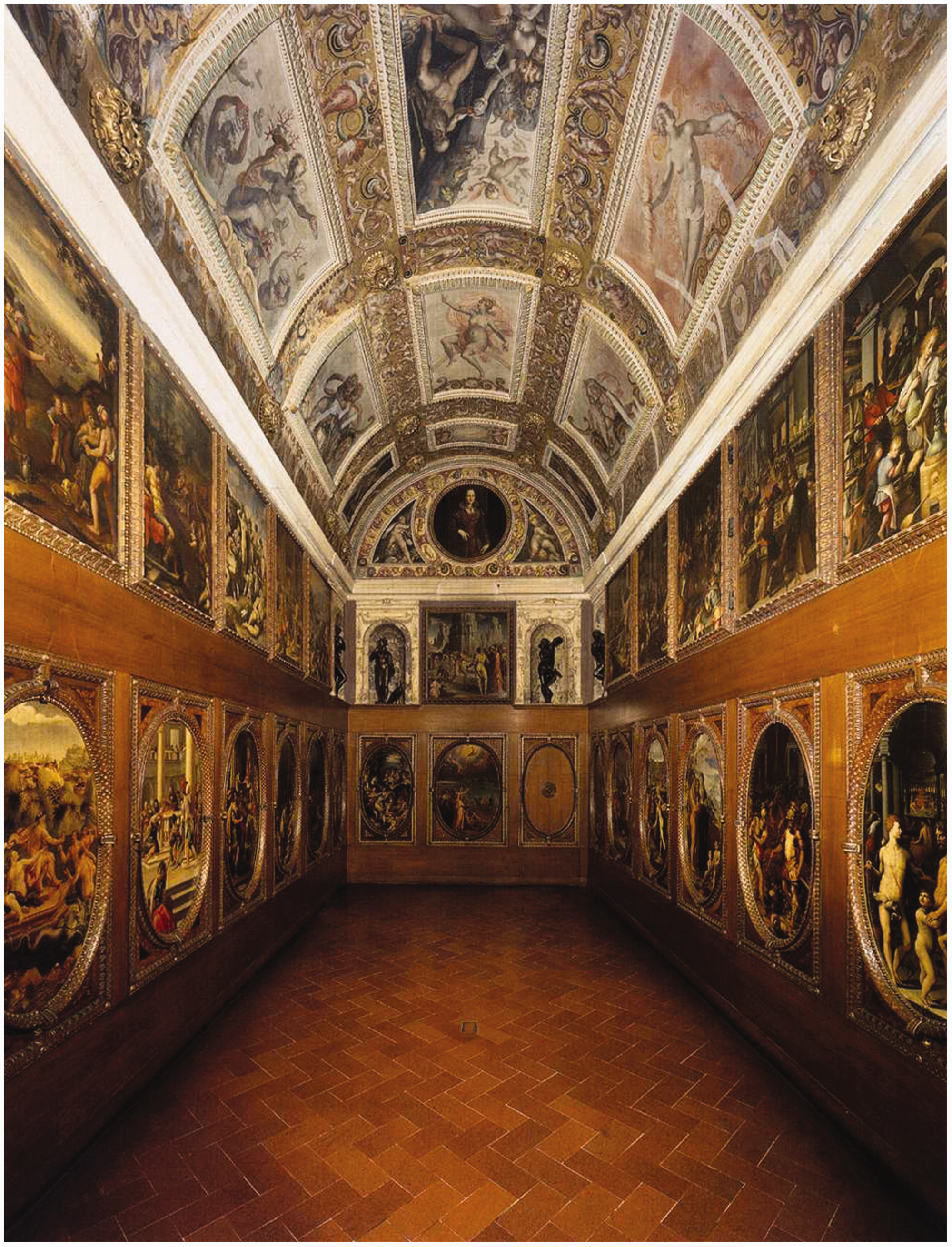
Matter and body are, then, but the phenomenal result of this total representation. Via this infinite perception, there is a complete ‘accommodation’ of each to all (§56). However, monads are self-enclosed; they ‘have no windows’, no exteriors by which to interact (§7, §11); no causal environment, only a regional purview. Instead, ‘the ultimate reason of things’ is found in that most perfect and necessary substance – God – who imparts a ‘pre-established harmony between all substances’ (§38, §78).
Though all created monads have ‘perceptions and appetites’ (§19), all are ordered in degrees of perfection: from the most rudimentary souls, equipped only with ‘passion’; to those given memory, and hence animality; to humans – and, higher still, angelic beings – endowed with ‘action’, reason, and, hence, an aspect of divinity (§29, §49, §83). Thus, the lesser a monad’s perfection, the more obscure its perception, and its agency. Any created substance perceives with clarity only its most immediate region, going ‘confusedly to infinity, to the whole’ (§60). The Divine purview, by contrast, encompasses, at a glance, all actuality and possibility. The influence of one windowless monad on another, then, is purely ideal, taking effect only via the medium of God (§51).
Although ‘an infinity of possible universes’ is available to Him, there must be a ‘sufficient reason’ for God’s selection of this possible world (§53). This reason is found in ‘the fittingness [la convenance]’ and maximum degrees of perfection contained in the continuous series of substances existing in the actual world. To be compossible – capable of coexistence – in this series is to be deserving of existence, and thus to exist (§54). Hence the perspectival ‘mirroring’ of each in all: §58: And this is the means of obtaining as much variety as possible, but with the greatest order possible; that is, it is the means of obtaining as much perfection as possible.
Thus it was that Deleuze, nearly three centuries later, acclaimed Leibniz’s reconciliation of continuity and difference as a testament to ‘the fold’. As it happens, the expression ‘fold’ appears only occasionally in Leibniz’s œuvre, and Deleuze offers only a handful of citations thereto (Lærke, 2009: 27; 2015: 1197). Indeed, besides the verb expliquer (to explain), pli-derived terms are largely absent from the Monadology – though with two crucial exceptions: §57: The same town, when looked at from different places, appears quite different and is, as it were, multiplied in perspectives. […] §61: But a soul can read in itself only what is distinctly represented there; it cannot unfold [développer] all at once all that is folded within it [tous ses replis], for this proceeds to infinity.
In Leibniz, Deleuze finds an exemplary expression of that ‘magic formula’ – ‘
However, this unity is of a very specific kind. ‘Harmonic unity’ of the Baroque sort, Deleuze writes, ‘is not that of infinity, but that which allows the existant to be thought of as deriving [découlant] from infinity’ (1993: 128, 1988a: 175). In other words, since even the merest, most undistinguished mote of percipience contains some dimly glimpsed impression of the totality, there are as many unities as there are perspectives – yet all perspectives share in, and through, the (literally) com-plete, all-involving Divinity.
The philosophy of the Baroque is to be found in Leibniz, then, because he is the thinker of that style which implicates, integrates, incorporates the most within the least – amassing and displaying a maximal, yet harmonic, immersion of existents in any given moment. However, for all its incorporatorial extravagance, the monadic universe was also one of individuals – and it is this that allows Deleuze to defend Leibniz’s infamous answer to the problem of evil.
Glory of the Mystical Lamb – dome of Church of the Gesù, Rome, by Giovanni Battista Gaulli, unveiled 1679 (Wikimedia Commons). An exemplary and influential encapsulation of Baroque harmony, and its use of perspective.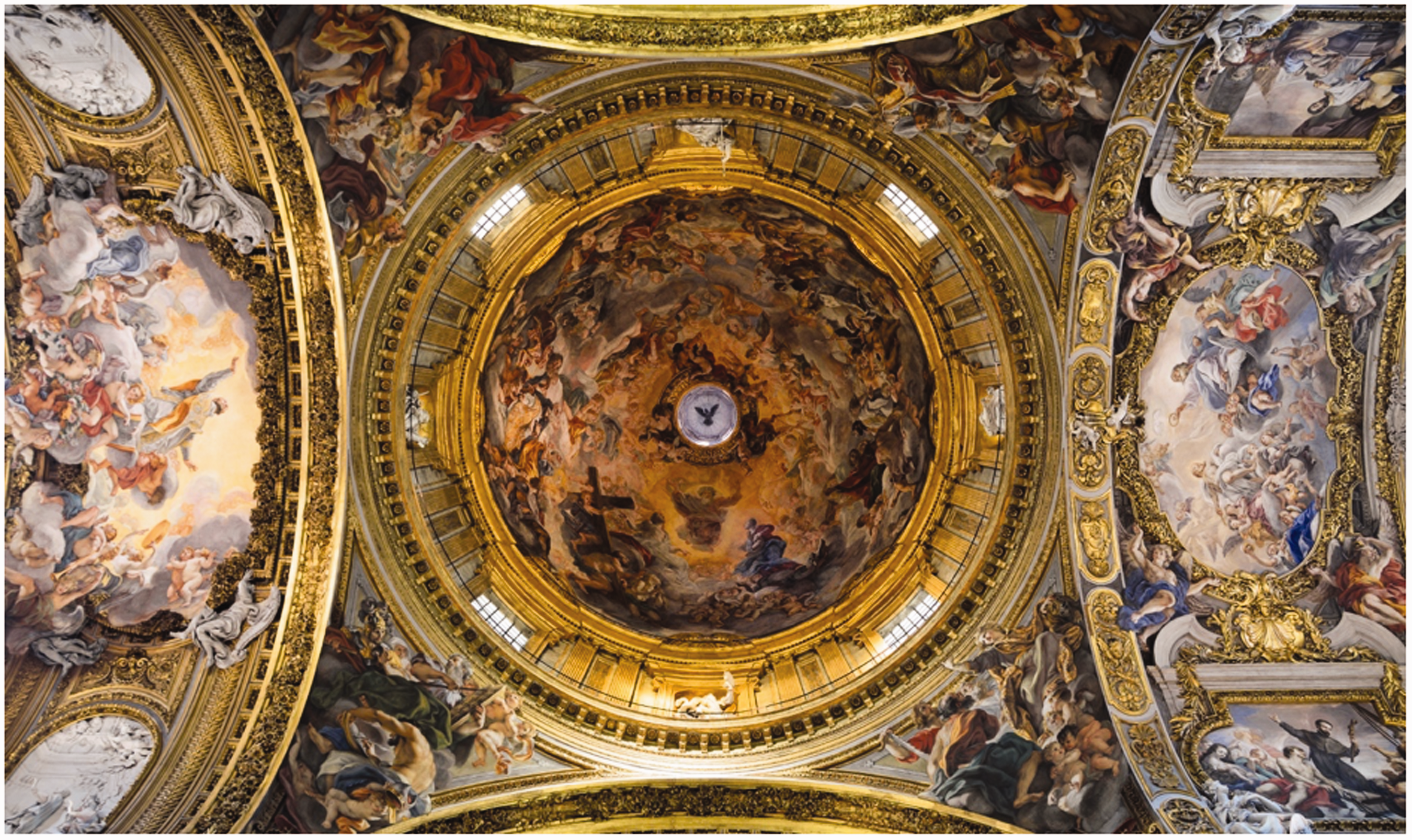
In 1759, the most caustic quill of the Enlightenment, that of Voltaire, was brought to bear on Leibniz’s theological sanguinity, in the satirical novella Candide, or Optimism. Feeding on a pall of gloom emanating from the then-blazing Seven Years’ War, in which around a million people would be killed across five continents, and the Lisbon earthquake of 1755, in which up to 100,000 people died, Voltaire pitilessly lampooned Leibnizian optimism, as embodied by the clueless Professor Pangloss: ‘For,’ he said, ‘all this is the best that can be. For if there’s a volcano at Lisbon, then it couldn’t be elsewhere. For it’s impossible that things should not be where they are. For all’s well [tout est bien].’ (1993: 22–3) The best of all worlds […] was neither the least abominable nor the least ugly, but the one whose All granted a production of novelty, a liberation of true quanta of ‘private’ subjectivity, even at the cost of the removal [soustraction] of the damned. The best of all worlds is not the one that reproduces the eternal, but the one in which new creations are produced [se produit le nouveau]. (1993: 79, 1988a: 107–8, emphasis in original)
The Force of Discord
Satirists may scoff; however, Leibniz was no aloof idealist, lost in the forests of airy abandon. Born in a time of war, he trained initially in law, specializing in the resolution of difficult cases. As early as 1670, at the age of 24, Leibniz had written on foreign affairs and been engaged as an emissary (Antognazza, 2009: 117). He dedicated much of his life and thought to reconciling that most bloody rift of creeds: between Catholicism and Protestantism. Rather than ‘presuming harmony’, then, Leibniz held that ‘knowledge should be built out of the variety of diverging views’ (Dascal, 2006: xxi). His theory of evil, Deleuze claims, was devoted to establishing ‘a method to prepare for and to resolve dissonances in a “universal harmony”’ (1993: 131–2). This, the ‘Baroque solution’ for when the ‘ravages and miseries’ of the earth ‘shake and tremble’, is to ‘multiply principles – we can always slip a new one out from under our cuffs – ’, ready for ‘this or that “perplexing case”’ (1993: 67). The courtly wig is a façade, an entry, like the vow to hurt no one’s established feelings [sentiments établis], and the art of presenting his system from one point of view or another, in such and such a mirror, following the apparent intelligence of a correspondent or of an opponent [contradicteur] knocking on his door, while the System itself is up above, turning about itself, ceding absolutely nothing to the compromises, down below, whose secret he keeps, taking, on the contrary, ‘the best of all sides’ in order to deepen or make another fold [un pli de plus] in the room with closed doors and with sealed windows, the room in which Leibniz is confined when he states: ‘Everything is always the same, with degrees of perfection excepted.’ (1993: 33, 1988a: 46)
It is straightforward to understand how, in an age of religious wars, monadology could be posed as a philosophy of peace. Any given existent is not infinite but ‘deriving [découlant] from infinity’; the world is ‘not the one that reproduces the eternal’, it is the eternal condition for the particular and ‘private’; none but God may approach the totality, and He alone mediates the all-in-all. Thus, each Christian creed may claim its portion of the eternal but only in deference to the Complete. Doctrinal pluralism is given shelter, while paganism, polytheism, and pantheism are buttressed against (Deleuze, 1993: 9). Even Leibniz himself remains ‘in the room with closed doors’. Perspicacity presupposes perspective.
However, the Avocat of providence is not the diplomat of speculation. The lawyerly conciliator of ‘established sentiments’ wraps every contradiction into ‘pre-established’ Harmony, in a world that is because it is the best, because it is the most. Like Stengers after him, and Leibniz before – and utterly unlike Voltaire – Deleuze takes little interest in critical condemnation (cf. Stengers, 2014: 196; Dascal, 2006: xlviii). He seeks out what is worthy in a thinker, not what makes them a thing of the past (Deleuze, 1993: 4). However, he is clear that Leibniz and the Baroque mark a historical disjuncture – a ‘transition’ away from the age of classical reason, which ‘toppled under the force of divergences, incompossibilities, discords, dissonances’ (1993: 81). Like the maps, two centuries before, that strained to incorporate the so-called Western ‘discoveries’ within the Ptolemaic grid of representation (Figure 3), the Baroque was a concerted, gasping mission for God’s grace in an unfolding age of mechanics, empire, capitalism, and the microscope (1993: 110).
World map on the basis of Ptolemy’s Geography, supervised by Bernard Sylvanus, 1511 (Wikimedia Commons). Despite its inclusion of the newly connected continent to the west, this map, with its ‘climata’ (lines of latitude), remains, structurally, within the tradition of Claudius Ptolemy (c. AD 100–c.170).
Whereas, for Leibniz, a bifurcation or divergence of series (necessitated by ‘contradiction’ in a logical, Aristotelian sense) meant ‘genuine borders between incompossible worlds’, for more contemporary philosophers, such as Alfred North Whitehead (e.g. 1929), ‘bifurcations, divergences, incompossibilities, and discord belong to the same motley world’ (Deleuze, 1993: 81). Thus, cosmos becomes, as per James Joyce, ‘chaosmos’; even God ‘becomes Process’ (Deleuze, 1993: 81).
Nevertheless, this epochal differentiation does not, for Deleuze, dethrone the fold. His book concludes: ‘we all remain Leibnizian because what always matters is folding, unfolding, refolding’ (1993: 137). But what, then – if bifurcations of series, or incompossibilities, must now be retained in one and the same universe – can be said of the cut?
Conjugations of the verb couper (to cut) may be found in The Fold, though one needs to look past Tom Conley’s translation. For instance, Immanuel Kant ‘isolates [coupe] the two floors’ of the monad (1993: 119, 1988a: 161) – i.e. mind and matter – thus reinstituting Cartesian duality. For Leibniz, by contrast, ‘the break [coupure] is never a gap [lacune] or a discontinuity’ (1993: 151, n.13, 1988a: 89, n.13). Likewise, in the Leibnizian universe: The principle of indiscernibles establishes divisions [coupures]; but the divisions are not lacunae or ruptures of continuity; on the contrary, they divide [répartissent] continuity. (1993: 65, 1988a: 88)
It is crucial to recognize, then, that Deleuze’s philosophy of the fold is concerned, for the most part, with aesthetic, cosmological, and empirico-transcendental questions (e.g. also 1988b: ch. 5). It is in Stengers’ iteration, by contrast, that the questions turn political. Thus, the ‘courtly wig’, ‘the façade’, the ‘established sentiments’ become, for Stengers, what ‘the fold’ was for her predecessor: another point of perspective from which all else can be arranged; a second reaspection.
Approaching the Borders
From διπλοũν [diploũn], meaning to double or fold, came δίπλωμα [dípl
Of course, as the British diplomat Ernest Mason Satow wrote in 1917: ‘Diplomatists existed long before the words were employed to denote the class’ (1979: 7). For Iver Neumann, more expansively, ‘diplomacy is ubiquitous once political life is lived on a scale larger than the band’ (2012: 23). Thus understood, there have been, and are, many varieties of diplomacy (Cornago, 2013). However, only a few have been conventionally recognized as such. For instance, as Sam Okoth Opondo argues, during the colonization of Africa, the colonized were precluded from being agents of diplomacy until such a time as they could be ‘converted into something recognizable, yet inferior to the European standard’ (2010: 110, emphasis in original). However, this ‘European standard’, too, is by no means uncomplicated.
In Greek antiquity, ‘embassies to other city-states’, engaging in ‘oration, persuasion, and negotiation’, were known as πρɛσβɛία [presbeía] – presbes meaning both ‘ambassador’ and ‘elder’ (Constantinou, 2013: 148). The term θɛωρία [the
It is significant, then, that Stengers identifies ‘the invention of diplomacy’ as preceding ‘that of politics in the sense we have given to this term since the ancient Greeks’ (2011a: 387, cf. 2010b: 29, 2005a: 194). In other words, diplomacy precedes the polis – the city-state. It is significant, too, with respect to Deleuze who, while folded into the concept-multiplicity of Michel Foucault, found the ancient Greeks to have been ‘the first doubling’ in the history of Being – the outside bent back on itself, becoming an inside capable of ‘spontaneity’ and ‘receptivity’. That is, it was in the polis that ‘the relation to oneself assume[d] an independent status’ (1988b: 99–101). By contrast, for Stengers, evading such Hellenocentrism: The diplomat was invented so that peoples, nations, groups could, if necessary, successfully coexist without the destruction or the enslavement of one by the other being the sole outcome [horizon] of their relationships [rapports]. (2011a: 387; see also 1997: Vol. 7, 114, 2011a: 349)
Thus was developed the conceptual persona of the diplomat. However, Stengers formulated this figure with a very specific conflictual milieu in mind: that between ‘relativist’ and ‘realist’ sociologists and scientists. To inform a physicist ‘that their electrons are only a social construction’, Stengers warns, is a truly undiplomatic statement: ‘you will get war’, and, what’s more, ‘you will have deserved it because you have insulted not simply their beliefs but what attaches them, causes them to think and create in their own demanding and inventive way’ (2005a: 191, 2011a: 332–3). In other words, you will have attacked their established sentiments – in effect, their mode of existence. To do justice to the scientists’ insistent passions without, in turn, insulting the ethical acuity of the constructivists: it is via this double-bind – these ‘two regimes of obligation’ (2011a: 377) – that Stengers, at risk of betraying both camps, attempts to think through the problem. Nevertheless, ‘the diplomat’ expresses neither a general theory of mediation nor an overarching ethical prescription (cf. Cornago, 2013: 21–2; Stengers and Despret, 2014: 67). The diplomatic act is rigorously case-specific; always of the order of an event – that is, of something new.
The ‘only general moral advice’ that Leibniz ever gave, writes Stengers, was ‘“Dic cur hic [say why here]” – say why you chose to say this, or to do that, on this precise occasion’ (2005a: 188). In this respect, whatever aspersions Candide may have cast, it is indeed important to remember that Leibniz was a lawyer. Duly, it was not with disputes as such that he had quarrel; rather, it was with confused or ‘mingled’ disputes (Leibniz, 2006 [c.1670]: ch. 1) – those whose conditions rendered attempts at their redress futile.
Probably the most famous feud of Leibniz’s career was the Prioritätsstreit (priority-dispute) with Isaac Newton regarding infinitesimal calculus (Antognazza, 2009: 428–31). Deleuze was fascinated with this innovation; however, not for reasons of its disputation. The calculus – with which differential relations can be calculated at any infinitesimal point of a curve – was, for Deleuze, a crucial demonstration of infinitely differentiated continuity (1993: 90; Lærke, 2015: 10–13). For Stengers, by contrast, it was the fact itself that Leibniz, like Whitehead, was a mathematician that was of principal significance (2000: 15). Mathematicians, even more than lawyers, may be the pragmatists par excellence because their practice is always relative to a problem. The mathematician ‘brings into existence conceptual spaces that no one can inhabit without accepting their constraints’ (2010c: 169). That is, to address the mathematical triangle, one must first accept the irrelevance of any material triangle to its characterization. This principle then informs ‘the only slogan Leibniz ever proposed: Calculemus. Let us calculate’ (2011a: 399–400).
So sanguine was he concerning his mode of thought, Leibniz proposed that if only language could be made as precise as mathematics then disputes could be reduced to a formal assessment of error; a matter of calculation. Such Panglossian accountancy would be easy to ridicule. However, for Stengers, this would be a misunderstanding: There is no commensurability without the invention of a measurement […]. That is the first meaning of calculemus: the ‘us’ does not pre-exist the invention of the calculation […]. It is this very invention that produces this ‘us.’ (2011a: 399–400)
Above all, then, the calculemating diplomat is not an agent of probability. No created monad more than grasps ‘the whole world darkly’ (Deleuze, 1993: 91). Thus, the good cannot be simply calculated, it can only be made calculable – that is, commensurable. As such, diplomats are ‘creatures of speculation’ (Stengers, 2018b: 85); agents of possibility (2011a: 412). Probability may be the soul-search of the sovereign but the interstices of diplomacy are loci of hesitation, vacillation, and indecision (2011a: 397, 2018a: 153) – moments where the rhythms of history lose their assurance, and, thereupon, ‘a struggle against probabilities’ becomes possible (2010c: 13).
At the Summit
Bearing in mind the filiation of the word providentia (meaning foresight, foreknowledge) we might say that Leibniz was the thinker of providence par excellence. That is, the line of sight that mattered most fundamentally was that of God. Good order was, in absolute if not local terms, given. As such, this was an ontologically hierarchical universe.
Likewise, the ‘essence’ of the Baroque, writes Deleuze, is that of a cone: given unity not from a ‘centre’ but ‘through a projection that emanates from a summit as a point of view’ (e.g. Figures 2 and 4). This is the mode of relation permitting such ‘full continuity’ and ‘tightly knit individuality’ to coexist (1993: 124–5). It may be taken as more than semantic coincidence that double-words deriving from diploũn produced ‘diplomacy’; likewise, that diplomacy also concerns ‘summits’.
Saint Peter’s Square, from the dome of Saint Peter’s Basilica, Vatican City (Wikimedia Commons). Whatever his Protestantism, such ornate heights of state have particular resonance with Leibniz's cosmic orderliness.
At the summit of the Baroque universe is the agency of selection that effects closure. It is a position of power – more precisely, of perfection. The selection of this, rather than any other, possible world is the act enclosing the cone of the universe. Thereupon, each and every extant point of percipience, in an infinite series or curve, is enveloped in a conic world of its own – ever more obscure as it becomes more expansive. These are the fundamental folds by which each closure – of existence, in its maximal perfection; of each substance, in its relative imperfection – is secured.
The ‘diplomatic summit’, not unrelatedly, is where sovereigns meet (Constantinou, 2004: ch. 2) – or, more precisely (as I have termed them), dispatchers. At the summit, dispatched diplomats become under-labourers, facilitators, since those to whom they report are now immediately present. Delegated diplomats, meanwhile, must tread with especial care. Dispatchers may, of course, act ‘diplomatically’ – but, also, they may not. Delegators, by contrast, remain remote from the heights of eminence, issuing their plea: ‘“If you decide that, you’ll destroy us”’ (Stengers, 2005b: 1002, 2018a: 153).
Thus, while diplomacy and sovereignty cannot be conflated, nevertheless, and no less, they cannot be extricated. Diplomacy exists only among ‘powers.’ The diplomat knows that […] those she reports to have the power to reject her proposals. The inherent grandeur of her practice is tied to this risk. (Stengers, 2011a: 378)
Without higher authority, a diplomat cannot simply compel estranged parties to make peace: all must ‘agree on the possibility of peace and thus define themselves as capable of participating in its invention’ (2005b: 1003). As Stengers dramatizes with respect to Leibniz’s telling of the story of Beelzebub, the very offer of a covenant may be enough to provoke violent disdain (2011a: 415). The anarchic diplomatic art thus consists in negotiating a double danger. Without any direct means of actualization, the diplomat maintains the possibility of defying probability. Whatever the odds, the diplomat works for such a fold as would achieve not a scission (a subordination or declaration of war) but, rather, a resolution (an alignment or contentment) – the condition of peace being not the negation of war but, rather, the acceptance of ‘a constraint’ (2011a: 387).
A diplomatic fold between powers is not, therefore, either a harmonization or an annexation. When Stengers writes of there being ‘no general opening of the border’ between parties where ‘contradiction (either/or)’ has become ‘contrast (and, and)’ (2005a: 193), this is an alignment of difference, in its difference – a fold accepted from both sides (though by no means in a condition of equality). Thus it is that the diplomat is not ‘closed’ but exists between closures, intensively folding and refolding the conflictual milieu in question. However, we can now be more precise.
Diplomacy is an art of folds – of folding and being folded. A more or less simple intermediary might be said to be duplicitous, having only one fold, carrying a single, solitary missive (from/to). A pure mediator would be chaos, a crumpled ball of creases, collapsed in on themselves. The skilled diplomat can shift between foldings – from a few, neatly-creased and clearly directed, to the most back-breakingly origamic monstrosity. Every fold, a diploma; a trace of a mission. A one-diploma diplomat simply unfolds to authenticate authority – a glorified passport, wax-sealed. A many-diploma diplomat cannot unfold them all at once but must show many sides to many agencies, depending on the situation. Such complexity might be taken for duplicity (two facedness), but also duplexity or complication (the capacity to bend double in many directions at once). In this ‘art of divided loyalty’ (Stengers, 2010b: 30), some are more artful than others. But it is an art that can make no decisions. The sovereign cuts, the diplomat folds.
The Infinite Fold
Many over the centuries, as Maria Rosa Antognazza puts it, have concluded that Leibniz ‘was disingenuous, a timeserver, a courtier, willing to placate opposing parties by misrepresenting his principles, or a man without principles at all’. However, he was, she adds, a man with an astonishing capacity to grasp ‘the harmonies underlying seeming antitheses’, and, for reasons theological, philosophical, or political, ‘was equally capable of presenting his single, coherent position in apparently incompatible ways’ (2009: 4). How Leibniz did this, and what this might mean for contemporary philosophical practice, can be better understood by taking a specific example.
In 1900, Bertrand Russell lamented that, despite repeatedly adopting transubstantiation as a tenet, ‘nowhere does Leibniz himself assert that he believes it’. This adoption arose, principally, from the Protestant monadologist’s correspondence with the Jesuit theologian Bartholomew Des Bosses. For a universe of unique, eternal substances, in which body and soul correspond but do not connect, Catholicism presented a problem: How could the bread of the sacrament trans-substantiate into the body of Christ? Leibniz’s answer was, quotes Russell, that there could be ‘some real thing which unites, and is added by God to the monads’ – a substantial bond or vinculum substantiale; a gift from God, momentarily established. Having already faulted ‘the unduly practical nature of Leibniz’s interest in philosophy’, the vinculum, Russell withers, was ‘rather the concession of a diplomatist than the creed of a philosopher’ (1900: 72, 151–2, cf. v–vi, 139).
For his part, Deleuze took the vinculum to be crucial, though he sidestepped the sacramental problematique, posing it instead as a general question of how a soul may ‘have’ or ‘possess’ a body: the ‘unilaterality’ of the monad implies as its condition of closure a torsion of the world, an infinite fold, that can be unwrapped [déplier] in conformity with the condition only by recovering [restituant] the other side, not as exterior to the monad, but as the exterior or outside of its own interiority: a partition, a supple and adherent membrane coextensive with everything inside. (1993: 110–11, 1988a: 148–9)
For her part, Stengers writes that ‘Leibniz, the philosopher diplomat so often reviled by those he represented’, was he who had the audacity to refuse ‘the concept of a body causally subject to the soul that “possesses” it’, while nevertheless accepting ‘the risks imposed by the possibility of saying “my body”’. The vinculum provided, then, a ‘paradoxical sense of belonging’, through which the soul folds into itself ‘something like a collective echo of the crowd’ (2011a: 391–2).
The speculative acrobatics by which Leibniz was able to incorporate yet another proposition into the Lord’s universe evidently irked Russell no less than it delights both Deleuze and Stengers. What, for the latter, displays a bravura feat of conceptual creativity was, for the former, rather an abandonment of the standards of conscientious conviction that make rational consensus, and hence peace, possible. It was Russell’s friend, former teacher, and future collaborator Whitehead who both Deleuze and Stengers would later posit as the paragon of the speculative philosopher. Thus conceived (see Whitehead, 1929: 3), philosophy relinquishes every power of existential disqualification, asking instead how each experienced existent might be accommodated by conceptual constructions that, like the mathematician’s immaterial triangle, affect the world only by rendering things ‘calculable’ – that is, commensurable; compossible (see Stengers, 2011c: 16).
As such, a speculative philosopher’s diplomatic milieu, no less than that of a mathematician, is strictly circumscribed. The disqualifying judgements of ontological hygiene are out; likewise, the temptation to whisper in the prince’s ear: ‘any relationship with power and its responsibilities’, Stengers writes, ‘is poisonous for philosophy’ (2011a: 403; cf. Stengers and Despret, 2014: 67–8; Iannone, 1994). Instead – and analogously to the vinculum, which is ‘present without interaction’ in the Leibnizian cosmos – the vocation of speculative philosophy becomes that of ‘fabricat[ing] concepts that actualize what a given epoch realizes [i.e. makes possible], the disparate ensemble of the calculemuses that may be realized during that epoch’ (2011a: 403).
We are returned, then, to the question with which we began: More than half a century since Deleuze declared the overrunning of ‘identity and contradiction’ by the forces of affirmative ‘aggression’ (1994 [1968]: xix), what shift in conception might ward off ‘negative passions’ (Braidotti, 2011: 279) while, at the same time, dispelling the ‘beautiful soul’?
A Diplomatics of the Pluriverse?
One could almost say: Why is there something rather than nothing? Because there are folds. However, since the fold, now in contrast to the cut, is no longer a neutral or innocent term, le pli cannot be straightforwardly ontologized, as though being itself were, at root, authentically coexistential.
In this respect, my proposal differs from that of, for example, Rosi Braidotti (2016: 53), for whom the ‘monistic vital materialism’ that today so widely animates the ‘posthumanities’ – a monism found most profoundly in the works of Deleuze (and Félix Guattari) – institutes a kind of ‘ontological pacifism’. This pacifistic existential ethic, Braidotti argues, bypasses violence by obviating the ‘logical necessity to link political subjectivity to oppositional consciousness’ – a reductive relation that instils a ‘lethal logic’ of negativity. Of course, it is immediately clarified – like Deleuze’s ready recognition of ‘bloody contradictions’ (1994 [1968]: xix) – that ‘[t]he ethical cultivation of positivity […] does not exclude, either logically or practically, situations of antagonism or conflict’. However, such qualifications remain caveats, not expressions of future concentration.
From similar wellsprings, Martin Savransky (2019: 15), drawing on the work of William James, writes that: Pluralism […] is a name for staying with the feeling of and, of but and if and with; for staying with the one and the many, with the pluralistic problematic. I insist: for staying with it, not for overcoming it (emphasis in original).
And so, rather than ‘a pragmatics of the pluriverse: speculatively experimenting with problems not in order to find their “true” solution, but to enable them to enable us to impregnate the world with new differences’ (Savransky, 2019: 15), I would prefer to propose a diplomatics of the pluriverse: speculatively experimenting with problems so as to solve what we can, coordinate with who we may, and build what we must – with ‘we’ being forever a situationally-issued appellation. Such a praxis does not require permanence in the problems it ‘stays with’ or the coalitions it constructs (Kanngieser, 2012: 286). Nor does it presuppose that coexistence, beyond the ‘coercive state of [actual, historical] reality’ (Adorno, 1973 [1966]: 10), requires universal reconcilement. However, it does require more than celebratory multiplication; it requires concern for contradiction.
Stengers reminds us that creativity, Whitehead’s basic ontological principle, ‘is neutral with regard to the distinction between cosmos and “disordered” multiplicity’ (2011c: 308). Diplomatic creativity cannot be ‘neutral’, in this sense. Thus, a diplomatic political ontology – premised upon the fold and the cut, difference and contradiction – is an ontology neither bellicose nor pacific. Rather, it exists poised upon a precipice between the two. Peace is inherently possible but it is not inherent in things.
In another recent work, Braidotti (2019: 19) announces that: the task of critical theory [today] consists in activating subjects to enter into new affective transversal assemblages, to co-create alternative ethical forces and political codes – in other words, to compose a missing people.
The question of relations between peoples, to borrow once more from Stengers (paraphrasing Tobie Nathan), begins with partial closure as a ‘condition of exchange’ (2011a: 336–7; see also Nathan and Stengers, 2018). One must, therefore, be wary of universalization through ontologization – monistic, vital, or otherwise. No cosmos-repairing ‘infinite fold’ can suffice. Diplomacy qua pluralism situates itself amidst the conflictual multiplicities of uncommon worlds, while, at the same time, affirming that pluriversality, though never given, is nevertheless possible. However, although both delegated and dispatched diplomats undertake ‘missions’, they are, most emphatically, not ‘missionaries’. However varied their parameters of practice, no diplomat sets forth to transmit a pre-established truth, defining the other who would receive it as the lack to which abundance, by nature, flows. Rather, diplomatic missions are obligated to the irreducible multiplicity of whatever concerned powers incline, in their difference, towards the milieu in question. In this respect, it is imperative to recognize that diplomacy, as we have seen, precedes the polis. It is, therefore, already opened out onto an ecology of practices that greatly exceeds either post-Burkean linguistic conventions or Hellenocentric critical theory. However, it is upon this point that the limitations of the proposal herein explicated must be recognized – as, indeed, Stengers insists of her own work (2018b: 95), when it is claimed as a ‘decolonial practice’ premised upon ‘the absence of ontological sameness’ (De la Cadena, 2015: 281; see also Conway, 2019).
As we have seen (Opondo, 2010; Constantinou, 1996; Cornago, 2013), there are many more ways to be diplomatic than the conceits of established power have commonly allowed (see also e.g. Beier, 2009; McConnell et al., 2012). Thus, the Mississauga Nishnaabeg artist and intellectual Leanne Betasamosake Simpson writes that, whatever the racist delusions many settlers may harbour, ‘Indigenous nations had their own precolonial diplomatic relations and political cultures’. However, she also warns against ignoring the fact that ‘the traditions, beliefs, and worldviews that defined concepts such as “treaties” were extremely different’ (2008: 31). To collect such practices under the rubric of ‘diplomacy’ must not, therefore, reduce them to the specific history that has made this expression hegemonic.
And so, if there is to be a pluriverse worthy of the name, the proposal articulated herein may only address one small part of it. There may be many diplomacies, as there are many ontologies – and, indeed, the above has not even begun to do justice to existing knowledges of either. Nevertheless, I am hopeful that the concepts herein developed constitute meaningful possibilities for allaying the allegedly unavoidable ‘either/or’ of oppositional and compositional political thinking.
Diplomacy is not an agency of ‘dialogue’. It cares nothing for ‘keeping the conversation going’, for ‘hearing them out’, for ‘letting them have their say’. On the contrary, it has no time for stallers, and any diplomat who sees around them only would-be allies – fellow beautiful souls divided merely by differing ‘views’ – is a traitor to their craft. Nor, then, does diplomacy aspire to dissolving all antagonisms, such that a sea of mutuality might then rise. No. It seeks, quite simply, to dispel unnecessary antagonisms so that necessary ones might come to the fore. It explores the folds that are possible so as to enable the cuts that are necessary. And so, one last word for the diplomats: Their reputations are wont to precede them, and perhaps their infamies are deserved. However, diplomats do not only broker peace, they also build alliances.
ORCID iD
Philip R Conway https://orcid.org/0000-0002-7039-7619