







Abstract
Governmental performance is important for maintaining the public’s political trust. This article examines the moderating role of the popular perceptions of democracy on the effect of governmental performance on political trust in authoritarian regimes by studying the case of China. The popular perceptions of democracy affect the evaluations of governmental performance, and the effects of governmental performance on political trust are contingent on particular democratic perception. The results reveal that a better government’s social performance particularly increases political trust among people who view elections as an essential component of democracy. However, such a positive effect is significantly reduced among people who consider political rights to be a key component of democracy. Regardless of how Chinese people view democracy, government’s poor political performance reduces people’s political trust in the government. However, the negative effect is most significant among people who prioritize political rights in their perception of democracy. For those who view economic security as an essential component of democracy, the negative effect of the government’s poor political performance on political trust is substantially attenuated.
Introduction
Theories of political development underline two patterns of determinants in democratization. First, governmental performance correlates with regime support (Mishler and Rose, 2002; Tang, 2005; Zhong, 2014). When the masses are dissatisfied with their government’s performance, political trust will decline. Second, the public’s support for democracy will threaten the rule of authoritarian regimes and drive political development (Chu et al., 2008a; Fuchs and Roller, 2006; Qi and Shin, 2011). Many countries witnessed democratic transitions in the past few decades after their government’s performance worsened or the public’s demand for democracy rose. Despite its authoritarian regime, China has achieved great economic success and its political system remains resilient. Ordinary Chinese people appear to have an ambiguous mentality regarding democracy – while they have a high level of political trust in the current authoritarian government, they are still supportive of democracy (Lu and Shi, 2015; Shi, 2008; Zhai, 2018b). What is the prospect for democracy in an authoritarian regime like China? The case of China is of great relevance for research on democratization.
The Chinese government enjoys considerable political trust from the public (Li, 2004; Shi, 2008, 2014; Tang, 2016). Sustaining economic growth over the past three decades has allowed the authoritarian regime to survive despite the domestic and international pressure of democratization. The high level of political trust is attributed to government policy performance. A number of studies demonstrate that the favourable evaluation of governmental performance is the major reason for high levels of political trust in the current regime (Tang, 2005; Yang and Tang, 2010; Zhong, 2014). Indeed, China’s economic growth has improved the ordinary Chinese standard of living. When comparing current Chinese conditions with that of several decades previously, the Chinese government can take credit for the economic achievements. However, governmental performance is not merely restricted to the economic domain. The government’s social and political performance is an equally important factor affecting the public’s political trust (Bratton and Mattes, 2001; Craig, 1996; Zhai, 2016). The effects of outputs of political systems on political trust vary with different sorts of performance. Evaluation of governmental performance changes across different policy domains. The government may perform fairly well regarding the economy, but fails to protect citizens’ human rights. If the majority of the Chinese treat human rights as the most important issue, they would not hold positive sentiments or trust in the current government. Therefore, concerns for economic affairs are not the whole story. Policy success or failure in other fields affects political trust equally.
The public’s support for democracy is another factor in the democratization process. Democracy has established its legitimacy as a political system since the 20th century. Today, there is no country that publicly opposes democracy but autocratic countries try to manipulate the concept of democracy for serving undemocratic rules. Existing literature has shown that the Chinese public has a high level of support for democracy (Shi, 2000; Shi and Lu, 2010; Zhai, 2018a). Yet, pro-democratic attitudes have not resulted in a widespread public struggle for democracy or democratic movements. Researchers find that the Chinese people’s democratic perceptions are not necessarily consistent with the liberal democracy discourse (Lu and Shi, 2015; Shi and Lu, 2010; Zhai, 2017). These studies largely contributed to the advances in exploring popular perceptions of democracy in an authoritarian system. We know that the word ‘democracy’ in China has different connotations from the Western conceptualization of democracy.
This study aims to take this line of research further and examine how citizens’ views of democracy may influence the relationship between their evaluation of government policy performance and political trust. Popular democratic perceptions are important for regime support and its stability (Baviskar and Malone, 2004; Zhai, 2018a). This article investigates variations in the levels of government performance perception and political trust in China as different patterns in popular democratic perceptions intervene in their relationships. The findings show that popular democratic perception affects the masses’ evaluation of government’s social performance. Moreover, the effects of government’s social and political performance on political trust are moderated by popular democratic perceptions. This study also shed light on the Achilles’ heel of political trust in the current Chinese regime. Regardless of how Chinese people view democracy, the government’s political performance is negatively associated with their political trust. Abuse of power worsens the masses’ evaluation of governmental performance and has become the subject of discontent throughout the Chinese population.
Popular perceptions of democracy
Democracy is a contested concept, and people in different cultures or countries view it in different ways (Bratton et al., 2005; Chu et al., 2008b; Fuchs and Roller, 2006; Miller et al., 1997; Shin, 2012). The concepts of democracy are classified differently, according to distinct standards such as constitutional arrangements, procedural perspective, liberty and rights, and outcomes of democracy. This study will employ a theoretical framework of procedural and substantive conceptions of democracy in classifying conceptions of democracy and apply the two categories to an empirical survey in China. The method that divides the multiple conception of democracy into procedural and substantive categories has been widely used in previous theoretical discussions of democracy and in empirical investigations of popular democratic conceptions (Dalton et al., 2007; Huang et al., 2013; Kollmeyer, 2010; Lu, 2013; Lu and Shi, 2015). Researchers also use terms including ‘liberal democracy’, ‘understanding democracy as means’, or ‘intrinsic value of democracy’ to refer to the procedural perceptions of democracy, and terms including ‘the guardianship discourse on democracy’, ‘understanding democracy as ends’, or ‘instrumental value of democracy’ to refer to the substantive perceptions of democracy.
People who hold procedural perceptions of democracy, place an emphasis on elections that falls under a minimalist concept of democracy (Schumpeter, 1976 [1942]). The minimalist concept of democracy contends that democracy is equal to holding periodic competitive elections. In Schumpeter’s definition of democracy, the active participation of ordinary citizens in deciding political issues is secondary to the selection of representatives. Democracy is a political process of ‘a competitive struggle for the people’s vote’ (Schumpeter, 1976 [1942]: 250). In other words, ‘democracy does not mean and cannot mean that the people actually rule in any obvious sense of the term ‘people’ and ‘rule’. Democracy means only that the people have the opportunity of accepting or refusing the men who are to rule them’ (Schumpeter, 1976 [1942]: 284–285). A democratic system involves open, periodic, electoral competition with different parties seeking to earn voter’s support to win office. Representative government, fair elections, and multi-party competition, political freedom are indispensable components of liberal democracies (Dahl, 1956; Shapiro, 2011).
Dahl created an alternative terminology – polyarchy – to describe political systems that guarantee three fundamental opportunities for ordinary people: (1) formulating preferences, (2) signifying and having preferences, and (3) weighted equally in the affairs of government. Some requirements for a polyarchy include the freedom to form and join organizations, freedom of expression, freedom to vote, eligibility for public office, right of political leaders to compete for support, alternative sources of information, free and fair elections, and institutionalization of elections (Dahl, 1971: 3). Differing from Schumpeterian democracy, Dahl’s polyarchy underscores the citizens’ rights of participation and free opposition to the ruling elites. He emphasizes civil liberties and political rights in his definition of democracy as these are a part of public contestation and participation, the means by which polyarchy survives.
In contrast to procedural conceptions of democracy, a substantive democratic conception emphasizes social justice, equality, and socio-economic benefits (Bevir, 2010; Birch, 2001; Cohen, 1997). ‘The health of a democratic regime is particularly poor when some citizens are effectively disenfranchised as a consequence of poverty, lack of basic education, or sheer apathy’ (Altman, 2011: 36). Substantive conceptions of democracy define it as the desirable outcome or ends of democracy rather than the procedural definition. Citizens expect democracy to deliver desirable outputs, such as economic equality and social services. In contrast to the preference for promoting individual interests in the United States and Great Britain, Rousseau considers that, in an ideal democracy, individuals should commit to promoting communal welfare instead of personal interest (Birch, 2001: 79). Cohen (1997: 74) states that substantive equality of resources is required for effective and equal deliberative participation (one of the processes of democracy). If citizens suffer from poverty and deprivation of education, they will be unable to ‘fulfill their agency potential as responsible and reasonable beings’ (Altman, 2011: 39). Moreover, some researchers point out that substantive conceptions of democracy are much closer to the Confucian minben tradition and the Marxist-Leninist view that socioeconomic welfare rights are more important than political rights (Nathan, 1986: 128; Lu and Shi, 2015; Shi and Lu, 2010).
What does democracy mean in the context of China? Democracy is not an alien notion to the Chinese. A call for ‘democracy’ in China was one of the two key slogans during the May Fourth student movement in 1919. Both the Nationalist Party and the Chinese Communist Party (CCP) employed the notion of democracy to justify their rule. On 30 June 1949, before the CCP took power, Mao delivered a speech on the CCP’s policy on democracy, entitled ‘On the People’s Democratic Dictatorship’. The CCP later replaced the term ‘People’s Democratic Dictatorship’ with ‘Socialist Democracy’, and since the 1990s has claimed that the current political regime is democratic. After detailed scrutiny of China’s traditional culture, Shi and Lu (2010) argue that Chinese people’s understanding of democracy is strongly influenced by Confucian minben thought (people are the root). Basically, minben philosophy can be interpreted as advocating reciprocal relationships between rulers and the ruled (Murthy, 2000). People remain loyal and deferential to the government in return for protection and welfare. On the other hand, the government should take care of people’s interests and bring tangible benefits to the people. Lu and Shi (2015) state that the Chinese government has taken advantage of its education and media systems to promote and indoctrinate its people with the guardianship discourse (a mix of deep-rooted Confucian traditions and more recent Leninist legacies). Consequently, the Chinese people tend to view democracy as substantive outputs of a political system that brings benefits to the people (Shi and Lu, 2010). Due to the guardianship discourse on democracy, the Chinese public perceives the current political system as democratic (Lu and Shi, 2015).
The popular perception of democracy is of vital importance for understanding political reality in China. Empirical researchers used open-ended questionnaires to probe how ordinary people understood democracy (Baviskar and Malone, 2004; Dalton et al., 2007; Shi, 2008), allowing researchers to investigate how people conceive of democracy. Through an extensive and careful analysis of Chinese people’s answers to the open-ended questions, previous studies identified some key components of popular democratic conceptions in China: (1) norms and procedures, (2) freedom and liberty, (3) social equity, and (4) good government (Huang et al., 2013; Lu, 2013). Clearly, individuals view democracy in far broader terms, not only political but also socio-economic (Baviskar and Malone, 2004). The survey results regarding popular understanding of democracy are consistent with the theoretical framework of the procedural-substantive classification of democratic conceptions. Viewing elections, political rights, multiparty competition, freedom, and liberties as essential characteristics of democracy constitute procedural conceptions of democracy that emphasize the institutional and procedural components of democracy. Social equality, economic progress, access to basic necessities, and sufficient job opportunities as essential characteristics of democracy constitute substantive conceptions of democracy that prioritize its substantive outcomes.
The classification of procedural conceptions of democracy and substantive conception of democracy effectively covers popular understanding of the concept of ‘democracy’ in China. 1 Following the aforementioned framework that differentiates between procedural and substantive conceptions of democracy, this study will take one further step by discussing the implications of the popular understanding of democracy for political trust in an authoritarian system. Specifically, this study examines how popular democratic perceptions affect the evaluation of governmental performance and how the effects of governmental performance on political trust are moderated by popular democratic perceptions.
Governmental performance and political trust
Governmental performance is one of the most relevant factors in sustaining political trust in China (Tang, 2005, 2016; Wong et al., 2011; Yang and Tang, 2010; Zhong, 2014). A utilitarian justification for the Chinese government stems from the concept that desirable outputs of policy lead to improvements in the material well-being of the average person. Legitimacy of a regime does not exclusively depend on procedural legitimacy, as is the case with electoral legitimacy. To some people, substantive benefits from a regime take precedence over procedural processes in evaluating the legitimacy of a political system. In this case, the performance of policy is a more important source of political trust.
The effects of governmental performance on political trust vary in different sectors. Chu et al. (2008a) argue that empirical tests of governmental performance should distinguish between policy outputs in the political and economic sectors. Ordinary people make this distinction in their evaluation of governmental performance in practice (Bratton and Mattes, 2001). Increased economic performance may assist an authoritarian government in maintaining support, but a less satisfactory political performance will overshadow political trust in the country. The existing literature has primarily explored the effects of government’s economic performance on political trust in China. It has however, neglected the role of political performance, which is the focus of this study.
Authoritarian regimes have a bad reputation when it comes to political performance because the authorities exercise power arbitrarily with almost no system in place for checks and balances. China is not an exception to this. Chinese government’s political performance is far less satisfactory, particularly in terms of corruption and human rights. Corruption has been rampant in China, which has a middle-high score in Transparency International’s Corruption Perceptions Index (CPI). 2 Johnston and Hao (1995) point out that the party-state system is responsible for China’s surge of corruption. Anti-corruption campaigns are carried out through a top-down measure, but ‘there is little evidence that corruption has significantly abated’. In addition, China has a notorious human rights record (Hom and Mosher, 2007). In the post-Tiananmen crackdown, the Chinese government has been keeping a tight grip on domestic politics and ruthlessly oppressing any activities that threaten its one-party administration. The United Nations Committee against Torture expressed deep concerns about torture in China, despite acknowledging the government’s efforts to address the problem. 3
Both corruption and human rights violations reflect the authorities’ abuse of power and the lack of supervision of that power. Unsurprisingly, the authorities arbitrarily use their power in an authoritarian country. For instance, they can take drastic actions like forcing the residents to move out from their houses and demolishing their buildings without consulting the relevant stakeholders. In November 2017, Beijing authorities evicted low-income migrant workers in the name of ‘city cleansing’. In this campaign, some officials chased away migrant workers in the freezing winter and smashed their personal belongings (Wang and Liu, 2017). The eviction triggered widespread public anger and people expressed criticism against such abuse of power. The authorities’ abuse of power, be it in the form of corruption or violation of human rights, 4 causes discontent among the masses regardless of how they perceive democracy. The poor opinion of government’s political performance will reduce political trust in China. Therefore, this study postulates that discontent with the government’s political performance undermines political trust in China regardless of patterns in how people perceive democracy.
Hypothesis 1. The government’s political performance does not contribute to an increase in the citizens’ trust in political institutions.
Evaluation of governmental performance and democratic perceptions
We will examine the popular perceptions of democracy in two ways: (1) different patterns of democratic perceptions may influence people’s assessment of government policy performance, which, in turn, affects citizens’ political trust and (2) popular democratic perceptions will moderate the relationship between the evaluations of governmental performance and political trust.
Policy performance-based political trust in China may vary with different democratic perceptions. As stated previously, this study divides popular perceptions of democracy into two broad categories: procedural perceptions of democracy (elections and political rights) and substantive perceptions of democracy (economic equality and economic security). By decomposing popular democratic perception, this study will investigate the mechanisms involved in the way multifaceted policy performance affects political trust. I argue that the effects of government policy performance on political trust are conditioned by different views of what democracy means. For some people, a higher opinion of policy performance leads to greater political trust, but depending on how people perceive democracy, they may be blind to government policy performance in some sectors and sensitive to it in others. Undoubtedly, this social psychological process of understanding democracy ultimately affects their political trust. Previous studies have shown the favourable effects of government’s economic performance in sustaining political trust in the current Chinese regime (Pei, 2012; Yang and Tang, 2010; Zhai, 2016). Governmental social performance also contributes to trust in political institutions (Wong et al., 2011). This article will survey variations underlying the positive effects of economic and social policy performance on political trust. More specifically, it will explore the conditions in which the positive effects become stronger or weaker.
Although the government’s economic and social performance boosts political trust in China, for people who view elections and political rights as essential components of democracy, China is not a liberal democracy. Such pattern of democratic perception may counteract the positive effects of government’s performance on political trust. In other words, no matter how much better the government performs in the economic sector, people for whom the procedural legitimacy of a regime is important will still regard the current political system as illegitimate (Zhai, 2018a). In particular, fair elections and political freedom cannot be guaranteed in the current Chinese regime, and this undermines trust in the government among people who see elections and political rights as essential components of democracy. Hence, the positive effects of government’s economic and social performance on political trust in an authoritarian political system are offset by the procedural perceptions of democracy. This study postulates that a positive opinion of government’s economic and social outputs has a relatively limited effect on the political trust of Chinese citizens who subscribe to a procedural conception of democracy.
Hypothesis 2. The positive effects of government’s economic and social performance on political trust will be attenuated among people who subscribe to a procedural conception of democracy (who view elections and political rights as essential components of democracy).
However, people who see economic equality and economic security as essential components of democracy are sensitive to the government’s economic and social performance. A better governmental performance in economic and social sectors indicates that the current regime is a ‘democracy’ in the eyes of these people. Therefore, a higher opinion of government’s economic and social performance directly contributes to increasing political trust in the current regime. This is what is currently happening in Chinese politics. Higher levels of political trust are sustained by satisfactory government’s economic and social policy outputs. Public opinion surveys show that the majority of Chinese people subscribe to a substantive conception of democracy (Shi and Lu, 2010). These people, who view economic equality and economic security as essential components of democracy, may have higher levels of political trust, and this constitutes a major part of the overall political trust in China. This study postulates that a higher opinion of economic and social policy performance have stronger effects on political trust among people who view economic equality and economic security as essential components of democracy.
Hypothesis 3. The positive effects of government’s economic and social performance on political trust will be reinforced among people who subscribe to a substantive conception of democracy (who view economic equality or economic security as essential components of democracy).
Popular democratic perceptions also exert influence on the evaluation of government’s political performance. Abuse of power leads to rampant corruption and human rights violations. As a result, poor governmental performance tends to erode political trust (see Hypothesis 1). However, the negative effects of governmental performance are moderated by the popular democratic perception. There are variations in the relations between government’s political performance and political trust. For people who adhere to a procedural perception of democracy, lack of check and supervision of power is contradictory to their expectation of democracy. Hence, government’s poor political performance may have stronger negative effect on political trust of people who view elections and political rights as essential components of democracy. In contrast, the negative effect of government’s political performance on political trust may become weaker among people who prioritize economic security and equality in their perception of democracy because substantive perceptions of democracy stress on the instrumental value of democracy.
Hypothesis 4.1. The negative effects of government’s political performance on political trust will be reinforced among people who subscribe to a procedural perception of democracy (who view elections and political rights as essential components of democracy).
Hypothesis 4.2. The negative effects of governmental political performance on political trust will be attenuated among people who subscribe to a substantive conception of democracy (who view economic equality or economic security as essential components of democracy).
Here, it is worth noting that the different ways in which democracy is perceived not only moderate the relationship between governmental performance and political trust, but may directly affect people’s assessment of governmental performance. The individual’s understanding of democracy is relevant to the evaluation of public policy and governance quality (Zhai, 2018a). With regard to assessing government policy performance, for example, people who see economic security as essential components of democracy may choose to pay more attention to government economic performance. However, people who view political rights as essential components of democracy may have little interest in the government’s achievement in improving Chinese living standards. They are more concerned about the government’s political performance, and perhaps they are more critical of this. In other words, variations may occur in citizens’ assessment of how government policy performs, because of the influence of different democratic perceptions. Therefore, we will examine how popular democratic perceptions affect the public evaluation of governmental performance in different policy domains.
Data and methods
Data
The Asian Barometer Survey (ABS) 5 data were utilized for empirical study. The Chinese data in the ABS project were collected using a probability proportional to size design (PPS). The standard questionnaire was carried out using face-to-face interviews. Before the start of the survey, all supervisors, fieldwork managers, and interviewers had undergone intensive training. In all, 5075 valid cases were obtained. The age of respondents ranged from 18 to 95. There were 2598 male respondents (51.19%) with 2477 female counterparts (48.81%).
Dependent variable
Political trust was measured by a battery of items involving their trust in political institutions: the parliament (q11), political parties (q10), the national government (q9), and courts (q8). A principal component analysis (PCA) was performed, and the first component score was extracted as the indicator of political trust.
Independent variables
Government policy performance
Government’s social performance was measured by whether the Chinese think their government treats its citizens in a fair manner as opposed to favouring a privileged elite. Respondents were asked to indicate their agreement or disagreement with the statement that ‘everyone is treated equally by the government’ (q108). Responses were measured on a four-point Likert-type scale. A higher score indicated a higher opinion of the government’s social performance. Government’s economic performance was measured by how well the government supplies the basic necessities of life. Respondents were asked to indicate their agreement or disagreement with the statement that ‘people have basic necessities like food, clothes and shelter’ (q109). Responses were measured on a four-point Likert-type scale. A higher score indicated a higher opinion of the government’s economic performance. Government’s political performance was measured by citizens’ evaluation of abuse of power. Respondents were asked to indicate their agreement or disagreement with the statement that ‘our current courts always punish the guilty even if they are high-ranking officials’ (q104). This question reflected the extent of citizens’ trust in the capabilities and competence of authority to contain rampant corruption and abuse of power in China. Responses were measured on a four-point Likert-type scale. A higher score indicated a lower opinion of the government’s political performance.
Moderating variables
Respondents were asked to choose the most essential characteristic of democracy from a four-category scale (q92): ‘opportunity to change the government through elections’, ‘freedom to criticize those in power’, ‘a small income gap between rich and poor’ and ‘basic necessities like food, clothes and shelter for everyone’. Viewing elections as an essential component of democracy was measured by recoding responses to the above question on a dummy scale (1 indicating the popular perception of democracy as an ‘opportunity to change the government through elections’ and 0 indicating other democratic perceptions). Viewing political rights as an essential component of democracy was measured by recoding responses to the above question on a dummy scale (1 indicating the popular perception of democracy as ‘freedom to criticize those in power’ and 0 indicating other democratic perceptions). Viewing economic equality as an essential component of democracy was measured by recoding responses to the above question on a dummy scale, 1 indicating the popular perception of democracy as ‘a small income gap between rich and poor’ and 0 indicating other democratic perceptions. Viewing economic security as an essential component of democracy was measured by recoding responses to the above question on a dummy scale (1 indicating the popular perception of democracy as ‘basic necessities like food, clothes and shelter for everyone’ and 0 indicating other democratic perceptions).
Control variables
People who have a better family economic situation probably benefit from the current regime. Therefore, they may have higher levels of political trust. Greater political efficacy encourages people to be involved in politics. Political efficacy is a factor that may influences ordinary people’s political trust. Whether citizens feel government is effective and responsive also affects the extent to which they trust political institutions. This study controlled for family economic situation, political efficacy, perceived responsiveness of the government, and other demographic factors (age, gender, and education) in analyses.
Results
Analyses were conducted on data from four groups of people with different democratic perceptions. The effects of different popular democratic perceptions will be examined in two facets: (1) how popular perceptions of what democracy means condition the effects of evaluation of governmental performance on political trust and (2) whether the way in which people assess governmental performance on policy is itself affected by different democratic perceptions.
First, I will survey whether the way in which Chinese citizens see governmental performance on policy varies as a result of different democratic perceptions (see Table 1). The results show that those who view elections or economic security as essential components of democracy have a higher opinion of the governmental performance on social issues. People who view political rights as an essential component of democracy score the lowest in the way they see the governmental performance on economic issues. People who view political rights or economic equality as essential components of democracy are more critical of governmental performance in the political sector.
The effects of different democratic perceptions on the evaluations of governmental performance.
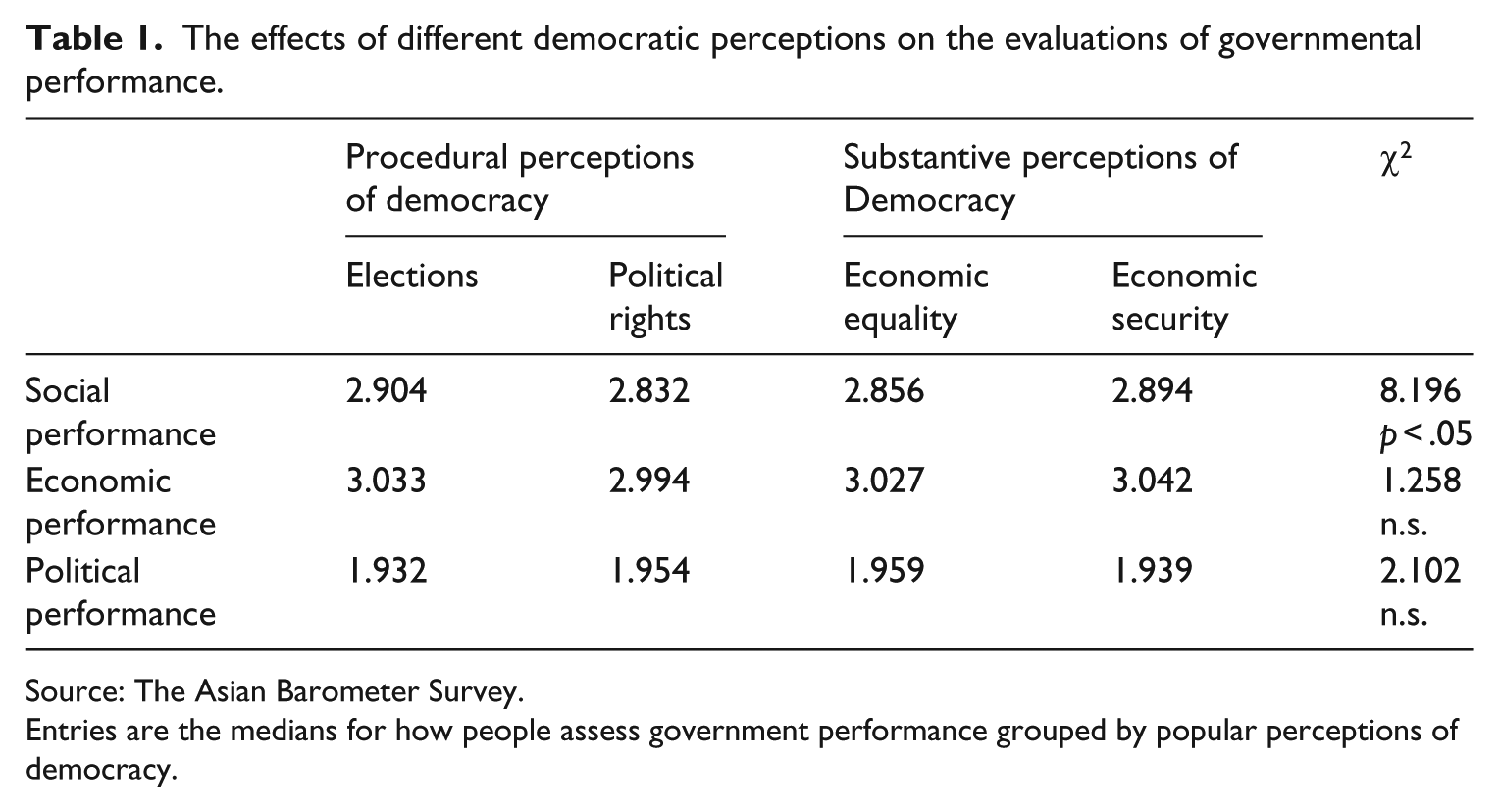
Source: The Asian Barometer Survey.
Entries are the medians for how people assess government performance grouped by popular perceptions of democracy.
Kruskal–Wallis tests were conducted to test the difference in how people assess governmental performance on policy for four types of popular democratic perceptions (elections, political rights, economic equality, and economic security). 6 First, with regard to social equality (the assessment of governmental performance on social issues), there was a significant difference in the medians, χ2(3, N = 3868) = 8.196, p < .05. This indicates that different democratic perceptions affect how people assess the governmental performance on social issues. Because the overall test is significant, pairwise comparisons were conducted across the four groups using the Mann–Whitney U test by controlling Type Ⅰ error. The results of these tests indicated a significant difference between the group of people who view elections as an essential component of democracy and the group of people who view economic equality as an essential component of democracy (p = .026). Also, a significant difference was found between the group of people who view economic security as an essential component of democracy and the group of people who view economic equality as an essential component of democracy (p = .040). Second, in respect of economic security (assessment of the government’s economic performance), there was no significant difference in the medians, χ2(3, N = 3988) = 1.258, p = .739. Nor was there a significant difference in the medians observed in terms of abuse of power (assessment of the government’s political performance), χ2(3, N = 3755) = 2.102, p = .552.
Figure 1 summarizes the results of the above analyses. Different popular perceptions of democracy affect how the masses evaluate governmental performance on social issues (social equality). However, there was no significant difference in their assessment of the government’s economic and political performance, regardless of how they understand the meaning of democracy.
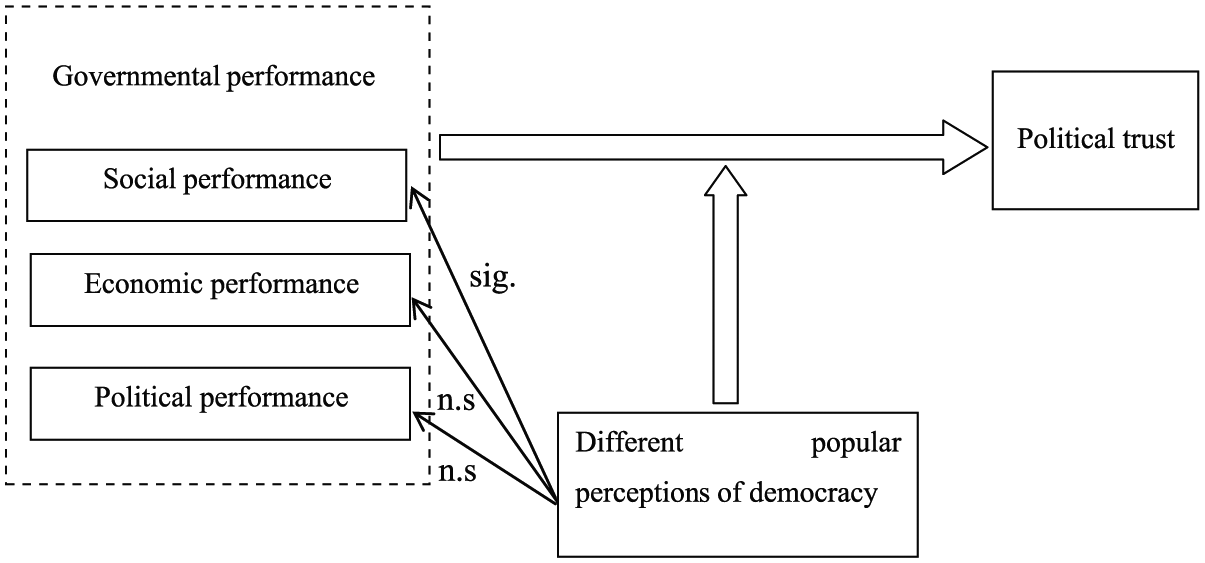
The influence of popular democratic perceptions on evaluation of governmental performance.
Next, multivariate regression analyses were conducted to estimate how the effects of government policy performance on political trust were moderated by different popular perceptions of democracy. Table 2 displays the results of the conditions for procedural perceptions of democracy (viewing elections and political rights as essential components of democracy). Table 3 presents the results of the conditions for substantive perceptions of democracy (viewing economic equality and economic security as essential components of democracy). Table A1 shows the descriptive statistics of variables.
The effects of governmental performance on political trust conditioned by procedural perceptions of democracy.
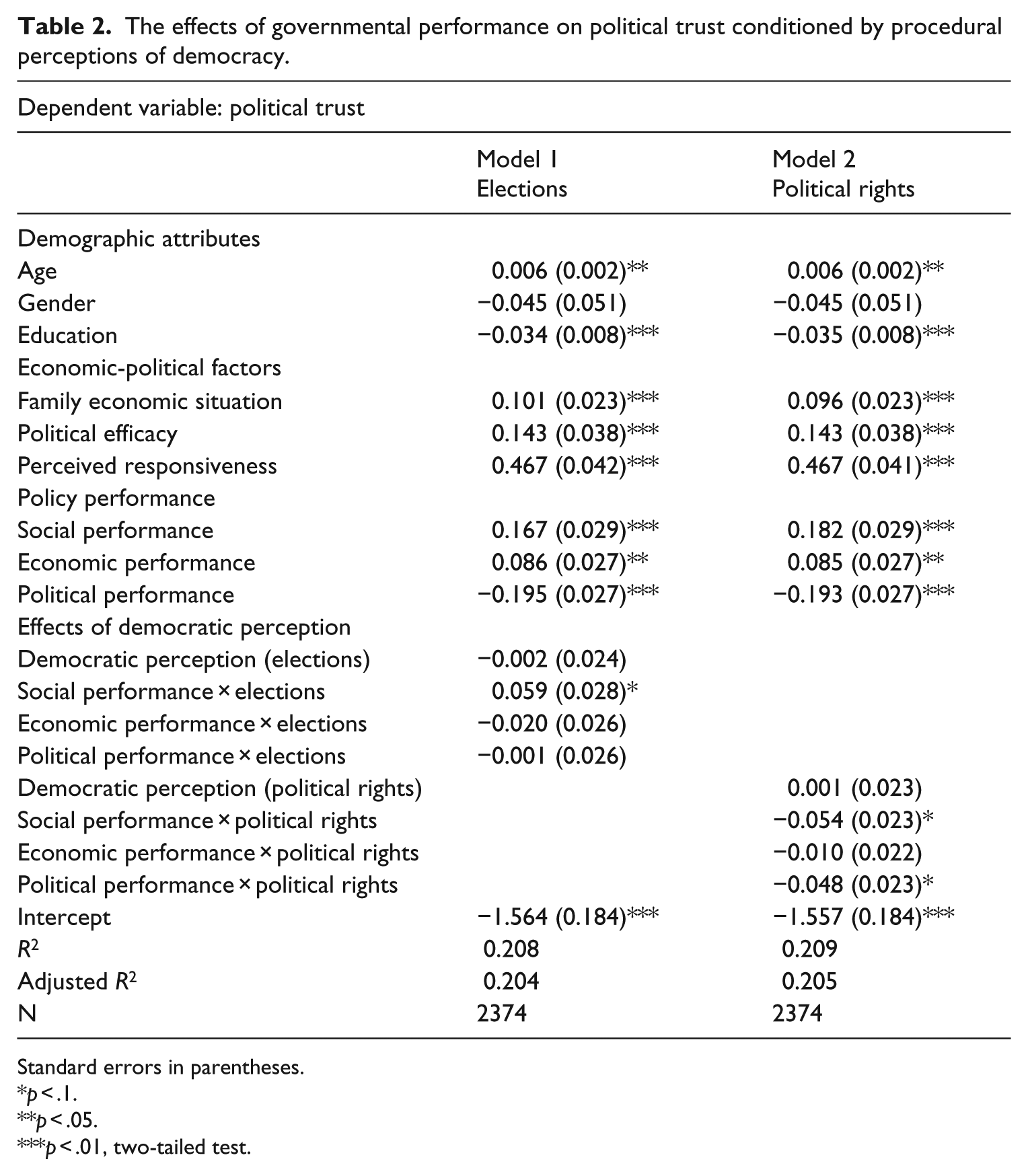
Standard errors in parentheses.
p < .1.
p < .05.
p < .01, two-tailed test.
The effects of governmental performance on political trust conditioned by substantive perceptions of democracy.
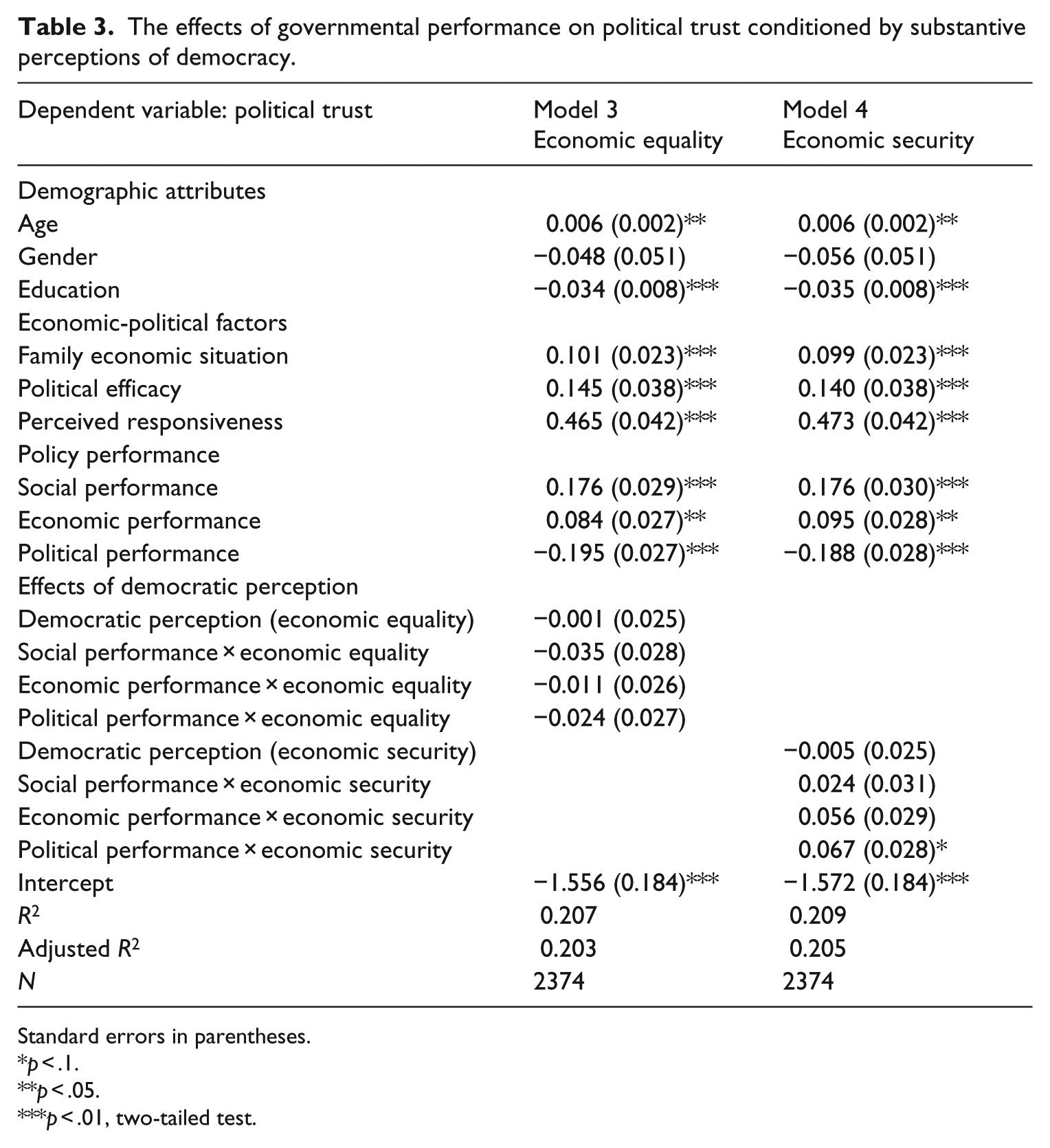
Standard errors in parentheses.
p < .1.
p < .05.
p < .01, two-tailed test.
The effects of government’s political performance on political trust
Tables 2 and 3 show that ordinary Chinese people’s assessment of their government’s political performance (abuse of power) was negatively correlated with political trust in all four models (β = −0.195, p < .001 in Model 1; β = −0.193, p < .001 in Model 2; β = −0.195, p < .001 in Model 3; β = −0.188, p < .001 in Model 4). The government’s political performance invariably undermines political trust, no matter how the Chinese understand what democracy means. Hypothesis 1 assumes that the poor political performance of the Chinese government does not contribute to an increase in political trust, regardless of the way in which people view democracy. Hence, Hypothesis 1 was confirmed.
The effects of governmental performance conditioned by procedural perceptions of democracy
The effects of government’s economic and social performance on political trust were intervened by procedural perceptions of democracy (see Table 2). In Model 1, for people viewing elections as an essential component of democracy, the effects of government’s social performance on political trust was moderated by their perception of democracy (β = 0.059, p < .05), but the government’s economic and political performance had an independent effect on political trust regardless of the popular democratic perception (β = −0.020, p > .1; β = −0.001, p > .1). Model 2 shows how popular democratic perceptions intervene with the effects of governmental performance on the political trust of people who view political rights as an essential component of democracy. The results reveal that the effects of government’s social and political performance were moderated by popular democratic perception (β = −0.054, p < .05; β = −0.048, p < .05), but the effects of the government’s economic performance on political trust did not depend on different patterns of democratic perception (β = −0.010, p > .1).
Figure 2 shows how governmental performance interacts with popular democratic perceptions. Hypothesis 2 assumes that the positive effects of government’s economic and social performance on political trust will be attenuated among people who subscribe to a procedural perception of democracy. Figure 2(b) shows that the positive effects of government’s social performance on political trust became weaker among people who view political rights as an essential component of democracy. However, for people who view elections as an essential component of democracy, a better evaluation of government’s social performance reinforced their political trust (see Figure 2(a)). Hypothesis 4.1 assumes that the negative effects of government’s political performance on political trust will become stronger among people who subscribe to a procedural perception of democracy. Figure 2(c) shows that government’s poor political performance worsened political trust and the negative effect was most salient among people who view political rights as an essential component of democracy. Such reinforcement effect by the procedural perception of democracy was not observed among people who view elections as an essential component of democracy. Therefore, Hypotheses 2 and 4.1 were partially confirmed.
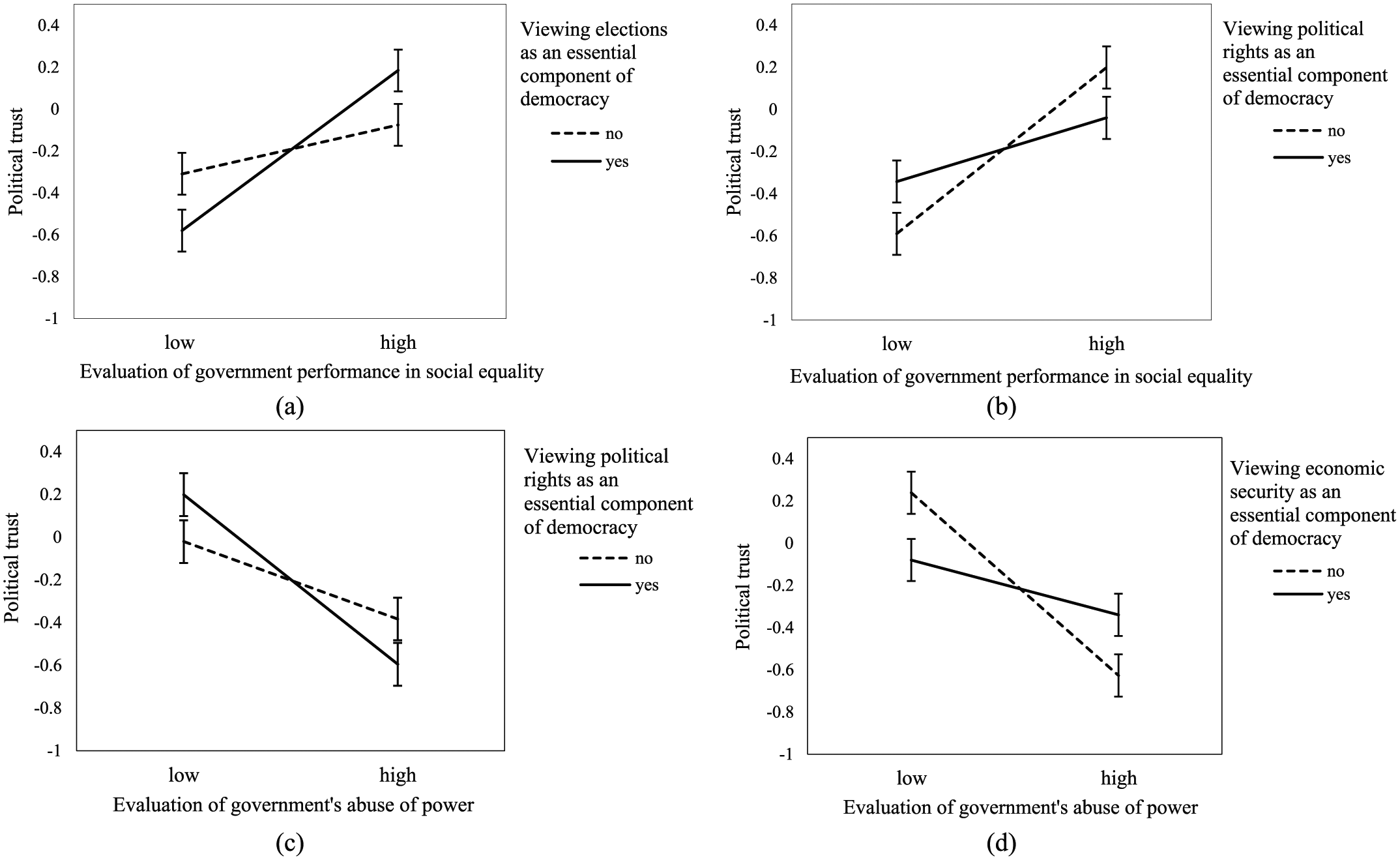
Interaction effects of governmental performance and popular perception of democracy. (a) Evaluation of government performance in social equality. (b) Evaluation of government performance in social equality. (c) Evaluation of government’s abuse of power. (d) Evaluation of government’s abuse of power.
The effects of governmental performance conditioned by substantive perceptions of democracy
The results in Model 3 show that the effects of government’s economic and social performance on political trust did not vary between people who view economic equality as an essential component of democracy and people who did not (β = −0.035, p > .1; β = −0.011, p > .1). In addition, Model 4 shows that the effects of government’s economic and social performance on political trust did not depend on whether the masses view economic security as an essential component of democracy or not (β = −0.005, p > .1; β = 0.024, p > .1). Hypothesis 3 assumes that a positive opinion of the government’s economic or social performance increases political trust among people who subscribe to a substantive perception of democracy. The results did not support Hypothesis 3.
However, popular democratic perception intervened with the effects of government’s political performance on political trust. Model 4 shows that the effects of government’s political performance were moderated by a substantive perception of democracy (β = 0.067, p < .05). Figure 2(d) reveals that the negative effects of government’s political performance on political trust became weaker among people who view economic security as an essential component of democracy. However, such attenuating effects were not observed among people who view economic equality as an essential component of democracy. Hypothesis 4.2 assumes that the negative effects of government’s political performance on political trust will become weaker among people who subscribe to a substantive perception of democracy. Hence, Hypothesis 4.2 was partially confirmed.
Discussion and conclusion
This study examines the moderating effects of popular democratic perception on the relationship between governmental performance and political trust in the authoritarian context. Specifically, we clarify how governmental performance in different policy domains interacts with popular democratic perception in their effects on political trust in China. Prior studies suggest that political trust in China is primarily established on the masses’ satisfaction of governmental performance. When ordinary citizens are satisfied with their government, authoritarian leaders lack pressure or incentive to promote political reform and regime transition (Inglehart and Welzel, 2005; Lu, 2013; Zhai, 2016). In this study, we focus on the popular perceptions of democracy because the masses’ understanding and perception of democracy have significant relevance for an authoritarian regime’s political development. The findings show that evaluations of governmental performance are contingent on the different popular perceptions of democracy. People who view elections and economic security as essential components of democracy are inclined to give a more favourable assessment of the government’s social performance, while people who view political rights as essential components of democracy tend to have a low opinion of it (see Table 1).
Moreover, the effects of the public’s evaluation of governmental performance on political trust were moderated by the different democratic perceptions. A positive effect of government’s social performance on political trust was reinforced among people who view elections as an essential component of democracy, whereas the positive effect was attenuated among people who view political rights as an essential component of democracy. In addition, the negative effect of government’s political performance on political trust was reinforced among people who view political rights as an essential component of democracy. When compared with people who subscribe to the procedural perception of democracy, substantive perception of democracy has less influence in moderating the relationship between governmental performance and political trust. We only found that the negative effect of government’s political performance on political trust became weaker among people who view economic security as an essential component of democracy. However, for people who subscribe to the substantive perception of democracy, the positive effects of government’s economic and social performance did not further increase their political trust. This is probably because people who subscribe to the substantive perception of democracy care little about the democratic issues in China. Instead, they pay more attention to their personal lives and welfare.
Although this study focuses on China, our findings have general implications for research on democratization. Several conclusions can be inferred from this study. First, government’s economic and social performance buttresses political trust in the Chinese government. Popular democratic perception among the masses reinforces or attenuates the effects of governmental performance on political trust rather than alter the general patterns. Improvements in ordinary people’s material well-being are relevant to the political support for the authoritarian regime (Chen, 2004; Shi, 2008; Zhai, 2016). The results of this study show that government’s economic performance has a positive effect on political trust even among those people who view democracy in a procedural manner.
Second, even though China’s unprecedented economic growth earned the government a substantial amount of political trust, the lack of check and supervision of power inherent in an authoritarian regime resulted in the severe abuse of power. In recent years, rampant corruption and human rights violations have led to rising discontent and anger among the people. The authorities’ abuse of power negatively affects the public’s evaluation of government’s political performance and will ultimately undermine their political trust in the government. Our results reveal that discontent with the government’s political performance leads to a deterioration of the political trust in an authoritarian regime. The abuse of power by the authorities may become a driving force for democratic reforms and mobilize people from all walks of life to come together by setting aside other disagreements and conflicts.
Third, the moderating effects of popular democratic perception on the relationship between governmental performance and political trust are asymmetric. On one hand, our results show that the negative effects of abuse of power by the authorities on political trust became weaker among people who view economic security as an essential component of democracy. These people are relatively tolerant of government’s poor political performance. On the other hand, people who prioritize political rights in their perceptions of democracy will become critical citizens of the country. Demand for liberal democracies, combined with dissatisfaction with non-democratic practices, is critical for democratic transitions (Diamond, 2006). Our study shows that in those people, the positive effects of government’s social performance on political trust attenuated, while the negative effects of government’s political performance on political trust became stronger. In contrast to the older generations and less educated people, the younger generations and educated people tend to subscribe to the procedural perceptions of democracy (Shi, 2014; Zhai, 2018a). With inter-generational replacement, an increase in the population that views political rights as an essential component of democracy will have relevant implications for an authoritarian system’s democratic transition in the future.
Footnotes
Appendix 1
Table A1 displays the descriptive statistics of variables.
Acknowledgements
The author is grateful to Professors Ken’ichi Ikeda of Doshisha University, Yukio Maeda of the University of Tokyo, and three anonymous referees for their valuable comments on earlier drafts of this article.
Funding
The author(s) received no financial support for the research, authorship, and/or publication of this article.
