







Abstract
Deliberative exercises may reinvigorate civic life by building citizens’ capacity to engage in other types of civic activities. This study examines members of a citizens’ panel (n = 56) who participated in a 6-day deliberative event on climate change and energy transition in Edmonton, Alberta (Canada), in 2012. We compared panellists’ civic engagement, political interest, and political knowledge with those of the general population using a concurrent random digit dialling survey conducted 2.5 years after the event (n = 405). Panellists are more likely to talk about politics, and volunteer in the community compared to their counterparts in the larger population. Examining three points in time, we reveal a trajectory of increasing political knowledge and civic engagement. Finally, we examine the mechanisms that mobilize panellists into greater civic engagement. This study illustrates how deliberative events could strengthen engagement in civic and political life, depending on the degree to which deliberation was perceived to have occurred.
The purpose of many deliberative exercises is to provide public input into policy areas based on reasoned discussion (Bohman, 1996; Elster, 2007, Chapter 25). However, these events may also help reinvigorate civic life and build enthusiasm for additional discursive participation (Christensen et al., 2017). Furthermore, participation in deliberative processes may affect the propensity to vote in elections (Gastil et al., 2008, 2010) and may build capacity to engage in ‘thicker’ types of civic activity (Barber, 1984), thus serving as a school of democratic participation and agency. The extent of these forms of capacity-building depends on the nature of the deliberative event.
This study examines members of a citizens’ panel (n = 56) who participated in a 6-day deliberative event in Edmonton, Alberta (Canada), in 2012. We compared panellists’ civic engagement, political interest, and political knowledge with those of the general population using a concurrent random digit dialling survey (n = 405) collected in June 2015 – 2.5 years after the deliberative event. Our article shows that panellists are more likely to talk about politics, and volunteer in the community compared to their counterparts in the larger population. We attribute these differences to participation in the citizens’ panel. We also note that panellists reported higher levels of boycotting and political interest – a difference which may relate to a self-selection bias. In addition, we examine the trajectory of changes in panellists’ political interest, knowledge, and civic engagement, which reveals patterns of increasing knowledge and engagement across multiple data points, from the pretest survey to the survey conducted 2.5 years after the event. The deliberative event and the period afterwards built citizens’ capacity to engage in additional civic and political activities. Finally, we examine the mechanisms that mobilize panellists into greater engagement in civic life. Using our panel design, we explore how listening to diverse viewpoints and supporting the development of evidence-based opinions impact political interest, political knowledge, and civic engagement. This study illustrates how deliberative events can strengthen capacity for engagement in civic and political life, depending on the degree to which participants report deliberating. Our study is distinctive in employing six-wave panel data, gathered over 2.5 years, as well as a high-quality comparison group to assess the process through which deliberative events can transform civic capacity and engagement in civic and political life. The data sources and modelling approach advance scholarship on deliberative democracy and on processes through which citizens are mobilized into civic action.
Deliberation and civic participation: The relationship
Over a century ago, De Tocqueville first hypothesized a relationship between jury service and civic engagement (Gastil et al., 2010: 26) and pointed out various participatory and deliberative practices as schools of citizenship (De Tocqueville, 1835). Many contemporary scholars expanded upon these insights. Deliberative events can be ‘schools’ to develop public-mindedness (Fishkin, 2009). The experience of jury service can serve as a ‘civic educational experience that inspires many Americans to heighten their sense of civic commitment and do things such as vote, join local boards, and so on’ (Gastil et al., 2007: 356). Many scholars have provided empirical evidence to demonstrate the positive relationship between deliberation and civic engagement (e.g. Delli Carpini, 1997; Delli Carpini et al., 2004). In a national US survey of a random sample (n = 1500), Jacobs et al. (2009: 87–117) found that the more people participated in various online or offline deliberative forums, the more they volunteered in the community, worked on community organizing, and engaged in problem-solving.
Moving beyond correlation analysis and self-reported data on deliberation and civic engagement, Gastil and his colleagues used a national study of court and voting records to compare the voting behaviour of people who served on a jury and those who did not (Gastil et al., 2008). They found that jury deliberation can significantly increase turnout rates among those who were previously infrequent voters. Therefore, ‘there is strong evidence that deliberative participation in one form of public life can increase the likelihood of civic or political participating in other settings’ (Gastil et al., 2008: 363). People do not just feel more engaged; there is evidence that after deliberation, they are more likely to participate in non-voting political activities such as following politics through media, contacting public officials, and volunteering (Gastil et al., 2010).
Scholars also suggested that deliberation influences key mediators in the mobilization process for civic engagement. These mediating factors include political interest and knowledge (e.g. Boulianne, 2011). Knobloch and Gastil (2015) investigated two deliberative events in Australia and Oregon, which included surveys asking people whether they thought there was a change in their political interest and participation since the conclusion of the deliberative process. Participants self-reported changes in how frequently they talked to others about politics, worked in the community and went to political meetings. Knobloch and Gastil did not measure behaviour before and after the deliberative events, but rather relied on self-reports of perceived changes.
Fournier et al. (2011: 115) examined three deliberative events and found that comparing pretest and post-test values, ‘participants report paying more attention to the news, becoming more interested in, and feeling more informed about politics at the end of the process than they did at the beginning’. They also compared panellists to a group that expressed interest in the event but were not chosen to participate. They documented participants’ higher levels of political interest and feelings of being informed (knowledge), compared to non-participants. Finally, Christensen et al. (2017) compared interest in engaging in political talk before a deliberative event and after; they find a significant increase in interest in engaging in political talk after the event.
As part of the deliberative process, participants may learn about how their input feeds into the government decision-making process, which contributes to political knowledge. A knowledgeable citizenry is not only a democratic ideal, but political knowledge is a key predictor of participation in election campaigns, including voting and donating money (Delli Carpini and Keeter, 1996). Furthermore, a meta-analysis of research on voting demonstrates that political knowledge, as well as political interest, is a consistent predictor of voting (Smets and Van Ham, 2013). As such, deliberation could build capacity and skills, particularly political knowledge, leading to increased civic engagement.
Building on these findings, we propose that participation in a deliberative event has long-term impacts on participants’ levels of civic engagement. We use a contemporary definition of civic engagement to include volunteering, donating, and other forms of participation that exist outside the formal mechanisms of the state (Theocharis and van Deth, 2018). We test this relationship using multi-wave panel data. This analysis will help us understand whether the effect of deliberation on civic life is short term or enduring. Jacobs et al. (2009: 84–85) have pointed to the difficulty of establishing causal links: ‘public talk and public action may be correlated, but does engaging in the former lead to more of the latter?’. Our data are unique in addressing this ‘complicated issue of causality’ (Jacobs et al., 2009: 84–85). To further isolate the distinct effects of the deliberation on civic engagement and address issues of causality, we use data from a simultaneous public opinion poll to serve as a comparison group. We expect the following:
H1. Citizens who participated in a deliberative event will report higher levels of civic capacity and civic engagement compared to non-participants.
H2. Compared to pre-test levels, participants will report higher levels of civic capacity and civic engagement after the deliberative event.
The importance of procedure – Degree of deliberation
Not all scholars have found a relationship between participation in a deliberative event and civic participation. After studying a series of both online and offline citizen deliberation experiments in Finland from 2006 to 2008, Grönlund and associates found minor effects of deliberation on participants’ readiness for political action (Grönlund et al., 2010; Strandberg and Grönlund, 2012). The minimal effect was likely due to the short duration (2 hours) of the deliberative experiment. Moreover, as Grönlund et al. (2010) noted, participants’ unfamiliarity with the online technology might impact the observed results of deliberation. The findings stress the importance of procedural features in understanding the impact of deliberative events.
Myers et al. (2018) compared people who participated in a group deliberation and people who were encouraged to think individually about a policy. They found no differences between the two groups in people’s willingness to participate politically in the future. This example points to the importance of group dynamics in impacting outcomes of group deliberation. The short duration of this deliberation (63 minutes) may also help to explain the lack of changes in people’s willingness to participate politically.
These findings are in contrast to Gastil and associates’ (2008, 2010) conclusions about the effects of jury duty. Juries represent high-quality deliberative contexts where participants have a decision to make (Myers et al., 2018). The distinctiveness of jury deliberation may explain the discrepant findings. As illustrated in Figure 1, we argue that a given deliberative event can have short-term effects by building civic capacity (political interest and knowledge) and long-term effects by increasing civic engagement. The long-term impacts manifest directly, as well as indirectly through civic capacity. These effects depend on procedural quality.
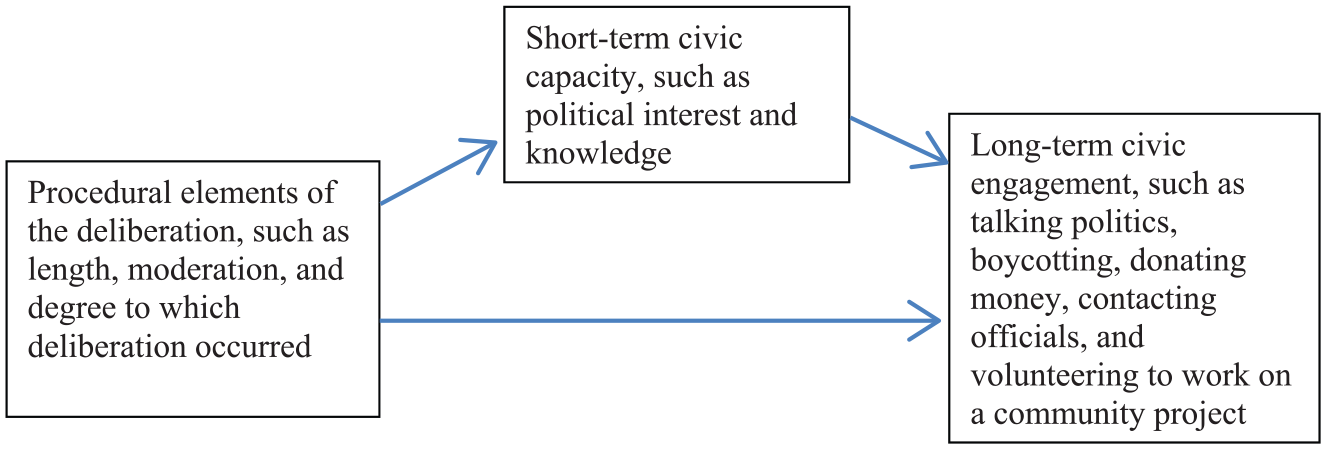
Theoretical model.
As noted above, we attribute the mixed findings in this field to different deliberative features and elements. For instance, many deliberative events are of short duration, which could limit the outcomes for civic engagement, particularly in the long term. In contrast, more sustained forms of deliberation may lead to stronger and longer term outcomes. Beyond duration, we identify two procedural elements that impact the relationship between deliberation and civic engagement: exposure to multiple viewpoints and developing opinions based on evidence.
Weighing the viewpoints of others is one of the defining features of deliberation (Burkhalter et al., 2002). Eggins et al. (2007) used the data from an Australian Deliberative Poll on a bill of rights, conducted in 2002. They found that exposure to multiple viewpoints increased people’s levels of engagement, as measured by intent to talk to others, interest in the issue, and desire to change other’s views. Exposure to all sides of the issue increases participants’ sense of representing the whole community (Eggins et al., 2007). During deliberation, if one perceives one’s views being treated as important and deserving of respect, one’s group-community identity is stimulated and this sense of representativeness is likely to play out in future civic participation (Simon and Stürmer, 2003).
On the other hand, the literature also suggests that exposure to multiple viewpoints could have a dampening effect on civic engagement. Mutz (2006) noted that when deliberation occurs in non-organized settings such as informal, everyday political talk, it can negatively affect people’s level of political participation. People encounter conflicting views or disagreements during informal deliberation and these can increase uncertainty about their views on an issue; as a result, they are less likely to take action (Mutz, 2006). In a meta-analysis, Matthes et al. (2019) find that exposure to diverse viewpoints neither increases nor decreases political participation. However, the researchers do not account for whether there is a trained moderator facilitating the discussion. We propose that in a properly moderated deliberative event, listening to multiple viewpoints will increase civic capacity (political interest, knowledge) and ultimately lead to increased civic engagement. Using multiple waves of data, we expect that
H3. Listening to diverse viewpoints during a well-moderated deliberative process will increase civic capacity (in the short term) and civic engagement (in the long term).
As Fishkin (2009, 2018) pointed out, deliberation gives people the information they need to develop more evidence-based opinions and educates people to weigh the pros and cons of an argument. As explained by Fearon (1998), participants in a deliberation offer analyses that do not occur to others, and thus enhances judgement and supports knowledge of better solutions. The theory is that participating in a deliberative event will teach people about using reasoning when discussing their opinions. We expect this reasoning process to support the development of one’s own civic capacity (political interest, knowledge) as well as support the development of others’ civic capacity (political interest, knowledge). This greater civic capacity will lead to greater engagement. In sum, when people are provided opportunities to deliberate about political issues, they are more likely to build understanding of these issues and to participate politically around these issues in future. Through our long-term research design, we expect to find that
H4. Providing evidence-based opinions during the deliberative event will increase civic capacity (in the short term) and civic engagement (in the long term).
In sum, this study is distinctive in offering strong data to attribute changes in civic capacity and civic engagement to participation in a deliberative event. The multi-wave data about deliberative participants and a comparison group help trace the evolving impacts of deliberative participation on civic capacity and civic engagement. While we cannot test all these procedural features (moderation, length of event, etc.), we focus on the degree of perceived deliberation as a key procedural element. Specifically, we focus on panellists’ perceptions that they provided evidence-based opinions and listened to diverse viewpoints. This study is also unique in testing how these perceptions about the deliberative process impact civic capacity in the short term and civic engagement in the long term. Understanding these mechanisms will help us reflect upon the contested evidence on the relationship between deliberation and civic engagement.
Data and method
Case study
The Citizens’ Panel on Energy and Climate Challenges was designed and executed as a collaboration between the City of Edmonton, the Centre for Public Involvement, and Alberta Climate Dialogue (a network of scholars and practitioners). 1 Panellists spent six Saturdays from 13 October to 1 December 2012 participating in this event. In the first session, citizens met to learn about the deliberative process and discuss their values. The second session involved learning about climate change, then deliberating and voting on values. The third session involved stakeholder presentations in which participants heard about different perspectives about Edmonton’s climate and energy challenges and discussed different goals and scenarios for action. The fourth session involved identifying points of agreement and disagreement, then evaluating different policy options. The fifth session and sixth session focused on developing preliminary recommendations to Edmonton City Council, voting on these recommendations, and identifying key messaging. Throughout this process, participants were provided with balanced briefing materials, moderated discussion, and expert presentations. For a more detailed outline of the six Saturday meetings and description of the process, see Hanson (2018: 44–45).
Sample
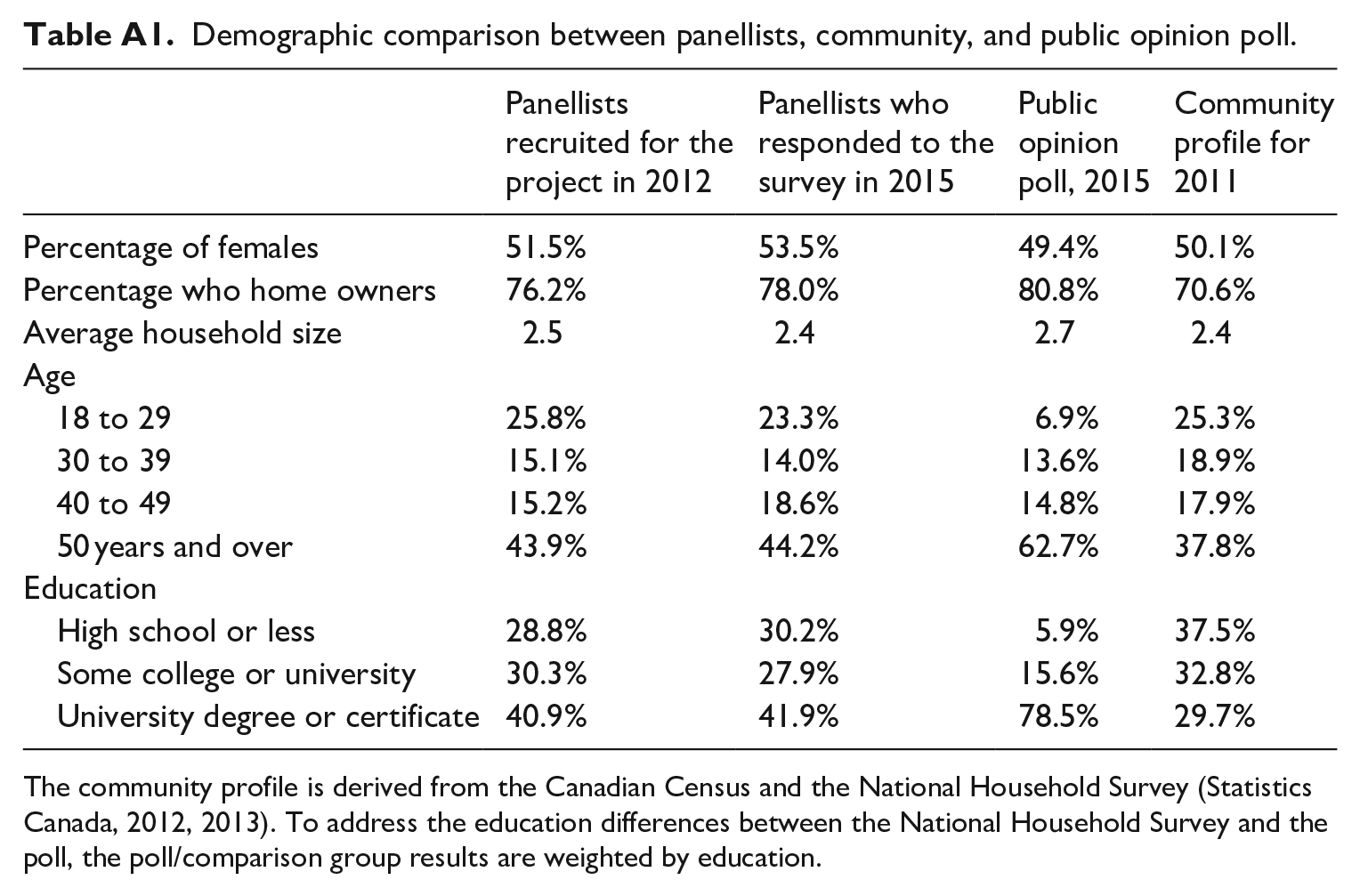
Panellists were recruited through random digit dialling as part of an interactive voice response survey (for more details, see Boulianne, 2018). Quotas were used to ensure representation based on age, education, gender, and other variables (Table A1 in Appendix 1). Those who expressed interest and met quotas were invited to join the Citizens’ Panel on Edmonton’s Energy and Climate Challenges. This approach to invitations is rare in this field of research, where the norm is to rely on more passive forms of recruitment, such as posters and newspaper ads (see Boulianne, 2018). Sixty-six citizens were recruited to participate and 56 continued to participate through the entire 42-hour event. The size is typical of these types of deliberative events (see Boulianne, 2019).
Many of the studies include approximately 100 participants (Grönlund et al., 2010) or 200 participants (Christensen et al., 2017; Myers et al., 2018), but the events are of short duration. Our sample size is larger than the 2010 Oregon Citizens’ Initiative Review (CIR), which involved 40 participants who met for 5 days (Knobloch and Gastil, 2015). In the existing scholarship, there seems to be a trade-off in sample size and length of the event. Despite the small size, the citizens’ panel is representative (Table A1 in Appendix 1).
Panellists completed a web survey (October 2012) prior to the deliberative event and were asked to complete identical questionnaires at Sessions 2 and 4. The Session 2 and 4 surveys were one-page surveys including a handful of procedural questions and gathering qualitative feedback about the day’s events. Panellists were given the option to complete these surveys anonymously to ensure their comfort in reflecting critically. However, most participants wrote their names on the form after reading a statement clarifying that doing so would allow researchers to link their responses across the different surveys. The same questions were repeated in Session 6 (December 2012). Finally, 6 months (June 2013) and 2.5 years (June 2015) after the event, panellists were surveyed with a robust set of questions from the pretest survey.
In 2015, the University of Alberta’s Population Research Lab was commissioned to ask a small set of questions matching those asked in the 2.5-year follow-up survey (June 2015). The questions were included in the Alberta Survey 2015 series, a random digit dialled, interviewer-led survey of the Alberta population. The data are free to download from the University of Alberta’s repository: https://dataverse.library.ualberta.ca/dvn/. The AAPOR Response Rate #2, which includes partially completed interviews, is 11% for the Edmonton-based sample, which is the focal point for the comparative analysis. The poll data serve as a comparison group for the panel. That said, the poll data contain slight biases in terms of an over-representation of well-educated people. In contrast, the panel (at the pretest stage) is more representative of the census composition of the community than the poll results (Table A1 in Appendix 1). To enable comparisons between the poll and the citizens’ panel, the poll data are weighted on education to match census characteristics.
As mentioned, the sample size for the panel is small, reflecting that deliberative events tend to trade off duration with size of event (bigger events, shorter time periods). However, we do not believe that a larger sample would necessarily produce better results, as we needed to weight the large sample data (poll data) to reflect the educational profile of the community (established by census data). The educational bias in survey research is well-established; our citizens’ panel recruitment was designed to address this bias and ensure a more accurate representation. A larger sample size might increase the statistical power of the models and we acknowledge the limitation of the sample size in this respect.
Measurements
Procedure – Degree of deliberation
For procedural elements, we are restricted to questions about the deliberative aspects, rather than the many other procedural features that were identified in our theoretical model, such as length, moderation, and other measures of procedural quality, such as fairness in the process, and satisfaction with the event. We focus on items that were best matched to analyses in the existing literature. Like existing research, we are restricted to self-assessed measures, rather than independent observations, of listening to diverse viewpoints or providing evidence-based opinions. To test Eggins et al’.s (2007) ideas about exposure to diverse viewpoints, we asked respondents to agree or disagree with the statement, ‘I listened carefully to people I disagreed with’ in surveys administered after Session 2 (October 2012), Session 4 (November 2012), and Session 6 (December 2012). The response options were originally offered as strongly agree (1) to strongly disagree (4), but in analysing the data, we reverse coded to help with interpretation. In analysing the data, we also averaged panellists’ scores across these three sessions to offer an overall score about the deliberative event. The average of these averages is 2.58 (standard deviation (SD) = 0.371) on the 4-point scale (disagree to agree).
Another procedural element is evidence-based opinions. To test Fishkin’s (2009, 2018) ideas about evidence-based opinions, we repeated a line of questioning at multiple sessions. The question was about participants’ use of reasoning when expressing their views: ‘In discussions today, I sought to give the best reasons I could for my views’. The measure relies on self-reports, given the difficulty of documenting these specific instances in a deliberative event spanning 42 hours. The question addresses a defining feature of deliberative talk (Habermas, 1985) as well as evaluating the success of the deliberation in encouraging reasoned talk. Across the three data points (October to December 2012), we can see consistent appraisals on a 4-point scale. In analysing the data, we reverse coded the responses and used the averages across the three sessions to given an overall score about the deliberative event. The average of these averages is 2.46 (SD = 0.463) on the 4-point scale (disagree to agree).
Civic capacity
Another set of measures relates to civic capacity. We asked about participants’ interest in local community politics, using a 5-point scale ranging from not at all interested (1) to extremely interested (5), following work by Knobloch and Gastil (2015) and Fournier et al. (2011). Averages are presented as part of the analysis in the next section.
Respondents were asked to self-assess how informed they feel about how municipal policy-making works, using a scale of 1 (not at all) to 10 (very). This measure was used to self-assess political knowledge, rather than asking participants to complete a test of political knowledge. This is a limitation of the current design, but the measure does allow for a consistent measure to be used in multiple waves of data collection.
Civic engagement
Respondents were asked whether they participated in a range of civic activities, including talking to people to change their views about a political issue, which has been a focal point of much research (Christensen et al., 2017; Delli Carpini et al., 2004; Eggins et al., 2007; Jacobs et al., 2009; Knobloch and Gastil, 2015; Myers et al., 2018). These studies also explored volunteering in the community as an outcome of participation in deliberative process (Delli Carpini et al., 2004; Jacobs et al., 2009; Knobloch and Gastil, 2015). Building on work from Esterling et al. (2011), we examined contacting public officials as a measure of civic activity. We included two additional measures of civic activities: boycotting and donating money to an organization or group. The inclusion of boycotting is intended to broaden the definition of civic activities, which have become more diverse in contemporary periods (see Theocharis and van Deth, 2018). In addition, boycotting is particularly relevant for activism related to the environment (Berlin, 2011), which was core to this deliberative event where panellists discussed energy and climate issues. We wanted to include civic activities rather than only ones tied to the formal political process (Theocharis and van Deth, 2018), and included donating money, which has become a popular way to participate in civic life, as will be discussed in the next section. Including boycotting and donating represents a move beyond existing research in this area, which has focused on ‘thinner’ measures of participation.
The questions about civic activities asked about participation in the past 12 months at the pretest stage (October 2012). At the 6-month follow-up, the question was adjusted to ‘since October 2012, have you done the following’ as part of trying to account for changes that may be distinctively related to the deliberative event. Finally, at the 2.5-year follow-up (June 2015), the question returned to ‘in the past 12 months’, which is consistent with the pretest survey wording.
Method of analysis
To offer an overview of how civic engagement has evolved over time, the five activities were added together in our analysis. This approach facilitates an understanding of how degree of deliberation and civic capacity influence civic engagement in general. It also works well for summarizing trend data across three points in time. In addition, it offers consistency in the analysis: the self-assessed measures of deliberation and civic capacity measures include ordinal scales, which are analysed as t-test differences of group means over the series of data points and used in correlational analysis. The civic participation index, as opposed to individual items, enables this consistency in the analysis approach. Finally, all these variables are included in the analysis of correlations, using Pearson product moment correlations. The correlational analysis replicates existing analysis approaches for these research questions, that is, Eggins et al. (2007) and Gastil et al. (2007).
The sample sizes decrease in the correlational analysis, as the results are based on data that could be linked across time periods – a difficult task since participants were offered the option to submit their survey results anonymously and there are six data points spanning more than 2.5 years. Because the sample sizes are so small, many substantial correlations do not meet the threshold for statistical significance, even after adjusting the level of significance from p < .05 to p < .10. To offer transparency in the results, we report on the p values associated with the estimates. Following trends in political science (Gill, 2018), we move beyond the focus on p values into a discussion about how substantive the relationships are. Readers can judge for themselves the significance of the relationships using results presented in the tables.
To assess the theoretical model depicted in Figure 1, we computed a correlation matrix of the bivariate correlations, then we inputted this correlation matrix into Lisrel 9.3. Lisrel is a simultaneous equation modelling programme. The value of this approach is that it provides a multivariate perspective on the relationship between these variables, highlights potential mediated effects (indirect pathways among variables), and can assess overall quality of the model through model fit statistics. While this type of analysis approach is common in the political communication literature, it has rarely been used for multi-wave data to assess mediated relationships (exceptions include Ardèvol-Abreu et al., 2019; Boulianne, 2011). Despite the small sample size and the single-case study approach, we believe that the tests of this causal model offer a significant contribution to scholarship, well beyond the confines of deliberative democracy. The study also is a key contribution to the study of the impacts of deliberative democracy on civic engagement, as existing scholarship does not assess long-term impacts.
Results
The most popular civic activities are political talk and donating to an organization or group (see Table 1), as measured in the post-test survey 2.5 years after the deliberative event. Approximately 66.7% of panellists reported talking to someone to try to change their mind about a political issue (n = 45). In contrast, among the non-participating general public, only 49.2% reported talking to someone to try to change their mind (n = 405, weighted data). However, the strongest support for Hypothesis 1 is based on measures of boycotting. Approximately 48.9% of panellists boycotted (n = 45), compared to 19.8% of the non-participating general public (n = 405). Panellists were also more likely to report volunteering to work on a community project, a 20 percentage point difference (44.4% vs 24.5%). Aggregating across the various types of civic activities offers a holistic picture about changes. Panellists were more engaged compared to those who had not participated in the deliberative event (2.48 vs 1.71). Hypothesis 1 also mentions building civic capacity. As for political interest, panellists report higher levels of political interest, compared to non-participating citizens. The difference is .44 on a 5-point scale (Table 1). Panellists had slightly higher levels of self-assessed knowledge about policy-making, compared to non-participating citizens. However, the difference was small (.27 on a 10-point scale). In sum, Hypothesis 1 has mixed support.
Differences between the comparison group and the panellists 2.5 years after the event.
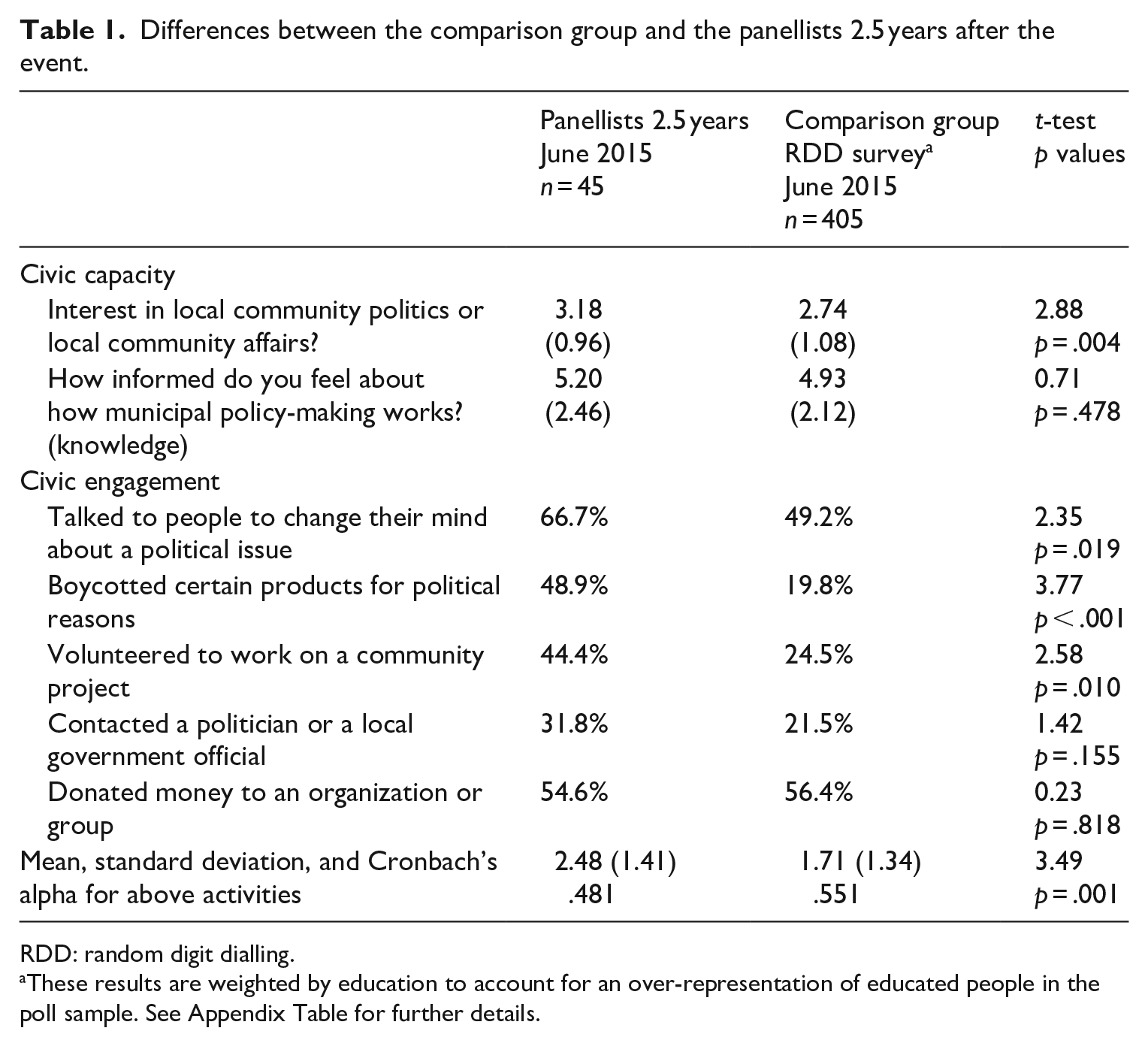
RDD: random digit dialling.
These results are weighted by education to account for an over-representation of educated people in the poll sample. See Appendix Table for further details.
Hypothesis 2 relates to how panellists’ participation changes over three points in time (Table 2). From the pretest to the 6-month post-test and the 2.5-year follow-up, we see a consistent pattern of increasing knowledge about how policy-making works. The average changed from 4.00 to 5.15 to 5.20 (Table 2). Political interest remained more consistent across the three data points (see Table 2).
Changes in panellists over time.
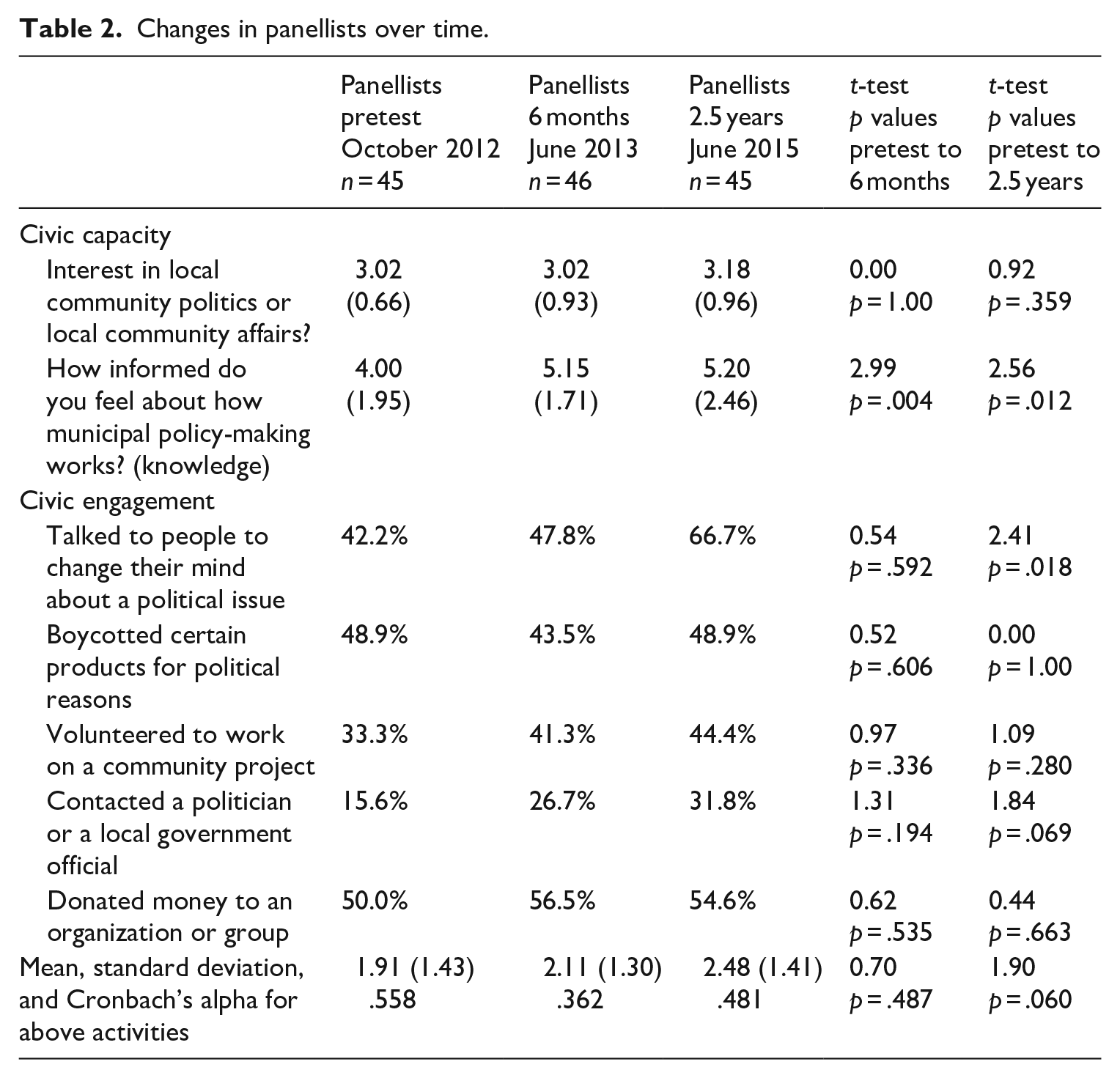
As for participation in civic activities, the changes from the pretest (September to October 2012) to the 6-month period (June 2013) were small, which makes sense given the short time span limiting opportunities to get involved. Comparing the pretest to the 2.5-year follow-up, there are patterns of increasing engagement (Table 2). The most dramatic changes are observed in relation to talking about political issues and contacting officials. At the pretest, 42.2% of panellists reported talking about political issues with the intent to change others’ opinions. In contrast, 66.7% of panellists reported doing so more than 2.5 years later. For contacting officials, 15.6% of panellists reported doing so in the past 12 months when asked at the pretest stage; at the 2.5-year follow-up, 31.8% of panellists reported contacting officials. Aggregating across the various types of civic activities offers a holistic picture about changes. The average number of activities engaged in increases from 1.91 to 2.48. Participants reported higher levels of knowledge about policy-making and higher average levels of engagement, comparing the pretest to the 2.5-year post-test. In sum, we find support for Hypothesis 2.
Procedure – Degree of deliberation
Hypothesis 3 to Hypothesis 4 relate to the role of self-assessed deliberation (October to December 2012) in impacting political interest (June 2013), political knowledge (June 2013) and eventually, civic engagement (June 2015). Hypothesis 3 focuses on listening to diverse viewpoints (Table 3). Listening to diverse viewpoints, as measured by ‘listening to people who I disagreed with’, did increase political interest (r = .256). Listening to differing viewpoints correlates positively and weakly with political knowledge (r = .094) and civic engagement (r = .056) (see Table 3). Hypothesis 3 has mixed support: listening to diverse viewpoints increases political interest, but has minimal impact on knowledge and engagement.
Correlations of civic capacity, civic engagement, and procedural elements.
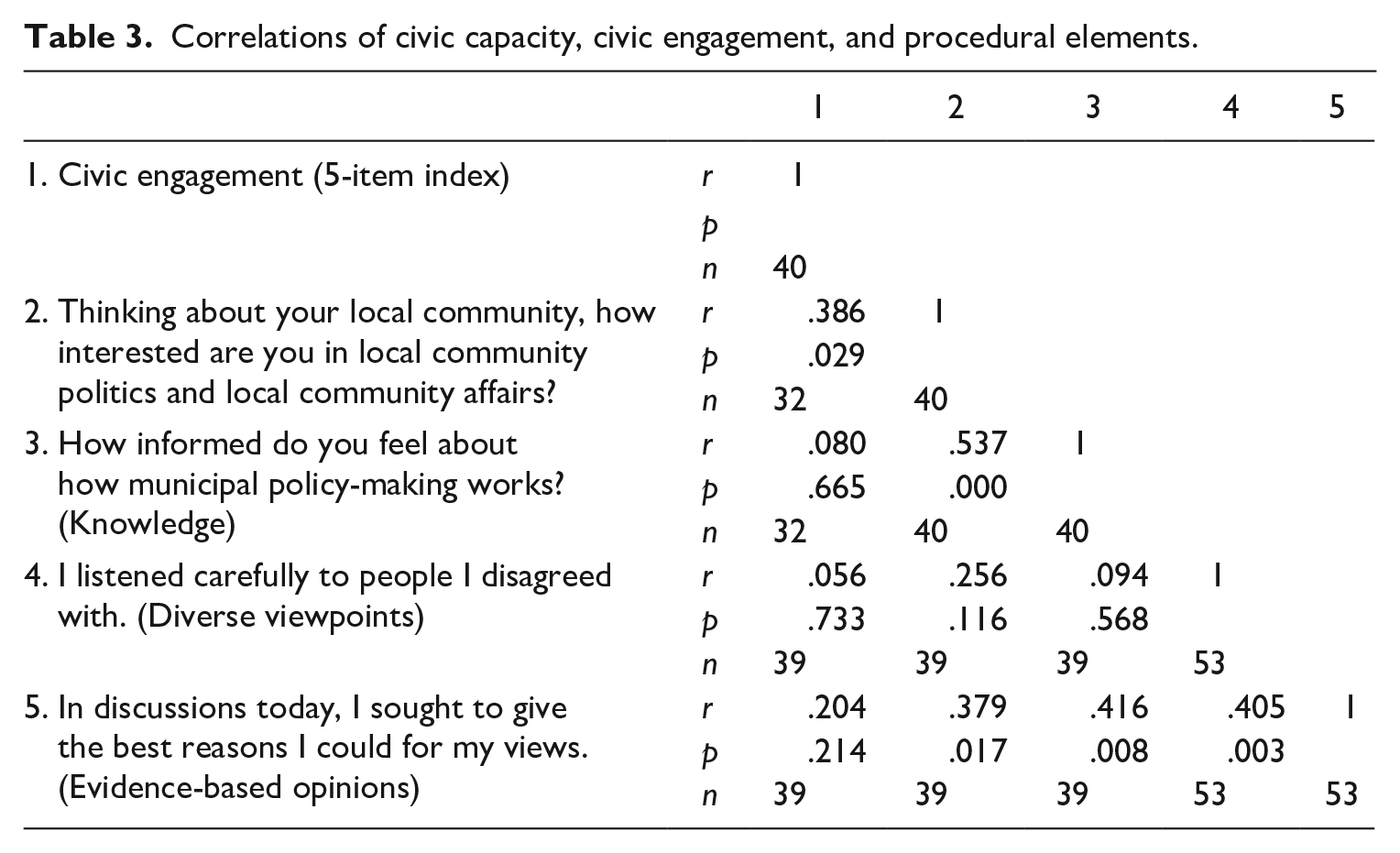
As for developing more evidence-based opinions, Hypothesis 4, we asked respondents to report on whether they sought to give reasons for their views. Indeed, this is a core expectation of deliberative talk. In this line of questions, we find our strongest evidence about the role of procedural elements in impacting civic capacity and engagement. Providing reasoned opinions increased political interest (r = .379), political knowledge (r = .416), and civic engagement (r = .204). Overall, we find strong support for Hypothesis 4.
Simultaneous equation model
As a final set of analyses, we used the correlation matrix in Table 3 to construct a simultaneous equation model, which can assess multiple dependent variables and their relationship to each other as well as to the independent variables (self-assessed degree of deliberation). In addition to providing this multivariate perspective, this analysis approach can reveal the direct and indirect effects between variables and measure the overall quality of the theoretical model through model fit statistics. The model fits (chi-square = 9.94, p = .04), which means that there are very small differences between the theorized model and the observed model. In sum, the model fits well with the data. We could adjust the model to estimate correlations among the deliberation measures (listening to diverse viewpoints, providing evidence-based opinions), but this change does not improve the model fit. To offer more parsimonious evaluations of indirect effects, we did not establish a link between our procedural variables. We have summarized the findings in Figure 2. The explained variance is 26% for civic engagement, 16% for political interest, and 18% for political knowledge.
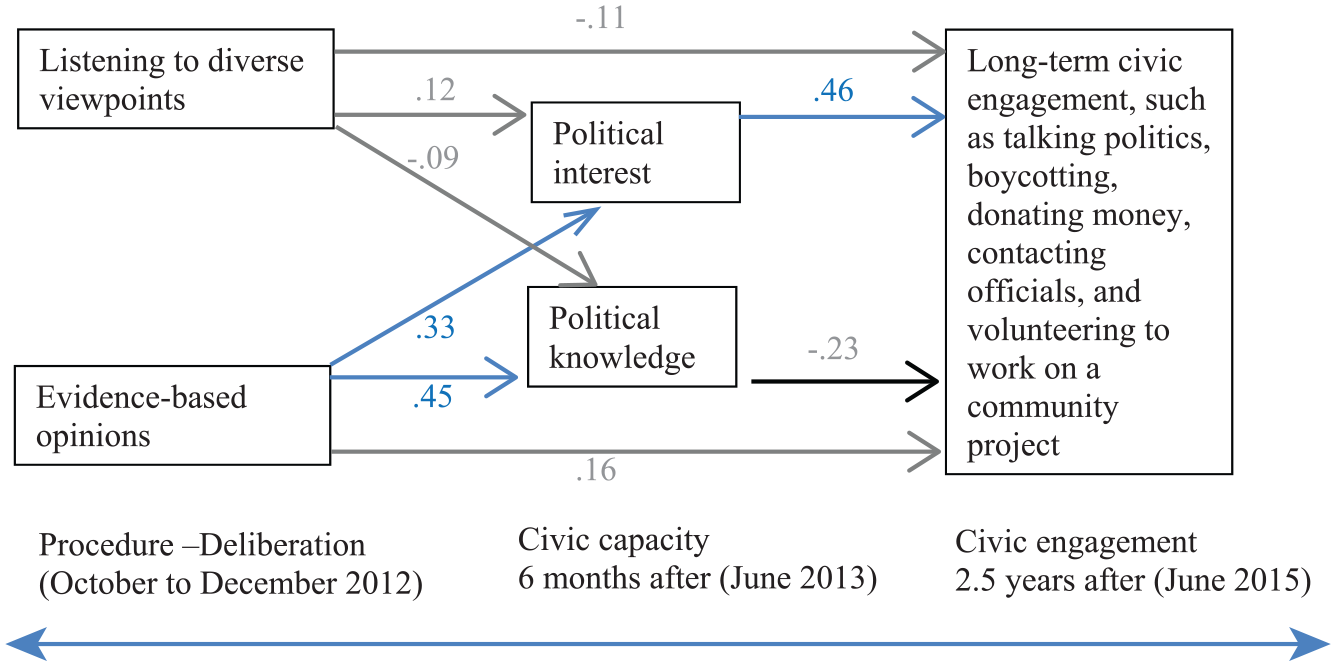
Multivariate simultaneous equation model.
In this multivariate model, providing evidence-based opinions during the deliberative events (October to December 2012) impacts political interest (B = .33, T = 2.02) and knowledge (B = .45, T = 2.81) 6 months later. Providing evidence-based opinions also increases civic engagement as measured 2.5 years later: the direct relationship is positive but did not reach statistical significance (B = .16, T = 0.91). That said, there is a small indirect effect between evidence-based opinions and civic engagement, mediated through political interest. Political interest (at the 6-month survey) is strongly and positively related to civic engagement 2.5 years later (B = .46, T = 3.01). Combining the direct relationship (.16) of evidence-based opinions on civic engagement with the indirect relationship (.05) provides a total effect of .21.
In the multivariate model, listening to diverse viewpoints did not have significant impact on subsequent civic capacity (political interest, knowledge) or civic engagement. Listening to diverse viewpoints (October to December 2012) has a small positive effect on political interest measured 6 months later. Finally, there are negative relationships depicted in this multivariate model, which should be interpreted with caution since they are not statistically significant. Most of the relationships between the key variables are positive.
Discussion and conclusion
We found an effect of participation in deliberative event on civic engagement, as measured 2.5 years after the deliberative event. These findings are unlike that of Grönlund et al. (various works) and Myers et al. (2018). We explain our significant findings in terms of the quality and length of the deliberative event. Moreover, like juries, panellists in our deliberative event had an impact on the decision-making process (Gastil et al., 2008). And the quality of the event was demonstrated through respondents’ assessment of being exposed to diverse viewpoints and listening to others’ viewpoints. Our findings may also differ from Grönlund (various works) and Myers et al. (2018) because we measured self-reported behaviour, as opposed to willingness to engage in civic life: our data offer a stronger threshold because of the focus on actual behaviour. Furthermore, the long-term design (2.5 years after the event) makes for a stronger test because any changes in activities had to endure to be observed in our data. Prior studies focus on short-term effects of deliberation, which limits understanding of how deliberative participation can have long-term, enduring effects on civic and political engagement. Because of our data’s distinction in demonstrating the trajectory of changes across three points in time, we are able to study both the long-term causal impact of deliberation and the specific elements of deliberation that contribute to civic capacity and engagement. Thus, our findings enrich understanding of the long-term impact of deliberation on day-to-day civic engagement.
In addition, our data address ‘the complicated issue of causality’, which has been a prominent but unaddressed concern in the literature (Jacobs et al., 2009: 84–85). We examined how participation in a deliberative event impacted civic engagement. To study this, the literature informs us that the mechanism works in two ways: in the deliberation procedure itself and in the capacity-building brought about by deliberation. We found that (1) some elements of deliberation (i.e. process for developing evidence-based opinions) matter for civic capacity and civic engagement and (2) the capacity factors (i.e. political interest, knowledge) brought about by deliberation matter for civic engagement.
The most dramatic changes are observed in relation to talking about political issues and contacting officials, which aligns with existing research on this topic (Esterling et al., 2011; Knobloch and Gastil, 2015). Indeed, the results from testing Hypotheses 1 and 2 offer some strong evidence related to talking politics, replicating findings by Christensen et al. (2017). The findings clearly point to the role of the deliberative process in increased levels of political talk (Table 2), increased contact with officials (Table 2). Furthermore, participation in a deliberative event cultivates reasoned opinions, which increased political interest and knowledge (Table 3). We suggest that the results affirm the role of deliberative events in creating opinion leaders. Panellists become more confident in their opinions and try to influence others. The nature of these opinions is important, since the deliberative event is expected to create more evidence-based opinions and encourage panellists to use reasoning in expressing their views (Fishkin, 2009, 2018). As most scholars of deliberative democracy theory advocate, the goal of deliberation is to foster considered opinions (Fishkin, 2009, 2018).
Participating in a deliberative event may encourage participants to develop a disposition to talk in a deliberative way, for example, providing reasons for one’s position (Burkhalter et al., 2002; Christensen et al., 2017). Our findings take a step forward, demonstrating that considered opinions can increase civic engagement in the long term. These evidence-based opinions are linked to civic capacity such as political interest and political knowledge (Table 3, Figure 2). While evidence-based opinions were positively correlated with civic engagement, the sample size was a detriment to conclusive findings (Table 3, Figure 2). The correlation failed to meet statistical significance, but the size of the positive correlation is substantial.
Panellists were also more likely to volunteer compared to non-participants (Table 1) and demonstrate a trajectory of increasing likelihood of volunteering (Table 2). The 11 percentage-point change is noteworthy. We replicated existing findings in the field that rely on cross-sectional survey data, using self-reporting of deliberative talk and volunteering (Delli Carpini et al., 2004; Jacobs et al., 2009). We also replicate findings that rely on participants’ self-assessing changes in their levels of activity (Knobloch and Gastil, 2015). Our multi-wave panel, with a public opinion poll (n = 400) as a comparison group, offer stronger causal data to support the theory that deliberation will increase civic engagement.
Our article is unique in examining self-assessed measures of deliberation’s impact on civic capacity and engagement. While existing literature points to the significance of diverse viewpoints and evidence-based opinions, we did not find consistently strong support for the importance of these factors. As for multiple viewpoints (Hypothesis 3), our findings were mixed, which reflects existing scholarship (see above discussion of Matthes et al., 2019; Mutz, 2006). We suggest further research on whether moderating a discussion with differing viewpoints (vs not moderating) might influence whether there is an impact on civic engagement. Listening to different viewpoints did increase political interest slightly and as such, holds promise as a contributor to greater civic engagement.
We also found differences between panellists and our control group in terms of boycotting and political interest. However, these differences could relate to a self-selection bias, rather than an outcome of deliberation. Panellists differed from the control group, but they did not change their behaviour (substantially) over the 2.5-year period. Despite using random sampling to recruit participants, we may have ended up with a set of participants who are highly interested and more likely to engage in boycotting, compared to non-participating members of the public.
From October 2012 (pretest) to June 2015, we see a pattern of increased knowledge of municipal policy-making (Table 2). The post-event period offered a critical learning process, since panellists observed their report submitted to City Council (April 2013), then acted upon (April 2015) (see Boulianne, 2019). As such, participants learned about policy-making process in the six Saturdays as well as in the post-event period. The results suggest that political knowledge and civic engagement are only weakly related across data points (Table 3, Figure 2) and further research would help evaluate the cause.
Footnotes
Appendix 1
Demographic comparison between panellists, community, and public opinion poll.
| Panellists recruited for the project in 2012 | Panellists who responded to the survey in 2015 | Public opinion poll, 2015 | Community profile for 2011 | |
|---|---|---|---|---|
| Percentage of females | 51.5% | 53.5% | 49.4% | 50.1% |
| Percentage who home owners | 76.2% | 78.0% | 80.8% | 70.6% |
| Average household size | 2.5 | 2.4 | 2.7 | 2.4 |
| Age | ||||
| 18 to 29 | 25.8% | 23.3% | 6.9% | 25.3% |
| 30 to 39 | 15.1% | 14.0% | 13.6% | 18.9% |
| 40 to 49 | 15.2% | 18.6% | 14.8% | 17.9% |
| 50 years and over | 43.9% | 44.2% | 62.7% | 37.8% |
| Education | ||||
| High school or less | 28.8% | 30.2% | 5.9% | 37.5% |
| Some college or university | 30.3% | 27.9% | 15.6% | 32.8% |
| University degree or certificate | 40.9% | 41.9% | 78.5% | 29.7% |
The community profile is derived from the Canadian Census and the National Household Survey (Statistics Canada, 2012, 2013). To address the education differences between the National Household Survey and the poll, the poll/comparison group results are weighted by education.
Funding
The author(s) disclosed receipt of the following financial support for the research, authorship, and/or publication of this article: This work was supported by a Community-University Research Alliance grant from the Social Sciences and Humanities Research Council to the Alberta Climate Dialogue group, #833-2009-4011.
