







Abstract
Our study examines the influence of various candidate characteristics (sociodemographic profile, competence and experience, issue positions, and party affiliation) on voters’ preference for a candidate, and investigates the impact of voters’ levels of political sophistication on their likelihood of considering various candidate characteristics when deciding whom to support. Using data from the 2015 Finnish National Election Study, this study is situated within the complex Finnish open list system with many candidates at display and mandatory preference voting. We find that voters mostly argue to make their choice based on candidate characteristics with direct politically relevant information such as candidate party affiliation and issue positions. Candidate sociodemographic profile has relatively little stated impact. Overall, voters with higher levels of political sophistication tend to be more likely to consider a broad range of candidate characteristics. When investigating the relative impact of each candidate characteristic (that is, their impact relative to the other candidate characteristics) on voting behaviour, political sophistication increases the likelihood of saying to rely on candidate characteristics that are more demanding in terms of information processing such as competence and experience, and issue positions. Our analyses also show how different measures of political sophistication have distinct effects.
Introduction
Political behaviour scholars seem to have reached a consensus that the personalization of politics constitutes an ongoing trend in Western democracies, with the profiles of leaders and candidates playing an increasingly important role in citizens’ voting behaviour (e.g. Garzia, 2014; McAllister, 2007). As the link between voters and parties has weakened, voters have substituted their partisanship with other factors in their electoral decision-making process, notably the assessment of party candidates and leaders (Dalton and Wattenberg, 2000; Wattenberg, 1991).
Despite this suggested trend of personalization, relatively little research has systematically compared the extent to which various candidate characteristics influence voters’ preferences for candidates. Most existing research has focused on how candidate gender affects voters’ likelihood of supporting candidates (e.g. Campbell and Cowley, 2014; Coffé and Theiss-Morse, 2016; Dolan and Lynch, 2014; Koch, 2002; Rosenthal, 1995; Trent et al., 2001). Some other studies have looked at the effect of candidate personality traits or appearance (e.g. Berggren et al., 2010; Catellani and Alberici, 2012; Clifford, 2014; Johns and Shephard, 2007; Lenz and Lawson, 2011; Peterson, 2005), as well as candidates’ local roots, visibility, and political experience on electoral behaviour (Collignon and Sajuria, 2018; Put and Maddens, 2015; Shugart et al., 2005; Tavits, 2010).
With the exception of a few recent experimental studies focusing on the impact of candidates’ sociodemographic characteristics and issue positions on voting behaviour (Arnesen et al., 2019; Franchino and Zucchini, 2015; Kirkland and Coppock, 2018; Pedersen et al., 2019), relatively little is known about the extent to which the impact of a wide variety of characteristics differs. For example, we know little about the extent to which the impact of candidate sociodemographic characteristics compares with other candidate characteristics, such as issue positions and party affiliation. Therefore, the aims of this study are (1) to investigate which candidate characteristics voters say to consider when choosing which candidate to vote for and (2) to examine how these considerations differ depending on voters’ levels of political sophistication. To do so, we rely on the 2015 Finnish National Election Study (Grönlund and Kestilä-Kekkonen, 2015). With its system of open-list proportional representation with mandatory preferential voting, Finland is a complex electoral context. In particular, a high number of nominated candidates competing for votes on individual platforms but within the framework of strong and relevant parties, makes the system demanding for voters to navigate.
We compare which emphasis voters place on candidate sociodemographic profile, competence and experience, issue positions, and party affiliation when deciding whom to vote for. By analysing which characteristics voters take into account when making their choice, we can gain a deeper understanding of voters’ decision-making processes and behaviour, and its consequential influence on the make-up of legislatures. We argue that characteristics that are strongly related to substantive aspects of politics (such as candidate party affiliation, competence and experiences, and issue positions) will be prioritized by voters, despite the observed trend towards partisan dealignment and the complexity voters face when deciding whom to vote for with many candidates at display. In addition, we expect politically sophisticated voters to be more likely to consider candidate characteristics that are more challenging in terms of information processing compared with less politically sophisticated voters (see, for example, Bartels, 1996; Funk, 1997; Goren, 1997; Johns and Shephard, 2007; Popkin, 1991; Zaller, 1990).
Theory
The impact of candidate characteristics
How do voters decide which candidate to vote for when there are many candidates at display? Previous research has pointed towards the use of various voting cues to navigate the complexities of the political information available, and as such facilitate the decision-making process. Adam and Maier (2010) state that personalization works by clustering political information about a candidate into characteristics, which then act as information shortcuts for voters. The more complex and information-rich the electoral environment is, the more responsive voters tend be to simple cues that allow them to reduce the time and effort devoted to deciding how to vote (Lau and Redlawsk, 2006).
One such simple cue is a candidate’s sociodemographic profile. The vast majority of research examining the influence of candidate sociodemographic characteristics on voters’ candidate preferences has concentrated on the effect of gender. Some studies conclude that gender stereotypes held by citizens affect their likelihood of supporting a female candidate (e.g. Koch, 2002; Rosenthal, 1995). However, other research finds that candidate gender has little influence on voters’ preferences for candidates (e.g. Campbell and Cowley, 2014; Coffé and Theiss-Morse, 2016; Dolan and Lynch, 2014; Trent et al., 2001). Looking at sociodemographic characteristics other than gender, research has shown that candidate occupational background (Coffé and Theiss-Morse, 2016) is considerably more relevant to voting decisions than gender, while age does not appear to affect voters’ candidate preferences (Campbell and Cowley, 2014). Candidate level of education has also been found to influence voting behaviour (Campbell and Cowley, 2014), with a candidate who left school at age 18 surprisingly favoured by voters in comparison with a candidate who had obtained a university degree. Some research (Pedersen et al., 2019) has also demonstrated that voters infer both personal traits and policy positions from sociodemographic characteristics of candidates.
A more demanding type of decision-making process is a focus on substantive matters such as candidate competence and experience, and issue positions. Research by political psychologists suggests that citizens are well practised in assessing political candidates based on their personality, given that people habitually utilize others’ personality in order to evaluate and form an impression of the person (Fridkin and Kenney, 2011). Voters can make inferences about candidate reliability and ability to manage things through the media, and through candidate campaign messages (Fridkin and Kenney, 2011). Information on the personal qualities of a candidate offers voters important insights into how the candidate may perform while in office (Miller et al., 1986). Focusing on personal qualities, most empirical studies have concluded that candidate political and management skills influence voters’ opinions and behaviour to a greater extent than non-political aspects (Adam and Maier, 2010). Relatedly, there is a great advantage for candidates to be well known among the public. This holds particularly in personalized voting systems such as the Finnish system. Experienced candidates who have accumulated a reputation from politics, by previous office holding (Dahlgaard, 2016; Kirkland and Coppock, 2018) and being acknowledged in the local community (Collignon and Sajuria, 2018; Put and Maddens, 2015; Shugart et al., 2005), or candidates who are well known from other areas of public life (Arter, 2014) tend to win more votes.
Another important characteristic of candidates relates to their issue positions. These positions, which provide direct political information, are generally expected to influence voters’ evaluations of candidates and voting behaviour (Lau and Redlawsk, 2001). This is confirmed in a recent conjoint experiment (Arnesen et al., 2019), demonstrating that voters’ preference for candidates is influenced more strongly by candidates’ issue positions than by their social characteristics (see, however, Luskin, 1990). In the same vein, Franchino and Zucchini (2015) present evidence that policies trump education (and integrity) when voters choose between pairs of candidates. However, a systematic gathering of candidate issue positions for a large pool of potential candidates is highly demanding for voters.
Candidate party affiliation is also a characteristic providing direct and substantive political information, but in a way that is relatively easy for voters to grasp. Despite the movement towards partisan dealignment and the loosening ties between citizens and political parties, we expect candidate party affiliation to have a strong influence on voting decisions as it provides voters with a strong indication of the path that the candidate will take if elected to office. Looking at evaluations of MPs among a sample of undergraduate students, Johns and Shephard (2007) concluded that partisanship is the dominant influence (see also Hayes and Lawless, 2016). Previous research on Finnish voters demonstrates that candidate party affiliation is a decisive factor for about half of the voters when deciding for which candidate to vote (Isotalo et al., 2019). Despite the trend of dealignment, studies show that voters’ political affiliation is (still) often the best predictor of their vote choice (e.g. Bafumi and Shapiro, 2009; Bartels, 2000; Hayes and Lawless, 2016).
In sum then, there are different types of candidate characteristics that voters can rely on when deciding which candidate to support. Some of these characteristics, such as sociodemographic profile and party affiliation, are relatively easy for voters to grasp, and do not crave much in terms of information processing. Others are more demanding and presume that voters process a great deal of information. This holds in particular for evaluations of issue positions, but also to some extent for competence and experience, especially in an electoral setting with many candidates at display. Candidate characteristics, however, also vary in terms of the political information they contain, with characteristics such as party affiliation, competence and experience, and issue positions, containing greater direct political information compared with, for example, candidate sociodemographic background.
Given that party affiliation is a simple cue with great political relevance, we expect this characteristic to be the most influential when voters decide which candidate to support. Candidate competence and experience, and their issue positions are, in their turn, anticipated to have less impact than party affiliation since they tend to be more difficult to decipher. Due to the political relevance of competence and experience, and issue positions, we do, however, expect them to have a greater political bearing on voters’ selection process than sociodemographic characteristics, which contain less directly politically relevant information. Indeed, while sociodemographic characteristics, such as gender, have been found to influence representatives’ parliamentary behaviour and policy focus (e.g. Bolzendahl and Brooks, 2007; Childs, 2004; Lovenduski, 2005; Norris, 1996; Wängnerud, 2009) and as such contain politically relevant information, the political information that they contain is less straightforward. Therefore, we expect sociodemographic characteristics to be of lower relevance to voters compared with more concrete and straightforward political pointers, such as candidate party affiliation. In sum, we expect voters to emphasize different candidate characteristics depending on the amount of direct political information they carry, and on how challenging they are in terms of information processing. In particular, our hypotheses read as follows:
H1a. Party affiliation is the candidate characteristic which has the greatest impact on voters’ candidate choice.
H1b. Candidate competence and experience, and issue positions have less impact on voters’ candidate preference than candidate party affiliation.
H1c. Sociodemographic characteristics are the candidate characteristics which has the least impact on voters’ candidate choice.
Political sophistication and the impact of candidate characteristics
The extent to which voters will rely on different candidate characteristics may, however, differ depending on voters’ levels of political sophistication. Political sophistication refers to the extent to which a person has knowledge of political activities, understands and assimilates political information, and forms political views. Luskin (1990) writes as follows: ‘A person is politically sophisticated to the extent to which his or her political cognitions are numerous, cut a wide substantive swath, and are highly organised, or constrained’ (p. 332).
Some scholars have argued that politically sophisticated voters evaluate candidates and make their voting decisions in different ways compared with those who are not politically sophisticated (e.g. Bartels, 1996; Dalton, 1984; Funk, 1997; Goren, 1997; Johns and Shephard, 2007; Popkin, 1991; Zaller, 1990). Politically sophisticated voters have greater political knowledge, have a greater ability for complex processing of political information, and are better able to absorb the complexities of politics (Funk, 1997). As put by Sniderman et al. (1991),
It is, in short, not plausible to suppose that the well-informed voter and the poorly informed one go about the business of making up their minds in the same way. (Sniderman et al., 1991: 166)
The way in which voters make up their minds is thus likely to vary depending on voters’ levels of political sophistication, and the impact of political sophistication is expected to grow with the complexity of the electoral context (Lau and Redlawsk, 2006). In information-rich electoral settings such as the Finnish open-list proportional representation (OLPR) system with many candidates competing for votes on individual platforms using personalized campaign strategies, voters are overloaded with information, making political sophistication a key factor in information processing.
Various scholars have confirmed that political sophistication leads to greater accessibility of policy attitudes and consequently higher levels of ideological and policy voting, and a greater likelihood of evaluating candidates and parties in policy terms (Delli Carpini and Keeter, 1996; Goren, 1997; Macdonald et al., 1995). In order for citizens to utilize candidate issue positions as voting cues, they must obviously be informed of and understand candidates’ policy positions (Cutler, 2002). In addition, they need to know their own opinions on relevant issues and thus be able to conclude whether they agree or disagree with the policy stance taken by candidates. Given that politically sophisticated voters will have a better understanding of candidate policy positions and their own position on relevant issues, they are expected to rely more on candidate policy positions than politically unsophisticated voters. Empirical research has indeed confirmed that higher levels of political sophistication are related to higher levels of voter party ideological congruence (Boonen et al., 2017; Lau et al., 2013; Singh, 2010).
Evaluations of candidates’ competence and experiences can be seen as less demanding than evaluations of issue positions, but they do take more information processing compared with party positions and sociodemographic background, especially when there are many candidates for voters to choose from. Brown et al. (1988) suggest that sophisticated voters place greater importance on the characteristics of leaders that are relevant to politicians’ ability to do their job, than unsophisticated voters. This finding is consistent with the idea that candidate characteristics, like their issue positions, are harder to decipher and hence may be utilized to a greater extent by politically sophisticated voters who have greater exposure to and understanding of political information.
Based on the above, our hypothesis regarding political sophistication and the tendency to rely on characteristics that require greater political understanding to decipher reads as follows:
H2. Politically sophisticated voters are more likely to be influenced by more complex candidate characteristics such as candidate competence and experience, and issue positions when deciding who they will support compared with less politically sophisticated voters.
While empirical research has mostly confirmed that politically sophisticated voters rely more on characteristics that are hard to ascertain, results are inconsistent when focusing on the link between voters’ levels of political sophistication and the likelihood of relying on candidate characteristics that are easy to ascertain. For example, candidate party affiliation, and the associated party’s reputation, provide a voting cue which is easily ascertainable by almost all voters, except those with no political engagement and interest whatsoever. While one may thus expect – as also suggested by the cognitive mobilization theory (Dalton, 1984, 2007) – that candidate party affiliation would be most frequently utilized by less politically sophisticated voters in order to supplement their limited political awareness, Kim (2006) finds that in the South Korean case, politically knowledgeable citizens are more likely to rely on partisan cues than unsophisticated voters. Albright (2009) also found that greater political knowledge and exposure to mass media leads to an increase in party attachments (see also Zaller, 1992). This suggests that politically sophisticated individuals may be more likely to rely on candidate party affiliation to reach a voting decision.
Similar to candidate party affiliation, candidate sociodemographic characteristics, such as gender and age, are relatively easy to determine. They are observable features which are easily ascertainable by voters from the names and images of candidates and are, as such, easy heuristics (Johns and Shephard, 2007). Popkin (1991) confirms that less informed citizens will place greater reliance on sociodemographic cues than more informed citizens since the latter will update their perspectives with material of greater political substance. Similarly, Cutler (2002) concludes that less sophisticated voters are more likely to rely on sociodemographic characteristics. He does, however, also find that more politically sophisticated voters also fall back on sociodemographic characteristics and that they seem to rely on both policy and sociodemographic criteria.
The inconclusive findings for the cognitively simple candidate characteristics of sociodemographic profile and party affiliation is in line with the argument put forward by Sniderman et al. (1991) that better informed voters rely on a broader range of decision criteria than the less well informed. According to Sniderman and colleagues, it is hence not necessarily the case that political sophisticates turn to more demanding types of information only, but rather that ‘[. . .] the better-informed voter tends to take account of nearly everything including the kitchen sink’ (Sniderman et al., 1991: 173).
While the empirical research on the link between political sophistication and the likelihood of relying on cognitively simple candidate characteristics is inconclusive, based on the reasoning of Sniderman et al. (1991), we hypothesize that the effect of political sophistication for these types of characteristics is weak. Our third hypothesis thus reads as follows:
H3. Political sophistication does not influence the tendency of voters to emphasize ‘easy’ candidate characteristics such as party affiliation and sociodemographic background when deciding who they will support.
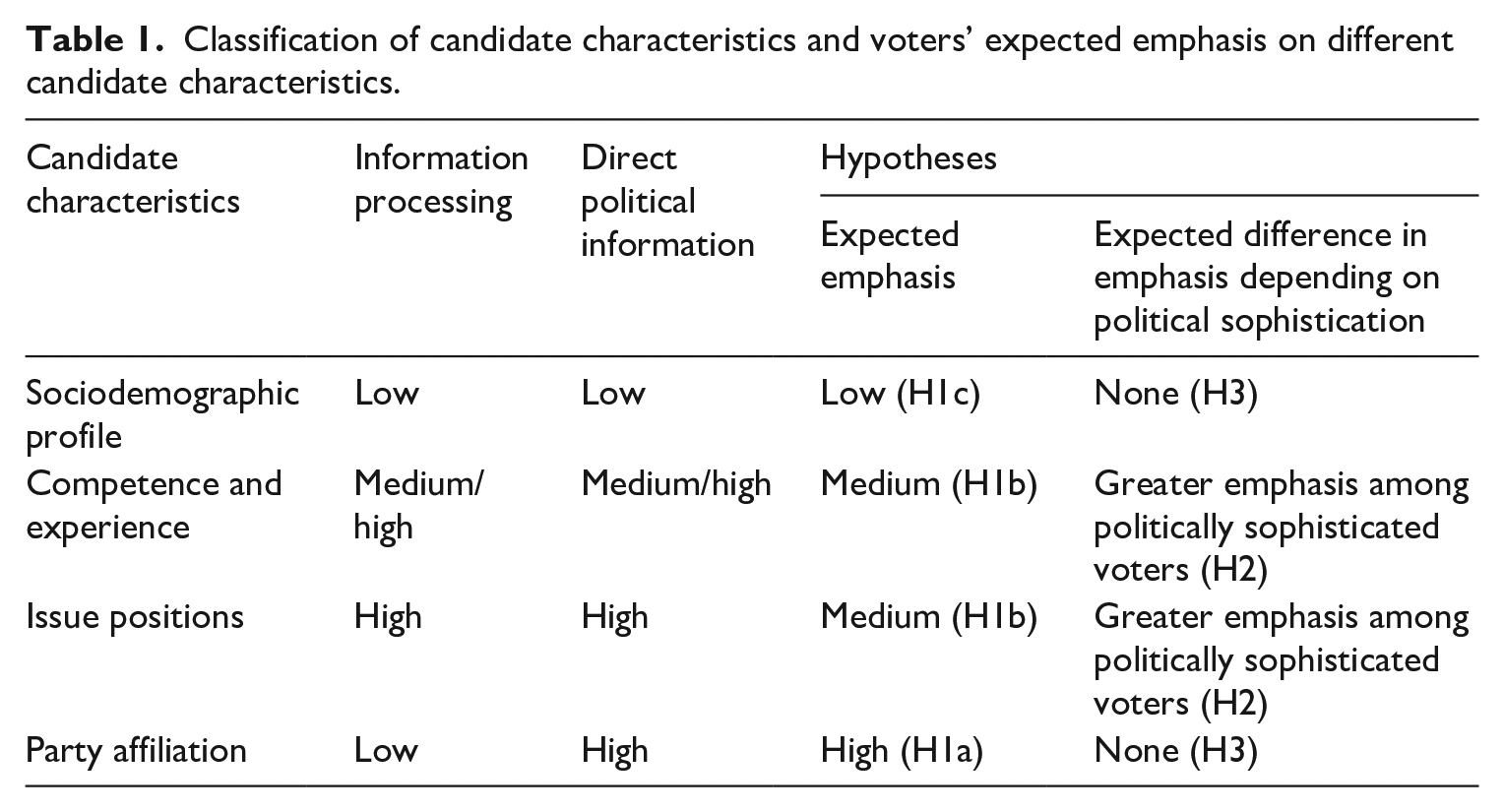
Table 1 provides an overview of the different candidate characteristics studied in this article, their differences in terms of information processing and the political information they contain, and the emphasis we expect voters to say they put on the different candidate characteristics and how this emphasis is expected to differ depending on voters’ levels of political sophistication.
Classification of candidate characteristics and voters’ expected emphasis on different candidate characteristics.
Data and measurements
Our study is situated in one of the oldest examples of OLPR systems, namely, Finland. It is a highly candidate-oriented system, but a system with cohesive parties and where party affiliation still matters a great deal for electoral behaviour (Karvonen, 2010). Votes are casted directly for individual candidates, and not for a collective party list, but parties nominate candidates and the votes are pooled at the party level (e.g. Karvonen, 2010; Marsh, 1985). The amount of seats won by a party is determined by the total amount of votes for the candidates nominated by the party in the district (13 in the 2015 Parliamentary Election), and the seats are filled by the candidates with the highest number of personal votes. The system is characterized by duality in terms of electoral competition, with equally strong competition between parties (inter-party competition) and between candidates running for the same party (intra-party competition; Von Schoultz, 2018). It is also a complex system for voters to navigate, since there are many candidates at display. Parties are allowed to nominate 14 candidates, or as many candidates as there are seats to be filled, and the system incentivises parties to run full lists (Von Schoultz, 2018). In the 2015 election, the number of nominated candidates in the largest electoral district of Uusimaa was 394.
Due to the competition across and within parties, and the many nominated candidates from which the voters have to choose a single candidate, the system provides voters with a highly complex choice set-up. This, in turn, is believed to make voters more responsive to simple cues that allow them to reduce the time and effort devoted to deciding how to vote (Lau and Redlawsk, 2006).
To investigate the importance of different candidate characteristics in voters’ decision-making processes and examine the extent to which this importance differs depending on voters’ levels of political sophistication, we use the 2015 Finnish National Election Study (Grönlund and Kestilä-Kekkonen, 2015). While all elections take place in their specific context, the 2015 Finnish parliamentary election can be considered as a ‘regular’ Finnish election. As in many other European democracies, the Finnish party system has become more fragmented and polarized over the last two decades, with the electoral breakthrough of the populist radical-right Finns Party in the 2011 election being the most dramatic change. These developments have made voters more aware of differences across parties, and more likely to take into account the party affiliation of candidates when deciding which candidate to vote for compared with 15 years ago (Isotalo et al., 2019).
The Finnish National Election Study is a national representative cross-sectional survey performed in two stages involving face-to-face interviews based on quota sampling (according to age, gender, and province of residence). The original dataset consists of 1587 respondents. Of those respondents, 291 said they had not voted at the 2015 elections. These non-voters are not included in the analyses. We also excluded respondents who voted blank (N = 2). Other respondents with missing information on any of the independent variables (except the left-right scale) have been deleted listwise, giving a final sample size of 1173 respondents. 1
Data were weighted using the variable provided with the dataset. The variable weights the sample to match mother tongue, age, gender, and electoral district distributions in the population as well as the actual vote share of parties in the elections. All results presented below are provided for weighted data.
Dependent variables
To grasp the extent to which voters take various candidate characteristics into account when deciding which candidate to support, we use a question asking respondents to ascertain the extent to which a selection of characteristics influenced for which candidate they decided to vote. Note that the answers to the question do not say whether respondents voted for someone with the same characteristics (e.g. age, gender, party affiliation) as the respondent. We ran some explorative analyses investigating the link between the extent to which age and gender influenced voters’ choice of a candidate and, respectively, whether they voted for someone who is of the same gender (yes/no) and what the age was of the candidate they voted for (roughly the same age – much younger – much older). These analyses revealed that those who voted for a candidate of the same gender and – to a lesser extent – age are more likely to find, respectively, gender and age a decisive factor in their candidate preference than those who did not vote for a candidate of the same gender.
Subjective evaluations of personal behaviour should be interpreted with some caution. As demonstrated in previous research, such answers may be subject to rationalization; voters may report reasons that sound rational and systematic and fail to mention considerations based on emotions (Rahn et al., 1994). Voters may also be unaware of the true motives for their choice (Nisbett and Wilson, 1977). Some scholars have, however, suggested that an introspective approach provides valuable information regarding citizens’ behaviour (Blais et al., 1998; Kelley, 1983). The use of survey questions such as the one used here also overcomes the major deficiency of survey experiments often used in studies on the effect of candidate characteristics, namely, that the results may have limited validity outside the context of the experiment. Asking respondents directly about their preferences can give a better representation of which candidate characteristics matter most in real-life situations.
Based on a principal component factor (PCF) analysis (Table A in the Supplemental Appendix), the substantive meaning of items, and the internal inconsistency (measured through Cronbach’s alpha) of possible scales, we operationalized four different (groups of) characteristics: sociodemographic profile, competence and experience, issue positions, and party affiliation. 2 As such, the study looks at a diverse range of characteristics, including characteristics which are more difficult to ascertain (e.g. competence and issue positions) and those which are easier to understand and discern (e.g. party affiliation and demographic characteristics). It also includes measures that have direct political relevance (e.g. party affiliation and issue positions) and characteristics that do not have such direct relevance and may seem more ‘superficial’ (e.g. sociodemographic profile).
The measure of candidate sociodemographic profile relies on three items: age, gender, and education (Cronbach’s α: .64). Four items are used to measure perceived competence and political experience of the candidate: reliability, ability to manage things, public speaking and presentation skills, and prior experience in politics (Cronbach’s α: .79). Issue positions and Party affiliation are both measured by a single item. The answer categories were the following: (1) decisive factor in my choice, (2) a lot, (3) somewhat, and (4) not at all. Answers were recoded in such a way that higher values refer to greater importance.
Explanatory variables
Political sophistication has been measured in various ways in empirical research and has been linked to citizens’ exposure (the political information citizens receive), their motivation (citizens’ interest in learning about politics), and their intelligence (their ability to assimilate and organize political information) (Luskin, 1990). While most empirical research has focused on the effect of one specific measure of political sophistication, we investigate the effect of three different measures simultaneously: political knowledge, political interest, and media exposure. While we did not formulate specific hypotheses for each specific measure of political sophistication (but rather formulated hypotheses on the effect of political sophistication overall) in our theoretical section, testing the effect of different measures of political sophistication allows an empirical examination of which measure of political sophistication has the greatest impact on the relevance of various candidate characteristics. Political knowledge measures factual knowledge about politics and is a sum scale that relies on four multiple choice questions asking respondents the name of the Finnish Minister of Finance right before the 2015 parliamentary elections, the name of the party with the second largest number of seats in the newly elected parliament, the name of the current Secretary-General of the United Nations, and the meaning of a parliamentary system of government (Cronbach’s α: .50). The variable measures the number of correct answers. The second measure of political sophistication is political interest and relies on a question asking respondents how interested they are in politics. Answer categories ranged from (1) very interested to (4) not interested at all, but are recoded in such a way that a higher value refers to greater political interest. The third and final measure of political sophistication is media attention and relies on a question asking the respondents how much attention they paid to media coverage of the parliamentary elections. We distinguish two measures operationalized as sum scales. The first one measures traditional media use and includes seven items: television debates and party leader interviews, television news and current affairs programmes, television entertainment programmes featuring politicians, radio programmes, newspaper articles, columns or letters to the editor, and television advertisements and newspaper advertisements (Cronbach’s α: .74). The second scale refers to online media use and also includes seven items: web news covering elections (e.g. newspaper websites), candidate and political party websites, blogs, candidate selectors on the Internet, social media (e.g. Facebook, Twitter, or Instagram), videos of the candidates or political parties on the Internet (e.g. YouTube), and news broadcasts on the Internet or social media (Cronbach’s α: .85). 3 Answer categories for each individual item were as follows: a great deal of attention, a fair amount of attention, only a little, and paid no attention at all. They are recoded in such a way that higher scores refer to greater attention.
Control variables
In the analyses below, we also include a series of common sociodemographic and political control variables known to affect electoral behaviour. Table B in the Supplemental Appendix provides an overview of the control variables. Table C in the Supplemental Appendix introduces descriptive information for all explanatory variables and control variables included in the analyses.
Analytical strategy
To investigate the link between political knowledge and the relevance of candidate characteristics when voters decide whom to support, we performed ordinary least squares (OLS) regression analyses for each of the dependent variables introduced above. 4
Analyses
Descriptive analyses
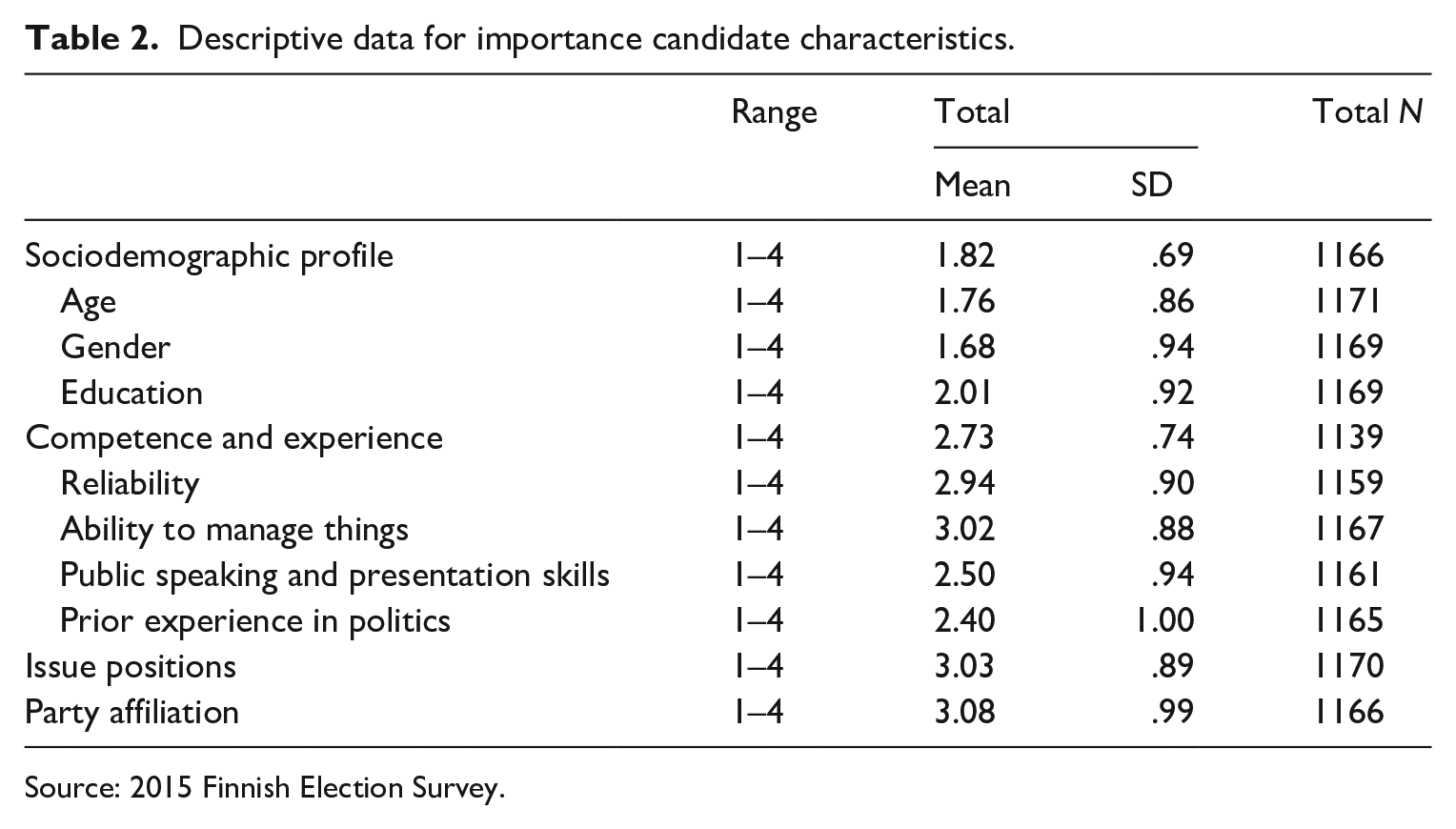
Before investigating explanatory patterns through a multivariate analysis, Table 2 presents the means (and standard deviations) for the four candidate characteristics investigated in this study. Table D in the Supplemental Appendix provides more detailed results with the percentages per answer category.
Descriptive data for importance candidate characteristics.
Source: 2015 Finnish Election Survey.
As can be seen from Table 2, candidate party affiliation is the most often mentioned factor when voters evaluate how important various characteristics were for them when deciding whom to vote for, confirming H1a. About 45% of the respondents (see Table D in the Supplemental Appendix) state that candidate party affiliation was a decisive factor, indicating that candidate party affiliation (still) plays an important role in voting decisions. As anticipated (H1b), candidate issue positions, and competence and experience scale follow candidate party affiliation as the characteristics that are most frequently considered by voters when deciding whom to vote for. Of the four items included in the competence and experience scale, ability to manage things is emphasized the most, followed by reliability. In line with H1c, candidate sociodemographic characteristics are considered the least. Of the sociodemographic characteristics, education plays the most important role, followed by age and gender. More than 58% of the respondents (see Table D in the Supplemental Appendix) state that candidate gender does not play a role at all when deciding whom they will vote for. This confirms other research suggesting that gender does not have a major impact on citizens’ candidate preference (e.g. Campbell and Cowley, 2014; Coffé and Theiss -Morse, 2016; Dolan and Lynch, 2014; Trent et al., 2001).
Overall, the data thus show that the characteristics which contain the most direct politically relevant information are the most influential. The correlations between the different characteristics (see Table G in the Supplemental Appendix) suggest that the candidate issue positions and competence and experience have the strongest link (correlation = .50), indicating a tendency among those who say to consider candidate competence and experience when deciding whom to support to also consider their issue positions. The correlation is the weakest (.15) between considering candidate party affiliation and their sociodemographic profile.
Explanatory analyses
Turning to a detailed test of our hypotheses, Figure 1 shows scatter plots of the point estimates of our main explanatory variables resulting from our multivariate OLS regressions for the four candidate characteristics (see Table E in the Supplemental Appendix for the full models).
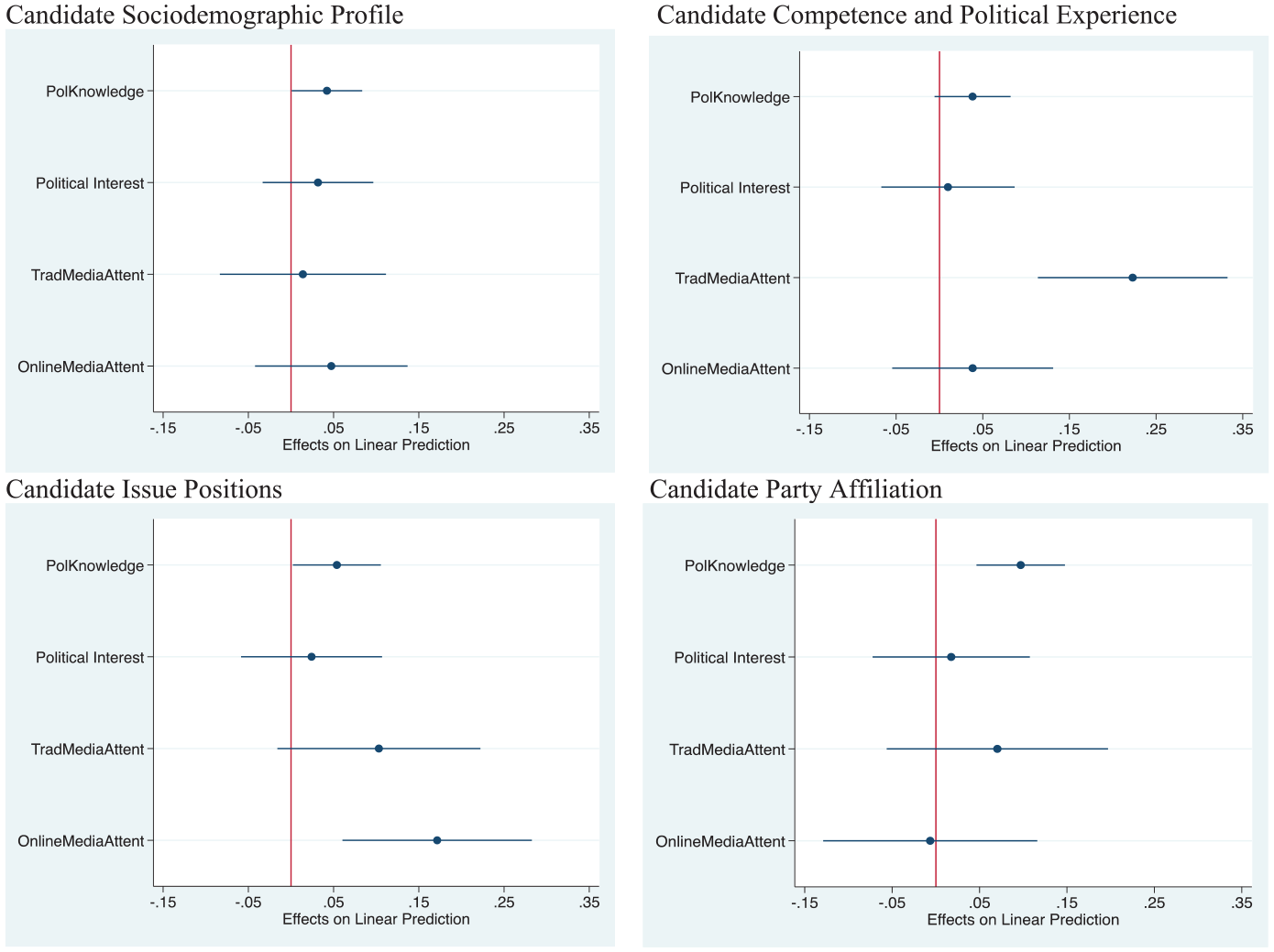
Coefficients (with 95% confidence intervals) for main explanatory variables of ordinary least squares regression analyses explaining the likelihood that various candidate characteristics influenced voters’ choice of a candidate.
The results indicate that political sophistication has a significant and positive impact on the likelihood of saying to rely on all four candidate characteristics when deciding whom to support. The particular measures of political sophistication that matter, however, differ between the different candidate characteristics. As can be seen from Figure 1, factual political knowledge has the most consistent impact and has a significant (p < .05) and positive impact on voters’ likelihood of relying on all candidate characteristics investigated in the study, except candidate competence and experience (on which it has a marginally significant (p < .10) impact). Hence, it appears as if politically knowledgeable voters are more likely to emphasize both characteristics that are difficult to ascertain and/or that contain highly relevant political information, and characteristics that are easy to ascertain and/or that contain little political information compared to voters who are less political knowledgeable. While these findings confirm H2, they reject the anticipated non-significant effect of political sophistication on candidate characteristics that are easy to ascertain (H3).
The likelihood of relying on candidate issue positions and competence and experience is also positively influenced by media attention. The more voters followed the campaign via online media (and marginally significantly also traditional media), the more likely they are to say that their voting behaviour was influenced by candidate issue positions. Media attention also matters positively for the likelihood of considering candidate competence and experience when deciding whom to vote for, but here it is the extent to which voters followed the traditional media that matters strongly. Political interest as a measure of political sophistication does not seem to influence the likelihood of voters to consider certain candidate characteristics once controlling for political knowledge and media attention. 5
The finding that politically sophisticated voters tend to rate all types of candidate characteristics as more important than less sophisticated voters leads us to further investigations which examine the relative importance of the different candidate characteristics, and how these relative ratings are influenced by political sophistication. In other words, do politically sophisticated voters find candidate sociodemographic profile more important compared with the other candidate characteristics than voters with lower levels of political sophistication? To that end, we calculated for each voter how important they considered each particular characteristic and compared the importance of each particular characteristic with the average rating of the other candidate characteristics. 6 Figure 2 presents scatter plots of the point estimates for the effect of our political sophistication variables on the relative importance attributed to the four different candidate characteristics (see Table F in the Supplemental Appendix for the results of the full OLS regression models).
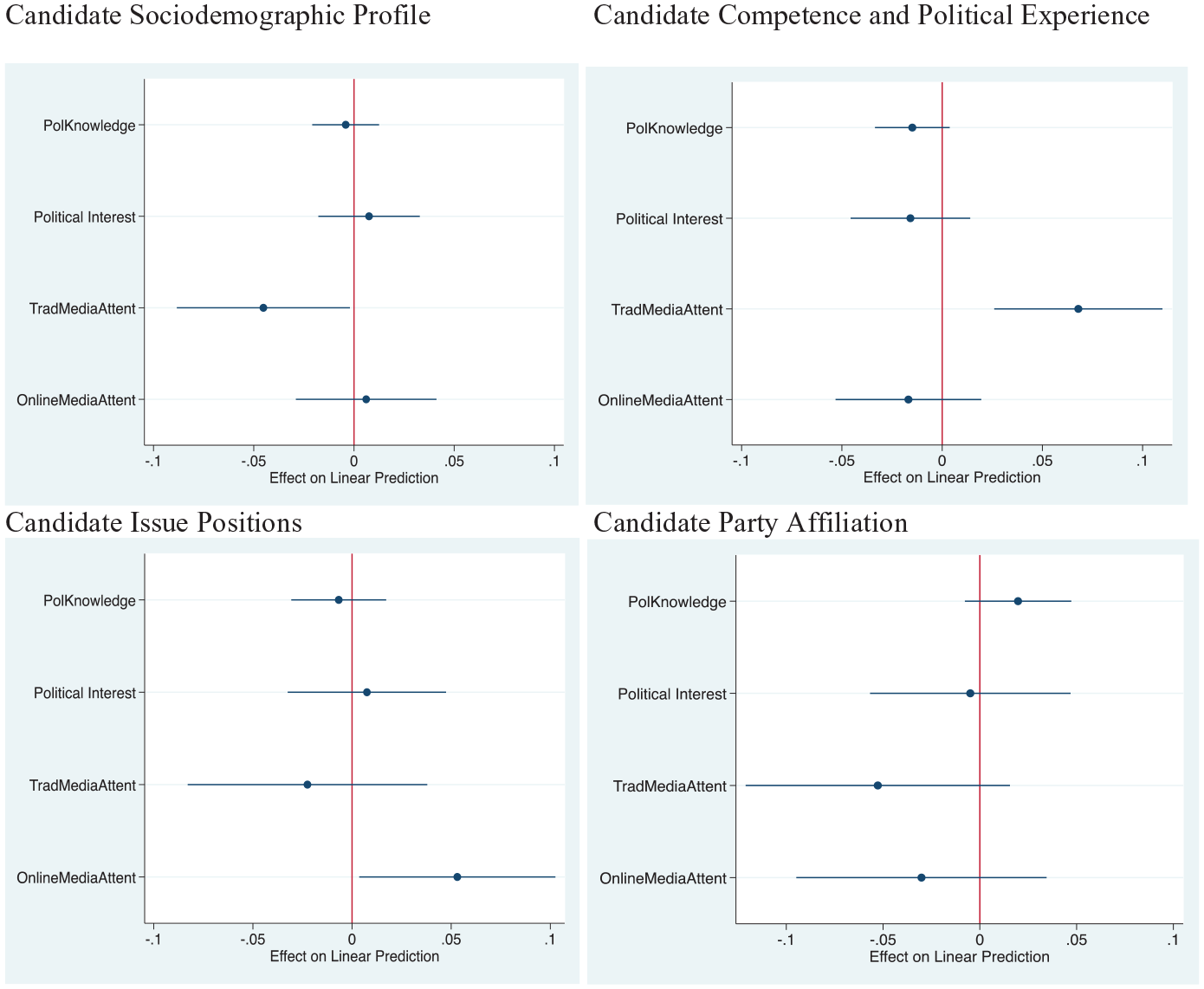
Coefficients (with 95% confidence intervals) for main explanatory variables of ordinary least squares regression analyses explaining the relative influence of various candidate characteristics on voters’ choice of a candidate.
Figure 2 shows that the relative importance of specific characteristics is mainly influenced by media attention. The more attention that voters pay to the coverage of parliamentary elections in the traditional media, the more likely they are to find candidate competence and experience more important than other characteristics. Similarly, the more attention that voters pay to the coverage of parliamentary elections in online media sources, the more likely they are to find candidate issue positions more important than other characteristics. These findings indicate that politically sophisticated voters are more likely to emphasize more complex candidate characteristics such as candidate competence and experience, which is in line with our originally formulated H2. The analyses also show that voters who pay little attention to the coverage of the parliamentary elections in traditional media are significantly more likely to rely on candidate sociodemographic profile than other candidate characteristics. This seems to suggest that politically sophisticated voters (at least when measured by exposure to traditional media) rely less on candidate characteristics that are relatively easy to ascertain.
Conclusion and discussion
The aim of this study was to systematically investigate which candidate characteristics voters emphasize when deciding which candidate they will support, and to what extent this differs depending on citizens’ levels of political sophistication. Overall, the analyses show that voters argue to be most influenced by candidate characteristics containing the most direct politically relevant information when deciding which candidate to support. Candidate party affiliation is the most emphasized characteristic, but candidate issue positions also play a major role. By contrast, candidate sociodemographic characteristics have, according to voters themselves, little relevance when they decide whom to support. As such, this study adds to the empirical study on the personalization of politics and somewhat challenges the claim of the (growing) importance of personal qualities and characteristics, as it suggests that it is (still) parties and candidate party affiliation that play the most important role for voters – at least when they explain their own voting behaviour.
The study also shows that political sophistication does have an impact on which characteristics voters say to rely on when deciding whom to support. In particular, political sophistication has a positive effect on all candidate characteristics considered in this study. Voters who are politically sophisticated are more likely to find both characteristics that are easy to ascertain and characteristics that are more complex important when deciding whom to support compared with those who are not politically sophisticated. Sophisticated voters thus seem to consider a wider variety of candidate characteristics when deciding whom to support. This is in line with the argument put forward by Sniderman et al. (1991) and might reflect politically sophisticated voters’ greater awareness of the complexity of the vote choice and multidimensionality of political representation. When examining the relative importance of each characteristic (relative to the other characteristics), a different pattern occurs. Political sophistication decreases the likelihood of finding sociodemographic characteristics important but increases the likelihood of saying that political competence and experience as well as policy issues matter.
Our study also indicates that the way that political sophistication is measured matters. We find that factual knowledge has the most consistent (and positive) effect on the likelihood of stating to rely on all candidate characteristics considered in the study except the competence and experience scale. Substantively, however, the effect is overall stronger for media attention than for political knowledge. When studying the relative importance of the different characteristics (relative to the importance of other characteristics), media attention also matters the most. Traditional media exposure has a negative effect on the relative importance of candidate sociodemographic profile, but a positive impact on the likelihood of finding political competence and experience is more important than other candidate characteristics. Similarly, online media attention increases the likelihood of saying to rely more on policy positions than other candidate characteristics.
Overall, our study shows that different patterns occur whether one studies the overall importance respondents attribute to different candidate characteristics, or whether one focuses on the relative importance of different candidate characteristics. In addition, our results highlight the relevance of including different measures of political sophistication in empirical studies. It may also help explaining some of the conflicting results found in the existing research on the link between candidate or leader characteristics and political sophistication, since different studies use different measures of political sophistication.
Since our study focuses on only one country, the question remains to what extent the findings are generalizable to other (post-industrialized) countries. The Finnish electoral system offers voters a demanding decision-making context, which is expected to highlight the importance of information shortcuts and the impact of political sophistication. Political sophistication may thus have a less differentiating effect in, for example, flexible list systems such as the Belgian and Danish electoral systems. Given that Finland has a tradition of strong female political representation (Statistics Finland, 2015), the sociodemographic profile of candidates (and in particular their gender) may play a smaller role when voters decide whom to support in Finland compared with countries with lower levels of female representation in parliament.
For now, we can conclude that in a highly candidate-centred political context such as Finland, it is (still) – according to the voters themselves – candidate party affiliation that matters most when they decide whom to support. Simultaneously and systematically investigating the influence of various candidate characteristics – both in overall and relative sense – made it possible to directly compare which characteristics voters emphasize the most and how the importance compares to one another. As such, it offers a valuable addition to the existing studies on the topic at hand. These studies generally rely on survey experiments and mostly only deal with one (typically sociodemographic) characteristic, leaving party affiliation and issue positions out of the contest. While survey experiments provide valuable evidence, the controlled environment in which they take place does not reflect and represent real-world elections. While having its own shortcomings (e.g. through possibly providing socially desirable answers, answers that are a result of rationalization, or not knowing or remembering which characteristics mattered precisely when deciding whom to vote for), the use of survey questions does contributes with a complementary perspective and improves our understanding of which candidate characteristics voters consider the most in real-life situations.
Supplemental Material
POL922077_appendix – Supplemental material for How candidate characteristics matter: Candidate profiles, political sophistication, and vote choice
Supplemental material, POL922077_appendix for How candidate characteristics matter: Candidate profiles, political sophistication, and vote choice by Hilde Coffé and Åsa von Schoultz in Politics
Footnotes
Acknowledgements
Both authors graciously acknowledge the financial support from the Academy of Finland and the academic support from the IntraComp-team. The first author would also like to thank the Åbo Akademi University (Social Science Research Institute) for the fellowship it provided to work on this article and the hospitality. She also gratefully acknowledges the financial support that she received from Victoria University of Wellington, Faculty of Social Sciences. A previous version of this article has been presented at the Åbo Akademi University (Social Science Research Institute) and the 2018 ECPR General Conference. Thanks goes to all participants for their helpful comments and feedback. The article also gained from helpful input from Lauri Rapeli. Finally, the authors are very thankful to Anna Novis, Sam Crawley, and Achillefs Papageorgiou for their excellent editorial work and help.
Funding
The author(s) disclosed receipt of the following financial support for the research, authorship, and/or publication of this article: The article is part of the research project ‘Intraparty competition: The neglected dimension of political competition’ funded by the Academy of Finland (Project No. 316239).

Supplemental Material
Supplemental material for this article is available online.
Table A. Factor Loadings Rotated Principal Component Factor Analysis Candidate Characteristics (N = 1131).
Table B. Summary of Control Variables.
Table C. Descriptive Statistics for All Explanatory and Control Variables (N = 1173).
Table D. Percentages Per Answer Category For Importance Candidate Characteristics.
Table E. Ordinary Least Squares Regression Analyses Explaining the Likelihood That Various Candidate Characteristics Influenced Voters’ Choice of a Candidate (Robust Standard Errors between brackets).
Table F. Ordinary Least Squares Regression Analyses Explaining the Relative Influence of Various Candidate Characteristics on Voters’ Choice of a Candidate (Robust Standard Errors between brackets).
Table G. Correlations Between the Different Candidate Characteristics.
Table H. Ordered Logit Regression Analyses Explaining the Likelihood That Policy Positions and Party Affiliation Influenced Voters’ Choice of a Candidate (Robust Standard Errors between brackets).
Notes
Author biographies
References
Supplementary Material
Please find the following supplemental material available below.
For Open Access articles published under a Creative Commons License, all supplemental material carries the same license as the article it is associated with.
For non-Open Access articles published, all supplemental material carries a non-exclusive license, and permission requests for re-use of supplemental material or any part of supplemental material shall be sent directly to the copyright owner as specified in the copyright notice associated with the article.
