







Abstract
This article investigates the impact of intolerance on online political participation among young Europeans. Based on the theoretical insights of (in)tolerance, political participation, youth, and media studies, we explore whether and to what extent intolerant attitudes drive young people’s online political participation. In doing this, we draw on original survey data with booster samples for young people, covering nine European countries. Our results show that intolerance leads to more online political activities among young people. However, these individuals are not socially isolated and marginalised; in fact, the effect of intolerant attitudes on online political engagement is reinforced by participation in offline unconventional forms of participation and social capital. Our findings bear important consequences for the understanding of intolerant attitudes, youth politics, and (online) political participation.
As danah boyd (2014) forcefully argued in her work, young people today do not differ so much from those of past generations, but they have different avenues for expressing themselves and make their voices heard. We can read the decline in conventional forms of participation (e.g. electoral turnout, contacting a politician) among young people as coinciding with an increased engagement in politics through alternative avenues (Dalton, 2009; Sloam, 2014). Public space has often structural constraints that make it exclusionary for young people, through surveillance and policing practices implemented by adults. Also, arenas for political engagement, particularly through traditional and institutional settings, are perceived as increasingly inaccessible for young people and riddled by adult-dominated dynamics. On the reverse, the digital sphere, which refers to Internet and related technologies, has opened up new opportunities to facilitate political engagement and expression in our societies and in particular for young people, who are known to be more intensive and active Internet users (Kwak et al., 2006; Theben et al., 2018). Notably, the digital sphere presents different opportunities for young people relative to physical – both private and public – spaces where youth are generally subject to adult and institutional control (boyd, 2014). Young people in the digital sphere claim agency on themselves that may not be afforded to them in traditional public space. They have been, in fact, consistently found to be more involved than adults in online activism or ‘connective action’, as digitally personalised communication that crosses boundaries between private and public spaces (Bennett and Segerberg, 2012; Earl et al., 2017). The relatively anonymous contexts provided by the digital sphere may be free, in the views of young people, from concerns for positive evaluation of their behaviour and opinions, and therefore ‘facilitate online activism without fear of social repercussions’ (Greijdanus et al., 2020: 50). 1 Even if this may also be true for older individuals, the increased demands for policing and surveillance, and more broadly exclusionary patterns of control and removal generated in public spaces, affect the perceptions of risk and control for young people, and particularly their use for political purposes (Tani, 2015; Van Aalst and Brands, 2020). These dynamics prevent young people from the enjoyment of public space with the same rights, confidence, and intensity as older groups of citizens while making the digital sphere more appealing.
Given the digital sphere has quickly become of paramount importance in our contemporary societies, it has opened a vast debate over the impact it may have on people’s political opinions, attitudes, values, and knowledge (Robinson et al., 2002). On a systemic level, it refers to questions over the impact of the digital sphere on democratic processes, particularly on public debate, deliberation, and pluralism, that is, how changes in media environments influence the quality of democracies. Studies along these lines of research are still divided, pointing to either pessimistic views, where intolerant discourses and attitudes find a home in the digital sphere (Jamieson and Cappella, 2008), or more optimistic views, insofar as it provides autonomous access, fast and direct communication, interaction, and dissemination, as well as broadly unregulated creation of information and sharing of opinions and worldviews (Himelboim et al., 2017). These works, despite their different results, investigate whether the digital sphere is a context affecting attitudes. In other words, the digital sphere is the independent variable, given that ‘social structures and patterns change because of the use of technologies’ (Calenda and Meijer, 2009: 882). Against this background, and building on the idea that the digital sphere ‘mirrors, magnifies, and makes more visible the good, bad and ugly of everyday life’ (boyd, 2014: 24), we argue in this article that per se the digital sphere does not create from scratch young people’s attitudes, even if it makes them more visible to the broad public. We reverse the direction of the investigation and ‘focus on one specific individual attitude as a trigger factor for’ participation in the digital sphere (Rapp and Ackermann, 2016: 568). From this approach, ‘members of social systems choose how to use technologies to fit their specific situation’ (Calenda and Meijer, 2009: 882); in this article, the digital sphere is interpreted to create among young people the perception of an instrument for those who want to express themselves and make their voices heard, behind the perceived adult-dominated physical– private and public – space. Online political participation includes a range of activities reflecting the frequency through which young people use the digital sphere to access political information, acquire political knowledge, express and share political opinions, and mobilise. This way, we shed light on the determinants of online political participation, which have been less explored than those of offline political participation.
Based on these insights, the article investigates two crucial questions. First, do intolerant attitudes make young people more active in online political participation? Second, and partially qualifying the first question, we ask whether this association holds in particular for young people who report high values of intolerance and are also engaged in offline unconventional forms of participation (e.g. street protesting, striking, occupying), have higher levels of social capital, or are dissatisfied with democracy, that is, do offline unconventional activities, democratic satisfaction, and social capital reinforce the effect of intolerant attitudes on online political activities among young people? In doing so, this article advances a key argument: while we find intolerant attitudes increase youth’s online political participation, offline political engagement, democratic dissatisfaction, and social capital reinforce such association. This argument is substantiated theoretically, tested empirically, and found to hold in the form of a strong and significant interaction effect between intolerant attitudes and variables measuring offline unconventional participation, democratic satisfaction, and social capital. By investigating the role of intolerant attitudes on young people’s online political participation, we do not only shed light on a largely unexplored topic (see Feezell, 2016; Lobera and Portos, 2020), but also address a major challenge for contemporary democracies and their prospects. In fact, the relationship between young people and the digital sphere is tightly linked to the ways it affects collective action and mainstream modes of democratic expression. The normative implications of our argument and findings are important to better grasp the extent to which the digital sphere can be considered, on the one hand, as a democratising force helping young people becoming ‘digital citizens’ (and not only ‘digital natives’), adhering to models of moral respect and democratic pluralism. On the other hand, our study also cautions us about the use of the digital sphere as an instrument for intolerant discourses, threatening a pluralist democracy while fuelling polarisation.
The article breaks down into five main sections. In the first section, we specify the concept of (in)tolerance. Drawing on (in)tolerance, political participation, youth, and media studies, in the second section, we present the argument on intolerant attitudes triggering online political activities among young people, as well as the moderating role of offline unconventional forms of participation and social capital, and develop our main research hypotheses. The third section introduces the data and presents the methodological design. Our empirical analyses draw on original survey data with booster samples for young people conducted in the framework of the ‘Reinventing Democracy in Europe: Youth Doing Politics in Times of Increasing Inequalities’ (EURYKA) project, 2 covering nine European countries. In the fourth section, we discuss our results and empirical findings, showing how intolerance affects online political activities and how this effect is further strengthened when young people participate in offline unconventional activities, and report high democratic satisfaction and social capital. A concluding section summarises the main arguments and findings, and reflects on the main implications of this piece of work.
A note on terminology: Intolerant attitudes
Tolerance and intolerance are at the two ends of a spectrum – meaning they are the opposite of one another (Gibson, 2005). However, what does it mean to be (in)tolerant? No one definition gathers consensus. Some scholars relate tolerance with the affirmation of diversity, pluralism, and difference (conversely, intolerance is associated with discrimination and prejudice); recognising, permitting, and affirming socio-cultural differences and lifestyles in society are the defining traits of tolerance (Langmann, 2011). Some other scholars point out an important and somehow paradoxical aspect of people holding tolerant attitudes. As W. Paul Vogt (1997: 1) stresses, ‘tolerance is putting up with something you do not like, often in order to get along better with others’, which means that ‘to speak of tolerance, there must be an aspect of dislike, disagreement or disapproval’ (van Doorn, 2014: 907). The implication behind this argument is that there must be a degree of tolerance, of how much and what should be tolerated – in other words, unconditional tolerance to any person, group, or idea is ‘unlikely to be found’ (van Doorn, 2014). Vogt (1997) has introduced a distinction between different types of tolerance – namely, political, moral, and social tolerance. However, the extent to which such analytical distinction should be made between these types of tolerance can be questioned since they are difficult to separate and empirical evidence is inconclusive as to whether they are clearly interlinked and mutually dependent on each other (Gibson, 2006; Giugni and Morariu, 2010; Leite Viegas, 2007). Indeed, items that measure intolerance towards different collectives and groups are expected to be highly intercorrelated; hence, ‘intolerance begets intolerance’(Giugni and Morariu, 2010). In this article, we follow the first approach to (in)tolerance and define it, in a broader sense, as a negative attitude towards a disliked social group, built on the existence of prejudice towards social groups which are considered different from oneself in various respects (Gibson, 1992; Mutz, 2001; Rapp and Ackermann, 2016). In addition, research on (in)tolerance has also found that the presence of (in)tolerant attitudes has important consequences across different forms of political participation (e.g. Claassen and Gibson, 2020; Rapp and Ackermann, 2016; Teorell et al., 2007). Complementing this body literature, in this article we focus specifically on young people’s intolerance and their political participation in the digital sphere. Recent studies, like the one by Jan G. Janmaat and Avril Keating (2017) on young people in Britain, have already questioned the recurrent claim that young people today are more tolerant than older age groups and/or previous generations. In fact, the authors underlined that if young people today are less intolerant than previous generations towards racial minorities and homosexuality (‘cohort effect’), it is also true that in ‘a sizable minority of youth, it has merely shifted its focus to immigration’ (Janmaat and Keating, 2017: 44) – meaning that (in)tolerant attitudes have not disappeared but rather changed in their extent and targets depending on the prevalent social conditions in which young people live (‘period effect’).
The effect of intolerant attitudes on online political activities among young people
As the academic literature has widely suggested, the digital sphere provides a ‘high-choice media environment’ where young people may access political information from a vast range of platforms and sources, thus leading to two possible outcomes (Dubois and Blank, 2018: 730): ‘individuals may be exposed to information and perspectives which are also diverse or they may select varied media in a way that produces the echo chamber effect’. In other words, scholarship has been divided over the potential for ‘incidental’ or ‘selective’ exposure, according to which people active online may be ‘incidentally exposed to more of everything’, including diverse political news and opinions (Fletcher and Nielsen, 2018). Yet, several studies have confirmed the tendency of politically active individuals to actively seek and passively receive content and messages that would defend or reinforce their attitudes (e.g. Iyengar and Hahn, 2009; Stroud, 2010). This preference for ‘consonance’ would lead to ‘selective exposure’, notably through people navigating in ‘echo-chambers’ in which ‘the political leaning of the content that users receive from the network agrees with that of the content they share’ (Garimella et al., 2018: 213). Such tendency to grouping with like-minded people often results in the emergence and reinforcement of people’s worldviews, including intolerant attitudes. As suggested by Perry and Olson (2009: 187): while many purveyors of hate are content to spread their rhetoric of intolerance in the ‘real’ community, there are those who prefer to hold their conversations in the ‘cyber space’ or the context of ‘virtual communities’. In conjunction with the globalisation of technology, there has been a notable increase in online hate groups and cyberhate related activities on the Internet.
In this article, the digital sphere is interpreted to create among young people the perception of an instrument for those who want to express themselves and make their voices heard. We argue that young people who report high levels of intolerance, who have been until now for the most part perceived as marginalised and constrained in their public (offline) participation in Western societies, tend to use the digital sphere as a tool to express their opinions with others who share their views and against (at least what they perceive as a majority of) people with attitudes different from their own. Furthermore, engaging in online political activities allows young people to perceive they are expressing intolerant attitudes without the adult filters while at the same time reinforcing the intolerant (if not extremist) status of some young people’s political attitudes and opinions as they promote the diffusion of one-sided leaning content (Stroud, 2010). Accordingly, we expect that the more intolerant a young individual is, the more he or she engages in online political activities (Hypothesis 1). In order to qualify this argument, we explore whether this positive effect of intolerance on the level of online political activities among young people is moderated by political engagement, specific support for democracy, and social capital.
On the one hand, we seek to contribute to the debate on whether increased online participation can become either young people’s only form of political engagement or a complement to young people’s offline political participation (Anduiza et al., 2010; Delli Carpini, 2000; Vissers and Stolle, 2014). The current debate on political participation in the digital sphere is bound to a dispute about whether online and offline participation has a similar or different nature. Generally, the literature provides mixed results with respect to the negative versus positive impacts of digital sphere on youth political participation. Scholars have pointed to the role of slacktivism or clicktivism, implying that ‘online, low-effort political activities do not translate into more intense forms of off-line political activities’, notably through the ‘illusion of having put enough effort’ (Boulianne and Theocharis, 2018: 114). Against these claims, other scholars consider that the digital sphere reinforces the existing pattern of offline participation, whether through a spillover effect – in which political realities offline often mirror activities online (Delli Carpini and Keeter, 2002; Krueger, 2006; Norris, 2001) – or a gateway effect (Harlow, 2012; Wang, 2007), whereby the online sphere functions as a training ground for political development (Conroy et al., 2012; Kim et al., 2017; Velasquez and LaRose, 2015; Livingstone et al., 2007; Wang, 2007). An alternative approach contends that the digital sphere is useful to mobilise those who otherwise abstain from participation offline (Emmer et al., 2012; Nam, 2012), particularly for young people who lack access to formal political institutions and conventional modes of engagement (Boulianne and Theocharis, 2018). However, crucial for this study, most recent research has found a strong correlation between online and offline forms of political and civic engagement, thus concluding that young people participate in both contexts (Boulianne and Theocharis, 2018; Lobera and Portos, 2020). In line with the ‘normalisation’ approach, the digital sphere tends to reinforce pre-existing structures and inequalities without substantially changing the patterns of political involvement (Bimber, 2002). At least in most European countries, where opportunities for political participation are manifold and costs and restrictions on the circulation of information tend to be low, one would expect that the digital sphere helps reinforce the political participation of those who are already politically active in offline unconventional actions. The digital sphere offers affordances relevant to activism as challengers do not need to be physically present to engage in coordinated action, and the web reduces costs for organising (Earl and Kimport, 2011; Lobera and Portos, 2020). In sum, as the digital sphere is incorporated into routine practices of everyday life, we expect to find a continuation between offline unconventional political engagement and online participation.
On the other hand, we look at the moderating role of political discontent, understood as people’s judgements of the operation of governmental institutions and processes and the day-to-day actions of political leaders (Kornberg and Clarke, 1992: 20). Specifically, satisfaction with democracy ‘comprises a set of perceptions relating to the ability of a given polity to solve problems that citizens consider to be particularly important’ (Zmerli et al., 2007: 44), thereby referring to the gap between real functioning democracies and the ideal (Fuchs et al., 1995). It has been noted that dissatisfaction with democracy oftentimes leads to resignation and apathy, therefore not inviting mobilisation (see Dalton, 2009; Norris et al., 2005). Young people who show high levels of intolerance and are satisfied with democracy (or engage in offline unconventional politics) may use the digital sphere to inform their participation further, to share their political opinions and engagement, or to document that they feel at ease with the polity. This implies a positive moderating effect of young people who engage in offline unconventional forms of participation – or are satisfied with the democratic performance – on the intolerance–online political participation nexus. For these reasons, we expect that people who are politically involved in offline unconventional activities and hold intolerant attitudes will engage more in online political activities than people who do not participate in offline unconventional actions (Hypothesis 2A). Similarly, people who are satisfied with democracy and hold intolerant attitudes will engage more in online political activities than those who are not democratically satisfied (Hypothesis 2B).
In addition, from a social capital and network perspective, we expect that those who engage in online political activities are not socially isolated and marginalised young people. Building on the resource mobilisation tradition, we know that it is not the lack but the availability of resources, such as social capital and network exposure (e.g. organisational membership, civic skills, the salience of identities associated with given social ties in the individual’s network, interpersonal trust), that is positively associated with the broader political engagement (Feezell, 2016; McCarthy and Zald, 1977; Norris, 2001; Schussman and Soule, 2005). Moreover, the perceived advantage of anonymity to outsiders and the potential consequent lift of social restrictions to intolerant behaviour in online environments should be complemented by the tendency to behave more consistently with the norms and views of the ‘insider’ group (Greijdanus et al., 2020: 50), both online and offline. For these reasons, we expect people who display high levels of social capital and hold intolerant attitudes will engage more in online political activities than people who report low social capital (Hypothesis 2C).
However, the moderating relationship can work in the opposite way. Relative to people who participate in politics only through digital media, young people who are politically involved both online and offline are more likely to experience social interaction and crosscutting exposure with various and conflicting worldviews; thus, they should be more tolerant (Mutz, 2002). Given young people socialise through offline participation, sharing valued experiences with other people that limits the ‘consonance’ with like-minded people only, it may result in accepting diversity and difference in other people (Côté and Erickson, 2009). In addition, in light of a widespread democratic deficit, research has noted that ‘critical citizens’ engage in protest to voice their grievances (Norris, 2012), with democratic dissatisfaction being a driver of offline and online participation under various circumstances (Norris, 2001; Portos, 2021; Vrablikova, 2014). As social capital influences participation in offline unconventional forms of participation, this (positive) impact that social capital has on tolerant attitudes could tap the (negative) effect of tolerance on online participation. For these reasons, we can also hypothesise that people who are politically involved in offline unconventional activities and hold intolerant attitudes will engage less in online political activities than people who are not politically involved offline (Hypothesis 3A). Similarly, we will test whether people who are satisfied with democracy and hold intolerant attitudes will engage less in online political repertoires than those who are dissatisfied with democracy (Hypothesis 3B). Also, people who display high levels of social capital and hold intolerant attitudes could engage less in online political activities than people who have little social capital (Hypothesis 3C).
Data and methods
The EURYKA survey we use to conduct our empirical analyses includes nine European countries, namely, France, Germany, Greece, Italy, Poland, Spain, Sweden, Switzerland, and the United Kingdom. This database has two unique advantages. First, while the dataset is made up of at least 1000 general population cases in each country, it includes two booster samples of young people for each country (N = 27,446; see EURYKA, 2018). Specifically, the latter consist of an oversample of 18- to 24-year-old people with at least 1000 respondents per country, plus another subset of people aged 25–34 years (also with a minimum amount of 1000 cases for every country). As we zoom into young people that we define as those under 35 years old, we use a sample of 20,616 respondents. Second, the specialised polling agency Qualtrics collected the data ad hoc by administering online surveys between June and August 2018, with balanced country quotas in terms of sex, age, region, social class, and education level in order to match national population statistics (EURYKA, 2018). This way, it allows us to confront people who are politically active in the Internet (taking into account their offline political involvement as well) and confront them with young Internet users who are politically inactive in the digital space.
Online political participation
The EURYKA questionnaire includes a battery of four items that measure the frequency in which the following activities are carried out over time: ‘discussed or shared opinion on politics on a social network site for example, Facebook or Twitter’, ‘joined or started a political group on Facebook/followed a politician or political group on Twitter’, ‘visited the web site of a political party or a politician’ or ‘searched for information about politics online . . .’ (0 = ‘never’; 1 = ‘once every few months’; 2 = ‘at least twice a month’; 3 = ‘at least once a week’; 4 = ‘at least every day or more’). Since the level of intercorrelation between the items is moderate-to-high (.44 < Pearson’s r < .65), we carried out a Principal Component Analysis, which allowed us to construct a weighted additive scale that we used to measure the level of digital political participation (these items are part and parcel of established scales of online political participation; see, for example, Lobera and Portos, 2020). 3 While we use the weighted additive scale as the main dependent variable in the models reported throughout, we alternatively use a dichotomic variable that captures digital participation, depending on whether the respondent has engaged in any of the four previous activities or not (0 = ‘never’, 1 = otherwise; Table 1; see also Appendix 1; Figure A1, Appendix 2). The mean value in the scale is 2.06 (it ranges from 0 to 7.99); 19.8% of young Internet users do not engage in online political activities (see Table 1).
Descriptive statistics of predictors and control variables included in the statistical analyses.
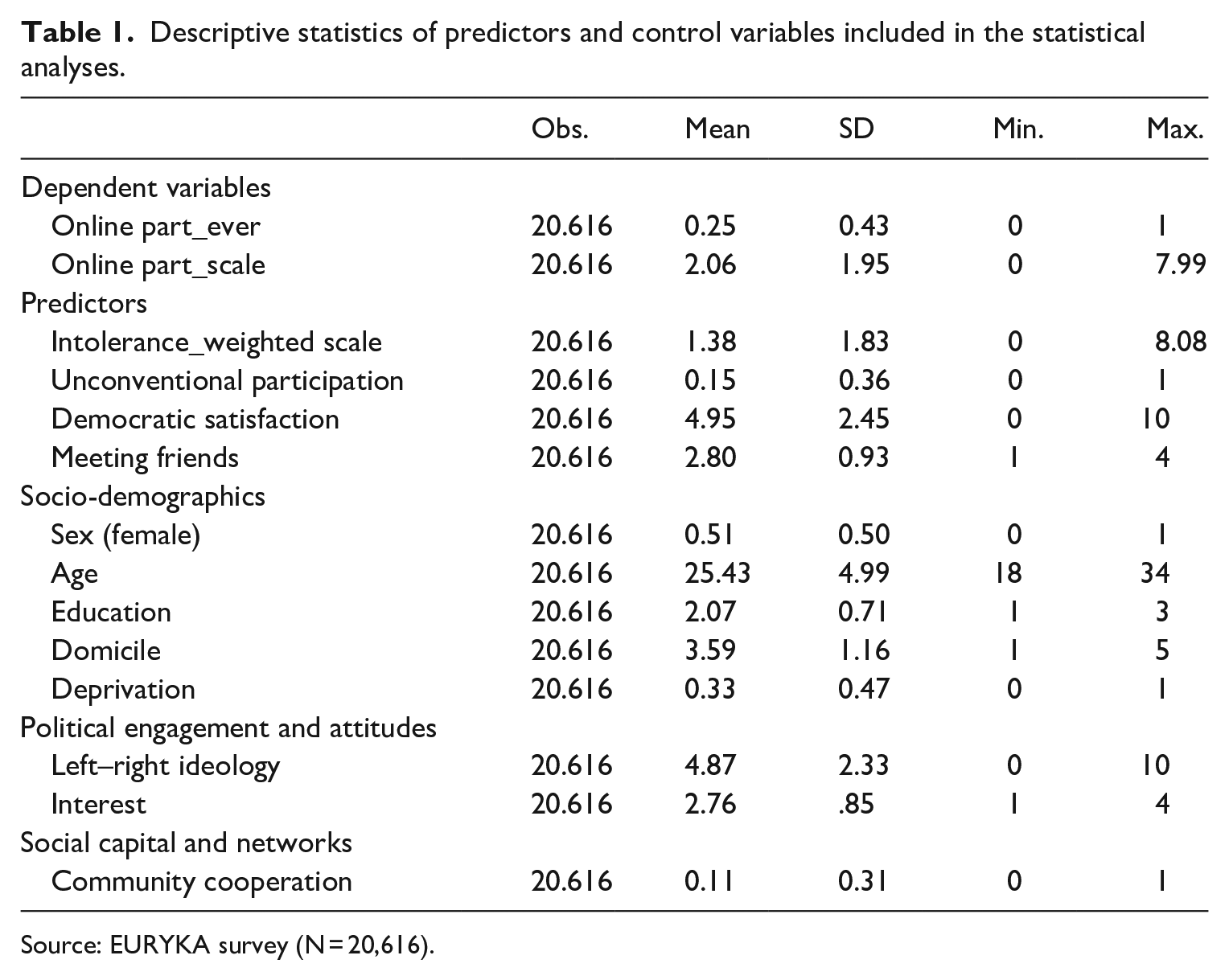
Source: EURYKA survey (N = 20,616).
Intolerance
The EURYKA questionnaire provides us with a unique asset relative to the scant literature on the association between (in)tolerant attitudes and online political participation: we neither reduce intolerant attitudes to a tolerant/intolerant dichotomy nor we limit our analysis to intolerant positions merely towards the most widespread groups. We ask respondents whether they ‘would mind or not having each of the following as neighbours’, picking a no/yes answer for each of the 14 items in Appendix 1. We provide the descriptive statistics and the tetrachoric correlation matrix of these items in Appendix 2 (Tables A2 and A3). 4
We perform an exploratory factor analysis to analyse whether these 14 items represent a single factor or various factors of intolerance (Table A4, Appendix 2). Each item’s loading represents how strongly that item is associated with the underlying factor (Mueller and Kim, 1978). Items that measure intolerance towards most social collectives and groups are expected to be highly intercorrelated (cf. Giugni and Morariu, 2010). Indeed, the factor analysis returns only one factor with eigenvalues greater than 1, which explains about 93% of variance. Our results suggest that there is one single moral and socio-political dimension of tolerance (this scale is robust; Cronbach’s α = .85). Although this marks a contrast with some studies of tolerance (e.g. Lu and Yu, 2020; Vogt, 1997), it goes in line with some prior research (e.g. Leite Viegas, 2007; Teorell et al., 2007). As a result, we created an additive index of intolerance that is based on the weighted sum of the items in the factor (the higher the score, the more intolerant the individual is) – note that the subset of respondents tends to be quite tolerant (1.38 on average in the 0–8.08 weighted scale); moreover, 40% of sampled young people are extremely tolerant; thus, the distribution is strongly skewed to the left (see Table 1; Figure A2, Appendix 2).
Other predictors and controls
In order to weigh our hypotheses against rival explanations, we include a number of control variables and predictors (we report the summary statistics in Table 1; for the exact wording and operationalisation, see Appendix 1; for a matrix of correlations, see Table A5, Appendix 2). First, we take into account socio-demographic aspects. As the resource mobilisation approach contends, enhanced resources are associated with increased prospects for political engagement (McCarthy and Zald, 1977; Schussman and Soule, 2005). This is also the case of engagement in online political activities: people with higher economic status, from younger age cohorts, more educated, and living in urban areas are more likely to mobilise in the digital sphere (van Laer, 2010). Second, we measure the level of socialisation, network availability, and social capital, which are associated with protest propensity and online political engagement (Feezell, 2016; Norris, 2001; Schussman and Soule, 2005). Specifically, social capital ‘reflects access to information, the provision of positive experiences with diversity and increased political trust, all factors that in turn promote tolerance [. . .]’ (Côté and Erickson, 2009; Iglič, 2011; van Doorn, 2014: 915). Third, certain political attitudes and values, such as left–right ideology, satisfaction with democracy, and political interest, could likewise be important predictors of political activism, both online and offline (Norris, 2001; van Laer, 2010). Also, offline political engagement, in general, and participation in offline unconventional activities, in particular, are associated with increased online political participation (Lobera and Portos, 2020). Finally, we include country fixed-effects in order to account for the specific (institutional, historical, cultural) characteristics of each country that might be correlated with online political activities.
Results and discussion
In order to explore the determinants of online political participation among young Internet users, we run a number of ordinary least squares (OLS) regressions with robust standard errors (Table 2). While model 1 includes the key predictor (i.e. intolerant attitudes) and the country dummies, model 2 is the full additive specification (with socio-demographic, political values, and social capital–related controls) – we report further additive specifications of OLS regressions with robust standard errors in Appendix 2 (models 1–4, Table A7). Instead, model 3 (4) includes the interaction between intolerant attitudes and offline unconventional participation (democratic satisfaction); the interaction between intolerance and meeting friends is considered in model 5.
OLS regressions with robust standard errors.
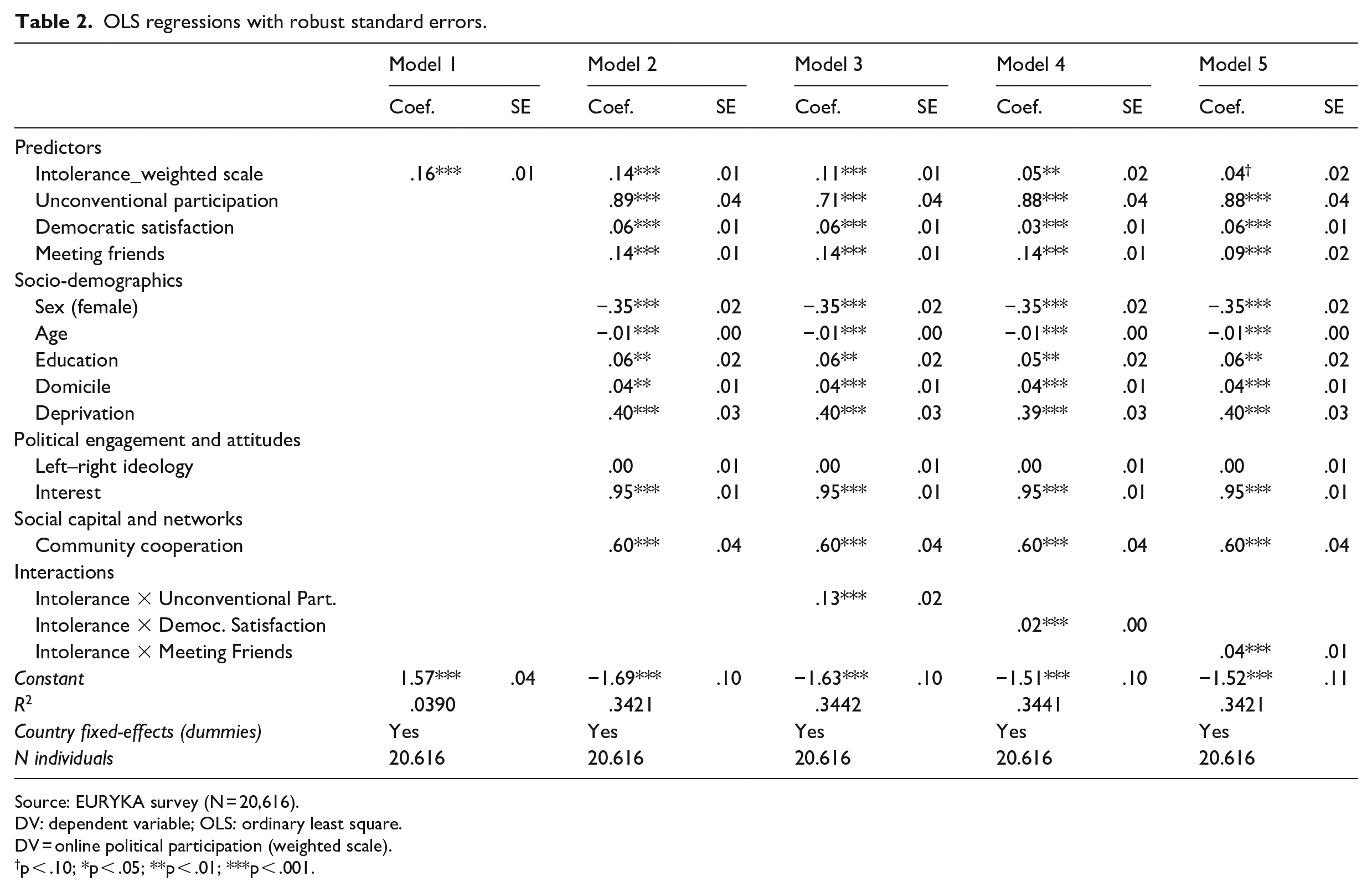
Source: EURYKA survey (N = 20,616).
DV: dependent variable; OLS: ordinary least square.
DV = online political participation (weighted scale).
p < .10; *p < .05; **p < .01; ***p < .001.
Overall, intolerance has a positive impact on the level of online political participation among young Internet users. That is to say, young people who report intolerant attitudes engage in political activities in the digital sphere to a greater extent than young tolerant respondents. Specifically, based on model 2 (Table 2), a one-unit increase in the intolerance index leads to a 0.14-point increase in the digital participation scale. In other words, the value of the digital participation index increases from 1.87 to 2.96 as the values in the intolerance index change from 0 (extremely tolerant) to 8 (extremely intolerant). We interpret this pattern as follows. Young people who hold intolerant attitudes on moral and socio-political grounds need to express them in order to go against the mainstream, widely perceived as dominant – and indeed majoritarian – tolerant positions. Yet, voicing intolerance is not easily accepted in many social milieus, but the digital sphere provides a channel that allows to actively engage in politics and express intolerant views against the dominant public discourse, at the same time reinforcing such attitudes by creating communities or groups with like-minded people. In addition, the digital sphere lowers the threshold of engaging in political participation, facilitating coordination, and, crucially, enabling anonymity and decreasing constraints associated with peer pressure.
However, further statistical analyses allow us to nuance this finding. The relationship between intolerance and the frequency of online political participation is moderated by a number of factors related to engagement in offline unconventional forms of participation, social capital/network embeddedness, and democratic satisfaction. Specifically, as the intolerance index fluctuates between 0 and 8, predicted values in the digital participation scale go from 1.76 to 2.78 for people who do not engage in offline unconventional forms of participation (but from 2.48 to 4.43 if the respondent engages in unconventional activities) – see model 3, Table 2; Figure 1. While values in the online political participation index increase only from 1.79 to 2.18 as intolerance fluctuates between the extremes (i.e. the intolerance index goes from 0 to 8) for people who are very dissatisfied with democracy (=0), these values change from 2.66 to 4.47 for people who are very satisfied with democracy (=10) – see model 4, Table 2; Figure 2. Similarly, as the intolerance index ranges from the minimum (=0) to the maximum values (=8), the predicted values of the digital participation scale change between 1.32 and 1.91 for people who meet their friends ‘less than once a month’ and between 2.16 and 3.59 for those who meet them ‘almost every day’ (model 5, Table 2; Figure 3).

Predicted values of online political participation (weighted scale) as a function of intolerant attitudes and offline unconventional forms of participation, keeping all the other predictors constant at their means (model 3, Table 2); 95% CI.
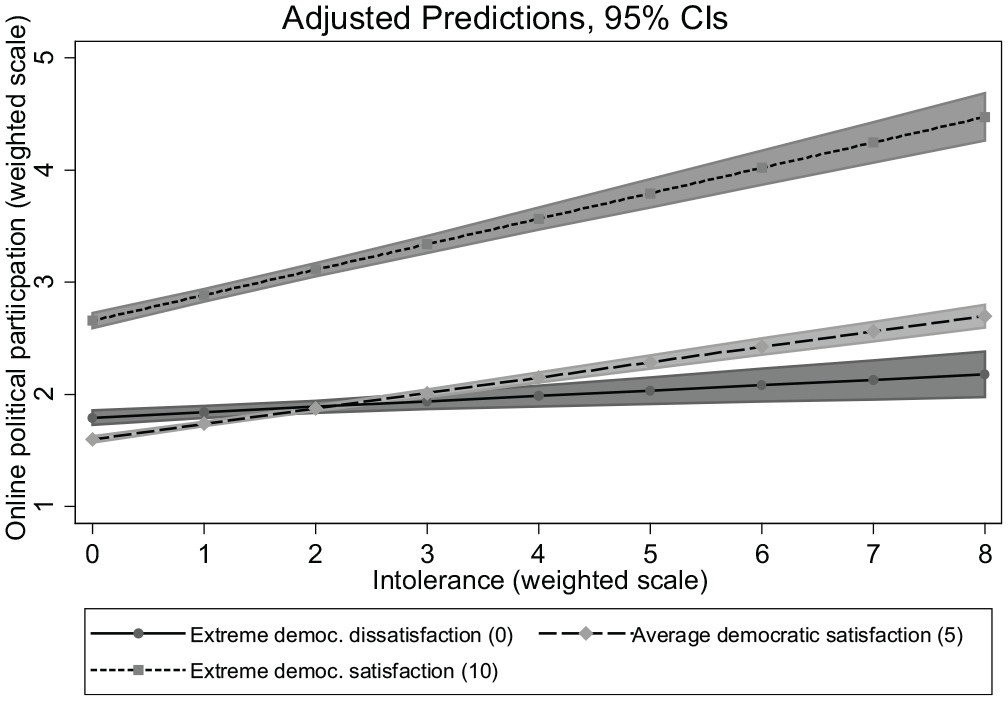
Predicted values of online political participation (weighted scale) as a function of intolerant attitudes and satisfaction with democracy, keeping all the other predictors constant at their means (model 4, Table 2); 95% CI.
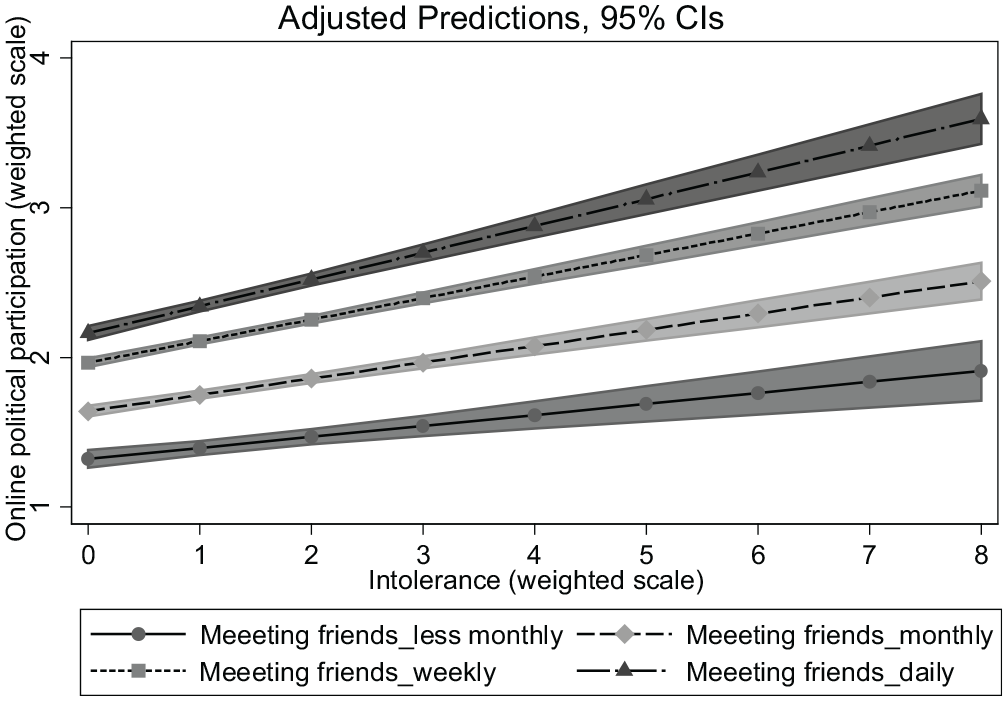
Predicted values of online political participation (weighted scale) as a function of intolerant attitudes and meeting friends, keeping all the other predictors constant at their means (model 5, Table 2); 95% CI.
In order to provide sounder empirical evidence for our findings, we perform a number of robustness checks. First, we replace the online weighted scale with a dichotomic variable that measures online political participation; while the overall results are robust (Table A6, Appendix 2; models 5–8, Table A7, Appendix 2; see also Appendix 1), the interactive figures follow similar patterns (Figures A7 to A9, Appendix 2). Second, we analyse cross-country variation. While some differences can be spotted across countries, the main results are consistent throughout (Figures A5 and A6, Appendix 2). The additive effects of intolerance, participation in offline unconventional forms of participation, democratic dissatisfaction, and meeting with friends are robust for each of the nine European countries. The interactive effects are not statistically significant for every country (e.g. Italy, Spain) and are instead very strong for other countries (e.g. Germany); however, the relationship between the interactive terms of the main variables at stake always works in the same direction (see, e.g. Figures A5 and A6, Appendix 2). Third, we explore the error terms and residuals. We report the post-estimation added-variable for intolerance and plot the residuals’ leverage by (normalised) residual squared (Figures A13, Appendix 2). 5 While in general terms our residuals are neither very large nor have a very high leverage, we implement robust regression routines to give them better than OLS efficiency (Hamilton, 2004: 239). Fourth, the distribution of the intolerance predictor is strongly skewed to the left; thus, we log it and replicate the main OLS models with robust standard errors (Table A8, Appendix 2). 6 Our overall results are robust (Figures A10 to A12, Appendix 2).
All in all, our findings suggest that the Internet can provide a channel for expression of intolerant worldviews, thus confirming Hypothesis 1, but less so among socially isolated and marginalised young individuals. Intolerant attitudes have a stronger political mobilising potential in the digital sphere among people who meet friends more often, who are satisfied with the democratic performance, and who engage in offline unconventional forms of participation outside the Net. While these results support Hypotheses 2A/2B/2C, they disconfirm the alternative Hypothesis 3A/3B/3C. Conversely, the interaction effects can also be interpreted as the intolerance attitudes positively reinforcing the effects of the traditional predictors (unconventional political participation, satisfaction with democracy, and frequency of meeting with friends) on online political participation. We also find that urban, male, and highly educated respondents, as well as those who feel deprived, engage to a larger extent in online activities. While left–right ideological orientation does not seem to play a role, other attitudes and political engagement–related variables such as democratic satisfaction, political interest, and participation in offline unconventional forms of participation increase online participation. As for network availability and social capital, besides meeting friends, community cooperation is also significantly associated with increasing digital political participation.
Conclusion
This article looks at the association between (in)tolerant attitudes and online political participation among young people. Adding to previous findings conducted on the digital sphere – namely those which understand it as a context that favours the development of politically polarised and intolerant attitudes and opinions, we find that intolerant attitudes on socio-political and moral grounds are associated with more engagement in online political participation. In doing this, our article allows us to understand the digital sphere not merely as a context affecting (in)tolerance, but also as an instrument that facilitates voicing intolerant opinions. Our results allow us to nuance previous findings in two important ways.
On the one hand, we move beyond the simplistic online/offline and tolerant/intolerant distinctions and look instead at the association between levels of intolerance and levels of online political participation. Overall, we argue that the more intolerant young people are, the more politically active in the digital sphere they are. We interpret the digital sphere as a powerful instrument where young people bearing intolerant attitudes can express them. The digital sphere provides an infrastructure that allows to minimise costs and constraints of participation, thus providing young people that bears some degree of intolerance with a political voice.
On the other hand, and partially qualifying this finding, we observe a strong, significant, and robust interaction between intolerant attitudes and variables related to political engagement and social capital. Specifically, intolerant people tend to participate more in online political activities, provided they engage in offline contention, they are satisfied with the democratic performance, and they meet often with friends. Not only the interaction per se, but the direction of the association between the interactive terms is relevant: the effect of intolerance on political participation is not stronger – but lower – among politically disengaged, socially isolated, and marginalised people. Intolerant values are conditional upon (offline) political engagement and availability of social networks, which reinforce each other, fostering political participation in the digital arena.
While more exhaustive evidence is necessary to exclude the reverse causality hypothesis, our findings are substantiated theoretically and are robust across a number of model specifications. We need more evidence to ascertain which specific features of digital sphere can facilitate or hinder their use to voice intolerant or extreme opinions, such as in the case of cyberhate phenomena. It would be important to investigate whether in countries where intolerant attitudes are more accepted in the public sphere, young people make more or less, or different use of the digital sphere to voice their intolerance in their political engagement, in comparison with countries where intolerant attitudes are less accepted (see Rapp and Ackermann, 2016). In addition, future research could focus more closely on the nexus between different types of intolerance, particularly by providing more robust and systematic measures of tolerant attitudes, and different forms of participation in general.
In conclusion, our study critically associates intolerant attitudinal configurations and online political participation among young people, enhancing an otherwise partial understanding of a pressing phenomenon of our times. Indeed, intolerance breeds young people political participation in the digital sphere. Our findings should alert us that the digital sphere might become an instrument young people use for voicing intolerant attitudes and opinions; it may signal an increasing trend towards polarisation and division of our societies. At the same time, however, we support the argument that young people are not a homogeneous group, including both individuals with intolerant and tolerant views, participating offline or not, and using the digital sphere as an instrument to voice their worldviews in various degrees. While challenging the common notion of young people who display higher levels of intolerance being inherently distrustful and apathetic, we argue that the political activity of young people who have intolerant attitudes in the digital sphere gets reinforced through social capital and engagement in offline political activities. This not only provides evidence of the great pluralism of voices and worldviews within the digital sphere, but it also suggests that, relative to other forms of political participation outside the digital world, the drivers behind politization – and political mobilisation – in the online sphere are not dramatically different.
Footnotes
Appendix 1
Appendix 2
Funding
The author(s) disclosed receipt of the following financial support for the research, authorship, and/or publication of this article: This project was funded by the European Commission under H2020 (grant agreement no. 727025). The Swiss part of the project was supported by the Swiss State Secretariat for Education, Research and Innovation (SERI) under contract number 16.0103. The opinions expressed and arguments employed herein do not necessarily reflect the official views of the Swiss Government.
