







Abstract
Authoritarian regimes attempt to control the circulation of political information. Scholars have identified many mechanisms through which actors can use broadcast and digital media to challenge or sustain authoritarian rule. However, while contemporary media environments are characterised by the integration of older and newer forms of communication, little is known about how authoritarian regimes use different media simultaneously to shape citizens’ perceptions. In order to address this issue, this study relies on focus groups and investigates Russian TV viewers’ cross-media repertoires and their reception of the Russia-Ukraine conflict. It argues that some citizens evaluate state-aligned television narratives as more credible when they are reinforced by similar narratives in digital media. Citizens’ reactions to this synchronisation are predicated on their type of media use. For not very active news consumers, the reliance on digital media can verify the regime’s narratives in television news. Others can escape the synchronisation effect by actively searching online for additional information or not using digital media for news. These findings show how authoritarian regimes can utilise the advantages of hybrid media systems to shape citizens’ perceptions and specify the conditions under which citizens can escape the effects of the regime’s simultaneous use of different media.
All authoritarian regimes attempt to control the media (Guriev and Treisman, 2019). They often capture major television networks (Gehlbach and Sonin, 2014). In recent decades, the increased role of digital media in politics has been also accompanied by autocrats’ awareness of the opportunities offered by digital media. They can devise architectures to filter traffic (Boas, 2006), use digital media to monitor public opinion (Gunitsky, 2015), and censor online discussions (King et al., 2013).
Existing studies have yielded rich results regarding citizens’ perception of state-controlled broadcasting and digital media. While citizens in authoritarian countries are often aware of media bias in television news (Gehlbach and Sonin, 2014; Mickiewicz, 2008), authoritarian regimes can adapt to this challenge and employ intricate strategies to mitigate it, such as realistic messages (Stockmann and Gallagher, 2011) or pre-emptive coverage of social problems (Zhu et al., 2013). Similarly, while digital media can negatively impact the legitimacy of authoritarian regimes (Bailard, 2012), governments can use digital media to shape public opinion (Deibert and Rohozinski, 2010) and discourage citizens from protest (Pearce and Kendzior, 2012). However, despite rich evidence of the intricate mechanisms through which different media can be used to challenge or sustain authoritarian rule, autocrats’ simultaneous use of different media has been a largely ignored issue. A number of scholars have suggested that the increased integration of media technologies problematises the distinction between traditional and digital media (e.g. Aday et al., 2012; Oates, 2016). In hybrid media systems, actors often use different media simultaneously to shape political outcomes (Chadwick, 2013).
This article attempts to understand how citizens perceive political information in a hybrid media system in which the government attempts to synchronise reporting across broadcast and digital media. The Russia-Ukraine conflict presents a good opportunity to investigate news reception in a hybrid media system under an authoritarian regime. Since the outbreak of the Russia-Ukraine conflict, the Russian government has attempted to achieve full control of the hybrid informational space and spread similar narratives across television (Oates, 2016), online news media (Yablokov, 2015), social media (Stukal et al., 2017), and news aggregators (Daucé and Loveluck, 2021).
This article employs focus groups to investigate Russian TV viewers’ cross-media repertoires and their reception of the Russia-Ukraine conflict in a hybrid media system. I argue that some citizens evaluate state-aligned television narratives as more credible when they are reinforced by similar narratives in digital media. This perception is predicated on the type of media use. To verify state-aligned television narratives via digital media, one should consume news online in addition to television news, but not very intensively. The most and least active TV viewers do not encounter identical narratives in digital media due to either active digital media use which thereby allows them to circumvent homogeneous information across media or by not using digital media for news at all. However, escaping identical narratives in digital media does not guarantee a critical attitude towards the regime. While the least active Internet users can still perceive the regime’s narratives as credible due to reliance on state-controlled television, the more active Internet users can still be receptive to the regime’s narrative due to political preferences.
The article begins with a review of the research on media control and media perception in authoritarian countries as well as hybrid media systems. I then outline the research design and analyse Russian TV viewers’ cross-media repertoires and their reception of the Russia-Ukraine conflict in a hybrid media system. The article concludes by pointing to the limitations and implications of the study.
Broadcast and digital media under authoritarian regimes
All authoritarian regimes attempt to control media organisations (Schedler, 2002). They often capture only ‘commanding heights’ – major national television networks – and so allow for other forms of media (Gehlbach and Sonin, 2014). There is no unified theory of citizens’ perception of state-controlled media under authoritarian regimes. Scholars have shown that citizens can distrust state-aligned news media. The causes of this perception can include experience of a totalitarian past (Pjesivac et al., 2016), prior interactions with biased media (Truex, 2016), and crude forms of regime propaganda (Huang, 2018). However, many factors can make citizens trust messages of state-aligned media, such as low political awareness (Geddes and Zaller, 1989), weak democratic attitudes (Moehler and Singh, 2011), and reliance on state-aligned media (Sirotkina and Zavadskaya, 2020). In addition, authoritarian regimes can counteract criticism of the government by relying on novel issues (Stockmann and Gallagher, 2011), using creative formats (Esarey et al., 2017), and covering social problems pre-emptively (Zhu et al., 2013).
Similarly, scholars have generated rich evidence on how digital media can be used to generate political outcomes under authoritarian regimes (Greitens, 2013). Governments can simply block specific websites, shut down the Internet completely, and establish control over the Internet infrastructure (Boas, 2006). In the past decade, some authoritarian regimes have also invested considerable resources into censoring online content through paid ‘Internet police’ and repressive laws (King et al., 2013). Since the flow of information is constrained in authoritarian countries, governments often have difficulties understanding citizens’ preferences (Kuran, 1995). Authoritarian governments can thus rely on digital media to track political opponents (Morozov, 2011), collect information on citizens’ preferences (Gunitsky, 2015), and oversee performance of bureaucrats (Chen, 2014). Finally, many authoritarian regimes have been utilising digital media to shape public opinion (Deibert and Rohozinski, 2010). The use of paid commentators and ‘bots’ has also become a popular strategy across authoritarian contexts (King et al., 2013; Stukal et al., 2017).
There are many mechanisms through which digital media can generate political outcomes. Access to alternative sources of information via digital media can negatively impact the legitimacy of authoritarian regimes (Bailard, 2012), facilitate political learning (Placek, 2020), and increase the demand for democracy among citizens (Nisbet et al., 2012). Digital media can also be used as a tool for mobilisation of protesters (Breuer et al., 2015) or the international community (Aday et al., 2012). However, autocrats can be efficient in using digital media to influence citizens. They can allow for free circulation of information about persecuted activists to dissuade citizens from protest (Pearce and Kendzior, 2012) or spread narratives which convince citizens that they cannot influence political events (Suslov, 2014).
However, the diversity of political information under authoritarian regimes vary. In fact, scholars argue that the media in some authoritarian contexts can be more diverse than in democracies due to the absence of liberal-democratic consensus (Toepfl, 2013). The degree of this diversity depends on different techniques of control and regimes’ available resources. For instance, restricted media freedom does not allow autocrats to monitor policy implementation (Gunitsky, 2015). As a result, resource-poor authoritarian regimes tend to allow for freer media because they do not have rich natural resources to compensate for policy failures (Egorov et al., 2009).
Broadcast and digital media in Russia
Russia is an electoral authoritarian regime which restricts political participation and manipulates media, while preserving elections as a democratic façade (Gel’man, 2015). It mainly controls ‘commanding heights’, like the national television networks (Gehlbach, 2010). However, being resource-rich and technology savvy, Putin’s regime has been experimenting with more advanced techniques. It has invested considerable resources in creating its own online media (Yablokov, 2015), manipulating search engines (Sivetc, 2018), and news aggregators (Daucé and Loveluck, 2021; Kravets and Toepfl, 2021), and using paid social media ‘trolls’ (Linvill and Warren, 2020) and automated bots (Stukal et al., 2017). However, these attempts to create a homogeneous media ecology have been constrained by the increased integration of the global media economy and the necessity to compete for audiences (Tolz et al., 2020). Even journalists working for the state-controlled television networks exercise some freedom in their coverage of political issues unless they touch upon sensitive issues, such as criticism of Putin (Schimpfossl and Yablokov, 2014). In other words, the Russian media sphere is characterised by ‘a large amount of media diversity except on key political topics’ (Oates, 2016: 402).
Similar to other authoritarian contexts, Russians are often portrayed as critical media consumers. Scholars find that Russian citizens distrust media because of perceived bias due to post-totalitarian turmoil (Oates, 2006) and rich life experiences (Mickiewicz, 2008). However, many factors make citizens trust state-aligned media, such as reliance on state-aligned media (Sirotkina and Zavadskaya, 2020) or nostalgic feelings for Soviet television (Hutchings and Rulyova, 2009). Digital media in Russian partly challenge authoritarian rule by increasing citizens’ perception of electoral fraud (Reuter and Szakonyi, 2015) and negatively affecting the legitimacy of the regime (Placek, 2019). However, the regime actively uses social media to convince citizens that citizens’ actions cannot affect the course of events (Suslov, 2014), leak information to shape perceptions of politics (Hoskins and O’Loughlin, 2015), and discredit opponents (Oates, 2016). While Russians distrust state-aligned media, they can still consume similar narratives in alternative media which are shaped by the state television (Szostek, 2018).
Hybrid media systems and the Russia-Ukraine conflict
Due to the rapid diffusion of digital technologies, many scholars call for the rejection of the traditional offline/online dichotomy in favour of more complex approaches. Hoskins and O’Loughlin (2015) and Oates (2016) show that authoritarian regimes can integrate information from social media into broadcasting to strengthen their narratives. Similarly, Aday et al. (2012) find that information from social media amplified by television, rather than social media alone, can be a crucial mobilising factor in authoritarian contexts. To tackle this growing complexity, Chadwick (2013) introduced the concept of the ‘hybrid media system’. Rather than using broadcast and digital media separately, actors in hybrid media systems are increasingly attentive to the different opportunities offered by different media and use them simultaneously to ‘create, tap, or steer information flows’ (Chadwick, 2013: 4). Temporal synchronisation of news production across broadcast and digital media plays an important role in hybrid media systems. For instance, politicians can use television appearances to direct the public to their websites or time their campaigns on social media to coincide with debates on television to catch the attention of viewers whose interest was sparked by a debate.
The Russia-Ukraine conflict presents a good opportunity to investigate how the synchronisation of content across different media in a hybrid media system under an authoritarian regime functions. Mainstream Russian television news programmes allocated a lot of their time to the conflict and can be characterised as biased in favour of the Kremlin’s version of the conflict (Khaldarova and Pantti, 2016). In addition, the regime has been trying to co-opt a variety of digital media to complement its ‘strategic narrative’ (Miskimmon et al., 2013) conveyed through TV news, such as online television and online news outlets, social media, search engines, and news aggregators (Daucé and Loveluck, 2021; Kravets and Toepfl, 2021; Sivetc, 2018; Suslov, 2014; Yablokov, 2015).
However, instead of simply co-opting digital media, the government has applied different tools to make different media interact as well as to synchronise reporting in state-aligned online media and broadcast television. For instance, the narratives of protests in Kiev as disorderly and the annexation of Crimea as the protection of Ukraine’s Russian-speaking population in television news were mirrored by identical narratives in state-controlled online news (Lankina and Watanabe, 2017). Moreover, television news ‘scooped’ images of Russia-backed troops in eastern Ukraine from social media, to strengthen the regime’s narratives in broadcast news (Hoskins and O’Loughlin, 2015; Oates, 2016).
In addition, the regime has applied infrastructural and algorithmic tools to attract attention to state-controlled broadcast and online news. For instance, Stukal et al. (2017) find that bots tweeting about the conflict in social media were designed to amplify the broadcasts of state-aligned television channels and online media through promoting their websites in the search engines’ rankings. Similarly, the new FZ-208 law on news aggregators passed in 2016 1 was designed to make news aggregators amplify the narratives of television channels and state-aligned online media. The law makes news aggregators bear legal responsibility for the veracity of the sources which are not officially registered with the government. Since other media agencies registered with the government bear legal responsibility and cannot be strongly critical of the regime, this system creates incentives for news aggregators to gather information from official sources which are less critical of the regime (Daucé and Loveluck, 2021).
These interactions between different media in a hybrid media system orchestrated by an authoritarian regime pose several questions which merit investigation vis-a-vis news reception among audiences. How do citizens perceive political information in the context of the state-enforced synchronisation of reporting across different media? What are the specific psychological mechanisms which mediate viewers’ perception? What are the specific factors which make citizens susceptible to such synchronisation or, alternatively, allow them to escape it? The following empirical section addresses these questions utilising data from focus group discussions.
Methods
This study asks the following research question: How do citizens make sense of the news in a hybrid media system in which an authoritarian regime attempts to control different media simultaneously? To address this question, I use focus group interviews as a method. This method is widely used in the study of voting behaviour (e.g. Kern and Just, 1995), news reception (e.g. Morley, 1980), Internet research (Metzger et al., 2010), and other areas. Focus groups have several l limitations: the artificial setting can expose participants to peer pressure; the lack of control over variables and statistical procedures makes it difficult to identify cause-effect relationships; and finally, the data is often very heterogenous and difficult to interpret. However, focus groups allow scholars to get insights into the psychological nuances of respondents’ statements (Lunt and Livingstone, 1996).
This article is based on eight focus groups that explored participants’ cross-media repertories, opinions about politics, and their receptions of the Russia-Ukraine conflict. The focus groups were based on the viewing of several news episodes to elicit participants’ reactions to the regime’s narratives. The episodes were drawn from Channel 1—one of the most popular TV channels in Russia (Volkov and Goncharov, 2019). After watching all prime time news about the Russia-Ukraine conflict in November and December 2013, May 2014, and June 2014, I selected three news broadcasts that provided a good representation of the key tenets of the Kremlin’s official narrative, such as the depiction of the regime change in Ukraine as orchestrated by the West, the representation of the war in eastern Ukraine as a struggle between Russia-sympathetic rebels and punishers from Kiev funded by the West, and the framing of the conflict as a conflict between Russia and the West using Ukrainian government as a proxy (Lankina and Watanabe, 2017).
The list of the broadcasts included: (1) a news report about the violent dispersal of the Maidan protests in Kiev (November 30, 2013), (2) a news report covering the referendum in Donetsk (May 5, 2014), and (3) a news report about the military confrontation between separatists and the Ukrainian National Guard in Donetsk Oblast in the summer of 2014 (June 1, 2014). All news reports were accessed via the Channel 1 website. 2 The first news story is presented as an example in Appendix 1. This study does not seek to explore TV viewers’ reactions to these videos per se. Rather, these videos represent the cornerstones of the regime’s ‘strategic narrative’ regarding Ukraine and the West (Miskimmon et al., 2013). These rhetorical elements have continued to be essential elements of the state-aligned media’s reporting on the Russia-Ukraine conflict to the present (e.g. Kazakov and Hutchings, 2019; Knobel, 2020; Rimpiläinen, 2020). News coverage of the Russia-Ukraine conflict in 2013 and 2014 constitutes the most vivid representation of the Kremlin’s foreign policy narratives which is likely to elicit participants’ reactions.
Each group viewed all three stories and questions were asked after each story. Discussions were structured around the following topics: reception of each news story; opinions about Russian politics; and media consumption habits. The focus group scenario can be found in Appendix 2. A total of 56 people participated in the study. Four focus groups were conducted in St. Petersburg in 2016, and four in Moscow in 2017. One group had four participants and seven groups had seven to eight participants each. Each focus group lasted up to two and a half hours, totalling some 19 hours of discussions. The discussions were video recorded, transcribed, and coded via Atlas.TI. The Russian pollster Public Opinion Foundation recruited participants. 3 Recruiters and participants were provided with a payment. The author moderated the focus groups. Participants were informed about the nature of the study, and they all provided informed consent. All names in this study have been changed.
Data from the focus group participants
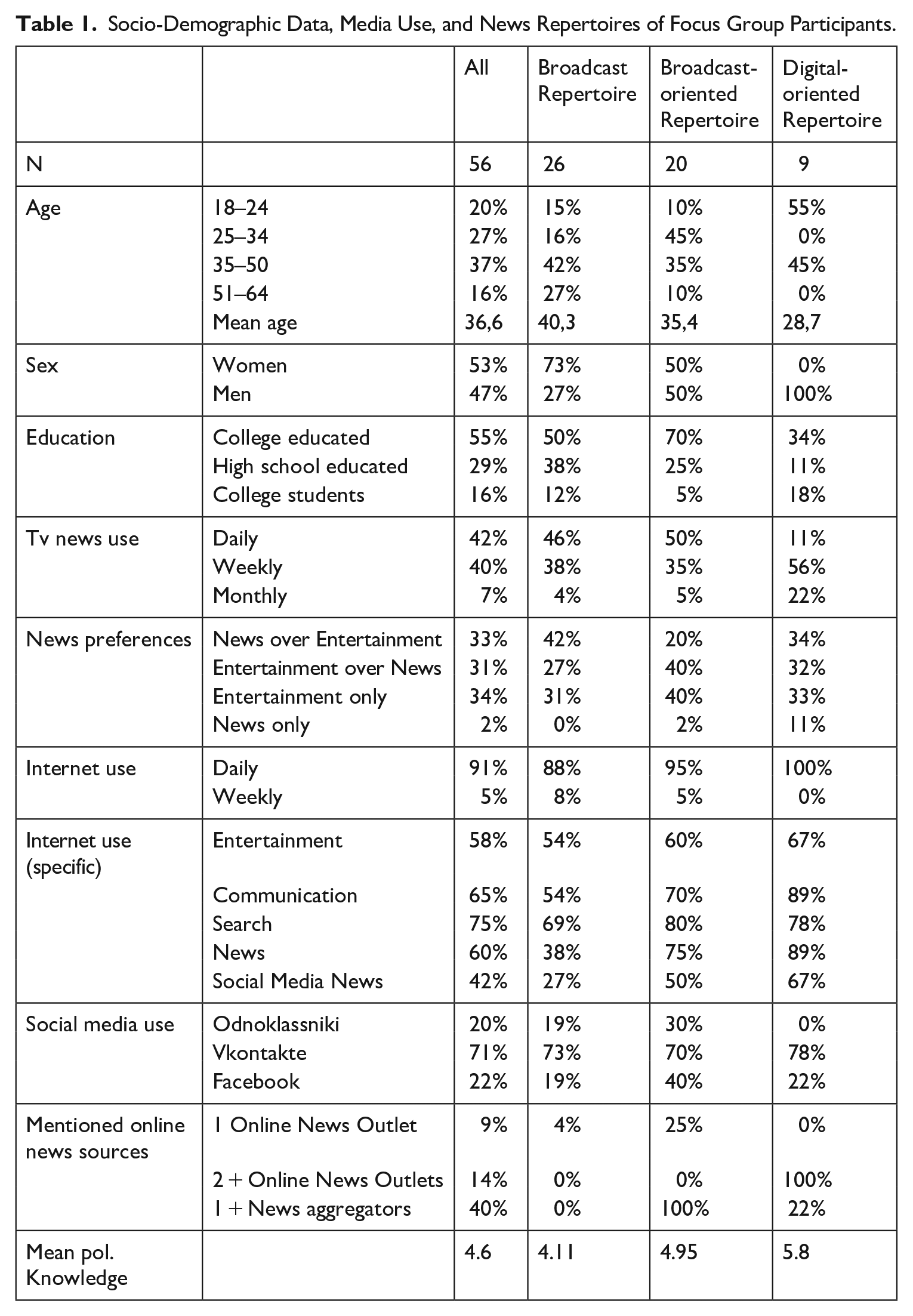
Based on focus group data and a short survey conducted before focus groups sessions, I inductively identified several ‘news repertoires’ or sets of preferred sources (Taneja et al., 2012). Below I describe the socio-demographic characteristics, media use, and political knowledge 4 of all participants. I then identify three separate news repertoires based on the type of media use, and I compare them to nationwide representative data.
My sample is balanced in terms of gender and age and slightly skewed towards people with higher education. In Russia, 54% of 25- to 64-year-olds have higher education (OECD, 2016). Television news use is high: most participants watch television news daily or weekly. Viewing preferences are skewed towards entertainment. Almost all participants use the Internet daily for non-news purposes. Three quarters report online news consumption and a half report social media news consumption. However, only few can remember specific online news media used. Almost half of the participants report using news aggregators.
Broadcast Repertoire (28 participants; TV: primary, news and entertainment; Internet: secondary, entertainment only). This group is older than other participants and includes more women. This news repertoire includes TV which is used both for news and entertainment. Most participants watch television news daily. They prefer news over entertainment slightly more often than other participants. While these participants use the Internet daily for non-news purposes, only a few report using the Internet and social media for news. Only one participant mentioned a specific news media outlet. No one mentioned news aggregators. These participants are slightly less knowledgeable about politics according to the questionnaire.
Broadcast-oriented Repertoire (19 participants; TV: primary, news and entertainment; Internet: secondary, news and entertainment; news aggregators). This group is younger than the previous one and balanced in terms of gender. This news repertoire includes TV which is used both for news and entertainment. Most participants watch television news daily, although some participants watch it several times per week. Almost all participants in this group use the Internet. They use the Internet for news more often than the previous group: three quarters report using the Internet for news and a half report using social media for news. However, only a quarter remember one specific online news outlet used. Instead, they occasionally use search engines to complement television news and rely on news aggregators which were mentioned by all participants in this group. These participants are slightly more knowledgeable about politics than the previous group.
Digital-oriented Repertoire (9 participants; Internet: primary, news and entertainment; TV: secondary, news and entertainment; specific online news media outlets and social media). This group is significantly younger than other participants and includes more college students. It is also exclusively male. This news repertoire includes the Internet which is used for both news and entertainment as a primary source of information. Almost all participants report using the Internet and social media for news. Unlike other participants, they can recall many online news outlets, such as Meduza and Vedomosti among others. TV is also used for news and entertainment, but as a secondary source. Participants in this group watch television much less than all other participants. These participants are more knowledgeable about politics than the two previous group.
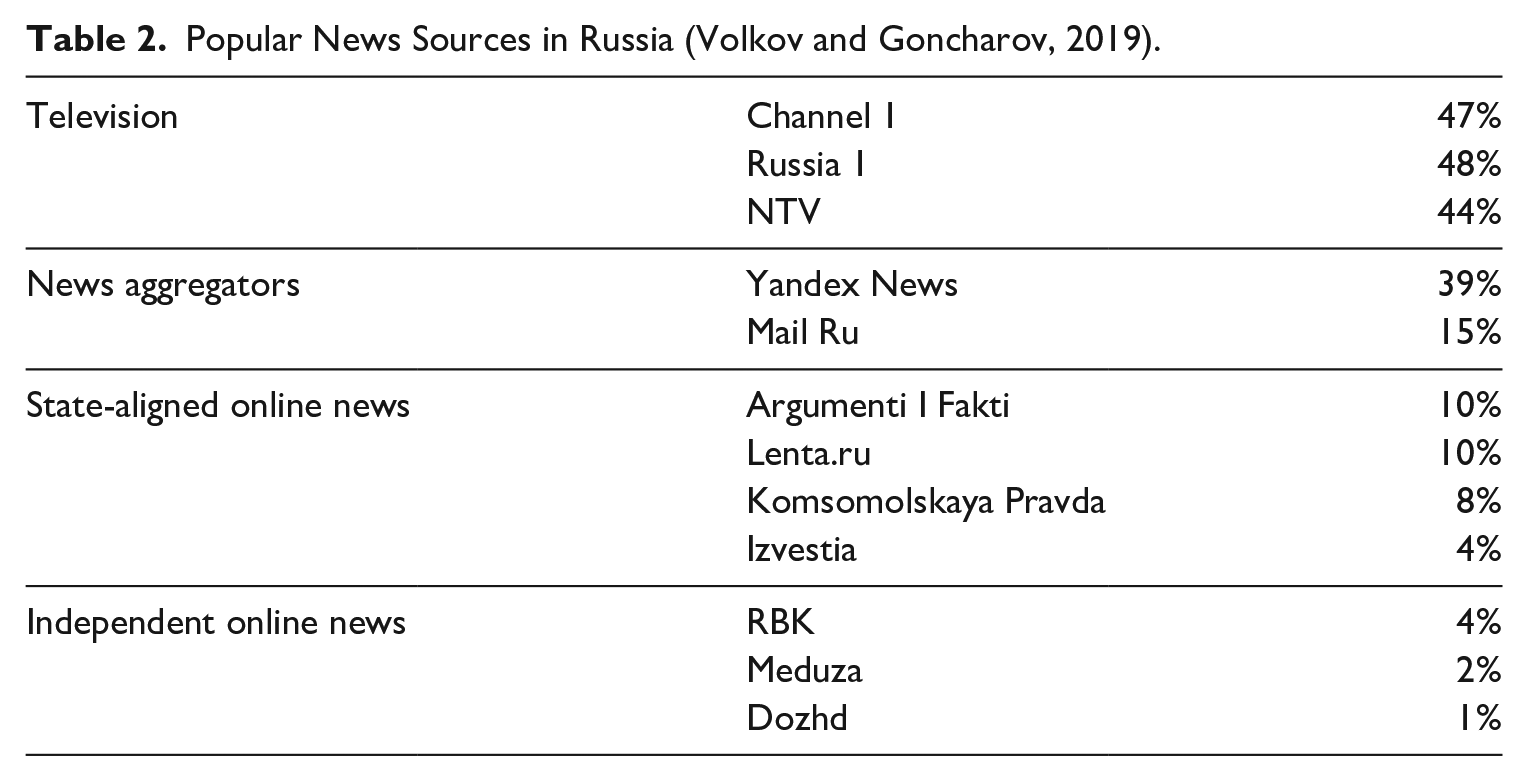
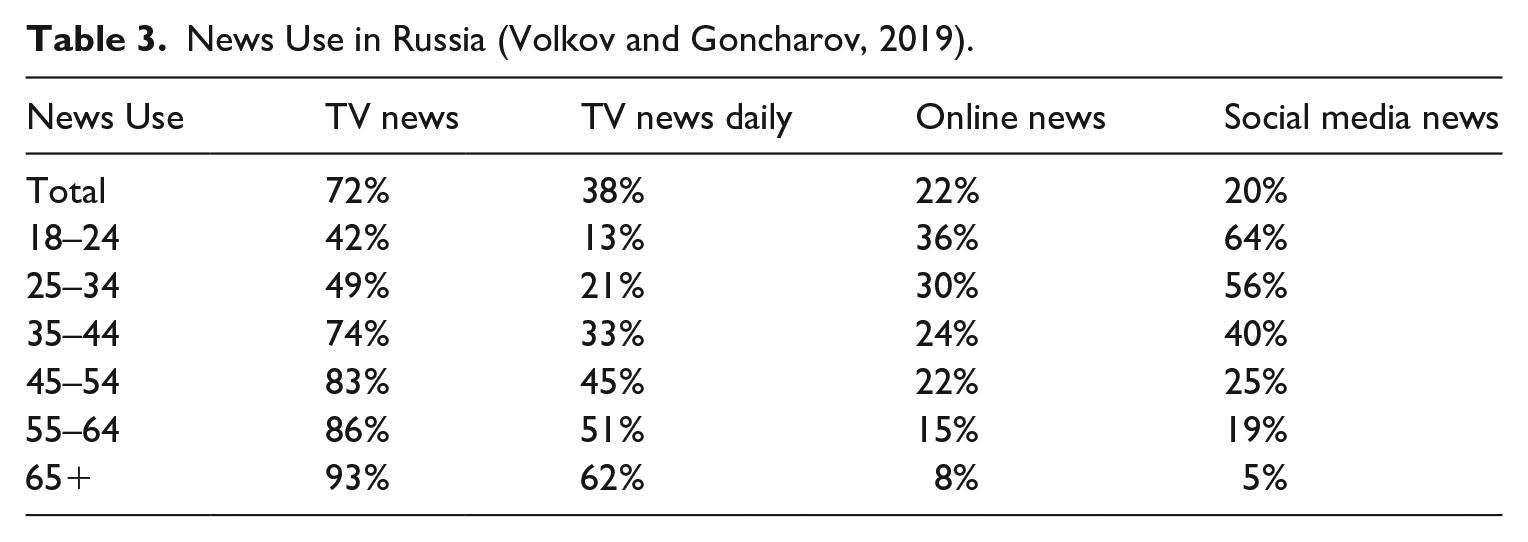
All characteristics are summarized in Table 1 below. Although not representative, this sample is fairly similar to the news consumption of the Russian population. According to the Russian pollster Levada Centre, broadcast television, news aggregators, news on social media, and state-owned online news media represent the most widely used sources of news in Russia (see Table 2) (Volkov and Goncharov, 2019). Participants with the broadcast repertoire are similar to the older cohorts of the Russian population who watch television news daily and consume online and social media news less often. Participants with the broadcast-oriented repertoire watch television news daily and consume online news slightly more often than the respective younger and middle cohorts of the Russian population. Participants with the digital-oriented repertoire are comparable to the respective younger and middle cohorts of the Russian population in terms of social media news and television news use, but use online news media more often (see Table 3). The differences can be explained by the small sample size.
Socio-Demographic Data, Media Use, and News Repertoires of Focus Group Participants.
Popular News Sources in Russia (Volkov and Goncharov, 2019).
News Use in Russia (Volkov and Goncharov, 2019).
Broadcast repertoire
Participants in this group rely on television news and consider it credible. For instance, Vasiliy explains that state-owned television provokes trust because the government ‘is responsible for the credibility of information’. Participants with this repertoire are receptive to the regime’s narratives about the Russia-Ukraine conflict propagated via television news (Lankina and Watanabe, 2017). On the one hand, participants understand the events that happened during the Maidan protests in Kiev as a ‘bedlam’ (Nadezhda) with ‘provoked violence’ (Yekaterina). They believe that these were ‘foreigners who [. . .] provoked this in the previous days’ (Valentina). Participants blame the Ukrainian government for allowing the US government to control Ukraine and turn it into an ‘America’s gas station’ (Valentina). On the other hand, referenda and separatism in Crimea and eastern Ukraine are understood as a legitimate reaction of the Russian-speaking population to the West-supported aggression by Ukraine. Participants believe that Russia-backed militias ‘defend their own way of life and the desire to live on their own land’ against the Ukrainian army which has turned against them. Not surprisingly, participants with this repertoire support the current Russian government. For instance, Yana would like to see ‘a leader as good as our Putin’ in Ukraine who could stabilise the situation.
While participants in this group use the Internet for non-news purposes, they are uncomfortable with online news. The complexity of the saturated online environment makes participants ‘trust television [rather than the Internet] in reporting of what actually happens’ (Natalia). Moreover, with little experience of consuming online news, participants also consider the Internet as a danger. They believe that exposing Internet users with ‘too volatile personalities and too critical attitudes’ (Sonya) to uncensored information can provoke ‘a wave of rallies’ (Natalia). As a result, they believe that it is ‘right to filter information’ on the Internet (Sonya).
Participants with the broadcast media repertoire are older than the other participants. These results are partly in line with previous research suggesting that older people in Russia tend to prefer state-aligned television channels, rely on the Internet less, and have more favourable attitudes towards the regime (Oates, 2013; White and Oates, 2003). Due to their reliance on television, it is also possible that their trust in television and support of the regime can be partly explain by a ‘rally around the flag’ effect or a temporary patriotic consolidation around the president during international crises (Gershkoff and Kushner, 2005; Mueller, 1970). Other scholars find that a ‘rally around the flag’ was still present in 2016 in Russia (Sirotkina and Zavadskaya, 2020), thus making it a possible reason for this group’s trust in state-aligned television channels and pro-government attitudes. These results are also in line with scholars who have shown that authoritarian regimes can frame the Internet as a threat and thereby increase the support for online censorship among less experienced Internet users (Nisbet et al., 2017).
Broadcast-oriented repertoire
Participants in this group are younger than participants in the previous group and rely on the Internet for political information more. This finding is in line with the previous research (Oates, 2013). However, they emphasise the burden of information-seeking in a saturated online sphere in contrast to the less cognitively demanding television news. As Yulia explains, television news typically has ‘only one opinion’, while there are too ‘many diverse points of view’ on the Internet. It is difficult to tame ‘a very large flow of information on the Internet’. Actively searching for information is too costly for participants in this group. As Galina argues, ‘I am too lazy for this [searching for information]’. In a context of abundant media choices, users develop complex sets of tools to assess information without expending too much effort (Metzger et al., 2010). Participants with the broadcast-oriented repertoire use two strategies for searching for and evaluating information: they rely on news aggregators and the scheduled programming of TV news.
News aggregators offer a very convenient opportunity to simplify information searches. Participants from this group often emphasise the ease-of-access aspect of their information search practices. As Ksenia argues, ‘I only read news when I am checking my e-mail – when there is something on Mail or Yandex [Russian news aggregators] [. . .] because you have little time for reading news’. Similar to the findings of Dellarocas et al. (2015), they often satisfy their interest in public affairs by simply reading headings. As Boris explains, ‘I do not read it attentively, only headings [of the news in Yandex News]’.
Another strategy to simplify information searches online is to rely on scheduled TV news programming and use the Internet as a supplementary source. As Kirill argues, ‘if the topic is interesting, you will [. . .] start digging’. Similarly, Olga says she uses information online to complement TV news: ‘This year French journalists were shot in Paris by Arabs [. . .] I started reading articles on the Internet [. . .] [Then I] found out the whole story’. Importantly, TV news sets the agenda for the described situation. In Olga’s case, she only started looking for information online after her initial interest was sparked by TV news. Similar to news aggregators, TV news helps to simplify information searches.
While relying on the scheduled programming of TV news and news aggregators are convenient strategies to help deal with information abundance, this combination can lead to a biased image of politics. When looking for additional information through search engines, TV viewers often find stories in state-controlled online media. Similarly, since news aggregators in Russia are exposed to political pressures, they typically include references to state-aligned sources. Because the information found in Russian news aggregators and state-aligned online news does not contradict TV news, participants overwhelmingly report that TV news and online news are consistent. As Tatiana says, ‘I only watch the news on TV and on the Internet. They are mostly similar’. ‘Approximately the same’, ‘no contradictions’, ‘no inconsistencies’ are all common narratives in this group.
This consistency of information across broadcast news and many digital news sources allows TV viewers to use consistency as a heuristic for veracity. This simple logical rule dictates: ‘If others agree it’s correct, then it’s probably credible’ (Metzger et al., 2010: 429). When the moderator asked a question about credibility in the context of multiple contradicting sources of information, Veronica replies, ‘[I will believe] those sources which coincide [in reporting information]’. In the following excerpt, Nikolay jumps directly from the consistency heuristic to agreeing with the official narrative of Russian TV news: All information is too objective and consistent to provoke arguments, reporting in all sources is the same [. . .] I have the feeling that we are all moving towards the same goal [. . .] We will win. On the side of the republics – DPR [Donetsk People’s republic] and LPR [Lugansk People’s Republic] – pro-Nazi power will leave.
This statement mirrors the Kremlin’s official narrative on the Russia-Ukraine conflict which sympathetically frames separatist regions as grassroots mobilisations opposing far-right forces which gained power in Ukraine. Since information in news aggregators and on TV news is identical, the consistency heuristic verifies the validity of the Kremlin’s narrative conveyed through TV news.
Digital-oriented repertoire
Participants with the digital-oriented repertoire indicate that they rely on more active strategies for their information searches. They are also the youngest of the participants and are exclusively male. This is in line with previous research suggesting that older people and women generally feel less confident with Internet use (Oates, 2013). This group includes both participants who are supportive of Putin’s regime and those who are highly critical of it. These participants often show more familiarity with the media sphere and specific online news media. Unlike other participants, they can recall and name many specific online newspapers and news websites, such as the independent RBK, Meduza, and the state-aligned LifeNews, RIA Novosti, Lenta, and so on.
Participants with this repertoire often have strong pro- or anti-government views. For instance, Sergey is a vocal critic of the Russian media and government. He believes that ‘federal channels [. . .] exploit propaganda’. At the same time, he believes that TV news’ focus on Ukraine is a maneuverer which helps the government to shift attention from ‘real corruption and [political] inaction’ in the country. Alexander, another political sophisticate, is an active supporter of the Russian government and a vocal critic of the Ukrainian government. He harshly criticises the involvement of the West in Ukrainian domestic politics: ‘What is your [Western countries’] business there [in Ukraine]?’ Alexander thinks that TV news is ‘more credible in Russia than in Ukraine and the United States’. Finally, he considers the war in Donbas as an insurrection of people who ‘fight for their interests which are similar to Russia’.
The information search strategies of the participants with the digital-oriented repertoire are different than those of the broadcast-oriented repertoire participants. First, instead of using news aggregators, they actively rely on social media, blogs, and online news sites. For instance, Sergey claims that he uses ‘The Internet and Livejournal [a Russian blogging platform]’ to search for information about the Russia-Ukraine conflict. Similarly, Alexander searches through discussions and videos in the pro-separatist groups on Russian social media Vkontakte, such as ‘Donetsk. Lugansk. Novorossia’, to receive information about the military confrontation. These groups are ‘huge, they contain everything [about the conflict]—facts, statistics, links to other sources’.
Second, the participants in this group combine different sources in a way which is exactly opposite to the strategies of the previous group. While participants in the previous group rely on scheduled programming for TV news and then search online for additional information, participants in this group use information found in social media and online news as a criterion to evaluate TV news. As Alexander claims, social media groups ‘were first to report on the events [in Ukraine] before [TV] news’. He continues, ‘I saw a lot of omissions – the information I was finding on social media was lacking on TV news’. Compared to the previous group, the participants with the digital-oriented repertoire use the information found on the Internet to evaluate TV news rather than TV news to evaluate information found on the Internet.
While the understanding of the conflict of participants with the broadcast-oriented repertoire is defined by TV news and reinforced by news aggregators and situational use of search engines, the understanding of the conflict of participants with the digital-oriented repertoire is predefined by their active Internet use and political preferences.
Conclusion
I turn now to implications of the data presented in the article. Based on the data, I identified three news repertoires. (1) TV viewers with a digital-oriented repertoire rely on television news and complement it with diverse online media. As a result, they actively search online for information and can partially circumvent the regime’s framing of the Russia-Ukraine conflict in TV news and synchronised reporting in TV news and digital media. (2) TV viewers with a broadcast repertoire use the Internet for pragmatic purposes, but rely exclusively on TV news for political information. As a result, they escape the synchronised reporting in TV news and digital media but are receptive to the regime’s narratives on television. (3) Participants with a broadcast-oriented repertoire are in between in terms of the intensity of their use of digital media. They rely on television for political information but complement it with news aggregators or stories in state-aligned online news media found via search engines. As a result, they encounter identical information across media, overwhelmingly report that information in television news and various digital media is similar, and conclude that the reporting of regime-controlled television is credible.
As is true of any focus group data, these findings are characterised by a number of limitations. Focus group data is rarely representative of the population in general and can suffer from social desirability bias (Krumpal, 2013; Lunt and Livingstone, 1996). Since politics in Russia is a quite sensitive topic, participants may omit socially undesirable information. However, if treated as tentative hypotheses, these findings offer a number of insights about political communication in a hybrid media system under an authoritarian regime.
These findings offer a number of insights into the nature of political communication under an authoritarian regime in Russia. The interactions between broadcast media and digital media – as well as how media is perceived in such hybrid media systems – have been largely omitted from the scope of scholarly analysis in authoritarian contexts. Russia is an illustrative example of a hybrid media system in which the same regime’s narratives travel between state-aligned television and online media. My findings demonstrate how citizens perceive political information in the context of such synchronised reporting across media. This synchronisation triggers a consistency heuristic in citizens who rely on both television news and news in digital media. While lacking engagement for evaluating news messages, these citizens perform intuitive contextual verification. When information across media is homogeneous, this verification reinforces the regime’s agenda.
However, citizens’ perceptions vary depending on the type of media use. Previous research has found that both the most and the least engaged citizens are not affected by the regime-controlled communications because they either resist persuasion or do not pay attention to it. Instead, citizens in the middle ranges of political engagement are affected by the regime’s communications (Geddes and Zaller, 1989). My findings suggest that a similar logic applies to Russian TV viewers in the hybrid media system: they can escape synchronisation by actively using digital media to look for alternative information online or entirely refrain from using digital media. However, some are still receptive to the regime’s communications due to reliance on television news or pro-regime political preferences, albeit without reinforcement via digital media.
In addition, participants with different news repertoires have different socio-demographic profiles. Participants with the broadcast repertoire were older, less politically knowledgeable, and included more women. Participants with the digital-oriented repertoire were younger, more politically knowledgeable, and exclusively male. Participants with the broadcast-oriented repertoire were in between in terms of age, political knowledge, and gender. These findings are in line with previous research which suggests that older people tend to favour and trust television more than the Internet and have more favourable attitudes towards the regime, and that women are less confident with Internet use (Oates, 2013; White and Oates, 2003). Since the media use of participants is fairly similar to the Russian population in general, these characteristics can partly explain the nature of these repertoires. However, a small-N study is not enough to make generalisations. Hence, the extent to which these relationships between news repertoires and socio-demographic characteristics pertain to the Russian population in general should be a subject for further research.
In addition, these findings speak to the nascent area of research on ‘computational propaganda’ or ‘the use of algorithms, automation, and human curation to purposefully distribute misleading information’ (Woolley and Howard, 2017: 3). I demonstrate that computational propaganda in Russia can perform a variety of functions which are not reducible to direct persuasion. For instance, some scholars implicate Russian news aggregators in filtering out critical information rather than seeking to persuade citizens directly (Daucé and Loveluck, 2021). Similarly, automated bots on social media can be used to promote the stories of specific news media outlets and channels in the rankings of search engines rather than to convince citizens directly (Stukal et al., 2017). However, there is no evidence which would show how this strategy affects the individual psychology of news reception. My data suggests that state-controlled television news, online news media, and news aggregators form a media ecology with a complicated division of labour: while TV news broadcasts are responsible for spreading political narratives, news aggregators and state-controlled online news media are responsible for reinforcing these narratives.
To what extent can these findings can be generalised to other authoritarian regimes? For a similar cross-verification of state narratives via digital media, the population must be considerably digitalised and the regime needs to command significant resources. The crucial factor which determines whether a regime can deploy sophisticated techniques of digital control is the availability of resources (Egorov et al., 2009; King et al., 2013). In this sense, Putin’s regime stands out as a resource-rich and technologically-advanced autocracy in a country with a very digitalised population. Hence, my findings can be relevant for resource-rich autocrats with highly digitalised populations – particularly when the autocrat is ready to invest extensive resources in the deployment of advanced techniques of media control.
Footnotes
Appendix 1
Appendix 2
Appendix 3
Acknowledgements
I am thankful to Vladimir Gel’man, Saara Ratilainen, Svetlana Erpyleva, Ilya Matveev, Marielle Wijermars, and three anonymous reviewers for providing feedback on the article, and Zachary Reyna for his editorial assistance.
Funding
The author(s) received no financial support for the research, authorship, and/or publication of this article.
