







Abstract
Global climate politics, marked by youth marches led by Greta Thunberg, reactions by important political figures such as President Donald Trump, nearly four times her age, and the landmark litigation action by Swiss elderly women, are potential illustrations of the global politics of age. Yet, the explicit conceptualisation of age groups has so far been neglected in mainstream international relations (IR). To fill this gap, this article takes the example of the youth age group to illustrate how the lack of reflection on age conceptualisations has led to the dominance of limited frames and practices in IR. The contribution starts by reconstructing the conceptual youth frames present in mainstream IR, showing how they have evolved around three frames: youth as (1) victims, (2) risks, and (3) potential. A more recent conceptualisation of ‘youth as stakeholders’ has emerged inspired by dynamics in the climate and security domains. However, the second section, building on the social interpretation of youth approach, details the limits of such conceptualisations that have conceived youth in a passive way, as recipients of policies. As a response, the third section develops a complementary conceptualisation of youth in IR, as agents, and explains what it entails for the global governance agenda.
Introduction
Much empirical evidence indicates that age matters on a global scale. The climate debate is a case in point: from its revitalisation by, among others, the 2018 transnational youth climate movement led by the then 15-year-old Greta Thunberg, followed by the highly mediated tweet of President Donald Trump in September 2019 criticising her, also for her young age, while he was more than four times her age, without forgetting the 2020 climate litigation case brought by a group of Swiss elderly women in front of the European Court of Human rights that condemned the Swiss government for lack of climate ambition: age politics appear central to global climate governance. And yet, while race, gender, and class challenges have shaken the international relations (IR) discipline (Best et al., 2021; Shilliam, 2020; Tickner, 2005), age is one key challenge that still needs to be considered in global governance studies.
As a start, a keyword search for ‘age*’, ‘child*’, ‘youth*’, and ‘elderly 1 *’ in the titles and abstracts of the articles of the four most central IR generalist journals, for the last 25 years (2000–July 2025) is informative: 2 no research article of the key IR journal World Politics appears with the corresponding keywords. No research article of International Organization appears with the ‘age’ keyword, only two research articles refer to ‘children’ (Beber and Blattman, 2013; Carpenter, 2003) with the first also related to the ‘elderly’ keyword and the second to the ‘youth’ keyword; only one article of International Studies Quarterly mentions ‘age’ (Byun and Carson, 2023), four mention ‘children’ (Carpenter, 2005; Comstock, 2024; Faulkner and Doctor, 2021; Faulkner and Welsh, 2022), with the first also related to ‘elderly’ as keyword and the second ‘youth’; while only two articles refer exclusively to ‘youth’ (Kustra, 2019; Urdal, 2006). Finally, the European Journal of International Relations published four research articles on children (Bode, 2017; Haer and Böhmelt, 2016; Haer et al., 2019; Linde, 2013), with the two first also referring to the ‘youth’ keyword and the third to the ‘elderly’ keyword.
While the anecdotical coverage of age in mainstream IR research appears through the above quantitative assessment, this contribution states that when IR has been engaging with age groups analytically, it has done so under restricted, implicit, conceptualisations of such age groups. And such limitations have had an impact on the practice of IR as theoretical frameworks usually have to ‘remain up to the task of making sense of, let alone fashioning solutions to, the global challenges of the times in which we live’ (Best et al., 2021: 218). To illustrate such a claim, the contribution zooms in on the way mainstream IR research has conceptualised the youth age group. This enables to discuss why recent peacebuilding and peacekeeping IR research (Berents et al., 2024; Berents, 2022; Berents and Mollica, 2022; Sukarieh and Tannock, 2018a among others), as well as climate change IR research (Bullon-Cassis, 2024; Thew, 2018; Thew et al., 2021 among others), while embracing youth as important stakeholders, has not fully convinced the IR disciplinary and practitioner core. 3 This article contents that a substantive reflection on the conceptualisation of youth in IR has not happened yet, at the detriment of important IR reflection and practices. 4
The contribution is structured as follows. The first part makes explicit the conceptualisation of youth in mainstream IR on the basis of a re-reading of the existing literature with a framing theory approach. The second exposes the common limits of such conceptualisation, by building on the social interpretation of youth literature, a lively research field outside IR. Most of all, such limits define age and power hierarchies on the global scene. In turn, they constrain current developments in global governance, not least on climate and security. The third introduces a new frame of youth in IR, and shows how it would support the development and resonance of innovative perspectives, including for security and climate research. Just as Josefsson and Wall (2020) suggest a ‘child-responsive’ conception of global power, the third part proposes a ‘youth-responsive’ conception of such power, and sheds light on what age-related research tell us about conventional IR.
The contribution is not depreciative of what IR scholars have researched on youth so far. It rather suggests conscious ways to move the research agenda further. By making the implications of youth conceptualisations in IR explicit, the aim is to consolidate a new perspective for the IR discipline to be ‘more attentive to the analytic assumptions on which it is premised, more aware of the potential oversights, biases, and omissions they contain, and more reflexive about the potential costs of these blind spots’ (Best et al., 2021: 217).
Current framing of youth in IR
To identify youth frames in mainstream IR, the six articles with ‘youth’ as a keyword mentioned in the introduction were qualitatively analysed. In addition, all research articles appearing with the ‘youth’ keyword, following the same methodology, were collected from four additional IR central journals. 5 The content of such articles was analysed qualitatively according to framing theory (Mortensgaard, 2020) to enable to synthetise it around three main frames of youth. Frames appeared in parallel to specific international events involving young people, which explains a certain chronological logic in their appearance.
Youth as victims
The most dominant frame in the sample (5 out of 10 articles) emerged in the early 2000s, and deals with youth as victims, suffering from different international issues, including conflicts and labour trafficking, often combined and related to each other.
One group of scholars has investigated the negative consequences that conflicts can have on young people when they are enrolled as soldiers. Among others, Beber and Blattman (2013) have shown evidence that ‘children are more easily manipulated in war’ (p. 65). Despite the impression that they might have made the choice to join the war, difficult family situations (physical and sexual violence) and hope for food or economic survival are most of the time at play in their ‘choice’ to become fighters (Haer et al., 2019). These authors suggest ways to limit such recruitment by reintegrating young people into social dynamics and better communicating the risks of war, often underestimated by youth. Recognising that ‘the recruitment and use of children in armed conflict remains a prevalent feature of modern civil war’, Faulkner and Doctor (2021) show how the way rebel groups emerge and organise also explains their propensity to recruit child soldiers: the more fragmented they are, the more they are likely to recruit people of young age. Lack of resources also favours such recruitment (Haer et al., 2019). Overall, in these studies, young soldiers are depicted as strategic tools, manipulated during international conflicts (Haer and Böhmelt, 2016).
A second group of scholars has analysed how young individuals can be victims of exploitation on the international scene. This has been the case of studies interested in labour exploitation, with Anna Holzcheiter as a key author on this topic. In particular, she has demonstrated how representation of victims’ interests by non-governmental organisations (NGOs) can create a double penalty for child labour victims if not performed according to safeguard rules: not only do they suffer from being exploited for labour purposes but they also are impeded from directly expressing their needs (Holzscheiter, 2016).
Overall, these works insist on the vulnerability of young individuals and on the need to protect them from violence. It is telling that they almost exclusively refer to ‘children’ and not to ‘youth’, even when in practice they also deal with young adults, insisting thereby on the fragility of the victims. To the contrary, another well-established frame of youth in IR uses almost exclusively the term ‘youth’ to embrace an opposite perspective: the ‘youth as risks’ conceptualisation, mostly centred on how youth can generate violence.
Youth as risks
The ‘youth as risks’ frame relies on the evidence that youth can destabilise national governments and consequently the international system. It mostly takes its origin in the ‘youth bulges’ hypothesis, relying on the link (even if never clearly empirically verified, Pruitt, 2020) between an important share of young individuals within a national population and the rise of protests and instability within the concerned countries, a phenomenon observed worldwide. Such ‘youth bulges’ are ‘argued to potentially increase both opportunities and motives for political violence’ (Urdal, 2006: 607). The hypothesis originates from the analysis of the instability crises in Sub-Saharan Africa, the Middle East, and the Caucasus.
In addition to reflecting on the collective effects of young people on political instability and violence, authors such as Tyler Kustra (2019) have questioned the role that isolated young persons could have in perpetrating terrorist actions. Kustra shows that the proportion of young men in a country is correlated with political violence, with such isolated individuals more easily engaging in terrorist actions. These approaches are gender biased, mostly dealing with young men and neglecting the role of young women (Pruitt, 2020). Their revision in relation to gender and/or class would be needed as they ‘result in creating or exacerbating inequalities within and between countries’ when response measures are perpetrated by governments (Pruitt, 2020: 718).
Overall, the ‘youth as risks’ frame suggests the need to better integrate young people in society. In particular, in the ‘youth bulges’ approach, young populations are seen as problematic when young people feel at the margins of societies, due to a lack of education or employment.
Youth as potential
These solutions, designed to counter youth violence, resulted in the development of a third frame on youth in IR: ‘youth as potential’. On the one hand, in parallel to their scholarly work on youth bulges, some IR scholars have decided to engage in policy advise to push for the intervention of international institutions on youth. This has been the case of Henrik Urdal, who became an adviser to the World Bank (Urdal, 2004). Building on the youth bulge hypothesis, many international institutions, including the United Nations (UN), the World Bank, and the UN Children’s Fund (Ortiz and Cummins, 2012), have invested time and money in targeting youth with their policies. Studies in IR about state instability following youth bulges have pushed some international organisations (IOs), such as the World Bank, to improve youth employment policies (Pruitt, 2020: 714), for instance.
The rationale behind these programmes is that providing employment, education, and training to young people can limit their propensity to disrupt society and, most of all, is an asset for the implementation of the international agenda. They were soon labelled as youth empowerment programmes. Today, the youth bulge is still a common expression used by the UN, World Bank, ILO, or even UNESCO to justify their policies.
While some academics have been supporting it, the ‘youth as potential’ frame appears in mainstream IR through a critical perspective. Indeed, the ‘youth as potential’ has been criticised for one of its major side effects: the current system is not adapted to be fully supportive of youth: it still applies a top-down dynamic (Kušić, 2025). Empowerment is less for youth than for international institutions. Just as development has initially been conceptualised as a linear process of economic progress, for these scholars, international institutions tend to perceive youth as an anomaly, that needs to be corrected by including it in a linear dynamic of economic inclusion through education, training and employment (Kušić, 2025). As such, international institutions are there to act on youth, not for youth to act on them.
Combining mainstream IR youth frames
Appearing progressively in the literature, often in relation to key international events (conflicts, regime destabilisations, response to destabilisation from international institutions), the three frames currently coexist and may be combined. In transitional justice studies, the dominant conceptualisations of ‘youth as victims’ and ‘youth as risks’ are present simultaneously: ‘youth have been either reduced to children or cast as the perpetrators of heinous crimes, as child soldiers or as independent agents’ (Mollica, 2017: 372). In climate change politics, ‘youth as potential’ dynamics have somehow generated youth protests as ‘young people are calling for more radical re-evaluation of the relationship between economy and society’ (Gorman, 2021: 33) with ‘an unwillingness of the current generation of young people to integrate into and reproduce the status quo’ (Gorman, 2021: 34).
What makes these frames combinable is the fact that they share one important common feature: they limit the agency of youth – agency being defined as the capacity to act and affect one’s environment (Thew, 2018), either because youth are victims to be protected or destabilising factors to be fixed by implementing policies. Such frames risk infantilising youth by focussing on the socialisation strategies of governments, international institutions, or NGOs upon them (Epstein, 2012), as the best solution to deal with their presence on the international scene.
In 2006, Alison Watson (2006) advocated for putting children centre stage in international politics as
‘acknowledging children may change the focus of the discipline and, indeed, may cause us to look at some of the age-old dilemmas of IR–such as the nature of war, and the solutions for peace -in an entirely different, and more inclusive, manner’ (p. 250).
A few decades later, it is true that the three frames of mainstream IR research fail to conceptualise youth as centre stage. Interestingly, what mainstream IR has neglected is the fact that youth have still entered global politics from the back door: as a civil society constituency like any other. As such, youth have been recognised as stakeholders by international institutions and several studies outside mainstream IR have analysed their impact on policy decisions.
Entering IR from the back door: Youth as stakeholders
In practice, young people participate in international politics as stakeholders, just as other civil society groups. Within the UN system, in parallel to empowerment policies, Agenda 21 has officially recognised nine Major Groups in 1992, among which the UNMGCY. These Major Groups are meant for civil society to have a say in international policymaking. In addition, for youth, the 1995 UN World Programme of Action for Youth established, among others, the UN Youth Delegates Programme to sponsor youth involvement in countries’ permanent missions to the UN. The idea of these instruments is to favour inclusive policies, a concept that goes beyond, but also includes youth. Among others, key milestones have been reached regarding youth inclusion in two specific domains: peace and security with the adoption of the UN Security Council Resolution 2250 known as ‘The Youth, Peace and Security Agenda’ (2015) and climate with the creation of the YOUNGO constituency in 2011 and of the UN Youth Advisory Group on Climate Change in 2020.
Academic research has evolved in parallel to the adoption of these instruments by international institutions, while, so far, not penetrating mainstream IR. Among others, Cumiskey et al. (2015) have reflected on youth participation at the Third UN World Conference on Disaster Risk Reduction during the negotiations of the 2015–2030 Sendai Framework. They mostly concluded that youth have great potential to implement the Framework, a conclusion in line with the ‘youth as potential’ frame for policy implementation. In 2015, Bersaglio et al. (2015) also analysed the involvement of young people within international development negotiations, concluding that youth were mostly ‘under construction’. In the same line, Soo Ah Kwon, studying several international youth summits demonstrated how such meetings were summits ‘on youth’ rather than summits ‘by youth’ (Kwon, 2019). Finally, Yunita et al. (2018) have questioned youth participation in forest negotiations. On the basis of a survey of young people, they identified the extent to which youth are invited to express their views during negotiations, finding that such opportunities are limited.
On peace and security, recent studies have analysed to which extent youth made a difference for the adoption and content of the UN Security Council Resolution 2250 (Berents, 2022; Berents and Mollica, 2022; Sukarieh and Tannock 2018a). These studies confirm the importance of youth-led advocacy for the advancement of the agenda (Berents, 2022) while also confirming that change is limited by
‘three overlapping sets of global security concerns: the concept of the youth bulge (. . .); the ideal of youth as peacebuilders is a model for eliciting youth support for the current global social and economic order; and the spectre of globally networked youth being radicalised by extremist groups’ (Sukarieh and Tannock 2018a). The three sets are mirroring the above-identified frames of youth in IR especially of youth as risk (youth bulge) and youth as potential (support).
Sukarieh and Tannock (2018b) have, moreover, very well explained how such frames centre on the individual responsibility of youth to become good citizens, rather than on structural change.
Since the 2018 first Fridays for Future climate strike, studies on youth as stakeholders in global governance have flourished. Three subgroups can be identified. The first analyses youth presence in international conferences, especially at Conferences of the Parties (COPs) to the UNFCCC (Thew, 2018; Thew et al., 2021; Yona et al., 2020), including studies on indigenous youth (MacKay et al., 2020; Ritchie, 2021). They mostly conclude on the limits of youth political influence due to a lack of resources and recognition as proper interlocutors. A second subgroup has analysed youth climate protests, and especially the Fridays for Future movement, with a detailed study of youth claims within this movement (Knops, 2021). Current policies towards youth (youth empowerment) have been criticised: ‘if the goal is to change the system, not the climate, it may be necessary to do more than just educate young people about climate change’ (O’Brien et al., 2018: 42). Research analysing the influence such parallel activism may have on climate COPs (concentrating on the broader climate movement) shows impact is limited (De Moor, 2018, 2021). A third subgroup analyses youth climate trials to foster governmental action (Kerns, 2021; Parker et al., 2022), identifying ‘a worrisome trend in which youth-focused cases are dismissed due to a lack of justiciability or standing at a procedural stage’ (Parker et al., 2022), showing, again, the limits of youth as impactful stakeholders.
While the frame of ‘youth as stakeholders’ opens perspectives to study youth as actors in their own rights, it finds youth political agency to be more an ostentatious goal than a reality. The following section develops how, limitations in the way IR scholars have so far conceptualised youth have created implicit barriers for youth involvement in global governance. The following section builds on research outside IR and on recent empirical IR findings to render such limits explicit.
Limits posed by current IR youth framing
A substantive, conscious, reflection on why the frames presented above might limit youth agency in global politics, even in youth-evolving domains such as security and climate, has not happened yet. This section opens such a reflection by underlying three characteristics that these frames share: (1) they tend to implicitly adopt an adultist vision of global politics, (2) they tokenise youth and (3) they provide an essentialist vision of youth. To identify such limits, the contribution builds both on research on the social interpretation of youth (Bessant, 2021; Bourdieu, 1981) and on empirical cases within the fields of peace & security and of global climate politics. By combining both, one can fully reveal the effects that underlying assumptions on youth impose both on research and on practice, rendering explicit the power at play regarding youth and IR.
Adultism
Current IR research has been focusing on youth as suffering from (‘youth as victims’), targets of (‘youth as potential’), in need of receiving (‘youth as risks’), or as onlookers of (‘youth as stakeholders’) international politics. These frames all implicitly conceptualise youth as passive recipients of policies, perpetuating a social identity of youth as targets, in need of protection, education and training, by adults. Such understanding has been qualified, outside of the IR discipline, mostly by sociologists, as adultism, a specific form of ageism, meaning discrimination according to age.
Building, among others, on the work of Bell (1995), Ceaser (2014) defines adultism, as ‘attitudes and behaviours of adults that are based on the assumption that adults know what is in the best interests of youth and are thus entitled to act upon them without their agreement’ (p. 169). Adultism is dominant within societies worldwide, yet often unnoticed by researchers or practitioners who implicitly create an asymmetry between actors, considering adults as superior to young people. In that perspective, youth are implicitly seen as subaltern.
In the case of youth, adultism has important limits as most young people are actually adults. The vision of youth as dependent on adults is therefore not empirically verified, yet still discursively very robust in international politics. As explained above, several scholars tend to assimilate youth to children in certain circumstances (‘youth as victims’), and most of them consider youth as a category to be taught. In their interpretation of youth as children, they might be misled by third party actors, such as labour rights NGOs or transitional justice NGOs, which tend to concentrate most of their discourses on children, instead of the broader category of youth, ‘to invoke sympathy amongst donors and the general public’ (Mollica, 2017: 372).
Adultism in IR is problematic by contributing to silencing youth. An increasing number of authors in IR recognise this bias: as Josefsson and Wall (2000) recall:
‘how can global norms of power be challenged by the very subaltern groups that they silence? Children and young people similarly face a problem of legitimacy to speak on the global stage to begin with, since they tend to be constructed as dependent on adults for global political expression’ (p. 1049).
In politics, a seniority culture dominates (Stockemer and Sundström, 2022), that is even more sensitive at the global level. World leaders are most of the time senior (Byun and Carson, 2023) and IOs recruit very few young people: in 2023, the UN had just 3% of its personnel under 30 (Ghantous, 2023). Recent studies on climate change international negotiations show that young people have somehow even internalised an imposter syndrome compared to other stakeholders: ‘youth are quick to attribute challenging participatory experiences to lack of recognition’ (Thew, 2018: 386).
Existing research in security studies shows that the problem of silencing youth is that it prevents scholars from opening new dialogues, for potentially dominant dynamics to be questioned, as several authors have recently noted in the security field. As explained by Kurtenbach and Pawelz (2015): ‘When young people refrain from action, political elites have an easy time staying in power’ (p. 142). Adultism can even lead to the instrumentalisation of youth by adults, in favour of the status quo: ‘adult society perceives youth mostly as troublemakers and uses youth as a scapegoat for broader problems in the transformation towards peace and democracy’ (Kurtenbach and Pawelz, 2015: 146). Audre Lorde rightly ‘pointed out that ageism and the failure to connect and work together across age and generation contributes to social repression, distorted vision, and the likelihood of repeating past mistakes’ (Lorde cited in Pruitt, 2021: 243).
Climate politics research suggest that many young people have much to contribute to the political debate because they are able to ‘imagine the future in new and sometimes radically alternative ways. Some are already making these utopias a reality’ (Piispa et al., 2020: 13 quoted in Gorman (2021: 35)). Most youth, compared to decision-makers, are disconnected from hidden interests or political agenda timings that usually blur decision-making on difficult problems. Some therefore argue that policymakers could have to learn from youth: reversing adultism, Gorman (2021) explains, ‘rather, the (climate) strikes can be seen as educational because they offer adults a chance to learn from youth’ (p. 30). Recent security research indicates that, being considered as a minority, youth are very sensitive to inclusion and participation issues, meaning they can bring these new ideas on the international scene: ‘youth should be conceptualized and studied as agents of positive peace and in broader social change processes to transform violent, oppressive and hierarchical structures, as well as behaviour, relationships and attitudes into more participatory and inclusive ones’ (Özerdem and Podder, 2015).
Tokenism
The ‘youth as stakeholders’ perspective shows how international institutions have given increasing spaces (youth delegates programmes, Children and Youth Major Group, etc.) for youth to express themselves in global politics. These trends have been accelerating in the past decade in the climate and security domains. And yet, there is still a significant gap between youth participation and youth meaningful participation in such domains. In the rare but increasingly visible, because highly mediatised, events during which youth are invited at the table, policymakers still insist on the extent to which youth can benefit from or validate policies that have been adopted without them. This practice is known as youth tokenism (Spajic et al., 2019). Often, NGOs and global civil society organisations speak in the name of youth (Foran and Widick, 2013). While representation by third-party is a recurrent practice in political science, difficulties can be exacerbated for youth because of the fragility of young people but also and most of all because of their perceived fragility (Hahn and Holzscheiter, 2013). When they directly participate, youth mostly participate in the political game symbolically (appearing on pictures for instance).
Let’s consider recent invitations of Greta Thunberg to international conferences. Rather than giving more space to youth, such invitations have mostly served as legitimacy token for international processes (‘we have invited youth’) but not to propose meaningful, inclusive participation on the long term (Morena, 2023; Yunita et al., 2018 even refers to co-optation of youth). As explained by youth themselves: ‘We are tired of just being “spoken to” and our demands being disregarded in blatant “youth washing”’ (Generation Climate Europe, 2020: 2 quoted in Gorman (2021: 12); see also Orsini and Kang, 2023). Harriet Thew (2018) clearly explains the limits of youth participation in international climate politics, despite their strong presence. On this basis, she proposes new principles of inclusive orchestration for youth in these processes.
Youth tokenism is visible in academia as well, whereby IR experts develop research results about youth without their meaningful participation into such research. Most IR researchers are not part to the youth category and a seniority culture is also likely to prevail within IR. This means most research fails to fully engage young people as a firsthand information source: most accounts rely on third-party observations and interpretations. Moreover, they often also fail to question the diversity of youth.
Youth essentialism
While youth studies outside IR, and especially work on the sociological composition of national youth movements, question the homogeneity and autonomy of youth (as early as Bourdieu, 1981), studies from the four frames presented above fail to do so. In general, most IR research takes non-state actors’ categories for granted, as black boxes (Betsill and Corell, 2008; Nasiritousi et al., 2016). Following such trend, the four IR youth frames tend to essentialise youth, treating them as a unitary category.
This is problematic as these studies tend to amalgamate youth around a unique identity. Climate change politics provide a landmark example of youth essentialism: the transnational youth climate movement is often amalgamated and simplified around one unique activist: Greta Thunberg (see the media coverage of her participation to international summits; see also Jung et al., 2020; Sabherwal et al., 2021). However, Greta Thunberg is only one piece of a whole diverse group comprising many, sometimes well-established, youth organisations or platforms, such as the UNMGCY or YOUNGO (Thew et al., 2021). Hundreds of young people are attending climate COPs, including from all over the world.
Specific figures cannot represent the whole group. Analysing Greta Thunberg’s speeches, Holmberg and Alvinius (2020) identify three resistance targets: political leaders, capitalist ideologies, and older generation. They recall how Greta Thunberg’s discourses criticise leaders for behaving like children. From a different youth perspective, this discourse might be counterproductive as it reiterates ageism by replicating the idea that children are not behaving properly. While very useful in a first step for awareness raising and for pointing at the difficult relations between governments and youth, such discourse might also appear counterproductive to some other youth as it tends to confirm the premise of adultism (Orsini and Kang, 2023).
In addition, essentialising youth does not enable to question the autonomy of youth vis-a-vis other state and non-state actors. The conceptualisation of ‘youth as potential’ has pushed several international institutions to sponsor youth participation, meaning that some youth actors are sponsored financially by (inter)-governmental entities. Several states cover the expenses of the participation of youth delegates to the UN General Assembly in the name of the UN Youth Delegates Programme. The autonomy of actors who identify themselves as youth while they are sponsored by non-youth actors (Kuhn, 2020) has so far been unexplored by the four youth frames.
Adultism, tokenism, and essentialism reinforce one another. Adultism essentialises young people as ‘non-adults’, which is most of the time empirically incorrect and impedes to embrace youth as central actors of IR. Essentialism might reinforce adultism (all youth are the same) and prevent meaningful participation (they only need one voice). Importantly, the analysis of such limits reveals that the current frames are not neutral categories: they are shaped by power dynamics and research traditions around dimensions that are made visible in Table 1. The first column of Table 1 enables to engage with such dynamics: if current research is positivist by taking youth for granted, complementary research should be post-positivist, understanding youth as socially constructed. If current research centres on a unique identity of youth as passive actors (victims, threat, potential, stakeholders), complementary research should engage with the diversity of youth as agents of politics.
Current IR research paradigm on youth and the rejuvenating IR paradigm.
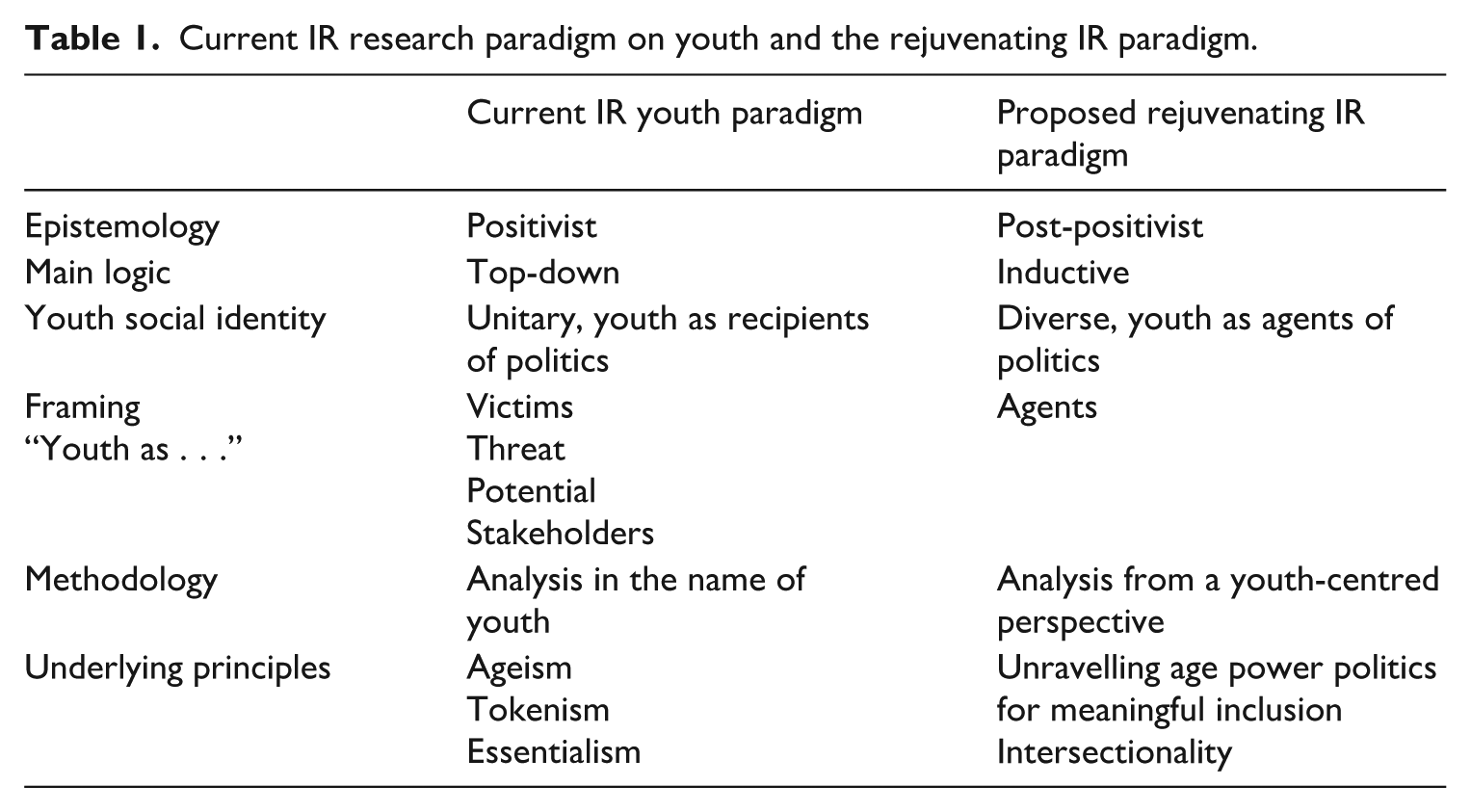
A new research methodology and new underlying principles for understanding youth, and age more generally, are also needed. The next section develops such elements of a new framing to ‘rejuvenate IR’.
Rejuvenating IR by consolidating a ‘youth as political agents’ frame
To go beyond the limits of the identified four IR frames, this section builds on the above analysis and on 14 exploratory interviews conducted with states, IOs, and NGOs at the UN headquarters in February 2025, 6 to detail the methodology and underlying principles of a new framing of youth in IR, ‘youth as political agents’. This additional frame consolidates research reflexivity (Ackerly and True, 2008) with two underlying principles: (1) the need to consider age power dynamics in IR for meaningful inclusion and (2) the need to open IR to the plurality and intersectionality of youth for innovative global governance solutions.
Starting from youth: A youth-centred methodology
As for other major reflexive exercise on the discipline (Tickner, 2005), a youth perspective implies a new research programme concerned with the type of questions that are currently (un)asked. So far, research on youth in IR has been mostly positivist and deductive. Among others, the youth bulges approach has asked whether younger populations are more inclined to destabilise political regimes, leading to large-scale quantitative statistics and correlations (Pruitt, 2020). But what about the past relations between youth and political regimes in these countries? How have youth been included in decision-making, or not? Where they included in peace-keeping decisions if these countries suffered from conflicts? Were they in a position to decide about political issues, being the ones inheriting from such policies? These are not causal questions but constitutive questions on the way politics are conducted. Paraphrasing Tickner (2005), and replacing feminist concerns with youth ones:
‘the basic questions that remain are why, in just about all societies, are youth disadvantaged, politically, socially, and economically relative to elders and to what extent is this because of international politics and the global economy? Conversely, in what ways do these hierarchical aged structures of inequality support the international system of states and contribute to the unevenly distributed prosperity of the global capitalist economy?’ (p. 6, adapted).
A ‘youthdist’ standpoint for IR (paraphrasing Biswas and Mattheis, 2022 and their childist standpoint) would have to rely on a youth-centred methodology that would ask first and foremost young people about their experiences, being related to conflicts, environmental changes, or (un)employment. A bottom-up perspective, using surveys, interviews, and observations of youth would borrow from bottom-up, participatory, or ethnographic approaches that have been informing feminist and postcolonial scholarship (Pruitt, 2021). It would recognise youth not just as subject matters but also as creators of knowledge (Schwiertz, 2021). As explained by one IO representative, change must come from people themselves:
‘regarding the distribution of age, age is increasing. The UN is also realizing this more and tries to have more recruitment of young people. There is a trend globally. Look at what happened in the US. The age of politicians is extending towards higher age. Both candidates were around 80, also for the UN staff (..) And gender is terrible. Still white male. I don’t see more diversity here (compared to Geneva). Old men. (. . .) It’s not the environment that has to change, you have to do it yourself’ (Interview 9).
Another IO representative confirmed: ‘it was more a perception. Of course there will always be male old man. It depends on how you present yourself’ (interview 7). This would impede that other actors impose thoughts on youth: in international security ‘several case studies from post-peace accord literature highlight the discrepancy in what leaders believe is best for youth, and what youth actually need’ (Grizelj, 2019: 168).
Such a methodology would help question concepts typically imposed on youth, such as education or experience, to deconstruct them. It would for instance invite researchers and policymakers to be open to the possibility to gain experience from youth and to even be educated by youth. As explained by the UN Secretary General Antonio Gutierrez at the Youth Summit organised ahead a biodiversity summit in December 2022 in Montreal: ‘You should bring decision-makers here and ask them to ask you questions. You have to reverse the course’ (Fieldwork observation notes). A youth-centred methodology would question the implicit link often made between experience and age, while experience can take many forms. In the security field, it has been found that youth ‘imagination, skills, energy, knowledge and preparedness to invest in the future are some of the most obvious advantages that could be utilized in war-to-peace transitions’ (Özerdem and Podder, 2015: 220). As explained by one Ambassador, we need a new world, and for this, new people to be involved:
‘the new world has to find the people who are skilled but are not in the legitimated space. We have to bring these people (. . .). A world looking for people who are not institutional. How do we organize the world to find these people, give them legitimacy, and scale their solutions? It is the main issue’ (Interview 12).
A youth-centred methodology does not equate studying exclusively youth, creating new scientific biases by reifying youth perspectives. Rather, it means starting research from youth, to then, in a second step, compare their insights with the ones of other actors, for a more comprehensive general view. For example, a youth-centred methodology has already been explored by recent research on youth in the negotiations of the Sustainable Development Goals (Orsini, 2022). It revealed the specific barriers for youth involvement in these processes. First, youth presence relies nearly exclusively on voluntary work, with young people missing classes or jobs to attend international processes. Moreover, youth-led organisations lack the bureaucratic capacity and institutional stability to apply for funding opportunities compared to other stakeholders such as NGOs. In addition, visas or passports are even more difficult for young people to obtain as they often have no stable revenue and employment. This informs us on the specific power dynamics that affect marginalised groups within international negotiations. It visibilises power hierarchies and imbalances that are specific to young people but not only.
Unravelling age hierarchies in IR
The youth-centred methodology of a ‘youth as political agents’ frame leads to question age hierarchies in global governance. The UN, the most universal IO of the world, happens to be particularly untransparent regarding its age practices: neither the UN human resources department reports nor the Chief Executives Board of Coordination Personnel statistics reports cover age in a comprehensive manner. This is problematic when one considers that representation for external affairs is usually performed by older individuals, while the national politics of age already favour a seniority culture (Stockemer and Sundström, 2022). One UN staff member mentioned a truly ‘organizational culture of age within the UN’ that needs to change (interview 8). As summarised by one State diplomat: ‘The UN secretariat is where maybe the age issue needs to be considered. I heard somebody (from the UN) complaining “we tend to become old, retired people”. It is difficult for them to appreciate the participation of the youth’ (interview 10).
Age hierarchies are also visible in IR research as developed above. Youth have been present on the international scene as observers in formal negotiation processes at the international level for several decades already, but these formats of youth participation have been understudied. The UNMGCY was created as early as 1992 to give input into the sustainable development negotiations. Official youth platforms have also developed within sectorial international processes, such as YOUNGO in international climate negotiations and the Global Youth Biodiversity Network in biodiversity negotiations, both created around 2010. Lack of scientific research on these official youth platforms, related to current framing neglecting youth agency in global politics, is somehow contributing to their lack of political visibility.
Lack of data and scientific research means policymakers have few information about youth presence and may end up engaging with established youth-serving organisations already involved in the institutional agenda, instead of with less politically visible youth-led groups. As noticed in the security field: ‘there is a need to find a balance between the initiative and creativity of organizations and individuals already operating in the space of youth peacebuilding (often, long before a formal agenda existed) and (new) institutional mandates and agendas’ (Berents and Mollica, 2022: 68). Current initiatives by governments and international institutions to include youth may end-up as mere ‘cherry-picking’ exercises, whereby governmental actors pick and choose, somehow randomly, the youth to engage with, reinforcing tokenism (Orsini and Kang, 2023) at the detriment of the legitimacy of the global process.
Putting attention on youth would also shed light on new ways to engage in politics and advance the global governance agenda. Studies zooming on youth political practices (Pickard and Bessant, 2019) show that, while neglecting formal processes of voting, many young people actually practice DIO politics (Do It Ourselves politics (Pickard, 2022)) to provoke the change they feel is needed at all policy levels. In peace and security studies, research attention to ‘the often unnoticed informal or creative approaches they (youth) take to building peace in light of years of widespread exclusion from formal peacebuilding initiatives’ (Pruitt, 2021; see also Ragandang, 2020) is highly informative to ensure stronger peace. Most importantly, unravelling age hierarchies would also shed new light on other persisting hierarchies of global politics.
Reinforcing intersectional analyses of global governance
Research has found that youth, when embraced in their diversity of agencies, have the potential for innovative rethinking of world politics (Walters, 2024). A ‘youth as political agents’ perspective would enable to open the black box of ‘youth’ as international actors, studying the diversity of youth, including ‘invisible’ youth in international studies and not just youth visible in the media (Schwiertz, 2021).
A ‘youth as political agents’ follows the underlying principle that youth encompass and come across a high number of social identity challenges in global governance. These challenges include, among others, gender. Youth are often conceptualised as male in IR studies regarding violence (child soldiers, youth bulge). In practice, however, such gender categorisations risk the adoption of unsuitable policies. In peace and security studies,
‘girls and young women have often been side-lined from efforts to draw attention to challenges faced by child soldiers, who are usually envisioned to be young men and boys (. . .) (while) situate(ing) young men as inevitably current or future perpetrators of violence may limit their ability to flee war and find safe refuge in other more peaceful countries’ (Pruitt, 2021: 249).
Five of the 14 interviewees also spontaneously mentioned gender, and several of them also race, as challenges to tackle with age as a starting point. As explained by one NGO representative: ‘age first. But other things come after’ (interview 6).
These challenges also include decolonial stakes, as youth from developing countries are particularly struggling with, among others, poverty, and climate change, and are therefore very vocal on such issues, asking for more climate justice (Sengupta, 2023). Being themselves neglected as political actors, youth often advocate for the rights of other marginalised actors on the international scene, such as sexual minorities, indigenous peoples, and disabled individuals. Being young for a limited time, they are prone to develop claims that go beyond their age group, encompassing climate justice, gender equality, or participatory/democratic decision-making. Within climate mobilisations, young people have mostly environmental or democratic claims, not claims directly related to youth (Knops, 2021). They have been found to develop a much-needed cosmopolitan view of politics (Henn et al., 2022) and to play a key role as future generations (Gorman, 2021).
These challenges also encompass inter- and intra-generational stakes. Youth is not an exclusive social category on the international scene. In climate change politics, research has shown that youth claims do not call for generational wars, or for a world where older people would be put aside. They, instead, most of the times, are claims for more inter-generational dialogue (O’Brien et al., 2018). Among others, Parents for Future and Grand-Parents for Future have been marching together with Fridays for Future in the climate marches. Broadening IR research to ‘youth as political agents’ means to rethink concepts such as inclusivity, intersectional and cross-sectorial perspectives. It questions dichotomies (young/old; male/female; North/South) that impede dialogue.
Thinking inclusively in terms of all age groups would help develop new perspectives:
‘most old people think that if fighting stops, there will be peace. But they do not think about other problems like drugs, trafficking . . . (. . .) If they allow young people to participate in peace process, the young people can educate the community’ (Grizelj, 2019: 182).
As explained by one Ambassador, we need a new world, crafted by youth:
‘diplomacy is still not as open to youth or to people of younger age but we can’t remain in the past, we have to look forward. We need a world reordering. This new world order, the youth need to define it. If they’re not, it may not be there for long. That is why my view for Trump’s appointment are quite grey, which is good. As diplomats, we do need to do better. It is an open story’ (Interview 10).
Conclusion
This contribution has synthetised and explained four dominant youth frames in IR, three from mainstream IR, one more recent, to advance that, while highly informative on some aspects, they have dismissed important dynamics that define contemporary global governance. Indeed, the frames identified – ‘youth as victims’, ‘youth as risks’, ‘youth as potential’, ‘youth as stakeholders’ – suggest a passive role for youth as recipients of politics. The absence of an explicit recognition of the conceptual biases towards adultism, tokenism, and youth essentialism in mainstream IR prevents most IR experts from fully engaging with the complex reality of youth as a socially interpretated category.
Making the existing tensions of the current frames explicit enables to highlight the need to understand youth as a socially constructed category. How young people are framed, positioned, and engaged with politically depends on the adopted perspective. By going beyond the limits of the current frames, a new, complementary, conceptualisation of youth in IR is developed, a ‘youth as political agents’ frame. Paraphrasing Freeman (2001), replacing feminist with youth concerns, such additional framing is meant to correct ‘the erasure of youth as integral to social and economic dimensions of globalization when framed at the macro, or “grand theory”, level and an implicit aging of these macrostructural models’ (p. 1008, adapted). Such a frame is based on a youth-centred methodology, and on a discussion of age power hierarchies in IR for meaningful inclusion, and on the opening-up of IR to the diversity of youth.
In broadening the current research endeavours on youth, what is at stake is not just youth, but the ever-growing challenge to rebalance an IR discipline biased towards the past instead of towards the future, towards insisting on hierarchies and dichotomies, instead of being truly intersectional and inter-sectorial. While initiated on youth, many of the discussion elements of this contribution could apply to other non-dominant age groups, such as children and the elderly, as well as to other marginalised groups in terms of gender, race, wealth or culture. What the age dynamics detailed in the introduction about climate change reveal is the ongoing struggle of marginalised actors on the global scene. As Epstein (2012) rightly recalls ‘the lenses through which we look at the world shape our ability to devise policies to change it’ (p. 136). A new youth perspective in IR would enable to re-discover age and global governance at the same time and inspire new research on the subjectivities of the international.
Footnotes
Funding
The author disclosed receipt of the following financial support for the research, authorship, and/or publication of this article: This work was supported by the Fonds de la Recherche Scientifique - FNRS for the “Youth Earth” research project under Grant n° T.0020.21 (2021-2025) and by the UCLouvain FSR Research Chair “Global Cleav-Age, Permanent and Climate Diplomacy through the Prism of Age” (2024-2026).
