







Abstract
This article develops a framework to analyse the contingent intersections between populism, anti-populism, and environmental politics. These intersections defy simple categorisation: left-wing populists champion climate justice while resisting specific green policies; right-wing populists deny climate change yet defend national landscapes; grassroots movements – from pipeline resistance to the Gilets Jaunes – deploy populism with divergent implications; anti-populist actors both defend and obstruct environmental protection. Actors hold ambiguous positions, shift stances, and form unexpected alliances. Building on scholarship that has increasingly recognised these complex interactions between (anti-)populism and environmental politics, we propose a systematic analytical framework. Drawing on discourse theory, we argue that neither populism nor anti-populism – understood as distinct modes of constructing political frontiers – predetermines environmental positions. Our framework crosses two dimensions: political logic (populism vs anti-populism) and stance towards environmentalist demands (supportive vs oppositional), yielding four articulations that synthesise existing insights into a coherent structure for empirical analysis and strategic reflection.
Introduction
Populism is often understood – particularly in public and policy debate – as inherently threatening to environmental protection, mobilising ‘the people’ against environmental measures driven by scientific knowledge and rational governance. Right-wing populist climate scepticism has become the defining image of this relationship – from Trump’s withdrawal from the Paris Agreement to climate change-denying parties across Europe (Forchtner and Lubarda, 2023; Lockwood, 2018). For instance, prominent environmental practitioners, including former Brazilian Environment Minister Izabella Teixeira, climate NGO director Ana Toni, and former French climate ambassador Laurence Tubiana, have argued that populism has become ‘the biggest obstacle to tackling climate change’ (Teixeira et al., 2022).
Yet this apparent opposition masks a more complex reality with far-reaching political implications. Left-wing populists champion climate justice against corporate elites (Chazel and Dain, 2023), but left populists such as Sahra Wagenknecht also resist green policies they frame as socially unjust (Wagenknecht, 2024). Right-wing populists oppose climate action as elite imposition (Lockwood, 2018), but also embrace ‘patriotic ecology’ to defend national landscapes (Aiolfi, 2024; Benoist et al., 2024). Populist arguments have been mobilised in pipeline resistance in North America (Bosworth, 2022) but also in anti-carbon tax protests in France (Driscoll, 2023). Anti-populist arguments against populist demagogy and irrationality, for their part, are prominent in defending technocratic climate governance (Meyer and MacGregor, 2025), but are also used to delegitimise environmentalist demands as unrealistic populism (Malm and Zetkin Collective, 2021: 64). Actors shift positions over time – when Macron’s technocratic environmentalism provoked the Gilets Jaunes backlash, he changed position (Driscoll, 2023) – and form unexpected alliances, as when left-wing and right-wing populists jointly oppose green policies they frame as elitist (Durand and Thomas, 2024). How can we make analytical sense of these complex, shifting, and contradictory intersections?
Scholarship has increasingly problematised the simplistic equation of populism with anti-environmentalism. Systematic reviews demonstrate populism’s ideological flexibility (Hunger and Paxton, 2022), comparative studies reveal diverse relationships between populist parties and environmental positions (Ko et al., 2025; Schwörer and Fernández-García, 2024), and discourse-theoretical work has long emphasised the contingency of populist articulations more generally (De Cleen and Stavrakakis, 2017; Stavrakakis et al., 2017). Dedicated literatures on the relationships between populism and the environment (Beeson, 2019; Buzogány and Mohamad-Klotzbach, 2022; Ofstehage et al., 2022) and the ‘populistisation’ of green politics (Fu, 2025) have further enriched the field. Building on these advances, this article proposes a systematic framework that organises these insights in a way that accounts for both populism and anti-populism, theorises their articulation with environmental politics as fundamentally contingent, and enables comparative analysis and clear strategic considerations across the full range of configurations.
Building on the post-structuralist discourse-theoretical tradition developed by Laclau and Mouffe (1985) and in particular the logics approach of Glynos and Howarth (2007), we conceptualise both populism and anti-populism as political logics – distinct modes of constructing political frontiers. The populist political logic constructs a vertical opposition between ‘the people’ and ‘the elite’, with populists claiming to speak for ‘the people’ (De Cleen and Stavrakakis, 2017; Laclau, 2005a). The anti-populist political logic constructs a frontier against those labelled as ‘populists’, mobilising the signifier ‘populism’ to delegitimise opponents as undemocratic, demagogic, irrational, or irresponsible, while defending one’s own positions as democratic, rational, or responsible (Goyvaerts, 2025; Moffitt, 2018). Crucially, neither logic predetermines positions on environmental issues: the logics lack ideological content and can be used to formulate diverse and even opposite substantive demands.
Our aim is to clarify how these two distinct political logics – populism and anti-populism – articulate with environmental politics in fundamentally contingent ways. Importantly, these are specific discursive logics, not just shorthands for the broader tension between popular politics and technocratic governance. Because populist and anti-populist logics structure political frontiers in distinctive ways – defining who belongs to ‘the people’, who counts as ‘the elite’, what is dismissed as ‘populism’ – they shape environmental debates differently than other forms of popular or technocratic politics, and conflating them obscures the specific political work the populist and anti-populist logic perform.
We propose a framework crossing two analytically distinct dimensions. The first concerns the political logic through which actors construct political frontiers: populism versus anti-populism. The second concerns the stance actors take towards environmentalist demands: support versus opposition. We intentionally use this second axis in a simplified, functional manner, asking only how populist and anti-populist political logics are used to formulate/support or oppose environmentalist demands/policies, understood as demands/policies formulated in the name of environmental defence – ranging from cycling infrastructure and reduced car dependency, to climate mitigation policies or nature preservation. We use ‘environmentalism’ and ‘anti-environmentalism’ to denote these opposing positions towards environmentalist demands, making abstraction of the significant diversity of environmentalisms and debates over what ‘environmentalism’ as substantive ideology should be. With ‘environmental politics’ we refer to any politics relating to the environment, whether defending the environment or opposing green measures; this makes opposition to environmentalist politics as environmental as environmentalist politics.
Crossing these dimensions yields four possible articulations: environmentalist populism, anti-environmentalist populism, environmentalist anti-populism, and anti-environmentalist anti-populism. These quadrants represent not fixed categorisations of actors but a model that allows analysing how actors position themselves, often ambiguously, how they move over time, and how they relate to each other through alliances and antagonisms.
This framework makes three contributions. First, building on existing scholarship that has demonstrated populism’s ideological flexibility and the diversity of populism-environment intersections, it provides a discourse-theoretical account of how both populist and anti-populist logics – as ways of constructing political frontiers that are not ideologically fixed – can articulate with environmentalist demands in contingent ways. Crucially, this includes theorising anti-populism’s role in environmental politics – a dimension that has received considerably less attention despite its prominence in both supporting and opposing environmentalist demands. In short, the framework draws attention to the full diversity of ways populism and anti-populism articulate with environmental politics – including configurations that existing research has underexplored. Second, the framework synthesises and organises these existing insights by distinguishing clearly between (a) the mode of constructing political frontiers (populism vs anti-populism) and (b) the stance towards environmentalist demands (supportive vs oppositional). It thus brings order to contingency, providing a starting point for systematic empirical analysis of alliances, oppositions, and transformations over time. Third, by making sense of these diverse and shifting articulations, the framework provides a basis for normative and strategic reflection for actors committed to environmental protection and climate action.
The article proceeds in five sections. First, it maps the threefold analytical challenge – empirical, conceptual, and normative-strategic – that motivates the framework’s requirements. Second, it elaborates a discourse-theoretical account of populism and anti-populism, drawing on the logics approach (Glynos and Howarth, 2007) to theorise them as distinct modes of constructing political frontiers. Third, it proposes the two-dimensional framework, explaining its analytical logic and the four articulations it generates. Fourth, it illustrates each articulation empirically, demonstrating how they manifest in concrete political contexts. Finally, it develops agenda-setting questions for empirical research and reflects on how the framework might structure strategic and normative debates.
The analytical challenge: Populism, anti-populism, and environmental politics
Analysing the intersections between populism, anti-populism, and environmental politics poses a threefold challenge – empirical, conceptual, and normative-strategic. While existing scholarship has generated important insights – particularly regarding right-wing populist climate scepticism – the field would benefit from a systematic framework that organises these insights and addresses remaining gaps in what is studied, how populism is conceptualised, and how environmental defence should relate to populism. This section maps these challenges to establish the requirements for such a framework.
Empirical challenge: Diversity beyond right-wing populist climate scepticism
Scholarly and public attention has concentrated heavily on right-wing populist climate scepticism – a focus justified by the electoral success of such parties (Mudde, 2019) and their documented negative effects on climate policy (Lockwood and Lockwood, 2022). Research demonstrates how right-wing populist actors present climate policies as elite projects threatening national sovereignty and burdening ordinary citizens (Lockwood, 2018), while engaging in climate scepticism ranging from outright denial to delay tactics (Forchtner and Lubarda, 2023). Yet as a growing body of scholarship has shown, the empirical landscape of populism-environment intersections is considerably more diverse than this picture suggests (Beeson, 2019; Buzogány and Mohamad-Klotzbach, 2022; Huber et al., 2021; Ofstehage et al., 2022).
Left-wing populist parties demonstrate that populist mobilisation can strengthen environmental defence. Spain’s Podemos framed climate action as defending ‘the people’ against corrupt elites preventing environmental policies (Huber et al., 2021). France’s La France Insoumise explicitly theorises ‘popular environmentalism’, combining environmentalist demands with populist anti-elitism (Chazel and Dain, 2023). Greece’s Syriza and Nordic left parties have similarly combined environmental justice with anti-elitism (Huber et al., 2021; Wang and Keith, 2020). Beyond party politics, grassroots environmental protection movements employ populist frameworks – as in anti-pipeline resistance in the United States, where activists mobilise a people-versus-elite antagonism against fossil fuel infrastructure (Bosworth, 2022).
Even within right-wing populism, environmental positions prove more complex than climate scepticism alone. Right-wing populist parties articulate environmental concerns through ‘patriotic ecology’ (Aiolfi, 2024; Benoist et al., 2024), defending ‘our’ landscapes and national heritage against threatening outsiders – whether immigrant populations, superdiverse cities, multinational corporations, or supranational institutions (Forchtner and Kølvraa, 2015; Lambrechts and De Cleen, 2025). Marine Le Pen’s 2022 campaign exemplified this, framing environmental protection as defending national territory against cosmopolitan elites (Aiolfi, 2024). The same actor can thus combine climate scepticism with environmentalist nationalism, resisting simple classification.
Importantly, while both left-wing and right-wing populist actors articulate environmentalist demands, the nature of these demands differs fundamentally. Where left-wing populist actors typically ground their environmentalist demands in ecological urgency or social justice, right-wing populist ‘patriotic ecology’ is driven primarily by ethno-nationalist attachments to territory rather than environmental protection as such. A growing body of scholarship argues that such nativist constructions of environmental concern – where defending ‘our’ land serves nationalist rather than ecological goals – should not be equated with environmentalism in any substantive sense (cf. Audikana and Kaufmann, 2022; Beyer and Weisskircher, 2025; Honeker and Spoon, 2025; Ungureanu and Popartan, 2024). Our framework registers this tension without resolving it: it captures that both left-wing and right-wing populist actors claim to defend environmental concerns through a people-versus-elite antagonism, while recognising that the substantive motivations and ecological implications of these claims differ fundamentally.
Anti-populism displays comparable diversity in its relationship to environmental politics, yet has received considerably less scholarly attention than populism (exceptions include Dannemann, 2024; Meyer and MacGregor, 2025). Environmental policy defence is often couched in anti-populist terms, with rational climate governance framed as under threat from irrational populist disruption – as exemplified by Emmanuel Macron’s explicit opposition to populism combined with environmental ambition (Henley, 2017). Yet anti-populist logics can also obstruct environmental defence, for instance, by dismissing demands for systemic ecological transformation as unrealistic populism (Meyer, 2024) – as when the radical right Sweden Democrats leader Jimmie Åkesson labelled climate concern ‘the worst kind of populism’ (Malm and Zetkin Collective, 2021: 64), or when the head of a prominent Labour-affiliated think tank urged his party to confront the ‘twin populisms’ of the radical right and the Greens, dismissing the latter’s environmentalist demands as ‘unicorns’ and ‘fantasy’ (Stewart, 2025). Anti-populism, like populism, articulates with environmentalist demands in multiple and contradictory ways.
This empirical diversity – including ambiguities, shifts, and contradictions within actors’ positions – demonstrates that the relationships between populist and anti-populist logics and environmentalist demands cannot be captured through static categorisation. An adequate analytical framework must accommodate not only diverse configurations but also their instability and relational dynamics.
Conceptual challenge: The ideological flexibility of populism and anti-populism
This empirical complexity points to deeper conceptual issues that scholarship has made increasingly clear: both populism and anti-populism are ideologically flexible, meaning that the analytical distinction between how political frontiers are constructed and the substantive content with which they are filled must be maintained consistently.
Regarding populism, Stavrakakis et al. (2017) identify a ‘reified association’ between populism and (extreme) right-wing politics. Particularly in public debate, characteristics of one populist variant are wrongly generalised as essential features – a problem now widely acknowledged across different academic approaches to populism (Hunger and Paxton, 2022; Mudde, 2017). Bosworth (2020: 3) observes how ‘populism in everyday political discourse is understood to be synonymous with the political right, nativism, strongman politics, faux representation, xenophobia, and anti-environmental politics’ – obscuring the analytical distinction between populism and ideological content. Brown and Mondon (2021) demonstrate how media coverage reinforces this conflation by euphemising the radical right as ‘populism’. While scholars have thus increasingly challenged this conflation, it persists in public debate, where contingent articulations are treated as essential features: because many right-wing populist actors oppose environmentalist policies, populism itself is assumed to be anti-environmentalist.
A parallel conflation operates in public debate around anti-populism’s relation to environmental politics. Climate policy discourse is often dominated by an anti-populist logic that frames environmental governance as fundamentally technocratic and scientific. Climate action is presented as requiring rational expertise and scientific consensus – explicitly positioned against populist irrationality and anti-expert sentiment (cf. Clark, 2024; Teixeira et al., 2022). This creates an implicit equation: anti-populism equals pro-environmental governance, as if defending technocratic governance against populism naturally aligns with defending climate policy. Yet anti-populism, like populism, is a way of drawing political frontiers rather than a substantive ideology. Anti-populist arguments can defend climate governance as rational policy but can equally delegitimise environmental movements as populist threats to institutional order or economic stability. As scholarship has increasingly recognised (Dannemann, 2024; Meyer and MacGregor, 2025), assuming anti-populism is inherently environmentalist is as misleading as assuming populism is inherently anti-environmentalist.
An adequate framework must therefore distinguish clearly between populism and anti-populism as ways of constructing political frontiers, and the substantive content – including environmental stances – with which they are filled. Only by maintaining this distinction can we analyse how these combinations take shape in specific contexts.
Normative-strategic challenge: Implications for environmental politics
The analytical challenge carries significant normative implications. How we understand the relationships between populist and anti-populist logics and environmentalist demands shapes strategic choices for those seeking effective responses to environmental crises.
If populism is understood as inherently opposed to environmental protection, the strategic implication is clear: environmental action requires protection from populist interference. This view finds expression particularly in public debate and climate policy discourse. For instance, political commentators warn that ‘divisions over climate are aggravated by populist politicians’ (The Economist, 2023), while senior climate policy figures argue that ‘reactionary populism is now the biggest obstacle to tackling climate change’ (Teixeira et al., 2022).
Scholars in critical traditions have argued, however, that technocratic, consensus-oriented approaches – explicitly positioned against populist ‘disruption’ – have failed to deliver adequate environmental responses. Swyngedouw (2013) argues that consensual framing presents climate change as requiring technical management rather than political contestation. Stavrakakis (2014: 506) observes more broadly that ‘the domination of a predominantly anti-populist logic . . . marginalises the people and its demands. It reduces politics to an administrative enterprise . . . offering no real choice between different alternatives’. Meyer and MacGregor (2025: 3) reveal the consequences: by ‘locating the core problem within populism itself’, anti-populist approaches ‘not only elevate a failed mainstream approach but throw out the populist baby with the authoritarian, climate-sceptical bathwater’.
These competing perspectives highlight what is at stake. If populism is equated with anti-environmentalism, the strategic implication is that environmentalist demands should be shielded from populist politics specifically – yet this risks foreclosing populist mobilisation for environmental justice. If anti-populism is equated with environmentalism, we overlook how anti-populist logics can obstruct environmental protection. An adequate framework should make visible different configurations through which populism and anti-populism intersect with environmental politics without predetermining normative conclusions.
What an adequate framework must do
These three challenges – empirical, conceptual, and normative-strategic – converge on the need for an analytical framework that maintains a clear distinction between political logics and substantive environmental positions. Existing scholarship has made important strides: discourse-theoretical work has theorised populism’s formal openness (Laclau, 2005a; Stavrakakis et al., 2017), comparative research has documented diverse populism-environment configurations (Huber et al., 2021; Ko et al., 2025; Ofstehage et al., 2022), and critical scholars have questioned the assumed alignment between anti-populism and environmental governance (Meyer and MacGregor, 2025; Swyngedouw, 2013).
Building on these contributions, the framework we propose must enable three analytical operations. First, it must locate and track political positions – accommodating the full empirical diversity in how populism and anti-populism intersect with environmental politics, including ambiguities, shifts, and contradictions within actors’ positions over time. Second, it must analyse interactions – capturing how actors positioned differently across the two dimensions engage in antagonistic struggle and form alliances, and how these interactions shape what becomes politically possible. And third, it must inform strategic and normative reflection – making visible the contingent character of different configurations and the trade-offs they entail for those seeking effective political responses to environmental crises.
A discourse-theoretical approach to populism and anti-populism
To analyse the contingent articulations between populism, anti-populism, and environmental politics, we require a theoretical approach that avoids fixing populism or anti-populism to predetermined environmental positions. Discourse theory, as developed by Laclau and Mouffe (1985) and elaborated through the logics approach by Glynos and Howarth (2007), provides such tools. This section outlines the core premises of this approach and explains how it allows us to conceptualise both populism and anti-populism as political logics – distinct modes of constructing political frontiers that can articulate with diverse environmental stances – rather than as fixed ideologies predetermining environmental positions.
Discourse theory and the logics approach
Discourse theory develops a discursive perspective on the political and the social. This does not mean material reality does not exist (rising temperatures, melting ice caps, and extreme weather events are real), but that the meaning of such phenomena depends on the discourses in which they are articulated (Laclau and Mouffe, 1985: 105). Discourse theory focuses on how meaning is produced, stabilised, contested, and transformed through articulation, defined as ‘any practice establishing a relation among elements such that their identity is modified as a result of the articulatory practice’ (Laclau and Mouffe, 1985: 91). ‘Climate change’ can be articulated with ‘expertise’ in a technocratic-scientific discourse or articulated to ‘social justice’ requiring populist mobilisation against corporate elites. Similarly, ‘the people’ can be constructed as defenders of nature against polluting elites, or as workers threatened by green technocrats. Political identities, demands, and antagonisms emerge through discursive struggles over meaning.
Central to discourse theory is the concept of hegemony. Politics is a struggle for hegemony, where competing discourses construct political identities and compete over the representation of political demands (Torfing, 1999: 36–38). Hegemony refers to the temporary and partial fixation of meaning through articulatory practices that establish particular nodal points, which are privileged signifiers around which a discourse is organised (Laclau and Mouffe, 1985: 99). For instance, ‘the people’ functions as a nodal point in populism, organising diverse demands as expressions of popular will against elite obstruction (De Cleen and Stavrakakis, 2017; Laclau, 2005a). Because discourse can never achieve full closure, hegemonic formations remain contestable. Political struggle over environmental politics, through this lens, consists in attempts to establish, maintain, or challenge hegemonic articulations: for instance, whether environmental protection should be understood as an elite concern or a popular cause, as compatible with populist mobilisation or opposed to it.
Political identities are constructed through drawing political frontiers that divide the social field into opposing camps. Glynos and Howarth (2007) develop this approach through their logics framework, distinguishing between social, political, and fantasmatic logics. Social logics characterise institutionalised practices often taken for granted (Glynos and Howarth, 2007: 136). Political logics explain how these practices emerge, are contested, or transform (Glynos and Howarth, 2007: 136). At the highest level of abstraction are the logics of equivalence and difference (Laclau and Mouffe, 1985: 113–120). Equivalential logics link diverse demands into a collective subject (e.g. ‘the people’) by emphasising shared opposition to a common antagonist (e.g. ‘the elite’), simplifying the political field into two camps. The logic of difference maintains distinctions, dissolving equivalential chains into differential positions manageable within an institutional order. Fantasmatic logics explore the affective investments sustaining particular ideological positions, explaining why subjects are ‘gripped’ (Glynos, 2001; Glynos and Howarth, 2007: 213) by certain ideologies despite contradictions or failures.
For our purposes, the concept of political logics is particularly useful. Understanding populism and anti-populism as political logics means recognising them as distinct modes of constructing frontiers: the way they construct such frontiers is specific, but they remain fundamentally open to diverse substantive articulations with environmental (and other) politics. This openness explains why the populist logic can articulate environmentalist demands in supportive or oppositional ways, or even articulate both in different contexts, and why the anti-populist logic can similarly articulate with environmentalist demands diversely.
Populism as political logic
Building on Laclau’s (2005a) work, we conceptualise populism as a political logic that constructs a vertical frontier between ‘the people’ and ‘the elite’. Populism is a political logic ‘in which “the people” are juxtaposed to “the elite” along the lines of a down/up antagonism in which “the people” is discursively constructed as a large powerless group through opposition to “the elite” conceived as a small and illegitimately powerful group’ (De Cleen and Stavrakakis, 2017: 310). It operates through a logic of equivalence that achieves ‘symbolic unification’ of various groups and demands into ‘the people’ (Laclau, 2005a: 74) These demands may be heterogeneous – concerning economic inequality, political exclusion, cultural recognition, or environmental degradation – but become unified insofar as they are all perceived as blocked by ‘the elite’.
Crucially, populism is fundamentally indeterminate with respect to substantive political content. As Laclau emphasises, the focus shifts from the contents of populism to how it formulates ‘those contents – whatever those contents are’ (Laclau, 2005b: 33). The populist logic concerns how political frontiers are drawn – vertically, between ‘down’ and ‘up’ – rather than what substantive content fills these categories. ‘The people’ and ‘the elite’ function as empty signifiers that can be articulated differently: ‘the people’ can be constructed in ethnic-national terms (right-wing populism) or class terms (left-wing populism). Whether an actor is populist is determined not by substantive policy positions, but by constructing this vertical frontier.
Anti-populism as political logic
Anti-populism can also be seen as a political logic. While the discourse-theoretical tradition is best known for its work on populism, recent scholarship has increasingly addressed anti-populism (Goyvaerts, 2025; Moffitt, 2018; Stavrakakis et al., 2018). Anti-populism constructs a political frontier around opposition to ‘bad populists’ (Goyvaerts, 2025: 15), with the signifier ‘populism’ mobilised to delegitimise opponents by presenting them as threats to democracy, rationality, or civilised political conduct. The flexibility of the signifier ‘populism’ is crucial here, with anti-populist discourse criticising populism as ‘(a combination) of simplification, emotionality, demagogy, aiming to please people, and antagonism – all of these characteristics seen as antithetical to what appropriate democratic debate and good policy is supposed to look like’ (Goyvaerts and De Cleen, 2020: 90). This allows ‘an odd mix of ideological and strategic bedfellows [to be] pulled together in a temporary alliance of opposition to populism’ (Moffitt, 2018: 2).
Crucially, anti-populism is not simply the opposite of populism, but rather a derivative and reactive political logic. It is more compact than populism: while populism captures politics revolving around ‘the people’ against ‘the elite’ (with many not labelling themselves as populist), anti-populism captures politics revolving around explicit rejection of certain politics labelled as ‘populist’. For populism, ‘the people’ and ‘the elite’ are the nodal points; for anti-populism, ‘populism’ is the nodal point. As Kim (2026: 60) notes: The distinct value of anti-populism as an analytical category consists precisely in capturing this wide range of uses and constructions of ‘populism’ – in other words, anti-populism as ‘a series of discursive resources which can be put to very different uses’ (Laclau, 2005a: 176) – from the left to the centre to the right.
Like populism, the anti-populist logic is formally rather than substantively defined, making it indeterminate with respect to substantive content. Anti-populism revolves around resistance to ‘the threat of populism’, yet this formal structure can articulate with diverse substantive ideological positions (Stavrakakis et al., 2018). Anti-populism can defend free-market economics against left-wing populism or liberal multiculturalism against right-wing populism, or centrism against populism on both sides. What determines the frontier that opposes populists shifts according to substantive ideological positions and visions of democratic politics (Goyvaerts, 2025).
It is important to distinguish anti-populism from technocracy, even though the two frequently overlap in practice. Technocracy, understood as a mode of governance that privileges expertise and rational problem-solving over partisan contestation (Caramani, 2017; Pilet et al., 2025), does not necessarily involve the construction of a political frontier against actors labelled as ‘populist’. A technocratic actor can appeal to scientific expertise without ever invoking ‘populism’ as a target. Technocratic discourse becomes anti-populist when it explicitly constructs populism as a threat to be opposed – when the appeal to expertise is articulated not merely as a claim to competence but as a defence against what is presented as dangerous populist irrationality. That this transition occurs so readily is unsurprising: as Bickerton and Accetti (2017) have shown, technocracy – like populism – claims unmediated access to a singular truth, leaving little space for legitimate disagreement. When that claim is contested, technocratic actors can respond by labelling the opposition as ‘populist’, thereby articulating their technocratic logic with an anti-populist logic. Importantly, this pejorative ‘populism’ label is not reserved for actors whose discourse is populist in the analytical sense defined above – it can be applied strategically to any challenger of technocratic authority, thereby extending the reach of the anti-populist logic beyond what might actually be counted as ‘populism’.
A two-dimensional framework for analysis
Having established that both populism and anti-populism are political logics whose articulation with environmentalist demands is contingent rather than predetermined, we now propose an analytical framework to analyse these articulations systematically. By uncoupling populism and anti-populism from particular environmental stances, the framework makes visible the full range of possible configurations: not only anti-environmentalist populism but also environmentalist populism, not only environmentalist anti-populism but also anti-environmentalist anti-populism. The framework enables analysis of the conditions under which different configurations emerge, how they compete and interact, and what strategic possibilities they open or foreclose.
While discourse-theoretical scholarship has extensively analysed populism and increasingly engages with anti-populism, relatively little work has examined their articulations with environmental politics. Notable exceptions include Stavrakakis’ (1997) discursive reading of Green ideology, Griggs and Howarth’s (2008, 2016) work on environmentalist protest movements and their populist dimensions, and Mouffe’s (2022) advocacy for a ‘green democratic revolution’ that combines left-wing populism with ecological transformation. However, systematic theorisation of how both populist and anti-populist logics articulate with environmentalist demands remains underdeveloped – a gap this article addresses.
The framework crosses two analytically distinct dimensions. The first dimension – which constitutes the framework’s primary conceptual contribution – concerns the political logic through which actors construct political frontiers and constitute collective subjects. At one pole lies populism, which constructs an antagonism between ‘the people’ (a large, powerless group) and ‘the elite’ (a small, illegitimately powerful group) and builds legitimacy on representing ‘the people’. At the other pole lies anti-populism, which revolves around opposition to ‘populism’ and builds legitimacy around this antagonism to the ‘populist threat’. As established in section ‘A discourse-theoretical approach to populism and anti-populism’, both are discursive structures that do not predetermine substantive political content but provide distinct modes of organising political frontiers.
The second dimension concerns the stance actors take towards environmentalist demands: whether they support or oppose them. At one pole lies what we call, for simplicity, ‘environmentalism’ – support for environmental protection, climate action, and ecological transformation. At the other pole lies what we call ‘anti-environmentalism’ – scepticism towards, opposition to, or deprioritisation of environmental protection. Crucially, we do not define what ‘environmentalism’ substantively means. These remain contested and open signifiers whose meaning varies across contexts. Our framework uses this dimension in a consciously minimal way: it asks only whether a given populist or anti-populist logic articulates environmentalist demands supportively or oppositionally, not what environmental politics ‘is’ in any fuller sense. This deliberate simplification focuses analytical attention on how populist and anti-populist logics give meaning to environmentalist demands, without requiring a comprehensive theory of environmental politics. This dimension captures explicit positions on environmental issues and the priority assigned to environmental politics relative to other political goals. Importantly, environmentalism and anti-environmentalism are not binary opposites but anchor points on a spectrum: actors may occupy intermediate positions, hold conditional stances, or take contradictory positions across different environmental issues – a complexity we address in the empirical illustrations.
Crossing these two dimensions generates a two-by-two matrix with four quadrants, each representing a distinct ideal-typical articulation of political logic and environmental stance (see Figure 1).
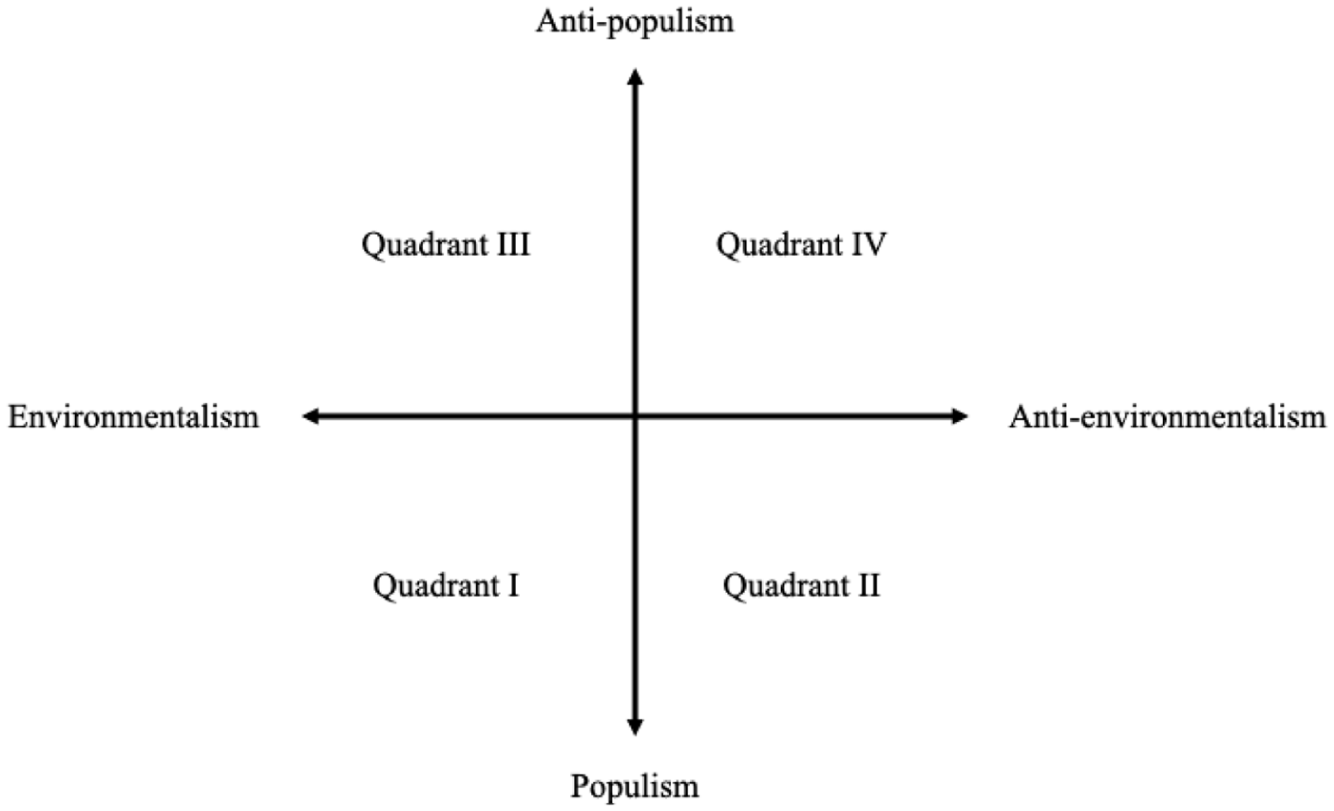
Analytical framework: Four possible articulations between political logics (populism vs anti-populism) and stance towards environmentalist demands (supportive vs oppositional).
This framework serves three analytical functions, which we elaborate further in the final section of this article. First, it enables locating and tracking political positions – identifying where actors position themselves, how positions shift over time, how they manage contradictions, and how discursive opportunities shape articulations. Left-wing populist actors (Quadrant I) and environmentalist anti-populism (Quadrant III) can both support climate action but through fundamentally different political logics – a difference that matters for mobilisation strategies and political effectiveness. Second, the framework allows for analysing interactions between actors through antagonistic struggle and alliance formation. Actors in different quadrants may clash over environmental politics, but actors within the same quadrant sharing a political logic may differ ideologically. Conversely, unexpected alliances may form when actors share a position on one dimension despite diverging on the other. Third, the framework clarifies strategic choices and normative implications for ecological transformation: should environmental defence proceed through populist mobilisation or anti-populist expertise, and what trade-offs does each path entail?
It is important to emphasise that the framework is not designed to place actors in fixed boxes but to pose sharp analytical questions about their positioning and movement. As the empirical illustrations below demonstrate, actors frequently occupy ambiguous positions, shift over time, and combine elements from different quadrants.
The four articulations
Having established the two-dimensional framework, we now examine each articulation in turn, illustrating how populist and anti-populist logics articulate with environmentalist and anti-environmentalist positions in concrete political contexts.
Environmentalist populism (Quadrant I)
Environmentalist populism articulates the people-versus-elite antagonism in ways that support environmentalist demands, constructing ‘the people’ as defenders of the environment and victims of environmental destruction perpetrated by powerful elites.
Left-wing populist parties exemplify this articulation prominently. Spain’s Podemos frames climate action as defending ‘the people’ against ‘corrupt elites’ preventing environmental policies (Huber et al., 2021: 1008). France’s La France Insoumise explicitly theorises ‘popular environmentalism’, with leader Mélenchon declaring: ‘in the battle for the survival of the ecosystem . . . there is a confrontation between the people and the oligarchy’ (Chazel and Dain, 2023: 1238). Greece’s Syriza and Nordic parties like Sweden’s Left Party combine environmental justice with anti-elitism, though demonstrating compromises – Syriza on climate policy during government (Huber et al., 2021: 1008), and Swedish leftists by subordinating environmental concerns to traditional socialist priorities, remaining ‘more red than green, more materialist than postmaterialist’ (Wang and Keith, 2020: 13). Such cases fit within growing scholarly attention to environmentalist populism (Beeson, 2019; Buzogány and Mohamad-Klotzbach, 2022) and the ‘populistisation’ of green politics (Fu, 2025). Beyond party politics, grassroots movements employ comparable populist logics. Bosworth’s (2022) analysis of anti-pipeline resistance in the United States reveals how activists construct fossil fuel infrastructure as elite impositions threatening local communities, uniting those who perceive pipeline approval as a struggle between ‘the people’ and oil interests. In such cases, the populist construction of ‘the people’ typically transcends ethnic or national boundaries, unifying diverse groups through shared opposition to ‘the elite’.
Importantly, environmentalist populism is not confined to the left. Right-wing populist parties occasionally articulate environmental concerns through exclusionary nationalism, defending ‘our’ landscapes, resources, or national heritage against threatening outsiders – whether immigrant populations, multinational corporations, superdiverse cities, or supranational institutions (Forchtner and Kølvraa, 2015; Lambrechts and De Cleen, 2025). This ‘patriotic ecology’ (Aiolfi, 2024; Benoist et al., 2024) also has a populist dimension as it constructs environmental protection as defending the people’s connection to their homeland against cosmopolitan elites. Marine Le Pen’s 2022 campaign exemplifies this, advocating an ecology that ‘recreates the link between man and his territory’ while claiming ‘populations united by a long presence on a territory’ have special ‘complicity with nature’ (Aiolfi, 2024: 17). Such discourse positions environmental protection as popular and national sovereignty against EU diktat and globalist elites, though remaining sceptical towards climate mitigation policies. Crucially, in right-wing populism, ‘the people’ is determined by nationalism – in an exclusionary ethnic form – with the populist logic subordinate to and used in support of that nationalism. This contrasts with left-green populism’s more inclusive, coalition-based constructions.
As discussed in section ‘The analytical challenge: Populism, anti-populism, and environmental politics’, however, scholarship has raised serious questions about whether such right-wing articulations constitute environmentalism in any substantive sense, given that they are driven by nationalist attachments rather than ecological protection (cf. Audikana and Kaufmann, 2022; Beyer and Weisskircher, 2025; Honeker and Spoon, 2025; Ungureanu and Popartan, 2024). Despite these differences, both share the formal structure of linking environmentalist claims to the people-versus-elite antagonism.
Anti-environmentalist populism (Quadrant II)
Anti-environmentalist populism articulates the people-versus-elite antagonism in ways that oppose environmentalist demands, positioning environmental policies themselves as elite impositions threatening ordinary people’s livelihoods, freedoms, or ways of life.
Right-wing populist climate scepticism exemplifies this articulation. Research shows that such parties consistently oppose ambitious climate policy (Forchtner and Lubarda, 2023), reflecting what Lockwood (2018: 713) calls a ‘congruence between RWP (right-wing populism) and climate scepticism’. This construction presents ‘the people’ as victims of environmental regulation – for instance, facing higher energy prices, mobility limits, and job threats – while ‘the elite’ includes politicians, scientists, NGOs, and international institutions detached from ordinary citizens. Dirkx and Wettengel (2024) document how Germany’s AfD wants to ‘abolish all climate laws at the national and European level’, claiming EU rules allow ‘Brussels’ to ‘interfere in the personal lives of every citizen’. Similarly, the Dutch PVV insists that ‘whether we eat meat, catch a plane or drive a gasoline car is something we decide for ourselves’, while Viktor Orbán in Hungary accuses the European Commission of ‘killing the European middle class’ with climate policy (Dirkx and Wettengel, 2024). This discourse portrays climate change as a hoax or ‘new religion’, suggesting that climate science serves elite interests (Forchtner and Kølvraa, 2015).
This anti-environmentalist populism is not, however, exclusively right-wing. A distinct left-wing variant mobilises the people-versus-elite antagonism through challenging the socio-economic fairness of green policies. Sahra Wagenknecht, founder of Germany’s BSW (Bündnis Sahra Wagenknecht), argues that ‘The Greens’ approach to environmental policy is economically punishing for most people . . . The Greens radiate arrogance towards poorer people’ (Wagenknecht, 2024). Similarly, the Belgian Workers’ Party (PTB) opposed Brussels’ ‘Good Move’ sustainable mobility plan as an elitist project burdening the working class (Durand and Thomas, 2024). Crucially, while this left-wing populist construction of ‘the people’ is more class-based – differing from the ethnically determined ‘people’ of right-wing populism – its construction of the ‘green elite’ as out-of-touch is strikingly similar. This convergence is observable in opposition to the Brussels ‘Good Move’ urban mobility policy, which faced opposition from both the PTB and the radical right and populist Vlaams Belang (Chini, 2022; Durand and Thomas, 2024). Both parties mobilised against the same elite and policy yet defended different notions of ‘the people’.
Anti-environmentalist populist articulations extend beyond formal party politics. The Gilets Jaunes (Yellow Vests) in France exemplify this, demonstrating how grassroots movements can mobilise the people-versus-elite antagonism against climate policies perceived as socially unjust. Emerging in response to Macron’s diesel tax, the movement constructed ‘the people’ as a ‘community of committed workers who produce the nation’s true wealth’ (Guerra et al., 2019: 2) in peripheral areas, ignored by a disconnected metropolitan elite. While not uniformly anti-environmentalist – with many expressing climate concern (Driscoll, 2023) – the core grievance was framing this policy as social injustice. It gave voice to a disaffected ‘precariat’ (Grossman and Mayer, 2023: 746), uniting economically insecure workers. As one activist argued, the carbon tax was ‘ultra-hypocritical’, taxing ordinary citizens while corporations received exemptions (Driscoll, 2023: 155). Their slogan crystallised this resentment: ‘End of the month, end of the world: the elites talk about the end of the world, we talk about the end of the month’ (Rérolle, 2018).
Environmentalist anti-populism (Quadrant III)
Environmentalist anti-populism articulates an opposition between rational, science-based climate governance and populist forces framed as threats to effective environmental action. The anti-populist logic frames environmental action as requiring protection from populist interference.
French President Emmanuel Macron’s first term exemplifies this environmentalist anti-populism clearly, combining strong opposition to populism with environmental commitment. During his 2017 campaign, Macron presented himself as a defender of liberalism against populism, and during his TV debate with Marine Le Pen, he described the European Union as protection against populism (Barthold and Fougère, 2020). In his 2017 Sorbonne speech, he warned: ‘we mustn’t fall into the trap of the populists or extremes’ (Macron, 2017). On environmental issues, Macron declared ‘there is no planet B’ (Wentworth, 2018) and coined ‘Make Our Planet Great Again’ (Henley, 2017). His approach combines environmental ambition – appointing prominent environmentalist Nicolas Hulot as ecology minister – with market-oriented pragmatism, campaigning on being ‘neither left nor right’ and transcending ideological divisions (McAuley, 2017). This centrist construction positions pro-European, technocratic, and moderate forces as defenders of both democracy and climate action, while ‘bad populists’ encompasses anti-EU nationalists, climate sceptics, and radical left forces alike. An anti-populist frontier is constructed that opposes rationality to extremism, institutional stability to disruption, and evidence-based policy to demagoguery.
Anti-populist framing of environmental protection is also common in public debate. Journalistic discourse frequently juxtaposes scientific reason and technocratic competence with populist distortion and reaction. The Financial Times writes that ‘net-zero-sceptic populist parties seized on cost-of-living anxieties to denounce green policies as a costly elitist plot against working people’ (Clark, 2024). Politico’s headline ‘Populists vs. the planet’ illustrates this: while the article examines right-wing populism specifically, the title employs ‘populists’ without specification, exemplifying the conceptual conflation at work (Mathiesen, 2022). Former Brazilian Environment Minister Izabella Teixeira, climate NGO director Ana Toni, and former French climate ambassador Laurence Tubiana argued that ‘reactionary populism is now the biggest obstacle to tackling climate change’ (Teixeira et al., 2022). By labelling right-wing parties as ‘populist’ rather than ‘right-wing populist’, these accounts leave the status of left-wing populism ambiguous, reinforcing the view of populism per se as incompatible with environmental protection.
Anti-environmentalist anti-populism (Quadrant IV)
Anti-environmentalist anti-populism combines opposition to environmental policies with defence of established institutions, economic rationality, or democratic procedure against populist threats – delegitimising environmentalist demands by associating them with populist excess.
A striking example comes from within Macron’s own government – the same case already discussed under Quadrant III. In January 2020, Brune Poirson, Secretary of State for Ecological Transition, warned in Le Figaro that ‘a genuine green populism is developing’, driven by political leaders ‘willing to make people believe anything’ (Public Sénat, 2020). She pointed to a movement that ‘aims to use ecology as an excuse to break the current system’, targeting both Mélenchon’s La France Insoumise and other green parties on the left, as well as Le Pen’s nationalist ecology on the right, arguing that their promises of rapid transitions to renewable energy or elimination of plastics were dangerously unrealistic. Against this, she defended Macron’s ‘realistic’ approach as ‘less easy on a TV set but more effective for the planet’ (Public Sénat, 2020). When Mélenchon responded in the National Assembly by embracing the label, Poirson replied that his intervention confirmed ‘the very essence of the green populism I was denouncing’ (Public Sénat, 2020). Notably, Poirson did not oppose environmental protection as such but delegitimised more ambitious environmentalist demands as dangerous populism – whether this constitutes anti-environmentalism or responsible governance is itself a site of political contestation. This episode illustrates how the anti-populist logic can operate across Quadrants III and IV depending on which actors are targeted, and that where actors are positioned along the environmentalist axis depends on how one defines what counts as adequate environmental ambition.
A comparable dynamic has emerged in the United Kingdom, where the Green Party under leader Zack Polanski has since 2025 explicitly embraced ‘eco-populism’, combining environmentalist demands with anti-elitist mobilisation. In response, mainstream actors have deployed anti-populist rhetoric against these green challengers. In The Guardian, Joe Dromey, general secretary of the Fabian Society, a Labour-affiliated think tank, urged his party to confront the ‘twin populisms’ of Reform UK and the Greens, accusing Polanski of offering voters ‘unicorns’ and ‘fantasy’ solutions – summarising the choice facing British voters as ‘one is offering you a unicorn, the other’s peddling hatred’ (Stewart, 2025). Writing in The Spectator, West (2026) described Polanski’s Green Party as a ‘naive populist movement’ whose eco-populism amounted to ‘a cocktail of deranged utopianism’ that ‘would bring ruination upon this country’, arguing that Polanski had ‘steered his party into the realm of fantasy’ by ‘appealing to the worst inclinations of a Generation Z mindset that believes everything should be free’.
In both the French and British cases, the anti-populist logic operates to delegitimise not just right-wing climate scepticism, but also left-green environmentalist demands, casting them as two sides of the same populist coin in a manner reminiscent of horseshoe theory (Kim, 2026).
Interestingly, anti-environmentalist anti-populism can be voiced by what are themselves populist parties. Particularly among right-wing populists, we see strategies where environmental concerns are framed as ‘populist’, allowing these parties to present themselves as rational, responsible, and protective of democratic norms, even while elsewhere employing populist tactics themselves. A striking example is Sweden’s 2018 election during a severe heatwave and drought. In early August, Jimmie Åkesson, leader of the radical right Sweden Democrats (SD) – themselves routinely criticised as populist – turned the accusation against his opponents. Dismissing climate concern, Åkesson declared: We have enjoyed an amazing summer . . . Many conclude that this is the ultimate proof that the world is going under. Is it going under? I actually don’t think so. To turn a single summer’s weather into politics is simply not serious. It is the worst kind of populism. (Malm and Zetkin Collective, 2021: 64)
By labelling climate concern as ‘the worst kind of populism’, Åkesson framed SD’s own policies – slashing fuel taxes and easing burdens on farmers – as rational and pragmatic, while casting environmentalist demands as irrational and demagogic.
While these examples illustrate the analytical logic of this quadrant, anti-environmentalist anti-populism remains the least empirically documented of the four configurations. Further research could examine how anti-populist discourses are deployed to delegitimise environmentalist demands across different institutional contexts – from corporate communication and mainstream media framing to centrist party discourse that dismisses radical environmentalist demands as irresponsible populism.
Conclusion: An analytical agenda
The two-dimensional framework developed in this article offers a basis for systematically analysing the intersections between populism, anti-populism, and environmental politics. By uncoupling populist and anti-populist political logics from the stance taken towards environmentalist demands, the framework reveals a logical space of possible articulations – demonstrating that both populist and anti-populist logics can be used to articulate environmentalist demands in either supportive or oppositional ways. This final section outlines how the framework can guide empirical research and structure strategic and normative debates about environmental politics.
The framework is necessarily a simplification. Real political projects operate within terrains structured by class, nationalism, gender, race, and other dimensions. Yet by isolating two crucial dimensions – the mode of constructing political frontiers (populism vs anti-populism) and the stance towards environmentalist demands (supportive vs oppositional) – it enables systematic comparison across contexts and over time. While the framework is built around these specific discursive logics, its analytical reach extends further: populism and anti-populism can be understood as the most crystallised expressions of broader tendencies in environmental politics – populism articulating with wider traditions of popular mobilisation and more radical opposition to the mainstream, anti-populism with technocratic and expert-led governance and a rejection of more affective and antagonistic politics (even if, as argued above, the relation between (anti-)populism and technocracy is not straightforward). The framework thus offers a lens not only for analysing the specific political work performed by populist and anti-populist logics, but also for thinking more broadly about the strategic choices facing environmental politics.
Locating and tracking political positions
The first analytical task concerns identifying where political discourses position themselves across the two dimensions. Positioning requires attending not only to explicit statements about environmental issues but also to the formal structure of antagonism. Does a discourse construct ‘the people’ against ‘the elite’, or revolve around opposition to ‘populism’? How are environmentalist demands articulated within these antagonistic structures? Positioning also concerns the relative centrality of environmentalist demands and of (anti-)populism: are we dealing with environment-focused politics incorporating populist or anti-populist dimensions, or with primarily populist or anti-populist movements incorporating some environmentalist demands within broader projects?
The four quadrants reveal that positioning is rarely stable or unambiguous. La France Insoumise champions ‘popular environmentalism’ (Chazel and Dain, 2023) while Swedish left parties remain ‘more red than green’ (Wang and Keith, 2020); Marine Le Pen combines climate scepticism with patriotic ecology (Aiolfi, 2024; Benoist et al., 2024); Macron’s environmentalist anti-populism provoked the Gilets Jaunes’ anti-environmentalist populism (Driscoll, 2023). The case of Greta Thunberg and Fridays for Future further illustrates the framework’s analytical precision. Zulianello and Ceccobelli (2020) argue that Thunberg’s activism is better understood as technocratic ecocentrism than as populism. The framework allows us to push this analysis further. Thunberg’s technocratic environmentalism can become anti-populist when her discourse shifts from appealing to scientific consensus to explicitly targeting political leaders as irresponsible populists who sacrifice the planet for short-term electoral gain – constructing the kind of frontier against ‘populism’ that defines anti-populist logic. But it can equally become populist when the climate movement constructs ‘the people’ (particularly youth) against ‘failing elites’ who ignore scientific truth – a shift that illustrates Bickerton and Accetti’s (2017) insight that technocracy and populism are not opposites but can share the same underlying claim to a singular truth. The framework captures this duality, prompting the question of which discursive logic predominates in specific moments and contexts rather than assigning actors to fixed positions.
The framework generates a range of further analytical questions. Under what conditions do actors shift from populist to anti-populist logics, or vice versa? When and why do actors shift their stance towards environmentalist demands? How do discursive opportunities shape positioning – when do environmental crises create openings for environmentalist populism, and when do they strengthen anti-populist responses? When does opposition to specific environmental measures – such as parking removal, increased taxes on fuel, or restrictions on car use – generate populist engagement with environmental issues? The framework enables longitudinal analysis that traces how articulations evolve as contexts shift, coalitions form or dissolve, and discursive opportunities emerge or close.
Analysing interactions: Antagonism and alliance
Political discourses never operate in isolation. Political identities, demands, and strategies are constructed through constant and shifting interaction between competing actors. The second set of analytical questions concerns how discourses positioned across the framework interact – both through opposition and alliance.
The framework reveals that political struggle can organise along either axis or both simultaneously. Environmentalist populism and environmentalist anti-populism may both support climate action yet clash over political strategy: should environmental defence proceed through populist mobilisation against elites, or through expert-led institutional reform? Most significantly, the framework reveals diagonal antagonisms. The most visible confrontation – between anti-environmentalist populism and environmentalist anti-populism – has dominated public debate (cf. Clark, 2024; Teixeira et al., 2022). Yet equally significant are conflicts between environmentalist populism and anti-environmentalist anti-populism, where grassroots environmental mobilisation confronts corporate or institutional resistance framed as defending economic necessity, democratic propriety, or rational governance.
Beyond antagonism, the framework illuminates both possibilities for alliances and obstacles standing in their way. Alliances might form along the populist axis based on shared anti-elitism despite different ideological orientations – as when the Belgian radical right Vlaams Belang and the left-wing PVDA-PTB both mobilised a people-versus-elite antagonism against the Brussels ‘Good Move’ sustainable mobility plan (Durand and Thomas, 2024). Yet despite opposing the same policy and contributing to the same discursive dismissal of soft mobility as elitist, these actors defended fundamentally different constructions of ‘the people’ and did not form a coordinated political alliance – illustrating that even shared positions on both dimensions do not automatically translate into cooperation. Conversely, actors in different quadrants who share a position on only one dimension face additional obstacles: environmentalist populists and environmentalist anti-populists may share substantive environmental goals but struggle to cooperate because each constructs legitimacy in a way that delegitimises the other’s mode of political claim-making – as the Poirson episode illustrates, where Macron’s anti-populist environmentalism actively targeted left-wing environmentalist populism as a threat (Public Sénat, 2020). The framework is thus illuminating not only as a way to explain alliances but also as a tool for understanding why the relations between actors who appear aligned may nonetheless show significant tensions.
Strategic choices and normative evaluations
For actors committed to ecological transformation, the framework highlights a fundamental strategic choice: should environmentalist demands be articulated through populist mobilisation or anti-populist expertise? As discussed in sections ‘The analytical challenge: Populism, anti-populism, and environmental politics’ and ‘The four articulations’, each path entails distinctive trade-offs. Environmentalist populism can democratise environmental conflict and mobilise broad constituencies (Bosworth, 2020, 2022), but may risk exclusionary constructions of ‘the people’ and sharp antagonisms that alienate potential allies (Forchtner and Kølvraa, 2015; Lambrechts and De Cleen, 2025). Environmentalist anti-populism can preserve institutional stability and scientific authority, but risks depoliticising environmental policy and marginalising environmentalist demands that challenge institutional consensus (Meyer and MacGregor, 2025; Stavrakakis, 2014; Swyngedouw, 2013). The anti-environmentalist quadrants raise their own normative concerns: anti-environmentalist populism may opportunistically mobilise frustrations while obstructing necessary ecological transformation; anti-environmentalist anti-populism may dismiss environmentalist demands to defend vested interests.
These evaluations cannot be separated from substantive environmental outcomes. Democratic processes must be assessed not only by their procedural qualities but also by their effectiveness in preventing environmental catastrophe. Conversely, environmental policies must be evaluated not only by their ecological outcomes but also by whether they marginalise affected communities or undermine democratic participation. The framework does not resolve these tensions or prescribe particular paths. Its purpose is to make the contingent character of these articulations analytically visible, enabling researchers and political actors alike to identify the strategic choices and normative trade-offs involved in seeking effective political responses to environmental crises.
Footnotes
Acknowledgements
Not applicable.
Author contributions
Both authors contributed equally to all aspects of this work.
Declaration of conflicting interests
The authors declared no potential conflicts of interest with respect to the research, authorship, and/or publication of this article.
Funding
The authors disclosed receipt of the following financial support for the research, authorship, and/or publication of this article: This work was supported by the Research Foundation – Flanders (FWO) under Grant FWOTM1329 awarded to Gijs Lambrechts.
Ethical considerations
Ethical approval was not required for this study as it did not involve human participants, human data, or human tissue.
Consent to participate
Not applicable.
Consent for publication
Not applicable.

Data availability
This article does not use original data. The article is based on existing scholarship and publicly available news articles. All sources are cited in the reference list.