






Abstract
For many years, local economic development has been driven by the desire to maintain, attract and nurture clusters of economic activity in targeted industrial sectors. However, where clusters are not conventionally sector-based, public policy needs to develop alternative approaches to leverage the economic benefits and realise competitive advantage. Drawing on a study of the Sheffield City Region (SCR), the paper explores the challenge of leveraging ‘hidden’ cross-sectoral clusters, which do not fit dominant discourses of agglomeration-led growth. We posit that it is the cross-sectoral connections and networks in the SCR which represent its key strength, yet these are only partially reflected by current place marketing and policy considerations, and, in many ways, are overlooked and thus remain ‘hidden’. The paper argues that the competitive advantage of the SCR is undermined when it characterises clusters in terms of industrial sectors, and instead needs to articulate its strengths as a strategically important industrial centre. The paper concludes by drawing out a number of implications for academic theory and policy development.
Introduction: localism, agglomeration and the Sheffield city region (SCR)
In recent years, ‘localism’ has become a mainstream policy discourse (Bailey and Pill, 2015; Bentley and Pugalis, 2013; Hildreth and Bailey, 2013). The creation of Local Enterprise Partnerships (LEPs) in England in 2010 represented a new institutional architecture predicated on the notion that local economic development is fostered in more productive ways at a pre-defined local scale. The 39 LEPs were created to stimulate local economic growth based on their own economic ‘growth plans’. While LEPs were intended to represent ‘more functional economic areas’ than their predecessors the Regional Development Agencies (RDAs) (DCLG, 2011), they ostensibly retained similar economic and social objectives (Williams and Vorley, 2014).
One outcome of this has been to encourage places to articulate their core economic strengths and sector specialisms which differentiate them from other regions (Pugalis and Bentley, 2014). Katz and Warner (2014) also suggest find this to have led to a resurgence of ‘Innovation Districts’ as a method of developing industrial agglomerations locally. However, the paper argues that for many regions (re)defining these strengths and specialisms has been difficult as they often shared by other LEP regions and are often varied within them as well.
Our study focuses on the Sheffield City Region (SCR), which covers the urban centres of Sheffield, Doncaster, Rotherham, Chesterfield and Barnsley, and has a population of c1.7m people (Williams and Vorley, 2014). Through much of the twentieth century, the SCR was at the fore of British industry and became an internationally renowned centre for coal, steel and manufacturing. However, the throes of post-1970s deindustrialisation has challenged the supremacy of the SCR as an industrial centre (Jones and Etherington, 2009) and led to the stagnation of the regional economy in the 1980s (Williams and Vorley, 2014). The SCR, like many former industrial centres in the United Kingdom, has sought to regenerate its economic and social environs rather than becoming ‘locked in’ to a path dependency (Dawley et al., 2010, 2014). Dabinett (2002: 235) argued the search for cluster development in Sheffield since the early 1980s has produced a modish focus on ‘soft qualities’ such as the spillover of tacit knowledge, skills and cultures. These have in turn been used to create a place product that is incongruous with the processes of footloose capital flows that promote uneven spatial development.
Through this process of change, policymakers in the SCR today have struggled to define what is unique in terms of the Sheffield City Region's strengths. However, this paper explores the SCR as an example of how city regions can be understood in different, or hidden, ways to the policy-driven interpretations of sectors, clusters and agglomeration economies that have long remained de rigeur in approaches to local economic development. Agglomeration needs to be understood as a complex interaction of material and imagined understandings of locality. Indeed, policies towards localism and spatial devolution of economic growth have struggled to reflect different and relational configurations of approaches and discourses, in particular the ways in which ‘regions’ and ‘localities’ are shaped by both these imagined and material notions of space (Jones, 2010; Jones and Woods, 2013). The paper specifically explores how stakeholders characterise the city region economy, and the significant impacts that this has on the accuracy and credibility of economic growth plans. The paper explores how place-making is an essential component of city regionalism and how local stakeholders have used particular definitions of ‘clustering’ to shape public policy and strategic economic goals, in particular through the pursuit of large transnational companies and reliance on a traditional doxa centred upon manufacturing.
With the administrative and geographic boundaries of the SCR, like elsewhere, policymakers have sought to engineer economic growth around the notion of clusters. However, the paper identifies the challenge and limitations of strategic economic plans based on narrowly defined sectors coupled with an abstract aspiration for cluster-led growth. In addressing this issue, the paper asserts that the SCR as a strong a manufacturing-led economy, is not well portrayed in terms of sectorial clusters. Instead we argue that many of the strengths of the SCR lie in the ‘culture of manufacturing’ which has provided strength to a wide range of ‘materials’ businesses (i.e. steel, composite, plastic, glass, etc.). This cross-sectorial platform with shared technologies and skills that cut across many sectors, akin to the Marshallian industrial district (Marshall, 1920), reinforces the competitive advantage of the SCR. By focusing on the multiple forms agglomeration, we posit that the policy-driven language of clusters can provide a lens for local economic development if it goes beyond the visible. To understand the extent to which such hidden clusters are understood, made visible, or even desired, is the core aim of this paper.
The paper is split into three sections. The first section explores the polysemous terminology and toponymy which have come to describe the economies of city regions. In particular, we explore how the idea of sectors, agglomeration and clusters are defined as the engines of local economic development. The second section outlines the nature of the SCR and the attempts by stakeholders from within and outside of the region to label its economic character, configuration and priorities. Using material from the interviews, the third section challenges the representations and spatial tropes of the SCR by examining the perspectives of what constitutes the delimited space of the SCR by business leaders and stakeholders.
Agglomeration, sectors and clusters: the issue of identification and classification
The evolution of agglomeration as theory and practice
The idea of a cluster has its origins within Marshall's (1920) notions of industrial districts borne out the imperial cities of nineteenth century Britain. These districts were though to promote an ‘industrial atmosphere’ in which proximity promotes the spillover of skills, tacit knowledge and connections (Amin and Thrift, 1994; Polanyi, 1967). It was in the embedded cultures of production harnessed through inter-generational knowledge transactions and in the reduced costs of production brought about by distance to natural resources and transportation that Marshall perceived the accrual of positive agglomeration effects.
The scholarly history of agglomeration took on a renewed impetus with Michael Porter's description of the ‘cluster’ (Desrochers and Sautet, 2004). The Porterian cluster, broadly conceived, is premised on firms maximising economies of scale brought about by co-location and to make use of the social relationships of proximity. Porter (1990, 1998) elaborated on his ‘competitive diamond’ model as the basis for clustering, based on different configurations of firm organisation, governmental and institutional policies, the wider industrial and market context, the nature of demand (and an element of serendipity). In other words, the Porterian cluster was not only a form of spatial economic analysis but also portrayed as a policy tool that may be replicated in different localities (Atherton, 2003; Desrochers and Sautet, 2004; Vorley, 2008), luck permitting.
Porter's definition and description were not rooted in strict geographical or economic boundaries and as such it has been described as an elusive concept (Malmberg and Maskell, 2002). This spatial ambivalence has provoked criticism as to its usefulness in understanding the mechanics of agglomeration and its foundations for public policy. Furthermore, Martin and Sunley's (2003) much cited critique of the Porterian cluster questioned the value added to studies of agglomeration and regional economies due to its vague outlines and heuristic flexibility. In particular, these critiques have focused on the indicators that Porter uses in his competitive diamond model as being too broad and having immeasurable outcomes. Regardless, the Porterian cluster has been recurrently used by academics and policymakers alike to articulate a myriad of different ideas and approaches. The concept has thus become a ‘black box’ which refer to different things, but are united in an assumed understanding that spatial proximity and relationships between firms producing beneficial agglomeration effects (Lagendijk and Cornford, 2000).
To this end, Swords (2013) argues that the theoretical and policy driven clusters have typically emphasised flexibility and horizontal linkages, embedded regional companies (no longer footloose and ephemeral), and were fuelled by global success stories such as Silicon Valley alongside a desire for supply-side growth. Pinch et al. (2003) have identified the shift from ‘industrial districts’ to ‘knowledge clusters’ and the move away from inter-firm and stakeholder relationships dependent on proximity to their respective markets, to one based on proximity to other related activities which may also not be rooted in physical proximity characteristic of the Marshallian industrial district. While Swords (2003: 19) argues that ‘clusters had their peak for policymakers in the UK in the mid-2000s’, the lure of cluster development polices has meant that the language of clustering has remained a powerful vocabulary for policymakers due to the expectation of the positive externalities of proximity.
Naming and branding agglomeration
The importance of spatial agglomeration to innovation and driving growth has been reaffirmed in recent scholarship (Delgado et al., 2014; Feser et al., 2008; Porter, 2003) and this has provided a renewed impetus for regionalism, in that, policymakers have continued to adopt Porterian ideas as a means to implement strategies based on clusters (Swords, 2013). Other conceptualisations such as ‘learning regions’ (see Morgan, 2007: 149) have sought to understand how institutional routines and social conventions shape innovation and regional development in post-industrial city regions, although gained less traction with policymakers. This thesis is echoed in our findings that the search and desire to have agglomeration effects ignores the richness and heterogeneity of smaller and larger firms that can learn and foster the untraded interdependencies. Such effects are great than those of simply an urban agglomeration and broader than sectorial agglomerations, although as Storper (1995) finds that they are often rooted in specific geographical territories. However, the presence of a voluminous literature exploring cluster policy is testament to the uncertainties surrounding how to construct, or tease out existing spaces of agglomeration and the power of the concept as a fad.
The idea of close spatial relationships is attractive as to (regional) governments and stakeholders as such clusters provide an opportunity to (re)develop and (re)brand local economies by bringing local traditions and global trends together (Vorley, 2008). While the theoretical grounding of clusters lacks uniformity, its use by stakeholders involved in local economic development have continued to apply it uncritically to the outward presentation of places and policy prescription. A core aspect of this process is how the cluster is named and presented as part of a broader strategy of place marketing (Nathan and Vandore, 2014). Eigenhüller et al. (2013) highlight how high-tech firms seek to be more co-operative with cluster development and use place branding to signify their collaborative endeavours to attract further investment. However, as Pasquinelli (2010) notes, weak branding, which is not place-specific and relies on generic image banks that are indistinguishable from other areas, can further reduce the potential of a region to compete on a global scale. This point is reiterated by Zavattaro (2012), in that problems of branding, which have little or loose association with a place, undermine the messages that marketers wish to exhibit and can, therefore, create perception gaps between stakeholders and investors (Zenker and Martin, 2011).
The representation of place is critical when considering agglomeration. ‘Clusters’ can be identified and named from within and outside of the region meaning that how a region is portrayed and understood are central to their future and potential development paths. Those defined from within, such as the science-led clusters in Cambridge, UK or the automotive cluster in Detroit, US, have a strong sense of self and distinctiveness. This sees them promoting what they do internally and externally to attract further investment. Those defined from outside, such as the Silicon Roundabout in London, are labelled by policy-makers and are developed around a coherent narrative to serve a propulsive industry (Nathan and Vandore, 2014). In reality, clusters are defined by a combination of both, and, therefore, as Delgado et al. (2014) assert what is interesting is the how clusters are identified, how they are promoted and what they include.
The significance for policy
This raises significant questions concerning the issue of what and who is involved in defining clusters, as they can emerge in unpredictable and uncertain ways (Atherton, 2003; Porter and Ketels, 2009). As such, the identification and promotion of agglomeration is a critical matter from a policy perspective, as how a cluster is defined and understood can influence support, networking and the ability to attract firms and workers. To overcome the a priori labelling of activities in this paper, we avoid the ‘clusters’ label in our analysis to recognise that agglomerations can take many forms, both visible and invisible/hidden, and interpreted differently by those operating within the same places and spaces. The visibility of an agglomeration and how it is sold as a tangible element of a city region is dependent on how it is constructed and managed by policy-makers and place-makers, as well as by those populating the place although often to a lesser degree. Hidden agglomerations, by contrast, are those often practice-based communities and activities not captured or articulated by policy-makers and place-makers in how the construct and portray agglomerations, not least because of their complexity and the fact that they fall outside of orthodox sector-based representations.
Regionalism and agglomeration policies in England
The ‘city region’ has become the spatial focus of a resurgent regionalism (Katz, 2000; Soja, 2015), as a site for innovation and creativity-led economic growth. As cities have been drawn together in more interdependent relationships, they have also become fragmented, socially polarised and multi-nodal (Kantor and Nelles, 2015). As Jonas and Ward (2007) point out, the infrastructures and imaginations of city regionalism, like those of clusters and regional agglomerations, have often been subject to a lack of critical perspective on how they are territorially arranged and organised.
The creation of city regions within England has increasingly been conceptualised by scholars as an assemblage of economic, political and social forces (Cochrane, 2012). While localism in the form of city regions is not a new phenomenon within Britain, its resurgence under the Coalition government has reignited scholarly interest. The development of city regions is characterised by complex configurations of horizontal and vertical linkages among actors, organisations, firms and government(s) (Allen and Cochrane, 2007; Perulli, 2014). While LEPs are not always the same as city regions, they have adopted the posture that they reflect more ‘functional economic geographies’ than RDAs, and hence see themselves as outward facing representatives of a priori city region geographies.
However, as spaces of economic development, city regions have been forged by economic and policy forces which seek to territorialise the functional capabilities (Brenner, 2001; Sassen, 2006). This means that juxtaposed scalar interpretations of localism, centralisation and pressures of global production networks co-exist as understandings of city regions and in conceptualisations of how economies can be sustained and grow. The relational nature of defining city regions is, therefore, an important epistemological foundation of economic localism and the effects of place-based policies on economic development. The creation of LEPs has formed a part of the narrative of ‘re-scaling the state’ and a resurgent localism, often packaged within a guise of city regionalism (Davies, 2008; Goodwin et al., 2012).
Sector specialisms as a policy narrative
The importance of these spatial imaginations of city regions is their translation and usage by governments and policymakers to drive economic growth within England. Providing support for key industries has long been a facet of government economic policy. Much of the recent policy concentration has been on cluster and/or sector strategy which has come to be seen as a key action for improving the economic performance of locations, particularly among those areas which lag behind the national average (Huggins and Williams, 2011). The focus on sectoral policy has led to active public investment being made to attempt to accelerate economic growth and encourage higher value added businesses. This approach led to a lack of distinctiveness between Regional Development Agencies (RDAs), with a great deal of overlap between different regions and their priority sectors (Pearce and Ayres, 2009). Consequently, RDAs were often competing to attract the same businesses in the same sectors, with little to distinguish between the genuine strengths of a region (Peck and McGuinness, 2003).
As the new panacea for economic growth, the focus on sector specialisms reflects what Pugalis and Bentley (2013) refer to as the ‘new grammar of localism’. Yet Clarke and Cochrane (2013: 11) argue the meaning of localism, like clusters, ‘is often purposefully vague and imprecise’, and they consider it as a ‘continuing and inescapable’ feature of British politics. Consequently discourses of localism have provided the coalition government with a means to devolve decision making and increase local accountability for growth. However, where the sector-specialisms of city regions are not distinct, devolution can result in a ‘race to the bottom’ as LEPs seek to attract similar kinds of investment. As Younès (2012a) points out, how the disconnect between the policy narratives and economic realities can undermine growth where based cluster polices are narrowly constructed around an industrial sector.
There has long been a focus on industrial sectors as levers for regional growth that have masked the underlying capacities that underpin economies. In the SCR, we argue that is the strength of ‘materials’ businesses (i.e. steel, composite, plastic, glass, etc.) comprise a cross-sectorial cluster. Whereas local economic policy has previously been sectorial and sought to emphasise healthcare technologies and advanced manufacturing, businesses across the SCR are materials businesses. Moreover, many of the region's small and medium-sized firms have been shown to be deeply interwoven around common technologies and approaches to similar problems (Potter and Watts, 2014), the economic reach of which spans regional, national and global scales.
However, the nuances within and between places have been subsumed within a broader discourse of localism, which have failed to recognise the complex relationships that have emerged between different technologies and firms working across the materials. As this paper shows, the SCR has courted inward investment from Original Equipment Manufacturers (OEMs), a term typically used in relation to the automotive and electronics industries, but more widely refers to a central, usually transnational firm that serves as a private sector anchor. Despite the hope is that an OEM would act as a ‘growth pole’ to attract other significant inward investment, galvanise regional supply-chains and serve as a catalyst for job and wealth creation, the SCR has not managed to attract inward investment. In the absence of an OEM and with the continued pursuit of sector-led economic growth strategy, the disconnect described by Younès (2012a) can be found to occur as attempts to develop sector-led agglomeration economies are not aligned with the SCRs cross-sectorial strengths in materials.
Empirical focus and method
Since 2000, the SCR has experienced higher growth compared with other northern economic centres, however, this growth was primarily in the public sector. The 2014 SCR Growth Plan outlined the plans for stimulating private sector growth (Sheffield City Region, 2014), yet to achieve this the SCR is faced with the dilemma of backing growth sectors (with the associated risks of ‘picking winners’) or a more general economic and social prescription (which is likely to be beyond the resources available) (Williams and Vorley, 2014). While the recent SCR devolution agreement professes ‘freedom to deliver its growth priorities’ (Sheffield City Region, 2015: 15), there is tension between specialisation in advanced manufacturing versus general business growth.
List of stakeholders.
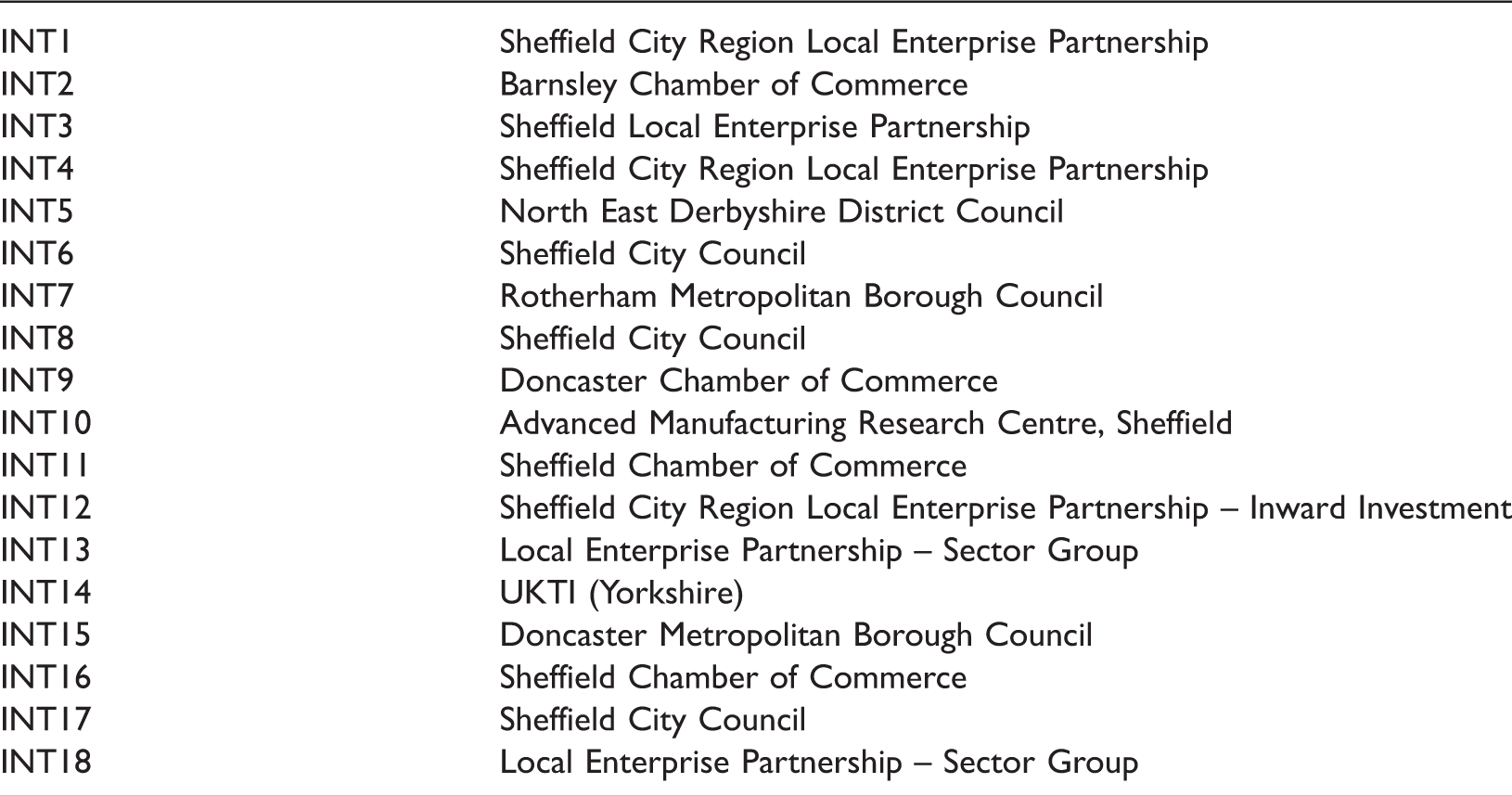
The use of in-depth interviews is particularly applicable to policy research, since they address objectives concerning contextual, diagnostic, evaluative and strategic issues and provide rich data (Silverman, 2000). Collectively, the interviews provided a comprehensive overview of economic agglomeration in the SCR, as well as providing deep insights into the extent to which policy has sought to identify and improve the economic performance. Although single region case studies permits deeper analysis (Baker et al., 2010), they are not without risks. One notable limitation is the risk of misrepresentation, with respondents offering stylised and selective accounts of past actions or future intentions rather than presenting ‘facts’ related to policy approaches (Doern and Goss, 2013). Although such biases cannot be ruled out completely, the in-depth conversational style of the interviews meant as the respondents recount their experiences the interviewers probed responses, definitions and perceptions. As such a wholly artificial story would be very difficult to sustain, and the independently coded analysis would also reduce the likelihood of presenting a distorted vision of the SCR.
Understanding the DOXA of stakeholders in the SCR
Prioritising actions is critical for local economic development. The ‘smokestack chasing’ to attract inward investment is no longer sufficient (Acs and Szerb, 2007). Yet local arrangements influence the assemblage of power and where multiple actors have different perceptions, and what is prioritised will vary (Younès, 2012a). It is against this challenges that LEPs are seeking to prioritise activities and strategies, and, within the SCR, there is increasing debate as to whether sector-based approaches are the most effective strategy for local economic growth.
The SCR economy is made up of around 54,000 small and medium-sized enterprises (SMEs) without a clear dominant sector or the presence of an OEM. While there are some large firms within the city region such as Sheffield Forgemasters International, B Braun Medical and Outokumpu Stainless, these businesses do not have the same critical mass to serve as an anchor or the capacity to galvanise SME supply chains in the SCR. In the absence of agglomeration centred on, an OEM (or equivalent) has also meant positive multiplier effects such as acting as a magnate for further inward investment is lost. This has led the LEP to primarily focus on sectoral policies, although the SCR Growth Plan notes its desire ‘to unleash over and above specific sectors’ (Sheffield City Region, 2014). Of the nine key sectors identified by the SCR Growth Plan, the top three in terms of Gross Value Added (GVA) growth are creative and digital industries (CDI), advanced manufacturing and healthcare technologies (Sheffield City Region, 2014). A fourth, logistics, was also identified as an important sector given the associated levels of high employment despite comparatively lower contributions to GVA. In contrast to Watts et al. (2003) who referred to the metals firms within the SCR as an identifiable agglomeration, we argue that the SCR lacks any regional specialism as the basis for agglomeration-led competitive advantage although the manufacturing tradition sees the sector continue to dominate headlines. As such a key question for the SCR and equivalent economies is, therefore, how to establish themselves as sites of economic growth and spaces for inward investment.
The SCR has maintained focus on the (advanced) manufacturing capabilities of the region as primarily associated with the Advanced Manufacturing Park on the outskirts of the city (Sheffield City Region, 2013). Yet despite this focus, many of the manufacturing businesses in the city region are not classified as and/or do not associate with the advanced manufacturing. One significant attempt at defining the uniqueness of the SCR has been to hang its place marketing strategy around the Made in Sheffield brand, reflecting the path dependency associated with the regions manufacturing history. The brand has been created as quality mark for manufactured products, and while not a unique marketing strategy, the Made in Sheffield brand is used as part of inward investment activities to promote the SCR at international trade fairs and exhibitioners. However, there is a tension, here as to be eligible to use the Made in Sheffield brand, businesses need to be based in the historic county of Hallamshire which is a smaller area with in the SCR today (Made in Sheffield, 2012). This is testament to the mono-centric geography of the SCR, and was reflected in how interviewees referred to ‘Sheffield’ rather than the ‘Sheffield City Region’ – an issue that was acutely pointed out by those interviews from outside the City of Sheffield. As Jones (2013) notes, such divisions have been subsumed within a narrative of ‘localism’ that in the case of the SCR is precarious and contested. Akin to Younès (2012b), in the SCR, this disagreement about priorities can be understood as a result of the multiple local stakeholders comprising in the city region with strong geographic ties and the businesses in the region demonstrating strong sectoral ties.
The continued presence of manufacturing, however, is a significant contributor to the region accounting for 8% of businesses and 60,000 jobs to the SCR economy ( Sheffield First Partnership, 2013), and growing under the auspices of engineering and advanced manufacturing. The historic metals cluster, primarily associated with the steel industry, has fostered short supply chains and the build-up of trust between local firms (Potter and Watts, 2014). Of the total GVA (around £22 million) provided to the SCR economy through materials in 2012/2013, metals contributed 31.2 per cent, steel 13.1 per cent and plastic 24.4 per cent (Williams and Vorley, 2014).
Much of the SCR's basis in materials is cross-sectoral rather than existing as a standalone sector, which is characterised by high levels of tacit knowledge and human capital across a broad swathe of manufacturing industries. Such foundations provide an essential basis for local economic development in industrial regions and should be melded into the existing institutional frameworks. Despite having no prominent sub-sector strengths in manufacturing, the SCR has cross-sectoral strengths generated from the common use of intermediary products, machinery and equipment across supply chains. Yet articulating and leveraging the cross-sector strengths of the industrial base in the SCR as part of the new grammar of localism referred to by Pugalis and Bentley (2013) has proved a challenge, in particular where industrial sectors are conventionally the basis of economic development for attracting inward investment. As one LEP team member noted, ‘selling cross-sectorial specialisms or platforms won't wash when we present our case to Government or to potential investors – it doesn't fit with the way things are understood’. (INT13) This position makes acting on behalf a region whose premise is to reflect ‘more functional economic geographies’ difficult if these geographies are not coterminous with the national level policy narratives. This apparent diversity is seen as a weakness rather than a strength when viewed through a narrow lens of agglomeration-based economic development.
In an attempt to forge a sector-led identity in the absence of a flagship business, there has been significant public sector investment in high value manufacturing. Most visibly this has been in the Advanced Manufacturing Research Centre (AMRC) and the Advanced Manufacturing Park (AMP). While the levels of private investment are increasing, the AMRC has become the principal regional anchor and asset to leverage inward investment. Yet despite advanced manufacturing being a market demand led sector in the SCR, one stakeholder (INT3) explained that there was not sufficient ‘critical mass’ for the sector alone to drive economic growth in the SCR. While the AMRC is a key node in the High Value Manufacturing (HVM) Catapult Centre, seven UK government created centres to foster innovation, it is arguably more of a national asset than it is a local one in terms of driving economic growth. Indeed despite the presence of the AMRC, one stakeholder commented, many overseas investors were interested in the UK as ‘a space of combined regional capabilities rather than local needs and capabilities’ (INT9). This reflects the finding of Ling and Martins (2015) who describe collaboration and co-location as ‘a national impact and not exclusive to the local region’.
The focus on the AMRC has meant that plans have been drawn up to make the SCR the site of a new Advanced Innovation District. Resonating with the ideas of Katz and Warner (2014), the Innovation District will seek to harness the potential of the AMRC, universities and the 2050 Factory which will be ‘reconfigurable’ to suit different industrial needs. This development of the Innovation District has been positioned within the path dependent perspective of agglomeration, linking the performance of the city region to the demands and co-location of transnational businesses such as Rolls Royce, Boeing and Battelle, and research performance of the region's universities.
The SCR was often described by the stakeholders as a ‘spoke’ and not as a ‘hub’, with repeated reference to the lack of an OEM within the region. Many businesses in the SCR are geared towards servicing and supporting supply chains grounded outside the SCR, and as a result, value was seen to be lost from the SCR. Among the local stakeholders interviewed, this was regarded as a priority issue, and one stakeholder even stated ‘attracting an OEM should be the priority for the Sheffield City Region. Everything else would fall into place with that’ (INT12). Although the SCR Growth Plan sets out the desire to attract at least one internationally significant OEM (Sheffield City Region, 2014), OEMs are not a panacea for growth. Indeed, OEMs which do not reinvest into a region can drain talent and resources away, while still positive about the need for an OEM another stakeholder noted that it was important to ‘get the right type of OEM, and one that will stick around for a long time’ (INT12). For the SCR to benefit from the presence of an OEM, it is less about being at the centre of a narrowly conceived cluster but rather to complement and augment existing cross-sectoral synergies and connections. The emphasis needs to be on building capacity rather than picking winners, with a view to leverage the strengths of regional firms.
To this end, and in the absence of a sectorial-led approach, the LEP has sought to foster extra-regional connectivity of businesses across and beyond the city region (Sheffield City Region, 2015). Indeed businesses across the SCR tend to be servicing non-local supply chains, often providing high-value and specialist functions. While Younès (2012b) notes, inter-sectoral or cross-sectoral connections are often undeveloped through a lack of communication between actors within a region or shared common outlet of governance, interestingly businesses in the SCR seem to have stronger ties with businesses outsider the city region than with those in it. While nearby Manchester has implemented a strategy to join-up assets as a catalyst for economic growth (GMS, 2013), the metropolitan geographies of Greater Manchester have been forged over three decades whereas the SCR is a much more recent concept and still emerging. Consequently one stakeholder stated that funding divested on a sectoral basis was ‘sheep-like in its approach’ (INT11), with sector-led regional growth strategies failing to demonstrate any appreciation of the wider economic environment. Needless to say that identifying clusters of geographically co-located manufacturing businesses will not lead to an agglomeration with characteristics akin to successful clusters such as Silicon Valley or the Third Italy. What matters for the SCR accepting and understanding its competitive advantage is not sectorial, but in how the regions material businesses service multiple international supply chains in a way that does not fit the prevailing localism policy debates.
Revealing ‘hidden’ value beyond sector-based industrial clusters
The configuration of the city regions nationally means stakeholders rely on place-based approach for developing and implementing local economic development strategies. How business leaders, civic leaders and policymakers view the economic landscape (i.e. in terms of sectors), is critically important in understanding how the strategies of localism are interpreted and implemented (i.e. in terms of clusters) (Menu, 2012). For those involved in policy and businesses related to manufacturing industries in the SCR, this has meant developing a coherent narrative for the sector. However, as discussed above, where there is a lack of critical mass in a given sector this has seen attempts to articulate the competitive advantage of the region differently.
The stakeholders stated that businesses often saw little advantage of investing in the region, since there are not established strengths in a sector. At the same time, the prospect of cross-sectoral connections served no immediate advantage unless allied to a specific project or objective. As one stakeholder noted ‘despite our best efforts to promote the SCR, it seems that to businesses seeking to develop partnerships and collaborations, there is not sufficient sector strengths in any single sector’ (INT6). This lack of critical mass in established sectors has stymied efforts to attract inward investment into the SCR, while the regions cross-sectorial strength as a ‘materials cluster’ have not helped bridge the gap as they do not resonate with the interests of potential investors.
Consequently, and especially since the deindustrialisation of the 1980s, the strengths of the SCR are not so much in terms on the intra-regional strengths of sectorial agglomeration but rather in related variety. The advantage of being part of the agglomeration of materials business in the SCR, therefore, is not in the geographic proximity to other businesses in the same sector. In relation to the aerospace sector, one interviewee noted that it was not the SCR or even the United Kingdom which was of interest, but the ‘European aerospace cluster’ (INT12). They continued to highlight the need to emphasise the value in the related variety of materials businesses within the SCR, explaining that ‘there are lots of businesses working in similar areas of different industries which is a real strength’ (INT 12). This complementarity, and the associated value added, is in the translation and cross fertilisation of ideas across sectors that can lead to innovation. In this respect the AMRC with its cross-sector focus supports innovation and capacity building and an example of what Faggian and McCann (2006) refer to as a regional knowledge asset and part of what Asheim and Cohenen (2005) call the regional knowledge infrastructure.
As well as the AMRC's role as a regional knowledge asset, it also represents an important growth pole. While there is no tier 1 OEM in the SCR, one interviewee described how ‘firms had been attracted by the AMRC’, of which the presence of Rolls Royce on the Advanced Manufacturing Park is clear testament to its importance as an anchor institution (Katz and Warner, 2014). In addition the high-profile membership of the AMRC provides links with global high-value manufacturing corporates including Boeing, BAE Systems and Mitsubishi which would otherwise have no association with the SCR. In this sense, the role of the AMRC is about more than being an anchor for the geographic agglomeration locally, it also places the SCR as part of global high-value manufacturing production networks. Consequently, another strength of the SCR is the extra-regional connections of manufacturing businesses as a result of their business models being externally facing and often export orientated.
The concept of GPNs (Global Production Networks) as a form of industrial organisation (see Coe et al., 2008) represents a challenge to traditional placed based local economic development where the emphasis is on relational proximity and processes as opposed to co-location. In the SCR, the engagement of the AMRC as well as other manufacturing business in, sees local economic development become ‘a globalised relational process dependent on the ability of local actors’ Murphy (2012: 210). As a result the implication of this for the SCR has resulted in territorial discontinuity with variegated global supply chains resulting in new forms of interregional relationships that are not premised on the co-location of sectors. This can culminate in what may appear to be a lack of industrial coherence, as the norms, practices and routines associated with the shared sector identities are lost. Indeed many of the stakeholders interviewed considered that the perception of the SCR as lacking critical mass and coherence in any industrial sector, which often deterred inward investment.
With businesses in the SCR engaged in GPNs, the importance of relational processes and proximity has seen some of the advantages of geographic agglomerations eroded. As a result, the SCR has experienced a combination of spatial and industrial reconfiguration, although one inherently geographic advantage remains the skills and capabilities associated with the local labour market. One regional stakeholder noted ‘selling the region to involve selling the strengths of the potential employees’ (INT1), which highlights the importance of appropriately skilled labour. There was a consensus among the stakeholders interviewed about the importance of strengthening the skills base through initiatives to promote investment in skills. The presence of two universities, academies run by and in conjunction with companies such as Rolls Royce, as well as the development of demand led training through the LEP skills bank were all regarded to enhance the attractiveness of the local labour market. One respondent noted how skills were an important dimension of regional marketing, stating that ‘transnational companies considered the long-term stability of re-location was dependent on the nurturing of specific skills’ (INT10). The challenge for the SCR has been developing and retaining skilled labour with pipelines into employment.
The value of these intangible assets and skills was seen as a hidden and undeveloped aspect of the SCR economy. As one local stakeholder noted, there was ‘a clear lack of co-ordinated message’ about the SCR and no outward place marketing exercise to promote inter-sectoral connections (INT16). The policy disconnects between the narratives of the SCR as a space of historical importance in the field of manufacturing and materials, the day-to-day business considerations of SMEs and multinational companies, as well as the labelling of sectors and specialisms invoked by the localism agenda are at the core of the SCR's multi-layered agglomeration experiences and synergistic relationships. However, their awareness of the need to fit into a broader ‘cluster’ at national and European level remained at the forefront of their geographical imaginations. As one local stakeholder noted, there was ‘a clear lack of co-ordinated message’ about the SCR and no outward place marketing exercise to promote inter-sectoral connections (INT16). A silo-based policy focused on particular manufacturing sectors loses the richness and diversity of the cross-cutting competencies such as metal cutting, research design, shared instrumentation and methodologies of materials production embedded in the SCR. The policy disconnects among the narratives of the SCR as a space of historical importance in the field of manufacturing and materials, the day-to-day business considerations of SMEs and multinational companies, as well as the labelling of sectors and specialisms invoked by the localism agenda are at the core of the SCR's multi-layered agglomeration experiences and synergistic relationships.
Conclusions
In this paper, we have presented the case of the SCR as an example of a region in which local economic prerogatives do not immediately interweave with national policy or the doxa of agglomeration. As an amalgam of conflicting and overlapping interests, city regions combine national strategy, central funding, human capital, inter-region completion, intra-regional strengths, inter-firm competition and the demand of international markets. In the form of LEPs, city regions have also become enveloped within a series of ambiguities including the pursuit of agglomeration (referred usually by the term clusters) that is not easily defined and struggles to operate across various scalar and sectoral boundaries. This is a challenge which is not unique to the SCR, and we have shown that theoretical ambiguities can lead to a priori and ill-defined policies for economic growth.
From the perspective of innovation and entrepreneurship, it is often SMEs and start-ups that are the source of innovation, rather than the large firms seeking geographical expansion into new markets and acquiring established firms. This is contrary to the prevailing SCR strategy of focusing on the capture of an OEM to the region, either by concentrating on particular sectors or by chasing large OEMs to re-locate in the region as a means to generate economic growth. There are, therefore, questions which emerge over the reliance of policymakers in the SCR and other city regions to encourage the re-location of multinational firms, who by definition, operate according to a footloose industrial location strategy. Indeed any attempt to attract inward investment to the SCR needs to emphasise the strategic as well as the operational value.
The large capital investments into the high value manufacturing end of the material platform, through the plans for an Advanced Innovation District, may be future-oriented but they are not necessarily reflective of the broader regional connections which exist underneath this layer of agglomeration. There is a potential for such projects to be trapped within a fetishised notion of the cluster that can be replicated. Without the necessary infrastructural changes across the city region in terms of employment, health and education, there remains a two-tier and unequal localism which promotes a certain ethos of economic growth and ignores the variegated landscape through which SMEs, universities and associated industries have emerged in the city region. Indeed the support of entrepreneurs and small business has been shown as vital to the future of the SCR in providing both economic and social resilience (Williams and Vorley, 2014).
Increasingly, clusters have become a heuristic rather than a technical concept, yet if clustering policy is to be effective, it needs to be more dynamic as opposed to focusing exclusively on industrial sectors. As the empirical study highlights, any semblance of a cluster within the SCR is a work in progress. The position of the SCR in GPNs is critical to leveraging the otherwise hidden capabilities and competitiveness of the agglomeration. In attracting FDI, there needs to be a shift in the strategy towards cross-sector competencies as opposed to sector strengths, which runs contrary to prevailing cluster policy, which resonate with the strategies of firms and whereby the wider business environment provides the firm a competitive advantage. Such synergies are not always accounted for in local economic development policies and strategies that prioritise on delivering growth through the attraction of large transnational firms to serve as anchors for sectoral clusters. In much the same way that the discourse of clusters has developed, policy thinking must also.
The paper has sought to illuminate the hidden cross-sectoral strengths, most notably in the form of shared technologies, skills and cultures of manufacturing, which have not been well articulated by policymakers and stakeholders who have sought to construct the competitive advantage of the city region in more narrow sectoral terms. This norm is seemingly a response to sector-led policies and funding pressures from central government, although we have shown the reality of agglomeration in the SCR to be a more complex series of unifying regional connections (Fornahl et al., 2015). For those agglomerations where there is not a defining industrial sector with a national competitive advantage, as is the case with the SCR, reinterpreting clusters can provide a useful strategy for policymakers. Instead of trying, present a place in terms of an a priori model of a cluster, the strength of agglomerations are better articulated in terms of cross-sectoral skills and a strong SME community that are international and export-oriented. For policymakers in regions such as the SCR who are seeking to leverage agglomeration based economic growth and employment, there is a need to understand that the basis of clusters is more than sector-led and is in a constant process of being made by a myriad of actors. In problematising myopic sector-based views of agglomerations, such as in the SCR, this paper has identified the need to articulate the often hidden cross-sectoral strengths of city region agglomerations. In so doing, the paper seeks to challenge the focus on industry-focused agglomerations by revealing the importance of alternative cross-sector competencies as the basis of competitiveness for contemporary agglomerations.
Footnotes
Declaration of conflicting interests
The author(s) declared no potential conflicts of interest with respect to the research, authorship, and/or publication of this article.
Funding
The author(s) received no financial support for the research, authorship, and/or publication of this article.