







Abstract
This article draws on findings from two longitudinal case studies of voluntary organisations engaged in delivering social care services via purchaser–provider relations with local authorities. The study focuses on changes to contractual relations, employment conditions in provider organisations and service quality. The article argues the influence of the market on these changes can only be adequately comprehended by rooting the analysis in an understanding of the way in which surrounding regulatory frameworks shape its structure and operation. In doing so, it reveals how in an era of shifting market conditions characterised by greater competition and dramatic local authority cuts, a ‘soft’ regulatory framework offers little support to partnership relations between voluntary organisations and local authorities. Instead, the regulatory environment undermines financial security among voluntary organisations, degrades employment conditions in them and raises concerns regarding their service quality.
Introduction
The purpose of this paper is to explore the way in which regulatory frameworks shape the structure and operation of the Scottish social care market place and hence influence purchaser–provider relations between local authorities and voluntary sector providers of social care. Previous studies have pointed towards how New Public Management (NPM) has shaped social care markets and thereby prompted detrimental changes to the terms and conditions of employment of workers in voluntary sector providers due to competition and pressures on public sector budgets and price. The same studies have highlighted more tentatively subsequent detrimental consequences for service quality outcomes (Baines, 2004: Cunningham, 2008: Cunningham and James, 2011).
Using a longitudinal analysis of two voluntary sector organisations, this paper provides a different conceptual lens through which to explore the employment outcomes flowing from purchaser–provider relations in social care. In particular, it adopts a framework of analysis under which public service outsourcing is conceptualised as a ‘regulatory’, as well as a ‘market’, process. That is an approach which recognises the value of theoretical perspectives which acknowledge that the advance of the market does not wholly replace state regulation but rather involves a re-configuration of regulatory roles, forms and relationships in a way that enhances the position of some (market-based) actors and reduces that of others (MacKenzie and Martinez-Lucio, 2005; Martinez-Lucio and MacKenzie, 2004). In adopting this conceptual framework, the paper has three main concerns. The first is to explore how market mechanisms and regulation have changed the economic fortunes of voluntary sector organisations. The second is to investigate the implications of these changing fortunes for employment relationships in voluntary organisations. Finally, the last is to examine the degree to which they are associated with detrimental changes to service quality.
This article proceeds through four inter-related stages. It commences with a two-part literature section. The first part of this provides a summary of the theoretical framework of this paper while the second uses this framework to explore the development and nature of the regulatory infrastructure governing the product and labour markets surrounding social care outsourcing. The next section then outlines the method. This is followed by the findings of longitudinal case studies in two Scottish voluntary sector care providers. The findings shed light on provider experiences of the contracting market place and its implications both for the employment conditions of their staff and, more tentatively, service quality. Finally, there is a discussion of the inter-connections between these findings and the surrounding regulatory infrastructure for adult social care and the light these shed on the value of utilising the paper’s analytical framework.
Purchaser–provider relations in public services – The continuing relevance of regulation in shaping market outcomes
Over the last three decades NPM has dominated thinking concerning the delivery of public services (Pollit, 1995). NPM identifies market relations, and related modes of production through purchaser–provider splits, as the most efficient approach to delivering public services (Mohammed, 2010). Following the logic of conventional market economics, it is argued that quality and pricing concerns in service delivery will both be maximised if potential providers have to compete for the right deliver services (Bailey and Davidson, 1999). In addition, efficiencies are seen to arise via voluntary organisations’ responses to threats of market entry and replacement of existing providers by alternative agencies. Moreover, these pressures for efficiencies undermine opportunities for public sector bureaucrats and their representatives to maximise their potential gains from surplus budgets (Mohammed, 2010). This last strand of analysis reflects public choice theory. This theory argues market forces would act to reduce the ability of public sector staff to be insulated from supply and demand dynamics through being employed on nationally negotiated terms and conditions in a context where reliance was placed on internal labour markets to ensure the requisite supply of skills (Buchanan, 1972).
This characterisation of market relations shaping public service delivery cannot, however, ignore the continued influence of regulation in such outcomes. As the above studies themselves suggest, local authorities do not abdicate all responsibility for delivery as they mediate service user preferences and further redefine and oversee the roles and responsibilities of providers through contracting and accountability regimes (Mohammed, 2010). Moreover, local authorities themselves are subject to certain central government controls (Bailey and Davidson, 1999).
This continuing multi-level activity by the state challenges simplistic assertions about its declining regulatory role and its increasing replacement by the ‘market’ as a source of economic and political decision-making (Mackenzie and Martinez Lucio, 2014, 2005; Martinez Lucio and MacKenzie, 2004). Drawing upon broadly based conceptualisations of regulation that encompass ‘all mechanisms of social control – including … non-state processes …’ (Baldwin et al., 1998: 4), Martinez-Lucio and MacKenzie have emphasised the need to move beyond a zero sum approach to the evaluation of shifts in regulatory policy based on a simple dichotomous distinction between ‘regulation’ and ‘deregulation’. Instead, they have advocated a perspective that focuses on how regulation moves across different regulatory sites, spaces, levels and actors as the State withdraws from, or engages in, particular forms of direct intervention in social economic affairs. For MacKenzie and Martinez Lucio (2005; Martinez Lucio and MacKenzie, 2004) the advance of the ‘market’ should therefore be seen as the product of the state acting to re-configure regulatory roles, forms and relationships in a way that enhances the position of some (market-based) actors and reduces that of others through often simultaneous processes of de- and re-regulation. Moreover, this process of re-configuration should be viewed as inherently political and hence potentially unstable because of its vulnerability to attack from vested interests and pressures for reform on the grounds of their failure to perform in line with expectations.
The framework of analysis offered by Mckenzie and Martinez Lucio provides a potentially valuable lens from which to analyse processes of public service outsourcing. This is because it encompasses two important related strands of analysis. Firstly, the analysis draws attention to the socially constructed nature of markets (Bres and Gond, 2014; Fligstein, 1996; Polanyi, 1957), and highlights the way in which the nature and operation of purchaser–provider relationships are influenced by surrounding social norms and institutions, including legally based ones (see e.g. Marchington and Vincent, 2004). Secondly, the framework enables these lines of analysis to be combined and explored in a detailed and rigorous way. In particular, by highlighting how roles and responsibilities within a regulatory space are distributed across a variety of actors, exist at different levels and take different forms, the approach provides a platform facilitating more in-depth examinations of the nature of public service markets and the factors influencing their operation.
In what follows the argument that public service outsourcing can usefully be conceptualised as a ‘regulatory’, rather than just a ‘market’, process is explored in relation to the structure and operation of the outsourcing of adult social care services in Britain.
The social care market and its regulation
The British social care market was created as part of the dismantling of the institutions and regulatory apparatus of Keynesianism. This dismantling followed New Right critiques of the failure of Keynesian welfare provision and deteriorating public services (Thompson, 2007). The neo-liberal inspired response to these critiques was to favour, where possible, cheaper and more efficient service provision via NPM involving the state’s phased withdrawal from the delivery of services and its role as a direct employer (see e.g. Entwistle, 2005; Walker and Ling, 2002). In its place came the establishment of markets made up of independent subcontracted organisations from the private and non-profit sectors (Crouch, 2011; Martin, 2011): a process of marketization that has resulted in the majority of residential and domiciliary care being outsourced (Hughes et al., 2009).
In line with the analysis of Mackenzie and Martinez-Lucio, however, this withdrawal of the state from social care delivery has not comprised a form of zero-sum deregulation. Rather, it has involved the transferring of regulatory functions to other sites, spaces and actors and accorded a greater regulatory role to forms of private product and labour market regulation. The operation of these private forms of regulation have, however, continued to be ‘framed’ by established and new regulatory decisions taken at the level of the state (see e.g. Hoggett, 1996; Mackenzie and Martinez-Lucio, 2004). Consequently, they have been associated with the establishment of a regulatory infrastructure that combines together elements of both public and private regulation (see e.g. Locke et al., 2013).
This continuing public regulation embodies elements of both ‘hard’ and ‘soft’ law and acts to impose responsibilities and expectations on both local authorities, as the commissioners of services, and provider organisations, in their capacity as both employers and the deliverers of services. With regard to local authorities, many outsourced services fall within the scope of their mandatory powers and responsibilities to deliver services relating to child and adult protection and the management of managing high risk offenders. Care governance arrangements in Scotland require, for example, each local authority to appoint a Chief Social Work Officer (CSWO), who must hold a social work qualification. The CSWOs are accountable to the Chief Executive and elected members of local authorities for the discharge of the laid down statutory service obligations. In this capacity, they have overall responsibility for social work practice and standards – whether provided directly by the local authority or in partnership with private or voluntary agencies (Social Work Scotland, 2013). As a consequence, the governance of outsourced services has come under the auspices of legally binding contracts and strict performance criteria (Crouch, 2011; Martin, 2011).
Such ‘hard law’ driven contractualisation has existed alongside more direct governmental attempts to influence the contracting practices of local authorities. The period of New Labour rule saw changes made to the regulatory space of local government procurement to introduce greater stability and predictability in the market and thereby counter perceived problems with the operation of Compulsory Competitive Tendering (CCT) during the Thatcher and Major governments (Bailey and Davidson, 1999; Kendall, 2003). In particular, there was a perception that while the calls for cost cutting and efficiencies associated with market reforms were being achieved, the accompanying improvements in service quality were less apparent (Smith, 2000). New Labour’s changes encompassed the introduction of a Best Value regime intended to ensure that issues of quality, as well as cost, are taken into account when awarding public service work, and to encourage mutuality among the various stakeholders (Higgins et al., 2004; Roper et al., 2005). They also involved the introduction of a number of softer ‘best practice’ procurement processes (Davies, 2011). Reflecting New Labour’s emphasis on partnership and quality of services, these notably included the advocacy of longer-term contracts and hence funding, the award of ‘full cost recovery’, and the involvement of voluntary sector providers in the specification of the services to be contracted (Home Office, 2005; HM Treasury, 2002; Office for the Third Sector, 2006).
For their part, care service providers are the subject of detailed (and changing) statutory requirements relating to their registration as care organisations, as well as the standards of care they provide (Care Quality Commission, 2010). 1 These standards are process and performance based in nature and reflective of the international trend towards reflexive, self-regulation that place less reliance on ‘command and control’ style prescriptive requirements (see e.g. Braithwaite, 1985; Short and Toffel, 2010). Compliance with them is monitored by a regulatory agency, the Care Quality Commission, that is armed with an array of enforcement powers, including prosecutions and inspections, and which rates the quality of services so inspected, currently on a four-point scale ranging from inadequate, through ‘requires improvement’ and good, to outstanding. 2
Labour market reforms have meanwhile both enhanced and constrained the employment policies and practices of providers. In the case of the former, this freedom has been provided by undermining the legitimacy and regulatory reach of trade unions over the terms and conditions of employment offered to staff (Cunningham and James, 2007) as a result of the actions taken during the period of Thatcher government to repeal Schedule 11 of the Employment Protection Act 1975 under the Employment Act 1980 and rescind, in 1983, the long-standing Fair Wages Resolution (FWR).
The FWR required those contracting with government departments for the supply of goods and services to ‘pay rates of wages and observe hours and conditions of labour no less favourable’ than those laid down under [essentially multi-employer] collective agreements in the relevant trade or industry for the district where the work was carried out’ (Bercusson, 1978). It further stipulated that, in the absence of such trade or industry based provisions, those provided should be no less favourable ‘than the general level of wages, hours and conditions observed by other employers whose general circumstances in the trade or industry in which the contractor is engaged are similar’. Furthermore, by virtue of Schedule 11 of the Employment Protection Act 1975, its requirements were effectively extended across the whole economy through provisions which enabled complaints to be brought on the grounds that an employer was failing to observe ‘recognised terms and conditions’, or, where no such provisions existed, relevant ‘general’ ones (Wood, 1978). The removal of these provisions served to avoid the potential difficulties they created for external, and often non-unionised, providers who wanted to depart significantly from the terms and conditions negotiated nationally in the local authority sector (Atkinson and Lucas, 2013; Cunningham, 2008).
However, echoing the argument that processes of marketization and NPM are invariably accompanied by degrees of re-regulation (Bach and Given, 2010), aspects of provider employment practices continue to be the subject of sector-specific government regulation. In order to ensure the supply of appropriately skilled labour, mandatory qualification standards have been specified based on the systems of National and Scottish Vocational Qualifications (Gospal and Lewis, 2011). Tighter controls have been exerted over recruitment through the introduction of criminal disclosure regulations (Cunningham, 2008). Reflecting the different levels at which regulation can occur (Majone, 1994), providers have also been obliged to honour the terms and conditions of staff transferred to them from local authorities (or for that matter other employers) under the terms of successive Transfer of Undertakings (Protection of Employment) (TUPE) regulations that are themselves the product of a European directive (Arthur, 2014; Cavalier and Arthur, 2006). In addition, during the period 2003–2010, these provisions were temporarily supplemented by a code of practice which provided for staff working alongside transferred local authority personnel to be provided with ‘no less favourable’ terms and conditions. 3
The current regulatory infrastructure relating to the outsourcing of British social care services is, then, the product of elements of state driven de-regulation and re-regulation which have served to create a meta-framework that simultaneously enables and constrains macro-level regulatory activity on the part of service commissioners and providers. The evolution of this framework has clearly been informed by a belief among successive governments as to the desirability of transferring service delivery responsibilities to private and voluntary sector organisations (Davies, 2011). Beyond this, however, it can be seen to have emerged from a series of relatively ad hoc policy initiatives. These initiatives have been informed by a combination of shifting ideologically and philosophical principles, and more pragmatic actions aimed at addressing perceived weaknesses in preceding ones against the backcloth of trying to minimise tensions between the potentially contradictory objectives of improving cost-effectiveness and the quality of service provision (Hood and Dixon, 2013).
The resulting meta-framework for the regulation of social care outsourcing is consequently best viewed as representing a temporary, or transitory, regulatory settlement. It is also one that embodies contradictory and mutually supporting elements. Local authorities retain responsibility for the adequate delivery of a set of mandatory services and are required to commission them in a way that strikes an appropriate balance between cost and quality considerations. Beyond this, they possess considerable discretion as to how they seek to commission services given their effective ability to ignore ‘soft’ policy prescriptions in the area. In particular, they have no ‘hard’ statutory obligations to fund services at a particular level and to therefore resource services at a level that enables providers to comply with the detailed performance standards imposed on them. Providers meanwhile possess considerable legal freedom to re-shape their employment strategies to accommodate financial pressures arising from local authority funding decisions but also face potentially serious contractual and statutory penalties if they fail to meet laid down standards pertaining to the quality of services.
These configurations of public and private regulation governing labour and product markets in social care raise three important questions concerning their operation and outcomes. First, how do market mechanisms and regulation change the economic fortunes of voluntary sector organisations, and which of them are the most influential? Secondly, what are the implications for employment relationships in voluntary organisations of these changing fortunes? Finally, to what degree do they appear to be associated with detrimental changes to service quality? Our case study data is now used to shed light on these questions.
Method
Interviewing schedule.

In the first interviews in 2002 respondents were asked to outline the changes to the regulatory and funding environment confronting their organisation over the previous three years and discuss its employment implications. Subsequently, the follow-up interviews addressed the same issues, but with a greater focus on the changes occurring in contractual relationships with local authority service commissioners and the employment-related implications flowing from them. The interviews were conducted face-to-face, lasted for between 45 minutes to one hour and were transcribed verbatim.
Below the collected data are used initially to examine what they tells us about the evolution and operation of the social care product market and its impact on the financial status of the two voluntary organisations. Following this, attention turns to a consideration of how its operation has prompted changes to the working conditions of those working in the two case study organisations, and the implications of these changes for service delivery.
Markets, regulation and the economic fortunes of voluntary sector organisations
The initial interviews conducted at the commencement of the research in 2001 confirmed that the two case study organisations were strongly engaged in bidding for outsourced work from local authorities. Indeed, they revealed them to be highly dependent on such work for their financial survival.
In case 1 it was reported that from 2001 onwards the increased marketization and outsourcing of care had enabled the organisation to emerge from a period of financial problems in the late 1990s into an era of income and employment growth through the taking on of new contracts. This picture of financial recovery and expansion contrasted with a situation of essentially ongoing stability in case 2 that was marked by an absence of significant financial problems and a good deal of continuity in service provision. Although, as in case 1, interviewees did indicate that relations with funders were variable, with some being only of a year’s duration, quite distant and falling short of ‘best practice’ commissioning. For example, it was noted how local authority officials at times attempted to impose uplifts with little negotiation and irrespective of whether these covered increases in costs by – ‘hiding behind letters or emails’ (Director of Care Services). Local authorities say ‘we will give you a percentage rise of what 2% on your salary costs, but no other. So they are recognising that there is an increase in the cost, but it doesn’t necessarily bare any relation to what we pay by way of increase salary costs.’ (Finance Manager, case 2) The ultimate sanction is calling off the service. So for us as an organisation we turn round to a local authority and say ‘what are you going to do with twenty severely disabled people? So that is the sanction and power that is the biggest power that we have as a negotiating tool. (Director of Care Services)
A common theme emerging from the interviews was how the evolving social care market departed significantly from the ‘soft’ regulatory government prescriptions of ‘best practice’ regarding local authority commissioning. ‘Full-cost-recovery’ was often not provided by funders, three year contracts remained relatively rare, and Best Value reviews of services were raising concerns because of their apparent cost-based nature, as the following quote illustrates. Some of our local authorities equate best value with cheapness. That is a thing we have to contend with, it can be another tool to drive costs down. (Finance Officer Case 2)
The subsequent 2011 and 2014 interviews in case 1 revealed a further worsening financial situation brought on by emerging public expenditure cuts. Reference in this context was made to how relationships with funders were becoming less close as responsibility for tendering processes was passed to specialist procurement teams and hence away from social service departments with whom close relationships had often been established. Providers also pointed to the changing way in which local authorities were using Approved Providers Lists (APLs). Previously APLs had been used to audit voluntary sector provider practices, including employment-related ones. By 2011, however, their usage had shifted towards a focus on reducing costs. In one case this had involved a reduction in the hourly rate (a figure that includes all employment costs, travel, management charges and costs of social and other activities for service users) from £18.00 to £14.00, and in others to calls from funders to make cuts of up to 7%. Meanwhile, in 2014 interviewees in both organisations reported that not only were local authority funding cuts continuing, but that commissioning authorities were no longer allowing them to contribute surpluses from relatively generous funding packages to reserves (as a contribution to potential redundancy payments). Instead, they were now claiming such money back.
The third round of interviews revealed a further deterioration in the financial environment. As a result, the previous relative stability of case 2 had been transformed against the background of increasing losses on its care activities flowing from local authority funding cuts and freezes during the previous 18 months. In this period, the organisation had received increases in income from only two of the 22 local authorities for which it provided services. It was also receiving notifications from commissioners of cuts of around 5% for the forthcoming year.
In this rapidly changing situation, the researchers were invited to undertake another interview as a further sharp financial shock occurred when one of case 2’s main local authority clients imposed cuts amounting to £300,000 on its forthcoming budget. During this it emerged that there was a strong possibility of more cuts coming from other funders, and that these would make the services concerned unsustainable since the scale of them meant that they could not be compensated for by drawing on financial reserves, as had previously been done.
More widely, this 2014 interview revealed how case 2’s strategy of trying to attract extra income had not been successful. Efforts to promote and expand its services among some existing funders had led to some new small contracts. However, as the BDM reported, the organisation had chosen not to compete for recent retenders of services currently held by other providers as a consequence of fears that, if successful, it would be liable for expensive accrued pension rights under TUPE. It was also reported that over the previous 18 months persistent requests by the Director of Finance to meet with local authority officials to discuss the sustainability of services in the context of austerity measures had been consistently rebuffed. As a consequence, the organisation had launched a sustainability review of its care contracts.
Changing employment conditions
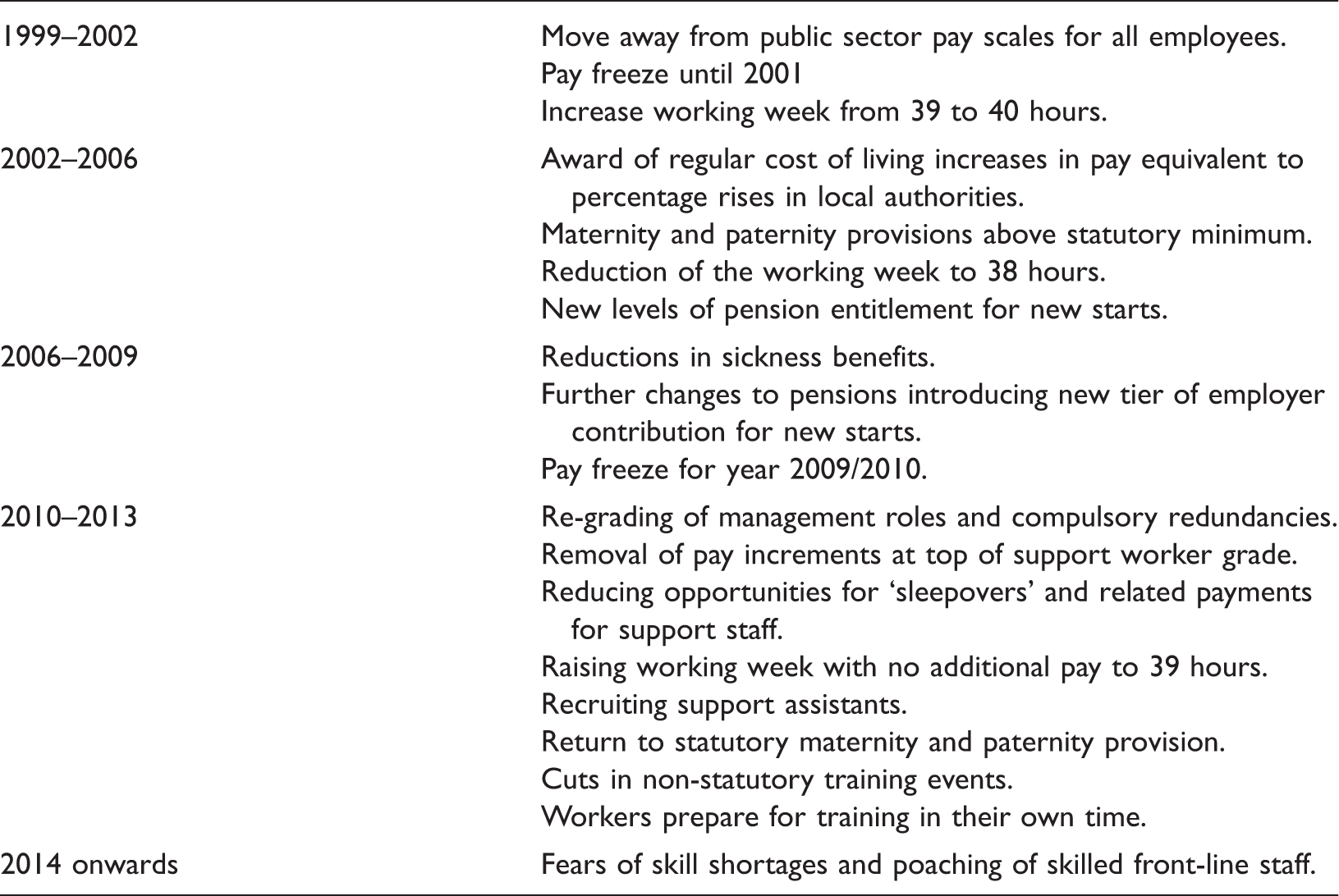
Impact of deregulation – Case 1.
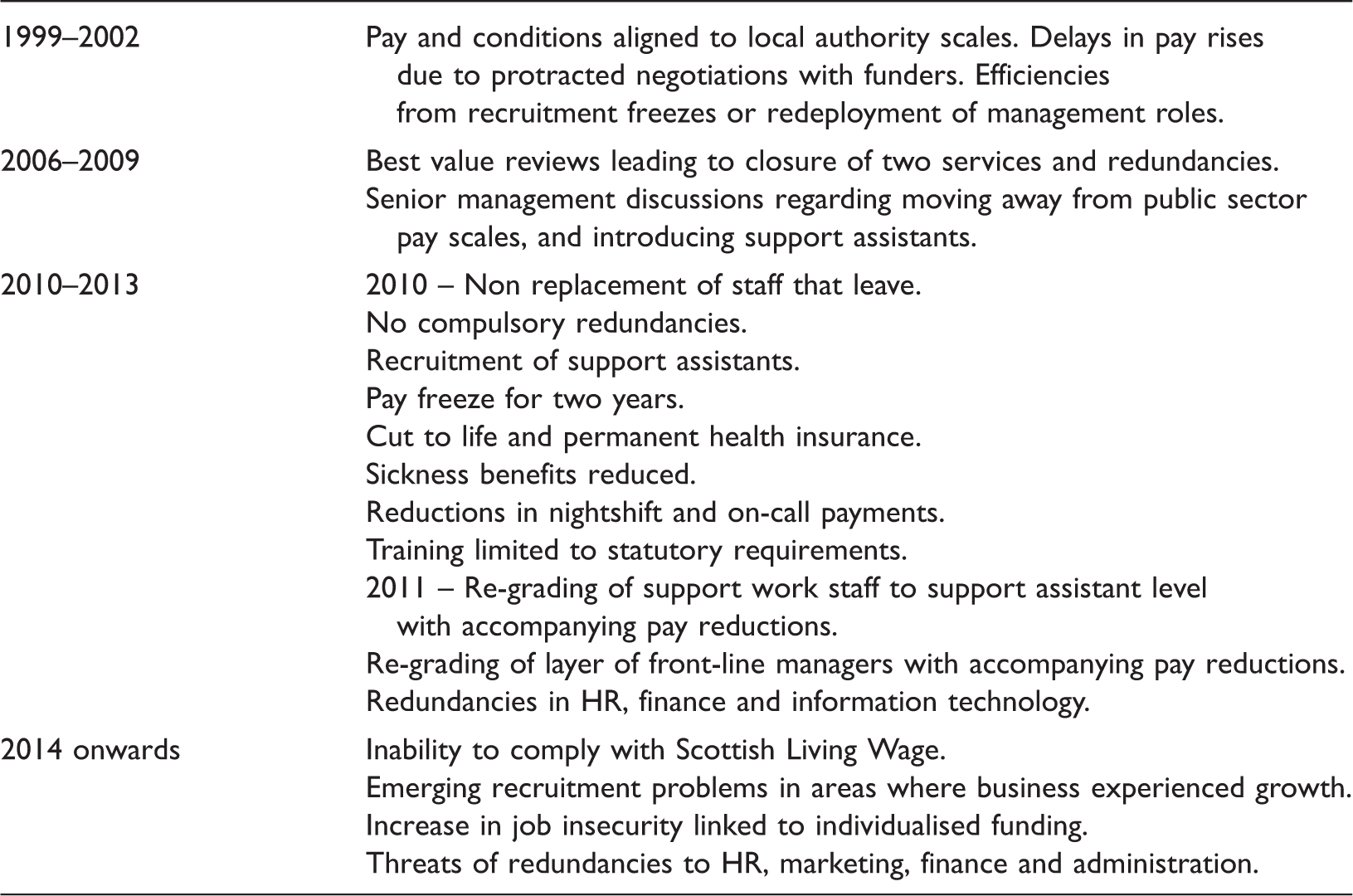
Impact of deregulation – Case 2.
In case 1, up until 1999 employees were paid salaries and conditions equivalent to public sector workers. However, from the late 1990s it was considered no longer financially viable to support these conditions and a radical reshaping of employment arrangements took place which involved the introduction of new pay scales, as well as more intensified working practices and increases in working hours. These changes were subsequently partially reversed during the period of income growth that commenced from 2001 via efforts to match percentage pay rises given to local authority workers, an enhancement of family-friendly benefits above the statutory minimum, and a reduction in the working week. In contrast, the emerging financial difficulties highlighted in the 2009 interviews were reported to have led to further negative changes in employment conditions, including changes to pension arrangements, leading to three tiers of employer contributions ranging between 17% and 4%, the reduction of sickness entitlements through the introduction of ‘waiting days’, along with the much more active management of sick leave absences, and a move away from previous efforts to award percentage pay increases similar to those received by local authority workers. We restricted pay rises last year and at the moment the decision of our board is to not to award one. We are to review that at the end of October, we have had to make other cuts and cut back dramatically on training on our SVQ activity and make a couple of posts redundant. (Senior Manager, Case 1)
Changes in employment conditions in case 2 similarly reflected its changing financial fortunes. As Table 3 shows, the first two phases of fieldwork in Case 2 revealed stability in employment conditions, with pay and conditions linked to local authority scales. The organisation retained a good reputation in terms of training and developing staff, and, to retain a high skill mix, it had resisted employing low paid and skilled Support Assistants (as opposed to Support Workers). Some strains on employment conditions were though apparent, with references being made to recruitment freezes within particular local authority regions where relations were difficult and job losses stemming from cuts engendered by Best Value reviews. There were also pressures to reduce the proportion of expenditure devoted to project/line management salaries. They (local authorities) are putting a fair bit of pressure on us to bring the number of managers down. They have been trying to pressurise us to have only one manager between the two units. (HR Manager, Case 2) Cost of living and increments we normally pay on the 1st of July annually … but the assumption has been made that we won't be. We’ve told staff we’re in a really difficult place financially. There is a pay freeze in terms of the cost of living award, and there’s also a pay freeze in terms of the increments people would normally expect to get.
In large part, the recognised unions in both organisations struggled to head off such adverse changes to the employment conditions of their members when confronted with the realities of the surrounding market pressures. In case 1 union membership had historically struggled to grow over 50 percent. On the announcement of cuts in 2011, its membership initially increased, with the workforce refusing to accept the proposed changes and industrial action being considered. Eventually after negotiations, the changes were accepted in return for a management commitment to avoid compulsory redundancies. Rather similarly, in Case 2, an initial failure to agree with the union had raised the prospect of industrial action occurring, with the union putting the organisation’s proposals to a ballot, but without recommending acceptance. The resulting vote was in favour of accepting the proposals. Subsequently, the union experienced membership decline, along with the loss of several lay officials.
Market forces had therefore effectively supplanted internal regulation by collective bargaining in both organisations and in doing so acted to weaken local union organisation. It was apparent, however, that employee–employer relations had also deteriorated, with managers in both organisations reporting widespread staff discontent. Managers in Case 1, for example, observed that: There are a number of people who are feeling very aggrieved and it will be quite difficult to motivate and stimulate those people. (Senior Operational Manager)
Service viability and quality
Such motivational challenges existed alongside more general concerns about the impact that the changes made to working conditions would have on the ability of the organisations to deliver services of an appropriate quality and to cope with the demands of competing for services in the changing market environment.
In case 1, the reductions in training and alterations to the workforce skill mix brought about by the recruitment of cheaper support assistants were seen to have worrying implications for the capacity and expertise of front line staff. In addition, although respondents in the final interviews described the organisation as ‘tender fit’ (Operational Manager) and competitive on price, fears were voiced regarding the impact of the above changes on future recruitment. If people are coming in for such low terms and conditions, we’re not going to be able to recruit. (HR Manager)
Concerns in Case 2 were also expressed about whether it would remain financially viable. For example, it was reported how the organisation had been unable to meet the request from one of its funders to meet the Scottish living wage (£7.85 per hour), and that in another local authority area the organisation was refusing new business opportunities because of recruitment problems linked to low pay. Wider still, cuts in management were seen to potentially have important implications for organisational efficiency at a time when some of its regions were experiencing increasing numbers of users managing their own social care budgets and acting as purchasers of services as a result of a government desire to encourage the greater personalisation of services (REF). These developments were viewed as challenging if existing users took their funding elsewhere, but also an opportunity if it meant more business. They were also generating uncertainties regarding staffing numbers, and what type of contract workers would be recruited on, i.e. temporary, permanent or zero-hours. Somewhat ironically, their successful exploitation was seen to require inputs from finance, marketing and HR functions which were already under pressure due to themselves having experienced significant staffing cuts.
Discussion
The central objective of this paper has been to use the findings of two longitudinal case studies of voluntary organisations engaged in the delivery of outsourced social care services to explore the value of analysing such outsourcing through the lens of the regulatory perspective of Mackenzie and Martinez Lucio (2014, 2005; Martinez Lucio and MacKenzie, 2004). That is through a framework of analysis within which the use of market relations to replace the role of the state in public service delivery is viewed as a process of regulatory re-configuration rather than withdrawal.
As was noted at the paper’s outset, there is nothing new in the idea that markets do not emerge spontaneously but rather are the product of social construction (Fligstein, 1996; Polanyi, 1957) and political decisions and actions (see e.g. Walker and Ling, 2002; Wang and Gooderham, 2014). The analysis offered by Mackenzie and Martinez Lucio, however, arguably provides a richer and more nuanced lens through which to understand the processes involved in such construction and the way in which they shape resultant market structures and outcomes. In this way, it can be argued to afford a means of moving beyond relatively static forms of institutional analysis that tend to treat regulation as an exogenous constraint and facilitator rather than as a factor that is intimately embedded in market structures as well as behaviours.
This study’s first question was to ascertain how market mechanisms and regulation change the economic fortunes of voluntary sector organisations. The presented findings point clearly to the fact that, even if, as in social care, public sector outsourcing occurs via deliberately created markets, those created do embody fundamental market dynamics whereby buyers and sellers interact in situations of finite resources to reach agreements over the supply of goods and services. Thus, it was clear that real tensions and compromises over both price and quality issues marked the relationships existing between service commissioners and providers. These relationships appeared to often be asymmetrically balanced towards the interests of the former, as a result of local authorities occupying monopsonistic market positions. At the same time, it was also clear that the use made of these advantageous market positions varied. Thus, while early interviews revealed variable purchaser–provider relationships, ranging from the highly transactional (and financially stable) to the closely collaborative, later ones indicated that they were increasingly being used to impose funding cuts, with all that these meant for the financial security of provider organisations.
Yet it was also clear from the undertaken interviews that the market exchanges reported by respondents were both directly and indirectly constrained and facilitated by the surrounding – and constantly evolving – regulatory framework governing social care delivery. In the case of the former, and in addressing our question concerning quality, the care standards laid down and enforced by the Care Commission formed an important reference point for commissioners and providers as they sought to establish and maintain market relations. Indeed, they effectively formed the financial and ethical faultiness along which exchanges between funders and providers took place. This influence was not of a deterministic nature, however. Instead, it was apparent that the two sides frequently adopted differing interpretations of what constituted an appropriate level of service quality and what resources were needed to achieve it, as exemplified by reports of how the two case study organisations had chosen not to bid for work which in their view was inadequately funded.
Meanwhile, although there was no doubt that the enforceable standards of the Care Commission did influence the funding decisions of local authorities, this was less the case with regard to the best commissioning practices promulgated by government, such as full cost recovery and the use of longer-term contracts. It appeared therefore that the soft, unenforceable nature of these prescriptions – which it should be noted were introduced by the second Blair government and hence after the initiatives of the Thatcher/Major ones aimed at encouraging the externalisation of public services – tended to be sacrificed on the altar of more immediate financial and operational objectives.
The second research question concerned the implications for employment relationships in voluntary organisations from these changing economic fortunes. The data revealed that the central way in which providers attempted to resolve the price–quality dilemmas confronting them was by revising their employment arrangements to reduce costs and increase efficiency. In both organisations, these revisions encompassed ongoing, and often dramatic, deteriorations in staff terms and conditions, as well redundancies, less expenditure on training and development and work intensification. Changes that echo those reported in a number of other studies (see e.g. Cunningham and James, 2014; Pennycook, 2013; Rubery and Urwin, 2011; Rubery et al., 2011) and which highlight a symmetry with the New Right rationales that informed the externalisation policies of the Thatcher and Major governments, as well as those subsequently pursued by the post-1997 New Labour, Coalition and Conservative governments (Thompson, 2007), and the labour market reforms that were introduced to support them, such as the FWR (Bercusson, 1978), and the repeal of schedule 11 of the Employment Protection Act 1975 (Wood, 1978).
The article also contributes to the literature by providing some judgement regarding which of these factors (market or regulation) is most influential in terms of determining these outcomes. The findings obtained illustrate clearly the argument of McKensie and Martinez Lucio. Specifically, how governmental processes of marketization encompass re-configurations of regulatory roles which act to enhance the positions of some actors and reduce those of others.
Market forces are clearly influential in how local authorities, in shifting from the direct delivery to the commissioning of services, acquired an enhanced ability to cut costs in a way that would almost certainly not have been possible with their internal workforce given their own collectively bargained terms and conditions of employment. As to the case organisations themselves, they, like the voluntary sector as a whole, gained the opportunity to expand their activities as care providers. An actor with diminished capacity to influence outcomes in the social care market in this environment are trade unions in the two case study organisations. Their already fairly weak position is further undermined by the same forces that enhance those of funders and providers.
At the same time the two cases found their freedom to deliver services – and employ staff – in the way they wanted to be more constrained. Here, the day-to-day operation of the social care market and the plight of the two case study organisations cannot be adequately understood without taking into account how the actions of its participants are crucially constrained and facilitated by the surrounding regulatory architecture. Thus, at the most basic level, this architecture determines key features of the services to be delivered and what organisations and individuals are deemed qualified to deliver them. The regulatory architecture further places through best value reviews parameters around the price and quality compromises that can be reached by service commissioners and providers. Meanwhile, the scope given to providers to cut their employment costs, has to be seen in the context of labour market regulatory changes and local authorities not having any legally binding obligations to fully fund service delivery on a reasonably long-term basis.
These observations not only fit well with the arguments of MacKenzie and Martinez Lucio but receive reinforcement from recent comparative analyses of the employment-related effects of public service contracting that show them to vary as a result of differences in the way that national frameworks regulate the relevant employment and production regimes (Jaehrling, 2015). It seems reasonable to argue therefore that an important function of empirical studies of public service outsourcing should be to provide detailed and critical examinations of the influence exerted by such regulatory infrastructures and how they can potentially be better designed to support the achievement of intended, and important, social objectives. That is to move beyond a focus on how organisations respond to surrounding regulatory contexts to engage with the appropriateness of them (see e.g. Rubery and Urwin, 2011: 135).
This last point is especially important because the evidence presented here suggests that the capacity of local authorities to establish a network of providers that can cut employment costs, is leading to concerns about their ability to maintain service quality in the face of resulting recruitment and retention problems, rising workloads and growing staff discontent.
Conclusion
Drawing on the work of Mackenzie and Martinez, this paper has used two longitudinal case studies of voluntary organisations engaged in the provision of adult social care to examine the argument that processes of public service outsourcing are best conceptualised as ‘regulatory’, as well as ‘market’, phenomenon. In each of the organisations studied, it was found that contracting relationships had become more cost-based and insecure, to have generated funding difficulties and prompted adverse changes to the employment conditions of staff. It was also apparent that these outcomes had very much stemmed from the funding pressures local authorities were under and the capacity they had to pass these on to voluntary sector providers. At the same time, however, it was further clear that these market-related dynamics were intimately connected to key features of the surrounding regulatory infrastructure and to largely be derived from them. As a result, the obtained findings are seen to add weight to the view that the operation of such outsourcing markets cannot be fully understood without due regard being paid to the nature and influence of the meta-frameworks of regulation underlying their creation and operation.
Footnotes
Declaration of conflicting interests
The author(s) declared no potential conflicts of interest with respect to the research, authorship, and/or publication of this article.
Funding
The author(s) received no financial support for the research, authorship, and/or publication of this article.