







Abstract
The local level and private actors play an important role in the implementation of climate change adaptation. The engagement of the private sector and citizens has received increasing attention in recent years. Local authorities' choice of policy instruments, the distribution of responsibilities and the benefits of adaptation as a public or a private good have a bearing on the involvement of private actors. Based on interviews and documents from Copenhagen and Helsinki, we analyse how public authorities' choices, to whom and how they shift responsibilities, can foster transformational, participatory or market-oriented elements of adaptation. The results indicate that local authorities play a dominant role in providing adaptation. Public authorities steer where the private sector and citizens are expected to take responsibilities. This mix of top-down steering, market mechanisms and citizen involvement might reduce the advantages that a shift of responsibilities towards private actors could provide for the handling of climate change adaptation.
Keywords
Introduction
The local level and urban context have been recognised as highly important for climate change adaptation 1 (e.g. Birkmann et al., 2010; Bulkeley and Betsill, 2013; Carter, 2011; Carter et al., 2015; Hunt and Watkiss, 2011). More recently, policy documents have highlighted the need for private action in adaptation (Danish Nature Agency, 2012; European Commission, 2007, 2013; Intergovernmental Panel on Climate Change (IPCC), 2014a: 25; Finnish Ministry of Agriculture and Forestry (MMM), 2014). It has been argued that climate change can overstrain public capacity for adaptation and therefore necessitates more involvement of the private sector and citizens likewise (Geaves and Penning-Rowsell, 2016; Wamsler and Brink, 2014; Wamsler, 2016). As the Danish Nature Agency (2012: 7) points out: ‘Climate change adaptation is first and foremost locally based – at the municipal authorities, companies or individuals.’
However, so far several studies indicate that local adaptation is dominated by the public sector in Europe. There is little involvement of citizens and private companies, and as far as private adaptation takes place, this often happens autonomously and without a clear intention to address climate change (Brink et al., 2016; Juhola, 2013; Wamsler and Brink, 2014, 2015). Little is known about how local authorities should foster the involvement of private actors. A clear picture of the implications this might have for adaptation, and also for wider theoretical discussion on environmental governance, is lacking. A number of authors see the emphasis on private involvement and shifting of responsibilities as a neoliberal turn in adaptation and some of the authors see its advantages in a potential contribution of the private sector to sharing risk, efficiency and flexibility in adaptation, and supporting economic growth (Konrad and Thum, 2014; Mendelsohn, 2006; O'Hare et al., 2016; Rickards et al., 2014; Romero-Lankao et al., 2013; Taylor and Harman, 2016). On the other hand, this shift in responsibilities has also been understood as an increase in participation and deliberation between the public sector, private sector and citizens addressing the complexity of adaptation and aiming at transformation via learning (O'Hare et al., 2016; Rickards et al., 2014; Wamsler, 2016; Wardekker et al., 2010). O’Hare et al. (2016) use the term ‘responsibilisation’ for this shift of responsibilities from the public sector to private actors. This responsibilisation can strongly rely on market-oriented elements and incentives for adaptation, and builds on contractual relations between the involved actors (O'Hare et al., 2016; Taylor and Harman, 2016; Thynne and Peters, 2015) or it is a deliberative process that strives towards consensus and a synergetic relation between actors, stressing the public interest in adaptation. The advantages of this approach are seen in the prevention of inequalities, and the protection and inclusion of those individuals and groups with limited possibilities to adapt (Brink et al., 2016; Penning-Rowsell and Pardoe, 2015; Phadke et al., 2015; Thynne and Peters, 2015).
Several authors have noted that responsibilities can remain unclear in new policy areas, in this case adaptation (Bulkeley, 2013: 187–188; Burton and Mustelin, 2013; Carter, 2011; Kern and Alber, 2008; Urwin and Jordan, 2008; Wamsler and Brink, 2014). Depending on the policy instrument chosen by public authorities, responsibilities are either mandated by law, i.e. top-down instruments, delegated by a public authority or self-initiated (Mees et al., 2014). Soft policy instruments encourage participatory and partnership approaches for adaptation by involving private actors (citizens or companies), allowing them to influence the goals of adaptation and the distribution of responsibilities; whereas with harder or more top-down instruments, public authorities define the goals and allocate responsibilities between public (state, municipalities) and private actors (Jordan et al., 2005; Mees et al., 2014; Tennekes et al., 2013). The allocation of responsibilities and choice of policy instruments also touch upon the debate of adaptation as a private or public good, and how its benefits are shared between those who participate in adaptation and those who do not (e.g. Geaves and Penning-Rowsell, 2016; Mendelsohn, 2006; Osberghaus et al., 2010b; Tennekes et al., 2013; Thynne and Peters, 2015; Wamsler and Brink, 2014).
We propose that the interplay of policy instruments, distribution of responsibilities, and public or private benefits of adaptation can appeal to private actors in very different ways and affect private actors' capacity to adapt. We examine these themes from the perspective of the local public authorities in two cities by posing the following research questions. First, how do local public authorities' choices of policy instruments for adaptation interact with the distribution of responsibilities between public authorities, companies and citizens? Second, are the benefits of the selected adaptation measures a public or a private good? The answers to these questions allow us to reflect on the implications for the envisaged increased private involvement in adaptation at the local level and its meaning in terms of responsibilisation in governance.
Analytical framework
Background
To understand how policy instruments, distribution of responsibilities, and the benefits of adaptation as public or private good can be interlinked, it is necessary to first look closer at each of these separately.
Broadly speaking, adaptation benefits can be considered as either public or private. The benefits of adaptation measures are a private good if they only accrue to some persons, while others are excluded (excludable), and if they are, once consumed by somebody, no longer available for anybody else (rival). Adaptation benefits are a public good if they are accessible to all citizens (non-excludable) and they can be enjoyed by many without reducing their availability (non-rival) (Geaves and Penning-Rowsell, 2016; Konrad and Thum, 2014; Tennekes et al., 2013).
On the one hand, adaptation can be a private good that is expected to be provided under market conditions. On the other hand, adaptation can be a public good, which is supposed to be provided or managed by the public sector (for a more nuanced account of public and private goods see e.g. Geaves and Penning-Rowsell, 2016; Mendelsohn, 2006; Thynne and Peters, 2015). For example, dykes for flood protection are often considered a public good (Tennekes et al., 2013), but adaptation in agriculture (Mendelsohn, 2006) or the cooling of homes as adaptation to potential heat waves can be seen as a private good (Tennekes et al., 2013). However, beyond the classical economic notion of public goods as non-rival and non-excludable, equity questions, security of supply, and uncertainty and incomplete information inherent to future climate change scenarios make it challenging to define how the responsibilities for adaptation should be distributed (Geaves and Penning-Rowsell, 2016; Mees et al., 2012; Osberghaus et al., 2010b).
Tennekes et al. (2013) further point out that the responsibility for adaptation is not a one-dimensional issue or simply a question of more or less responsibility. They divide responsibility into four dimensions: the initiative for adaptation action, its implementation, its financing and the liability for remaining risks. Given this division, responsibilities can be distributed differently in kind and in degree 2 between public and private actors.
When examined closely, neither the responsibilities for, nor the enjoyed benefits of adaptation actions are exclusively public or private. In practice, dykes or other adaptation measures related to flood risk management (e.g. floating houses, pumps, elevated ground level) are often built and managed by small communities or individuals, as shown in examples provided by Baron and Petersen (2015) and by Mees et al. (2014).
It is further understood that the existing context, ideologies and underlying rationales for adaptation influence the choice of policy instruments 3 and the modes of public–private interaction (Felli and Castree, 2012; Fünfgeld and McEvoy, 2014; Juhola, 2013; Klein, 2016; Klein et al., 2016; Mees et al., 2015; O'Hare et al., 2016; Rickards et al., 2014; Romero-Lankao et al., 2013; Taylor and Harman, 2016; Tennekes et al., 2013). The emergence of governance has influenced the way in which power and responsibilities are allocated between the public and private actors including individuals and companies (Anguelovski and Carmin, 2011; Hooghe and Marks, 2003; Jordan et al., 2005).
Strong top-down steering and legally binding regulations as policy instruments mean that the municipality or any higher-level public authority assigns responsibilities to the public sector, companies or citizens (e.g. Dessai and Hulme, 2004; Kern and Alber, 2008). Bottom-up and participatory policy instruments give citizens more possibilities to engage in and influence the planning of adaptation, share problem ownership and influence the distribution of responsibilities, thus affecting relationships between local authorities and citizens (Allmendinger, 2009: 197–220; Amaru and Chhetri, 2013; Arnstein, 1969; Healey, 1997; Stoker, 1998; Van Asselt and Renn, 2011; Wamsler, 2016). In contrast, market-oriented approaches utilise partnerships between the public and the private sector, aiming for flexible responses, efficient solutions or economic growth (Harman et al., 2015; Kuronen et al., 2010; O'Hare et al., 2016; Rickards et al., 2014; Taylor and Harman, 2016; Thynne and Peters, 2015). Finally, public authorities often use a range of policy instruments simultaneously to tackle impacts of climate change. Hence, ‘it is the mix between the modes of hierarchy, market and networks, and instruments employed that really matters’ (Juhola, 2013: 4).
Framework of the study
Policy instruments can be applied across many levels of governance (from intergovernmental to local) and they are not restricted to the interaction between municipalities and private actors. Governance also includes vertical and horizontal interaction, as well as networks that go beyond traditional notions of state and territory (Bulkeley, 2005; Juhola, 2013; Juhola and Westerhoff, 2011). So far, there has been little compelling guidance from higher institutional levels for climate change adaptation at the local level (Bauer et al., 2012; Juhola, 2010; Kern and Alber, 2008; Wejs, 2014). In our two case cities, we therefore focus on local authorities, the private sector and citizens, and examine how responsibilities are allocated through policy instruments. Via the allocation of responsibilities, the policy instruments also indicate assumptions of whether adaptation is considered to be a public or a private good (Geaves and Penning-Rowsell, 2016).
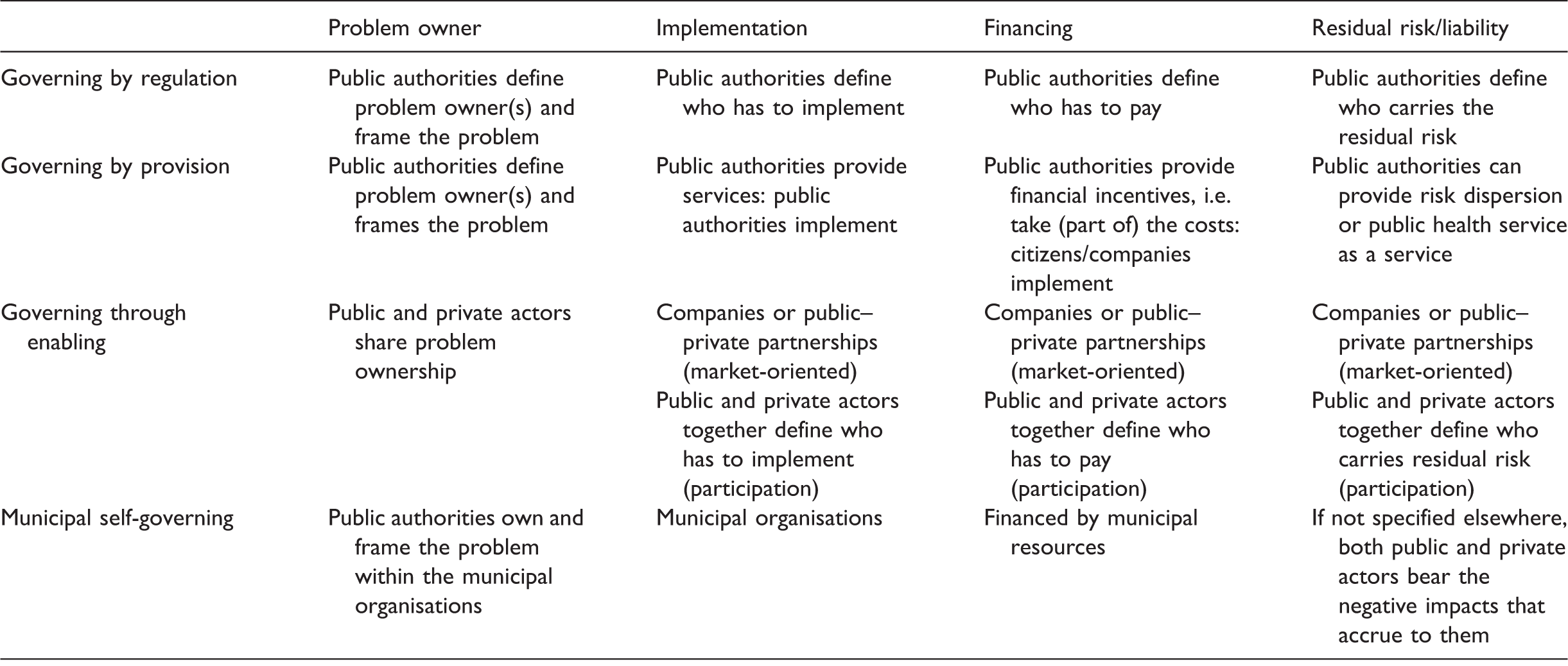
In this paper, we bring together the four policy instruments identified by Kern and Alber (2008) and the four dimensions of responsibility defined by Tennekes et al. (2013). Kern and Alber (2008) consider policy instruments a spectrum of instruments, from hard, i.e. governing by regulation, to softer instruments, i.e. governing by provision or through enabling, and self-governing. Governing by regulation means top-down governing with the help of hard policy instruments and the potential of sanctions. Governing by provision can be done by softer instruments, either by the provision of (financial) incentives or by the provision of services. Governing through enabling is based on the provision of information and knowledge, but includes also the facilitation of partnerships with the private sector and citizens’ participation. Finally, we understand Municipal self-governing in Kern and Alber's (2008: 174) terms as ‘the capacity of local government to govern its own activities, for example by improving energy efficiency in government offices and other municipality-owned buildings. Self-governing relies on reorganisation, institutional innovation and strategic investments.’ This has, in the context of our study, at least two implications: first, that the municipality focuses on the organisations within local authorities and second, that it does not actively govern private actors’ adaptation (Juhola, 2013; Kern and Alber, 2008).
The four dimensions of responsibility suggested by Tennekes et al. (2013) are grouped according to the implementation process of an adaptation measure. The Problem ownership indicates who or which organisation takes initiative for adaptation and frames the problem, e.g. by advocating a certain technical or organisational measure. Depending on the problem framing, the Implementation can leave room for discretion or it can be largely predefined. The Financing of adaptation can be the responsibility of public authorities, via taxes and the organisations' budgets, or it can be the responsibility of citizens and companies in the form of fees for services, insurance premiums or the price for commodities. Liability concerns the question of who carries the (financial) risk that remains after the implementation of an adaptation measure.
Policy instruments and the allocation of responsibility.
Methods
Two case study cities
We conducted a study based on interviews and document analysis in Helsinki and Copenhagen. Both case study cities have been active in adaptation (City of Copenhagen, 2011, 2012; Haapala and Järvelä, 2014; Yrjölä and Viinanen, 2012). Both are the capital cities of their countries and centres of wider metropolitan regions with 1.1 million inhabitants in the Helsinki metropolitan area (City of Helsinki Urban Facts, 2014) and 1.8 million inhabitants in the Copenhagen metropolitan area (Statistics Denmark, 2015). Finland and Denmark are Nordic welfare states with comprehensive public policies, extensive social security and strong equality policy (Kvist, 1999). In both countries, the municipalities have authority over local general and detailed planning and have municipal tax income (Keskitalo, 2010).
With the juxtaposition of examples from Helsinki and Copenhagen, we show how the choice of policy instruments and distribution of responsibilities interact and provide different types of adaptation with different shares of public and private contribution. The juxtaposition cannot, however, provide a causal explanation for why the two cities prioritise different steering instruments and different types of adaptation, nor depict the full policy-making process, including all its contingencies. In fact, adaptation in Helsinki and Copenhagen is not limited to the examples presented in this study, but both cities use an array of steering mechanisms and adapt in many ways.
We analyse two specific areas of adaptation: first, adaptation to increased precipitation and more intense rainfall, and second, adaptation to the intensification of the urban heat island (UHI) effect. Both cities assume the urgency for adaptation to be very high with respect to precipitation and lower with respect to the UHI effect (City of Copenhagen, 2011; Haapala and Järvelä, 2014). The interviewees considered adaptation to changing precipitation patterns to be a pressing issue, whilst tackling of potential impacts of the UHI effect was considered less urgent.
Data collection and analysis
We performed 16 interviews in Helsinki and 10 in Copenhagen during 2013. 4 The semi-structured interviews were conducted face-to-face (one Skype interview) and the interviewees were selected based on their involvement in adaptation in Helsinki and Copenhagen. We interviewed in total representatives of 12 local administrative departments (8 in Helsinki; 4 in Copenhagen), three sub-regional organisations (3; 0), five research organisations (2; 3), one political representative (1; 0), two consultants (1; 1), two municipality owned public service companies (1; 1) and one national authority (0; 1). The full list of interviewed organisations and the interview questions are in the Supplementary material 1 and 2.
The interviews were transcribed and analysed with the help of ATLAS.ti qualitative analysis software. We also analysed strategic documents on climate change adaptation (City of Copenhagen, 2011; Yrjölä and Viinanen, 2012) and storm water management (City of Copenhagen, 2012; Nurmi et al., 2008) which were mentioned by the interviewees.
Operationalisation of framework
The interviews and strategic documents are analysed in three steps. In the first step, the policy instruments for specific examples of adaptation are identified. As far as possible we specify whether the steering is targeted at citizens or the private sector. Interviewees representing public authorities described how they steer, whereas interviewees of private organisations described how they are steered. In the second step, we analyse how responsibilities are distributed between public authorities, companies and citizens according to policy documents and interviewees, as well as how the interviewees defined the distribution of responsibilities vis-à-vis policy instruments. In the third step, we analyse how the distribution of responsibilities relates to adaptation as a public or a private good.
Results
Storm water management and climate change adaptation in Copenhagen and Helsinki
Storm water management – Copenhagen
Storm water management has the highest priority in Copenhagen (City of Copenhagen, 2011, 2012). This is mainly because of the focusing event (Birkland, 1997) of the cloudburst of 2 July 2011 that was explicitly mentioned by 8 out of 10 interviewees. The Copenhagen Climate Adaptation Plan (City of Copenhagen, 2011), which was published before this event, recommends the handling of rainwater locally, and its retention and infiltration in accordance with the Sustainable Drainage Systems (SuDS) approach as far as possible. As a ‘plan B’, the document recommends guiding the water on the surface to areas where it causes the least harm. The 2011 cloudburst and the resulting political demand for action is reflected in the content of Copenhagen's Cloudburst Management Plan (published after the event, City of Copenhagen, 2012), stressing the need for implementation of ‘plan B’. It points out areas that are suitable for storm water storage on the surface and for discharge to the sea. Both approaches, SuDS and the ‘plan B’ recommend that storm water is handled on the surface. These measures reduce the need to retrofit the underground sewage system to accommodate more water.
The SuDS and ‘plan B’ clashed with established routines and the legal framework, and brought new challenges to the municipality and the water service company (HOFOR, owned by Copenhagen and other municipalities). Therefore, adaptation to changing precipitation patterns and more intense rainfall has entailed changes in legislation, as well as rearrangements and clarifications in the distribution of responsibilities between the municipality, HOFOR and private actors.
The Cloudburst Management Plan (City of Copenhagen, 2012) has helped to clarify who is responsible for implementing and financing measures. The plan has a mainly municipal self-governing character, since it ‘is not per se legally binding – neither for property owners, the utility company, nor the City Administration.’ (City of Copenhagen, 2012: 21). Special attention has been paid to the distribution of implementation and financing responsibilities. If public (green and blue) space
5
is used for storm water retention, the actual storm water handling will be the responsibility of HOFOR. However, the maintenance of the area for recreational purposes is implemented and financed by the municipality. This is also confirmed by the interviewees: Some parts of the green area will be maintained by the water company, so for instance the water company will be responsible for changing the soil when it's polluted, while the city of Copenhagen will have the responsibility to make sure that area is attractive. (C6) The water management company, they pay through the water fees for everything that has to do with the basic water management, whether [it] is above or below ground. So different technicalities about [the] way the payment is split up. But I mean, basically, that's paid by the water fees. And everything that has to do with the urban design as such, is paid by taxes. (C5)
The role of private actors is highlighted in the Cloudburst Management Plan when it comes to the protection of private property. It is HOFOR's task to safeguard that the water level does not exceed the ground level by more than 10 cm once in a 100 years. Owners of private properties, both companies and citizens, are responsible for the implementation and financing of adequate protection measures up to a water level of 10 cm above ground. This distribution of responsibilities is also governed by legal regulations (Koerth et al., 2014): You are responsible in Denmark to protect your basement. That's your responsibility. With extreme rain you must protect your building up to 10 cm level. And this is told to them again and again and again. That's part of the protection of the city, this is your responsibility. (C4)
Storm water management – Helsinki
In Helsinki, storm water management was considered an important issue by 12 out of 16 interviewees. Two central drivers emerge from the interviews: the Storm Water Strategy (Nurmi et al., 2008) and the storm water working group (established according to the goals of the strategy). Both the Storm Water Strategy and the working group have helped to coordinate and structure planning processes, and to distribute responsibilities between the municipal organisations. This means that the strategy and the working group are the foremost instruments of municipal self-governance. Hence, At the city level are different departments, and they have a working group. This is an established practice that we have municipal working groups and a flood strategy and a storm water strategy. (H2) Actually, adaptation in our department means to plan the construction of flood barriers. Storm water issues, the practical matters are at our department. We also participate in the storm water group that is led by the Environmental Centre. (H3) In short, this means that the runoff of heavy rains, floods, flood water, is slowed down. When we plan new areas in the city, they get infiltration areas and retention areas. So it doesn't go straight on the asphalt to the sea … The flow is slowed down. This is the basic idea of the storm water programme, this is preparation. (H10) … in Helsinki we made a storm water strategy in 2008. I think that all big cities have something like this. This has basically shifted the rain water processing completely to the plot. The most important criterion to start with is to locally infiltrate and process as much as possible. That is with respect to climate change certainly an important thing. The Building Control Department has its role in it, as we require a storm water plan in the permit phase for new developments. (H12)
When private builders (companies, developers or individuals) are requested to handle storm water on site, the implementation and financing become private responsibilities. However, this does not make storm water management a private good since the privately financed and built local storm water infiltration and retention helps to reduce the flood risk for all people in the storm water catchment area. This reduction is by and large non-excludable and non-rival, i.e. it is a public good.
According to Helsinki's flood guidelines (City of Helsinki, 2013), citizens are also responsible for the protection of their private homes and goods. This issue was not, however, mentioned by the interviewees. A recent change in Finnish legislation shifted the liability for damages from the state to private actors (MMM, 2011). Most home insurances cover flood damages since the law came into force, but this type of insurance is not compulsory (Aarre, 2014). This means that property owners either fully carry the residual risk or take an insurance to share the risk. If property owners take a flood insurance, this means a shift of problem ownership towards insurance companies defining the premium and limits of flood insurance (Adger et al., 2013; Kokko, 2015; O'Hare et al., 2016; Penning-Rowsell and Pardoe, 2015).
Helsinki vs. Copenhagen
Policy instruments, adaptation measures for increased precipitation and distribution of responsibilities for two examples in Copenhagen and Helsinki.
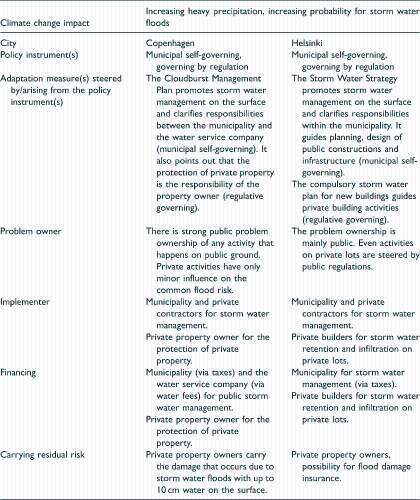
The guidance of citizens and private companies has become relevant only after the initial introduction of these self-governing policy instruments. While the Cloudburst Management Plan of Copenhagen stresses the owners' responsibility to protect their own property (in terms of implementing and financing flood protection measures), the Storm Water Strategy of Helsinki gives the highest priority to storm water management on site highlighting the property owners' responsibility to implement and finance the infiltration and retention measures.
Copenhagen and Helsinki promote different types of adaptation measures to be implemented and financed by private actors. Whereas the protection of private property is predominantly a private good, the infiltration and retention of storm water is mostly a public good that reduces, albeit maybe only marginally, the flood risk for a large group of people, providing non-excludable and non-rival benefits.
Urban heat island (UHI) effect and climate change adaptation in Copenhagen and Helsinki
UHI effect – Copenhagen
The UHI effect and adaptation to higher urban temperature received far less attention by the interviewees in Copenhagen than the issue of storm water management. The Copenhagen Climate Adaptation Plan lists it as the third priority (City of Copenhagen, 2011).
The interviewees in Copenhagen referred to UHI in three different ways. First, four interviewees stressed the role of urban structure, and more specifically, green and blue space. Second, the heating and cooling of houses were mentioned by four interviewees in connection with questions of energy efficiency and climate change mitigation, and third, two interviewees mentioned plans for district cooling. The order of measures used for dealing with rising temperature was explained by an interviewee in the following way: They are working with it on two levels, first of all greening of the city is simply trying to make the city cooler, … actually three levels, and then they are working on the way they build houses, a lot of them are built in a way that they use … the flow of air actually to cool the building itself, so a natural cooling system. […] But that's of course with new buildings. And then there is [the] final one … they are working slowly on implementing district cooling: we basically use harbour water, water to cool buildings. (C5)
Managing UHI by urban planning also has elements of governing by regulation. Legally binding plans can imply restrictions on where to build or how to build (e.g. requirements for green roofs). And if you talk to the urban renewal people, they have specific goals in how to get the existing buildings changed so that we can be better at using heat. There are a lot of specific goals for them as well: How many solar sun cells do we want and how many green roofs do we want. (C9) We've had more than 80 social activities taking place on this our first, climate adapted square, starting with a square that did not have a name, a square that was 60% asphalt, 40% green and the green part was used as a dog toilet. And having discussion about how this area was going to be changed from dog toilet /asphalt parking area to a climate adapted square requires not only that you call a public meeting, because no one would know what you're having the meeting about, because there's no name for the square. […] So we have a lot of different activities taking place and all kind of structures, manners. (C6)
UHI effect – Helsinki
The Environment Centre of the City of Helsinki identified UHI as a phenomenon that needs attention (Yrjölä and Viinanen, 2012), suggesting improved building structures and shading, green roofs, the planning of urban green space, as well as district cooling as potential adaptation measures with no clear prioritisation.
In the interviews, adaptation to UHI was addressed by only six out of 16 interviewees. Building structure and district cooling seem to be preferred over urban planning with three interviewees referring to building structure as an important factor in influencing indoor climate and temperature, e.g. in the following way: We don't have any air conditioning. We were considering it for the last 30 years, but there was never enough money. Exactly here, we would need some innovative and energy efficient solutions. (H15, sitting in a hot municipal office building) There has been a trend – especially if it as hot as it is now – that the need for cooling has grown. Now it is quite common in office buildings, but in future also residential buildings will have more air conditioning. This will consume a lot of electricity, if traditional solutions are used. So we can offer district cooling that works half of the year with sea water and in the summer with absorption heat, that is with otherwise lost energy. This is very energy efficient and reduces the climate impact. (H13) There [the project “Taking climate change into account in urban land use planning”] we researched, what kind of microclimate we will get if the plans are implemented. For example, when you consider how you plan different routes and buildings, building masses and their windiness. (H6)
Helsinki vs. Copenhagen
Adaptation measures for increased UHI effect, policy instruments and distribution of responsibilities for two examples in Copenhagen and Helsinki.
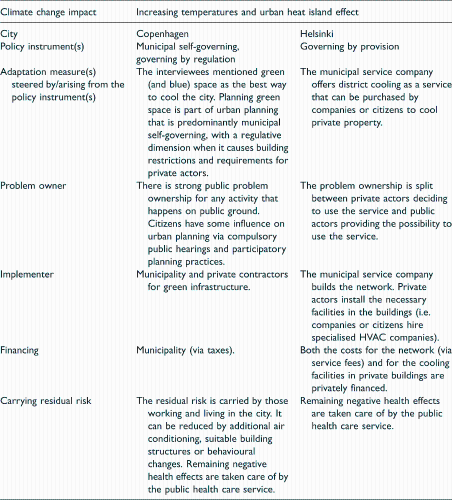
Urban blue and green space that helps to cool the city is a public good provided by the local authorities to all citizens. 6 All responsibilities are mainly in the hands of the local authorities, although citizens have some influence on urban planning, which gives them problem ownership. It is very difficult to exclude citizens from the benefits of a cooler city structure (non-excludable), and people can enjoy the blue and green spaces without reducing each other's cooling benefits (non-rival with certain limits).
District cooling that can be purchased by citizens and companies is a private good that is provided by the municipal service company. After the principal decision to build and invest in a district cooling network, the responsibilities for this type of adaptation are in private hands. Property owners decide whether they use the service, and if they chose to do so, they have to install the necessary facilities and pay for it. Thus, this type of adaptation is not accessible to everybody without restriction. The availability of cool air depends on the decision of private actors, and the decision does not only depend on the perceived need for cool air but also on the individual capacity to pay for it.
Discussion
In the backdrop of increasing demand for private action and responsibility in adaptation, this study shows that the interplay of local authorities' choice of policy instruments, distribution of responsibilities and the type of adaptation can affect how much action citizens or companies want to take and can take. Thus, the findings of this study raise important questions related to the incentives and rationales of private adaptation action, as well as the capacity of private actors to engage in adaptation.
In both cities, the analysis shows that public authorities are the major problem owners, financers and implementers of adaptation, despite national strategic documents pointing to the important role that the private sector and citizens should take (Danish Nature Agency, 2012; MMM, 2014). Nevertheless, our study also finds elements of both market-oriented and deliberative responsibilisation.
Both cities take a prominent position in providing adaptation as a good of public interest, which is well in line with the Nordic tradition of the welfare state and a ‘statism’ governance approach (Thynne and Peters, 2015). Both cities take on many responsibilities by publicly implementing new ways of storm water management, e.g. infiltration and retention on the surface that complement the rather rigid system of underground sewage pipes. In addition, both cities steer private adaptation action in storm water management with regulative instruments, although they steer distinctively different private actions. UHI is addressed by urban planning in Copenhagen, with public authorities providing a public good, whilst the issue is strongly framed by the district cooling provided by the municipality-owned service company in Helsinki.
Despite the dominant role of public authorities, the results also show that adaptation to any particular climate change impact is not a uniquely public action, but that the responsibilities are distributed in kind and degree among public authorities, the private sector and citizens. This is in line with recent studies from the UK and the Netherlands (Geaves and Penning-Rowsell, 2016; Tennekes et al., 2013), but it does not result in a pronounced responsibilisation of private actors.
A clear move towards deliberative responsibilisation can only be identified in pilot studies, with participatory elements such as the St. Kjelds urban renewal and adaptation project. In the studied material, there are only few signs of a broader involvement of citizens beyond the standard participation procedures in urban planning. Even though storm water management in both cities aims at the transformation of traditional approaches, these approaches were framed and negotiated within the public sector. Also, private actors' responsibilities for financing and implementation are decided upon by public authorities.
Elements of a market-oriented responsibilisation are more obvious in our material. In Copenhagen, the protection of private properties is the responsibility of private actors and there are good incentives for investments because the benefits of private action accrue to the occupants and owners of the private property. This implies a market-oriented responsibilisation, albeit steered by regulation, where private actors are seen ‘not as victims but as stakeholders in, and agents of, risk management’ (O'Hare et al., 2016: 5). In Helsinki, storm water of private properties should be handled on site, i.e. the financing and implementation of storm water management are private responsibilities. However, this is no clear turn to market instruments, because it provides few economic incentives for private actors to invest in these actions since the benefits have to be shared with all the neighbours and the municipality, as has been shown to be the case elsewhere by Tompkins and Eakin (2012).
Helsinki's commercial provision of district cooling represents a market-oriented instrument and the relationship between the city and private actors changes to a contractual relation between a company and its customer. However, there is strong public influence on the framing of the issue (i.e. the preference of district cooling over other alternatives to tackle UHI). And although private actors can choose alternative methods to address UHI, there is only one provider of district cooling, which can impact flexibility and efficiency of adaptation in market terms. Here, the ability or inability to access adaptation benefits, i.e. pay for the service, may lead to new inequalities or exacerbate existing ones (see Penning-Rowsell and Pardoe, 2015; Phadke et al., 2015).The different approaches to tackle UHI in Copenhagen and Helsinki demonstrate the role that capacity can play in terms of private adaptation action and reflect the broader tension between the individual capacity for implementation and the role of society in guaranteeing a level of wellbeing.
Conclusions
Local authorities are major players in climate change adaptation in Helsinki and Copenhagen. Both cities have shifted few responsibilities towards private actors and this happened via regulative instruments and strong public problem ownership. Thus, responsibilisation of companies and citizens has so far been secondary to adaptation by local public authorities. This has generated a mix of top-down steering, market mechanisms and – on occasion – citizen participation that blur elements of the welfare state with market-oriented and deliberative adaptation approaches. The limited private problem ownership and few incentives for private implementation of adaptation on the one hand, and little participation from citizens and private sector in the framing of adaptation on the other, might reduce the advantages that responsibilisation, market-oriented or deliberative, could provide for the handling of complex problems.
With the promotion of certain adaptation measures, policy instruments, and the allocation of responsibilities, municipalities can only set the frame for private adaptation action. This also means that this study can draw only part of the picture of responsibilisation because of its strong focus on public authorities' perspective. Ultimately, individuals take action, and their perception of climate change and adaptive capacity are crucial factors for implementation (Blennow and Persson, 2009; Grothmann and Patt, 2005; Osberghaus et al., 2010a). Private actors (citizens and companies) might opt for air conditioning as a measure to reduce residual risk, or they might accept higher indoor temperature as a minor nuisance, despite a dense urban structure and UHI.
In terms of policy implications, our findings suggest that more attention needs to be paid to the manner in which local authorities engage private actors in adaptation. If municipalities are to promote more private involvement and action in adaptation, this has to be more than merely shifting the responsibilities for certain tasks to private actors. A clearer position with respect to public authorities' intentions regarding private involvement would help to redeem the benefits that responsibilisation can offer for adaptation. In practice, this would mean assessing and stating potential consequences of policies and measures on citizens' and companies' motivation and capacities to adapt. If municipalities are able to take into account the interplay of the type of adaptation, responsibilities and policy instruments in the design and implementation of policy measures, they can provide better conditions for a successful and just engagement of private actors in adaptation.
Footnotes
Acknowledgment
We would like to acknowledge Simo Haanpää's valuable input, when we discussed climate change adaptation, risk and responsibilities.
Declaration of conflicting interests
The author(s) declared no potential conflicts of interest with respect to the research, authorship, and/or publication of this article.
Funding
The author(s) disclosed receipt of the following financial support for the research, authorship, and/or publication of this article: The preparation of this publication has been supported by the Norden Top-level Research Initiative sub-programme ‘Effect Studies and Adaptation to Climate Change' through the Nordic Centre of Excellence for Strategic Adaptation Research (NORD-STAR).