







Abstract
Early interactions between state administrators and forest-dwelling communities in eastern Africa yield significant insight into colonial attempts to grapple with difference across hierarchically conceptualized ‘races’, classes, tribes, and radically alternative livelihoods. In particular, uncertainties related to the governance of forest-dwellers resulted in a problematic known as the ‘Dorobo question’ in Kenya Colony, the former word being a corruption of the Maasai term for the poor, the sinful – and hence – the cattle-less. Drawing upon archival research in Kenya and the United Kingdom, I argue that halting attempts to govern such communities illuminate an historically and geographically specific dimension of late imperial Britain’s apparently ‘liberal’ biopolitics, which entailed not the ‘abandonment’ of populations, per se, but rather the elimination and subsequent transformation of livelihoods, ontologies, and sustainablities perceived as fiscally barren or otherwise of little use to the colonial state. Far from being resolved, however, the afterlives of these logics of elimination highlight the stakes of contemporary struggles over eastern African forests, and particularly so in the context of an emergent transition to ostensibly ‘green’ forms of capitalism in the region.
The ascent of man to a higher plane of intelligence, self-control, and responsibility is a process not unattended by pain. (Lugard, 1922: 91)
Introduction: Civilizing violence
The young Winston Churchill (1909: 41) did not hold ‘wood-squirrels’ in particularly high regard. This much is obvious from his writings during an early 20th-century journey through the ostensible ‘protectorate’ of British East Africa. Yet the squirrels to which he referred were not some African version of the common English rodent, but to scattered groups of people – initially thought by certain Europeans, variously, to be dubiously, partially, or prototypically human – that were collectively known as ‘the Dorobo’.
The word ‘Dorobo’ is an English corruption of the Maasai term il-torobo, which the latter still occasionally and pejoratively use in reference to the sinful, the poor – and hence – the cattle-less (Chang, 1982). Amongst a society in which both wealth and status are principally measured in livestock, an absolute shortage of the latter denotes both abject poverty and perhaps also a kind of moral vice not unlike that implied by the doctrine of Protestant industriousness. Somewhat unsurprisingly, then, the term gained traction with British colonial administrations in eastern Africa, becoming the dominant exogenous label for primarily hunting and gathering communities residing in forests throughout the region, whether in the Maasai (il-torobo) or corrupted English (dorobo) version. Thus, in his account of a journey throughout East Africa that was almost identical to Churchill’s, it was possible for Theodore Roosevelt (1910: 246), for example, to simply conclude that the Dorobo were ‘wild hunter-savages of the wilderness, who are more primitive in their ways of life than any other tribes of this region.’
Churchill and Roosevelt’s ruminations on the East African forest communities that they encountered decidedly tell us precious little of enduring value about the region’s indigenous politics, resource management systems, or cultural mosaic. Conversely, however, these and similar accounts do grant us significant insight into the relationship between forest ecosystems, their inhabitants, and what we might call ‘the colonial mind’ in the late 19th and early 20th century. 1 Accordingly, the focus of this paper is less on the ‘impacts’ of British colonialism on forest-dwellers in what is now Kenya, as it is on what the colonial state’s policies toward these communities tell us about the ‘culture’ of its administrators, their peculiar biopolitics, and their corresponding technologies of government.
In engaging these foci, not least, we gain insight into the colonial state’s attempts to grapple with difference across its own imposed hierarchies of apparently distinct ‘races’, classes, tribes, and radically alternative livelihoods, as well as an understanding of the ways in which the afterlives of these dimensions of colonial governance might still resonate into the present. This is especially so in relation to enduring conflicts over – as well as recurring bouts of eviction from – territories historically claimed by so-called ‘Dorobo’ communities in Kenya, such as by the Ogiek of Mount Elgon and the Mau forest complex (Kimaiyo, 2004), the Sengwer in Kenya’s Cherangani Hills (e.g. Tiampati, 2015), and the Aweer of the coastal forests in Lamu County (Browne, 2015). Beyond Kenya, evictions of current or former hunter–gatherers constitute an enduring feature of both eastern African and sub-Saharan African political ecologies more generally (see also Hitchcock et al., 2015), as evidenced by the experience of the Hadzabe in northern Tanzania (McCrummen, 2007), the Benet of Ugandan Mount Elgon (Himmelfarb, 2012), and the Batwa or Twa of the Uganda, Rwanda, and Democratic Republic of Congo borderlands (Lewis, 2000). By implication, then, these cases perhaps also illuminate a novel dimension of the ways in which contemporary forms of ‘green grabbing’ (Fairhead et al., 2012: 237) or ‘the appropriation of land and resources for environmental ends’ compound upon legacies of colonial racializations and tribalizations in ominous yet frequently still unacknowledged ways (see also Cavanagh and Himmelfarb, 2015).
Rather than simply consolidating imperial power, however, such efforts to categorize and classify subject East African populations in fact gave rise to practices and policies that were fraught with uncertainty and subject to continuous re-examination. In particular, I examine a locus of uncertainties related to the governance of forest-dwellers that resulted in a problematic known as the ‘Dorobo question’ in the British East Africa Protectorate (Colony and Protectorate of Kenya after 1920). In short, the Dorobo question encompassed both the biopolitical status of these communities – that is, the question of whether they should be conceptualized as equal in status to the other African subjects of the colonial state – as well as the resultant problem of precisely how they should be governed. As one can imagine, the answer to the latter depended substantially on that provided for the former; if these communities were not deemed to be properly or ‘fully’ human, in other words, they could potentially be treated with even greater violence than that reserved for the other African subjects of British imperial rule.
I argue that these halting attempts to govern forest communities in eastern Africa illuminate certain historically and geographically specific dimensions of the violence entailed within what became known as Britain’s ‘civilising mission’. Contrary to what some critical scholars might assume, however, the dominant answer to the Dorobo question in Kenya Colony – at least in de jure terms – was generally not that these people comprised some sort of fundamentally sub-human or otherwise ‘bare’ life, which would thus be utterly exposed to the violence of colonial state formation. Of course, much more virulently racist sentiments certainly did exist amongst individual administrators and elements of the European settler population (see, for example, Elkins, 2005; Hitchcock et al., 2015; Shadle, 2012). This is also not to say that the British administration did not generally conceive of Africans as inherently inferior, and thus in possession of a much more limited range of rights and protections than their European counterparts (see, inter alia, Campbell, 2007; Cavanagh and Himmelfarb, 2015; Mamdani, 1996; Mbembe, 2003).
As we will see, the Dorobo in Kenya Colony came to occupy a much more ambiguous biopolitical status; that is, as a population apparently in need of especially rapid and intensive civilization. Ironically, however, this status denotes that they were often particularly exposed to a very peculiar kind of violence – what I will call a form of ‘civilizing violence’ – by which they could be subject to dispossession, forced assimilation, and the very material consequences for lives and livelihoods that this inevitably entails. In other words, violence was here deployed and justified as a means of securing the ostensibly liminal humanity of forest-dwelling populations; or, in Walter Mignolo’s (2011: 82–83) terms, of converting an uncivilized, forest-dwelling anthropos into candidates for future membership in the apparently civilized, rights-bearing community of humanitas by whatever means necessary. Admittedly, the violences of colonial trusteeship and apparently ‘liberal’ forms of paternalistic governance have been well-examined elsewhere (see, for example, Lester, 2016; Lester and Dussart, 2014; Mehta, 1999; Shadle, 2012). However, the case of the Dorobo question perhaps reveals novel dimensions of how the civilizing mission was ultimately predicated on certain empirically specific “logics of elimination” (Wolfe, 2006) in eastern Africa – not of people, necessarily, but of livelihoods, land uses, and underlying ontologies frequently perceived as useless or ‘fiscally barren’ (Scott, 1998: 23) to the colonial state, European settlers, and metropolitan capital alike.
To support this argument, I draw upon archival research conducted between June 2014 and June 2016 at both the Kenya National Archives (hereafter KNA) in Nairobi and the United Kingdom’s National Archives (hereafter UKNA) in Kew. Following Stoler’s (2002) call for critical scholars to examine archival sources ethnographically – that is, as sites of “knowledge production” rather than mere “knowledge retrieval” – my inquiries were particularly attuned towards identifying the formation or ossification of racial, ‘tribal’, and other biopolitical taxonomies rather than simply on deploring the deleterious effects of their application per se. That is to say, I consulted these archives with an eye towards identifying the perceptions, reactions, and responses of local administrators – or, to use the vernacular of the period, of Kenya Colony’s “men on the spot” (e.g. Elkins, 2005: 21) – to the ways in which the idiosyncrasies of East African political geographies and ecologies posed novel challenges for colonial administration. Rather than the machinations of some sort of imperial master plan for the racialization and tribalization of eastern African populations, therefore, such an approach usefully draws our attention to the often fraught, contingent ways in which such taxonomies can be formed via iterative engagements between prevailing ‘scientific’ theories and the desire to pursue ‘administrative convenience’ within the day-to-day realities of colonial governance.
The findings of this approach will be presented in three sections. First, I locate this inquiry within the context of colonial state formation or ‘internal territorialisation’ (e.g. Vandergeest and Peluso, 1995) in Kenya Colony, examining in particular the tensions and contradictions of the British administration’s attempts to expeditiously govern across imposed categories of race, class, and tribe within this process. Second, I trace the imbrication of early colonial studies of East African forest-dwelling communities with prevailing forms of ‘racial science’ in the early 20th century, which evince something of a European obsession with the biopolitical status of hunters and gatherers in eastern and central Africa. Third, I draw upon archival sources to investigate the effects of these and similar discourses in Kenya Colony, which involved the dispossession of Dorobo communities amidst an overarching stratification and territorialisation of land and ecosystems into spaces for settlers, natives, and nature. I conclude with a discussion of how the contemporary afterlives of these phenomena may constitute not only a form of environmentally justified accumulation by dispossession, or simply a contemporary extension of ‘internal territorialisation’ processes, but also perhaps the apotheosis of a century of the tribalization and forced assimilation of forest-dwelling communities in the region.
State formation, race, and the biopolitics of ‘tribe’ in Kenya Colony
For the purposes of this analysis, I understand the concepts of ‘race’, ‘tribe’, and ‘native’ primarily as legal and administrative categories deployed via colonial modes of governance in East Africa. As Mahmood Mamdani (2012) notes in a recent intervention, race constitutes only one axis of discrimination in British colonies, intersecting in different constellations with an axis of hierarchically conceptualized native tribes. Whereas non-native “races” in British Africa were typically governed by imperial common law, tribes were – especially following intensifying crises of British colonial governance after 1850 – largely subjected to a strategically ossified version of so-called customary law, which was ‘defined in the singular, more or less unchanged since time immemorial’ (Mamdani, 2012: 3). For instance, Kenya’s first complete census – conducted shortly before independence in 1963 – categorized the colony’s population into four races (Europeans, Asians, Arabs, and Africans), and in turn subdivided only the “native” African race into 40 distinct tribes (Government of Kenya, 1966: 34). As we will see, however, the delimitation of these tribes was not an uncontested process, nor one necessarily approached from a standpoint of tribal equity before the colonial state and its imposed legal system.
Mamdani’s intervention extends a series of debates on these phenomena that are often traced to Terrence Ranger’s (1983) contribution in a seminal volume edited by himself and Eric Hobsbawm, entitled The Invention of Tradition. Here, Ranger argues that the formation of colonial states in British Africa involved two interrelated forms of the invention of ‘neo-traditions’: both among the European administrative and settler classes and their interaction with various ‘tribal’ groups. For Ranger (e.g. 1983: 210–211), critical scholars are therefore presented with the rather ironic danger of repudiating ‘imperial’ culture and traditions while embracing or advocating versions of ‘native’ tradition that were just as surely formulated via engagement with the colonial state and the forms of political economy that it introduced. Perhaps the most obvious example is the imposition of certain hierarchical forms of political organization – epitomized by the appointment of state-sanctioned “chiefs” and “Native Authorities” – amongst societies that were historically more acephalous and perhaps even more democratic in orientation (e.g. Ochieng, 1975: 103, see also Mamdani, 1996: 41–45). In such cases, custom was in fact specified via a ‘politics of collaboration’ (Robinson, 1972) between colonists and local groups, often with the effect of reformulating or otherwise reinterpreting the most authoritarian elements of tradition in ways that were variously useful to indigenous elites, the colonial state, or both. In its attempt to convert raw power into legitimate authority, in other words, the colonial state increasingly found itself able to intervene and reshape indigenous economies and subjectivities in ways that were at least outwardly framed as non-interventionist.
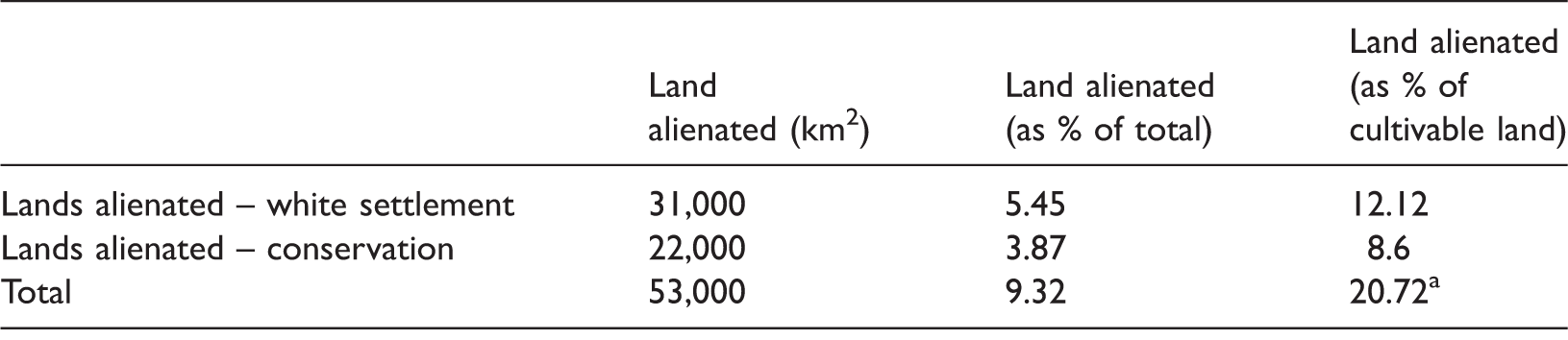
Extent of land alienations for white settlement and conservation in Kenya Colony, ca. 1960.
Source: Compiled from East African Statistical Department (1964), Morgan (1963) and Lützelschwab (2013).
Kenya’s Njonjo Commission (2002, para. 70) would later estimate that, although the lands alienated for white settlement and conservation in Kenya amounted to only 9% of total land area and approximately 20% of cultivable land, they nonetheless encompassed – on the Commission’s analysis – 75% of the highest potential agricultural lands in the country.
Indeed, Kenya Colony lay somewhere in between the prevailing political–economic forms of other British colonies in Africa, conforming neither to the West African or Ugandan model of a peasant commodity-exporting system nor to the more thoroughly settler-dominated economies of South Africa and Southern Rhodesia (now Zimbabwe) (Lützelschwab, 2013). Moreover, following the Devonshire White Paper of 1923, in which the Colonial Office declared its trusteeship over native interests – rather than its support for white settlers or Indians – to be ‘paramount’ in Kenyan affairs, settlers found themselves under increasing pressure to justify their de facto economic supremacy as contributing to the trusteeship of an overwhelmingly African majority population (Ogot, 1968). 2 In this regard, prevailing forms of racial science proved useful in framing state support for settler accumulation as a kind of tutelage over a supposedly naturally less economically apt African population. Consequently, the question of ‘amentia’ or alleged mental deficiency became one of the dominant foci of racial science in Kenya, especially insofar as it pertained to the African population’s alleged lack of propensity for civilization via capitalist economic development (e.g. Gordon, 1934, see also Campbell, 2007: 49–50).
In this context, both wage labour and ‘improved’ commercial agricultural practices emerged as two of the foremost ways in which such economic tutelage could be exercised over a ‘native’ population that both administrators and settlers initially believed to be recalcitrantly inclined toward subsistence livelihoods (Berman and Lonsdale, 1980: 63). As Sir Charles Eliot (1905: 92) put it, immediately following his tenure as Commissioner of the British East Africa Protectorate: The African does not care to be rich, or at any rate will not take the trouble to become so […] The African is greedy and covetous enough, but he is too indolent in his ways, and too disconnected in his ideas, to make any attempt to better himself, or to undertake any labour which does not produce a speedy and visible result. His mind is far nearer to the animal world than is that of the European or Asiatic, and exhibits something of the animal’s placidity and want of desire to rise beyond the state he has reached.
Indeed, although the alienation of land for white settler agriculture had certainly entailed what Marx (1990: 873–875) had already – some several decades earlier – termed a form of ‘primitive accumulation’ or the separation of producers from the means of production, this disproportionately occurred at the expense of Kenya’s pastoralist and hunter–gatherer populations, rather than its sedentary agriculturalists. In the first instance, this was due to the provisions of the 1902 Crown Lands Ordinance to prohibit the alienation of land ‘in the actual occupation’ of natives, which was usually interpreted as sedentary habitation rather than customary territory more broadly in its various East African incarnations (Morgan, 1963: 140). 3 Nonetheless, production for subsistence and related strategies of tax evasion continued to provide an appealing ‘exit option’ (Hyden, 1980) for certain segments of the rural population, and particularly for Kenya’s stalwartly non-agriculturalist groups of pastoralists and foragers. Hence, the identification and territorialisation of native reserves usefully supported this process by reducing the scope for tax evasion, sedentarizing pastoralists, and facilitating the capture of native labour for service on settler estates and other government enterprises (Njonjo Commission, 2002: 25–26). 4
In many cases, larger groups – such as the Maasai and Kikuyu – were able to secure native reserves of their own, albeit not necessarily on amenable terms. The colonial state’s approach to forest-dwelling communities was much less favourable in this regard, however, threatening not just their livelihoods, but also their cultural survival (see also Hitchcock et al., 2015). In short, Dorobo communities were deemed to be right-less in relation to their territorial claims, and largely because their prevailing modes of livelihood did not entail settled cultivation nor other forms of the ‘improvement’ of the landscape. As the Crown Counsel to the Attorney General, one A. Phillips, put it in a letter to the Conservator of Forests in 1937: In my opinion natives occupying land in ‘demarcated forests’ (even through their occupation may have existed continuously since before the date of proclamation) do not possess any enforceable rights […] Natives occupying such forest lands are, subject to any special agreements such as squatter contracts, in the position of tenants at the will of the Crown.
5
The Dorobo were never in the position of rightsholders, and merely roamed the forest as hunters. They did not cultivate until recently; and, as far as honey is concerned, it is probable that they depended solely on wild honey, and have only used honey-barrels in recent times.
6
The wretched of the forest: Hunter–gatherers and the ‘simian hypothesis’
Early 20th-century writings on ‘the Dorobo’ are marked by a tendency for early colonial researcher–administrators to either implicitly or explicitly interpret their findings in relation to prevailing theories of ‘racial science’ at the time. Indeed, it is here that we see the ways in which the deployment of racial science in eastern Africa did not only concern the relationship between Europeans and other “races” in aggregate; crucially, it also addressed the question of difference within colonized populations and attempted to establish status hierarchies amongst them. Especially in the early 20th century, for example, primarily hunting and gathering societies in Africa were frequently thought to provide a glimpse into early human evolutionary history, in contrast with their ostensibly more advanced agriculturalist and pastoralist counterparts (Ballard, 2006). 7 Of course, such a stage-based conception of human development conveniently implied that Europeans were more advanced and hence inherently superior to the African subjects of their colonies. But it implied, as well, that African societies were in turn differentiated by their demonstrated capacities for the development of various technologies, complex forms of hierarchical government, and systems for the accumulation of surplus wealth.
By each of these measures, East African forest communities fared poorly in the colonial mind. Both administrators and settlers typically viewed them through recurring tropes of either ‘the infantile, the primordial, and the bestial’ (Ballard, 2006: 133), or variously as either environmentally noble or environmentally destructive savages (see also Woodburn, 1997). In contrast with precolonial agrarian states such as the Buganda, Toro, or Ankole kingdoms in contemporary Uganda, their political organization was relatively egalitarian in nature, in many cases eschewing even the appointment of chiefs in favour of councils of elders, as was the case for many relatively acephalous groups in western Kenya (Sutton, 1976). Neither did they pursue the substantial accumulation of surplus wealth in either crops or cattle 8 – much to the disdain of their pastoralist neighbours such as the Maasai – preferring instead the collection of symbolically important honey (Blackburn, 1974, 1982).
These supposed shortcomings of forest-dwelling communities became the focus for some of the most infamous ‘ethnographic’ writings of the 19th and early 20th centuries in East Africa. This was especially so insofar as these ‘ethnographies’ solicited discussions about which combination of lifestyles and livelihoods might be said to mark certain communities as constitutive of a ‘dying race’, which would be unlikely to survive the colonial experience without undergoing some form of assimilation (see also Lester, 2016). In the East African context, for instance, Harry Johnston (1902) devotes a chapter of his two-volume The Uganda Protectorate – published after his tenure as Commissioner of the eponymous colony – to the subject of ‘Pygmies and Forest Negroes’. ‘Summing up the experiences of many African travellers, together with my own observations’, Johnston writes (1902: 510): I should venture to say that there is a prognathous beetling-browed, short-legged, long-armed – ‘ape like’ – type of Negro dwelling in pariah tribes or cropping up as reversionary individuals in a better-looking people, to be met with all down Central Africa.
Although Johnston had already been knighted for his interrelated efforts in both colonial government and ‘scholarship’, especially following his publication of A History of the Colonisation of Africa by Alien Races (Johnston, 1899) – with Cambridge University Press, no less – he still sought to make an enduring contribution to racial science with his inquiries amongst various East African peoples. In his previous work, Johnston (1899: 277) had argued that the European ‘scramble for Africa’ in the late-19th century – far from being an historical anomaly – was simply the culmination of ‘race movements during three thousand years which have caused nations superior to the Negro, the Negroid, and the Hamite to move down on Africa as a field for their colonization, cultivation, and commerce’. Although Johnston took the racial superiority of Europeans over Africans as largely self-evident, his later work increasingly dwelt on the determinants of ostensible inequalities within and between African societies. Although he acknowledged the challenges of founding a theory of such inequality purely on evolutionary biology, conceding the difficulty of making a direct link between primates and hunter–gatherers that were allegedly ‘ape-like’ (e.g. Figure 1) or ‘simian’ (Johnston, 1902: 511) in appearance, Johnston was still interested in establishing a ‘scientific’ basis for a status hierarchy amongst various East African peoples.
9
Indeed, Johnston’s text goes to great lengths to substantiate his view of such inequalities, filling two volumes with tables of phrenological and other physiological measurements. For these and other efforts in ‘exploration’, Johnston would later be awarded the Founder's Medal of the Royal Geographical Society in 1904.
A photograph from Harry Johnston’s The Uganda Protectorate, allegedly depicting an ‘ape-like negro’. Source: Johnston (1902: 514). Copyright expired.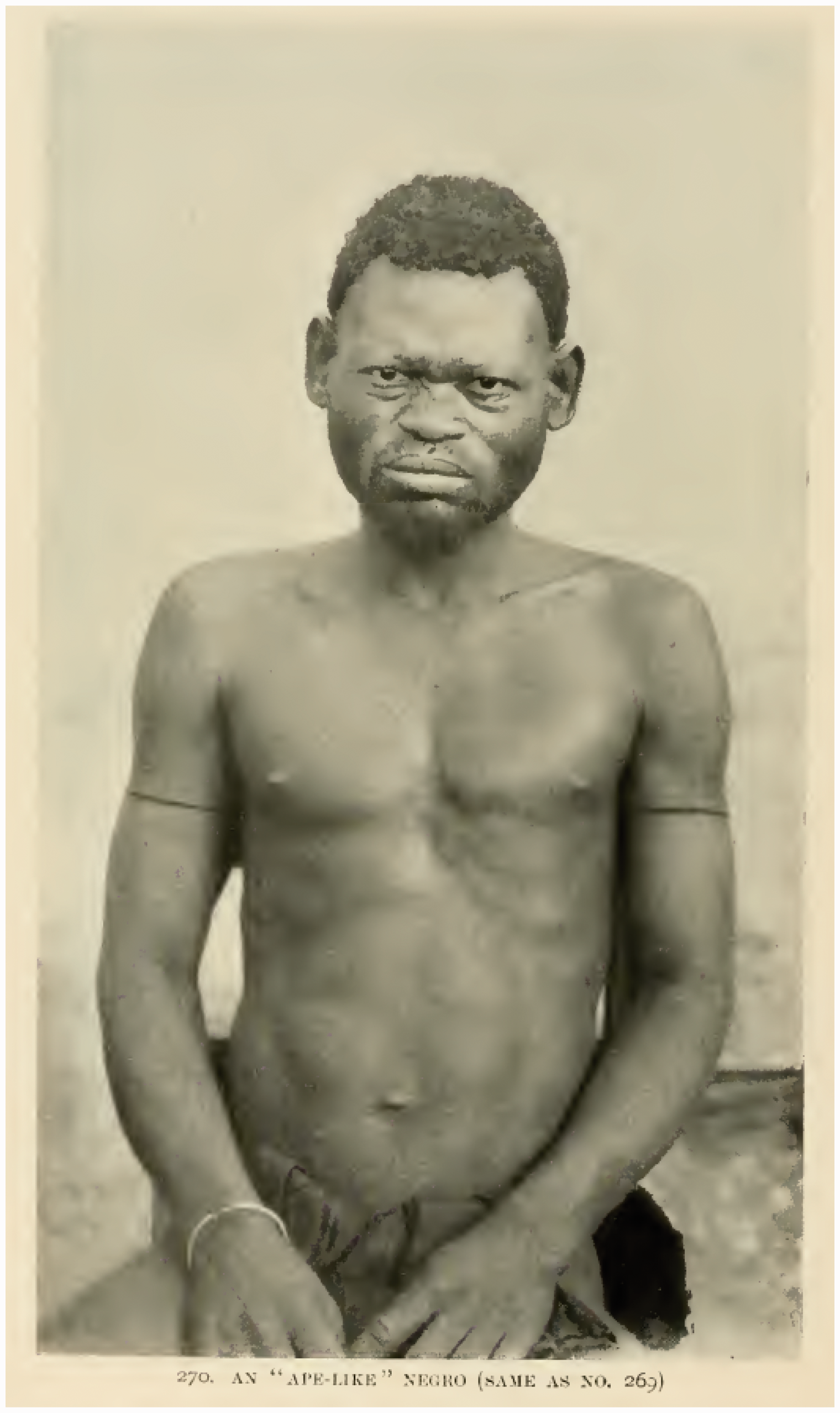
Although he is today perhaps not one of the most remembered of the late colonial British administrators, Johnston’s ‘findings’ from East Africa reverberate in the more widely read works of his better-known colleagues in the Colonial Service. For example, in The Dual Mandate in British Tropical Africa, Frederick Lugard (1922: 67) emphasizes that ‘it is essential to realize that tropical Africa is inhabited by races which differ as widely from each other as do the nations of Europe’. Of these, Lugard (1922: 68) identifies the primarily agrarian Bantu ethnic groups as ‘the finer negro races’, whose ‘intelligence is more developed, and many tribes have reached a degree of social organisation which, in some cases, has attained to the kingdom stage under a despot with provincial chiefs of the feudal type’. Hence, Lugard saw fit to parallel Johnston’s theory of inequality among African societies, alleging that although each were properly seen as ‘child races’ relative to Europeans, they nonetheless illustrate ‘every state in the evolution of human society, from the hardly human bushman of the Kalahari […] to the organized despotism and barbaric display of a negro kingdom like that of Uganda’ (Lugard 1922: 72).
In short, it was not by accident that this theory of intra-African inequality appears in what is perhaps the definitive case for British indirect rule on the continent. Under indirect rule, the ostensibly more advanced segments of subject populations would become conduits for the civilizing mission in much the same way that they were conduits for state itself. Here, the quintessential example is perhaps the Buganda Kingdom in the Uganda Protectorate, in which ‘Baganda sub-imperialism’ or the use of Baganda agents as administrators, chiefs, and tax collectors became one of the principal means of integrating various relatively acephalous societies into the colonial state (e.g. Roberts, 1962). In the following section, however, I turn to a closer examination of the ways in which these processes unfold in relation to forest communities in the context of hybrid settler colonialism in Kenya Colony. In doing so, I draw upon the 1934 report of Sir Morris Carter’s Land Commission in particular – and its several thousand pages of recorded evidence and memoranda (hereafter ‘Carter Land Commission’, see Colonial Office, 1934) – as well as related archival sources. As we will see, these accounts reveal the machinations of civilizing violence within colonial governance in Eastern Africa, and in ways that would entail deleterious effects for forest communities in particular.
Scientific forestry, ‘administrative convenience’, and the Dorobo question
In Kenya Colony, the political and economic exigencies of imperial rule – often euphemistically referred to in the archival record with the term ‘administrative convenience’ – entailed substantial implications for the ways in which prevailing theories of intra-African inequality would be reworked and implemented in practice. This was particularly the case in relation to the ways in which ‘tribal’ identities would be delimited and territorialized by the colonial state. This process of tribal ossification was particularly complex in western Kenya, given that few communities are autochthons in the literal sense of the word, having immigrated from elsewhere albeit as part of different historical migrations and processes. As Ehret (1976: 16) puts it [o]n the whole, western Kenya and the adjoining fringe of Uganda between 500 and 1800 [CE] was a region which drew immigrants, and because the immigrant groups came from a variety of origins, it became and remained a region of ethnic and cultural multiplicity and thus a context for wide-ranging social change.
As a result, there is also significant cultural, linguistic, and socioeconomic diversity among the region’s forest-dwelling communities. This resulted in significant confusion in early interactions between Europeans and these populations, wherein forest dwellers were often assumed to simply constitute a pastoralist underclass that had resorted to a subsistence-based mode of livelihood in the forest (e.g. Huntingford, 1931). As the former colonial military officer Guy Yeoman (1993: 31) puts it, in this context the Dorobo appeared, from the perspective of the British administration, as ‘an elusive, apparently (but not truly) nomadic, uncountable people lacking a recognizable hierarchical structure and resistant to tidy organization’. But perhaps more seriously, to a state embroiled in recurring financial and political crises (Berman and Lonsdale, 1980), their livelihoods appeared to be ‘fiscally barren’ (Scott, 1998: 23); in other words, unlikely to contribute either labour or taxes and other revenues to state coffers. Worse still, they were perhaps even capable of impeding new streams of such revenues, such as those from exotic softwood plantations and logging concessions established in and around the customary territories of forest communities (e.g. Anderson, 1987). Further to this, a related concern was that of the sustainability of water supplies to settler agriculture in the ‘White Highlands’, which substantially depended on the catchment functions of forests occupied by Dorobo communities (Ofcansky, 1984).
Hence, it was these interrelated issues of both the allegedly uncivilized and fiscally barren nature of Dorobo livelihoods – as well as the perceived incommensurability of human habitation of forests with the principles of scientific forest management – that gave rise to what became known as the ‘Dorobo question’ by the 1920s (Kimaiyo, 2004: 5). At the time, various constituencies within the naturalist or preservationist movement in Europe were openly debating the precise biopolitical status of forest-dwelling communities, to the extent that there were disagreements about whether such groups should be removed from forests or allowed to remain with the other flora and fauna as a kind of ‘natural people’ (Sysling, 2015: 382). In Kenya, these and similar debates led to the formation of the Committee on the Dorobo Question, which submitted an otherwise unpublished report to the Kenya Colony administration in 1931. The former Chief Native Commissioner O.F. Watkins (1934: 213), for example, summarizes the dominant administrative position on the Dorobo question thusly: The word Dorobo is one of wide application. It connotes any native who is neither agricultural nor pastoral, ancient primitive stock reinforced by outlaws or rebels from the later Bantu and Nilotic invasions, who live by the produce of the chase and on honey barrels in the forest, formerly often in caves or in stone-lined roofed-in pits of prehistoric type. These people under the Pax Britannica have come out of their fastness, and either tried to become pastoral, or to attach themselves to agricultural or pastoral tribes. This is the right future for them. They cannot exist in the modern world as forest dwellers without danger to forest and so to water, already a scarcening commodity in Eastern Africa.
Although ostensibly meant to ensure the fulfilment of the present and future land needs of Kenya’s African population, the Land Commission made little attempt to involve Africans in the interpretation of received evidence. As Githeru (2005: 87) notes, the Commission consisted of only three members, none of whom were African. Specifically, these were Sir Morris Carter, a judge with experience from British settler colonies in southern Africa, as well as two settlers, R.W. Hemsted and Captain F. Wilson. For its part, the Commission framed its predicament regarding the Dorobo question as follows: The passing of the game and forest laws interfered with the primitive mode of life led by the Dorobo, and efforts have been made by the Administration with varying success to induce them to become useful members of native society. They have been encouraged to acquire stock and to cultivate, but unfortunately no land has been reserved for their use. They live, for the most part, in forest reserves, but exception is taken by the Conservator of Forests to the presence of native-owned stock in areas under his control […] Thus they present a definite problem. Government, having encouraged them to abandon their primitive pursuits, should make specific provision for their land requirements.
10
The evidence and memoranda which have been submitted to us, and the various official documents to which we have had access show that a considerable number of the Dorobo are considered related, in a greater or less degree, with various tribes in the vicinity which have native reserves allotted to their use, and the recommendation of the Dorobo committee is that they should be moved to the reserves of the tribes to which they are affiliated […] We agree with the committee that the Dorobo are most likely to progress and become useful citizens if they live side by side with communities who have already advanced some along the road of orderly progress.
11
In particular, wage labour emerged as a particularly efficient strategy of civilization. As discussed in relation to the removal of Dorobo communities from a proposed Game Reserve near Mount Marsabit: The Game Warden points out, we think rightly, that the natives will be better off in these respects than if no Game Park is declared […] The Game Warden further points out that such Dorobo that inhabit this land will never advance from their primitive condition until they are brought into contact with the white man. We agree with him to the extent of believing that congenial work in connection with the park could possibly be found for some of these Dorobo, and that they would be likely to derive benefit from such a project and undertaking.
12
These Dorobo, as has been stated in evidence, have been ‘driven like chaff before a wind of progression’, and it might be expected that we should now recommend a definite reserve for them. But they are too small a community to be treated in isolation and we are satisfied that it is a better solution to combine them in one area.
13
Such convenience refers, in the first instance, to incentives for reducing the overall number of native reserves for gazettement, demarcation, and subsequent governance by the colonial state (see also Lynch 2006). Secondly, however, it perhaps also suggests a desire to ensure a certain degree of population of the reserves, so that at least portions of this would be compelled into wage labour rather than smallholder agriculture (see also Anderson, 2000: 468). Finally, it further signals the ways in which the colonial state was unable – or, more likely, simply unwilling – to accommodate the Dorobo system of land and resource governance by demarcating a forested native reserve for them either in or ex situ, especially in relation to a growing conservation establishment that was programmatically opposed to the human habitation of forests. In aggregate, therefore, this approach to the Dorobo question necessarily entailed an implicit condemnation of Dorobo lifeways, denoting the state’s acceptance that interrelated forms of Dorobo culture and livelihoods could be ‘let die’ (e.g. Foucault, 2003: 255) even if the Dorobo themselves could not.
Indeed, the Land Commission’s recommendations regarding forced assimilation were somewhat paradoxically combined with a continuously reiterated concern for the physical welfare of relocated Dorobo communities. For instance, acknowledging the economic disarticulation that would likely ensue from the forcible eviction of Dorobo from forests in Kikuyu-dominated areas, the Commission concludes that some form of compensation is necessary: We do not think it practicable to recommend that the Forest Department should be required to permit them to continue indefinitely to live in the forest and we conclude that a small extension of the [Kikuyu] reserve is advisable […] we recommend a further addition of 2,000 acres which should be regarded as comprehensive compensation for disturbance and loss of amenities occasioned by the alienations […] We also recommend a monetary compensation of £2,000 to be paid through the Native Councils to natives who are still living on alienated land as of right.
15
We wish to lay particular stress on the necessity for arranging that the Dorobo are fed, until such time that they can make new arrangements. They might further be granted one year’s exemption from the hut and poll tax. Another matter which will require careful consideration is the fact that Chepalungu [reserve] is an East Coast Fever area, and the Dorobo-owned stock removed from a ‘clean’ area will in all probability die on reaching their destination. Government should make arrangements to obviate this, and we suggest that the Dorobo cattle might be exchanged, through Government, for immune animals.
16
Satisfied that it is in their own interests they should be moved. They are at present confined to a limited area, which cannot be extended and which will surely be quite inadequate for themselves and their stock and, in view of what we may term their insular position, they cannot receive their fair share of the social services provided by Government.
17
As I have sought to demonstrate in relation to the administration’s response to the Dorobo question, however, not all of Kenya’s populations felt the effects of this approach equally. For all, the process of colonial state formation surely entailed varying degrees of social, economic, and political marginalization. But for some, such as groups of so-called Dorobo, this very same process also entailed an attempt to foreclose their collective futures. This was surely a ‘logic of elimination’, albeit not precisely the genocidal one outlined in Patrick Wolfe’s (2006) account of settler colonialism. This was a removal of people from forest territories, an attempted erasure of certain cultures and their underlying socio-ecological relations, but one intended to utterly and forcibly transform a community rather than to physically extinguish it. As I discuss in this paper’s concluding section, the colonial state’s response to the Dorobo question thus stands as perhaps one of the clearest examples of both the violence and the implicit biopolitics of imperial Britain’s civilizing mission, albeit one that resonates within a contemporary transition to ostensibly ‘green’ forms of capitalist development as well.
Coda: Anthropos into humanitas
In the years following the publication of the Carter Land Commission’s report, various provincial and district-level administrations began implementing its recommendations on the Dorobo question across Kenya Colony’s forest estate.
18
Understandably, these actions were met with earnest protest and resistance from forest-dwelling communities in many parts of the country. To take but one example, this was notably the case for a group living in forests close to Kijabe – near the present-day Gatamaiyo Forest Reserve – who were slated for forcible eviction and assimilation into a Kikuyu native reserve nearly 100 miles away. With the exception of the elderly and the infirm, their mode of transport to this new location, together with their livestock, was to be a forced march. Hence, as a group of elders – led by one Turuthi wa Githera – eloquently put it in a scathingly critical letter to the Governor of Kenya Colony himself in 1940, just prior to their community’s eviction, they were: Under the fond belief that pending the duration of the War in which the British Empire is now engaged there would be no execution of the programme of removal of African people from their ancestral homes. […] We little thought that when we are writing this letter that the Nazis were likely to follow so slavishly in the footsteps of the Imperial Government. But we did appreciate the chorus of disgust with which the people of the civilized world expressed their condemnation of the policy of the wholesale compulsory transfer of Semitic (and other) Germans from their homes which they occupied for countless generations. We on our part find it hard to see any difference in principle between the Nazi policy of compulsory transfer of people and the Imperial policy in Kenya of removing compulsorily the aboriginal inhabitants of the soil from their ancestral homes […] perhaps what makes the policy so heinous in Europe is that Europeans are being treated in such a way, and what makes the policy so fair in Africa is that is only Africans.
19
Although it is tempting to extend Giorgio Agamben’s (1998) thesis on the figure of homo sacer in this regard, simply perceiving communities of so-called Dorobo as a form of ‘bare life’, this paper has sought to document a more idiosyncratic mode of biopolitics at work. Indeed, attempts to govern the ‘Dorobo question’ in Kenya Colony evince the decidedly peculiar biopolitics of tribal ossification under a purportedly ‘liberal’ or ‘humane’ form of British colonial rule (see also Lester, 2016; Lester and Dussart, 2014). Here, certain interrelated livelihoods, cultures, and socio-ecological relations were selected for incorporation into the colonial state – albeit perhaps not on their own terms – whereas others were slated for forcible assimilation. Throughout, I have argued that the latter dynamic entails a form of ‘civilizing violence’, under which the dispossession of lands, resources, and place-based dimensions of culture were justified as necessary for the civilizing mission to effectively proceed. In turn, this asymmetrically impacted the colony’s primarily hunting and foraging communities, whose habitation of forests was seen as unacceptable both from the perspective of a conservation establishment preoccupied with the principles of scientific forestry, and from a broader colonial administration whose approach to the civilizing mission was informed by prevailing theories of racial science in the early 20th century. As suggested by archival material on the Kenya administration’s response to the ‘Dorobo question’, however, the deployment of such violence was largely oriented towards converting an ostensibly backward, forest-dwelling anthropos into a kind of citizen-in-becoming or candidate for eventual inclusion into the liberal, rights-bearing community of humanitas (à la Mignolo, 2011: 82–83) – even if doing so would entail, essentially, a form of attempted cultural genocide (see, for example, Hitchcock et al., 2015).
Yet it must be said that the Dorobo question was never definitely answered in the colonial period. Attempts to conclusively remove forest-dwelling groups were stymied both by these communities’ own resistances to and evasions of forcible eviction, as well as to the shifting priorities of the colonial administration during the Second World War (1939–1945) and the Mau Mau insurgency (1952–1960) in central Kenya. At the time of independence in 1963, the result was that Kenya inherited a forest estate that was neatly gazetted and demarcated within state documentation, but unevenly territorialized on the ground. Consequently, subsequent efforts to (re)territorialize and in some cases expand the national protected area estate – with significant volumes of multilateral, bilateral, and NGO support – have led to the frequently violent eviction of remaining ‘Dorobo’ communities such as the Sengwer in the Cherangani Hills (e.g. Tiampati, 2015) and the Ogiek of Mount Elgon and the Mau forest complex (Kimaiyo, 2004) in recent years. Moreover, in the context of new financial incentives for forest conservation – such as national readiness activities for Reducing Emissions for Deforestation and Forest Degradation (REDD+) programme – as well as official strategies for rolling out a ‘green economy’ and ‘low carbon, climate-resilient development pathway’ in the country (e.g. Government of Kenya, 2015), there is arguably now more impetus than ever before for a the conclusive removal of forest communities from their customary territories (see also Cavanagh et al., 2015).
In turn, an analysis of the afterlives of such civilizing violence perhaps sheds new light on contemporary debates concerning ‘green grabbing’ (Fairhead et al., 2012: 237) or ‘the appropriation of land and resources for environmental ends’. This is perhaps especially so in cases where the fate of displaced communities seems poised once again to entail both uneven ‘spatialities of displacement’ (Lunstrum, 2015) and forcible cultural or economic assimilation. Here, contemporary evictions and displacements for conservation not only parallel similar phenomena in the colonial era, but are in many ways enabled or sanctioned by the complex institutional, political, and ideological legacies of the latter (Cavanagh and Himmelfarb, 2015). In this sense, the process of colonial state formation remains, in Wolfe’s (2006) terms, a continuously evolving and mutating ‘structure’ with enduring consequences rather than simply an isolated ‘event’ whose relevance gradually dissipates over time. As Geisler (2012) argues, in particular, colonial discourses of terra nullius – unowned or under-utilized lands – continue to authorize or animate ‘investments’ oriented towards the large-scale acquisition of such lands and resources in sub-Saharan Africa for the purposes of both conservation and commercial exploitation (see also Li, 2014). As I have sought to illuminate in this paper, however, such discourses of under-utilized lands remain tied in many instances to discourses concerning under-productive, ecologically threatening, or otherwise ‘uncivilized’ people who inhabit these spaces. Although certainly couched in the jargon of ‘sustainable development’ and ‘modernization’ rather than colonization and the civilizing mission, the underlying argumentation is ominously familiar to forest communities in particular: we are told that customary livelihoods and resource management systems threaten to impede, rather than stimulate, ‘green’ economic development; that forest habitation is a backward mode of subsistence, threatening both health and access to government services; and that forest communities are growing in number and increasingly unable to conserve their own forest environment via traditional means – all reminiscent of the conclusions of Sir Morris Carter’s National Land Commission. Once again, violence is justified not as a means of eradicating specific communities, per se, but to enact a forcible transformation in modes of livelihood and socio-ecological relations thought to be characteristic of ‘modern’ citizens, the contemporary incarnation of the implicit colonial notion of the humanitas.
Such intersections of contemporary land and resource acquisitions with complex legacies of the attempted European ‘civilization’ of much of the contemporary ‘Global South’ suggest the need for further inquiries into the geographies and political ecologies of civilizing violence. Indeed, this is specifically so in relation to the ways in which intertwined attempts at forcible assimilation and related dispossession now increasingly operate within logics of apparently ‘ecological’ modernization and ‘green’ development. Precisely how, for example, do such phenomena now articulate with a transition toward a phase of ostensibly ‘green’ capital accumulation, which increasingly values forest territories and agro-forest landscapes in novel ways? How do states seize upon discourses of sustainability and sustainable development to bolster longstanding programmes of sedentarization and the elimination of interrelated cultural, economic, and socio-ecological difference? By examining these and related questions, not least, both historical and contemporary studies of civilizing violence may contribute to our understanding of the ways in which diverse civilizing missions and impulses have attempted to foreclose upon alternative sustainabilities, ontologies, and political ecologies – many of which are now being reinvigorated and reanimated in the context of recurring crises of both capital and contemporary forms of imperialism.
Footnotes
Declaration of conflicting interests
The author(s) declared no potential conflicts of interest with respect to the research, authorship, and/or publication of this article.
Funding
The author(s) disclosed receipt of the following financial support for the research, authorship, and/or publication of this article: This work was conducted while the author was supported by a Doctoral Fellowship from the Social Sciences and Humanities Research Council of Canada 10.13039/501100000155 767-2013-2425.