







Abstract
This essay reflects on recent debates around planetary urbanization, many of which have been articulated through dismissive caricatures of the core epistemological orientations, conceptual proposals, methodological tactics, and substantive arguments that underpin this emergent approach to the urban question. Following consideration of some of the most prevalent misrepresentations of this work within this special issue, I build upon Barnes and Sheppard’s (2010) concept of “engaged pluralism” to suggest more productive possibilities for dialogue among critical urban researchers whose agendas are too often viewed as incommensurable or antagonistic rather than as interconnected and, potentially, allied. The essay concludes by outlining nine research questions whose more sustained exploration could more productively connect studies of planetary urbanization to several fruitful lines of inquiry that have been explored within postcolonial, feminist and queer-theoretical strands of urban studies. While questions of positionality necessarily lie at the heart of any critical approach to urban theory and research, so too does the search for intellectual and political common ground that might help orient, animate and advance the shared, if constitutively heterodox, project(s) of critical urban studies.
1
The specter of universalizing theory appears to be haunting contemporary urban studies. According to many of the contributors to this special issue of Society & Space, that specter is today associated with theories of planetary urbanization. In their view, such theories embody the latest in a long line of Eurocentric, masculinist, and heteronormative epistemologies that perpetuate the hubristic “god-trick” of denying their own embeddedness within the social processes they aspire to understand. The result is an all-encompassing, transcontextual, and neocolonial metanarrative that, it is claimed, ignores the power-laden realities of difference, place-specificity, everyday life, struggle, and experience.
Despite the repetition of such assertions across many pages of this Issue, Christian Schmid and I have not offered any of our proposals in a spirit of universalization or intellectual colonization. Nor have we produced, or advocated for, a finished, comprehensive, transcontextual, or ahistorical theory of the urban or urbanization. In politico-epistemological terms, we share much common ground with many of our critics who work in feminist, queer, and postcolonial traditions of critical theory. We likewise insist upon the social constitution and political mediation of all knowledge-formations. We likewise reject the positivist/technoscientific contention that knowledge can be constructed from some disembodied Archimedian point exterior to social relations, power hierarchies, spatial politics, and political struggle. We likewise connect all essentializing, transhistorical knowledge-claims to formations of power, domination, exclusion, and normalization. There can be no critical theory, we likewise insist, without systematic recognition that all knowledge is situated, embodied, embedded, contested, and mediated through power relations (Brenner, 2016). Much like our critics, then, Christian Schmid and I vigorously reject any and all epistemologies that are derived from naïve realism and oriented towards the generation of context-independent validity-claims.
Readers of our critiques of historical and contemporary “urban age” ideologies (Brenner and Schmid, 2014, 2015a) will also be aware that we likewise harbor major anxieties regarding the dangers—both intellectual and political—of proliferating ideologies of universalism in contemporary urban discourse. Indeed, a centrally animating concern of our work has been to critique the overgeneralized, acontextual concepts of “the” city that have long underpinned the episteme of modern urban thought. The idea of urban space as a singularity, a dense, bounded spatial unit whose existence and developmental dynamics can be comprehensively explained, promoted, and managed through an appeal to transcontextual covering laws, today remains as robust as ever. Such conceptions are such deeply engrained “habits of mind” (Dewey, 1922; Peirce, 1877) within the urban studies establishment that those dissident thinkers who challenge them—whether from postcolonial, assemblage-theoretical, or neo-Lefebvrian perspectives—are often dismissed or ridiculed as being confused, ignorant, particularist, and/or anti-theoretical (Storper and Scott, 2016).
Meanwhile, universalizing ideologies of “the” city—especially in positivist, technoscientific, entrepreneurial, eco-managerial, and/or neoliberal variants—remain powerfully operative conceptual tools for analysis, mapping, policy, planning, and practice in international organizations such as the United Nations, the World Bank, and the World Economic Forum (WEF), among multilateral development banks, in national and local governmental agencies, and in nongovernmental organizations oriented towards confronting diverse social, infrastructural, and ecological crises. This “debilitating city-centrism” (Cairns, 2018) has recently been entrenched, for example, through the rollout of mainstream global urban policy frameworks such as those associated with the Sustainable Development Goals (SDGs) and the New Urban Agenda (Habitat III) presented in Quito in 2016, in the Paris Agreement of the United Nations Convention on Climate Change (IPCC), as well as in a host of national and local policy innovations designed to implement or respond to the latter (Barnett and Parnell, 2016; Parnell, 2016). Such city-centric, depoliticizing “simplification projects” (Scott, 1995) are also being aggressively promoted by a range of corporate actors and property developers for whom the construction of “global cities,” “smart cities,” “creative cities,” “sustainable cities,” “eco-cities,” and the like is seen as the optimal pathway for ensuring continued economic growth without disrupting the currently hegemonic formation of neoliberalized, financialized accumulation by dispossession (Kaika and Swyngedouw, 2014; Sheppard et al., 2013; Soederberg and Walks, 2018). These universalizing ideologies of the urban scarcely receive mention in this Issue. Instead, the broad argumentative arc of this issue of Society & Space may leave many readers with the impression that the so-called “planetary urbanists” represent the most significant contemporary intellectual obstruction to the development of more heterodox, contextually sensitive, hermeneutically attuned, and explicitly politicized approaches to urban knowledge, policy, and practice.
Against this background, the editors’ invitation to reply to the texts assembled here presents Christian Schmid and myself with an extremely unwieldy and, in many ways, unpalatable task. On the one hand, it is not obvious how to engage in meaningful intellectual dialogue with critics who are inclined to present our core arguments in such polemical, simplified, or superficial ways. In some cases, denunciatory references to our writings appear to serve mainly as a rhetorical foil against which to highlight the contributions of other (important) research projects. In several such texts, it is not readily clear how a focus on or engagement with the debate on planetary urbanization advances the research in question, except by way of positioning the latter as doing “something else” than what we have purportedly done or proposed. Elsewhere, our ideas seem to function mainly as “cannon fodder” in an apparently intensifying struggle for recognition among competing paradigms in the field of critical urban studies (on which more below). Insofar as so many of the contributors flatten our epistemological commitments into those associated with the very positions we have been concerned to critique, how can we engage with their narratives in ways that advance discussion in mutually productive directions? After reading many of the essays, one is tempted simply to repeat the refrain, “It just isn’t so,” and to hope that future readers will form their own judgments by taking the time to peruse some of our texts for themselves. This is the assertively defensive approach that we adopted in our online response to Walker’s (2015) scattershot polemic in an earlier round of academic “combat and caricature” (Brenner and Schmid, 2015b).
On the other hand, amidst the sound and fury of these polemics, there are clearly some important issues under debate that cannot be explored effectively through the adoption of purely defensive postures. Even where we believe our ideas are being misrepresented, caricatured, or pilloried, it behooves us to pay close attention to the methodological, epistemological, substantive, and political questions being raised in such contributions. In thus proceeding, we may be presented with an opportunity not only to gain a deeper understanding of key concepts, methods, and research fields with which we have not adequately engaged, but to reconsider some of our own previously developed proposals in that light. Moreover, to the degree that certain misreadings are now apparently becoming rampant, it is incumbent upon Christian Schmid and myself to reflect on how some of our own intellectual choices—for instance, regarding style of argumentation, conceptual grammar, intellectual genealogy, methodological tactics, and citation practices—may have contributed to the latter. From this point of view, even the most dismissive, bellicose, or fantastical critiques presented herein may actually harbor an opportunity for us, and perhaps for others who are developing broadly allied agendas, to reflect upon, revise, and perhaps even reinvent our approach to the problematiques with which we are concerned. But how to excavate such latent opportunities for autocritique and learning within a scholarly atmosphere that is imbued with so much negative energy?
In writing and rewriting this essay, I experimented with various strategies for dealing with these issues. After much deliberation, I concluded that it would be intellectually disingenuous to try to ignore the question of how our project is being (mis)read, especially in a scholarly exchange in which Christian Schmid and I often cannot recognize our own ideas in the grotesquely distorted simulacrum of our work that is being promulgated across many of these pages. But I also fully acknowledge that an indignant catalogue of misreadings is not likely to advance the cause of dialogue or mutual understanding: it would probably make for pretty tedious reading, and serve mainly to stoke the flames of a debate that has already unfolded in what are, at least from my point of view, needlessly polemical directions. More importantly, such a response would not speak very effectively to what is arguably the key question at stake in these epistemological debates: How can we most effectively decipher and influence emergent patterns and pathways of urban transformation?
Accordingly, this essay pursues two interconnected goals—first, to address succinctly certain distortions of our arguments that are repeated in many contributions to this special issue; and second, to consider the prospects for a more productive dialogue among the participants in this debate, one that would mine the seams of various shared (or at least allied) epistemological, substantive, and political agendas rather than unleashing further rounds of polemical non-debate that emphasize maximal disagreement. To this end, in the next section, I briefly outline some of the core misinterpretations/misrepresentations that are repeated across many contributions to this special issue. I consider this initially defensive mode of engagement to be a necessary yet radically insufficient step towards the unfolding of a more meaningful dialogue among the debate’s contributors. As a modest step in pursuit of the latter goal, the rest of my essay builds upon the conception of “engaged pluralism” proposed by Barnes and Sheppard (2010) to reflect upon the prospects for dialogue and even intellectual progress among scholarly communities that embrace apparently opposed “local epistemologies.”
2
Based on a reading of many contributions to this special issue, it would be easy to reach any or all of the following conclusions: (a) Christian Schmid and I are completely unreflexive about questions of positionality in sociospatial theory; (b) we are working in a white, masculinist, Eurocentric, and heteropatriarchal tradition that is indifferent to questions of gender, sexuality, race, and difference; (c) our work is directly antagonistic to such concerns—that is, the frameworks we are developing actively impede productive engagement with them; and (d) we embrace a homogenizing, universalizing, and intellectually imperialistic conception of urbanization.
There is currently a tendency to articulate such criticisms through general assertions about our alleged positions (or, in some cases, on the basis of second- or even third-hand references to the work of others who have made such general assertions), rather than through an engagement with our texts, and through the consequent, grounded elaboration of specific arguments in support of such conclusive dismissals. For example, the claim that our work on planetary urbanization is “totalizing” is repeated regularly in discussions of our work among some of our feminist and poststructuralist colleagues, as if it were an established truism. But what exactly is meant by this claim and the conception of “totalization” it presupposes? 1 Can it really be grounded with reference to specific arguments we make in our writings (for further discussion, see Buckley and Strauss, 2016; Goonewardena, 2018; Schmid, 2015, 2016, 2018)? How can such readings be reconciled with our arguments (a) that planetary urbanization is variegated, uneven, volatile, contradictory, and emergent; (b) that this process assumes specific forms across divergent spatiotemporal contexts; (c) that we need a plurality of conceptualizations, methodological approaches, analytical perspectives, and cartographic strategies through which to decipher its manifold manifestations; and (d) that our understanding of emergent urban transformations currently remains severely underdeveloped? Such readings also tend to ignore the explicitly nominalist, anti-universalizing orientation of our critique of contemporary triumphalist “urban age” ideologies, of inherited conceptions of “the” city as a singular, generic settlement type, of entrenched modernist understandings of urbanization as a unilinear rural-to-urban “transition,” and of mainstream, naïve empiricist approaches to geospatial visualization.
Aside from the misleading, simplistic polemics on the question of “totalizing” theory, several other inaccurate assertions about our position have been repeated by many critics, including throughout many contributions to this Issue. Here is a short list of some of most prevalent caricatures or misreadings that are now in circulation, often in combination with one another:
We have never claimed to be studying something called “planetary urbanism”; nor have we ever used this label to describe the epistemology of the urban we have been developing. In fact, Christian Schmid and I have never used the term “planetary urbanism” in any of our writings. The term “urbanism” is one we have used only with considerable precision, generally to describe contemporary mainstream urban ideologies; the specific discourses, practices, and ideologies of urban design; and with reference to Wirth’s (1938) famous sociological theorization.
2
Our work is focused on the problematique of urbanization, capitalist urbanization in particular. We view planetary urbanization as the contemporary formation of the latter, and we argue that its consolidation generates new conceptual, analytical, methodological, and political challenges for those trying to decipher, represent, and influence its variegated spatiotemporal dynamics. The tendency, especially but not exclusively among some critics, to label us and our collaborators as “planetary urbanists” amounts to affirmatively identifying our research agenda with the very processes we are concerned to decipher, criticize, and supersede. It is formally equivalent to describing critics of capitalist urbanization as “capitalist urbanists,” critics of neoliberal urbanization as “neoliberal urbanists,” critics of heteropatriarchal forms of urbanization as “heteropatriarchal” urbanists, and so forth. We have never asserted that cities no longer exist or are no longer important. In fact, we have consistently emphasized that concentrated urbanization (the process of agglomeration and its wide-ranging consequences) remains a constitutive dimension of urbanization; it is, accordingly, a central analytical, representational, and political focus in our work. We have, however, questioned the long-entrenched obsession among many urban scholars with demarcating a neat boundary between city and non-city spaces in a world of increasingly generalized urbanization and rapidly imploding/exploding urban transformations. We have also called into question the naturalized, monist, singular, diffusionist, and transhistorical conception of “the” city that has long underpinned the major traditions of urban theory. We thus critique the epistemological framework of city-centric and city-dominant urban theory (McGee, 1971; see also Angelo and Wachsmuth, 2015; Cairns, 2018). We have never argued that planetary urbanization flattens, evens out, or supersedes differences among places (or territories, landscapes, scales, or ecologies). In fact, we have constantly emphasized the constitutively uneven, variegated nature of capitalist urbanization, including in its planetary configuration. As Schmid explains in his contribution to this special issue (2018; see also Schmid et al., 2018), our proposed conceptualization of urbanization as planetary is intended to decenter inherited approaches to the urban question that begin with the idea of “the” city as a bounded spatial unit and then look “inwards” towards its neighborhoods, built environments and social fabric (as, for example, in classic Chicago School models), or “outwards” towards the metropolis, the region, the territory, and the world (as, for example, in more recent theories of global city formation). We invert that intellectual starting point and the analytical frameworks, methodological tactics, and cartographic visions that flow from it, using a planetary (re)orientation as the impetus for a foundational reframing of the urban question as such. This radical reframing immediately alters the sociospatial lens through which uneven spatial development is understood—for instance, by relativizing inherited geographical dualisms such as urban/suburban/rural/wilderness—but it in no way entails the absurd claim that sociospatial, institutional, and ecological differentiation no longer exist or no longer matter. The question, for us, is not whether urbanization generates uneven spatial development, but how most effectively to conceptualize, represent, and influence its contemporary manifestations. We have never claimed that planetary urbanization has the same causes or assumes the same forms in the cities, regions, and territories of the Global North and those in the Global South.
3
In fact, we have emphasized repeatedly that planetary urbanization is a constitutively uneven, variegated process, one that is necessarily articulated through contextually specific patterns and pathways. It is thus false to suggest we are attempting to impose northern or Euro-American theory upon spaces to which it does not apply. Despite some differences of epistemology, conceptual apparatus, and method with some of our colleagues working in postcolonial streams of urban studies, we strongly support their injunction to develop specific theoretical conceptual tools and analytical insights from diverse experiences and geographies of urban transformation around the world. Indeed, own exploratory proposals to develop new insights into emergent geographies of urbanization through the investigation of recent industrial transformations in erstwhile hinterland zones are analogous, in methodological terms, to the injunctions of postcolonial urban thinkers such as Jennifer Robinson (2014, 2016) and Ananya Roy (2012, 2016) to transcend conventional assumptions about the appropriate “sites” of urban theorizing. We approach this project of theoretical “dislocation” via different routes, but we share a closely allied critical agenda: in Roy’s (2009: 820) suggestive phrase, “to blast open” the entrenched theoretical geographies of the urban question in relation to emergent, early 21st-century transformations. We have never presented our approach to planetary urbanization as a “theory of everything.” The claim that urbanization has become planetary does not mean that all aspects of planetary existence are somehow derived from, or explicable with reference to, urbanization; that other scales of urbanization no longer exist or matter; or that our knowledge of this process is now (or ever could be) comprehensive. Nor have we ever proposed that studies of planetary urbanization require the subsumption or colonization of other fields of research (for instance, political ecology, agrarian studies, or rural sociology). And we have certainly never advanced the intellectually imperialistic view that the reinvented approach to urban theory we are proposing could somehow supplant other forms of knowledge, within or beyond the field of urban studies, academic or otherwise. Our texts repeatedly emphasize the metatheoretical nature of our intervention; the challenges of reconstructing the field of urban studies as a collective, multifaceted, politicized, open, and ongoing research endeavor; the need for plural, heterodox epistemologies; the constitutively multiscalar configuration of urbanization processes; and the specificity of urbanization as one among a multitude of sociospatial processes and transformations shaping planetary life today (see Box 1). Urban theory without an outside? We have never claimed that the study of planetary urbanization requires us to privilege structural analysis and to ignore the fabric of everyday life, the mobilizations of social movements and ongoing struggles to shape and reshape the urban fabric of the world. Our work is intended to help illuminate the changing contexts in which such mobilizations and struggles are occurring, and their shifting and intensifying stakes in a world of generalized urbanization, intense geopolitical volatility, and cascading economic and environmental crises. More generally, our critique of planetary urbanization is focused on the potentialities for emancipatory politics, the “possible urban worlds” (Harvey, 1996) and “alter-urbanizations” (Brenner, 2016) that inhere within, but are systemically suppressed by, current power relations, institutional arrangements, and forms of territorial organization.
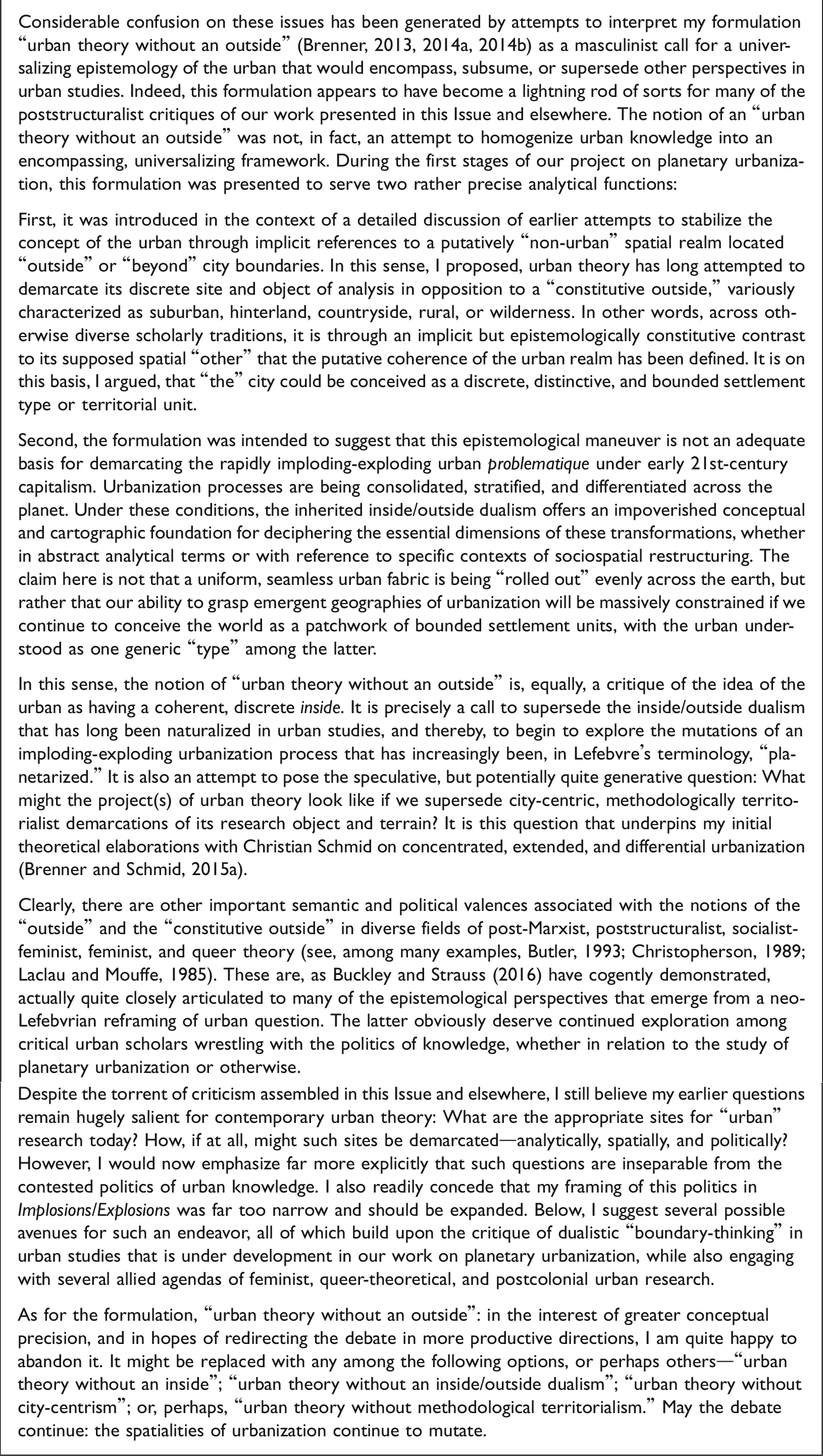
In short, Christian Schmid and I have always framed our work in accordance with the critical realist principle of “open systems,” according to which the concrete articulations of social relations result from a “concentration of manifold determinations” rather than from singular, all-encompassing causal mechanisms or covering laws (Jessop, 1990; Marx, 1973 [1857]; Sayer, 1992). Our goal has never been to “lock down” a singular, monistic approach to the urban question. Rather, we concur with Leitner and Sheppard’s (2016: 230) recent injunction “to take seriously the possibility that no single theory suffices to account for the variegated nature of urbanization and cities across the world.” In our work on planetary urbanization, we have sought to contribute to the broader, collective, and constantly evolving project of developing new approaches—concepts, methods, cartographies, modes of interpretation, analytical tactics, and much more—that might help us investigate and understand emergent transformations of urban life and their wide-ranging implications for material conditions, territorial organization, politics, ecology, everyday life, and struggle. Thus, as we argued in our essay, “Towards a new epistemology of the urban?” (Brenner and Schmid, 2015a: 13): […] Our proposals are meant to demarcate some relatively broad epistemological parameters within which a multiplicity of reflexive approaches to critical urban theory might be pursued […] This discussion is thus intended as a meta-theoretical exercise: instead of attempting to nail down a fixed definition of the essential properties of the urban phenomenon “once and for all,” it involves developing a reflexive epistemological framework that may help bring into focus and render intelligible the ongoing reconstitution of that phenomenon in relation to the simultaneous evolution of the very concepts and methods being used to study it.
3
In a fruitful reflection on the evolution of debates within economic geography since the 1980s, Barnes and Sheppard (2010: 194) build upon the work of pragmatist philosopher Richard Bernstein (1988) to distinguish various forms of pluralism, only one of which—“engaged pluralism”—promotes “open conversation and a tolerant community.” The others—which Bernstein termed fragmenting pluralism; flabby pluralism; polemical pluralism and defensive pluralism—tend to splinter intellectual communities into hermetically sealed language-games; to promote superficial rather than substantive forms of intellectual borrowing; to privilege polemical, antagonistic modes of engagement with alternative viewpoints; or to engage alternative perspectives only as a means to reaffirm the correctness of one’s own paradigm. The problem with such polemical or defensive epistemological postures is that they create a fragmented intellectual landscape composed of apparently incommensurable, internally focused and self-affirming research communities that interact only superficially or antagonistically, rather than reciprocally informing or animating one other in productive, mutually transformative ways. By contrast, Barnes and Sheppard (2010: 194) argue, building upon Bernstein’s (1988: 15) reading of pragmatist philosopher William James, an engaged pluralism involves “resolving that however much we are committed to our styles of thinking, we are willing to listen to others without denying or suppressing the otherness of the other.”
In a recent exchange on global city theory and postcolonial urban studies, van Meeteren et al. (2016b) apply a conception of engaged pluralism derived from Barnes and Sheppard’s work to contemporary urban studies debates (see also van Meeteren et al., 2016a). Although approaches to postcolonial theory have often been framed through antagonistic, polemical, and sometimes superficial contrasts to the positions of global city theory, van Meeteren and his co-authors argue that there are actually ample possibilities for more productive dialogue, mutual engagement, and cross-pollination that have yet to be tapped, and that have wide-ranging implications for how each of these approaches to urban research might be pursued. Van Meeteren, Bassens, and Derudder’s reflections on the global city theory/postcolonial urban theory debates have considerable relevance to the increasingly heated controversies about planetary urbanization that are currently under way. The cautionary reflections of van Meeteren et al. on such matters are worth quoting at length: The main challenge is not to become paralyzed by notions of theoretical or empirical incommensurability (Kuhn, 1970 [1962]) […] Engaged pluralism above all means stubbornly pursuing potential common ground rather than accentuating alleged incommensurability and thus avoiding placing cities beyond compare (Peck, 2015). Whatever the source of intellectual disagreement, our key point is that we, as participants in the debates on global urban research, in fact quite often agree (Bunnell, 2016). Yet we tend to focus on disagreements. However, contention should not preclude a collective choice to engage in an overarching global urban studies project that, in its most general sense, wishes to analyze, understand, explain and influence the urban drivers of social change. Nevertheless, it remains an open question exactly how to practice and facilitate engaged pluralism in the face of enduring epistemological and ontological differences, especially when navigating contemporary publication structures that seem to reward controversy over understanding. This makes engaged pluralism a difficult task, as potential agreement does not ensure establishing a veritable research culture in which engaged pluralism can take root (van Meeteren et al., 2016a: 297).
In effect, the various participants in these discussions today appear poised to embark upon a contemporary “rehash” of the rancorous debates on capitalism, culture, locality, gender, and difference of the late 1980s and early 1990s, which pitted Marxian geographers such as David Harvey against feminist scholars such as Doreen Massey, Donna Haraway, Rosalyn Deutsche, and others. Nonetheless, from my particular point of view, an unreflexive return to the “scorched earth” of these earlier rounds of academic combat would represent a missed opportunity, in a radically transformed intellectual, politico-cultural, and geoeconomic configuration, for further dialogue across apparent epistemological, theoretical, and political divides. Such a dialogue is arguably needed more urgently than ever in these “post-truth” times of “fake news” and “alternative facts,” when clear lines of communication among political allies, including (perhaps especially) about points of disagreement, are a matter of foundational, even existential, importance.
Indeed, faced with the prospect of a contemporary “reenactment” of the bitter Marxism/poststructuralism battles of the 1990s in the field of critical urban studies, it may also be salient to consider their stakes not only in abstract, epistemological terms, but in relation to the contested, always mutating historical-geographical contexts in which they are embedded and which they are also presumably concerned to illuminate. To what degree, one might ask, did the polarized debates of the 1990s—which, for example, opposed global/local, economy/culture, structure/agency, totality/fragment, system/difference, major/minor, and whole/residue—effectively illuminate that particular moment of worldwide sociospatial restructuring, uneven spatial development and politico-cultural struggle? To what degree would a contemporary reenactment of those arguments, the defensive or polemical modes of critique they tended to deploy, and the dualisms they tended to ossify rather than supersede, productively illuminate our present planetary predicament, its contradictions and crisis-tendencies, and the struggles (both reactionary/neoauthoritarian and progressive/radical) it is unleashing?
While I would certainly not discount the continued philosophical, methodological, and political importance of the foundational issues that were explored in such debates, I have serious doubts that such battle reenactments will prove to be particularly productive for advancing the work of critical urban studies today. Within a neoliberalized university environment that tends “to reward controversy over understanding” and to promote a culture of competitive individualism among scholars (van Meeteren et al., 2016a: 297), the reenactors may well receive professional recognition for their efforts. But that should offer cold comfort to those who view the field of critical urban studies as a collective intellectual and political endeavor: one whose contributors embrace diverse conceptual orientations, methodologies, and research agendas, while also striving to confront some broadly shared questions and concerns, both scholarly and practical.
Surely, more fruitful modes of engagement are also possible—ones that, despite possibly fundamental epistemological, methodological, and/or political differences, could (a) productively advance and reciprocally transform the heterodox research cultures involved in critical explorations of the urban question today, while also (b) harnessing them as part of the shared project(s) of critical urban studies to confront the major intellectual and political challenges associated with our contemporary moment of worldwide urban transformation. This is, from my point of view, an agenda that deserves to be taken very seriously, not only in relation to debates on planetary urbanization, but across the wide-ranging terrain of contemporary critical urban studies. 4
4
In their manifesto on engaged pluralism, Barnes and Sheppard (2010: 208) argue that “the challenge […] to all geographers of whatever stripe […] is to initiate exchange, to trade their various local epistemologies and theories with those of others, and in the process to create new knowledge.” This, they suggest, can produce “a more vibrant, interesting discipline, capable of generating complex, shifting understandings that reflect and shape equally complex and dynamic materialities” (Barnes and Sheppard, 2010: 208). But they also underscore a number of major hurdles to the creation of genuinely flexible, open “trading zones” in which research questions and methodological tactics may be coordinated coherently in order to advance knowledge, despite the persistence of distinct cultures of inquiry, discursive conventions and intellectual objectives among the various participants (Barnes and Sheppard, 2010: 196–197; Galison, 1997). These hurdles include, among others, hegemonic institutional practices and professional norms that may inhibit cultures of dialogue; entrenched power relations within universities, professional associations and disciplines that privilege some actors, voices and forms of “evidence” while excluding others; the persistent role of hidden, hierarchical networks of influence that determine which conceptual frameworks, methodological tactics, and research questions receive attention and thus legitimation within specific scholarly milieux; as well as pervasive issues of translation that seriously complicate communication across linguistic, cultural, and political divides (Barnes and Sheppard, 2010: 208–209). Clearly, then, engaged pluralism is not simply an abstract epistemological stance, a purely normative vision or a generic commitment to détente or dialogue among apparently opposed scholarly perspectives. It is a long-term, incremental project, at once intellectual, interpersonal, and institutional; and it is one that requires considerable dedication, patience, and persistence among its proponents and participants.
Barnes and Sheppard’s injunction, and their cautionary warnings, seem especially salient for the field of critical urban studies today (van Meeteren et al., 2016a, 2016b). In our current moment of paradigmatic uncertainty and intense, often fragmenting, debates regarding the intellectual foundations, methodological tools, spatial referents, and overarching mission(s) of our research field, there are arguably many interesting, emergent possibilities for the construction of new scholarly “trading zones” (Barnes and Sheppard, 2010: 195–197) that would not only permit more productive, meaningful modes of communication among critical urban researchers, but would also enhance the field’s collective capacities to decipher the core processes, transformations, and contestations with which it is concerned.
The controversy around planetary urbanization is, obviously, only one among many terrains of debate in which such trading zones could potentially be established, should critical urban scholars choose to prioritize that goal. Too often, though, such explorations are blocked through the entrenched habits of mind associated with polemical and defensive pluralism, in which alternative perspectives are introduced primarily as “hyperreal” counterpoints intended to bolster the reader’s confidence in an author’s own preferred framework of analysis (van Meeteren et al., 2016b: 258). While such polemical procedures and defensive rhetorical maneuvers may enhance feelings of community, cohesiveness, identity, and perhaps even righteousness within specific research milieux, they also entail significant disadvantages and may, in aggregate, be intellectually counterproductive. As van Meeteren et al. (2016b: 259) explain, the uncritical adoption of polemical pluralist framings might (a) “lead scholars to draw wrong conclusions about the value of the work of colleagues”; (b) engender a “toxic culture of dialogue”; and, most importantly, (c) prevent scholars from learning from one another’s conceptual frameworks, methodological tactics and concrete insights in order to wrestle with shared or intersecting research questions, to rethink the parameters of established research agendas or to invent new pathways of investigation.
It is in this spirit, then, that I revisit a few of the core issues that were debated in the Toronto workshop from which much of this special issue arose, and that are also articulated in various forms—polemical, defensive, and dialogic—across the articles published here. Given the special issue’s specific focus on planetary urbanization, these metatheoretical observations focus perforce on that specific problematique, and on the project Christian Schmid and I have been pursuing to explore its major elements. Obviously, this focus should not be misconstrued as a self-serving assertion that this problematique, or our own formulation of it, should be privileged reference points for exploring the possibilities for engaged pluralist dialogue in critical urban studies. As we have emphasized, this project represents but one thread within an ongoing, multifaceted, and increasingly variegated debate regarding the contemporary urban question.
Indeed, an essential starting point for an engaged pluralist dialogue on the issues at stake in this exchange is the recognition that emergent studies of planetary urbanization are not enclosed within a neatly bounded “school” of thought to which scholars “subscribe,” like members of a political party or a country club. The same surely applies to most other major strands of contemporary critical urban theory, including all of those represented in this debate, from feminism and queer theory to postcolonial urban studies, critical race theory, indigenous studies, and the multiple variants of poststructuralist urban theorizing. In fact, each of these streams of critical urban theory is quite internally differentiated and intersects considerably with many of the others on a range of essential issues—including normative foundations, epistemological commitments, methodological orientations, research agendas, and interpretive claims. Consequently, despite the tendency in some debates to emphasize the distinctiveness of putatively “competing” approaches to the urban question, as if they formed discretely separated discursive “bubbles” or opposing “teams” of researchers, such characterizations exaggerate (a) the degree of coherence, unity, and consensus within the major streams of critical urban research and also, in many cases, (b) the extent of intellectual antagonism, differentiation, and divergence among the latter. It is thus probably more productive, in reflecting on the major debates that animate the field of work in critical urban theory today, to eschew simplistic labels (whether for paradigms, epistemologies, or methods) and to focus more attention on specific intellectual challenges and political concerns, the research questions that flow from them, and the various strategies of engagement that have been mobilized to confront the latter.
Against this background, I would like to demarcate several central issues in the study of planetary urbanization that, from my perspective, could be productively explored (a) through a more sustained engagement and critical dialogue with the insights of key strands of feminist urban studies, queer theory, critical race theory, and indigenous studies; as well as (b) through a still deeper exploration of several research agendas that Christian Schmid and I have long shared with key strands of postcolonial urban theory (see, for instance, Barnett and Parnell, 2016; Parnell, 2016; Robinson, 2014, 2016; Roy, 2014, 2015, 2016). In thus proceeding, I certainly do not intend to subsume these intricately differentiated, entangled, and dynamically evolving research fields under any kind of generic, homogenizing intellectual rubric—epistemological, methodological, political, or otherwise. Nor do I claim any special competence or expertise in addressing their hugely variegated research agendas, which I have to date engaged primarily as an interested reader, teacher, reviewer, and editor, rather than as an active participant or contributor. My more circumscribed purpose here is to outline what I take to be some of the most productive, if also controversial, questions that have thus far emerged from the dialogues that were initiated at the Toronto workshop, and that build variously on contributions to these diverse streams of critical urban studies and social theory.
For purposes of this discussion, I do not attempt further to defend, clarify, or elaborate the specific arguments that Christian Schmid and I have been developing in our writings on planetary urbanization; that is a task for other venues. My concern is simply to propose just a few among many possible focal points for future dialogue among the various streams of critical urban theory in which the problematique of planetary urbanization has been provoking discussion, debate, controversy, and research. In each of the nine questions presented below, the possessive adjective “our” refers specifically to my collaborative writings on planetary urbanization with Christian Schmid. Of course, the same questions may also be quite productively posed about the recent work of our immediate collaborators, about that of broadly allied scholars (Andy Merrifield, Stefan Kipfer, Kanishka Goonewardena, and Roberto-Luis Monte-Mór, for example), and about many other contemporary engagements with this problematique. I suspect that even among those who are concerned to explore and develop some version of this research agenda, these questions would be answered in a variety of different ways, pointing in turn towards a fairly broad spectrum of possible pathways for its future elaboration.
In what ways might the investigation of planetary urbanization be productively extended and transformed through a more sustained engagement with the knowledge-claims of those in nondominant, subordinate, marginalized, or subaltern positions, in and outside the academy (de Sousa Santos, 2014; Gramsci, 1971 [1948]; Katz, 1996; Lukács, 1971 [1923]; Mignolo, 2000; Peake, 2016; Quijano, 2000)?
5
In what ways are contemporary urban ideologies infused with and animated by sexist, racialized, heteronormative, heteropatriarchal, biopolitical, and neocolonial projects of sociospatial transformation? In what ways might our historical genealogy and critique of contemporary “urban age” discourses and practices be productively extended and transformed through the deployment of feminist, queer-theoretical, postcolonial, decolonial, and critical race-theoretical modes of analysis? In what ways might our critique of city-centric and city-dominant approaches to the urban question be extended or transformed through a more sustained engagement with earlier feminist and queer-theoretical deconstructions of “metronormativity” and associated geographical dualisms, including the classic triad of urban/suburban/rural (Buckley and Strauss, 2016)? How might such critiques be extended and transformed through their articulation to postcolonial and decolonial critiques of Eurocentric, metrocentric knowledge-formations, and associated spatial dualisms, such as Occident/Orient, modern/traditional, and culture/nature (de Sousa Santos, 2014; Mignolo, 2000; Quijano, 2000)? To what degree does a theoretical focus on capitalist structurations of the urban inhibit, warp, or block engagement with questions of “difference”—whether of gender, sexuality, race, ethnicity, nationality, religion, citizenship status, or otherwise? In what ways might an analysis of capital’s uneven, chronically crisis-prone historical geographies productively inform and animate investigations of the shifting territorial landscapes in which social differences are expressed, materialized, contested, and fought out—and vice versa (Quijano, 2000; Schmid, 2016; Tsing, 2009)? We have anchored our call for new conceptualizations of the urban question with reference to various emergent sociospatial transformations, within and beyond major metropolitan regions, that destabilize inherited urban epistemologies (Brenner and Schmid, 2011, 2014, 2015a: 151–153). A closely parallel line of argumentation has been articulated by several prominent postcolonial urban theorists, who likewise connect many of their specific epistemological proposals to the challenges of deciphering contemporary urban transformations (see, for example, Robinson, 2014; Robinson and Roy, 2016; Roy, 2009). To what degree do feminist, queer-theoretical, and critical race-theoretical approaches to urban questions likewise ground their proposed concepts and methods in relation to the specific tasks associated with analyzing contemporary or emergent forms of urban restructuring? To what degree do such approaches direct attention to essential dimensions of contemporary urban emergence that our work has neglected? If so, what are the implications of (re)considering the latter for our own epistemological proposals, methodological orientations, and research agendas?
6
In what ways are the geographies of extended urbanization we have begun to demarcate in our work—related, for instance, to the tendential enclosure, industrialization and infrastructuralization of erstwhile agricultural and extractive hinterlands, emergent landscapes of tourism, logistics and waste management, and new regimes of techno-environmental management—forged through gendered, sexualized, racialized, biopolitical, and neocolonial power relations, and associated projects of normalization (Arboleda, 2015a, 2015b; Wilson and Bayón, 2015)? How might more explicitly feminist, queer, critical race-theoretical, decolonial, and postcolonial approaches to such dynamics inform, extend, and transform conceptualizations and investigations of extended urbanization (Cowen, 2014; Kipfer, 2014, 2017; Kipfer and Goonewardena, 2013)? In our work to date, we have theorized the planetary scale of contemporary urbanization primarily with reference to Lefebvre’s notions of generalized urbanization and the “planetarization” of the urban, which focus primarily on the spatiotemporal dynamics, contradictions, and contestations unleashed by capital (see also Brenner, 2018). In what ways could that conceptualization be complemented, extended, or transformed through a more sustained engagement with alternative understandings of the planetary derived from other traditions of literary, political, cultural, spatial, and ecological theory that speak, for instance, to questions of citizenship, politics, sovereignty, coloniality, world ecology, environmentality, the anthropocene, the capitalocene, the posthuman, the nonhuman, technonature, geoculture, and altermondialité (see, for example, Bratton, 2016; Connolly, 2017; Elias and Moraru, 2015; Luke, 2015; Mignolo, 2000; Moore, 2016; Roy, 2015; Ruddick, 2015; Spivak, 2003)? In what sense is planetary urbanization a (bio)political project, one that entails not only new strategies of capital accumulation and new formations of capitalist territorial organization, but new frameworks of territorial regulation, state spatial strategies, modes of racial, and/or sexual normalization, formations of governmentality, biopower, and regimes of subjectivity? To what degree might the analysis of such issues help inform the broader project of repoliticizing debates on the urban question, in and outside the academy, in this putatively “post-political” age (Exo Adams, 2014; Roy, 2015; Swyngedouw and Wilson, 2014)? In what ways might approaches to planetary urbanization contribute to ongoing struggles to imagine and to construct “alter-urbanizations” (Brenner, 2016)—alternative pathways for the production, appropriation, and transformation of space, at once in the spheres of politics, law, social reproduction, ecology, infrastructure, and everyday life? How might the post-capitalist visions of “possible urban worlds” (Harvey, 1996) and differential space (Schmid, 2008) that pervade neo-Marxian and neo-Lefebvrian scholarship be extended and transformed by those oriented towards transcending sexist, heteropatriarchal, racially exclusionary, neoimperial, and neocolonial forms of urbanization?
Obviously, this list of questions is hardly exhaustive, and it is necessarily articulated from my own particular perspective as an urban theorist and researcher. Readers of this special issue will no doubt generate many other questions, whose exploration might also potentially advance the kind of engaged pluralist dialogue among critical urban theorists I am proposing. In this sense, whatever conclusions might be drawn from the questions posed above, the point of this exercise transcends the particular contents of my own enumeration: it is to promote a research culture within critical urban studies in which scholars strive “to initiate exchange, to trade their various local epistemologies and theories with those of others, and in the process to create new knowledge” (Barnes and Sheppard, 2010: 208).
It should be emphasized, finally, that a multiplicity of starting points for engaged pluralist approaches to critical urban studies are possible, each opening up distinctive pathways of theorization, methodological experimentation, and concrete research (see, for example, the interesting proposals presented by van Meeteren et al. (2016b) and the subsequent exchange in the same volume of Dialogues in Human Geography). The problematique of planetary urbanization is under scrutiny here because it has recently provoked some discussion, debate, and controversy, but it is but one among many vibrant critical perspectives on the contemporary urban question that could be productively brought into closer dialogue with one another, in the interest of advancing, among other agendas, the following three central tasks of critical urban theory (Brenner, 2016): (1) the critique of urban ideologies that naturalize or legitimize the inscriptions of power, domination, dispossession, social suffering, and ecological devastation upon spatial landscapes; (2) the development of a spatial analytics of power through which to decipher patterns and pathways of urbanization, their contestation, their crisis-tendencies, and their consequences; and (3) the excavation of alter-urbanizations: possible urban worlds that are immanent within, yet suppressed by, extant spatial practices, and that point towards more emancipatory—just, democratic, inclusive, diverse, nonviolent, culturally vibrant, and environmentally sane—modes of urban life.
For my part, I would hope not only that engaged pluralist dialogues will proliferate among critical urban researchers, building upon a broad range of starting points, but also that the various pathways of exploration thereby forged might eventually intersect to inform and animate these, and no doubt many other, shared agendas in the field of critical urban studies. But such agendas can only be the (provisional) outcome of dialogue, debate, and research. While they cannot and should not entail a convergence of epistemologies, concepts, or methods, they do imply “a willingness to listen and to take seriously other people’s ideas” (Barnes and Sheppard, 2010: 209).
Footnotes
Acknowledgements
At various stages of reflecting on, drafting, and rewriting this essay, a large number of friends and colleagues offered helpful suggestions, corrections, insightful feedback, cautionary warnings, and incisive criticisms. Without naming them here, I wish to express my gratitude for their intellectual generosity. Of course, I assume full responsibility for this essay’s arguments.
Declaration of conflicting interests
The author(s) declared no potential conflicts of interest with respect to the research, authorship, and/or publication of this article.
Funding
The author(s) received no financial support for the research, authorship, and/or publication of this article.