







Abstract
While batteries are ubiquitous in modern life, they often go unnoticed; that is, until they stop working. Each time a battery dies and becomes waste, our modernist expectations of convenient, reliable energy sources, and our unexamined dependence on these volatile combinations of heavy metals, plastics, and chemical pastes is exposed. In this paper, we document and visualize battery waste flows across North America to reveal the anxiety-ridden processes through which we manage, mismanage, and attempt to forget about battery waste. Drawing on Lacan’s seminar on Anxiety, this paper contributes to understandings of the role of psycho-social objects in constituting both material landscapes of risk and the symbolic structures of capitalist modernity that repress these risks in the interest of continued economic growth. We examine the “total management narrative” around battery waste as a Lacanian phantasy preserved through dysfunctional responses to underlying anxieties about the continued production, circulation, and distribution of toxins necessary to the maintenance of modern life. In challenging these total management narratives, we argue that processes of denial, disavowal, and foreclosure only partially mask the myriad ways that battery waste escapes, exceeds, or endures our practices of disposal and recycling, producing problematic and often environmentally unjust outcomes.
Introduction
In early 2017, the US Federal Aviation Administration (FAA) instigated a cabin ban on laptops and other devices on planes. At first, cabin bans were implemented only on flights to the US from 10 airports located in the Middle East and North Africa. The ban was presented as a necessary step to prevent terrorists from disguising bombs as carry-on devices. As there was talk of expanding the ban to include flights originating in Europe, reaction was fierce on many fronts. Airlines complained that the ban would limit ridership by further inconveniencing business travelers, who had already grown weary of security measures. The FAA was faced with a dilemma. Was it safer, on the whole, to allow laptops and other devices in the cabin than to put them in cargo? As headlines like “At the heart of laptop ban debate, officials ask which is worse: Bombs or accidental battery fires?” (FAADaily.com, 2017) demonstrated, it was not the devices themselves that posed hazards, but their power source—the lithium-ion battery. Following deadly accidents on cargo planes in 2010 and 2011, the dangers of transporting lithium-ion batteries in the cargo hold were obvious. While other economic and political concerns certainly drove the debate over where the safest place to carry batteries was, airline officials and others argued that it was much safer to carry devices with lithium-ion batteries in the cabin—not because fires were less likely there, but because a fire would be noticed quickly and could be stopped. The ban followed on the heels of two product recalls of the Samsung Galaxy 7, which was prone to spontaneous ignition, a problem that Samsung blamed on shoddy battery production. While in that case Samsung eventually found a technological fix to stop their smartphones from combusting, in the other case, air travel officials decided that the inevitable risk associated with lithium-ion batteries was worth bearing to ensure passenger satisfaction and preserve the bottom line. In making this decision, they weighed risks posed by batteries against the taken-for-granted conveniences of a mobile modern political economy: a theme we will return to below.
These events highlight the fact that batteries of all types, capacities, and sizes are now ubiquitous in modern life. Despite their ubiquity, batteries are often forgotten, driving the mobile landscapes and imaginaries of modernity, but relegated to the background. That is, until they stop working. Each time a battery dies, explodes, or ignites, our unexamined dependence on these volatile combinations of heavy metals, plastics, and chemical pastes is exposed. This article examines the anxiety provoked by dead batteries. 1 It calls into question “total management narratives” put forth by battery-producing and recycling firms that attempt to assuage this anxiety in favor of the phantasy (sic, Lacan’s spelling) that properly disposing of or recycling batteries eliminates their risks. We use the phrase “total management narratives” to indicate the discourses through which battery producers and recyclers frame battery waste as rendered inert and unproblematic through recycling or other disposal practices. A prominent example of this is a recent report published by the Battery Council International (BCI), a trade association comprising lead-acid battery producers, which claims that high recycling rates make lead-acid battery production “a closed loop industry” (BCI, 2017a). In contrast to such narratives, we demonstrate that the battery industry, like the broader economy of which it is a part, is an inherently entropic system, producing significant waste and excesses that are symbolically erased in total management narratives. As waste, however, postconsumer batteries come apart, exposing specific communities to the public health and environmental costs of modern political economies from which others benefit. Tracing battery waste in its afterlife is one way to connect the structurally, spatially, and temporally disjointed functions of batteries in modern life—as drivers of mobility, connectivity, and profit on the one hand, and nagging reminders of the proliferation of risks associated with such ‘progress’ on the other.
Below, we first establish our psychoanalytic framework. We draw on Lacanian notions of anxiety to illuminate the relationship between a capitalist phantasy that promises a future of continued growth and mobility without negative consequences, and battery waste that gives lie to that phantasy. Additionally, we create a framework for a Lacanian analysis of responses to anxiety (denial, disavowal, and foreclosure) in the symbolic universe of hazardous waste management. Next, we briefly discuss the history of battery development as an example of how modernist capitalist phantasies support the proliferation of potentially hazardous objects, while denying, disavowing, and foreclosing these hazards. We then turn to how total management narratives associated with wasted batteries are reinforced by fetishization and attempted repression. These total management narratives break down as wasted batteries come apart, literally and figuratively, through processes of disposal and recycling. We trace these processes as they occur in the transboundary hazardous waste trade among Canada, Mexico, and the US. Specifically, we draw on a novel data set that documents imports of batteries to the US from Canada and Mexico (https://geography.wisc.edu/hazardouswaste/about.html). We demonstrate the symbolic and material excesses that escape precise tracking and regulation and show that these excesses are unevenly distributed across the US. Our point is not that regulations should be further strengthened to prevent these gaps, but rather that these gaps are inherent to battery waste management, and by extension, hazardous waste management under present-day capitalism (cf. Gabrys, 2009; Gidwani and Reddy, 2011; Moore, 2012). We conclude by arguing that failures to comprehensively manage waste are not just a product of insufficient regulation, technology, or will. Instead, they are intrinsic to capitalist economies fueled by desires for modern conveniences whose costs are narratively and spatially distanced from those who benefit most. 2
Anxiety and capitalist phantasy
In the last 20 years, psychoanalytic geographers have made it clear that psychic phenomena are both social and thoroughly material (Kingsbury, 2007; Proudfoot, 2015), rather than individual and purely ideal. We follow these insights, adhering to a psychoanalysis that begins with the fundamentally socio-spatial nature of the unconscious (Kingsbury, 2017; Kingsbury and Pile, 2014) and the materially embedded effects of this social unconscious on the landscape (Moore, 2009; Nast, 2000; Popke, 2001). We contribute to these by developing a predominantly Lacanian notion of anxiety that, we argue, provides important insights into the failures of contemporary battery waste management as not simply incidental to, but constitutive of modern capitalist political economy. According to industry officials and regulators alike, comprehensive management practices have greatly reduced the potential risks associated with battery waste in North America. We argue that such claims present total management narratives related to a broader capitalist phantasy of growth without consequences.
In this phantasy, capitalist society can continue to grow economically and produce modern conveniences like mobility and constant connection without meaningful risk to human or environmental health. Such phantasies, according to Lacan, require the active denial, disavowal, or foreclosure of what we as a society already know. In this case, waste managers and regulators know that the batteries on which people rely to fulfill desires for mobility and “progress” comprise hazardous materials. Further, they know that when batteries die, consumers come face to face with this reality as they ponder how to dispose of them. The wasted battery therefore provides an important moment of disruption to the capitalist phantasy. Once the battery transitions to waste it reveals its capacity to disrupt normative orderings (Moore, 2012) .
This disruptive capacity undermines the capitalist phantasy in specific and fundamental ways. As Tomšič (2015) argues, the capitalist unconscious is built in part on two presumptions. First, that capitalist orders are without history, that they are a simple reality experienced as an eternal present, easily grasped through supply and demand curves and cost–benefit analyses. Second, that they account for all possible pathways of experience and engagement with the world. Therefore, the stopped battery is disruptive as both the suspension of present motion—a negation of the eternal present—and a persistent residue that haunts the normal operation of things. Anxiety accompanies this moment of disruption, and actors from waste managers and regulators to trade associations such as the BCI try to stave it off by repeatedly insisting that battery production is a “closed loop industry” (BCI, 2017a). The radical potential of anxiety, however, is that it can reach beyond the phantasy to lay bare such contradictions of modern life, while at the same time prompting a potentially radical shift in the constitution of subjects, practices, and institutions.
For Lacan, this makes anxiety important enough to comprise an entire seminar (Seminar X, originally presented 1962–1963). Perhaps Lacan’s most succinct description of anxiety in this seminar is as a signal (Lacan, 2014: 46), which “cuts” through the complex symbolic structure of subjectivity: Anxiety is this cut …—it’s the cut that opens up, affording a view of what now you can hear better, the unexpected, the visit, the piece of news, that which is so well expressed in the term presentiment, which isn’t simply to be heard as the premonition of something, but also as the pre-feeling, the pre-sentiment, that which stands prior to the first appearance of a feeling. (Lacan, 2014: 76) [Anxiety]’s unfastened, it drifts about. It can be found, displaced, maddened, inverted, or metabolized, but it isn’t repressed. What are repressed are the signifiers that moor it. (Lacan, 2014: 14)
Metonymy is thus one important operation through which subjects are formed (Lacan, 2007: 412–445). The unconscious functions through metonymy, where things are constantly morphing into other things, continuously out of touch with the Real, but engaged in the generation and circulation of desires endorsed by the big Other (in our case, desires pertaining to a mobile, connected, capitalist modernity enabled by battery life and disrupted by battery waste). Anxiety is particularly difficult to contain or domesticate in this chain of meaning; it is hard to fasten to a signifier—to symbolize or articulate. This is what Lacan is pointing to above when he says that the signifiers mooring anxiety are repressed.
Lacan makes additional insights into how anxiety operates by rejecting a Freudian distinction between fear and anxiety, where fear is attributable to particular objects and anxiety is not. Lacan instead argues that anxiety is “not without an object.” The object of anxiety is the objet petit a, which is the residue of the emergence of the subject and the Other through an originary separation. The objet petit a thus throws into relief the importance of understanding the objects of anxiety as remainders and castaways whose persistence threatens assumed distinctions between subjects and objects and between subjects and the big Other.
It is in the context of the link between subjects and the big Other that the phantasy must be understood. In the simplest terms, phantasies seek to contain and sustain a subject’s desire and to stave off anxiety. The phantasy maintains the desire of the subject along a specific, sanctioned path—toward capitalist economic growth, for example. In this sense, the objet petit a presents itself as an unattainable ideal just beyond the subject’s reach, but worth pursuing. At the same time, the potential for the subject to stray from this path always exists, because objet petit a lingers at the edge of the phantasy, reminding the subject that in pursuing its desire, it has been forced to leave behind a part of itself. Here, the phantasy “is found in a place where its stability and persistence—and its apparent immediate and volitive summoning—guarantees a subject a situation in which lack is veiled or made-up” (Harari, 2004: 59). In other words, the phantasy provides the subject with stability by presenting to it a larger context, a demand from the big Other that is created by hiding and papering over what the symbolic order itself lacks and cannot actually give. What helps to paper over these deficiencies is the objet petit a. It fills the lack in a manner similar to filling a hole in the wall with spackle. In making the wall appear whole, it disappears. The problem occurs when one notices not just the wall, but the spackle itself. The manifestation of an object that had appeared as part of a different, complete (w)hole causes anxiety because now the lack is lacking—it is apparent, and proximate. This is disturbing to the subject, because it makes it obvious that, given its own deficiencies, the big Other cannot address all of the subject’s needs and is incapable of providing a pathway to satisfaction. To preserve the phantasy that the big Other indeed has all the answers, therefore, repeated attempts must be made to cut off the objet petit a once the lack it masked is revealed. In our case, battery waste as the objet petit a represents the papering over of the rather obvious risks posed by the ubiquity of hazards produced as byproducts of modern capitalism. When it is contained in beloved objects or reined in by total management narratives, subjects are able to trust that the system is running smoothly. On the other hand, when such hazardous materials exceed and escape the narrative and the management system, pointing out the system’s own contradictions and insufficiencies, anxiety may arise.
We argue that capitalism has not found a way of eliminating the radical otherness of waste and that this leads to anxiety over its management. Research in waste geographies has previously demonstrated that in capitalism waste is always simultaneously a threat to value and a frontier for surplus accumulation (Gidwani and Reddy, 2011). Both capitalism and the capitalist unconscious, therefore, are still entropic systems with remainders, excesses and other constitutive negativities that undermine dominant narratives about economic growth without consequence. Below we argue that the radical potential of objet petit a is highlighted when the matter at stake stubbornly remains waste. In doing so, we are contributing to the project of developing a “cultural theory of environmental sinks” (Gabrys, 2009) from a psychoanalytic perspective. By examining the psychosocial circulation of battery waste we wade through the “murky terrain … traversing the ecological, cultural, and political ambiguities of [the] deep spaces where waste is channeled and stored” (Gabrys, 2009: 668) to reveal the impossibility of the capitalist phantasy of a closed loop industry.
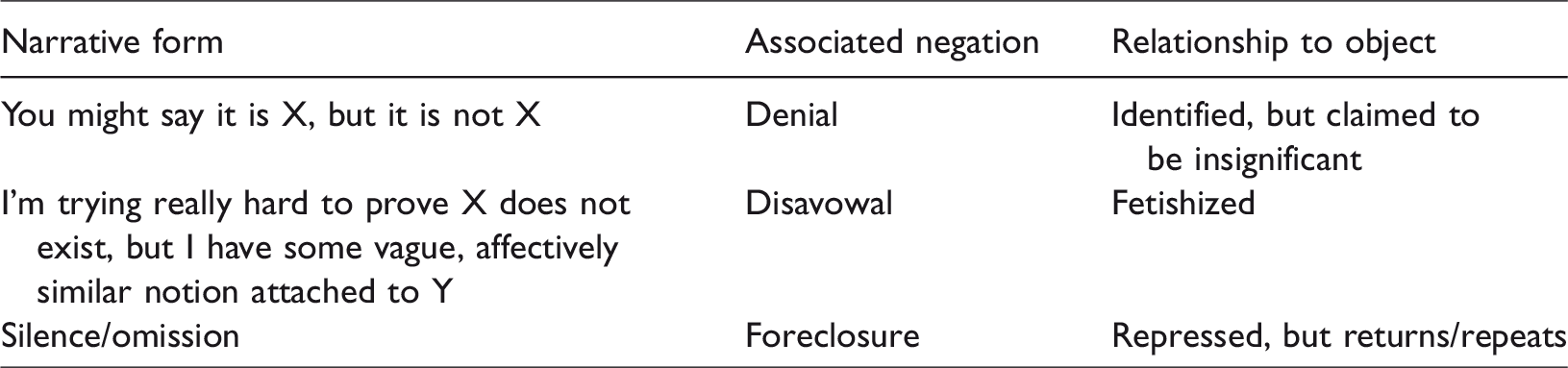
In the following, we focus on specific forms of negation as defined by Lacan to identify the moments when total waste management narratives are anxiously shored up by their proponents. These are denial, disavowal, and foreclosure, accompanied by fetishization and repression (see Table 1). Denial, according to Freud is “the neurotic repudiation of a thought that the unconscious is in the process of expressing” (Freud, 1994: 235). Disavowal is more profound and does not acknowledge the truth being negated—rather, “we see that the perception has persisted, and that a very energetic action has been exerted to keep up the denial of it” (Freud, 1994: 153). In disavowal, the subject actively distances him or herself from a traumatic thought, but cannot fully escape it. While the idea is not signified, it lurks in the psyche at the perceptual level. In this case, the thought may be attached to a fetishized object in the subject’s field of perception, allowing the idea to be safely contained. The battery is such a fetish object in the Lacanian sense when it is seen as a benign, inert whole, instead of as a sum of its explosive, toxic parts. This “wholeness” breaks down physically in wasted batteries. It also breaks down discursively when we start thinking about batteries as waste, risk, and hazard, as well as power sources. Foreclosure, the strongest form of negation, refuses any relationship to a disturbing thought or material, hiding the issue from the subject itself. This can signal repression, which should be read in conjunction with another of Lacan’s views—that “what is repressed is what returns” (Harari, 2004: 203). This play on Freud’s “return of the repressed” highlights the fact that for Lacan, language, subjectivity, and the unconscious are coextensive, not hierarchical. In contrast to Freud, Lacan therefore argues, repressed feelings or ideas do not come from a more “authentic” deeper order, but are rather part of the symbolic order and can and should be analyzed as such, 3 advice we follow below. For Lacan, another indicator of repression is the repetition compulsion. Here, what is being repressed can be identified by what returns in repeated behaviors and/or by the breaks in language and disruptions of the metonymic chain represented by malaprops, slippages, etc. These all indicate what is worrying or occupying the subject, and with analysis may tell us more about the fundamental cause of the subject’s anxiety (Lacan, 2007: 11–12; 386–388).
Analysis of the symbolic field indicating anxiety.
Denial and fetishization: Battery development and the pursuit of modernity
Battery development has helped to sustain a desire for modernity and mobility by denying the risks associated with the widespread manufacture and circulation of volatile materials from which batteries are made. Batteries comprise an inherent contradiction, as the storage of energy is anathema to natural entropic systems. Below we briefly trace the history of two types of batteries tied to modern desires for mobility and connection: sealed lead acid and lithium-ion. We identify moments of anxiety in the development of batteries through moments of denial and processes of fetishization.
Sealed lead acid batteries (SLABs) generate energy in most cars. Lead poses obvious risks to human and environmental health. There is no safe threshold for lead in the blood. Even small amounts of lead can lead to brain and kidney damage, hearing impairment, and learning difficulties in children. These risks have been known for decades, but have been rationalized as a necessary evil for continued economic growth. At a staged public hearing in, 1925 Frank Howard of Standard Oil, for instance, testified not to the safety of leaded gasoline, but its importance to industrial modernity. Calling the lead added to gasoline an “apparent gift of God,” he asked: What is our duty under the circumstances? Should we throw this thing aside? Should we say, ‘No, we will not use it,’ in spite of the efforts of the government and the General Motors Corporation and the Standard Oil Co. toward developing this very thing…? Because some animals die and some do not in some experiments, shall we give this thing up entirely?….I think it would be an unheard-of blunder if we should abandon a thing of this kind merely because of our fears. (Rosner and Markowitz, 1985: 348)
Lead is not the only volatile material to be used in batteries. Recent stories of exploding cell phone batteries and concerns over laptop batteries on airplanes are only the most recent demonstrations of the volatility of lithium-ion batteries. While Edison was adding lithium to his nickel-plated batteries in the early 1900s, it took several decades for lithium to become a main component of batteries. Spurred by the oil crisis, development of primarily lithium-ion batteries began in the 1970s. Early development was so plagued by accidents that fire departments in the US threatened to make Exxon pay for the special chemicals required to put out lithium fires at their factories (The Economist, 2017). In 1990, Sony announced the development of rechargeable lithium-ion batteries, which rapidly replaced batteries made with the known hazardous materials mercury and cadmium. In contrast to mercury- and cadmium-based batteries, lithium-ion batteries were billed as the “environmentally friendly” option (e.g., BatteryUniversity.com, n.d.). This designation disavowed toxins in contemporary lithium-ion batteries (lead, copper, cobalt, nickel, hazardous organic chemicals, and many of the same hazardous elements, like mercury and cadmium) and allowed the potential dangers of lithium-ion batteries to go under-researched and under-regulated.
In this brief history of battery development, denial and disavowal provide rationales for the continued production of batteries, despite the inherent risks associated with safely capturing energy and the hazards posed by their composite materials. In the case of SLABs, they are clearly made up of a “thing,” that causes fear (i.e., lead). The dangers of lead are acknowledged by proponents of its use, but it is simultaneously denied a name in the interest of sustaining the desire for progress, modernity and profit embodied in industrial modernity. The development of lithium-ion batteries is also riddled with the metonymic displacement that signals disavowal: “We know that batteries are dangerous, but here’s an ‘environmentally friendly’ one.”
Both types of batteries are composites of hazardous materials, masked by a hard casing that makes them appear whole and inert. They are fetishized objects carrying within themselves both the promise of modern conveniences and mobility, and the risks that we are willing to ignore. Disavowal of the possible risks of circulating and relying on hazardous composites begins to break down as the fetishized object submits to entropy and comes apart, as working battery becomes battery waste. In the next section we describe the negations employed by battery industry groups and regulators to shore up the total management phantasy in the light of risk and anxiety.
Repetition and phantasy: Battery waste management according to corporate and governmental managers
By volume, one of the most significant battery waste streams globally comes from SLABs. In the US, postconsumer SLAB waste has only one legal means of disposal: to enter the official recycling program. SLAB recycling in the US is widely touted as a regulatory win–win success story in which regulations have both reduced risks and created a booming recycling industry (e.g., Gaines, 2014). According to BCI, a North American trade association representing SLAB manufacturers, SLAB recycling programs are the most efficient in the world, with a recycling rate of 99.3% between 2012 and 2016. Government agencies, other trade organizations (e.g., www.associationofbatteryrecyclers.com), battery recycling companies, and nongovernmental organizations (NGOs) often quote this rate or an earlier version of it (97% between, 2009 and 2013) (e.g., www.rsrcorp.com). BCI reiterates this in their summary of the advantages and disadvantages of lead acid batteries: Advantages: This chemistry has been proven over more than 140 years. Batteries of all shapes and sizes, available in sealed and maintenance-free products, are mass-produced today. In their price range, lead-acid batteries provide the best value for power and energy per kilowatt-hour, have the longest life cycle and a large environmental advantage in that they are recycled at an extraordinarily high rate. (Ninety-seven percent of the lead is recycled and reused in new batteries.). No other chemistry can touch the infrastructure that exists for collecting, transporting and recycling lead-acid batteries. (BCI, 2017b)
Further omissions masked by total management narratives include the other potentially hazardous materials in waste SLABs. In particular, the acid in lead-acid batteries is a sulfuric acid solution. The BCI attempts to depict sulfuric acid as safe precisely because it is ubiquitous (a mode of denial), saying it is “the most widely used industrial chemical in the world.” They continue: “As with lead, many innovations have been developed to handle and even completely recycle sulfuric acid battery electrolyte in a safe and environmentally friendly method. Sulfuric acid is non-flammable and is not considered toxic beyond its obvious corrosive hazards” (BCI, 2017c). In these statements, the battery production and recycling industries describe sulfuric acid as safe because of technologies developed to mediate its risks, and because it is neither flammable nor toxic. However, this is simply an evasion made possible by the slipperiness of the legal term “hazard.” As a corrosive material, it causes burns upon exposure by inhalation, ingestion, or skin contact (Centers for Disease Control [CDC], 2014). Additionally, though not flammable or toxic in itself, in a fire it gives off toxic fumes.
Using this highly problematic SLAB recycling system as a model, contemporary researchers are developing processes for recycling lithium-ion batteries. Lithium-ion batteries are more complicated to recycle than SLABs because lithium-ion batteries contain more individual cells and several different materials. According to industry experts, three factors will drive development of lithium-ion battery recycling programs: (1) changing the physical construction of batteries (e.g., designing for easy disassembly), (2) the economics of recycling, and (3) “[a]ssurance that regulations will not impede recycling” (Gaines, 2014: 6). Additionally, experts claim that major lithium-ion battery recycling operations do not need to be in place immediately, but should be in the next ten years or so, when increasingly large numbers of lithium-ion automobile batteries from hybrid cars will likely become waste (Gaines, 2014). In the meantime, growing stocks of lithium-ion batteries are disposed of as e-waste or thrown in the trash. Despite being the “environmentally friendly” battery, landfilled lithium-ion batteries have been found to leach heavy metals into the environment, producing concentrations at levels harmful to humans and ecosystems (Kang et al., 2013). Additionally, concerns have arisen about lithium-ion batteries causing fires at recycling facilities (Anderson, 2013), which hearkens back to the repressed—and then repeated—history of their development.
Locating the objet petit a
In the following sections, we describe our attempts to recover battery waste symbolically and place its material persistence, using the example of SLAB and lithium-ion batteries that are imported to the US. Any reassurance provided by the 97–99% recycling figure is further undermined by the fact that SLABs produced in the US are often exported for processing. In fact, battery waste exports have risen with the advent of free trade agreements such as the North American Free Trade Agreement (NAFTA). According to the EPA, 1.4 billion pounds of SLABs were exported in 2013 (RSRCorp, 2014). The Commission for Environmental Cooperation (CEC), a trinational organization comprising Canada, Mexico, and the US, was established in conjunction with the signing of NAFTA. It estimates that from 2004 to 2011, SLAB exports to Mexico increased by 449–525% and by 221% to Canada (CEC, 2013: xi). This would not in itself be worrying, except for the constant insistence by the CEC and the EPA that the US has the strictest standards for hazardous waste management in North America. The limitations of such claims can be seen in the story of one company.
One major lead-acid recycler and US-based importer of waste SLABs, RSR-Quemetco Corporation, advocates against the export of lead-acid batteries. It argues specifically that Mexico has weaker regulations for lead emissions (RSR Corporation, n.d.), and that toxic waste is best managed in the comparatively stringent US (RSR Corporation, 2015). This argument expresses the idea that the stricter regulatory environment of the US prevents mismanagement of hazardous waste, a claim that functions to support the total management narrative. Even so, the phantasy fails. RSR-Quemetco has been under investigation by the EPA for causing elevated levels of lead in neighborhood soils (Peterson, 2015). They replied to a 2015 demand for soil testing by disavowing their responsibility for elevated lead in the soil: Lead comes from many sources in the environment. Historic sampling at other locations and lead speciation studies indicate that there are several other sources of lead that may be identified during the sampling process. The proximity of the facility to the 60 Freeway and historic use of lead in gasoline are two potential sources, and there could be many more. (Peterson, 2015)
In the following sections, we draw on data gathered from a series of Freedom of Information Act requests to the EPA to demonstrate the multiple negations at work in attempting to omit, manage, extract profit from, and spatially cast aside hazards of battery waste. These data include all reported hazardous waste transfers between the US and Canada or Mexico from, 2010 to 2012, recorded in shipping manifests and annual reports quantitatively and qualitatively. Figure 1 shows an annotated manifest, highlighting the main pieces of information we gleaned and compiled. Despite being novel in its ability to track transboundary transfers of specific hazardous materials among specific locations in all three countries, it is worth noting the incompleteness and uncertainty associated with the dataset. These issues begin with the raw data as collected by the EPA; while in Figure 1, all parts of the manifest are filled in, legible, and without discrepancies, this was frequently not the case.
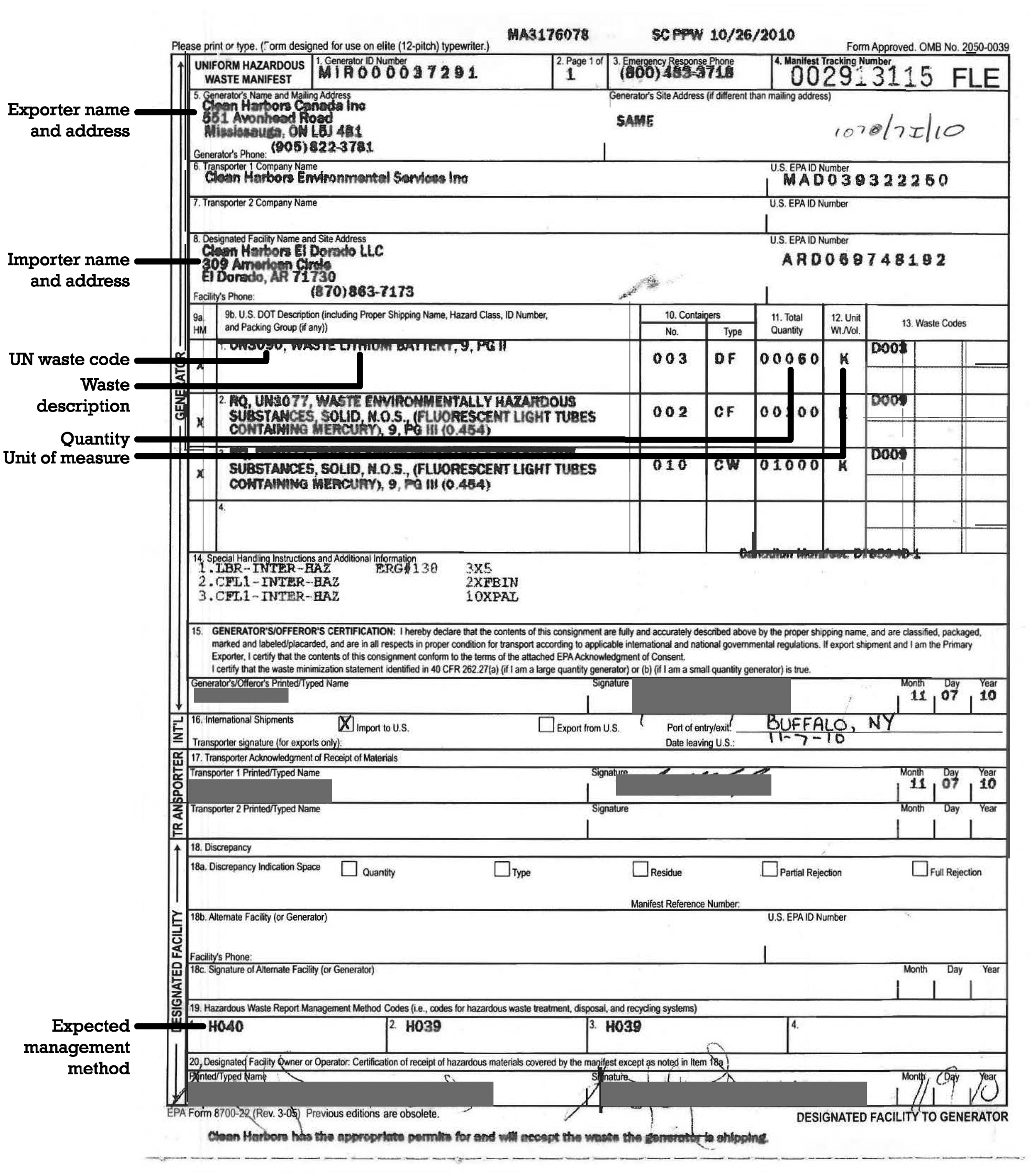
Example manifest of hazardous waste imported into the US, annotated with information used for mapping and analysis.
Battery waste is tracked through such manifests and annual reports. In addition to uncertainty related to the state of the raw data, there are a number of other ways in which actual transfers of battery waste exceed our data. First is illegal trade, since as much as 30–60% of SLABs from American markets are illegally exported to Mexico. While this figure does not capture the extent of the issue precisely, the CEC claims that even the lower figure of 30% could lead to devastating consequences because few smelters in Mexico “appear to have the types of controls, processes and technologies necessary to receive a permit in the United States or Canada today” (CEC, 2013: ix). Second, there is both misreporting and non-reporting in the legal trade. For example, the CEC reports that in North America “the United States has the most stringent overall framework [relative to Mexico and Canada]” and that with Mexico, “significant gaps in its existing regulatory framework, certain emission controls and requirements are the least stringent and need to be augmented” (CEC, 2013: x). On the other hand, the report continues to note that, contrary to Canada and Mexico, the US “does not require a manifest to accompany international shipments of SLABs. It also does not require exporters of SLABs to obtain a certificate of recovery from the recycling facility” (CEC, 2013: x).
Coding waste: Denial, disavowal and foreclosure
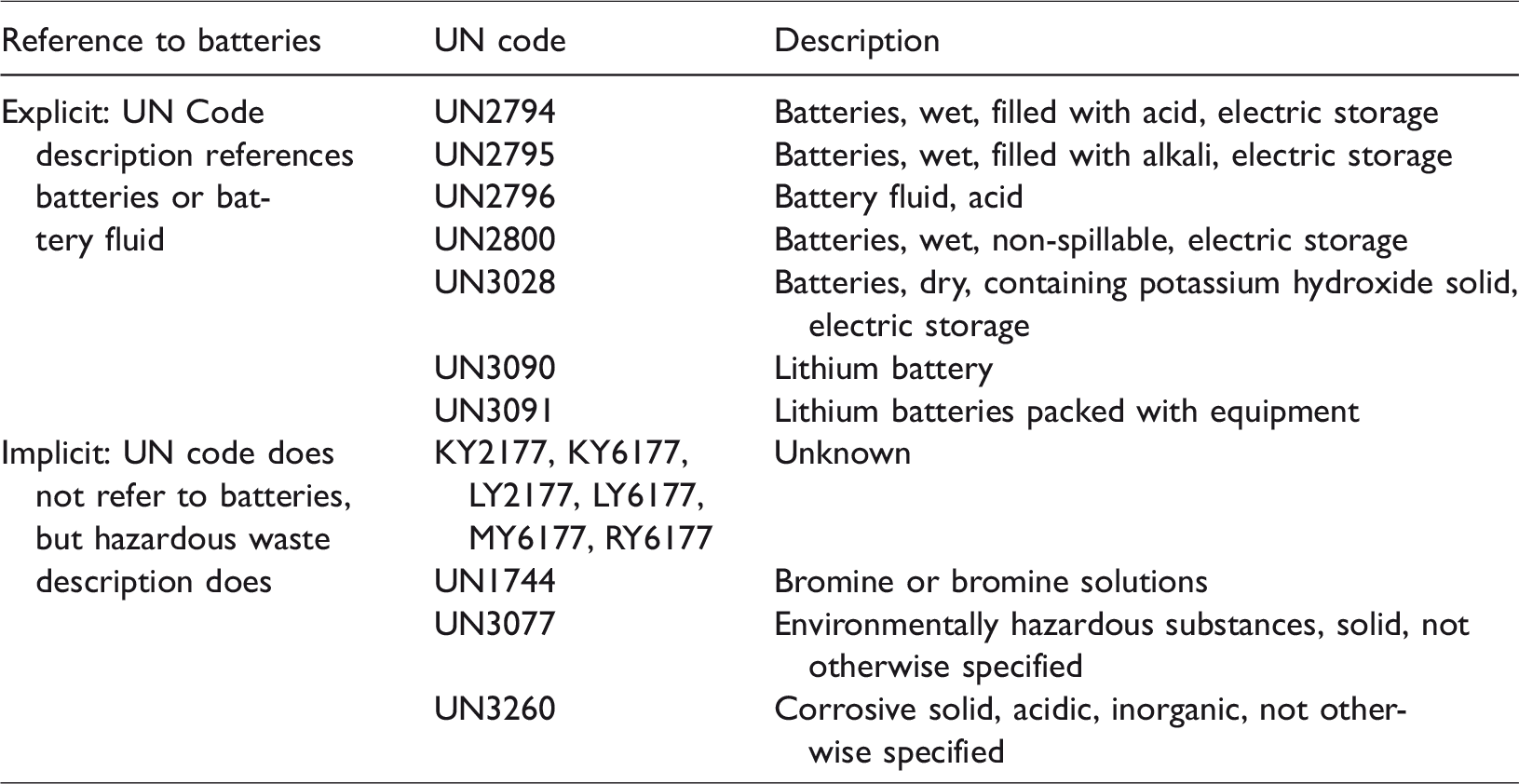
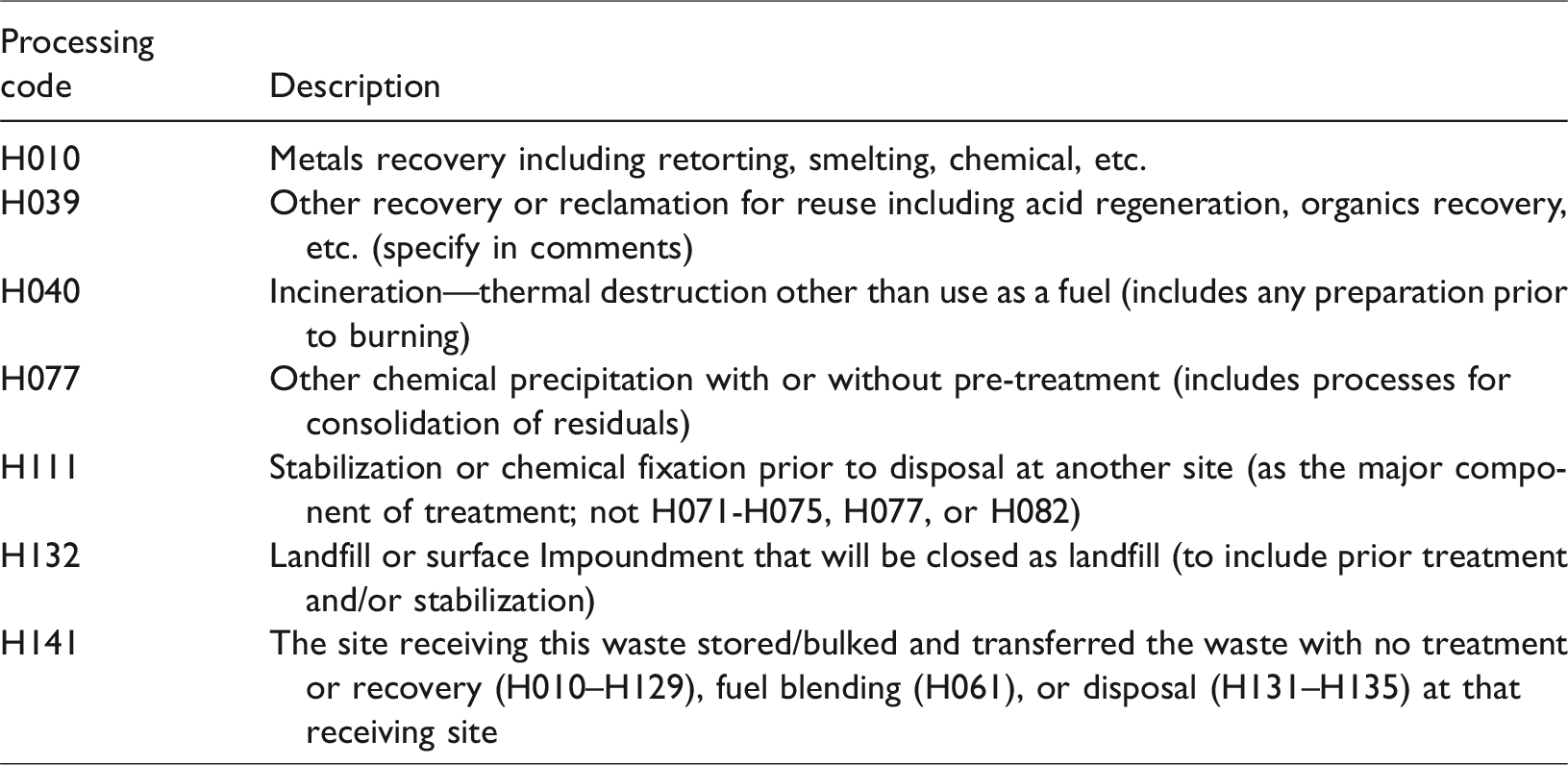
The elaborate and detailed process of regulating the transnational hazardous waste trade creates the expectation that waste can be rendered manageable through codes, its contents identified, contained, and, when possible, made once again into something valuable. Battery waste is tracked through several codes, which apply to waste that is kept in the US as well as waste that is imported or exported (see Tables 2 and 3). First, the United Nations Committee of Experts on the Transport of Dangerous Goods issues codes that identify hazardous substances. Several codes specifically refer to batteries, such as UN3090 and UN3091 (lithium batteries and lithium batteries contained in or packed with equipment, respectively). Additional codes identify battery fluid (UN2796 refers to acidic battery fluid and UN2797 to alkali battery fluid), batteries in vehicles or equipment, for storage, or containing/composed of a particular material. In addition to codes that identify that a waste is or includes batteries, an additional code identifies how battery waste is processed when it arrives at its destination. These codes explain, for example, whether the waste is supposed to be recycled (codes H010, H039, and others), or whether something else happens to it – incineration is H040, landfilling is H132, and so on.
United Nations Committee of Experts on the transport of dangerous goods codes describing battery waste (restricted to codes present in our data set).
Codes for hazardous waste processing that are used for batteries (Descriptions from US EPA, 2015).
Additionally, batteries can be classified as “universal waste,” instead of hazardous waste. The “universal” classification was developed to facilitate the recycling of certain ubiquitous materials like batteries. Specifically, wastes declared as universal do not require prior consent from importers and are not accompanied by the normally-required manifests. Due to this metonymic transformation, the CEC found that “US exporters are sending SLABs to 47 countries where US EPA has no record of having obtained consent from those countries to receive the SLABs” (CEC, 2013: x). This is compounded by the slippages between codes seen in the previous table. In 2011, for example, the US Census Bureau used Harmonized Tariff Codes to estimate that the US exported 342,186,978 kg of SLABs to Mexico, while the EPA estimated a number 14% higher (389,539,362 kg) (CEC, 2013: 24).
Battery imports from Mexico or Canada to the US can be seen more comprehensively in Figure 2. What Figure 2 also shows, however, is how difficult it is to track where wasted batteries go. The innermost (red) circle represents materials that either use one of the UN codes for batteries or refer to batteries in the description field. Such field combinations include, for example:
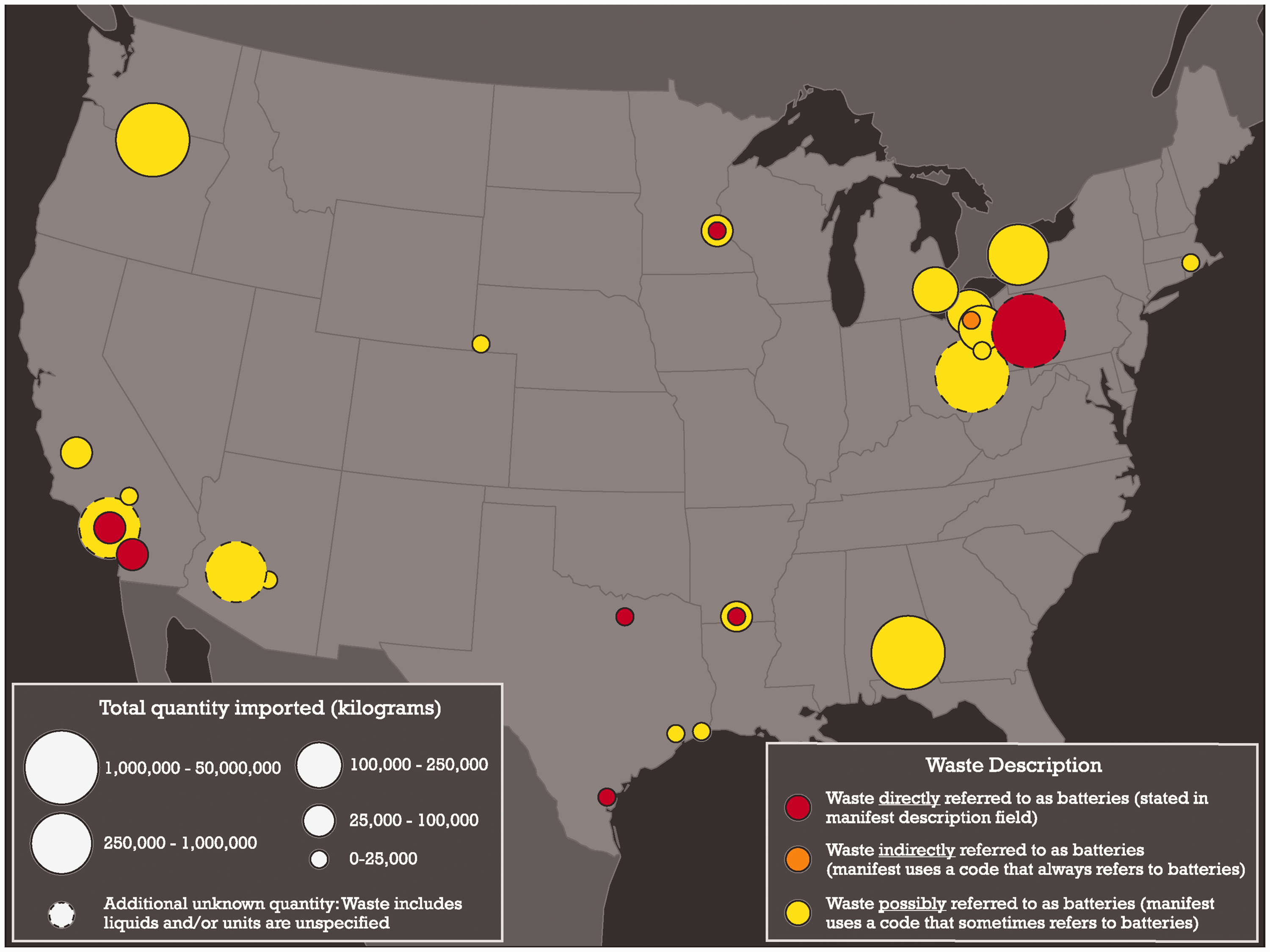
Imports of battery waste and possible battery waste.
“Open lead acid batteries” in the hazardous waste description field, and “corrosive solid, acidic, inorganic, nos” in the UN code description field (UN 3260).
“Lithium + lithium-ion” in the hazardous waste description field, and “lithium battery” in the UN code description field (UN 3090 and 3091).
A blank space in the hazardous waste description field, and “lithium battery” in the UN code description field (UN 3090 and 3091).
The slipperiness of these categories derives from official translations of UN ID codes and the flexibility in reporting for the hazardous waste description field that allows for ambiguity. The third field combination, the blank space, introduces the most obvious element of omission, in that sometimes one or more of these fields is either blank or makes no reference to batteries. The literal blank space simply forecloses such waste altogether by eliminating it from the symbolic universe. The same occurs, albeit less obviously, in the first two descriptors, in which batteries are elided through metonymic transformation in one of the two fields. Our point is not that individual managers fail to fill out these forms completely because of individual feelings of anxiety. They may have any number of reasons to do so. However, the repeated occurrence of such practices, as well as their official sanction in regulatory loopholes, indicate to us systemic foreclosures of risk that help maintain desire along the line of a modern mobile capitalist phantasy.
The middle circle (orange) contains materials equally likely to be batteries, but that are not directly stated to be such. The UN codes include several that specifically refer to batteries, such as UN2796. UN2796 stands for “battery fluid, acid.” By looking for specific codes (e.g. UN2976) rather than direct references to batteries themselves, several additional battery transactions can be identified. Without using the codes, such transactions would be left out, as they are described as “waste sulfuric acid” in the hazardous waste description and the UN code field is left blank. These inner two circles thus illustrate not simply ambiguity in the data, but regulation-sanctioned opportunities for denying battery flows.
The outermost circle (yellow) symbolizes materials that are potentially batteries. Waste managers do not necessarily use the UN codes that correspond to battery waste to denote such waste, but instead use more general or alternative categories. This circle symbolizes these categories, which includes codes ranging from fairly specific (UN3090: lithium and lithium-ion) to extremely general (UN3077: environmentally hazardous waste solid, not otherwise specified). We checked the description field of these codes to eliminate shipments that were obviously not battery-related (e.g., waste streams described as fertilizers). Yet, as the map shows, many additional shipments that potentially involved battery waste were revealed.
Finally, these reported quantities are rendered even more ambiguous through an additional element of denial. The dashed outline around some facilities indicates when larger quantities of batteries might have been imported than are symbolized. In some cases, this is because of inconsistent units: this map quantifies only solid battery waste, and in some cases the waste is reported in liquid rather than solid units. In other cases, the units are simply not listed.
Figure 3 shows the limits of total management narratives in terms of battery processing, mapping the “Expected Management Method” field from the manifests (codes shown in Table 3). We have included imported materials that were either coded or described as batteries specifically or coded in ways that indicate that they might be batteries. In most cases, facilities received more than one shipment of batteries and/or potential batteries. If a facility processed these shipments in multiple ways, the symbol is coded to indicate these multiple processes. The uncertainty in this map is compounded by the previous one as it includes data from all categories of Figure 2.
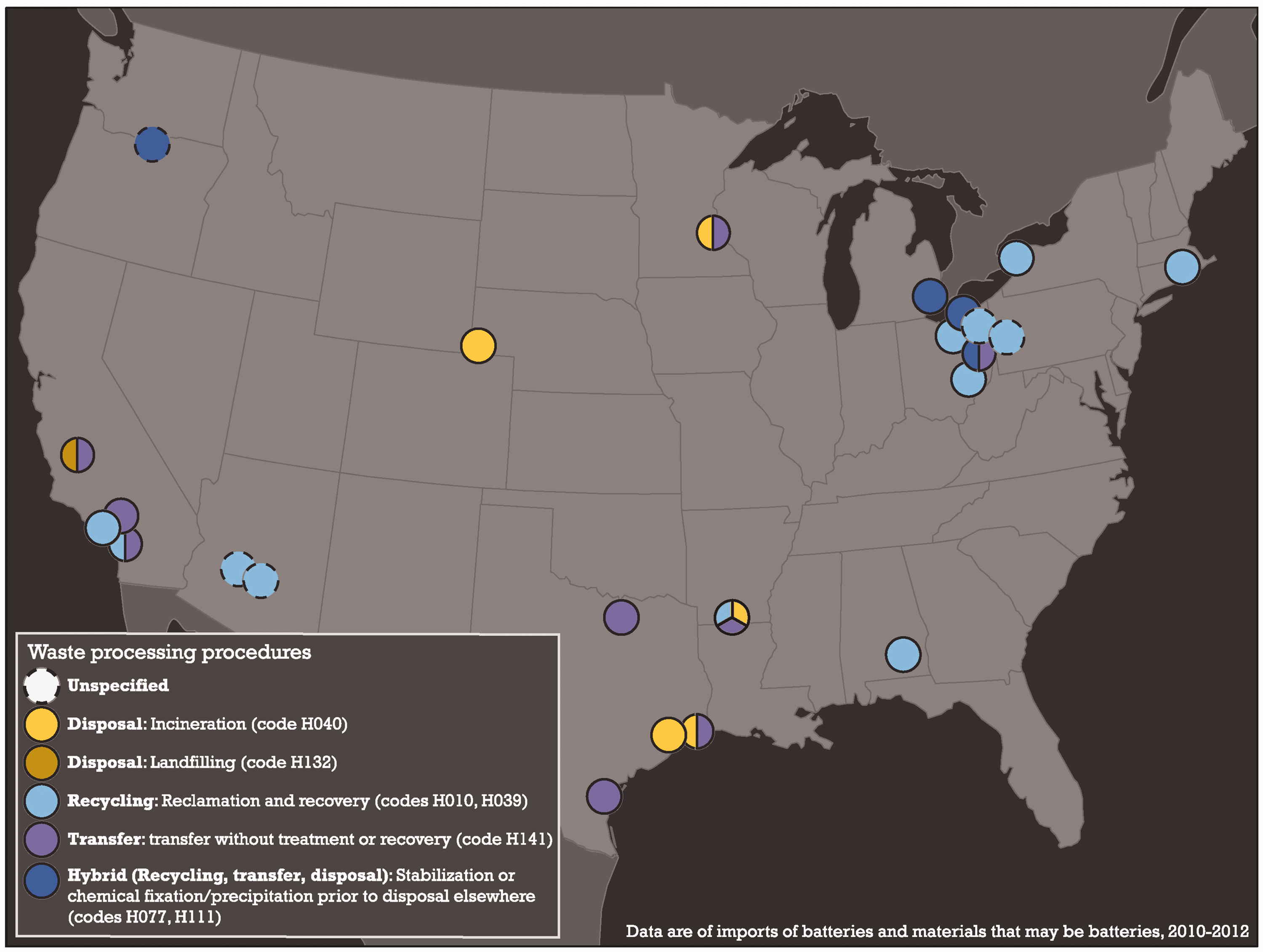
Waste processing mapped by code and location.
While total management narratives highlight the “stringency” of the US regulatory structure requiring facilities involved in the waste trade to report on what will happen to battery waste upon arrival at its destination, we see, once again, foreclosure in the form of several facilities simply not filling out processing type. The dashed line ringing some symbols in Figure 3 indicates either that the expected management method field was not filled out or that it was illegible (either due to handwriting or low quality scans). Further examples of foreclosure occur when the paper trail ends with the receiving site simply serving as a further transfer point, particularly at sites in Southern California and Texas. Waste processed with code H141 is not processed at the receiving site at all. Rather: “[t]he site receiving this waste stored/bulked and transferred the waste with no treatment or recovery (H010-H129), fuel blending (H061), or disposal (H131-H135) at that receiving site” (US EPA, 2015). The codes H077 and H040 present a similar case of transfer, but after initial treatment. This is a symbolic and material shell game, highlighting the continuous discursive and spatial displacement of risk. To be clear, however, our point in analyzing these codes is not simply that regulations should be more specific to eliminate the ambiguities, inconsistencies, and gaps in the data. Nor is the problem that the forms are not always filled out or not always filled out legibly. Rather, as we argue in the conclusion below, across these cases, these ambiguities, inconsistencies, and gaps are inherent to battery waste management under capitalism.
Conclusion
In this article, we have argued that battery waste is the remainder or the objet petit a that must be cut away to preserve the total management narratives that support contemporary capitalist phantasies of growth without consequence. The attempted severing of waste from the political economic body, however, is incomplete and haunts industry leaders and regulatory bodies who grapple with anxiety associated with the objet petit a through a series of defensive strategies that negate the object. Our data highlight the slippages, omissions and repetitions constituting the symbolic universe associated with waste management that we argue indicate a highly fraught, anxious relationship. To analyze this relationship we drew on Lacan’s concept of anxiety to argue that anxiety’s radical potential exists in its ability to reach beyond capitalist phantasies to lay bare contradictions of modern life. We argued that the history of SLAB and lithium-ion battery development was plagued by denial of the explosive and toxic materials they comprise (lead, lithium) and fetishization of them as necessary objects powering the modern economy. We then turned to how the phantasy is supported in the contemporary moment through slippages in the metonymic chains that make up the symbolic universe of hazardous waste management. Here, risks associated with the circulation of hazardous materials are actively disavowed by constant discursive metamorphosis of batteries into materials that are claimed to be safe in their mundane ubiquity, their mismatch with the legal definition of “hazard,” or their amenability to technical “solutions.” Next, we examined hazardous waste codes that symbolically deny and disavow hazardous waste. Codes do this by transforming battery waste into a series of tradable commodities. Alternatively, the existence of hazardous waste can be foreclosed altogether through regulation sanctioned omissions. Building on this, we visualized imports of batteries to the US in order to underline both their symbolic slipperiness and their material persistence in specific locations. Throughout the empirical sections, and especially in placing potential batteries on the map, we emphasize how these negations fail as the repressed returns. Constant repetition of claims of the safety of US processing of imported hazardous waste including batteries indicates a repetition compulsion. As a society, we continuously pursue and desire battery development and use, while at the same wanting to mask over the risks associated with it.
We are not arguing that the presence of anxiety is the cause of how batteries are managed, or that the symbolic universe associated with battery waste, and hazardous waste management in general, is separate from modern capitalist economic development. On the contrary, we argue that these are intimately linked. By continuing to pursue battery development, as well as recycling and recovery projects for wasted batteries, we are compulsively repeating the bargain originally made by Volta in, 1799 when his “pile” became the first battery that could continuously provide an electric current to a circuit, enabling mobility and contributing to the modern idea that energy could be safely stored and would drive economic growth and progress.
While the above argument is not unique to batteries, we do believe that batteries are emblematic of the central concerns of this article, since they are particularly freighted with modern ideas of mobility, progress, and circulation, until they become waste. In this moment, and “with dreadful certainty, we know the peculiar weight of certain objects” (Robertson, 2015: 11). To protect the modern subject qua consumer from this weight and to maintain desire along a path of capitalist development, hazardous waste regulators and managers have promotedtotal management narratives about what happens to dead, discarded batteries. The elaborate and detailed process of regulating the transnational trade has created a symbolic universe supporting what we consider to be the impossible expectation that hazardous waste can be rendered manageable through codes. As battery waste exceeds these codes, this excess is anxiously denied, disavowed, or foreclosed. These negations, too, must fail as the wasted battery as objet petit a is de-fetishized, releasing its dangerous components and revealing the hazards accompanying everyday life for many modern subjects. The repressed risks and hazards associated with batteries as emblems of modern conveniences return as they persist over time and through space.
Our point in this analysis is not that regulations should be further strengthened to prevent these gaps, but rather that these gaps are inherent to battery waste management, and by extension, hazardous waste management under present day capitalism. Battery waste is emblematic of the splits in the thing itself—between value and waste, between commodity and risk—that drive capitalist desires, while veiling the lack at the heart of the impossible promise of modernity. This parallax object is enrolled in multiple big Others in the form of legal and regulatory structures, as well as modern capitalism, but exceeds all of them. Failures to comprehensively manage waste are not just a product of insufficient regulation, technology or will. Instead, they are intrinsic to capitalist economies fueled by desires for modern conveniences, whose costs are narratively and spatially distanced from those who benefit most. We have argued that a Lacanian approach to such phenomena can reveal how total management narratives are constructed and, more importantly, how they can fall apart. We believe it is these sites in which the anxious psycho-spatial functioning of capitalism can be contested and reimagined in the name of more environmentally just futures.
Footnotes
Declaration of conflicting interests
The author(s) declared no potential conflicts of interest with respect to the research, authorship, and/or publication of this article.
Funding
The author(s) disclosed receipt of the following financial support for the research, authorship, and/or publication of this article: Support for this research came from the National Science Foundation (#1539712) and the Wisconsin Alumni Research Fund.
