






Abstract
This paper examines the continuity of the Israeli settler colonial project into the contemporary moment – as manifested in the city of Tel Aviv – and its transfiguration into current socio-political and spatial processes in the urban arena. It offers a close reading of a case study from which such continuity emerges, exposing the settler colonial terms of production of Tel Aviv in current entrepreneurial real-estate projects. The case study under analysis is of the Giv’at-Amal neighbourhood, established on the emptied Palestinian village of Jamassin in the war of 1948, now facing eviction by private entrepreneurs constructing a luxurious residential compound. The paper aims to expose the ways in which the urban entrepreneurialism in Giv’at-Amal reproduces the settler colonial logic of devaluation, erasure and replacement of existing inhabitants of the land. It further conceptualises the area as an urban frontier, in which current neoliberal restructuring plays an active role in the ongoing production of the settler colonial urban space. By so doing, it aims to undermine the notion that settler colonial projects of replacing existing people and geographies are completed historical events, and to re-articulate them as ongoing contemporary processes.
Introduction
For the past four decades, the residents of the neighbourhood of Giv’at-Amal in Tel Aviv have been engaged in a struggle against their eviction from the land they inhabit since the war of 1948. The Jewish residents settled in the area during the war as internal refugees from the neighbourhoods bordering hostile Jaffa, and were housed in the emptied Palestinian village of Jamassin as a temporary solution. Several decades later, the land – meanwhile appropriated by the state – was sold to private entrepreneurs planning a residential compound of luxury high-rises on the premises. The residents of what eventually became Giv’at-Amal were classified as invaders and trespassers and are to this day struggling in courts against their eviction. Several forced evictions have already taken place in the neighbourhood, while the area is becoming a construction site threatening the residents still holding on to their homes.
This chronology can be read as a distinct case of neoliberal urban restructuring and its destructive impact on local communities – taking place in the global arena in general, and in Tel Aviv metropolis in particular. The commodification of the urban space, the massive displacement of communities and the withdrawal of civic institutions – abandoning civilians to face impossible negotiations with powerful private entrepreneurs – are all reflected in the struggle of Giv’at-Amal’s residents. At the same time, this chronology enfolds key elements of Tel Aviv as the locus of the Israeli settler colonial project. The establishment of Giv’at-Amal on the emptied Palestinian village of Jamassin is part and parcel of the systematic erasure of the Palestinian history and geography from the founding narratives of Tel Aviv, allowing the city to be perceived as the ultimate settler colonial creation, formed on the ultimate terra nullius.
As a project of replacement, operating to erase existing people and geographies and establish newly invented settler ones, settler colonialism essentially aspires to cease ‘being settler colonial’ (Veracini, 2010: 22). But settler colonialism never ceases. It is, in Bonds and Inwood’s words, ‘a kind of permanent occupation that is always in a state of becoming’ (2016: 721). I therefore find that an intriguing endeavour in settler colonial studies is the constant effort to expose the ‘continuities and extensions of what have been thought of as a settler colonial past into our contemporary moment’ (Lloyd and Wolfe, 2015: 8). Following this objective, in this article I suggest a reading of the chronology of Giv’at-Amal – its settler colonial ‘past’ and neoliberal ‘present’ – as a single, continuous story.
This work aims to contribute to an emerging body of literature engaged in the presence of settler colonial logics in contemporary accumulation regimes, prominently neoliberal ones. It is interested in the continuity of the Israeli settler colonial project into the present moment, and its transfiguration into current socio-political and spatial processes. More specifically, it offers a close reading of a case study from which such continuity emerges. In the analysis of the study case, two stories of displacement and erasure are revealed: that of the Palestinian village of Jamassin and that of the Jewish neighbourhood of Giv’at-Amal. I first propose to analyse these two stories separately in order to delineate the discursive tools mobilised to justify and execute these displacements. Such an analysis exposes the displacement of Giv’at-Amal’s residents as operating along the lines of the settler colonial logic which enabled the erasure of Jamassin. But I am not merely interested in delineating the ways present accumulation regimes echo settler colonial histories. Rather I find that the continuity of these two stories indicate that the materialisation of Tel Aviv as a settler imagined geography – the replacement of indigenous Arab communities while erasing them not only physically but from the memories and narratives of the newly formed city – is an uncompleted, ongoing process. In light of my argument, I conceptualise Jamassin/Giv’at-Amal as an open urban frontier, a place narrated as available for re-shaping, which inhabitants and their homes are still not incorporated into the settler colonial city. Current neoliberal restructurings, I argue, are mobilised to finally close it.
The theoretical framework
Settler colonial studies, as shaped in recent years by different scholars (see, for example, Banivanua Mar and Edmonds, 2010; Elkins and Federsen, 2005; Veracini, 2011; Wolfe, 1999, 2006), distinguish other forms of colonialism from settler ones by the latter’s ‘intention to stay’ (Veracini, 2010: 100) and to establish a new society, located in a newly designed and re-invented geography. Settlers do not merely seek to exploit the appropriated land, its resources and people, but rather to re-invent it, to replace its people and re-design its geography. As defined by Patrick Wolfe, ‘settler colonialism is at its base a winner-takes-it-all project whose dominant feature is not exploitation but replacement’ (1999: 163). A foundational narrative of settler colonialism is therefore the one of the empty land, the terra nullius, on which settlers’ imagined geographies can be materialised. The materialisation of such geographies requires, first, the materialisation of the imagined emptiness – thus settler colonialism always entails what Wolfe famously termed ‘the elimination of the native’ (2006), and what Veracini elaborated as a wide variety of ‘transfers’ (2010). Perceiving land as empty is facilitated by applying frameworks which render existing people and patterns of inhabitation unrecognisable or invalid. It is a discursive ‘emptying’ which allows the justification of the physical erasure – either by the deportation, killing or forced assimilation of the natives. As these discursive frameworks narrate land as empty, they also set new measures for the establishment of acknowledgeable rights to the land – allocating these rights to the settlers. These measures are often based on the Lockean tradition of the active participation in the land’s cultivation (‘improvement’) and the development of a pioneering ethos.
It is this practice of displacement and replacement, facilitated by the narration of existing patterns of inhabitation and rights as unrecognisable or invalid, which guides my interpretation of the public and legal struggle of Giv’at-Amal’s residents: reading their current displacement by neoliberal forces as reproducing a settler colonial logic. But this reproduction of the settler colonial logic, I argue, is not merely an echo of the past. It exposes the settler colonial socio-spatial project as an uncompleted, ongoing project, and Jamassin/Giv’at-Amal as an open urban frontier.
My use of the term frontier, based on several scholarly works from recent years (see, for example, Pullan, 2011; Ron, 2003; Weizman, 2006), subverts its Turnerian (Turner, 1921) use as a geographically defined edge. Following the definition suggested by Ariel Handel, I refer to the frontier as ‘a space containing antagonistic relations between two or more populations, while one of them perceives the others' place as empty or unregulated, therefore identifying it as a destination for spreading, regulation and codification’ (Handel, 2011: 161). As such, frontiers are created (or opened) by applying legal, discursive, or any other perceptual framework which render the existence of a group of people in a certain space illegitimate, invalid or indeed transparent. Such a definition undermines the notion that frontiers close when they are physically settled, when their perceived emptiness is materially filled. Rather, I suggest that the closing of frontiers is dependent on the institutionalisation of the geography casted onto them, namely, its affirmation and integration into a broader collective narrative. This affirmation is manifested both at the symbolic level – being written into a collective narrative, which can be read in history books as much as on street signs – and at the material one – the allocation of rights on the settled land. Such institutionalisation is operated by ‘the official apparatuses that are assigned with the authority to designate place-names and symbolic meaning’ (Leshem, 2016: 104). In the case study of Jamassin/Giv’at-Amal, as its reading in the current work suggests, the establishment of the Jewish neighbourhood of Giv’at-Amal was not institutionalised by formal recognition in its residents’ narrated right to the land. So the area remained an open frontier, in which neoliberal forces operate to materialise a geography that can, and may eventually will, be institutionalised.
My focus on the continuity and interdependency of the Israeli settler colonial spatial project and the current neoliberal urban moment in Tel Aviv corresponds to several recent scholarly works. These studies are engaged in how capitalistic accumulation regimes, primarily neoliberal ones, reproduce and reinforce settler colonial logics. David Lloyd and Patrick Wolfe (2015) identify the fundamental continuity between these two accumulation regimes in their common ‘exigencies of managing surplus populations’ (p. 3). Similarly to the settler colonial re-organisation of occupied lands, neoliberal economies constantly produce human surplus, masses of people that cannot be integrated into the socio-economic order. Lloyd and Wolfe point to the ways in which ‘settler colonialism’s inventory of local strategies’ for managing this human surplus ‘is becoming increasingly congenial to neoliberalism’s emergent world order’ (p. 4). Other writings aim to underline the ways in which neoliberalism reinforces, reproduces and maintains the racial stratification of settler societies in what is considered to be the post-colonial present. Elizabeth Strakosch (2015), for example, points to the ways neoliberal regimes classify people and communities in terms of ‘capacity’, allowing the exclusion of racialised communities from freedoms and rights by labelling them ‘incapable’. Haim Yacobi and Erez Zfadia (2017) criticise the notion that land reforms in Israel promoting privatisation undermine the racial hierarchies embedded in the Israeli land regime. They use the term ‘neo settler colonialism’ in order to examine how these reforms reinforce and reproduce settler colonial hierarchies and inequalities in land distribution. In a similar vein, Andy Clarno (2017) suggests a comparative study of South Africa and Israel/Palestine, using the term ‘neoliberal apartheid’ to describe the ways neoliberalism reinforces settler colonial separations.
This article aims to contribute to this growing literature, while continuing its underlying argument. In reading the chronology of Jamassin/Giv’at-Amal, I will show that the current neoliberal re-organisation of the area does not merely reinforce and reaffirm the existing settler colonial order. Instead, it is mobilised to continue organising space according to the settler colonial logic and imposing racial hierarchies deriving from this logic. As such, it plays an active role in the ongoing process of producing settler colonial urban space as ‘western’, ‘modern’ and – indeed – white. Such a reading further subverts the separation between a settler colonial ‘past’ and a neoliberal ‘present’.
Two important notes are relevant before approaching the case study and its analysis. The first note is regarding methodology: The theoretical premises of settler colonial studies guiding this reading are concentrated in the discursive frameworks which are established and applied in order to allow perceiving a place as empty – to produce it as a frontier. The methodology of this work is therefore based on a discursive analysis of several types of text: correspondence between the Giv’at-Amal residents’ committee and the municipality of Tel-Aviv; public statements of the neighbourhood’s residents in the press and social media; and legal documentations of the residents’ struggle against their eviction by the entrepreneurs, such as statements of claims and verdicts. The reading of these texts aims to show how both material substances and actions regarding those substances are given meaning and value – or are stripped of meaning and value – by different actors. A structure can be either a ‘shed’ or a ‘home’; an inhabitant can be either a ‘pioneer’ or an ‘invader’.
The second note I wish to make here regards my positionality as a researcher. As a Jewish-Ashkenazi woman born in Israel to a veteran family I am aware of my privileged researching and writing position. I have no pretentions in offering a solution to the complex question of representation – a question which rightly became central in social sciences in the past few years – but I do feel obligated to at least a full disclosure of such positioning. I approach the study of settler colonialism in Israel out of a political commitment to understand and expose the mechanisms that allow me to be in such a position and to critically examine the socio-political structures which facilitates my privileges. I therefore focus on the actions and narratives of the settler society to which I belong, while refraining from telling the stories of the indigenous Arabs.
Case study: Jamassin/Giv’at-Amal 1
The Palestinian villages of Jamassin Al-Sharqui and Jamassin Al-Gharbi were named after their residents’ main source of living – the herds of buffalos (Jammus) they raised on the banks of Wadi Musrara, known in Hebrew as the Ayalon River (Figure 1). The villagers of Jamassin, an estimated population of 2000 people, fled their homes in the 1948 war,
2
between 7 January and 17 March.
3
A map of Tel Aviv and the location of Jamassin/Giv’at-Amal. Based on a screenshot taken from: gisn.tel-aviv.gov.il.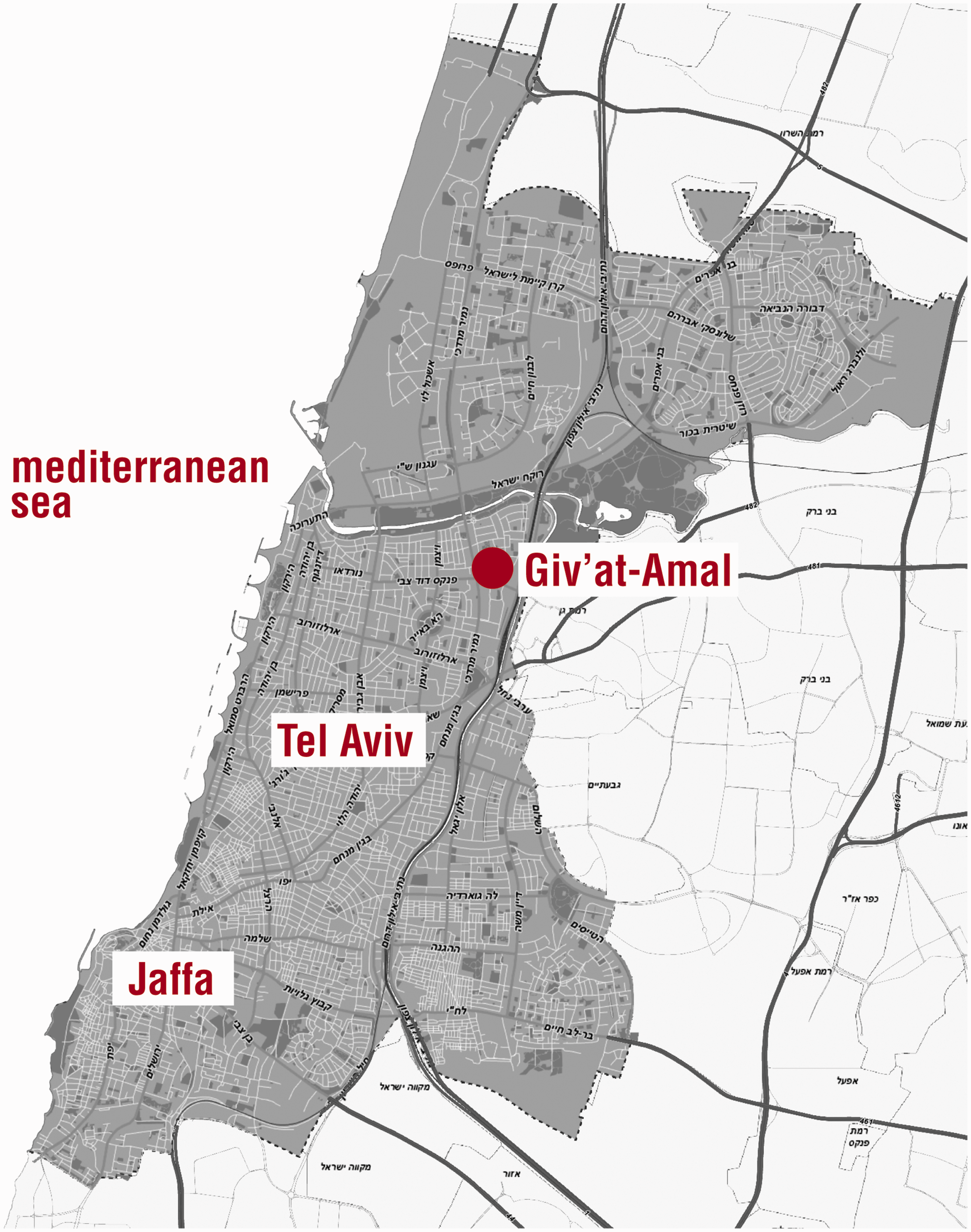
Around the same time the village was emptied, Jewish residents from the southern neighbourhoods of Tel Aviv left their homes, fearing their proximity to hostile Jaffa. They first found shelter in public buildings around the city, and were later moved by the ‘Hagana’ organisation
4
to the emptied houses of Jamassin Al-Sharqui and Jamassin Al-Gharbi, re-naming them ‘Giv’at-Amal’ A and B. Like many lands owned by Palestinians who fled or were forced to leave their homes during the war, the lands of Jamassin were registered – in the years following the war and the establishment of the state of Israel – as ‘absentees’ property’ and entrusted to a state institution which would later become the Israel Land Administration (ILA). The rights of the people placed on these lands during the war were discussed in a government decision published in November 1949. The decision stated that the neighbourhoods built during the war on empty Palestinian villages should be evacuated and their inhabitants should be re-located. The re-location: […] will be executed based on a mutual agreement and no shed will be demolished or removed – until their [the residents] transfer will be executed. All those which settled Jamassin or other places with the agreement of the authorized institutions will be able to remain in their place until they will be accommodated in a permanent location.
5
Despite this government decision, the Tel Aviv municipality identified the residents of the neighbourhood as trespassers who entered the buildings with no permission and demanded their eviction in the Magistrate Court in 1954. Though the municipality’s claim was rejected, the new neighbourhood was officially given a temporary status (Figure 2). The residents’ constant pleading with the city for proper infrastructure was continuously rejected. The pleadings and the rejections are well documented in an extensive correspondence between the established ‘residents’ committee’ and the municipal institutions. In 1961, the property was sold to a contractor, DP Diur. The contractor's agreement included a condition, demanding that the new housing project planned on the premises will be built within five years and that a substitute equivalent housing for the existing residents would be offered. This agreement recognised the status quo that was formed in the neighbourhood since 1948, applying the commitment for equivalent residence for all the families living on the premises at that time – 1961.
6
Despite the condition to which the buying contractor committed, in 1965 it filed lawsuits demanding the eviction of the residents. In addition, though the planned housing project was never executed, violating the sale agreement, the land was never returned to the state and remained the property of the contractor.
An aerial view of Giv’at-Amal and its surroundings. The neglected, underdeveloped state of the neighbourhood is evident, especially in contrast to its surroundings. Based on a screenshot taken from: gisn.tel-aviv.gov.il.

Plan TA/1770/A to the new compound. The proposed division of land parcels in superimposed with the existing structures of the neighbourhood. The plan was retrieved from the Israel Land Authority website: http://land.gov.il.
In 1986, the land was sold again to several private entrepreneurs, including twelve percent to the municipality of Tel Aviv. The entrepreneurs are currently executing the erection of a luxurious compound of high-rises named Park Bavly, based on a plan initiated and authorised in the first decade of the 21st century (Figure 3). The responsibility to evict the existing neighbourhood was sold with the property – calculating the costs of evictions to be conducted by the buyers into the sale, significantly lowering the price of the land. In 1988, the new owners of the land filed a series of lawsuits against Giv’at-Amal’s residents, launching a legal process that is still taking place today. 7 The bone of contention between the entrepreneurs and the residents in this legal debate is the legal entitlement for compensations – or, indeed, lack of entitlement – of the second and third generations of the families who moved to the neighbourhood after 1948, building their homes in family compounds next to their parents’ houses.
A forced eviction of several families took place on 17 September 2014, and more trials are currently being held against the families still living in the area. In these trials the entrepreneurs are not only demanding the eviction of the residents, but also use fees of up to 2.5 million Shekels (about US$700,000) to be paid by them for the use of the property. The residents oppose these demands and struggle for compensations for their eviction from the neighbourhood.
The chronology of the area exposes two stories of dispossession and replacement: the one of Jamassin by Giv’at-Amal, and of Giv’at-Amal by Park Bavly. I now turn to examine each of these stories separately. I first set the replacement of Jamassin by Giv’at-Amal in the context of the Israeli settler colonial project (with Tel Aviv as its locus). I find that the settler colonial logic as the organising principle of the Israeli accumulation and distribution of resources is evident in the residents’ adoption of this logic as the justification for their rights to the land. I then examine the replacement of Giv’at-Amal by Park-Bavly, tracing in it the same logic of devaluation which justifies erasure and replacement. Following this, I suggest reading these two stories in continuum, presenting my main argument regarding it being an open urban frontier in which the neoliberal restructuring is integral to the ongoing process of the materialisation of the settler colonial space.
From Jamassin to Giv’at-Amal
The conceptualisation of Israel as a settler colonial project is an ongoing conversation, originating from earlier works in colonial studies (Peled and Shafir, 2005; Shenhav, 2004; Yiftachel, 2006). Recent works, emerging from the field of settler colonial studies, establish this particular framework as suitable for the understanding of the Israeli endeavour (Degani, 2016; Leshem, 2013; Lloyd, 2012; Shafir, 2016; Veracini, 2006; Yacobi and Zfadia, 2017).
The story of Tel Aviv, a coastal city located at the centre of the country and constituting its main metropolis, provides an insightful prism for the understanding of Israel as such. Although traditionally identified with the agricultural settlements (Kibbutzim and Moshavim), the creation of what is popularly known as the ‘first Hebrew city’ encapsulates the essential aspects of the Zionist practice and discourse (Mann, 2006), and mainly the narration of Eretz Israel as Terra Nullius. The city of Tel Aviv unfolds a mythology of being ‘born from the sands’, enforced by an iconography framing the establishment of Tel Aviv in a vast sandy, empty space.
8
‘Since the most important concept of Zionism was the normalization of the Jewish people’, writes Sharon Rotbard (2005), not Jerusalem but Tel Aviv, the white city, is the real Zion. She was born Tabula Rasa […] on the sands, there was nothing there before her, she didn’t come on nobody’s expense and all she did was to make the wilderness bloom. (p. 85)
The erasure of the Jaffan history of Tel Aviv and of the Palestinian presence from its cityscape was solidified by the 2003 UNESCO declaration of Tel Aviv as a World Heritage Site, concentrating a dense urban texture representing the modern movement in architecture and urban planning. The declaration area was marked along the lines of what is known as ‘the White City’ – the neighbourhoods built in the early decades of the 20th century, representing an urban experiment in modernism, mostly built on a narrow stretch of sands between the sea and Jaffa’s citrus groves. This declaration ratifies Tel Aviv’s story as framed in a specific space and time – excluding the Jaffan attachments. These efforts expose the ‘White City’ as the product of a meticulous process of whitening.
The context of Tel Aviv as a settler colonial urban project is clearly reflected in the struggle of Giv’at-Amal’s residents for their recognition as the legitimate inhabitants of the land. The set of arguments they use in order to demand recognition of their rights is based on a claim of participation in the collective pioneering effort – their active role in the creation of the city. This adoption of the settler colonial system of justifications for establishing rights and entitlements testifies to its centrality as the organising principle of the Israeli spatial project.
The narration of Giv’at-Amal’s history as one of pioneering is evident as early as the 1950s, in the residents’ demands from the municipality to invest in infrastructure and improve municipal services to the neighbourhood. Letters written to city officials included a recounting of their initial settling in the area, repeatedly emphasising the physical conditions they have faced and the labour they have invested in its improvement. For example, in a letter to Mayor Levanon from 29 December 1952, the committee writes: When the families came to settle they found in those villages no place habitable, but: shaky and destructed rooms or stables and tin sheds unworthy of human dwelling. Nevertheless […] they have worked day and night […] fixed, perfected and cleaned […] the many years' filth, dirt, stench and decay of the Arabs.
9
When the battles subsided and the state was established, our situation did not get better. The neglect in the place was glaring and we had to fight the rough conditions: the neglect, the dirt, the shaky and filthy huts, the fields of thorns and reed, the harmful snakes and larva […].
10
We did everything with our hands. We built the electric and telephone poles […]. There weren’t any water taps; we drew water from the well on the hill like Falachim [peasants in Arab]. We washed the dishes in the drinking fountain in the street, until we brought the water home with pipes with our own hands. The cesspits were also dug by the residents – the state and municipality didn’t exist here. (in: Boso, 2015)
The rendering of the Palestinian village a non-village, denying it as a possible lived-space and justifying its erasure, is perhaps most explicitly articulated in a paper published in the alternative online journal ‘The Hottest Place in Hell’, published by Zafrir Bashan in 18 February 2014. The paper, supportively describing the residents’ struggle, delineates the history of the neighbourhood and the settling in Jamassin: ‘The families settled in huts and stables, slowly turning them into houses’ (Bashan, 2014). In Hebrew, ‘houses’ and ‘homes’ are described by the same word, ‘Batim’. The Palestinian structures in Jamassin, according to this narrative, were neither. Through the investment of work, the Jewish ones are both.
The examination of the struggle taking place in Giv’at-Amal exposes the settler colonial logic of devaluation, erasure and replacement which underpins Israeli spatial discourses and practices. This logic is adopted by Giv’at-Amal’s residents since it constitutes the main currency by which rights and entitlements are distributed under a settler colonial accumulation regime. However, despite their use of this currency, the municipal and state institutions refuse to acknowledge the claims of Giv’at-Amal’s residents. Such a refusal indicates the layered racial logic inherent to ethnocratic settler societies such as Israel, as defined by Oren Yiftachel (1999, 2006). As Mizrahi Jews whose origins are in North African and Arab countries, the residents of Giv’at-Amal are not part of the founding group of the settler society, but are rather part of the immigrant groups, located between the founding settlers and indigenous people. They identify with the founding group – by reproducing the settler colonial logic of justification for their claimed land rights – but are never equally and fully integrated. This racial hierarchy, inherent to settler colonialism, is clearly reflected in the layering of displacements exposed in the chronology of Jamassin/Giv’at-Amal: first the displacement of the Arabs, and then of the Mizrahi Jews, as part of the current neoliberal restructuring of the city.
From Giv’at-Amal to Park Bavly
The eviction of Giv’at-Amal residents and the construction of a new high-rise compound in its place are occurring in the context of a general shift in the political and economic structures affecting cities around the globe – a shift that can be conceptualised under the broad definition of neoliberalisation. Neoliberalisation in general, and in the urban arena in particular, has been the subject of extensive scholarly works (see, for example: Brenner et al., 2012; Hackworth, 2007; Shatkin, 2017). As part of this process, urbanity – which, in Lefebvre’s terms (1991[1974]), is a complex creation of different groups and individuals seeking to manifest their ways of life, values, interests and beliefs – is restructured in the form of real-estate markets, as effective ‘vehicles of capital accumulation’ (Smith, 2002: 447). Urban governance apparatuses change radically in the process, becoming increasingly involved in, supportive of, and even subjected to private entrepreneurship and real-estate markets. The city of Tel Aviv is deeply influenced by the neoliberal turn in urbanity, where extensive areas in the city have become subjected to massive privatisation, producing large-scale entrepreneurial re-development projects. In this process, Giv’at-Amal’s location in the city has become prime real-estate (Margalit, 2006a, 2006b). This phenomenon is maintained by a regulative framework designed to encourage its proliferation: the approval of urban plans designating the area for luxurious high rises and expanding building rights, and the institutional support for private entrepreneurship. This intense privatisation of urban land is at the core of Tel Aviv’s neoliberal urban restructuring, both in its physical and civilian aspects. 12
The current owners of the lands on which Giv’at-Amal stands are executing a plan to build a luxurious residential compound named ‘Park Bavly’ on the premises. The plan for the new compound is accompanied by a stages appendix, dividing the construction process into several stages. Each stage calls for the erection of one high-rise, for which a building-permit will be given by the municipality – conditioned by the eviction of all existing structures on its surface, and of a pool of existing structures (namely, houses of Giv’at-Amal) in the designated ‘public’ area. This strategy means that the responsibility to evict the existing neighbourhood was de facto sold to the entrepreneurs along with the land. In order to execute the eviction, the entrepreneurs filed a series of lawsuits against the residents. 13
In their struggle against their eviction, the main argument being raised by the residents for the recognition of their compensation rights is based on a narrative of pioneering: their participation in the national endeavour of settlement and their being sent to the abandoned Palestinian village as part of the settling efforts of the city. Accompanying this argument, apparent in many recent publications, is the one of familial continuity, transforming the newly settled land into patrimony while inhabiting it for ‘70 continuous years’. 14 In the terms suggested by Yoav Peled and Gershon Shafir (2005), this set of claims is based on a republican citizenship perception which is inherent to the pioneering ethos of the Zionist settlement: a perception according to which rights are allocated based on participation in the collective settlement project. As such, the real addressees of the residents’ claims are not the private entrepreneurs at all, but rather the allocating institutions of the state, the apparatuses assigned with the authority to acknowledge the participation and to allocate rights accordingly.
But in the process of privatisation and neoliberalisation of Tel Aviv’s urban space, the state and municipal institutions to which Giv’at-Amal residents address their claims withdrew from their authority as allocators of rights. This withdrawal is clearly evident in the privatisation of the responsibility to evict the neighbourhood along with the land of Giv’at-Amal. This privatisation of the responsibility for eviction places the debate in the legal arena of private property, in which land is perceived and discussed as a good to which only private-property based claims are valid. In such a context, the residents’ claims are rendered inadequate, invalid, irrelevant. They are left with no acknowledgeable claims, and their presence is registered – clearly resonating the narration of the Palestinian village in terms of filth and dirt – as one of ‘trespassers’ and ‘invaders’, as a matter out of place. It is this discursive gap, or discord, between the residents’ rhetoric and the legal arena in which the debate is taking place, which testifies to the settler colonial logic shaping the patterns of displacement in this process of neoliberal urban restructuring. Like in settler colonial narrations, the conversation is re-located in a discursive framework through which space and land are being narrated in a way that produces existing communities as transparent or illegitimate.
The devaluation of existing communities through the re-location of the debate in the arena of private property law, as illustrated in the case study of Giv’at-Amal, is strongly echoed in several scholarly works interested in the modus operandi of neoliberal forces. Nicholas Blomley (2004) is especially interested in the ownership models of private property through which land rights are distributed in the urban arena. 15 This single prism of private property does not recognise any other forms of inhabiting urban spaces and taking part in its production as an enforceable right. It thus facilitates urban neoliberal restructurings as ‘creative destruction’ (Harvey, 2007), namely, an accumulation regime in which every creation – of an institution, a policy, an infrastructure – is necessarily dependent on a parallel act of destruction of an existing institution, policy, or infrastructure (Brenner and Theodore, 2002).
An effort to re-frame the discussion on Giv’at-Amal was made through a 2016 class action law-suit filed by the residents against the state institutions and the municipality of Tel Aviv. In an interview in ‘The Marker’ on 24 December 2016, lawyer Moshe Karif explains: ‘Instead of fighting with Tshuva [the entrepreneur], we decided to file a suit against those who we understand to be directly responsible for what is happening in Giv’at-Amal, the state […], and the municipality of Tel Aviv’ (in: Boso, 2016). Another effort to bring the discussion back to the state institutions is in the promotion of ‘Giv’at-Amal’s Law’ which will regulate the compensations for the residents. Lately (October 2018), during the municipal elections in Tel Aviv a candidate facing the acting Mayor of Tel Aviv was endorsed by the neighbourhood’s activist after promising to acknowledge the city’s civic obligations towards the residents.
From Jamassin to Giv’at-Amal to Park Bavly: The urban frontier
Analysing the chronology of Giv’at-Amal and the discursive tools used by its residents in their struggle for recognition of their rights, reveals the discursive production of the area as a frontier – a space which is perceived by its new inhabitants as empty and unregulated, and in which entitlements are acquired by pioneering endeavours. In this conceptualisation, the frontier is not a material reality of emptiness but is rather opened by devaluating existing people and geographies. Respectively, the frontier is not closed simply by being materially filled, since it is indeed not materially empty to begin with. I suggest, rather, that in order to close the frontier, both the pioneers’ ethos and the new geography they created (settlements, agriculture, infrastructure) have to be institutionalised, to become an integral part of the collective historiography and geography of the settler’s society.
The chronology of Giv’at-Amal, from its establishment on the emptied Palestinian village to its current eviction, testifies to a constant refusal to institutionalise the neighbourhood as part of the official historiography and geography of the city. The pioneering narratives of the neighbourhoods’ residents and the urban geography they have created (by replacing Jamassin with Giv’at-Amal) were never affirmed by the official apparatus of the state and municipality. The area thus remained a de-facto open frontier – codified as empty, but never institutionally codified as ‘full’. This rejection of their narrative is clearly reflected in the current process of eviction – reproducing the settler colonial logic of invalidating rights claims in order to justify dispossession and displacement. But Giv’at-Amal’s rejection from the ‘text and texture’ (Leshem, 2016: 124) of the city has existed throughout the entire history of the place. Conceptualising the area as a frontier which was opened in the emptying of the Palestinian village in 1948, yet never closed by the institutionalisation of a new geography cast onto it (the one of Giv’at-Amal), allows for an understanding of the current neoliberal restructuring as integral to the ongoing settler colonial production of the city.
A document from 10 October 1960 states that the city agrees to help the entrepreneur promote a plan for the neighbourhood in order to ‘eliminate the slums’.
16
This ‘slum elimination’ was, as Nati Marom (2009) shows, a central feature of the city’s planning strategy in many of the neighbourhoods annexed after 1948, such as Giv’at-Amal, HaArgazim, Kfar-Shalem, Florentin, Shapira and HaTikva. All of these places – the Jewish neighbourhoods of Jaffa and the emptied Palestinian villages settled with Jewish residents – did not fit the modernist vision of Tel Aviv’s planners, and were described as dangerous slums that must be erased and re-built. Since these neighbourhoods were meant to be demolished in order to build modern and improved tenements, all requests for improvement in their infrastructure were perceived as a waste of resources and consequently rejected. In Giv’at-Amal, letters written by the residents of the neighbourhood, pleading for improvements in its physical conditions (such as street lights and cleaning) were answered: I hereby inform you that according to the existing plan […] your neighbourhood is about to be changed radically and fundamentally. There is therefore no point and justification for the city to invest large amounts of money in the […] streets of a neighbourhood which is about to be changed;
17
After a discussion with the city's management it was decided not to put a municipal sewer line since the whole area is intended to be re-percolated and the houses are meant to be demolished.
18
The strategy of ‘eliminating the slums’, entailing the withdrawal of municipal planning authorities from certain parts of the city, exposes frontiers – as areas produced as empty and unregulated, where newly invented geography is to be materialised – as inherent to urban planning. 19 In Wendy Pullan’s words, they ‘have become absorbed’ into the urban institutions (Pullan, 2011: 16). What Marom calls ‘inclusion by replacement’ (Marom, 2009: 235) is, in other words, frontierisation as a planning strategy: codifying and producing a place as empty, a terra nullius on which the city’s vision of progress can be invented and materialised. Since no institutional urban vision ever materialised, and Giv’at-Amal remained in its official temporality for seven decades, I suggest that the current neoliberal restructuring of these places is meant to facilitate the completion of the replacement and the attempted closing of the frontier.
But defining the neighbourhood as temporary and hence designated for demolition does not merely indicate that its buildings were unfit for the architectural modernist vision of the city. Refusing to acknowledge Giv’at-Amal as an integral part of the city reflects the racial logic inherent to settler societies (Lentin, 2018). Settler colonial racial categorisations do not only differentiate between settlers and indigenous people, but divides settlers themselves into hierarchically layered subgroups. The racial discrimination between Ashkenazi and Mizrahi Jews in Israel and its impact on the distribution of land resources is at the core of extensive scholarly works, the full review of which is beyond the scope of this paper (see, for example: Kedar and Yiftachel, 2006; Peled and Shafir, 2005; Shenhav, 2006). However, in focusing on the settler colonial effort to erase and deny the Arab spaces from which the Israeli ones emerged, it is important to reflect on the duality carried by Mizrahi Jews – their being, in Ella Shohat (2017) terms, ‘Arab-Jews’. This duality disrupts the possibility of narrating the Israeli socio-spatial project as exclusively western – namely, as white and ‘clean’ of ‘Arabness’. The Arab-Jewish settlers of Giv’at-Amal are therefore marked as unfit, unworthy and destined for removal. 20
In the analysis of the case study another way is revealed in which the settlers of Giv’at-Amal carry the denied Arabness into the settler colonial space, thus subverting the effort to narrate Tel Aviv as born tabula rasa, 'from the foam of the waves', as the famous song goes. Their demand for recognition is based on the explicit argument of participating in the displacement of the Arabs, thus admitting the existence of such displaced Arabs. In other words, the settling narrative of Giv’at-Amal exposes the land on which Tel Aviv was built as being emptied rather than empty, and it is therefore impossible to institutionalise it, to write it as a chapter into the official historiography of the city.
The neighbourhood and its residents hence constitute a link which ties the invented (whitened) urban space with the Arabness that the settler colonial project struggle to erase and deny: both with Arabness as the backward contrast of the settlers’ perceived western modernity and – a theme which is the core of this article – with the concrete Palestinian spaces from which the Israeli ones emerged. The closing of the frontier while institutionalising this neighbourhood and its residents’ narratives will mean the insertion of Arab presence into the textual borders of the White City. So Giv’at-Amal remained temporary, and the frontier remained open.
The current neoliberal restructuring of these areas may allow, finally, the area’s incorporation into the city. By reproducing the dynamic of devaluation, erasure and replacement – Park Bavly replaces Giv’at-Amal which had replaced Jamassin – it both removes the unwanted, non-white inhabitants, and nullifies the displacement of a Palestinian community as a valid claim for right over the land. Instead, it allows the articulation of a land claim that is based on nothing but ‘pure’ private property rights – justifiable by what are considered to be the politically neutral legal tools of property law. In Sharon Rotbard’s terms, it allows ‘the erasure of the erasure’ (2005: 111). Such erasure of the erasure is inherent to settler colonialism, which is, according to Veracini, ‘[…] a system that supersedes itself’, aspiring to ‘obscure[s] the conditions of its own production’ (2010: 100, 14). Since settler colonialism wishes to re-invent the land as a reflection of the settlers’ imagination, logic and morals, it aspires to naturalise the new geographies it creates. Therefore, ‘[…] a triumphant settler colonial circumstance, […], having tamed the surrounding “wilderness”, having extinguished indigenous autonomy, and having successfully integrated various migratory waves, have also ceased being settler colonial’ (Veracini, 2010: 22).
From this perspective, the current neoliberal restructurings taking place in Giv’at-Amal and the displacement of its residents are integral to the process of creation and naturalisation of settler colonial urban invented geographies in Tel Aviv: a process in which real-estatisation is another form of whitening.
Concluding remarks
This paper aims to contribute to the understanding of the relevance of settler colonialism to the analysis of certain contemporary moments. It seeks to undermine the notion that settler colonial projects of replacing existing people and geographies are completed historical events, and to re-articulate them as ongoing contemporary processes which are transfigured in different political, social and economic contexts. In focusing on Tel Aviv the paper also contributes to the growing literature studying the city as the locus of the Israeli settler colonial project. The suggested analysis further develops the concept of ‘whitening’ – offered by scholars studying Tel Aviv as a whitened city rather than a white city – by placing it in the wider context of settler colonial studies. It points to the ways in which the logic of devaluation, erasure and replacement is operated on different racialised groups, organising settler colonial space and society according to racial differentiations both externally (Jews/Arabs) and internally (Ashkenazi/Mizrahi), in a constant attempt to untie Israelisness from the Arabness with which it is entwined.
In the context of Israel/Palestine, this paper shifts the focus of analysis of Israeli contemporary settler colonialism from the salient ‘conflict zones’, namely the West Bank (Gordon, 2008; Handel, 2010, 2015; Weizman, 2017) and East Jerusalem (Pullan, 2011; Yacobi, 2015, 2016), into the centre of the prosperous Tel Aviv metropolis. Such a shift aims to undermine what I find to be a problematic distinction between the perceived ‘active’ settler colonialism of the occupied territories and the ‘historic’ settler colonialism inside the internationally recognised state of Israel. It further stresses the impossibility of settler colonialism to ever cease being actively settler colonial – it being, indeed, always in the state of becoming.
Settler colonialism’s inability to be completed is rooted in the inherent contradiction between its perception and the material reality of the places on which it operates. Settlers’ imagined geographies are projected onto a space which is fantasised as being empty but indeed never is. Although extensive efforts are invested in the elimination of the people and geographies that fill these places, the subjects of erasure stubbornly resurface in the newly created spaces and narratives – necessitating the continuous maintenance and reproduction of devaluation, erasure and replacement. This defiance of the erased is reflected in the processes taking place in recent decades in many settler colonial countries, where indigenous groups are vocalising a demand for de-settler-colonisation through the incorporations of their histories and cultures in the official apparatuses of countries such as Australia, Canada and the United States. Though these processes are indeed positive, they run parallel to the mobilisation by contemporary accumulation regimes of other means in order to reinforce the exclusion of these racialised groups from power and participation. Exposing the reproduction of settler colonial logics by such regimes calls for particular caution before conceptualising recent official acknowledgements in indigenous narratives (such as Canadian Prime Minister Justin Trudeau’s 2018 announcement of his intentions to incorporate First Nations’ rights in the constitution) as heralding a new, post-settler colonial age.
The case study analysed in this paper exposes the transfiguration of a settler colonial replacement into the neoliberal moment restructuring different areas in the city of Tel Aviv. This paper’s occupation with the neoliberal modus operandi is thus a derivative of the chosen case study and is limited to its specific context. Yet, further consideration should be invested in exposing the unique role of this specific accumulation regime – as one of the most significant social, political and economic concepts of our time – in the reproduction and maintenance of settler colonial projects. Scholars such as Lloyd and Wolfe (2015) and Strakosch (2015) offer insightful theoretical propositions through which the specific nexus between settler colonialism and neoliberalism can be examined. Following this, the practice of erasure and replacement arising from the above analysis – facilitated by the application of a discursive framework through which existing patterns of inhabitation and rights claims are rendered invalid or transparent – have the potential to offer broader theoretical insights in this direction. At the same time, I believe that particular caution is required when approaching such a theoretical endeavour. Both neoliberalism and settler colonialism vary widely across a diverse range of contexts. Analysing their continuities and extensions can therefore not be accomplished through a pure theoretical prism, but in examining specific case studies intersecting ‘actually existing neoliberalisms’ and – paraphrasing Brenner and Theodore (2002) – ‘actually existing settler colonialisms’. A meticulous reading of as many such intersections is therefore especially valuable in further unpacking the interdependency between these two large ‘isms’.
Footnotes
Acknowledgements
I would like to thank my PhD supervisor and mentor, Professor Haim Yacobi, for his guidance and advice.
Declaration of conflicting interests
The author(s) declared no potential conflicts of interest with respect to the research, authorship, and/or publication of this article.
Funding
The author(s) disclosed receipt of the following financial support for the research, authorship, and/or publication of this article: The research for this paper was conducted with the support of the Kreitman Negev scholarship of Ben-Gurion University of the Negev.