






Abstract
The path to lesbian, gay, bisexual, transgender, and queer (LGBTQ) liberation has been narrated through a claim to long-term, propertied territory in the form of urban neighborhoods and bars. However, lesbians and queers fail to retain these spaces over generations, often due to their lesser political and economic power. What then is the lesbian–queer production of urban space in their own words? Drawing on interviews with and archival research about lesbians and queers who lived in New York City from 1983 to 2008, my participants queered the fixed, property-driven neighborhood models of LGBTQ space in producing what I call constellations. Like stars in the sky, contemporary urban lesbians and queers often create and rely on fragmented and fleeting experiences in lesbian–queer places, evoking patterns based on generational, racialized, and classed identities. They are connected by overlapping, embodied paths and stories that bind them over generations and across many identities, like drawing lines between the stars in the sky. This queer feminist contribution to critical urban theory adds to the models of queering and producing urban space–time.
When I was conducting research on lesbian and queer spaces in New York City in 2008 and 2009, all of my participants, across races, classes, and generations, mourned the absence of and/or bemoaned the consistent disappearance of many of the city’s lesbian and queer spaces. This included places in the city’s well-known lesbian, gay, bisexual, transgender, and queer (LGBTQ) neighborhood, Greenwich Village, and the city’s only lesbian neighborhood, Park Slope. White, working-middle-class Sally who came out in 1996 described the lack of a LGBTQ or lesbian neighborhood in her life to her co-interviewees: I think [a queer community is] something you slip into and slip out of … It’s not like [deep cartoon voice], “Oh, now I go home to my queer community.” [All: Laugh.] It’s not like, “Oh I go home to my queer neighborhood.” …we don’t have that … a town in upstate you go home to every night. …we’re constantly moving in and out of queer and straight and lesbian spaces and mostly we’re in kind of, like [sighs], …spaces that are heteronormative or whatever you want to call it.
How can we make sense of this geographical contradiction? How do these women and transgender and gender non-conforming people (TGNCP) constitute the spaces they desire in spite and alongside of cis-heteropatriarchal precarity? I argue that lesbians and queers produce urban space in what I call constellations whereby lesbian–queer star-like places (in their range of import and brightness) relay the importance and comparative rarity of place-making in queer worlds. Just as lesbian–queer lines and networks relay the constrained but constant mobilities as well as the interdependent relationality between these stars. Lesbian–queer places are scattered across the city in comparison to the businesses and residences idealized in the LGBTQ neighborhood. Their places are often fleeting, as they appear and collapse much more quickly due to rising rents and political shifts. Like stars that come and go in the sky, as Sally tells us, urban lesbians and queers “slip into and slip out of” fragmented places and, often, fleeting lesbian–queer experiences.
Lesbians and queers draw lines between these stars, making sense of their lives between the spaces, people, and experiences available to them. Women and TGNCP share stars and lines across their individual constellations, just as constellations are shaped by race, gender, class, and generation. These often-overlapping lines (subways, bus routes, walks, or rolls between the pizza place and the bookstore) reveal the cultural and political bind of lesbians and queers in their sociospatial production of constellations. While individuals configure their own night sky on Earth, constellations only become recognizable in relation to each other.
By tracing the production of virtual, physical, and imagined places and the lines and networks between them, I show the formation of constellations as a queer feminist practice of resilience and, at times, resistance, as well as an alternative geographical imagination of the production of urban space. The concept speaks to the mythical (imagined), calendrical (temporal), and navigational (wayfinding) qualities of lesbian–queer life under neoliberal cis-heteropatriarchal precarity. Constellations then queer fixed, property-owned, neighborhood-based models of traditional LGBTQ space as the primary spatial models for urban liberation.
This paper produces critical urban theory that primarily contributes to and draws upon queer and feminist theory, and vice versa—an important move as queer theory rarely draws on geography, and most geographers rarely apply queer theory (cf. Oswin, 2018). As David Seitz observes, critical urban theory “has most often treated sexuality as an attribute, rather than a diffuse discourse of subject-producing power intimately connected with race, class and gender” (2015: 251). Drawing foremost on Sara Ahmed’s queer phenomenology of lesbian world-making in lines and orientations, my queer feminist contribution of constellations relates to a range of other spatial models that have been used to describe the LGBTQ production of space, as my participants relied on models of places, mobilities, lines, and networks for their survival over generations. Constellations are both a critical amalgamation and rethinking of these models that offer lesbians and queers their own term inspired by their own world-making. Constellations articulate the practice of and can also be used to diagram lesbian–queer resilience in the face of gender and sexual injustice.
I also chose “constellations” in light of the lesbian–queer dedication to astrology, which speaks to their ways of making worlds all at once mythical, imaginary, and physical. While the attachment to astrology risks sentimentality or nostalgia, it is also “the recognition that our [queer] worlds, imagined or otherwise, are fucked in totalizing and crushing ways” so that a “love for astrology carries for queers this unconvincing illusion, this mark of woundedness, of wanting to be convinced, together with others who have been rendered symptomatically suspicious” (Lee, 2011, emphasis in the original).Indeed, the stars, lines, and networks of constellations indicate how queers arrive at and keep going to create worlds while remaining “symptomatically suspicious” of cis-heteropatriarchy.
By using the metaphor of constellations to speak between queer feminist theory and critical urban theory, I offer dyke constellations as merely one way to imagine and enact space around, alongside, and/or against cis-heteropatriarchal capitalism. The concept is already relevant to many marginalized groups and may yet be relevant to others who must yet rely on alternative relational geographies. I hint at any notion of generalizability with great caution through what Michelle Fine refers to as provocative generalizability: “researchers’ attempts to move their findings toward that which is not yet imagined, not yet in practice, not yet in sight” (Fine, 2006: 100).In this paper, I offer constellations as a lesbian–queer production of space to strengthen and reflect the politics and purpose that my participants desire.
Theorizing lesbian-queer spaces in lieu of the myth of neighborhood liberation
Since the early 2000s, many queer theorists have focused on theorizing queer time on behalf of cultural and political interventions, but often at the cost of splitting (fabulous, delightfully promiscuous) queer time from (vague, static) queer space. 1 Doreen Massey argues that scholars across disciplines must intervene in the space–time split. Space, like time, Massey writes, must be “never finished; never closed… In this open interactional space there are always connections yet to be made…to pursue an alternative imagination” (2005: 9, 11, 13). Geographical imaginations remain flat if only time is innovative, liberatory, and mysterious, while space remains fixed, assumed, and merely a surface upon which to record time, a two-dimensional map.
A partial list of prominent queer theories speaks to this range of temporal-focused work: a queer death drive toward “no future” (Edelman, 2004), “queer futurity” derived by, for, and about minoritarian subjects (Muñoz, 2009), “feeling backward” to find community through discontinuity (Love, 2009), “temporal drag” that describes the fuzzy understanding of lesbian generations and the difficulty of knowing what practices actually belong to the past (Freeman, 2010), and “queer temporality” to name dimensions of time that produce risk (Keeling, 2019). Most notably, Jack Halberstam (2005) coined “queer time” as those practices disturbing heterosexual life rhythms. I read the multiple projects of exploring queer time as a remark on LGBTQ people so deeply cut off from their history and one another that they created their own temporalities to negotiate cis-heteronormativity.
Yet how space can be queered requires further attention. Halberstam also frames “queer space” as the “place-making practices…in which queer people engage and it also describes the new understandings of space enabled by the production of queer counterpublics” (6). I read Halberstam to mean that queer people and practices make queer space, both alongside of and against dominant values and ways of being.
But, beyond queer bodies producing queer space, what of the queer practice of producing space? Like other queer geographers before me (cf. Brown, 2007; Browne, 2006; Johnston, 2018; Nash and Gorman-Murray, 2017; Oswin, 2008), I take a queer feminist approach that seeks to destabilize privileges, assumptions, and normative models of “secure” white supremacist cis-heteropatriarchy in to call out that which makes lesbian–queer lives and space unstable and precarious. Queer, feminist, antiracist, and anticapitalist practices of urban survival can offer profound insights into organizing against social injustice, particularly in regard to theorizing a group’s social production of space. I rely heavily on the work of queer and sexual geographers who, in the last decade or so, have produced work that queers space by looking beyond the hetero/homo binary, while not presuming that queer identities and spaces equate with radicality or to be “beyond normativity” (Oswin, 2008).
In this paper, I specifically attend to my participants’ production of urban space in New York City as it relates to and upends notions of the myth of neighborhood liberation, whereby long-term, clustered property ownership legitimates a state-sanctioned role of participating in the American Dream. A “neighborhood,” broadly, is often defined by residential uses, walkable or rollable in scale and design, and has a physical territory that is often conflated with the social communities that live within it. In 1983, Manuel Castells released his study of social movements that included gays and lesbians in the Castro district in San Francisco. Marked by the unique confluence of culture, economy, and physical spaces, he contended that the difference between a “marginalized” ghetto and the “deliberately constructed” and “liberated” neighborhood was a way for “gay people to create their own city” (1983: 139). Castells’ support for legitimation via the ghetto-to-neighborhood model, a.k.a. “ethnic enclave” model, took a neoliberal approach in painting early patterns of gentrification as a path to better tomorrows for gays and lesbians. Even though scholarship in geography, sociology, and cultural studies shows that LGBTQ people increasingly socialize and live in a wider-range of cities, suburbs, and rural areas, the ideas in Castells’ highly referenced chapter are also still pervasive in the popular and academic LGBTQ geographical imagination (cf. Brown, 2014).
Yet, the claim of gay neighborhood as “its own territory,” writes Jin Haritaworn, presents “a non-intersectional landscape where ‘gays’ (white) exist along racialized populations (straight) who … are excessive to the newly forming gay community” (2015: 43–44). Similarly, in her comparative history of LGBTQ neighborhoods in San Francisco and New York City, Christina Hanhardt (2013) found that some gay and lesbian organizers legitimated their claim to LGBTQ neighborhoods through white privilege. These spatial entitlements were mutually supported by the real-estate industry, banks, investment portfolios, urban planning, policing, and settler colonization. Today, those with political and economic power in cities take a homonormative approach in promoting their connections to “legitimate” gay and lesbian citizens whose bodies and politics are aligned with dominant forms of power, while marginalized knowledges are refused.
Confusion around the concept of “lesbian neighborhoods” persists among my participants and the literature alike because few felt they can call a territory by that name. Like scholars before and since, Tamar Rothenberg (1995) illuminated the importance of a lesbian spatial “concentration” or “community,” as well as the role of “networks” in her research on lesbian spaces in early 1990s Park Slope. These concentrations were residential, commercial, or a mix thereof, but they were not a full, traditional neighborhood, because women did not and could not majority own, visibly occupy, and/or control these areas.
Since the turn of the century, there are the consistent and all-too-familiar US newspaper articles mourning the closing of another lesbian bar in another city or town. LGBTQ neighborhoods are supposedly in decline due to “assimilation,” becoming “passé,” or experiencing a “straightening” (Brown, 2007; Ghaziani, 2014; James, 2017). Yet, all along, mainstream media has presumed that lesbians claim and lose territories identically to gay men, without consideration of the highly racialized gender pay gap or women’s and TGNCP’s greater financial stress and lesser abilities to claim space through property ownership. My intervention here is an effort to write against the reduction of the lesbian–queer experience, revealing why producing neighborhoods holds power over and limited promise for my participants and other marginalized groups. Processes of gentrification seem inevitable in the 1980s and 1990s, and then made such urban territorial claims increasingly daunting if not impossible in the 2000s. I offer constellations as a concept for understanding the contingent ways lesbians and queers are resilient and/or resistant to cis-heteropatriarchy. 2 As their practices of place-making, mobilities, and relationality are interwoven, constellations reveal how lesbians and queers produce space all at once alongside, within, and otherwise from neighborhood models alone.
Collecting and telling the stories of lesbian-queer New York
My arguments here draw from a larger historical geography of contemporary lesbian and queer politics, culture, and economies in New York City (Gieseking, 2020). LGBTQ history is often reduced to stories of the Stonewall riots, Pride marches, and renowned activist groups like ACT UP, Queer Nation, and Lesbian Avengers that took place and/or began in New York City. While important, these events and groups are often frustratingly used to portray New York City LGBTQ history as that of the entire United States or as the world’s LGBTQ history (cf. Tongson, 2011). At the same time, my research is one of the first lesbian–queer-specific historical geographic studies of New York City, showing how research on lesbian, queer, and LGBTQ geographies is still needed in New York City and so many other cities, suburbs, and rural places; thus, there are the aspects of New York City that can and cannot be generalizable. This project’s period of study spans 25 years (1983–2008) in order to grasp urban lesbian–queer everyday experiences over generations and upend the larger-than-life portrayal of NYC LGBTQ history. 3
I crafted a qualitative, mixed-method, generational approach to gathering women’s and TGNCP’s stories in their own words. I asked participants to articulate both generational differences and similarities as well as change over time, asking them to compare the present to their moment of coming out. I led a series of 22 multigenerational group interviews with 47 self-identified lesbians and queers, each with mental-mapping and artifact-sharing components. Mental maps are an individual’s or group’s hand-drawn or labeled maps of their mind’s eye. Each participant was asked to draw their own map of lesbian and queer spaces, and some interview groups produced composite maps in order to more fully represent their spatial stories. Wanting to amplify the marginalized voices within my research, I organized a group interview for women and TGNCP of color. Masculine-presenting and butch participants could not find a time to meet. When I conducted the interviews, I identified myself as a white, middle-class, lesbian, butch dyke; I was not publicly out as trans. My participants were informed of my identity through my masculine appearance and stories I shared.
To contextualize these interviews, I conducted in-depth archival research of organizational records and publications at the Lesbian Herstory Archives (LHA) in Park Slope, Brooklyn. The LHA is the largest collection of materials by, for, and about lesbians in the world. My coding of the LHA materials detailed the everyday events, and the sea changes of urban political economy in participants’ stories. At the conclusion of group interviews, I presented the first draft of summary findings to participants via a collective, private, password-protected blog to co-produce the ideas in my work. A participatory action research approach of studying with my participants helps to bridge the turns of history with everyday memories. Because of the sheer wealth of data available and my determination to prioritize my participants’ experiences, their stories and maps are my primary object of analysis.
In order to queer notions of community and connection, I do not use age as a principal marker of generation, but rather the year in which participants came out. All participants came out between 1983 and 2008, and spent most of the time since then in New York City. A participant’s coming out year is denoted after each participant’s name (i.e. Jack ‘91). Participants were given pseudonyms.
Ten of my participants were Black, Latinx, or mixed race; 37 participants identified as white, white-Jewish, or white-Armenian. Aged 19 to 56 at the time of our conversations, over half of my participants had attended some college and/or had an advanced degree, one was finishing high school, and 11 were at work on bachelor’s or advanced degrees. Nearly two-thirds identified as working-middle-class; the remainder identified as middle-class and one identified as upper-middle-class.
Around the time of my interviews, some scholars and some of my participants suggested that older women more closely identified with second-wave feminism and use lesbian, while queer applied to younger, third-wave individuals who also refute gender norms (Pellegrini, 2004). Participants answered a call to participate in research about “lesbians and queers,” so that I primarily describe them using those sexual identities. My participants did not always ascribe to this identity renegotiation but agreed that a generational shift had occurred. Angela Willey writes that dyke is an “explicitly politicized category that lends itself [to be understood] differently from ‘lesbian’” that “emerges out of and evokes histories of sexism/homophobia/transphobia that cannot be parsed” (2016: 99). To be clear, my reference to my participants as women does not mean participants identified as lesbians or dykes, and queer participants did not necessarily identify as trans, gender non-conforming, or non-binary. All participants were assigned female at birth (AFAB) and raised as girl children; a few participants also identified as transgender to me directly but did not share this with their co-participants. As not all of my gender non-conforming participants identified as transgender, I use both terms.
A star is born: Queering places and making queer places
The metaphor of the star, in all of its varying brightness, is the best means I have to convey the magnitude of import that my participants exhibited while describing their limited number of lesbian and queer places. I define a star as a space that holds meaning for lesbians and queers, a spatiotemporal iteration of dyke life. Stars are queer guides that accumulate mass and brightness through experiences, ideas, nostalgia, and desire in places, on bodies, and/or in memories. Participants produce their stars with others (first kiss, hot one-night stand, tragic breakup, activist zap, friendship, popular bar, proposal, drag queen bingo at the LGBT Center, chat room) or on their own (reading, listening to music, a realization of one’s sexuality, crying over a tragic breakup, first-time binding, masturbation, reading LGBTQ history in a library or a bookstore or on Wikipedia). Like other marginalized groups the world over, my participants also use people as infrastructure (cf. Simone, 2004), often referring to ex-girlfriends, lovers, and friends as guiding beacons. Many participants’ stars are shared, but many are unique, much like the constellations of different cultures which projected myths onto similar but not always identical groups of stars.
Stars are how dykes find their way when the sociophysical landscape fails them. When we are lost in the dark, stuck on the subway, or wake up at some new hook-up’s house in the middle of the night, we look for light and direction. Ahmed writes that that which is “queer unfolds from specific points, from the life-world of those who do not or cannot inhabit the contours of heterosexual space” (2006: 556). Even when their limited number of lesbian–queer stars fall out of view (pollution, racism, isolation, violence, loss, cis-heteropatriarchy, or the astronomer’s “zone of avoidance,” when your location on Earth blocks the view of stars beyond your horizon), they continue to burn bright in physical, remembered, and even imagined worlds. And even long after stars eventually burn out or implode, the light can still reach us in memories, stories, and relationships.
My participants’ stories read like star charts. White, middle-class Eva ‘98 arrived in New York City in the early 2000s. She described a sense of isolation and dispersal, and she drew this in her map (Figure 1): [My lesbian spaces were] every bookstore shelf that says Queer/Gay/Lesbian/Homosexuality. The [LGBT] Center, I’ve gone to things there. I don’t think I’ve ever gone with another person, except [a friend]. So, I heart Netflix. [Jack ‘91 (me) and Alex ‘98: Laugh.] Googling. Herstory Archives on 14th Street. Fifth Avenue in June, Pride, and East Village queer theater. I’ve seen some great lesbo plays in the East Village. They’ve all been in the East Village. [Pauses.] I was thinking about that, [sarcastically] “Wow, they’ve all been in the East Village! Wow! That can go on a map!” So, that’s mine. And it’s always fragmented.
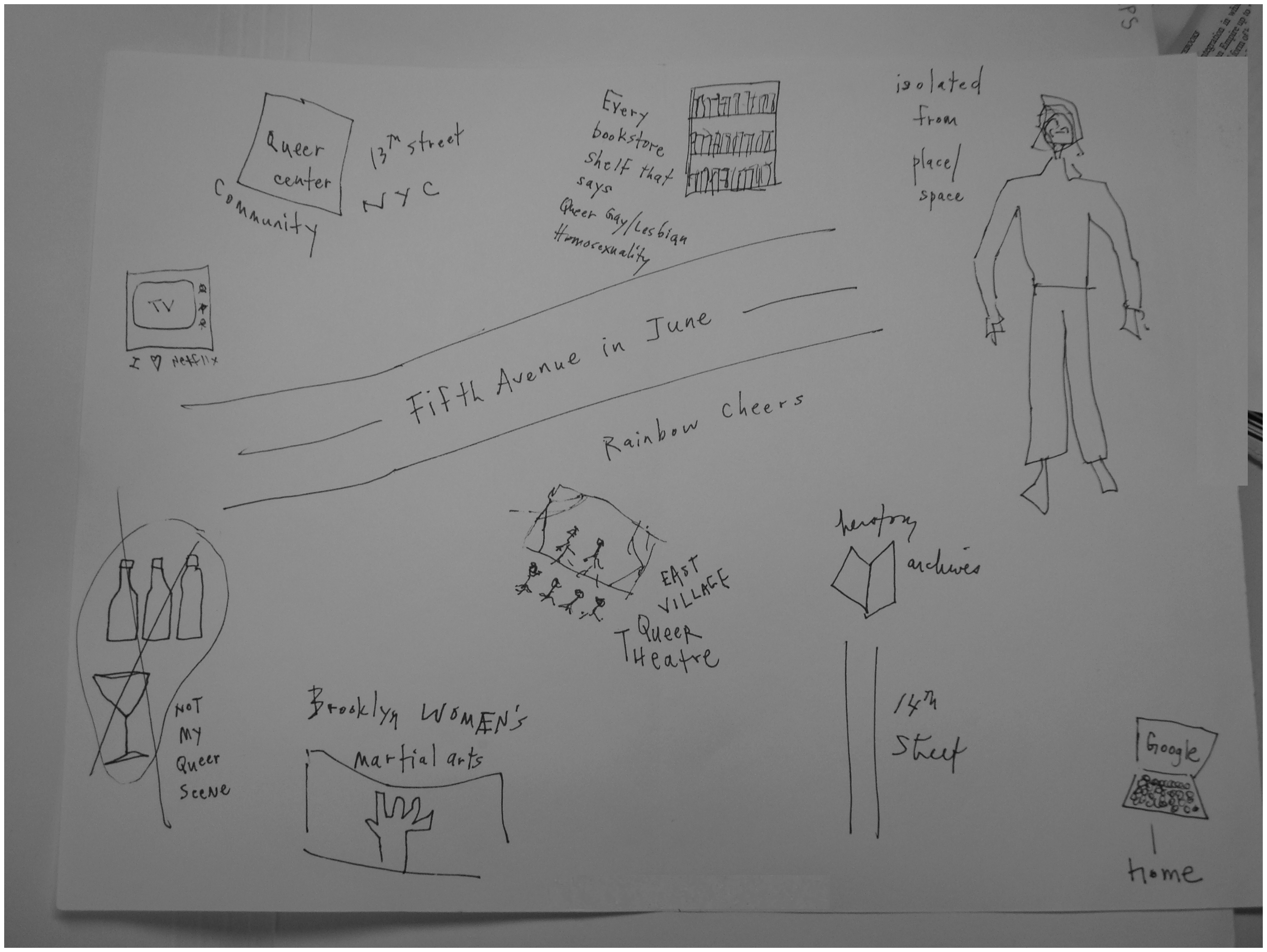
White, middle-class Eva ‘98’s mental map.
Eva’s map depicts a sense of fragmentation in comparison to a seemingly spatially and socially congealed, permanent gayborhood. Even when accounting for the range of class positions of my participants, the fragmented and fleeting qualities of these stars derive from these women’s and TGNCP’s diminished economic and political power that they described in their stories. This lack of power also leaves many spaces vulnerable to (materially) closing. Similarly, the smallest/brightest stars of the sky make up the majority of the sky but yet we cannot see them with the naked eye, and fizzle out without the mass to “turn on” fusion.
Digital geographies, exemplified in Eva’s mention of Googling and Netflix, increasingly appeared in 2000s-generations participants’ stories, but my participants still depended on and described a world comprised physical places at a time when smart phones and online dating were still new. Throughout my period of study, my participants also always revealed an attachment to virtual places in less physical places long before the digital era. White, Armenian, working-middle-class Maral ‘04, for example, said she did not see queer spaces “as set places such as bars and clubs because [queer spaces] are so intangible.” White, middle-class, butch Chris ‘86 recalled: I couldn’t afford to go to the city, so the only way that I had any kind of community at all was those [lesbian folk] albums. I played them in my Walkman… on a cellular level, that music kept me from [committing] suicide. [All: Nodding.] …I thought, “Okay, these people are finding this then it’s possible for me to find it somewhere.”
Phrases like “it’s closed now” or “it’s just gone” were spoken in mourning, anger, and/or inevitability by participants across races and classes in many of our conversations. White, working-middle-class Quinn ‘95 discussed the mass of younger, more easily queer-identified bodies who were now missing from the city because they could not afford the rent. Similarly, most of the brighter stars that made up the constellations of 1980s- and 1990s-generation participants were long gone by 2008, including bars, non-profits, bookstores, activist and social groups, and (then) less-regularly policed parks and other public spaces. The visible queer people that once marked the streets of Park Slope, for example, were now a rarity, as Quinn shared: Things had started to go away… I moved right near Atlantic [Avenue], seven years ago…it was definitely not as fancy as it is now. And even then it seemed dykeier, and I remember walking by and seeing DYKE TV and I was like, “Holy crap! Here I am in New York City, and there’s DYKE TV.” And so it was kind of cool… The next thing you know, it was just gone, you know what I mean? [All: Nodding.]
Ahmed also identified the fleeting quality of lesbian spaces and argues that it is “as much a sign of how heterosexuality shapes the contours of inhabitable or livable space as it is about the promise of queer…moments, where things come out of line, are fleeting” (2006: 565). I understand Ahmed to be asking lesbians and queers to calendrically approach understanding lesbian–queer space–time differently, for the “unknowable length of its duration” (2006: 566). As racial capitalism structures cities as it structures constellations, I take heed when Ahmed writes, “It is important that we do not idealize queer worlds or simply locate them in an alternative space” (2006: 565). At its best, the conceptualization of lesbian–queer constellations offers an alternative geographical imagination that reflects the complexities of lesbian and queer experiences, varied as they are by generation, age, race, gender, class, ability, etc.
Further, Quinn’s and all of my participants’ shock articulates what they experienced as their sudden loss of recognizable and seemingly timeless geographies. Thus, the queer spatiotemporality of fragmented and fleeting lesbian–queer space also shapes these women’s and TGNCP’s ideas of themselves, their spaces, and culture. The eventuality of a star’s implosion recalls the fleeting quality of making lesbian–queer enterprises and organizations, indicating even further the geographically itinerant and temporally iterant qualities of queer space–time. The stars of astronomy seem close and proximate at a distance, much like the idealized LGBTQ neighborhood. Only when we come close do we realize how far apart they are. The actual stars of the sky remain for long periods of time but their departure from the sky can be equally abrupt, even when we carry their light with us.
In the early 1990s, Gill Valentine found that lesbian spaces, more so than gay men’s, were “time specific, that is they are only gay on one night a week or one night a month” (1993: 9).I found this pattern to be constant over my period of study, and these temporalities tied to participants’ race and class. For example, participants often conflated bars and parties, i.e. open-daily bars versus those “time-specific” events. Of the top 10 mentioned bars and parties, Clit Club was open on (some) Friday nights in the late 1990s and early 2000s, and often misremembered as a seven-day-a-week bar. Clit Club was perhaps most well known for being the most mixed-race and -class party, as well as the first lesbian place to host go-go girls in New York City. Participants reminisced about its great music and club-like atmosphere. Lesbian porn and music videos played on TVs, and hook-ups occurred in corners or even in the middle of a packed dance floor. As African American, middle-class Naomi ‘89 put it, “Clit Club was off the chain.”
It is surely not by chance that the one of most racially and class diverse and sexually radical lesbian–queer spaces became spatially unmoored and then closed, and also bounced between regular and irregular (queer) temporalities in the ever-gentrifying New York City. Then the Meatpacking District just north of Greenwich Village, where the party was first hosted, gentrified from an industrial neighborhood into a bastion of highest-end boutiques and higher-priced condo developments in the early 2000s. The party moved around until it disappeared entirely from New York City. Afro-Caribbean, working-middle-class Alex ‘98 described her brief experience of the Clit Club party: “Yeah, I went once. A few times. Then it just closed down…and I’m like, ‘Oh. What just happened?’”
Correspondingly, there are absences that fill the space between the scattered stars of lesbian–queer urban geographies. The seemingly banal backgrounds of empty darkness, that interstellar medium between stars, were the structures of oppression that participants learned to resist or at least pay less attention to. The darkness often held haunting exclusions, disconnections, missed connections, and silences as participants navigated to, from, and around cis-heteropatriarchy. Recently out, white, working-middle-class 19-year old Victoria ‘04 included an enormous amount of blank space on her map (Figure 2). Quiet during our conversations to the point where she spoke only three times, she still found it imperative to share: “I came out in Staten Island and there’s really nothing there, so I put gay un-friendly.” The historically white ethnic, middle-class, and primarily suburban borough of Staten Island rarely made participants’ maps, and even then they felt unwelcome there or in a range of other "no-go" areas. These “un”-places of queer life—at times similar to what Lawrence Knopp (2004) describes as a LGBTQ “sense of placelessness,” referring to a lack of physical LGBTQ places—render bodies and virtual and imagined places all the more valuable and essential to find one’s way and make sense of their place in the world.

White, working-middle-class Victoria ‘04’s mental map.
Finding the (deviating) lines to our (deviant) people
Building from our stargazing, I am back with Ahmed who writes from a lesbian perspective that there are “lines of desire” that create alternate “orientations.” These paths lesbians and queers take to get to who they love and/or desire necessarily require resisting and/or being resilient to paths of “straight lines” a la cis-heteropatriarchy (2006: 565). Queerness, then, comes into being as lines that are out of line. As Lauren Berlant and Michael Warner wrote a decade earlier, a “queer world is a space of entrances, exits, unsystematized lines of acquaintance, projecting horizons, typifying examples, alternate routes, blockages, incommensurate geographies” (1998: 565). Lines are the embodied, imagined, and remembered paths my participants take and make between stars that deviate from straight culture and present as deviant.
From rolling or walking down the street to taking the subway, bus, or taxi, from wandering online to wandering in one’s memories, the sum lines and stars of each participants’ constellation are unique to them. Many of the lines and stars of participants’ constellations overlap as New Yorkers take city subways and buses to travel to and from the same well-known lesbian–queer places or areas. Describing one place her group did not know about, Cullen ‘99 added, “It’s pretty accessible to the community ‘cause so many people live on the F line.”
But lines also have a deeper merit to dykes. In Finn Enke’s research about lesbian spaces in the 1970s Upper Midwest cities, lesbian archival projects never included why a meeting was in a certain neighborhood, or “what social and cultural boundaries they had to traverse to arrive there. In contrast, [their interviewees’ like my participants’] narratives of their lives were ‘travel stories’” (2007: 15). In other words, asking about the everyday lesbian–queer geographies revealed that they are not just Halberstam’s notion of “place-making” alone, but also the mobilities between them as equally important.
Queers seek escape from or even through cis-heteropatriarchy by trudging through the interstellar medium between stars like the “lesbian flâneur” who wanders city streets, a paradoxical site of freedom/violence for women and TGNCP (Munt, 1995). Constellations are a practice of producing lesbian–queer urban space and also a diagram of that production, which speaks to queer geographers’ theorization of mobilities, immobilities, and moorings. Catherine J Nash and Andrew Gorman-Murray focus on queer im/mobilities “to avoid the somewhat binary deterritorialising/reterritorialising arguments about the decline of the gay village and the rise of alternative spaces” (2017: 1523). The constellations I argue for do similar work of describing the “rise of alternative spaces.” Yet, over a prolonged period of time and across many women’s and TGNCP’s urban experiences, the concept of constellations also invokes the resonance of place-making/moorings, including places no longer physically present but mentally and emotionally substantial. Constellations are not just mobilities or networks but catalogue their traces as well.
The racist and classist restrictions placed upon women and TGNCP of color configure the lines that participants could walk or roll along, just as it defined their stars. African American, middle-class Naomi ‘89 held up her map to her co-participants (Figure 3), and said, It’s something I actually do to this day…apparently there’s a spot, and my girlfriend finally pointed it out, where I would drop hands as I would get closer to my house [in Queens]. But she was like, one day, she was like [pounds fist], “Why’d you do that, you’re not proud of me?!” [Annabelle ‘97, Rachel ‘00, Holly ‘03 (white, working and middle class): Uh-hm (nodding in acknowledgment).] And I was like, “What?!” I didn’t even realize. I had trained myself that just, if you’re walking you just drop hands because you’re—it even happens—once I hit Sixth Avenue in the Village you drop hands, [when you] I go into Washington Square Park. Then you get to the East Village and you can hold hands again. [All: Laugh.]

African American, middle-class Naomi ‘89’s mental map.
All 1980s-generation participants recalled the boundaries between the well-known gay and lesbian neighborhoods of Greenwich Village and the larger Lower East Side and East Village, largely driven by the crime and disinvestment then prevalent in the city center. The subway was deemed unsafe, especially for women traveling alone. Some relied on taxis, when or if they could afford them. By the late 1990s, white, middle-class Sally ‘96 would describe the ability to walk across the same neighborhoods with friends that Naomi could not, unaware that processes of gentrification reshaped a different world for her white, cisgender, middle-class body.
The line that runs down Naomi’s map does not exist on the ground: there is no actual street or border that flows as that line does. Naomi imagines and reads a supportive pair of neighborhoods, while her body forms constellations in, across, and beyond these and other neighborhoods that nurture her, even as they also limit her. At times, all of my participants found humor in their survivalist tactics, muted visibilities, and not-yet-conscious experiences of violence. At the same time, narratives by some white women and TGNCP were veiled in white privilege by focusing solely on gender and sexual discrimination. Constellations can only be accounted for by looking in and across neighborhood bounds and attending to the ways race, class, gender, sexuality, and generation shape the urban landscape (Gieseking, 2016).
Lines are all the more difficult to forge for lesbians and queers who are Black, Brown, Latinx, Indigenous, Two-Spirit, Muslim, Jewish, sex worker, disabled, working-class, poor, immigrant, refugee, drug user, addict, homeless, and/or other marginalized people. Yet, there is a popular narrative that “queer people are experiencing greater urban mobilities because of ameliorative human rights and social-political gains that both foster and shape these new mobilities” (Nash and Gorman-Murray, 2017: 1521). However, Fatima El-Tayeb, Haritaworn, and Paola Bacchetta write that “the pathologization of racialized immobility contrasts with the celebration of queer mobility” (2015: 771). The lines that lesbians and queers make range from migrations across continents to commutes across the city, and each is as racialized, gendered, sexualized, and classed as the borders they cross over in making them.
Lines are the unwritten, invisible records of how queers survived to get here, to get anywhere. These lines proceed forward, sideways, and sometimes backwards when queers make a way out of no way. Rather than a linear progression of narratives, these constellations are composed of rhizomatic lines that shoot off in various directions and grow back onto one another as lesbians and queers seek new stars emerging on the horizon and others disappear (Deleuze and Guattari, 2000).
Ahmed also notes that “points accumulate, creating the impression of a straight line,” but from a geographic standpoint rendering lines is also a matter of scale: we can zoom in close to render lines’ non-straightness (569). Countless queers may have walked the same streets and visited the same clubs, basketball games, and stitch-and-bitch knitting circles, and they may have dated, befriended, and/or slept with the same women and TGNCP, but they may not have met or interacted. For those people who can’t even “think straight,” the lines they draw are not necessarily orderly or geometrically straight, but rather articulate what is “artificial about straightness. … [revealing] a quality of things that are made, rather than of things that grow” (Ingold, 2007: 153, 155, emphasis in the original).
Together now and then and again: Piecing together constellations
Lesbians’ and queers’ everyday geographies lent themselves to a wide range of what queer space is and could be, and led me to the mythical, calendrical, and navigational qualities of constellations. Ways of coming together, like people, change over time. Some new and some old lines and stars of participants accumulate into constellations, while some memories also fade as stars implode, get lost from view by pollution or fading eyesight, or are obscured by newer stars. Most importantly, these dyke stars and lines also dazzle and inspire us out of our expectations that any sort of neighborhood-based normalcy will liberate us; i.e. in the words of Ahmed, “To make things queer is certainly to disturb the order of things” (565).
Geographers have long written about the social networks that shape lesbian–queer life but have less so accounted for the network as a spatial form. Julie Podmore writes that “lesbian forms of territoriality at the urban scale have been relatively ‘invisible’ since their communities are constituted through social networks rather than commercial sites” (2006: 595; see also Rothenberg, 1995). In her study of Black queer women’s spaces in 2010s Washington, DC, Nikki Lane relates these women’s geographies as primarily network-driven: “the Scene, as I have defined it—the collection of [social] networks and spaces those networks inhabit and produce—is comprised of a set of constantly shifting, constantly moving scene spaces” (2015: 25). Lane’s insights also point again to the privilege of whiteness that is apparent in the production of constellations. While lesbian–queer spaces tend to be fleeting and fragmented, some white, middle-class women and TGNCP often possess the increased sense or presumption of remaining in place.
Turning to the geographies of lesbian–queer networked practices reveals the coming-together quality of lesbian–queer relational geographies, such as in the practices of cruising and U-hauling. Cruising can be understood as searching for a sex partner and/or participating in sex in public space, usually casually and anonymously. Cruising is often a spotlighted practice in the literature on queer spaces that describes radical sex publics as characteristic of a queer claim to space (cf. Berlant and Warner, 1998; Chauncey, 1994; Chisholm, 2005; Warner, 2002). In his critical analysis of Times Square’s “revitalization” at the turn of the century, Samuel Delany (2001) describes how the elimination of many gay male cruising hubs indicates a refusal of queer people by the city itself, namely working-class and poor queers and queers of color.
Cruising is also a popular topic among and associated with LGBTQ people or, more specifically, gay and queer men. Notably, none of my participants, again all AFAB, brought up cruising in our conversations before I asked, even though participants often brought up sex as a topic without pause. Although cruising is often highlighted by scholars as an especially queer act, my participants have suggested that cruising may be only a minor part of lesbian–queer space-making. As more than one of my participants wondered: if lesbians didn’t typically cruise, were they still radically, relationally, and spatially queer?
Three participants asserted that they did cruise for casual sex, and a handful more each had a friend or two that cruised. Alex ‘98 explained: “That’s what the [lesbian] bars are for,” and added that she had sex with people she just met after dancing with them, and other participants expressed jealousy or said they felt inspired. Kathy ‘05 shared that she often had sex with women she met randomly at lesbian or LGBTQ bars and parties. Still, across races, classes, and generations, participants asserted it is common to envision that lesbians do not have “that public cruising thing” per Bailey ‘95, or what Noelle ‘84 called “the Shane thing” referring to the hook-up queen of L Word TV show fame.
Seemingly antithetical to cruising and central to lesbian mythos is a joke I first heard in the early 1990s: “What does a lesbian take on a second date? A U-haul.” The colloquial practice of what LGBTQ people, namely lesbians and queers, term “U-hauling” involves moving in with someone shortly after dating. My participants often proffered an explanation for dyke tendencies toward quick-start serial monogamy: AFABs are socialized to nest. I knew this explanation was reductionist at best, and even used as a way to legitimate why lesbians are not seen as central to urban culture because, as Sally ‘96 pointed out, they were said to “drop out of the culture.”
With queer theory’s fixation on cruising, I had not given the practice of U-hauling much thought until I saw Alex ‘98’s keys. In another interview, Afro-Caribbean, working-middle-class Alex shared her artifact of two sets of more than 20 keys: The reason why I keep these keys is because … I moved out of my mother’s house after I came out. She didn’t kick me out but it was sort of, like, respectful. I didn’t want to be there taking girls. … And so ever since then, at 17, I always was living with a girlfriend. I have never not lived with a girlfriend. … I just moved from my last place—where these keys are [hold up one set of keys]—to my new place [holds up the other set] where these are. [Laughs.] And I still go back and forth to get my mail. … My keys say it all. And, you know [holds up a couple of keys], the keys [for place where I volunteer], [holds up another couple of keys] and the keys [for the place where I work]. Which is why I still have these.
Each of Alex’s keys represents a star in her own queer constellation of relationships and places that, at times, navigate white cis-heteropatriarchal property ownership. Alex’s constellation holds as a sociospatial network of interchangeable parts (girlfriends, alternative kinships, apartments, activisms), as well as a practice that accumulates each star of a home and the partner within it and the lines between them into constellations that are Alex. In fact, every constellation is equally produced in the deficit in social, economic, and political supports that lesbians and queers must navigate. In her history of feminist bookstores, Kristen Hogan writes, “As spaces run by lovers, the bookstores were also sites of contentious break-ups and just plain bad days” (2016: 41).
Jangling her keys in front of us, I realized that Alex was also expressing the way she carries a representation of these spaces and relationships with her, on or near her body wherever she wanders. She enacts a queer space that remains open to her making even amidst both personal and collective lesbian–queer histories of breakdowns, breakups, and starting over again. Walter Benjamin’s theorization of constellations speaks to the philosophy of ideas that have “no centers, no ‘ultimately determining instances’ or bottom lines, except for the relationship of all these [aspects] to each other” (Jameson, 2007: 244; citing Benjamin, 1998). 4 Similarly, U-hauling helps to articulate the spatialized networks of lesbian–queer constellations that have “no centers … except for the relationship of all these [dykes] to each other.”
We must all reorient our gaze to account for the political economies of relational spaces in constellations and to do so we must place U-hauling alongside cruising as a radical queer practice. That lesbians’ and queers’ spaces come and go, and are bound together by the often overlapping paths of their bodies in constellations, makes all the more sense when reading their experience through the lens of urban political economy. The lack of financial and political capital induces myriad strains on their romantic relationships, which in turn weakens or prohibits their ability to stay put and produce long-term spaces.Issues that LGBTQ people are likely to face include lack of access to secure housing, abuse, domestic violence, lower incomes, longer commutes, and longer hours, all of which in turn lead to more breakups and more frequent relocations (cf. Doan and Higgins, 2011: 17–18). All of my participants mentioned facing at least some of these agonies in their stories.
The composition of constellations reveals many shared spaces specific to generations (say, various cafés or bars) or across generations (Park Slope Food Coop, LGBT Center), yet it is racial and class identities that most significantly define the sprawl or clustering of constellations across the city. These break-ups and decreased capital force lesbians’ and queers’ apartment and business locales further from sought-after areas like city centers. The result is the ever-the-more fragmented and fleeting stars of racialized lesbian–queer life across the city, as well as the sprawl induced by (and surely furthering) processes of gentrification. That the term U-hauling is common to the lesbian–queer vernacular speaks to resilience in and resistance to their political economic situation.
Constellations across the urban universe
Katherine McKittrick writes, “The production of space is caught up in, but does not guarantee, longstanding geographic frameworks that materially and philosophically arrange the planet according to a seemingly stable white, heterosexual, classed vantage point” (McKittrick, 2006: xv). In constellations, I hope to have extricated some of the white, middle-class, cis-heteropatriarchal “stability” in the promise of neighborhood liberation in the American Dream in exchange for a life on Earth among the stars. Constellations, instead, are the lesbian–queer way of producing urban space that do not and often cannot rely on property ownership and neighborhood exclusion. In other words, a lesbian–queer theorization of constellations afford a way of queering the production of the city as it relates to and works against capital to radically make sense of, more aptly describe, and take action in shaping the lesbian–queer role in the city. Thus, the political insight of constellations is that lesbian and queers are often resilient to and at times resist cis-heteropatriarchy in claiming and making spaces (for however long), and by finding one another (however few/multiple) in and beyond neighborhoods. Constellations speak to how lesbians and queers make sense of their directions in life, their irregular temporalities, and the tropes and myths of their world-making.
If they have been there all along, why am I arguing that we can see constellations now? I believe the obfuscation of constellations can be found especially in four forces. First, the pull of the American Dream and the promises of neighborhood liberation seemed to be reaping rewards for some (white, middle-class, educated) LGBTQ people—that is until the recent claims to and experiences of the end of the gayborhood. Surely, the political concerns of women and TGNCP were never central—if not antithetical—to the project of the white supremacist cis-heteropatriarchal state. Constellations matter because they can extend and fuel new geographical imaginations on behalf of social and spatial justice.
Second, like astronomical constellations, one comes to know how to read and navigate by the queer night sky. Many stars or nodes of lesbian–queer life may change over time, and while cis-heterosexual New York sees one city, lesbian–queer stars often are only found by those who know where and when to look. Many LGBTQ people have long clung to the belief that producing (now disappearing or disappeared) LGBTQ and/or lesbian neighborhoods would afford their liberation. Importantly, my theorization of dyke constellations as resilience and resistance follows from and is indebted to relational geographic theorizations of constellations as networks of decolonization. Leanne Betasamosake Simpson describes constellations as places where Indigenous (Nishnaabeg) spirits and knowledge live that are “visible to everyone all night and unreadable theory and imagery to the colonizer or those who aren’t embedded in grounded normativity” (2017: 212, 213). Building from Simpson, Michelle Daigle and Margaret Ramírez write of decolonial projects as forging “constellations of co-resistance through an ethic of relational accountability to their lands and peoples” (2019: 82). While lesbian–queer constellations are not necessarily decolonial, queers also inherit and rework the paths of their ancestors as they inherit and rework their places and politics. Constellations are historical acts and can be promises of radical futures.
Third, much of my argument has to do with time. Returning to Massey’s insights, it may be that in gathering so many participants’ stories, maps, and artifacts over time about one city—rather than theorizing queer time alone—a richer complexity of queer space and time emerges. Indeed, the blend of virtual-physical spaces that have heightened in the digital era were always a prominent element of queer life, as I have shown in my multi-generational study. The range of places and place types attest to lesbians’ and queers’ abilities to make space when there was none to claim or share physically, especially as a bounded, propertied territory. Constellations invent as much as they attach to preexisting spaces and practices, and thereby provide an alternative account of lesbian–queer spaces that often are hidden by, succumb to, and also disturb the order of structural oppressions.
Finally, without as many queer histories to turn to, LGBTQ people are inclined to repeat the same mistakes again and again, and expect a different result. It is my most significant hope, my most profound queer feminist assertion, and my raging gay agenda that the urban production of space in constellations offer a practice of queering space, in the way that Muñoz describes “queer practice” as a “mode of being in the world that is also inventing the world” (2009: 121). In reorienting the queer gaze away from models of liberation via LGBTQ neighborhoods alone, we see how lesbians and queers make lines of connections across space and time that critical urban theory has not accounted for previously. Alongside Ramírez and Daigle’s Black, Brown, and Latinx constellations of decolonization, many lesbians and queers are also “building this bridge as we walk” and roll the streets and places of the city (2019: 78).
A queer feminist method of tracing “allows other ways of gathering in time and space,” as Ahmed shows, to “generate a queer landscape, shaped by the paths that we follow in deviating from the straight line” (2006: 569–70). There are many queer tales of the city held, hidden, and revealed in tracing constellations that deviate from straightforwardness as well as straightness. Radical interventions are required to pursue queer space, through constellations and by any other metaphor or means possible to make worlds “not yet imagined, not yet in practice, not yet in sight.”
Footnotes
Acknowledgements
My deepest thanks to Natalie Oswin and three anonymous reviewers for their generous feedback and support. I remain always thankful to my participants and those whose stories appear in the Lesbian Herstory Archives. My profound gratitude to Kathryn Gillespie, Elizabeth R Johnson, Nick Lally, Johanna Schuster-Craig, Anna Secor, Nari Senanyake, Anna Terweil, and, especially, Elizabeth W Williams for their comments, insights, and encouragement. All mistakes are surely my own.
Declaration of conflicting interests
The author(s) declared no potential conflicts of interest with respect to the research, authorship, and/or publication of this article.
Funding
The author(s) disclosed receipt of the following financial support for the research, authorship, and/or publication of this article: This paper/research was made possible through the support from the Five College Women’s Studies Research Center Fellowship, Joan Heller-Diane Bernard Fellowship from the Center for Lesbian and Gay Studies (CLAGS), Woodrow Wilson Dissertation Fellowship in Women’s Studies, Center for Place, Culture, and Politics Fellowship, and Proshansky Dissertation Award from the CUNY Graduate Center.