







Abstract
Port cities stand at the center of the contradictions of supply-chain capitalism, where large-scale logistical expansion collides with social, economic, and environmental priorities on the ground. Drawing on critical logistics scholarship and ethnographic research, the article conceptualizes port infrastructure as a site of Polanyian double movement: while enabling the expansion of global circulation, it simultaneously provokes counter-movements, where alliances can form across sectors and where narrow single-issue politics (“Not In My Back Yard”) can be transcended. The analysis examines Durban, South Africa, and Valencia, Spain—two cities confronting distinct port expansion projects that have given rise to wide-ranging social resistance. In Durban, the expansion of the port–petrochemical complex is rooted in extractivist logics, with social resistance envisioning solutions tied to just transition in the wake of contestations related to shipping volumes and oil refining capacity. In Valencia, port expansion aims at growing transshipment, reigniting longstanding disputes over urban livability, ecological sustainability, and post-growth development. While shaped by different histories and political trajectories, these struggles converge in exposing the uneven costs of logistical growth and in generating alternative visions of development and urban futures.
Port cities in a time of volatile supply-chain capitalism
This article focuses on port cities as sites of resistance, where popular mobilizations against port-related expansion are potentially reordering social, spatial, and political relations forged by globalized capitalism. It examines port expansion in Valencia, Spain, and Durban, South Africa, as paradigmatic cases of Polanyian double movement where pluralistic social resistance counters the logics of contemporary supply chain capitalism. As Karl Polanyi (1957) anticipated, excessive market penetration has generated both top-down economic expansion and bottom-up demands for social and environmental protection. Yet, despite the growing literature on how logistics reshapes infrastructural spaces, urban geographies, and laboring bodies, the escalating socio-ecological challenges to highly carbon-intensive and locally polluting neoliberal agendas demand further investigation.
Conflicts and resistance within and around ports are deeply entangled with infrastructural transformations driven by the reorganization of global capitalism and the consolidation of global supply chains. As Khalili (2020) argues, container shipping and globalization have developed through a mutually constitutive relationship that renders port infrastructures key sites of political and labor struggle. The historic shift of merchant capital toward shipping containers—in the wake of US military transport standardization following the Vietnam War—provided what came to be the world maritime primary unit of measure, the Twenty-foot Equivalent Unit (TEU) metal box (Campling and Colas, 2021; Cowen, 2014). Containerization as a system of calculable, standardized, and computerized logistics has reorganized transport and production in global capitalism (Chua et al., 2018), with highly automated Taylorism encouraging economic globalization and local deindustrialization. On the one hand, this enabled what Anna Tsing has described as supply-chain capitalism—a polymorphic landscape of capital accumulation, formed through mobilizations of labor, nature, and capital across fragmented but linked economic niches (Tsing, 2009). On the other hand, this process has transformed the nature of ports, which, after recovery from the global recession in the early 1980s, entered a new and more aggressive phase of conflict with their back-of-port operations and host cities (Wiegmans and Louw, 2011).
The relentless growth of logistics and port expansion has continued despite the merchant capital circuit's volatility and the declining pace of world trade. Between 2020 and 2022, global value chains faced significant disruptions from COVID-19 measures, particularly China's strict lockdowns in its major manufacturing-export zones. Additional crises, such as the Suez Canal blockage by the ship Ever Given in March 2021, the disruption of Black Sea trade instigated by Russia's 2022 invasion of Ukraine, and the blockade of Israeli-connected ships in the Bab-el-Mandeb chokepoint, have compounded these challenges. In January 2024, the number of container ships at the mouth of the Red Sea on their way to or from the Suez Canal was 90% lower than the same period in 2023 (Wright, 2024). Such incidents drove up shipping costs by 256% for routes between Shanghai and Europe, and 162% for trans-Pacific routes by late 2023 (UNCTAD, 2024). The Baltic Dry Index (measuring the cost of shipping) has suffered extreme price spikes in 2008 and 2023, as well as the lockdown-impacted crash in March–April 2020. Environmental factors are also important: drought in early 2024 reduced Panama Canal traffic by more than a third, with rising sea levels and extreme weather anticipated to add more costs to shipping infrastructure. The 2024 inclusion of shipping in the EU's Carbon Border Adjustment Mechanism will ultimately add a substantial carbon tax (typically in the range of $60–110/tonne from 2021 to 25) at a time when shipping represents nearly 3% of global greenhouse gas emissions. Most catastrophic for global shipping, energy, fertilizer, and ultimately food markets, the Strait of Hormuz's disablement in March–April 2026 due to Iranian revenge for the war waged by the United States and Israel blocked hundreds of daily oil and fertilizer ships carrying Persian Gulf exports, as well as hundreds of container vessel inflows.
In the meantime, the rise of protectionism, “nearshoring” and “friendshoring” associated with the slowing of globalization—or “slowbalization” according to The Economist—has seen world trade as a share of GDP decline since its peak in 2008, despite a temporary rebound in 2022 driven by high commodity prices (Gong et al., 2022). Another uptick in 2025, in spite of new United States tariffs on many imports, reflected frontloaded orders and the displacement of Asian products to other markets, especially given China's frenetic new wave of manufacturing outputs (facilitated by state credit redirected from the property market). This trade volatility indicates that the sustained expansion of globalized supply chains and associated logistical infrastructure does not respond to any real demand for trade, but rather, fabricates opportunities of circulation to keep goods in motion, intensifying infrastructural encroachment. The spatial and social realms of everyday life are, in the process, disrupted in ways that compel resistance (Mezzadra and Neilson, 2019): loss of community spaces and displacement of residents (Lombard et al., 2023), the monopolization of public land for corporate profit, producing sacrifice zones (Apostolopoulou, 2024), and the destruction of coastal environments and commodification of nature (Armas-Díaz and Sabaté-Bel, 2020). Critics are increasingly concerned with high CO2 and methane emissions associated with ship bunker fuels, and with the trucking industry in a context of maritime industry self-regulatory failure (Bond et al., 2016).
Historically, port contestations have featured dockers’ struggles, first to unionise (famously in Durban in 1973) and then against the precarization of labor. Due to the ports’ role in global value chains, dockworkers occupy strategic “chokepoints” in global circulation networks, where disruption can generate immediate economic and political pressure (Alimahomed-Wilson and Ness, 2018). This capacity to halt or slow circulation has made dockworkers pivotal to labor disputes and broader political struggles, with strikes functioning as direct interventions into global economic infrastructures (Silver, 2003). Dockworkers have repeatedly used this leverage to connect workplace demands to wider claims about rights and solidarity, including refusals to handle military cargo such as the Block the Boat campaign targeting Israeli ships (Fox-Hodess and Ziadah, 2025), as well as anti-apartheid actions disrupting trade with South Africa (Featherstone, 2012). Ports thus remain key arenas where labor struggles intersect with wider political conflicts, and where localized disruptions reverberate across global systems.
While ongoing processes of logistical restructuring continue to reorganize global value chains and labor, fueling renewed mobilizations at the docks, these same dynamics also intensify pressure on surrounding territories. Many civic struggles are articulated through diverse but overlapping discourses, ranging from environmental and climate justice to the right to the city and anti-extractivist critique. As a result, port cities are not only sites of escalating vulnerability, but also strategic battlegrounds where alliances form across sectors, exceeding single-issue politics (“Not In My Back Yard”). As Danyluk (2022) has shown, however, alliances in port contestations also reveal limits, as their effectiveness is shaped and often constrained by specific spatial and social contexts.
This paper examines the movement and counter-movement generated by port expansion in Durban and Valencia, focusing on the conflicts it produces and the socio-political convergences it enables inside and outside the port, as well as the limitations such mobilizations encounter. It frames ports as infrastructures of a double movement: simultaneously advancing top-down projects of logistical expansion while catalyzing bottom-up forms of resistance. The analysis of both cases draws on ethnographic research and the authors’ long-term engagement with these cases. It highlights the context-specific alternatives that emerge in response to different trajectories of port expansion, which, by shifting attention from localized impacts to the systemic dynamics they reproduce, open space for articulating alternative urban visions and development models grounded in post-growth debates and just transition.
The next section situates the crisis of port cities within critical scholarship in logistics and political economy, emphasizing the contradictions embedded in dominant narratives that uphold global logistical expansion amid slowbalization and geopolitical instability. We then turn to the cases of Durban and Valencia, examining port-city conflicts with particular attention to historical alliance formation and grassroots resistance. These cases, brought into dialogue, show how Polanyi's double movement provides a useful lens for understanding ports as infrastructures where disembedding logics of supply-chain capitalism are materially enacted, but also disrupted and reworked through place-based counter-movements. The conclusion underscores how port cities are not only intensifying sites of conflict but are pivotal arenas for reordering relations within volatile supply-chain capitalism.
The myth of logistical development and its contradictions within “slowbalization”
Port-city conflicts are becoming more frequent in many different geographies (Savoldi, 2024). However, the boundary between “port” and “city” isn’t always clear. Though ports have grown increasingly deterritorialized while integrating global logistical networks, port cities are characterized by a complex global-local nexus in which logistical imperatives are continuously translated into local political and developmental arrangements. Port authorities, public–private partnerships, development agencies, and municipalities actively mobilize narratives of competitiveness, modernization, and economic regeneration to position territories within transnational infrastructure circuits (Savoldi and Soriani, 2026). Hence, cities are not only passive recipients of port policies, but are active implementers. The city at conflict with the port is not necessarily the city in its institutional terms, but rather, its residents, who bear the impacts of port activities—represented by the municipal government and not.
Port-city conflicts stem largely from the excessive expansion of logistics driven by the pursuit of ever-extending global supply chains. The excess productive capacity (“overaccumulation”) of capital in Western economies and strengthened labor and environmental protections peaking in the 1970s coincided with opportunities in new production sites—especially the duty-free and tax-free maquiladora, or factories, in Mexico and the introduction of Chinese Special Economic Zones that lack trade unions, occupational health and safety rights, and environmental regulations. Containerization and the declining costs of international transport together drove economic globalization. One result of the rise in global trade/GDP—from 26% to 61% between the 1970s and 2010s—was the fragmentation of production processes on a global scale. Tsing (2009) describes this shift as “supply-chain capitalism”—a system reliant on expanding supply chains to generate profit by exploiting disparities in existing power structures and deepening inequalities across class, culture, and geography, particularly between the Global North and South.
Critical perspectives on the logistics sector have highlighted its role as a political technology of contemporary capitalism, showing how such infrastructural expansion fixes, as in secures, capitalism's chronic problem of overaccumulation, by facilitating geographical displacement of surpluses (Danyluk, 2018; Harvey, 2006). In the process, capital reshapes infrastructural spaces, geographies, and laboring bodies in order to renew opportunities for profit across and between different markets (Chua et al., 2018; Cowen, 2014; Mezzadra and Neilson, 2019). One result is the subordination of democratic principles and the welfare of populations to the needs of the supply chain (Ziadah, 2018). As a technology of contemporary capitalism, the global logistics sector underpins a consumption model based on rapid cycles of product innovation and obsolescence (Birthchel, et al., 2015). Supply-chain capitalism is therefore a growth-centric system that relies on a “growth imperative” driving resource extraction and inequality, leading to ecological breakdown (Hickel, 2021; Jackson, 2017; Kallis, 2021).
The growing frictions between the port and the city are reflected in the contradictions between the hegemonic discourse on development, growth, and urban prosperity and the blatant realities of violence, precarity, degradation, and injustice (Apostolopoulou and Pizarro, 2025; Vegliò et al., 2025). Port cities are forced to bear the increasing socio-environmental and economic costs associated with logistical restructuring and resource extraction. Despite this, global institutions like the World Bank, IMF, and World Economic Forum continue to promote logistics as synonymous with development and growth (Stenmanns and Ouma, 2015). The World Bank's Logistics Performance Index (2023) benchmarks and ranks countries’ infrastructure-related trade competitiveness, while its 2020 World Development Report frames globalization within the discourse of global value chains (GVCs). This is based on the idea that “the age of GVC” has made cheaper goods available to more people, with inequalities and ecological destruction being a reasonable price to pay. The report has been considered as a willful miscomprehension, presenting distorted narratives of development as natural (Bair et al., 2021).
The neoliberal orthodoxy that associates logistics with export-led growth to development is a social construction supporting port expansion in at least two ways. First, it links container traffic to economic health via the promotion of exports as a fundamental strategy for developing countries in the Global South (Bond et al., 2016). In port cities promoted as exporting platforms, investment in logistics ensures that raw materials and labor, often extracted from the Global South with extreme unequal ecological and labor exchange, flow continuously into production and distribution systems (Mezzadra and Neilson, 2019). Secondly, orthodox strategies equate port expansion to logistical agility, fostering transshipment. Ports demand more capacity to accommodate increased container traffic—even of empty containers—to remain competitive, accelerating the movement of goods and resources. However, this expansion is speculative and oversized. The pursuit of “gigantism” in naval and port infrastructure rarely benefits port cities economically and reduces the number and quality of jobs at ports due to increasing automation (Bologna, 2017).
This rising global paradigm is entwined with various forms of infrastructural violence. Large-scale port and logistics projects often entail infrastructural investments that extend logistics to industrial, commercial, and housing projects across the city (Apostolopoulou, 2024). Examples of this are obvious along Beijing's main external spatial fix for overaccumulated capital, the Belt and Road Initiative. In Chancay, Peru, for example, construction of a private mega-port exemplifies a broader process of infrastructure-led urbanization, with China's increasing involvement in Peruvian affairs, while extractive industries shaping Peru's development policies exacerbate the marginalization of local communities (Apostolopoulou and Pizarro, 2025).
Logistics investments and related forms of gigantism continue to grow despite a global context that included extreme volatility in the merchant circuit of capital, as seen in the Baltic Dry Index (Figure 1). Between 2008 and 2024, globalization came into question due to a decline in relative rates of trade, investment, and finance. For example, the trade/GDP ratios of most economies peaked in 2008, with the global measure then falling from 61% to a COVID-19 lockdown low of 52.5% before a brief recovery and then a slide from 63% in 2022 to 57% in 2024, and a brief uptake in 2025 (Figure 2).
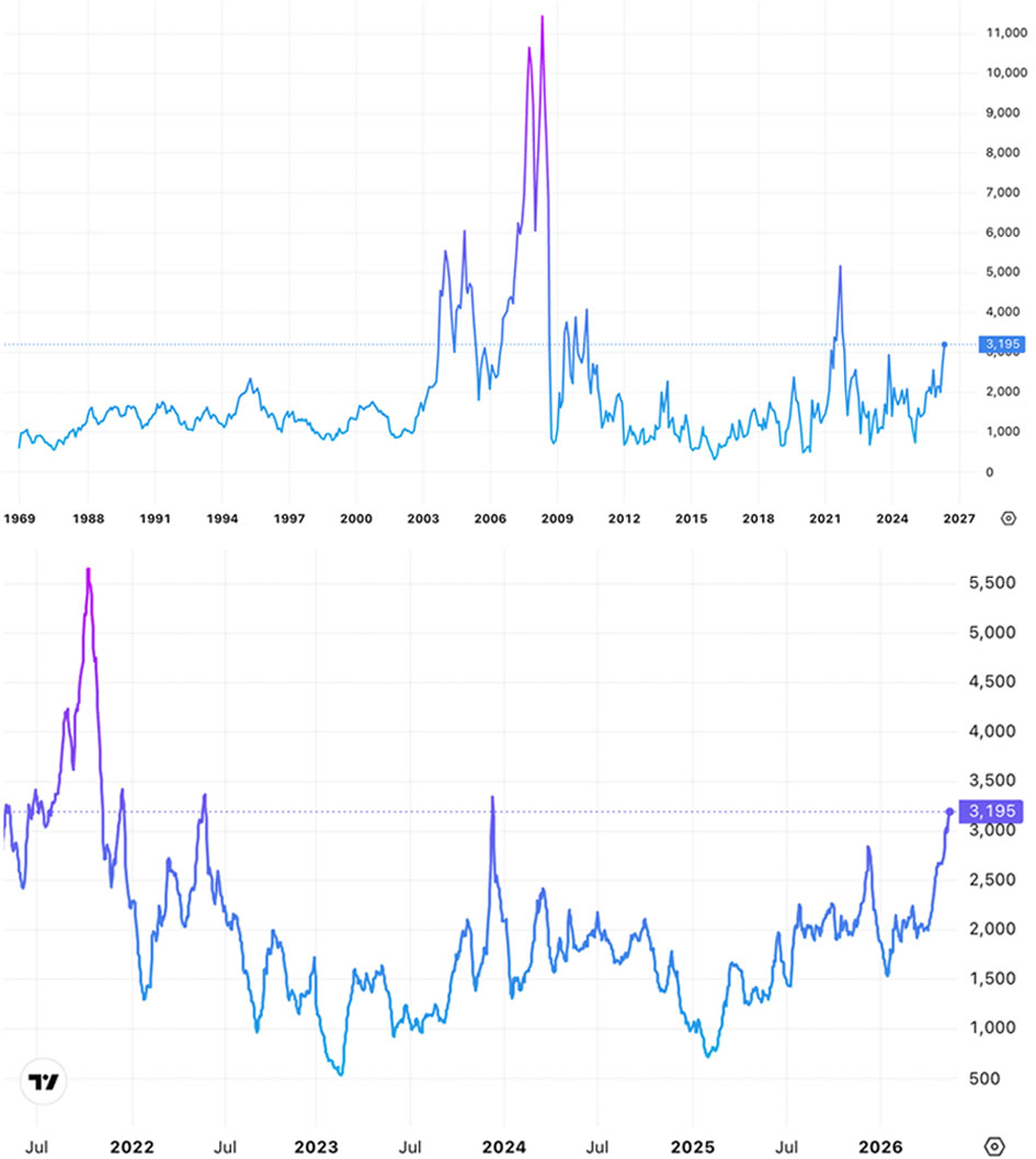
Baltic dry index.
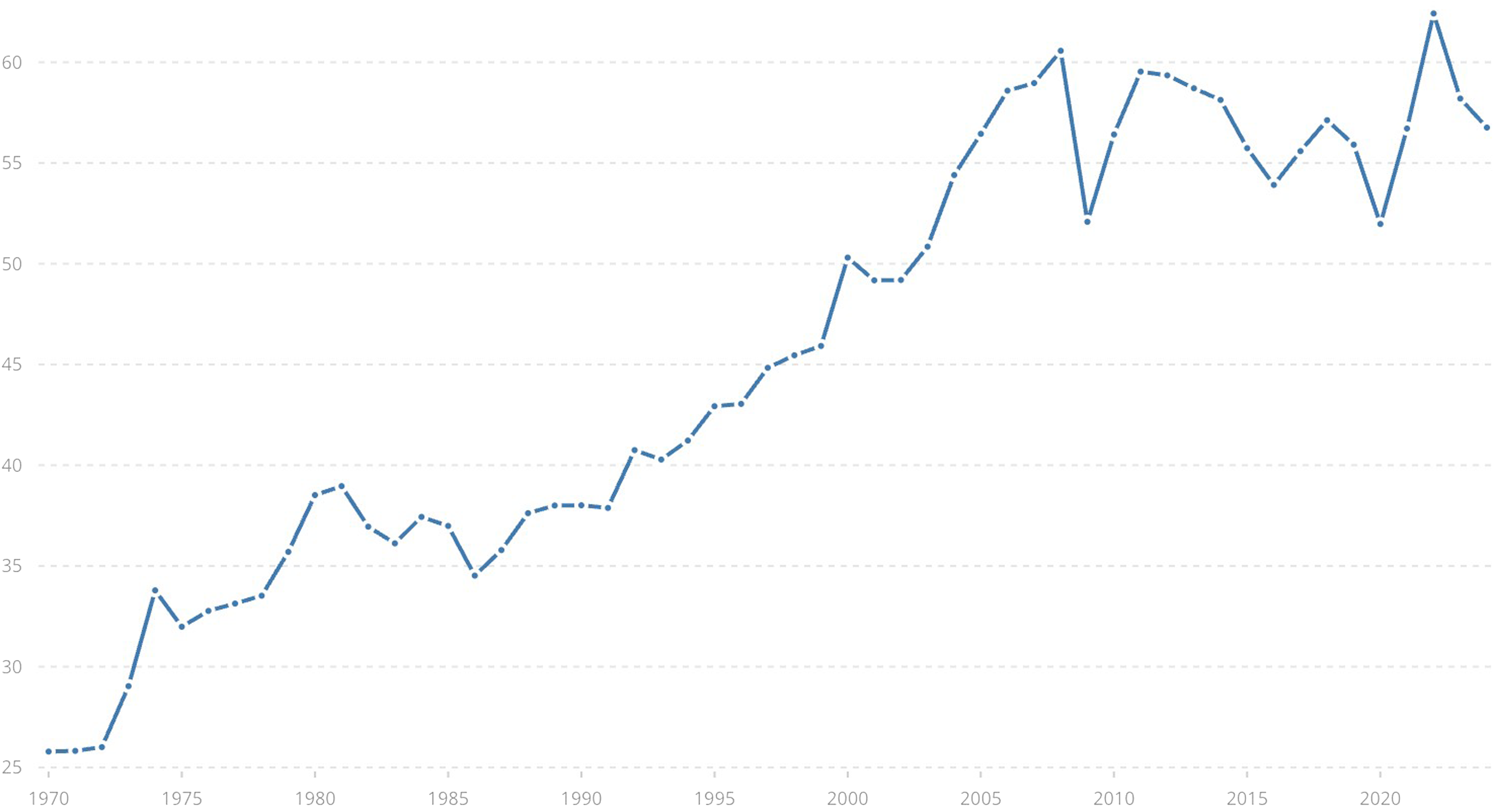
Trade/GDP.
More recently, three exogenous factors have been crucial: Russia's invasion of Ukraine in February 2022, which led to soaring energy and grain prices (and consequent disruptions from Ukrainian ports and shipping rearrangements); the onset of intense Israeli Defense Force attacks on Gaza in October 2023 and the backlash led by Yemeni Al-Ansar hijackings and bombardment of ships in the Red Sea; and the US-Israeli war on Iran in February 2026. By early 2024 through the October 2025 Gaza “cease fire,” most of the 12% of global trade that traversed the Suez Canal was rerouted via the Cape of Good Hope, South Africa, adding 2 weeks of extra shipping time and greater distance, contributing to a spike in shipping costs. An even more extreme disruption of 20% of world oil and gas output from the Persian Gulf occurred once the Iranian government closed nearly all Hormuz Strait shipping in March 2026, with April cease-fire negotiations failing and the US government then blocking the same thin passage from the other direction.
In spite of these significant structural and geopolitical problems, port infrastructure has continued to expand at an unprecedented rate. This is partly propelled by the dominant narrative of uninterrupted circulation and the logistical agility of merchant capital as a cornerstone of development (Stenmanns and Ouma, 2015). However, in addition to the profound internal contradictions, this mode of development has led to the intensification of port encroachment on community spaces, violent displacement, and environmental toxification, resulting in widespread grassroots mobilizations against port projects (Vegliò et al., 2025). In some cases, these protests are effective because of how logistics has become an Achilles heel of capitalism—strategic shut-downs, blockades, and strikes are far more powerful at circulatory choke points, such as ports and associated rail, road, and pipeline access systems, than at any other place in the global value chains (Cowen, 2014). Social mobilizations against port expansion, as in Durban and Valencia, can be considered as productive happenings: similarly to what Davis (2021) has described for logistical blockades, as activists attempt to produce, deploy, and sustain different forms of governance.
The following two sections delve into port-city conflicts in Durban and Valencia—cases that illustrate how logistics, development, and resistance are connected. While Durban's port expansion exemplifies the push to turn port cities into import–export platforms in an economy with extreme levels of resource extraction, the expansion of Valencia port highlights the impulse to turn ports into transshipment hubs that prioritize international trade over regional economies. These analyses illustrate how citizens are contesting and deconstructing dominant narratives that equate logistics with development and prosperity.
Durban: A top-down fossil-fuel port development
This section explores the long-standing efforts and controversy surrounding plans to expand the Durban port-petrochemical complex into the South Durban Basin, illustrating how—even in the absence of organized labor's strength prior—grassroots mobilizations have partially defended existing residential space, initiated a detoxification of the petrochemical complex and called for alternative development strategies. The analysis is based on a two-decade-long ethnographic engagement of one of the article's authors, combined with literature on the contestations of the port expansion in Durban since the 1970s.
Throughout the 20th century, South Africa's import and export growth ebbed and waned, in part contingent upon the dramatic rise of manufacturing in the 1930s due to the import-substitution industrialization model that accompanied the Great Depression and World War II, followed by liberalization in the 1990s—reflecting both the end of anti-apartheid sanctions and the advent of the World Trade Organization's tariff-cut mandates. With a manufacturing/GDP ratio once at 25%, the import of East Asian goods mainly through the continent's largest container port, Durban, deindustrialized the economy to 12% by the early 2010s, a rate that led planners to envisage massive onward growth at the harbor. Durban's traffic of 310,000 TEU containers in 1980 and 522,000 in 1990 soared to 1.170 million in 2000 and 2.55 million by 2010 (ITF, 2014).
The proposed expansion of Durban's port, envisioned by the South African government and major corporations, included the enlargement of its port-petrochemical complex and the creation of a logistical mega-hub, handling 20 million TEU containers annually by 2040, an eightfold increase from 2010 levels. The cost of a newly dug port (more than 20 m deep) was estimated at $25 billion. Yet this ambition, branded as a cornerstone of South Africa's 2012 National Development Plan, masks the devastating costs anticipated by local communities, ecosystems, and the broader socio-economic fabric. Due to slowbalization in the 2010s, the fully fledged expansion into a new, deeper “Dig Out Port” was, however, delayed from 2016 to 2032. If in 2011 the Durban harbor handled 2.72 million containers, diminishing productivity and shrinking demand, plus competition to serve Johannesburg from the closer Maputo harbor in neighboring Mozambique, were reflected in 2024's 2.65 million. Ecological crises, including the country's worst climate catastrophe in April 2022 (350 mm of rain in 24 hours), also played a role in what ultimately might be seen as a white elephant that was never born. Indeed, by 2016, Transnet switched its strategy and instead of a mega-project, increased capacity slowly; in April 2026, the parastatal announced it would infill 22 ha of portside space from the Durban harbor water, to increase TEU container processing capacity by 1.8 million annually, with an ambition of reaching 10 million annually.
Although the two adjoining South Durban refineries—capable of 350,000 barrels/day output at peak—experienced traumatic shutdowns due to an explosion at Engen in late 2020 and to the April 2022 “Rain Bomb” flooding at BP-Shell's Sapref, there are continuous efforts to resuscitate a carbon-intensive approach to Durban's port expansion. In 2025, Sapref refinery was sold to South Africa's oil parastatal for $0.06, forgiving the British/Dutch firms’ massive environmental liabilities in the process, an extremely contentious point for local environmental justice and community activists, and for a climate movement empowered in mid-2025 by an International Court of Justice advisory opinion approving of reparations demands by Tuvalu youth.
The original 2012 plan entrenches South Africa's reliance on fossil fuels and the minerals–energy complex, a destructive model of extractivism that has long impoverished the country through resource depletion, massive emissions, and border-crossing greenhouse gases (Bond, 2021). The parastatal logistics company Transnet continues to aggressively promote coal exports and imports of liquefied natural gas (LNG) through a proposed terminal facilitated in 2019 by the World Bank at Richards Bay, 2 hours’ drive up the coast from Durban. Indeed, in mid-2025, the scope for new LNG facilities rose dramatically as part of the Pretoria government's offer to Donald Trump to buy $12 billion worth of US gas during trade negotiations, in exchange for Trump lowering tariffs—a deal that had not been achieved by mid-2026.
In February 2025, smelted metals destined for the US were hit with 25%–50% tariffs, followed by a 30% general tariff imposed by Trump in August 2025 that especially affected vineyard products. Only raw minerals and energy products were given the same 0% tariff that most exports had enjoyed under the prior African Growth and Opportunity Act. That benefit expired in September 2025 but was revived in early 2026. The export of $4.1 billion in duty-free products in 2024 included $1.92 billion in automobiles, $1 billion in steel and aluminum, and $540 million in chemicals and machinery. By mid-2025, there were reports of dramatic year-on-year monthly declines in excess of 50% for most such sales. From 26,000 auto sales shipped from three South African ports to the United States in 2024, only 6000 were sold in 2025 due to the tariffs.
Another contradiction arose from petroleum and gas imports. Fossil fuels desired by South African corporations and consumers are not difficult to acquire, and by 2025 were sourced from the rest of Africa (more than half from Nigeria but also Angola, Algeria, and Ghana), Saudi Arabia (about a third), and the United States (less than 10%). Northern Mozambican methane gas fields that were brought into production in the late 2010s were expected to complement South African imports from Mozambican supplies further south. However, an Islamic guerrilla movement attacked the main facilities in 2021, and following French leader Emmanuel Macron's visit to South African President Cyril Ramaphosa, the latter committed a 2021–24 deployment of 1200 army troops to defend the base of the main extractive firm, TotalEnergies, with its $20 billion LNG processing investment (Bond, 2023). South Africa also has multi-billion-barrel offshore gas and oil reserves, including on the Transkei Wild Coast 2 hours south of Durban, but environmental litigation by community groups halted exploration in 2022 (Bond, 2024). Finally, the mid-2025 purchase of Sapref—until 2022, the country's leading oil refinery—will still require substantial rehabilitation, and so appears an uneconomic purchase, given that elsewhere in South Africa, existing import and storage facilities were perfectly capable of supplying the national market, with no security benefits to having an internal refinery for imported crude.
In this difficult context, and as both slowbalization and social resistance hit, there were few new port-petrochemical investments in South Durban. Nor were expectations fulfilled of a major gentrification boom—supported by large Malaysian property capital inflows—along the north side of the port (Desai and Bond, 2019). Most of the incremental expansion of the Durban harbor occurred within existing parameters (e.g., with new dockside equipment installed to improve container processing), as well as on Transnet rail tracks leading to Richards Bay, mainly to expand coal exports from the northern KwaZulu-Natal (KZN) provincial coastline.
The paradox is stark: while KZN faces rising climate risks, including the catastrophic super-storm and floods that severely damaged Durban port facilities and the surrounding city in 2017, 2019, and especially 2022, Transnet and its partners forged ahead with plans that exacerbate ecological vulnerability in both its main ports. For Richards Bay, that included a major effort to restore coal exports from less than 50 million tons in 2023 to the prior average of close to 70 million tonnes (Bond, 2014; Bond and Galvin, 2023). That included nearly one million tonnes sent annually to Israel, mostly from mines owned by Glencore and Ramaphosa's brother-in-law Patrice Motsepe. There, combustion in coal-fired power plants provided nearly a fifth of that country's power supply, in spite of the fact that the government in Pretoria accused Israel of genocide in its December 2023 complaint to the International Court of Justice (Boesak et al., 2024).
The expansion also reflects a deep disconnect between state priorities and the pressing urban needs of Durban. In a city plagued by polluted environments and limited access to basic services and infrastructure—such as affordable housing, clean water, public transport, and sanitation—there is a vast discrepancy between corporate subsidies and social needs. Yet, taxpayer resources are funneled into projects that exacerbate urban inequality and ecological damage. One example is the Durban municipality's August 2022 allocation of more than $15 million in climate-adaptation investments (pumping and stormwater drainage) specifically for Toyota's South Durban plant, the firm with the single largest carbon footprint of any in South Africa, to protect a factory that makes diesel and petrol powered cars and trucks. During the April 2022 Rain Bomb, Toyota was compensated for its loss of 4300 vehicles to a 1.5-m high mudslide from the nearby Umlazi River. It's a Japanese insurance company then sued the city for reimbursement due to inadequate municipal storm water drainage. While nearly 500 residents were killed in that storm, and 14,000 houses were destroyed, survivors received no equivalent compensation or reparations (Bond and Galvin, 2023).
Bottom-up resistance: A red-green counter-movement
The state's overwhelming service to shipping and logistics companies and to the plants of Toyota, BP and Shell at a time of severe community suffering prompted resistance from the South Durban Community Environmental Alliance (SDCEA). The network of two dozen local groups, founded in 1995, was at the forefront of contesting the expansion of the port-petrochemical economy previously. Some protests by SDCEA and allies addressed aspects of port business, such as the attempted import of three million Chinese bullets by the government of Zimbabwe in May 2008, at a time when hundreds of opposition activists were being killed. The import was halted by SDCEA in alliance with local Zimbabwean democracy-solidarity activists, churches, and the SA Transport and Allied Workers Union (SATAWU, 2008). This highlights how citizens’ protests have targeted the port not only because of its territorial impacts, but also because of its strategic role within global value chains and its entanglement in broader social justice struggles—an arena in which urban residents and transport workers have converged.
SATAWU has a tradition of solidarity actions, within the framework of pan-Africanism (Cole, 2018) and beyond. In 2009 and again in 2014 and 2021, SATAWU members and other local activists also protested Israeli-owned Zim Integrated Shipping Services, in solidarity with Palestinians. In August 2025, the port was the scene of another protest, this time against the state's willingness to facilitate coal exports to Israel on the dubious grounds, as the trade minister put it, that such a move “would violate the World Trade Organization principle of non-discrimination and would open the country to legal challenge” (Tau, 2024). This is in spite of the facts that South Africa's own transition to democracy had relied upon the very same Boycott Divestment Sanctions strategy, and that Colombia recently banned coal exports to Israel without a challenge (Boesak et al., 2024).
By that time, however, SATAWU was much reduced in power and membership. From 2015 to 22, the union's membership fell from 220,000 to less than 60,000 as a result of internal union splits and port automation that drastically cut stevedore employment. The peak post-apartheid moment of dockworker strength was in May 2010, when SATAWU's strike against Transnet just prior to the soccer World Cup allowed it to block the unloading of hundreds of ships queued up outside the Durban port. But the campaign was merely based on economics, with the union demanding a 10% real wage increase and a reversal of casualization trends underway (contracted outsourced workers and mass retrenchments). The 2010 strike made progress on the former, but not on the latter.
The port expansion is contested also due to its potential amplification of racial and class divides. As plans were first announced from the early 2000s, the most affected local neighborhood proximate to the harbor, Clairwood—working-class and historically marginalized due to apartheid policies until 1994—suffered waves of trucking-company invasions of residentially-zoned land. SDCEA has highlighted the displacement of people, particularly from lower-income, predominantly Black African and Indian communities, who already suffer from loss of homes and the destruction of their cultural heritage, especially Muslim and Hindu sites of worship.
Communities from across South Durban have already endured significant pollution, displaying world-leading asthma rates. The expansion of the port would worsen public health and living conditions by contributing to increased truck traffic, air pollution, and noise. The South Durban basin is already one of the most polluted areas in South Africa, so expansion would exacerbate the already severe environmental degradation, including air, land, and water pollution, and further harm local ecosystems (Bond et al., 2016).
From a working-class community-protection standpoint, SDCEA has organized rallies against port expansion on many occasions since 2012, when protesters blocked the back port entrance, causing a three-km-long queue of trucks. In 2014, SDCEA held a march to the City Hall of 800 residents, including farmers and fisherfolk facing displacement. Different communities joined the anti-port expansion coalition subsequently (Bond, 2017). SDCEA challenged claims of job creation, arguing that employment opportunities, especially in shipping, are unrealistic, as modern container ships require minimal crew. The contestation of port expansion has created the conditions for SDCEA to build alliances with other civic groups, including environmentalists, communities that faced displacement, residents, and workers. Among them were Clairwood shack dwellers, small-scale farmers who lost land previously belonging to an airport where the Dig-Out Port was to be built, fisherfolk whose access to the fishing area in the harbor was denied, and the Umlazi Unemployed People's Movement (UPM), whose ambition was to have the old airport land turned into low-income housing and labor-intensive industrial cooperatives. This “red-green” alliance has been actively challenging the expansion of the port-petrochemical complex, advocating for a radically different model of development that prioritizes sustainability, social justice, and environmental protection. They have proposed alternative visions for the region's future, one that contrasts sharply with the fossil-fuel-based, capital-intensive expansion promoted by the state and corporate interests, evoking genuine eco-socialist politics.
SDCEA, alongside other local activists, has framed their struggle not merely as a defense of the environment, but as a fight for a more just, sustainable, and equitable form of development. The alternative development model they promote recognizes the urgent need to detoxify South Durban, emphasizing a transition away from fossil fuel-based industries and the expansion of petrochemical infrastructure. It advocates for investment in labor-intensive, low-polluting industries that create sustainable jobs while reducing environmental impacts: increasing public transport, investing in renewable energy and organic agriculture not reliant upon pesticides, a “zero-waste” philosophy, and the promotion of a new consumption ethos.
The coalition's vision of sustainable development evokes the “just transition” frame, which calls for a shift away from carbon-intensive industries to those that offer both ecological and social benefits. Just transition as a counter-hegemonic narrative is rooted in working-class environmentalism, highlighting its potential to reframe socio-ecological conflicts as struggles for justice and democracy (Barca, 2024). With such a diverse and powerful coalition, activists have connected the dots between environmental issues and broader social concerns such as poverty, labor precarity, and access to basic services. These alliances are crucial in ensuring that local voices are heard in development decisions and that communities have a say (Bond, 2014, 2017).
SDCEA's campaigns have also highlighted the importance of local control over development decisions. It argues that communities should have the power to decide the future of their land and resources, rather than having these decisions imposed from above by state authorities and multinational corporations. This demand for local sovereignty over development is central to their opposition to the port expansion. Through these efforts, SDCEA has not only mobilized local communities but has also made important connections between the local struggle in South Durban and broader global issues, such as climate change and economic inequality. Their campaigns have highlighted the need for a new kind of development that prioritizes people and planet over profit. This stands in stark contrast to the extractive, concentrated profit-driven model pushed by port expansion.
The SDCEA mobilizations also stand in contrast to the prior models of port organizing. SATAWU and a more conservative dockworker union that took over the majority membership were not subsequently involved in labor–community–environmental activism. This represented a shift from the broader liberatory political perspectives that had motivated the original 1972–73 organizing at the harbor, involving two of South Africa's greatest political minds, working in tandem while resident in South Durban at the time: Black Consciousness founder Steve Biko and utopian socialist Rick Turner a political philosopher at the main Durban university trained by Jean-Paul Sartre in Paris (both were assassinated by apartheid authorities). But the trade unionists who experimented with that “Durban Moment”—centering first on dockworker mobilizations that soon spread—had a profound impact on the subsequent two decades of anti-apartheid organizing.
One of the main labor activists, David Hemson, wrote in 1979 of how the dockworker and allied unions “became the foundation stones of the Congress of South African Trade Unions and the South African Federation of Trade Unions. If there could be a wandering road from Sartre to the docks, there has been an even longer road from incipient militant trade unionism and the struggle for democracy and workers’ power in communities and workplaces” (Hemson, 1979). The linkages trace forward to South Durban's extremely strong residential and environmental defense, worthy of two SDCEA leaders winning the Goldman Environmental Prize (Desmond D'Sa in 2018 and Bobby Peek in 1998), but may not (at least in the near future) reintegrate a much smaller, conservative workforce in South Africa's troubled docks, as automation and slowbalization continue.
“More Valencia, less port”: Reimagining the port city
Waves of port expansion: Socio-environmental costs and uneven benefits
This section critically reconstructs the conflict around the port expansion in Valencia, Spain. It examines the alternative vision for the port city's future that has emerged from social mobilization from 5 years of research and direct engagement of one of the authors of this article. This engagement entailed ethnographic work, action research (in the legal, environmental, and social fields), data analysis (e.g., port-related air pollution, economic and traffic flows), as well as desk research and case analysis, including comparisons of national and international encounters with civic groups contesting other ports. The port-city contestation in Valencia has received almost no attention from academia so far, with existing scholarship focusing mainly on environmental challenges related to the port (del Saz-Salazar and García-Menéndez, 2015; Molner et al., 2024).
The Port of Valencia has become one of the Mediterranean basin's largest ports in terms of container traffic. Since the 1980s, the port has pursued aggressive expansion, creating a contentious relationship with the city. Today, the port stretches 4 km into the sea, significantly reshaping the physical landscape and affecting the socio-political fabric of Valencia and its metropolitan area, home to 2.5 million people. It is predominantly a transshipment port—in 2022, 64% of containers passing through the port were either transshipment cargo or empty, exposing the inefficacy of logistical expansion in creating regional wealth (APV, 2024).
The first significant expansion, the South Terminal, occurred in 1986, dispossessing the coastal neighborhood Natzaret of its urban beach, a public space cherished both by the district and the city. In return, the port promised community benefits, including the redevelopment of nearby factory sites, sanitation of the river delta, and the creation of a park—commitments that remain unfulfilled. A second port expansion, in 1999, included the creation of a logistics area (ZAL) in the nearby neighborhood of La Punta, which resulted in the violent and illegal eviction of 620 people and the expropriation of 70 ha of productive agricultural land. This destroyed hundreds of farmhouses and shacks, dismantling a historic rural community. Five different courts have declared the expropriation illegal, but legal battles against this expansion persist. Displaced residents remain without restorative justice and will likely go to the European Court.
These two port expansion projects have caused profound socio-environmental impacts, irreversibly altering the social fabric of Natzaret and La Punta, while generating what local critics describe as an “ecological debt” owed by the port to the city. Over time, the environmental damage has become increasingly evident. The expansions have accelerated severe coastal erosion, threatening the Albufera Natural Park—Spain's largest freshwater lagoon and a critical ecosystem for biodiversity and local rice farming. The lagoon's survival depends on sedimentary dynamics that maintain the barrier beach separating it from the sea. Since the 1990s, the park beaches south of the port have eroded by 70%, a decline linked to the port's role in disrupting marine sediment transport patterns (Molner et al., 2024). In response, the Spanish Ministry of Ecological Transition invested €30 million in 2023 to refill the beaches once more. Port activity and expansion are also encroaching on ecologically sensitive marine areas, including the cetacean corridor and those within the EU's Natura 2000 network, underscoring how the port status has created a “zone of exception”: a gray area of compliance with environmental regulation.
The most recent major expansion, conceived back in 2005, involved the construction of a vast platform reclaimed from the sea, equal in size to Valencia's city center. The construction of the new North Terminal has been interrupted several times by citizen-led legal battles. Major points of contention are articulated around its environmental impacts (with the port project relying on an environmental impact assessment carried out in 2007, which disregarded impacts on protected areas) and the project's economic implications (the ongoing expansion is costing €656 million in public funds). Drawing on the 2020 report Evaluation of Public Spending on Transport and Infrastructure by the Spanish Independent Agency of Fiscal Responsibility (AIReF, 2020), critics of the port project argue that the wealth generated by the expansion benefits its promoters disproportionately, leaving the city burdened by social costs and the state's financial deficits.
The cumulative social and environmental consequences of port expansion have sparked waves of opposition, growing from local grievances to citywide movements. Since 1986, southern residents of Natzaret have organized against the expansion through the Associació Veïnal Natzaret. A women-led struggle since 1999 has united displaced residents under the La Unificadora de La Punta campaign. These efforts have energized civic engagement, inspiring a second generation of port contestation.
In 2019, old and new concerns coalesced in the formation of Comissió Ciutat-Port (City-Port Commission, the commission from hereon), an informal entity established through the collaboration of neighborhood associations, environmental organizations, climate activists, and groups dedicated to the defense of the territory, such as the coast and the traditional agricultural land of the city, L’Horta. It has since garnered widespread support, with over 100 associations and connected groups representing a broad spectrum within Valencia and its surrounding areas, contributing to the commission's efforts to varying degrees. The commission has raised awareness about the complexities of port-city coexistence through research, urban art contests, museum exhibitions, public talks, concerts, guided visits, performance protests, and large-scale protests. Notably, mass rallies in October 2021, June 2023, and May 2024 drew over 10,000 participants. Key demands include protecting the Albufera Natural Park and beaches, reducing air pollution, preserving jobs within and outside the port, curbing public expenditure on port projects, and challenging what many perceive as authoritarian decision-making by the port authority.
The North expansion project simultaneously produces clear winners and those caught in-between. The primary beneficiary is the global shipping giant MSC, which would consolidate its position as the first operator in this port to command a broader platform, alongside the port authority and the consortium of companies contracted for construction, which would increase revenues. The local maritime group Boluda would also stand to gain, as its tugboat company is slated to be integrated into the MSC group, thereby merging into the towage operator MedTug, contributing to fleet enlargement and reinforcing competitiveness.
Caught in-between, however, are the dockworkers. Conceived to double the port's container capacity, the expansion entails the development of a nearly fully automated and remotely operated terminal, a project explicitly aligned with the demands of MSC. In this context, the expansion is understood as serving the specific business imperatives of MSC, despite the possibility—as argued by the dockworkers’ union La Coordinadora (El Diario, 2021)—that such capacity could instead be created by optimizing the use of existing terminals. According to La Coordinadora, the new North Terminal would result in the loss of approximately 500 jobs due to automation, as the public terminal that MSC is expected to vacate for the new facility currently employs hundreds of workers under exclusive contracts, positions that are non-transferable. No prospective operator has expressed interest in assuming control of this space, leaving these employees without foreseeable employment.
As a result, the dockworkers’ union began to openly oppose the North expansion, bringing itself into line, at least temporarily, with the commission through participation in debates, media interventions, and mass demonstrations, while simultaneously advocating for the protection of jobs and workers’ rights in negotiations with the port authorities. Yet, this convergence proved transient: by 2022, La Coordinadora had publicly circumscribed its critique of the port expansion to the specific issue of automation, clarifying that its opposition sought to secure a manual or semi-automatic terminal rather than resist expansion as such (La Coordinadora, 20/6/2022). Its criticism, therefore, did not extend to the logic of transshipment or to the broader paradigm of port growth, but was strictly framed around the preservation of employment within the port. However, the union's official position did not necessarily reflect the perspectives of all dockworkers. In an interview conducted in 2023, one docker, also active in a local residents’ committee defending the environmental preservation of the coastal fringe, its public access, and its community use, explicitly aligned himself with civic movements opposing port expansion, beyond concerns over automation. Having worked on the docks for over two decades, he described a steady deterioration in both job quality and the working environment. He linked port investments to intensified workloads, reduced staffing, and growing precarity, while simultaneously generating pollution, congestion, and territorial damage. This experience led him to a shared diagnosis: growth primarily benefits shipping companies and terminal operators, while its costs are externalized onto both workers and surrounding communities.
Resisting port expansion and growth: Seeking alternative futures
A key factor behind the broad contestation of port expansion in Valencia was the socio-spatial and environmental sensitivity developed through successive phases of port growth over three decades. The most recent phase was quickly perceived as an unprecedented challenge of multifaceted territorial depredation. This perception enabled the articulation of alliances between key associations, particularly ecological organizations and civic collectives that had previously engaged in parallel struggles, such as the opposition to the ZAL project. The conflict is then marked by accumulated experience in protest and mobilization, and a history of contestation against port-related projects. This legacy of resistance provided both symbolic capital and organizational capacity, allowing the conflict to be reframed as part of a broader trajectory of urban and territorial struggles in Valencia. From this context, a collective discourse emerged, crystallized in the assertion by the commission that “people do not want to transition from being a city with a port to being a port with a city.”
The commission, a convergence of heterogeneous actors, then produces a shared critique of port expansion. Its strategy combines immediate objectives—halting the enlargement of port infrastructure and dismantling sections of the new platform already under construction—started during the deadly floods of October 2024 (when some areas received over 300 mm to nearly 500 mm of rainfall in 8 hours)—with the articulation of a long-term vision for the city's future. This vision is sustained through critical research and deliberative practices that incorporate diverse voices, including neighborhood associations, environmentalists, academics, and climate activists, including the youth movement for climate justice, among others. The discursive framework that emerges emphasizes the need to reassess the city's priorities, which have shaped the commission's manifesto under the slogan “more Valencia—less port.” The manifesto deconstructs the “general interest” under which the central government defends public spending for large-scale infrastructure. Specifically, it calls for the reallocation of public resources away from the port megaproject and toward climate adaptation, health and education, sustainable mobility and the protection of peri-urban agricultural landscapes.
Although the port of Valencia largely functions as a transshipment hub, and the proposed terminal seeks to consolidate this logistical role, opposition has moved beyond objections to its immediate material and environmental costs. The commission situates the infrastructural project within the broader eco-social crises of climate change, biodiversity loss, and social inequality, starkly revealed by the catastrophic floods of October 2024, which underscored the city's escalating vulnerability to climate disruption and highlighted the paradox between mounting disaster risk and ongoing investment in carbon-intensive infrastructures. “We are publicly funding an infrastructure that contributed to the destruction we have just experienced,” said an interviewee, linking the port project to climate vulnerability. By shifting focus from the localized impacts of infrastructural enlargement towards the systemic dynamics it reproduces, this opened space for articulating alternative models of development grounded in post-growth debates. Rooted in ecological economics, post-growth perspectives challenge the paradigm of continuous economic expansion as the dominant metric of societal progress; instead, it calls for prioritizing human well-being and ecological sustainability within the planet's biophysical limits (Kallis et al., 2025). A grassroots counter-imaginary has then emerged for the city, one that emphasizes short-distance economies oriented toward local production, self-sufficiency, and sustainable practices. This vision seeks to reduce dependence on carbon-intensive, fragmented, and delocalized production embedded in uneven geographies, linking projects of social justice-oriented slowbalization with pathways of decarbonization. Seen through this lens, the struggle against port expansion in Valencia is not only a critique of a megaproject, but a confrontation with the structural dynamics of contemporary capitalism, raising a critical crossroads: if cities will continue to reproduce socio-environmental vulnerabilities through infrastructure-led globalization, or whether alternative trajectories grounded in climate justice and social equity can be institutionalized.
Discussion: Ports as double-movement infrastructure
Polanyi's concept of double movement captures the dialectical tension between the expansive logic of the market and the counter-movements that arise to resist the disembedding of economic relations from social and ecological life (Polanyi, 1957). Polanyi's notion of embedding and disembedding—re-elaborated later by others such as Giddens (1990) and Granovetter (1985)—refers to the ties between economic activities and social relations. While “disembedding” separates economy and social relations, turning land, labor, and money into fictitious commodities out of society's control, “embedding” refers to societies pushing back through resistance, welfare protections, and regulations, reasserting social control over markets. The conflicts surrounding port expansion in Durban and Valencia make these dynamics visible in particularly revealing ways. Port expansion—central to the reproduction of supply-chain capitalism through spatial restructuring, automation and ecological transformation—intensifies the commodification of land, labor, and nature in port cities, as dockers organise against the precarization of labor, and coalitions of civil society actors mobilize against dispossession, environmental degradation and technocratic governance, while simultaneously advancing projects that seek to re-embed economic activities within ecological limits and social norms. What emerges here is not only a concrete instance of Polanyian tensions but also a deeper understanding of the spatial and scalar infrastructures through which market disembedding materializes, as well as the alternative urban imaginaries that resistance engenders.
While Polanyi's framework can be mobilized across a range of contemporary struggles—including critiques of extractivism—its application to port-city conflicts foregrounds the infrastructural apparatus through which market penetration is materialized and normalized. Ports, as strategic logistical nodes within global supply chains, act as infrastructures of capitalist regulation; their transformation into logistical devices is neither natural nor merely conjunctural, but has depended on sustained state intervention—through deregulation, privatization, and public financing—that enables the continuous expansion of supply chains in service of economic globalization. Yet, this expansionist logic increasingly reveals contradictions: infrastructural and shipping expansion are sustained by both public and private investments despite the cyclical crisis of overcapacity, the volatility of capital circuits, and the protracted slowdown of global trade since 2008. Such policies are rationalized through hegemonic narratives, promoted by global institutions and corporate actors, that equate circulation and logistical expansion with development and prosperity.
The counter-movements in Durban and Valencia illustrate why port cities are particularly fertile grounds for coalition building in several ways. First, the drive for permanent logistical growth and competitiveness fuels port expansion into surrounding territories, intensifying spatial encroachment, environmental toxification, and automation. This has created a shared terrain for civic and labor mobilization: in both cities, dockworkers temporarily joined anti-port coalitions. Although these convergences proved transient, they opened a space for imagining alternative futures for the port-city relationship—more explicitly articulated through the concept of just transition in Durban. Second, these red-green alliances extended beyond the docks to include workers outside the port, including fisherfolk and the unemployed, who, with residents, advance demands for jobs and environmental protection beyond the fossil-fuel-based, capital-intensive expansion promoted by state and corporate interests. Third, because ports occupy a strategic position within global value chains, they also become sites where struggles converge beyond localized impacts, providing an arena to advance broader claims for social justice, as shown by mobilizations contesting the port's role in imperialism and war. Fourth, the role of ports in the climate crisis further expands the terrain for anti-port alliances: both Durban and Valencia suffer from pollution levels above UN World Health Organization limits and have recently experienced devastating climate-induced floods, drawing climate justice movements into anti-port struggles. In Valencia, climate movements have actively participated in protests against port expansion, while in Durban, there is strong awareness of the port's contribution to climate change due to the explicitly petrochemical character of its expansion.
Despite these commonalities, the two cases demonstrate how social movements articulate distinct alternative futures. In Durban—typical of Global South port cities reconfigured as export platforms (Bond et al., 2016)—port expansion is rooted in extractivism, with the extension of the port–petrochemical complex coupled to the creation of a logistics hub. Resistance here builds on long-standing struggles against environmental racism, petrochemical toxicity, and apartheid—era spatial injustice, situating it within critiques of fossil-fuel dependency and the minerals—energy complex. In Valencia, where expansion is driven by the logic of transshipment—a common logistical objective across both North and South—resistance draws upon three decades of accumulated experience with urban dispossession (Nazaret, La Punta) and ecological degradation (beach erosion, the threat to the Albufera). These histories have crystallized into a city-wide coalition that challenges the naturalized equation of logistical growth with “general interest” and instead articulates an alternative imaginary rooted in post-growth, privileging short-distance economies, sustainable agriculture, public services, climate resilience, and slowbalization. Whereas both cases advocate for democratic urban governance, Durban's counter-movement foregrounds working-class health, livelihoods, and fossil-fuel dependency, while Valencia's emphasizes urban quality of life, ecological sustainability, and local forms of production.
Taken together, these cases illustrate how counter-movements in port cities render visible the material dimension of Polanyi's double movement: the very devices that enable global circulation are also the sites where struggles to re-embed economic life acquire traction. They show that this double movement does not play out through abstract social relations, but is materially inscribed in concrete infrastructures of globalization, and that resistance, by targeting these infrastructures, opens new terrains for imagining urban futures outside the dynamics of supply-chain capitalism, re-embedding futures framed by just transition and postgrowth concepts.
Conclusion
The expansion of the Durban and Valencia ports into mega-hubs reflects two interlinked processes reshaping global port cities under supply-chain capitalism. On the one hand, it underscores the intensified drive to extract resources and accelerate circulation; on the other, it reveals the growing contradictions of overcapacity and gigantism. These dynamics highlight how logistical imperatives subordinate urban and ecological needs, particularly in territories already strained by the climate crisis. Durban's incremental enlargement is bound to its role as a platform for importing, which results in local and national deindustrialization, whereas Valencia's growth reflects the search for logistical agility as a growing transshipment hub. This juxtaposition of growth imperatives reveals how localized struggles converge into strategic alliances under varied conditions, generating alternative political imaginaries and modes of action. In both contexts, resistance to port expansion functions as a catalyst for thinking beyond infrastructure, unsettling the naturalized association of logistical growth with economic development and social prosperity. From these struggles, alternative trajectories for the port city emerge—trajectories that organically engage with notions of post-growth and just transition—including local reindustrialization—while intersecting with broader agendas of decarbonization and slowbalization.
The two case studies confirm Polanyi's core insight that society resists when markets disembed from social and ecological relations, but they also extend his framework in two ways. First, they emphasize the infrastructural dimension of disembedding, with ports as clear instruments of expansion that reconfigure urban space and relations around circulation. Second, they show that social movements can be generative, rather than merely defensive. In Durban, a red–green alliance articulates eco-socialist visions of just transition, while in Valencia, the “More City, Less Port” coalition advances imaginaries of urban development grounded in post-growth perspectives and democratic participation.
By applying a Polanyian lens to conflicts in port cities, this article shows how both market expansion and counter-mobilization are materially enacted through logistical systems. It moves beyond segmented analyses of struggles against ports to foreground the possibilities for convergence enabled by the multiple roles ports play within capitalism, illustrating how environmental degradation, labor restructuring, and the violence of capitalist accumulation are not separate processes, but mutually constitutive dynamics through which disembedding and re-embedding are continuously negotiated.
Footnotes

Funding
The authors received no financial support for the research, authorship, and/or publication of this article.
Declaration of conflicting interests
The authors declared no potential conflicts of interest with respect to the research, authorship, and/or publication of this article.