






Abstract
Why should relations with spectral beings be so important to Singapore—a nation that is thought to stand at the forefront of highly technical, hyperrational, and secularized modes of speculative capital? This article explores why property development and the production of modern architecture have become a major site of concern about ghosts and hauntings, and of practices intended to mollify the dead. Such phenomena are not vestiges of a curious or quaint “folk” belief, but rather an assemblage of modern popular discourses and that seek to comprehend mysterious aspects of contemporary capital: the abstract logics and material outcomes of speculative processes, the roles of risk and precarity in the production of extreme wealth, and of the city as a commodity-world comprising contradictory (and apparently irreconcilable) forms of value. Ultimately, the conjectural figure of the ghost—through an occult decoding of relations between risk and wealth—offers a lens through which we might glimpse the underlying logic of a novel, emergent economic order.
The passport
Money for the ghosts had been placed carefully on the earth. Single notes were folded into circles, like paper medallions—a sign that they were ready to be burned, and to remit their value to the spirit realm.
The ground, on this ceremonial morning, was a site at Nassim Hill Road near Singapore's retail district, where a cluster of ultrahigh-end townhouses was to be built. A dated block of flats stood here for decades before being demolished in a single weekend. The plot was now bare, apart from a rented tent and one excavator with its steering wheel and gear-levers wrapped in knots of red ribbon. In place of the old house was a carpet of small fragments, shards of architectural waste.
Under the tent, high-ranking representatives of the contractors and developers spoke in quiet voices, their body language communicating concern. Another of the construction company's sites had recently become subject to reports of worrying spectral activity. A Bangladeshi migrant worker was said to have been possessed and injured. Lorry drivers had been seized with a mysterious sickness, and a heavy segment of scaffolding—typically secured by bolts and moorings—had fallen and narrowly missed a foreman. This is how ghosts are known to issue their threats. It is also known that their mischief has a contagious character, following trucks and personnel from one site to another.
A famous medium, Master Goh, stepped out to explore the site and to initiate contact with resident spirits. The master's body language showed a heightened concern for the earth—he walked as if on a minefield, his gaze fixed on the surface of clay and debris. Moving a bare foot forward, he made a series of tentative exploratory taps before shifting his weight and taking a short, leaping step. After several such movements, he stopped to consider one particular patch of mud. Goh then crouched into a Buddhist prayer posture, an upright hand at his solar plexus. He placed a rosette of bills and began to chant, his voice lowering into a slurred rumble as a trance state began. For half an hour, a team of assistants joined in a slow crescendo, creating a hypnotic aural rhythm as other offerings were set alight. Suddenly falling silent, the medium began nodding—as if he were listening intently to instructions. Removing a ball-point pen and a wad of joss paper from his sash, he began to draw Chinese characters and geometrical figures with quick strokes. He then folded the sheets in half. Later, he shared that he had been making a passport for a spirit that had become trapped on the site. Taking a cigarette lighter from his assistant, he set this document ablaze, watching as its smoke floated into the humid air. Goh was satisfied; the ghost would be free.
This type of event—a “negotiation” to convince a troublesome spirit to be on its way—is hardly unusual in Singaporean life, and even less in the building trades. Quite the contrary: it is a commonplace that local sites, at significant moments in the construction process, be addressed with varied rites of propitiation for specters and wandering souls.
This fact may appear to contradict the well-known image of Singapore as a global center of financial operations, technologically sophisticated and administered by a bureaucratic regime adept in managing social and personal risk. As the “Switzerland of Asia,” and an international hub for FIRE industries (finance, insurance, and real estate), the island-nation increasingly stands for the pragmatic, futuristic, and disenchanted frontier of management and transaction. And yet, unruly ghosts are reported at sensitive areas of the national project. In addition to occupying construction sites, they are said to ride public transport, occupy civic spaces and nature reserves, and cause trouble in government ministries and police stations. Trees resist being felled, refusing to make way for new buildings by the powerful Housing Development Board. 1 A pervasive fear of such manifestations causes disruption in both the economic and physical development of the city—halting its modernization and scrambling its controls. At the same time, Chinese Singaporeans court ancestors and ghosts as economic partners, giving rise to a lively speculative economy. The nonliving is offered proxy commodities on sacrificial pyres: paper cars, iPads and laptops, cardboard mansions and office blocks, which are assumed to become functioning objects and architectures in the netherworld. They are also paid (as in the ceremony described above) with spirit moneys, joss paper “currency” thought to remit value and to defray the expenses of the afterlife. In return, the dead are hoped to skew the outcomes of speculative deals—be these lottery tickets, stock positions, or investments—to create great wealth and luck.
In what follows, I will attempt to make sense of this apparent paradox: why a city-state so beholden to the technical abstractions of the financial should court the speculative partnership of spirits, and why property development should become a major site of spectral practices and concerns. The argument of this article, simply put, is that ghosts are invoked to address the irreducible, fraught presence of risk within Singapore's heavily speculative economy, upon which value is increasingly based—a pathology of what Susan Strange (1986) has termed “casino capitalism.” Allegations of hauntings and rituals to redress or preemptively appease typically occur at dangerous moments within complex commercial processes. As we will see, ghosts offer a source of imaginative intervention into contemporary capital, as both an explanatory mechanism and an ostensible means to securitize the unpredictable factors leading to profit or loss. This imaginary lies at the center of an ethnographic project of urban cultural geography, conducted over the course of 15 years, which has explored the many ways that Singaporeans explicitly engage problems of volatility and exposure to negative outcomes via spectral transactions. 2 Through occult determinations of risk and wealth, the ghost here offers a lens to glimpse the anxieties of an emergent economic order.
In this context, as we shall see, buildings and their grounds are understood as a medium for transmitting energetic currents and essences, which delineate comprehensible circuits of value, labor, and inhabitation, and result in the production of good and ill luck. To explain why this might be the case, I will introduce the accounts of respondents directly involved in these practices: clients, contractors, architects, and workers. And not least the spirit medium, who assumes a central role in arbitrating between living and dead, and among conflicting regimes of law and ownership. As such, the haunted site offers a hyperbolic mirror of formal economy, in which lives, values, and the spaces of the city appear transfigured.
Through this research, I argue that Singapore brings to bear a novel and expanded conception of the ghost. It does so for theorizations of the spectral in general, but more specifically with reference to the spectral in the city—after all, the city has long been a site where returning dead have been claimed to “speak” to issues of trauma, to unjust and illiberal powers, to collective memory, to migrant or marginalized communities, to value, and to a wild polyvocality of shared aspirations and anxieties. In this Southeast Asian context, the specter certainly continues to perform its august duties of dysregulating time and space, reminding of traumatic pasts and lost futures, and personifying the generational sin of dead labor. But it also transcends these familiar behaviors.
Specters (more commonly referred to by Chinese Singaporeans as gui, from the Mandarin) are imagined within the cosmological assumptions of what is colloquially called “Chinese religion”: a syncretic accommodation of Taoism, Buddhism, Confucian philosophy, Feng Shui geomancy, and evolving popular tradition. Here, the nonliving is characterized by a complexly projected social personhood and subjectivity: they are imagined as economic actors, a variety of homo economicus able to mitigate speculative risks (Tong, 2004; Heng, 2013, 2020a, 2020b; Lye and Heng, 2024). As such, the case of Singapore bears upon an existing field of theory in which the ghostly, alongside other magical and “occult” practices, informs popular economic understandings and practices. It echoes, for example, Chu's (2010) work on questions of cosmic credit, labor, and migration within Chinese diasporas, or Alan Klima's analysis of the “kinship” of spirits and numbers in Thailand, and the convention of funeral gambling. As a means to make cultural sense of the increasingly obfuscated character of late capital, a specifically monetary Asian spectrality may be put into productive dialogue with studies of witchcraft and zombification in Africa, in the work of Geschiere (1997) and Comaroff and Comaroff (1999), or with the infernal monetary phantasmagoria of Michael Taussig's The Devil and Commodity Fetishism in South America (1980). It also reflects, in diverse and productive ways, the central themes of Jacques Derrida's seminal hauntological text, Specters of Marx (1993), and its precedents in Capital and the critical theory of Theodor Adorno.
At the same time, however, the Singaporean case adds dimensions to literature on specifically urban spectrality. This is a field with a longstanding emphasis upon haunting as the “return of the repressed” within the conditions of rapid urban change and destroyed places discussed by Till (2010) and Pile (2005). Here, spirits are cast as agents of memory in cities scarred by the “creative destruction” of urban renewal, real estate markets, gentrification, and rentier capital. They have been invoked, more recently, in studies of the specifically financial violence of the speculative city, and of the alienated logics of commodified homes and buildings. Ghosts offer a resource to explain boom-and-bust cycles, as Johnson (2014) has shown in Chiang Mai—or to account for the delayed arrival of modernization and its anticipated windfalls, as in Sylvia Nam's Cambodian examples (n.d.). These cases recall Arjun Appadurai's Mumbai, roiling with occult rumors that relate physical properties and phantasmal exchange-values. As we will see, Singapore's ghosts are ascribed all of these roles.
Likewise, they also return our attention to the metropole as a nexus within networks of migration, marginalization, and exclusion. Most pointedly, these entail questions of migrant labor and “precaritized” populations of precisely the ilk who provide immense value, and heightened perceptions of risk, for Singapore's speculative construction projects. In his account of the necropolitical, Mbembe (2019) has deployed ghostliness to describe this netherworld of devalued humans that both underpins and is exiled from ostensibly safe spaces and securitized cities. These same populations are uncommonly vulnerable to the intrusion of spirits, as evocatively described by Antona (2024) in her account of Filipina domestic workers possessed by ghosts in Singaporean halfway houses, as were factory women in Aihwa Ong's classic study in Malaysia (1987). Such concerns directly influence the ritual practices and precautions that follow.
Lastly, but importantly, Singapore's ghosts embody a surprising and robust cosmoecological vision. Within Chinese religion, geomantic theory is deployed to “read” particular urban parcels and properties within matrices of spectral power, ownership, and historical change; as will become clear, the city is viewed as a congelation of flow spaces in which human disturbance (including construction, investment, and devaluation) can attract, repel, and trap spirits and wealth amid congruences of energetic currents. Discourses of haunted construction sites variously absorb and expand upon these themes and tropes, within a transcendental systematization and a utopian vision of capital reimagined as dangerous—but also uncommonly enabling, positive-sum, and redemptive, so long as the ghosts are given their due. Their alleged mischief and the practices of ritual appeasement introduce meaningful disruptions and contestations into what this island's Prime Minister has called “a nation by design.” 3
City of managed risk
Singapore has often been depicted as an artificial condition that struggles with reality—a play of forms both simulacral and short on substance. As Koolhaas (1995: 1077) famously asserted, its architects can make things “but not necessarily make them real.” There is a certain truth to this. The structures and infrastructures of the nation are undoubtedly ontologically present, and yet in some integral sense they remain elusive: figural, fleeting, and thin.
Koolhaas attributed Singapore's “unreality” to the PAP government's revolutionary planning ideology, in which all architectures are rendered conditional and liable to sudden change. This is, likewise, an effect of the city's existence as a speculative commercial instrument. This economic model, which Haila (2016) has termed a “property state,” requires the ground to be continually in motion. Land sales are a crucial source of revenue, and have netted S$17 billion per year from 2013 to 2019, with another S$10 billion or so from invested earnings in previous years. 4 This provides lucrative income for government coffers, and while the constitution forbids use of the proceeds for the national budget, they nonetheless contribute to an endowment that generates enormous expendable interest. In order to keep this flowing, swaths of the national landscape must continually be sold and resold—and made available for new functions.
This financial impetus exists alongside another: the state's participation in speculative development that realizes profits far beyond those of land sales. Many of the largest property corporations in the association of southeast Asian nations region—and beyond, in Australia and the rest of the world—are partly or mostly owned by the Temasek sovereign wealth group, alongside a slew of other funds and companies collectively nicknamed “Singapore, Inc.” The reconstruction of existing shopping centers, hotels, and mixed-use megastructures makes financial sense when prices and rents continually increase, when the government raises the allowable square footage on a given site, or grants a new admixture of uses. To reap the rewards of continual renewal on a small island, the churn must necessarily be brisk. This lies behind the fact that the average age of a Singaporean building is only 16 years. 5
It would be difficult to overstate the significance of speculative construction in this context. Home ownership remains a dominant aspiration of this society, encouraged by officialdom as a mechanism for savings and the basis of stakeholdership in the Singaporean project. Due to a perennially “hot” market, fueled by land scarcity and regional investment, the nation's condos typically command multimillion-dollar unit prices. The “maisonettes” at Nassim Hill, above, sold for a floor of US$14 million apiece. Just as early subsidized housing was showcased as evidence of rapidly arriving modernity, luxe developments carry connotations of “global city” status.
There is a paradox to Singapore's new housing complexes, however. On the one hand, these are incontrovertibly massive material undertakings: clusters of towers involving vast inputs of sand, cement, water, rebar, glazing, stone, and timber. Such projects typically occupy large, consolidated parcels, and appear more like microcities than “buildings” per se. At the same time, these retain an oddly provisional status—an impermanence that more commonly characterizes commercial devices. They have comparatively brief shelf-lives, often standing less than two decades before being remade at higher densities for refreshed profits. Their owners, moreover, treat them with straightforward pragmatism and calculation, as financial assets first and foremost. Units flood the market when prices rise, and residents are quick to form collective sale committees for demolition and redesign.
This reality stands awkwardly alongside the imaginative elaboration of the flat as a site of domesticity. As elsewhere, “home” is an idea steeped in affective associations, as family space. At the same time, real estate represents the central savings vehicle for most Singaporean families. Exchange value necessarily remains at the fore, inseparable from class identity and wealth as proof of social merit. There is thus an apparent contradiction at work here: the affective materiality and daily life of such buildings stand against the impression that they might, at any moment, “melt into air” (Berman, 1982) when the occasion for profit-making arises.
The fact that physicality and economic abstraction coexist in housing should not be surprising, perhaps. In Marx's theorization, this tension defines the commodity form itself—an awkward relation of use and exchange values. It is implicit, moreover, in the processes of the latter, which make profit precisely by cycling through material and immaterial stages. The contradiction of the “product” is that it exists as a site of both use and exchange (Stallybrass, 1998). Real estate thus embodies apparently incompatible desires: to provide an economic armature, as well as a lifeworld.
Sociologist Chua Beng Huat (1997) has observed that the affective ideal of “home,” here, cannot be disentangled from the function of property in wealth production. Real estate is overwhelmingly used as an entrée into capital accumulation, and Singaporeans are savvy in leveraging their properties against loans and other debt. There is continual tension, in the building, between concrete and legal-monetary roles, investment, and home-ownership. As a result, as Appadurai (2000) observed separately of Mumbai, a sense of spectral impermanence characterizes the skyline. Similarly, Singapore's two dominant modes of speculation, finance and property development, interact in complex ways. This occurs principally with housing units produced for sale, and bought in the expectation that their values will rise. Here, too, profitability depends upon both material and abstract factors. Quality of construction and location are ever important, but so is the calculus of supply and demand. Sale prices and rents are also vulnerable to the nation's economic health, and to sudden “cooling measures” and policy adjustments used by the government to curb inflation.
Likewise, the process of creating homes is shaped by speculative logics and anxieties. Realizing a new development is a difficult and expensive undertaking. This extends from land purchase—awarded by bidding exercises that require the evaluation of designs and financial models—to the management of numerous independent factors, inputs, and potential risks during construction. Opportunities for vast, compounded losses are hidden within a labyrinth of codes. 6 Profitability, moreover, often relies upon getting grants of “waivers” that allow certain regulations to be ignored. This must all happen in the shortest possible time, as the government issues per diem charges and other fines for late completion.
To make matters more fraught, the outcome is never guaranteed success. Local developments are heavily exposed to what economists call “idiosyncratic risk.” This means that individual projects may fare poorly in a booming market. This happened at the 8 Napier condominiums, for example, in 2010. Well-designed units on a prime site went unsold. A common explanation, given by respondents and on social media, drew attention to the project's position beside Gleneagles Hospital; presumably, buyers worried that “many people probably died next door.” 7 Suspicion was later considered confirmed when a unit was sold at a loss of $969,000—a depreciation associated with bad luck and with the influence of death. 8 Industry players explained this to me otherwise: the building simply had too many units at too high a price, and several nearby complexes offered sales in the same range. Extended lack of interest often results in cut-price purchases by funds, by REITs, or by investors in “distressed assets” who feel that reputational issues can be managed.
Securing development
Ghostly mischief is a common mode of explanation in this charged context. Attempts to build mysteriously fail. Equipment and materials break. Workers are killed or injured, and spirits “reveal themselves” to unnerve and undermine morale. These incidents may be minor or disastrous, but allegations are nearly always taken seriously. This is because one paranormal event amplifies the expectation of others and is linked to bad fortune in the sale or subsequent occupation of the project. 9 A common hedge against this is conspicuous propitiations: visits by renowned mediums such as Master Goh, monks, or “inter-religious organizations” (IROs), who attempt to cleanse the project through blessing and sacrifice. This helps to establish confidence that the developer has courted the right kind of spiritual collaboration, and that future setbacks will be less likely.
Site “ceremonies”—a blanket, generic term that is common despite many differences of ritual form—are not associated with a specific variety of project, developer, or contractor. In the trade, protection from ghosts is almost universally seen to be a necessary precaution. As an architectural designer and ethnographer, I have attended rites at projects large and small, from luxury offerings to public housing. These were undertaken by corporate contractors and small-jobbers, of diverse ethnic origins, and were commissioned by executives from all of Singapore's major religions (as well as secular “free-thinkers.”). Similar events—likewise understood as safeguarding or potentially huat (“lucky,” in the Hokkien dialect)—are held whenever a place is in some way subject to change. These are also deemed favorable when moving into a new dwelling or office, just before or after redecoration, or when introducing a new resident or family member to a given home. Each adjustment, no matter how minor, is assumed to have effects upon the spiritual atmosphere, and thus asks for a form of address.
The ceremony at Nassim Hill was characteristic of the logic and concerns of spectral discourses and practices in Singapore, and how these may serve to “secure” the unpredictable processes and outcomes of development. Attendees were asked to present themselves promptly, on a Monday in March at 8:30 in the morning. This timing was not random, but selected with a Chinese astrological almanac, preferred by feng shui professionals in determining auspicious moments for different types of endeavors. The guests included representatives of all companies within the design team, structural and mechanical engineers, quantity surveyors, clients, and contractors. The organizer of the event was Chen, a senior project manager at the Singapore branch of a multinational construction firm based in Tokyo. He expressed pleasure at the strong showing, as a crowd would bolster the chances for success. More importantly, the party included representatives from all participating trades and consultancies. In Chen's understanding, the offerings and chants serve only partly to purify the site and identify possible problems. They also, crucially, establish a goodwill contract between any resident spirits and the members of the project team. If someone were missing, it would be impossible to guarantee that they would be protected during the works or benefit from ghostly approval of the venture.
The ceremony was likewise understood to be necessary by other attendees, albeit for differing reasons. Beatrice, the daughter of a developer with controlling share in the project—and principal decision-maker for the client's team—feared that the failure to hold observances might be poisonous for morale. As a devout Methodist, Beatrice stood to the rear of the tent and demurred when the organizers asked for her participation in lighting incense or joining chants. She believed, however, that prohibiting the rites would cast a pall over the enterprise and would lead the “superstitious” workers to feel that their safety had not been given proper consideration. Mr Shinbo, managing director for the builder, echoed that the blessings were to be respected as “local custom.” He noted, also, that most Japanese construction sites host similar rituals at various key moments: at the outset, when structural framing is complete, and at the conclusion. Several guests admitted to being skeptical of the literal “truth” of the rites, though all agreed that it would be bad not to hold them. Even the skeptics articulated a version of Pascal's Wager: there was nothing to lose by conducting them.
Chen, by contrast, understood the day's activities in a much more explicit, and nuanced, way. As an adherent of Chinese religion and an “old hand” in the industry, Chen was convinced of its necessity. Moreover, he was able to decode particular signs arising in the course of events. He was comforted, for example, that it took place during a brief downpour (a sign of prosperity), and when a bag of rice on the altar caught fire during one of the prayer cycles. The rising flames were a sign that the spirits had accepted the offerings.
Before dawn on the day of the ceremony, the contractors erected a tent near the entry of the site. This was to provide a base of activity for the various ritual elements and stages. The latter took place at various points around the parcel, and most notably at the geomantic middle and perimeter. Attention was also paid to past and future access points from bordering roads. As the collected group milled about, Master Goh's 12 assistants arrived and began outfitting this base of operations. All were dressed in matching white polo shirts and khaki trousers. This caused distinct reactions of amusement and discomfort among the assembled guests, as these were almost identical to the famous uniform worn by the authoritarian People's Action Party during reelection campaigns.
These men and women, who erected the altar and participated in prayers, represent a loose association of Buddhist charitable volunteers. Most hold secular jobs or are supported by their families. They are “disciples” of Master Goh and understand themselves as working for the greater spiritual and energetic good, by ameliorating spiritual–environmental conditions. Some, such as a young woman named Lily, began following the Master after he was able to heal physical and mental ailments. Similar “fellowships” in Singapore, in the organizational guise of Buddhist social foundations, care for the elderly and the terminally ill, and teach meditation, tai qi, and feng shui to novices.
In contrast to his acolytes, Goh—the most important attendee—arrived last, and with a notable air of untidiness. He was overweight, with multiple tattoos and scars. He smoked through cigarettes quickly with deep, aggressive drags. 10 This only served to underscore the exceptional status of his charismatic body, as the channel by which the spirits could make their presence and their desires known. It is, in the accounts of his supporters, a highly sensitive receptor of flows and polarities. But as is typical in Singaporean Taoism, the medium's body is also abused and exposed with a casual disregard.
The master did not explain any aspect of the rites or speak to anyone besides Chen. He later described his method to me as a sort of spiritual pragmatism, deployed for the general betterment. His services are in high demand, he claims, as buildings with bad energetic distributions tend to be dangerous and heavily devalued, and are known to attract ghosts. This emerged in public debate in 2007 when one old condominium complex, Farrar Court, was said to have very bad feng shui. As a result, a spate of incidents was reported: ill health, poor marks on school exams, suicides and accidents, as well as the inability of younger married residents to conceive children. The complex was up for collective sale to a developer, who spread the rumors to local new outlets in order to encourage some unit owners—hold-outs opposing the negotiated price—to liquidate quickly.
11
This was a fraudulent practice, but it shows quite clearly what contractors and other industry informants describe as a climate of extreme sensitivity surrounding the “health” of houses and offices. By contrast, Master Goh observes that skillful work with the energies of the site, through chants and offerings, will not only avoid these problems but will create the opposite effect. He explains that, because of the energy, [when] I work on it, it becomes comfortable. People will come in later, pay even twenty percent above the market price, because, you know, they just feel comfortable, relaxed there.
Goh assumed his role at the age of 30—considered rather late, as Taoist mediums tend to experience first possessions at the onset of puberty, and sometimes earlier. Prior to this he was a “lazy” young man (by his own account), and uninterested in the spirit-world. After a seizure, however, he began to see ghosts, to perform site ceremonies and healings, and to teach disciples the methods of chants and directing qi.
The types of ceremonies he performs are varied. Some, as at Nassim—where no incident had been reported—are held prior to the inception of foundation works. He insists that this is the crucial moment if an accident is to be avoided; the instant of groundbreaking is a disturbance most likely to manifest in negative consequences. This is a time wherein the “original owner” of the property may make their prior claim felt, and when the “laws of the site” must be obeyed. As he explained, “when you want to buy a site; you want to develop, they got laws. Must go to authorities, make application, get license, all of this. Site also got laws; different laws. You can follow Singapore laws, also have to follow site laws.” He claimed to have performed this service on many occasions for the state's bureaucratic ministries. “The government is very strong,” he said, “but still, they have problems, they have to call me.”
A haunted site is often addressed by bringing a Buddhist monk or a Taoist medium to chant, or (in the case of a government building) the “Blessings Team” of an IRO will be called in. Master Goh and Chen feel that this is ritually formulaic and ineffective, however, as it does not address the underlying problem. As Goh explained, A monk is like a policeman. A policeman comes, can chase you away. But after the policeman gone, what happens? You come back. Monk comes in and chant, and they can chase spirits away, but later they will come back. You must know the logic of the energy, cannot just chant. So I chant, it's like I talk with them. I say, what do you need? Money? How much, is this enough? This? You need a passport, you need to go away somewhere? I help you. This way the site can be made alright.
This is done using an array of gifts and tools. At Nassim, this comprised food offerings of Thai rice, a plastic bottle of water, and thimble-sized cups containing cold tea and brandy, and two large gold platters of sweet pineapples and oranges. Two vases held marigolds, and a plastic sack contained white jasmine flower petals to be scattered on the ground, beside an array of joss paper banknotes. These were arranged alongside specialized geomantic implements, including a “sacred” hammer and wooden stakes for marking key points on the ground—a process resembling preconstruction surveying. These lay upon an altar: a folding table, skirted in red cloth and with a bolt of white linen beneath the offerings. After arriving, Goh carefully adjusted the offerings, incense, and tools. He examined each of the wooden stakes, marking Chinese characters (one of the four cardinal directions, and a number) on their sides with a red Sharpie pen. Goh also added a modified luo pan compass to locate the site within cardinal directions and yin and yang energies.
The ritual sequence, itself, was divided into several stages. It did not begin with a clear gesture or overture, but via a gradual coherence of chanting voices. The recitations were begun while the altar was still being arranged, lending a sense of informality. Joss sticks were lit and placed into the fruit platters, sack of rice, and bowls of sand and ash. While his assistants chanted, Goh led members of the construction team to the earth in front of the tent, to the pyres of spirit money (Figure 1). These were placed in specific configurations; sheets were separated, as burning in stacks is thought to devalue the offering. At one point, Goh and Chen became angry with the contractor's younger staff for dropping large wads onto the fire. Some notes are folded into tight knots to resemble ingots; others are doubled, corner to corner, and arranged in circles—a geometrical motif of many Buddhist–Taoist rites locally. Goh later explained that this represents a drawing-together of living and dead partners in the construction venture. At the same time, it signals reciprocal intentions: the “wheel” is a circuit of gifted value that goes into the spirit world and returns in the form of safety and prosperity.

Hell money, a joss paper currency thought to transfer value to the dead.
In this sequence, contacting resident ghosts was the first order of business—that it was important to “clean the current mess first.” 13 After entering trance and offering his “passport” (Figure 2), the medium then turned to the parcel and its energetic properties (which are themselves thought to affect the site's tendency to attract other wayward spirits in perpetuity). This is a collective work. He led the contractor's and client's project managers in a slow, single-file procession. At occasional stops, a member of the team was called upon to drive a stake into the ground to form an elongated octagon (Figure 3). A final rosette of money and fruit was placed in the site's center and set alight, to encourage energies to flow (Figure 4). Successive layers of building tend to block these important apertures; like acupuncture needles, each stake helps ease the passage of energies trapped within the ground at a particular point. This would also allow marooned spirits to evacuate the parcel.

Spirit medium master Goh, in trance state, communicates with resident spirits at the Nassim hill site.

Master Goh leads representatives of the project teams in prayer.

Yin Zhi (joss paper spirit money) is folded and placed in a circular distribution before being set alight.
Having established the center, the work shifted to the perimeter. The project team and apprentices walked the property boundary, continuing to chant with their hands in a prayer position. This was performed barefoot, as all must maintain continual contact with the ground. The latter appeared distinctly dangerous, with its shards of waste and metal fragments, but Master Goh claimed that this activity presents no risk. When performing a rite at a former Coca-Cola plant in 2005, he recounts, his team walked many rounds on broken bottles without a single cut. At Nassim, each participant made a complete circuit to reinforce the perimeter using human prayer energy. While “blocked” sites are problematic, those that are rendered incontinent—through axial alignments of doors and gates, or the incorrect placement of water elements that allow unregulated flows in and out—also pose risks to future residents. And for their money, in particular, which is thought to escape through such openings like water from a leaky vessel. 14
The process of site definition was the final stage in creating “stable” ground for the new development to proceed. Throughout the morning, an excavator was positioned near the center of the empty site, having been towed in earlier that day. Master Goh climbed into the operator's seat and pressed a button to start the engine. The ceremony was concluded, and the project was officially underway.
Other sites, other ceremonies
The above describes one rite, conducted with great punctiliousness. It is important to note, however, that such events follow the evolving conventions of a “popular” religion, with very little or no institutional oversight. Moreover, most offerings to ghosts and ancestors are made by lay individuals, without the participation of priests or mediums. There are thus divergent approaches to ritual form. The chanting cycles, the objects and moneys and foods offered, are all variable. As at Nassim Hill, some involve precise geomantic assessment, with a repertoire of actions addressed to the ground and to qi “phases” of earth, water, metal, and wood. 15 Spirits are not, here, the sole targets of the proceedings. Equally important is the site itself, as an environment balanced to benefit living and dead. In other instances, the focus is more centrally upon offering and prayer, with the primary objective being ghostly appeasement. In the former cases, the distribution of joss sticks and sacrificial accoutrements assumes a more architectonic role. They are used to locate and reinforce the cardinal points, axes and accessways, low and high ground, and natural features—because these are understood as critical in attracting or repelling potentially malevolent spirits and energies. When simply appeasing resident ghosts, these conditions are often ignored. Any nearby open space or grassy patch may serve for mass burning, as at annual events during the seventh lunar month. This is because “hungry” (uncared-for) ghosts are assumed to be largely migratory. What is addressed is thus not a specific location but a traffic.
By my observations, and by respondents’ accounts, a large proportion of rituals combine aspects of these two approaches. This was evident at another site, where offerings were made to protect the workers and the owner of a large suburban home. Even though the house was not a speculative product, it is linked to that of the owner's personal prosperity and health, and uncanny incidents at home are thought to directly affect the fortunes of its proprietor in the broadest sense. As such, architecture is a place of both opportunity and vulnerability. The proprietor was, himself, a well-known property developer and thus many present and future projects (as well as their contractors and laborers) stood to be affected. The ceremony was much simpler than that undertaken by Chen. It was held not at groundbreaking but during the seventh month, when some form of offering will be made at most building works at least once. Yin zhi (joss paper currency) was burnt expediently in large piles, rather than by sheet. No priest or medium was present. Prayers appeared uncoordinated, and few of those participating knew the words to the chants (Figure 5). A majority of the laborers were migrants from South Asia and were guided by older, Mandarin-speaking colleagues.
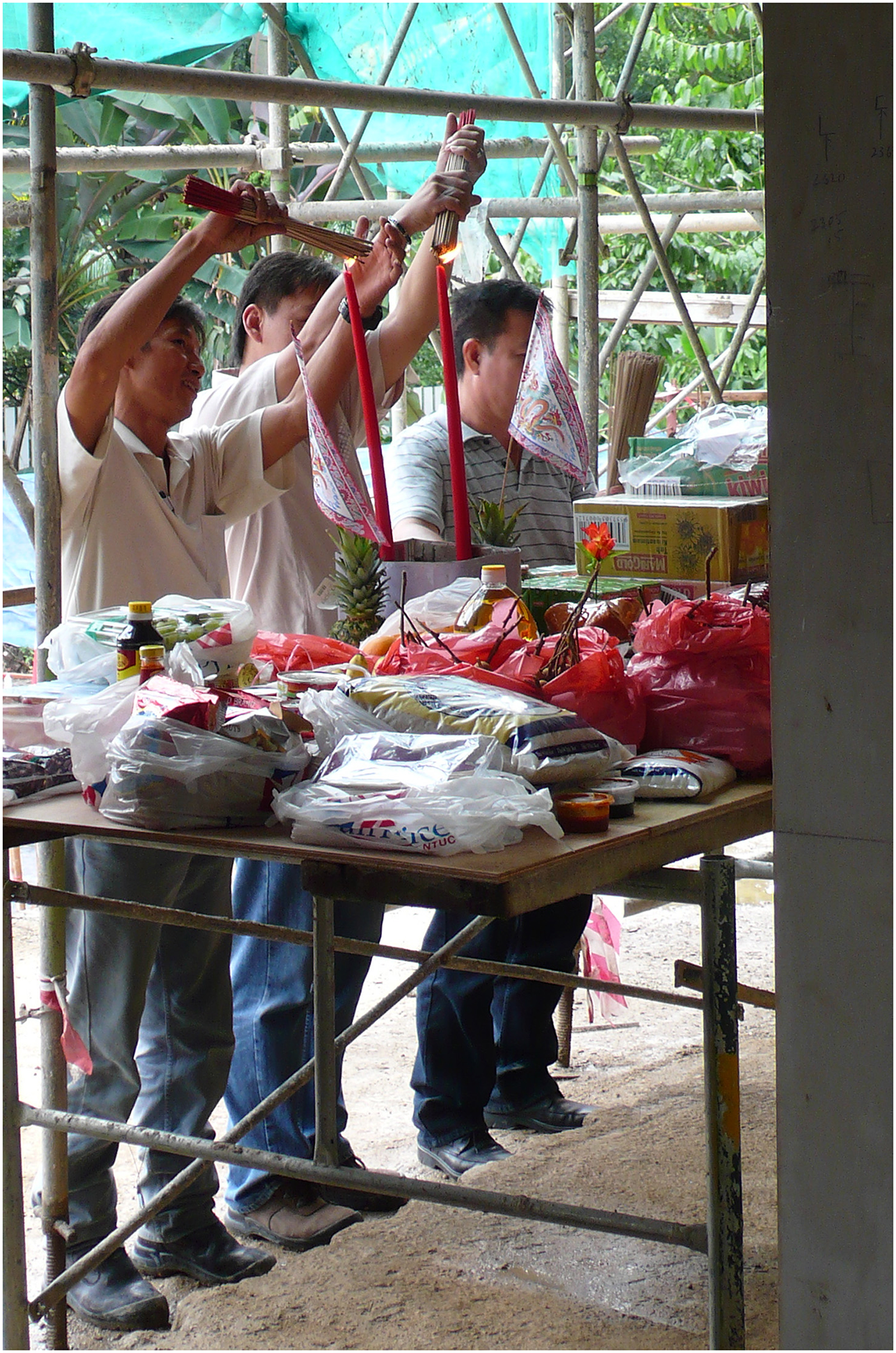
Workers begin their ceremony at Belmont road.
Another difference, here, was the understanding of what was being blessed. Goh's geomantic approach placed an obvious emphasis on earth and water, and the parcel's perimeter. Here, it was the half-completed architecture that was the focus, and the stage upon which offerings were set. Rather than being placed directly upon the soil, joss sticks, and small pyres of ghost money were sited around the building's avant-garde form—at edges, apertures, stairwells, and transitional spaces. To address its nonrectilinear geometries, which are typically considered unhealthy by Feng Shui experts, joss urns were placed on the edges of the unfinished slabs. The largest pyre, and ceremonial center, was positioned at the end of the new house's clearly defined central axis. Here, a folding table was laden with plates of human banquet foods—roast duck and suckling pig, fried rice, and sausage—and formidable stacks of spirit-money.
At other times during construction, regular offerings were made at a small shrine. When the project was completed, as is typical, this was relocated to a temple, for a small fee. If no new home can be found for such an object, contractors will customarily leave it under a tree near the temple, with some apologetic brandy and joss sticks. Most significantly, the relocation of the shrine marks the moment when inhabitants move in, and the ownership of the new building passes into the hands of a tenants’ management committee. It is also the moment when the developers’ possession of the project is converted to liquid capital, once again.
Danger, spirit, and speculative process
To what does all of this symbolic work, these particular rites with their own symbolic emphases, address? What specific social concerns make them necessary? Clearly, site ceremonies have much to do with anxieties about transformations and “becoming past” (Munn, n.d.) of urban places, their sudden demolition and conversion to mere memory. This was very clearly the case at the Nassim project. The unease lingering over the morning of the ceremony was quietly voiced by Jessie, the lead structural engineer of a London-based firm. She gestured toward the blanket of finely pummeled building waste that covered the earth. It was evidence of destruction, residue of what went before, and powerfully present. Shards of tile, clearly hammered from the walls of kitchens and bathroom, covered the ground. An atmosphere of violence resonated, here, a shattering of the intimate and the familiar. In Singapore, such waste has traditional associations with potential physical and spiritual pollution. Such materials are thought to be channels of contagious conditions: illness, death, and bad luck. This is especially true in those zones when resident spirits remain unreconciled with the ongoing charge of progress.
For the developer, the shards on the ground were also a disquieting reminder. The demolition of the former building represented the erasure of valuable fixed capital: in this case, a condominium complex worth $500 million dollars. It is a form of destruction that necessarily takes place before new value can be realized. Regardless, the moment at which work on the new building begins is also one of great risk. While large sums have been paid out, the project has not advanced far enough that sales can begin. This is the period of greatest risk from financial leverage. Large changes to the market will leave the owner holding fixed or prospective assets that are not easily moved in a sluggish market. The ceremony thus took place at a moment in which the equations of profitability contained the maximum number of unresolved liabilities.
In the peculiar business of real estate development, these are the most unreal moments, the instants of transformation in the developer's capital. Those like Master Goh can understand, and articulate in terms of energetic liquidity, this acrobatic moment: the uncertainty of the site, the immanence of its eradicated histories, and the as-yet-unrealized presence of a new object to anchor and shape the flows and forces of the place, are precisely what make it potentially toxic and attractive to ghosts. 16 This is merely the flip-side of the financial situation that concerns the other stakeholders: a moment in which gui, who both aggregate and amplify existing risk, can interrupt the intended flow of monies from one medium to another.
The ceremony, as well as those by others, addressed the anxieties of this moment on several levels simultaneously. Where such practices draw upon a rich conceptual vocabulary to articulate concerns of creation and destruction, they readily adapt to a mode of capital that reincarnates across past and future commodities, old buildings and “hot” properties, abstract finance and fixed investments. For this reason, the material practice of the Buddhist troupe and their medium replicates in its interactions with the spirit world an amalgam of the cycle of speculative capital. Master Goh “invests” objects with his blessings: paper money, rice, and food. These are used, or alienated, in the pursuit of a balance between the human world and the afterlife. This, in turn, is thought to bring profits, excesses, and surplus.
But ceremonies are not merely employed to secure monetary flows. Master Goh's language also addresses the problem of a certain vacuum created through the sudden razing of parcels. This vacuum is as abhorrent to spirits and energies as well as to the popular imagination. Certainly, there seems to be a continued demand, even on the part of those who make their fortunes via the process of transformation itself, for a moment of restitution and reflection—and to make certain acknowledgements prior to the endless recreation of novelty for profit.
In Singapore, the presumptive nature of the ghost addresses two key concerns in the architecture of the speculative city. The first involves the status of the building as a spiritual-geomantic fact, with deep implications for luck and prosperity. Architecture and site, as material things, cannot be extricated from their histories as environmental disturbances. There are no “accidents”: fate and ecology are conjoined. The second question is (as above) the problem of the building as a commodity, as an economic operator sitting uncannily at the core of the life-world. The resolution of these, for Chinese popular religion, lies in the fact that they are one—that the environmental and the pecuniary can be shown to be deeply embedded within each other, and mutually constitutive.
As an intervention in a field of energies and spirits, the work of architecture carries implications extending far beyond both domestic harmony and value. Singaporean Chinese folk practices sit within a heavily Taoist and geomantic worldview, in which a given building stands within the expansive notion of da zi ran, or “greater nature.” The principles ordering the universe imbue the new structure, just as the latter creates localized effects in the world that preceded it and that which surrounds it. And not least with the dangerous fluidity of yin energy, which can wash out wealth as easily as it can carry it in. As noted above, this is where the ghost assumes a new role: as a figure that helps to articulate, and ostensibly mitigate, anxieties arising from the irreducible presence of risk in the speculative process.
Conclusion
In the imaginary of real estate development, risk affects everyone. This invests considerable fear in the building not only as an economic instrument but also as a space that will determine the fates of those who inhabit it. Hence, Goh's claims to transform the “energies” of a condo complex and to inflate prices. This speaks to a belief in the home not merely as a capital investment but as a determining factor in one's economic fortunes. Likewise, it echoes the conception of landscape and architecture as, essentially, spirit-ecologies. In this context, spectral work is seen to benefit all—capital, workers, contractors, suppliers, and designers. By the same token, the failure of a project is thought to have a contagious effect. This explains the great importance, for Goh and Chen, of all parties joining the ceremony. At stake is a social contract with the invisible world, and herein the project's ultimate production of value plays a double-role: as evidence that relations were handled properly, and as an investment that will benefit the condition of the place going forward. It will bolster the residents’ prosperity, and also that of everyone who worked on the job. This makes sense of a curious fact about Singaporean construction, which is the heightened care by the workers for the success of a venture that rewards them proportionately poorly, and offers no additional benefits if all goes well. This explains, also, another unexpected phenomenon: while gossip within the construction industry is a perennial fact, most contractors will jealously guard knowledge of paranormal incidents within the team, as if the developer's vast profits were their own. In this cultural understanding, all buildings are speculative—in that they are thought to have direct and uncertain effects upon the futures of those linked by association with them.
For this reason, the provisional quality of Singapore's grands projets may be read in a wholly different way: as transmitters that link property values with Greater Nature's fluid dynamics, and thus to personal and collective fortunes. Ghosts, after all, are imagined as energetic forms that share in the energy of value itself. Value and the ghost encounter each other as beings of a common substance. This interaction, on urban sites, can engender happiness, health, social harmony, fertility, and good grades—the whole aspirational world of middle-class life. Chinese religious understandings of money/value, energy, and spirit thus serve to reconcile the equivocal nature of the house as property with the house as home. Influx of spiritual investment via site ceremonies works to improve sheng qi (growth/prosperity energy) and to appease unseen residents. This, in turn, amplifies human futures through the discursive figures of “luck” and “prosperity.” The exchange value of a property is thus not a characteristic alienated from the quality of domestic life but a lever for its generalized augmentation.
Moreover, this value must be put in motion. Discomfort arises from the disturbance of environments. But there is also a Taoist assumption that the value instantiated in architecture needs occasional release. Old buildings, both conserved and without official heritage-value, are often viewed with suspicion as their inherent value is trapped and stagnant. Peggy, a realtor in her 40s, joked to me that many bungalows from the early 2000s were a pain to sell, because “people think they’re so old, haunted already.” Their impeded energy leads to an imbalance, which draws ghosts magnetically. Likewise, their sediment of human emotion and event. The process of construction is both anodyne and dangerous, and must reckon with the fact that disturbed histories, and the ghosts that these attract, are not easily dispelled. These not only evoke fear but also embody a poignant wish-image. For the specter is also thought to possess the power of recuperating Singapore's architecture, and Marx's commodity—no longer an alienated contradiction between forms of value, but the site of profound and holistic reconciliation.
Footnotes

Funding
The author received no financial support for the research, authorship, and/or publication of this article.
Declaration of conflicting interests
The author declared no potential conflicts of interest with respect to the research, authorship, and/or publication of this article.
Notes
Author biography
Assistant Professor Joshua Comaroff (Department of Architecture, National University of Singapore) is a cultural geographer and designer. Joshua has published writing about architecture, urbanism, religion, and politics, with an Asian focus. He is the author of Spectropolis: The Enchantment of Capital in Singapore (University of Minnesota Press, 2025) and co-author of Horror in Architecture (University of Minnesota Press, 2023).