







Abstract
Research suggests that mentoring may facilitate offender rehabilitation. Less is known about the impact on mentors, especially those who are ex-offenders. This study uses in-depth interviews with eight ex-offender mentors to explore the processes through which such schemes can be effective. Four key categories emerged: self-satisfaction; mutual benefit; mechanisms underlying success; and negative aspects of mentoring. Mentoring was experienced as a rewarding and mutually beneficial career which may reduce the social stigma of being an ex-offender. Challenges for mentors included dealing with failure or frustration and managing risk. Findings suggest that participation in mentoring schemes should be voluntary rather than compulsory and future schemes should consider employing ex-offenders as mentors and role models, to benefit from their lived experience, despite the barriers and challenges involved.
Introduction
Strategies to prevent re-offending have focused primarily on interventions in early life (Farrington et al., 2006) and cognitive-behavioural programmes for adult offenders (Hollin and Palmer, 2006). Studying ex-offenders who desist from crime can also provide insight into how to reduce re-offending (Kazemian, 2007). Desistance has been linked to the age-crime curve (Jolin, 1985), and the interaction of biological and environmental influences (Sutton, 1994). Data from longitudinal studies has also suggested that employment, education and positive relationships can be particularly significant in desisting from crime (Farrington, 1992). Community interventions such as offender mentoring schemes try to incorporate all these variables into their services.
Mentoring offenders is a topical area, with the current focus on replacing short prison sentences with community sentences, and developing new strategies to work with offenders. Research into mentoring with offenders is very limited, although preliminary findings from non-offender populations suggest that the mentoring role can be very fulfilling and rewarding. Ragins et al. (2000) found that the quality of the relationship formed between mentor and mentee in a work environment was the most significant factor in success. Philip and Hendry’s (2000) study of adults mentoring young people (including homeless adolescents) suggested that mentors felt that they gained a deeper understanding of their own problems and past difficulties through mentoring others and building relationships with others from different backgrounds and age groups. Mentoring helped them develop more advanced social skills, leading to a feeling of being ‘exceptional adults’ who could offer social support to those in need. Mentees reported that being free to choose whether or not to participate in mentoring helped to develop good relationships with the mentors, in comparison with the teacher−pupil relationship they had experienced at school (Philip and Hendry, 2000).
A review carried out by Jolliffe and Farrington for the Home Office (Joliffe and Farrington, 2007) found mentoring to be a key factor in reducing offending behaviour in seven of the 18 studies included. However they also highlighted the limitations of the research, including difficulties in measuring the data and limited sample sizes. Using a method of rapid evidence assessment on the 18 studies, they concluded that mentoring schemes result in a reduction in re-offending of 4 to 11 per cent dependent on the method used. The programmes that were more successful spent more time with their clients in general and mentors met with their clients at least once a week. These more successful programmes adopted a multi-modal approach to mentoring, supporting clients’ needs when released from prison and helping to modify clients’ behaviours, providing employment opportunities or encouraging them to enter education. A different type of offender mentoring is the Samaritans’ Listening scheme, introduced into prisons in England and Wales in 2004, where offenders are offered a chance to train as a peer mentor to other offenders who are experiencing emotional difficulties, especially risk of self-harm or suicide (Snow, Towl and McHugh, 2000). ‘Listeners’ support offenders who are experiencing difficulties, whilst also helping the mentor to develop new skills that may assist them in the future (Farrant and Levenson, 2002).
The Ministry of Justice paper ‘Breaking the Negative Cycle: Effective Punishment, Rehabilitation and Sentencing of Offenders’ (Ministry of Justice, 2010) emphasized the need for new approaches to reducing re-offending. An example of a new intervention which has already been implemented is ‘The One’ Service run by the charity St Giles Trust (formerly Camberwell Samaritans). At present a third of St Giles Trust employees are ex-offenders working as mentors/peer advisers offering support to offenders in prison, homeless people or youths involved in gangs. ‘The One’ Project is a tailored service for offenders serving a sentence of 12 months or less at HMP Peterborough. It was developed from the peer advice model at HMP Wandsworth and is the first pilot scheme introduced using the Social Impact Bond, in which private investors put money into the project and are reimbursed by the Government if the scheme is successful in reducing re-offending. The current research study focuses particularly on a successful project (SOS) which has been running at St Giles Trust for five years. The project is managed by an ex-offender and trains and employs ex-offenders as mentors. This holistic service mentors offenders in prison and/or after release, providing opportunities to train and obtain an NVQ, assistance with housing needs and advice about employment. SOS has helped almost 400 clients to date and their re-offending rate of 8 per cent (after 6−12 months of mentoring ) compares very positively with national re-offending rates.
The aims of the current study were therefore to explore what ex-offender mentors felt they gained from their experiences of mentoring, what they perceived as the positive and negative aspects of the role of mentor, and what factors they saw as contributing to the effectiveness of the schemes in reducing re offending. The wider purpose was to use these findings as guidance for those planning similar schemes and considering recruiting mentors.
Method
Participants
Eight male ex-offender mentors from St Giles Trust in Camberwell, London, were selected for interview. Participants (average age 36) had all previously served time in prison but were now desisting from crime and had been mentoring offenders for at least two years. Six participants were employed full-time and two were volunteers. The participants were recruited for the research study by the SOS project manager and represented mentors from a range of projects within the organization. As ex-offender mentors, all participants had completed the NVQ level 3 in Advice and Guidance. Those in full-time employment had applied and been successfully interviewed for the post of mentor. All ex-offender mentors received monthly supervision from their managers.
Data collection and analysis
The interviews were semi-structured and questions were open ended to enable participants to talk freely. Most participants were open about their personal experiences of offending although one did not disclose his experience of prison until after the interview. Interviews focused on mentoring experiences and lasted approximately one hour ; they were recorded and transcribed. Transcripts were coded using line by line coding and interpreted using grounded theory techniques of comparison and categorisation (Glaser and Strauss, 1967).
Ethical issues
Permission for the research was given by the Head of Community Services at St Giles. Participants gave written consent to participation and to recording. All participants were advised of their right to withdraw at any time during the interview and their right to decline answering any questions that made them feel uncomfortable. Ethical guidelines of anonymity and confidentially were discussed with the participants and written into the consent form.
Results and discussion
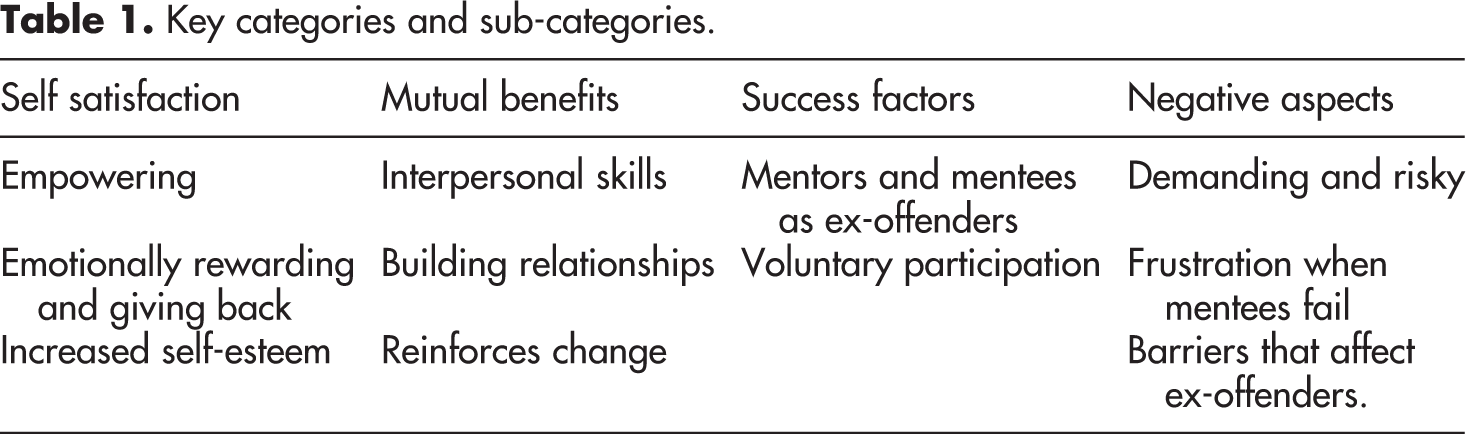
Four main categories emerged from the analysis, with 11 sub categories (see Table 1).
Key categories and sub-categories.
Category 1: Self-satisfaction
This category was consistent throughout the study. The experiences that defined self-satisfaction included feelings of empowerment, emotionally rewarding experiences, and being able to give back to the community.
Empowering
Participants stated that they found mentoring to be empowering in both prison and probation settings, contrasting this with their previous experiences of feeling powerless. Being able to be in a job which made them feel in control and able to help others was expressed as empowering and satisfying:
I was in that environment and delivering a service, the officers had to give me respect… and some of them didn’t like it but it was the most powerful situation to be in the world. (Interview 1) I had a scenario where my probation officer turned around and asked me for my help with her client and I said to her ‘do you know what I’m really busy right now’ and it was just this power change.… Power dynamic it really empowered me, made me feel like a professional. (Interview 1)
Emotionally rewarding and giving back
Another sub category recurring throughout the data referred to participants finding mentoring emotionally rewarding, enabling them to ‘give something back’. For some, this was about being part of something bigger which allowed them to make positive changes. These changes in turn were perceived as having an impact on other people, benefiting both mentees and the wider community. This was clearly a very important factor for the interviewees, who disclosed frequently their pleasure of giving back to the community:
It makes me feel very good like at least I’m contributing to someone else’s life, I mean making a difference to peoples’ lives like I’m making my own personal contribution to society … it is uh emotionally rewarding to realise that I am making a difference in peoples’ lives you know. It’s not so much monetary rewards but it’s nice to make people happy. (Interview 6) The benefits are reducing reoffending rates within your community thereby making us safe. Secondly, all these people we are helping back into employment can contribute back into the community so they can give back. (Interview 2)
Increased self-esteem
Every interviewee perceived their experience of mentoring as an opportunity to grow personally and professionally.
So… What do I get out of it??? I get fulfilment, increase in personal esteem… at the moment I feel I should study more, housing laws so I can help the clients better. (Interview 7) Knowing that I’m growing as a human being… personally and professionally and.… Umm I wouldn’t say success so much but you know like for me there has to be a feeling like I’m doing the right thing. (Interview 1)
Category 2: Mutual benefits
The findings confirm that the relationship between the mentor and mentee was not only perceived as supporting the mentee but also as beneficial for the mentor. This was previously noted by Farrant and Levenson (2002) with reference to the Samaritan Listening Scheme. In the current study, three sub-categories of the Mutually Beneficial category emerged: mentors developing interpersonal skills; being able to build trusting and honest relationships; and – very importantly − reinforcing the changes they have previously gone through.
Developing interpersonal skills
Mentoring is mutually beneficial if supporting mentees also enables the mentors to gain experience and develop their interpersonal skills. Participants described the skills they felt they had developed since embarking on mentoring as a career:
Someone that not only talks but someone who listens, listening is much underrated. We have one mouth and two ears so we should do twice as much listening. The relationship between a mentor and the client is really important and it has to be mutually beneficial. (Interview 5) Somebody who is really prepared to help other people, someone who is resilient, somebody who is umm can I say empathetic… you know put yourself in someone else’s shoes, you know umm someone who has consideration for other people… someone who does not discriminate you know at all, that’s really important. We deal with people from all different backgrounds and nationalities so you have to be open and receptive to everyone you have to liaise with and not stereotype. (Interview 6)
Building trusted relationships
Another area that interviewees referred to as mutually beneficial in the career of a mentor was having the opportunity to build honest and trusting relationships. Participants emphasized how the level of success achieved with their clients was a reflection of the type of relationship that was formed:
You need to show interest and do what you say to your clients, they may never have had anyone they can really trust or lean upon. The minute you let them down or don’t see some of your promises through then it can break the level of trust and then the process is not going to work. (Interview 7) Someone that does what they say they are going to do. It builds trust and by that person doing what they say they are going to do. That’s the most obvious ultimate thing I think, mentors do some many wonderful things for their clients but that I reckon is the most important, you understand. If I can get one client to trust me and change his behaviour I’m really happy as it takes a lot for even one of these guys to really trust you. (Interview 4)
Reinforcements of change
Another prominent theme was that mentoring offenders reinforces the mentors’ own behaviour change:
I re-evaluated everything in my life… being around homeless people makes me realise I don’t ever want to be homeless again so you makes sure you pay your bills. Or like being around drug addicts it reminds you, you never want to end up like that again. The same applies with ex-offenders, I never want to go back to prison. This job keeps reminding you daily of the roads you would never want to walk again. (Interview 5)
Category 3: Success factors
The interviewees described many reasons for the success of their projects but two main sub categories emerged: being reformed ex-offenders themselves, which enables them to become role models to the mentees, and the voluntary nature of client participation.
Mentors as ex-offenders
Throughout the interviews, participants emphasized their view that the success of their schemes is due to the fact that the mentors are themselves ex-offenders. They believe this has a positive effect on the dynamics of relationships and enables them to work more effectively with clients in three ways. Firstly, mentees feel at ease and can relate to the mentor because they have experienced similar lifestyles:
Some clients when they come, think I’m not telling you anything… but when they realise we are all ex-offenders they feel they are on the same level and will open up more. (Interview 7) … yeah definitely I couldn’t do this job without my own past personal experiences. I think you could do it to some to degree and tick all the boxes on paper, but you have to know in it. I know when someone is talking crap to me.… anytime I hear some rubbish that I would (have) said when I was younger I laugh, because I know exactly what they are doing. They get a bit shocked that I know where they are coming from. It actually works in my favour as they then know I’m real. Real recognises real you know, that all makes my job easier then. (Interview 4) … they see that I have been where they have come from and I have a good job now, they see it’s possible for them to make changes and get a good job. I volunteered here for a year before I got the job, I don’t tell them it is easy as it isn’t.… But there are possibilities for them if they want to make the change. (Interview 7)
Voluntary participation
Offenders who are mentored through St Giles Trust do so through as a voluntary process. Although some of the schemes target prolific offenders, the mentee does have the ultimate choice of whether to participate. Interviewees suggest that this emphasizes to mentees that they have to be motivated in order to make real positive changes. Secondly, being a voluntary service means that it is not enforced, allowing offenders more choice, in contrast to the probation service where there may be legal consequences for non-compliance.
I think if clients were forced to do the scheme it would not be so successful but it’s a shame though, as if the guys were to get on the scheme it may work really well for them you know. The best way to get a client is to explain who you are, give them a card and tell them you’re waiting for them if they need you. (Interview 4) … we sort of act like a parent role, or like the glue between all the organisations and the client. I think a lot of the clients see this scheme as a way out and the best thing of all is it is not forced upon them so they don’t have to participate.… I think the fact they choose the course helps them as they are restricted by so many other services like probation. (Interview 7)
Category 4: Negative aspects of mentoring
Despite the very positive statements made by participants about mentoring they were also open about some of the difficulties and challenges they faced in this work. Participants defined mentoring as being very demanding and risky due to the behaviour of some mentees. Another negative aspect was linked to the mentor’s emotional response when their clients fail or revert to old behaviours. They also expressed their frustration at the systems that affect ex-offenders, not only restrictions relating to their own employment but also the regulations that restrict them when working with offenders.
Demanding and risky
Participants were able to disclose some of the negative and potentially dangerous events that happened with mentees:
Oh yes umm it’s a risky job − we deal with offenders who have committed all types of crimes you know from murder to arson, from using weapons, everything you know, so sometimes it’s risky you know, as you’re on your own with them going to view accommodation, going out you know. Some clients have mental health problems and can start off really quickly you know, so these are some of the negative sides of the job. (Interview 6) Uh quite a few actually, I have had a couple of clients threatening to kill me. I found myself in uncompromising situations even as a leader and a mentor, hmm I still face the conflict of interest if personal issues arise and I don’t always talk to people about that yeah so I mean difficult situations arise quite a lot you just have to get on with them really. (Interview 1)
Frustration when mentees revert back
Another negative aspect of the job is related to mentees failing to desist from crime or other negative associated behaviours. Participants recalled upsetting events where their mentees had re-offended and been recalled to prison, or took drugs whilst on the mentoring scheme:
Yes sometimes they are very negative you know, um some of them say they don’t want your help… or some people released from prison they are given their discharge grant and some of them were on drugs before prison and while they are away they can’t get any so when they are released some of them just want to go and get drugs again you know. (Interview 6) I try my best for them but if they are not putting their part in then it’s really, I don’t know, disappointing I guess and frustrating.… I hate that part the most, when you want the best for your clients but they can’t be bothered and you see them going back to their old ways, it’s depressing. (Interview 4)
Ex-offender barriers
Participants also discussed their frustrations toward barriers and bureaucracy that ex-offenders face in society. They discussed not only the personal barriers that exist as a result of being an ex-offender but also the restrictions they face when trying to support other offenders:
The negative parts of my job are sometimes bureaucratic, I mean sometimes… where you know things will not work but due to the powers that be we have to do things that way. (Interview 7) Just over a year ago we had a very similar project… it was funded by the probation office.… The probation office said they will not employ ex-offenders, well the whole point of it is to try and help people with these backgrounds so it’s quite strange… that project, well, it did do quite well and people keep on saying to us do you think you’ll get the funding back, but it’s highly unlikely. The probation service seems to put more barriers in our way than anything else. (Interview 8)
Conclusion
The research findings in this article highlight some of the significant experiences of ex-offenders as mentors and give a deeper insight into why these individuals value their career in mentoring. These findings cannot be generalized to all mentoring schemes but provide in-depth accounts of the experiences on one group of ex-offender mentors. Working as an offender mentor was perceived as a very positive experience. Not only does it make mentors feel empowered but they reported that it has also enabled them to continue on the path of desistance by presenting them with the opportunity to give back to society. Working as an offender mentor was perceived by these participants as encouraging their personal and professional growth and increasing self-esteem. Mentors felt that they have developed an array of interpersonal skills and have benefited from building trusting and open relationships with their mentees. Most importantly, they suggested that the job helps to keep them grounded, reminding them of a path they never want to take again, and reinforcing the positive changes they have made within themselves.
Although the participants were selected by the project manager and not by the researchers, representing the experiences from a range of mentoring projects, it is of course possible that these interviewees agreed to take part because they were particularly pleased and satisfied with their experience as a mentor. They may also have been keen to communicate to the interviewer their positive experiences and achievements so that any feedback on the scheme would be positive and further cement their position as mentors. It would therefore be useful in future research on mentoring schemes to include any mentors who had left the scheme or been found to be unsuitable. Nevertheless, in the absence of such participants, the interviewer probed the negative aspects of mentoring as an ex-offender, and interviewees were found to be open and honest about these, as described above.
The mentors who took part in the research believed that the mentoring schemes they were part of were particularly successful because all the mentors were ex-offenders. They believed that their clients can relate to them due to the similarity of backgrounds and lifestyles and feel more at ease to discuss their problems and be honest. Ex-offenders who mentor may provide mentees with good role models and an incentive, as they can see that change is possible. Nevertheless, working as an ex-offender mentor was not without its negative aspects. Participants gave examples of situations where they felt at risk, such as dealing with aggressive clients or clients with mental health problems. They also described the frustration and distress they experienced when mentees re-offended. Changing behaviour is a long process and mentors have to learn to focus on the positive achievements rather than fearing failure. Furthermore it is apparent that setting up a scheme with ex-offenders may not be accepted by funders and that ex-offenders still face immense discrimination when attempting to obtain employment, even though employment is a key factor in desistance.
Mentoring alone is not likely to be sufficient in supporting all offenders, but should be complemented by other services such as schemes for rebuilding family ties and helping with accommodation issues. Although the mentors interviewed here had all received training and regular supervision it might be appropriate for organizations to consider providing more in-depth counselling for those ex-offender mentors and mentees with deeper problems. Increased access to cognitive behaviour therapy for offenders with low to moderate mental health problems could also be considered as part of the wider service provision.
For mentoring schemes to succeed with offenders it is important that the links between the mentors and statutory services are positive and robust. Some comments made by participants suggest that the balance of power has to be carefully negotiated, with mentors needing to establish their new identity, even if this involves saying no to probation staff requests. The mentors interviewed in this research dealt with the same clients as their probation staff colleagues, described by the project manager as working hand in hand. Mentors sometimes accompanied clients to their probation appointments and also discussed the risk of recall with clients. However, as expressed above, mentors tended to believe that they had a special relationship with clients because it was voluntary rather than statutory and because they had themselves experienced both sides of the probation process. The success of mentoring schemes is therefore likely to be influenced by the extent to which clear and respectful relationships are developed between the ex-offender mentors and non-offender probation staff.
Further statistical research is required to assess how successful offender mentoring is in reducing re-offending in comparison to the national rate, and to demonstrate empirically that employing ex-offenders to act as peer advisors or mentors would help to reduce re-offending. Further research should also identify and address the barriers which prevent organizations from developing policies to encourage re-integration of offenders. However, for those organizations contemplating setting up mentoring schemes, the comments of these participants suggest that employing ex-offenders in the mentoring role is likely to be very worthwhile and that voluntary participation is likely to be particularly effective. Risk assessment and regular supervision appear to be important in supporting mentors, and good relationships with probation services are also important to the success of a mentoring project. Finally there are still some barriers of bureaucracy and prejudice that will need to be overcome if mentoring is to become mainstream within the criminal justice system.
Footnotes
Acknowledgment
The authors would like to thank Junior Smart and members of staff at St Giles Trust for facilitating this research. We would also like to thank all interviewees for their invaluable contribution.