







Abstract
Whilst a positive working relationship has been recognized as a ‘powerful vehicle’ for offender change (NOMS, 2010), little is known in respect to how powerful a positive working relationship can be for probationers and the impact it may have upon their lives. From considering the ‘experience’ of a working relationship, this study evaluated ‘what worked’ for probationers by drawing from the successes and failures within a relational context. The study also explored the impact of these relationships upon the probationers, both at the time of the relationship and once it had ceased. Seven probationers were involved in this collaborative study, assisting in the design and analysis of the study, as ‘experts’ in probation relationships. The results tentatively suggested that certain characteristics (acceptance, respect, support, empathy and belief) enable a positive relational climate to exist that has a powerful impact upon the probationer, their beliefs and their behaviour. Conversely, if the probation supervisor (PS) fails to demonstrate these characteristics, a ‘toxic’ environment for change is more probable and could lead to greater risk of offending.
Introduction
In February 2012, I was fortunate enough to be awarded the Sir Graham Smith Award, an annual award given in honour of Sir Graham Smith who was an influential leader in the probation service. This study contributed to my own personal and professional interest in the working relationship, a topic that is central within my doctoral work and part of a wider research agenda that examines ‘the experience’ and the process of a working relationship.
Clark (2005) recognized that a supportive and collaborative environment is essential within correctional work, as well as adopting the strengths perspective; a belief that an offender can change. Whilst Clark (2005) recognized that ‘the “them and us” culture hampers the relationship’, he argued that control can work effectively alongside motivation if the right climate is created. From the ever-increasing research in this area, the impact of such a relationship has begun to be explored in general terms. NOMS (2010) highlighted that a good relationship between probationer and officer can be considered a ‘powerful vehicle’ to enable change and reduce re-offending (NOMS, 2010). Whilst is has been recognized that ‘the relationship’ is important, there are a number of reasons that underlie why this might be the case. First, it is generally accepted that creating a positive working relationship with a probationer can support the process of desistance and positive change (Burnett and McNeill, 2005; Rex, 1999). This may be associated with improving levels of compliance and legitimacy during supervision or providing a positive experience of supervision as a whole (McIvor, 1998; Trotter, 1999.) Trotter’s (1999) contributions relating to pro-social modelling proposed that the compliance of an offender can be improved if the relationship is perceived to be of value, suggesting that practitioners have an impact in relation to levels of compliance and overall ‘buy in’.
Drawing upon the literature around attachment theory, Ansbro (2008) discussed Bowlby’s work (1988) in relation to probation practice. Attachment theory suggests that early relationships with significant individuals (i.e. a mother) can in turn influence later relationships, creating a ‘blueprint’ for future bonds (Ansbro, 2008). Ansbro (2008) highlighted the importance of creating a secure base for a probationer within a supervisory relationship that will increase the likelihood of positive change through the healthy bond between practitioner and probationer. Additionally, McNeill and Robinson (2013) stated that it is possible that such a bond can act as a bridge to normative compliance through the development of trust and respect as well as a sense of commitment that is important to create legitimacy for a probationer (Robinson, 2005). Whilst a positive relationship may support the process of desistance it may also sustain such processes. Appleton (2010) concluded from her work that a ‘good’ offender−probation officer relationship can be vital within the maintenance of desistance and described how a positive relationship can also increase motivation in the offender. In addition to this, Ryals (2011) acknowledged that a therapeutic relationship cannot only help offenders feel positive about themselves and contribute to self-transformation but can enrich the feelings of empowerment. These insights suggest that ‘the relationship’ between PS and probationer may have significance within different aspects of correctional work including attachment, compliance, legitimacy, motivation and desistance. These findings also highlight the complexity of such relational processes as these constructs interact with each other, at different times, to different depths. It is important to therefore investigate the role PS’s play within the dynamics of a working relationship, as it is felt to be currently underestimated within practice.
Whilst knowledge can be uncovered from considering success within correctional work, investigating failure can bring additional learning and clarity to the impact PSs have upon those they work with. In light of Raynor et al.’s (2010) call to consider non-effective as well as effective methods, a further objective of the study was to consider the impact of negative relationships between practitioner and probationer. Bonta et al. (2008) considered one-to-one work within the context of supervision and highlighted that warmth, enthusiasm, empathy and respect were all important relational attributes of the PS, highlighting that offenders were more willing to engage when these attributes were present. They also observed aspects that required improvement highlighting that there was a reluctance to challenge anti-social behaviour and a lack of both pro-social modelling and positive reinforcement. Bonta et al. (2008) also observed negative behaviour and deduced that being hostile and unfriendly were behaviours that seemed to ‘turn off’ the probationer. Similarly, Clark (2005) proposed that a confrontational style not only creates distance between the probationer and probation officer, but can cause the probationer to shut down or ‘back away’. Research has highlighted the negative characteristics of correctional staff (e.g. Rollnick et al., 1999) though the impact of such relationships has only been explored in abstract terms. For example, Burnett and McNeill (2005) stated that a negative relationship may have ‘detrimental effects’ and Clark (2005) has argued that a disrespectful relationship pushes change away rather than pulls it closer, though little is known in respect to the nature or degree of this impact. In light of this work, an aim of this study was to explore the working relationship between the PS and probationer that were both positive and negative in nature. Whilst it has been stated that a positive relationship is ‘powerful’ in relation to recidivism and positive change, it is argued that a negative relationship can be as equally powerful. Therefore, this study considered what aspects of the relationship ‘worked’ and ‘didn’t work’ from the perspective of the probationer.
The approach and ethos
I wanted the probationers to be active throughout all stages of the research, particularly in light of the topic that was being explored. Appleton (2010) highlighted that in order to establish a positive working relationship with those that offend, it is vital for them to feel they are being listened to. Therefore, I wanted to adopt a collaborative approach to actively demonstrate to the probationers that they were being listened to. To do this successfully was firstly dependent upon my relationships I had with the participants and second, upon creating a climate within the interviews that was congruent to that of a positive relationship. To achieve this I approached the interviews and data analysis discussions in a relaxed and informal way, based upon listening to the participants and giving them greater power by presenting to them this concept of being ‘an expert’. Painting an accurate picture of their thoughts and beliefs was essential and was the main rationale behind collaborative data analysis, ensuring that their views were accurately interpreted and reported within the study.
During the study, all of the data was treated with equal value and verified by those that participated. To gain a greater perspective upon the data, both probationers and practitioners were involved throughout the research process to create new insights into the data that differed from that of the researcher. It was not assumed that the data represented truth or fact, but more the representation of relationships from the eyes of the probationer. In respect to data analysis, the assumption that the researcher was ultimate ‘expert’ was abandoned and a collaborative phenomenological approach was embraced, not considering the data from different perspectives, but actively involving different individuals to express their perspective.
The sample
Seven white men were interviewed for the research in total and were from numerous probation offices locally. Whilst a number of probationers were approached to participate in the research from a variety of diverse backgrounds, those that volunteered were white males. It is hoped that in future research a broader range of participants would be achieved in order to respond to and represent the diversities of probationers. The probationers that volunteered had previously committed a range of offences and all of the participants had been in contact with the Criminal Justice Service for over ten years. The participants had also stated that they wanted to desist from crime and it was felt that this benefitted the research as the probationers demonstrated a good insight into their previous offending and how their own behaviour impacted upon the relationships they had with PSs in the past. The majority of the sample had experience of custody, though all had been sentenced to a community order on at least three occasions. At the time of the research, five of the seven participants were still under some form of supervision and the entire sample had successfully completed the Thinking Skills Programme within the past three years. Whilst on this programme, I was their programme tutor and had built a good working relationship with all of the participants during their time on the programme. From an ethical perspective, it was important for me to make my role as researcher explicit and I formulated a formal informed consent form to address all key ethical considerations. Prior to the interviews I reiterated my role as a researcher and the aims of the study. Whilst some role conflict was unavoidable within the study, it was managed as effectively as possible and it was felt that the benefit of having a positive working relationship prior to testing significantly contributed to the richness of the data that was collated.
The methodology
The methodology aimed to be highly collaborative at each stage of the research. To do this, I drafted out three broad research questions and a possible visual aid that could assist me during the interviews. From my work as a programmes facilitator I felt that creating an interactive visual would encourage the participants to engage in the topic and take ownership of the data. Also, my research up until this point had adopted a visual methodology and I wanted to explore different visual methods to creatively capture the data as effectively as possible. At this stage in the project I contacted an ex-probationer, who I had previously worked with me in a small pilot study for my thesis (Lewis, forthcoming). He had extensive experience and knowledge of the Criminal Justice Service and been subject to both a custodial and community orders over a period of 20 years. We discussed the visual that was proposed and evaluated how it could be changed to maximize its effectiveness during the interviews. I also gained feedback from my colleagues during a team meeting, outlining the main design and discussing the research questions. From this, a final design of the visual was created on two large flip charts. The two visuals were dedicated to positive and negative working relationships respectively and had an identical structure with a main title (‘what worked’ and ‘what didn’t work’) at the top and a mind map at the bottom (see Figure 1).
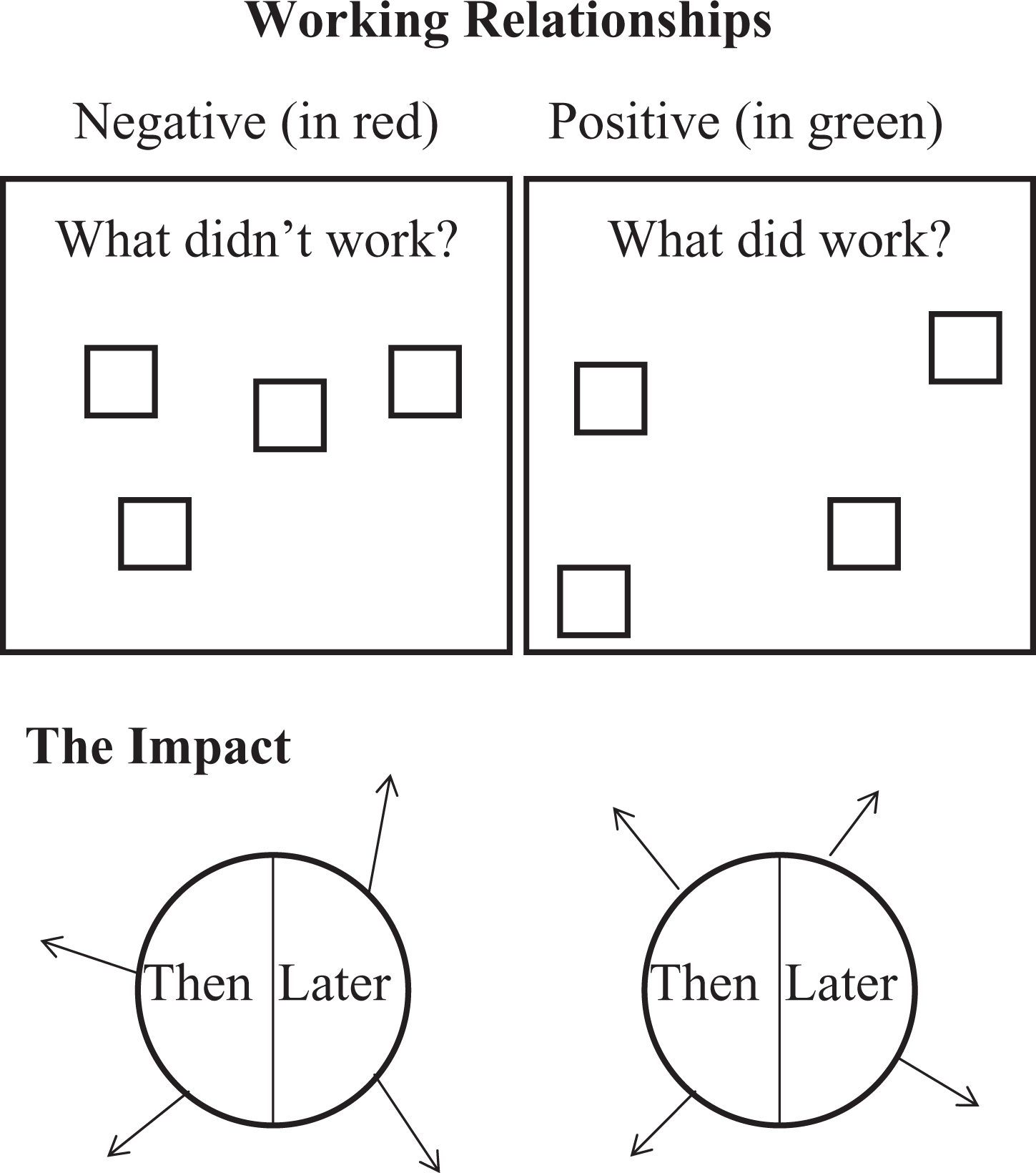
Mind maps were chosen following Reason’s (2010) recommendation of mind mapping in research, and from using them previously within research (Lewis, forthcoming). I felt they were an accessible and helpful framework to collect rich and relevant data. The colour of the text on the flipchart was green and red, relating to the positive and negative working relationship respectively, an approach that is consistent with green and red flags within the Thinking Skills Programme. This was used to add clarity to the data both at the time of the interviews and during the analysis phase.
During the interview, the participants were asked the question, ‘When considering the positive relationships you have had with PSs, what worked for you?’ As they discussed their experiences of positive relationships, any relevant skills, attitudes, virtues or characteristics were written on post-it notes and added to the visual under the main title. The participants were then asked to refer to the mind map at the bottom of the page and asked to describe the impact of their relationships at the time they were experiencing them (impact ‘then’). Post-it notes were used to capture the main statements that arose from the question. The participants were then asked, ‘What impact did these relationships have on you once the relationship had ended?’ (Impact ‘later’.) The data was again captured and posted onto the flipchart and an identical structure was adopted for both discussions relating to the positive and negative relationships.
Data analysis
During the data analysis phase, the probationers were considered as equals in respect of their views around the data and how they constructed and made sense of the data as a whole. I collated 221 post-it notes during the seven interviews and loosely grouped the statements by theme. Each post-it note represented one statement and in the event that two participants elicited identical statements (for example), two post-it notes were used to represent the statement. The rationale behind this was to create a clear picture of the data that was captured during the interviews to assist in data analysis, particularly in respect to the frequency in which particular statements were cited by the probationers.
Two group analysis discussions were then organized, one that consisted of six probation practitioners and a second that consisted of four of the original probationers from the interviews. The format of these two analysis sessions were again identical in structure: All of the 221 statements were presented on the walls of a meeting room, the red text on the left (relating to negative working relationships) and the green text on the right (relating to positive working relationships). Each group was given three tasks: first, to walk round and read all of the statements; second, to confirm the themes that have been created (questions were asked like, ‘Do any two themes need to come together? Do statements need to be moved?’) The final task was to give a name to each theme that represented the statements of meaning as a whole. Both data analysis sessions took place within the same week and the final analysis of the themes were completed by myself in light of the outcomes.
The insights that I gained from the probationers were significant in relation to the analysis and it is an approach that I would strongly recommend and adopt in future research. It challenged my own analytical approach and highlighted that probationers have a significant role in respect to how data is analysed effectively within criminal justice research, particularly in respect to relational work. Upon reflection, the small sample size and all male sample was recognized as a limitation and it was a pity that all probationers could not attend the group discussion. Also, due to time, the data was loosely placed into themes that were likely to influence the practitioner and probationer interpretation of the data during the discussion. Whilst the visual displays of the data both at interview stage and data analysis had a number of benefits, writing and moving the post-it notes was believed to impact upon the flow of discussions at times. A final, but important aspect of this study was my own positionality to the research. As an ‘insider’ within the research (I was employed by probation at the time of data collection) I brought with me a number of biases that would have ultimately impacted upon my construction and direction of the interviews, analysis and group discussions. As a constructivist I do not see this as a limitation per se, though it is an important aspect of the project that needs to be openly acknowledged.
Findings and discussion
To explore the data in simple terms I will outline the key themes that arose from the data, comparing each theme and drawing upon the raw data to illustrate meaning.
The relationship
Table 1 shows the themes that emerged from the collaborative data analysis discussions with practitioners and probationers when considering positive and negative working relationships with probation supervisors.
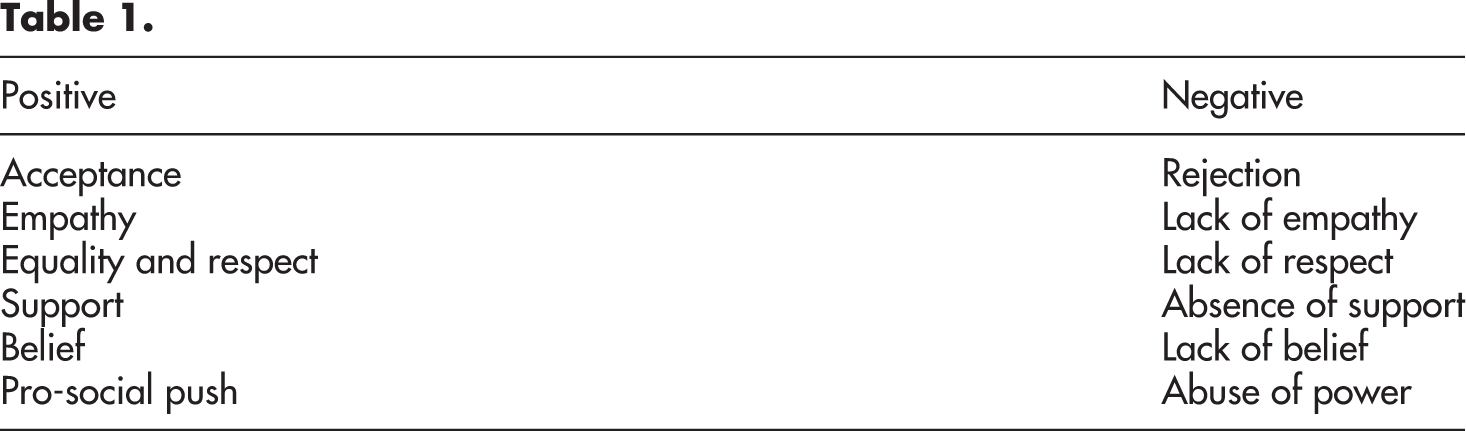
First, the participants discussed the need for PSs to demonstrate a genuine acceptance of probationers, as individuals, not as ‘objects’ or ‘units’, as previously discussed. Probationers described acceptance as ‘open’, ‘genuine’, ‘friendly’ and the practitioner adopting a ‘positive attitude’. When they discussed negative working relationships, they interpreted ‘rejection’ to be based around the lack of acceptance, but also associated traits of ‘arrogance’, ‘aggressiveness’ and ‘rudeness’. In light of Ansbro’s (2008) work that highlights the importance of a secure base, it was discussed how mutual acceptance between practitioner and probationer encouraged a secure attachment to be established and a bond to be formed.
The second theme that transpired from the data was that of empathy. The probationers described this characteristic as ‘someone who listened’, ‘someone who cared’ and ‘someone who showed interest’. When they discussed the absence of empathy, again it seemed to incorporate the absence of interest or care in that individual as a person. From considering the work on Rogers (1967) it would seem that this notion of unconditional positive regard and empathy are central to a positive working relationship within correctional work in a similar context to that of counselling. In respect to punishment, the concept of empathy has been discussed within Brown’s paper (2012), drawing upon the philosopher Nancy Sherman (1998: 84) who states ‘empathy relates fundamentally to ‘explaining others’ behavior and communicating back that understanding’. This idea of a PS ‘understanding’ and taking the time to ‘explore’ the probationer and the lives that they lead was central to this theme.
The third theme of respect/equality was identified as the ability to treat a probationer as an equal, showing them respect and being ‘non-judgemental’. These findings are congruent to the work of both Rex (1999) and Appleton (2010) and are closely linked to demonstrating acceptance of the probationer as a person, creating a separation between the individual and their behaviour. When ‘lack of respect’ was discussed by the participants, the main statements that arose within this theme were related to feeling ‘belittled’ and ‘patronized’, as well as feeling ‘judged’ by the practitioner. Further to this, the probationers incorporated the theme of ‘dishonesty’ with the theme of ‘lack of respect’, highlighting that for someone to be ‘duplicitous’ infers an absence of respect of that individual.
The presence or absence of support and guidance was the fourth theme that arose from the data. Support was defined as a PS giving advice and help to the probationer, though also included the signposting to appropriate agencies where advice could be accessed. The probationers stated that it was clear in their positive relationships that help was available to them and it was encouraged by their practitioner. Conversely, when discussing the absence of help the probationers not only highlighted the lack of help and support, but also the lack of opportunity to be helped. One probationer described their meetings with their PS to be ‘in and out.…nothing more’, inferring that irrespective of whether they needed help or not, the opportunity was absent.
The concept of possessing a genuine belief in the individual and their capacity to change has previously been seen as a vital ingredient to a positive working relationship (Clark, 2005; Lewis, forthcoming) and this was considered by the participants as the most important theme out of the six that were elicited. The probationers described this ‘belief’ as an intrinsic quality that could also be linked to that of acceptance, drawing commonalities between intrinsic belief and intrinsic positive attitude. When this was discussed in light of the negative working relationship, one probationer stated: ‘They didn’t believe I could change, they put me down when I achieved’. From our discussions at the group analysis sessions, the interpretation was made that it was not just a lack of belief in their capabilities to change, but almost an assumption of their failure to change.
The final two themes that were discussed in relation to the working relationship were the concept of ‘pro-social push’ and an ‘abuse of power’. Pro-social push was defined as a PS who challenged their behaviour, thoughts and attitudes with a ‘direct’, ‘straight’ and ‘honest’ approach. This was respected by the probationers as it highlighted their own limitations and what aspects needed to be addressed in order to lead a ‘good’ life. An abuse of power on the other hand was described as: ‘Someone who orders you about, someone who tells you what was what, someone who promotes “them and us”’. During the group analysis session, the question was posed to the group as to whether these two remaining themes were related or whether they were independent of one another. It was made clear by probationers that there was a link between these two themes, but also to the other themes that had been identified. It was concluded that in the event that the PS had created a climate for change (i.e. a relationship that is based on mutual respect, support, belief, acceptance and empathy) then the practitioner’s ability and confidence to challenge anti-social attitudes and beliefs were not only listened to by the offender, but valued by the offender. If, however, the PS had created a ‘toxic’ environment for change (i.e. an absence of respect, support, belief, empathy and acceptance) then it was more likely that the probationer would interpret such challenges as an ‘abuse of power’. From considering the work of Bonta et al. (2008) when exploring the black box of supervision, these findings relate strongly to one of the reasons why probation practitioners may not challenge anti-social behaviour as much as they need to. Furthermore, creating a positive climate for growth may have further links to the development of secure bonds that can be associated to secure attachments. Through the establishment of a healthy and secure relationship, it is felt that probationers cannot only learn through what the practitioner is saying, but also learn from relational processes that are at play, using similar processes within their own lives to create social bonds and secure attachments. It is argued that the ability to be truly honest with an individual, an element of trust is required and so, through secure attachments, anti-social behaviour can be addressed and opportunity for growth can follow. Further exploration into how pro-social push can successfully be achieved may lead to greater insight into the mechanisms behind change and how offending behaviour can be addressed effectively through effective relationships.
The impact
The results relating to the impact of a working relationship were in two parts: first, the impact at the time of the relationship; and second, the impact once the relationship had passed. Tables will again be used to outline the main themes and these will be elaborated upon in turn.
The impact ‘then’
Table 2 shows the themes that emerged when considering the impact of positive and negative working relationships between probationers and probation supervisors at the time of the relationship.
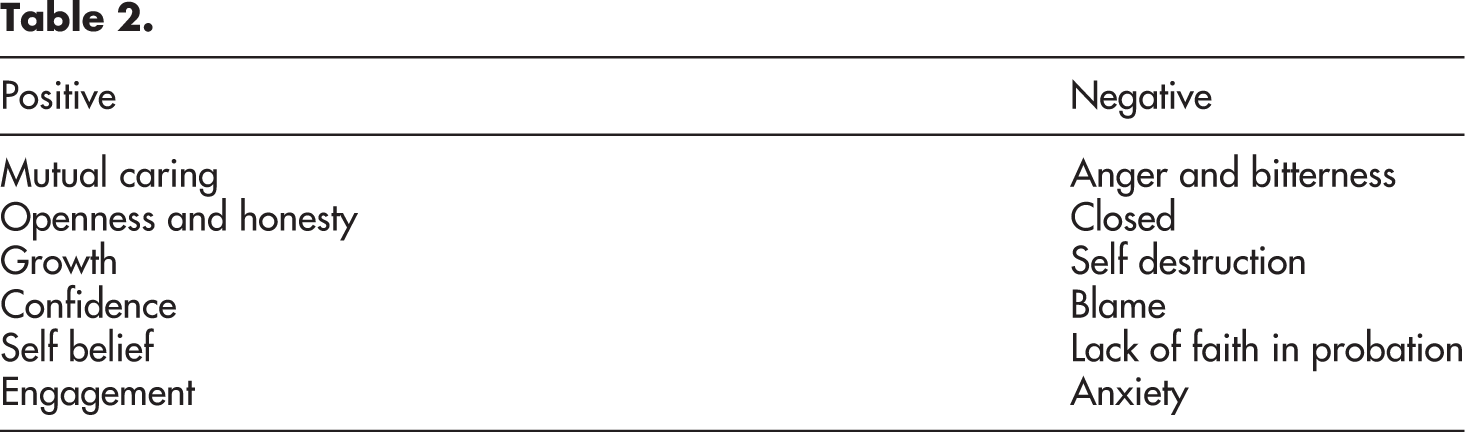
First, when referring to the positive working relationship, probationers discussed the concept of mutual caring. This included a strong loyalty to their practitioner and investment in the personal relationship that they had established. For example, it was stated that ‘I didn’t want to let her down’, ‘I almost wanted to protect her’ and ‘I cared about what she thought’. Conversely, probationers described feelings of anger and bitterness towards the practitioners from negative relationships, one probationer going as far as contemplating criminal damage to their practitioner’s car.
Second, probationers described an open and closed level of communication when referring to positive and negative relationships respectively. Probationers described how their ‘barriers came down’ and their practitioner ‘made me open up’ whereas this was the opposite within their negative relationships. Some discussed how they did not talk during supervision, others referred to ‘minimal communication’ or ‘shutting down’. This finding is congruent to the notions of ‘backing away’ that Clark (2005) proposed and could also be linked to the work around how psychological distance promotes the ‘them and us’ culture and is a barrier to rehabilitative progress (Williams, 2006). I believe these findings are not only important when considering the impact a negative relationship can have upon a supervision session, for example, but it is also highly relevant in respect to the assessment and management of risk. In order for PSs to tackle re-offending, they are reliant to an extent on the information that the probationer is giving them and without it, they are at a significant handicap. Practitioners are therefore encouraged to not only reflect upon such sessions when this takes place, but also to creatively consider what they can do to break down communicative barriers.
The third theme that transpired from the data related to growth and self-destruction. This theme again strengthens Clark’s (2005) argument that ‘the relationship’ cannot only move change closer but also push change away. The probationers discussed growth in terms of the achievement of goals as well as skill development, for example, in respect to anger control. Self-destruction, however, seemed to include very reactive measures, one offender stating: ‘I finished my meetings with her and went straight to the pub, got drunk and went home to argue’ another similarly commenting, ‘I left the session and was so angry I went to the pub, got drunk and went out offending’, ‘I did it in spite of her’. This theme linked closely to the fourth theme that was related to ‘growth with offending’ and ‘blame’. In their positive relationships, the probationers described how they became increasingly confident in their own abilities and increased their hope around desistance, one stating, ‘They made me not want to offend’. Whilst this growth was again described as a steady and progressive process, ‘blame’ seemed to include impulsive emotive outlets. For example, one stated: ‘I got home and was abusive to my mum’, another saying, ‘I took my anger out on my loved ones’. Whilst these are tentative findings due to the small sample, it seems that a negative relationship does not only increase the likelihood that an individual will offend, but also suggests that it impacts upon the very relationships that were considered as protective factors. Whilst Farrell (2003) has described the importance of significant and meaningful relationships when considering the road to desistance, a negative relationship with a PS could not only threaten a good working relationship, but damage other significant relationships.
The fourth theme was centred upon the concept of belief. Probationers reported how their PSs instilled confidence in them that boosted their own self belief in their capacity to change. When referring to negative relationships, this lack of belief was projected onto the organization as a whole. It would be interesting to carry out further work in relation to this theme in order to consider how self-belief is specifically effected by a negative relationship as this was not captured within this study; however, links can be drawn between self-belief and the action of self-destruction.
The final theme was specifically related to the emotions that were linked to meeting with the probationers’ practitioner. In respect to positive relationships, the probationers reported a real value in the time they had with their practitioner and how those individuals encouraged them to continue and successfully complete their probation. In relation to negative relationships, the probationers described ‘dreading’ the meetings beforehand, feelings of ‘anxiety’ during the meetings and feeling ‘in bits’ after a meeting. One particular probationer stated that his anxiety would begin two days prior to the meeting and not subside until two days after. Again, links can be made between this theme and theme four, and it suggests that the emotions that arise from a negative working relationship can be detrimental to the probationer (and others) if they do not possess skills in managing strong emotions effectively.
The impact ‘later’
The final part of the study was to consider the impact of both positive and negative relationships once the relationship had passed. Table 3 outlines the themes that emerged during collaborative discussions concerning the impact of positive and negative relationships once the relationship has passed.
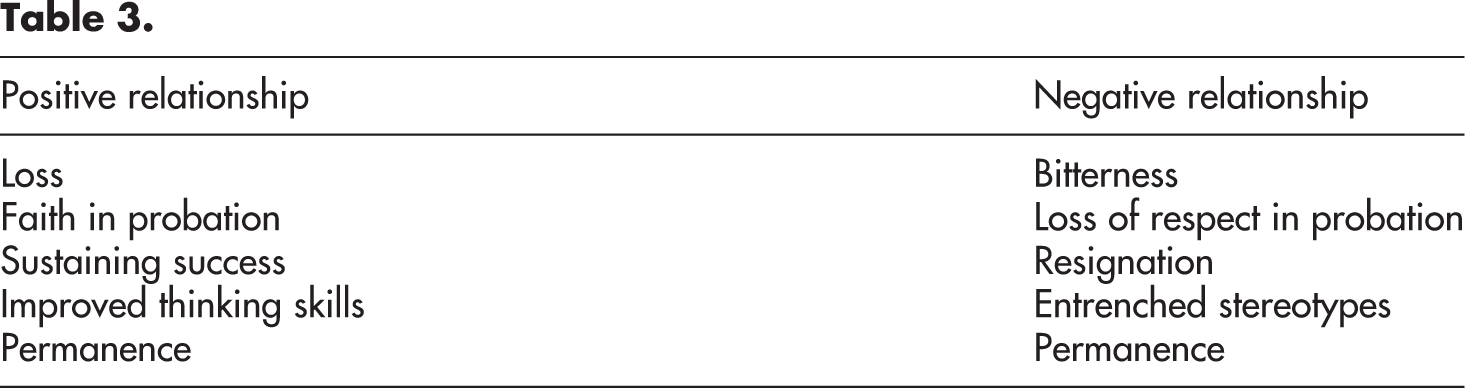
An experience of loss was a theme that was discussed by the probationers when they explored the initial feelings relating to the ending of their positive relationships with their supervisors. One probationer stated ‘I felt empty inside’ another commented, ‘I felt disappointed not to see her’. When this was discussed during the analysis stage, one probationer described the experience as ‘leaving a good shaped hole’ in their self that they endeavoured to fill with something of equal worth. When endings were discussed in negative relationships, it was clear that bitterness still remained for the participants, one stating plainly ‘I still hate him for what he did’, another claiming that he still thinks about reporting her for the way she treated him. This is an area of probation work that still needs a great deal of consideration and an area that I intend to explore during my doctoral studies, not just in general terms, but specifically in relation to how we effectively end relationships within practice. Within therapeutic relationships, Ward (1984) highlighted that an experience of loss can be associated with therapeutic endings, including that of sadness and anxiety. Through the application of attachment theory, it is believed that this can be linked to feelings of abandonment that can prevail when a secure attachment ends, sometimes prematurely, in the case of probation orders. For me this highlights the need for some flexibility within probation practice as it would appear that addressing a probationers ‘need’ (and consequently risk) is time bound to the point of order/licence termination. Some form of through-care that caters for the scenario when the probationer still requires support (or a secure bond/attachment) may be a way in which practice could be developed in the future.
The impact of working relationships were also described in light of a more global representation of probation as a whole and it seemed that the feelings towards the PS, whether good or bad, were projected onto the organization. Feelings of ‘instilled faith’ were described within positive working relationships, a probationer standing up, raising his hands and declaring ‘the system works!’ coupled by a loss of respect in probation when negative relationships were discussed.
The theme of desistance also transpired from the data; within positive relationships the probationers highlighted that whilst the impact did not stay as powerful, it remained in their ‘make up’ once the relationship had passed. A number of the participants admitting that they still think about their positive relationships and have fond memories of the learning that these relationships brought for them. In respect to negative relationships, the probationers discussed how they became resigned to the situation that they found themselves in. However, a more prominent sub theme included the exploration of how a similar ‘negative’ relationship would have future impact. For example, one participant stated, ‘I would have rather gone to jail than saw her’ another claiming,’I would be inside if I had him again’. This would suggest a particular fragility to the samples’ desistance and it would appear that a future negative relationship could threaten or even sabotage the good work that the gentlemen has achieved over the past three years that I had worked with them. This was an uncomfortable notion, particularly in respect to the progress and strengths that the participants had at the time of the interview and it also was worrying to consider how a negative relationship could counteract such positive relationships that had taken place within the individuals’ lives. However, in light of the Skills for Effective Engagement and Development (SEEDS) initiative, if observed practice and reflective supervision is effectively utilised within practice, it is hoped that negative relationships could be addressed more actively in the future. A pro-active approach to safeguard the relationship is paramount in light of the tentative findings from this study and further work in this area would be recommended.
The fourth theme was centred on skills and attitudes. The participants described greater thinking skills in their lives after the relationship had ended, stating that they gained skills and developed pro-social attitudes whilst they were in the working relationship with their supervisor. It is hard, however, to measure whether this was an impact of the cognitive behavioural work that they had all carried out or whether it was specifically relevant to their PS. When negative relationships were described, entrenched stereotypes relating to correctional relationships were strongly cited during the interviews and data analysis session. Probationers discussed how they ‘gave my new PO (probation officer) a hard time’ and believed that ‘all POs were the same’. This would suggest that a negative relationship does not only encourage the probationer to project a negative attitude on to probation as an organization, but interpersonal projection on future PSs was also evident.
The final theme was related to the level of impact that the probationers felt relationships had on their lives. They stated that both negative and positive relationships were equally as powerful and whilst the impact reduced once the relationship ended, it did remain. This was particularly evident during the interviews and analysis session when observing the atmosphere within the room and the non-verbal communication of the sample. Probationers laughed and smiled as they reminisced and shared their stories around the PSs that played a significant role in their lives and this transformed into a more animated and frustrated group, as they recounted those individuals that they ‘hated’ and ‘despised’.
Implications and conclusions
It is argued that there are implications in light of these tentative findings to recruitment, probation training and practice. First, with respect to recruitment, it is recommended that those who recruit new staff are mindful of the characteristics that are congruent to offender change and a positive relationship, ultimately recruiting people ‘who could work’. Further to this, it is argued that recruitment could provide an opportunity for the offender to have a ‘voice’ and be considered an ‘expert’, involving probationers in the interviewing process and design of interview content.
When considering training on the Probation Qualification Framework (PQF) further development of relationship knowledge is encouraged, with learning outcomes relating to an understanding and application of the theories that underpin relationships and the relevant variables that practitioners would benefit from exploring (i.e. attachment, transference and Rogerian theory). Within practice, these findings again have their place. It is not only recommended that engagement initiatives are embraced and reflection remains central to the work of PSs, but a more mindful approach in respect to observed practice and what aspects of one-to-one work are congruent and incongruent to promoting change in a probationer. It is also important to ensure that if a PS experiences a negative relationship with their probationers, they are actively supported and guided so as to ensure that risk is not heightened. A further challenge within practice is not only training practitioners and increasing their awareness of the impact of working relationships and ‘what works’ with relationship but also maintaining newly learnt skills effectively so as to ensure that complacency does not set in. The SEEDS initiative will hopefully ensure that practitioners are effectively supervised and a supportive climate of collaborative working amongst peers is promoted.
On a final note, with the recent political shift towards a more punitive approach it may be argued that in order to get ‘tough’, we need to return to the more formalized approach of the past. I argue quite the opposite. Practitioners need to effectively assess risk and challenge anti-social attitudes and behaviours that offenders present. In order to do this successfully, we need to not only ensure effective communication is present in our relationships but also use ‘the relationship’ as a vehicle to protect the public and manage the risk of the offender. A positive relationship does not simply benefit the offender, but also the practitioner and the organization. It is argued that if a positive relational climate is present, PSs will be more comfortable in challenging anti-social attitudes through the use of pro-social push and probationers will also be more likely to open up and discuss their problems honestly, building their confidence in their ability to change and hope of desistance. If the relationship is, however, relegated once again within correctional work, this will not only, in my view, increase the likelihood of future offending but have negative impacts upon both the probationer, the public, PSs and the service as a whole. If offenders are going to experience ‘tougher’ community orders in the future, it is essential that a good working relationship is present so that work can be carried out effectively and legitimately. Further work within this area of research is necessary for us to gain a greater understanding of the processes that underlie a positive working relationship and how we safeguard this relationship within practice. From this small scale study it would suggest that the working relationship is a ‘powerful’ vehicle, in both a positive and negative way, and its impact is wide reaching. Whilst practitioners may underestimate their contributions to change and desistance, it is urged that practitioners reflect upon their practice and make ‘the relationship’ central within their work.