







Abstract
In addressing human trafficking, probation services play a key role in identifying victims, providing support, working to prevent exploitation and reduce the potential for re-exploitation. In a world-first scoping review, this paper maps emerging empirical research on probation practices with justice-involved people subjected to exploitation and identifies gaps in research to inform policy and practice.
Keywords
Introduction
Human trafficking research has focused primarily on trafficking victimisation, with the aim of increasing identification, providing holistic services and supports and improving legislative efforts. Although the small body of research examining trafficking offending has consistently shown overlaps between justice involvement and victimisation, there is a dearth of literature exploring the victim-offender overlap and how correctional services are responding to this issue. Drawing on the findings from of a scoping review, in this paper, we explore some of the approaches used in probation services to working with young people and adults who have been subjected to exploitation and are involved in the criminal justice system. In redressing this gap, our paper considers research with justice-involved trafficking victim-survivors rather than perpetrators. We begin by discussing key terminology and briefly reviewing the literature on the overlaps between victimisation and offending. Next, we present the method for this scoping review, before presenting key findings from the analysis. Ultimately, we argue that without systems change, the dominant approaches to working with justice-involved people that are shaped by ideas of ‘penal welfare’ may cause harm to the groups they set out to protect.
Human trafficking and probation: parameters and terminology
Our understanding of probation services goes beyond the narrow legal definition of a state agency (i.e., His Majesty's Prison and Probation Service [HMPPS]) to incorporate well-established partnerships between statutory services and the penal voluntary sector (Tomczak and Buck, 2019). This means our paper considers probation as an institution where services can be ‘spread over a plurality of agencies in the public, private and voluntary sectors’ to support the successful social inclusion of justice-involved people (Hall, 2015; Senior and Ward et al., 2016: 1). Justice-involved refers to people who have come into contact with the criminal justice system. This might be through booking, charging, sentencing, incarceration (jail or prison), probation or parole.
Defining human trafficking has become increasingly muddied by the inclusion of the umbrella term ‘modern slavery’. Historically, the United Nations (UN) rejected this term in the Protocol to Prevent, Suppress and Punish Trafficking in Persons, Especially Women and Children (UN, 2000), which contained the internationally agreed definition of human trafficking. However, the UN embraced use of this term in the Sustainable Development Goals where, under goal 8.7 member states were required to establish ‘immediate and effective measures to eradicate forced labour [and] end modern slavery and trafficking’ by 2030 (UN, 2015: 20). As Gadd (2024) suggests, the inclusion of ‘modern slavery’ was in part due to lobbying by international charities like Anti-Slavery International, the International Labour Organization and Walk Free and the British and Australian governments. The inclusion of modern slavery is problematic and unhelpful as: While it adds rhetorical force to the agenda, harking back to the international campaign to abolish the slave trade, the term is unacceptable to many countries and individuals. It does not have a clear definition internationally and, in failing to distinguish between different forms and degrees of exploitation, can be seen as stigmatising all survivors as slaves. (Independent Commission for Aid Impact, 2020: ii)
Although the term lacks precise definition, modern slavery encompasses a range of related but distinct and sometimes overlapping forms of exploitation. This includes bonded labour and forced labour, human trafficking (labour and sexual exploitation) and the worst forms of child labour. However, under the UK's Modern Slavery Act (2015), this definition extends beyond labour to include criminal exploitation and this change in problem framing has allowed further exploitation creep between anti-trafficking and drug policy and immigration control (Findlay, 2025). This reframing has largely been uncritical, and it is a worrying one as it risks further criminalising marginalised and minoritised groups.
As we are looking at probation practices with justice-involved people subjected to exploitation, in this paper, we use ‘modern slavery and human trafficking’ based on a critical understanding and appreciation of the term. We use modern slavery and human trafficking (MSHT) to mean labour exploitation, including bonded and forced labour, human trafficking (labour and sex trafficking) and the worst forms of child labour. Here, sex trafficking means forced sex work, and we do not use the terms sex work and sex trafficking interchangeably as the terms are not interchangeable – they are referring to two very different things. In this paper, we have taken care not to conflate sex work with sex trafficking, but we do explore contexts where sex work has been conflated with sex trafficking in probation practices to highlight the contradictory logics in operation and the dominant, institutionalised gender ideology that women sex workers are ‘victim-criminals’ (Majic, 2014; Sandy et al., 2025). While we are critical of exploitation creep, we have included criminal exploitation in the definition as this framing is rapidly entering into the probation sector in the UK and elsewhere.
Human trafficking victimisation and offending
Early responses to human trafficking were developed in a context linking this mostly with sexual exploitation. While understandings of human trafficking have broadened since then, the focus on sex trafficking remains. Additionally, the criminalisation of trafficked people remains an issue, with many states failing to recognise trafficked people's experiences of victimisation, instead punishing them for crimes some were victimised into committing. Research shows that imprisonment for trafficking committed due to a trafficking or modern slavery situation can exacerbate trauma, vulnerability and re-exploitation after release (Heys, 2023). This also works to erode trust in the authorities and the criminal justice system, which further reduces the likelihood of victims wanting to engage in the future (Jovanović et al., 2024).
Although we only have a small number of studies focusing on people convicted of trafficking offences, the research consistently shows gendered aspects to victimisation and offending and overlaps between justice involvement and victimisation. It is an area of offending with a relatively high rate of female involvement, both as people with experiences of being trafficked and as those convicted of trafficking offences (Surtees, 2008). Research shows how incarcerated women have experiences as both a victim-survivor and perpetrating exploitation, with many surviving significant trauma and their offending being part of a patriarchal victimisation matrix (Broad, 2024). Thus, the literature illustrates how relationships between facilitators and people experiencing exploitation are often complex, involving subtle methods of recruitment and control and victim-survivors’ involvement in offending, with this group often referred to as victim-defendants.
In recognising the overlap between offending and victimisation in human trafficking, the non-punishment principle was developed to ensure victim-survivors were not punished for crimes committed during the trafficking process (ICAT, 2020). However, this principle only applies to people who committed offences as a direct result of their trafficked status, and research has documented a reality that is not as clear-cut as this suggests (Broad, 2024; Cockbain, 2018; Surtees, 2008). The issue of how to respond to trafficked people who later become perpetrators raises complex issues for the detection and prosecution of trafficking offences and the care and management of justice-involved people as the non-punishment principle is rarely applied to victim-defendants (Heys, 2023). In addition, as Jovanović et al. (2024) highlight, correctional services face significant challenges in identifying and supporting justice-involved people who have experienced exploitation. For example, the prison environment itself acts as a barrier to identifying victim-survivors, meaning that underreporting and missed cases are highly likely. Prison itself may also create conditions conducive to exploitation within the prison estate, with incarcerated people generating significant debts in prison that are then used as a means of control on release, or cell debt extortion scams being used to control vulnerable prisoners (Grey, 2023).
It is difficult to know the extent of justice involved people subjected to exploitation; however, research suggests this may not be a fringe concern isolated to a small number of cases (Jovanović et al., 2024). Increasing awareness of the overlap between justice involvement and victimisation has led some correctional services like HMPPS to develop responses to human trafficking for justice-involved young people and adults (Sandy et al., 2024). Although there may be growing awareness and literature on how prisons are responding to trafficking, a 2024 survey revealed a lack of clarity surrounding how correctional facilities like jails and prisons are responding to this call for action (Rizo et al., 2024). Further, there is almost no literature exploring how probation services are responding to trafficking. This study aims to fill a significant gap in literature. This scoping review of empirical literature attempts to shed light on approaches to working with justice-involved people subjected to exploitation, with a focus on identifying the specific challenges and barriers in providing probation services and developing trauma-informed, person-centred care and support for people under the management of correctional services to reduce the potential for exploitation and re-exploitation.
Methods
Empirical research on human trafficking and probation is limited because it is an emerging area of research. This led us to undertake a world-first scoping review that mapped the literature and identified gaps to inform policy and practice. This paper presents the findings of a scoping review, developed using the PRISMA-ScR extension for scoping reviews (Gottlieb et al., 2021). We followed the PRISMA guidelines to develop a systematised review process to minimise bias, increase reliability and answer our research questions. As a scoping review, it followed the five stages of a scoping review outlined by Arksey and O’Malley (2005), which involved identifying a research question; identifying relevant studies; selecting studies; charting data; and collating, summarising and reporting results.
Our main research question was to discover the approaches taken in probation services to working with justice-involved people involved in MSHT offending, including victim-survivors. We also wanted to document the needs of justice-involved people involved in MSHT offending and better understand how this group accessed services, while considering the ways in which race, ethnicity, gender, age and nationality intersected. Of particular interest for us was mapping how the criminalisation of victim-survivors was reinforced and exploring understandings of the overlap between victimisation and offending. The scoping review also allowed us to chart the literature and create a map reflecting studies connected to answering these questions. This allowed us to create a multilayered map reflecting research from different, but interconnected disciplines including criminology, women's studies, social work, youth studies and child welfare (Gottlieb et al., 2021).
Literature searches were conducted between September and December 2025 using academic databases (APA PsycINFO, CINAHL Ultimate, Applied Social Sciences Index and Abstracts, CINCH: Australian Criminology Database (Informit), Criminal Justice Database, Current Contents Connect (ISI) [Web of Science], EBSCOhost, National Criminal Justice Reference Service (NCJRS) abstracts online, ProQuest dissertations and theses, Scopus, Sociological Abstracts and Web of Science) for quantitative and qualitative research on the topic. We initially identified search terms including probation* OR offend* OR parole* OR “community rehabilitation servic*” OR “community rehabilitation manag*” OR “community order*” OR “community treatment order*” OR “community sentenc*” OR “community supervision*”) AND (“human traffick*” OR MSHT OR modern slavery). We then identified the need to include “modern slavery” as the initial search resulted in 2500 results on one database.
The inclusion criteria were qualitative and quantitative research on probation practice. Trafficking research is of variable quality, so we focused on empirical peer-reviewed primary research reporting results from studies directly involving the probation sector (either practitioners or justice-involved people). Given the emerging nature of the field, we used citation searching (snowballing) with backward searching (cited in/review of reference list/cited papers) to identify further studies. We did not use forward searching (cited by/citing papers) due to the relatively new nature of research. We excluded grey materials and literature, non-English language and non-peer-reviewed studies. The initial search included studies reporting results from ‘prostitution diversion programs’ in the USA as part of sex work criminalisation. These studies focusing on sex work criminalisation were excluded, unless the authors specified human trafficking-related offending (e.g., domestic-minor sex trafficking/minor sex trafficking). This decision was taken to challenge the hegemony of trafficking lenses applied to sex work policy and programming often seen with the conflation of sex work with trafficking (Shdaimah et al., 2023). Different publications from the same data set were included if they were reporting new information. After conducting searches and applying the selection criteria (see above), we identified a total of 19 papers for inclusion in the analysis (see Figure 1). During analysis, two papers were removed due to their focus on sex work criminalisation, and four new papers were identified and included in the study, bringing the total number of studies to 23.
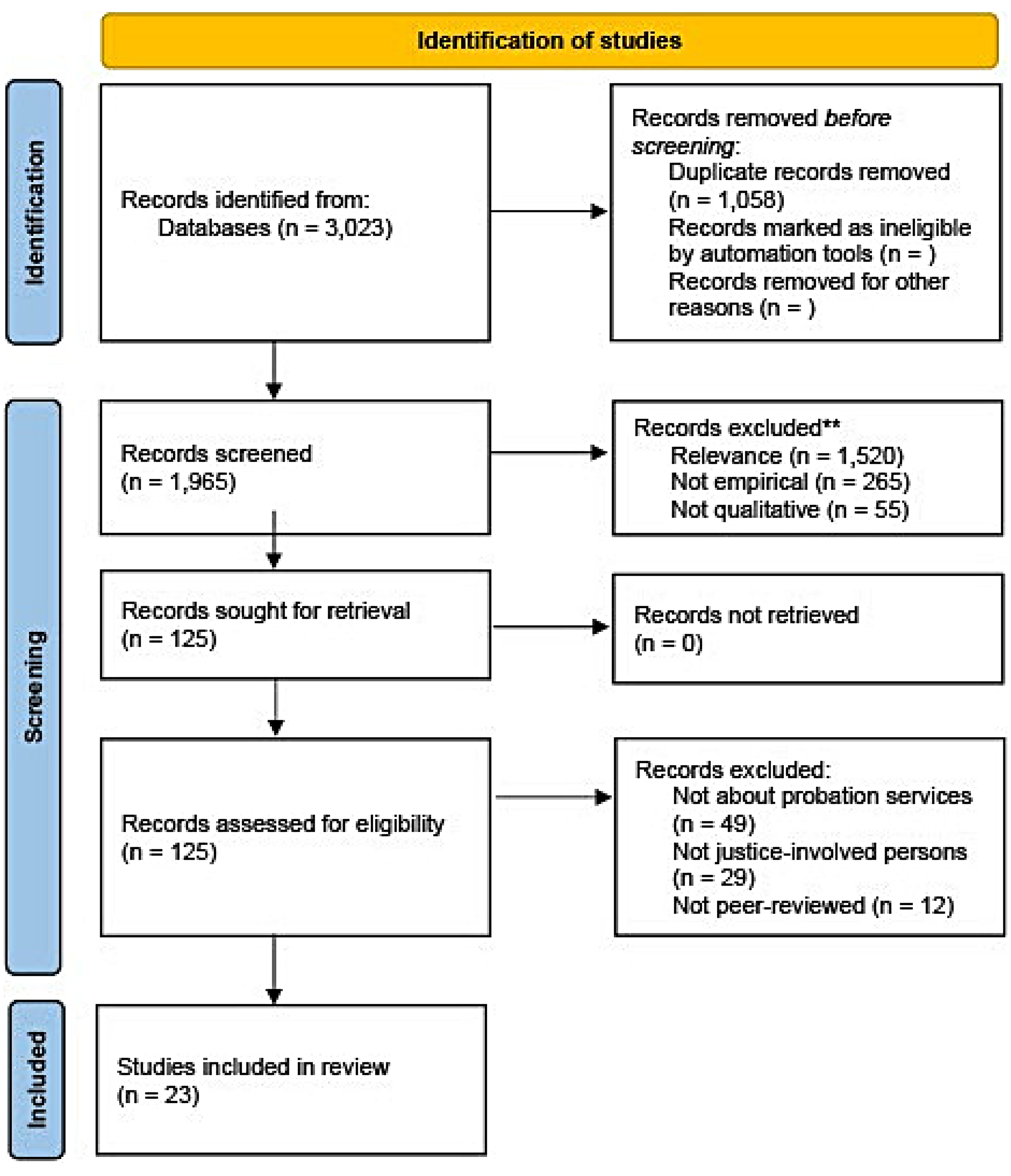
Flowchart of the review.
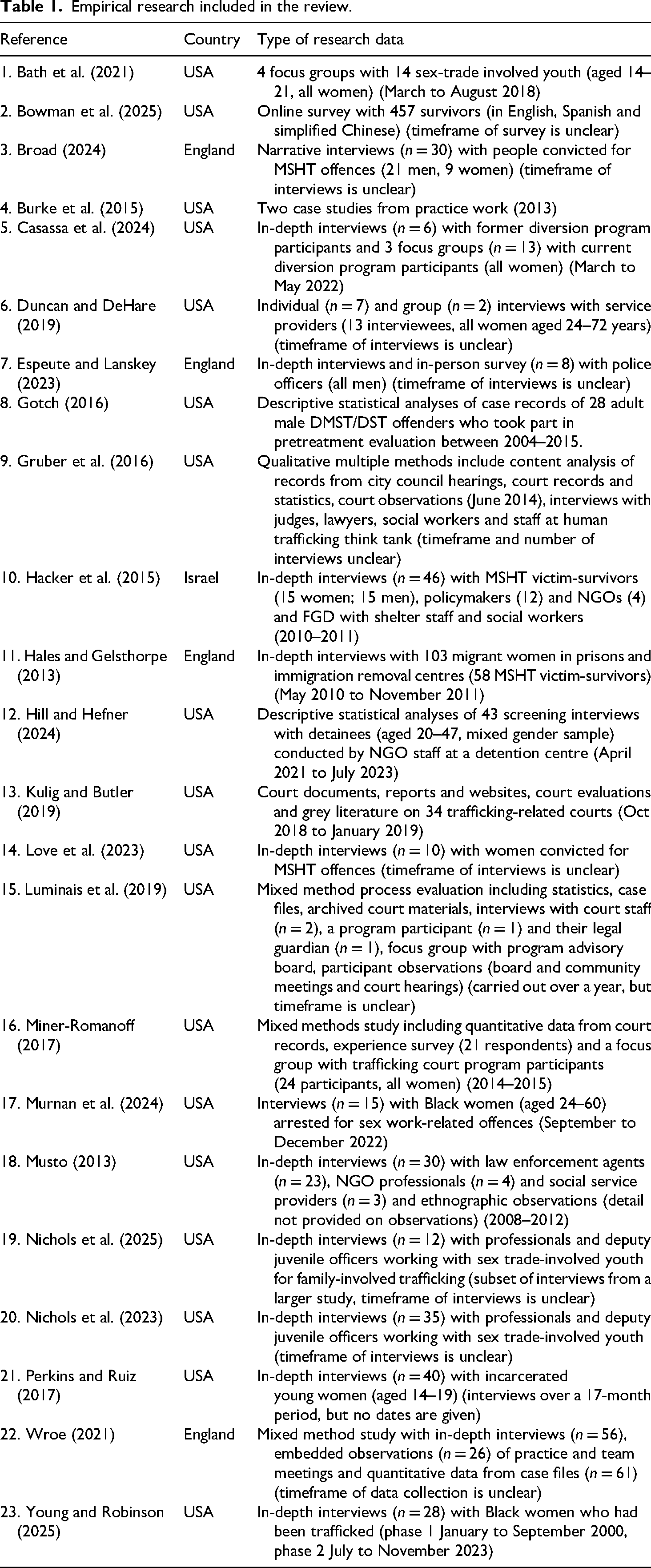
From the 23 papers included in the review, 65% (n = 15) included qualitative data, 22% (n = 5) included quantitative and qualitative data and 13% (n = 3) included quantitative data (see Table 1). Most papers were in the field of criminology (57%, n = 13), while 17% (n = 4) were from the fields of social work/child welfare and gender and sexuality studies. Nine per cent (n = 2) were in the field of public health/psychiatry. A small number of papers were interdisciplinary including the fields of medicine, social policy and social work. Noticeably, papers from criminology were the least interdisciplinary. Most papers were on sex trade-involved youth and adults (70%, n = 16), 22% (n = 5) of the studies explored sex and labour trafficking and 9% (n = 2) focused on criminal exploitation. Only one study considered labour exploitation, and none explored the combined topics of sex-trade involved youth or adults and criminal exploitation. We found no studies involving domestic servitude. Sixty-one percent (n = 14) of the studies were with justice-involved people, and of these, 64% (n = 9) were with women and young girls, 28% (n = 4) were with both genders and one study included a male only sample. Of the remaining studies, seven were with criminal justice actors and/or service providers and two studies included both groups in their sample. Over half the studies were published between 2021 and 2025 (n = 12) and just under half were published between 2013 and 2019 (n = 11). No papers were published on this topic in 2020 and 2022, which could be an artefact of the COVID-19 pandemic. We used thematic analysis to identify themes and patterns in the studies, guided by our research questions and synthesise the findings of these papers in our narrative discussion below. In this paper, we focus on answering questions related to approaches in probation services to working with justice-involved people involved in MSHT offending. We answer our remaining questions about justice needs and experiences in another paper.
Empirical research included in the review.
Approaches to working with justice-involved people subjected to exploitation
Empirical studies show that approaches to working with justice-involved people varied significantly by location and offence type. The review identified empirical research from the USA and UK only, showing a significant gap in research. Almost all the USA-based studies focused on human trafficking courts that dealt almost exclusively with sex trafficking/‘prostitution’. Studies from the UK were primarily on contextual safeguarding in the area of criminal exploitation. The subsections below review and summarise the findings on approaches to working with justice-involved people identified in the literature.
Human trafficking/sex trafficking courts
Globally, the USA was the first jurisdiction to implement specialised human trafficking courts. The empirical studies included in the review can be seen as tracking the beginning of a national movement towards the use of problem-solving courts for justice-involved people subjected to exploitation in the USA. Most of the USA-based studies in the review focused on the rise and status of these specialist courts dealing almost exclusively with sex trade-involved youth and adults. Under the USA Trafficking Victims Protection Act (2000) sex trafficking is the recruitment, harbouring, transportation, provision or obtaining of a person for a commercial sex act induced by force, fraud or coercion. If the person is under the age of 18, it is considered as trafficking regardless of the use of force or coercion. Kulig and Butler's (2019) evaluation documented the introduction of trafficking courts with a 2004 pilot in Queens, New York, in which sex work was redefined as violence against women and framed as torture, slavery and trafficking. This problem-solving court led to a reconceptualisation of women charged with sex work-related offences ‘not as petty offenders, but as likely victims of domestic violence’ (Gruber et al., 2016: 1350). Across the USA, this has seen ‘prostitution diversion programs’ morph into specialised human trafficking intervention courts with the concept of coercive control from domestic violence research becoming trafficking in the context of sex work (Kulig and Bulter, 2019).
Research documents the increase in human trafficking courts leading to a shift in probation service responses from viewing sex workers as ‘prostitutes’ or ‘whores’ to exploited victims, with women's behaviour redefined from voluntary, immoral and degrading to coerced and deserving of rescue and rehabilitation (Gruber et al., 2016; Kulig and Bulter, 2019; Miner-Romanoff, 2017). This has resulted in a changing narrative reorienting responses to sex work crimes that instead emphasise a need to identify victims and divert them to services and support. A key theme in the studies was identifying sex workers as victims of coercive circumstances with approaches focused on overcoming those coercive circumstances by stopping sex work (Miner-Romanoff, 2017; Perkins and Ruiz, 2017).
In accessing services, most justice-involved people enter human trafficking courts as people arrested for sex work-related offences. Miner-Romanoff's (2017) mixed-method study with trafficking court program participants discussed how, as a diversionary program, human trafficking courts aim: … to provide a comprehensive, coordinated approach with defendants who exhibit any combination of post-traumatic stress disorder, major depression, other mental health disorders, or drug or alcohol dependency in order to decrease criminal recidivism, jail nights, and arrests, to improve public safety, and to improve the defendant's quality of life by affording the defendant opportunities to be stabilized in the least restrictive location. (Franklin County Municipal Court, cited in Miner-Romanoff, 2017: 142)
The court programs are long-term engagements (some are 2 years) providing intensive probation focused on reintegrating women back into the community. A 2017 study stated that entry into the program was voluntary, however, to qualify, potential program participants needed to plead guilty to criminal charges (often sex work-related), after this they were placed on probation and a court-mandated treatment program was created (Miner-Romanoff, 2017). Although these court programs have been designed to address a group recognised as ‘victim-defendants’, Gruber et al.'s (2016) multiple method study with legal professionals revealed how they were still identified by the courts as offenders. Program participants not fully complying with the requirements were seen as violating probation, resulting in dismissal from the program and additional charges. If the person completed the program, all charges against them were dismissed, and in some states, their records expunged. Further, their study outlined the tensions with coercive treatment by documenting how defence attorneys sought to protect their clients from the lack of agency, inconvenience and material detriment caused by them being compelled to comply with court mandates. This group of legal professionals also argued that as victims, their clients could not be culpable for committing crimes that justified court control. This, they said, saw their clients re-victimised by judicial acts of authority and mandated participation in court-ordered programs. Their study highlighted how, while these court programs may be well-intentioned, they can backfire as participation was coerced with arrest and the threat of incarceration working to disempower justice-involved people. As part of a ‘multiprofessional detention-to-protection pipeline’, a 2013 study with law enforcement officers and service providers identified how this hybridised criminal justice and social service model may not be a victim-centred and survivor-centred anti-trafficking approach (Musto, 2013: 257). This study documented how services and treatment programs were not solely offered for a trafficked person's rehabilitation but rather worked to ‘provide a pathway to fulfilling the criminal justice goal of effectively prosecuting trafficking pimps and expanding the carceral state’ (Musto, 2013: 269).
In these court-mandated trafficking programs, interventions included individualised treatment and specialist one-to-one case management. Miner-Romanoff's study documented services including treatment for mental health and/or substance use disorders, housing, education and employment training and the ‘teaching of healthy behavioral choices and supportive interpersonal relationships’ for program participants (2017: 142). The studies included in the review show how these programs were closely supervised probation services essentially designed to stop people from selling sex as a means of preventing trafficking and providing rehabilitation (Gruber et al., 2016; Kulig and Bulter, 2019). In Miner-Romanoff's (2017) study, program participants were required to undergo compulsory status review hearings in court (often weekly) and attend additional frequent appointments with probation officers to monitor progress. Participants were also required to undergo compulsory random alcohol and drug tests and random home visits from probation officers or program staff. Given the coercive nature of the program, another challenge raised in the literature is how some participants understand treatment mandates as punishment itself, making it seem more like penal treatment (Gruber et al., 2016; Luminais et al., 2019; Murnan et al., 2024).
A 2019 evaluation found that, while these specialist courts could serve human trafficking victims, almost all people identified and diverted into the court programs were sex trade-involved youth and adults (Kulig and Butler, 2019). There has been a significant increase in the number of human trafficking courts in a very short amount of time. This is an important observation because Kulig and Butler's (2019) study found that very little was known about the outcomes of these courts, even where court evaluations had been carried out. This means it is difficult to know if these programs are effective at identifying and addressing the unique needs of this group. Kulig and Butler's review study also found most programs lacked a clear theory of trafficking victimisation, which was likely hampering effective programming. Their key finding that, ‘given the lack of empirical data, very little is known about the efficiency of existing problem-solving trafficking courts’ suggests a need for more research to examine these specialist courts using rigorous and comprehensive methods guided by theory (Kulig and Bulter, 2019: 315).
Criminal exploitation & contextual safeguarding
The exploitation of young people and adults in drug crime and supply pre-dates the UK's Modern Slavery Act (2015) as prior to this people were trafficked into the country as gardeners in cannabis cultivation (Burland, 2023). Under the Modern Slavery Act, criminal exploitation is defined as a form of modern slavery and this includes crimes like forced begging, forced theft, cannabis cultivation and supply and financial exploitation. Essentially, criminal exploitation is when someone is forced, coerced, deceived or manipulated (‘groomed’) by someone else into committing crime. Child criminal exploitation is an emerging area of focus in which a person or group is said to take advantage of a power imbalance to coerce, control, manipulate or deceive anyone under the age of 18 into criminal activity. This could be in exchange for something the young person wants or needs, financial or other advantage for the perpetrator or through violence or threats. It should be noted that Section 45 of the Modern Slavery Act provides a statutory defence for trafficking victim-survivors under the age of 18 accused of certain offences (Heys, 2023). While this reflects the international principle of non-prosecution of victims, young people must pass a ‘reasonable person test’ and Schedule 4 of the Act lists 140 offences exempt from the statutory defence, many of which are common in trafficking crimes (Heys, 2023). Adults have no similar statutory defence.
The most common type of modern slavery in the UK is criminal exploitation, and the most well-known form of this is known colloquially as ‘county lines’ (Espeute and Lanskey, 2023). ‘County lines’ is a policing term describing a model of illicit drug dealing where urban drug gangs cross police borders to transport heroin and crack cocaine to rural or coastal towns (NCA, 2016; Wroe, 2021). On the scope and scale of the issue, National Crime Agency (2016) data indicate this model is now commonplace with 71% of police forces in England and Wales reporting ‘established’ lines and 12% seeing this as an emerging issue. Research suggests child criminal exploitation is strongly associated with ‘county lines’ as, to reduce risk, gangs use young people as runners to transport and distribute drugs using dedicated mobile phone lines (hence the name, ‘county lines’) (Espeute and Lanskey, 2023; Wroe, 2021). The review identified the use of contextual safeguarding in approaches to criminal exploitation implemented in several local authorities in England and Wales. 1
Contextual safeguarding is based on Bourdieu's theory of social capital, and it aims to recognise the harms young people can face outside of their homes – essentially it is a model designed to help child protection services look beyond the family unit to consider issues like peer exploitation, manipulation or ‘grooming’ and gang involvement (Firmin, 2000). In addition to requiring child protection systems to target the social conditions of abuse, it is a framework for multi-agency partnerships and working with communities, schools and so on to expand traditional safeguarding beyond focusing on the child to consider environments, extra-familial harm and collaborative approaches (Wroe et al., 2025).
Although theoretically, approaches like contextual safeguarding were designed to consider environment and context, a 2021 study showed that implementation through one-on-one casework maintained the focus on ‘individual decisions, choices and behaviours, [thereby] situating vulnerability in the actions and attitudes of young people’ (Wroe, 2021: 45). In addressing peer-to-peer harms, this study documented how ‘peer mapping’ was the major way in which contextual safeguarding approaches were adopted. This saw the creation of ‘maps’ of young people and their friendship networks, referred to as ‘associations’. In the program, these maps were largely used to identify young people ‘at-risk’ of criminal exploitation, resulting in a disconnect between exploring friendships as a feature of young people's lives and mapping this for analysis and generating intelligence (Wroe, 2021). Despite undertaking significant effort in creating peer relationship and network maps, the one-to-one casework used by services failed to utilise peer maps and engage in group work with young people and their friends, families and communities. Instead, this study shows how friendships and relationships were read in the context of risk, with one-to-one casework seen as a protective measure designed to decrease risk, which ruled out the possibility of adopting a strengths-base, survivor-centred approach (Wroe, 2021). In addition, Wroe's study documented how many of the approaches taken to safeguard young people left contexts of harm unaddressed and ‘posed significant risks to civil liberties’ (Wroe, 2021: 45). For example, in identifying and intervening in locations of child harm in ‘county lines’, interventions focused on individuals or groups of young people. Preventative measures included dispersal, use of exclusion zones, social media blocks, panic buttons and CCTV installed in homes, bans on associating with certain friends and relocations (Wroe, 2021).
Multiagency partnerships
The review identified the importance of multiagency partnerships in approaches to working with justice-involved youth and adults. A qualitative study exploring community-based models involving social service and justice system practitioners highlighted the importance of team approaches being supported by formal protocols, with specialised courts incorporating ideas from therapeutic jurisprudence to involve judges, supervisors and multiagency teams working to address justice-involved people's needs holistically (Nichols et al., 2023). The promising practices documented in the study included coalition building, which was noted for building trust, establishing shared goals, enhancing communication and building formal and informal networks. This community-based collaborative model was also supported by judges and supervisors being educated about the dynamics of exploitation as part of cross-training efforts (Nichols et al., 2023). However, Wroe's (2021) study highlighted issues in these multiagency partnerships. For example, in her study, practitioners working directly with young people had some reservations and concerns with partnership working and information sharing. Case workers raised issues about the criminalising impact of peer mapping and the use of data for intelligence-led ‘disruption’, particularly when justice-involved people subjected to exploitation were both victims and perpetrators of harm (Wroe, 2021). In this study, a lack of transparency about information sharing meant that case workers were concerned about older ‘associates’ of young people being criminalised when they were also vulnerable young people. In a similar vein, Musto's (2013) study with criminal justice and social service actors led her to question the close alliances between law enforcement agencies, victim advocates and service providers. Musto highlighted issues with these close working relationships and the potential this presented for perpetuating young people's distrust in the criminal justice system and the knock-on effect of increasing their reliance on facilitators.
Discussion
The empirical research on human trafficking and probation is heavily skewed toward sex trade-involved youth and adults, with our review illustrating the almost exclusive focus on women and girls that reflects broader trends in human trafficking research. While the decision was taken to exclude sex work criminalisation, this review retains the dominant focus on sex work-related offending largely because it remains the dominant focus in empirical studies. The focus on sex work in this paper is an artefact of existing empirical research in the field, which highlights both a significant gap and persistent feature of trafficking research. Out of the twenty-three studies included in the sample, twenty-one researched sex trade-involved young people and adults. From this total, five studies explored sex and labour trafficking. Only two studies focused on criminal exploitation, and we did not find any empirical research on domestic servitude. The review uncovered a small but growing body of literature on domestic minor sex trafficking and minor sex trafficking in the USA and criminal exploitation in the UK. Although Australia was one of the first countries to introduce modern slavery legislation, there was almost no research on this topic from the region, showing a significant gap in research.
Our findings illustrate how hybridised criminal justice and social service intervention models have taken shape across the USA and UK in managing responses to trafficking in probation services. Although court-mandated programs and measures may incentivise participation, this review has shown that this is not necessarily a victim-centred response or a survivor-centred approach. Some of the empirical studies tried to counter this by arguing for the need for criminal justice and social service actors to develop shared goals focusing on what is best for the survivor. However, as the other studies show, a paradigm shift is needed for this to happen where criminal justice practice moves away from a focus on individual risk and responsibility and punishment to consider the broader structural factors that shape people's lives and choices. This shift needs to encompass interventions focusing on preventing exploitation and re-exploitation and addressing structural and systemic inequalities and barriers to social justice – financial precarity must be a programmatic focus. This paradigm shift may be possible with the development of public health and social work/welfare approaches to addressing human trafficking in probation services like we see in contextual safeguarding. Our findings, however, cast doubt on this possibility, as on face value, contextual safeguarding is an approach that ostensibly sets out to empower young people by increasing their social and cultural capital. In practice, the application of this novel approach in criminal justice settings was stymied by responses remaining largely unchanged, meaning it failed to deliver beyond individual case work and, seen as ‘associates’, friends and peer-networks were once again viewed as sources of harm. Without paradigm change, practitioners may end up in states of conflict as revealed in Wroe (2021), Gruber et al. (2016) and Kulig and Bultler's (2019) studies, which can cause further harm to victim-survivors. This is because the approaches still result in the imposition of statutory frameworks to young peoples and adults’ lives, and this can be a form of disempowering carceral protectionism where the system is seen as protecting them for their own good.
In human trafficking courts sex work is still considered a crime, and our analysis shows the contradictory logics in operation where victimisation, agency, rehabilitation and responsibilisation unreflexively co-exist (Baylson, 2017; Sandy et al., 2025; Shdaimah et al., 2023). This approach is a form of penal welfarism where sex work ‘exiting’ is carried out and experienced through a punitive criminal justice system. It is a carrot-and-stick approach to enforcing individual behavioural change (i.e., sex work desistance) constructed around the idea of protecting sex workers for their own good (Musto, 2016; Sandy et al., 2025; Shdaimah et al., 2023). The conflation of sex work and sex trafficking means women who are nominally considered ‘trafficked’ are arrested, prosecuted and held criminally responsible, leading to incarceration, fines and heightened surveillance (Sandy et al., 2025). However, if sex trade involved young people and adults are considered trafficked, this implies victimisation and lack of choice, and if this were the case, as a trafficked person they would not meet the criterion of intent (mens rea) required for criminal offending (Baylson, 2017). It is also a probation practice that does not see sex work as work and a valid occupational choice. This reveals the faulty logic framing approaches that conflate trafficking with sex work and the impact of probation programs that incorporate the dominant gender ideology of sex working women as ‘victim-criminals’ (Majic, 2014).
Our analysis of these hybridised criminal justice and social service intervention models has not only illustrated the conflict between a welfare-oriented perspective and risk-oriented perspective but also revealed a form of ‘penal welfarism’ (Gruber et al., 2016). As ‘victim-defendants’, justice-involved young people and adults are simultaneously seen as ‘victims-criminals’, in the case of approaches to criminal exploitation, this is as violent ‘criminals’ and for sexual exploitation this is as immoral ‘deviants’. The probation approaches identified in this review do not seem to reflexively consider this conjecture. Instead, multiple harms may be enacted on already marginalised communities by interventions designed for public order and safety and to protect them (largely from themselves) (Rodriguez et al., 2020; Sandy et al., 2025). While welfare-based approaches may have good intentions and set out to improve justice-involved young people and adults through integrative measures, as Garland (2017) argues, it is not only punishment but also help that can label. The message carried in these criminal justice approaches can be that a ‘person has character deficits and is unable to help themselves … being categorised as in need of help may subjectively be experienced as worse than punishment, for need directly discredits the person where punishment is directed only at the behaviour’ (Dollinger, 2019: 122). Our review highlights the need for research to better understand the punitive nature of welfarism from the perspective of justice-involved people, especially those who have been subjected to exploitation. More research is needed to understand how welfarist measures like those featured in our review are experienced and perceived by people charged with or convicted of trafficking offences. Here, we suggest more research on the view ‘from below’ – more empirical studies are needed with justice-involved young people and adults to better understand their assessments of welfare measures in criminal justice approaches and the decisions they would like to see being made about their lives and how best we can help them. This needs to be with all forms of exploitation, labour, criminal and domestic, and not just sexual exploitation. Our findings illustrate how the approaches perpetuate the dominant narrative of trafficking ‘victim-defendants’ as ‘criminal’ and vulnerable and in need of control and protection. These approaches are influenced by binary thinking of victims who need to be protected and criminals who need to be punished. More research is needed with trafficked people exploring the victim-offender overlap and offender and victim networks as these relationships raise complex issues for the detection and prosecution of trafficking offences and the care and management of justice-involved people subjected to exploitation. More research is also needed with probation services to understand practices in the sector and attitudes towards justice-involved people subjected to exploitation to enable the development of theoretically informed policy and practice.
Conclusion
This review has highlighted the importance of multiagency approaches in working with justice-involved people subjected to exploitation in probation services. While we have documented examples of good practice and collaborative relationships, we have also raised issues about the role of partnership approaches and how they may be replicating surveillance, removal, disruption and exiting/desistance typical of the policing and criminal justice responses these supposedly trauma-informed and contextualised programs are seeking to avoid. Probation is designed to hold the young people and adults accountable for their actions but adopting a person/victim-survivor-centred, trauma-informed framework means we are asking a punitive, carceral system to change its ways. Our findings highlight the need for the revisioning required and challenges probation services may face in meeting this aim, while raising questions about the harms that may be inadvertently introduced in penal welfare responses to human trafficking.
Footnotes

Author contributions
Conceptualisation: LS and JT; methodology: LS and JT; formal analysis: LS and JT; literature search and data curation: JT; writing–original draft preparation: LS and JT; writing–reviewing and editing: LS and JT; visualisation: LS and JT; project administration: LS. All authors have read and agreed to the published version of the manuscript.
Funding
The authors received no financial support for the research, authorship and/or publication of this article.
Declaration of conflicting interest
The authors declared no potential conflicts of interest with respect to the research, authorship and/or publication of this article.