







Abstract
This practice note asserts that prison and probation services have a significant and unique role in contributing to anti-slavery regimes which has been largely overlooked. It sets out the development of a new framework to assist prison and probation services in responding to modern slavery and human trafficking (MSHT) using three key themes. The first centres on raising awareness of known types and methods of MSHT. It captures emerging new risks and threats and acknowledges a wide diversity of offending where people are used as commodities for the financial gain of their exploiters. The second theme suggests ways in which potential justice-involved victims can be identified, supported to recover, and how risks of further exploitation may be reduced. The third theme seeks to develop ways in which those involved in slavery and trafficking offending can be disrupted, managed and supported to desist. It includes consideration of the victim-perpetrator overlap and the impact on public and victim confidence in how perpetrators are managed. It is understood that the new framework may represent the first comprehensive approach for prison and probation services in responding to slavery and trafficking.
Keywords
Introduction
Ann Snowden is the head of anti-slavery and human trafficking within the Prison Operational and Policy Delivery Group at His Majesty's Prison and Probation Service (HMPPS), an executive agency of the Ministry of Justice. HMPPS is responsible for HM Prisons, Under 18 Young Offender Institutions and The Probation Service in England and Wales. Her role involves developing HMPPS’ strategic and operational response to modern slavery and human trafficking (MSHT).
MSHT involves the severe exploitation of human beings, primarily for financial gain. This practice note sets out the development of a new framework to assist prison and probation services in responding to the risks and needs of both justice-involved victims of MSHT, and those involved in modern slavery offending.
Background
A first set of MSHT guidance was issued to prisons in England and Wales (GOV.UK, 2023) following a legal challenge (Cundall, 2022). This included awareness materials for staff and prisoners in written and digitised versions. It set out how prison staff can work in alignment with the National Referral Mechanism 1 (NRM – the UK Government's framework for supporting and protecting victims). A modern slavery victim alert was created to flag potential victims and survivors in prisons, and a new initial assessment of basic immediate needs within the prison environment was introduced. Modern slavery ‘single points of contact’ were established in each of the 122 adult prisons and 4 Young Offender Institutions whose role included facilitating first responder interviews to complete referrals to the NRM.
In 2023 an independent review of the HMPPS modern slavery guidance for prisons was commissioned (Jovanović et al., 2023). Whilst prison staff were commended for how they identified and supported some victims and survivors, examples of good practice tended to be located within individual responses rather than systematic institutionalised procedures. Overall it was found that awareness of MSHT was generally lacking for both staff and prisoners, a high likelihood of unidentified survivors in prisons persisted, and staff training needs were largely unmet. Further, a recommendation was made that HMPPS should seek to become a first responder in order to directly refer potential victims into the NRM.
It was agreed within HMPPS that development of a new MSHT framework should be explored to include all three HMPPS operational services (HM Prisons, The Probation Service, and the Youth Custody Service). The approach would seek to improve arrangements in how justice-involved victims and survivors could be identified, supported and protected. It would also incorporate opportunities to manage, disrupt and work with those involved in MSHT offending, acknowledging the victim-perpetrator overlap. As international guidance on how prisons should discharge their legal duties in response to MSHT was sparse, the approach was welcomed by Jovanović et al. (2023) who stated that it ‘represent(s) a unique attempt to address this issue in a comprehensive way’ (p. 19).
The design of a new framework for prison and probation services in responding to MSHT
To inform the design of a coherent framework for prisons and probation, a wide range of anti-slavery experts were consulted. Anti-slavery Non-Government Organisations (NGOs) provided valuable support and information, which included conversations with survivors. Other important insights were provided by academics with a specific research interest in MSHT and this collaboration resulted in the first thematic edition on modern slavery of the Prison Service Journal (Prison Service Journal, 2024). Modern slavery leads in statutory organisations and other government departments were consulted who confirmed that the emerging approach was aligned with wider government. Not only did HMPPS benefit from such valuable knowledge, insights and experience built up over many years by a wide range of experts, but trusted relationships were established which enabled ongoing communication and feedback loops.
The desired outcomes of a new framework were articulated at the outset and included the following:
the support and well-being of HMPPS staff are prioritised when dealing with severe exploitation; learning, training and guidance resources are tailored to different roles; HMPPS staff maintain professional standards which are fair and decent, and in accordance with the law; consistency is achieved in meeting legal obligations across HMPPS; an embedded approach is developed, applying a ‘MSHT lens’ to existing operational policy and assessments (rather than introducing separate ‘stand-alone’ processes); an evidence-informed approach is adopted which includes recognition of the victim-perpetrator overlap and informed by equality analysis; trauma-informed approaches are developed in response to the wide diversity of MSHT offending, and individual risks and needs; assessment of risk and need are based on valid evidenced factors that relate to that individual. For those assessed as vulnerable to future exploitation, their safety and protection is considered alongside factors associated with the risks of reoffending; collaborative approaches are adopted with key partners and organisations in the UK and internationally; alignment is achieved with HMPPS strategy and wider UK Government responses to MSHT.
Transparency within HMPPS supply chains was not in scope for the framework as these are addressed separately and included in the HMPPS annual business report and accounts (HMPPS, 2025).
An iterative approach was taken to develop a high-level model which could apply to each of the operational services across HMPPS (HM Prisons, The Probation Service and Under 18 Young Offender Institutions) as shown in Figure 1 below.
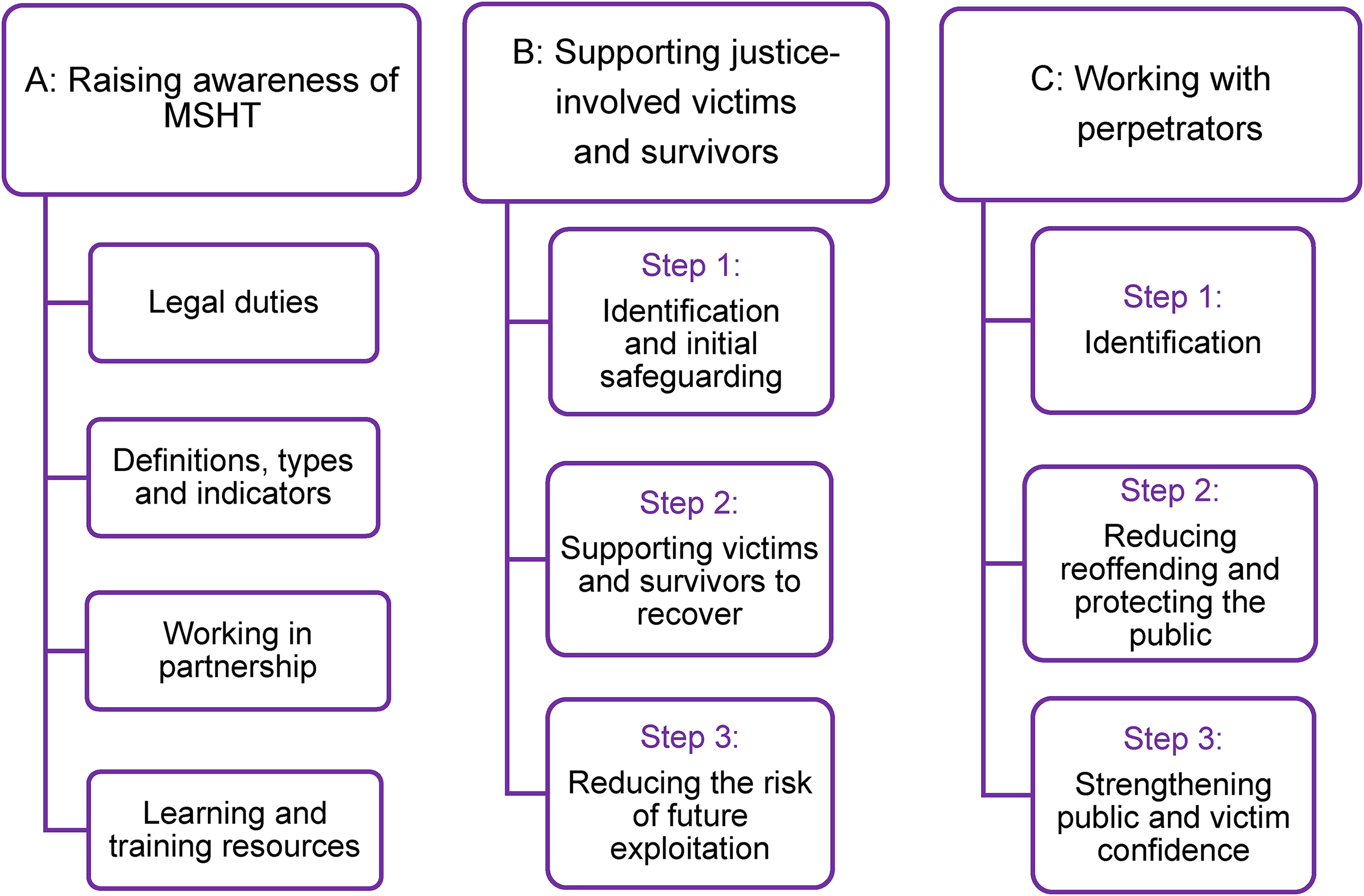
High-level model to assist prison and probation services in responding to MSHT.
Using the above model, a suite of guidance products were developed for each of the three HMPPS operational services (prisons, probation and youth custody) which reflected different operating environments, legal requirements and processes. All products included a ‘trigger warning’ containing information where staff could seek help and support when dealing with severe exploitation.
The following sections of this practice note will discuss each of the three main themes within the model.
Theme A: Raising awareness
Legal duties
Asserting the legal obligations for HMPPS at the outset ensured that all staff, including those in leadership positions, were aware of their duties as set out in Modern Slavery Statutory Guidance (Home Office, 2026) and the European Convention on Action against Trafficking in Human Beings (ECAT, 2005). In summary, requirements included raising awareness of MSHT; proactively identifying potential victims (without relying on their disclosure); referring them to a first responder (to complete a referral to the NRM); supporting their recovery; and protecting them from further exploitation. A further duty relating to engagement with the strategies of Anti-Slavery Partnerships was highlighted. The legal frameworks relating to child safeguarding and child protection were paramount for children in custody. The 2014 Care Act was also highly relevant when considering the safeguarding needs of vulnerable justice-involved adults. The updated Slavery and Trafficking Survivor Care Standards included a section on prisons and probation for the first time and represented a further vehicle to promote legal obligations for HMPPS (Human Trafficking Foundation, 2025a). Finally the Code of Practice for Victims of Crime in England and Wales was included in the guidance which applies to all victims, including those who become justice-involved (GOV.UK, 2005).
Definitions, types, and indicators
In laying the foundations for a new framework, communicating a clear definition of what constitutes MSHT was important but challenging, particularly in prison and probation environments where exploitation, harassment, intimidation, and bullying are commonplace. The term MSHT was adopted, emphasising that it relates to the severe exploitation of people, driven by economic demand and motivated by financial gain. This is set out in the Modern Slavery Statutory Guidance (Home Office, 2026, p.18) as follows:
Modern slavery encompasses human trafficking and slavery, servitude and forced or compulsory labour.
The essence of human trafficking is that the victim is coerced or deceived into a situation where they are exploited. Article 4(a) of the Council of Europe Convention on Action against Trafficking in Human Beings (the Convention) defines ‘human trafficking’ as: “the recruitment, transportation, transfer, harbouring or receipt of persons, by means of the threat or use of force or other forms of coercion, of abduction, of fraud, of deception, of the abuse of power or of a position of vulnerability or of the giving or receiving of payments or benefits to achieve the consent of a person having control over another person, for the purpose of exploitation.”
A plethora of information relating to types and methods of MSHT was available from a wide range of sources. This included the United Nations Office on Drugs and Crime (UNODC), the UK Government, and anti-slavery NGOs. However, any in-depth knowledge of victim-survivors and perpetrators, particularly in relation to forced criminality, appeared to be lacking. Contributing factors included the low conviction rate under the Modern Slavery Act, resulting in individuals and groups involved in MSHT offending prosecuted for other types of crime (such as drug trafficking, organised immigration crime, violent or sexual offending). The contrast between the numbers of potential victims referred into the NRM and the number of convictions for modern slavery is stark. In the year ending 2025 some 23,411 potential victims were referred to the NRM (GOV.UK, 2026).
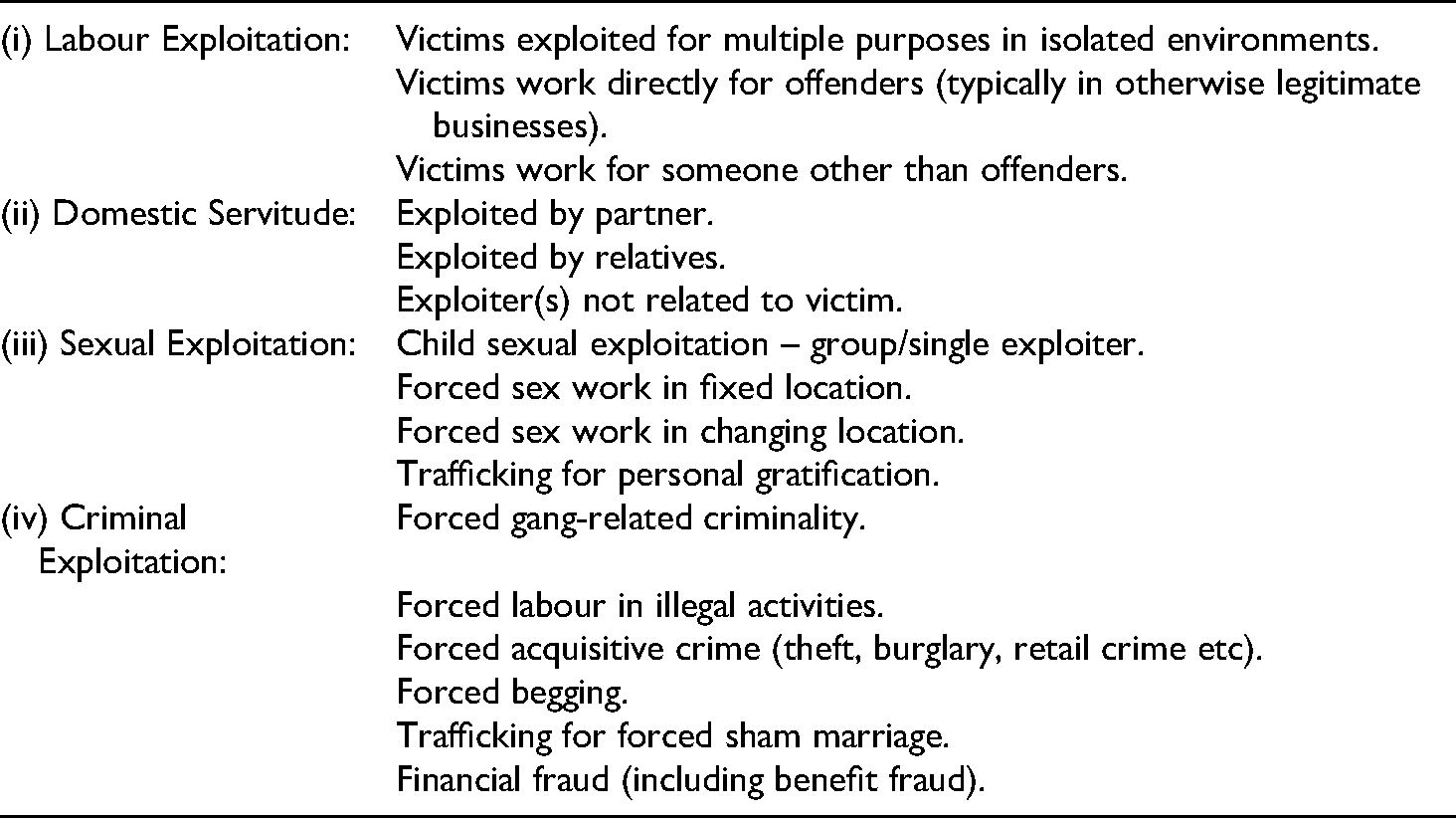
The framework aimed to enable all staff working within HMPPS to gain a fundamental understanding of what MSHT is, how it works and how to act when it is suspected. During consultation with HMPPS operational staff, they reported that the typology of modern slavery offences in the UK (Home Office, 2017) was helpful as follows:
In 2026, further offences introduced in the Crime and Policing Act which relate to MSHT were included in HMPPS guidance as follows:
Child Criminal Exploitation – where children (under 18 years) are manipulated, coerced, or deceived in committing crimes for the benefit of others. Children and young adults forced into drug trafficking, commonly known as County Lines, was highlighted as an area of particular concern. ‘Cuckooing’ or ‘Take over’ where the victim's home is taken over for illegal purposes (such as storage and distribution of drugs, weapons or other contraband). Forced internal concealment – where victims are forced to conceal drugs or other items in their bodies.
Challenges were identified in maintaining an up-to-date awareness of MSHT, which is constantly evolving. New and anticipated risks and threats captured by the Independent Anti-Slavery Commissioner (IASC, 2026) were included in the guidance as follows:
Cyber-scam factories – where people are tricked and falsely recruited into jobs, are threatened and detained in large, remote compounds where they are forced to commit fraud. The use of Artificial Intelligence enabling victims to be identified, targeted, and deceived at scale, which includes the use of deep-fakes and synthetic identities. Organ trafficking – where people are forced or tricked into removal of organs such as kidneys or corneas which are then sold. Illegal surrogacy, harvesting of human eggs, and forced adoption.
Staff reported that a pack containing case studies to illustrate different types and methods of MSHT offending was helpful. This aimed to promote an understanding of how people are tricked, groomed, coerced, threatened and controlled.
The Modern Slavery Statutory Guidance (Home Office, 2026) sets out the statutory defence for adults and children who are compelled into committing crimes which is enshrined in section 45 of the Modern Slavey Act 2015. This was included in the HMPPS guidance to raise awareness of the ‘non punishment principle’ particularly for those remanded into custody who had yet to be sentenced. Further, a proposal was made for probation court-based staff and pre-sentence report writers to alert the court to any observations of coercion and control and/or where suspicions arose that a Guilty plea may have been entered under duress.
Working in partnership
The Modern Slavery Statutory Guidance includes a legal requirement for HMPPS to engage with the strategies of Anti-Slavery Partnerships (where these are available). This presents opportunities for prisons and probation to develop regional responses informed by local demographic data. Other important opportunities were highlighted through established partnerships such as local authority safeguarding partnerships, multi-agency risk assessment conferences (MARAC), (including the Modern Slavery MARAC which operates in Wales), and multi-agency public protection arrangements (MAPPA). This highlighted that partnership approaches facilitate safeguarding issues to be prioritised in response to risks surrounding homelessness, cuckooing and exploitation with local authority modern slavery leads, adult and child safeguarding teams, and working with regional leads within the Ministry of Housing, Communities & Local Government Homelessness and Rough Sleeping Directorate.
Learning and training resources
A range of e-learning resources (including trauma-informed e-learning), videos, and case studies were provided to raise awareness of MSHT. MSHT was introduced into staff induction programmes and work is ongoing to adopt an embedded approach of MSHT into all relevant training across the organisation. This incorporated the UK Government's learning materials (GOV.UK, 2026) and the Anti-Slavery Wales online learning (Learning at Wales, 2026).
An emphasis on trauma-informed training was encouraged to enable staff to understand the impact of severe exploitation and that accounts may contain inconsistencies. In discussions with HMPPS prison staff, examples were provided of initial denial of exploitation by both British and foreign national prisoners who went on to admit that they had been trafficked but requested that no action be taken and that they would ‘sort this out for themselves’, whilst others sought support once trusted relationships had been established.
Theme B: Supporting justice-involved victims and survivors
Victims and survivors of MSHT may enter the prison or probation system due to crimes they were forced to commit (where a statutory defence had not been raised or where the offence was not eligible to raise a defence). Involvement with the criminal justice system could also occur which was indirectly linked or unrelated to MSHT exploitation. For example, offences could be committed as a result of destitution, deteriorating mental health, addictions, blackmail by exploiters or illicit behaviour following enduring periods of severe exploitation. For others their MSHT exploitation may be historic but trauma remains unresolved.
The legal obligations as set out in the Modern Slavery Act 2015, and ECAT provided the overarching framework for prison and probation service responses in supporting justice-involved victims and survivors. These were (i) identification, (ii) supporting recovery, and (iii) protection from future exploitation.
Step 1: Identification and initial safeguarding
In 2024, monitoring of how UK prisons identify victims of MSHT was introduced by the Council of Europe Group of Experts on Action against Trafficking in Human Beings (GRETA). Their evaluation report of the UK's Action against Trafficking in Human Beings was published on 5 May 2026 (GRETA, 2026). Whilst GRETA generally welcomed the approach taken by HMPPS, concerns were expressed about delays in referrals to the NRM in prisons, whereby HMPPS is required to facilitate an interview by a first responder. Modern slavery single points of contact were established in each of the 122 prisons and Young Offender Institutions to support a smoother process for adults referred into the NRM.
As part of the new framework, further guidance was developed to improve the identification of victims of MSHT within prison and probation settings. Early identification was promoted as an important principle which could also prompt an initial safeguarding assessment (in addition to the NRM referral), and to ensure that potential victims were located separately from exploiters (such as co-defendants) on prison wings, approved premises and unpaid work groups. However, there was no systematic way for HMPPS to be informed if a person was already in the NRM. Challenges of identifying possible victims on first contact by staff operating in pressurised, time-limited environments such as courts, prison receptions, or inductions was also recognised. Where suspicions were raised HMPPS staff were required to contact the NRM competent authority to check if the person had any NRM status on a case-by-case basis.
Ongoing opportunities to identify potential victims during the course of a community or custodial sentence were emphasised, especially when relational practice engendered a sense of trust and where opportunities for trauma-informed conversations arose. Whereas self-disclosure was included as an important means of identification, the framework did not solely rely on this. Rather it acknowledged that full or partial disclosure may occur where trusted relationships with HMPPS staff had been built. During consultation with staff, those who had higher levels of face-to-face contact such as wing-based prison officers or personal officers, chaplaincy, unpaid work supervisors, approved premises staff or partners such as prison healthcare and education providers, reported examples where victims had partially or fully disclosed to them.
Ethical considerations prevented any direct involvement of victims or survivors who were serving sentences in prison or on probation. An approach was taken where survivors based within NGOs were consulted, some of whom had experience of the justice system. The Self-Identity Toolkit or ‘bingo card’ developed by survivors (Human Trafficking Foundation, 2025b) was included in the guidance. It is intended that further survivor engagement and co-production of guidance for people in prison or on probation will be developed.
Overall, a wider proactive approach was promoted to identify potential victims where all available information could be viewed through a ‘MSHT lens’ and embedded across all HMPPS assessments and services. This could include information relating to the offence type, offending histories and the context of the offence. Suspicions could be raised by observing behaviours (such a vulnerability), signs of psychological trauma and anxiety (such as fear, threats to themselves or family members, perceived debts, or ongoing exploitative relationships), or physical indicators (such as scars or unexplained injuries). Consideration of personal and protected characteristics could also indicate vulnerability to severe exploitation such as age, disabilities, nationality, pregnancy, care experience, and unsettled immigration status.
In order to illustrate the variety of ways in which a potential victim could be identified, case studies were developed which depicted a diverse range of victims and different types of severe exploitation. It was also important that HMPPS staff were alert to MSHT indicators which may be specific to and/or occur within prison and probation settings. This could include incurring debts from a previous incumbent of a prison cell, being groomed prior to release in order to be recalled with contraband items or to be exploited following release. The framework also brought the victim-perpetrator overlap into focus which recognises that justice-involved individuals may have experiences of being a victim of crimes themselves (Jennings, 2016). It was acknowledged that those convicted of, or involved in, MSHT offending may have been victims of severe exploitation themselves.
A ‘modern slavery victim alert’ flag was made available on both prison and probation case management systems. Guidance was provided that the flag could be removed if evidence emerged that a person was attempting to test or undermine support arrangements. However, an approach was encouraged where alerts were added as soon as MSHT was suspected and retained where an adult was assessed as vulnerable to ongoing or future severe exploitation, whether or not they had entered or remained in the NRM. Identification via the alert also enabled case-by-case support from a small anti-slavery team established in HMPPS HQ and provided data which could be collated and analysed. Following a Freedom of Information request, HMPPS confirmed that between March 2023 and June 2024, 368 potential victims of modern slavery were identified in English and Welsh prisons (Norris, 2024).
Step 2: Supporting justice-involved victims and survivors to recover
For those who enter and remain in the NRM, temporary need-based support is provided via the Modern Slavery Victim Care Contract (MSVCC), with The Salvation Army as the current primary contract provider. This is due to be replaced later in 2026 by the Support for Victims of Modern Slavery (SVMS) programme.
HMPPS guidance highlighted the importance of prison and probation services engaging and aligning with the NRM system for justice-involved victims of MSHT to maximise available support and gain formal recognition of their experiences. However, such support is only available in the community and does not extend to prisons. It was recognised that preparation for release from custody is essential if support is to be approved by the probation service and aligned with reporting instructions and licence conditions. For example, a justice-involved victim of MSHT may be eligible but not suitable for MSVCC safehouse accommodation due to complex risks and needs.
In order to identify the support and protection needs of justice-involved victims and survivors, a support pack was created whereby prison, and probation staff could access a series of prompt questions relating to MSHT which could be used alongside established assessment tools. Feedback by operational colleagues was sought and it will be evaluated at a future point. However, this would be limited only apply to those who receive assessment interventions. Working in partnership with statutory and voluntary organisations to support the ongoing recovery of victims was promoted and largely relied on the availability and capacity of regional anti-slavery partnerships and anti-slavery NGOs. Gaps were identified in responding to the recovery support needs for groups who appeared to be disproportionately identified as justice-involved victims and survivors which included women, young adults (aged 18–25), and foreign nationals. Further guidance will be developed to address intersectional support needs across diverse cohorts.
Step 3: Reducing the risk of future exploitation
The new framework asserted that the role of prisons and probation in reducing the risks of future exploitation for justice-involved victims of MSHT was intrinsically linked to reducing the risks of reoffending. An approach to sentence planning was encouraged that prioritised reducing the risks associated with reoffending and harm (Bonta and Andrews, 2017), and the safety of individuals vulnerable to future severe exploitation or ‘re-trafficking' where a person has exited and re-enters an exploitative situation.
A research project commissioned by the former Independent Anti-Slavery Commissioner together with the University of Nottingham Rights Lab (IASC, 2021) suggested that risks of exploitation increases if effective support is not provided. The risk factors identified shared many common features with the eight risk factors identified by Bonta and Andrews (2017). An approach was proposed where consideration of the risks of reoffending and the safety and protection needs of the individual could be addressed simultaneously to reduce both reoffending and re-trafficking risks. This included assessing risk factors associated with accommodation, relationships, access to work and education, engaging in a pro-social network, addressing health needs, and building resilience and controlling impulsivity.
For some victims and survivors, anecdotal examples appeared to show that custodial sentences and probation supervision may also offer temporary protection from ongoing exploitation. These included the woman who expressed relief at being recalled to prison where she would not be sexually exploited, and a young man who requested that his electronic tag be extended as his exploiters had avoided him whilst he was subjected to monitoring. However, for others, their levels of vulnerability may expose them to new risks of exploitation by virtue of being in prison or on probation. The impact of punishment as a means of offering protection, including the concept of ‘prisons as a safehouse’ (Jovanović et al., 2023) is an area that appears worthy of further exploration. Opportunities for additional protection measures for justice-involved victims who are foreign nationals who are to be deported were also considered. These included exploring routes to referrals for NRM support in home countries and via international NGOs prior to deportation.
Theme C: Working with perpetrators of MSHT
Guidance on working with perpetrators of MSHT had not previously been developed within HMPPS. The new framework adopted a three-step approach as follows: (i) identification of MSHT perpetrators; (ii) reducing reoffending and protecting the public; and (iii) strengthening public and victim confidence.
Step 1: Identification
The impact of the low conviction rate under the Modern Slavery Act, 2015 recorded at less than 2% (UK Parliament, 2024) presents challenges to prisons and probation in identifying those who present a risk or threat of engaging in MSHT offending. In the year ending 2025, the Crown Prosecution Service recorded just 467 prosecutions for modern slavery-flagged crimes in England and Wales, of which 355 (76%) resulted in a conviction (Heys, 2025). The Sentencing Council guidelines highlight that modern slavery offences can attract a life sentence, yet the average sentence for those convicted under the Modern Slavery Act is 3.5 years (Heys, 2025). The Sentencing Council provides a framework for determining the seriousness of the offence by considering the culpability of the offender and the harm caused by the offending, which is of benefit to probation staff preparing Pre-Sentence Reports (Sentencing Council, 2021).
The complexity of MSHT prosecutions, which largely rely on the testimony of vulnerable victims, often result in convictions being pursued for other types of offences such as drug trafficking, organised immigration crime, fraud, sex or violent offences. This presents challenges for prison and probation services in managing risk where those involved in MSHT offending but convicted of other offences appear to vastly outnumber those convicted of it. Ancillary orders such as the Slavery and Trafficking Risk Order represent an important but under-used measure by which individuals may be identified as being at risk of future MSHT offending (GOV.UK, 2015). Where a court does grant such an order, the prohibitions are especially important to inform sentence management plans and align with post-release licence conditions. Anecdotal discussions with police colleagues point to the disruption factors of ancillary orders in general, where other perpetrators wish to avoid associating or networking with individuals whilst an order is in place.
Step 2: Reducing reoffending and protecting the public
A strategic priority of HMPPS is to reduce reoffending and protect the public. The new MSHT framework recognised key benefits of partnership working to achieve HMPPS strategic priorities. Offences prosecuted under the Modern Slavery Act 2015 are specified violent or sexual offences with perpetrators eligible for management under MAPPA.
A key priority area for further development was identified to increase understandings of MSHT perpetrators. From 2018–2021 the first-ever primary research study of individuals convicted of modern slavery offences was undertaken by Broad and Gadd (2022) who interviewed 21 male and 9 female prisoners. They found diverse motives for offending and a wide range of offence types. Stereotypes of exploiters were largely inaccurate and counterproductive. Very few profited substantially from organised crime and many acted in a chain and could be substituted. Some were destitute and also victims of MSHT themselves. Some were British business owners who had failed to comply with immigration regulations. Three men did fit some stereotypical features of organised criminals and sentences ranged from 6 months to 12 years (with one exception).
A HMPPS resource pack was developed to assist prison offender managers, psychologists and probation practitioners when assessing those convicted of, or at risk of, slavery and trafficking offending. The design of the pack centred around prompt questions which could be embedded within existing assessment tools. Ongoing feedback and evaluation will determine how this will be developed further.
Step 3: Strengthening public and victim confidence
It was important that the HMPPS framework considered the impact of sentence management of those convicted of MSHT on victims and the wider public. This was intensified where conversations with criminal justice partners such as the police confirmed that victims and their families may continue to feel threatened by repercussions following lengthy and complex trials. A particular difficulty centred around an understanding of the impact of time spent on remand, early release, early removal, or other schemes which result in a reduction of time served in custody.
Greater transparency in sentencing and sentence management, including post-sentence decisions relating to release, removal and deportation decisions was recognised as important for increasing public and victims confidence, especially for those who had been subjected to severe and enduring exploitation. For example, in addition to the HMPPS Victim Contact Scheme (GOV.UK, 2022), awareness was raised across prison and probation services that services exist to continue to support victims post-trial such as victim navigators and anti-slavery NGOs within the UK and internationally.
Opportunities were identified to explore how the risks of reoffending could be reduced for foreign national offenders convicted of slavery and trafficking who are deported from the UK. This included a ongoing monitoring and restrictions following deportation in the home country. An example is the Provisional Protection Order introduced in Romania in 2018 primarily to address domestic abuse. In response to MSHT, a perpetrator (where the victim resides in Romania) may be fitted with an electronic proximity tag on arrival following deportation from the UK, which is reviewed by a court within five days. Measures include restricting movement, restraining contact with the victim and mandating that weapons are surrendered. Other types of restrictions may also be explored within other jurisdictions such as prohibitions including use of mobile phones, non-contact and exclusion zones to disrupt offending networks. If successful, this will represent a strengthened approach to sentence management across borders in response to MSHT as an international crime.
In conclusion, it is argued that the HMPPS framework establishes that prison and probation services have an important and unique contribution to anti-slavery regimes. It aims to introduce a new and comprehensive response to MSHT. It takes an evidence-informed and trauma-informed approach which recognises the wide diversity of offences involved in slavery and trafficking. Further research is encouraged to consider how prison and probation services can continue to improve their understanding of MSHT victims and perpetrators and develop effective policy and legal responses.
Footnotes

Funding
The author received no financial support for the research, authorship, and/or publication of this article.
Declaration of conflicting interests
The author declared no potential conflicts of interest with respect to the research, authorship, and/or publication of this article.