






Abstract
This article describes and reflects upon the use of diffusely coloured tents to enclose both child and therapist which, in our service, has brought about remarkable transformations in attention, engagement, and understanding for severely impaired children with multiple disabilities and cerebral visual impairment (MDVI). A brief overview of how to construct this simple tent is presented, and the ways in which these tents have proved effective are described by means of two case studies of students with complex needs. The positive impact over a 2-year period was considerable. The changes brought about persisted into typical environments, and parents and carers expressed surprise and delight at the outcome. The proposed explanation is that the children who benefitted had profound impairment in seeing more than one or two items at once (simultanagnosia) due to presumed damage in the posterior parietal lobes of the brain, related to their cerebral palsy, and that elimination of distraction allowed this limited visual function to be recruited, to afford meaningful experience and enhance learning.
Keywords
Introduction
Students with severe multiple disabilities and cerebral visual impairment (MDVI) can appear inattentive and unresponsive, while noisy and visually crowded environments can lead to a lack of any engagement (presumably due to sensory overload), sometimes accompanied by self-stimulatory behaviours. Yet, parents have described to us that episodes of engagement can take place when sensory stimulation is minimised, for example, when playing ‘hide and seek’ under a bed sheet that cuts out extraneous sounds and renders the surroundings uniform, without pattern or clutter. We report an observational study in which we found the use of coloured tents to be of considerable value in bringing about increased visual awareness and attention, which has been recorded as part of an education programme from regular sessions throughout a period of 2 years.
Children with damage to the brain leading to quadriplegic cerebral palsy can also manifest cerebral visual impairment (CVI). Impairment of primary visual functions causes low visual acuities and contrast sensitivities and limited visual fields, while damage affecting higher visual functions impairs recognition, and limits the dorsal stream functions of the use of vision to guide body movement (compounding the motor dysfunction) and, in our experience, the capacity to see more than one or two items at a time. This capacity is commonly overwhelmed in the presence of excessive visual and auditory stimulation, culminating in apparent absence of visual function and little or no capacity to engage and learn.
We hypothesised that elimination of surrounding pattern and clutter would enable any limited visual functions to be employed to better effect by enhancing attentional capacity. This led to the development of plain bright coloured tents to minimise peripheral visual stimuli and extraneous noise. We describe two case reports describing the positive effects and outcome of implementation of focused sensory sessions conducted within such tents.
Method
Tent designs
The tent is designed to create a ‘little room’ to provide a focused environment. The hand-held tent is simply a large sheet of plain coloured material, which is draped to surround the student’s head as can be seen in Figure 1(a) where gold fabric was offered as a choice from gold and orange material. This tent can also be held in front of the child and draped to envelop the child and therapist, with the colour evoking the greatest visual awareness. Bright fluorescent colours, yellow, orange, green, and pink material, have yielded the greatest attentional responses. Figures 1(b) and (c) show such a tent being used to good effect, as the intense colours of fluorescent yellow and orange were used, which enabled visual awareness for the first time, and orange was observed to be the most effective colour for this child’s use of visual awareness and attention.
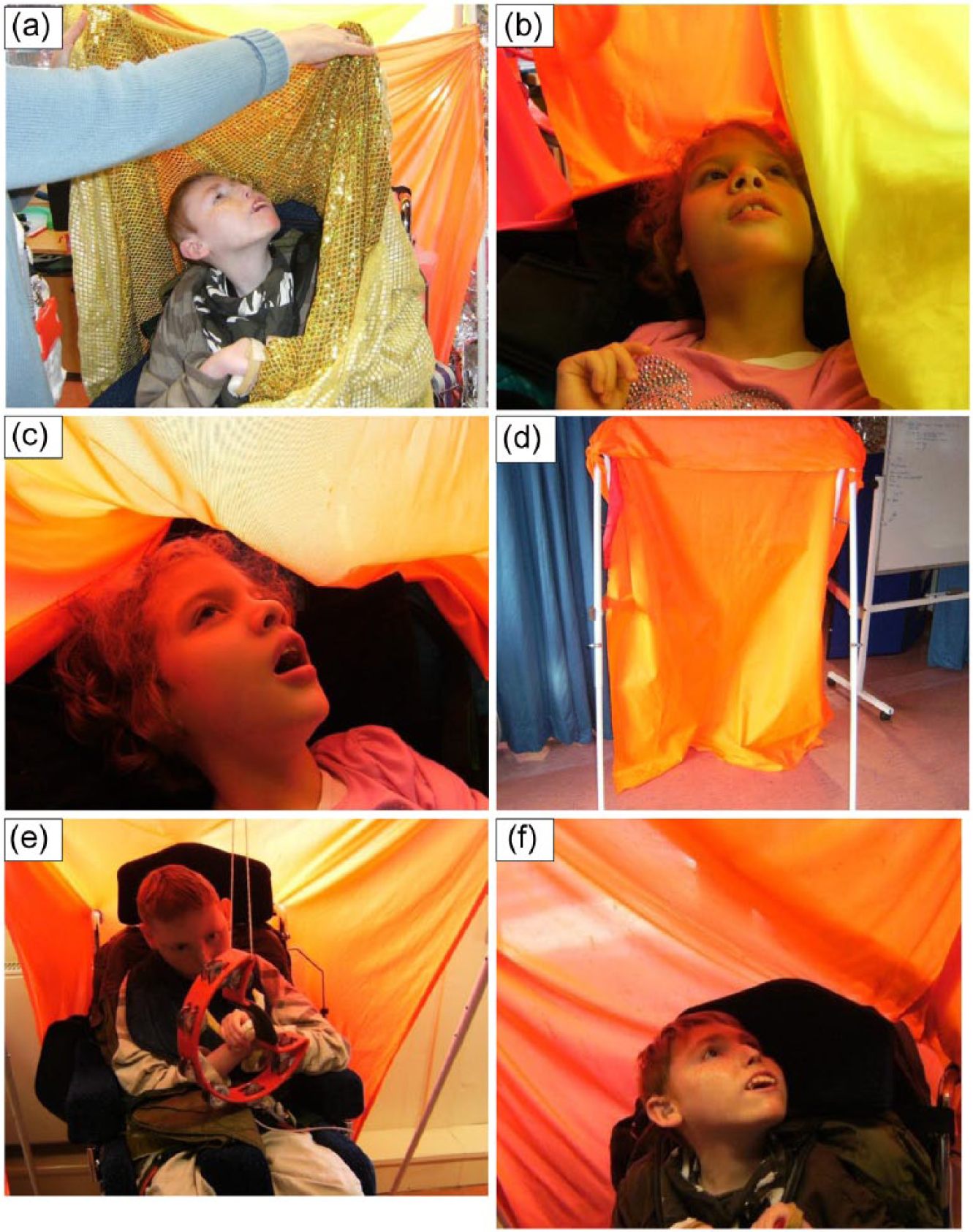
(a) A hand-held tent being used to good effect. (b) Ali using her visual awareness for the first time and spending time gazing at the coloured tent. (c) Ali’s visual awareness became visual attention, and the tent had a calming effect. (d) A floor-standing frame with orange material tied onto the frame to make a tent which can surround a wheelchair. (e) Tom has enjoyed looking at his chosen colour of orange and is now offered a tambourine to reach and explore. Tom employs his vision within the coloured tent to concentrate on moving the tambourine, taking his time with one thing at a time. (f) Tom using his visual attention showing joy in seeing his favourite colour, which he likes to have time to explore without distraction.
Frame construction
A floor-standing frame tent
This frame can be used with a large sheet of coloured material, which is placed over the top of the frame and tied or sewn to each side to create a tent as seen in Figure 1(d). This can be positioned around a wheelchair, providing a space where the child can have time to engage their visual attention without distraction.
Hoop and ceiling hook
Large sheets of material can be sewn to form a hem over a hoop that can be suspended from a ceiling hook to create a tent, and this can be used in the same way as the frame tent.
Ceiling hooks to create a small tent room
Hooks can be secured to the ceiling and long sheets of material can be attached and suspended to form a tent area. It can have dark curtains at the sides to create a small room to provide a contrasting light and coloured environment, with a projector and colour cassette providing a visual stimulus of slow movement of colour.
Using the tent
Once the student has been surrounded by the tent, sufficient time is allowed to show visual awareness. This can take up to 20 min when the tent is first used, shortening to less than a minute on repeated use. Thereafter, clear slow methods of presentation and engagement can be employed to match the perceptual abilities and response times of the individual child.
Recording the outcome
The assessment guidelines described in ‘Vision for Doing’ (Aitken & Buultiens, 1992), comprising levels of engagement, from awareness to attention and from location to recognition and understanding, were used to evaluate the outcome of the use of the tents. An individualised interdisciplinary team assessment report giving a holistic assessment framework of parental knowledge, medical background, as well as cognitive and sensory assessment related to the child’s abilities was written in summary format. This information was employed to devise the student’s visual programme, recorded as part of the six monthly individual educational programme (IEP), from which the aims and objectives for each session were planned. The outcomes were reviewed weekly, while video recordings were used to evaluate and record progress which was shared at staff meetings and at training and educational annual reviews.
Case reports
Ali
Ali is 9 years old. She has profound quadriplegic cerebral palsy and is registered blind. Although in typical environments she responded to intensive interactive approaches with sound and movement and appeared to have some light and dark awareness, she showed no interest in any visual stimuli even in the multisensory room. In noisy and busy environments, she became distressed and engaged in self-stimulatory behaviours. However, when Ali was positioned in a hand-held coloured tent for the first time, her response was immediate and compelling. She responded to the visual stimulus, gazing around and smiling with pleasure. The tent appeared to create a calm environment that crossed her sensory threshold and facilitated her capacity to become visually aware (Figure 1(b) and (c)).
She began subsequent school days with the familiar hello song, followed by entering the frame tent, where she would quieten and gaze for 3–4 min at a time, manifesting focused visual awareness and attention for up to 15 min. During days of good health, she enjoyed responding to her tent environment gazing and giggling, giving visual attention for up to 20 min at a time. The tent became a part of her daily routine as cues to the beginning of the day and the afternoon session, and at other times when she needed a quiet space.
After a period of a few months of using the tent, Ali’s vocalisations began to change from shouting into space to using gentle sounds, in turn, taking with other people, and she began to use claps to ask for ‘more’ in activities when working with her teacher and with others. Ali’s visual awareness and attention to colour and light increased in other environments, including the small tent room of projected light and colour, which provides simple and uncluttered stimuli. This new visual awareness, combined with further exploration with sound and touch appeared to enable Ali to begin to find calmness and increased her willingness to interact with others and explore her environment outside the tent, while intermittent use of the tent continues to provide a space of calm.
Ali has subsequently increased her attention and concentration span up to 30 min with a new stimulus in the multisensory room. She enjoys spending time viewing one piece of equipment in the darkened room, which also acts in an analogous way to a tent by limiting visual input. The equipment used provides light and colour reflected by a mirror and provides a new visual experience that had not previously attracted Ali. Now, she will concentrate on the visual effect, and when a slow sound effect is also added, she responds by reaching out to explore in a way she had not done before. With these progressive one-at-a-time steps, clear interactions, and communication have also developed with Ali’s use of vocalisation and clapping for more. Ali’s visual threshold has been matched and crossed from awareness to attention through the use of the coloured tent to provide a meaningful experience; this has enabled Ali to work slowly and quietly with one thing at a time, to obtain positive outcomes.
Tom
Tom is 17 years old and has profound quadriplegic cerebral palsy with CVI and is registered blind. His previous education reports/assessments indicate that he is a sociable young man who responds to sound, but he startles to sudden and fast movements. The reports stated that Tom rarely uses his limited vision as he has poor head control and keeps his head down for most of the day. These features remain evident.
A hand-held tent with fluorescent orange material immediately crossed Tom’s visual threshold, enhancing his awareness, as he lifted his head to gaze and laugh with pleasure. Thereafter, Tom followed a daily routine of a visual programme employing a tent frame for 15–20 min at a time, and he became motivated to concentrate on one thing at a time, either using his limited arm movement to touch a tambourine as shown in Figure 1(e) or with visual attention to look at the orange-coloured tent. Tom began to hold his head up for the first time within the initial week of experiencing this visual stimulus as can be seen in Figure 1(f). This had the effect of increasing his attention to the world around him as he became able to continue keeping his head up both within the tent and outside it. When offered choices of different colours, Tom located orange and expressed his preference of this colour through his facial expression, vocalisation, and visual attention. Within the single-coloured tent frame, Tom was able to concentrate upon one stimulus by attending to and scanning the colour. When a red tambourine was added to the frame, Tom removed his attention from the colour to concentrate on the object and with small left arm movements reached and touched the tambourine. When this object was moved a little at a time, Tom was able to track the object from his more functional left side to midline and slightly to the right. He used his visual attention by either looking at the object or by returning his attention to the coloured tent. Tom remains able to focus upon single items within the tent, but not more, indicating that he has inability to handle more than one visual stimulus at a time, or profound simultanagnosia (Balint, 1909; Harvey, 1995; Holmes, 1918; Rizzo & Robin, 1990). At this stage in his programme, Tom is best left alone in silence to explore his tent and to find single items that he recognises, within it. It is clear from his behaviour that Tom much appreciates his newfound capacity to independently explore his new surroundings and discover a single object within them, albeit in a limited fashion, from the perspective of the observer.
As a sequel to the use of the tent, Tom has gained a better posture, holding his head up to scan his surroundings and locating light and colour movement in the multisensory room, as well as manifesting more engaging behaviour in communal activities.
Subsequently, outside the tent, Tom became more aware and able to fix upon smaller objects, such as his red communication aid, which he became able to locate at 1.5 m in his functional left side of visual attention. He has become able to track movement of his communication aid to the midline and to turn his head to look a little to the right.
Responses remain consistent even after a period of absence and ill health; as on Tom’s return, he immediately responded with a vocalisation of delight and apparent recognition when given a frame with orange material to surround his chair. He used his visual attention, scanning the colour tent for 20–30 min at a time, throughout the session. The stimulus of the tent appeared to enable him to continue to interact with others and afforded him the pleasure he needed to regain his use of visual attention.
Discussion
Children with multiple disabilities and low vision due to CVI not only have damage to the centres in the occipital lobes and their input but they also have commonly sustained damage to the brain areas just in front, the posterior parietal lobes. This territory of the brain creates an internal emulation of the external environment, which is used to guide our movements. This emulation encompasses every object that might be an obstacle to movement or may be of interest. When this territory is markedly damaged, very few items can be seen, and visual guidance of movement is profoundly impaired. Those who have sustained brain injury in this territory can only see one or two items at once, and are unable to move through the world that they can see (Balint, 1909; Harvey, 1995; Holmes, 1918; Rizzo & Robin, 1990).
The tent effect provides a novel means of stimulating and evaluating functional vision because eliminating visual distraction and being surrounded by colour appear to motivate students with MDVI to use their potential vision often for the first time. MDVI is associated with limited capacities to visually process more than a small number of items at once, or simultanagnosia. Within the tent environment, it is possible to observe and assess students’ individual thresholds, from the point at which the stimulus triggers a perceived awareness to the possibility of how to work from this to develop visual learning and interaction with others. A record of the nature and duration of any visual engagement, changes in affect/mood, vocalisation and its nature, and interaction with the environment and with others, both within the tent environment and during everyday life, is necessary. Following on from these assessments, it is possible to respond to the individual’s capabilities to provide further meaningful stimuli, one step at a time, thereby avoiding sensory overload. We have yet to obtain measures of visual acuities either prior to or after the management described. Preferential looking methods give equivocal results, but notwithstanding, engagement with the surroundings, and visually guided reach seen as a direct sequel to the use of tents, indicates that useful visual functions have been brought about in the children described. The tent appears to provide a way of conveying meaningful information by creating ‘a funnel-like approach’ to deliberately focus the person’s attention on the experience and to ‘minimise distractions so the experience itself is unchanging and pure’ (Pagliano, 2012), thus facilitating the release of attention for additional purposes.
The impact of using the tents
The first author S.L. has observed the positive effects of these tents throughout her 18 years of teaching experience with students with MDVI. The tent has provided the opportunity to observe and assess a student’s response based upon recognising their limitations and awareness levels, allowing time at their own pace to enable any possible visual processing and enjoyment of visual awareness. Children with MDVI often receive inappropriate use of over stimulation or limited use of visual stimulation, as their visual impairment is overlooked due to their other multiple disabilities and needs taking precedence. The tent, however, has provided a meaningful space for many students who have a limited visual perception of visual acuity, contrast sensitivity, and visual fields, as well as negative responses to visual crowding. It has been consistently evident from using the tent-like spaces with many students with complex needs that the removal of visual and auditory clutter, to give the simplicity of a coloured tent has matched and crossed the individual student’s visual threshold of awareness to provide a new opening of the mind.
These observations and recognition of individual student responses support planning individualised learning programmes aimed at providing optimal and appropriate stimuli. This is linked to the philosophy and method of assessment of functional vision using ‘Vision for Doing’ guidelines (Aitken & Buultiens, 1992) for students with MDVI, in observing what a student ‘can do’ and what they find motivating based upon the level of visual responses within the tent and a programme designed to meet the individual’s capabilities. The tent design appears to enable development of awareness levels, depending upon an individual’s processing capacity, and it can be used to promote and develop the awareness level to attention, attention to location, and in a few cases location to recognition (Aitken & Buultiens, 1992) with activities written into an individual visual programme to enable and empower further visual and sensory involvement in learning as appropriate to an individual child. Furthermore, written, photographic, and video case study records are of value in sharing with colleagues the importance of using observation for evaluation and reflection from the perspective of the individual child with complex needs.
The nature and range of benefits of using the tents have varied according to each individual’s sensory awareness level: from the lowest level of visual detection, to awareness and attention, and joy in ‘seeing’, often for the first time, as in the case of Ali, to location through scanning and fixation and recognition of a colour from a choice of two colours (one at a time), as well as tracking and reaching out to a slow moving object as in the case of Tom. The use of the tents has also promoted a link for communication and expression of preferences. In addition, other tents with gentle light and colour effects have even appeared to assist in calming epileptic seizures for some students for whom the tent appears to provide the requisite calmness. In the same way that too much imagery creates overload for students with multiple disabilities, so does too much background noise and talking. Slow sequential singular language with clear meaning has often worked in harmony with the tent; an example of this is when a simple colour tent that has increased visual awareness and attention is used to develop expression of preferences of colour – through the introduction of a single slowly annunciated word to allow a sound code to be linked to this isolated experience. This was the case for a student who, after a time of visual attention to his preferred fluorescent yellow tent, began to attend to the link between the word ‘yellow’ spoken slowly with clear articulation, with the appearance of the yellow tent around his head for him to locate after hearing the word. The activity was repeated slowly as he began to increase his attention to the link between the colour and word. This resulted in his discovery that he could press his communication aid with the word ‘yellow’ and the tent would be brought around his head enabling him to see yellow, thereby becoming a game with meaning, giving him the power to control the colour he wanted to see. Other students have become more receptive to sensory stimuli involving touch, movement, and sound by their gradual introduction one at a time, beginning with the tent environment. Students with complex sensory impairments need appropriate stimuli matched to their level of sensory response and visual-processing capacity. Both authors consider that the potential for the use of these tents is considerable and that dissemination of this knowledge would allow further children to benefit and facilitate further development of the methodologies described.
Final comments
Children with MDVI and their parents need to be empowered through recognition of what they can do and through appropriate individualised assessment and planning. Tom’s parents expressed clearly what they felt about the changes in their son’s responses as they stated, It’s beyond our wildest dreams, the door to our son’s mind has been unlocked, and you can now see what we know he is capable of.
Footnotes
Declaration of conflicting interests
The authors declared no potential conflicts of interest with respect to the research, authorship, and/or publication of this article.
Funding
This research received no specific grant from any funding agency in the public, commercial, or not-for-profit sectors.