







Abstract
This study investigated what happens when the discrimination strategy fails: It revisited Graven’s ‘qual-quan’ data, to compare correct and incorrect target detections made by the figure identity strategy, the global characteristics strategy, and the touch vision strategy. Do the braille readers use the same or different discrimination strategies, or; is their discrimination strategy vague in incorrect target detections? Do the braille readers rank the same, different, or no target-discriminating feature(s) as the most important? Do s the braille readers use longer exploration time for incorrect than for correct target detections? When the discrimination strategy fails, they lack a repertoire of discrimination strategies, and/or the experience of using this repertoire; they have either encountered attentional load or not focussed their attention sufficiently. Individuals who are taught braille should be taught a repertoire of discrimination strategies, how to, efficiently, switch between them, and what level of attention is suitable for each one.
Introduction
Previous research has suggested that individuals, who use vision to detect two-dimensional targets among distractors, may adopt different, even personal, strategies for ranking target-discriminating features in order of importance (Treisman & Paterson, 1984). Is this the case also for individuals who use haptic touch to target a specific braille character?
Indeed it is. Graven (2015) asked individuals who are blind to detect one braille character target among 11 braille character distractors, as fast and accurately as possible, and also to describe in their own words how they discriminated the target from the distractors. Three discrimination strategies were identified (Graven, 2015).
The first discrimination strategy to be identified was the figure identity strategy. It recognises each braille character (e.g., R and V), and performs preliminary analyses of dots; it ranks a feature conjunction (of dot location and dot quantity) as the most important target-discriminating feature. Then, it performs a specific analysis of dots, in both target and distractors, for example, (R amid Vs) ‘R’s dot 5 equals V’s dot 6’ (Graven, 2015, p. 85). The second discrimination strategy was the global characteristics strategy, which notices different global braille letter shapes, for example, (N amid Ls) ‘An N and some L’s, or something like that’ (Graven, 2015, p. 87); it ranks one separate feature as the most important target-discriminating feature, in fact dot location or shape property. If found necessary, it then performs a specific analysis of the global braille letter shapes’ shape features, for example, (N amid Ls) ‘One is a curve, while the other ones are a straight line’ (Graven, 2015, p. 87). Finally, the third discrimination strategy to be identified was the touch vision strategy. It notices braille characters or shapes of dots, and performs preliminary analyses of dots/gaps or shape features. Next, it recognises the braille characters by associating their tactile features with visual experiences, for example, ‘Braille V is “hard” because of the angle in the bottom left corner of the braille cell – equals regular print V’ (Graven, 2015, p. 88), and (U amid Ts) ‘U equals a chair in profile without legs. T equals a chair in profile with legs’ (Graven, 2015, p. 88).
Based on Treisman’s theory of attention (see Wolfe & Robertson, 2012 for a collection of Treisman’s work); more explicitly, what information is processed where on the continuum from pre-attention to focussed attention (Treisman, 1995), Graven (2015) suggested that the three discrimination strategies are rather dissimilar when it comes to attention.
At the pre-attentive end of Treisman’s continuum is the global characteristics strategy, which notices different global braille letter shapes and ranks one separate feature as the most important target-discriminating feature (e.g., shape property) – it focuses attention only if found necessary. Indeed, only separate features are processed in pre-attention; each one independent of attention and fast – in fact, pre-attention calls upon attention (Treisman, Vieira, & Hayes, 1992). In pre-attention, the exploration time is short and the targeting accuracy is high. At the focussed attention-end of Treisman’s continuum is the figure identity strategy: it recognises each braille character and performs preliminary as well as specific analyses of dots in both target and distractors: in doing so, ranking a feature conjunction (of dot location and dot quantity) as the most important target-discriminating feature. Feature conjunctions are processed in focussed attention, and constant focussing of attention results in attentional load (Treisman, 1988). When encountering attentional load, the information processing system starts failing – to detect the target is now difficult, even impossible. In order to repair itself, the information processing system focuses attention even further and searches for more features from which to discriminate the target from the distractors. In focussed attention, the exploration time is significantly above that in pre-attention and the targeting accuracy is significantly below. Somewhere at the middle of Treisman’s continuum is the touch vision strategy, which notices braille characters or shapes of dots and then performs both preliminary and specific analyses of their tactile features. It is yet not clear, however, which target-discriminating feature(s) the touch vision strategy ranks as the most important (Graven, 2015).
With the above in mind, the global characteristics strategy should be the fastest and the most accurate of the three, while the figure identity strategy should be the slowest and the least accurate (cf. Treisman, 1995). But this was not the case: there was no statistically significant difference between the discrimination strategies (Graven, 2015) – the within-group variability in either discrimination strategy was substantial, especially on exploration time.
Surely, the issue is not which discrimination strategy is at use – one is not better than the other – but rather what happens when the discrimination strategy fails. This study investigated this issue by comparing correct and incorrect target detections made by the figure identity strategy, the global characteristics strategy, and the touch vision strategy (cf. Graven, 2015). Do the braille readers use the same or switch to a different discrimination strategy, or; is their discrimination strategy vague, that is, doing a bit of everything, in incorrect target detections? Do the braille readers rank the same, different, or no target-discriminating feature(s) as the most important? Do the braille readers use longer exploration time for incorrect than for correct target detections?
Method
Design
This study revisited Graven’s (2015) ‘qual-quan’ data: first the qualitative data, to explore how individuals who are blind describe discriminating braille characters, including ranking target-discriminating features in order of importance when not detecting the target. It then revisited the quantitative data, that is, to compare their exploration time on correct and incorrect target detections.
Participants
Twenty-three individuals (offered a remuneration to compensate for their time) participated in Graven’s (2015) study, 14 of whom made incorrect target detections (five males; nine females; mean age 40.9 years) and thus were included in this study: Three had congenital total blindness. Two had congenital light perception (perceiving a light source) and two had congenital light projection (perceiving where a light source is situated). One had congenital colour perception and one congenital minimal visual shape perception. Three had encountered total blindness after birth: two when <5 months old, and one <22 months ago. Finally, one had light projection from <30 months ago. None of them had a cognitive delay or impairment: in fact, their education ranged from comprehensive school level to a master’s degree, and no one had a physical disability.
Materials
This study used Graven’s (2015) ‘qual-quan’ data: the qualitative data on incorrect target detections, the quantitative data on both correct and incorrect target detections.
Graven (2015 [cf. fig. 2; 3; 4, pp. 83–84]) used 23 arrays (210 × 210 mm), comprising 12 (tactile) braille characters spread out randomly: 18 arrays with one target, 11 distractors, and five catch-arrays with no target. Six target-distractor pairs were included (all presented twice plus once in reverse), with the first character as the target: LN, RV, OM, UT, VY, and RT. The arrays were presented, separately, inside a 210 × 210 mm frame. Frame wall height was 20 mm.
Procedure
First, this study pulled out Graven’s (2015) qualitative data on incorrect target detections – the data describing how the participants had discriminated the target from the distractors, including how they had ranked the target-discriminating features in order of importance. Graven (2015) scored an answer as ‘correct’ when the participant had detected the braille character target; as ‘incorrect’ when the participant had failed to do so, regardless of whether he or she had named the braille character or not: indeed the task was to detect the target, not to recognise it. Next, this study pulled out Graven’s (2015) quantitative data on exploration time, that is, both on correct and incorrect target detections. Graven (2015) scored exploration time in number of seconds.
In short, Graven’s (2015) experiment took place in a quiet room where all interiors were in a neutral colour, and all distinct light sources were removed. The all white test materials were presented right in front of the participant. At first, the participant had to make a fist with both hands and place it in the middle of the frame. The participant was then asked to (undo his or her fist and) explore the presented array in order to detect the target, and subsequently to explain in his or her own words how he or she had discriminated the target from the distractors. The participants were not told whether their detected target was correct or not, not that target and distractors were braille characters, and not how many braille characters there were in each array.
Analysis
This study analysed Graven’s (2015) ‘qual-quan’ data, that is, 28 qualitative answers from incorrect target detections (see Table 1), and (18 correct and incorrect target detections × 14 participants =) 252 quantitative scores on exploration time.
Number of incorrect target detections.

Explicitly, this study started off by approaching Graven’s (2015) ‘mixed group’ (with [a] onset of blindness >4 months after birth, and [b] degree of blindness from total to minimal visual shape perception). Of the four individuals who made incorrect target detections (Graven, 2015 [cf. pp. 87–88]), two described the figure identity strategy (individuals 7 and 9, totally blinded – one ~5 months old; one <22 months ago). One described the global characteristics strategy (Individual 8, blinded <30 months ago – light projection), and one, the touch vision strategy (Individual 11, congenitally blinded – minimal visual shape perception). Next, this study counted the number of incorrect target detections: the figure identity strategy made 14, the global characteristics strategy made 11, and the touch vision strategy made three. This study then analysed the qualitative data, discrimination strategy by discrimination strategy, replicating Graven’s (2015) approach.
Graven (2015) approached the qualitative data by descriptive phenomenology: step 1 was to read for overall meaning. Step 2 was to reread to establish meaning units, reduce, and disclose what was answered. This study searched for meaning units in the answers of each participant, and also across all 28 answers (Graven, 2015): indeed, in the figure identity strategy, the global characteristics strategy, and the touch vision strategy, respectively. The most important target-discriminating feature was acknowledged as the one answered first – the most spontaneous, while features answered in addition to this and/or after encouragement were acknowledged as not being spontaneous – requiring his or her focussed attention (Graven, 2015). Step 3 was to transform meaning units from idiosyncratic detail to more general meaning, that is, in this study, to show what had happened when the target was not detected. Step 4 was to describe the most invariant connected meanings: in this study,the general structure of incorrect target detections.
This study then approached Graven’s (2015) quantitative data, that is, to compare the participants’ exploration time on correct and incorrect target detections, when using (1) the figure identity strategy, (2) the global characteristics strategy, and (3) the touch vision strategy.
Results
The figure identity strategy
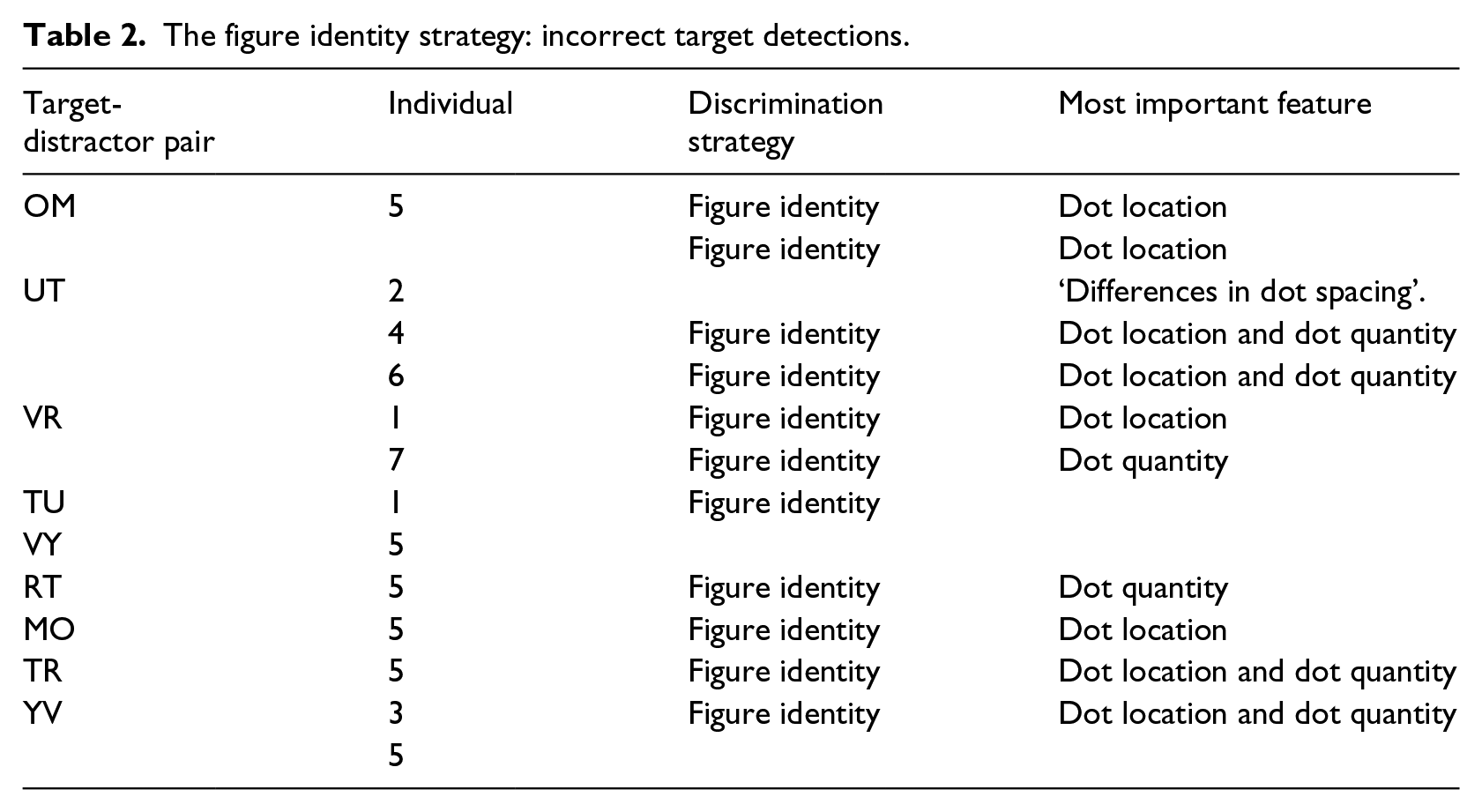
Seven individuals (one male; six females; mean age 46.0 years) made 14 incorrect target detections: seven in which the target and the distractors differed in a feature conjunction (of dot location and dot quantity [UT; TU; VY; YV], and seven in which they differed in one separate feature (i.e., dot location only [OM; VR; RT; MO; TR] [Graven, 2015]).
These individuals described using the figure identity strategy in ~80%, and no discrimination strategy in the remaining incorrect target detections. They ranked two target-discriminating features as the most important, that is, (a) dot location (28.6%), and (b) dot location and dot quantity (also 28.6%). Furthermore, they mentioned no target-discriminating feature in 21.4%; they ranked dot quantity as the third (14.3%), and ‘dot spacing’ (even though not included [cf. Graven, 2015]) as the fourth (7.1%) most important target-discriminating feature (see Table 2).
The figure identity strategy: incorrect target detections.
A Wilcoxon Signed-Ranks Test indicated that the exploration time was statistically significantly longer for incorrect than for correct target detections: Z = −2.12, p = .03. Median exploration time rating was (1) for correct; 14.0 s, and (2) for incorrect target detections; 34.0 s, N = 7.
In brief, individuals who use the figure identity strategy describe this in ~80%, and describe no discrimination strategy in the remaining incorrect target detections. They rank; (a) dot location, and (b) dot location and dot quantity (28.6% each) as the most important target-discriminating feature (cf. dot location and dot quantity [49.6%] in correct target detections [Graven, 2015, p. 85]). Their exploration time is certainly longer for incorrect than for correct target detections.
The global characteristics strategy
Six individuals (three males; three females; mean age 36.7 years) made 11 incorrect target detections: six where the target and the distractors differed in a feature conjunction (of dot location and dot quantity [UT; TU; VY]); five where they differed in one separate feature (i.e., dot location only [VR; RT] [Graven, 2015]).
These individuals described using the global characteristics strategy in >90% of all incorrect target detections. When not describing the global characteristics strategy, these individuals did not describe any discrimination strategy at all. They did not mention a target-discriminating feature in 36.4% and did not analyse ‘global braille letter shape’, not even when encouraged to do so (Graven, 2015), in 54.5%: indeed, they ranked no target-discriminating feature(s) as the most important in 90.9%, and they ranked ‘shape’ as the second (9.1%) most important target-discriminating feature (see Table 3).
The global characteristics strategy: incorrect target detections.
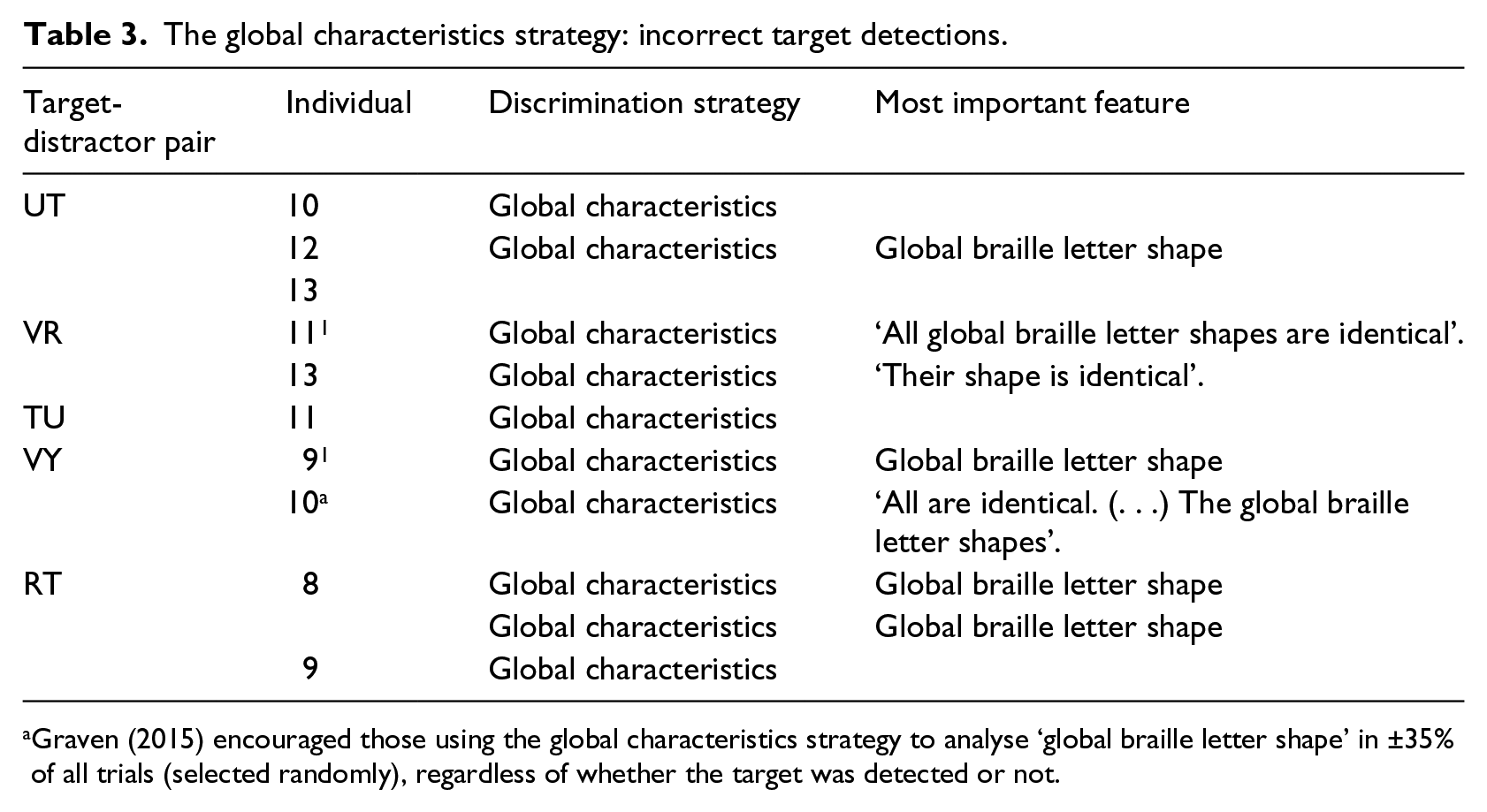
Graven (2015) encouraged those using the global characteristics strategy to analyse ‘global braille letter shape’ in ±35% of all trials (selected randomly), regardless of whether the target was detected or not.
A Wilcoxon Signed-Ranks Test indicated that the exploration time was statistically significantly longer for incorrect than for correct target detections: Z = −2.20, p = .03. Median exploration time rating was (1) for correct; 11.8 s, and (2) for incorrect target detections; 17.8 s, N = 6.
In short, individuals who use the global characteristics strategy describe this in >90%, and describe no discrimination strategy in the remaining incorrect target detections. In 90.9% of the time they do not rank any target-discriminating feature(s) in order of importance (cf. dot location [40.4%]; shape property [38.6%] as the most important in correct target detections [Graven, 2015, p. 87]). Their exploration time is longer for incorrect than it is for correct target detections.
The touch vision strategy
One individual (male; 30 years old) made three incorrect target detections: one in which the target and the distractors differed in a feature conjunction (of dot location and dot quantity [YV]), and two in which they differed in one separate feature (i.e., dot location only [OM; RT] [Graven, 2015]).
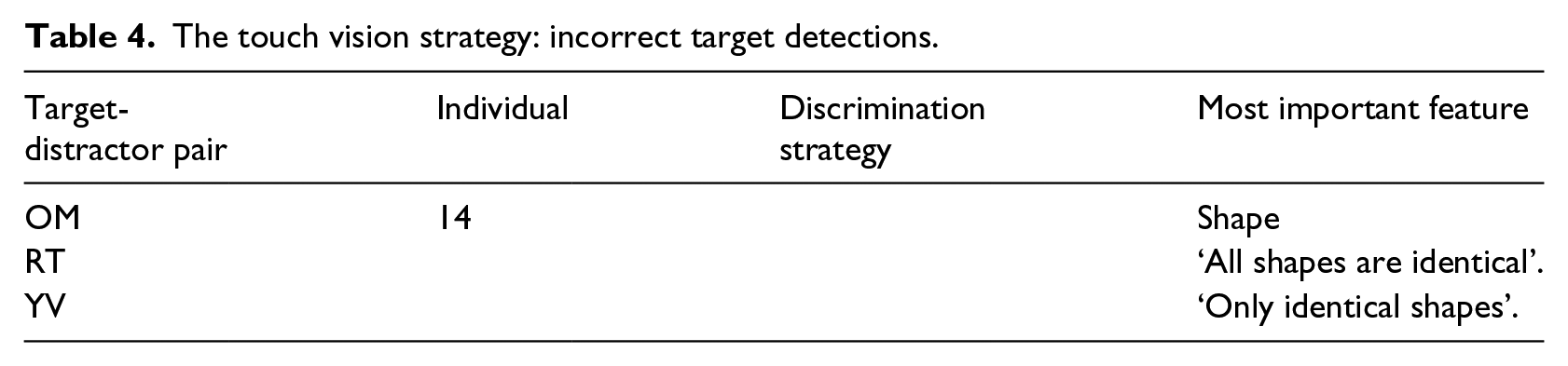
He described no discrimination strategy in incorrect target detections, and he ranked ‘shape’ as the (100%) most important target-discriminating feature (see Table 4. It is not clear what target-discriminating feature(s) the touch vision strategy ranks as the most important in correct target detections [cf. Graven, 2015, p. 92]). His exploration time was noticeably longer for incorrect (M = 13.8 s) than for correct target detections (M = 8.6 s).
The touch vision strategy: incorrect target detections.
Discussion
So, what happens when the discrimination strategy fails: do the braille readers use the same or switch to a different discrimination strategy, or; is their discrimination strategy vague in incorrect target detections? Do the braille readers rank the same, different, or no target-discriminating feature(s) as the most important? Do the braille readers use longer exploration time for incorrect than for correct target detections?
Discrimination strategy
Individuals who use either the figure identity strategy or the global characteristics strategy in correct target detections described these also in incorrect target detections: in ~80% and >90%, respectively. In contrast, the one using the touch vision strategy described no discrimination strategy at all when failing to detect the target. Then again, the ranking of target-discriminating feature(s) in order of importance suggests that the same discrimination strategy was used throughout. It is not clear, however; whether this was the touch vision strategy or a different discrimination strategy: in fact, the global characteristics strategy. Indeed, it is (1) not clear what target-discriminating feature(s) the touch vision strategy ranks as the most important in correct target detections and (2) clear that both the global characteristics strategy and the individual using the touch vision strategy ranks shape as highly important (cf. Graven, 2015). If this individual used a different discrimination strategy in incorrect target detections, that is, because the touch vision strategy failed, it suggests that he has a repertoire of discrimination strategies and that he draws upon them whenever needed. That he still failed to detect the target suggests that he lacks experience in using the other discrimination strategies: surely, with only three incorrect target detections, it seems the touch vision strategy is his main discrimination strategy.
When those using the figure identity strategy described no discrimination strategy, they ranked either no target-discriminating feature(s) or ‘dot spacing’ as the most important target-discriminating feature: the ranking of no target-discriminating feature(s) as the most important suggests (a) that they are using the global characteristics strategy or (b) that their discrimination strategy is vague. The ranking of ‘dot spacing’ (not included as a target-discriminating feature [Graven, 2015]) as the most important, suggests that their discrimination strategy is vague. In any case, it seems that individuals who mainly use the figure identity strategy have a limited repertoire of discrimination strategies, and also that they lack experience in using this repertoire.
Finally, when those who use the global characteristics strategy did not describe a discrimination strategy, they ranked no target-discriminating feature(s) in order of importance: it seems they are using the global characteristics strategy also when not describing it. Do they lack a repertoire of discrimination strategies to draw upon; do they too lack experience in using other discrimination strategies; do they even try a different discrimination strategy, or are they rather set in their own ways? Indeed, individuals who mainly use the figure identity strategy or the touch vision strategy and who use a different discrimination strategy in incorrect target detections, all seem to have switched to the global characteristics strategy.
With this in mind: braille readers who use the figure identity strategy or the global characteristics strategy seem to have a limited repertoire of discrimination strategies, and also to lack the experience in using this repertoire. Braille readers who use the touch vision strategy on the other hand seem to have a repertoire of discrimination strategies, but they too seem to lack the experience in using this repertoire. Thus, individuals who are taught braille should be taught several strategies for discriminating the braille characters, and also be given ample experience in using them. Further research is needed to investigate whether certain discrimination strategies are more robust than others: why do most of those who switch to a different discrimination strategy in incorrect target detections, switch to the global characteristics strategy?
Target-discriminating feature(s)
Individuals using the figure identity strategy ranked (a) dot location and (b) dot location and dot quantity as the most important target-discriminating feature in incorrect target detections, dot location and dot quantity as the most important in correct target detections (Graven, 2015). According to Treisman’s theory of attention (cf. Wolfe & Robertson, 2012), individuals who rank the feature conjunction of dot location and dot quantity as the most important fail to detect the target because of attentional load. Further along the lines of Treisman’s theory: do individuals also fail to detect the target because of re-focussing their attention, with the aim of reducing any attentional load, that is, re-focussing it from the feature conjunction (of dot location and dot quantity) to one separate feature (i.e., dot location only) – in doing so placing more, not less, load on their attention? If so, it seems they too may have encountered attentional load.
Further, more often than not did those using the global characteristics strategy not rank any target-discriminating feature(s) in order of importance; they ranked either dot location or shape property as the most important target-discriminating feature in correct target detections (Graven, 2015). Following Treisman’s theory of attention, did these individuals fail to detect the target because neither of the separate features (i.e., dot location or shape property; processed in pre-attention) called upon attention (Treisman et al., 1992) – hence not ranking any target-discriminating feature(s) in order of importance. Did they, in fact, not pay sufficient attention?
The one individual using the touch vision strategy in correct target detections ranked shape as the most important target-discriminating feature in incorrect target detections. (It is not clear what target-discriminating feature[s] this discrimination strategy ranks as the most important in correct target detections [Graven, 2015]). Is ‘shape’ one separate feature, or is it in fact a feature conjunction of several shape properties, for example, a conjunction of angles, curves, and straight lines (cf. Graven, 2015)? If ‘shape’ is a conjunction of shape properties, then also this individual is in danger encountering attentional load. But, when revisiting what this individual actually reported – ‘Shape’; ‘All shapes are identical’; ‘Only identical shapes’ (see Table 4) – it seems ‘shape’ indeed is one separate feature: he seems rather attentive to the global shape, just as the global characteristics strategy. So, was he too not paying sufficient attention – did the ‘shape’ (processed in pre-attention) not call upon attention (cf. Treisman et al., 1992)?
In other words, when braille readers fail to detect the target, they have (a) encountered attentional load: by ranking a feature conjunction as the most important target-discriminating feature or by re-focussing attention, from feature conjunction to separate feature or (b) not focussed their attention sufficiently: the separate feature has not called upon attention. Thus, individuals who are taught braille should be given various opportunities to improve their discriminating skills; making them more automatic (cf. Treisman et al., 1992), as automaticity might reduce attentional load: they should be encouraged to be attentive to either dot location or shape property (cf. Graven, 2015) when failing to discriminate the braille characters. Further research is needed to investigate what level of attention to encourage in each discrimination strategy.
Exploration time
All three discrimination strategies used longer exploration time for incorrect than for correct target detections: for those using the figure identity strategy or the touch vision strategy, this could be because they needed time to switch to a different discrimination strategy. For those using the global characteristics strategy, in contrast, this could be because they had a very limited – or even non-existing – repertoire of discrimination strategies: forcing them to keep on trying to detect the target with a failing discrimination strategy.
Moreover, for those using the figure identity strategy, this could also be because they had encountered attentional load. They either (a) constantly focussed their attention on the feature conjunction of dot location and dot quantity (cf. Treisman’s theory of attention [Wolfe & Robertson, 2012]) or (b) re-focussed their attention, that is, from the feature conjunction (of dot location and dot quantity) to a separate feature (i.e., dot location only). Attentional load seems not to be the case for those using the global characteristics strategy or the touch vision strategy, as both discrimination strategies rank one separate feature as the most important target-discriminating feature. Then again, did they use longer exploration time because they did not focus their attention sufficiently – did the separate feature (e.g., shape) not call upon attention?
Concisely, individuals who are taught braille should be taught a repertoire of strategies for discriminating the braille characters, and also how to, efficiently, switch between the different discrimination strategies. Additionally, they should be taught what level of attention is the most suitable for each discrimination strategy.
Footnotes
Declaration of Conflicting Interests
The author(s) declared no potential conflicts of interest with respect to the research, authorship, and/or publication of this article.
Funding
The author(s) received no financial support for the research, authorship, and/or publication of this article.