







Abstract
A convenience sample (n = 35) of Teachers of Students with Visual Impairments (TVIs) and Rehabilitation Specialists completed a survey about their instructional techniques and perspectives on the relationship between braille and technology. While 62.5% of TVIs and Rehabilitation Specialists working with children, adolescents, or adults use technology in braille instruction, only 26.3% of those working with seniors use technology when teaching these clients. Rehabilitation Specialists felt significantly less knowledgeable about technologies than TVIs and used technology less frequently. TVIs felt more strongly that technology increased learner motivation and that the use of technology improved learning outcomes. These results suggest that the level of technological knowledge and instructor beliefs in the benefits such technologies provide may impact the decision to incorporate technology within braille instruction. Additional study is required to assess the validity of the motivational and learning benefits of various technologies within braille training programs.
Technological advancements continue to provide new opportunities to access braille. These technologies include both stand-alone braille notetakers (with word-processing capabilities) and braille displays connected to computers, smartphones, and tablets that allow users to control and access information on these devices. Little is known, however, about the extent to which these innovations have impacted the actual teaching and learning of braille. While prior research has primarily focused on the experience of braille users who access both hard copy and electronic braille, this study explores how Teachers of Students with Visual Impairments (TVIs), who typically teach students within educational systems, and Rehabilitation Specialists, who typically teach adult and senior clients, view, and utilize technology in the context of teaching braille as a starting point for further research in this area.
Review of literature
The proliferation of text-to-speech technologies for accessing printed material has at times been cited in the literature as a threat to the continued relevance of braille (Frey, Rosier, Southern, & Romero, 2012; Tobin & Hill, 2015), with many pointing to declining braille literacy rates as evidence of the phenomenon (Schroeder, 1996). However, rehabilitation and teaching professionals recognize that braille, like print for the sighted, is a foundational component of literacy, the use of which is positively correlated with education, employment, and earning outcomes for persons who are legally blind (Ryles, 1996). In response to the perceived threat of technology advanced by some, research in recent years has begun to explore the ways in which technology and braille can complement each other.
Bickford and Falco (2012), for instance, attempted to quantify the efficacy of introducing the use of an electronic braille notetaker in braille literacy instruction, based on the Patterns curriculum (Caton, Pester, & Bradley, 1982). The use of electronic devices and notetakers provided added motivation for students, and greater gains in fluency and proficiency were noted during instructional phases using the electronic notetaker than during instructional phases utilizing traditional techniques. Many of these same advantages were described in the results of the early braille readers’ project by Cooper and Nichols (2007), where electronic braillers were provided to 20 students in Texas, spanning kindergarten through grade 2. They found that participants with delayed motor skills and limited finger strength were able to produce braille for a longer period of time and with less fatigue. In addition, the electronic braillers were viewed as less disruptive than traditional mechanical braille writers, and the audio feedback provided greater motivation to students, assisting them in staying on task and learning braille letters at a faster rate than many teachers felt they could with conventional technologies alone. Similar themes were observed by Kamei-Hannan and Lawson (2012) in their study of three students in grades 5–7, where improved stamina and higher quality writing, both in terms of content and technical form, were found when using an electronic braille notetaker. D’Andrea (2012) similarly reported benefits for elementary and high school students who use both hard copy and electronic braille depending on the context, suggesting that early introduction of braille technology for use across the curriculum is both appropriate and increasingly necessary.
Less is known about braille instructional trends among adult and senior learners with acquired vision loss, and those studies which have been conducted focus largely on the experience of the braille user. In contrast to students with visual impairments, the variability of braille instructional services and equipment available for adult and senior clients is more restricted and dependant on geographic location and funding models (Douglas, Franks, Weston, & Clements, 2009). In a study by Cryer and Home (2011b), 13 adult braille users cited advantages to using braille display technologies such as portability and the ability to access the Internet and a variety of reading materials. On the other hand, these same respondents identified limitations to existing braille technologies for the learning and use of braille, such as cost and the perceived reduced speed of single-line braille displays, and suggested that multi-line braille displays would provide access to tactile graphics and greater context while reading. A number of new braille-related technologies are currently under development to increase learner motivation and to address limitations inherent to current braille devices, including educational “app-based” learning tools, multiple-line braille displays, and distance learning platforms (Cryer and Home, 2011b; Frey et al., 2012; Kamei-Hannan, Pomeroy, Smith, & Niebrugge, 2015).
In light of this context, this study addresses three primary questions to better understand the role of technology in current braille teaching practices from the perspective of professionals engaged in braille instruction: (1) How is technology being incorporated within braille instruction, if at all? (2) Do TVIs and Rehabilitation Specialists feel sufficiently knowledgeable to incorporate technology into braille instruction if they choose to do so? (3) How do TVIs and Rehabilitation Specialists perceive the relationship between braille and technology?
Methods
Ethics approval for the study was obtained through the Centre for Interdisciplinary Research in Rehabilitation of Greater Montreal (CRIR), which was a pre-requisite for recruitment of participants from Quebec-based, government-run rehabilitation centers.
Questionnaire and procedure
This research was conducted by way of a primarily quantitative questionnaire (see Appendix 1), available in English and French. The majority of the questions in the survey were closed where respondents were asked to select one or more of the available options. A 5-point Likert scale was employed for questions seeking to ascertain agreement with a stated position, typically with the option of providing an additional comment. Prior to commencing the survey, which could be completed independently online or by telephone, prospective participants were provided with a complete briefing on the objectives and goals of the study, in accordance with The Declaration of Helsinki and Public Health (Williams, 2008) and informed written consent was obtained.
Participants
Specialists who had taught braille within the past 5 years were recruited from a convenience sample of invitees, with rehabilitation providers in Canada as well as the Association for Education and Rehabilitation of the Blind and Visually Impaired’s listserv (https://aerbvi.org/) distributing the call for participants. Between February and April 2014, 35 survey responses from TVIs and Rehabilitation Specialists were received. Slightly more than half (53%) of the respondents were from the United States, while 47% of respondents were from Canada. Respondents had on average 12 years of braille teaching experience (mean [M] = 12 years, 10 months, standard deviation [SD] = 11.1 years).
Respondents were grouped into two broad categories consisting of (a) Teachers of the Visually Impaired (“TVIs”), typically found in elementary and high school educational environments, who represented 49% of respondents, and (b) Rehabilitation Specialists, who typically work in rehabilitation centers serving adults and seniors, representing 51% of respondents.
Data analysis
The majority of the data elucidated by the survey instrument were categorical in nature. Analyses were conducted using a chi-squared (χ2) test (based on the observed frequencies) between the TVI and Rehab groups, to evaluate the likelihood that the observed differences arose by chance alone. In cases involving small sample numbers where the χ2 test would be inappropriate (i.e., where the value of any cell in the analysis table was less than five), Fisher’s exact test (FET) was used instead. For results emanating from questions based on Likert scales (single responses indicating degree of agreement or disagreement with a statement), the Mann–Whitney–Wilcoxon test was used (after grouping the two sets of extreme levels in the scale) to identify significant differences (de Winter & Dodou, 2010). In all cases, tests were conducted with a .05 significance level.
Results
How is technology being incorporated within braille instruction?
Table 1 demonstrates that those who teach children, adolescents, and adults, respectively, are far more likely than those who teach seniors to use technology during braille instruction. As many participants provided instruction to clients in multiple age groups, the lack of independence among the groups precluded direct statistical analysis using non-parametric tests. However, using a qualitative perspective instead, differences were observed in the proportion of respondents (consisting of TVIs and Rehabilitation Specialists together) who use technology with senior learners (27%) when compared with the proportion of respondents who use technology when teaching children (61%), adolescents (59%), and adults (65%).
Instructors’ use of technology in braille instruction by learner age.
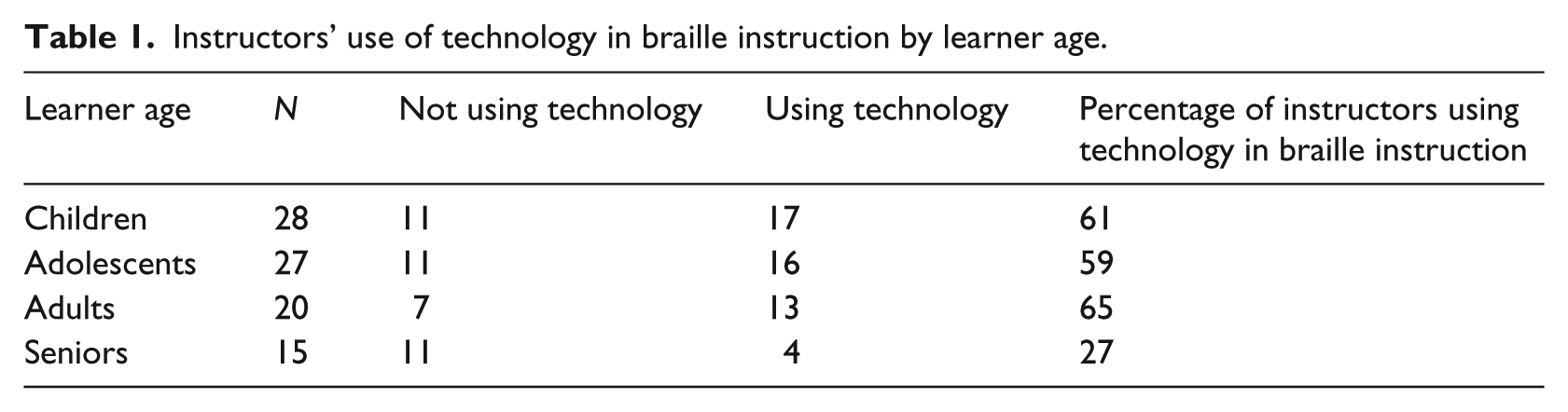
Table 2 compares the percentage of TVI and Rehabilitation Specialists who are utilizing specific technologies during braille instruction. Of interest was that TVIs were significantly more likely than Rehabilitation Specialists to use notetakers with braille displays (TVI: 59%, Rehab: 22%, χ2 [1, N = 35] = 4.88, p = .03), braille displays with phones or tablets (TVI: 35%, Rehab: 6%, χ2 [1, N = 35] = 4.83, p = .04), and iPhones/iPads (TVI: 65%, Rehab: 22%, χ2 [1, N = 35] = 6.44, p = .01). There were no technologies for which Rehabilitation Specialists expressed a statistically significant preference as compared with TVIs. Among the 8.6% (N = 3) of respondents who indicated that they used no technology whatsoever, the qualitatively open-ended comments suggested that these few individuals had been teaching braille only a short while, their clients had not reached a point where technology could be useful, or the cost of the technology was prohibitive.
Technologies used in braille instruction by profession.
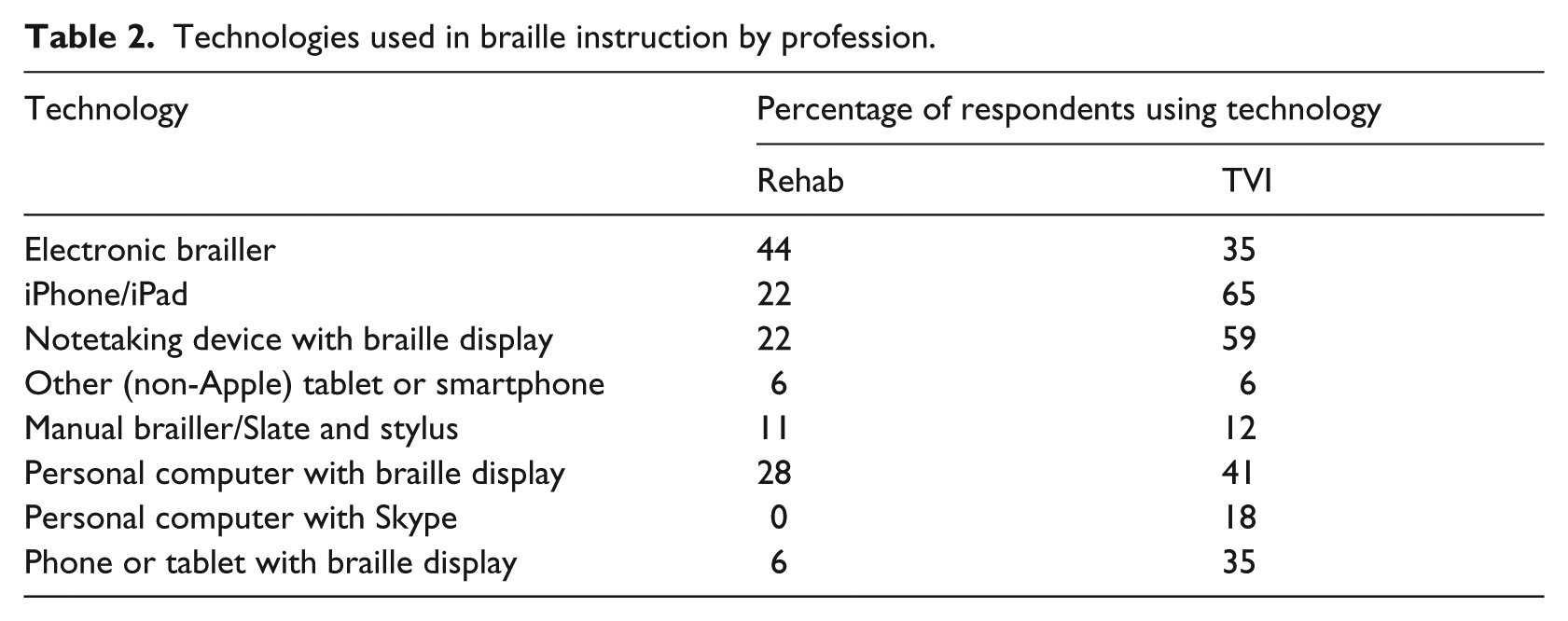
Percentages may add up to more than 100% for each respondent category because some participants worked with more than one technology.
Did respondents feel sufficiently knowledgeable to incorporate technology within braille instruction?
When asked which response category best reflected their current level of knowledge about available technologies and the degree to which they regularly use technology in braille literacy instruction, Rehabilitation Specialists felt significantly less prepared to teach with technologies that might be used in braille instruction as compared with TVIs: “I know these technologies exist, but have little experience using them” (TVI: 12%; Rehab: 50%); “I know how to use these technologies but do not regularly teach them” (TVI: 12%; Rehab: 22%); “I know all about these technologies, and sometimes teach them to my students” (TVI: 12%, Rehab: 17%); “I know about them all and encourage my students to use them in appropriate circumstances” (TVI: 64%, Rehab: 11%): χ2 (3, N = 35) = 11.53, p = .006. Respondents indicated that they stayed up to date about braille-related technologies through conferences (67.5%), webinars (40%), interactions with colleagues (40%), and journals (35%).
How did respondents perceive the relationship between braille and technology?
Participants were asked to indicate their level of agreement (on a 5-point Likert scale) with three statements relating to braille and technology in order to determine whether differences exist between TVI and Rehabilitation Specialist respondents. The responses to the following three questions are displayed in Table 3.
Respondents’ perception of the relationship between braille and technology.
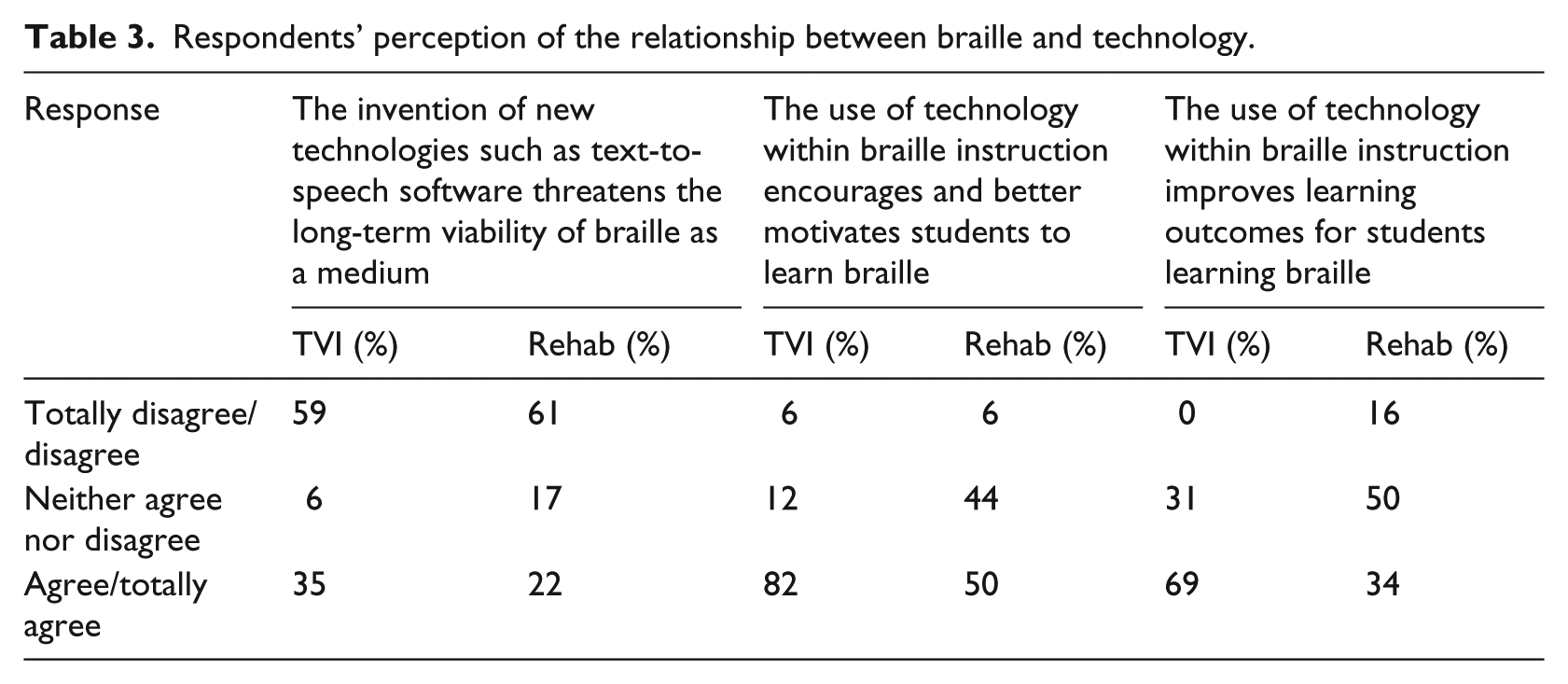
The invention of new technologies such as text-to-speech software threatens the long-term viability of braille as a medium. Most respondents disagreed to some extent with this statement; however, no significant difference was found between TVIs and Rehabilitation Specialists (U = 142.5, p = .71). The open-ended comments accompanying this question revealed that braille was felt not to be particularly threatened because it is critical to literacy instruction; the fact that braille is useful and difficult to replace for certain use cases; its usefulness for providing access in public spaces; and the need to accommodate diverse learning styles.
The use of technology within braille instruction encourages and better motivates students to learn braille. Most respondents agreed with this proposition, but a larger proportion of TVIs perceived technology as providing greater motivation to their clients than did Rehabilitation Specialists (U = 106.5, p = .04).
The use of technology within braille instruction improves learning outcomes (as compared to teaching without the use of technology) for students learning braille. Few respondents disagreed with this statement, but the largest number of respondents neither agreed nor disagreed. TVIs held significantly more positive views about the improvement to learning outcomes that technology achieves compared with Rehabilitation Specialists (U = 85.5, p = .03).
Discussion
The results demonstrate that technology is being incorporated into braille instruction less often with seniors than with learners in other age groups, notwithstanding general agreement that technology could provide important motivational and learning advantages. In addition, Rehabilitation Specialists (who typically work with adults and seniors) feel less confident about their level of technological knowledge than TVIs (who work with children and adolescents).
Technology is being incorporated less in braille instruction when servicing older clients. This may be partially explained by the different needs of some older clients using braille for limited labeling purposes, rather than for longer and more extensive reading. Douglas et al. (2009) as well as Cryer and Home (2011a) suggest that decisions about braille instruction in general may also be influenced by misconceptions about the abilities of older learners. To date, no research on the potential benefit of such technologies when teaching braille to aging learners is available, though such investigations would be worthwhile to pursue as technology will continue to play an increasing role in the lives of older adults.
Respondents in this study generally agreed that technology is a motivator for learners and that the use of technology in braille instruction could generate more positive learning outcomes. This is consistent with the prior findings of Bickford and Falco (2012), Cooper and Nichols (2007), as well as Kamei-Hannan and Lawson (2012). What is interesting, however, is that TVIs felt significantly more strongly about the motivational potential of technology within braille instruction than Rehabilitation Specialists. Wittenstein and Pardee (1996) noted from a survey of TVIs that there was a direct relationship between the training that TVIs received and their attitudes toward braille: more specifically, those who received more training in braille held more positive attitudes about braille. The greater positivity about the motivational potential of technology within braille instruction noted here may stem from the fact that TVI respondents are using technology more frequently than Rehabilitation Specialists.
Limitations
Where differences have been found in the responses between the Rehab and TVI groups, it is not possible to know conclusively whether those differences arise from the professional context (TVI vs Rehab) alone or the geographic location of respondents (Canada vs US). The Canadian respondents included a much greater number of Rehabilitation Specialists (88%) than TVIs (12%), while the American respondents included a much greater number of TVIs (83%) than Rehabilitation Specialists (17%). Differences exist in the service models and funding resources available to each category of professional between the two countries, and the imbalanced representation may therefore have impacted upon the results and will require further study.
Conclusion
In this study, we aimed to gain a general understanding of the perception and use of technology within braille instruction today. The results suggest that technology is finding some use within braille instruction and new developments could make it even more relevant, particularly for older learners who appear to have less exposure to braille technology. This technology may provide motivational benefits for learners and is largely seen as complementing rather than replacing hard copy braille.
Although these results help us to understand whether TVIs and Rehabilitation Specialists are incorporating technology into braille instruction, little remains known about how they are incorporating it or what precisely they are incorporating. Further in-depth research including focus groups with TVIs and Rehabilitation Specialists would provide greater insight into the technologies and how they might be used in braille instruction across all ages. What is clear is that Rehabilitation Specialists in this study, who primarily work with adults and seniors, felt less technologically savvy than TVIs, who work primarily with children and adolescents, and that this is correlated with a limited adoption of technology-based instruction within braille rehabilitation training. In order for technology to be effectively used in braille instruction, professionals, including those working with older learners, must be provided with regular and ongoing professional development opportunities so that they may be exposed to and gain an understanding of these new technologies. Such professionals must remain aware of the potential benefits that technology can bring and how to appropriately integrate that technology within braille teaching practices.
While the perception of those teaching braille is that technology carries with it motivational and learning benefits, empirical evidence to support the contention that learning outcomes are better when supported by technology is required. New technologies will continue to increase the availability of electronic braille, but the task now is to ensure that professionals are effectively able to utilize these tools in instructional settings when appropriate. This will provide new approaches to complement existing braille instructional methods, enabling learners to effectively access information in braille through the growing array of technologies that are available to them.
Footnotes
Appendix 1
Acknowledgements
The authors would like to thank Dr Olga Overbury and Marie-Julie Rivest for their support throughout the research study and writing of this manuscript.
Funding
The authors received no financial support for the research, authorship, and/or publication of this article.
