







Abstract
Orientation and mobility (O&M) provides individuals with visual impairments the skills needed for independent travel and community participation. Despite training requirements, including 350+ internship hours, research on internship experiences remains limited. Short-term programs, such as 1-week sports camps, offer experiential learning opportunities that help interns fulfill required competencies and hours. This qualitative study examined the experiences of seven O&M interns and seven youth athletes with visual impairments at a sports camp through written accounts, observations, and focus groups. Three themes emerged: (1) experiential learning and skill development, (2) strategies fostering independence, and (3) challenges to skill acquisition. Findings emphasize the role of multidisciplinary collaboration between O&M and adapted physical education (APE) specialists in promoting O&M skills and confidence among athletes. However, barriers like unclear roles, limited guidance, and Academy for Certification of Vision Rehabilitation and Education Professionals (ACVREP) competency concerns highlight the need for improved preparation and communication. Camps provide valuable real-world practice, reinforcing the importance of transdisciplinary practice and collaboration with APE specialists.
Orientation and mobility (O&M), taken together, refer to the ability to travel successfully in the home and community (Long, 1990). Orientation is the ability to process sensory information to know where one is in space, in relation to oneself or other objects; the application of this knowledge for problem-solving; and the ability to update that information while traveling (Chang et al., 2020; Long, 1990; Tellefson, 2022). Mobility is one’s ability to safely, efficiently, and independently travel through familiar and unfamiliar environments (Chang et al., 2020; Tellefson, 2022). O&M skills allow individuals with visual impairments to participate more fully in their communities.
Ideally, O&M skills are taught sequentially by individuals who have completed a university-level training program and a certification program (Academy of Certification of Vision Rehabilitation and Education Professionals [ACVREP], 2024). University training programs typically culminate in an internship of more than 350 hours, under the direct supervision of an experienced certified O&M specialist (or COMS; ACVREP, 2024). While these internships typically take place over an academic semester or year, O&M interns now demand greater flexibility in these placements, as more O&M specialists enter the profession as working adults (Burgin et al., 2022).
The internship experience may take place at one or multiple sites. Regardless of the setting, all O&M interns are expected to master the same set of skills (ACVREP, 2024; Association for Education and Rehabilitation of the Blind and Visually Impaired [AERBVI], 2023). The skillset ranges from communicating effectively with families to teaching human guide and using various cane techniques, all of which are crucial proficiencies to ensure their future students or clients are best supported when they enter the field as a COMS. Despite the importance of the culminating internship, little research exists regarding what placements and experiences are most beneficial for interns.
Once in the field, O&M specialists face challenges in service provision. Due to the fact that there is a continuing shortage of O&M specialists, newly certified graduates may lack the needed time to provide quality services, and/or they may be tasked with teaching skills other than O&M (Griffin-Shirley et al., 2009). To address these challenges, O&M specialists have looked for alternative means and modes of teaching O&M skills to students in need. For example, O&M specialists both in the United States and abroad have used short-term programs (i.e., short, intense training sessions over a few days) to provide services to small groups of students (Fazzi & Naimy, 2010; Higgerty & Williams, 2005; Neustadt-Noy et al., n.d.; Parker et al., 2022). Small group instruction, when appropriately planned, provides opportunities for students to confront orientation challenges, increase confidence, and learn how to work with others (Fazzi & Naimy, 2010). In addition, initial research suggests that short-term (i.e., 1-week) sports camps provide instruction in all nine areas of the Expanded Core Curriculum (ECC), including O&M (Lieberman et al., 2021). The ECC is designed to address the unique needs of students with visual impairments by encompassing nine critical areas: compensatory skills, O&M, recreation and leisure, social interactions, independent living, sensory efficiency, self-determination, career education, and assistive technology (Sapp & Hatlen, 2010). Thus, a 1-week sports camp provides a potentially ideal space to prepare pre-service specialists to teach O&M. In addition, the participants in these sports camps programs need to learn O&M skills to navigate their sports environment whether at a school, university, or camp setting.
Purpose
The purpose of this qualitative study was to explore opportunities for interns to teach O&M skills during a 1-week educational sports camp for youth with visual impairments and deafblindness. Researchers focused on the following research questions: (1) What experiences, if any, influenced the proficiency and self-confidence of O&M interns and students with visual impairments? (2) What instructional strategies or approaches helped children with visual impairments to be more independent with adapted sports activities? (3) What barriers existed that limited the improvement of O&M interns’ instructional skills?
Research positionality and reflexivity
Given the impact that researchers’ beliefs, experiences, and positions may have on the analysis of findings, it is important to describe our positionality. The research team was composed of five members, all of whom have personal and professional interests related to the preparation of O&M specialists or adapted physical education (APE) specialists. The first two authors were both doctoral students; the second author has conducted research at sports camps previously, while the first author had no prior experience with the camp. The remaining authors all work as professors in personnel preparation programs, and the third author has extensive teaching experience focused on students with visual impairments in adapted PE programs.
Method
This study used qualitative methods, including written accounts, observations, and focus group data, to understand the O&M internship experience at a 1-week educational sports camp. The university Institutional Review Board approved this study.
Participants
O&M preparation programs typically allow their scholars to choose internships that best suit their strengths, needs, and professional goals; however, regardless of setting, scholars are required to complete 350 internship hours to meet ACVREP (2024) guidelines. Starting in February 2024, a sports camp advertised available O&M internships and invited applications from qualified scholars (i.e., those who had completed all O&M coursework). O&M program coordinators distributed the advertisement to eligible candidates. Potential participants had to be currently enrolled in an O&M personnel preparation program, and they were required to complete an application form and submit a letter of recommendation from their current O&M program coordinator or current O&M supervisor. Seven O&M scholars applied, and seven interns participated in the internship program. All O&M interns were invited to take part in the study, and all provided consent for participation.
To participate in this sports camp, athletes must have a documented visual impairment or deafblindness; demonstrate physical stamina and age-appropriate independent living skills; and have a communication system. From the 48 eligible participants, researchers randomly selected 10 athletes between the ages of 9 and 17 to engage in the focus groups; three of these participants declined to participate. Each focus group participant provided assent and their parent/guardian provided consent for participation prior to data collection.
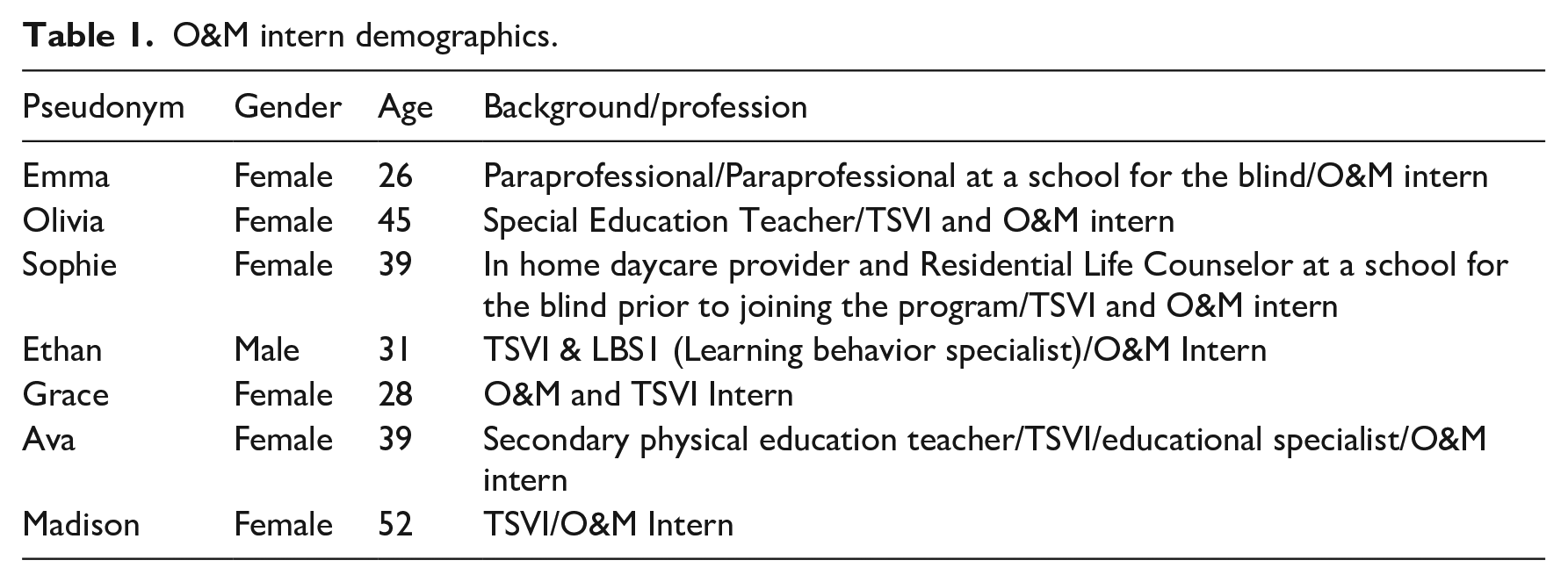
Tables 1 and 2 list participant demographics. Athlete participants were evenly split between male and female. Most received O&M services outside of camp, and most used a white cane for travel. O&M interns, on the contrary, were majority female (85.7%), and the mean age was 37 years, which is reflective of the field (Burgin et al., 2022).
O&M intern demographics.
Athlete demographics.
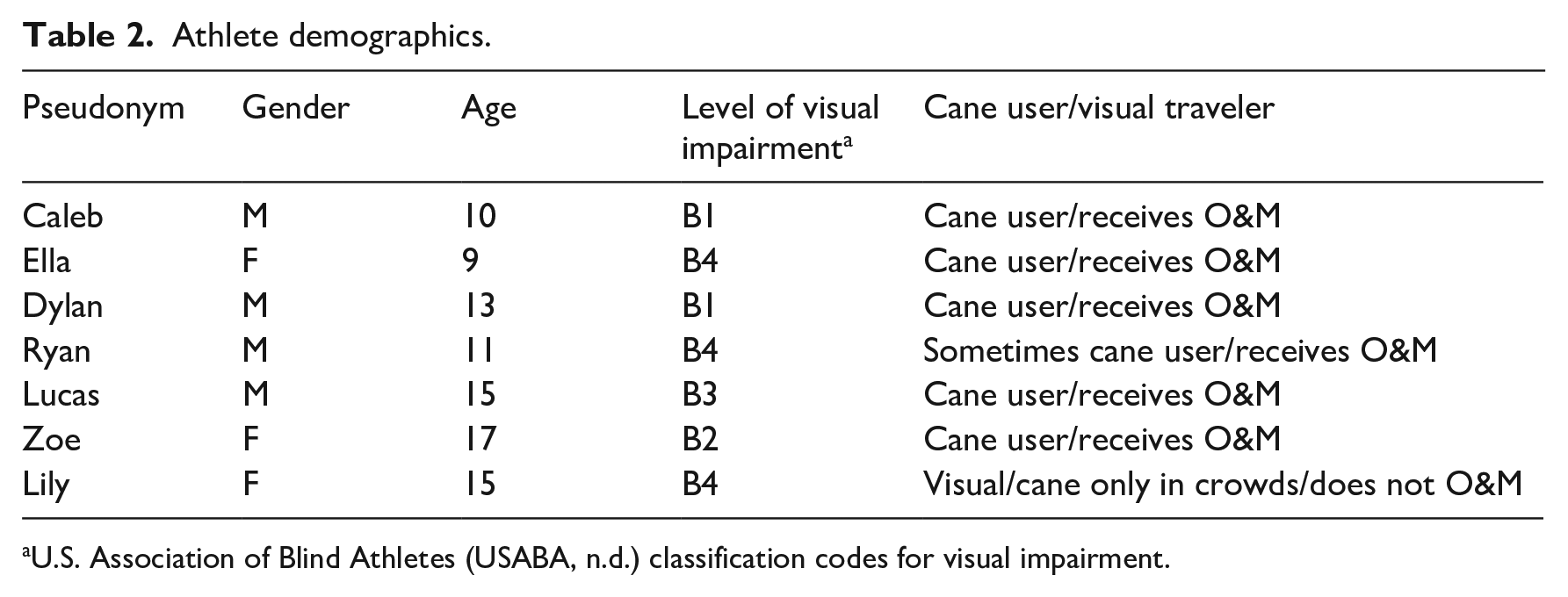
U.S. Association of Blind Athletes (USABA, n.d.) classification codes for visual impairment.
All participants received compensation. O&M interns received travel funding, room and board, and a $500 stipend for their work. Athletes who participated in this study (and completed two other studies at camp) received a gift card.
Setting
The camp was a 1-week, overnight educational sports camp for young people with visual impairments or deafblindness. It provided opportunities for athletes to practice skills related to the ECC, such as O&M (Lieberman et al., 2021). A college campus hosted the camp, which allowed athletes to experience dorm living and provided a variety of potential travel experiences.
The mission of the camp is to empower young people with visual impairments, blindness, or deafblindness to be physically active and productive members of their schools, communities, and societies. At camp, athletes received one-on-one instruction from coaches, and specialists who are experts in a sport taught and led each activity. Athletes participated in organized physical activity (e.g., blind tennis, goalball) during the day, and in the evening, they participated in recreational activities of their choice. O&M interns joined each group of athletes and coaches for the week; three groups had two O&M interns to provide O&M instruction and assistance during activities, while one group had one O&M intern. O&M interns also worked with athletes one-on-one between activities and during the evening.
Instruments
A professor in APE developed focus group questions for athletes and O&M interns to address the research questions. The lists of questions were then reviewed by four experts in the field for face and content validity. These experts included one with expertise in physical education and children with visual impairments, two O&M specialists, and one specialist in motor development and visual impairment. The questions were revised and discussed until consensus was reached (Please see Appendices 1 and 2 for the focus group questions for the athletes and interns).
Description of the internship
The Camp Director, one of the camp graduate assistants, two O&M supervisors, and the O&M interns met monthly on three separate occasions via Zoom. These meetings were held collaboratively to develop a plan for the internship experience. Interns were told that they would be working in groups with 10–12 athletes along with one-on-one coaches.
Upon arrival at camp, the team met to prepare for the week by reviewing the schedule of activities. During training, before athletes arrived, the O&M supervisors and interns provided instruction in basic indoor O&M skills (e.g., human guide technique, narrow passage technique) to all coaches and specialists. The interns then participated in training activities related to adapted physical activity with coaches and specialists. In addition, O&M interns met with supervisors daily to discuss any challenges, as well as plan for upcoming opportunities throughout the week.
During the week, the interns participated in all activities with their assigned groups. The interns provided both group and one-on-one O&M instruction to athletes during transitions (i.e., travel between activities). Although the O&M interns came from two different preparation programs, all were required by their program’s internship guidelines to teach at least one, one-on-one lesson to an athlete during the week at camp. A certified O&M supervisor observed these lessons and provided feedback throughout the week.
Data collection
Participants engaged in a range of O&M activities during the week at camp, including navigating from a grassy area to the dock for kayaking or stand-up paddleboarding, walking between the locker room and pool area (with tasks such as showering and changing), participating in running and field events on the track, and playing blind soccer on a grassy field. O&M interns supported the athletes through one-on-one and group O&M lessons. Throughout the week, researchers gathered three primary types of data to explore participants’ experiences with the different O&M activities. The data sources consisted of written accounts, observational notes, and focus group discussions.
Written accounts
During the course of the week, blank posters were displayed in the main common area of the camp dorms for participants to share their reflections on various O&M activities, adaptations, and challenges they faced. Each poster was equipped with sticky notes and Braille cards for participants to record their thoughts. Using black markers, participants wrote on the sticky notes or created Braille responses, which were then attached to the appropriate poster. All participants were invited to share their insights on O&M, including their experiences and the instructional strategies that worked well or fell short.
O&M interns also wrote daily about their internship experience. These reflections focused on the skills O&M interns taught, what went well, and what could be improved. Reflections were submitted electronically to the first author.
Observations
The first three authors maintained field notes throughout the week, capturing interactions and lessons between O&M interns and athletes. They documented instructional strategies, adaptations, remarks related to activity participation, and any challenges observed. Each day, one or two researchers attended and recorded details from the activities.
Focus groups
Ten athletes were randomly selected for focus groups, with seven agreeing to participate in the study. All O&M interns were also invited to take part in the focus groups. The participants were divided into four groups: two groups included three and four athletes each, while the remaining two consisted of three and four O&M interns. Over the final two days of camp, these focus groups convened to share their experiences and respond to discussion prompts. Athlete-focused questions explored their O&M experiences, effective practices, areas for improvement, and how they planned to apply their O&M skills at home and within their communities. Meanwhile, questions for the O&M interns centered on their experiences during the week, instructional strategies used, their effectiveness, and suggestions for refinement.
Trustworthiness
Trustworthiness aims to establish credibility with the data, analysis, and associated methodology, ensuring the study is both valid and reliable (Stahl & King, 2020). Researchers took steps to ensure trustworthiness and credible findings through multiple methods: (a) a researcher certified in the fields of visual impairment and O&M with no direct affiliation with the camp was tasked with collecting data for the study, minimizing potential bias; (b) this researcher conducted focus groups with O&M interns and athletes using expert validated research questions; (c) prior to the start of the focus groups, the researcher shared his positionality as a O&M specialist and how that influenced his approach to research with the participants; (d) researchers triangulated the data from focus groups, written accounts, and observations to ensure comprehensive and consistent findings (Carter et al., 2014). Such triangulation enhanced the analysis by incorporating diverse perspectives, yielding a nuanced understanding of the instructional and experiential dynamics within the camp setting. Finally, a “critical friend,” a researcher/COMS who did not attend camp, reviewed the themes and data to promote objectivity and limit bias (Stolle & Frambaugh-Kritzer, 2022).
Findings and discussion
Researchers transcribed and systematically analyzed the data collected from focus groups, observational data, O&M intern daily reflections, and notes from posters using a deductive coding approach (Saldaña, 2016). The first and fourth authors generated codes based on the pre-established research questions, ensuring that the analysis remained aligned with the study’s core objectives. A total of three themes emerged from the data: (1) experiential learning and skill development; (2) instructional strategies promoting independence; (3) challenges and barriers to O&M skill acquisition. See Table 3 for a list of the themes with quotes. Findings related to the intern’s experience as well as the skills learned by the athletes during the week.
Themes and illustrative examples.
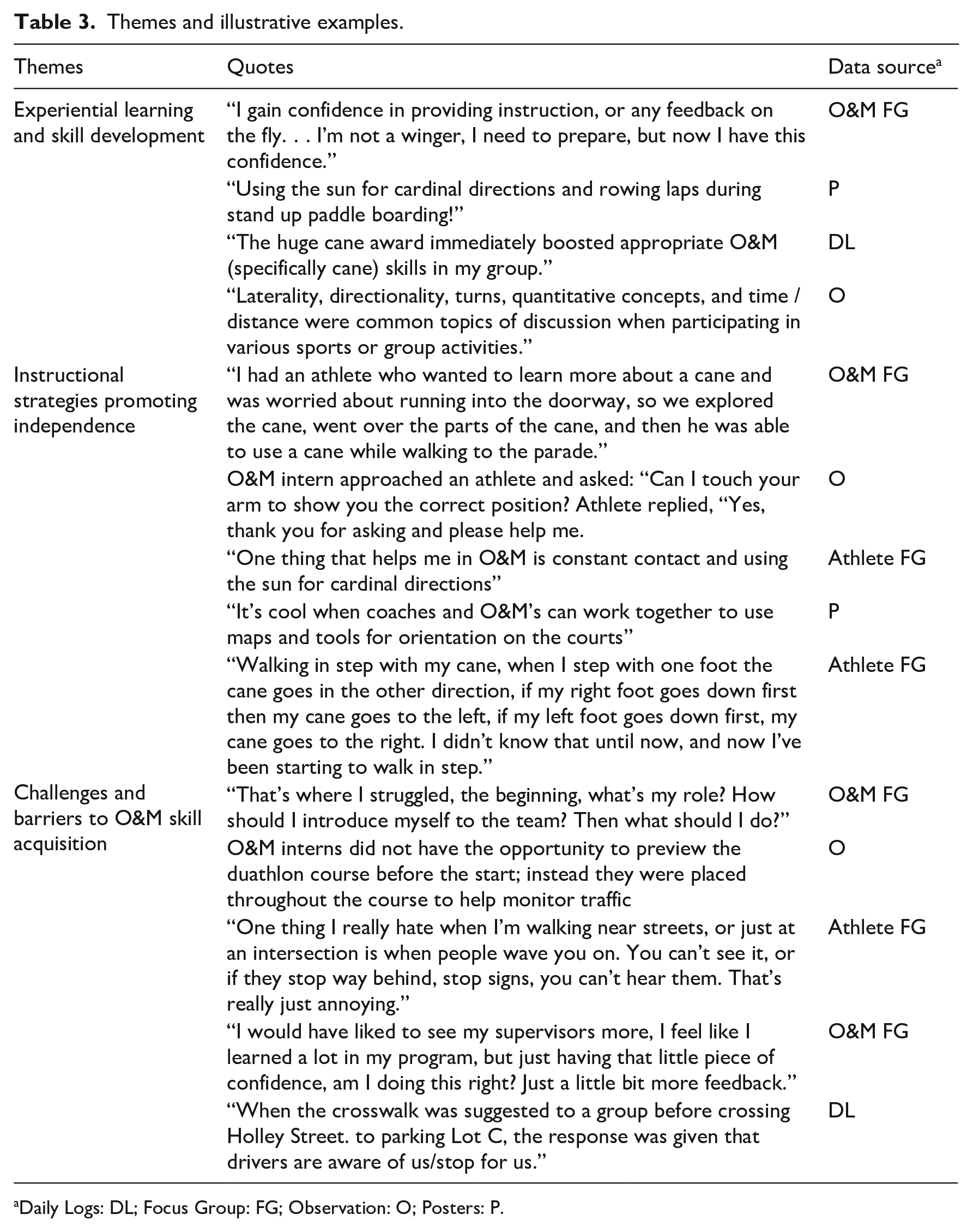
Daily Logs: DL; Focus Group: FG; Observation: O; Posters: P.
Experiential learning and skill development
A thematic analysis of the data suggests that participation in the camp facilitated O&M skill development among both O&M interns and athletes. During the focus group, an intern shared, “I really liked picking up tips like teaching the time and distance relationship ideas that could be incorporated into swimming and running.” Through a multidisciplinary team approach, APE specialists, coaches, and O&M interns integrated specialized pedagogy to enhance sports education for individuals with visual impairments. Researchers such as Szabo and Panikkar (2017) have highlighted the benefits of collaboration between related service providers and O&M specialists, underscoring the value of a coordinated approach. Within this collaborative framework, the camp provided structured opportunities for instructional and personal growth, promoting skill development and goal attainment among athletes. Many of the athletes and O&M interns appeared to demonstrate gains in confidence, adaptability, and technique (Lieberman et al., 2023). For example, an intern discussed, “I gain confidence in providing instruction, or any feedback on the fly.” In addition, O&M interns directly supported athletes in developing O&M skills while enhancing their learning in adapted sports.
Focus group data revealed that O&M interns took on leadership roles within their groups as the week progressed, allowing them to deliver O&M instruction to athletes in meaningful ways. Notably, during an intern focus group one participant shared: It’s only been like four days or five days, but I feel like we’ve all emerged as leaders now in these groups. Whereas, like we had that backseat at first, but now it’s like, oh, we’re clearly some of the most knowledgeable people in these traveling groups of teams. Aside from the specialists and I think people have come to realize that.
The collaboration between the seven O&M interns proved invaluable; they frequently exchanged ideas, supporting one another in constructing new insights and approaches to instruction. Furthermore, the collective effort led to the creation of an incentive—the “Giant Cane Award”—presented daily to the team of athletes demonstrating the most growth in O&M skills. Observational and written accounts noted an increase in the use and application of O&M skills among athletes after the award’s introduction, suggesting that this recognition positively impacted motivation and skill acquisition. For example, one athlete wrote, “The huge cane award immediately boosted appropriate O&M (specifically cane) skills in my group.” The collaborative and innovative atmosphere fostered among the interns highlights the benefits of peer support in developing instructional strategies and encouraging engagement in O&M skills.
Instructional strategies promoting independence
Positioning O&M interns within an adapted sports camp provided athletes with unique opportunities to apply their O&M skills in the context of various sports, enhancing their learning and confidence. Sports Courts and Picture Maker Wheatley Tactile Diagramming Kit from the American Printing House (APH, 2024) were used at camp, allowing interns to collaborate closely with APE specialists to tactually preview sports areas with athletes and build essential background knowledge tailored to each activity. Figures 1, 2, and 3 highlight the use of the Picture Maker Wheatley Tactile Diagramming Kit from APH during camp.
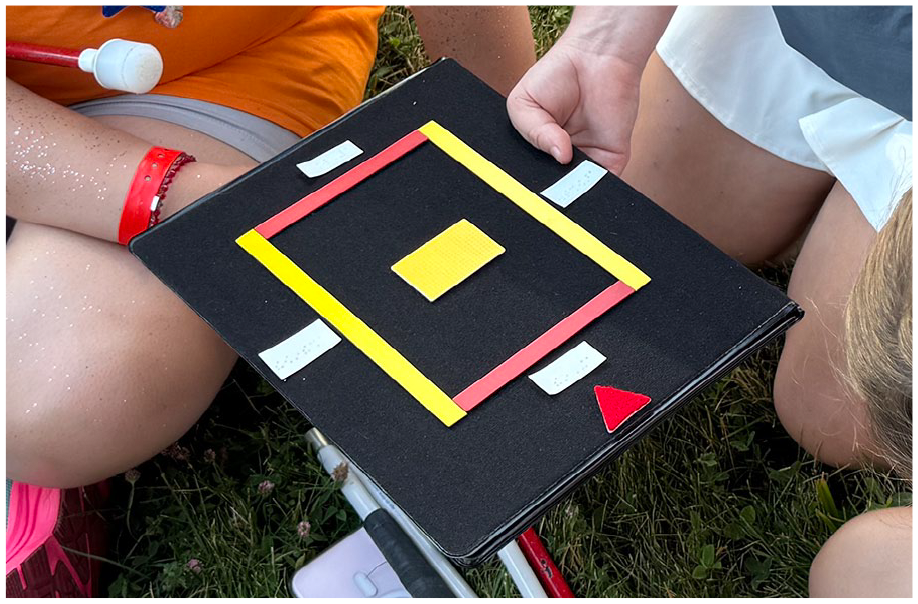
Tactile map of 4th of July route.
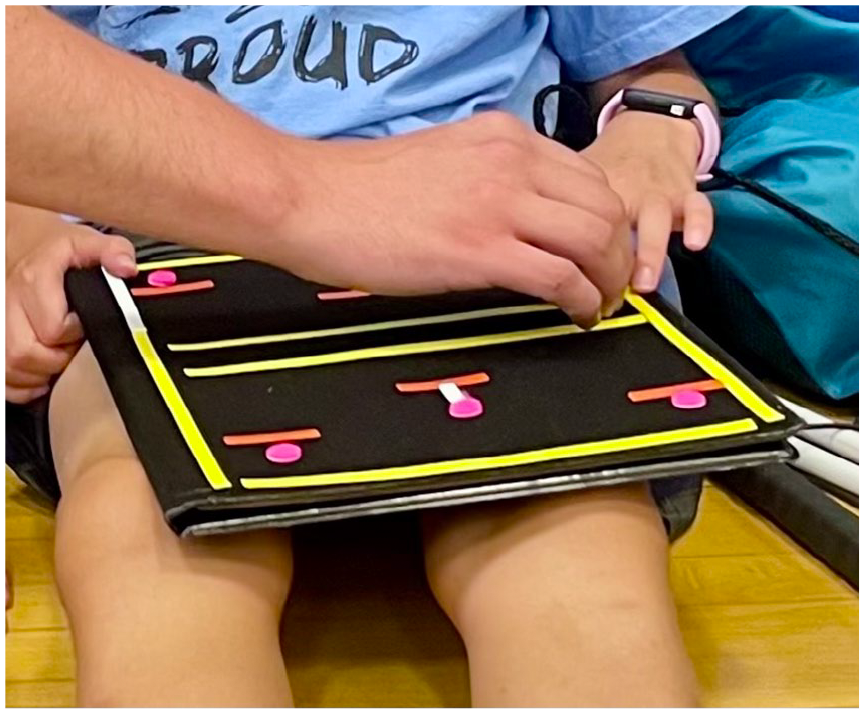
Intern providing instruction for goalball court.
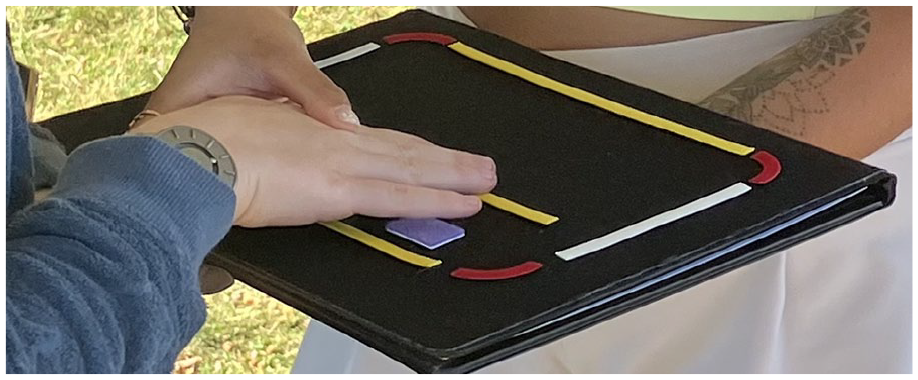
Intern providing information about the tandem bike route.
Furthermore, this approach allowed interns to bridge skill acquisition across both APE and O&M, reinforcing spatial awareness, familiarity with sports-specific movement, and independence in adapted sports settings. An O&M intern reported: I feel like something I learned working with Grace was the importance of risk, we would collaborate, maybe for 20 seconds, does this map look okay? We’d try it or we would change it . . . I learned from just doing it.
Modeling and specific feedback were observed and discussed during focus groups, playing a crucial role in the learning experiences of both interns and athletes at camp. Athletes noted how interns provided both praise and constructive guidance to support their skill development. During the athlete focus group, one participant reflected on the feedback received, stating, “She would tell me that I am sweeping my cane really well and just using it in the correct manner.” In addition to direct instruction, athletes also benefited from informal discussions with interns about O&M strategies. Another athlete participant shared, “I talked to her a couple of times about O&M, and she would, like, give helpful tips, or like, praise us for doing good on our O&M.” These interactions reinforced proper technique and created a supportive learning environment where athletes could refine their mobility skills with encouragement from the interns.
Challenges and barriers to O&M skill acquisition
Although the O&M interns met three times on Zoom before camp to discuss specifics about the program, several notable barriers emerged during the camp that limited instructional opportunities for both O&M interns and athletes. Prior to the athletes’ arrival, many O&M interns reported feeling isolated from the larger camp community and expressed a lack of clarity about their roles within the camp. An O&M intern discussed, “It was odd that there was not a plan for us, a specific role. We were surprised by being told we were going to do a presentation. We didn’t really understand what about because O&M is kind of broad.” The absence of a strong sense of belonging and purpose among interns indicated a need for more deliberate communication and collaboration with coaches, specialists, and camp directors in the lead-up to the camp. Purposeful planning with coaches, specialists, and camp directors would allow O&M supervisors to more thoughtfully and deliberately infuse O&M skills and activities into existing camp activities. In addition, fostering inclusion and clearly defining roles ahead of time could better integrate O&M interns into the broader camp ecosystem, enhancing both their instructional impact and personal engagement. Adopting a more transdisciplinary approach would also likely benefit the athletes (Rausch et al., 2021). In addition, the camp’s intensive, week-long schedule, filled with diverse activities and objectives, created time constraints that limited the depth of instructional interactions. With such a condensed format, there was little room for individualized guidance and mentoring opportunities, potentially impacting the interns’ ability to apply and refine their skills.
Similarly, a primary focus of this internship was to provide O&M interns with hands-on experience and help them meet competencies required by ACVREP. However, interns expressed concerns about feeling vulnerable in their role as future COMS, particularly if this camp represented their only field work. For instance, an O&M intern asserted, “If this had been my only COMS experience, I think I’d be feeling pretty fragile as a new COMS. I’m not really sure anything can get signed off on my paperwork.” The limited exposure to more generalizable O&M opportunities left some feeling unprepared to independently manage common scenarios they would face in residential environments.
In addition, certain environmental limitations posed barriers to more advanced skill acquisition. Specifically, the camp’s location on a college campus restricted access to settings needed for teaching complex O&M skills, such as street crossings, public transportation, or navigation in busy urban environments. The camp structure is just one example of how contextual factors can limit the scope of experiential learning opportunities in O&M instruction. Addressing these barriers could enhance the camp’s instructional effectiveness and foster a more cohesive, supportive environment for O&M interns and athletes alike.
Limitations and future research
The current study included a convenience sample of youth with visual impairments and O&M interns attending the camp. That is, all participants chose to apply and participate in a sports camp. In addition, this study occurred at one camp, whose leadership chose to add an O&M internship program to the existing camp program. As each camp is structured differently and emphasizes different ECC skills, the findings may not be transferable or representative of the O&M internship experiences at other camps.
Moreover, this particular camp typically does not host individuals with multiple disabilities. Thus, O&M interns in this placement have limited opportunities to provide direct instruction to athletes with multiple disabilities. Similarly, the camp’s setting on a college limits interns’ ability to teach more advanced O&M skills (e.g., complex street crossings, public transportation) to athletes. As a result, interns would need to complete an additional internship at another site to meet ACVREP and AER’s required competencies. Future research should explore what specific skills athletes learn at camps and how these align with the competencies required by ACVREP for internship and certification.
Based on the data collected, it appears that O&M interns learned more about APE and how to adapt physical activity and recreation activities for their students and clients. However, we did not consider whether the camp’s coaches and specialists learned more about O&M and how to reinforce students’ O&M skills. Researchers should investigate whether the inclusion of an O&M internship at camp improves coaches’ and specialists’ knowledge of and confidence in reinforcing O&M skills.
Conclusion
The findings from this study highlight the transformative potential of immersive experiential learning in an adapted sports camp setting. By actively engaging O&M interns in one-week programs like this sports camp, both interns and athletes seemed to benefit from meaningful instructional and learning experiences. O&M interns expressed growth in leadership, adaptability, and instructional strategies, which positively influenced the confidence and skill acquisition of athletes. Collaboration with APE specialists and innovative use of tools such as tactile diagrams further enhanced the instructional environment, bridging skill development across O&M and sports activities.
However, the study also underscores the importance of clear communication, as well as intentional role definition, thoughtful and coordinated development of the internship experience, and pre-camp preparation to maximize the effectiveness of such internships. Addressing barriers, including the feeling of isolation among interns and the time constraints inherent in short-term programs, is essential to optimize both learning outcomes and professional growth opportunities. These insights contribute to a deeper understanding of how short-term experiential programs can strengthen O&M education, support the acquisition of required internship hours, and foster independence and confidence in youth with visual impairments.
