







Abstract
This qualitative study explores how middle school students with visual impairments perceive and conceptualize environmental issues. Drawing on data from semi-structured interviews with 13 students across different grade levels, the research examines participants’ understanding, emotional responses, and proposed solutions to a range of environmental problems. Findings reveal that students demonstrate high sensitivity and moral awareness toward environmental degradation, particularly regarding observable and experientially grounded issues such as air, water, and soil pollution. Interestingly, some students appeared to have knowledge about abstract or large-scale phenomena such as global warming, ozone layer depletion, and acid rain, even though they had not yet received formal instruction on these topics; however, significant conceptual misunderstandings were observed in their understanding. The study emphasizes the need to address and correct some of the preconceptions that students with visual impairment hold about environmental concepts.
Keywords
Introduction
The 21st century, as one of the most critical periods in human history, has been a time period in which the importance of environmental problems has been increasingly recognized. Rapid industrialization, urbanization, population growth, and changes in consumption habits have led to environmental degradation worldwide, and this situation has reached a dimension that threatens the future of humanity. Therefore, understanding environmental problems, raising awareness about these problems, and generating solutions have become one of the main goals of education systems (Lindsey et al., 2021).
Environmental education contributes to the development of individuals’ abilities to understand the world they live in, to question change, to make responsible decisions and to be effective citizens (Orr, 1992). In this sense, examining individual views, attitudes and perceptions toward environmental problems is indispensable for an effective environmental education design. However, studies on this subject generally focus on the views of individuals with typical vision, and the perceptions of individuals with disabilities, especially students with visual impairment, are not sufficiently considered (Güler, 2023). This study aims to reveal the perceptions of students with visual impairments about environmental problems.
Background
Despite the growing urgency of environmental issues, many individuals, especially those with limited exposure to sustainability education, continue to rely on natural resources without a clear awareness of their finite nature (Kopnina & Cocis, 2017). However, this knowledge gap often leads to an overreliance on the environment, with the assumption that it will indefinitely support human needs. The Earth, through increasingly frequent ecological disruptions, reminds humanity that unconscious behaviors are causing severe environmental degradation and threatening the survival of all living beings (Newell & Dale, 2015).
Since the Industrial Revolution, technological advancements—such as factories, transportation systems, and chemical industries—have significantly improved human life (Perovich, 2018). Yet, the relentless pursuit of energy to meet expanding human demands has resulted in exploitative environmental practices (Saidi & Hammami, 2015). This has led to critical global environmental challenges, including climate change, pollution, ecological degradation, and global warming, all of which are closely tied to the dominant consumer culture and heavy fossil fuel use (Dong et al., 2019). Despite the global nature of these issues, individuals often perceive them as distant or abstract risks, especially when they cannot directly experience them. However, environmental problems occurring in one part of the world can have real, local impacts—even in one’s own backyard (Breves & Schramm, 2021; Scannell & Gifford, 2013). Hence, although environmental issues may vary across regions, their global interconnectedness necessitates a universal approach to environmental awareness and action.
At the core of these global environmental problems lie overpopulation, unsustainable resource use, excessive urbanization, pollution, and industrial expansion, all of which contribute to biodiversity loss and threaten the continuity of various species (Ürey et al., 2011). Since the 1960s, global leaders in politics, science, and education have increasingly acknowledged the severity of these issues, and in response, an ecological worldview advocating environmental protection has gained momentum (Walter, 2023). One major milestone in global environmental advocacy was the 1972 United Nations Conference on the Human Environment held in Stockholm. This led to the establishment of the International Environmental Education Programme in 1975 and the landmark Tbilisi Intergovernmental Conference on Environmental Education in 1977. These initiatives laid the foundations for defining the goals, principles, and strategies of environmental education at both national and international levels.
Over the decades, environmental education evolved in its purpose and approach: in the 1980s, it became a vital strategy for preserving the planet’s resources; in the 1990s, it embraced the concept of sustainable development; and by the 2000s, it began emphasizing sustainability awareness and action (Palmer, 1995; Ünal, 2008). Today, environmental education aims to foster environmentally responsible behaviors, equipping individuals with the knowledge, skills, and attitudes necessary to make informed decisions (North American Association for Environmental Education [NAAEE], 2014; Pooley & o’Connor, 2000). A key goal of environmental education is to promote environmental literacy, which encompasses awareness of the functioning of natural systems and the impact of human activities (Lezak & Thibodeau, 2016). Since the relationship between humans and nature is often shaped through formal education, environmental literacy development begins in early childhood and continues through primary and secondary schooling (Karaarslan et al., 2014).
Potter (2010) outlined three major goals for environmental education: (1) Raising awareness of ecological, social, and economic interdependencies, (2) Providing all individuals with values, attitudes, and opportunities to protect the environment, and (3) Promoting new behavioral patterns toward sustainable living. Environmental education thus plays a central role in fostering knowledge, attitudes, and behaviors that are conducive to the protection of nature. It is also seen as an essential component of sustainability efforts, encompassing environmental, economic, and social dimensions (Shephard, 2009). As such, many countries have integrated environmental education into various stages of the education system—from preschool to higher education—often as part of multidisciplinary curricular content (Zachariou et al., 2019). While environmental education is not always offered as a standalone subject in elementary curricula, related learning outcomes are often integrated across disciplines such as science, social studies, and life sciences, reflecting a cross-curricular approach adopted in many international education systems (UNESCO, 2017). Of these, the science curriculum stands out for its comprehensive inclusion of environmental concepts. These include biodiversity, natural disasters, pollution, fossil fuels, space debris, waste management, global warming, acid rain, sustainability, and nuclear power plants (Özata-Yücel et al., 2018). The science curriculum’s interdisciplinary design integrates environmental content from physics, chemistry, and biology. However, rather than being structured as a cohesive whole, these topics are often scattered across various units and linked to other learning outcomes (Ateş, 2019). Despite this fragmented approach, the environmental learning outcomes are crucial in shaping students’ understanding of global and local environmental issues.
Research suggests that early experiences significantly influence later cognitive development and learning (McCormick et al., 2020). In particular, the primary education period is considered pivotal in forming positive environmental attitudes and behaviors. Children’s mental schemas—formed through observation, repetition, and role modeling—eventually evolve into knowledge, skills, values, and actions during their schooling (Karpudewan et al., 2015). Accordingly, education programs in this period are essential for cultivating environmental literacy and empowering students to propose solutions to environmental challenges (Powers, 2004).
Although environmental education is vital for all learners, research exploring how students with visual impairments perceive and internalize environmental issues remains limited. These students encounter the world differently, often relying on alternative sensory experiences and cognitive strategies. Therefore, examining how they interpret environmental information and interact with nature is not only important for inclusive education but also for ensuring that sustainability efforts truly reflect the diverse needs and perspectives of all members of society.
This study aims to explore how students with visual impairments perceive environmental issues, examining their understanding, attitudes, and potential contributions to environmental protection. In this context, it will be analyzed which environmental problems students draw attention to and what kind of sensitivities they develop about environmental action. By focusing on a group whose interactions with the physical environment are mediated through non-visual experiences, the study provides unique insights into how environmental education can be made more accessible, inclusive, and impactful.
Method
In this study, a qualitative research approach was employed to facilitate a thorough and nuanced examination of the events and experiences relevant to the research objectives. This methodology enabled the researchers to capture rich, detailed data and to interpret the underlying meanings and contextual dynamics that shaped participants’ perspectives and behaviors (Creswell, 2013).
Participants
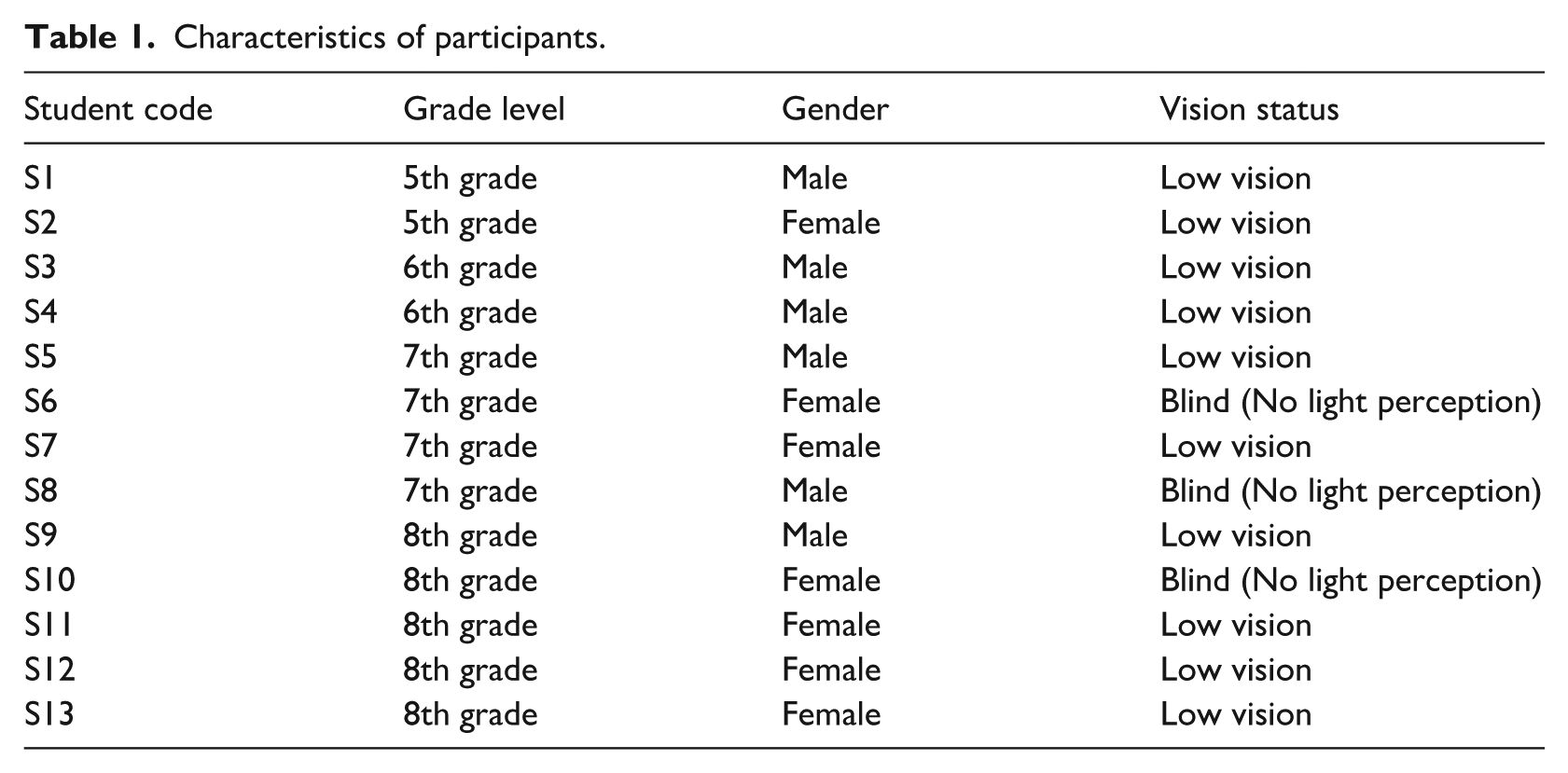
In the current study, purposive sampling was employed to determine the study group. Purposive sampling is preferred when the aim is to study one or more specific cases that meet certain criteria or possess particular characteristics relevant to the purpose of the research. In the first phase of the study, which involved needs analysis, a total of 13 middle school students from different grade levels were included (two students from fifth grade, two from sixth grade, four from seventh grade, and five from eighth grade), and the characteristics of these students are presented in Table 1.
Characteristics of participants.
Data collection tool
The data for this study were collected exclusively through semi-structured interviews designed to explore middle school students with visual impairments’ perceptions of environmental issues. The interview protocol was developed based on a review of the environmental education literature and aligned with students’ developmental characteristics. The questions were structured to elicit student thinking across three dimensions: causes, consequences, and proposed solutions to environmental problems.
The questions were carefully designed to elicit any existing understandings or ideas students might have regarding environmental themes such as air pollution, global warming, and ozone layer depletion, which were later reflected in the findings. All interviews were conducted individually and orally, with necessary accommodations based on the students’ vision levels and communication needs. The interviews were audio-recorded with consent and, when needed, clarifying prompts were used to encourage students elaborate on their ideas. Participation was voluntary, and informed consent was obtained from the participants’ guardians in accordance with ethical research principles.
Data analysis
The qualitative data obtained from the semi-structured interviews were analyzed using content analysis. Audio recordings were first transcribed verbatim, and the resulting transcripts were examined inductively. Student responses were categorized under three key analytical dimensions: causes, consequences, and proposed solutions to environmental issues. Thematic codes were generated based on recurring concepts, ideas, and misconceptions in the students’ explanations.
To accurately reflect students’ perceptions, direct quotations from participants were integrated into the findings section. These quotations served to illustrate students’ conceptual understandings, emotional expressions, and the reasoning behind their environmental interpretations. The inclusion of these firsthand accounts allowed for a richer and more authentic representation of student voices.
To ensure participant confidentiality, students were not identified by name. Instead, each participant was assigned a unique code (e.g., S1, S2, . . . S13), which was used throughout the analysis and reporting. This approach preserved anonymity while still allowing readers to trace individual perspectives across different themes.
To enhance the credibility of the analysis, coding was carried out independently by two researchers, and any discrepancies were resolved through discussion and consensus. This collaborative process contributed to the consistency and trustworthiness of the thematic structure presented in the study.
Findings
This section presents students’ conceptualizations of environmental issues, based on their responses to questions about 13 key environmental problems. The data were categorized into three dimensions—causes, consequences, and proposed solutions of the students—and are organized by thematic area. Two overarching patterns were identified: (a) a higher level of familiarity with concrete and observable forms of pollution (e.g., air, water, and soil), and (b) the emergence of informal or pre-instructional understandings—often marked by misconceptions—about more abstract environmental phenomena (e.g., global warming, ozone depletion, acid rain), which are typically addressed at later stages in formal education.
Theme 1: air pollution
Among all environmental themes, air pollution emerged as the most frequently and coherently stressed. Students predominantly identified vehicle exhaust and factory emissions as primary contributors. Some participants also mentioned open fires, deforestation, and tobacco smoke as contributing factors.
The consequences articulated by students tended to focus on human and animal health, including respiratory damage and lack of oxygen. As for proposed actions, students suggested filter installation in factory chimneys, increased use of electric and public transportation, and raising awareness among individuals. For instance, S10 asserted that
Animal species are becoming extinct, and the reason for this is our actions. Air pollution prevents animals from breathing, cutting down trees reduces oxygen levels, and polluted seas make it impossible for fish to survive.
Theme 2: water pollution
Water pollution was the second most commonly discussed theme. Students emphasized littering in rivers and seas, chemical waste from factories, and sewage disposal as prominent causes. The consequences included animal deaths, water discoloration, and scarcity of clean water resources.
Suggested actions ranged from proper waste disposal to recycling, though few students mentioned systemic solutions such as wastewater treatment. Students’ awareness of water-related environmental problems appeared grounded in lived experiences or observations. In this sense, S11 stated that
People throw trash and masks into rivers . . . germs spread . . . fires also affect the air.
Theme 3: soil pollution
Students’ understanding of soil pollution was closely related to waste management. Responses predominantly emphasized improper disposal of batteries, bottles, and garbage, with fewer references to industrial causes. Consequences included decreased soil fertility, harm to vegetation, and even threats to food security.
Proposed interventions centered around recycling, using waste bins, and avoiding littering, again suggesting a tendency to propose individual-level behavioral solutions rather than systemic change.
Theme 4: global warming
Student responses concerning global warming were diverse and reflected pre-instructional understandings that sometimes included misconceptions. While many correctly linked it to air and environmental pollution, deforestation, and ozone depletion, their explanations frequently revealed conceptual confusion.
Common consequences included climate change, melting glaciers, sea-level rise, and extreme heat. Some students associated global warming with the disappearance of polar bears or global catastrophe. Suggested remedies—such as planting trees, avoiding electricity waste, and reducing pollution—were often cited but not connected to the underlying mechanisms of greenhouse gas accumulation. For example, the statements of students S5 and S9 are as follows:
Too much light causes global warming. I think water will run out in the 21st century. The heat dries the water, and since no trees are planted, there is no rain. (S5) When the ozone layer melts, the sun’s rays harm us. Global warming follows, and people get skin cancer. (S9)
Theme 5: light, sound, and other less tangible forms of pollution
Light and noise pollution were less frequently and less clearly explained. Some students identified billboards, fireworks, and car noise as contributing factors. Consequences were more speculative, with a few students referring to eye damage or difficulty observing celestial objects. In this sense, S2 asserted that
Among environmental problems, there is also light and noise pollution. Light pollution happens when unnecessary fireworks are set off into the sky, when building lights are left on unnecessarily, or when billboard lights are turned on in the middle of the night when no one is around.
Theme 6: climate change
Students’ understanding of climate change was most often articulated through its observable consequences rather than its causes. Participants frequently mentioned shifting seasons and drought as key impacts. A few also noted the harm to living beings, but responses concerning causes were sparse and vague.
One student linked climate change to fossil fuel use, but there was minimal reference to greenhouse gas emissions or atmospheric processes. In terms of solutions, the only suggestion mentioned was international agreements, reflecting a limited grasp of both the global scope and governance frameworks of climate change.
Theme 7: ozone layer depletion
Responses related to ozone layer depletion revealed that students tended to merge or confuse the topic with global warming, suggesting that these concepts were not yet clearly differentiated in their pre-instructional knowledge. Students associated the phenomenon with air pollution, deodorant usage, and exhaust fumes. Consequences included increased UV exposure, skin diseases, and drought, yet scientific mechanisms were rarely described.
While a few students correctly identified aerosol sprays as harmful, there was no mention of CFCs (chlorofluorocarbons) or international policies such as the Montreal Protocol. Suggested solutions were limited to reducing deodorant use and developing harmless alternatives. For instance, S13 asserted that
I know ozone layer depletion causes the earth to heat up. Too much perfume makes it worse. To prevent it, we should make safe gases and reduce deodorant use. (S13)
Theme 8: acid rain
Although less prominent, acid rain was one of the themes where students offered relatively rich explanations regarding its effects. They described damage to skin, plants, historical artifacts, and water sources. However, most attributed acid rain to air pollution or chimney smoke without naming the specific chemicals involved. For example, S9 stated that
As far as I know, acid rain damages historical buildings and stone houses. (S9)
The suggested solution—to be aware and sensitive—reflects again a moral framing rather than scientific reasoning.
Theme 9: overpopulation
Students associated overpopulation with urban expansion, deforestation, resource depletion, and pollution. Interestingly, while they could identify multiple outcomes, they did not articulate any causal mechanisms or suggest concrete solutions. This thematic pattern suggests the importance of supporting students in developing a more structured understanding of systemic socio-environmental relationships, especially as their current ideas appear to stem from informal learning experiences.
Theme 10: animal extinction
The theme of animal extinction elicited thoughtful and emotionally charged responses. Students identified a range of causes including poaching, habitat destruction, climate change, water scarcity, and pollution. The most common outcome mentioned was the death of animals, particularly polar species. For instance, S10 asserted that
Animals are disappearing because of us. They can’t breathe because of pollution, and they can’t live because we cut down trees and dirty the seas. We should use less gasoline and stop dumping trash in the sea. (S10)
Proposed actions included ending unnecessary hunting, protecting habitats, and promoting empathy toward animals. This was one of the few themes where students connected multiple environmental issues together (e.g., air pollution and deforestation) in explaining biodiversity loss.
Theme 11: resource depletion and waste
Under resource depletion, students identified leaving water and lights on and deforestation as main contributors. Consequences included diminishing freshwater, topsoil loss, and even global conflict. Suggested actions focused on conservation, recycling, waste reduction, and public awareness.
Likewise, the waste problem was discussed primarily in the context of individual behavior. Improper disposal of items such as batteries, glass, and plastic was mentioned, with solutions centered on using recycling bins and raising environmental consciousness.
Theme 12: complex or underrepresented issues
Topics such as ozone depletion, acid rain, and overpopulation were less clearly understood, likely due to their complexity and students’ limited formal exposure. These findings reflect the importance of introducing such topics using developmentally appropriate methods. For example, ozone depletion was often confused with global warming, while acid rain was generally described as damaging to historical structures or human skin. Students rarely linked these phenomena to emissions of sulfur dioxide or nitrogen oxides.
Similarly, overpopulation was associated with consequences such as urban expansion, resource depletion, and deforestation, yet its causes and policy-related implications were left unexamined.
Theme 13: solutions and actionability
Across nearly all environmental themes, students demonstrated greater ease in proposing individual-level solutions than in articulating the structural causes of environmental degradation. Common suggestions included turning off lights and taps, planting trees, avoiding littering, and raising awareness. The repeated emphasis on being responsible and conscious points to a moral framing of environmental responsibility rather than a scientific or systemic one.
Summary of cross-theme patterns
Across all themes, student responses reflected a strong concern for the environment and a desire to contribute positively. While their responses demonstrated meaningful engagement, students’ scientific understanding—particularly of large-scale or abstract environmental systems—was shaped by informal sources and prior beliefs. These pre-instructional conceptions often included inaccuracies, suggesting the need for targeted instructional scaffolding rather than indicating an absence of knowledge. Most proposed solutions emphasized personal responsibility over structural or policy-level interventions, indicating a gap between moral awareness and scientific literacy.
Overall, the findings suggest a need to strengthen instructional emphasis on the interconnectedness of environmental problems, address misconceptions, and foster systems thinking, particularly regarding global challenges such as climate change and biodiversity loss.
Discussion
The results of this study provide valuable insight into how middle school students with visual impairments understand environmental problems. Students’ responses demonstrated a genuine concern for the natural world, often expressed through emotionally charged language and concrete behavioral suggestions. However, their conceptual understanding varied considerably across topics, revealing that while students demonstrated strong moral awareness, their developing scientific understandings were sometimes shaped or constrained by prior informal conceptions, particularly in relation to abstract environmental topics that had not yet been formally introduced. This trend also noted in prior studies on environmental cognition in young learners with normal vision (e.g., Liao et al., 2022; Torkar & Mavrič, 2016).
One pattern that appeared in the data was that students seemed to engage more confidently with environmental issues that were observable, immediate, and personally experienced (e.g., air and water pollution). Their responses in these domains often referenced familiar sensory cues like unpleasant odors, visible waste, or the discomfort caused by smoke and noise. This tendency may be shaped not only by the concrete nature of these issues but also by students’ prior exposure through formal instruction, media, or everyday experience—factors not directly examined in this study. The finding aligns with Bruner’s (1966) notion that children initially construct meaning through enactive and iconic representations, relying heavily on direct sensory input. For students with visual impairments, alternative sensory pathways—particularly olfactory, auditory, and tactile modalities—likely play a central role in conceptualizing environmental phenomena (Pinquart & Pfeiffer, 2011). In these more tangible contexts, students were also more likely to suggest plausible and actionable solutions, such as recycling, conserving water, or reducing car use, which echoes Palmer’s (1995) findings on how children can translate everyday environmental encounters into behavioral responses.
In contrast, more abstract or large-scale phenomena—such as global warming, ozone layer depletion, acid rain, and overpopulation—were often misunderstood, oversimplified, or confused with one another. For instance, global warming was sometimes incorrectly described as a result of artificial lighting or conflated with ozone depletion, mirroring misconceptions commonly reported in the literature (Boyes & Stanisstreet, 1993; Papadimitriou, 2004). These patterns may reflect the natural challenges associated with transitioning from concrete to abstract thinking, especially in the absence of formal instruction on complex environmental systems (Assaraf & Orion, 2005).
An additional pattern was the prevalence of moral framing over analytical explanation. Students frequently emphasized personal responsibility—such as “not polluting” or “protecting nature”—rather than articulating systemic or scientific explanations. While this demonstrates the internalization of pro-environmental values (Hungerford & Volk, 1990), it also suggests that while students have internalized ethical values, the integration of these with scientific reasoning is still emerging and requires further instructional support. This phenomenon has been documented by Gough (1997), who cautions that overreliance on affective dimensions in environmental education can result in shallow understanding if not paired with cognitive depth.
Furthermore, students’ proposed solutions were overwhelmingly focused on individual behavior, with minimal reference to collective, institutional, or policy-based interventions. This reflects a narrow perception of agency—a pattern that has been previously observed in both sighted and youth with visual impairment (Güler, 2023). The scarcity of references to structural causes such as energy systems, economic policies, or international agreements suggests that students’ system-level thinking—an essential component of environmental literacy (Lezak & Thibodeau, 2016)—is still in its formative stages. This is consistent with research indicating that the ability to analyze environmental issues through complex systemic lenses typically develops through sustained instructional support at later educational stages (Hattie, 2013; Seiffert & Loch, 2005).
Another noteworthy observation was students’ reluctance or difficulty in expressing uncertainty. Rather than acknowledging what they did not understand, students tended to articulate confidently held ideas, some of which diverged from scientific explanations—a tendency noted by Opie (2018) as a barrier to metacognitive development. These observations underscore the importance of fostering metacognitive awareness and creating inquiry-based learning environments that normalize uncertainty. This is particularly crucial for students with disabilities, who may already face challenges in engaging with open-ended discussions and exploratory tasks (Asamoah et al., 2018).
Although the study did not directly examine developmental or sensory factors, the interpretation of students’ conceptualizations may benefit from considering these dimensions. As Piaget (1977) outlines, middle school students are typically in transition from concrete to formal operational thinking, which can limit their ability to engage with abstract or systemic concepts without sufficient scaffolding. For students with visual impairments, the absence of visual supports—such as diagrams, maps, or simulations commonly used in environmental science—may further constrain access to abstract representations (Jones et al., 2006). These considerations underscore the importance of perceptually inclusive instructional approaches, including tactile models, auditory simulations, and experiential learning activities tailored to non-visual modalities (Papadopoulos et al., 2014).
Moreover, middle school is a formative period for cultivating scientific habits of mind—such as hypothesizing, evaluating evidence, and reasoning about cause and effect. Environmental education at this stage should therefore go beyond content delivery to promote epistemic curiosity and systems thinking (Seiffert & Loch, 2005). For students with visual impairments, this requires accessible and interactive pedagogies that support exploration, feedback, and scaffolding (Güler, 2023; Manitsa & Doikou, 2022).
Finally, the social context of learning should also be considered. Teacher expectations, peer interactions, and the accessibility of learning environments shape how students with visual impairment engage with environmental discourse (Erwin et al., 2001). Ensuring these students are not positioned as passive recipients of simplified content, but rather as active participants in constructing knowledge, is essential for both equity and the advancement of environmental literacy (Lindsey et al., 2021).
Recommendations for educational practice and future research
While the current study does not directly evaluate instructional methods, the findings suggest that students with visual impairments may, in some cases, hold strongly held conceptions that diverge from scientifically accepted explanations of environmental issues. In this context, instructional approaches that emphasize meaning-making and conceptual development may offer particular value. Research indicates that these students benefit from opportunities to actively construct knowledge by forming causal relationships, rather than merely recalling isolated facts. Accordingly, strategies such as conceptual change models and inquiry-based learning are widely recognized in the literature for their potential to support the transformation of intuitive or experience-based understandings into more scientifically accurate conceptions. Moreover, instructional design should also support the gradual development of systems thinking—the ability to recognize and analyze the interconnections between individual actions and broader environmental, social, and economic systems. It is also important to recognize that students’ pre-instructional understandings, if left unaddressed, may contribute to persistent misconceptions or conceptual difficulties. Once such misconceptions are formed, they can be resistant to change and may hinder deeper learning (Bransford et al., 2000). Therefore, teachers need to be aware of these early conceptions and be equipped with strategies to identify and respond to them effectively.
Professional development for educators is another key component. Teachers working with students with visual impairments should be equipped with pedagogical strategies that integrate principles from special education, environmental education, and inclusive instructional design. Ongoing training can help ensure that teaching practices are not only effective but also equitable and responsive to the needs of diverse learners. In addition, this study highlights the importance of raising teachers’ awareness that students’ existing knowledge related to environmental concepts may include misconceptions stemming from various reasons. This aspect should be explicitly addressed in professional development programs to ensure that instructional practices are sensitive to and capable of supporting conceptual change.
In terms of future research, longitudinal studies could provide deeper insight into how students with visual impairments develop environmental understandings over time. In addition, comparative studies involving sighted peers or students with other types of disabilities may offer valuable perspectives on the role of sensory modality in concept development. Finally, experimental research examining the impact of specific instructional interventions on students’ environmental concept development would strengthen the evidence base for inclusive teaching practices.
In conclusion, environmental education should be conceptualized not merely as content delivery, but as an inclusive and evolving process that enables all learners to perceive, interpret, and act meaningfully within the world. For students with visual impairments, realizing this goal requires pedagogical approaches that are not only accessible and engaging, but also grounded in an understanding of how knowledge is constructed and transformed.
Footnotes
Acknowledgements
This paper forms part of the PhD thesis of the first author, written under the supervision of the second author.
Data availability Statement
The datasets generated during and/or analyzed during the current study are available from the corresponding author on reasonable request.
Declaration of AI-assisted technologies in the writing process
This article was checked for grammar and clarity using the ChatGPT AI tool under the supervision of the authors. The intellectual content and analysis are entirely the work of the authors.
Funding
The authors disclosed receipt of the following financial support for the research, authorship, and/or publication of this article: This study has been supported by Scientific and Technological Research Council of Türkiye (TUBİTAK) with the project number 120K736.
Ethics statement
The authors declared that the current study was ethically approved by Trabzon University, Social Sciences & Humanities Research and Publication Ethics Board on 04.05.2020 with the approval code: 81614018-000-E.153. This research was conducted in compliance with ethical guidelines, ensuring voluntary participation, informed consent, and the confidentiality and anonymity of all data.
