







Abstract
This study explores the career decision-making experiences of students with vision impairment in higher education, employing Interpretative Phenomenological Analysis (IPA) to gain an in-depth understanding of their personal and social meaning-making processes. Semi-structured interviews were conducted with nine students from diverse academic fields to explore how they interpret their career choices and aspirations, and the factors shaping these experiences. Through the interpretative analysis, four interrelated themes were identified: (1) vision impairment was experienced as an unavoidable factor influencing career perspectives; (2) personal values and interests emerged as central motivators; (3) societal attitudes were perceived as barriers diminishing confidence and opportunities; and (4) resilience was described as being fostered through maintaining hope and adopting practical approaches to guide their career decisions. The study contributes to understanding career development among individuals with vision impairment and emphasizes the need to address both individual and systemic factors to promote inclusive career guidance.
Keywords
Literature Review
Despite ongoing efforts to enhance accessibility and provide accommodations, employment rates for individuals with vision impairment remain markedly lower than those of sighted individuals in multiple countries. In the United States, national surveys consistently show that the employment-to-population ratio for individuals with vision impairment typically falls between the high 30% and mid-40% range, with a considerable proportion not participating in the labor force at all (McDonnall & Sui, 2019). In the United Kingdom, official data indicate that only about 27% of individuals registered as ‘blind’ or ‘partially sighted’ are employed, in contrast to approximately 76% among the general population (Royal National Institute of Blind People [RNIB], 2020). Although postsecondary education has been shown to improve employment outcomes among individuals with vision impairment, it does not fully bridge the employment gap; significant disparities persist even among those with higher levels of educational attainment (McDonnall & Tatch, 2021).
An expanding body of research is increasingly illuminating the complex and interconnected factors that influence the employment experiences of individuals with vision impairment. Key factors influencing their career development and early employment experiences include employer attitudes and awareness, availability of mentoring opportunities, levels of self-determination, access to assistive technologies, health-related limitations, transportation challenges, employer practices, financial concerns, and the presence of accessibility barriers in everyday environments (e.g., Antonelli et al., 2018; Coffey et al., 2014; Crudden et al., 2024; Douglas & Hewett, 2014; McDonnall & Crudden, 2009; McDonnall et al., 2014; O’Mally & Antonelli, 2016). Consistent with this body of research, a recent systematic review and meta-analysis identified several factors associated with employment among individuals with vision impairment, including higher educational attainment, gender, marital status, and the severity of vision impairment (Daniels et al., 2023). These findings underscore the need for systemic interventions targeting not only individual capacity-building but also structural and attitudinal changes within the broader labor market.
In particular, one key area of intervention in response to these multifaceted challenges is mentoring, which has emerged as a promising support strategy for employment preparation. Individuals with vision impairment who received mentoring demonstrated increased assertiveness in job seeking and reported high satisfaction with the mentoring process (O’Mally & Antonelli, 2016). Similarly, longitudinal studies highlight strong mentor-mentee relationships focusing on disclosure, accommodation planning, and professional socialization, with the mentor’s lived experience of vision impairment being especially valued. The quality and relevance of support were found to be more important than geographic proximity (Antonelli et al., 2018). These findings suggest mentoring enhances employment readiness and network development for individuals with vision impairment, with potential longer-term benefits on employment outcomes (Antonelli et al., 2018; O’Mally & Antonelli, 2016). Beyond mentoring-focused interventions, a quasi-experimental study conducted in Taiwan examined the effects of a 6-month vocational training program for adults with vision impairment, conceptualized as a life and career reconstruction intervention. The program resulted in significant improvements in overall quality of life, particularly in psychological well-being, social relationships, and physical health domains (Chu & Chan, 2024). Although employment outcomes were not directly assessed, the findings suggest that vocational training may strengthen psychosocial resources relevant to labor-market participation, such as confidence, self-care capacity, and readiness for independent community engagement.
In parallel with structural supports such as mentoring, individual-level characteristics also play a critical role in shaping employment trajectories for young people with vision impairment. Empirical evidence indicates that factors such as prior engagement in paid employment, higher proficiency in reading and mathematics, effective use of assistive technologies, and elevated levels of self-determination and internal locus of control are significantly associated with an increased likelihood of successful vocational outcomes for individuals with vision impairment (McDonnall & Crudden, 2009). Consistent with these findings, Lund and Cmar (2019) report that prior work experience—especially self-initiated employment—and completion of postsecondary education are among the most reliable predictors of employment outcomes for transition-age youth with vision impairment in the United States. A qualitative study by Douglas and Hewett (2014) provides further insight into the personal and educational factors that support employment readiness among young people with vision impairment. Their findings underscore the importance of self-advocacy skills, which participants reported developing through the repeated need to explain their vision impairment in various contexts. Moreover, their study emphasized the relevance of Expanded Core Curriculum (ECC) skills in facilitating workplace independence, while simultaneously highlighting inconsistencies in access to ECC instruction across educational settings.
In addition to pre-employment preparation and early career support, workplace dynamics following job entry also significantly influence long-term employment outcomes for individuals with vision impairment. Studies on employed individuals with vision impairment show that workplace experiences after entering employment play a key role in shaping job satisfaction. For example, Steverson and Crudden (2023) found that feeling accepted and treated equally by colleagues and having supportive supervisors were strong predictors of higher job satisfaction. These findings highlight the importance of inclusive workplace relationships and advancement opportunities, suggesting that supervisor and coworker training, along with accurate job placement, are essential for improving retention and career growth.
Taken together, existing research highlights the need for coordinated efforts targeting both pre- and post-employment factors affecting individuals with vision impairment. The literature identifies educational attainment, early work experience, assistive technology proficiency, and self-determination as key predictors of employment outcomes, while post-employment factors such as employer awareness, mentoring, inclusive work environments, and supervisory support are linked to job satisfaction and retention. Building on these findings, there appears to be a potential need for interventions within the primary labor market; however, much of the existing evidence is based on participants’ subjective reports of satisfaction, while objective evidence for such interventions remains limited. Despite these insights, there remains a need to better understand how these dynamics are experienced and negotiated during earlier stages of career development. Gaining insight into the factors influencing the career decisions of individuals with vision impairment—and understanding how and why these decisions are made in particular ways—is crucial for developing more responsive and effective support mechanisms. This study addresses this gap by exploring how students with vision impairment make sense of career decision-making during higher education, with attention to the individual, social, and structural factors shaping their career paths.
Method
Participants
To access a small and specific population, a snowball sampling strategy was employed (Patton, 2015). Inclusion criteria required participants to be enrolled in higher education, have a vision impairment, and be willing to share experiences related to career decision-making. Recruitment began with five participants personally known to the researchers, whose interviews also served as a pilot phase to refine the interview protocol.
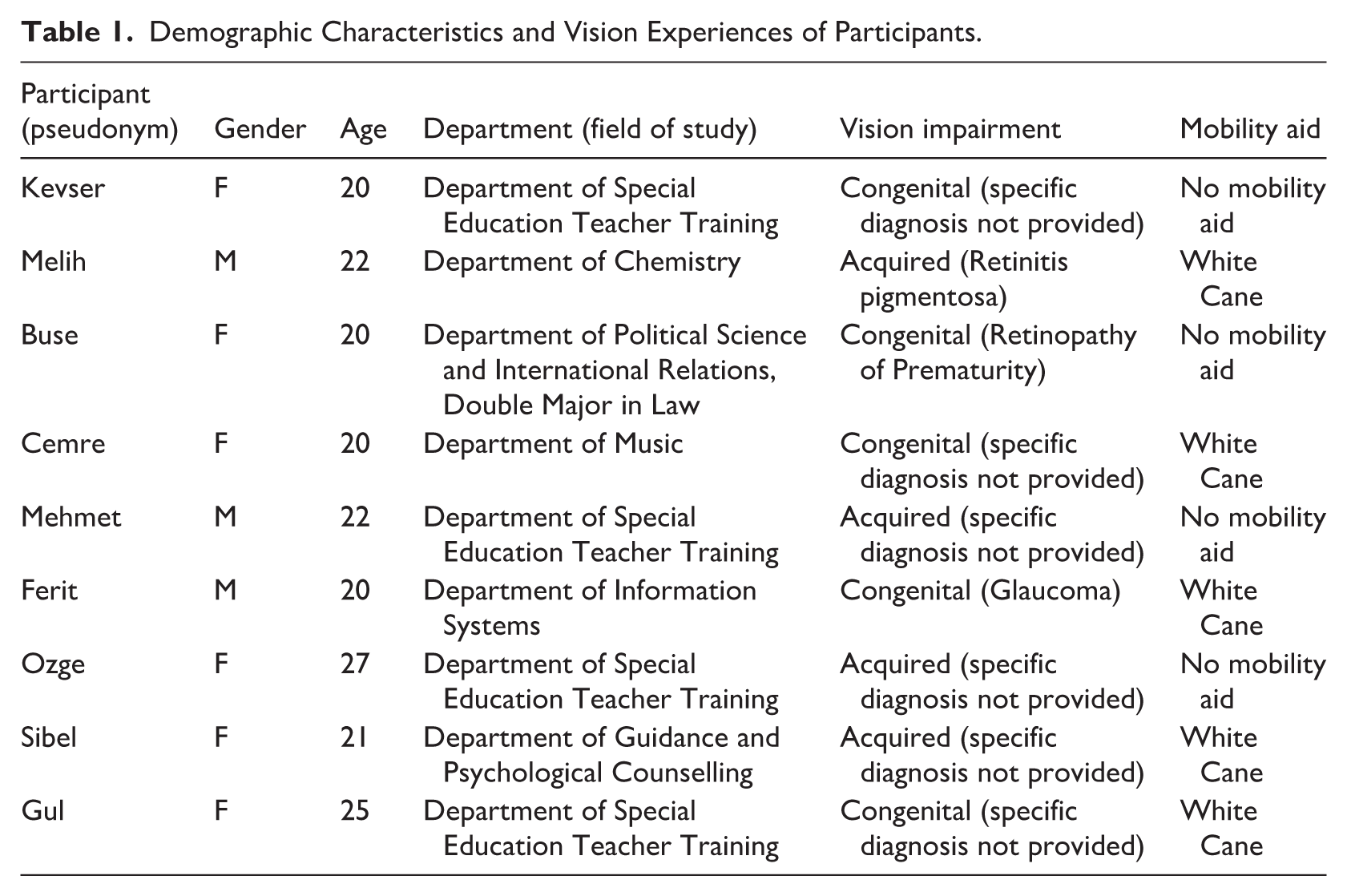
In line with qualitative research procedures, pilot interviews were not included in the final analysis to ensure procedural consistency. These participants then referred peers who met the same criteria, enabling further recruitment through existing networks. Fourteen individuals were interviewed in total; of these, the five pilot interviews were excluded from analysis, and nine participants (five females and four males), aged 20 to 27, were included in the final analysis. The study did not seek to categorize participants according to the degree of vision impairment, as the analytical focus was not on clinical comparison but on lived educational and transition experiences. Therefore, vision impairment was reported descriptively (congenital/acquired and diagnosis where available) rather than in terms of severity levels. The participants described a range of experiences related to vision impairment—some had congenital conditions while others acquired them later in life—and shared differing levels of independence in their daily lives, including the use or non-use of mobility aids (see Table 1).
Demographic Characteristics and Vision Experiences of Participants.
Procedure
To explore how students with vision impairment experience and make sense of their career decision-making processes during higher education, an interpretative phenomenological approach (IPA) was employed. IPA is a qualitative methodology focused on understanding individuals’ personal interpretations of experiences, emphasizing meaning-making rather than objective accounts of events (Smith et al., 1999; Smith & Osborn, 2003). As Smith et al. (1999) suggest, IPA focuses on understanding an individual’s personal interpretation of events or experiences, rather than attempting to provide an objective account of the events themselves. Therefore, it was anticipated that this approach would not only provide insights into the personal experiences of students regarding the factors influencing their career decisions but also help uncover the meanings they assign to these experiences. Moreover, due to the diverse ways in which students may perceive and interpret the factors shaping their career choices, IPA was considered an appropriate methodological approach for this study. Drawing on the principles outlined by Smith and Osborn (2003), IPA was deemed suitable for exploring how students with vision impairment make sense of their personal experiences and the social contexts that influence their career decision-making within the context of higher education. IPA was selected during the initial design of the study, prior to the pilot phase, due to its suitability for exploring lived experiences and meaning-making processes. The pilot study served only to refine the interview questions and did not affect the methodological framework.
In phenomenological research, Denscombe (2014) suggests that conducting interviews with members of a specific group allows researchers to gain deeper insights into their thoughts, experiences, and reasoning, thereby offering an understanding from the participants’ own perspectives. Accordingly, the aim of this study was to explore how students with vision impairment experience and make sense of the factors that influence their career decision-making processes during higher education. To explore these experiences, semi-structured interviews were conducted to investigate how these students perceive their career decision-making in relation to various enablers and barriers they encounter in the higher education environment. A semi-structured interview schedule was designed to explore the participants’ lived experiences across four key experiential domains: (1) personal and educational background, focusing on how participants make sense of their life history and educational journey in the context of their vision impairment; (2) the experiential impact of vision impairment on daily and academic life, examining how individuals perceive and navigate barriers and enablers; (3) meaning-making around career and academic choices, addressing how participants describe the process of selecting a field of study and envisioning a future profession; and (4) future orientation and perceived barriers, exploring how participants anticipate and interpret opportunities and obstacles related to future employment, shaped by their lived experience of vision impairment.
Ethical approval for the study was obtained from the Ethics Committee of [. . .] University. The interviews were conducted via telephone and lasted approximately 55 to 60 min each. All participants provided informed consent prior to the interviews, and confidentiality and anonymity were strictly maintained. Interviews were first audio-recorded, then transcribed verbatim, with all data securely stored and accessed only by the authors.
Data Analysis
The analysis followed Smith’s IPA framework (Smith & Osborn, 2003) through a systematic and iterative process. The lead researcher engaged deeply with the data by reading it multiple times and making detailed notes to identify initial themes. These themes were then developed and connected, while preserving the uniqueness of each participant’s experience. Other researchers later joined the process to help identify patterns across cases, strengthening the credibility and depth of the analysis. Finally, the interpretation was enriched by considering temporal references, providing a fuller and more nuanced understanding.
Analysis was conducted in accordance with the principles of IPA, beginning with detailed, case-by-case examination of each transcript. Following the idiographic analysis, patterns were explored across cases to identify convergences and divergences. The themes presented in the findings represent recurring experiential patterns that emerged across multiple participants. However, consistent with IPA’s idiographic commitment, themes were not expected to appear uniformly or with equal emphasis in every account. Rather than representing universal categories, the reported themes reflect shared meaning-making processes identified through cross-case analysis.
Findings
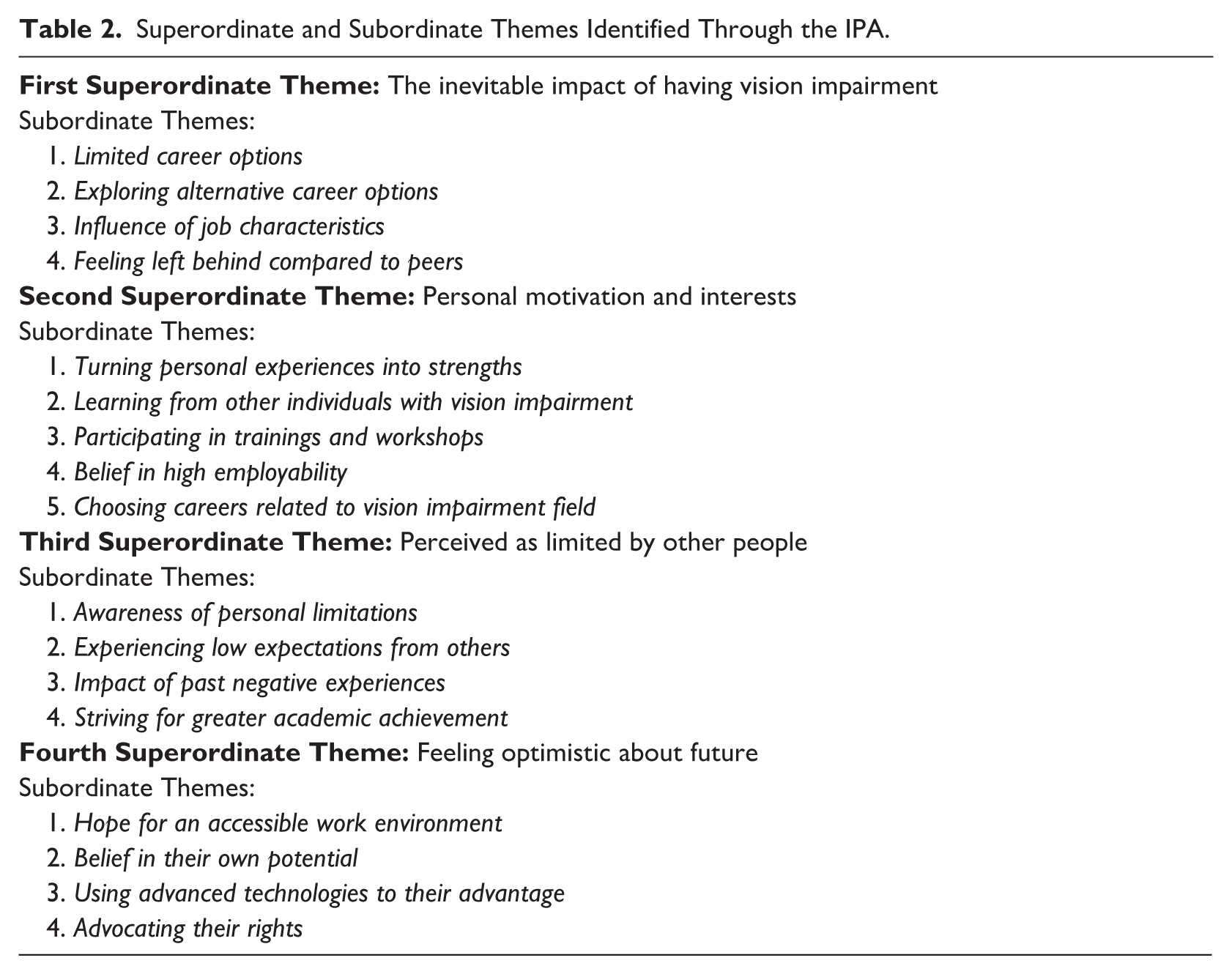
The IPA identified four key superordinate themes that shed light on how and why individuals with vision impairment make career choices, navigate challenges, and shape their professional futures (see Table 2). The first theme reveals how vision impairment fundamentally shapes participants’ perceptions of available career options and explains why vision impairment is a central factor in decision-making. The second theme highlights why participants pursue particular careers driven by their personal interests and values. The third theme shows how societal attitudes create additional barriers, impacting both the challenges participants face and their confidence in pursuing their careers. The final theme reveals how participants sustain hope and agency by envisioning future advancements in technology and actively seeking necessary accommodations (see Figure 1).
Superordinate and Subordinate Themes Identified Through the IPA.
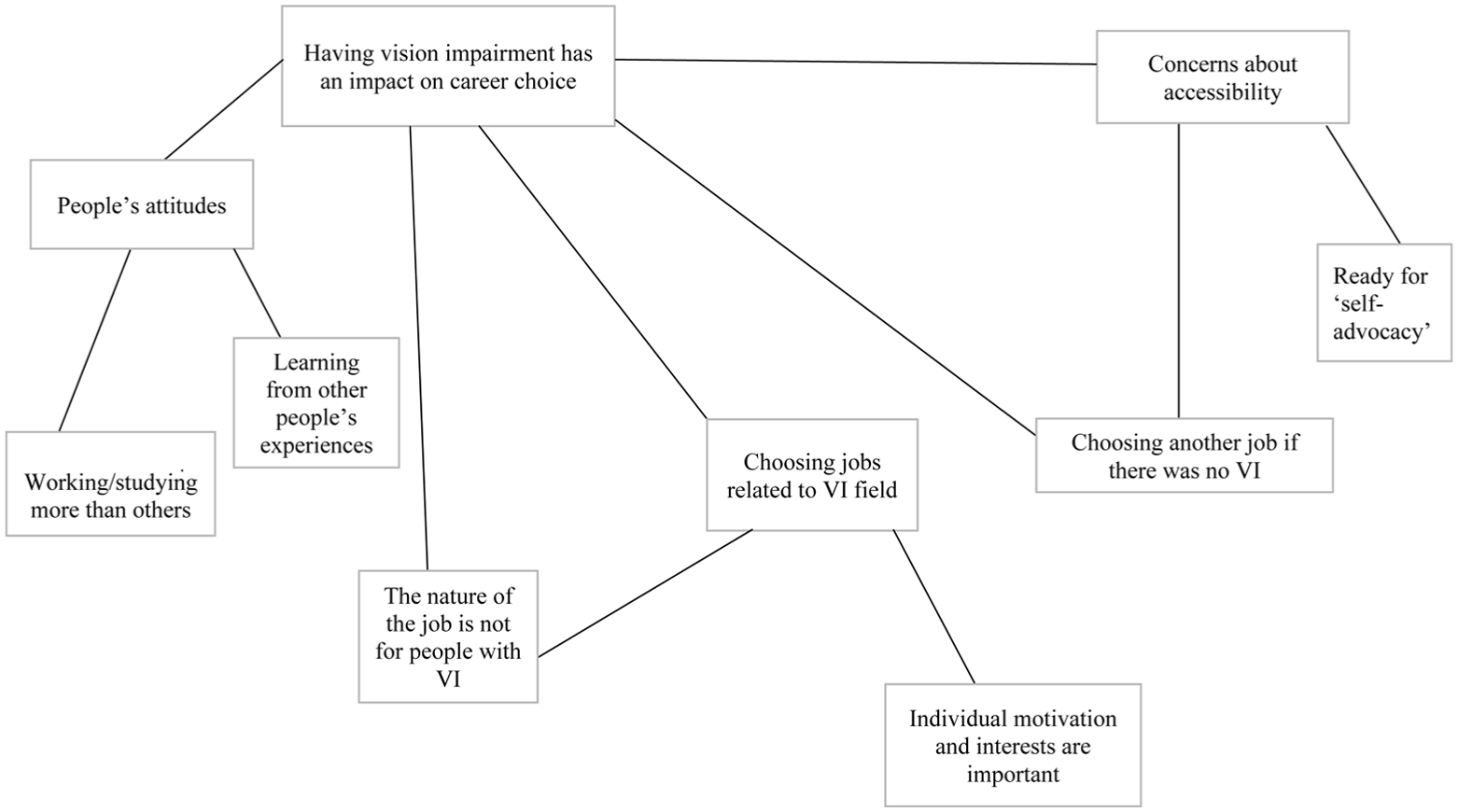
Thematic map of core themes emerged from the IPA.
The Inevitable Impact of Having Vision Impairment
In exploring the lived experiences of individuals with vision impairment, it became apparent that the vision impairment inevitably shaped not only their day-to-day interactions but also significantly influenced their career choices, aspirations, and the perceived boundaries of possibility. Participants’ narratives revealed a nuanced tension between capability and structural limitation, as Cemre articulated:
I still think the careers we can choose from are limited. Now, when I say this . . . some people with vision impairment might say, ‘So, are we not capable of doing anything at all?’ But I don’t agree with that. [. . .] Because, for example, we can’t just be a surgeon. That’s clear and obvious.
Her statement was not a declaration of incapacity, but rather a critical reflection on the structural constraints imposed by professional norms. The acknowledgment that ‘we can’t just be a surgeon’ highlighted the physical and visual demands embedded in certain professions—demands that can systematically exclude individuals with vision impairment, regardless of their competence. This recognition of constraint was shared by other participants, such as Ozge and Kevser, who reflected on how their career aspirations might have taken a different direction if they had not experienced vision impairment. Their reflections highlighted that vision impairment not only limits access to certain professions but also plays a formative role in shaping professional identity and interests. Ozge, for example, mentioned that she might have pursued psychology or counseling if her circumstances had been different. Similarly, Kevser reflected,
If I didn’t have a vision impairment, maybe I would have chosen something like dentistry or I would have preferred a field involving more direct interpersonal interaction.
A similar process of early adaptation was evident in Buse’s account, where vision impairment influenced not only how she navigated daily life but also how she made strategic decisions about her future profession. Despite having some residual vision, Buse remained aware that her visual capacity was not equivalent to that of her sighted peers and that it could not be relied upon as a stable or sufficient resource in all contexts. As she explained,
It was always on my mind throughout my time at school. Yes, I did have some vision, but . . . you never know what life will bring. And even that vision wasn’t at the same level as others—it wasn’t 100%. Naturally, that comes with certain limitations and disadvantages.
This awareness led her to make calculated choices that took her visual ‘limitations’ into account. For example, although she performed well in subjects like mathematics and physics, she consciously ruled out fields such as engineering due to their physically demanding and field-based nature:
I was good at math and physics, but I didn’t choose engineering, because working in the field and doing hands-on tasks would be too challenging. I had already ruled those options out in my mind.
Buse’s story showed how she carefully balanced her own strengths with the challenges she expected to face—choosing her career not just based on her interests or grades, but also by thinking ahead about what the job might require and whether it would suit her situation. This recognition of constraint was also reflected in Melih’s account. Although he initially aspired to remain in academia and eventually become a professor in chemistry field, he explained that this path now seems unlikely due to the visual demands of conducting laboratory experiments:
I really wanted to stay in academia. I genuinely wanted to do science—to become a professor, to write articles and so on. But right now, I won’t be able to pursue those goals, mainly because I can’t conduct experiments.
As an alternative, he considered roles that align with his background in chemistry but do not require intensive visual engagement—such as working with chemical analysis instruments, engaging in chemical sales, or contributing to occupational health and safety:
Each chemical has a safety data sheet explaining how harmful it is, what precautions to take, and what regulations apply. I think I could work in a position where I prepare or manage those documents.
Mehmet’s reflections further emphasized the practical realities faced by individuals with vision impairment, illustrating how the nature of certain professions inherently demands visual capabilities. His account complemented those of Buse and Melih by highlighting that these challenges are not a matter of personal ability but rather stem from the specific requirements of the job itself. He explained,
There’s definitely an impact, and unfortunately, I can’t deny that. Of course, we can live independently, but when it comes to career choices, the disadvantages we face are very real. For example, my department is one where vision truly matters. [. . .] Because working with a child with autism or teaching concepts like shape, background, or size—these are things that inherently require sight. Of course, I can still do certain things, but a typically developing colleague would likely be able to carry out instruction more easily.
It is important to note that these accounts reflect participants’ subjective perceptions rather than an objective evaluation of workplace accessibility, and access to accommodations or assistive technologies may significantly shape employment opportunities in practice. These narratives underscored that the impact of vision impairment on career decisions is not merely about exclusion from specific fields but about an ongoing process of adaptation and strategic decision-making.
Personal Motivation and Interests
Participants’ career decisions were often deeply rooted in personal values, emotional engagement, and a commitment to making a meaningful impact. For some, this stemmed primarily from interpersonal interests and relational dynamics. As Sibel reflected on why she chose to be a teacher,
I really enjoy communicating with people. I love listening to others and reading books like that—actually, I love reading in general. Being around people, being sincere and connected—honestly, those things brought me closer to this profession.
Buse’s account further illustrated how intrinsic motivation can strongly influence career decisions. Her deep interest in politics began at a young age, as she recalled:
Since the 8th grade, I was completely absorbed by the news. I followed the news every day—constantly reading the news, more than usual. There wasn’t a single type of source I didn’t read in a day. Back then, there were no apps collecting all the news in one place, so I would search everything manually on Google. That’s how it all started. And I said, ‘I want to study politics’.
In other cases, such as Gul’s, the motivation was more directly informed by personal experience. Her vision impairment has fostered a heightened sensitivity to social inequality and a desire to respond through educational work. She shared,
You know how, when you’re actually involved in something, you tend to notice certain gaps more clearly. Because of that, you can sometimes be more solution-oriented than others. In terms of empathy, we may not even need anything extra—our ability to understand can naturally become more nuanced. That’s why I thought, ‘I should become a special education teacher’.
For her, professional identity was shaped less by constraint and more by a sense of belonging, and affective alignment. Echoing this sense of personal alignment with professional purpose, Kevser described how her own lived experience shaped a long-standing interest in special education. She explained,
Special education was always a field I had in mind. Given my own circumstances, I truly believed that this was where I could best demonstrate my potential and work with discipline and motivation.
Building on this perspective, Mehmet reflected thoughtfully on his career path, focusing on a practical understanding of his strengths and interests while also recognizing the unique advantages his vision impairment brings. This aligns with Kevser’s view that personal experience could be a source of strength and competence in professional roles. Mehmet summarized his position clearly:
To be honest, rather than pursuing a master’s degree in autism or intellectual disabilities, I feel I could be more competent in the field of vision impairment. I say this frankly—because I also know Braille.
In Buse’s case, her career choice was strongly influenced by personal interest and early intellectual engagement, but this motivation was further reinforced by the visibility of role models with similar experiences. Seeing other individuals with vision impairment thrive in political and diplomatic spaces offered her a sense of possibility and belonging within the field. These examples not only aligned with her existing passion for politics but also validated her belief that her vision impairment need not be a barrier to success. As she explained,
There are also a few professionals in the field—like a blind member of parliament, or a blind diplomat. I’ve tried to connect with a few of them to exchange experiences and learn from what they’ve been through.
Similarly, Ozge’s journey highlighted how active participation in diverse environments and networks could further nurture motivation and personal development beyond the influence of visible role models. By engaging in various training and projects, she sought to broaden her horizons and establish meaningful connections not solely based on shared disability, but on shared values and curiosity. As she reflects,
I participated in as many training and events as I could. I joined TÜBİTAK projects and similar initiatives. As much as possible . . . My main aim was to make connections. It wasn’t about befriending people just because they were part of a specific disability group. I met so many different people—in terms of mindset, lifestyle . . . Some had disabilities, some didn’t. For me, it was all a valuable experience.
The participants’ experiences illustrated that career motivation arises from a complex interplay of personal values, intellectual curiosity, social connections, and lived experience. These findings suggest that career choices are shaped not only by external influences but also by individuals’ intentional efforts to seek meaningful connections and growth.
These findings indicate that, in the context of visual impairment, career development involves navigating structural barriers and social expectations while actively constructing agency through educational and relational opportunities.
Perceived as ‘Limited’ by Other People
Narratives from the interviews reveal how societal perceptions contribute to the construction of implicit hierarchies of competence, often marginalizing individuals with vision impairment irrespective of their actual abilities. It seemed that these perceptions not only shape how others evaluate competence, but also influence how individuals with vision impairment navigate their own career choices—often leading them to rule out certain professions in anticipation of structural or perceptual barriers. Ferit reflected on these dynamics, describing how discouraging comments frequently questioned not his knowledge or preparation, but his capacity to participate at all:
Sometimes, we need to block out the noise around us. There are so many people who can negatively influence us. For example, during the exam process, some might say things like, ‘How are you going to do it?’ or ‘How will you even take the exam?’ And the same kind of attitudes continue into our professional lives—people saying things like, ‘Can this person really do that?’ or ‘He can’t even see, what would he understand?’ These kinds of ridiculous remarks can really try to break our spirit.
Similar experiences appeared to emerge even within higher education. Melih described how his choice to pursue a degree in chemistry was met with skepticism by academic staff, not due to academic performance or policy restrictions, but based on assumptions linked to his vision impairment:
When I explained my situation to my professors, one of them actually asked me, ‘Then why are you pushing yourself with chemistry?’ They said quite a few things about switching to another department. And I responded, ‘Because I love chemistry, professor’. I mean, if you look at the YÖK Atlas, it says for aviation programs, for example, ‘You need to have full vision’, or ‘You need to be over 180 cm tall’. But there’s no such requirement listed for chemistry. So I thought, if there were any limitations, they should have written them there.
Sibel also highlighted how such biases can become embedded within formal institutional procedures. She described undergoing repeated questioning, evaluations, and bureaucratic procedures—not due to the actual demands of the role, but rather because of assumptions associated with her vision impairment. As she noted, ‘the real difficulty stems from prejudice’, underscoring how systemic attitudes, rather than functional limitations, often act as the primary barriers.
The analysis revealed that this persistent questioning of competence does not seem to disappear even after participants enter professional roles; rather, it appears to shift into more subtle and implicit forms of scrutiny. Gul articulates how, even before entering the profession, she anticipates encountering a heightened threshold of legitimacy. Her concern is not about performing the role of a teacher effectively, but about needing to meet an additional layer of expectation before being perceived as equally competent:
While others can start a job and immediately begin engaging with their students, I feel like I first have to prove myself—to those in higher positions—before I can even get to that stage of teaching.
Despite encountering various forms of doubt and lowered expectations, participants consistently resisted allowing external perceptions to define their aspirations or limit their potential. It seemed that rather than internalizing societal prejudices, they actively sought ways to assert their competence and sustain motivation. This often required a deliberate and sustained effort to exceed normative standards, not only to gain recognition but also to shield themselves from stigma. As Melih notes,
Especially in the beginning, I struggled a lot with motivation—what other people said, what my professors said, it all affected me deeply. But now, none of that matters anymore. I’ve set my eyes straight ahead, toward my dreams, and I will keep going!
For some partcipants, academic excellence appeared to play an important role in reframing how competence is perceived. Buse’s experience illustrates how in her case, high achievement can function as a form of strategic capital, enabling others to see her not through the lens of impairment, but through her demonstrated abilities. As she explains,
But what I realized is that when I establish myself academically, people don’t say things like, ‘Oh, you are a person with vision impairment, so you should sit over there’. [. . .] I realized that excelling through other means somewhat masks the prejudice linked to being a person with vision impairment. I made it my mission throughout my life. Whether in middle school or high school—I even graduated as the top student—and now I am the top of my university department. This was very important for me.
The findings suggest that individuals with vision impairment are frequently subjected to heightened levels of scrutiny across both educational and professional settings. Assumptions about their abilities often precede any opportunity to demonstrate competence, manifesting in subtle forms such as lowered expectations, unsolicited advice to change fields, or prolonged evaluative processes. These dynamics create an unequal starting point, where demonstrating basic competence often requires surpassing normative standards. However, rather than internalizing these limitations, participants actively employed strategies to counteract them. In several accounts, high academic achievement was described as one way of challenging stereotypes and establishing credibility.
Feeling Optimistic About Future
While participants acknowledged the uncertainties surrounding their professional futures, many expressed a cautious optimism grounded in personal agency and adaptability. Cemre, for instance, hesitated to make definitive projections about her future, emphasizing that much would depend on the specific professional and environmental context in which she might find herself. However, she emphasized that transportation—often seen as a major barrier—was not a central concern for her, noting:
To be honest, I’m not sure it would be right to make any definite statements at this stage, since I don’t yet know what kind of city, workplace, or environment I’ll be in. But if I had to point something out, I wouldn’t say transportation is the main issue—because I believe that, over time, we learn to manage those challenges on our own.
Sibel also anticipated possible prejudice in her future role as a psychological counselor, acknowledging that some clients might question her abilities due to her vision impairment. Still, she approached this possibility with preparedness and self-assurance:
Some clients . . . well, I’m actually prepared for this. When they come in, they might say, ‘Oh, this psychological counsellor is a person with vision impairment—what could she possibly do for me?’ Because, unfortunately, in some parts of our country, the level of education and awareness pushes people to think that way. But what truly matters is that I know what I am capable of. Just because someone says that doesn’t mean I’m incapable of doing anything in this profession.
Similarly, Ferit directly addressed the discouraging attitudes he encountered, noting that such remarks could undermine one’s confidence. Yet, he emphasized the importance of psychological resilience, stating: ‘But above all, we must not let them affect our motivation’. His optimism was not only rooted in personal determination, but also in the possibilities that technological progress opens up for individuals with vision impairment:
Technology is advancing every day. And with these advancements, the problems around accessibility are gradually decreasing . . . That’s why I see this as a problem that can definitely be overcome.
Participants also demonstrated a clear awareness of the potential access barriers they might face and showed readiness to address these challenges proactively. They recognized that encountering difficulties was possible but emphasized the importance of advocating for necessary accommodations to ensure equitable participation. This proactive stance reflected their understanding that accessibility should not be contingent on others’ discretion but regarded as an essential right. As Kevser articulated,
If I have the opportunity to explain, I would try to express that these adaptations are necessary—that they shouldn’t depend on whether someone chooses to provide them, but that they are actually essential.
Melih further reflected on how such barriers were often imposed even before individuals had the opportunity to demonstrate their capabilities. His perspective illustrated how limited expectations often stemmed from a lack of exposure rather than evidence, and how the opportunity to perform—rather than being pre-judged—could itself be transformative:
Well, they usually ask before hiring, but once you get the job, things are easier . . . What could be done before hiring, honestly, I don’t know. If they just gave us a chance, they would see what we’re capable of. Because even though we can’t see, we often have better memory, for example—and in jobs where memory is essential, I believe we may even be one step ahead of others.
Taken together, these reflections suggest a cautiously optimistic perspective among the participants, grounded not in idealism but in their experiences of navigating educational and career pathways. While aware of the structural and societal barriers they may encounter, participants expressed confidence in their ability to adapt, advocate, and pursue professional opportunities.
Discussion
In line with the aims of this study, the findings are organized under three interrelated categories—individual, social, and structural factors—that collectively shape the career development of individuals with vision impairment. Among these, individual factors such as personal motivation, internal drive, and intrinsic interests emerge as particularly influential in determining career aspirations and fostering resilience in the face of challenges. Although the participants in this study lacked or limited work experience, they consistently emphasized personal qualities such as self-motivation, perseverance, and a strong work ethic as crucial factors they believe will support their future career success. This emphasis on intrinsic qualities echoes Crudden’s findings, which similarly attribute occupational success largely to internal motivation and a robust work ethic among individuals with vision impairment (Crudden, 2002). In addition, developing intellectual curiosity and maintaining ongoing engagement with specific academic or professional fields appeared to shape their career choices. These observations correspond with existing research, which points to the importance of early guidance tailored to an individual’s interests and abilities in supporting career development. When support aligns with personal strengths and preferences from an early stage, it can strengthen career confidence and encourage sustained vocational participation for individuals with vision impairment (Avcı, 2024).
The ability to realistically assess and manage one’s personal characteristics emerged as both a facilitator and a constraint in career decision-making. On the one hand, recognizing and navigating personal challenges can strengthen individuals’ strategic decision-making and support more informed career choices (Crudden et al., 2024). On the other hand, internalizing prevalent societal judgments such as the belief that individuals with vision impairment are inherently incapable may lead young people to undervalue their abilities, weakening both their motivation and their sense of self-efficacy regarding career goals (Van Beukering et al., 2022). In this context, awareness of potential personal challenges may support realistic planning, but it can also act as a discouraging factor, leading individuals to reconsider certain career goals. When such self-perceptions intersect with external expectations and structural barriers, the career decision-making process becomes increasingly complex and constrained. A central aspect of this complexity is the enduring perception of young people with vision impairment as having limited potential, which continues to restrict the full recognition of their abilities and career aspirations. Indeed, Avcı (2024) found that individuals with vision impairment frequently encounter low expectations from their families and communities when making career decisions. Similarly, teachers’ low expectations and parents’ overprotective attitudes are identified as external barriers to the independence of young people with vision impairment (Akbayrak, 2023). These diminished expectations shape the types of careers young people with vision impairment are directed toward, often pushing them into so-called ‘safe’ but low-skilled jobs (Bengisu et al., 2008). However, it should be noted that these findings are largely based on studies conducted in Türkiye and are culturally specific.
A sense of agency and belief in one’s own potential were also found to be critical in navigating imposed limitations and structural barriers. The findings suggest that both the negative experiences the young people have faced in the past and their ongoing efforts to succeed academically have, to some extent, enabled them to overcome the narrow roles imposed by others. Belief in one’s own capabilities tends to foster higher aspirations, increased effort, and greater persistence in overcoming challenges (Eniola & Adebiyi, 2007). However, translating this internal confidence into tangible outcomes often requires self-advocacy skills, which play a critical role in enabling students with vision impairment to assert their rights and pursue equitable participation in professional life. Self-advocacy is identified as one of the most effective strategies these students use to navigate bias and overcome structural barriers in career decision-making (Swain & Waddington, 2022). Therefore, it may well be argued that those with stronger self-advocacy skills tend to explore a wider range of career possibilities and take more proactive steps in goal setting and planning processes.
In addition to individual factors, social dynamics play a critical role in either facilitating or constraining the career development of individuals with vision impairment. Findings suggest that strong communication and social skills are perceived as important drivers in shaping their career choices. In line with this, previous research indicates that social interactions with peers, family, and professional networks significantly contribute to employment opportunities and career success for individuals with vision impairment (Cimarolli & Wang, 2006; Leonard et al., 1999). In this context, participants highlighted the role of self-efficacy and the expectation of social acceptance as important factors influencing their anticipated job satisfaction and workplace adjustment, which is also supported by existing literature (Chu & Chan, 2024; Steverson & Crudden, 2023). In parallel with the current findings, the literature also suggests that instruction focusing on areas of the ECC—such as Braille literacy and orientation and mobility (O&M) training—is significantly associated with positive employment outcomes for individuals with vision impairment (Cmar & Markoski, 2019; Douglas & Hewett, 2014; Wolffe & Kelly, 2011). This aligns with previous correlational studies indicating that curricula tailored to the needs of individuals with vision impairment are important predictors of career success (Cavenaugh & Giesen, 2012).
Beyond individual and social dimensions, structural conditions and systemic barriers continue to shape the opportunities and limitations faced by individuals with vision impairment in their career development. One of the key findings of this research is that for individuals with vision impairment, the narrowing of career options due to environmental factors and job-specific visual demands such as those found in medicine, engineering or chemistry necessitates a strategic reconfiguration of vocational development. The literature suggests that limitations in access to STEM fields, both in terms of education and employment, reduce the inclination of individuals with vision impairment to pursue careers in these areas (e.g., Chrin & Nardo, 2025; Rosenblum et al., 2025). The findings also suggest that this situation reinforces a perceived tendency to be directed toward limited and predetermined career paths. In particular, the findings suggest that individuals with low vision frequently refrain from pursuing more demanding career paths, primarily due to the variability in their visual functioning and concerns about the potential progression of vision loss. Existing literature supports this phenomenon; individuals with vision impairment are frequently directed toward low-skilled or secure occupations, such as public service roles, telephone operator positions (Avcı, 2024; Bengisu et al., 2008), and having limited career options may negatively affect their quality of life.
In conclusion, this study highlights how individuals with vision impairment make sense of their career development within the context of their lived experiences. The findings reveal that individual motivation and self-perception, social interactions such as role models and professional networks, and structural barriers and enablers collectively shape their vocational pathways. Understanding these interrelated factors through the lens of participants’ own interpretations provides critical insights for promoting more inclusive and empowering career development practices.
Limitations
While this study provides in-depth insights into the career decision-making processes of university students with vision impairment, certain limitations should be acknowledged. As with all qualitative research, the findings are shaped by participants’ ability and willingness to reflect on their experiences and express them during the interview process (Yardley, 2000). In addition, the interpretative nature of IPA means that the researcher’s perspective inevitably plays a role in shaping the analysis, despite efforts to remain reflexive and grounded in the data (Smith et al., 2009). Furthermore, the participants in this study were university students with vision impairment, and therefore represent a group with relatively high levels of academic engagement and educational attainment. As such, the findings may not be fully representative of the broader population of individuals with vision impairment who may have different educational or socioeconomic backgrounds. In addition, some of the factors discussed in the study (such as belief in one’s capabilities, persistence, and personal motivation) may also be relevant to young people more generally. However, the contribution of this study lies in illustrating how these processes are experienced and interpreted specifically by individuals with vision impairment in the context of their career decision-making. Future studies may benefit from incorporating longitudinal or comparative designs to explore how career-related meaning-making develops over time or varies across different settings.
Footnotes
Acknowledgements
The authors acknowledge the use of ChatGPT (OpenAI) for language and style editing support. All intellectual content and interpretations remain the responsibility of the authors.

Ethical Considerations
Ethical approval for this research was obtained from the Anadolu University Ethics Committee (Approval No: 91/102, dated 24.12.2024). All participants provided informed consent prior to participation. The study was conducted in accordance with the principles of the Declaration of Helsinki and relevant national research ethics guidelines.
Author Contributions
Dr. Kubra Akbayrak conceptualized and designed the study, led the data analysis, interpreted the findings; drafted and revised the manuscript. Dr. Mustafa Dogus conducted the data collection, supported data analysis and coding, and critically reviewed the manuscript. Dr. Halil Ozturk conducted the data collection, contributed to data analysis and coding. All authors discussed and finalized the results, approved the final version of the manuscript, and take responsibility for the integrity of the research process.
Funding
The authors received no financial support for the research, authorship, and/or publication of this article.
Declaration of Conflicting Interests
The authors declared no potential conflicts of interest with respect to the research, authorship, and/or publication of this article.
Data Availability Statement
The datasets generated and/or analyzed during the current study are not publicly available due to ethical and privacy considerations.