






Abstract
Self-advocacy research often focuses on enhancing educational outcomes for students with disabilities. However, there is a pressing need for these studies to be backed by rigorously vetted psychometric measures and surveys. Thus, the purpose of this study was to examine the psychometric properties of the Physical Activity Self-Advocacy Inventory (PASAI) survey tool for youth with visual impairments. Participants (N = 66; boys = 42, girls = 24; Mage = 15.00, SD = 2.71 years) were enrolled in a 1-week physical activity program for children with visual impairments. Results included reliability (internal consistency and test–retest) and validity (construct validity, including confirmatory factor analysis). This study is significant because reducing measurement error via psychometric vetting is critical to improve self-advocacy programs. The strong psychometric properties of the PASAI make it a valuable tool to support the journey of youth with visual impairments to a high health-related quality of life.
Introduction
Self-advocacy is a vital skill that enables individuals to understand and articulate their rights and needs effectively (Holzberg et al., 2019). Historically, research has focused on self-advocacy for students with disabilities, demonstrating its value in improving educational outcomes, yet there remains a critical need to ensure that these findings are supported by robust measures whose psychometric properties have been vetted. Without strong psychometric evidence, the tools designed to assess self-advocacy may fail to capture its nuances or provide reliable data to guide instruction effectively.
The education of students with disabilities has often included self-advocacy instruction, reflecting its link to positive outcomes such as enhanced academic success, classroom engagement, and self-efficacy while also being rooted in the conceptualization of disability empowerment (Agran et al., 2007; Eisenman et al., 2005; Zickel & Arnold, 2001). The conceptualization of disability empowerment emphasizes personal agency, self-understanding, and active participation in society. Rather than viewing disability through a deficit lens, empowerment models promote autonomy by encouraging individuals to understand their unique experiences and remove barriers to inclusion (Llewellyn & Hogan, 2000). Furthermore, contemporary models of disability empowerment emphasize the importance of agency, inclusion, and systemic change. The empowerment model, grounded in empowerment theory (Perkins & Zimmerman, 1995; Sadan, 1997), addresses barriers to participation by equipping individuals with disabilities, educators, and community organizations with tools to foster autonomy and inclusion (Moran et al., 2017). The empowerment model promotes adapted strategies and a universal design to ensure meaningful engagement across social and educational contexts. In parallel, critical disability theory challenges deficit-based views of disability by reframing it as a socially constructed identity shaped by cultural, political, and environmental factors (Hiranandani, 2005). Rather than viewing disability as individual inadequacy, this framework advocates for self-determination and social justice, aligning with broader movements for equity and human rights. Together, these models offer a robust foundation for understanding empowerment and self-advocacy as interconnected processes that support agency and challenge systemic exclusion.
Complementing this is the self-advocacy framework developed by Test et al. (2005), which outlines four essential components: knowledge of self, knowledge of rights, communication skills, and leadership. The self-advocacy framework is particularly influential in educational contexts, where it guides curriculum and support services aimed at fostering independence and self-determination. Together, empowerment and self-advocacy frameworks provide a holistic foundation for promoting disability rights and agency, shifting the focus from passive care to active engagement and systemic change.
The psychometric properties of the instruments used to evaluate self-advocacy skills influence how we assess and understand the effectiveness of such programs, including their content/face validity. Psychometrically sound measures ensure that observed improvements in areas like Individualized Education Program (IEP) management are genuinely attributed to skill acquisition rather than measurement error. For example, students who actively participate in their IEP meetings display improved communication and confidence, key outcomes that must be measured precisely to inform both research and practical applications. Instruments without rigorous psychometric evaluation may compromise the ability to identify successful interventions or areas needing refinement.
Establishing stout measures with vetted psychometric properties is essential to promoting deliberate and effective self-advocacy instruction (Hagan et al., 2016; Lin, 2021). Students with disabilities often face challenges in articulating their needs outside the supportive school environment, and this difficulty underscores the importance of school cultures that actively prioritize self-advocacy (Ameri, 2024). In addition, barriers such as inadequate teacher training and limited curricula resources persist (Karvonen et al., 2004).
These barriers that limit teacher training and curricula can transcend beyond the classroom and into the physical activity space. Fortunately, self-advocacy is a foundational skill for youth with visual impairments (VIs) seeking equitable access to physical activity, as it enables them to navigate systemic barriers and assert their needs in environments often not designed with their participation in mind. Youth with VI consistently report lower levels of physical activity compared to their sighted peers, largely due to inaccessible facilities, a lack of trained staff, and limited adapted programming, all of which contribute to poorer health outcomes and reduced quality of life (Beach et al., 2025). These challenges are compounded by psychological factors such as fear of injury and social exclusion, which further discourage participation (Carretti et al., 2023). Self-advocacy empowers youth to communicate their needs, request accommodations, and engage confidently in physical activity settings. When youth with disabilities develop self-advocacy skills, they often experience improved autonomy, social integration, and long-term well-being (Roberts et al., 2016). Promoting self-advocacy is therefore not only a personal development goal but also a public health strategy that supports inclusive, active lifestyles for youth with disabilities.
Addressing these abovementioned gaps and needs requires not only better training and materials but also assessments that reliably measure students’ self-advocacy skills and guide targeted interventions. Psychometrically sound tools empower educators and researchers to design programs based on accurate data, ensuring that these foundational skills are cultivated with precision and consistency. Thus, the purpose of this study was to examine the psychometric properties of the Physical Activity Self-Advocacy Inventory (PASAI) for use among youth with VIs. Specifically, within this study, we explored the reliability (internal consistency and test–retest) and validity (construct validity, including confirmatory factor analysis [CFA]) of the results from this sample. This study is significant because measuring latent constructs is often fraught with measurement errors. Reducing measurement errors is critical to develop, reflect upon, and continue to improve self-advocacy programs. Thus, the PASAI, if its psychometric properties are stout, could be a groundbreaking heuristic to support practitioners and researchers who aim to support youth with VIs on their journey toward high health-related quality of life.
Design, Participants, and Setting
This study featured a secondary analysis from a previously collected data set as seen in Lieberman et al. (2025). Participants included children (N = 66; boys = 42, girls = 24; Mage = 15.00, SD = 2.71 years) enrolled in a 1-week physical activity program for children with VIs. Degree of vision varied across six levels, based on the Snellen chart and visual acuity in the following way according to the World Health Organization (2019):
Mild or no vision impairment (equal to or better than 20/70) = 4;
Moderate VI (worse than 20/70 but equal to or better than 20/200) = 16;
Severe VI (worse than 20/200 but equal to or better than 20/400) = 17;
Blindness (worse than 20/400 but equal to or better than 20/1200) = 13;
Severe blindness (worse than 20/1200 (5/300) but with light perception) = 7;
Total blindness (no light perception) = 9.
Instrumentation
The PASAI was originally a 17-item survey tool designed to evaluate the extent to which youth perceive their ability to self-advocate regarding physical activity behaviors (Lieberman et al., 2024). The PASAI shows strong content/face validity with youth, aged 9–18 years, with and without disabilities (Lieberman et al., 2024), and Lieberman et al. (2025) conducted exploratory factor analyses (EFAs). The results of the EFAs suggest a 10-item version (as opposed to the original 17-item inventory), but confirmation analyses are needed (which is occurring within this study). The PASAI is rated on a 1–5 Likert-type scale, where “1” indicates “none of the time” and “5” indicates “all of the time.” The items within the PASAI measure knowledge bases across four domains: leadership, communication, rights, and self. The PASAI is typically completed in approximately 10–15 minutes. Scores on the short form (ranging from 10 to 50 points) are calculated by summing the responses, with higher scores reflecting greater perceptions of self-advocacy skills.
Procedures
Participants completed the PASAI at the beginning and the end of a 1-week physical activity program. Participants could choose from a 12-point-font, large-print (e.g., 20-point Arial font), or brailed version of the PASAI. The institutional review board from the University of South Carolina approved all procedures. Parents provided written informed consent, and children provided verbal assent.
Data Analyses
Table 1 includes results from descriptive analyses for all variables of interest. We calculated two forms of reliability internal consistency and test–retest reliability. Internal consistency (e.g., inter-item associations within an inventory; American Educational Research Association et al. [AERA], 2014) via McDonald’s omega (ω) for the PASAI. McDonald’s omega is considered more robust than the traditional Cronbach’s alpha when used with factor analysis (Dunn et al., 2014; McNeish, 2018). McDonald’s omega is interpreted as a score of .70 or greater indicating moderate internal consistency while .80 and greater indicates strong internal consistency (Zinbarg et al., 2005). The second form of reliability, test–retest reliability, assesses the stability of a measure by administering the same test to the same people at different time points (AERA et al., 2014). Pearson’s r correlations, which are typically used for test–retest reliability, are interpreted as moderate (r = .30–.69) or strong (r = .70+; Cohen, 1988). All analyses occurred using the data collected after the physical activity program except test–retest reliability, which included both time points before and after the program.
Means and Standard Deviations for Self-Advocacy Across Time.
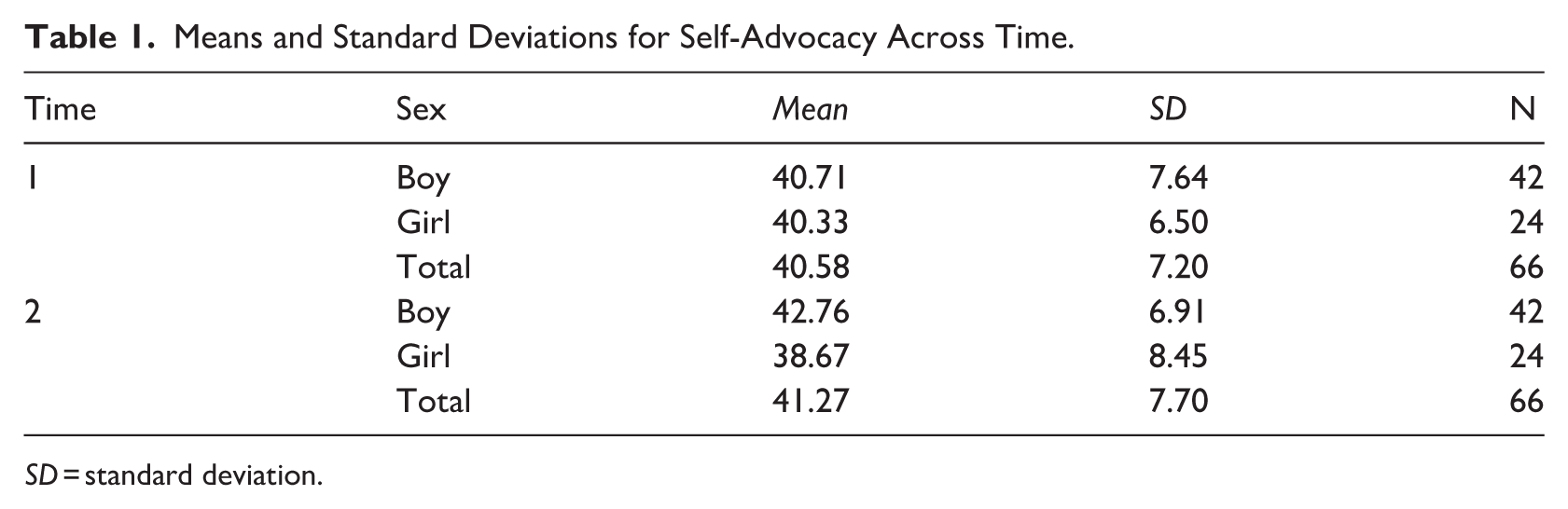
SD = standard deviation.
Construct Validity
We examined construct validity for the PASAI as a one-factor solution. Construct validity includes multiple different sources including both content/face validity and internal structure (AERA et al., 2014). Content/face validity already occurs (see Lieberman et al., 2024). To assess the internal structure for the PASAI, we conducted a CFA using maximum likelihood estimations due to the preexisting structure proposed within the parsimonious model for the PASAI suggested by Author et al. (in press). The original factor structure from Lieberman et al. (2024) included 17 items loaded into one construct of “self-advocacy.” However, preliminary EFAs resulted with a more parsimonious model, and items were reduced to 10 (see Author et al., in press; Figure 1). We calculated the CFA using SPSS AMOS v24 and included the following fit indices: (a) chi-square χ2, (b) root mean square estimation of association (RMSEA), and (c) comparative fit index (CFI). Indicators of a strong model fit include a nonsignificant p-value for χ2 with a χ2/Df ratio that is close to 1. Moreover, RMSEA at or below .05 is good, with values at or below .08 considered as acceptable, and CFI greater than .90 indicates good model fit (Hooper et al., 2008).
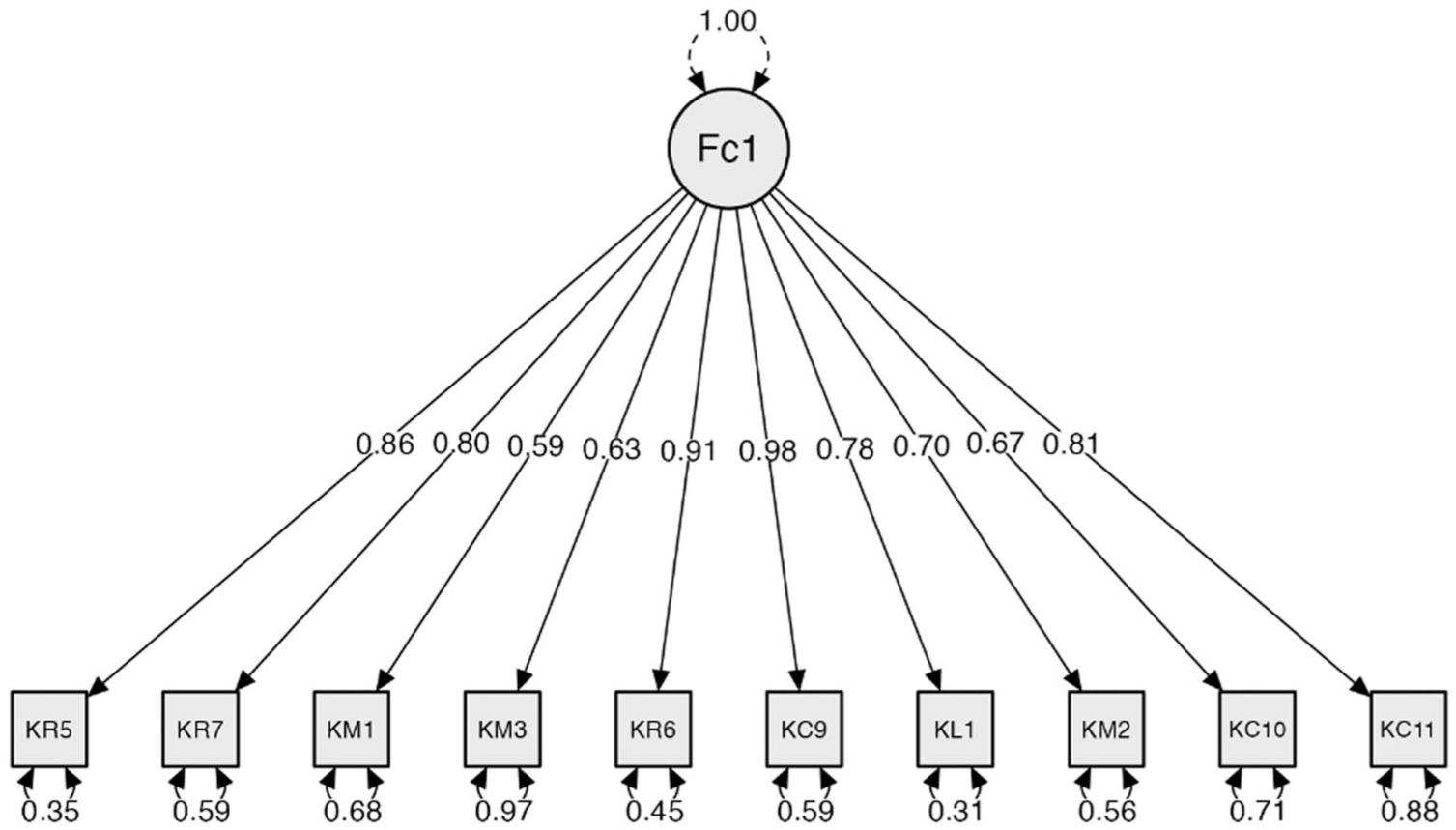
One-factor solution for the latent construct of self-advocacy.
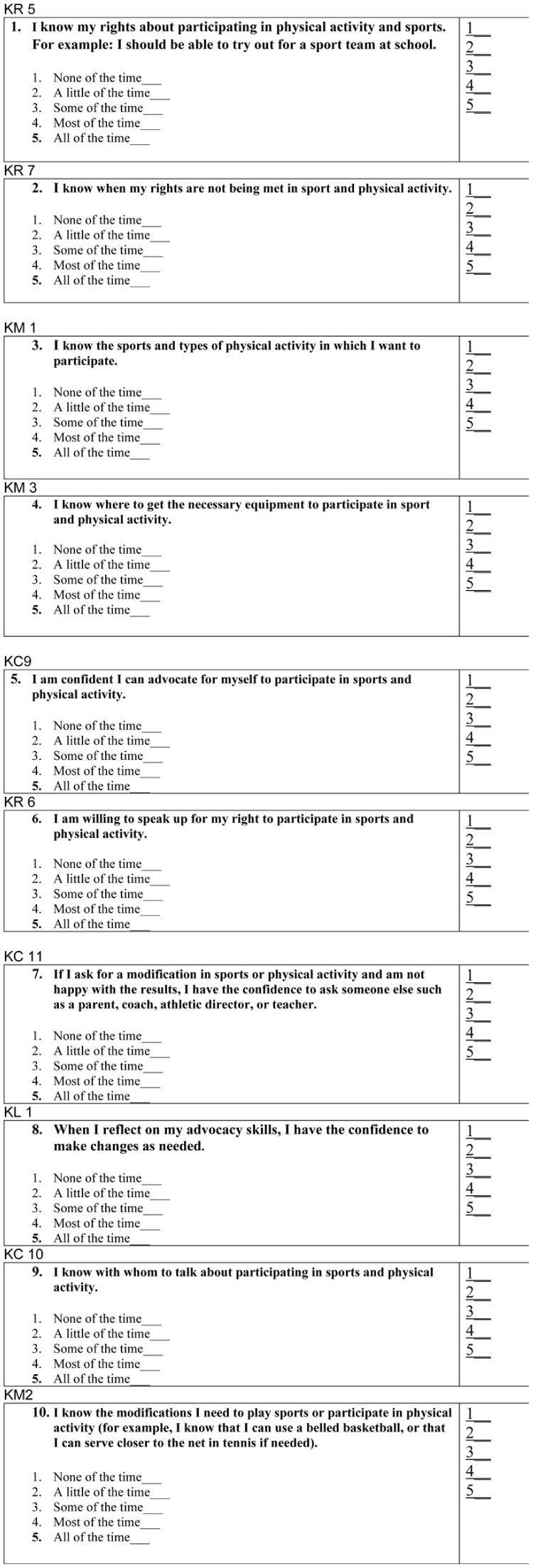
Ten-item version of the PASAI.
Results
McDonald’s omega scores (ω = .90) demonstrate high internal consistency for the PASAI. Test–retest reliability indicated strong stability (r = .77, p < .001). All items significantly (p < .05) loaded into the one-factor solution (Figure 1). Item loadings ranged from 0.59 to 0.95. The model suggested by Author et al. (in review) was supported from our findings with good model fit (χ2 = 19.77, p = .138, χ2/Df ratio = 1.41, RMSEA = .07, CFI = .98).
Discussion
The purpose of this study was to evaluate the psychometric properties of the PASAI for use among youth with VIs. These results suggest that the PASAI holds stout construct validity, via CFA. The CFA conducted within this study supports the initial EFAs initiated by Author et al. (in press), as well as the content/face validity reported by Lieberman et al. (2024). In addition, the CFA supported the construct validity of a one-factor model, with fit indices such as RMSEA and CFI meeting accepted standards. Thus, the PASAI has strong construct validity. Items within the PASAI include those that measure knowledge of communication, self, leadership, and rights (all within the self-advocacy framework), and as such, it is no surprise that these items loaded into the one construct of “self-advocacy.”
In addition to validity, these results dictate high internal consistency, as indicated by McDonald’s omega scores, and strong test–retest reliability, as demonstrated by significant Pearson’s correlations. Thus, the PASAI findings with reliable and consistent results when measuring self-advocacy skills address a critical need for psychometrically sound measures in this domain.
A key strength of the PASAI in addition to its stout psychometric properties is the ability to adapt the formatting of the tool to meet the needs of diverse individuals with VIs (e.g., 12-point font, large print, braille). However, limitations must also be acknowledged. The study sample was recruited from a physical activity camp, which may not reflect the broader population of youth with VIs or youth with different disability types. Another limiting factor is the sample size (N = 66) for conducting CFA. While our results indicate good model fit, these findings should be interpreted with caution and may not be replicable in larger or more diverse samples. However, we also view this as a strength in the context of our study’s focus on a highly specialized and hard-to-reach population, where larger samples are often impractical. The ability to achieve acceptable fit indices despite these constraints suggests that the underlying factor structure may be robust and meaningful within this unique group, providing valuable preliminary evidence for the measure’s validity in this context.
In conclusion, the PASAI has strong psychometric properties and produces results that can be considered valid and reliable for use among youth with VIs. These findings present opportunities for future research to expand upon the scope and applicability of the PASAI. Research efforts should also explore the PASAI’s adaptability and relevance across broader populations, including youth without VIs, those with other disabilities, and culturally diverse groups. In addition, future research can explore recommend cutoff scores or interpretation guidelines to aid practitioners with interpretation and actionable items. Longitudinal studies would be particularly valuable to examine the tool’s ability to measure changes in self-advocacy skills over time, particularly in diverse educational and community contexts. These longitudinal studies could occur in tangent in real-world settings so that practitioners can apply the PASAI for designing and evaluating their programs.
Footnotes

Ethical Considerations
The institutional review board at the University of South Carolina approved all procedures (Pro00110871).
Funding
The authors received no financial support for the research, authorship, and/or publication of this article.
Declaration of Conflicting Interests
The authors declared no potential conflicts of interest with respect to the research, authorship, and/or publication of this article.