







Abstract
The current study extends work by both Boon and Holmes (1999) and Murray, Holmes and Collins (2006) by providing a theoretical model and the first experimental examination of the connection between more subtle forms of risk exposure and the levels of trust third-party evaluators have in their own partners when giving advice to others about their relationship difficulties. One hundred and fifty-two participants initially completed trust and self-esteem scales. They returned to the laboratory one week later and read either a narrative designed to prime the risks inherent in romantic relationships or a control narrative. All participants then read and evaluated an account of events that occurred in someone else’s romantic relationship and gave advice to the victim. The results of our study suggest that indirect risk exposure and trust, in combination, do significantly predict initial evaluations of the event, the attribution of responsibility and blame, focus of caution, and advice to the victim. The only exception to this pattern was the absence of an interaction between risk and trust on our measures of suspicion and desire for further information. A dual-focus model of indirect risk exposure, trust, and caution is proposed.
For some, such as mental health practitioners in counselling settings and those who work in the legal system, third-party judgments of the events that occur in other people’s relationships and the potential consequences for those involved are motivated by goals specific to their professions (e.g., deciding on divorce and custody settlements). A lack of a professional stake in others’ relationships, however, does not leave us uninterested in the lives of others. Members of our social networks routinely ask us for advice on dealing with issues in their relationships (e.g., whether to increase commitment to a romantic partner). Indeed, third-party advice has been shown to have an impact on how others choose their partners and how they act in their lives (e.g., Brown, 1999; Dunphy 1963; Jonas, Schulz-Hardt & Frey, 2005; Simon, Eder, & Evans, 1992).
Given that people expect others’ advice to actually be useful in improving their own judgment accuracy (Yaniv, 2003), it is important we understand how people come to give the advice they do. Ideally, such judgments would be based on a thorough and objective assessment of all possible relevant information. In reality however, evaluating events that occur in the lives of others is much more complex (Bruner, 1958). We must often analyze situations based on incomplete information (e.g., only one partner’s side of the story) and without knowing much about the circumstances that preceded the event. As the stakes involved in rendering an opinion may be high – particularly if the opinion may be acted upon by another – it is important to understand the processes by which we evaluate events in others’ romantic relationships. Importantly, Hoch (1987) suggests that when asked for advice, people tend to project their own values onto their peers and others close to them. This finding spurred our investigation of the factors present in our own experience that may affect our ability to give well-grounded advice.
In this research, we examined the combined impact of two variables which may influence individuals’ evaluations of and advice concerning events occurring in others’ romantic relationships, namely indirect risk exposure and trust. To explain how and why these two variables may affect this type of third-party evaluation and advice-giving, we have proposed a dual-focus model of indirect risk exposure, trust, and caution which incorporates indirect exposure to risk and trust. Our model expands on Boon and Holmes’ (1999) work on the effects of indirect exposure to risk in romantic relationships by integrating it with Holmes’ (1991) theories concerning motivational and cognitive processes at differing levels of trust. Testing of the individual components of the proposed model is discussed as a focus for future research.
Direct, personal exposure to risk/threat in people’s own relationships
Early work on risk suggested that our default reaction to direct, personal threats to our own relationship is to actively seek increased connectedness with our partner in the service of maintaining a positive view of our partner and ultimately protecting the relationship from dissolution (see Johnson & Rusbult, 1989; Kunda, 1990; Murray & Holmes, 1993; Simpson, Ickes, & Blackstone, 1995). The direct threats studied in this research included evaluating extremely attractive alternative dating partners (Johnson & Rusbult, 1989) or having participants state that they do not fight with their partner only to be told that lack of regular conflict is sign of a relationship in trouble (Murray & Holmes, 1993). Subsequent studies, however, suggest that there are moderating factors which can motivate us to also consider self-protection or avoidance of connection as a goal in the face of direct threat. These moderators include attachment anxiety (Mikulincer & Shaver, 2003), rejection sensitivity (Downey & Feldman, 1996), and self-esteem (Murray, Derrick, Leder & Holmes, 2008; Murray et al., 2006).
Most relevant to the present study, Murray et al. (2006) demonstrated that, when participants were reminded of a time when they felt their relationship was being threatened by their partner’s behaviour, a series of “if-then” appraisal, signal, and behavioural decision-making rules came into play which affected the decision whether or not to approach the partner seeking connectedness or to avoid the partner in order to protect the self (see Murray et al., 2006 for further details). When faced with a direct risk prime (i.e., remembering a time in the recent past when they had been hurt by their own romantic partner), those with high self-esteem engaged in approach thoughts and behaviours designed to increase their connection with their partner and protect the relationship from potential harm. On the other hand, those with low self-esteem responded by engaging in avoidance thoughts and behaviours, such as distancing themselves from their partner and the relationship, in the service of protecting the self.
More subtle, less personal exposure to the risks inherent in all relationships
In everyday life, however, we may encounter direct threats to our relationships far less frequently than we encounter evidence from other people’s lives that implies, in a more subtle, indirect fashion, that relationships are inherently risky. For example, many of us have watched a family member’s marriage disintegrate, viewed media portrayals of infidelity and betrayal or read news reports bemoaning high divorce rates. Whatever the source, testimonials to the risks inherent in romantic relationships are ubiquitous and research suggests that – even though they may not readily bring to mind the ways in which an individual him or herself is vulnerable and at risk – they nevertheless hold considerable potential to influence the processes by which people perceive, evaluate, and respond to events in romantic relationships (Boon & Holmes, 1999).
In fact, Boon and Holmes (1999) believed that the impact of risks perceived in others’ relationships may be more insidious in their effects on judgment than direct threats to an individual’s own relationship. This is precisely because indirect risks are unlikely to mobilize the kinds of reassurance-seeking cognitions observed when participants’ own relationships are directly, overtly, and personally challenged. Instead, risks perceived in others’ relationships may prime those aspects of individuals’ general relationship schemas that pertain to issues of risk and vulnerability (e.g., beliefs relating to trust and betrayal, fears of abandonment, etc.), subtly shifting their beliefs about relationships in more pessimistic directions. Consistent with this prediction, Boon and Holmes (1999) found that, compared to control participants, individuals who read a narrative describing the unexpected, painful breakup of another couple’s romantic relationship (i.e., reminded that relationships in general are risky) were harsher in their evaluations of the persons and events involved in a subsequent, unrelated transgression and were less inclined to extend the benefit of the doubt to the perpetrator in question. Boon and Holmes interpreted this focus of caution as protecting the individual from potentially being hurt again.
Counter to the unidirectional relationship between indirect risk exposure and caution espoused by Boon and Holmes (i.e., indirect risk exposure necessarily results in a focus on protecting the individual), we believe that under some circumstances indirect risk exposure may promote cautious processing focused on protecting the relationship from harm. This suggests that, similar to the findings of Murray et al. (2006), not one but two distinct foci might shape individuals’ approaches to cautious processing: the repercussions associated with failing to protect the victim from future harm at the hands of his or her partner (i.e., a cautious orientation focused on maintaining the victim’s wellbeing) and the repercussions associated with failing to protect the relationship from potentially unwarranted dissolution (i.e., a cautious orientation focused on maintaining the wellbeing of the relationship). It is important to note, however, that our theorizing and its manifestation in the methodology of this study differ from the study by Murray et al. (2006) in several important ways: type of risk exposure, scope of the evaluations, and the focus on trust as the key moderator of risk exposure.
Type of risk
The first distinction we draw between our study and that of Murray et al. (2006) involves the type of risk under investigation. In response to early Murray and Holmes’ (1993) work, which found that people responded to direct threats to their relationships (e.g., the presence of an attractive potential alternative partner) by protecting their relationships, Boon and Holmes (1999) demonstrated that a less personal, more subtle exposure to risk (e.g., a narrative describing the breakup of a stranger’s relationship) produced the opposite response, focusing participants on protecting the individual. In creating our model, we too focused on a less direct, less personal risk prime to demonstrate that the direction an individual’s caution may take can be affected not only by direct threats but also by more general exposure to the risky nature of all relationships.
Scope of the evaluations
The second distinction we draw between our study and that of Murray et al. (2006) involves the scope of the evaluations. The majority of the research on risk has focused its impact on people’s evaluations of negative events occurring in their own relationships. As noted earlier though, Hoch (1987) believed that, when asked for advice, people are likely to project their own values onto their peers and others close to them. Considering the regularity with which we make these third-party judgments, this suggests that it is equally important that we understand how the same factors at work in our assessments of our own lives may influence the evaluations we make of events that are occurring in others’ relationships and how in turn these evaluations affect the advice we give. This does not suggest that our model should be limited to evaluations of events in others’ relationships, but that the focus of this study is on giving advice to others. Extending our model to evaluations of events in one’s own relationship is a matter for subsequent research.
Trust
The final distinction we draw between our study and that of Murray et al. (2006) involves the moderating variable we believe will direct people’s attention toward protecting the individual (i.e., avoidance) or protecting the relationship (i.e., approach). Murray et al. (2008) demonstrated that which focus of concern predominates depends at least in part on self-esteem (arguably a dispositional proxy for expectations of the partner’s acceptance and responsiveness). Nevertheless, they themselves suggested that a more direct measure of people’s expectations of their partner – such as trust – would be an even stronger predictor of the focus caution may take in the face of risk. We combined this perspective with Holmes’ (1991) theorizing resulting in the use of trust as the basis of our dual-focus model of indirect risk exposure, trust, and caution.
Trust in romantic relationships
Trust in close adult relationships reflects confident expectations of positive outcomes from an intimate partner, particularly in situations of dependency and personal vulnerability (Holmes & Rempel, 1989). Although most theorizing (including our own) portrays trust as having discrete levels (e.g., Holmes, 1991), in reality trust is a continuum upon which individuals may move up or down depending on their own personal situation or the actions of their partner. Figure 1 depicts our dual-focus model of indirect risk exposure, trust, and caution. Please note that our use of a “levels of trust” pictorial is for the purposes of clearer depiction of our theorizing and that, whereas we use a cross-sectional design in this study, we treat trust as a continuous variable in all analyses.
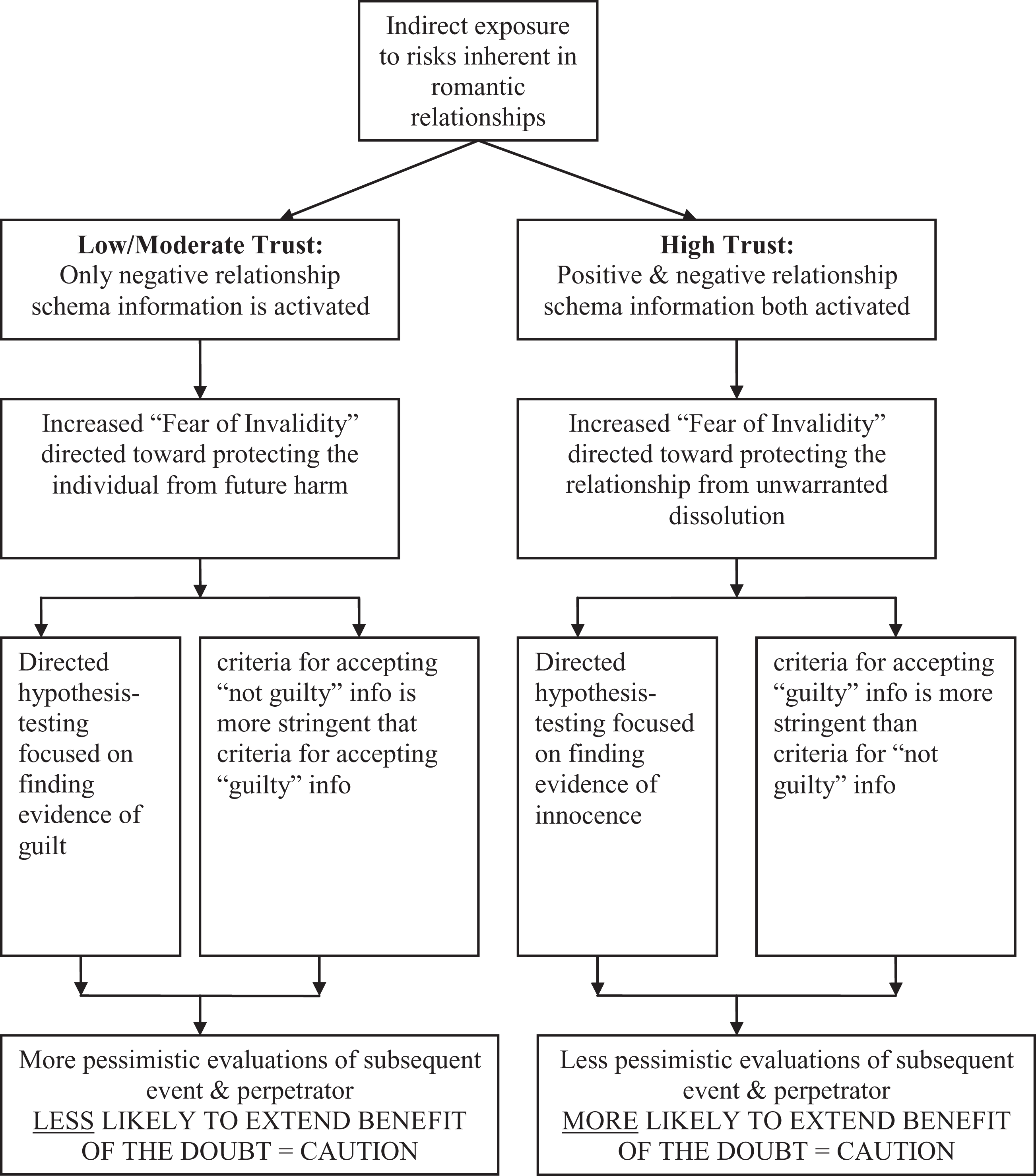
Dual-focus model of indirect risk exposure, trust and caution.
Lower to moderate trust and risk: Guilty until proven innocent
We believe that when trust is low to moderate, an indirect risk prime may act as an interpretive filter through which subsequent information must pass. Ambiguous events may then appear more negative than they really are. Such skewed perceptions may then diminish the odds that a lower or moderate trust individual would extend the benefit of the doubt to the perpetrator (i.e., “guilty until proven innocent”).
Work by Chaiken and Yates (1985), Holmes (1991) as well as Rempel, Ross and Holmes (2001) suggests that the lower the level of trust, the more compartmentalization of positive and negative information occurs in the individual’s mental models concerning relationships. Since positive and negative information is stored separately, the potential then exists for a given situation to activate the negative information in the individual’s mental models without also activating the positive information. Accordingly in Figure 1, the left side of our model reflects Boon and Holmes’ (1999) theorizing and postulates that for those who are moderate to low in trust, risks perceived in others’ relationships may prime only those aspects of their general relationship schemas that pertain to issues of risk and vulnerability, subtly shifting their beliefs about what relationships are generally like in a more negative, pessimistic direction.
Holmes (1991) also suggests that the lower an individual’s level of trust in a romantic partner, the more they tend to be inveterate hypothesis-testers, perennially concerned with establishing beyond a shadow of a doubt whether their partners truly care about them. Because they cannot entirely dispel their concerns on this point, they tend to be vigilant in observing and analyzing their partner’s behaviour, looking for diagnostic signs of his or her motives and feelings. They tend to treat a partner’s positive behaviours as less diagnostic than negative behaviours to the extent that a single negative event may be enough to alter their attitude toward the partner for the worse (Holmes, 1991).
Our model then suggests that the activation of only negative relationship schemas coupled with this focus on protecting the individual may amplify people’s concerns about the costs associated with giving faulty advice that may put others in future jeopardy (Kruglanski, 1990). This concern would then motivate lower to moderate trust individuals to collect as much information about the situation as possible in the hopes of avoiding drawing unwarranted charitable inferences about a partner’s questionable behaviours. Ultimately, this directed information search would result in more negative, pessimistic assessments of the situation and less inclination to advise the victim to extend the partner the benefit of the doubt.
Higher trust and risk: Innocent until proven guilty
Conversely, high trust individuals have successfully integrated positive and negative information about their partners into a cohesive mental model of relationships (Chaiken & Yates, 1985; Holmes, 1991). For example, negative information may be reinterpreted so that it is less negative or it may be assigned to areas of peripheral importance (Holmes, 1991). This suggests that even in the face of indirect exposure to risk it may be difficult to activate the negative information in their mental models without simultaneously activating positive information.
In addition, as trust increases, individuals become more confident that their partners truly care about them and will always have their best interests at heart (Holmes, 1991). As higher trust individuals achieve a sense of closure concerning their partners’ trustworthiness, they become increasingly likely to view their relationships from a dyadic “we” perspective rather than an egocentric “I” perspective focused solely on the self (see Arriaga & Agnew, 2001). This shift in focus is reflected in higher trust individuals’ tendencies to evaluate events from a longer-term accounting perspective or in terms of the “big picture” in ways similar to Clark and Mills (1979) concept of communal relationships. This allows them to interpret potentially negative events in the broader context of time and experience such that single negative events may have significantly less impact on a higher trust person’s perception of the partner’s trustworthiness than would be the case for someone lower in trust. High trust individuals’ primary concerns therefore are unlikely to be focused on protecting the individual from the possibility of future harm. In fact, like high self-esteem individuals in Murray et al.’s (2006) study, they should be motivated to protect the relationship from potentially unwarranted dissolution.
As you can see on the right side of Figure 1, we still expect indirect risk exposure to elicit concerns about giving faulty advice and motivate higher trust individuals to collect as much information about the situation in question as possible (Kruglanski, 1990). In this case, however, indirectly perceived risk would motivate information search and hypothesis-testing designed to allow higher trust individuals to protect the relationship from unwarranted dissolution. This would result in a tendency for higher trust individuals to view transgressions more benevolently than lower to moderate trust people, with higher trust people suggesting the individual extend the benefit of the doubt more often (i.e., an “innocent until proven guilty” perspective).
Overview of present study and hypotheses
The current study extends work by both Boon and Holmes (1999) and Murray et al. (2006) by providing a theoretical model and the first experimental examination of the connection between more subtle forms of risk exposure and the levels of trust third-party evaluators have in their own partners when giving advice to others about their relationship difficulties. Participants initially completed trust and self-esteem scales. They returned to the laboratory one week later and read either a narrative designed to prime the risks inherent in romantic relationships or a control narrative. All participants then read and evaluated an account of events that occurred in someone else’s romantic relationship and gave advice to the victim.
We expected to see a significant interaction between indirect risk exposure and trust in this study. Based on work by Boon and Holmes (1999), Holmes (1991), and Murray et al. (2006), this would mean that in the risk condition, LOWER levels of trust in one’s own partner would predict MORE:
H1: negative third-party evaluations of the event and perpetrator
H2: assignment of responsibility and blame to the perpetrator
H3: suspicion and therefore increased need for additional information before suggesting extending the benefit of the doubt to the partner
H4: concern about protecting the individual from future harm and less concern about protecting the relationship from potentially unwarranted dissolution
H5: negative and pessimistic relationship advice to the victim.
Similar but significantly less polarized results were expected for control participants.
Method
Participants
One hundred and fifty-two undergraduate psychology students (113 female; 38 male; one unknown) participated in this study for partial course credit. Participants ranged from 17 to 25 years of age (M = 20.54; SD = 1.76) and had been involved in a dating relationship of at least four months duration (M = 25.04; SD = 18.34; range = 4 to 84 months). Participants classified themselves primarily as exclusively dating either very or quite seriously (87.2%), though a small number were casually dating (6.1%) or cohabiting/engaged (6.7%). The sample identified themselves as primarily Caucasian (72.6%) or Asian (18.9%).
Procedure
In Session One, participants were told that the purpose of the study was to examine variables that affect people’s evaluations of real-life events that have occurred in someone else’s romantic relationship. Participants completed several individual differences scales (most importantly trust and self-esteem scales) and demographic items. One week later in session two, participants returned to the lab and were told that they would be evaluating two events, the first of which (either the risk prime or a control narrative depending on random assignment) had been written by a participant in a previous study. As part of the cover story, participants were told that having all participants read the same account would allow us to determine which of the variables from Session One would predict their evaluations of that event. In reality, this exercise was designed simply as a risk prime (or control narrative as the case may be).
After reading and “evaluating” this priming narrative, participants were asked to read, evaluate and make inferences about an event that had recently taken place in someone else’s relationship in which it is unclear whether or not the individual’s partner has been unfaithful. As part of the cover story, participants were told that this “real-life”, handwritten account had been supplied by a recent participant in this study and that we would later compare their evaluations of this event to the author’s evaluations in order to examine actor/observer differences in evaluations of the same event. The true purpose of this account was to determine the impact of the risk prime on third-party evaluations of relational events. A funnel interview and debriefing indicated that participants did not harbour suspicions concerning the purpose or contents of the study, the authenticity of the accounts, or the veracity of the cover story.
Materials and measures
Female participants read materials seemingly written by a female victim while males read the account of a male victim’s experience. In all other respects, the materials were the same for both men and women. We will refer only to the female materials throughout this document.
Experimental manipulation of risk
The one and a half page risk narrative (adapted from Boon & Holmes, 1999) indirectly highlighted the inherently risky nature of relationships. This narrative vividly detailed the recent, painful and unexpected breakup of Danielle’s romantic relationship (e.g. “We had a good relationship overall but things just eroded over time, things just changed”, “I almost wish now that I’d never fallen in love with Stephen because it hurts twice as bad now that it’s over”). The one and a half page control narrative – a neutral counterpart against which the risk narrative could be compared – was the mundane account of how two people met and began dating. It did not involve any references to risk in relationships.
Ambiguous account
This handwritten account was adapted from Nairn and Boon (2003) and recounts an incident in which romantic partners Christa and Rob exchange brief telephone calls over the course of an evening. When it eventually becomes clear that Rob has company, Christa tells him she’ll call him in the morning. Instead of calling, she decides to stop by his house and, after using her key to let herself in, discovers Rob sitting in his kitchen talking with his ex-girlfriend, Michelle. Participants were asked to imagine themselves in Christa’s position as they evaluated the situation.
The use of a more ambiguous event (Christa finds Rob and his ex talking in the kitchen) rather than an unequivocal transgression (Christa finds Rob and his ex in bed) was deliberate. This ambiguity allowed for the widest range of subjectivity in participants’ evaluations, allowing greater opportunity for exposure to risk and participants’ varying levels of trust to impact their judgments. In pilot testing (N = 21), participants were given the account and asked how likely they thought it was that Rob cheated on Christa with his ex-girlfriend. Evaluations of this event ranged between 3.5 and 4.5 (M = 3.83; SD = 1.17) on a seven-point Likert scale (1 = not at all likely he cheated; 7 = extremely likely he cheated), suggesting that participants were unsure whether or not Rob had cheated on Christa and therefore the account provided the ambiguity we desired.
Individual difference scales
Trust scale
The 34-item trust scale was adapted from Holmes and Boon (1994). Using a seven-point Likert scale (ranging from 1 “strongly disagree” to 7 “strongly agree”), participants responded to items such as “I feel that my partner can be counted on to help me” and “I often wonder if my partner is trying to manipulate me in order to gain his/her own ends”. Negatively worded items were recoded such that higher scores indicated greater levels of trust in one’s partner. A trust index was created by averaging the 34 items (alpha = .93). Scores on the trust index were negatively skewed (md = 5.80; M = 5.66; SD = .78, range 3.18 to 6.85). Accordingly, we reflected them and performed a square root transformation. The remaining assumptions of parametric testing for regression were met.
Self-esteem
The Self-Esteem Scale (Rosenberg, 1965) assessed participants’ general level of self-esteem. Participants rated 10 statements such as “I certainly feel useless at times” and “I feel that I am a person of worth, at least on an equal basis with others” using a seven-point Likert scale (ranging from 1 “strongly disagree” to 7 “strongly agree”). Negatively scored items were reversed before scoring such that higher scores indicated greater levels of self-esteem. A self-esteem index was created by averaging the 10 item (alpha = .90). Scores on the self-esteem index were negatively skewed (md = 5.95; M = 5.73; SD = .98, range 2.40 to 7.00). Accordingly, we reflected them and performed a square root transformation. The remaining assumptions of parametric testing for regression were met.
Manipulation checks
Valence of the risk/control narrative
Participants were asked to assess the negativity of the risk/control narrative when asked to complete the following statement: “The incident described in the account was...”. The seven-point Likert scale used for this assessment ranged from 1 “not at all negative” to 7 “extremely negative”.
Mood
This mood checklist was adapted from the Positive and Negative Affect Schedule (Watson, Clark, & Tellegan, 1988) and was used to determine whether or not reading the risk narrative decreased participants’ moods compared to those who read the control narrative. It consisted of 18 words which described feelings and emotions such as distress and calmness. Both before and after reading the risk/control narrative, participants were instructed to read each item and rate the extent to which they were currently experiencing that feeling or emotion. Ratings were based on a seven-point Likert scale, ranging from 1 (not at all) to 7 (extremely). Positive items were recoded and then scores on the individual items were averaged to form a general mood index, higher numbers indicating more negative mood (pre-manipulation mood alpha = .93; post-manipulation mood alpha = .96).
General relationship beliefs scale
This 12-item scale was adapted from Boon and Holmes (1999) and was originally constructed to assess people’s relational schemas or their beliefs about what relationships are generally or typically like (e.g. “Part of being in a relationship is facing the risk of someday losing the relationship”; “The benefits of being in a relationship outweigh the costs”). As in previous research (i.e., Boon & Holmes, 1999; Deveau, 2001; Nairn & Boon, 2003), we used this scale in this study primarily to establish the extent to which reading a narrative designed to remind people that relationships are risky can affect participants’ perceptions of vulnerability in relationships. Ratings were made on a seven-point Likert scale ranging from 1 (strongly disagree) to 7 (strongly agree). For analysis, these items were combined to form a general relationships beliefs index, with higher numbers indicating greater negativity or a more cautious approach towards relationships in general (alpha = .84).
Dependent measures
The dependent variables in this study were taken directly from Boon & Holmes’ (1999) and Nairn (2000). Participants responded to all dependent measures using seven-point Likert scales. Exact wordings for all items and the results of the factor analyses upon which the indices were based are available upon request from the first author.
Initial evaluations of the event and perpetrator
This set of five questions asked participants to rate the following items: “The incident described in the account was...” (1 – very negative to 7 – very positive); “Rob’s behaviour in this incident was...” (1 – very negative to 7 – very positive); and “Did Rob intend for this incident to affect Christa the way it did?” (1 – not at all to 7 – definitely). Participants also indicated: “If Rob were your boyfriend, how much damage do you think this incident would do to your relationship with him?” (1 – no damage at all to 7 – severe and extensive damage) and “If Rob were your boyfriend, how likely do you think you would be to forgive him?” (1 – not at all likely to 7 – extremely likely). Positively worded items were recoded such that higher scores indicated more negative initial evaluations of the event and its perpetrator. Scores on the five items were averaged to form an index of initial evaluations of the event and perpetrator (alpha = .75).
Responsibility attributions
Two items assessed how responsible and blameworthy the perpetrator was for the feelings experienced by the victim using separate seven-point Likert scales (1 – not at all responsible/blameworthy to 7 – extremely responsible/blameworthy). Scores on these two items were averaged to form an index of responsibility attributions (alpha = .85). Higher scores on this factor indicate greater perpetrator culpability.
Suspicion and desire for further information
These 21 items assessed participants’ levels of suspicion and desire for further information. Ten global evaluations of the perpetrator and his behaviour were included such as “Rob’s behaviour in this instance leads me to doubt his sincerity in the relationship more generally” and “I am suspicious that Rob was motivated to seek his own self-interests in this instance” (1 – strongly disagree to 7 – strongly agree). Seven additional items assessed how cautious participants would be in relying on the information contained in the ambiguous account when deciding whether to excuse or condemn Rob for his actions; for example, “It would be unwise to excuse Rob’s behaviour in this instance solely on the basis of any justifications Christa might offer to explain this behaviour” (1 – strongly disagree to 7 – strongly agree). Two items directly asked participants how suspicious Rob’s behaviour was (1 – not at all suspicious to 7 extremely suspicious) and how likely it was that Christa was reading too much negativity into the situation (1 – not at all to 7 – reading far too much into it). Finally, participants were asked how much more positive information they believed they would need before exonerating Rob as well as how much more negative information they would need before deciding whether or not he was guilty (1 – no further negative information to 7 – a great deal more negative information). Positively worded items were recoded such that high numbers indicated higher level of suspicion and greater desire for further information before extending the perpetrator the benefit of the doubt. Scores were averaged to form an index of suspicion and information processing (alpha = .84).
Caution orientation
Two items addressed the focus of participants’ concerns in the face of ambiguity: “I would rather err on the side of giving Rob the benefit of the doubt when I’m unsure if he has transgressed” and “I would rather err on the side of being cautious and not give Rob the benefit of the doubt when I’m unsure if he has transgressed” (1 – strongly disagree to 7 – strongly agree). These items were recoded so that higher scores suggested greater desire to refrain from extending the benefit of the doubt. Scores on these items were then averaged to form an index of caution orientation (alpha = .82).
Advice to the victim
Eleven items assessed what advice participants would give the victim. Participants were asked “How suspicious does this situation look to you?” (1 – not at all to 7 – extremely), “Am I reading too much into this?” (1 – not at all to 7 – extremely), “Do you think Rob cheated on me with Michelle?” (1 – not at all likely to 7 – extremely likely), “When I confronted him afterwards, Rob claimed nothing happened. Should I believe him, even though I have no way of proving he is telling the truth?” (1 – definitely should believe to 7 – definitely should not believe), “Should I give Rob the benefit of the doubt?” (1 – definitely should to 7 – definitely should not), “How much should I trust Rob after this?” (1 – not at all to 7 – completely), “How seriously should I think about ending the relationship?” (1 – not at all seriously to 7 – extremely seriously), “Do you think my relationship is in trouble?” (1 – not at all to 7 – a great deal of trouble), “Should I forgive Rob?” (1 – absolutely not to 7 – absolutely), “Should I be more concerned about saving an otherwise good relationship or about maybe getting more hurt if he really did cheat?” (1 – definitely should be concerned about saving relationship to 7 – definitely should be concerned about getting more hurt), and “Do you think I should stay with Rob or leave him?” (1 – definitely should stay to 7 – definitely should leave). These questions (and the corresponding seven-point Likert scales) were handwritten and presented to the participants in a sealed envelope to reinforce the cover story that “Christa” was actually involved in the study herself and in order to increase participants’ psychological involvement and investment in their evaluations. Higher scores indicated more negative or pessimistic advice to the victim. Scores on the 11 items were averaged to form an index of advice to the victim (alpha = .91).
Bivariate correlations between the indices cited above ranged from .42 to .73, indicating that they measure related but distinct constructs. According to Tabachnik and Fidell (2007), only bivariate correlations greater than .80 are problematic particularly when, in the present case, inter-correlation should be expected given that, for example, a decision about whether or not a victim should remain in a relationship should be related to an individual’s assessment of the negativity and intent of the behaviour.
Results
The zero-order correlations between self-esteem, relationship length and the dependent variables were small (−.01 to −.15) and non-significant (p’s > .05) therefore they were not included in the following analyses. Unless otherwise indicated, we analyzed the data using a mixed-model hierarchical regression analysis (involving one categorical variable and one continuous variable). The categorical variable “risk” was effect-coded (risk = −1; control = 1) and the continuous independent variable, trust, was centered (Aiken & West, 1991). The main effects of risk and trust as well as the interaction between them were then entered together in the regression. The results remained the same with and without the male participants, therefore we retained all participants’ data.
Manipulation checks
Valence of the risk/control narratives
As expected, the risk group (M = 5.39, SD = 1.04) perceived their narrative significantly more negatively (β = −.84; t (144) = −18.20, p < .001) than no-risk controls perceived theirs (M = 2.43, SD = .92). The main effect of trust as well as the Risk X Trust was not significant (p’s < .05).
Mood
When the risks inherent in romantic relationships were primed (i.e., in the risk condition) and concerns about negative outcomes were elicited, we expected to see a negative shift in individuals’ mood from baseline (pre-manipulation) to post-manipulation. Because scores on the two mood indices were correlated, we created a residualized mood variable representing the change in mood from baseline due to the manipulation. We subjected this residualized mood variable to a regression analysis in which trust, risk, and the Risk X Trust interaction were entered in the same step. This analysis resulted in a significant main effect of risk (β = −.38; t (142) = −7.94, p < .001) in which participants who read the risk narrative experienced significantly more negative change in mood (raw M = 3.01, SD = 1.02) than those who read the control narrative (raw M = 2.16, SD = .62). Neither the main effect of trust nor the Risk X Trust interaction achieved significance (p’s > .05).
General relationship beliefs
The general relationship beliefs of the risk group (M = 5.43, SD = .80) were significantly more negative and pessimistic than those of no-risk controls (M = 4.74, SD = .94; β = −.36; t (144) = −4.75, p < .001). The main effect of trust as well as the Risk X Trust were not significant (p’s < .05).
In sum, these manipulation checks suggest that the risk narrative was seen as more negative and induced more negative mood than the control. More importantly, those who read the risk narrative reported significantly more negative and pessimistic beliefs about relationships in general than did those who read the control narrative. Together these findings suggest that the risk narrative primed negative thoughts and feelings related to risk.
Dependent variables
Hypothesis #1: Initial evaluations of the event and perpetrator
The interaction between risk and trust significantly predicted the initial evaluations of the event and perpetrator (β = .16; r2Δ = .07; t (144) = 2.02, p = .05). As expected, in the risk condition, trust significantly predicted participants’ evaluations of the event and perpetrator (β = −.29; r2Δ = .08; t (72) = −2.52, p = .01) signifying that as trust decreased, risk participants’ evaluations of the event and perpetrator became more negative. Trust did not significantly predict evaluations of the event or perpetrator in the control condition (β = −.10; r2Δ = .01; t (70) = −.79, p < .05).
Hypothesis #2: Responsibility attributions
Consistent with Hypothesis 2, the interaction between risk and trust significantly predicted the level of blame and responsibility ascribed to the perpetrator (β = .26; r2Δ = .09; t (144) = 3.32, p = .001). In the risk condition, trust significantly predicted participants’ attributions of responsibility and blame (β = −.30; r2 Δ = .08; t (72) = -2.61, p = .01) signifying that as trust decreased, risk participants’ attributions of responsibility and blame increased. Trust did not significantly predict evaluations of the event or perpetrator in the control condition, t (β = .14; r2Δ = .02; t (70) = 1.09, p < .05).
Hypothesis #3: Suspicion and desire for further information
Contrary to our expectations in Hypothesis 3, the risk and trust interaction did not significantly predict participants’ level of suspicion and desire for further information (β = .42; t (148) = 1.57, p = .12). There was, however, a significant main effect of trust for participants’ level of suspicion and desire for further information before extending the benefit of the doubt (β = −.86; r2Δ = .08; t (148) = −3.18, p < .01). Whether or not they had been exposed to risk, the higher participants’ trust the less suspicious they were and the less information they felt they would need before extending the perpetrator the benefit of the doubt.
Hypothesis #4: Caution orientation
The interaction between risk and trust was a statistically significant predictor of the direction in which participants preferred to focus their caution when making their judgments (β = .16; r2Δ = .10; t (144) = 2.06, p = .04). In the risk condition, trust significantly predicted participants’ tendencies toward protecting either the relationship or the individual (β = −.42; r2Δ = .16; t (72) = −3.74, p < .001) signifying that as trust decreased, risk participants were more concerned about protecting the victim from possibly being hurt again than they were about protecting the relationship from unwarranted dissolution. Trust did not significantly predict participants’ inclinations toward protecting either the relationship or the individual who had been hurt in the control condition (β = −.14; r2Δ = .02; t (70) = −1.08, p >.05).
Hypothesis #5: Advice to the victim
Finally, consistent with Hypothesis 5, the interaction between risk and trust was a statistically significant predictor of the negativity of the advice participants gave to the victim (β = .17; r2Δ = .11; t (144) = 2.19, p = .03). In the risk condition, trust significantly predicted participants’ advice to the victim (β = −.42; r2 Δ = .16; t (72) = −3.79, p < .001) signifying that as trust decreased, risk participants’ advice to the victim became significantly more pessimistic. Trust did not significantly predict participants’ advice to the victim in the control condition (β = −.15; r2 Δ = .02; t (70) = 1.14, p < .05).
Discussion
Much of the previous research on risk has focused on how the type of risk affects desire for caution in evaluating relational transgressions. For example, Murray and Holmes (1993) found that direct threats to a person’s own relationship resulted in efforts to protect the relationship from potentially unwarranted dissolution. Boon and Holmes (1999) found that indirect exposure to the risks inherent in all relationships shifted caution in the direction of protecting the individual from future harm. In both of these cases, however, risk exposure was determined to focus caution in only one direction. The possibility that individual differences could moderate these findings and shift the focus of caution in different directions is a relatively new avenue of investigation. Our goal in this study was to extend Boon and Holmes’ (1999) work and determine the extent to which indirect, less personal perceptions of risk and the level of trust one has in his/her own partner interact to help explain the ways in which individuals evaluate and give advice about events, in this case, those that occur in other people’s romantic relationships. More specifically, we were interested in examining whether different levels of trust coupled with indirect exposure to risk would result in the same type of dual-directional focus of caution as found by Murray et al. (2006).
The results of our study suggest that indirect risk exposure and trust, in combination, do significantly predict initial evaluations of the event, the attribution of responsibility and blame, focus of caution, and advice to the victim, in the directions hypothesized in our dual-focus model of indirect risk exposure, trust, and caution. The only exception to this pattern was the absence of an interaction between risk and trust on our measures of suspicion and desire for further information.
Support for the dual-focus model of indirect risk exposure, trust, and caution
As we hypothesized, in the risk condition, lower levels of trust in one’s own partner significantly predicted more: negative third-party evaluations of the event and perpetrator, assignment of responsibility and blame, concern about protecting the individual from future harm, and negative and pessimistic relationship advice to the victim. These findings support work by Hoch (1987) which suggested that, when asked for advice, people project their own values onto their peers and others close to them. More specifically, when subtly reminded of the inherently risky nature of relationships in general, participants appear to have used their own level of trust in their romantic partner to evaluate events in other people’s relationships.
This is the first study to demonstrate that the impact of indirect risk exposure on people’s evaluations of relational events and focus of caution is not unidirectional. Certainly, indirect risk exposure can focus people’s desire for caution toward protecting the individual as Boon and Holmes (1999) found; however, the present results suggest that this only occurs when trust is low to moderate. As we saw in our study, the more an individual who had been indirectly exposed to risk was concerned about the extent to which his/her own partner could be trusted, the less likely he/she was to suggest a victim be benevolent, thereby recommending the victim focus primarily on self-protection. Conversely, when trust is higher, indirect risk exposure tends to direct caution toward protecting the relationship from potentially unwarranted dissolution. Hence, when indirectly exposed to risk, the more an individual trusted his/her own partner, the more likely he/she was to recommend a victim extend the benefit of the doubt to an offending partner and protect the relationship. There was no evidence that trust impacted participants’ evaluations of events in the absence of indirect risk exposure in this study.
Our evidence of dual-focus is similar to that found in Murray et al.’s (2006) risk regulation model. However, our findings are particularly interesting given that, contrary to their work, self-esteem was not a predictor, let alone a key predictor, of these evaluations. In fact, in our study, self-esteem and trust were only correlated .32 – a moderate correlation at best. As Murray et al. (2006) themselves suggested, this implies that the use of a more direct measure of felt regard such as trust may strengthen the findings of their risk regulation model. This finding also suggests that, whereas perceptions of the self may be useful predictors of events that occur in one’s own relationship, it is an individual’s perceptions of their partner’s potential responsiveness and care that are used to evaluate events in others’ relationships.
Our study also challenges Boon and Holmes’ (1999) unidirectional assumption that indirect exposure to risk primes only individuals’ negative relational schemas. Given their more negative evaluations of the event in question, it is possible that the low to moderate trust individuals in our study did have only their negative schemas activated in the face of risk. The fact that high trust individuals responded to risk exposure by becoming significantly less negative than those lower in trust, however, suggests the possibility of simultaneous activation of both positive and negative information in a single, consolidated relational schema (see Chaiken & Yates, 1995; Rempel et al., 2001). If both types of information are contained in one schema for those high in trust, then activating one would by necessity activate the other and, once activated, positive information may offset or at least minimize the effect of more negative representations. This consolidation and simultaneous activation of positive and negative information could conceivably result in the more benevolent evaluations proposed by our model and found in the responses of the high trust individuals in our study.
One exception to dual-focus model of indirect risk exposure, trust, and caution
Given that we found significant effects of an interaction between risk and trust for the initial evaluations, responsibility/blame attributions, focus of caution, and advice variables it was somewhat surprising that the Risk X Trust interaction was not a significant predictor of participants’ levels of suspicion and desire for further information. Indeed, only a main effect of trust predicted participants’ suspicion and desire for information. As Holmes’ (1991) theorizing would lead us to expect, the higher the trust, the less suspicion participants espoused and less desire they had to collect further information before extending the perpetrator the benefit of the doubt. Why was risk not an effective predictor here as it was in Boon and Holmes’ (1999) work?
We know it cannot be because the risk prime had decayed by the time participants made their suspicion and desire for further information judgments because the Risk X Trust interaction was significant for the advice questions participants completed last. It is however possible that, because they were evaluating someone else’s relationship (especially in this case someone they didn’t know personally), they were unmotivated to explore the situation further, considering the case “closed” at this point. To then report that they might require any further information or would not trust the information they believe they would receive from either party would, in a sense, be tantamount to invalidating or calling into question their already stated opinions.
It is also possible that, even though their judgments of the event and perpetrator were coloured by risk and trust, participants were striving to appear balanced or “more objective” in some way when asked directly how much more they would like to know about the situation at hand. An informal examination of several open-ended questions participants completed as part of this study suggests that while their evaluations and advice had been affected by the interaction between risk and trust, they did not want to believe that the perpetrator was indeed guilty. Across conditions (i.e., risk/not risk; low/moderate/high trust), many participants referred to the importance of remembering that there are “two sides to every story”, suggesting that even low trust participants who were exposed to risk want to believe the perpetrator is innocent even though they don’t actually believe he/she is, based on the information they have already received. This suggests that when basing their evaluations on the minimal information they were given, participants were influenced by risk and trust together. However, their desire to believe that the perpetrator may have had a good reason for his/her questionable behaviour overrode the impact of the risk manipulation but not their more chronic level of trust when deciding whether or not to access further information that may further condemn the perpetrator.
In addition, asking someone how much information they would hypothetically like to receive (as was the case in this study) is qualitatively different from allowing them to actually access different types of additional information until they feel satisfied they have enough to make a final decision. It is interesting to note that in our study, when participants were asked what kind of additional information they would like to receive, 61% of risk participants and 75% of controls indicated they would prefer positive information that suggested the perpetrator was not guilty. Whether or not participants’ evaluations would actually be swayed by being given access to more positive information about the situation and perpetrator remains an empirical question, especially as previous work suggests that, most often, negative information overpowers positive information in its effects on judgments (e.g., Baumeister, Bratslavsky, Finkenauer, & Vohs, 2001; Skowronski & Carlston, 1987).
Lack of trust effects in the absence of indirect risk exposure
Although not central to our model, based on Holmes (1991) we predicted that control participants would show the same pattern of results as those exposed to risk but to a less polarized degree. Our findings, however, demonstrated that, in the absence of risk, differing levels of trust do not produce significantly different evaluations of events occurring in others’ romantic relationships. The fact that trust did not influence participants’ evaluations in the control condition suggests that it is only when reminded that relationships are inherently risky that the different types of motivations and cognitive processing described by Holmes (1991) affect individuals’ assessments of events in others’ relationships and the advice they are willing to give. Bear in mind, however, that Holmes’ theorizing was based on evaluating events in one’s own relationship so it is possible that when evaluating others’ experiences trust is not a significant predictor unless participants are reminded of the risks inherent in all relationships.
Limitations and directions for future research
This study has several limitations worth noting. For example, our sample was quite young and predominantly female. Though we have found few sex or age differences in the trust and risk literatures this study was based on, inclusion of more males and older participants may prove interesting in terms of replication, model generalization, and/or identifying additional boundary conditions on the effects of caution when risk exposure is indirect. Longitudinal research following the ups and downs of trust within individuals’ lives would also be useful for determining whether the effects found here remain stable or shift over time and experience.
Related to this, though not a limitation per se, it is worth noting that while we speak of “low to moderate” and “higher” trust throughout this paper, the range of scores on our trust scale suggest that our sample consisted primarily of quite trusting individuals. It is therefore possible that we would find even more polarized results if future studies included participants who were experiencing significantly lower levels of trust in their romantic partners.
While the results of this study demonstrate support for the ultimate outcomes predicted by our dual-focus model of indirect risk exposure, trust, and caution, our attention must now turn to experimentally testing the individual motivational and cognitive components of the theoretical model itself. For example, while previous research has suggested that lower and higher trust individuals store positive and negative relationship information differently (Chaiken & Yates, 1985; Holmes, 1991; Rempel et al., 2001), further study will be needed to determine if this information is accessed and activated differently in the face of risk.
Future research is also needed to more directly examine the impact of the types of information low to moderate and higher trust individuals use or want access to when faced with evaluating relational events under circumstances of heightened risk awareness and how trust directly affects the stringency with which they choose to use or ignore additional information (Trope & Lieberman, 1998). As noted earlier, 61% of risk participants and 75% of controls indicated that, if given the choice, they would prefer to receive additional positive rather than negative information concerning the event and those involved. However, the extent to which being given additional information would affect their judgments and advice remains an empirical question (e.g., Baumeister et al., 2001; Skowronski & Carlston, 1987). Further studies should address several related issues concerning the impact of additional information including the amount needed, the influence of morality versus performance information (e.g., Earle & Siegrist, 2006), and the use of confirmatory search (e.g., Jonas et al., 2005) and/or belief perseverance strategies (e.g., Lord, Ross, & Lepper, 1979) in order to better understand the cognitive and motivational processes by which we use information to pass judgment and give advice about transgressions in others’ relationships.
The generalizability of the dual-focus model of indirect risk exposure, trust, and caution to evaluations of events in which we have a vested interest such as one’s own relationship or that of a close friend also remains a matter for future research. While Boon and Holmes’ (1999) work demonstrated very few differences between people’s evaluations of their own and strangers’ relationships in the face of indirect risk exposure, adding trust into the equation may increase these differences. Several studies have found that our advice to others differs significantly from what we believe we ourselves would do in our own relationships (e.g., Beisswanger, Stone, Hupp, & Allgaier, 2003), usually suggesting that we are more tolerant of risk-taking when someone else’s future is on the line rather than our own. This suggests that, in applying our model to evaluations of one’s own relationship, we may expect our results to become even more polarized with lower trust individuals being even more concerned with protecting themselves and high trust individuals focusing more on protecting their relationship in the face of indirect exposure to risk. The extent of the impact of risk and trust on the evaluations of a close friend’s relationship experiences remains an interesting empirical question worthy of future research.
Conclusion
Our investigation extends work by both Boon and Holmes (1999) and Murray et al. (2006) by providing a theoretical model and the first experimental examination of the connection between more subtle forms of risk exposure and the levels of trust third-party evaluators have in their own partners when giving advice to others about their relationship difficulties. With the single exception of the suspicion/desire for further information component of the model, we have found consistent preliminary evidence that indirect risk exposure and trust do interact to influence initial evaluations of events and perpetrators, responsibility and blame attributions, direction of caution towards protecting the individual or the relationship, and advice to the victim on where and how to proceed after a transgression has occurred. We believe that this work underlines the importance of examining factors in our own lives that may affect our ability to give well-grounded advice to others and will inspire further studies to examine even more potential boundary conditions that encourage and restrain these judgments.
Footnotes
Acknowledgements
The authors are indebted to Ryan Dawiskiba, Sue Clark, Bonita Ma, Liz Nosen, Eman Safadi, Laurie Sukovieff, Jonathan Koops, Alana Thibault, and Jonathan Chow for their assistance in running this study and Christine Lomore for feedback on an earlier version of this manuscript.
The data presented in this paper were obtained as part of the first author’s doctoral dissertation, which was supported by a Province of Alberta Graduate Fellowship.