







Abstract
Boredom has been described as a major obstacle to maintaining lasting love (Aron & Aron (1986). However, empirical research on this important challenge to relationship maintenance has been hampered by the lack of an agreed-upon definition of the construct. We tested the hypothesis that relational boredom is amenable to a prototype conceptualization. In study 1, participants provided prototypicality ratings for the features of relational boredom. Features such as “lack of interest in partner” and “no longer exciting” were considered prototypical of the construct, whereas features such as “nothing in common” and “too similar” were considered nonprototypical. We confirmed this prototype structure in the remaining studies. In study 2, when information that a couple was experiencing boredom was given, participants were more likely to infer that prototypical, than nonprototypical, features characterized the relationship. In study 3, the prototypical features were verified more quickly than the nonprototypical features in a reaction time task. In study 4, when a relationship was described in terms of prototypical, rather than nonprototypical, features of boredom, participants inferred greater boredom in the relationship. Moreover, these inferences were drawn more strongly for boredom than another negative relational state, namely conflict. Implications of these findings for theorizing and research on relational boredom are discussed.
It is well-established that marital satisfaction declines over time (see e.g., Berscheid, 2010). Research on possible contributors to this decline has focused on life transitions (e.g., birth of a child), life circumstances (e.g., financial strain), and negative interaction dynamics (e.g., conflict and hostility). However, in recent years, scholars have suggested that dissatisfaction can result not only from the presence of negativity in a relationship but also from the loss of positivity (Gable & Reis, 2001). For example, couples may feel unhappy because they no longer experience the excitement and exhilaration that characterized their relationship early on. Boredom may set in. Although this may seem like a more benign relationship challenge than dealing with overtly hostile, destructive relational dynamics, the effects may be just as corrosive. Indeed, Aron and Aron (1986) have claimed that “boredom is the major underrated, undertreated obstacle to lasting love” (p. 91). Nevertheless, this concept has received relatively little attention in the literature. Research by Aron and colleagues is an exception. For example, in a recent study, they demonstrated that marital boredom predicts less satisfaction 9 years later (Tsapelas, Aron, & Orbuch, 2009). Thus, it has now been documented empirically that the experience of boredom is associated with dissatisfaction in relationships. However, much remains to be known about what exactly this construct means and how it should be conceptualized.
Conceptions of boredom
Early definitions focused on the concept of boredom in general (i.e., not specifically in a relational context). Two main approaches were taken, namely defining boredom in terms of its causes and in terms of how it is experienced (see Harasymchuk & Fehr, 2010, 2012 for reviews). Initially, boredom was defined simply as habituation (see e.g., Smith, 1981). However, subsequent theorists argued that the cause of boredom is not merely repeated exposure or habituation, but, rather, it is the perception of a situation as inadequately stimulating that produces boredom (Mikulas & Vodanovich, 1993). In fact, it is now generally accepted that the causes of boredom reside in people’s subjective perceptions. However, there is a disagreement on what constitutes inadequate stimulation. Some theorists emphasize suboptimal levels of arousal (Zuckerman, 1974), challenge (Csikszentmihalyi, 1975), or lack of meaning (Fahlman, Mercer, Gaskovski, Eastwood, & Eastwood, 2009). Still others maintain that boredom is experienced when there is a lack of intrinsic motivation (Csikszentmihalyi, 1975; Hamilton, Haier, & Buchsbaum, 1984).
Turning to definitions of boredom in terms of how it is experienced, there is some common ground in that theorists agree that boredom is a dissatisfying state. However, there are divergent views on the nature of the dissatisfaction. Boredom has been characterized as a low arousal state similar to depression, loneliness, and learned helplessness (Frijda, 1987; Goldberg, Eastwood, LaGuardia, Danckert, 2011; Mikulas & Vodanovich, 1993; Russell, 1980). It has also been conceptualized as a high arousal state that is associated with frustration and agitation (Hill & Perkins, 1985). The lack of agreement on how boredom should be defined has led at least one theorist to suggest that it would be more accurate to refer to the concept as “the boredoms” (Phillips, 1993).
In the relationship domain, some conceive of boredom as a state or stage associated with the deterioration or dissolution of a relationship (e.g., empty shell marriage (Caughlin & Huston, 2006), relational atrophy (Kelvin, 1977), and stagnation stage (Knapp & Vangelisti, 1992)). The general idea is that relationships can reach a stage in which there is little communication, the partners are in a state of apathy, and they are disengaged from one another.
Other theorists conceptualize relational boredom as a relationship maintenance challenge. Boredom is attributed to a lack of positivity and growth that can be dealt with by proactively maintaining the relationship. For example, in Gable and Reis’s (2001) model of aversive and appetitive processes in relationships, a relational boredom-like state (i.e., stagnant) is conceptualized as the absence of positivity in a relationship (i.e., low appetitiveness) as opposed to the presence of negativity (i.e., high aversiveness). Similarly, according to the self-expansion model (Aron & Aron, 1986), boredom arises because of the inevitable deceleration of relationship growth that occurs as partners become familiar with one another. This deceleration is a natural consequence of getting to know another person well and is exacerbated when partners fail to actively maintain their relationship by engaging in novel and arousing activities (Aron, Norman, Aron, McKenna, & Heyman, 2000; Reissman, Aron, & Bergen, 1993).
Finally, theorists who take a dialectical approach view boredom as part of the dynamic tension that partners face between the desire for predictability and the desire for novelty in their relationship (Baxter & Montgomery, 1996; Erbert, 2000). Thus, models or theories of close relationships have touched on the question of “What is boredom?”. But there is a disagreement on the answer.
In summary, scholars who are interested in the general concept of boredom have shifted from defining the causes of boredom in terms of the objective properties of a situation (e.g., repetition) to definitions that emphasize the subjective construal of a situation as inadequately stimulating. However, there are differing views on how “inadequate stimulation” should be defined. Those who define the construct in terms of how it is experienced disagree on whether boredom is a low arousal emotion akin to sadness or depression or a high arousal emotion involving frustration and agitation. In the relational domain, there is consensus that boredom is a dissatisfying state. However, there is variability in terms of how this experience is conceptualized. Some view boredom as a state (or stage) of relationship deterioration, others regard boredom as a relationship maintenance challenge that can be overcome by engaging in stimulating activities, and still others conceive of boredom as part and parcel of the dialectical tension between predictability and novelty. Thus, although there are areas of commonality in extant conceptions of boredom (in general) and relational boredom, what is most striking is the divergence of views.
The prototype approach
According to Eleanor Rosch, the founder of prototype theory, many natural language concepts cannot be defined in terms of a set of individually necessary and jointly sufficient criterial features. Instead, these concepts are organized around their clearest cases, or best examples, which she referred to as prototypes. Prototypes shade into nonprototypes, which shade into nonmembers of the category. Therefore, boundaries between categories are blurry, rather than well-defined (Rosch, 1973; see Mervis & Rosch, 1981, for a review). In empirical tests of the theory, Rosch focused on the classification of natural object categories (e.g., fruits and vegetables). She found, for example, that apples and oranges are considered prototypical kinds of fruit—they exemplify the meaning of the concept. Other kinds, such as tomatoes and avocadoes, reside on the periphery and overlap with neighboring categories, such as vegetable (Rosch, 1973). Rosch’s work revolutionized the way that social scientists think about and study concepts, particularly those that have defied classical definition in the past. By now, there is considerable evidence that many concepts, including many relationship-relevant concepts, are organized as prototypes (e.g., emotion (Fehr & Russell, 1984; Shaver, Schwartz, Kirson, & O’Connor, 1987), love (Aron & Westbay, 1996; Fehr, 1988; Fehr & Russell, 1991; Fitness & Fletcher, 1993), commitment (Fehr, 1988), anger (Fehr & Baldwin, 1996; Russell & Fehr, 1994), jealousy (Fitness & Fletcher, 1993; Sharpsteen, 1993); forgiveness (Friesen & Fletcher, 2007; Kearns & Fincham, 2004), and respect (Frei & Shaver, 2002)).
The prototype approach has a proven track record of “coming to the rescue,” when there is a lack of consensus on the definition of a concept. Rosch argued that in many cases, scholars are attempting an impossible task, namely the delineation of necessary and sufficient criterial features of a concept that is not amenable to a classical definition, but, rather, is organized as a prototype concept. Put another way, top down approaches are not likely to produce the greatest yield in further understanding the meaning of many natural language concepts because the starting point is a precise definition of the phenomenon in question. Relational boredom is an example of a natural language concept that so far has eluded classical definition. 1
In addition to addressing issues of definition, a prototype analysis is useful in explicating lay conceptions of understudied concepts, such as relational boredom. Such an analysis entails a “bottom-up” examination in which the content and the structure of a concept are uncovered, at least from the perspective of laypeople. Tapping the collective knowledge that people hold for relationship-relevant concepts such as relational boredom is useful because people rely on this knowledge to understand interpersonal situations and make decisions about behavior (see e.g., Fehr, 2005).
Analyses of lay conceptions also can highlight aspects of a construct that may have been overlooked by experts. Indeed, Gregg, Hart, Sedikides, and Kumashiro (2008) argue that an advantage of prototype analysis is that it provides considerable breadth of the construct in question. Given how many facets of boredom (in general and in the relational domain) have been touched on in the literature (e.g., how it is caused, how it is experienced, and how it can be ameliorated), the concept of boredom is likely to be broad. Indeed, in a series of studies we conducted in order to construct a scale to measure this construct, it was evident that the concept of relational boredom is rich and multifaceted, at least as represented in the minds of ordinary people (Harasymchuk & Fehr, 2012). In our first study, we asked participants to list features or characteristics of the concept of relational boredom. A large number of features was generated. Features such as “lack of interest in your partner,” “lack of novelty,” “no spark in the relationship,” and “feels like you want change” were listed most frequently. Features such as “too similar to each other,” “spend too much time together,” and “things feel too comfortable” were listed relatively infrequently (Harasymchuk & Fehr, 2012, study 1). In a second study, we asked participants to rate these features in terms of prototypicality and then chose the 15 items with the highest ratings to comprise the items of our Relational Boredom Scale (see Harasymchuk and Fehr, 2012, for additional information on this scale).
Thus, the prototype approach is useful for revealing the wide-ranging and diverse nature of understudied concepts, such as relational boredom, that have eluded classical definition. Although our earlier findings were consistent with the notion that relational boredom may be a prototype concept, these studies did not provide a definitive test. According to Rosch (1973), in order to demonstrate that a concept is organized as a prototype in cognitive representation, a two-step process must be followed. First, it must be shown that people can reliably calibrate exemplars in terms of their degree of representativeness of the construct. The second step is to verify this internal structure using diverse methodologies. The purpose of the present investigation was to establish the prototype structure of the concept of relational boredom following the criteria outlined by Rosch.
Overview
Four studies were conducted. In study 1, participants provided prototypicality ratings for the features of relational boredom (generated in our scale construction research; Harasymchuk & Fehr, 2012). In study 2, we sought to confirm this prototype structure by examining category-based inferences. Specifically, participants rated the applicability of prototypical and nonprototypical features (based on the prototypicality ratings obtained in study 1) to a romantic relationship in which the partners were experiencing boredom. In study 3, we moved from explicit verification of prototype structure to implicit verification by using a reaction time task in which we assessed the speed of responses to prototypical and nonprototypical features. In our last study, study 4, we presented participants with a description of a relationship that was composed of either prototypical or nonprototypical features of boredom. The task was to rate the degree of boredom that was experienced in the relationship. We predicted that the features that received the highest prototypicality ratings in study 1 also would be most likely to be inferred when we activated the concept (study 2), would be verified quickly on a reaction time task (study 3), and that people would perceive a couple as most bored when prototypical features were characteristic of their relationship (study 4).
Study 1: Prototypicality ratings of the features of relational boredom
The goal of study 1 was to examine the internal structure of the concept of relational boredom by obtaining prototypicality ratings of features of the construct. These features were taken from previous research in which people in dating and marital relationships responded to the open-ended question: “What does relational boredom mean?” (Harasymchuk & Fehr, 2012; study 1). The responses were coded by two independent coders, yielding a final set of 69 features (listed by two or more participants; see Harasymchuk & Fehr, 2012; study 1). These features were administered to participants in the present study.
Method
Participants
Introductory Psychology students at the University of Winnipeg (N = 208; 116 women and 92 men), ranging in age from 17 to 51 years (M = 19.59 years), were recruited for a study on “Judgments of Relationship Words.” They received course credit for their participation. In terms of relationship status, 14% of participants reported that they were casually dating, 36% were seriously dating, 3% were cohabitating, and 1% was married. Mean relationship duration was 22 months (range = 1–300 months). A total of 40% of the participants were not involved in a relationship and 5% reported other (e.g., dating many others at once, on a break). English was the first language for the majority of participants (85%). The 32 participants for whom this was not the case had spoken English for an average of 11.6 years (ranging from 1.7 to 34 years). 2
Procedure
The 69 features of relational boredom were randomly divided into two groups (in order to reduce response fatigue). Thus, each participant rated 34 or 35 features of boredom on a scale, where 1 = not at all characteristic and 8 = extremely characteristic of boredom in romantic relationships. We also assessed trait levels of boredom proneness using Farmer and Sundberg’s (1986) Boredom Proneness scale. Participants who reported being in a romantic relationship completed additional measures, including a single item measure of boredom frequency (“How frequently do you feel bored in your relationship?”; rated on a scale from 1 = never bored to 7 = frequently bored) and a measure of relationship satisfaction, the Relationship Assessment Scale (Hendrick, 1988).
Results and discussion
The mean prototypicality rating across the 69 features of boredom was 5.57 (SD = .79) on an eight-point scale. Ratings ranged from 1.63 to 7.76, which supports the idea that relational boredom is a prototype concept, with some features representing the meaning of the concept better than the others. (Prototypicality ratings for 24 features of boredom that were targeted for further analyses in the subsequent studies are shown in Table 1. Ratings of these features ranged from 3.13 to 7.14.). 3 The feature of boredom that received the highest rating in our sample was “lack of interest in partner,” which reflects a lack of intrinsic engagement in the relationship. Another prominent theme reflected in the prototypical features was the loss of positive, high-arousal, satisfying qualities that once characterized the relationship, but no longer held true (e.g., “no longer exciting,” “no spark,” “less passion,” “lack of fun,” and “no more surprises”). Additional themes were disengagement from the relationship as exemplified in features such as “sick and tired of partner” and “feel nothing,” as well as the absence of communication (e.g., “lack of communication”). The features that received the lowest ratings (i.e., were considered nonprototypical) reflected the themes of excessive familiarity (e.g., “too similar to each other” and “things feel too comfortable”) and a lack of similarity (e.g., “nothing in common”).
Prototypicality ratings, applicability ratings, and reaction times for 24 features of relational boredom.
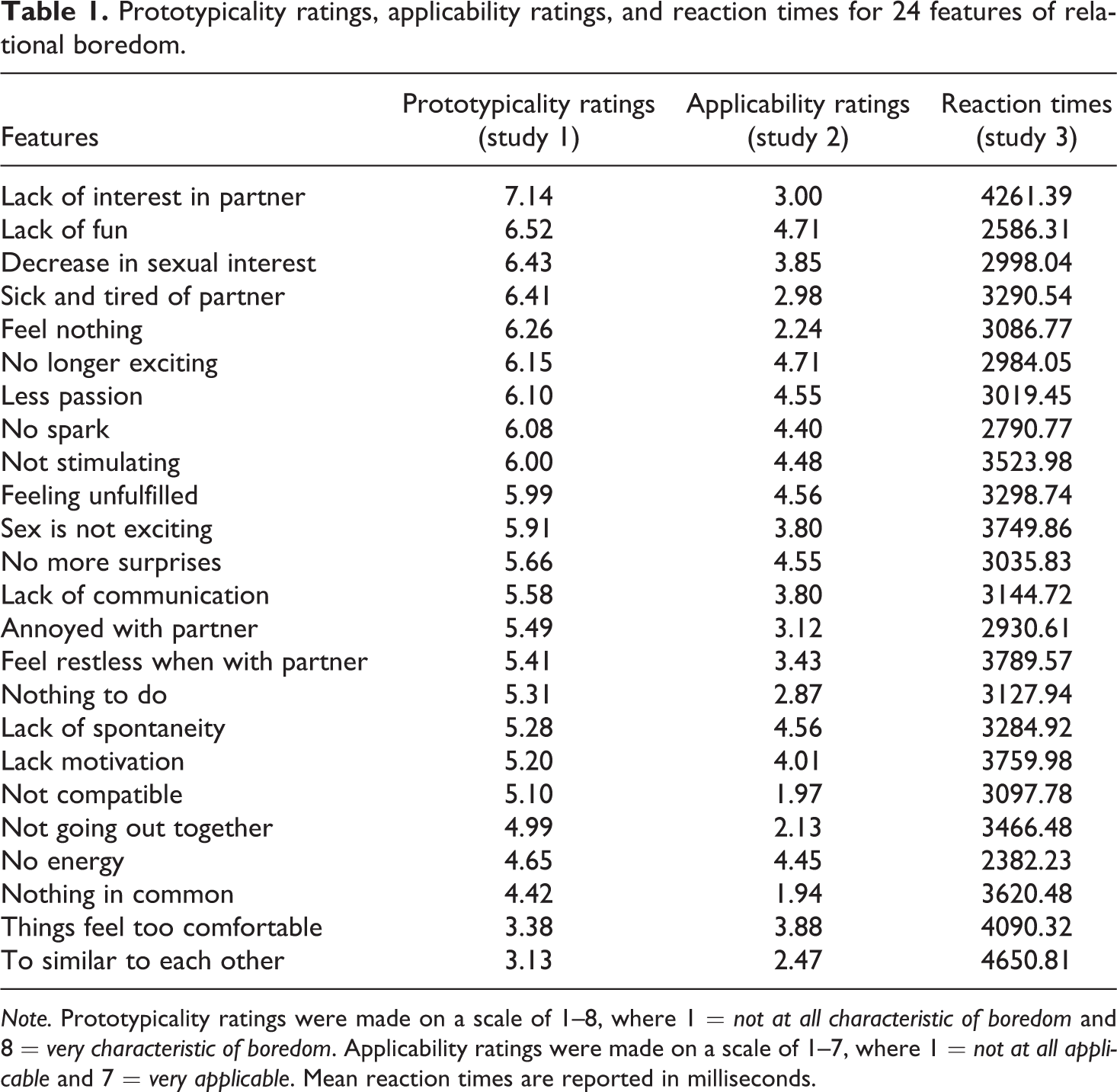
Note. Prototypicality ratings were made on a scale of 1–8, where 1 = not at all characteristic of boredom and 8 = very characteristic of boredom. Applicability ratings were made on a scale of 1–7, where 1 = not at all applicable and 7 = very applicable. Mean reaction times are reported in milliseconds.
To examine whether these ratings were influenced by gender or relationship status, a univariate analysis was conducted with prototypicality ratings as the dependent variable and gender and relationship status (married, cohabiting, and seriously involved (combined) vs. casually dating vs. not involved) as the fixed factors.
4
The relationship status effect was not significant, F (1, 190) = 1.32, p = .27,
Turning to our other measures, trait boredom proneness was not a significant predictor of prototypicality ratings, β = .003, p = .99 and, for those individuals who reported being in a close relationship, neither was the frequency of boredom experienced in the relationship, β = .17, p = .07, nor relationship satisfaction, β = −.12, p = .24.
In summary, there was evidence that the concept of relational boredom had a prototype structure, such that some features were regarded as more characteristic of the concept than others. Moreover, these ratings tended to be stable regardless of relationship status and trait boredom proneness. Although women had higher prototypicality ratings than men, the ratings were highly correlated suggesting that the sexes agree on a shared rank order. For people in a romantic relationship, the frequency of boredom experienced and the level of satisfaction did not affect ratings of prototypicality. Next, we sought to verify the prototype structure obtained in this study using a variety of methodologies.
Study 2: Category-based inferences
The purpose of study 2 was to verify the internal structure of the concept of relational boredom using category-based inferences. It was hypothesized that when given a description of a bored couple, participants would infer that prototypical features of relational boredom characterized the relationship more so than the nonprototypical features.
Method
Participants
Introductory Psychology students (N = 97; 57 women, 39 men, and 1 unreported) at the University of Winnipeg (mean age = 19.51 years, range = 17–41 years) were recruited for a study on “Judgments of Relationship Scenarios.” They received course credit for their participation. In terms of relationship status, 12% of participants were casually dating, 26% were seriously dating, 7% were cohabiting, and 2% were married. Mean relationship duration was 23 months (range = 1–118 months). Forty-four percent of the participants were not involved in a relationship and 8% reported other (e.g., “it’s complicated,” transitional relationship). English was the first language for the majority of participants (78%). The 19 participants for whom this was not the case had spoken English for a mean of 11 years (ranging from 3 to 28 years). The majority of participants self-identified as being Caucasian (64%), followed by smaller percentages of Asian (14%), East Indian (5%), Hispanic (4%), Aboriginal (4%), African American (1%), and other (5%) participants. Three percent did not report this information.
Procedure
Participants received a description of a couple who were experiencing boredom in their relationship. In constructing the scenario, we drew on Gable and Reis’s (2001) portrayal of the absence of positivity in a relationship. The description read as follows: Kayla and George have been in a long term relationship. They do not fight and do not feel there is anything really wrong with the relationship. However, they also do not feel as if things are right in the relationship. They are bored in their relationship.
Results and discussion
Mean applicability ratings for all the 24 features are shown in Table 1. A General Linear Model repeated measures analysis was conducted with prototypicality (prototypical vs. nonprototypical) as the repeated measures variable and gender as the between subjects factor. As hypothesized, participants rated the prototypical features of relational boredom as more characteristic of Kayla and George’s relationship than the nonprototypical features (M = 3.98 vs. M = 3.22, F (1, 92) = 88.51, p < .001,
Thus, when the concept of relational boredom was activated in cognitive representation, people inferred that the prototypical features applied; they were less likely to infer the applicability of nonprototypical features. Put another way, if told that a couple is experiencing boredom, people will infer that the relationship lacks interest, excitement or has “no spark”; they are less likely to assume that the partners are too similar to one another or that they are spending too much time together.
Study 3: Reaction time
The goal of study 3 was to verify the prototype structure of relational boredom at an implicit level using a reaction time paradigm. We hypothesized that participants would be faster to confirm that prototypical features, than nonprototypical features, characterize the concept. Given that prototypical features represent the core of a construct, the decision as to whether they belong should not require much thought. It should require more deliberation to confirm that the features on the periphery are part of the concept.
We also examined whether the prototype structure of relational boredom would be reflected in the kinds of true/false judgments people made. Specifically, we expected people to indicate that a feature was not a characteristic of relational boredom when it was nonprototypical rather than prototypical. This would provide further assurance that people are certain of the core aspects of relational boredom but more equivocal about the features on the periphery.
Method
Participants
Introductory Psychology students at the University of Winnipeg (N = 60; 35 women and 25 men) ranging from 16 to 31 years of age (M = 19.84 years) were recruited for a study on “Judgments of Statements: Computer Task Study.” They received course credit for their participation. In terms of relationship status, 15% were casually dating, 25% were seriously dating, 5% were cohabiting, 3% were married, and 53% were not involved in a relationship. Mean relationship duration for the participants who were in a romantic relationship was 14 months (ranging from 1 to 36 months). English was the first language for the majority of participants (82%). The 11 participants for whom this was not the case had spoken English for an average of 11 years (ranging from 2 to 22 years). Most participants self-identified as being Caucasian (61%), with smaller percentages of Asian (12%), Aboriginal (8%), East Indian (5%), and African American (7%) participants. Eight percent did not report this information.
Procedure
Upon arrival at the study, participants were told that they would be required to make true or false judgments about statements pertaining to everyday words, such as boredom and modesty, presented to them on a computer screen. We included statements about another concept, such as modesty, because prototype researchers typically include statements pertaining to another concept that has been subjected to a prototype analysis. This makes the task less repetitive for participants and also allows for a replication of prototypicality findings from other research. Modesty statements were taken from Gregg et al.’s (2008) prototype analysis.
Participants were given the following instructions: This study is part of a larger project on the meaning of words. You will see a series of statements about concepts such as RELATIONAL BOREDOM and MODESTY. The statements will be presented in the form “X is a feature/characteristic of Y.” For example, you might be presented with the statement, “Obligation is a characteristic of relational boredom.” If your answer is “true,” you would press the designated “true” key. If it is “false,” you would press the designated “false” key. To familiarize you with the task, we will first present a few trial sentences.
Results and discussion
Following standard procedure for reaction time studies, the data were cleaned by removing outliers. Specifically, we adopted Fehr and Sprecher’s (2009) criteria and removed reaction times that were three SDs above the mean and those that were below 800 ms. Approximately 2% of the responses met these criteria (27 responses were removed because they were three SDs above the mean; two responses were removed because they were below 800 ms). In addition, the data from one participant were excluded because of an inordinately high rate of “false” responses across trials.
Mean reaction times for all 24 features are shown in Table 1. A General Linear Model repeated measures analysis with prototypicality as the within-subjects variable and gender as the between subjects variable was conducted. Consistent with expectations, the main effect for prototypicality was significant, such that the participants were faster when responding to the prototypical, than the nonprototypical, features (M = 3291.41 ms vs. M = 3534.56 ms; F (1, 58) = 10.91, p = .002,
We also predicted that participants would be more likely to respond “false” to nonprototypical, than to prototypical, statements. To test this, we conducted a GLM repeated measures analysis with prototypicality as the within-subjects variable and gender as the between subjects variable. Consistent with this prediction, people were more likely to respond “false” to nonprototypical features than to prototypical features (M = 3.85 vs. M = 1.51, F (1, 58) = 71.22, p < .001,
We also conducted a GLM repeated measures analysis on reaction times to the modesty statements, again with prototypicality as the within-subjects variable and gender as the between subjects variable. There was a marginally significant prototypicality main effect, F (1, 58) = 3.53, p = .065,
In conclusion, the prototype structure of relational boredom was reflected in the speed of information processing. People were quick to verify that the prototypical features were characteristic of boredom. It required more deliberation to confirm the category membership of nonprototypical features. Participants were also more likely to respond “false” to the nonprototypical than to the prototypical features, suggesting that the “belongingness” of these features was seen as more equivocal. These results provide further evidence of the prototype structure of the concept of relational boredom.
Study 4: Relationship implications of the prototype structure of relational boredom
In studies 1–3, there was evidence that the concept of relational boredom is structured as a prototype concept. In study 1, people rated some features as more characteristic of relational boredom than others. In study 2, people were more likely to infer that the prototypical features, than nonprototypical features, applied when given a description of a bored couple. In study 3, the prototype structure of relational boredom was reflected in the speed of information processing, such that prototypical features were verified as characteristic of the concept more quickly than were nonprototypical features. In study 4, we hypothesized that people would be more likely to characterize a couple as bored when their relationship was described in terms of prototypical, rather than nonprototypical, features of relational boredom. We also addressed discriminant validity in this study by having participants provide ratings of another negative relational state, namely conflict, in addition to boredom. Our prediction was that a relationship description comprising the features of relational boredom would be rated as higher in boredom than in conflict. We also expected that the prototype structure that we uncovered in the previous studies would be unique to relational boredom and not apply to conflict.
Method
Participants
Introductory Psychology students (N = 90; 64 women and 26 men) at Carleton University (mean age of 22.89 years, range = 18–46 years) were recruited for a study on “Judgments of Relationships.” They received course credit for their participation. In terms of relationship status, 13% were casually dating, 29% were seriously dating, 21% were cohabiting, and 5% were married. Twenty-five percent of the participants were not involved in a relationship and 7% reported other (e.g., “it’s complicated”, transitional relationship). Mean relationship duration for the participants who were in a romantic relationship was 43.5 months (ranging from 1 to 336 months). English was the first language for the majority of participants (76.1%). The 20 participants for whom this was not the case had spoken English for an average of 12 years (ranging from 2 to 30 years). Most participants self-identified as being Caucasian (59%) with small percentages of, Asian (11%), East Indian (11%), African American(10%), Middle Eastern (8%) and Aboriginal (1%) participants.
Procedure
Participants received a description of a cohabiting couple that was composed of either prototypical features or nonprototypical features of relational boredom. For all participants, the scenario began as follows: Kayla and George met in graduate school and they have been together for several years. Kayla is interested in being a biologist and George studies physics. They live together in an apartment just off of campus. They have a dog that they take for walks every day. Lately, they have been feeling as if there is no spark in the relationship. There seems to be less passion and fewer surprises in the relationship than there used to be. As well, the relationship lacks fun. Kayla and George feel nothing when they are together. When they do have sex, it is no longer exciting. Lately, they have been feeling as if there is nothing to do. They find that they are lacking in communication and that they lack motivation. They feel annoyed with each other. There is also the sense in the relationship that they have nothing in common and feel too comfortable with each other.
Results and discussion
A univariate analysis with ratings of relational boredom as the dependent variable and prototypicality (prototypical vs. nonprototypical) and gender as the between-subjects fixed factors was conducted. Consistent with predictions, there was a significant prototypicality effect, F (1, 90) = 5.86, p = .02,
Next, we tested the hypothesis that when a relationship was described in terms of features of relational boredom, the relationship would be rated higher in boredom than in conflict. We conducted a GLM repeated measures analysis with relationship rating as the repeated measures variable (boredom vs. conflict) and prototypicality and gender as between subject variables. Consistent with predictions, there was a significant relationship rating effect, F (1, 86) = 76.46, p < .001,
Thus, participants attributed greater boredom when a relationship was characterized in terms of prototypical, rather than nonprototypical, features. They also attributed more boredom than another negative relational state, namely conflict. There was further evidence of discrimination in that the prototype structure of boredom did not apply to conflict.
General discussion
Given that the concept of boredom in general and the more specific concept of relational boredom have eluded classical definition, the time was ripe for a prototype analysis. Across multiple studies and diverse methodologies, there was support for the hypothesis that relational boredom is amenable to a prototype conceptualization. In our first study, people rated some features of boredom (e.g., “lack of interest in partner,” “lack of fun,” “decrease in sexual interest,” “sick and tired of partner,” “feel nothing,” and “no longer exciting”) as more representative of the concept than others (e.g., “feels too comfortable,” “too similar to each other,” “nothing in common,” and “not going out together”). Moreover, these ratings did not differ as a function of participants’ relationship status, trait levels of boredom proneness, frequency of boredom experienced in the relationship, or relationship satisfaction. Although women’s mean prototypicality ratings were higher than men’s, in study 1 correlational analyses suggested agreement on the relative ranking of the features. Moreover, gender differences were not found in any of the remaining studies. Thus, the prototypicality ratings that we obtained were rather robust. The fact that participants were able to calibrate features of relationship boredom according to how well they exemplified the construct satisfies Rosch’s first criterion for establishing that a concept is a prototype concept.
The second step in a prototype analysis is to verify the internal structure of a concept using diverse methodologies. If the findings across methods converge, the conclusion that a concept is organized as a prototype concept in cognitive representation can be drawn with greater confidence. Our findings in this regard were encouraging. In study 2, when given information that a couple was experiencing boredom, participants were more likely to infer that prototypical features characterized their relationship than that nonprototypical features did. Prototypical features also were verified more quickly in a reaction time task than were nonprototypical features (study 3). The prototype structure of relational boredom was further confirmed when examining participants’ true/false responses—participants were more likely to respond with “false” to statements about the belongingness of nonprototypical features than that of prototypical features. Finally, when a relationship was described in terms of prototypical features, participants inferred greater boredom than when the relationship was described in terms of nonprototypical features (study 4). Furthermore, the prototype structure of relational boredom was unique to boredom and did not apply to conflict. Taken together, these findings meet Rosch’s criteria for demonstrating that a concept is organized as a prototype concept.
In terms of the content of the prototype of relational boredom, our analysis revealed that a central theme in lay conceptions is a lack of positive, satisfying qualities, particularly the absence of high arousal, pleasant states (e.g., “lack of fun,” “no longer exciting,” “less passion,” and “no spark”). This theme also was reflected in some of the other features that received high ratings in study 1 (but that were not targeted for further analyses in the remaining studies), such as “lack of enjoyment,” “loss of romance,” “not happy,” “not satisfied,” and “no thrill.”
Another prevalent theme was disengagement from the relationship, physically, emotionally, and sexually (e.g., “sick and tired of partner,” “feel nothing,” and “decrease in sexual interest”). Again, this theme was reinforced by high prototypicality ratings assigned to features in study 1 that were not targeted in our verification studies (e.g., “lack of connection between partners,” “not wanting to be with partner,” “don’t want to spend time with partner,” “avoid partner,” and “rather spend time with others”). The theme of disengagement with the relationship suggests that boredom may be a more destructive relationship challenge than has been assumed.
It is also informative to examine the features that laypeople considered to be peripheral to the concept of relational boredom. These features pertained to familiarity (“too similar to each other” and “things feel too comfortable”), differences in personality (“nothing in common” and “not compatible”), amount of time spent with partner—either too much or too little—and an inability to “get up and go” (“no energy” and “lack motivation”). Once again, these themes also were reflected in features that were rated in study 1, but not selected for further analysis in the subsequent studies (e.g., “know everything about partner,” “predictable,” and “partner different that you thought they were”). Interestingly, it appears that the classic predictors of attraction, namely similarity and familiarity (see e.g., Perlman & Fehr, 1987), are perceived as contributing to boredom once relationships are established.
Implications of a prototype analysis of relational boredom
Our findings have implications for the scholarly enterprise of generating definitions of boredom and the more specific concept of relational boredom. The present evidence that relational boredom is organized as a prototype concept suggests that this concept may not be definable in the classical sense of the term. That is not to say that experts must adopt lay people’s conceptions. As discussed elsewhere (see e.g., Fehr & Russell, 1984), a prototype analysis is a descriptive analysis, but not a prescriptive analysis. Scholars are free to devise definitions in ways that are most useful for their purposes, so long as they remain mindful that the final product is a scientific construction and not a discovery of the “true” criterial attributes of the concept in question.
Our prototype analysis of relational boredom also has implications for people’s relationships. There is evidence that people rely on their conceptions of relational constructs when assessing the health of their relationships. For example, Hassebrauck and Aron (2001) showed that people rely on their prototype of relationship quality when deciding whether they are in a high quality, satisfying relationship. The prototypical features in particular serve as a benchmark when evaluating the quality of one’s relationship. A similar prototype-matching process is likely to occur for relational boredom. If asked “Are you bored in your relationship?,” knowledge of the prototype of relational boredom provides a basis for answering that question. More specifically, people are likely to assess whether their relationship is no longer exciting, whether they experience a lack of interest in their partner, whether passion has decreased, and so on. If these prototypical features of boredom characterize the relationship, they are likely to conclude that they are bored. They are less likely to reach this conclusion if the nonprototypical features of boredom apply (e.g., feeling too comfortable or not going out together). Thus, knowledge of the prototype of relational boredom provides people with a metric for assessing whether boredom is an issue in their relationship, and, if so, the seriousness of their ennui. These perceptions are likely to determine the steps that people take to deal with this important relationship challenge.
Relation between lay conceptions of relational boredom and experts’ models
Although close relationship scholars have yet to develop models that focus on relational boredom, per se, the self-expansion model provides a compelling account of why boredom occurs. According to this model, boredom results when self expansion—the merging of self with other—decelerates. The antidote is for couples to engage in novel and arousing activities (Aron et al., 2000; Reissman et al., 1993). Consistent with this model, a lack of self-expanding activities (or “lack of exciting activities” in laypeople’s terms) was central to lay conceptions of boredom. Moreover, the language that participants used to describe the absence of the high arousal, positive affective states suggests that these qualities were once present in the relationship, but had waned (e.g., “no longer exciting,” “no more surprises,” “less passion,” and “decrease in sexual interest”; emphases added).
The prototype of relational boredom as uncovered in our studies also was consistent with Gable and Reis’s (2001) conceptualization of what boredom-like states are, namely a deficiency in positivity and appetitive processes (i.e., low desire to approach pleasure and low relationship flourishing). The features rated as central to relational boredom revolved around the absence of positivity, rather than the presence of negativity (e.g., “lack of interest in partner,” “decrease in sexual interest,” “lack of fun,” and “no spark”).
Although our findings, based on laypeople’s conceptions, were consistent with these experts’ models, our analysis also uncovered aspects of boredom that have not been identified in the literature. For example, the theme of disengagement was viewed as central to the experience of relational boredom in the minds of laypeople. Boredom was conceptualized not simply as longing for the happy days of when a relationship first began, but, rather, entailed powerful feelings of disconnecting from the relationship. Disengagement took the form of physically distancing oneself from the partner and the relationship, withdrawing emotionally, as well as sexual disinterest.
Another theme that is not touched on in scholars’ accounts of relational boredom is a lack of communication (e.g., “lack of conversation”). This theme is reflected in features such as “lack of conversation” and “nothing to talk about” (study 1) as well as the feature “lack of communication” that was included in all of our studies. Finally, it was interesting that the feature that received the highest prototypicality ratings was “lack of interest in partner.” This feature reflects an absence of intrinsically rewarding qualities. Relationship scientists tend to focus on reducing conflict, criticism, and other destructive processes in relationships. The present findings suggest that the attention also should be paid to finding ways of enhancing intrinsic motivation to tend to one’s relationship. In short, there seem to be many facets to the relational boredom experience, at least as represented in the minds of ordinary people, which are not addressed in extant theories and conceptualizations.
Limitations and future directions
A limitation of this research is that we examined conceptions of boredom using an undergraduate student sample, most of whom were in dating relationships. Although we found that prototypicality ratings did not differ as a function of relationship stage or relationship climate (e.g., frequency of boredom and relationship satisfaction), it is possible that an older sample in longer-term relationships might hold a different prototype. Our concern is mitigated by the fact that in other prototype analyses, few, if any, individual and relationship-stage differences have been found, presumably because prototype analyses tend to tap knowledge that is shared by the members of a culture (see Fehr, 2005). Nevertheless, it remains an empirical question whether people in longer-term relationships might generate or emphasize aspects of relational boredom that differ from those in shorter-term relationships. For example, people in highly committed, long-term relationships might assign higher prototypicality ratings to features representing the disengagement aspect of relational boredom than those in less committed, shorter-term relationships.
The present investigation also was limited to a North American cultural context. It is possible that the content and structure of the relational boredom prototype would differ in other cultures. For example, in collectivist cultures, where the focus is on the well-being of friends, family, and the larger community, individuals may have lower expectations for excitement and “spark” in their romantic relationship. Such features might not even be generated, or if they were, might receive lower prototypicality ratings than those obtained in our individualistic culture with its emphasis on personal satisfaction and fulfillment.
Finally, it also will be critical in future investigations to empirically separate knowledge of and the experience of relational boredom from the knowledge and experience of other negative relational states. In study 4, we found that when a relationship was described in terms of features of relational boredom, it was rated higher in boredom than in conflict. There was also evidence that the prototype structure of boredom influenced ratings of boredom more than ratings of conflict. Although these findings are encouraging, in future research, it will be fruitful to explore the areas of overlap and differentiation between boredom and other negative relational states both in terms of the conceptualization of these constructs and in terms of their experience.
In conclusion, we found evidence in support of a prototype conceptualization of relational boredom. Our results show that people construe this experience as a loss of positivity that once characterized their relationship, as a lack of intrinsic motivation, as a lack of communication, and as disengagement from the partner and the relationship. These findings suggest that in addition to attempting to understand how negativity (e.g., conflict and hostility) affects relationship outcomes, relationship scholars would be well-advised to turn their attention to the issue of how couples regain the positivity that once characterized their relationship.
Footnotes
Acknowledgement
The authors thank Erin Buckels for her assistance in data collection.
Funding
This research was supported by a Doctoral Fellowship from the Social Sciences and Humanities Research Council of Canada awarded to the first author and a grant from the Social Sciences and Humanities Research Council of Canada awarded to the second author.