







Abstract
Prior research finds that sexually permissive individuals are judged more negatively than nonpermissive peers, placing them at risk of social isolation. Based on the positive assortment principle (i.e., preferences for similarity in attributes in close relationships), we examined whether participants’ own permissiveness mitigated negative judgments of permissive others in the same-sex friendship context. College students (N = 751) evaluated a hypothetical same-sex target with either 2 (nonpermissive) or 20 (permissive) past sex partners on 10 friendship-relevant outcomes. Participant permissiveness attenuated some negative evaluations. However, preferences were rarely reversed, and no moderation was found in five outcomes, suggesting the role of permissiveness-based positive assortment is limited, and evolutionary concerns may take precedence. Partial support for the sexual double standard was also found.
Keywords
The need to belong and form deep, lasting interpersonal relationships is a fundamental human motivation, and the failure to satisfy it leads to physical and psychological well-being decrements (Baumeister & Leary, 1995; Ryff & Singer, 1998). Satisfying this need could be more difficult for socially stigmatized individuals, as the number of close relationship partners available to them may be somewhat limited. For them, one of the few sources of companionship may come from those with the same stigmatized attribute, as people tend to associate with those similar to themselves with respect to many demographic, behavioral, and attitudinal attributes (McPherson, Smith-Lovin, & Cook, 2001). Sexually permissive individuals are often socially stigmatized and rejected as potential friends or partners (Crawford & Popp, 2003). Little is known, however, about the views of those who are themselves permissive, particularly in the context of same-sex friendships. If permissive individuals are rejected not only by those different from them but also by those similar to them, this may place them at a particularly high risk of social isolation and its many negative consequences.
The present study used an experimental person–perception paradigm to examine how participant permissiveness moderates the negative impact of target permissiveness on desirability of nonsexual, same-sex friends. Friends are one important, evolutionarily adaptive avenue for satisfying our need for belongingness, providing intimacy, support, self-affirmation, and autonomy (Lempers & Clark-Lempers, 1992; Sapadin, 1988). Same-sex friends are particularly valuable because they constitute the majority of our nonsexual friends throughout life (Stevens & Van Tilburg, 2011), we interact with them more frequently (Reis, Lin, Bennett, & Nezlek, 1993), and we value them more highly (Lempers & Clark-Lempers, 1992) than cross-sex friends. They are also typically devoid of sexual/romantic interests often present in cross-sex friendships and thus less burdened with mate selection concerns (Afifi & Faulkner, 2000; Bleske-Rechek et al., 2012).
The undesirability of sexual permissiveness
Sexual permissiveness can be defined as attitudes or behaviors that are more liberal or extensive than what is normative in a social group. It can include actual or desired frequent, premarital, casual, group, or extradyadic sex, sex with many partners, early sexual debut, or even nonverbal cues signalizing availability (e.g., provocative clothing). There are evolutionary and sociocultural reasons for the undesirability of permissiveness across interpersonal contexts. Permissive people are more likely to be sexually unfaithful to a mate (Bailey, Kirk, Zhu, Dunne, & Martin, 2000) and to poach someone else’s mate (Schmitt, 2004). This is costly for both sexes: It threatens paternity certainty for men, and continued provision of partner resources for women (Buss & Schmitt, 1993). This renders permissive individuals undesirable as partners as well as close same-sex friends, and distancing oneself from permissive friends could be an effective mate guarding strategy (Bleske & Shackelford, 2001).
Given the high cost of permissiveness to others, most societies have norms valuing sexual restraint over permissiveness (Abbott, 2000). Although attitudes in the US have become more permissive over time, the prevailing standard is one that finds sexual activity acceptable only with a few long-term partners (Laumann, Gagnon, Michael, & Michaels, 1994; Thornton & Young-DeMarco, 2001). Any person violating this—or any other—social norm is likely to trigger a host of negative cognitive, emotional, and behavioral reactions in others (Brown, 1991; Wilson & O’Gorman, 2003). In addition to serving a social control function, such as internal and/or external distancing from the transgressor could serve a self-promoting function—preserving one’s reputation and promoting one’s status (McAndrew & Milenkovic, 2002).
Extensive research demonstrates the general undesirability of permissiveness. Sexual experience in a friend or a partner is invariably rated as less desirable than sexual restraint and is often among the least desirable traits (Bleske & Shackelford, 2001; Coutinho, Hartnett, & Sagarin, 2007; Sprecher, 1989; Sprecher, Regan, McKinney, Maxwell, & Wazienski, 1997). In school-based sociometric studies, permissive adolescents, particularly girls, are often nominated as less liked and popular (Kreager & Staff, 2009; Prinstein, Meade, & Cohen, 2003), and hypothetical permissive targets are judged as less-desirable friends, dating partners, and spouses and are viewed as less moral, likable, intelligent, trustworthy, and adjusted (Bleske & Shackelford, 2001; Gentry, 1998; Mark & Miller, 1986; Marks & Fraley, 2005; O’Sullivan, 1995; Sprecher, McKinney, & Orbuch, 1991; Vaillancourt & Sharma, 2011). Vaillancourt and Sharma (2011) also found a greater need for mate guarding from permissive females among women; no men were sampled.
Role of participants’ own sexual permissiveness
Although the negative impact of permissiveness on desirability is well established across interpersonal contexts, less is known about factors that could attenuate or reverse this trend. One such factor may be individuals’ own permissiveness. People tend to have friends, partners, and colleagues who are similar to themselves in a variety of attributes, including age, intelligence, physical attractiveness, and social class—a phenomenon known as homophily (reviewed in McPherson et al., 2001). Homophily is often driven by positive assortment, a preference for similarity in these attributes, because similarity in close relationships is frequently beneficial (Prisbell & Andersen, 1980; Rogers & Bhowmik, 1970). If individuals positively assort based on permissiveness, permissive individuals would prefer permissive over nonpermissive others, providing critical social support that permissive individuals are unlikely to receive from nonpermissive others.
However, homophily in same-sex friendships has evolutionary drawbacks, as similar same-sex friends are more likely to be sexual rivals (Bleske & Shackelford, 2001). Permissiveness-based homophily in close relationships may be particularly dangerous, as the tendency of permissive people to be unfaithful and to engage in mate poaching carries equal evolutionary costs for close others regardless of one’s own permissiveness. Therefore, permissive people might reject permissive others just as strongly as do nonpermissive people, placing permissive individuals at a particularly elevated risk of social isolation.
Several studies have examined preferences for similarity in sexual behaviors and attitudes in romantic relationships. In several experimental studies, permissive participants evaluated the dating and marriage desirability of hypothetical permissive targets less harshly than did nonpermissive peers (Herold & Milhausen, 1999; Istvan & Griffit, 1980; Sprecher et al., 1991). Other studies found no such effects (Jacoby & Williams, 1985) or found them only among women (Sprecher et al., 1997). When moderation was present, participant permissiveness attenuated or eliminated the negative effects of target permissiveness among permissive participants, but it rarely reversed preferences.
Only one study to date has examined participant permissiveness in a friendship context, finding that permissive participants were more willing to befriend a same-sex permissive person and less willing to befriend a nonpermissive person than were less permissive participants (Coutinho et al., 2007). However, this study was nonexperimental, used different definitions of permissiveness for men and women, did not examine mate guarding or friendship-relevant personality attributes, and did not compare willingness to befriend permissive versus nonpermissive targets within levels of participant permissiveness. Thus, the power of participant permissiveness to mitigate the negative effects of target permissiveness in the realm of friendships remains unknown.
Sex differences
One’s sex may also moderate desirability of permissiveness in same-sex friends. In virtually all Western societies, women’s sexuality is more heavily regulated than that of men, a phenomenon known as the sexual double standard (Baumeister & Twenge, 2002). In the weak version of the double standard, both sexes are judged negatively for permissiveness, only men less so; in its strong version, women are judged negatively, but men are judged positively. Despite widespread belief in the double standard’s existence in contemporary cultures, experimental evidence regarding mate desirability and general person perception is mixed (reviewed in Crawford & Popp, 2003; see also Marks & Fraley, 2005, 2006).
The double standard may be particularly evident in same-sex friendships. Baumeister and Twenge (2002) argued that women, not men, are the most forceful regulators of women’s sexuality, and women have higher expectations of same-sex friends than do men (reviewed in Hall, 2011). Furthermore, to the extent that permissive people are more interested in casual sex than committed relationships, and men are more interested in casual sex than are women (Buss & Schmitt, 1993), permissive same-sex friends pose a greater fidelity threat to a woman with a male partner. If the double standard operates strongly in the same-sex friendship context, men would prefer permissive, and women would prefer nonpermissive friends. If the double standard does not operate in this context, men and women would show similar preferences for permissive targets, nonpermissive targets, or neither.
Research on the double standard in friendships is limited and mixed, with two studies finding a weak double standard (Bleske & Shackelford, 2001; Kreager & Staff, 2009) and three others finding no sex differences (Coutinho et al., 2007; Sprecher, 1989; Sprecher et al., 1991) in friendship desirability. To our knowledge, no study has examined sex differences in mate guarding. Thus, it remains unclear how sex impacts preferences for permissiveness in same-sex friends.
Current study
The current study focused on nonsexual, same-sex friendships. Our primary goal was to examine how participant permissiveness moderates the expected negative effects of same-sex target permissiveness on several outcomes relevant for same-sex friendships, including friendship desirability, need for mate guarding, target personality preferences, and target sexuality endorsement. This is one of the first studies to examine this interaction effect in the context of friendships, and to our knowledge, the first to examine multiple friendship-relevant outcomes and to do so in an experimental paradigm. A secondary goal was to contribute to the ongoing debate regarding the existence of the double standard in same-sex friendships, adding the rarely assessed aspect of mate guarding. As a final goal, we sought to replicate and extend findings of the negative main effects of target permissiveness on various aspects of friendship desirability. Much of the extant research is over a decade old, and as sexual attitudes have become more permissive over time, past findings require replication in contemporary samples.
We adopted an innovative approach for assessing perceptions of target personality in a way informative of the potential of such perceptions to impact friendships. Prior research used personality evaluations of hypothetical targets as outcomes. These provide insight into how permissiveness influences general person perception and likely reflect social ideals and stereotypes, but may not be relevant for friendship formation. Many examined attributes (e.g., traditional, earning potential, or dominant) are not uniformly (un)desirable in a same-sex friend, and it is unclear whether someone perceived as, for example, less dominant would be discriminated against as a potential friend. Even attributes that are more uniformly desirable, such as honesty or reliability (Sprecher & Regan, 2002), are likely preferred to a different extent by different people. To provide a measure of the degree to which permissive individuals might be discriminated against as friends due to their perceived personality attributes, we used both perceptions of target personality traits and the value each participant placed on those traits in a friend when creating our personality outcomes.
Based on extensive prior research, we expected permissive targets to be judged more negatively than nonpermissive targets on friendship-relevant outcomes. Our main hypothesis, based on the positive assortment principle, was that participant permissiveness would moderate this negative impact of target permissiveness. However, given opposing evolutionary forces, we expected this moderation to be of the weak, rather than the crossover type: All participants, regardless of permissiveness, would judge permissive targets more harshly than nonpermissive targets; only this tendency would be less pronounced among permissive participants. Finally, we examined moderating effects of sex, but given conflicting prior findings, made no specific predictions.
Method
Participants
Of 871 participants who completed the survey, 45 were excluded due to substantial amounts of missing data, nine due to missing permissiveness data, 18 due to unserious responding or response set bias, and six because they were older than 23 or missing age information. To maintain the nonsexual nature of the manipulation, 35 participants who identified as bisexual, mostly gay/lesbian, or gay/lesbian were also excluded.
Of 758 participants (75% female) with valid responses, the majority was White (62%), with the rest East or Southeast Asian (19%), Hispanic (5%), Black (5%), and multiracial (9%). Age ranged between 18 and 23 (M = 19.68, SD = 1.18), and virtually all (99%) were current undergraduates, with a consistent distribution across graduation years and a variety of majors, including social sciences (41%), life sciences (14%), business (13%), engineering/math (9%), and humanities/arts (5%). Most were Catholic (28%), nonbelievers (25%), Jewish (16%), or Protestant (16%); the sample was not very religious (M = 2.27, SD = 1.68 on a scale of 0–6, with higher scores indicating greater religiosity) and somewhat politically liberal (M = .69, SD = 1.41 on a scale of −3 to +3, with higher scores indicating greater liberality). Most were identified as upper-middle (43%) or middle (33%) class, 11% as upper, and 13% as working or lower-middle class. Most were identified as heterosexual (95%), 5% as mostly heterosexual, and 0.3% as asexual. The sample included 43% single participants, 36% in a serious romantic relationship, and 21% hooking up or casually dating.
Procedure
Most participants (97%) were recruited through in-class announcements in seven social science and communications courses at a large public/private university in the Northeastern US, inviting participants to take part in a 30-min online survey on friendship in return for extra research credit. An additional 24 participants were recruited via a Facebook advertisement placed online for 30 days, targeted to U.S. residents aged 18 to 23, with a chance to win a $10 or $25 lottery prize as compensation. There were few demographic differences between the two samples and were thus combined for all analyses; excluding the Facebook subsample did not affect the results.
After consenting, participants were directed to an anonymous survey created with the Qualtrics software. Participants first provided demographic information and rated a list of personality attributes in terms of their importance for same-sex friendship. They were then randomly assigned to read one of two vignettes (per sex of participant/target), a paragraph-long description of a hypothetical same-sex person (Joan or Jim), described as a 20-year-old student. The descriptions were identical except for target lifetime number (2 or 20) of sex partners (see Appendix 1 for full vignettes). After reading the target description, participants rated the target in a series of closed- and open-ended questions. Finally, they completed a measure of their own permissiveness, and other measures not of interest for this study.
Measures
Independent variables
Target permissiveness
One half of the sample (99 men, 291 women) read a description of a two-partner target; the other half (88 men, 279 women) read a description of a 20-partner target. Two was chosen for the typical target as it is slightly below the median number of lifetime partners for U.S. men and women in this age group (Mosher, Chandra, & Jones, 2005). Twenty was chosen for the highly permissive target based on data that 7–16% of this age group reports 15 or more partners (Mosher et al., 2005).
Participant permissiveness
The Sociosexual Orientation Inventory-Revised (SOI-R; Penke & Asendorpf, 2008) is a 9-item measure of casual sex motivation, attitudes, and experience. Three behavior items (e.g., “With how many different partners have you had sex within the past 12 months?”) are answered on a 9-point scale of 0–20 or more; three desire items (e.g., “In everyday life, how often do you have spontaneous fantasies about having sex with someone you have just met?”) are answered on a 9-point scale from 1 (never) to 9 (at least once a day); and three attitude items (e.g., “Sex without love is OK.”) are rated on a 9-point scale from 1 (strongly disagree) to 9 (strongly agree). Higher scores indicate greater permissiveness. Because men had significantly higher SOI-R scores (M = 4.26, SD = 1.53) than women (M = 3.16, SD = 1.54; t(749) = 8.45, p < .001), we centered this variable within each sex. 1
Dependent variables
Overall friendship evaluation
On a 7-point scale from −3 to +3 participants rated: (1) overall impressions of the target (I strongly dislike to I very much like him/her); (2) willingness to consider the target a close friend (very unwilling to very willing); (3) the amount of contact they would like to have with the target (I wouldn’t want any kind of contact to I could see him/her as a best friend); and (4) willingness to let the target maintain a close, nonsexual friendship with their own romantic partner (very unwilling to very willing).
The first three items expressed participants’ general interest in a potential friendship with the target, and were highly correlated (rs between .73 and .79). They were thus averaged into a composite mean score of friendship desirability (α = .90), with higher scores indicating greater friendship desirability. The fourth item was an indicator of the need for mate guarding from the target, with higher scores indicating lower need for mate guarding.
Friendship-relevant personality preferences
Before reading the target description, participants rated the importance of 32 personality attributes in a close same-sex friend, ranging from −3 (it is very important to me that a potential friend does not have this characteristic) to +3 (it is very important to me that a potential friend does have this characteristic). After reading the target description, participants rated the target on the same 32 attributes on a scale from −3 (Joan/Jim does not display this characteristic at all) to +3 (Joan/Jim does display this characteristic greatly). To account for between-person variability in values placed on different attributes, we multiplied the ratings of importance of each attribute in a friend with the target rating for that attribute. Scores for these friendship-relevant personality preferences ranged from −9 to +9, with positive scores indicating the target was desirable as a friend with respect to that attribute, either because the participant valued the attribute positively and felt the target possessed it, or because they valued the attribute negatively and felt the target did not possess it. Negative scores indicate the target was not desirable with respect to that attribute, either because the participant valued that attribute positively but felt the target did not possess it, or because they valued the attribute negatively but felt the target possessed it. Scores of 0 represent a neutral opinion—the particular attribute was rated as neither desirable nor undesirable, the target was rated as neither high nor low on that attribute, or both.
The 32 personality attributes were chosen based on past research on person perception, friend selection, and partner selection (Fiske, Cuddy, & Glick, 2007; Kenrick, Groth, Trost, & Sadalla, 1993; Sprecher & Regan, 2002). To reduce the number of outcomes, we grouped the friendship-relevant personality preferences for 29 of these attributes into six personality dimensions important for friendship using a combination of a priori considerations from previous research adopting evolutionary (Kenrick et al., 1993) or social cognition perspectives (Fiske et al., 2007), other classification schemes utilized by researchers in the area of partner and friend selection (Regan & Sprecher, 1995; Sprecher & Regan, 2002), and factor analytic results of our participants’ ratings of the importance of each attribute in a same-sex friend. The six dimensions are competence, including hardworking, responsible, intelligent, sophisticated, ambitious, mature, self-confident, and independent; warmth, including honest, caring, considerate, selfish (reverse scored), and trustworthy; emotional stability, including jealous, fearful, fragile, spoiled, and insecure (all reverse scored); dominance, including dominant, potential for wealth, aggressive, popular, and masculine; extraversion, including sociable, easy going/fun, shy (reverse scored), and passionate; and morality, including moral and faithful. Two items (feminine and traditional) could not be placed theoretically or statistically in any of the dimensions and are not discussed further (results available on request). A third item, sexually experienced, was used as an experimental manipulation check (described below) and was not included in the composites.
Target sexuality endorsement
At the end of the target evaluation portion of the survey, participants listed three things they liked the most and least about the target. Responses were coded for whether the target’s sexuality was mentioned among the three things, and if so, whether it was the lack or the presence of sexual experience that was liked/disliked. Interrater reliability between two raters was high (all κ > .95); the few disagreements were discussed and resolved to complete agreement. Two binary variables were created, liked sexuality and disliked sexuality, coded 1 if a participant liked/disliked something about the target’s sexuality, and 0 if there was no mention of sexuality. Information regarding whether it was the lack or the presence of experience that was liked/disliked is presented as descriptive and qualitative data.
Manipulation check
A linear regression with target permissiveness, participant permissiveness, sex, and their interactions as predictors indicated that the permissive target was rated as significantly more “sexually experienced” (M = 2.69, SD = .70) than the nonpermissive target (M = 1.17, SD = 1.18), B = 1.68, SE = .13, p < .001, on a scale of −3 (does not display this characteristic at all) to +3 (does display this characteristic greatly). There was no interaction with sex. Follow-up tests of a significant interaction with participant permissiveness, B = .10, SE = .02, p < .001, indicated that both groups perceived the permissive target as more sexually experienced than the nonpermissive target, only this effect was somewhat stronger among permissive, B = .94, SE = .05, p < .001, than nonpermissive participants, B = .63, SE = .05, p < .001. For seven participants who did not find the permissive target sexually experienced (rated him/her 0 or −1), we considered the experimental manipulation unsuccessful and excluded them from further analyses, reducing the analytic sample to 751 (566 women, 185 men).
Analytic plan
Descriptive data and correlations for all outcomes are shown in Table 1. A series of linear and logistic regressions were conducted using target permissiveness, participant permissiveness, sex, and their interactions as predictors. All analyses controlled for age, relationship status (single/hooking up vs. partnered), race (white vs. nonwhite), and socioeconomic status (middle/working vs. upper/upper-middle class). Results are presented in Table 2. Only the main effects of target permissiveness and the moderating effects of sex and participant permissiveness on target permissiveness were of interest, and only these are discussed. Interactions that were at least marginally significant (p < .08) were probed further. Significant interactions with sex were probed by running separate analyses for women and men. Significant interactions with participant permissiveness were probed using simple slopes for ±1 SD of SOI-R, hereafter, referred to as permissive and nonpermissive participants.
Descriptive data and correlations for all outcome variables, for men (under the diagonal) and women (above the diagonal).
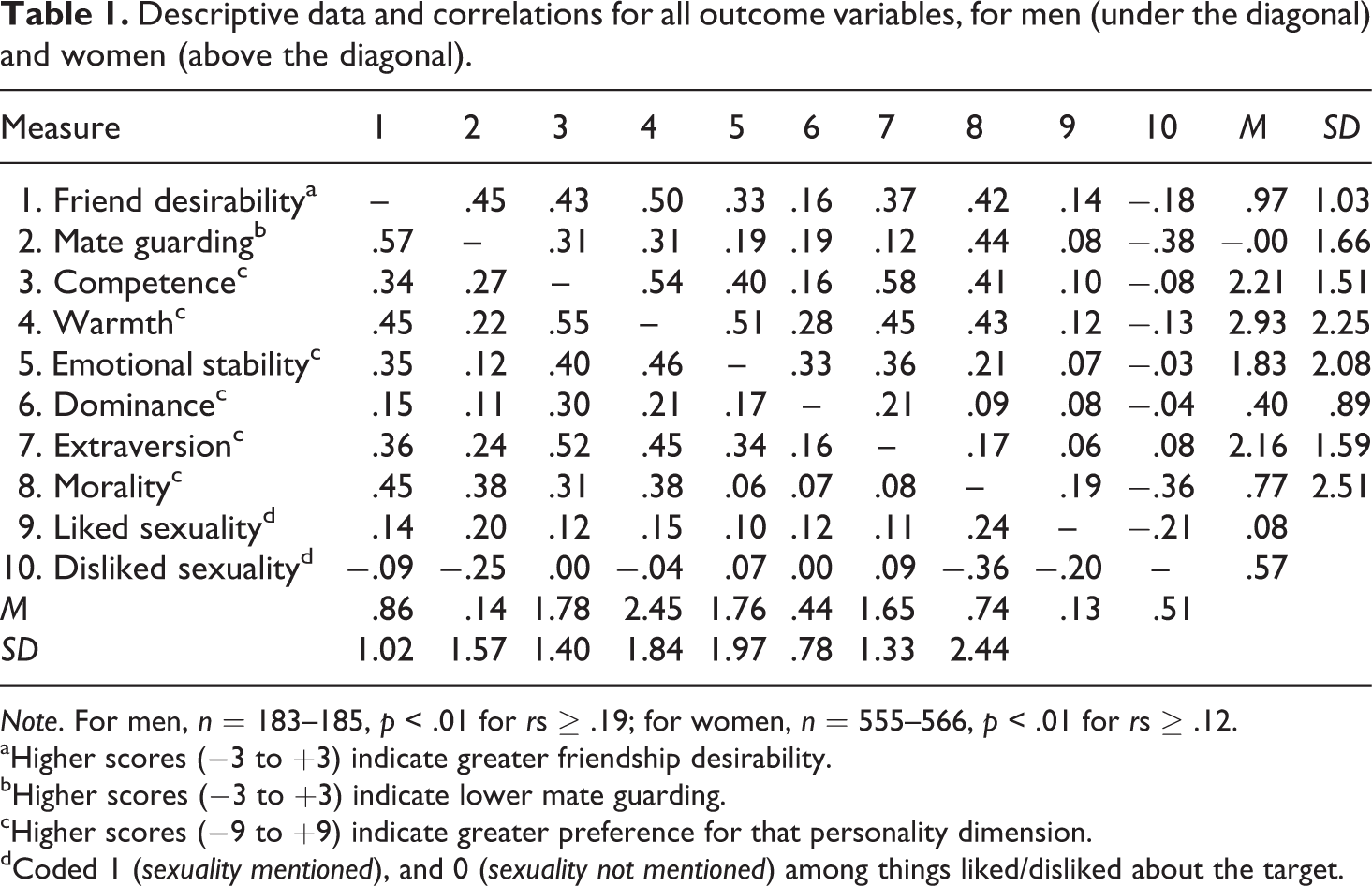
Note. For men, n = 183–185, p < .01 for rs ≥ .19; for women, n = 555–566, p < .01 for rs ≥ .12.
aHigher scores (−3 to +3) indicate greater friendship desirability.
bHigher scores (−3 to +3) indicate lower mate guarding.
cHigher scores (−9 to +9) indicate greater preference for that personality dimension.
dCoded 1 (sexuality mentioned), and 0 (sexuality not mentioned) among things liked/disliked about the target.
Linear and logistic regression results for all outcomes.
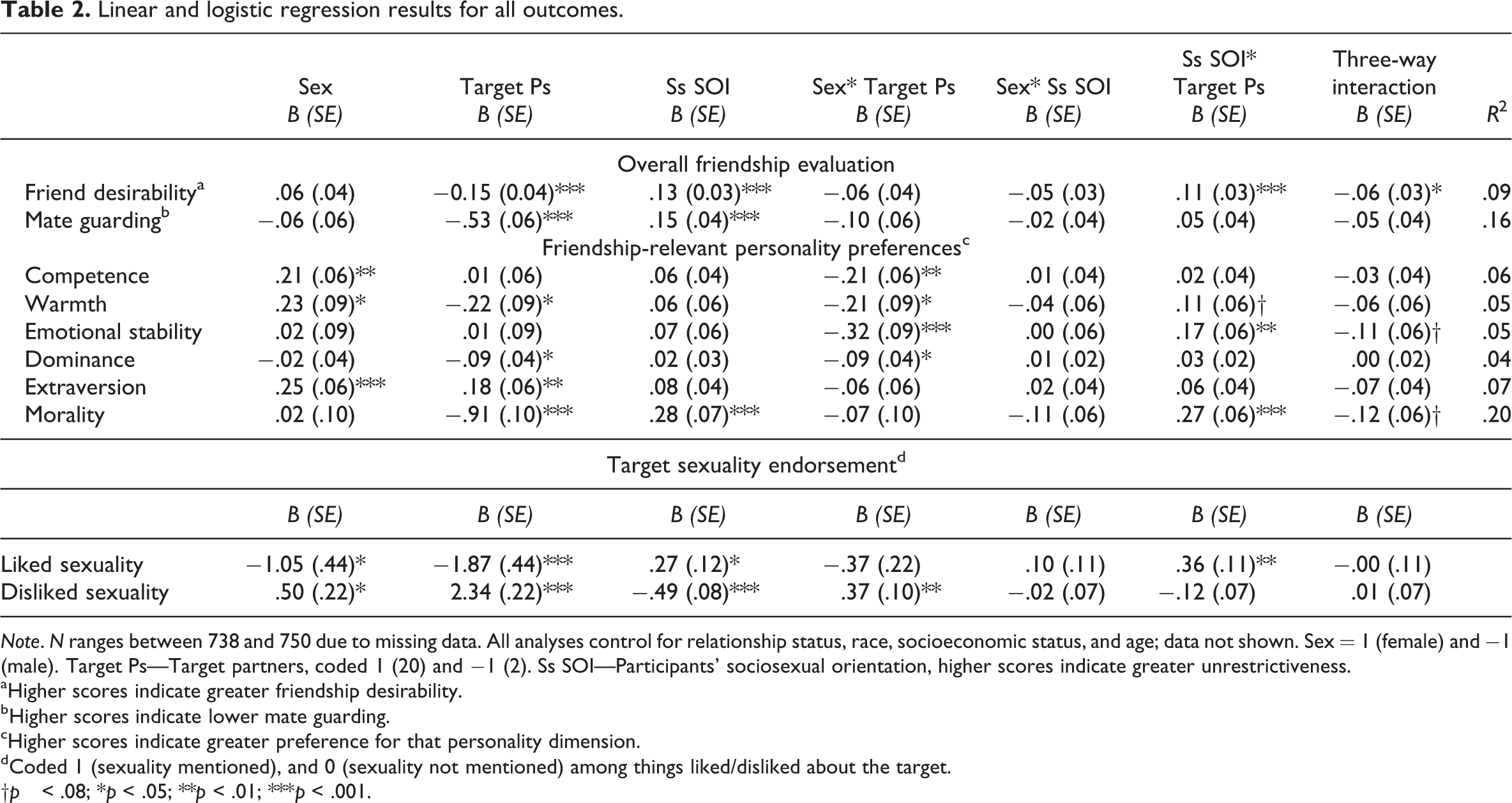
Note. N ranges between 738 and 750 due to missing data. All analyses control for relationship status, race, socioeconomic status, and age; data not shown. Sex = 1 (female) and −1 (male). Target Ps—Target partners, coded 1 (20) and −1 (2). Ss SOI—Participants’ sociosexual orientation, higher scores indicate greater unrestrictiveness.
aHigher scores indicate greater friendship desirability.
bHigher scores indicate lower mate guarding.
cHigher scores indicate greater preference for that personality dimension.
dCoded 1 (sexuality mentioned), and 0 (sexuality not mentioned) among things liked/disliked about the target.
†p < .08; *p < .05; **p < .01; ***p < .001.
Results
Overall friendship evaluation
As Table 2 demonstrates that there was a significant three-way interaction for friendship desirability. Follow-up analyses indicated that, among women, there was a main effect of target permissiveness, B = −.21, SE = .04, p < .001: Women rated permissive targets more negatively than nonpermissive targets. Probing the marginally significant interaction with participant permissiveness, B = .05, SE = .03, p < .08, revealed that this tendency was more pronounced among nonpermissive, B = −.28, SE = .06, p < .001, than permissive women, B = −.13, SE = .06, p < .05, but was present in both groups. Among men, there was a significant interaction between target and participant permissiveness, B = .16, SE = .05, p < .01. Simple slopes analyses revealed that only nonpermissive men showed a preference for the nonpermissive target, B = −.34, SE = .10, p < .01; permissive men rated both targets similarly, B = .15, SE = .10, p > .10 (Figure 1).
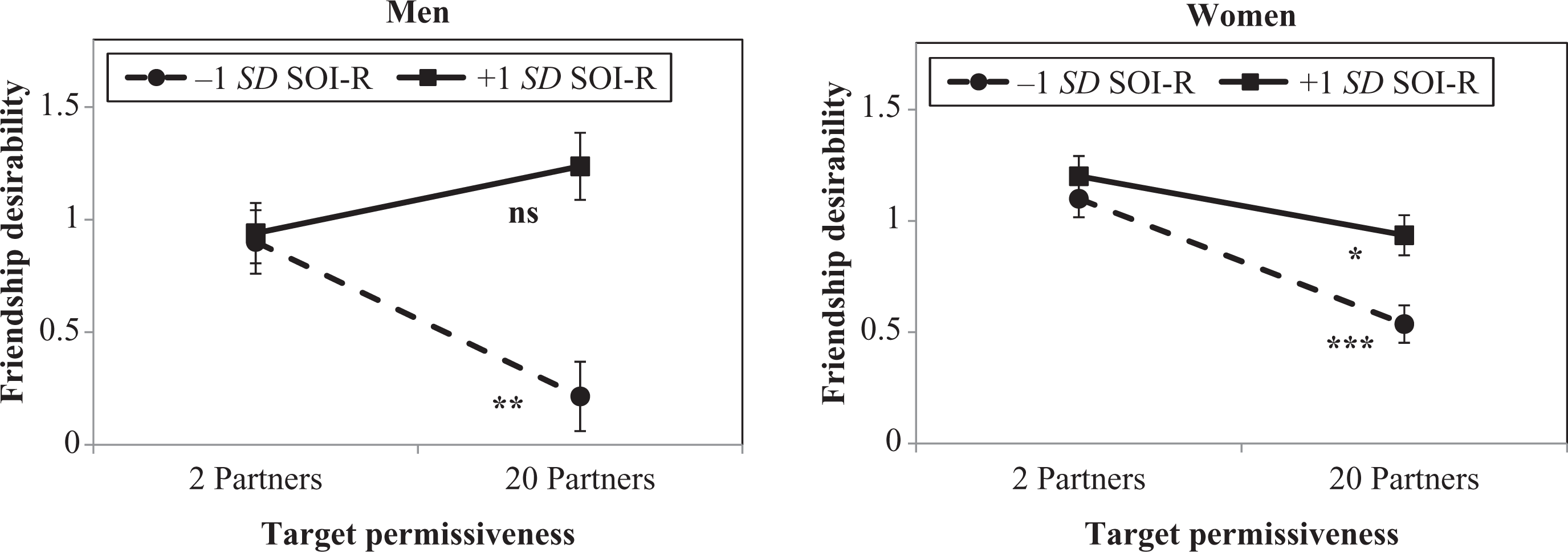
Friendship desirability of nonpermissive (two partners) versus permissive (20 partners) targets for nonpermissive (−1 SD SOI-R) and permissive (+1 SD SOI-R) participants. Error bars represent standard errors. Higher scores (−3 to +3) indicate greater friendship desirability. Note. *p < .05; **p < .01; ***p < .001; ns: p > .05 within levels of subject permissiveness. SOI-R: sociosexual Orientation inventory-Revised; SD: standard deviation.
An unmoderated main effect of target permissiveness on mate guarding indicated that all participants, regardless of sex or permissiveness, felt a greater need to mate guard from permissive than from nonpermissive targets.
Friendship-relevant personality preferences
For three of six personality dimensions examined, including competence, warmth, and dominance, there were interaction effects of sex. Follow-up tests revealed that women preferred the nonpermissive target in terms of competence, B = −.20, SE = .06, p < .01; warmth, B = −.42, SE = .09, p < .001; and dominance, B = −.19, SE = .04, p < .001. In contrast, men preferred the permissive target in competence, B = .23, SE = .10, p < .05, and showed no preference for either target in warmth, B = −.04, SE = .14, p > .10, and dominance, B = .00, SE = .06, p > .10. Regarding warmth, there was also a marginally significant interaction effect with participant permissiveness. Follow-up tests revealed that the tendency to view permissive targets as less warm was strongly pronounced among nonpermissive participants, B = −.45, SE = .11, p < .001, but only marginally so among permissive participants, B = −.20, SE = .11, p < .08. For preferences regarding extraversion, a significant unmoderated main effect of target permissiveness indicated greater preference for the permissive over the nonpermissive target.
A marginally significant three-way interaction moderated effects for emotional stability. Follow-up analyses revealed an unmoderated main effect among women, B = −.30, SE = .09, p < .001, indicating they uniformly preferred the nonpermissive target. For men, on the other hand, there was a positive main effect of target permissiveness, B = .32, SE = .14, p < .05, suggesting they preferred the emotional stability of the permissive target. This effect, however, was moderated by participant permissiveness, B = .31, SE = .09, p < .01. Simple slopes analysis revealed this preference was only present among permissive men, B = .80, SE = .20, p < .001; nonpermissive men did not prefer either target, B = −.16, SE = .20, p > .10.
Finally, there was a marginally significant three-way interaction for morality. Follow-up indicated highly significant main effects of target permissiveness among both men, B = −.84, SE = .16, p < .001, and women, B = −.99, SE = .10, p < .001, that were moderated by participant permissiveness in both men, B = .39, SE = .11, p < .001, and women, B = .15, SE = .06, p < .05. Simple slopes revealed that, for women, the interaction was mostly a matter of degree, as both permissive, B = −.76, SE = 0.14, p < .001, and nonpermissive women, B = −1.22, SE = .14, p < .001, strongly preferred the morality of the nonpermissive target. For men, their own permissiveness was more consequential. Only nonpermissive men showed a preference for the nonpermissive target, B = −1.45, SE = .23, p < .001; permissive men did not prefer either target in terms of morality, B = −.24, SE = .23, p > .10.
Target sexuality endorsement
In open-ended questions, 9% noted something about the target’s sexuality among the things they liked about them. Of these, most women (81%) and men (65%) referred to relatively low sexual involvement as positive, for example, “he only had two relationships” (male, two partners), “not a slut” (female, two partners). A minority of participants framed their likes in terms of high sexual involvement, such as “she is comfortable exploring her sexuality” (female, 20 partners), “likes to have fun (parties/sex partners)” (male, two partners). A significant main effect of target permissiveness indicated that participants in the permissive condition were less likely to like the target’s sexuality than were those in the nonpermissive condition. Follow-up of the significant interaction with participant permissiveness suggested this tendency was present in all participants, but was stronger in nonpermissive, B = −2.91, SE = .64, p < .001, than permissive participants, B = −.92, SE = .37, p < .05.
Over half (56%) of all participants included something about the target’s sexuality among their least-liked attributes. Of these, virtually all men (96%) and women (98%) referred to high involvement as negative, for example, “has whore-like tendencies” (female, 20 partners), “had sex before marriage” (male, two partners). Extremely rare were comments designating low sexual involvement as negative, such as “only had sex with 2 girls” (male, two partners), “had little sexual experience” (female, two partners). A main effect of target permissiveness indicated participants in the permissive condition were more likely than those in the nonpermissive condition to dislike the target’s sexuality. Follow-up of the significant interaction with sex suggested this tendency was stronger in women, B = 3.09, SE = .27, p < .001, than men, B = 1.63, SE = .35, p < .001, but was clearly present in both sexes.
Discussion
This study used an experimental person–perception paradigm to examine how permissiveness in a hypothetical same-sex target impacted that target’s friendship appeal and the extent to which this depended on sex and participants’ own levels of permissiveness. Given extensive prior research, we expected permissive targets to be judged more negatively than nonpermissive targets on 10 friendship-relevant outcomes. Given the opposing forces of positive assortment and evolutionary concerns, we hypothesized that participant permissiveness would mitigate, but not reverse, the negative impact of target permissiveness. Finally, given conflicting prior findings on the sexual double standard, we examined the moderating effects of sex but made no specific predictions. We found partial support for all three effects. We first discuss the well-established main effect of target permissiveness and the contentious double standard, followed by the more novel moderation effects of participant permissiveness.
As predicted, compared to the nonpermissive target, participants expressed greater need for mate guarding from permissive targets, preferred them less with respect to morality, were more likely to dislike their sexuality, and less likely to like their sexuality. Women and nonpermissive men also rated the permissive target lower on friendship desirability. Such negative main effects and a general lack of a double standard in these overall evaluation-type outcomes are consistent with prior findings (Bleske & Shackelford, 2001; Coutinho et al., 2007; Marks & Fraley, 2005; O’Sullivan, 1995; Sprecher, 1989; Sprecher et al., 1991, 1997; Vaillancourt & Sharma, 2011). Thus, across samples, operational definitions, and interpersonal contexts, permissiveness is an undesirable trait. This supports evolutionary claims that although permissiveness may be advantageous for some people under some circumstances, it is disadvantageous for those in close relationships with them (Bleske & Shackelford, 2001). It also suggests that although the specific risks posed by permissive friends and partners may differ for men and women, permissive intimates carry a similar overall amount of risk for both sexes.
A double standard emerged for preferences regarding four specific personality dimensions, including competence, emotional stability, warmth, and dominance. Whereas women preferred the nonpermissive target in all four dimensions, men showed preference for the permissive target in the first two, and no preference in the last two dimensions. These and prior results (Gentry, 1998; Mark & Miller, 1986; Marks & Fraley, 2005; O’Sullivan, 1995) suggest that although the double standard may not operate in overall person evaluation, it may shape perceptions of permissive people in specific domains. For example, competence and emotional stability were valued in a friend by both sexes; the sex difference in preferences was due to opposing perceptions of permissive men (more competent and stable) versus women (less competent and stable; friendship–importance and target–perception data on all personality dimensions available on request). This is consistent with sexual strategies theory that men benefit from many partners and are less selective than women; for women, the advantage of many partners is limited and the cost can be substantial (Buss & Schmitt, 1993). Thus, a man who has managed to attract many partners is particularly successful and assumed to be confident and emotionally secure. The acquisition of many sexual partners by a woman, on the other hand, is not a difficult achievement and is therefore interpreted as resulting from low self-esteem.
Both sexes valued warmth in a friend; the sex difference in preferences was due to different perceptions of permissive women (as less warm) versus men (as similar in warmth) compared to nonpermissive targets. In contrast, both sexes perceived permissive targets as more dominant; the sex difference in preferences was due to different values placed on dominance in a friend (undesirable for women; neutral for men). These differences in perceptions of warmth and values for dominance likely reflect gender stereotypes of power, dominance, and unbridled sexuality as male-typical trait, and communion and care (i.e., warmth) as female-typical trait (Deaux & Lewis, 1984). Our experimental manipulation may have amplified gender-typical responding, as people become more gender typical in their perceptions when primed with sexuality (Hundhammer & Mussweiler, 2012).
Extraversion was the only dimension where permissive targets were preferred over nonpermissive targets by both sexes, due to the positive value placed on extraversion in a friend coupled with perceptions of the permissive target as more extraverted. This is consistent with past findings that permissive people are seen as more fun and outgoing (Coutinho et al., 2007; Marks & Fraley, 2005),and with the assumption that in order to accrue many partners one would need to frequently socialize. Given overwhelmingly negative evaluations of the permissive target in all other outcomes, especially among women, it appears that people might like permissive others as entertaining acquaintances, but not as close friends.
This is one of the first studies to investigate interactions between target and participant permissiveness in the friendship domain. Participant permissiveness moderated the effect of target permissiveness in half of all outcomes, including friendship desirability, liking of the target’s sexuality, and preferences for morality, warmth, and emotional stability (among men only). The moderation was in the expected direction, such that more permissive participants evaluated permissive targets more favorably than did less permissive ones. This suggests permissiveness-based positive assortment does play some role in friendships, providing permissive individuals with protection from negative evaluations by less permissive others. This effect may be particularly relevant for men, where permissiveness typically eliminated or, rarely, reversed preferences for the nonpermissive target. Among women, however, the role of permissiveness appears limited, as there was no reversal or even elimination of preferences in any of the four outcomes: Like nonpermissive women, permissive women also preferred the nonpermissive target, only somewhat less so. Even very permissive women—those at two standard deviations above the mean—did not reverse preferences in these four outcomes, showing, at best, no preference for either target (data available on request).
No moderation of participant permissiveness was detected regarding mate guarding, with the heightened need to mate guard from permissive targets compared to nonpermissive targets equally pronounced in all participants. This indicates a precedence of evolutionary concerns over positive assortment in this regard, confirming evolutionary expectations that mate poaching is considered universally undesirable, even by those who are most likely to attempt it themselves, and that permissive friends pose the same level of risk for everyone, regardless of one’s own permissiveness. There was also no moderation of participant permissiveness in disliking of sexuality, and in preferences regarding competence, dominance, extraversion, and emotional stability (among women). This suggests that the influence one’s permissiveness may have over overall person evaluations does not extend into preferences for specific personality attributes.
Limitations and future research
The study has several limitations. We focused exclusively on same-sex friendships, and thus cannot make inferences regarding cross-sex friendships, where friends’ permissiveness may be judged less harshly given absence of mate poaching concerns. Additionally, if permissive women are ostracized primarily by other women (Baumeister & Twenge, 2002), the double standard might not emerge in cross-sex friendships. Moreover, if men, particularly permissive men, see in permissive female friends a welcome opportunity for easy sexual access (Bleske-Rechek & Buss, 2001; Bleske-Rechek et al., 2012), a reversed double standard may even occur, providing permissive women with a key buffer from the uniform rejection by other women.
Our sample had relatively few men compared to women, which decreased statistical power, and may have particularly limited our ability to detect reversal of preferences among permissive men. We focused exclusively on college students, as campuses are highly sexualized environments (Bogle, 2008) where sexual information is often sought by and shared across social networks (Holman & Sillars, 2012). Future work should examine these links in noncollege and older adults. Older adults have more experience with long-term relationships and the risks permissive friends can pose, potentially increasing hostility toward permissive friends, but they also acquire more sex partners, potentially increasing permissiveness-based positive assortment. Future research also needs to examine these links among nonheterosexuals who are more politically and sexually liberal and less burdened with evolutionary concerns than heterosexuals (Bailey, Gaulin, Agyei, & Gladue, 1994; Herek, Norton, Allen, & Sims, 2010). Finally, our findings may not generalize to non-Western cultures. Culture exerts a powerful influence over sexual attitudes (Abbott, 2000), and the negative effects of permissiveness may be attenuated in more sex-positive cultures. Given their likely evolutionary base, however, they are unlikely to be completely eliminated, regardless of the cultural milieu.
Our operationalization of target permissiveness—number of lifetime sex partners—is a direct and frequently used indicator of this construct. Engagement in casual sex is another aspect of permissiveness that has recently gained in social salience (Garcia, Reiber, Massey, & Merriwether, 2012) and that is often condemned as immoral and unhealthy (Stepp, 2005). Very few studies have examined the two indicators independently (Kreager & Staff, 2009; O’Sullivan, 1995); thus, it remains unclear whether their impact on desirability is additive or interchangeable. Furthermore, we were specifically interested in comparing a typical to a highly permissive target, hence our choice of two- versus 20-partner targets. Future studies should explore other levels of permissiveness. In older studies virgins were often rated most favorably (Jacoby & Williams, 1985; Mark & Miller, 1986); however, as standards have changed over time, for contemporary youth virginity may be less desirable (Carpenter, 2001; Prinstein et al., 2003), and moderately permissive targets may be viewed most positively (Marks & Fraley, 2005).
Our study examined one factor that may offer some protection against social rejection of permissive individuals—positive assortment. Future research should investigate other factors. Relationship status may be one key variable: Single people have no mates to guard, and may also value more the “entertainment” potential of permissive friends, as this could lead to increased exposure to members of the opposite sex and likelihood of finding mates (Coutinho et al., 2007). Cross-sex, cross-sexual orientation friendships (e.g., gay men and heterosexual women) may be another such factor. Certain personality traits (e.g., loyalty) or a current monogamous status of a target may override the negative effects of their permissive past. Individuals who do not expect sexual fidelity from a romantic partner (e.g., swingers) may in fact welcome permissive friends into their circle. Finally, certain demographic characteristics, such as race, socioeconomic status, or urbanicity may also play a role.
The judgments our participants made about the target occurred in response to hypothetical scenarios, and the pattern of findings should be replicated with more ecologically valid methodologies. The (limited) role of positive assortment based on permissiveness and its implications that permissive people would be subjected to more peer rejection and aggression should be examined in “real-life” situations and experiments. Longitudinal studies of friendship patterns, peer aggression, and loneliness as outcomes of permissiveness are all but lacking. Sociometric studies, which test for enacted peer acceptance, have not been done with adults. Furthermore, pur study, like others of this type, focused on individuals in nongroup situations. Social psychological theory suggests that people conform to social norms more in the presence of others (Turner, 1991); thus, examining these issues in group settings is warranted. Finally, our findings only suggest that there is lower preference for homophily at the highest levels of permissiveness; actual levels of homophily may be high due to mechanisms other than preferences, such as rejection or withdrawal (Schaefer, Kornienko, & Fox, 2011). More sophisticated longitudinal dynamic network data are needed to address this question.
Conclusions
The current study adds to growing evidence for the general undesirability of sexual permissiveness across a variety of personal relationships, which places permissive individuals at elevated risk for social rejection and aggression, and a host of negative well-being consequences. Adding to past findings regarding marriage and dating desirability (Sprecher et al., 1991, 1997), our study also presents evidence that permissiveness-based positive assortment is present in same-sex friendships, which could provide some buffer against social rejection. Such a buffer appears particularly likely to operate among men, as permissive men viewed the permissive target either similarly to or more positively than the nonpermissive target in all but two outcomes (mate guarding and dislike of sexuality). Permissiveness’ buffering effects among women seem more limited, as women rated the permissive target more negatively than the nonpermissive one regardless of their own permissiveness in all but one outcome (extraversion). Permissive women, therefore, may be at particularly high risk of negative consequences, a risk that may be further compounded by women’s higher friendship expectations (Hall, 2011) and their tendency to engage in more disclosure-based interactions (Fehr, 2004), thereby, increasing opportunities for revealing potentially damaging sexual information. This vulnerability of permissive people, particularly women, should be taken into consideration by parents, counselors, and educators.
Footnotes
Appendix 1
Funding
This research was partially supported by a Human Ecology Alumni Association grant by Cornell University, New York, USA, awarded to REB for conducting her undergraduate honors research.