







Abstract
Avoidance in adults is related to many negative aspects of caregiving and parenting. This was examined in a simulated parenting experience of 145 students who raised a virtual child from birth to age 19 using the website MyVirtualChild©. Avoidance and anxiety within adult relationships were assessed using the Experiences in Close Relationships–Relationship Structures questionnaire before and after this experience, and caregiver attitudes of positive feelings, perceptions of the child’s security, and willingness to serve as an attachment figure were assessed after the experience. As predicted, avoidance and anxiety were negatively related to caregiver attitudes, with avoidance accounting for these relations. These results support the negative impact of avoidance on caregiver attitudes, even when the child is raised in Cyberspace.
An attachment theory approach (Ainsworth, 1989; Bowlby, 1969/1982) has been used to examine relations between the attachment system of a child, the caregiving system of an adult, and an adult’s attitudes toward their own personal relationships. For example, a parent secure in their own relationships has the capacity to be relatively more empathic to the needs of others, and thus their caregiving system is more likely to be activated and responsive when called upon by children in need (Mikulincer, Shaver, Gillath, & Nitzberg, 2005). Alternatively, those adults avoidant/dismissive of their own relationship needs may be less effective at caring for others due either to a focus on their own distress or a discomfort with being needed by others (Collins & Read, 1994; George & Solomon, 2008).
While relations between adult attachment and caregiver attitudes have been examined in actual parent–child pairs, the current study took a unique approach using a simulated parenting task. In this task, a virtual child is raised from birth to 19 years by a “parent” making irreversible child-rearing decisions throughout the child’s life and answering questions periodically about their child. In the virtual world, personal relationships have been examined with characters in video games (Bowman, Shultheiss, & Schumann, 2012; Coulson, Barnett, Ferguson, & Gould, 2012), simulations of marital interactions with virtual spouses (Schönbrodt & Asendorpf, 2012), and even feelings that develop toward virtual animals (Venneman & Knowles, 2005). Coulson, Barnett, Ferguson, and Gould (2012) argued that relationships form because participant-dependent input is essential in order to influence changes in virtual characters, for example, in some video games people may go to great lengths to buy their own virtual characters clothing items and “special powers,” that is, invest resources in these characters. These findings provide support for the use of a virtual experience to investigate caregiving and, parents, too, invest in their children. However, there are few, if any, examples of virtual parenting experiences. The goal of this study was therefore to examine potential relations between adult attachment style and caregiver attitudes that develop toward a virtual child. Although a simulated parenting task, the study is also related to current interest in relationships young people form with virtual characters (Coulson et al., 2012; Schönbrodt & Asendorpf, 2012).
Caregiving and adult attachment style
The attachment behavioral system in infancy reflects how caregivers are used to balance exploration with proximity seeking to promote the infant’s safety, survival, and development (Bowlby, 1969/1982). However, Ainsworth (1989) described other systems relevant to the evolutionary context of attachment theory across the life span. First, there are affectional bonds with kin, close friends, and intimate partners, which are “attachments” in adulthood when they too include proximity seeking, distress during separation, joy upon reunion, and grief when lost (Fraley, Heffernan, Vicary, & Brumbaugh, 2011). Second, the caregiving system is designed to provide compassion, protection, and support to those either less capable or in need and thus includes serving as a safe haven and secure base to children (Bowlby, 1969/1982; Powell, Cooper, Hoffman, & Marvin, 2014). Effective caregiving and parental investment promote the survival and development of a child and thus evolved in conjunction with the attachment system (e.g., George & Solomon, 2008).
Adult attachment style has been examined within intimate and romantic relationships (Hazan & Shaver, 1987) and reflects attitudes about the self and other that are either positive or negative (Bartholomew & Horowitz, 1991). For example, a widely used measure became the Experiences in Close Relationships–Revised (e.g., Fraley, Waller, & Brennan, 2000), which has two dimensions of avoidance, that is, discomfort with emotional closeness to and dependency on intimate partners, and anxiety, that is, excessive worry and concern a partner will not be available and supportive when needed. As summarized by Mikulincer and Shaver (2012), low scores on both these dimensions reflect attachment security. A high score on avoidance reflects a strategy of deactivating the attachment system as others should not be called upon in times of distress and threats are handled alone, and a high score on anxiety reflects hyperactivation of the attachment system indicated by excessive bids for closeness and help, without the confidence that they are forthcoming. This two-dimensional model has been used widely and validated against various measures of intimate relationship function (reviewed in Feeney, 2008; Mikulincer & Shaver, 2007).
Rather than focus exclusively on intimate partners, Fraley, Hefferman, Vicary, and Brumbaugh (2011) developed the Experiences in Close Relationships–Relationship Structures (ECR-RS) measure to address multiple attachment figures in adulthood: mother, father, romantic partner, and best friend. They replicated the two-dimensional model of adult attachment with anxiety and avoidance factors and showed these dimensions were stable across both 1-year and 30-day time frames (Fraley, Vicary, Brumbaugh, & Roisman, 2011). An adult secure in their own relationships has the capacity to be relatively more empathic to the needs of others, and thus their caregiving system is more likely to be activated and responsive when called upon (Mikulincer et al., 2005). Alternatively, those adults preoccupied, dismissive, or fearful of their own relationship needs may be less effective at caring for others due to a focus on their own distress (Collins & Read, 1994; George & Solomon, 2008).
Avoidance in adult attachment style has a negative relationship with many aspects of parenting. For example, it has been related to mothers feeling less close and being less supportive of preschool age children (Rholes, Simpson, & Blakely, 1995), less sensitive parenting (Selcuk et al., 2010), more child distress and less responsive parenting when children received inoculations (Edelstein et al., 2004), and generally less responsive and less authoritative parenting attitudes in couples (Millings, Walsh, Hepper, & O’Brien, 2012). In addition, avoidance has been related to less desire to become a parent in both university students (Rholes, Simpson, Blakely, Lanigan, & Allen, 1997) and couples having a first child (Rholes, Simpson, & Friedman, 2006).
Anxiety in adult attachment style has also been related to negative aspects of parenting. For example, Selcuk et al. (2010) found that both anxiety and avoidance were negatively related to observations of sensitive parenting, but when both dimensions were entered as predictors, only avoidance was significant. A similar pattern of results can be found elsewhere. For example, Rholes, Simpson, and Friedman (2006) found that both anxiety and avoidance were positively related to parental stress in couples having a first child, but it was avoidance that uniquely accounted for these relations and anxiety was no longer related once avoidance was accounted for. Mikulincer, Shaver, Gillath, and Nitzberg (2005) described how attachment anxiety reflects personal distress and a self-oriented reaction, which are not necessarily related to care for another person. Avoidance, however, reflects a lack of concern and detached attitude for the needs of others, which would have a more negative impact on caregiving (see also Mikulincer & Shaver, 2012).
All these studies, of course, are of real parents raising real children. The current study is designed to examine relations of adult attachment style dimensions to caregiver attitudes when the child is not real and simply raised within Cyberspace. This simulation provides the methodological advantages of having a group of people going through similar parenting experiences at the same time and in a truncated time frame compared to raising a child in real life. Relationships are inherently bidirectional, which means that the interactive behavior and attitudes of both partners need to be considered to interpret how they develop. Virtual characters, on the other hand, provide the methodological advantage of studying attitudes that develop when there is no interactive partner and thus participants have a similar kind of experience. In one of the few studies of adult attachment and virtual relationships, Schönbrodt and Asendorpf (2012) found that avoidance and not anxiety assessed using the ECR-RS was predictive of deactivating strategies when participants directed a virtual character to interact with a virtual spouse during a conflict scenario. In sum, avoidance may also be related to negative caregiver attitudes that develop within a virtual parenting experience, just as it is related to negative aspects of parenting in real life.
The present study
The current study examines relations between adult attachment style and caregiver attitudes toward a virtual child that is raised within a simulated parenting experience. In the computer program MyVirtualChild© (Manis, 2006), a child is raised from birth to 19 years by a parent making caregiving decisions, receiving feedback, and writing assignments about their child. Our initial use of this program was with undergraduate students completing the task as a course assignment (Symons & Smith, 2014), and when the course was complete, we found that students felt they formed a relationship with their child, had positive feelings such as happiness with and pride toward their child, reported self-reflection about their own parenting skills and childhood experiences, and even reported desires to maintain contact in the future as their child “lives their virtual life.” Although a web-based experience, students acted as caregivers to their virtual child and a “relationship” formed. The goal of the current study was to see whether aspects of this relationship, that is, feelings that developed toward the virtual child, were related to adult attachment style. The advantage of this virtual task is that attachment style can be assessed prior to and after the experience, and we addressed various attachment-relevant feelings that arose which reflect relevant features of caregiving: positive feelings toward the child, how positive the child might view them as a secure base, and feelings about the willingness to serve as an attachment figure to their child.
Two other issues were addressed. First, it is possible that people who feel nervous, tense, and worried about their relationships with significant people in their lives may feel the same way about everything. Watson and Clark (1984) showed that trait anxiety, personality measures of neuroticism, and other indices of negative mood states were all positively related and indicative of a broader construct of negative affectivity. They reported that people high in this construct have a tendency to report distress, independent of either their circumstances or objective sources of distress. Within the adult attachment style literature, anxiety and avoidance have been moderately related to neuroticism, with relations being higher for the former than the latter (Crawford, Shaver, & Goldsmith, 2007; Holmberg, McWilliams, & Patterson, 2013; Noftle & Shaver, 2006). With this in mind, trait anxiety was controlled for within some of the analyses. Second, as the virtual child was raised as a course requirement and written responses within the program were evaluated, it is also possible that student performance on these assignments could affect feelings that developed toward the child. For example, it is possible that students would feel closer to their child if they received higher grades on the assignment or, alternatively, have negative feelings toward their child if they received poor grades on assignments. The impact of assignment grades was therefore considered.
The data analytic approach was to examine correlations between attachment styles and caregiver attitude measures. The hypothesis was that both avoidance and anxiety would be negatively related to negative caregiver attitudes. The plan was then to conduct multiple regression analyses in which relevant background variables were entered at the first step, followed by attachment style dimensions. The hypothesis was that when both attachment dimensions were entered into the predictive model, avoidance would remain as a significant predictor and anxiety would no longer be related to negative caregiver attitudes.
Method
Participants
Participants were 145 undergraduate students, 124 (86%) women, with an average age of 21.2 years, SD = 4.82, range from 18 to 51 years. All were enrolled in one of three sections of a child development course at a Canadian university and received two bonus points toward their final grade. A majority of students were White, and there were five of African North American and six of Asian descent. All students in these courses completed the mandatory assignment MyVirtualChild, but research participants completed measures at Time 1 before this assignment began and 12 weeks later at Time 2 after it was completed. About 90% of students in the courses participated in the study, and there were an additional 19 students who completed measures at either Times 1 or 2 but not both, so they were excluded from the study. Students were either in years two (35%), three (42%), or four+ (23%) of university, with roughly half (52%) being psychology majors and the other half majoring in other arts and science disciplines. A few students self-reported as parents and one as an expectant parent, but this information was not collected systematically and thus cannot be examined.
Measures
Adult attachment style
At both Times 1 and 2, participants completed the ECR-RS questionnaire (Fraley, Hefferman, et al., 2011). This measure contains 9 items for each of four attachment figures in life: mother, father, dating or marital partner, and best friend, for example, “Please answer the following questions about your mother or mother-like figure.” 1 For each person, the first 6 items assess avoidance (e.g., “I don’t feel comfortable opening up to this person”) and the next 3 assess anxiety (e.g., “I often worry that this person doesn’t really care for me”). All items are rated on a 7-point scale from strongly disagree to strongly agree, with some being reverse scored, and higher scores reflecting high attachment insecurity on each dimension. Scores for avoidance and anxiety can therefore be calculated as an average for each attachment figure and at each time. Internal consistency was acceptable in all cases, all α’s > .88 for each figure and time, with the exception of anxiety for mother, which was a little lower at both Times 1 and 2, α’s = .75 and .84, respectively.
A measure of global attachment anxiety and avoidance was created by averaging scores across the four domains at each time. Ratings across all four figures were highly reliable at both Times 1 and 2 for both anxiety, α = .86 and .87, respectively, and avoidance, α = .92 and .91, respectively, which are almost identical to reliabilities reported by Fraley, Hefferman, et al. (2011). In the current data, there were also significant stability across time in both global avoidance, r = .88, and anxiety, r = .81, so scores were also averaged across time to give measures of overall attachment anxiety and avoidance.
The factor structure of the ECR-RS has been replicated and found to be internally consistent and stable across time for both domain-specific and domain general anxiety and avoidance for people in dating or marital relationships, all α’s > .80 (Fraley, Hefferman, et al., 2011; Fraley, Vicary, et al., 2011). The dimensional structure has also been replicated in a sample of Danish adolescents across best friend and parental figure domains (Donbaek & Elklit, 2014). The dimensions of anxiety and avoidance also have the potential to interact and reflect concepts from attachment literature. For example, security is reflected by scores low on both anxiety and avoidance, whereas fearful avoidance is the conceptual opposite and reflected by high scores on both dimensions. A series of Anxiety × Avoidance interaction terms for the above measures were therefore created at each time as well as an overall measure.
Caregiver attitudes
At Time 2, there were three measures that addressed feelings within the caregiver relationship that participants had toward their virtual child. The Measure of Interpersonal Attraction (MIA; McCroskey & McCain, 1974; McCroskey & Richmond, 1996) has 15 items that address feelings a person has as they apply to your child’s social, physical, and task completion abilities (e.g., “I would like to have a friendly chat with him/her,” “I think he (she) is quite handsome (pretty), and I have confidence in his/her ability to get the job done”). Each item is rated on a 7-point scale from strongly disagree to strongly agree, with some being reverse scored. Scores consist of an average across all items, with higher scores indicating more positive feelings toward the child, α = .80. This measure has been reliably used in previous research to assess feelings for virtual game characters (Coulson et al., 2012).
The Security Scale was adapted from Kerns, Aspelmeier, Gentzler, and Grabill (2001), which is a 15-item child self-report measure about felt security toward a parent. Given the nature of the current study, perceived child security was assessed by having the participants complete the questionnaire from the perspective of the virtual child. The instructions were: “This questionnaire asks about what you think your virtual child would say about you as a parent. In other words, you are answering these questions as if you are the virtual child.” Items all have four choices. Participants must first choose between two statements that they think their virtual child would likely choose about them as a parent (e.g., “Some kids find it easy to trust their parent BUT other kids are not sure if they can trust their parent”) and then whether that statement is really true or sort of true for them. Items are, therefore, scored on a 4-point scale, and perceived child security scores were based on averages across 14 items, with higher scores indicating greater perceived security, α = .70 (note: item 8 was deleted due to weak relations with other items). Five students were confused by the item format and provided double responses, so they were omitted from analyses using this measure.
Also found in Kerns et al. (2001) are a list of 10 phrases a parent might think about themselves as a parent (e.g., “I respect my child’s opinions and encourage him/her to express them” and “I feel a child should be given support and understanding when she/he is scared or upset”). All these items address safe haven and secure base behavior, so participants were asked to rate these items on a 7-point scale from strongly disagree to strongly agree. Scores consisted of an average across 9 items, with higher scores indicating a greater willingness to serve as an attachment figure to their child, α = .71 (note: item 9 was omitted due to weak relations with other items).
Trait anxiety
At Time 1 only, participants in two of the classes (n = 89) completed the trait items from the State-Trait Anxiety Inventory Form Y (Speilberger, Gorsuch, Lushene, Vagg, & Jacobs, 1983). This well-known measure has 20 items that address how people generally feel and different aspects of dispositional anxiety, rated as being almost never, sometimes, often, or almost always. Nine of the trait items are reverse scored, good internal consistency was found, α = .92, and trait anxiety consisted of totals across the 20 items. The trait subscale has been described as the best single measure of negative affectivity and emotional distress in adults (e.g., Watson & Clark, 1984).
Assignment grade
In all classes, the students received 20% of their final grade for completing the virtual child assignment, which included raising their child from birth to 19 years as well as completing written assignments at different ages. There were two or three questions students had to write answers to at 12 age points in the program (8 and 19 months, 2, 3, 4, 7, 9, 11, 12, 15, 17, and 18 years of age). These typically required students to reflect on their child’s development, make observations about their child’s behavior, and sometimes relate these observations to course content (e.g., “What is your child’s temperament and what have you observed that affected your choice?”). Virtual children were to have reached the ages of 2 years after 1 month of the course, age 10 after 2 months, and age 19 after 3 months when the course ended. Written assignments were graded at these 3 times in terms of their length and quality of responses once per month at these three age points. Assignment grade was the total score out of 20, M = 17.3, SD = 2.66, range = 5.5–20, and was used to address the alternative account that students had positive attitudes toward their virtual child if they did well on the assignment. Individual assignment grades at each of the three times were not available.
Procedure
All participants raised a virtual child from birth to 19 years of age using the web-based parenting simulation MyVirtualChild (Manis, 2006). In this program, students first answer personal questions related to their own personality and abilities, which are used by the program to develop a virtual child that partly resembles the reported personality characteristics of the parent. In addition, participants can chose morphological characteristics of the child such as ethnicity, eye color, and skin tone. Students get to name their child, but gender is randomly assigned by the program. Once the child is “born,” a picture of the infant is provided which ages as the program progresses. The virtual child’s development is then guided by the irreversible parenting decisions made by a parent throughout the program in areas such as feeding, discipline, and educational involvement that can impact behavioral, emotional, social, and cognitive outcomes. Students could make any parenting decisions they wanted as there were no right or wrong answers nor was their child’s outcome part of the evaluative component.
The child’s development is also guided probabilistically through the program’s algorithm, for example, random events arise at rates similar to real life (e.g., ∼35% of parents get divorced). A parent receives feedback about their child from time to time from various sources such as reports from school, doctors, and specialists. It takes about 20 hr to make 256 multiple-choice parenting decisions throughout the child’s life and complete the assignments, so students spend considerable time raising their child over 3 months. They worked at their own pace with three age checkpoints of 2, 8, and 19 years, and all participants completed the assignment by the end of term.
Results
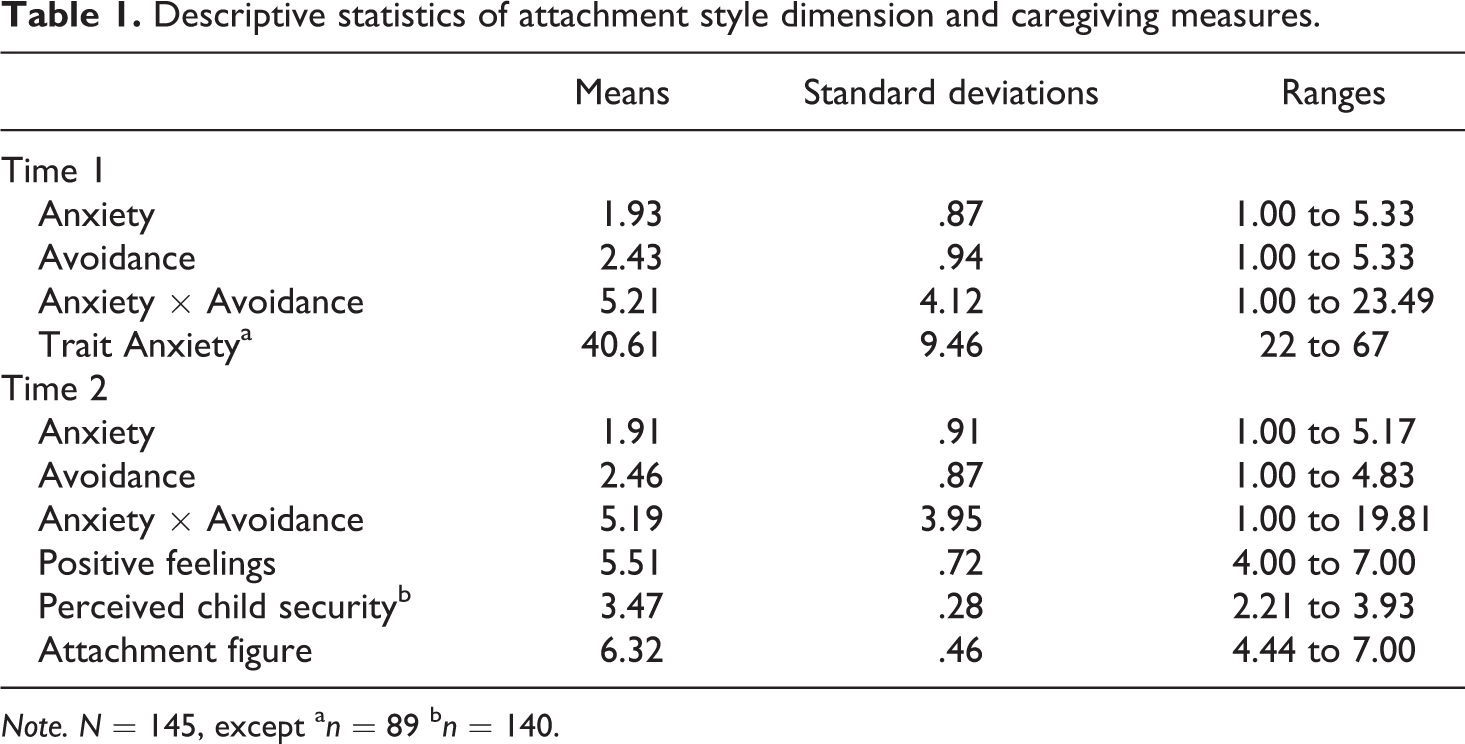
Descriptive statistics of dependent measures can be found in Table 1. On average, global anxiety and avoidance scores at both times were low and positively skewed, although there was still considerable variability in these measures. There were no significant differences between Times 1 and 2 on either global anxiety, paired t(144) = .49, n.s., or global avoidance, paired t(144) = 1.17, n.s., and similarly, there were no significant differences across time for any of the four specific attachment figures. Means on the three caregiving measures were somewhat high, which indicated generally positive caregiving feelings on average.
Descriptive statistics of attachment style dimension and caregiving measures.
Note. N = 145, except a n = 89 b n = 140.
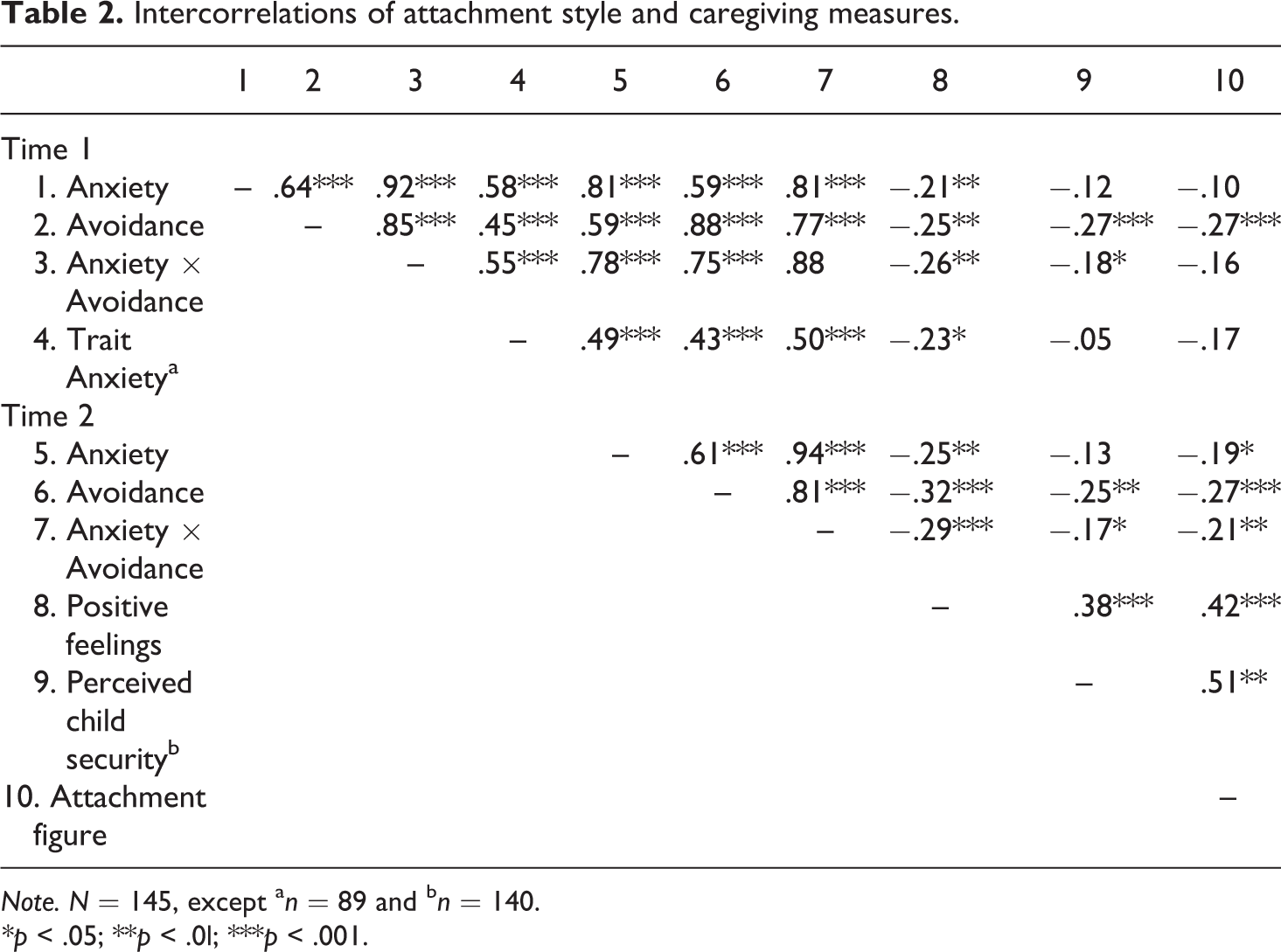
Table 2 contains intercorrelations of dependent measures. Not surprisingly, global anxiety, avoidance, and the Anxiety × Avoidance interaction terms were highly related within and between times. The various caregiver relationship measures were all moderately positively related with rs between .38 and .51. As hypothesized, global avoidance at both Times 1 and 2 was negatively related to all three caregiving measures: positive attitudes toward the virtual child, perceived child security, and willingness to serve as an attachment figure to their child, all rs < −.25. In addition, global anxiety at both times was also negatively related to positive feelings toward the virtual child and negatively related to feelings as an attachment figure at Time 2 only. The Anxiety × Avoidance interaction term at Time 1 was negatively related to positive feelings and perceived child security, and at Time 2, negatively related to all three of the caregiving measures. 2
Intercorrelations of attachment style and caregiving measures.
Note. N = 145, except a n = 89 and b n = 140.
*p < .05; **p < .0l; ***p < .001.
Assignment grade was unrelated to attachment style measures at Time 1. However, at Time 2, assignment grade was related to global anxiety, avoidance, and Anxiety × Avoidance, rs (144) = −.18, −.20, and −.20, all ps < .05, respectively, as well as positive feelings, perceived child security, and attachment figure feelings, rs (144) = −.18, −.25, and −.36, respectively, all ps < .05.
Trait anxiety was examined separately as it was only assessed in a subset of participants. Table 2 shows that trait anxiety was significantly related to all attachment style measures, rs ranging from .43 to .58 as well as positive feelings toward the child.
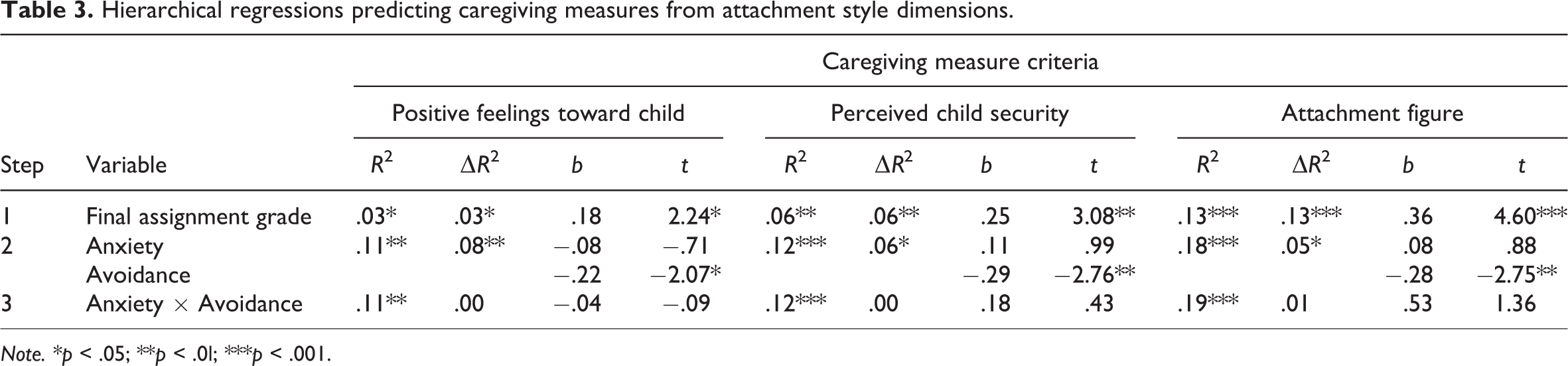
The next set of analyses was designed to examine the relative contribution of overall attachment style dimensions to the three caregiving measures and address the hypothesis that avoidance would be uniquely related to caregiver attitudes. Hierarchical regression analyses were run in which assignment grade was entered at Step 1. The high stability of avoidance and anxiety also raised potential multicollinearity issues, so the overall avoidance and anxiety scores were entered at Step 2. Finally, the overall Anxiety × Avoidance interaction term was entered at Step 3. Trait anxiety was not used in these analyses due to collinearity with attachment style dimensions and because it was not available for all participants.
These analyses can be found in Table 3. They show that the overall equation accounted for a significant 11% of the variance of positive feelings toward the child, 12% of the variance of perceived child security, and 19% of the variance of feelings about serving as an attachment figure. At Step 1, final assignment grades predicted a significant amount of variance of all three caregiving measures: 3% of the variance of positive feelings toward the child, 6% of the variance of perceived child security, and 13% of the variance of feelings about being an attachment figure. At Step 2, the two attachment dimensions added a significant amount of variance to each equation: 8% of the variance of positive feelings toward the child, 6% of the variance of perceived child security, and 5% of the variance of feelings about being an attachment figure. In all three regression equations, it was avoidance at Step 2, which accounted for this significant additional variance. The Anxiety × Avoidance interaction term had negligible impact and did not add a significant amount of variance to any of the equations.
Hierarchical regressions predicting caregiving measures from attachment style dimensions.
Note. *p < .05; **p < .0l; ***p < .001.
Discussion
This study shows that adult attachment style as assessed with the ECR-RS was systematically related to feelings that develop toward a child within a virtual parenting experience. Adults relatively more avoidant across a number of significant relationships in their lives reported relatively less positive attitudes toward a child, felt their child would feel less secure toward them as a parent, and felt less willingness to serve as an attachment figure to their child. These relations were found when avoidance was assessed concurrently with caregiver feelings after the virtual parenting experience, but more importantly, when avoidance was assessed before the parenting experience. Anxiety within adult attachment style was also related to negative feelings toward the child, regardless of whether attachment was assessed before or after the parenting experience. Regression analyses, however, suggested that it was avoidance and not anxiety that accounted for these significant relations, even when task performance in terms of assignment grades was controlled. These findings are therefore consistent with the negative relations of avoidance to various indices of parenting real children (George & Solomon, 2008; Mikulincer et al., 2005; Millings et al., 2012).
The use of a simulated parenting experience in the current study is methodologically unique. All participants had a similar parenting experience over a short time frame. Attitudes formed could not be influenced by actual interactions with the child, although the algorithm of the virtual child program did allow for different outcomes and events in the child’s “life” based on parenting decisions made and the input of the participant’s own personalities and interests (Manis, 2006). Of course, the current study is simply a simulation, and 20 hr over 12 weeks raising a virtual child may have little to do with parenting a real child 24/7 over 20 years. However, relationship formation research may benefit from this kind of methodology to examine attitudes and feelings that may or may not develop within computer simulations of a relationship, in this case, parenting.
Participants wrote assignments along the way in which they reflected on their relationship with their virtual child, their child’s development, and sometimes related course content to their experiences. Students who wrote longer, more detailed, and more integrated responses to questions did better on their assignment grade, and it was this grade that was negatively related to avoidance and positively related to all three measures of caregiving. Whereas this may simply reflect positive feelings associated with doing well academically, it is also possible that the assignment grade reflects greater involvement and investment in the task. In fact, knowledge of parenting and a child’s capabilities would be positive aspects of caregiving real children, and the current results support suggestions that avoidance reflects a desire to not be depended on by or close to others, even when the “other” is not even real. For example, George and Solomon (2008) described how avoidance is associated with psychological and emotional distance, and this is maintained through negative portrayals of the child and the self. In addition, children may be viewed in some ways as extensions of the self, just as research has examined how virtual characters, too, can be extensions of the self (Bowman et al., 2012; Coulson et al., 2012). Given that participants report on their own characteristics and to some degree the child develops to be somewhat like them, it is possible that people high in avoidance with negative portrayals of themselves similarly develop negative attitudes toward their virtual child.
This study was conducted with university students, in part, because of the pragmatics of raising a child as a term-long course assignment. Avoidance has been related to less desire to become a parent and more negative models of parenting in both university students (Rholes et al., 1997) and first-time parents (Rholes et al., 2006). Of course, students with no interest in children at this point in their lives may not sign up for a developmental psychology course in the first place, so it is not known whether these findings would be replicable in other kinds of students or young adults not at university, for example, nonstudent adults report higher levels of global anxiety and avoidance (Fraley, Hefferman, et al., 2011). It should also be kept in mind that there was a small proportion of men in this sample. While this may reflect the reality of who takes developmental psychology courses, it also means the current findings could be restricted to women, given they made up a high percentage of the sample. Although we did not collect this information systematically, few of the participants were actually parents. This has the advantage and disadvantage of examining the development of caregiver attitudes in the absence of any parenting history.
Caregiver attitudes were not assessed prior to or during the virtual child experience. While it is not possible to assess caregiver attitudes toward a child that has not yet been born, it could be possible to have participants rate what they think their caregiver attitudes will be once their child has been raised. This would address whether caregiver attitudes actually develop during the experience or simply become self-fulfilling prophesies from what participants once felt they would be. If caregiver attitudes are assessed during the experience, they could address longitudinal changes across the child’s life and at what point they become related to adult attachment style dimensions.
There were several limitations to the current study. First, parenting decisions in the virtual child program are all made in multiple-choice format, so it is possible that some participants made random responses in order to get through the assignment. There is no way of checking on this alternative explanation, but random decisions could lead to less optimal child outcomes according to the program’s algorithm and thus less favorable attitudes toward the child upon completion for some. Second, participants on average were relatively low in avoidance and anxiety, and thus significant correlations may result from a small number of relatively more avoidant people. For example, Fraley, Hefferman, et al. (2011) reports means for adults in their 20s of 3.2 for avoidance and 2.5 for anxiety, which are more toward the center of the 7-point scale of the ECR-RS. It would be interesting to study the impact of this task with people whose caregiving system was at high risk due to attachment disorganization or past relationship trauma (e.g., Solomon & George, 2011), who presumably would have higher adult attachment style scores on avoidance and anxiety. Third, while the ECR-RS is clear about the four kinds of relationships being assessed, it is unclear exactly who people were thinking about when they completed the measure. Fourth, there were some events in the program’s algorithm that occur randomly, for example, some parents are told they are having relationship problems and get divorced, and it is not known what impact those kinds of experiences have on adult attachment style and attitudes which develop. We did not systematically examine those events, although we did one analysis showing that there were no differences in caregiver attitudes between those participants who became divorced and those who did not. Finally, it would have been helpful to have anxiety measures for all participants as it is possible that people who worry about relationships worry about everything (see Noftle & Shaver, 2006).
Regardless of these limitations, the negative caregiving attitudes associated with avoidance across a number of significant relationships supports the domain-general approach and ultimately the construct validity of the ECR-RS (Fraley, Hefferman, et al., 2011). In addition, the results support suggestions that avoidance may reflect the tendency to not focus on or be sensitive to the needs of others (George & Solomon, 2008; Mikulincer et al., 2005), even when the other is not real. Findings are also consistent with research, which has found avoidance in adult attachment style to be negatively related to various kinds of positive parenting behavior and attitudes toward actual children (Edelstein et al., 2004; Millings et al., 2012; Rholes et al., 2006; Selcuk et al., 2010). There are pedagogical implications of this work we have discussed elsewhere (Symons & Smith, 2014), but the current study ultimately contributes to research that examines the interaction between adult attachment style and caregiver attitudes, even in a simulated parenting experience.
Footnotes
Acknowledgements
Authors thank Frank Manis for communications about the development of MyVirtualChild© and Sarah Vannier for help with data collection.
Authors’ note
A preliminary version of this article was presented at the Development 2014 Conference in June 2014 in Ottawa, Ontario, Canada.
Funding
The author(s) received no financial support for the research, authorship, and/or publication of this article.